Proceeding Paper

Optimizing Discrete Wavelet Transform Watermarking with Genetic Algorithms for Resilient Digital Asset Protection Against Diverse Attacks †
by
Chien-Hung Lai
1,
Yi Lin
2,*,
Yuh-Shyan Hwang
1 and
Tzu-Yu Hung
2
1
Department of Electronic Engineering, National Taipei University of Technology, Taipei 10608, Taiwan
2
Department of Business Administration, Takming University of Science and Technology, Taipei 11451, Taiwan
*
Author to whom correspondence should be addressed.
Presented at 8th International Conference on Knowledge Innovation and Invention 2025 (ICKII 2025), Fukuoka, Japan, 22–24 August 2025.
Eng. Proc. 2025, 120(1), 13; https://doi.org/10.3390/engproc2025120013
Published: 30 January 2026
(This article belongs to the Proceedings of 8th International Conference on Knowledge Innovation and Invention)

Abstract

This study proposes a robust digital watermarking method combining the discrete wavelet transform and genetic algorithms (GAs) to enhance the protection of high-value digital assets against geometric attacks. By optimizing embedding strength through GA, this method achieves high imperceptibility and resilience under scaling, rotation, and translation. Experimental results demonstrate improved watermark recovery and visual fidelity, providing a practical solution for digital anti-counterfeiting.

1. Introduction

In recent years, the digital economy has experienced exponential growth, particularly in the domain of high-value digital assets such as collectible game cards [1]. This expansion has, however, been accompanied by a surge in illicit practices, most notably digital counterfeiting. Such activities compromise market integrity, diminish consumer confidence, and result in tangible financial losses for legitimate stakeholders, including content creators, distributors, and trading platforms. Although documented cases of purely digital card counterfeiting remain limited, the well-documented economic incentives driving physical card forgery, along with the pervasive unauthorized reproduction of digital artwork, highlight the inherent vulnerability of digital visual media. Digital watermarking has emerged as a promising countermeasure, offering embedded authentication mechanisms that assert ownership and inhibit fraudulent use. Nevertheless, conventional watermarking schemes that frequently fail to withstand compound geometric manipulations (such as scaling, rotation, and translation) are increasingly prevalent in online digital asset exchanges. This underscores the need for more resilient and adaptive watermarking techniques capable of securing digital intellectual property in hostile environments.
This research endeavors to address the critical need for a robust and perceptually invisible digital watermarking technique capable of safeguarding high-value digital assets, exemplified by game cards, against a diverse array of geometric transformations encountered in online ecosystems [2].
The primary objectives of this research include the following:
  • To develop a novel digital watermarking scheme based on the DWT that exhibits enhanced robustness against a combination of scaling, translation, and rotation attacks, relevant to the digital marketing and trading of high-value assets.
  • To devise and implement improved watermark embedding and extraction strategies that enhance the resilience of the embedded watermark against geometric distortions commonly applied to digital images.
  • To investigate and apply GA [3] to optimize the watermark embedding strength (α) to achieve a superior balance between the imperceptibility of the embedded watermark and its robustness against geometric transformations.
  • To evaluate the efficacy of the proposed watermarking scheme in the context of anti-counterfeiting for digital game card assets, while also exploring its potential applicability to the broader domain of digital asset copyright protection.

2. Related Work

2.1. Digital Watermarking Techniques: Spatial vs. Frequency Domain

Digital watermarking embeds a signal into digital content, such as an image, to ensure imperceptibility while enabling reliable detection post-processing. Key objectives include copyright protection, authentication, tamper detection, and usage control. Techniques are broadly categorized into spatial domain and frequency domain methods.

2.1.1. Spatial Domain Watermarking

In the spatial domain, watermarks are embedded by directly modifying pixel values. The least significant bit (LSB) technique is a prominent method, represented as Equation (1).
P i , j = P i , j W k
where P i , j represents the original pixel value at coordinates i , j , W k is the k-th bit of the watermark sequence, and P i , j is the modified (watermarked) pixel value. The ⊕ operator denotes a bitwise XOR operation or direct replacement of the LSB. Although spatial methods are simple and allow high capacity, they are fragile against geometric transformations such as scaling, rotation, and translation.

2.1.2. Frequency Domain Watermarking

Frequency domain watermarking involves transforming the image into its frequency representation using transforms such as the discrete cosine transform (DCT) or DWT. The watermark is embedded into transform coefficients, followed by an inverse transform to reconstruct the spatial domain image. This technique offers enhanced robustness and imperceptibility by exploiting perceptual characteristics.

2.2. Frequency Domain Techniques: DWT vs. DCT

Frequency domain watermarking methods rely on transform properties for efficient embedding. Two widely adopted transforms are DCT and DWT.

2.2.1. DCT

DCT decomposes an image into a sum of cosine functions of varying frequencies, producing a matrix of coefficients. Low-frequency coefficients, concentrated in the top-left corner, contain most of the image’s energy, while high-frequency coefficients capture finer details. The 2D DCT is mathematically defined as Equation (2), where u , v = 0,1 , , N 1 , with scaling factors shown in Equation (3).
C u , v = α u α v x = 0 N 1 y = 0 N 1 I x , y cos 2 x + 1 u π 2 N cos 2 y + 1 v π 2 N
α u = 1 N ,   u = 0 2 N , u > 0 a n d   s i m i l a r l y   f o r   α v
Watermark embedding typically modifies mid-frequency coefficients to balance imperceptibility and robustness. Advantages include energy compaction and compatibility with established standards, but DCT-based methods are sensitive to geometric distortions such as scaling, rotation, and translation.

2.2.2. DWT

The DWT decomposes an image into multiple frequency sub-bands at various resolutions, enabling both spatial and frequency localization.
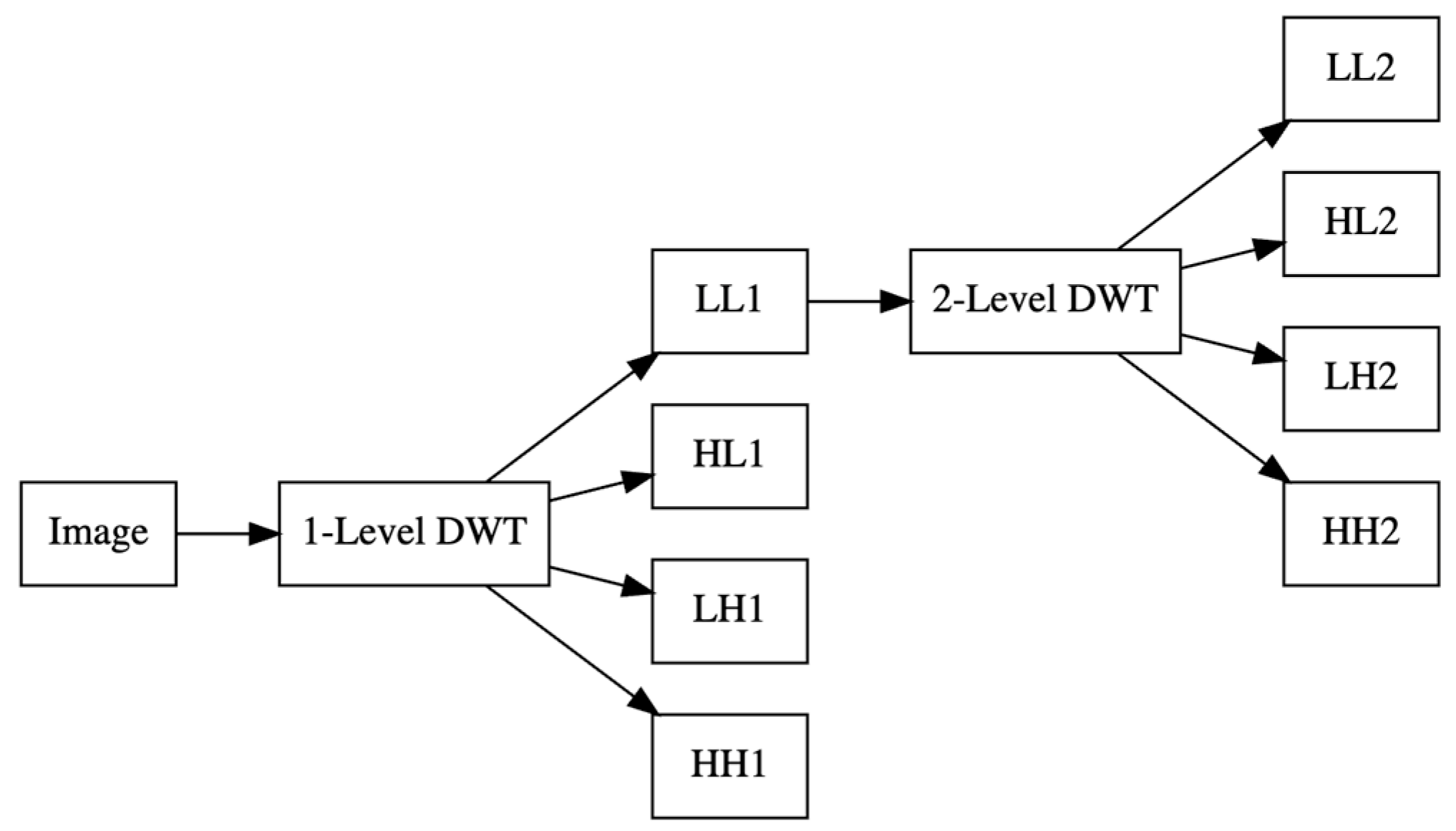
A single level 2D DWT produces the following four sub-bands:
  • LL (approximation): Contains low-frequency components, encompassing most of the energy and overall image structure.
  • HL (horizontal detail): Represents horizontal high-frequency details.
  • LH (vertical detail): Represents vertical high-frequency details.
  • HH (diagonal detail): Represents diagonal high-frequency details.
Further decomposition can be applied recursively to the LL sub-band for additional levels, offering a hierarchical frequency representation. Figure 1 illustrates one-level and two-level DWT decomposition. DWT watermarking allows embedding in perceptually insignificant high-frequency sub-bands (HL, LH, and HH) for enhanced imperceptibility and robustness against filtering, while embedding in lower-frequency sub-bands (LL) provides resilience to geometric distortions.
Advantages of DWT in watermarking include the following:
  • Multi-resolution analysis: Enables embedding in high-frequency components to maintain imperceptibility while retaining structural integrity in lower frequencies, aiding robustness.
  • Resilience to geometric distortions: Exhibits strong resistance to transformations such as scaling and translation due to global coefficient properties and multi-resolution representation.
  • Spatial-frequency localization: Facilitates precise embedding control, balancing frequency modifications and spatial effects.

2.2.3. Justification for DWT

DWT was selected as the transform domain for the proposed watermarking scheme due to its superior spatial-frequency localization and ability to balance imperceptibility and robustness. Its multi-resolution properties enable embedding in high-frequency sub-bands at levels like level 3, preserving visual fidelity. The global nature of lower-resolution coefficients provides inherent robustness against geometric distortions, distinguishing DWT from block-based methods such as DCT.
The spatial localization attributes of DWT minimize widespread artifacts, ensuring high-quality visual preservation. Compared to DCT, which is prone to geometric distortions due to block-based processing, DWT offers a versatile framework for robust watermarking essential for high-value digital assets such as game cards.

2.3. Robustness Against Geometric Attacks in DWT Watermarking

Effective watermarking requires resilience against manipulations, such as scaling, translation, and rotation. DWT-based strategies enhance robustness through advanced techniques.

2.3.1. Robustness to Geometric Transformations

  • Low-frequency embedding: Embedding in the LL sub-band provides robustness to global transformations but may reduce imperceptibility.
  • Invariant feature integration: Techniques such as scale-invariant feature transform (SIFT) [4] or speeded-up robust features (SURF) [5] align distorted images for accurate extraction.
  • Template-based synchronization: Embedded templates aid distortion correction, enhancing watermark recovery.
  • Invariant frequency domain properties: Exploitation of intrinsic characteristics improves resilience against spatial alterations.
Supplementary methods, including feature detection and synchronization templates, address geometric transformations effectively.

2.3.2. Robustness to Combined Attacks

Combined attacks involving scaling and geometric manipulations demand robust strategies. DWT methods leveraging resilient frequency bands and integrating advanced extraction mechanisms outperform spatial domain and DCT-based techniques. Optimizing embedding strength through GA enhances robustness while maintaining imperceptibility. We refine DWT watermarking approaches to meet the protection needs of high-value digital assets, ensuring adaptability and resilience against complex attack scenarios.

2.4. Optimization Algorithm in Watermarking

Optimization algorithms are essential in designing digital watermarking schemes by fine-tuning parameters to balance imperceptibility and robustness. GAs, inspired by natural selection, have proven effective in addressing complex optimization problems within digital watermarking.
The key features of GAs are presented as follows:
  • Population initialization: Candidate solutions are generated within the defined search space, each of which represents parameters such as embedding strength or DWT coefficient selection.
  • Fitness evaluation: Individuals are assessed based on a fitness function, often combining metrics such as peak signal-to-noise ratio (PSNR) for imperceptibility and robustness measures (e.g., structural similarity index (SSIM) or correlation) under simulated attacks.
  • Selection: Higher fitness candidates are prioritized for reproduction through methods like roulette wheel or tournament selection.
  • Crossover: Promising solutions are combined to create offspring, exploring the solution space using operators like single-point or simulated binary crossover (SBX) for real-valued parameters.
  • Mutation: Small random variations introduce diversity, preventing premature convergence to local optima.
  • Termination: The Iteration ends upon reaching a predefined number of generations or an optimal solution.
Applications in watermarking include the following.
  • Embedding strength optimization: GAs determine optimal embedding strength to balance visual quality and resilience against attacks.
  • Selection of embedding locations: Suitable DWT coefficients or sub-bands are identified to maximize robustness without compromising quality.
  • Watermark design: Patterns are optimized to enhance robustness and security properties.
GAs excel due to their ability to navigate complex, non-linear search spaces without requiring gradient information. In watermarking, these algorithms enable near-optimal parameter selection, resulting in schemes that effectively combine imperceptibility and robustness. Hybrid crossover operators and custom fitness functions further enhance exploration and adaptability, providing solutions tailored to the challenges of watermarking in the DWT domain.

3. Method

3.1. Watermarking Scheme

A robust digital watermarking scheme is designed for the protection of high-value digital assets, such as game cards, against a variety of attacks encountered in online marketing and counterfeiting scenarios. The method employs DWT for watermark embedding and extraction, utilizes GA to optimize the embedding strength factor (α), and incorporates robust extraction techniques to address geometric transformations.
The developed framework is divided into watermark embedding, embedding strength optimization, and watermark extraction. The descriptions of the three phases are as follows:
  • Watermark embedding phase: The original image undergoes DWT to decompose it into multiple sub-bands. The watermark logo is preprocessed and normalized before embedding into specific high-frequency sub-bands (HL, LH, and HH) using the embedding strength factor (α). An inverse DWT is applied to reconstruct the watermarked image.
  • Optimization of embedding strength phase: GA determines the optimal embedding strength (α) to balance imperceptibility and robustness. The process involves generating a population of candidate α values, embedding the watermark, simulating geometric attacks, extracting the watermark, and evaluating fitness through metrics such as PSNR for imperceptibility and SSIM for robustness. GA evolves the population using selection, crossover, and mutation operations until convergence on an optimal value.
  • Watermark extraction phase: The extraction phase targets attacked watermarked images. DWT is applied to the received image, and geometric transformations, such as scaling, translation, and rotation, are mitigated using techniques like center cropping or multi-angle and multi-scale search. The extracted watermark is compared to the original to assess the scheme’s robustness.

3.2. Watermark Embedding Process

The watermark embedding process focuses on imperceptibly embedding a binary or grayscale watermark logo into a host image using DWT. The process comprises the following steps.

3.2.1. DWT Decomposition of Host Image

The original host image, represented in the CMYK color space, is converted to the YCbCr color space, and the luminance (Y) channel is subjected to a 3-level 2D DWT. This decomposition generates one approximation coefficient sub-band (LL3) and three detail coefficient sub-bands at each level: horizontal details (HLn), vertical details (LHn), and diagonal details (HHn), where n 1,2 , 3 . At each level, the image undergoes filtering and down-sampling operations using low-pass (L) and high-pass (H) filters. The decomposition is mathematically represented as filtering operations over the dimensions of the image.

3.2.2. Preprocessing of Watermark Logo

The watermark logo undergoes resizing and normalization.
  • Resizing: The watermark is resized to match the dimensions of the chosen DWT sub-band (e.g., HL3, LH3, HH3) using algorithms like bilinear interpolation. If the watermark dimensions are M × N and the selected sub-band dimensions are M′ × N′, the resized dimensions are adjusted accordingly.
  • Normalization: The pixel values of the watermark are normalized to the range [−1, 1]. For grayscale images, normalization is achieved using Equation (4). For binary watermarks, pixel values 0 and 255 are normalized to −1 and 1, respectively.
W n o r m x , y = 2 × W r e s i z e d x , y 255 1

3.2.3. Watermark Embedding in DWT Sub-Bands

The normalized watermark is embedded into the high-frequency detail sub-bands (HL3, LH3, and HH3) at the third decomposition level. Embedding modifies the coefficients of these sub-bands using an additive embedding rule controlled by the embedding strength factor α. The watermarked coefficients C s u b u , v are obtained as Equations (5)–(7), where C s u b u , v presents the original DWT coefficients, and α (0 < α < 1) governs the trade-off between imperceptibility and robustness.
C H L 3 u , v = C H L 3 u , v + α × W n o r m u , v
C L H 3 u , v = C L H 3 u , v + α × W n o r m u , v
C H H 3 u , v = C H H 3 u , v + α × W n o r m u , v

3.2.4. Inverse DWT to Obtain Watermarked Image

An inverse 3-level DWT (IDWT) is applied using the modified detail coefficients (HL3, LH3, and HH3) and unchanged approximation and other detail sub-bands (LL3, HL1, LH1, HH1, HL2, LH2, and HH2). This reconstruction restores the watermarked luminance (Y) channel, which is then combined with the original Cb and Cr channels to recreate the YCbCr image. Finally, the image is converted back to the CMYK color space to produce the watermarked CMYK image.

3.2.5. Key Motivations for High-Frequency Sub-Band Embedding

The high-frequency, detailed sub-bands (HL3, LH3, and HH3) are less perceptually significant, minimizing visible artifacts while preserving the visual quality of the watermarked image. These sub-bands also provide inherent resilience against certain geometric manipulations. The optimal embedding strength factor α will be determined using a GA in subsequent phases.

3.3. Optimization of Embedding Strength Using GA

The embedding strength (α) significantly impacts the trade-off between imperceptibility and robustness in watermarking. Higher values enhance robustness but risk visual degradation, while lower values improve visual quality but may reduce resilience against attacks. GA is utilized to identify the optimal α value, balancing these competing factors.

3.3.1. Population Initialization

An initial population of candidate embedding strength values (α) is randomly generated within a predefined range, such as [0.01, 0.1]. Everyone represents a potential value, with population size (Npop) empirically chosen (e.g., 20–50).

3.3.2. Fitness Function

Fitness is evaluated based on imperceptibility and robustness metrics as shown in Equation (8).
F α = ϖ 1 · P S N R α + ϖ 2 · S S I M a v g α
  • P S N R α : Peak Signal-to-Noise Ratio between the host and watermarked images, indicating imperceptibility.
  • S S I M a v g α : Average Structural Similarity Index Measure between the original and extracted watermarks after simulated geometric attacks. Values close to 1 indicate robustness.
  • ϖ 1 and ϖ 2 : Weighting factors (0 ≤ ϖ 1 ,   ϖ 2 ≤ 1, ϖ 1 + ϖ 2 = 1 ), determining the relative importance of metrics.
Simulated attacks include scaling (e.g., scaling up or down), translation (e.g., horizontal or vertical shifts), and rotation (e.g., rotations at predefined angles). For each candidate α, the watermark is embedded, the watermarked image undergoes simulated attacks, and the watermark is extracted. The fitness value is calculated using Equation (8).
Candidates with higher fitness are preferentially selected as parents using roulette wheel selection, ensuring a higher probability for fitter individuals. New offspring αnew are generated using the blend crossover (BLX-α) operator shown in Equation (9), where α m i n = m i n α 1 , α 2 ,   α m a x = m a x α 1 , α 2 , and I is a random number in [−β, 1+β] (e.g., β = 0.5).
α n e w = α m i n I · α m a x α m i n   ,   o r   α n e w = α m a x + I · α m a x α m i n
To ensure diversity, a mutation operator is applied to offspring with a certain probability (Pm). The mutation randomly resets α to a value within [0.01, 0.1]. The offspring replace the current population in a generational strategy, ensuring continuous improvement in fitness scores. The algorithm runs for a predefined number of generations (Ngen) or until a fitness threshold is reached, with no significant improvement over subsequent generations. The optimal α is the embedding strength corresponding to the highest fitness value in the final population.

3.4. Watermark Extraction Process Robust to Geometric Transformations

3.4.1. DWT Decomposition of Potentially Attacked Image

The watermarked image, potentially subjected to geometric transformations, is processed through a 3-level 2D DWT, yielding approximation coefficients (LL3) and detail coefficients (HLn, LHn, HHn, n ∈ {1,2,3}).

3.4.2. Geometric Transformations

To mitigate scaling, translation, and rotation, the following strategies are employed:
  • Center cropping: A central region of high-frequency sub-bands (HL3, LH3, and HH3) is extracted, reducing the impact of boundary artifacts caused by transformations. The cropped region size typically ranges between 60 and 80% of the original dimensions.
  • Multi-angle search: Cropped regions are rotated iteratively within a range of angles (e.g., −15° to +15°, in 5° steps). Each rotation generates potential watermark candidates.
  • Multi-scale search: Watermark candidates from rotated sub-bands are resized across scales (e.g., 80% to 120% of the original size) for robustness against scaling.

3.4.3. Watermark Extraction from DWT Coefficients

The watermark is extracted from the adjusted high-frequency sub-bands using the inverse embedding rules for HL3, LH3, and HH3, as shown in Equations (10)–(12), respectively.
W H L 3 u , v = C H L 3 _ a t t a c k e d u , v C H L 3 _ o r i g i n a l _ m e a n / α
W L H 3 u , v = C L H 3 _ a t t a c k e d u , v C L H 3 _ o r i g i n a l _ m e a n / α
W H H 3 u , v = C H H 3 _ a t t a c k e d u , v C H H 3 _ o r i g i n a l _ m e a n / α
where C s u b _ a t t a c k e d refers to the coefficients of the attacked image, and C s u b _ o r i g i n a l _ m e a n is the mean of the original sub-band coefficients approximated during extraction. The embedding strength (α) is determined during optimization.

3.4.4. Combining and Post-Processing Extracted Watermarks

The extracted watermarks W H L 3 , W L H 3 , W H H 3 are averaged as shown in Equation (13). For binary watermarks, a thresholding operation is applied as shown in Equation (14), where T is typically set to 0. For grayscale watermarks, thresholding is omitted, and normalized values are used.
W e x t r a c t e d u , v = W H L 3 u , v + W L H 3 u , v + W H H 3 u , v 3
W e x t r a c t e d u , v = 1 ,   W e x t r a c t e d u , v T 1 , W e x t r a c t e d u , v < T

3.4.5. Watermark Similarity Evaluation

Similarity between the original watermark and extracted watermark is assessed using metrics such as SSIM or normalized correlation (NC) [6]. The optimal watermark is identified based on the highest similarity across tested angles and scales.

3.5. Performance Evaluation Metrics

The performance of the proposed DWT-based watermarking scheme is quantitatively evaluated using the following metrics.
PSNR is used to evaluate the visual quality of the watermarked image compared to the original image, serving as a measure of imperceptibility. A higher PSNR value indicates better visual quality. For an image I x , y and its watermarked version I x , y , both of size M × N, PSNR is calculated as (15), where MAXI is the maximum possible pixel value (e.g., 255 for 8-bit images), and the mean squared error (MSE) is defined as Equation (16). PSNR is calculated for the luminance (Y) channel, with values above 30 dB considered acceptable for imperceptibility.
P S N R = 10 × log 10 M A X I 2 M S E
M S E = 1 M × N x = 0 M 1 y = 0 N 1 I x , y I x , y 2
SSIM is used to assess the structural similarity between two images, accounting for luminance, contrast, and structural differences. The SSIM for two images x and y is given by (17):
S S I M x , y = 2 μ x μ y + c 1 μ x 2 + μ y 2 + c 1 × 2 σ x y + c 2 σ x 2 + σ y 2 + c 2
where μx and μy are the means, σ x 2 and σ y 2 are the variances, and σxy is the covariance. Constants c1 and c2 stabilize the formula. SSIM is used to evaluate the similarity between the original watermark and the extracted watermark, with values closer to 1 indicating better robustness.
NC is used to evaluate the similarity for binary or grayscale watermarks between the original watermark W x , y of size M′ × N′ and the extracted watermark W x , y as shown in Equation (18). NC values range from −1 to 1, with values closer to 1 indicating higher similarity and robustness.
N C = x = 0 M 1 y = 0 N 1 W x , y × W x , y x = 0 M 1 y = 0 N 1 W x , y 2 × x = 0 M 1 y = 0 N 1 W x , y 2

4. Implementation and Results

4.1. Implementation Details

4.1.1. DWT

In this research, the Daubechies wavelet of order 2 (‘db2’) was employed for DWT. The ‘db2’ wavelet provides a good balance between frequency localization and compactness, which is beneficial for watermark embedding. A two-level decomposition (L = 2) was used to decompose the image into approximation and detail coefficients. DWT was applied to each of the four channels of the CMYK image. This approach embeds the watermark across all color components, potentially increasing robustness.

4.1.2. Watermark Embedding

The watermark, a grayscale representation of the logo shown in Figure 2, was embedded into the horizontal detail coefficients of the decomposed image. The original watermark consists of the words “LAISAN” and “THE GREAT” in a bold, shadowed font against a transparent background. For each color channel, the watermark was resized and added to the horizontal detail coefficients at the second level by using Equation (19), where c H 2 is the modified horizontal detail coefficients, W r e s i z e d is the resized watermark, and α is the embedding strength.
c H 2 = c H 2 + α · W r e s i z e d

4.1.3. GA for α Optimization

GA was implemented to optimize the embedding strength α and maximize a fitness function that combines the PSNR and SSIM of the watermarked image by Equation (20). The parameters are population size = 6, number of generations = 10, and α ranging from 0.01 to 0.1. The algorithm used linear interpolation to generate new alpha values for each generation, focusing on the range between the best-performing individuals from the previous generation.
F i t n e s s = P S N R + S S I M

4.1.4. Watermark Extraction

The watermark extraction process involves calculating the difference between the watermarked and original images, scaled by the embedding strength α, using Equation (21). This difference is then clipped and scaled to the appropriate pixel range for visualization.
W e x t r a c t e d = W w a t e r m a r k e d W o r i g i n a l / α

4.2. Results and Discussion

4.2.1. Optimal Embedding Strength (α)

GA consistently converged to an optimal alpha value of approximately 0.01. The results in Appendix A show that as GA progressed, the alpha values shifted towards the lower end of the range. Initially, in Generation 1, alpha values ranged from 0.01 to 0.1, with corresponding PSNR values decreasing from 45.52 to 27.31 and SSIM values decreasing from 0.9684 to 0.3115. Over subsequent generations, GA favored smaller alpha values, ultimately stabilizing around 0.01. This convergence suggests that a lower embedding strength effectively minimizes visual distortion while maintaining an acceptable robust watermark, as indicated by the consistently high PSNR and SSIM values.

4.2.2. Imperceptibility

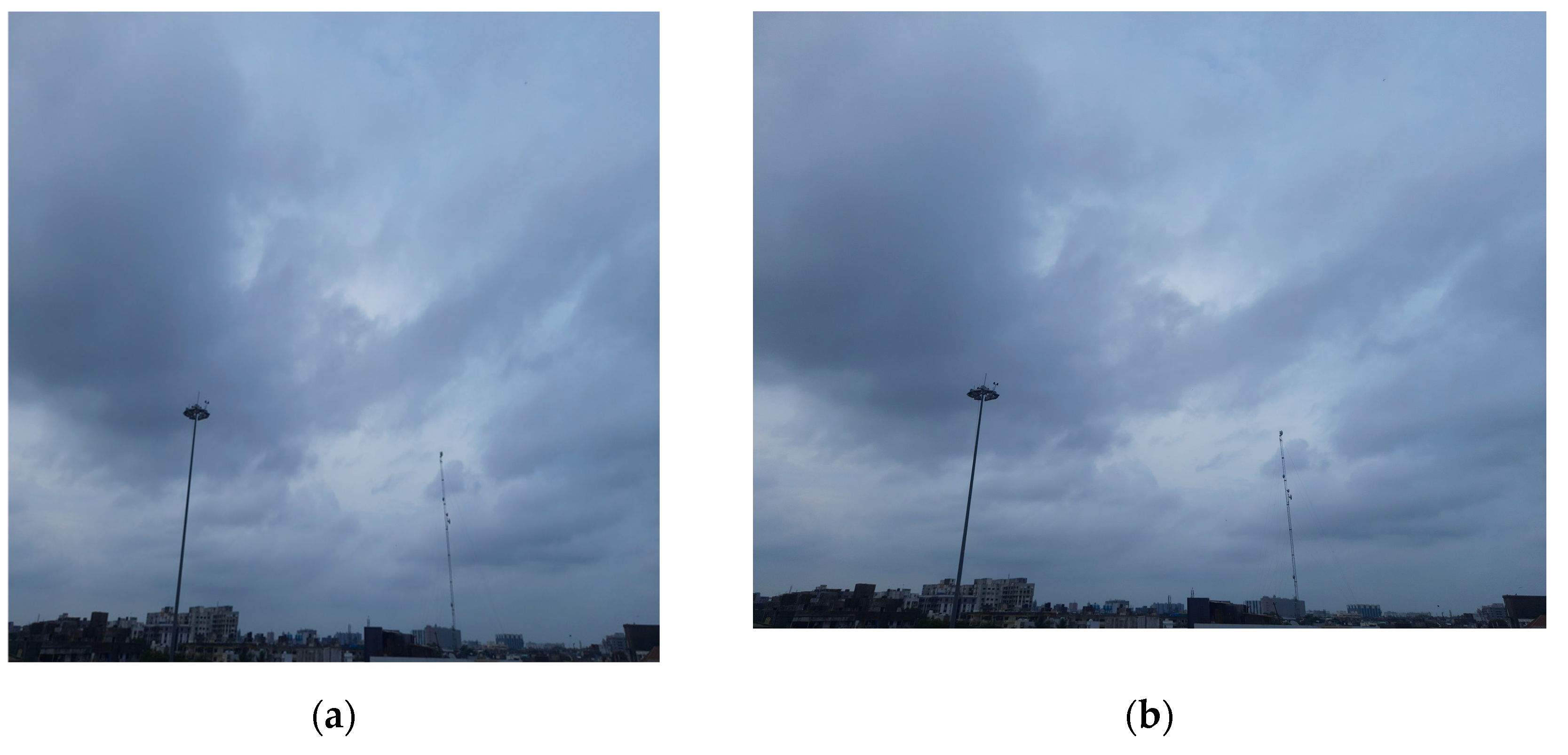
The PSNR values remained consistently high throughout the GA optimization, reaching approximately 45.52 dB with the optimal alpha. This high PSNR indicates that the watermark was embedded with minimal perceptual distortion, demonstrating excellent imperceptibility. The original watermarked image shown in Figure 3 visually confirms this; there is no discernible difference between it and the original image to the naked eye, suggesting the watermark’s presence is effectively hidden.

4.2.3. Discussion

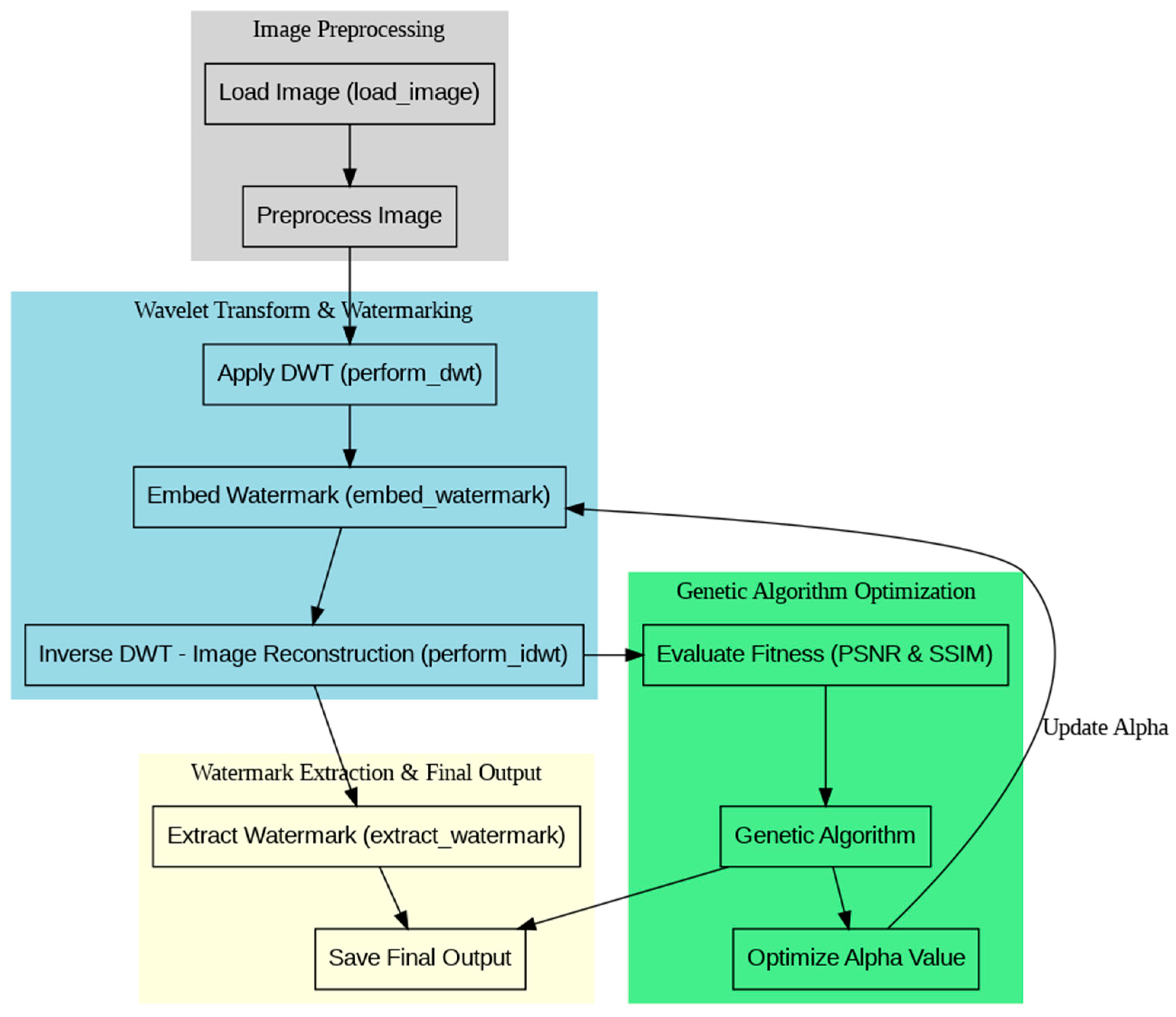
The results demonstrate that GA effectively optimizes the embedding strength α to achieve a high degree of imperceptibility, as evidenced by the consistently high PSNR values and the visual assessment of the watermarked image. The convergence of GA to a low alpha value suggests that minimizing the embedding strength is crucial for preserving image quality. The successful extraction of a recognizable watermark implies a level of resilience, although further testing is needed to quantify robustness against specific attacks. The flowchart in Figure 4 visually represents the overall workflow of the proposed watermarking scheme.

Author Contributions

Conceptualization, C.-H.L.; methodology, C.-H.L.; investigation, T.-Y.H.; resources, T.-Y.H. and Y.L.; writing—original draft preparation, C.-H.L.; writing—review and editing, C.-H.L., Y.-S.H. and Y.L. All authors have read and agreed to the published version of the manuscript.

Funding

This research received no external funding.

Institutional Review Board Statement

Not applicable.

Informed Consent Statement

Not applicable.

Data Availability Statement

Conflicts of Interest

The authors declare no conflicts of interest.

Appendix A

Appendix A.1

===== Generation 1 =====
Alpha = 0.0100, PSNR = 45.52, SSIM = 0.9684
Alpha = 0.0280, PSNR = 38.35, SSIM = 0.8298
Alpha = 0.0460, PSNR = 34.41, SSIM = 0.6651
Alpha = 0.0640, PSNR = 31.34, SSIM = 0.5063
Alpha = 0.0820, PSNR = 29.17, SSIM = 0.3966
Alpha = 0.1000, PSNR = 27.31, SSIM = 0.3115
===== Generation 2 =====
Alpha = 0.0100, PSNR = 45.52, SSIM = 0.9684
Alpha = 0.0172, PSNR = 41.28, SSIM = 0.9087
Alpha = 0.0244, PSNR = 39.57, SSIM = 0.8691
Alpha = 0.0316, PSNR = 38.32, SSIM = 0.8285
Alpha = 0.0388, PSNR = 36.15, SSIM = 0.7452
Alpha = 0.0460, PSNR = 34.41, SSIM = 0.6651
===== Generation 3 =====
Alpha = 0.0100, PSNR = 45.52, SSIM = 0.9684
Alpha = 0.0129, PSNR = 45.47, SSIM = 0.9679
Alpha = 0.0158, PSNR = 45.42, SSIM = 0.9675
Alpha = 0.0186, PSNR = 41.25, SSIM = 0.9079
Alpha = 0.0215, PSNR = 41.22, SSIM = 0.9072
Alpha = 0.0244, PSNR = 39.57, SSIM = 0.8691
===== Generation 4 =====
Alpha = 0.0100, PSNR = 45.52, SSIM = 0.9684
Alpha = 0.0112, PSNR = 45.49, SSIM = 0.9682
Alpha = 0.0123, PSNR = 45.48, SSIM = 0.9680
Alpha = 0.0135, PSNR = 45.46, SSIM = 0.9679
Alpha = 0.0146, PSNR = 45.44, SSIM = 0.9677
Alpha = 0.0158, PSNR = 45.42, SSIM = 0.9675
===== Generation 5 =====
Alpha = 0.0100, PSNR = 45.52, SSIM = 0.9684
Alpha = 0.0105, PSNR = 45.51, SSIM = 0.9683
Alpha = 0.0109, PSNR = 45.50, SSIM = 0.9682
Alpha = 0.0114, PSNR = 45.49, SSIM = 0.9681
Alpha = 0.0118, PSNR = 45.48, SSIM = 0.9681
Alpha = 0.0123, PSNR = 45.48, SSIM = 0.9680
===== Generation 6 =====
Alpha = 0.0100, PSNR = 45.52, SSIM = 0.9684
Alpha = 0.0102, PSNR = 45.51, SSIM = 0.9683
Alpha = 0.0104, PSNR = 45.51, SSIM = 0.9683
Alpha = 0.0106, PSNR = 45.51, SSIM = 0.9683
Alpha = 0.0107, PSNR = 45.50, SSIM = 0.9682
Alpha = 0.0109, PSNR = 45.50, SSIM = 0.9682
===== Generation 7 =====
Alpha = 0.0100, PSNR = 45.52, SSIM = 0.9684
Alpha = 0.0101, PSNR = 45.52, SSIM = 0.9683
Alpha = 0.0101, PSNR = 45.51, SSIM = 0.9683
Alpha = 0.0102, PSNR = 45.51, SSIM = 0.9683
Alpha = 0.0103, PSNR = 45.51, SSIM = 0.9683
Alpha = 0.0104, PSNR = 45.51, SSIM = 0.9683
===== Generation 8 =====
Alpha = 0.0100, PSNR = 45.52, SSIM = 0.9684
Alpha = 0.0101, PSNR = 45.52, SSIM = 0.9683
Alpha = 0.0101, PSNR = 45.51, SSIM = 0.9683
===== Generation 9 =====
Alpha = 0.0100, PSNR = 45.52, SSIM = 0.9684
Alpha = 0.0100, PSNR = 45.52, SSIM = 0.9683
Alpha = 0.0101, PSNR = 45.52, SSIM = 0.9683
===== Generation 10 =====
Alpha = 0.0100, PSNR = 45.52, SSIM = 0.9684

References

  1. Hung, T.-Y. A Study on the Business Ecosystem of Trading Card Games and Consumer Participation Motivations. Master’s Thesis, Takming University of Science and Technology, Taipei, Taiwan, 20 June 2024. [Google Scholar]
  2. Oppenheim, A.V.; Schafer, R.W. Discrete-Time Signal Processing, 3rd ed.; Pearson Education: London, UK, 2010. [Google Scholar]
  3. Haupt, R.L.; Haupt, S.E. A Genetic Algorithm for Function Optimization: A MATLAB Implementation; Wiley-Interscience: Hoboken, NJ, USA, 2004. [Google Scholar]
  4. Lowe, D.G. Distinctive Image Features from Scale-Invariant Keypoints. Int. J. Comput. Vis. 2004, 60, 91–110. [Google Scholar] [CrossRef]
  5. Bay, H.; Tuytelaars, T.; Van Gool, L. SURF: Speeded Up Robust Features. In Proceedings of the European Conference on Computer Vision, Graz, Austria, 7–13 May 2006. [Google Scholar]
  6. Lewis, J.P. Fast Normalized Cross-Correlation. Available online: https://www.researchgate.net/publication/2378357_Fast_Normalized_Cross-Correlation (accessed on 29 January 2026).
Figure 1. Two-dimensional DWT decomposition.
Engproc 120 00013 g001
Figure 2. Greyscale embedding of the logo used as the watermark: (a) original watermark; (b) extracted watermark at the end.
Engproc 120 00013 g002
Figure 3. Comparison between the original image and the watermarked version: (a) original image; (b) best watermarked image.
Engproc 120 00013 g003
Figure 4. Proposed workflow in this study.
Engproc 120 00013 g004
Disclaimer/Publisher’s Note: The statements, opinions and data contained in all publications are solely those of the individual author(s) and contributor(s) and not of MDPI and/or the editor(s). MDPI and/or the editor(s) disclaim responsibility for any injury to people or property resulting from any ideas, methods, instructions or products referred to in the content.