Proceeding Paper

Generalized Extreme Value-Based Fragility Curves †

Department of Structural, Geotechnical, and Building Engineering (DISEG), Politecnico di Torino, Corso Duca degli Abruzzi 24, 10129 Turin, Italy
*
Author to whom correspondence should be addressed.
Presented at the 6th International Electronic Conference on Applied Sciences, 9–11 December 2025; Available online: https://sciforum.net/event/ASEC2025.
Eng. Proc. 2026, 124(1), 11; https://doi.org/10.3390/engproc2026124011
Published: 30 January 2026
(This article belongs to the Proceedings of The 6th International Electronic Conference on Applied Sciences)

Abstract

Fragility curves are essential for assessing the vulnerability of buildings to earthquake-induced damage, representing the probability of exceeding various damage states as a function of seismic intensity. They enable rapid pre-screening of large building stocks, guiding focused analyses, monitoring, and mitigation strategies. This study introduces an empirical approach using the Generalized Extreme Value (GEV) distribution to model fragility curves, offering greater flexibility than the conventional lognormal method. In this work, GEV-based curves were derived from empirical data retrieved from the Italian Da.D.O. platform using Python 3.10.1 tool. The approach provides a practical framework for accurate, large-scale seismic risk assessment.

1. Introduction

Earthquake events highlight the vulnerability of our built environment, making it essential to quantify the probability of structural damage. Fragility curves estimate the likelihood that a structure reaches or exceeds a given damage state as a function of seismic intensity, forming a cornerstone of seismic risk assessment and performance-based earthquake engineering, including the Hazards U.S. (HAZUS) methodology developed by the Federal Emergency Management Agency (FEMA) and National Institute of Building Sciences (NIBS) [1]. They provide a simplified yet effective tool linking seismic hazard to expected structural damage at both building and territorial scales.
Fragility curves can be developed empirically from post-earthquake damage observations, often classified by macroseismic intensity scales such as EMS-98 [2], or analytically using nonlinear structural analyses and probabilistic performance assessment frameworks [3,4]. Porter et al. [4] proposed a widely adopted formulation for performance-based earthquake engineering. At the same time, recent studies leverage detailed damage and exposure datasets to refine empirical models for specific building types and regions [5,6,7]. Most applications represent fragility curves using lognormal distributions, due to their simplicity and ability to capture a smooth increase in damage probability with seismic intensity [3,4]. This approach underpins standard methodologies such as HAZUS [1] and has been widely applied to reinforced concrete (RC) and unreinforced masonry (URM) buildings, including the empirical models by Rosti et al. [6,7]. However, lognormal assumptions may not fully capture abrupt damage transitions observed under strong or extreme seismic events, which are critical for assessing rare but high-consequence outcomes [8].
To address this limitation, the present study introduces the Generalized Extreme Value (GEV) distribution as an alternative. The GEV explicitly models extreme behavior, providing a more realistic representation of the upper tail of the damage probability distribution. The methodology is applied to Italy’s predominant residential building types—URM and RC—and systematically compared with established empirical models, particularly those by Rosti et al. [6,7], to evaluate the benefits and limitations of extreme-value-based distributions in seismic fragility assessment.

2. Materials and Methods

2.1. Fragility Curves and Damage States

Building fragility curves, typically modeled with lognormal functions, estimate the probability that a structure will experience varying levels of damage during an earthquake. By accounting for uncertainties in building strength, damage definitions, and earthquake intensity, they provide a probabilistic framework for assessing structural vulnerability.
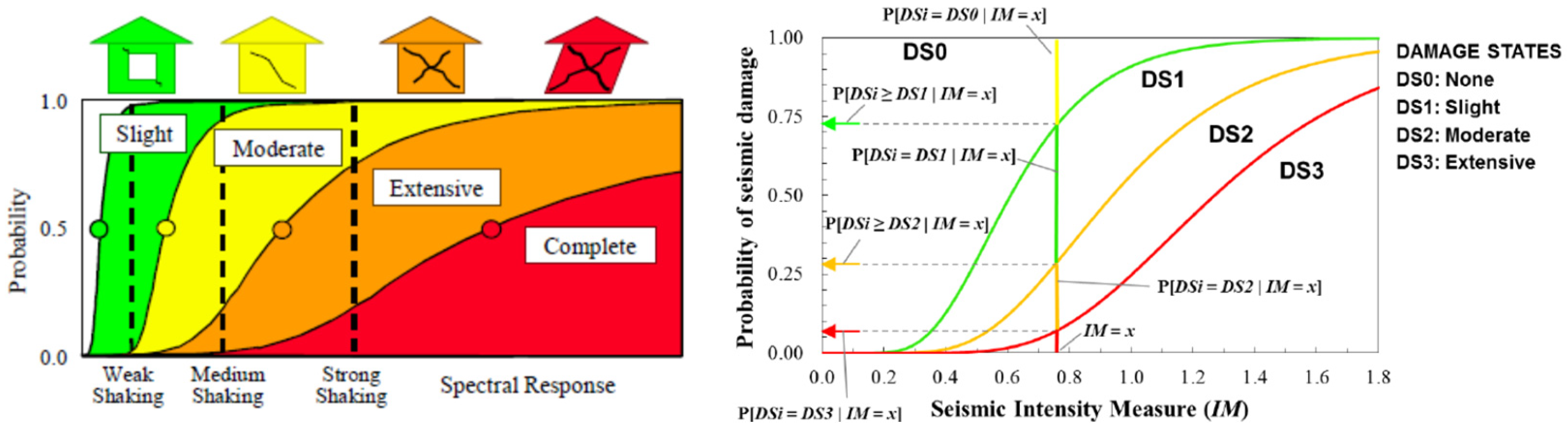
Figure 1 presents fragility curves for four distinct damage states defined by FEMA/NIBS methodology. Each curve shows the probability of reaching a specific damage state across different levels of spectral response [1,5]. The accompanying figure illustrates the relationship between seismic intensity (IM) and the probability of exceeding various damage states [3]. Along the curve, seismic intensity increases, and with it, the likelihood of damage, in terms of damage states (DSs). Each curve shows the increasing probability that a structure will exceed a given damage level [4].
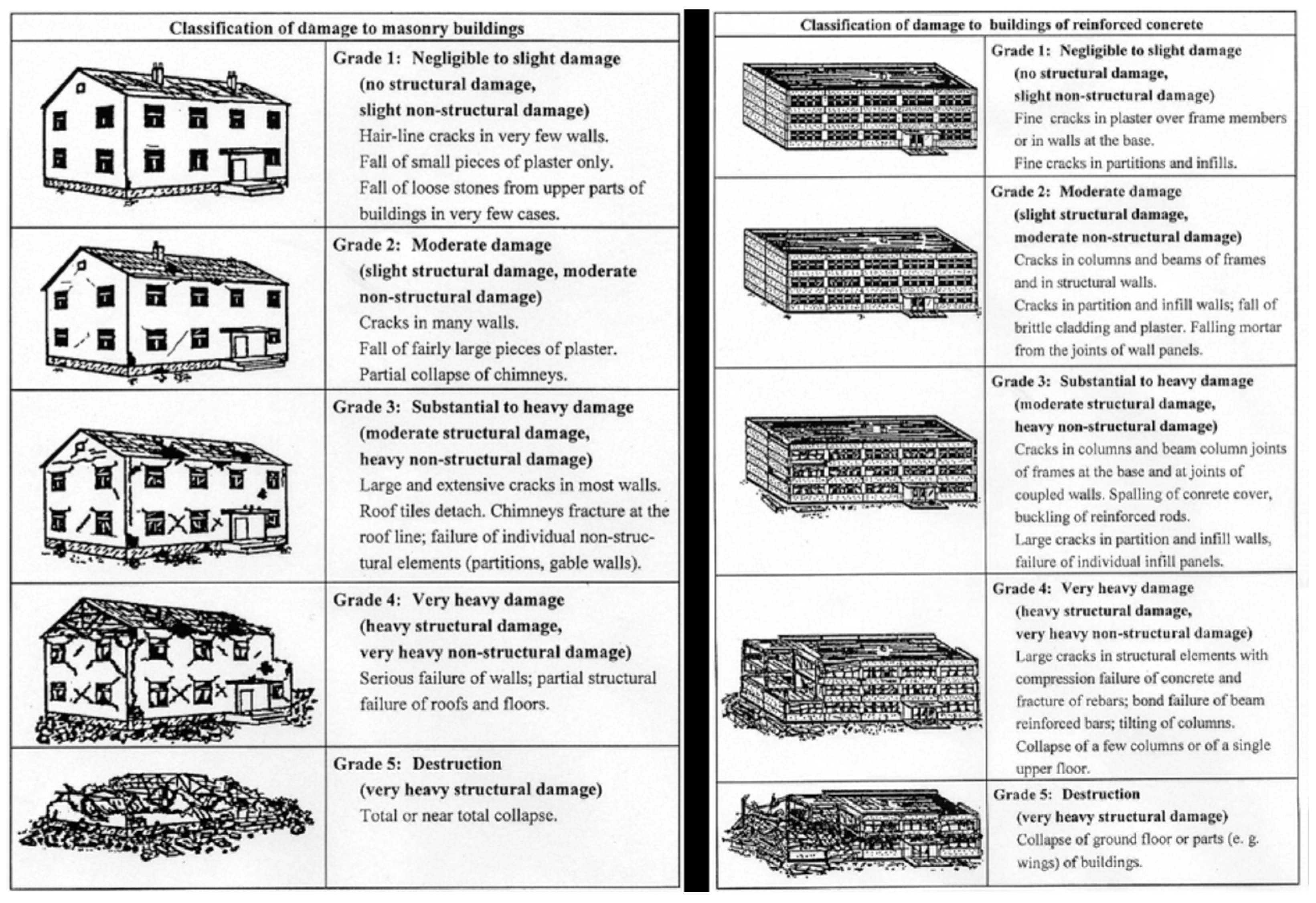
The European Macroseismic Scale 1998 (EMS-98, [2]) classifies building damage into five grades, ranging from slight damage to total structural collapse. This standardized system provides a clear framework for post-earthquake field surveys. It underpins the development of fragility curves by ensuring consistent damage-state definitions across building types [2], and it can be applied to both URM (left side of Figure 2) and RC buildings (right side).

2.2. Generalized Extreme Value and Lognormal Distributions

In seismic fragility analysis, the lognormal distribution is commonly used to model the probability of building damage as seismic intensity increases. Its advantages include mathematical simplicity, alignment with the multiplicative nature of structural failure, and good fit to typical earthquake response. However, its fixed shape can underestimate rare, extreme events, limiting its usefulness for high-consequence scenarios.
In contrast, the Generalized Extreme Value (GEV) distribution is designed to model extremes, offering greater flexibility in the upper tail to represent low-probability, high-impact seismic demands realistically. Depending on its shape parameter (ξ), the GEV can assume Fréchet (ξ > 0), Weibull (ξ < 0), or Gumbel (ξ = 0) forms, making it especially suitable for rare-event modeling. This flexibility supports risk assessments focused on extreme seismic scenarios, aligning with the research objective of capturing the full spectrum of structural vulnerability.
In this classic framework, the Probability Density Function (PDF) can be defined as:
f x = 1 x σ 2 π e ( ln x μ 2 2 σ 2 )
And the corresponding Cumulative Distribution Function (CDF) as:
f x = 1 2 1 + e r f ( l n x μ σ 2 )
In the case of the Generalized Extreme Value approach for rare-event modeling, the Probability Density Function (PDF) becomes:
f x =   1 σ 1 + ξ ( x μ σ ) ( 1 + 1 ξ ) exp 1 + ξ ( x μ σ ) 1 ξ
While the Cumulative Distribution Function (CDF) is as follows:
f x =   exp 1 + ξ ( x μ σ ) 1 ξ

2.3. Benchmark Fragility Curves

This study builds on the well-established fragility curves of Rosti et al. [6,7], replacing their lognormal fit with a Generalized Extreme Value (GEV) distribution. Specifically, the fitting was applied to Rosti et al.’s [6,7] curves directly, rather than recreating the figures from fitting the Da.D.O. data, because the original filtering process was not fully transparent, and attempts to reproduce it did not exactly match the histograms and results reported in Rosti et al. [6,7].
In particular, Rosti et al. [6] categorize RC buildings by height and seismic design class. Similarly, Rosti et al. [7] classifies URM buildings again based on height and six classes of construction, to account for building code evolution, plus some other categories [7]. For this work, both the RC and URM classifications were kept unaltered for direct comparability, using the EMS-98 damage states (as in [6,7]).

3. Results

This study tested multiple distributions beyond lognormal and GEV, including Exponential, Gaussian, Generalized Logistic, Weibull, Fréchet, and Gumbel, aiming to model all fragility curves without overparameterization. Weibull, Fréchet, and Gumbel are special cases of the GEV distribution, depending on the shape parameter ξ.
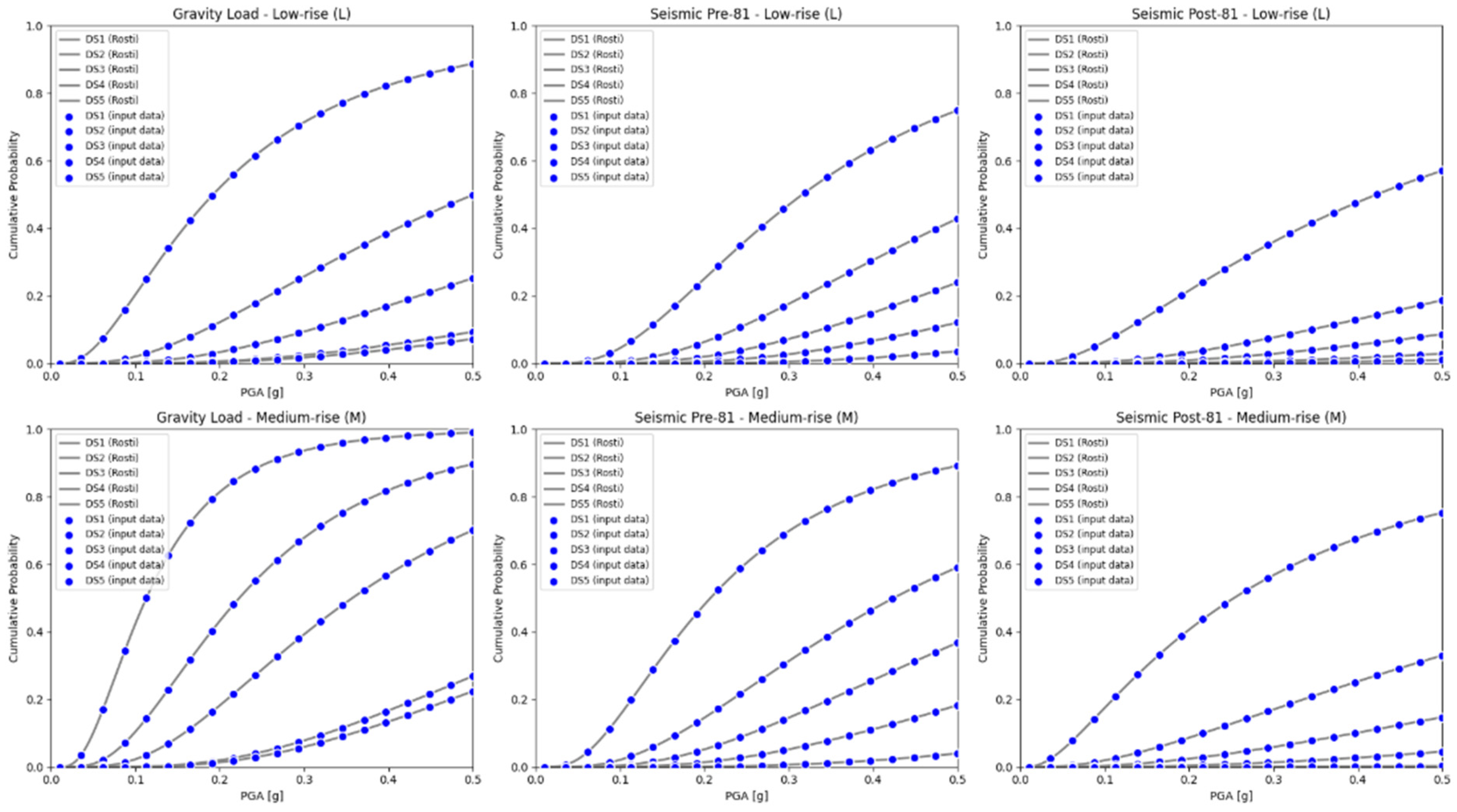
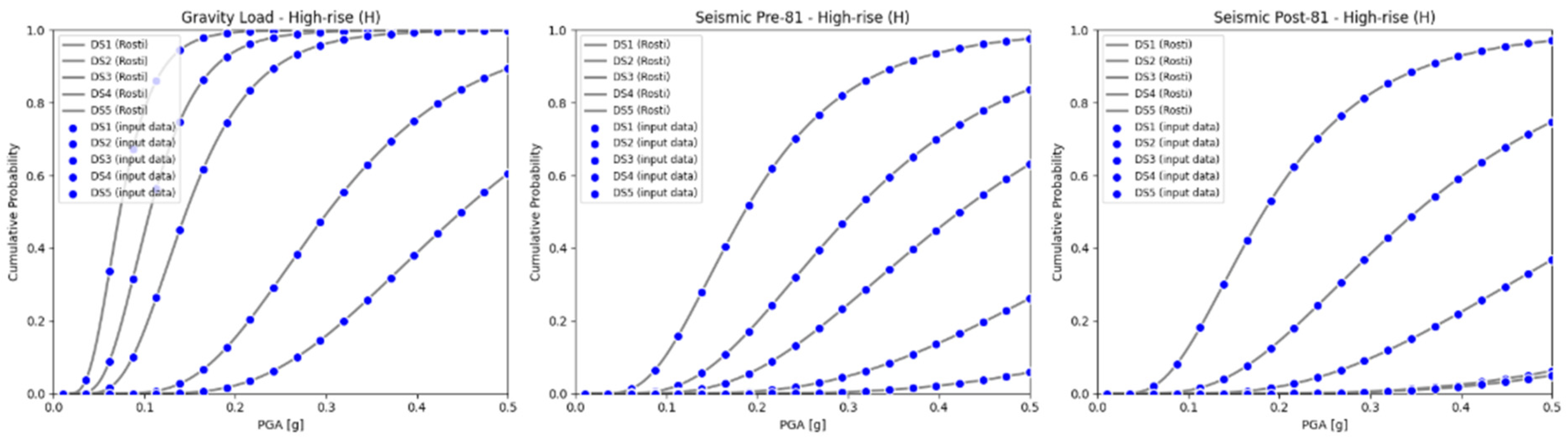
Datasets of 5000 points from Rosti et al. [6,7] for RC and URM buildings were converted to MATLAB R2022b files, and curve fitting was performed using non-linear least-squares and maximum likelihood estimation. Scripts automated analysis, and generated parameter estimates, CSV outputs, and error structures, providing a complete framework for evaluating fragility. Figure 3 illustrates the comparison of lognormal curves from this procedure with Rosti et al. [6].

3.1. Error Metrics

Mean Squared Error (MSE) measures the average squared difference between predicted and observed values [8].
M S E = 1 n i = 1 n ( Y i Y i ^ ) 2
MSE was calculated for each curve and damage state, with select results shown in Table 1 (darker = higher error, brighter = lower). The lowest errors were generally found for lognormal, GEV, and Fréchet, with GEV typically converging to the Fréchet form after fitting.
Table 2 lists the GEV fragility parameters for each building class. θ indicates the seismic intensity at which a damage state is reached (higher θ = greater resistance), and β represents the response variability (lower β = more predictable behavior).

3.2. Comparison with Retrieved Data from the DaDO Platform

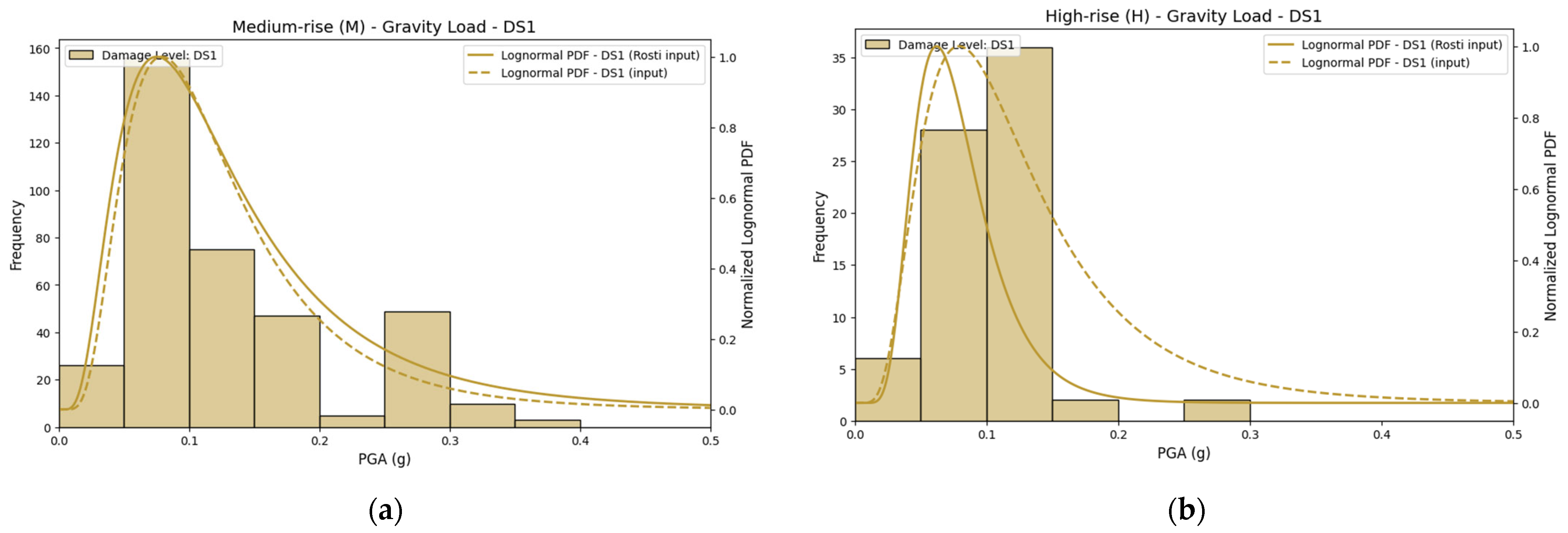
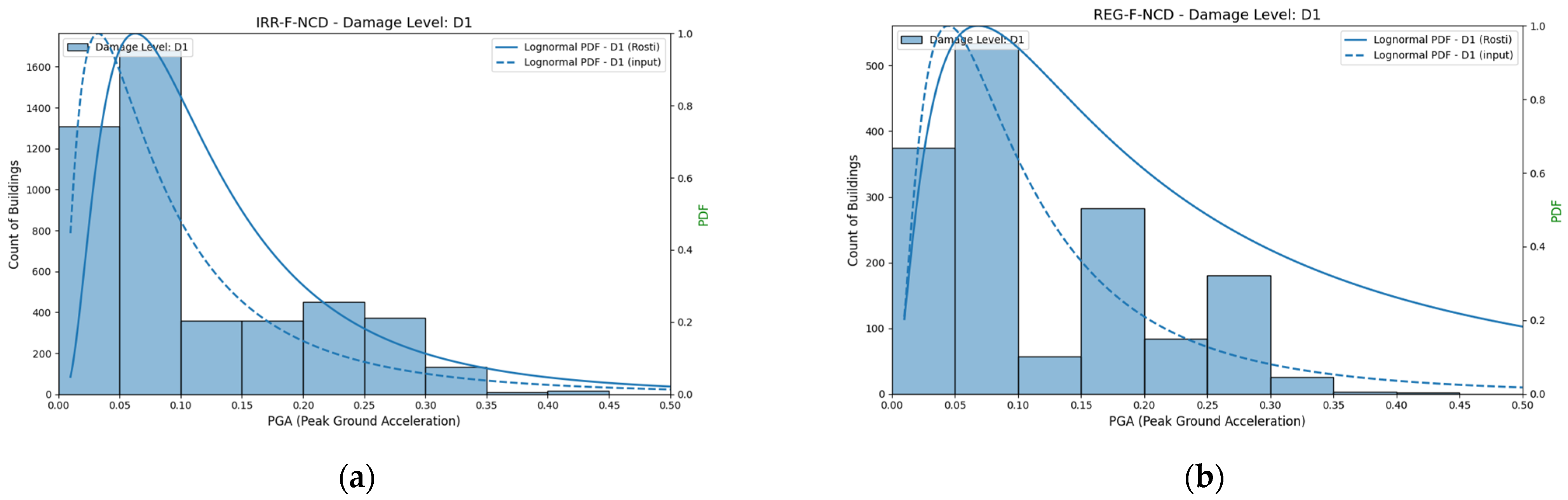
The fitting procedure targets the published fragility curves from Rosti et al. [6,7], rather than the original raw data from the Da.D.O. platform. Although attempts were made to reproduce their filtering steps, the specific parameters remain undisclosed. However, the obtained histograms seem to indicate an overall good match, as the PDFs obtained here by the authors match them well (Figure 4 and Figure 5 report Rosti et al.’s lognormal PDFs, according to the parameters reported in their papers, superimposed on the lognormal PDF estimated here by the authors).
Table 3 shows the MSE between the input fragility data and the PDFs from Rosti et al. [6,7] for selected RC and URM building classes, assessing how well the reference PDFs capture observed fragility behavior.

3.3. Fragility Curves

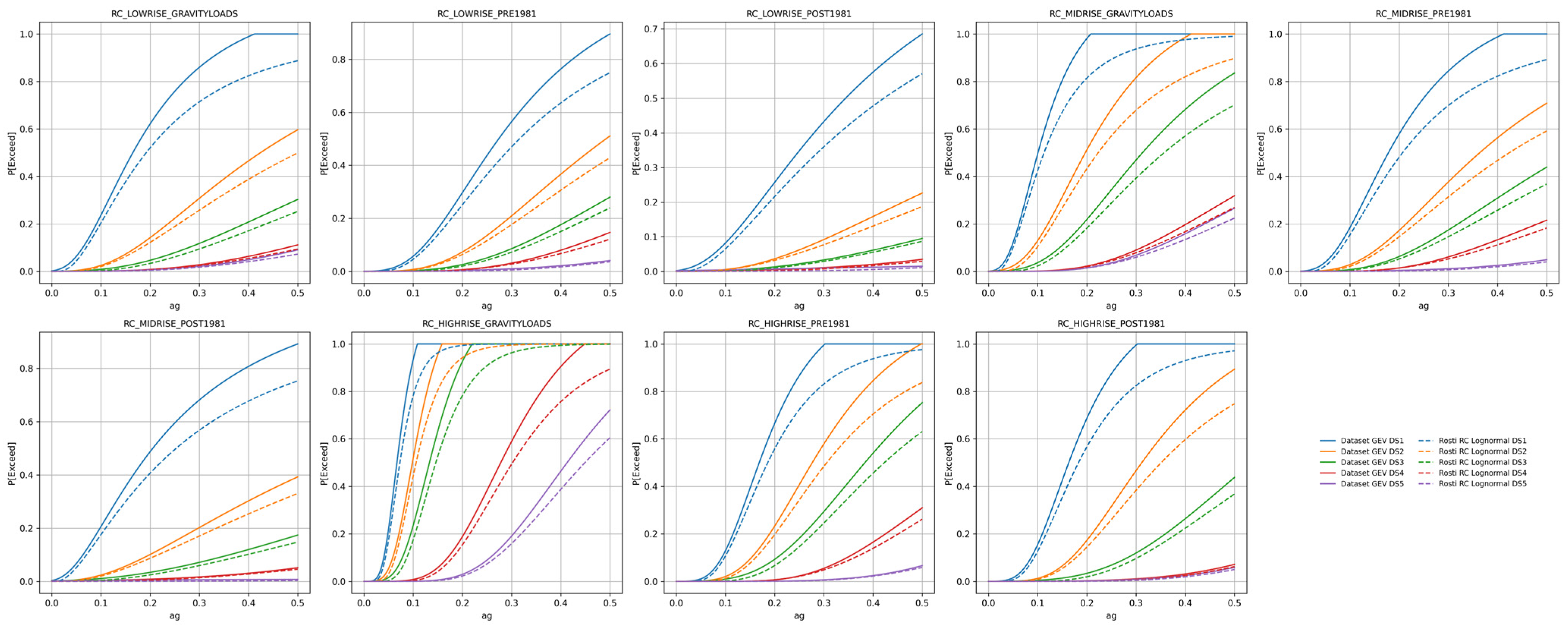
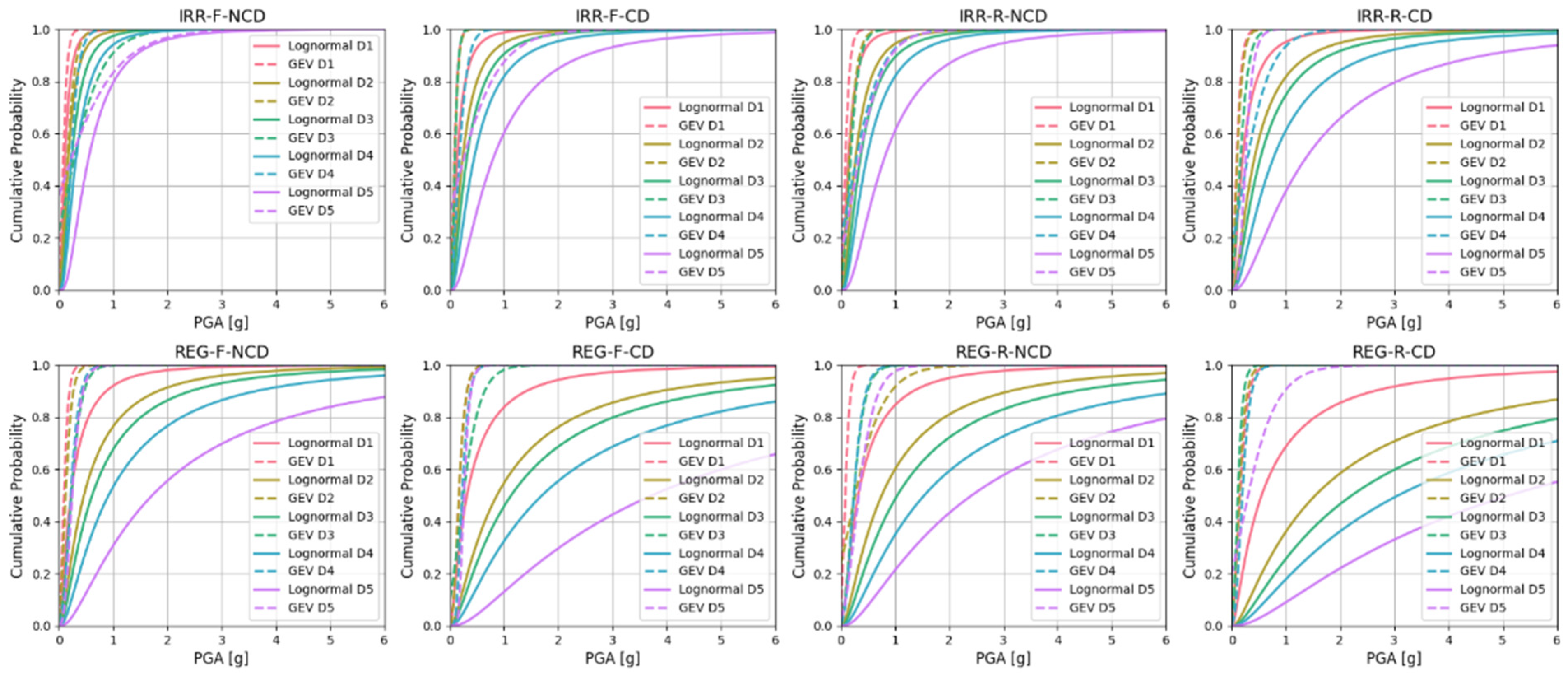
Figure 6 for RC buildings and Figure 7 for URM buildings compare lognormal and GEV fragility curves across different building types and classes. Both models are similar at lower damage levels, but at higher levels, the GEV shows a steeper increase in damage probability, capturing extreme events more effectively than lognormal.
The GEV approach performs well for both Reinforced Concrete (RC) and Unreinforced Masonry (URM) structures. For RC buildings, it captures both gradual damage progression and rare extremes, while for URM buildings, it realistically reflects their higher vulnerability to sudden, severe damage. This versatility makes the GEV model suitable for informed risk assessment, retrofitting, and urban resilience planning.
A fragility model is statistically robust if it reliably represents damage probabilities across typical and extreme seismic events. The GEV-based curves were evaluated using goodness-of-fit metrics, parameter confidence intervals, and sensitivity analyses, confirming accurate representation of both central tendencies and upper tails. This demonstrates that the GEV approach provides reliable and actionable insights for RC and URM structures.

4. Conclusions

The GEV distribution provides a statistically robust alternative to the lognormal model by explicitly modeling the tails of seismic fragility. Its adoption improves the reliability of risk estimates, particularly for high-intensity events, and strengthens the proposed simplified assessment protocol. Future work will expand datasets and incorporate site-specific seismic parameters to refine fragility assessments further and support effective earthquake mitigation strategies.
While the GEV approach performs well for both RC and URM structures, its application is limited by the scarcity of URM data, due to fewer inspections, variable construction, and incomplete records. Future research can expand URM datasets and incorporate site-specific seismic parameters to improve fragility assessments and mitigation strategies.

Author Contributions

Conceptualization, M.C.; methodology, M.C., M.D. and Z.H.; software, M.C., M.D. and Z.H.; validation, Z.H.; formal analysis, M.C. and Z.H.; investigation, M.C. and Z.H.; resources, M.C.; data curation, Z.H.; writing—original draft preparation, Z.H.; writing—review and editing, M.C.; visualization, Z.H. and M.C.; supervision, M.C. and M.D.; project administration, M.C.; funding acquisition, M.C. All authors have read and agreed to the published version of the manuscript.

Funding

This research received no external funding.

Data Availability Statement

Restrictions apply to the availability of these data. Data were obtained from the Da.D.O. (Database of Observed Damage) platform, and are available from the authors with the permission of Fondazione EUCENTRE.

Acknowledgments

The authors would like to thank Fondazione Eucentre for granting access to the Da.D.O. (Database of Observed Damage) platform and Hadi Alkhatib for his help in the initial steps of this research work.

Conflicts of Interest

The authors declare no conflicts of interest.

References

  1. Federal Emergency Management Agency; National Institute of Building Sciences (NIBS). Multi-Hazard Loss Estimation Methodology: Earthquake Model—HAZUS®-MH MR1 Technical Manual; FEMA: Washington, DC, USA, 2003.
  2. Accord Partiel Ouvert. Conseil de l’Europe, Cahiers du Centre Européen de Géodynamique et de Séismologie European Macroseismic Scale. 1998. Volume 15. Available online: https://eclass.uoa.gr/modules/document/file.php/GEOL138/%CE%9C%CE%91%CE%9A%CE%A1%CE%9F%CE%A3%CE%95%CE%99%CE%A3%CE%9C%CE%99%CE%9A%CE%97%202023/EMS98_GREEK.pdf (accessed on 28 March 2024).
  3. Porter, K.A. Cracking an open safe: More HAZUS vulnerability functions in terms of structure-independent intensity. Earthq. Spectra 2009, 25, 607–618. [Google Scholar] [CrossRef]
  4. Porter, K.A.; Kennedy, R.P.; Bachman, R.E. Creating Fragility Functions for Performance-Based Earthquake Engineering. Earthq. Spectra 2007, 23, 471–489. [Google Scholar] [CrossRef]
  5. Del Gaudio, C.; Di Ludovico, M.; Polese, M.; Manfredi, G.; Prota, A.; Ricci, P.; Verderame, G.M. Seismic fragility for Italian RC buildings based on damage data of the last 50 years. Bull. Earthq. Eng. 2020, 18, 2023–2059, Correction in Bull. Earthq. Eng. 2020, 18, 4547–4548. https://doi.org/10.1007/s10518-020-00890-4. [Google Scholar] [CrossRef]
  6. Rosti, A.; Del Gaudio, C.; Di Ludovico, A.; Rota, M.; Penna, A.; Verderame, G.M. Empirical Fragility Curves for Italian Residential RC Buildings. Bull. Earthq. Eng. 2021, 19, 3165–3183. [Google Scholar] [CrossRef]
  7. Rosti, A.; Rota, M.; Penna, A. Empirical Fragility Curves for Italian URM Buildings. Bull. Earthq. Eng. 2021, 19, 1755–1780. [Google Scholar] [CrossRef]
  8. Chai, T.; Draxler, R.R. Root Mean Square Error (RMSE) or Mean Absolute Error (MAE)?—Arguments against Avoiding RMSE in the Literature. Geosci. Model Dev. 2014, 7, 1247–1250. [Google Scholar] [CrossRef]
Figure 1. (Left): Fragility curves depicting the probability of reaching four damage states under varying seismic intensities, based on FEMA/NIBS methodology. (Right): Cumulative fragility curves showing the probability of exceeding each damage state with increasing seismic intensity.
Engproc 124 00011 g001
Figure 2. Classification of building damage according to the European Macroseismic Scale 1998 (EMS-98) [2], detailing five damage grades.
Engproc 124 00011 g002
Figure 3. Comparison of the fragility curves resulting from the fitting procedure and Rosti et al.’s [6].
Engproc 124 00011 g003aEngproc 124 00011 g003b
Figure 4. Comparison between histograms and PDF distributions resulting from the authors’ fitting of Da.D.O data (dashed line) and Rosti et al.’s [6] (solid line) in RC buildings: (a) for the MEDIUM-RISE-Gravity Load-DS1 category, and (b) for HIGH-RISE-Gravity Load-DS1.
Engproc 124 00011 g004
Figure 5. Comparison between histograms and PDF distributions resulting from the authors’ fitting of Da.D.O data (dashed line) and Rosti et al.’s (solid line) in URM buildings [7]: (a) for the IRR-F-NCD DS1 category, and (b) for the REG-F-CD DS1 category.
Engproc 124 00011 g005
Figure 6. Comparison between GEV and lognormal CDF distributions in RC buildings.
Engproc 124 00011 g006
Figure 7. Comparison between GEV and lognormal CDF distributions in URM buildings.
Engproc 124 00011 g007
Table 1. MSE for DS1 curves fitting over all cases and all distributions. Cells shaded in pale blue indicate lower Mean Squared Error (MSE) values, while cells shaded in dark blue indicate higher MSE values, highlighting the relative fitting performance of the distributions for each building class.
CATEGORISEEXPONENTIALNORMALLOGNORMALGENERALIZED LOGISTICGEVWEIBULLFRECHET (INVERSE WEIBULL)GUMBEL
RC LOWRISE PRE 19810.0076790.0015212.00 × 10−60.00038818.37 × 10−50.00031098.37 × 10−60.0003701
RC LOWRISE POST 19810.0017740.0011289.69 × 10−60.0004842.90 × 10−69.73 × 10−52.90 × 10−64.70 × 10⁻⁴
RC MIDRISE GRAVITY LOAD0.006420.0018344.42 × 10−60.00037461.69 × 10−60.00052121.69 × 10−50.0003743
RC MIDRISE PRE 19810.0063840.0028682.77 × 10−60.00071021.68 × 10−50.00051111.68 × 10−50.00071
RC MIDRISE POST 19810.0011020.0030372.44 × 10−60.0014076.72 × 10−60.00030046.72 × 10−60.001379
RC HIGHRISE GRAVITY LOAD0.010020.00030912.22 × 10−51.74 × 10−51.49 × 10−50.0002081.49 × 10−51.73 × 10⁻⁵
RC HIGHRISE PRE 19810.017230.0015092.69 × 10−60.00013054.70 × 10−60.00066114.70 × 10−60.0001302
RC HIGHRISE POST 19810.014910.0017452.96 × 10−60.00020233.20 × 10−60.00068813.20 × 10−60.0001981
URM LOWRISE PRE 19190.0018780.0039588.39 × 10−60.0013882.87 × 10−50.00047142.87 × 10−50.001387
URM LOWRISE 1919-19450.0019430.0037572.78 × 10−60.0014381.32 × 10−50.00044451.32 × 10−50.001438
URM LOWRISE1946-19610.0010020.0027014.76 × 10−60.0012854.65 × 10−60.00025324.65 × 10−60.001256
URM LOWRISE 1962-19710.00054770.0014761.93 × 10−60.00080462.67 × 10−60.00011562.67 × 10−60.000794
URM LOWRISE 1972-19810.00070480.00090322.49 × 10−60.00047531.86 × 10−66.74 × 10−51.86 × 1060.0004741
URM LOWRISE POST 19820.00053290.00079081.43 × 10−60.00045411.68 × 10−66.429 × 10−51.68 × 10−60.0004469
URM MIDHIGHRISE PRE19190.0021760.003531.25 × 10−50.0011562.90 × 10−50.00049072.90 × 10−50.001156
URM MIDHIGHRISE 1945-19610.0019950.0038871.38 × 10−50.0013412.54 × 10−50.00045372.54 × 10−50.00134
URM MIDHIGHRISE 1919-19460.0018330.0033419.42 × 10−60.0012871.74 × 10−50.00035151.74 × 10−50.00128
URM MIDHIGHRISE 1962-19710.00099240.0022314.34 × 10−60.0010927.68 × 10−60.00021477.68 × 10−60.001086
URM MIDHIGHRISE 1972-19810.00090990.0012121.61 × 10−60.00062792.67 × 10−60.00010562.67 × 10−60.000618
URM MIDRISE POST 19820.0008570.0011442.31 × 10−60.00060322.43 × 10−60.00010632.43 × 10−60.0005986
Table 2. GEV fragility curves parameters.
Curve θ D S 1 θ D S 2 θ D S 3 θ D S 4 θ D S 5 β
RC_LOWRISE_GRAVITYLOADS0.1933550.50290.8150891.412091.5372430.522237
RC_LOWRISE_PRE19810.3153320.5668910.8016611.1165532.7954630.472771
RC_LOWRISE_POST19810.4201461.0595491.9058983.74572823.1186140.526098
RC_MIDRISE_GRAVITYLOADS0.1144980.2243420.358010.7301440.8030640.517133
RC_MIDRISE_PRE19810.2063050.4230570.6303040.959192.3502660.515366
RC_MIDRISE_POST19810.2526360.7460471.2588672.728176109.211870.587645
RC_HIGHRISE_GRAVITYLOADS0.0730690.1073430.1456780.3027550.4497340.396585
RC_HIGHRISE_PRE19810.1870850.3066320.4259020.6942071.433510.429145
RC_HIGHRISE_POST19810.1819710.3483260.5918811.5196461.7314260.44599
URM_LOWRISE_PRE19190.1508050.2250060.2719720.3723790.6442120.747848
URM_LOWRISE_1919_19450.1952880.3132760.3751450.5584690.9348350.696127
URM_LOWRISE_1946_19610.2779420.5157020.6654590.9459491.6381850.613205
URM_LOWRISE_1962_19710.4363880.8833691.0785091.5405052.4660890.54699
URM_LOWRISE_1972_19810.5466041.1584211.5424892.0649575.6599420.516544
URM_LOWRISE_POST19810.6245251.1145231.2710291.6000892.7839440.512863
URM_MIDHIGHRISE_PRE19190.1289410.1866840.2247690.3049730.5714050.753045
URM_MIDHIGHRISE_1919_19450.1604260.2751020.352040.5258260.8361920.687177
URM_MIDHIGHRISE_1946_19610.2139080.3931930.5166230.7134271.0587360.634596
URM_MIDHIGHRISE_1962_19710.3229440.7095110.9174031.3442811.7318690.567159
URM_MIDHIGHRISE_1972_19810.4675131.058321.2800051.7799643.6562930.530431
URM_MIDHIGHRISE_POST19810.4947280.9499891.1330061.4406272.4151250.529102
Table 3. Mean Squared Error (MSE) table between input data and Rosti et al.’s [6,7] PDFs for some cases of masonry and RC buildings. Cells shaded in pale blue indicate lower Mean Square Error (MSE) values, while cells shaded in dark blue indicate higher MSE values, highlighting the relative fitting performance of the distributions for each building class.
Load TypeDamage LevelMSEBuilding ClassLoad TypeDamage LevelMSE
IRR-F-NCDD10.047524Low-rise (L)Gravity LoadDS10.008207
IRR-F-NCDD20.111412Low-rise (L)Gravity LoadDS30.025769
IRR-F-NCDD30.146891Low-rise (L)Gravity LoadDS20.01726
Disclaimer/Publisher’s Note: The statements, opinions and data contained in all publications are solely those of the individual author(s) and contributor(s) and not of MDPI and/or the editor(s). MDPI and/or the editor(s) disclaim responsibility for any injury to people or property resulting from any ideas, methods, instructions or products referred to in the content.