Proceeding Paper

Precursor-Directed Synthesis of Graphitic Carbon Nitride–Biochar Composites for Improved Photodegradation of Recalcitrant Pharmaceuticals †
by
Felix Amaning-Kwarteng
1,* and
Kingsley Safo
2
1
Department of Materials Science and Engineering, Egypt-Japan University of Science and Technology, New Borg Al-Arab City 21934, Egypt
2
Department of Chemical and Biomolecular Engineering, University of Notre Dame, South Bend, IN 46556, USA
*
Author to whom correspondence should be addressed.
Presented at the 4th International Electronic Conference on Processes, 20–22 October 2025; Available online: https://sciforum.net/event/ECP2025.
Eng. Proc. 2025, 117(1), 44; https://doi.org/10.3390/engproc2025117044
Published: 10 February 2026
(This article belongs to the Proceedings of The 4th International Electronic Conference on Processes)

Abstract

This study investigates how graphitic carbon nitride (g-C3N4), derived from melamine, urea, and thiourea, degrades recalcitrant pharmaceuticals. Among the materials used, g-C3N4 derived from urea showed the highest degradation of methyl orange (60.25%). When calcined with biochar derived from onion flower seed-cover biomass via pyrolysis and further activated with potassium hydroxide (KOH), it showed better adsorption and photodegradation results of 92.59%, 84.44%, 68.11%, and 61.11% for tetracycline, cefixime, ciprofloxacin, and carbamazepine, respectively. These results emphasize the potential of biochar-g-C3N4 composites as sustainable photocatalysts for water treatment focused on removing recalcitrant pharmaceutical contaminants.

1. Introduction

Pharmaceutical residues are a major environmental issue in the twenty-first century. Traces of antibiotics, pain relievers, and antiepileptic drugs are often found in surface and groundwater around the world [1,2]. This raises concerns about ecological toxicity and the rise in antimicrobial resistance. Traditional treatment methods, like coagulation, filtration, or activated-sludge processes, rarely break down these complex organic molecules. As a result, they persist in wastewater and accumulate in aquatic food chains.
Photocatalysis has become an attractive method for breaking down these pollutants. It uses solar or artificial light to produce reactive oxidative species that can turn organics into harmless byproducts [3,4]. Among the different photocatalysts, graphitic carbon nitride (g-C3N4) stands out and possess useful properties such as activity under visible light [5], stability under heat and chemicals, and easy production from cheap nitrogen-rich materials. Unlike traditional semiconductors, such as TiO2, that mostly rely on ultraviolet light, g-C3N4 absorbs visible light because of its moderate bandgap (approximately 2.7 eV) [6].
Despite these benefits, pure g-C3N4 still has a low surface area and rapid electron–hole recombination, which limits its photocatalytic performance. Researchers have looked into various modification strategies to address these issues, including forming heterojunctions, adding different elements, or combining them with conductive materials [7]. Recently, biochar, a porous carbon material made from biomass pyrolysis, has shown great potential as a co-catalyst [5]. Because of its large surface area and ability to transfer electrons, biochar minimizes charge recombination and adsorbs pollutants, making it an excellent material for combination with g-C3N4. Only a few studies, however, have investigated how various pre-existing g-C3N4 precursors interact with biochar in terms of photo-catalytic activity [8]. Recent studies have also demonstrated that the incorporation of carbonaceous materials such as biochar into g-C3N4 photocatalysts can significantly enhance their charge dynamics and photocatalytic efficiency. Biochar’s π-conjugated systems and high conductivity facilitate efficient interfacial electron transfer from photoexcited g-C3N4 to biochar, effectively acting as an electron acceptor and thereby reducing electron–hole recombination rates, which is a key limitation of pristine g-C3N4 photocatalysts [9]. Such conductive interfaces have been shown to increase photocurrent responses and decrease impedance, confirming improved charge separation and mobility in biochar-g-C3N4 composites. These synergistic interactions promote the generation of reactive oxygen species and enhance overall photocatalytic activity in environmental applications [10]. The nitrogen source type such as melamine [11], urea [12], or thiourea [13] has a high tendency to significantly influence the crystal structure, surface defects, and light absorption of the final catalyst. Therefore, a comprehensive study is needed to find meaningful interconnections to inform the development of high-performance photocatalysts.
In this regard, the current study aimed to generate g-C3N4 from three standard precursors, examine its performance, and then enhance the most effective precursor with biochar for the decomposition of recalcitrant pharmaceuticals. This research explains how the precursors influence photocatalysis and presents a sustainable composite with significant potential for practical applications in water remediation.

2. Materials and Methods

2.1. Materials

Melamine (C3H6N6; 99%), urea (CH4N2O; 99%), and thiourea (CH4N2S; 99%) were obtained from Loba Chemie (Mumbai, India). Tetracycline (C22H24N2O8), cefixime (C16H15N5O7S2), ciprofloxacin (C17H18FN3O3), and carbamazepine (C15H12N2O) were obtained from ADCO Pharmaceuticals (Cairo, Egypt). All stock and working solutions, including chemical reagents were made using deionized water. Lastly, onion flower seed covers were obtained from Egypt.

2.2. Synthesis of Biochar

The synthesis process was adopted from [14]. Briefly but precisely, onion flower seed-cover biomass was washed with de-ionized water and dried at 100 °C. The samples were ground using an RRH-500AK grinder from Zhejiang Winki Plastic Industry Co., Ltd (Jinhua City, China). and passed through a sieve with an aperture of 106 µm followed by pre-carbonization in a muffle furnace at 600 °C for 2 h under a nitrogen atmosphere. After treatment with KOH using the refluxing method, the sample was activated at 900 °C under a nitrogen environment and subsequently purified with 2 M HCl. The sample was then washed until a neutral pH was reached.

2.3. Synthesis of g-C3N4

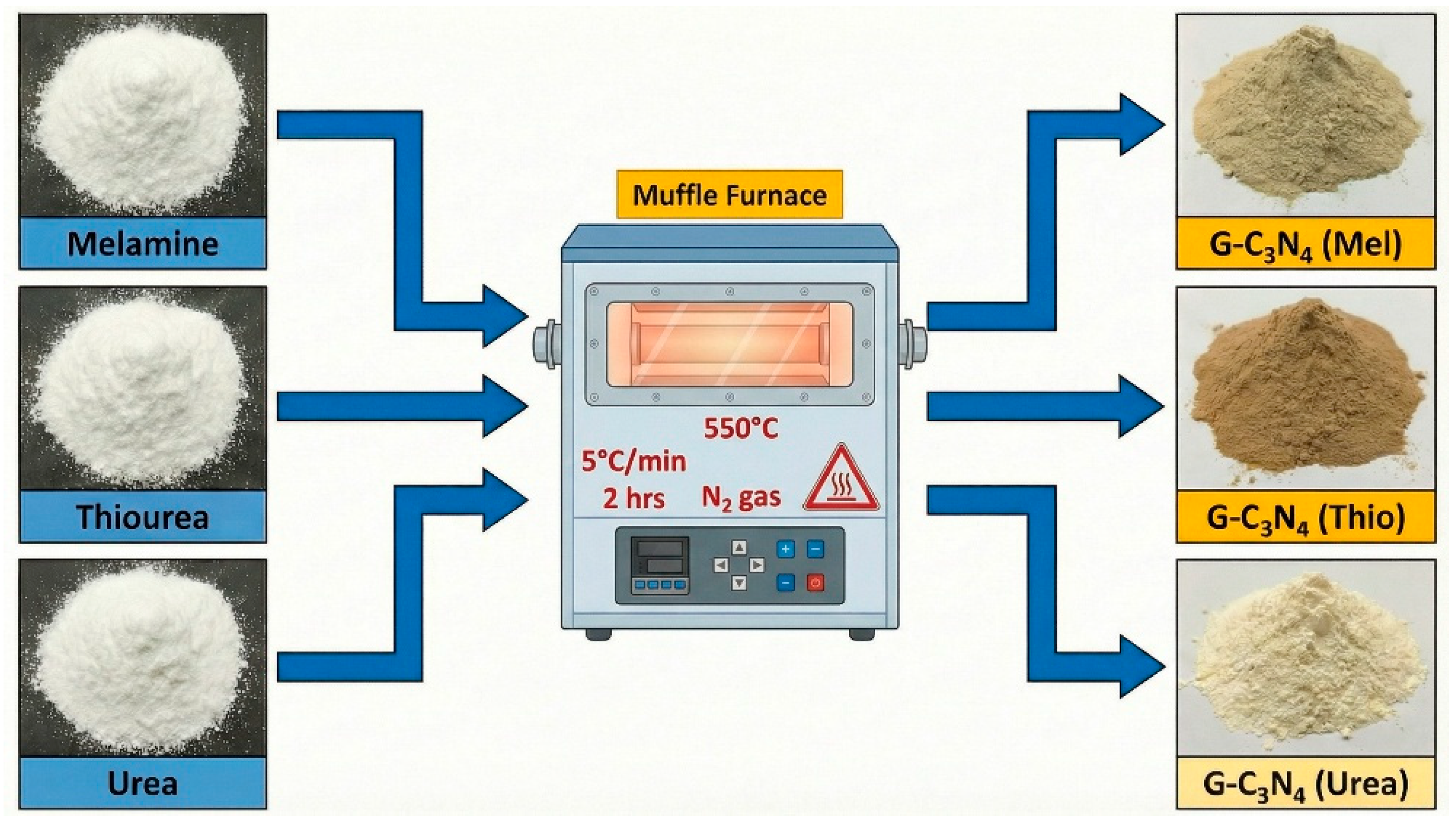
Melamine, urea, and thiourea were each calcined by heating in a covered alumina crucible at 550 °C for two hours in air. This process caused nitrogen-rich monomers to polymerize into yellowish g-C3N4 powders. Each sample was carefully ground and stored in an airtight container for later testing. This process is schematically represented in Figure 1.

2.4. Formation of g-C3N4–Biochar Composite

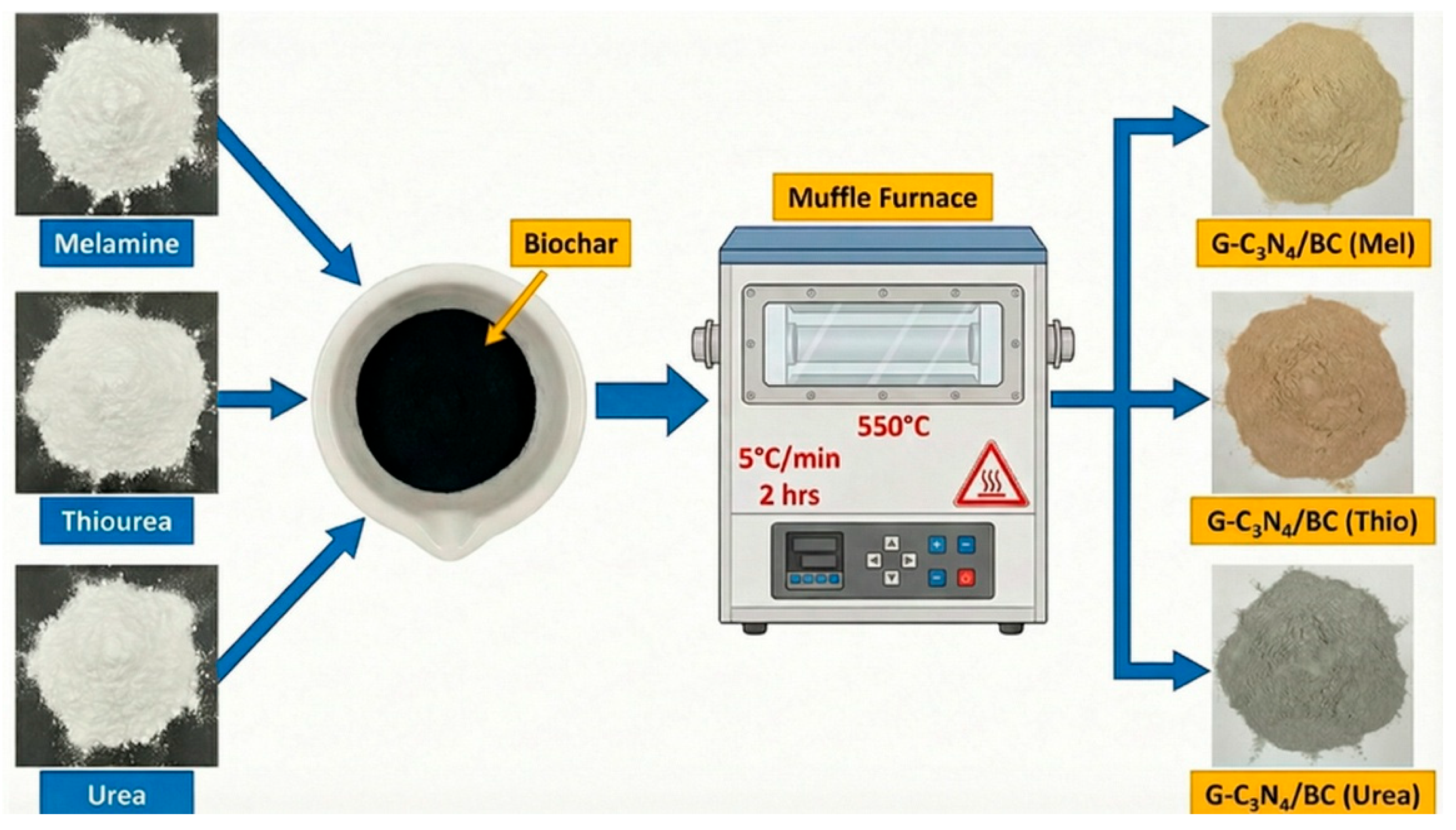
To enhance photocatalytic performance, urea-derived g-C3N4, which exhibited the highest initial activity, was selected for composite formation. Biochar produced from onion flower seed-cover biomass was sieved to particle sizes below 150 µm, thoroughly washed with deionized water, and oven-dried prior to use. The composite was prepared by physically mixing g-C3N4 precursors such as melamine, urea, and thiourea independently with biochar in a 1:1 weight ratio, followed by calcination at 550 °C for 2 h under an ambient air atmosphere as illustrated in Figure 2. This secondary thermal treatment promoted interfacial contact and electronic interaction between g-C3N4 and biochar while preserving the surface functional groups of the biochar.

2.5. Photocatalytic Activity Tests

Prior to visible-light irradiation, the reaction suspensions containing the catalyst and pollutant solution were magnetically stirred in the dark for 30 min to establish adsorption–desorption equilibrium. This step was carried out to minimize the contribution of physical adsorption during the subsequent photocatalytic degradation experiments. In the photodegradation experiments, 100 mL solutions of methyl orange (MO) or target pharmaceuticals like tetracycline, cefixime, ciprofloxacin, and carbamazepine under visible light were employed. Additionally, a 300 W xenon lamp with a 420 nm cut-off filter simulated sunlight. A catalyst dosage of 0.5 g L−1 and an initial concentration of 10 mg L−1 were used for comparison. Samples were periodically drawn and analyzed with UV–vis spectrophotometry at specific absorption wavelengths. All experiments were performed in triplicate to ensure reliability. The degradation efficiency was calculated as follows:
(%) = (C0 − Ct)/C0 × 100.
where C0 represents the initial concentration, Ct denotes the value measured at any given time t, and (%) is the degradation efficiency.

3. Results and Discussion

3.1. Effect of Precursor on g-C3N4 Performance

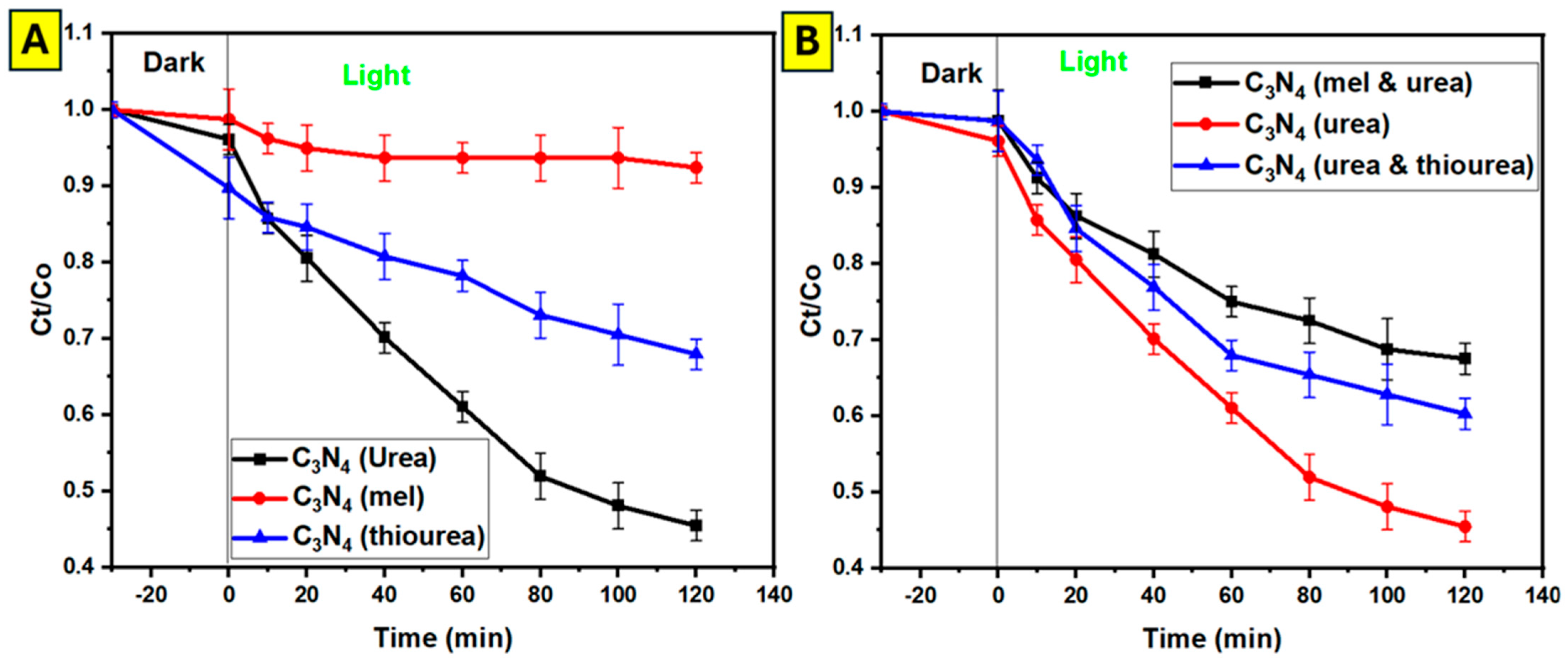
Methyl orange was initially used as a model organic pollutant to rapidly screen the intrinsic photocatalytic activity of g-C3N4 synthesized from different nitrogen precursors. This preliminary evaluation enabled the rational selection of the most photoactive material for subsequent biochar composite formation and pharmaceutical degradation studies, thereby ensuring an efficient and systematic catalyst selection process. As shown in the photocatalytic results in Figure 3, urea-derived g-C3N4 performed excellently, removing 60.25% of methyl orange in 120 min, which was much better than the performance of thiourea (32.05%) and melamine (7.59%).
The superior performance of the urea sample is attributed to its higher degree of polymerization and the availability of defect sites that facilitate charge separation [15,16]. The light-yellow color intensity also indicates narrowing of the bandgap, leading to better absorption of visible light [4]. The literature search confirms that the urea-derived g-C3N4 matrix generally possesses a higher degree of polymerization, increased defect states, and a comparatively larger specific surface area, which all promote visible-light utilization and separation of charge [9]. Furthermore, the lighter-coloration characteristic of urea-derived g-C3N4 has been correlated with a moderately reduced bandgap and enhanced photon-harvesting capability [17]. Although detailed structural and surface characterization was not undertaken in this study, the trends in photocatalysis observed here are in line with what is known about these precursor-dependent properties. Furthermore, as demonstrated in Figure 3B, the thermal treatment of a blend of urea with either melamine or thiourea, conducted prior to the experiment, resulted in a notable increase in photocatalytic activity. This enhancement can be attributed to the synergistic effects arising from the presence of coexisting nitrogen-doping structures. It is further established that urea promotes condensation, and thiourea adds sulfur heteroatoms, resulting in improved light harvesting and charge mobility.

3.2. Enhancement Through Biochar Incorporation

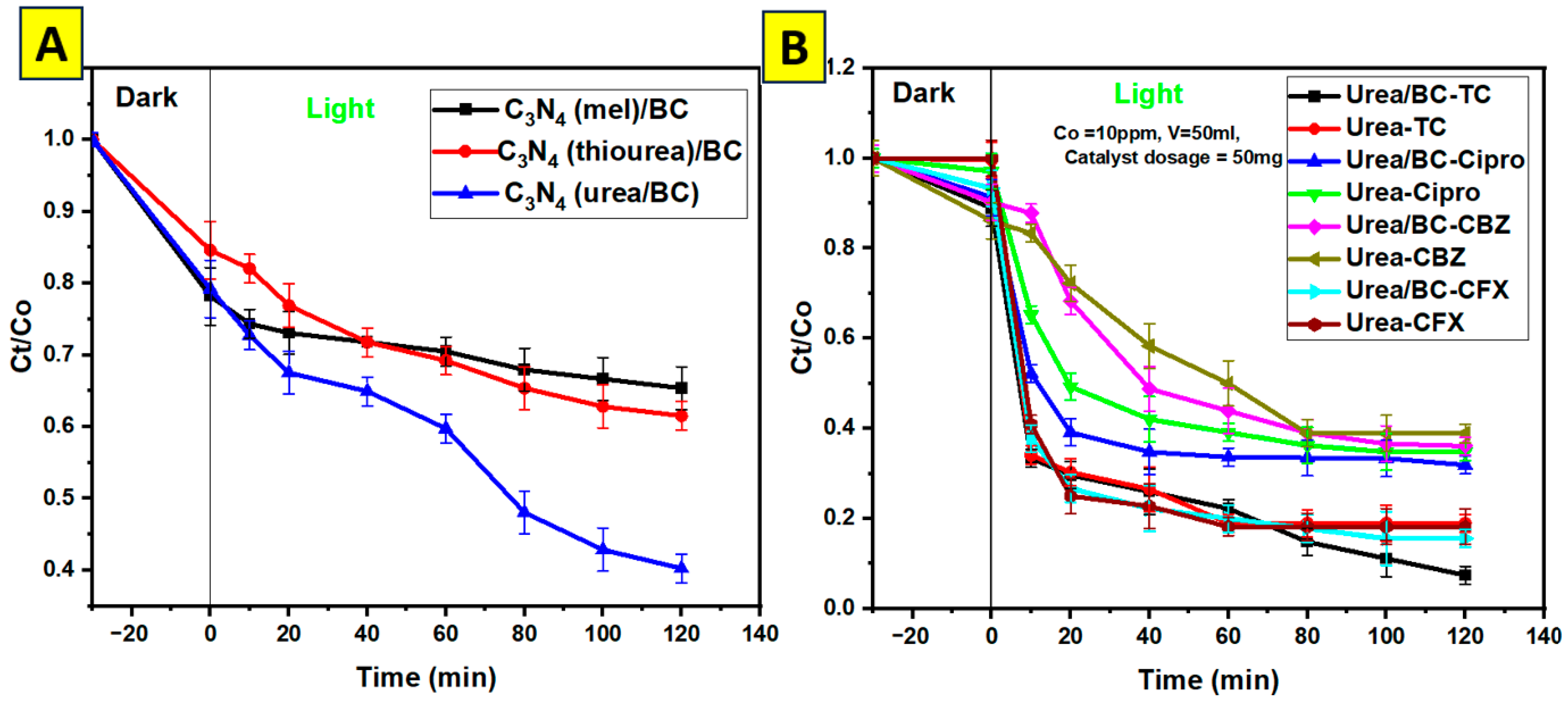
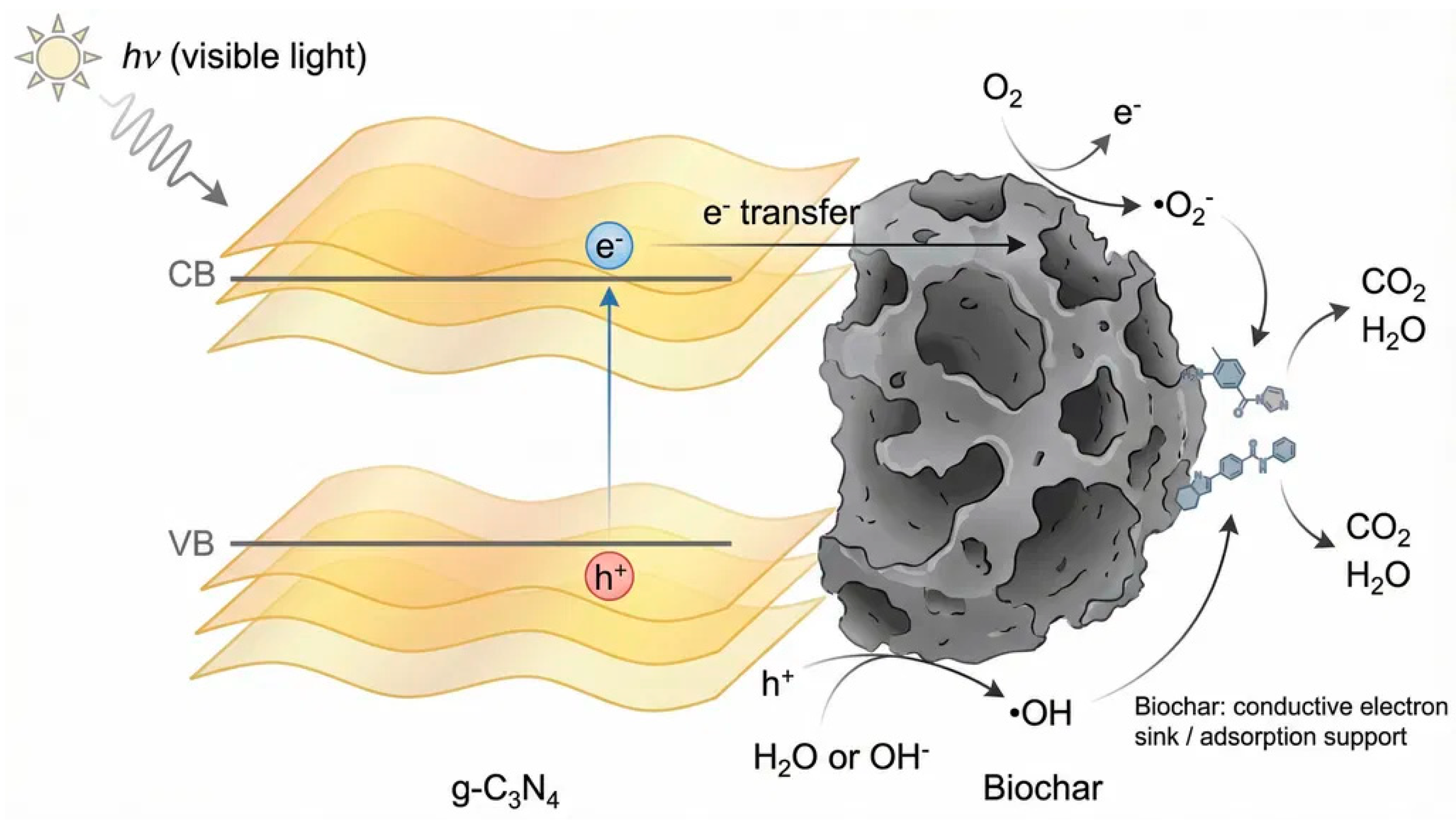
Integrating biochar with urea-derived g-C3N4 significantly improved performance, as evident in Figure 4. The composite achieved 59.7% degradation of methyl orange and excellent removal rates of 92.59%, 84.44%, 68.11%, and 61.11% for tetracycline, cefixime, ciprofloxacin, and carbamazepine, respectively, as shown in Figure 4B. This improvement stems from the large surface area of biochar, which provides numerous adsorption sites and facilitates charge transfer between the two materials [18,19]. At the microscopic level, the conductive biochar framework acts as an electron sink, reducing recombination and enhancing the production of reactive oxygen species (•O2 and •OH). This synergistic mechanism considerably increases photocatalytic efficiency under visible light [4]. Notably, all photocatalytic experiments began with a dark adsorption equilibration step. As a result, the reported degradation efficiencies primarily reflect photocatalytic removal rather than adsorption alone.

3.3. Comparison with Reported Catalysts

The composite developed in this research outperforms the majority of previously documented systems under similar conditions, affirming that the inclusion of biochar greatly improves electron transport and the ability to reuse catalysts. Furthermore, both elements originate from low-cost and sustainable materials, highlighting the method’s environmental friendliness. Table 1 below contrasts the present results with recently reported systems.
It should be noted that direct quantitative comparison of photocatalytic efficiencies across different studies is inherently challenging due to variations in experimental conditions, including pollutant type and concentration, catalyst loading, light source, irradiation intensity, and reaction time. In this context, Table 1 is presented to provide a qualitative performance benchmark rather than an absolute comparison. The selected studies were chosen because they involve g-C3N4-based catalysts applied under broadly comparable photocatalytic conditions, particularly with respect to visible or UV–visible light irradiation and pollutant concentration ranges commonly reported in the literature. Despite these unavoidable differences, the comparison highlights a clear performance trend, demonstrating that the incorporation of biochar significantly enhances the photocatalytic activity of g-C3N4 toward pharmaceutical degradation.

3.4. Proposed Mechanism

When the composite developed is exposed to visible light, electrons from the conduction band of g-C3N4 move to the interface with biochar, where they reduce dissolved oxygen, generating superoxide radicals. At the same time, holes in the valence band oxidize water molecules, leading to the formation of hydroxyl radicals as seen in the Figure 5. These reactive species target pharmaceutical compounds, disrupting aromatic rings and transforming them into less harmful intermediates. The combined effect of adsorption (biochar) and photocatalysis (g-C3N4) guarantees effective and ongoing degradation [9]. Although direct radical trapping or spectroscopic evidence was not obtained in the present study, the proposed photocatalytic mechanism is supported by numerous mechanistic investigations reported for g-C3N4–carbon-based composites. Previous studies have demonstrated that carbonaceous materials such as biochar facilitate interfacial electron transfer from photoexcited g-C3N4, acting as electron sinks that suppress charge recombination and promote the formation of reactive oxygen species, particularly superoxide (•O2) and hydroxyl (•OH) radicals under visible-light irradiation [8,23]. These reactive species are widely recognized as the dominant contributors to pharmaceutical degradation in analogous g-C3N4 composite systems.

4. Conclusions

In this study, it has been clearly revealed that the photocatalytic properties of g-C3N4 are significantly influenced by the choice of nitrogen precursor. g-C3N4 derived from urea displayed the most efficient activity, which was further improved by combining it with biochar. The resulting hybrid catalyst accomplished over 90% degradation of various persistent pharmaceuticals under visible light. This outstanding performance can be attributed to effective charge separation, an increased surface area, and the synergistic adsorption–reaction interface provided by biochar. These results emphasize that biochar–g–C3N4 composites represent a sustainable approach to developing cost-effective photocatalysts using readily available, low-cost raw materials. Future research may aim at optimizing composite ratios, investigating doping techniques, and assessing long-term stability in actual wastewater environments.

Author Contributions

Conceptualization, F.A.-K.; formal analysis F.A.-K.; investigation, F.A.-K.; writing—original draft, F.A.-K.; methodology, F.A.-K. and K.S.; validation, F.A.-K. and K.S.; data curation, F.A.-K. and K.S.; writing—review and editing, F.A.-K. and K.S. All authors have read and agreed to the published version of the manuscript.

Funding

This research received no external funding.

Institutional Review Board Statement

Not applicable.

Informed Consent Statement

Not applicable.

Data Availability Statement

The original contributions presented in this study are included in the article. Further inquiries can be directed to the corresponding author.

Acknowledgments

The authors gratefully acknowledge the Japan International Cooperation Agency (JICA) and the Egypt-Japan University of Science and Technology (E-JUST) for providing technical and laboratory support.

Conflicts of Interest

The authors declare no conflicts of interest.

References

  1. Safo, K.; Noby, H.; Mitsuhara, M.; Naragino, H.; El-Shazly, A.H. Novel solar simulated photocatalytic heterolysis of pharmaceutical wastewater via slag nanocomposite immobilization: Optimization using response surface methodology. Water Pract. Technol. 2023, 18, 2315–2328. [Google Scholar] [CrossRef]
  2. Delgado, N.; Capparelli, A.; Navarro, A.; Marino, D. Pharmaceutical emerging pollutants removal from water using powdered activated carbon: Study of kinetics and adsorption equilibrium. J. Environ. Manag. 2019, 236, 301–308. [Google Scholar] [CrossRef] [PubMed]
  3. Quesada, H.B.; Baptista, A.T.A.; Cusioli, L.F.; Seibert, D.; de Oliveira Bezerra, C.; Bergamasco, R. Surface water pollution by pharmaceuticals and an alternative of removal by low-cost adsorbents: A review. Chemosphere 2019, 222, 766–780. [Google Scholar] [CrossRef] [PubMed]
  4. Safo, K.; Rubangakene, N.O.; Noby, H.; El-Shazly, A.H. Photocatalytic purification of dye-containing wastewater using a novel embedded hybrid TiO2–slag catalyst heterojunction nanocomposite coupled with statistical models: A sustainable and techno-economic approach. Water Sci. Eng. 2025, 18, 151–164. [Google Scholar] [CrossRef]
  5. Xiao, Y.; Lyu, H.; Yang, C.; Zhao, B.; Wang, L.; Tang, J. Graphitic carbon nitride/biochar composite synthesized by a facile ball-milling method for the adsorption and photocatalytic degradation of enrofloxacin. J. Environ. Sci. 2021, 103, 93–107. [Google Scholar] [CrossRef]
  6. Ismael, M.; Wu, Y.; Taffa, D.H.; Bottke, P.; Wark, M. Graphitic carbon nitride synthesized by simple pyrolysis: Role of precursor in photocatalytic hydrogen production. New J. Chem. 2019, 43, 6909–6920. [Google Scholar] [CrossRef]
  7. Ashritha, M.G.; Hareesh, K. A review on graphitic carbon nitride-based binary nanocomposites as supercapacitors. J. Energy Storage 2020, 32, 101840. [Google Scholar] [CrossRef]
  8. Tang, R.; Gong, D.; Deng, Y.; Xiong, S.; Zheng, J.; Li, L.; Zhao, J. π–π stacking derived from graphene-like biochar/g-C3N4 with tunable band structure for photocatalytic antibiotics degradation via peroxymonosulfate activation. J. Hazard. Mater. 2022, 423, 126944. [Google Scholar] [CrossRef]
  9. Pei, J.; Li, H.; Yu, D.; Zhang, D. g-C3N4-based heterojunction for enhanced photocatalytic performance: A review of fabrications, applications, and perspectives. Catalysts 2024, 14, 825. [Google Scholar] [CrossRef]
  10. Ma, R.; Sun, Y.; Zhang, H.; Zhu, J.; Tian, H.; Guo, X.; An, S. Intense interaction between biochar/g-C3N4 promotes the photocatalytic performance of heterojunction catalysts. RSC Adv. 2024, 14, 19707–19717. [Google Scholar] [CrossRef]
  11. Bhanderi, D.; Lakhani, P.; Modi, C.K. Graphitic carbon nitride (g-C3N4) as an emerging photocatalyst for sustainable environmental applications: A comprehensive review. RSC Sustain. 2024, 2, 265–287. [Google Scholar] [CrossRef]
  12. Yan, W.; Yan, L.; Jing, C. Impact of doped metals on urea-derived g-C3N4 for photocatalytic degradation of antibiotics: Structure, photoactivity and degradation mechanisms. Appl. Catal. B Environ. 2019, 244, 475–485. [Google Scholar] [CrossRef]
  13. Hong, Y.; Liu, E.; Shi, J.; Lin, X.; Sheng, L.; Zhang, M.; Chen, J. A direct one-step synthesis of ultrathin g-C3N4 nanosheets from thiourea for boosting solar photocatalytic H2 evolution. Int. J. Hydrogen Energy 2019, 44, 7194–7204. [Google Scholar] [CrossRef]
  14. Kwarteng, F.A.; Abdel-Aty, A.A.; Mohamed, S.R.; Hassan, M.A.; Ohashi, H.; Lopez-Salas, N.; Khalil, A.S. Novel onion flower-derived biochar for high-performance sustainable supercapacitor applications. Diam. Relat. Mater. 2024, 150, 111703. [Google Scholar] [CrossRef]
  15. Li, T.; Liu, N.; Liu, J.; Lai, B.; Yuan, S.; Li, R.; Zhao, Y. A trade-off between light absorption and catalytic sites: The effect of polymerization degree of graphitic carbon nitride on its photocatalytic activity. J. Phys. Chem. C 2025, 129, 14788–14799. [Google Scholar] [CrossRef]
  16. Petrović, J.; Radovanović, Ž.; Kamal, K.M.; Medić, M.; Kuzman, S.; Gasik, M.; Petrović, R. Can the treatment of urea-derived g-C3N4 with H2SO4 be optimized by varying the acid concentration to enhance the efficiency of photocatalytic Cr(VI) reduction? Appl. Catal. A Gen. 2025, 707, 120506. [Google Scholar] [CrossRef]
  17. Yu, Y.; Huang, H. Coupled adsorption and photocatalysis of g-C3N4-based composites: Material synthesis, mechanism, and environmental applications. Chem. Eng. J. 2023, 453, 139755. [Google Scholar] [CrossRef]
  18. Jeon, P.; Lee, M.E.; Baek, K. Adsorption and photocatalytic activity of biochar with graphitic carbon nitride (g-C3N4). J. Taiwan Inst. Chem. Eng. 2017, 77, 244–249. [Google Scholar] [CrossRef]
  19. Bhattacharjee, B.; Mishra, S.R.; Gadore, V.; Ahmaruzzaman, M. Carbon-based composites for environmental clean-up: Advances in biochar, g-C3N4, graphene oxide and CNTs. J. Taiwan Inst. Chem. Eng. 2025, 168, 105918. [Google Scholar] [CrossRef]
  20. Song, J.; Zhao, K.; Yin, X.; Liu, Y.; Khan, I.; Liu, S.Y. Photocatalytic degradation of tetracycline hydrochloride with g-C3N4/Ag/AgBr composites. Front. Chem. 2022, 10, 1069816. [Google Scholar] [CrossRef]
  21. Zhou, F.Y.; Mao, J.N.; Peng, X.L.; Hong, B.; Xu, J.C.; Zeng, Y.X.; Wang, X.Q. Magnetically separable Ni/g-C3N4 nanocomposites for enhanced visible-light photocatalytic degradation of methylene blue and ciprofloxacin. Diamond Relat. Mater. 2022, 126, 109070. [Google Scholar] [CrossRef]
  22. Kane, A.; Chafiq, L.; Dalhatou, S.; Bonnet, P.; Nasr, M.; Gaillard, N.; Zeghioud, H. g-C3N4/TiO2 S-scheme heterojunction photocatalyst with enhanced photocatalytic carbamazepine degradation and mineralization. J. Photochem. Photobiol. A Chem. 2022, 430, 113971. [Google Scholar] [CrossRef]
  23. Xiao, L.; Zhang, S.; Chen, B.; Wu, P.; Feng, N.; Deng, F.; Wang, Z. Visible-light photocatalytic degradation of enrofloxacin by crawfish shell biochar combined with g-C3N4: Effects and mechanisms. J. Environ. Chem. Eng. 2023, 11, 109693. [Google Scholar] [CrossRef]
Figure 1. Schematic illustration of g-C3N4 synthesis from melamine, urea, and thiourea.
Engproc 117 00044 g001
Figure 2. Schematic illustration of g-C3N4–biochar composite formation.
Engproc 117 00044 g002
Figure 3. Photocatalytic degradation efficiencies of g-C3N4 from (A) different precursors and (B) blends on methyl orange dye.
Engproc 117 00044 g003
Figure 4. Degradation efficiencies of (A) methyl orange and (B) pharmaceuticals using g-C3N4–biochar composite under visible light.
Engproc 117 00044 g004
Figure 5. Visible-light-driven mechanism of g-C3N4–biochar composite for pharmaceutical degradation.
Engproc 117 00044 g005
Table 1. Qualitative comparison of photocatalytic performance of selected g-C3N4-based catalysts for organic and pharmaceutical pollutant degradation under reported experimental conditions.
CatalystPollutantLight SourceEfficiency (%)Reference
TiO2/Activated CarbonMethylene BlueUV74[1]
g-C3N4/Ag/AgBrTetracyclineVisible57.5[20]
Ni/g-C3N4CiprofloxacinVisible67[21]
g-C3N4/TiO2CarbamazepineUV71.4[22]
g-C3N4–BiocharTetracyclineVisible92.6this work
g-C3N4–BiocharCefiximeVisible84.4this work
g-C3N4–BiocharCiprofloxacinVisible68.1this work
g-C3N4–BiocharCarbamazepineVisible61.1this work
Disclaimer/Publisher’s Note: The statements, opinions and data contained in all publications are solely those of the individual author(s) and contributor(s) and not of MDPI and/or the editor(s). MDPI and/or the editor(s) disclaim responsibility for any injury to people or property resulting from any ideas, methods, instructions or products referred to in the content.