


Abstract
The ever-growing global consumption of coffee generates millions of tons of spent coffee grounds (SCG) annually, posing a significant waste disposal problem. Although some SCG find use in composting or biogas production, a large portion remains underutilized. This study introduces a novel circular waste-to-energy pathway to tackle this challenge. Our proposed technology employs a cascading valorization approach, utilizing non-catalytic supercritical transesterification of pyrolytic oil derived from SCG for liquid hydrocarbon production. The process begins with pyrolysis, which converts SCG into pyrolytic oil. This oil is then upgraded via supercritical transesterification with methanol. Experiments were conducted using a 1:6 oil-to-methanol ratio at precisely controlled conditions of 239.4 °C and 1200 psi for 20 min. This optimized process yielded an impressive 96% of valuable liquid hydrocarbon product. The resulting product exhibited highly favorable characteristics, including a density of 755.7 kg/m3, a viscosity of 0.7297 mm2/s, and a high heating value (HHV) of 48.86 MJ/kg. These properties are remarkably comparable to conventional biofuels and standard fossil fuels, demonstrating the product’s potential as a viable energy source.
1. Introduction
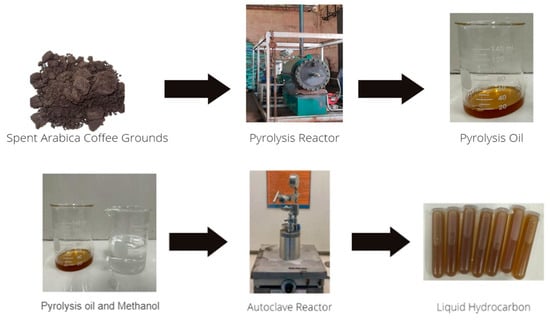
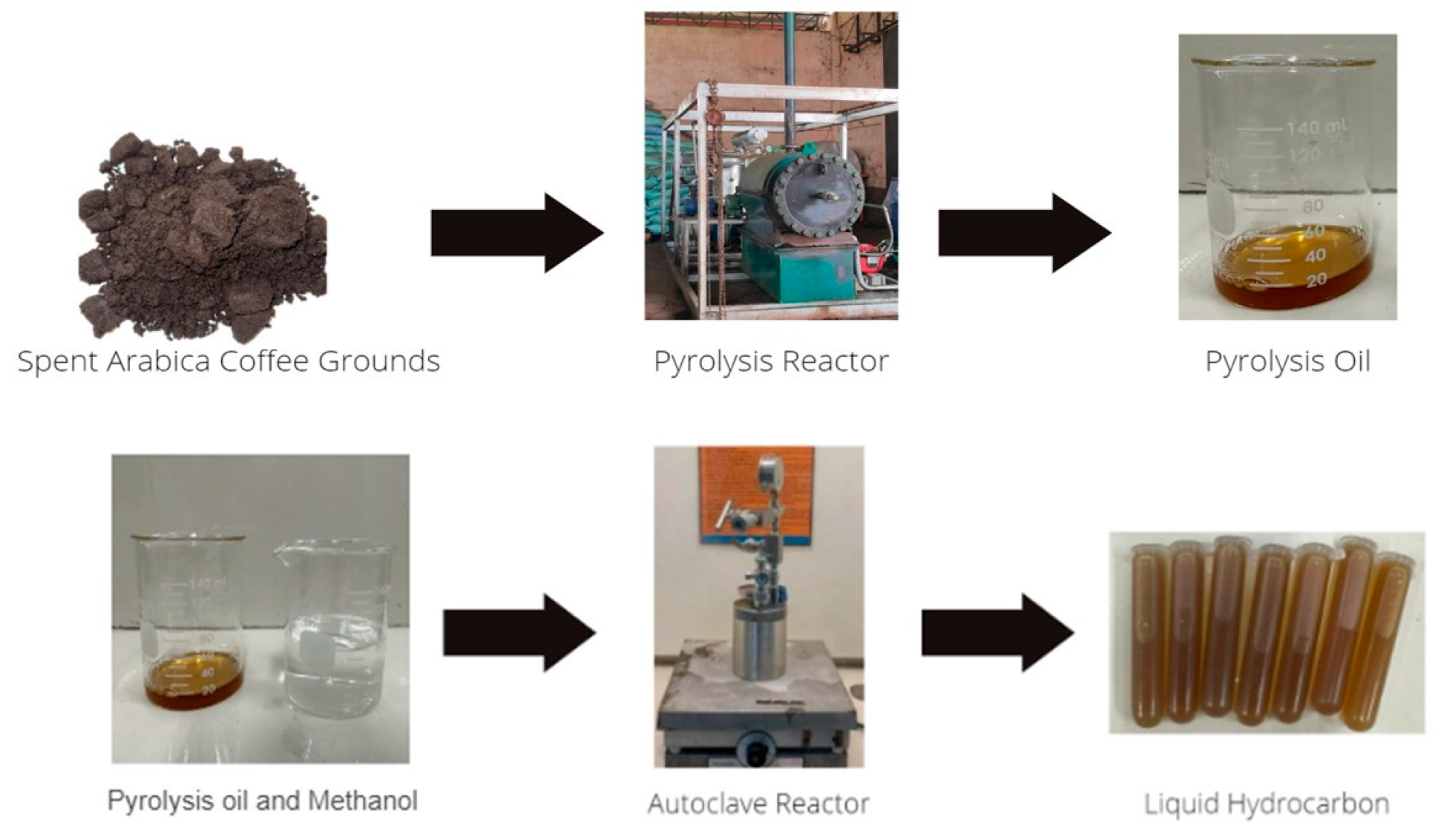
While the rising global energy demand necessitates renewable alternatives [1], the massive accumulation of spent coffee grounds (SCG) poses a significant disposal challenge [2]. However, current valorization strategies are often fragmented and inefficient. Conventional biodiesel production utilizes only the lipid fraction of SCG, wasting the remaining lignocellulosic biomass, while direct pyrolysis typically yields unstable, highly oxygenated bio-oils that are unsuitable for direct fuel use without complex catalytic upgrading [3]. Therefore, a critical research gap exists in developing a unified, non-catalytic pathway capable of converting the entire SCG mass into high-quality fuel. This research addresses this problem by evaluating a novel cascading approach: thermally converting wet SCG into an intermediate pyrolytic oil, followed by non-catalytic supercritical transesterification [4] to upgrade the oil into viable liquid hydrocarbon products (Figure 1).
Figure 1.
Cascading valorization pathway of SCG for novel waste-to-energy liquid hydrocarbon.
2. Materials and Methods
2.1. Materials
Spent coffee grounds (SCG) were obtained from Black Scoop Cafe (Marilao) and stored at 17–20 °C to prevent spoilage. Prior to processing, the raw biomass was characterized by a moisture content of approx. 60% and an elemental composition of ~55% C, 6% H, and 2.5% N. All chemicals used, including methanol (99.9%, Clean Pro Solution), were of analytical grade [3].
2.2. Pyrolysis Oil Extraction
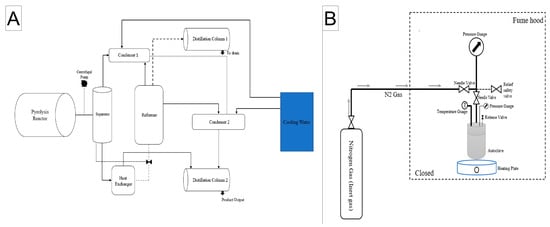
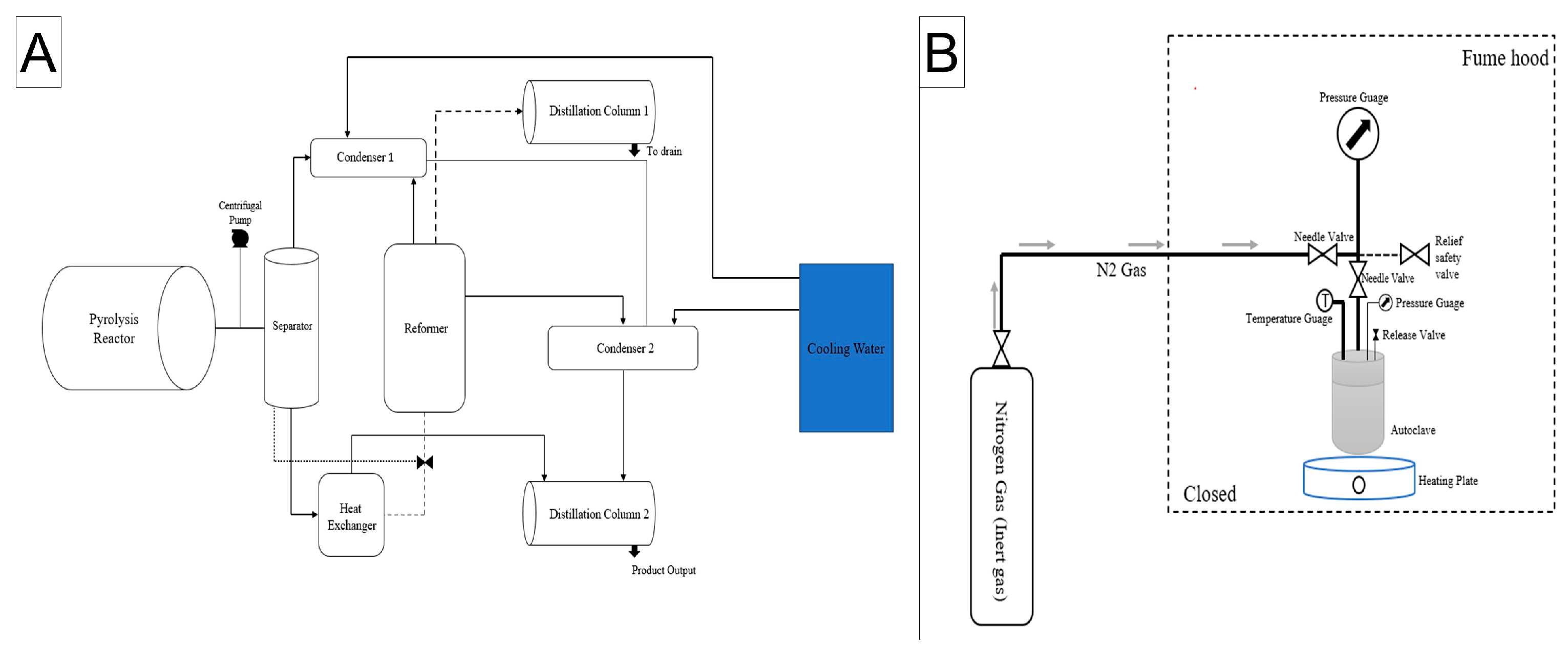
Pyrolytic oil was extracted from 100 kg of wet SCG using the reactor system shown in Figure 2A. The SCG was subjected to thermal treatment at 800 °C for a duration of 3 h. These processing parameters were selected to promote severe thermal cracking of the lignocellulosic matrix and ensure complete devolatilization of the wet feedstock, simulating a carbonization regime typically optimized for high-grade biochar production [1,2]. By operating under these conditions, the study aims to evaluate the feasibility of valorizing the liquid byproduct generated during high-temperature waste reduction. The resulting pyrolysis vapors were condensed, and the pyrolytic oil was collected for subsequent transesterification. Finally, the oil yield was determined gravimetrically.
Figure 2.
Schematic diagram of (A) pyrolysis of SCG and (B) non-catalytic supercritical transesterification of pyrolytic oil.
The pyrolytic oil was converted to liquid hydrocarbons via supercritical non-catalytic transesterification in the autoclave reactor shown in Figure 2B. Reactions were performed by varying the oil-to-methanol ratios (1:4, 1:5, and 1:6) and reaction times (20, 40, and 60 min). For each run, 20 mL of pyrolytic oil and a corresponding volume of methanol were pressurized to an initial 1200 psi with nitrogen, heated to 239.4 °C, and held for the specified time. After cooling and depressurization, the liquid product was collected for analysis.
2.3. Product Analysis and Statistical Treatment
The operating conditions for supercritical transesterification were selected based on the thermodynamic requirements of methanol and established process windows from literature. The temperature (239.4 °C) and pressure (1200 psi) place methanol in its supercritical region, where its enhanced diffusivity and solvent power enable catalyst-free conversion of complex oils [5,6].
The oil-to-methanol ratios (1:4–1:6) were chosen because excess methanol improves miscibility and drives the reaction toward completion, a trend well-documented for high-FFA and thermally degraded oils such as pyrolytic bio-oils [7,8].
Reaction times (20–60 min) reflect typical durations reported for rapid supercritical transesterification, where high temperature accelerates reaction kinetics and allows high conversions within short residence times [5,7]. These ranges ensure effective upgrading while avoiding excessive secondary cracking.
The liquid hydrocarbon yield (%) was calculated based on the volume of product obtained relative to the initial 20 mL of pyrolytic oil used in each transesterification run. The yield was determined using
This basis ensures consistent comparison across trials with varying oil-to-methanol ratios and reaction times.
Liquid hydrocarbon yield was determined volumetrically. Physicochemical properties were analyzed according to standard ASTM methods for Density (D4052), Viscosity (D445), Flash Point (D93), Cetane Index (D976), and Heating Value (D4868) [9]. Statistical analysis was performed using Minitab (ver. 20.2).
While single-replicate runs were performed, strict methodological controls were implemented to minimize measurement error and ensure the reliability of the data. Feedstock and product masses were determined using an analytical balance with a precision of ±0.01 g. The reactor temperature, a critical variable, was regulated via a PID controller with a deviation of ±1 °C, while pressure was monitored using a calibrated gauge with an uncertainty of ±10 psi. Given the wide range of hydrocarbon yields observed (37.0% to 96.0%), the magnitude of the experimental response significantly exceeds potential cumulative measurement errors, suggesting that the reported trends are statistically robust and reproducible.
3. Results and Discussion
3.1. Pyrolytic Oil Recovery from SCG
Pyrolysis of wet SCG at 800 °C achieved an 8% gravimetric oil yield, aligning with literature despite energy diversion for moisture evaporation [10]. The oil exhibited typical bio-oil characteristics [11], necessitating subsequent upgrading [12], while the high operating temperature favored the formation of lighter, low-viscosity compounds [13]. Product distribution (oil, biochar, and gases by difference) was quantified following standard industrial protocols [10,13]:
The resulting product distribution—8% pyrolytic oil, 18% biochar, and 74% gas—is consistent with lignocellulosic pyrolysis at high temperatures (700–850 °C), where secondary cracking enhances gas formation [3,10,11,13]. The 8% oil recovery is reported on a wet-basis (approx. 60% feedstock moisture); while dry-basis values would be higher, this calculation aligns with standard industrial protocols for systems operating without pre-drying stages [10].
3.2. Optimization of Liquid Hydrocarbon Yield via Non-Catalytic Supercritical Transesterification
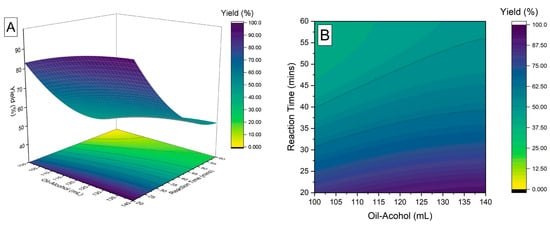
As shown in Table 1 and Figure 3, the highest liquid hydrocarbon yield (96%) was achieved at a 1:6 oil-to-methanol ratio and a 20 min reaction time. This result highlights the efficacy of supercritical methanol in promoting rapid conversion [7], which is noted for its efficiency at these operating temperatures [12]. Lower methanol ratios resulted in lower yields, likely due to insufficient reaction.
Table 1.
Liquid hydrocarbon yields supercritical non-catalytic transesterification of pyrolytic oil from SCG.
Figure 3.
(A) 3D surface plot of oil-alcohol ratio and residence time vs. yield (%) and (B) contour plot of oil-alcohol ratio and residence time.
ANOVA (Table 2) confirmed that both the oil-to-methanol ratio (Factor A) and reaction time (Factor B) are statistically significant (p < 0.05), with no significant interaction between them. The model’s high R-squared value (99.65%) indicates a strong fit to the experimental data.
Table 2.
ANOVA, model summary and optimal solution on supercritical non-catalytic transesterification of pyrolytic oil from SCG.
The predictive equation for the yield is given as
Yield (%) = 22.6 + 1.746A − 3.208B − 0.00604A2 + 0.02583B2 + 0AB.
The high yield is attributed to supercritical methanol’s enhanced diffusivity and miscibility, which facilitates rapid molecular breakdown [5]. The sharp decline in liquid yield (96% at 20 min to 50% at 60 min) confirms the occurrence of thermal degradation, consistent with supercritical processing literature [12,14]. Prolonged exposure promotes the secondary cracking of hydrocarbons into non-condensable gases, reducing liquid recovery and highlighting the necessity of precise residence time control [8]. This behavior is statistically corroborated by the ANOVA, where reaction time emerged as the dominant factor (F-value = 754.11), validating the experimental trends against established kinetic principles regarding thermal decomposition and mass transfer equilibrium [8,14]. Furthermore, residual analysis confirmed that the data followed a normal distribution with constant variance, satisfying the underlying assumptions of the ANOVA model and ensuring the validity of the optimization despite the limited degrees of freedom.
The achieved 96% yield aligns with supercritical benchmarks, such as the 95% conversion reported by Faizi (2019) [15], yet was achieved at a significantly milder temperature (239 °C). This efficiency is attributed to the preparatory pyrolysis step, which pre-cracks heavy triglycerides into lighter reactive intermediates, facilitating rapid esterification compared to conventional catalytic methods [16].
3.3. Physicochemical Characterization of the Produced Liquid Hydrocarbons
The physicochemical properties of the liquid hydrocarbon product are summarized in Table 3. The product’s density (0.7557 g/cm3) was comparable to standard diesel (0.86 g/cm3) [17], while its viscosity (0.7297 cSt) was significantly lower. The flash point (32 °C) was slightly below the standard, and the cetane index (28.2) was lower, suggesting a need for potential upgrading or blending. Critically, the Higher and Lower Heating Values (46.86 MJ/kg and 43.77 MJ/kg, respectively) exceeded those of standard diesel, confirming the product’s high energy content. Distillation analysis revealed a wide boiling range, confirming a complex hydrocarbon mixture.
Table 3.
Physicochemical properties of standard fuel and SCG liquid hydrocarbon product.
The significant viscosity reduction to 0.7297 cSt serves as the primary indicator of successful conversion, confirming the cleavage of triglycerides into lighter esters and hydrocarbons without requiring complex molecular speciation. However, the calculated Cetane Index (28.2) falls below the ASTM standard (40) due to the presence of aromatics inherent to pyrolytic oil. While unsuitable as a neat fuel for high-speed engines, the product demonstrates significant potential as a blending component (e.g., B10/B20), a fuel for stationary power generation, or a candidate for quality enhancement Via cetane improvers.
3.4. Mechanistic Insights into Non-Catalytic Supercritical Transesterification
The uniqueness of this pathway stems from the supercritical state of methanol (T > 239 °C, p > 8.09 MPa). Unlike conventional immiscible systems, the experimental conditions (239 °C, 1200 psi) create a homogeneous single phase, eliminating mass transfer resistance and explaining the rapid 20 min reaction time [15]. Additionally, the reduced dielectric constant enables effective solvation of the complex pyrolytic oil [18]. Chemically, the high gravimetric yield (96%) confirms that free fatty acids were successfully converted via simultaneous esterification (Equation (4)) rather than lost as soap [19]. Furthermore, the absence of a glycerol phase and the low product density (0.7557 g/cm3) provide evidence of glycerol etherification (Equation (5)), effectively upgrading the entire mixture into liquid hydrocarbons [20].
C3H5(OH)3 + 3CH3OH = C3H5(OCH3)3 + 3H2O
RCOOH + CH3OH = RCOOCH3 + H2O
3.5. Evaluation of the Cascading Valorization Approach for SCG Utilization
This two-step cascading valorization strategy maximizes resource recovery from SCG [21]. Pyrolysis first converts the solid waste into a manageable liquid intermediate, which is then upgraded into a high-value liquid hydrocarbon fuel. This approach offers higher value addition than direct combustion or composting [22] and simplifies processing by eliminating the catalyst separation steps required in conventional transesterification. While the process requires significant capital investment for high-pressure equipment [23], it avoids ongoing catalyst costs. A full techno-economic analysis is required to assess commercial viability.
3.6. Advancing Circularity in Waste Management and the Broader Implications of SCG Valorization
Process feasibility relies on offsetting solvent costs (1:6 ratio) through >90% methanol recovery via flash evaporation [16], while safety at 1200 psi is ensured by SS-316 ASME-compliant vessels. Environmentally, this pathway exemplifies circular economy principles by converting waste into high-density fuel and biochar, minimizing landfill methane emissions [24,25,26]. The process eliminates toxic catalytic sludge, utilizes closed-loop methanol recycling, and employs biochar as a carbon sink, potentially achieving a carbon-negative lifecycle [27].
4. Conclusions
This research successfully demonstrates a novel circular waste-to-energy pathway for SCG by integrating pyrolysis with non-catalytic supercritical transesterification. While pyrolysis of wet SCG produced a moderate 8% oil yield, it served as a crucial preparatory stage for the highly effective upgrading process.
The non-catalytic supercritical transesterification proved remarkably efficient. Statistical optimization identified that a 1:6 oil-to-methanol ratio and a 20 min reaction time achieved an exceptional 96% conversion to liquid hydrocarbons. The resulting product exhibited promising fuel properties, with a density and heating value comparable to conventional diesel, though its lower viscosity and cetane index suggest a need for further refinement.
This cascading valorization model provides a blueprint for a circular economy, transforming a waste stream into a valuable resource. The non-catalytic nature of the supercritical process simplifies the system, potentially lowering operational costs and environmental impacts. While further techno-economic and lifecycle assessments are needed, this study establishes a technically viable foundation for developing waste-to-energy technologies that simultaneously address waste management and the need for renewable energy.
Author Contributions
Conceptualization, E.J.B., J.B. (Joana Batistil), B.A.C., E.O., N.M.R., J.B. (Jayson Binay), R.R. and R.V.R.; methodology, E.J.B., J.B. (Joana Batistil), B.A.C., E.O. and N.M.R.; validation, E.J.B., J.B. (Joana Batistil), B.A.C., E.O., N.M.R., J.B. (Jayson Binay), R.R. and R.V.R.; formal analysis, E.J.B., J.B. (Joana Batistil), B.A.C., E.O. and N.M.R.; investigation, E.J.B., J.B. (Joana Batistil), B.A.C., E.O. and N.M.R.; data curation, E.J.B., J.B. (Joana Batistil), B.A.C., E.O., N.M.R., J.B. (Jayson Binay), R.R. and R.V.R.; writing—original draft preparation, E.J.B., J.B. (Joana Batistil), B.A.C., E.O. and N.M.R.; writing—review and editing, J.B. (Jayson Binay), R.R., R.V.R. and R.J.P.L.; visualization, E.J.B., J.B. (Joana Batistil), B.A.C., E.O., N.M.R. and R.J.P.L.; supervision, J.B. (Jayson Binay), R.R. and R.V.R.; project administration, J.B. (Jayson Binay), R.R. and R.V.R. All authors have read and agreed to the published version of the manuscript.
Funding
This research received no external funding.
Institutional Review Board Statement
Not applicable.
Informed Consent Statement
Not applicable.
Data Availability Statement
The authors declare that the data supporting the findings of this study are available within the paper. Should any raw data files be needed in another format they are available from the corresponding author upon reasonable request.
Conflicts of Interest
The authors declare no conflicts of interest.
References
- Latiza, R.J.P.; Rubi, R.V. Circular Economy Integration in 1G + 2G Sugarcane Bioethanol Production: Application of Carbon Capture, Utilization and Storage, Closed-Loop Systems, and Waste Valorization for Sustainability. Appl. Sci. Eng. Prog. 2025, 18, 7448. [Google Scholar]
- Milanković, V.; Tasić, T.; Pašti, I.A.; Lazarević-Pašti, T. Resolving Coffee Waste and Water Pollution—A Study on KOH-Activated Coffee Grounds for Organophosphorus Xenobiotics Remediation. J. Xenobiotics 2024, 14, 1238–1255. [Google Scholar] [CrossRef] [Scilit] [PubMed]
- Ko, H.; Lee, M.; Choi, J.; Oh, S. Effect of Temperature and Heating Rate on Pyrolysis Characteristics of Spent Coffee Grounds. Korean J. Chem. Eng. 2025, 42, 2853–2864. [Google Scholar] [CrossRef] [Scilit]
- Yusuf, B.O.; Oladepo, S.A.; Ganiyu, S.A. Efficient and Sustainable Biodiesel Production via Transesterification: Catalysts and Operating Conditions. Catalysts 2024, 14, 581. [Google Scholar] [CrossRef] [Scilit]
- Musa, I.A. The effects of alcohol to oil molar ratios and the type of alcohol on biodiesel production using transesterification process. Egypt. J. Pet. 2016, 25, 21–31. [Google Scholar] [CrossRef] [Scilit]
- Marulanda, V.F. Biodiesel production by supercritical methanol transesterification: Process simulation and potential environmental impact assessment. J. Clean. Prod. 2012, 33, 109–116. [Google Scholar] [CrossRef] [Scilit]
- Ceran, Z.D.; Demir, V.; Akgün, M. Optimization and kinetic study of biodiesel production from Jatropha curcas oil in supercritical methanol environment using ZnO/γ-Al2O3 catalyst. Biomass Convers. Biorefinery 2024, 15, 3903–3914. [Google Scholar] [CrossRef] [Scilit]
- Vibhakar, C.; Sabeenian, R.S.; Kaliappan, S.; Patil, P.Y.; Patil, P.P.; Madhu, P.; Dhanalakshmi, C.S.; Birhanu, H.A. Production and Optimization of Energy Rich Biofuel through Co-Pyrolysis by Utilizing Mixed Agricultural Residues and Mixed Waste Plastics. Adv. Mater. Sci. Eng. 2022, 2022, 8175552. [Google Scholar] [CrossRef] [Scilit]
- Kwao-Boateng, E.; Ankudey, E.G.; Darkwah, L.; Danquah, K.O. Assessment of Diesel Fuel Quality. Heliyon 2024, 10, e24733. [Google Scholar] [CrossRef] [Scilit]
- Atabani, A.; Ali, I.; Naqvi, S.R.; Badruddin, I.A.; Aslam, M.; Mahmoud, E.; Almomani, F.; Juchelková, D.; Atelge, M.; Khan, T.Y. A state-of-the-art review on spent coffee ground (SCG) pyrolysis for future biorefinery. Chemosphere 2022, 286, 131730. [Google Scholar] [CrossRef] [Scilit] [PubMed]
- Yu, X.; Zhang, L.; Dong, Z.; Ming, H.; Xiao, Y.; Fan, Q.; Yang, C.; Cheng, L. Co-hydrothermal conversion of kitchen waste and agricultural solid waste biomass components by simple mixture: Study based on bio-oil yield and composition. J. Anal. Appl. Pyrolysis 2024, 180, 106557. [Google Scholar] [CrossRef] [Scilit]
- Pan, X.; Wu, S.; Chen, J.; Zhou, X.; Chen, X.; Xin, Z.; Ding, P.; Xiao, R. Toward Efficient Biofuel Production: A Review of Online Upgrading Methods for Biomass Pyrolysis. Energy Fuels 2024, 38, 19414–19441. [Google Scholar] [CrossRef] [Scilit]
- Ullah, Z.; Bustam, M.A.; Ullah, M.; Rashid, M.U.; Khan, A.S.; Shah, S.N.; Shah, M.U.H.; Ahmad, P.; Sohail, M.; Khan, K.A. Unveiling Biodiesel Production: Exploring Reaction Protocols, Catalysts, and Influential Factors. ChemBioEng Rev. 2024, 11, e202400028. [Google Scholar] [CrossRef] [Scilit]
- Wang, F.; Peng, W.; Zeng, X.; Sun, D.; Cui, G.; Han, Z.; Wang, C.; Xu, G. Insight into staged gasification of biomass waste: Essential fundamentals and applications. Sci. Total Environ. 2024, 953, 175954. [Google Scholar] [CrossRef] [Scilit]
- Faizi, M.K.; Shahriman, A.B.; Majid, M.S.A.; Rahman, M.N.M.A.; Shamsul, B.M.T.; Ng, Y.G.; Razlan, Z.M.; Wan, W.K.; Hashim, M.S.M.; Rojan, M.A. The Physical Properties Observation of Oil Palm Empty Fruit Bunch (OPEFB) Chemical Treated Fibres. IOP Conf. Ser. Mater. Sci. Eng. 2019, 670, 012055. [Google Scholar] [CrossRef] [Scilit]
- Chuah, L.F.; Klemeš, J.J.; Yusup, S.; Bokhari, A.; Akbar, M.M.; Chong, Z.K. Kinetic Studies on Waste Cooking Oil into Biodiesel via Hydrodynamic Cavitation. J. Clean. Prod. 2017, 146, 47–56. [Google Scholar] [CrossRef] [Scilit]
- Zhang, X.; Feng, X.; Tao, G.; Guo, R.; Xu, J. Flammability limits of methanol/methacrolein mixed vapor under elevated temperatures and pressures. J. Loss Prev. Process Ind. 2024, 90, 105342. [Google Scholar] [CrossRef] [Scilit]
- Vardon, D.R.; Moser, B.R.; Zheng, W.; Witkin, K.; Evangelista, R.L.; Strathmann, T.J.; Rajagopalan, K.; Sharma, B.K. Complete utilization of spent coffee grounds to produce biodiesel, bio-oil, and biochar. ACS Sustain. Chem. Eng. 2013, 1, 1286–1294. [Google Scholar] [CrossRef] [Scilit]
- Ilham, Z.; Saka, S. Dimethyl carbonate as potential reactant in non-catalytic biodiesel production by supercritical method. Bioresour. Technol. 2009, 100, 1793–1796. [Google Scholar] [CrossRef] [Scilit]
- Glisic, S.B.; Orlovic, A.M. Review of biodiesel synthesis from waste oil under elevated pressure and temperature: Phase equilibrium, reaction kinetics, process design and techno-economic study. Renew. Sustain. Energy Rev. 2014, 31, 708–725. [Google Scholar] [CrossRef] [Scilit]
- Corrado, I.; Argenziano, R.; Borselleca, E.; Moccia, F.; Panzella, L.; Pezzella, C. Cascade disassembling of spent coffee grounds into phenols, lignin and fermentable sugars en route to a green active packaging. Sep. Purif. Technol. 2024, 334, 125998. [Google Scholar] [CrossRef] [Scilit]
- Iakovou, G.; Ipsakis, D.; Triantafyllidis, K.S. Kraft lignin fast (catalytic) pyrolysis for the production of high value-added chemicals (HVACs): A techno-economic screening of valorization pathways. Environ. Res. 2024, 248, 118205. [Google Scholar] [CrossRef] [Scilit] [PubMed]
- Ahmed, H.; Abolore, R.S.; Jaiswal, S.; Jaiswal, A.K. Toward Circular Economy: Potentials of Spent Coffee Grounds in Bioproducts and Chemical Production. Biomass 2024, 4, 286–312. [Google Scholar] [CrossRef] [Scilit]
- Yusufoğlu, B.; Kezer, G.; Wang, Y.; Ziora, Z.M.; Esatbeyoglu, T. Bio-recycling of spent coffee grounds: Recent advances and potential applications. Curr. Opin. Food Sci. 2024, 55, 101111. [Google Scholar] [CrossRef] [Scilit]
- Latiza, R.J.P.; Mustafa, A.; Reyes, K.D.; Nebres, K.L.; Abrogena, S.L.; Rubi, R.V. Optimization, characterization, reversible thermodynamically favored adsorption, and mechanistic insights into low-cost mesoporous Fe-doped kapok fibers for efficient caffeine removal from water. Sep. Sci. Technol. 2025, 60, 1643–1658. [Google Scholar] [CrossRef] [Scilit]
- Latiza, R.J.P.; Olay, J.; Eguico, C.; Yan, R.J.; Rubi, R.V. Environmental applications of carbon dots: Addressing microplastics, air and water pollution. J. Hazard. Mater. Adv. 2025, 17, 100591. [Google Scholar] [CrossRef] [Scilit]
- Saka, S.; Kusdiana, D. Biodiesel fuel from rapeseed oil as prepared in supercritical methanol. Fuel 2001, 80, 225–231. [Google Scholar] [CrossRef] [Scilit]

Disclaimer/Publisher’s Note: The statements, opinions and data contained in all publications are solely those of the individual author(s) and contributor(s) and not of MDPI and/or the editor(s). MDPI and/or the editor(s) disclaim responsibility for any injury to people or property resulting from any ideas, methods, instructions or products referred to in the content. |
© 2026 by the authors. Licensee MDPI, Basel, Switzerland. This article is an open access article distributed under the terms and conditions of the Creative Commons Attribution (CC BY) license (https://creativecommons.org/licenses/by/4.0/).