
Proceeding Paper

Determination of Pesticide Residues in Drinking Water Using the LC-MS/MS Method and Evaluation of the Results for 2023 and 2024 †

by
Miroslava Kuzniarová
1,2,*,
Milena Dömötörová
1,
Martina Micháliková
1 and
Zuzana Lukačovičová
1
1
Public Health Authority of the Slovak Republic, National Reference Center for Pesticide Residues, Trnavská Street 52, 826 45 Bratislava, Slovakia
2
Department of Analytical Chemistry, Faculty of Natural Sciences, Comenius University in Bratislava, Ilkovičova 6, 842 15 Bratislava, Slovakia
*
Author to whom correspondence should be addressed.
Presented at the 1st International Online Conference on Separations, 15–17 October 2025; Available online: https://sciforum.net/event/IOCS2025.
Chem. Proc. 2025, 19(1), 3; https://doi.org/10.3390/chemproc2025019003
Published: 20 January 2026
(This article belongs to the Proceedings of The 1st International Online Conference on Separations)

Abstract

This study focuses on the determination of pesticide residues in drinking water in Slovakia using the LC-MS/MS method, covering a target list of approximately 90 pesticides selected according to the national drinking water risk assessment. The aim of monitoring is to screen the presence of pesticide substances in various water supply systems and to gain experience for setting higher-quality criteria for the control of drinking water. Drinking water samples were collected in 2023, 2024 and 2025 within the National Monitoring Project of the Presence of Pesticides in Public Water Supplies, including both Large-Supply Areas (>5000 inhabitants—2023) and Small-Supply Areas (500–5000 inhabitants—2024, 2025). A total of 211 samples were measured and evaluated in 2023, compared with 199 samples in 2024. This article presents the evaluation of results for 2023 and 2024, while data for 2025 will be assessed in 2026. The findings contribute to the improved surveillance and quality control of drinking water.

1. Introduction

The continuous release of pesticides into the environment and their effects on living organisms make them one of the major concerns in water pollution. Pesticides are significant pollutants in drinking water, posing potential risks to both the environment and human health.
A pesticide is a commercial product placed on the market mainly made up of one or more active substances, along with other ingredients that improve its effectiveness and protect the treated plants. Pesticides are a large group of chemical substances used to kill, repel, or control harmful organisms. They are used to protect crops and plants from pests, diseases, and weeds, helping to increase agricultural productivity and ensure food security. They help reduce crop losses and improve the quality and quantity of food production [1].
The current wording of the legal regulations governing the requirements for drinking water quality in Slovakia does not provide detailed criteria for the control of pesticide substances. The monitoring of pesticides in drinking water is regulated by Act No. 355/2007 Coll. on the Protection, Support, and Development of Public Health [2], and by Decree No. 91/2023 Coll. of the Ministry of Health of the Slovak Republic, which establishes indicators and limit values for drinking water and hot water quality, procedures for drinking water monitoring, risk management of water supply systems, and risk management of domestic distribution systems [3].
According to legislation, only pesticides whose presence can be reasonably expected should be monitored. The limit value for each active substance and their relevant metabolite is set at 0.1 μg/L and 0.5 μg/L for the sum of pesticide residues. Besides the parent active substances, numerous pesticide metabolites occur in the environment as a result of the degradation or chemical transformation of active substances. Pesticide metabolites are classified as relevant—posing a risk comparable to or higher than that of the parent substance, with limit set at 0.1 μg/L—or as irrelevant, in which case they do not represent a significant risk, with limits set between 1 and 6 μg/L [4,5]. The relevance of metabolites is assessed during the approval process of the active substance. A list of pesticides and the relevance of their analyzable metabolites in drinking water is published on the website of the Public Health Authority of the Slovak Republic [6].
Monitoring of pesticide residues in drinking water requires analytical procedures capable of detecting compounds at very low concentrations. Therefore, methods with high sensitivity, accuracy, and reproducibility must be employed. In this study, high-performance liquid chromatography coupled with tandem mass spectrometry (LC-MS/MS) was used for the determination of pesticide residues. The materials and analytical procedures are described in the following section.

2. Materials and Methods

2.1. Apparatus and Reagents

The liquid chromatography–tandem mass spectrometry (LC-MS/MS) method was developed at the National Reference Center for Pesticide Residues at the Public Health Authority of the Slovak Republic using a SCIEX Triple Quadrupole 6500+ system (SCIEX, Framingham, MA, USA) equipped with a Turbo V™ ion source and electrospray ionization (ESI), integrated with an ExionLC™ system (SCIEX, Framingham, MA, USA). Data acquisition was performed using Analyst software (SCIEX, Framingham, MA, USA, version 1.7.2). Detection was carried out in both positive- and negative-ion modes with scheduled multiple reaction monitoring (sMRM). The certified standards of all pesticides (each standard was weighed individually and then a mixed solution was prepared, from which working solutions of the required concentrations were made) listed in Table 1 were purchased from HPC Standards GmbH (accredited by DAkkS, Cramlington, Northumberland, United Kingdom) or LGC Standards Ltd. (accreditated by DAkkS, Teddington, Middlesex, United Kingdom).
Details of the LC and MS/MS conditions are provided below, in Table 2, Table 3 and Table 4.
Methanol (LC-MS grade) used for chromatography was obtained from VWR BDH Chemical (Gdansk, Poland). Formic acid (≥98%, for LC–MS/MS) was obtained from Honeywell Research Chemicals (Fluka™) (Seelze, Germany). Ultra-pure water was produced using a Thermo GenPure Werner purification system (Thermo Fisher Scientific, Waltham, MA, USA).

2.2. Samples and Sample Pretreatment

Drinking water samples were directly filtered, which represented the only sample pretreatment step. Nylon membrane filters with a pore size of 0.22 μm and a diameter of 25 mm (AZ-CF-NYL-25-022, supplied by AZ Chrom s.r.o., Bratislava, Slovakia) and hydrophilic PTFE (H-PTFE) filters with a pore size of 0.22 μm (AZ-CF-HPTFE-25-022, supplied by AZ Chrom s.r.o., Bratislava, Slovakia) were used for filtration.

2.3. Preparation of Blank, Calibration Solutions and Solution for Recovery

Deionized water (Werner) was used as a blank sample, and the samples spiked with the group of pesticides and their metabolites for recovery determination purposes were filtered through both a nylon filter and H-PTFE filters. Recoveries were obtained for concentrations corresponding to the limits at a concentration of 0.1 μg/L. For calibration solutions, the blank sample was spiked with the group of pesticides and their metabolites listed in Table 1 at five levels: 25 ng/L, 50 ng/L, 100 ng/L, 200 ng/L and 400 ng/L. No internal standards were used in this study.

3. Results

3.1. Validation and/or Verification of Method for Pesticide Residues

In Table 1, active substances and their relevant or irrelevant metabolites are presented, together with their limits, accreditation status, blank responses to the lowest calibration level (25 ng/L), correlation coefficients, quality control results, and recoveries obtained using different types of filters.
Most pesticides showed no response in the blank samples; however, a few compounds—2,6-dichlorobenzamide, Acetochlor OA, Alachlor OA, Atrazine, Atrazine-2-hydroxy, and Azoxystrobin (free acid)—exhibited minor blank responses, still below the acceptance criterion of 30%. Correlation coefficients ranged from 0.9958 to 1.000. The quality control (QC) solution at a concentration of 100 ng/L is the same solution as that at the third level of the calibration curve and was measured at the end of each sequence to verify the stability of analytes during measurement. The acceptance criteria of 80–120% were fulfilled for all analytes. Acceptance criteria were adopted from the SANTE/11312/2021 guideline for the determination of pesticide residues in baby food [7].
The recovery solution was prepared in the same manner as the QC and calibration solution at 100 ng/L, with the only difference being that it was filtered through the same filter as the samples were to ensure that no losses of analytes occurred during filtration (a few milliliters was discarded to saturate the filter).
In previous analyses, drinking water samples were pretreated by filtration through nylon filters; however, during the development of our method, it was found that many pesticides were absorbed by nylon filters—up to 100% in some cases. Experimental research identified H-PTFE filters as more suitable, although four pesticides (Diflufenican, Dimetachlor, Chlorpyrifos, and Pendimethalin in Table 1) were still partially absorbed (35–67%). Fortunately, none of these pesticides were detected in the analyzed samples. In the case of future positive findings, calibration solutions will be filtered and compared with the samples to ensure data reliability.
In the future, the National Reference Center for Pesticide Residues will aim to identify a more suitable filter type or another appropriate sample pretreatment method.

3.2. Samples Determination

During the past few years (2023, 2024, 2025), lots of samples from different types of areas were analyzed to ensure appropriate quality control of drinking water according to the National Monitoring Project of the Presence of Pesticides in Drinking Water in Public Water Supplies.
Drinking water samples were collected by regional public health authorities. Sampling sites mainly included areas with agricultural activity, but also sources near golf courses, environmental burdens, areas with previously identified exceedances of pesticide concentrations, and regions with the highest amounts of pesticide use. Priority was given to sampling from facilities such as kindergartens and primary schools, social service homes, municipal offices, shops, etc., while also considering the various types of water sources and disinfection treatments used.
The first phase of the project (2023) focused on supplied areas with the status of LSA (“Large Supply Area”—supplying more than 5000 inhabitants). In 99 LSAs, a total of 211 drinking water samples were collected and 16,088 analytes were examined; pesticides above the limit of detection were found in 171 cases (0.105% of all measured analytes). The results of Phase I are detailed in the paper “Results of Monitoring Pesticide Substances in Drinking Water in Slovakia in 2023” [8].
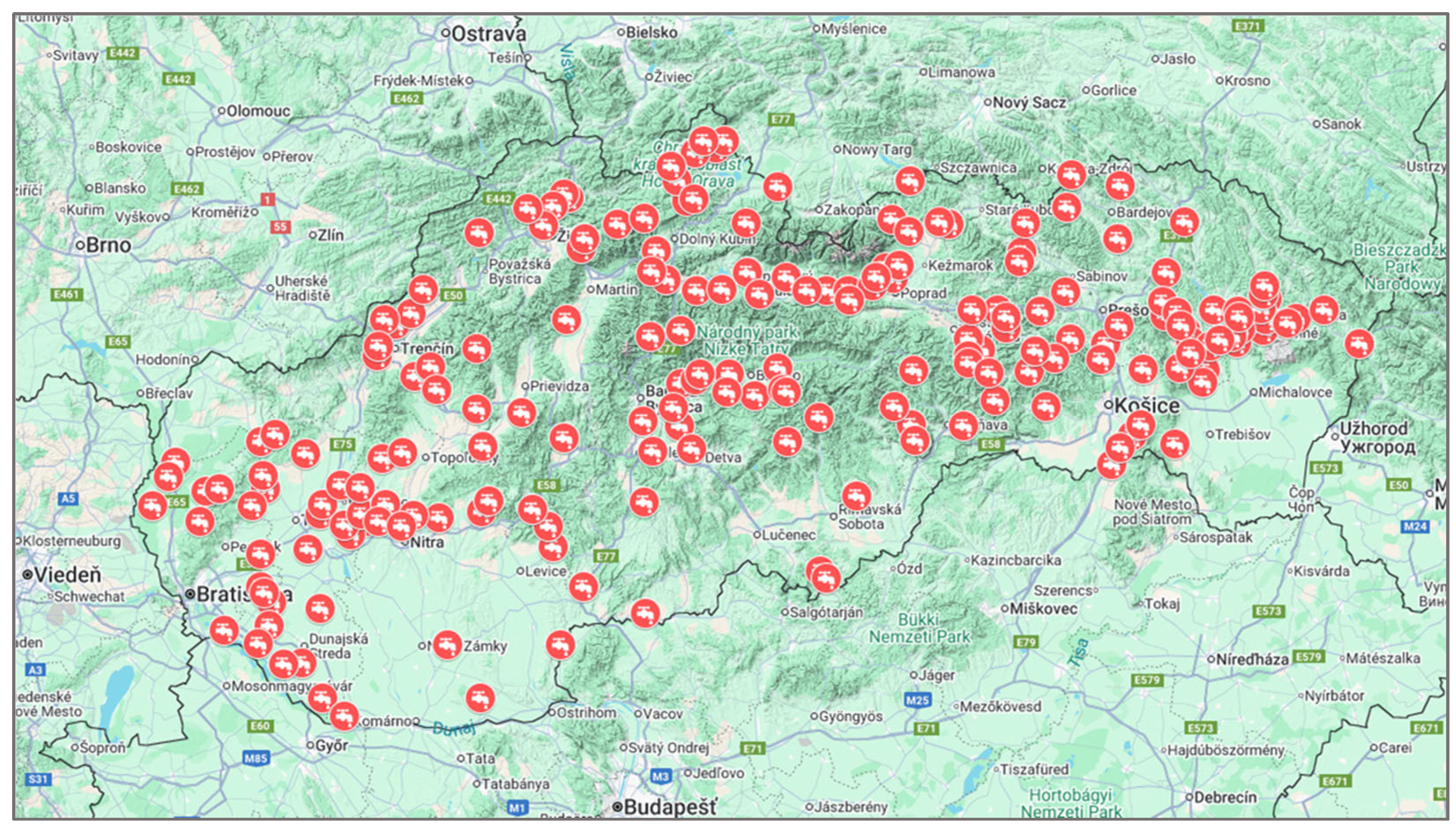
The second phase of the project (2024) involved continued monitoring in areas with the status of SSA (“Small Supply Area”—supplying 500 to 5000 inhabitants, see Figure 1)—Category IV (500 to 2000 inhabitants) and Category V (2000 to 5000 inhabitants). Analyses of pesticide substances were supplemented with monitoring of disinfection by-products and ecotoxicological tests. In 53 SSAs in Category V and 47 SSAs in Category IV, a total of 199 drinking water samples were collected. In 23.6% of samples, one or more pesticide substances above the limit of detection were identified [9].
The third phase of the project (2025) will continue in the second half of 2025 with the monitoring of pesticides in additional SSAs.

4. Discussion

In 2023, a total of 211 drinking water samples were collected, and pesticides above the limit of detection were found in 171 cases (0.105% of all measured analytes). Screening of drinking water in LSAs in 2023 revealed only seven active substances (Prochloraz, Azoxystrobin, Atrazine, Prometrin, S-metolachlor, Chloridazon, and Bentazon); of these, three active substances were no longer used in plant protection products as of 31 December 2023: Atrazine (authorized in Slovakia until 9 September 2005), Prometrin (authorized until 31 December 2007), and Chloridazon (authorized until 9 June 2022). Atrazine was the most frequently detected active substance (61.9%). Metabolites occurred more frequently than active substances (in up to 87.8% of detections).
Among the metabolites, non-relevant metabolites predominated (71.3% of cases)—most frequently Metolachlor ESA (42% of cases); among the relevant metabolites, Desethyl-desisopropyl-atrazine was most frequently detected (42.9%).
Only 0.012% of all detected results (2 values out of 16,088 determinations) exceeded the limit value of 0.1 µg/L established by the Decree of the Ministry of Health of the Slovak Republic No. 91/2023 Coll. [3]; these were the relevant metabolites Acetochlor ESA and Desethylatrazine.
For Acetochlor ESA, the resulting value for the first drinking water sampling performed on 13 July 2023 was 0.107 µg/L, and for the second control drinking water sampling performed on 27 September 2023, the value was 0.110 µg/L. The limit exceedance was confirmed. The Regional Public Health Authority informed the drinking water supplier, who carried out the sampling on 24 October 2023 and 20 November 2023, with results of 0.089 µg/L and 0.092 µg/L, both being within the acceptable limit. A report was submitted to the State Water Administration Authority, the District Environmental Office in Senica, and an investigation was carried out. The use of products that could have been the source of the metabolite contamination was discontinued.
For Desethylatrazine, the resulting value for the first drinking water sampling performed on 27 November 2023 was 0.227 µg/L, and for the second controlling drinking water sampling performed on 2 January 2024, the value was 0.307 µg/L. The limit exceedance was confirmed. As a result of the investigation, the Regional Public Health Authority informed the drinking water supplier, and on 11 January 2024, a ban on the use of drinking water for drinking, cooking, and food preparation was issued for the water source, which was deemed unsafe according to §12(2)(i) of Act No. 355/2007 Coll. The non-compliant water source was taken out of operation and replaced by an alternative water source.
The monitoring confirmed a favorable situation regarding the occurrence of pesticide substances in LSAs [8,9].
In 2024, a total of 77 pesticide substances were analyzed in 199 samples. At least one pesticide was detected above the limit of detection (LOD) in 47 samples (23.6% of samples). In 38 samples (19.1%), one or more pesticides were detected above the limit of quantitation (LOQ). In 15 samples, three or more pesticides were detected, and in another 3 samples, five pesticides were detected.
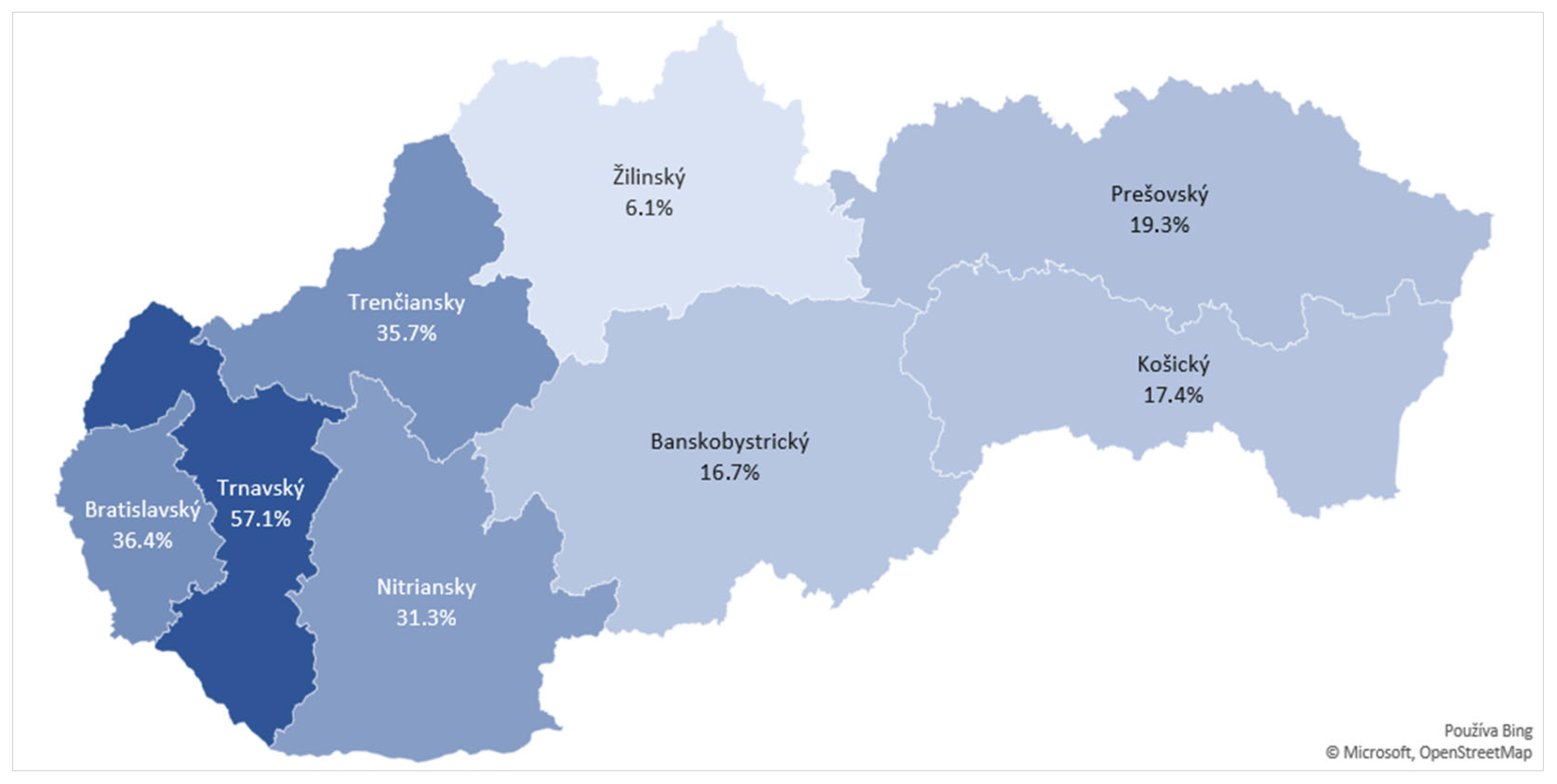
The highest detection rates in 2024 were recorded in the Trnava region (51.1%), followed by Bratislava (36.4%), Trenčín (35.7%), and Nitra (31.3%) (see Figure 2).
The most frequently detected substances in 2024 were Chloridazon metabolites (Chloridazon-desphenyl in 12.6% and Chloridazon-methyl-desphenyl in 6.0% of samples). The active substance Chloridazon was found in only one sample. Atrazine, the most commonly detected active ingredient, was found in 5.0% of samples. Although these substances are no longer approved in the EU, their presence is likely due to their persistence in the environment.
In none of the analyzed samples was the parametric value (0.1 µg/L for individual pesticides or 0.5 µg/L for the sum of pesticides) exceeded. The highest concentrations were observed for Chloridazon-desphenyl, reaching 1.31 µg/L; however, as an irrelevant metabolite according to the decision of the Chief Hygienist of the Slovak Republic (No. OHŽP/430/89726/2019), it has a maximum limit of 6 µg/L [5]. The compounds closest to the parametric value were Atrazine-desethyl (0.098 µg/L), Chlorsulfuron (0.077 µg/L), and Atrazine (0.074 µg/L) [9].

5. Conclusions

This validated LC-MS/MS method provides a powerful tool for the routine, high-throughput monitoring of pesticide residues in drinking water. Its high sensitivity and selectivity allow for the reliable detection of trace levels of pesticides and their metabolites, meeting current regulatory requirements.
In 2023, screening of drinking water in LSAs revealed seven active substances (Prochloraz, Azoxystrobin, Atrazine, Prometrin, S-metolachlor, Chloridazon, and Bentazon). Atrazine was the most frequently detected active substance (61.9%). Metabolites occurred more frequently than active substances (in up to 87.8% of detections).
Among the metabolites, non-relevant metabolites predominated (71.3% of cases)—most frequently Metolachlor ESA (42% of cases); among the relevant metabolites, Desethyl-desisopropyl-atrazine was most frequently detected (42.9%). Only two of all detected results exceeded the limit value of 0.1 µg/L; these were the relevant metabolites Acetochlor ESA and Desethylatrazine [8].
Importantly, no sample exceeded the legal limits for drinking water in 2024. The highest concentrations were observed for Chloridazon-desphenyl, reaching 1.31 µg/L; however, it has a maximum limit of 6 µg/L [5]. The compounds with values closest to the parametric value were Atrazine-desethyl (0.098 µg/L), Chlorsulfuron (0.077 µg/L), and Atrazine (0.074 µg/L) [9].
The results for 2025 will be evaluated in 2026 and presented in the next publication. For now, it cannot be stated that the decreasing occurrence of active substances and their metabolites observed in 2023 and 2024 will continue as a trend, due to the differences in water supply systems, even if they are located in the same geographical region.

Author Contributions

Conceptualization, M.K.; Methodology, M.D.; Validation or verification, M.K., M.D., M.M. and Z.L.; Formal Analysis, M.D.; Investigation, M.D.; Resources, M.K.; Data Curation, M.D.; Writing—Original Draft Preparation, M.K.; Writing—Review and Editing, M.D.; Visualization, M.K.; Supervision, M.D. All authors have read and agreed to the published version of the manuscript.

Funding

This research received no external funding.

Institutional Review Board Statement

Not applicable.

Informed Consent Statement

Not applicable.

Data Availability Statement

The raw data supporting the conclusions of this article are confidential and will be made available by the authors on request.

Conflicts of Interest

The authors declare no conflicts of interest.

References

  1. Available online: https://food.ec.europa.eu/plants/pesticides_en (accessed on 8 November 2025).
  2. Available online: https://www.slov-lex.sk/ezbierky/pravne-predpisy/SK/ZZ/2007/355/ (accessed on 8 November 2025).
  3. Ministry of Health of the Slovak Republic. Decree No. 91/2023 Coll. on Indicators and Limit Values of Drinking Water Quality. Available online: https://www.slov-lex.sk/pravne-predpisy/SK/ZZ/2023/91/ (accessed on 8 November 2025).
  4. Available online: https://food.ec.europa.eu/system/files/2016-10/pesticides_ppp_app-proc_guide_fate_metabolites-groundwtr.pdf (accessed on 8 November 2025).
  5. Available online: https://www.uvzsr.sk/documents/41637/141899/Rozhodnutie_pre_vybrane_nerelevantne_metabolity_pesticidov.pdf/ac7e3fe2-bed2-348d-15ad-93bb410afe01?t=1659890973238 (accessed on 8 November 2025).
  6. Public Health Authority of the Slovak Republic. List of Pesticides and Relevance of Their Metabolites to Be Analyzed in Drinking Water. Available online: https://www.uvzsr.sk/documents/41637/123252/Pesticidy_Zoznam.pdf/a0973c8f-9b70-0dce-ad65-fd0b68d52980?t=1659284813091 (accessed on 8 November 2025).
  7. Available online: https://food.ec.europa.eu/document/download/d4786faf-c574-4222-a5c6-45086b3920b8_en?filename=pesticides_mrl_guidelines_wrkdoc_2021-11312.pdf (accessed on 8 November 2025).
  8. Valovičová, Z.; Jatzová, K. Results of Monitoring Pesticide Substances in Drinking Water in Slovakia in 2023. In Proceedings of the XIX. Conference Drinking Water, Tábor, Czech Republic, 3–6 June 2024; pp. 78–84. [Google Scholar]
  9. Pálešová, N.; Valovičová, Z. When Less Is More: Monitoring of Pesticide Substances in Drinking Waters in Slovakia. In Proceedings of the XX. conference Drinking water, Tále, Slovakia, 30 September–2 October 2025; pp. 37–54, ISBN 978-80-570-6804-4. [Google Scholar]
Figure 1. Sampling sites of the screening study on the presence of pesticides in drinking water from public water supplies in small-supply zones in Slovakia; second phase, 53 SSAs in Category V and 47 SSAs in Category IV in 2024. Reprinted with permission from Ref. [9]. Copyright 2026 Nina Pálešová.
Chemproc 19 00003 g001
Figure 2. Incidence of positive samples (pesticide residues above the limit of detection) stratified by Slovak region in the second phase in 2024. Shades of blue indicate pesticide occurrence by region, from darkest (highest, Trnava region 57.1%) to lightest (lowest, Žilina region 6.1%). Reprinted with permission from Ref. [9]. Copyright 2026 Nina Pálešová.
Chemproc 19 00003 g002
Table 1. Determined pesticides divided into groups according to active substance or metabolite: black bold—active substance; red—relevant metabolite; green—irrelevant metabolite; black—metabolite not further specified (evaluation of statistics from calibration solution; partial data from 2025).
Pesticide μg/L
(LOD 0.020) (LOQ 0.025)
Active Substance/
Metabolite Relevant
or Irrelevant
Limit μg/LAccreditation% Blank from Minimal
Calibration Point
Correlation CoefficientQC %Recovery % NylonRecovery % H-PTFE
Acceptation Criteria<30>0.99580–12080–12080–120
2,4-Dactive substance0.10 *N0.00.9970093<0101
2,6-Dichlorobenzamideirrelevant metabolite3N2.20.999819899101
Acetochlor ESArelevant metabolite0.10 *A0.00.99857104N/A97
Acetochlor OArelevant metabolite0.10 *A5.20.9997810856100
Acetochloractive substance
(forbidden from 2011)
0.10 *A0.00.9989910410489
Alachlor ESAirrelevant metabolite1 **A0.00.99666103N/A101
Alachlor OAirrelevant metabolite1 **A8.10.999269956101
Alachloractive substance
(forbidden from 2007)
0.10 *N0.00.99971978387
Anthranilic acid isopropylamide 0.10 *N0.00.99998104105106
Atrazineactive substance
(forbidden from 2005)
0.10 *A1.60.9999010010099
Atrazine-2-hydroxyirrelevant metabolite2 **N0.50.99998102103105
Atrazine-desethylrelevant metabolite0.10 *A0.00.99965104103101
Atrazine-desethyl-desisopropylrelevant metabolite0.10 *N0.00.9975896104100
Atrazine-desisopropylrelevant metabolite0.10 *N0.00.99997101103107
Azoxystrobin (free acid) 0.10 *N12.40.999271069196
Azoxystrobinactive substance0.10 *N0.00.99961999291
Bentazone methylmetabolite N0.00.999691009497
Bentazoneactive substance0.10 *N0.00.99882101N/A108
Carbendazimmetabolite0.10 *N0.00.99974104102107
Clopyralidactive substance N0.00.9990211083119
Cyproconazoleactive substance0.10 *N0.00.99985103100103
Desmediphamactive substance0.10 *N0.00.99939101N/A80
Difenoconazole N0.00.99975931688
Diflufenicanactive substance0.10 *N0.00.99948951442
Dichlorprop-Pactive substance N0.00.9998394<098
Dimethachlor ESArelevant metabolite0.10 *A0.00.998449569105
Dimethachlor OArelevant metabolite0.10 *A0.00.9999510397103
Dimethachloractive substance0.10 *N0.00.99924976065
Dimethenamid ESAmetabolite N0.00.9995910142106
Dimethenamid OAmetabolite N0.00.9999910483105
Dimethenamid-Pactive substance 0.00.9993410098101
DMS N0.00.9999710610682
Epoxiconazoleactive substance0.10 *N0.00.998359894100
Ethofumesateactive substance0.10 *N0.00.9969699115101
Fenpropidin N0.00.999841029397
Flufenacet ESAmetabolite N0.00.996671016797
Flufenacet OAmetabolite0.10 *N0.00.9961111384104
Flufenacetactive substance0.10 *N0.00.999869510599
Fluopicolide N0.00.99993959599
Fluroxypyractive substance0.10 *N0.00.999561056101
Hexazinone N0.00.999971017599
Chloridazonactive substance0.10 *N0.00.9991910199103
Chloridazon-desphenylirrelevant metabolite6 **N0.00.9994696112103
Chloridazon-methyl-desphenylirrelevant metabolite6 **N0.00.99987108108108
Chlormequat chlorideactive substance0.10 *N0.00.998079390114
Chlorotoluronactive substance0.10 *N0.00.99876988098
Chlorotoluron-desmethyl 0.10 *N0.00.99670966089
Chlorpyrifosactive substance0.10 *N0.00.99971961049
Chlorsulfuronactive substance0.10 *N0.00.9989698196
Imidacloprid N0.00.9998592106112
Isoproturonactive substance0.10 *N0.00.9996510598101
Isoproturon-desmethylrelevant metabolite0.10 *N0.00.999589499101
Lenacilactive substance0.10 *N0.00.9986511795106
Linuronactive substance
(forbidden from 2017)
0.10 *N0.00.999549782100
MCPAactive substance0.10 *N0.00.99976109N/A93
MCPBactive substance0.10 *N0.00.998239731118
Mecopropactive substance0.10 *N0.00.9993791<095
Mesotrioneactive substance0.10 *N0.00.9958410652100
Metamitronactive substance0.10 *N0.00.99994100107105
Metazachlor ESAirrelevant metabolite5 **N0.00.9993712034103
Metazachlor OAirrelevant metabolite5 **A0.00.998891087396
Metazachloractive substance0.10 *A0.00.99963101104101
Metolachlor ESAirrelevant metabolite6 **N0.00.99986103387
Metolachlor OAirrelevant metabolite6 **N0.00.9981410455105
Metribuzinactive substance0.10 *N0.00.99937109100102
Metribuzin-desamino-diketometabolite/relevant N0.00.99986107125118
N,N-Dimethyl-2-sulfamoylnicotinamide 0.10 *N0.00.9991310510696
Nicosulfuronactive substance0.10 *N0.00.9999510180108
Parathion-ethyl N0.00.997351129380
Pendimethalinactive substance0.10 *N0.00.9998597633
Pethoxamid ESAmetabolite/relevant N0.00.99922931888
Pethoxamidactive substance0.10 *N0.00.99986979897
Phenmediphamactive substance0.10 *N0.00.9986899174
Prochlorazactive substance0.10 *N0.00.99949291102
Prometrynactive substance0.10 *A0.00.99985102102101
Propazineactive substance0.10 *A0.00.9998899100102
Propiconazoleactive substance0.10 *N0.00.99989969695
Prosulfocarb N0.00.99989967585
Prothioconazoleactive substance N0.00.9971486N/A70
Pyraclostrobin N0.00.9999395183
Quinmeracactive substance0.10 *N0.00.999771035898
Simazineactive substance
(forbidden from 2025)
0.10 *A0.00.999909388104
Simazine-2-hydroxymetabolite/relevant N0.00.99995101104105
S-Metolachloractive substance0.10 *N0.00.998339897100
Tebuconazoleactive substance0.10 *N0.00.999849494101
Terbuthylazineactive substance0.10 *A0.00.99995989899
Terbuthylazine-2-hydroxyrelevant metabolite0.10 *N0.00.99974104106104
Terbuthylazine-desethylrelevant metabolite0.10 *A0.00.999949892102
Terbuthylazine-desethyl-2-hydroxyrelevant metabolite0.10 *N0.00.99993103104106
Terbutrynactive substance0.10 *N0.00.999981009798
Thiabendazole N0.00.99999102101107
Thiophanate-methyl 0.10 *N0.00.9999010072104
Accreditation: A—accredited; N—non-accredited; LOD—limit of detection; LOQ—limit of quantitation; QC—quality control solution. * Decree of the Ministry of Health of the Slovak Republic No. 91/2023 Coll., which details the quality of drinking water, drinking water quality control, the monitoring program, and risk management in drinking water supply [2,3], ** Act No. 355/2007 Coll. on the Protection, Promotion and Development of Public Health and on Amendments and Supplements to Certain Acts, as amended [2,5]. Empty fields indicate that these values have not yet been determined, either in terms of relevance or limit, with the metabolite not further specified.
Table 2. Actual optimized LC conditions used in 2025.
LC Conditions
Column:Kinetex® (Phenomenex, Torrance, CA, USA) 2.6 μm Polar C18 100 Å, 100 × 2.1 mm
Column temperature:30 °C
Injection volume:20 μL
Autosampler temperature:15 °C
Mobile phase A:0.1% Formic acid in deionized water
Mobile phase B:Methanol
Run time:17 min
Flow rate:0.2 mL/min
Table 3. Actual LC method used in 2025, gradient elution.
Time (min)Mobile Phase A (%)Mobile Phase B (%)
0955
2955
65545
10595
13595
13.050100
170100
Table 4. Actual optimized MS/MS conditions used in 2025.
MS/MS Conditions
Scan type:Scheduled MRM
Target cycle time:1 s
Ion source:ESI
Curtain gas (CUR):40 psi
Collision gas (CAD):Medium
Ion Spray Voltage (IS):5500 V
Temperature (TEM):400 °C
Ion source Gas 1 (GS1):50 psi
Ion source Gas 2 (GS2):50 psi
Entrance Potential (EP):10 V
Disclaimer/Publisher’s Note: The statements, opinions and data contained in all publications are solely those of the individual author(s) and contributor(s) and not of MDPI and/or the editor(s). MDPI and/or the editor(s) disclaim responsibility for any injury to people or property resulting from any ideas, methods, instructions or products referred to in the content.