
Proceeding Paper

Integration of CO/PES Support Modules for Enhancement of Modified Chitosan-Filtration Membranes †

Department of Chemical Engineering, Vaal University of Technology, P/Bag X021, Vanderbijlpark 1900, South Africa
Presented at the 29th International Electronic Conference on Synthetic Organic Chemistry, 14–28 November 2025; Available online: https://sciforum.net/event/ecsoc-29.
Chem. Proc. 2025, 18(1), 49; https://doi.org/10.3390/ecsoc-29-26722
Published: 11 November 2025

Abstract

This study evaluated the impact of cotton (CO) and polyester (PES) fabric support modules on the filtering efficiency of chitosan/silver nanoparticles/graphene oxide (CS/AgNP/GO). The experimental results showed that both CO and PES fabrics may serve as excellent support modules for CS/AgNP/GO composite membranes, enhancing water permeability and greatly improving the filtration process. The effectiveness of the membrane separation process depends on how the molecules in the composite structure interact with the supporting components. Both fabric-supported modules improved the wettability of the membrane; however, the CO is more hydrophilic than the PES of roughly the same thickness. This was attributed to improved wettability and capillary pore diameters inside the molecular structure of the CO-supported membrane, in contrast to the PES-supported modified CS composite within the same timeframe, confirming a higher adhesive force resulting from heightened hydrophilicity. The improved chemical bonding between the CS composite and the support materials resulted in an increase in mechanical properties. The maximum tensile strength of 48.46 MPa was attained by the CO-supported composite, followed by the PES-supported modified CS filtration membrane (43.73 MPa), while the non-fabric-supported membrane exhibited the lowest tensile strength of 37.23 MPa with the highest elongation at break (64.2%).

1. Introduction

Cutting down on waste is very important for protecting the earth and keeping it healthy for the future. An interesting new way to improve membrane water treatment could be to reuse cloth as support membrane modules. Water is important for making food and energy, keeping ecosystems healthy, and long-term growth. But rising water pollution and falling water quality have highly negative impacts on the growth of populations, the building of industries, and economic growth in the world, especially in countries that are still growing [1,2]. One-third of people around the world do not have clean drinking water; this number is expected to hit two-thirds by 2030 if nothing is done [3]. Every year, about two million people die from preventable diseases spread by sewage or dirty water sources. This is because more than a billion people do not have access to safe drinking water and proper sanitation.
Therefore, it is urgently necessary to improve the performance of polymer membranes by using suitable accessible support materials. Chitosan (CS) is a biopolymer that is non-toxic, biodegradable, and natural, making it an eco-friendly alternative to synthetic materials. The principal use of CS in water treatment is to remove dispersed particles and turbidity as a coagulant/flocculant, as well as to function as an adsorbent for heavy metals, dyes, and organic contaminants [4,5]. Positively charged functional amide groups in CS allow for efficient binding to negatively charged contaminants. Furthermore, structural alterations, such as the production of nanocomposites, increase their adsorption capacity, selectivity, and overall efficacy in a wide range of activities, including membrane filtration and bioremediation. The fabric support materials were employed in this study to enhance the tensile strength of MSC, given that they are readily accessible as waste products in the textile industry and at various disposal locations within our communities, resulting in substantial resource waste [6]. The utilization of fabrics like polyester (PES) and cotton (CO) may be viable alternatives to support materials to improve polymer membrane functionality. Therefore, this study investigated the effects of CO and PES support materials to enhance the filtration performance of modified-chitosan (MCS) membranes.

2. Synthesis of MCS Composite

Silver nanoparticles/graphene oxide (AgNP-GO) nanocomposite was prepared by directly reducing silver nitrate (AgNO3) with trisodium citrate in a solution of graphene oxide (GO) by adopting standard procedures. The CS/AgNP/GO (MCS) membrane composite was prepared by the phase inversion method, while PES and CO fabrics served as membrane supports.

3. Results and Discussion

3.1. Membrane Surface Molecular Interactions

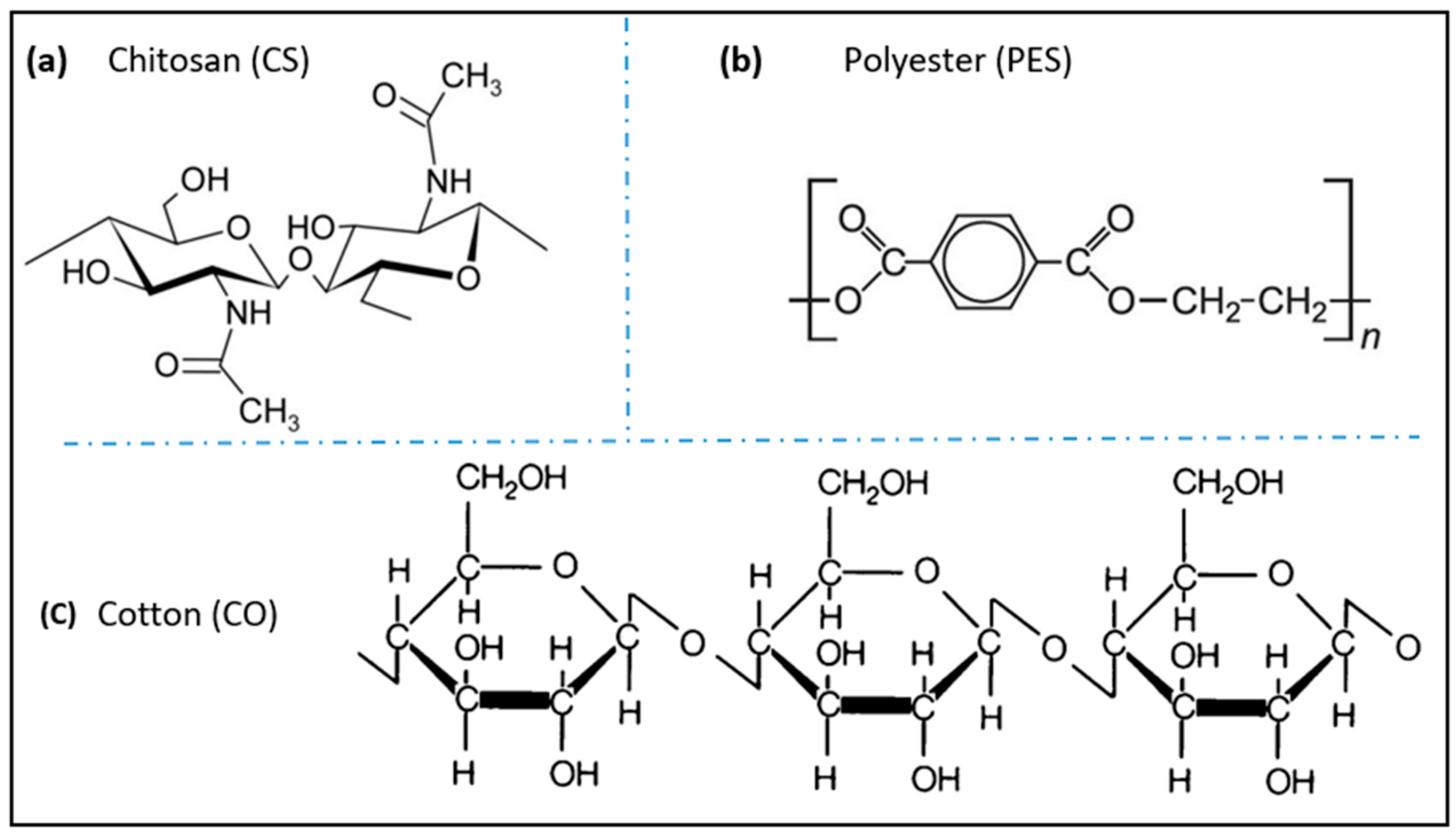
MCS molecular interactions are vital towards understanding the mechanism of surface hydrophilicity of the membrane composite. The chemical structures are shown in Figure 1. The molecular surface structures of MCS and cellulose from cotton could influence their chemical interactions. Cellulose is a linear polymer composed of glucose units linked by beta-1,4-glycosidic bonds, constituting the primary chemical structure of cotton [7].
The presence of highly electronegative oxygen atoms in the composite film is the primary factor facilitating the formation of an additional carbonyl group (C–O) and driving the chemical interaction within the MCS structure [8]. The presence of highly electronegative oxygen atoms on the PES support layer may primarily govern the chemistry of the interaction between the modified CS membrane and the PES support. The presence of an oxide group between the CS interface and the support module may enhance the probability of forming a non-polar covalent bond (O–O) between CS and the polyester structure. The enhanced composite’s N-acetyl group of chitosan may facilitate electrostatic attraction between the H-group of chitosan and the O-group of polyester, ensuring membrane integrity throughout the filtration process.

3.2. Permeation Flux Analysis of MCS Composites

CS/AgNP/GO (MCS) composite permeation flux was assessed to evaluate membrane permeation characteristics and the influence of fabric supports on separation efficiency. The addition of CO and PES to MCS composite membranes enhanced water permeation flux. Table 1 illustrates that the permeate flux for all samples exhibited a gradual decline over a 3 h period at a pressure of 0.2 MPa.
The permeation flux performance indicates that the MCS/CO-supported membrane sample achieved the highest water flow rate, with a permeation flux of 61.4 ± 1 Lm−2 h−1. This trend was followed by the MCS/PES at 52.1 ± 2 Lm−2 h−1, while the MCS demonstrated the lowest flux performance at 45.2 ± 1 Lm−2 h−1 after 0.5 h. After 3 h of filtration, the general permeation flux decreased significantly across all samples. The flux for MCS/CO decreased to 40.5 ± 2 Lm−2 h−1, while MCS/PES and MCS reduced to 32.2 ± 2 Lm−2 h−1 and 27.1 ± 1 Lm−2 h−1, respectively. This decline can be attributed to variations in the physicochemical properties of the fabric materials.

3.3. Morphological Analysis

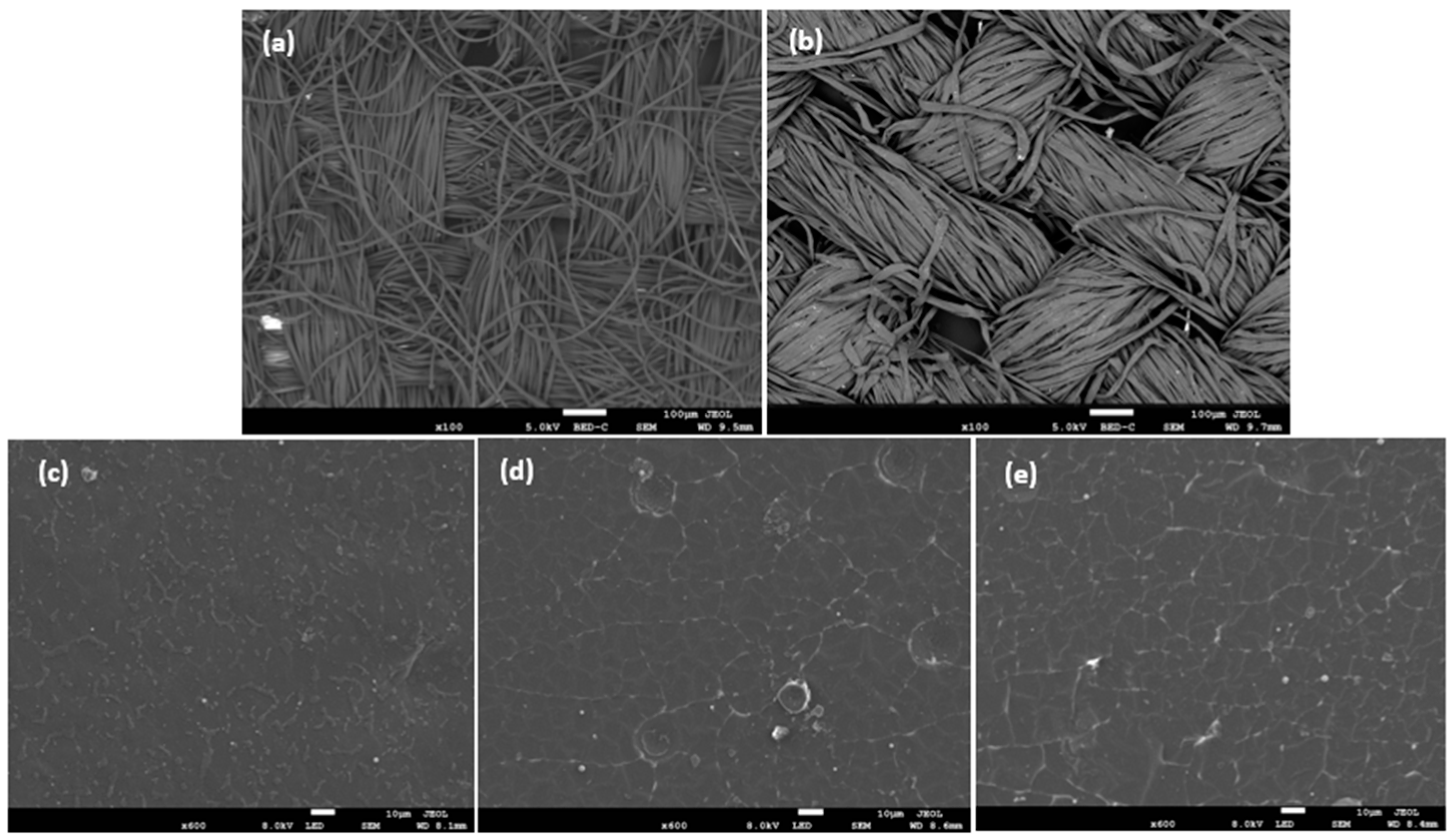
Surface morphological analysis of PES and CO exhibits significant differences, as illustrated in Figure 2a,b. PES fabric reveals a smoother and more uniform surface structure compared to CO fabric, attributable to inherent differences in fiber composition and manufacturing processes. These variations may influence the quantity and surface characteristics of the MCS matrix on each support layer. The SEM images presented in Figure 2c–e demonstrate distinct structural arrangements of MCS on both support modules.
Figure 2c illustrates the effective dispersion of MCS, with an absence of agglomeration on the membrane surface. Both PES- and CO-supported membranes exhibited a wide range of surface pore densities that differed from those of unsupported MCS (Figure 2d,e). The MCS morphology of the PES-supported membrane (Figure 2d) demonstrated a significant reduction in uneven surfaces and a decrease in surface cracks when compared to the CO-supported MCS membrane sample (Figure 2e), likely due to the presence of expanded loose fibers in the fabric support material. The quantity of MSC on CO support displays a denser layer with increased surface cracks, which could be attributed to its elevated surface porosity and irregular twisted morphology. Also, due to the presence of free hydroxyl groups on its surface, CO may engage in hydrogen bonding with the functional groups of modified chitosan. Such bonds may generate sufficient adhesive force through Van der Waals interactions, enhancing chemical bonding between the CS composite and CO support layer, thereby improving the water permeation flow rate.

3.4. Mechanical Properties of MCS Composites

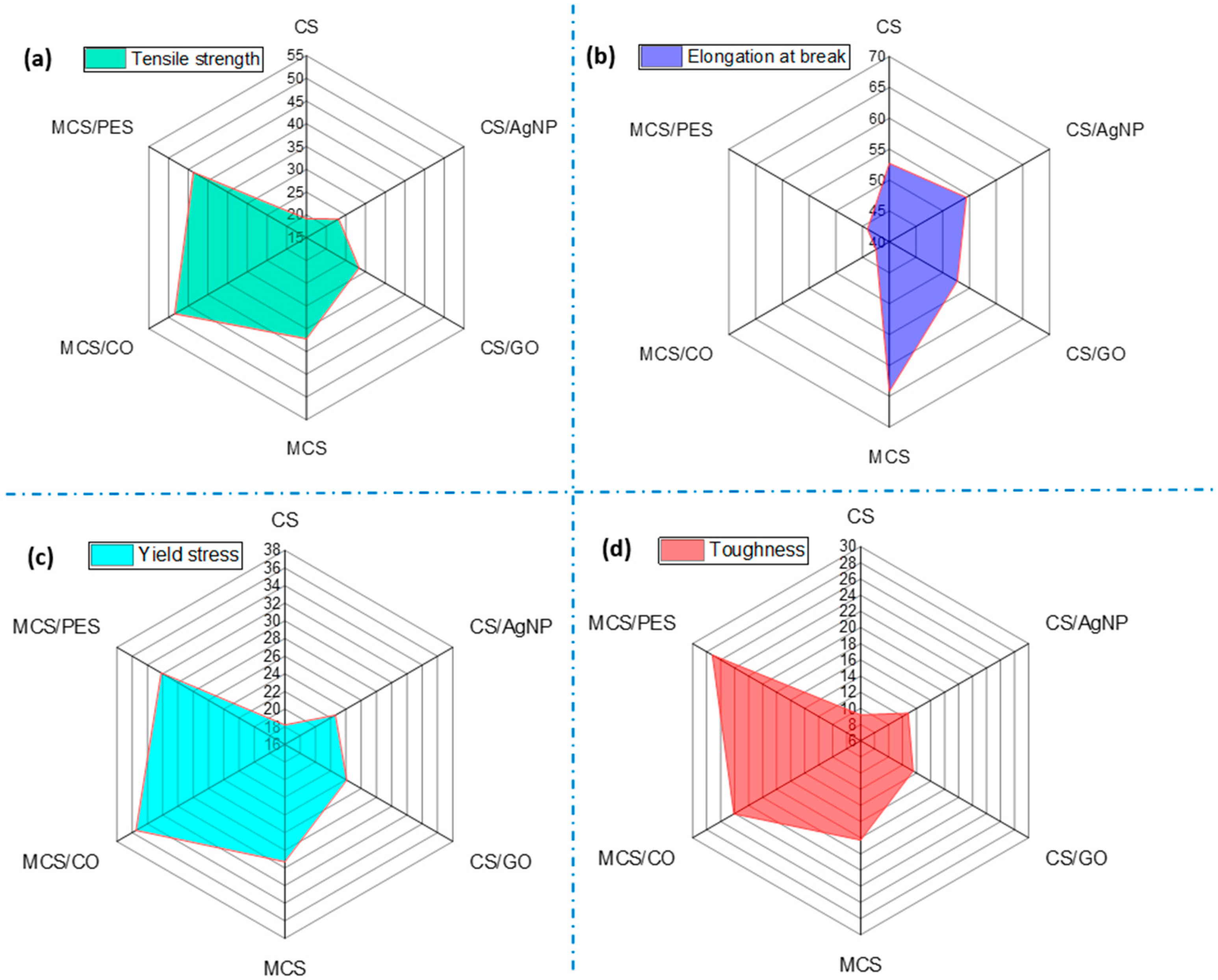
The mechanical properties of different CS-based composite membrane samples are shown in Table 2 and Figure 3. MCS/CO composite membrane sample exhibited the greatest tensile strength at 48.46 ± 1 MPa and yield stress (35.5 ± 2 MPa), while the MCS/PES composite displayed better toughness (27.2 ± 2 kJ·m−2) relative to the other samples.
The compatibility of chitosan monomers with the fiber surface may explain the superior bonding between the MCS composite and the CO fabric support, resulting in increased mechanical characteristics. The CS/AgNP/GO (MCS) exhibited the greatest maximum elongation at break (64.2 ± 2%), due to improved mobility of polymer chains inside the matrix. Conversely, the MCS/CO bond had the minimal elongation upon break (42.5 ± 1%). The strong electrostatic interactions between the MCS composite and the CO fabric support could have resulted in a decrease in the elongation at break of the composite film. The heightened entanglement between the MCS membrane composite and the CO fiber tissues during membrane fabrication may explain the augmented material strength found in the CO-supported membrane sample.

4. Conclusions

The integration of CO and PES support modules enhanced the modified chitosan filtration membrane by significantly improving permeability and mechanical strength without compromising rejection rates. The molecular surface structures of the modified chitosan (MCS) composites and cellulose from CO influenced their chemical interactions, while the presence of an oxide group between the CS interface and PES enhanced the non-polar covalent bond (O–O) between them. Therefore, the utilization of both fabrics could be viable membrane support materials to improve CS polymer membrane functionality despite CO having greater permeability performance than PES.

Funding

The APC was funded by Vaal University of Technology.

Institutional Review Board Statement

Not applicable.

Informed Consent Statement

Not applicable.

Data Availability Statement

The data is available on request from the author.

Acknowledgments

The author gratefully acknowledges the technical assistance and financial support provided by the Faculty of Engineering and Technology, Vaal University of Technology, Gauteng.

Conflicts of Interest

The author declares no conflict of interest.

References

  1. Tella, T.A.; Festus, B.; Olaoluwa, T.D.; Oladapo, A.S. Water and wastewater treatment in developed and developing countries: Present experience and future plans. In Smart Nanomaterials for Environmental Applications; Elsevier: Amsterdam, The Netherlands, 2025; pp. 351–385. [Google Scholar]
  2. Sarker, B.; Keya, K.N.; Mahir, F.I.; Nahiun, K.M.; Shahida, S.; Khan, R.A. Surface and ground water pollution: Causes and effects of urbanization and industrialization in South Asia. Sci. Rev. 2021, 7, 32–41. [Google Scholar] [CrossRef]
  3. World Health Organization; United Nations Children’s Fund. State of the World’s Drinking Water: An Urgent Call to Action to Accelerate Progress on Ensuring Safe Drinking Water for All; World Health Organization: Geneva, Switzerland, 2022. [Google Scholar]
  4. Badawi, A.K.; Salama, R.S.; Mostafa, M.M.M. Natural-based coagulants/flocculants as sustainable market-valued products for industrial wastewater treatment: A review of recent developments. RSC Adv. 2023, 13, 19335–19355. [Google Scholar] [CrossRef] [PubMed]
  5. Ogazi, A.C.; Osifo, P.O. Inhibition of coliforms and Escherichia coli bacterial strains in water by 3D printed CS/GO/AgNP filtration membranes. J. Polym. Environ. 2023, 31, 4448–4467. [Google Scholar] [CrossRef]
  6. Yalcin-Enis, I.; Kucukali-Ozturk, M.; Sezgin, H. Risks and management of textile waste. In Nanoscience and Biotechnology for Environmental Applications; Springer: Cham, Switherland, 2019; pp. 29–53. [Google Scholar]
  7. Drishya, P.K.; Reddy, M.V.; Mohanakrishna, G.; Sarkar, O.; Isha; Rohit, M.V.; Patel, A.; Chang, Y.C. Advances in Microbial and Plant-Based Biopolymers: Synthesis and Applications in Next-Generation Materials. Macromol 2025, 5, 21. [Google Scholar] [CrossRef]
  8. Liu, X.; Chen, C.; Cao, Y.; Peng, C.; Fang, J.; Wang, H.; Wu, W.; Lyu, G.; Li, H. Effect and enhancement mechanism of sodium lignosulfonate on the chitosan-based composite film. Colloids Surf. A Physicochem. Eng. Aspect. 2023, 678, 132505. [Google Scholar] [CrossRef]
Figure 1. Chemical structures: (a) CS; (b) PES; (c) Cotton.
Chemproc 18 00049 g001
Figure 2. SEM images of (a) PES; (b) CO; (c) MCS; (d) MCS-PES; (e) MCS-CO.
Chemproc 18 00049 g002
Figure 3. Mechanical characteristics of MCS components. (a) Tensile Strength; (b) Elongation at Break; (c) Yield Stress; (d) Toughness.
Chemproc 18 00049 g003
Table 1. Permeation flux analysis.
Time (h)MCS
Flux (Lm−2 h−1)
MCS/CO
Flux (Lm−2 h−1)
MCS/PES
Flux (Lm−2 h−1)
0.545.2 ± 161.4 ± 152.1 ± 2
1.040.9 ± 354.7 ± 146.3 ± 1
1.537.4 ± 249.2 ± 341.6 ± 1
2.0 33.3 ± 145.8 ± 137.1 ± 3
2.529.5 ± 342.3 ± 434.7 ± 1
3.027.1 ± 140.5 ± 232.2 ± 2
Table 2. Mechanical properties of the modified chitosan composites.
SampleTensile Strength
(MPa)
Elongation
at Break
(%)
Yield Stress
(MPa)
Toughness
(kJ·m−2)
CS19.14 ± 152.7 ± 118.2 ± 19.2 ± 2
CS/AgNP23.21 ± 354.4 ± 222.6 ± 112.8 ± 1
CS/GO28.35 ± 152.7 ± 124.1 ± 213.5 ± 2
MCS37.23 ± 264.2 ± 229.3 ± 118.3 ± 1
MCS/CO48.46 ± 142.5 ± 135.5 ± 224.1 ± 1
MCS/PES43.73 ± 144.1 ± 132.2 ± 327.2 ± 2
Disclaimer/Publisher’s Note: The statements, opinions and data contained in all publications are solely those of the individual author(s) and contributor(s) and not of MDPI and/or the editor(s). MDPI and/or the editor(s) disclaim responsibility for any injury to people or property resulting from any ideas, methods, instructions or products referred to in the content.