
Proceeding Paper

Preliminary Studies on the Biosynthesis of Microbial Inulinase by Aspergillus niger ICCF 92 †
by
Mariana Gratiela Vladu
,
Mihaela Carmen Eremia
,
Dana Maria Miu
,
Gabriela Valeria Savoiu
and
Maria Monica Petrescu
*
National Institute for Chemical-Pharmaceutical Research and Development-ICCF Bucharest, 112 Vitan Avenue, 3rd District, 031299 Bucharest, Romania
*
Author to whom correspondence should be addressed.
Presented at the 29th International Electronic Conference on Synthetic Organic Chemistry, 14–28 November 2025; Available online: https://sciforum.net/event/ecsoc-29.
Chem. Proc. 2025, 18(1), 48; https://doi.org/10.3390/ecsoc-29-26690
Published: 11 November 2025

Abstract

Modern diets are high in fructans, which may lead to abdominal discomfort, particularly in sensitive individuals. Microbial inulinase, an enzyme that hydrolyzes inulin into fructose and fructo-oligosaccharides (FOS), has significant prebiotic potential and may contribute to the prevention of metabolic disorders by enhancing fructan digestion. This study investigates inulinase production by the Aspergillus niger ICCF 92 strain under various growth conditions. Three carbon sources (inulin, molasses, and carob pod decoction), the time required for biosynthesis processes, and stirring speed were evaluated for their influence on inulinase activity. Nitrogen sources included yeast extract, ammonium nitrate, and ammonium phosphate. Process monitoring included pH measurement, protein quantification via the Bradford assay, and inulinase activity assessment using the 3,5-dinitrosalicylic acid method. The highest inulinase production (38.29 U/mL) and protein concentration (0.7548 mg/mL) were achieved after 14 days of static fermentation with carob pod decoction as the carbon source.

1. Introduction

Enzymes of microbial origin generally display greater stability and higher catalytic efficiency than those derived from plants or animals, making them preferable for numerous industrial and medical applications [1,2].
Among them, inulinases are of particular interest. These enzymes hydrolyze the β-2,1 linkages in inulin, a polyfructan, yielding fructose and fructooligosaccharides (FOS) with recognized prebiotic and industrial value. Inulinases are produced by a wide range of microorganisms, including bacteria (e.g., Bacillus sp., Streptomyces sp., Xanthomonas sp., Clostridium sp.), yeasts (Cryptococcus sp., Pichia sp., Kluyveromyces sp.), and filamentous fungi (Aspergillus sp., Rhizopus sp., Penicillium sp., Rhizoctonia sp.) [3].
For optimal production, several parameters must be optimized simultaneously, such as medium composition (carbon, nitrogen, and phosphorus sources), temperature, aeration, and pH. Carbon sources like inulin, sucrose, starch, and molasses, as well as nitrogen sources such as yeast extract, ammonium nitrate, and ammonium phosphate, are commonly used [4]. Recent studies emphasize the valorization of agro-industrial by-products—including sugarcane bagasse, wheat bran, rice bran, soybean bran, citrus peels, Jerusalem artichoke leaves, chicory leaves, apple pomace, and carob pods—as low-cost substrates for inulinase production [5].
Both submerged fermentation (SmF) and solid-state fermentation (SSF) have been successfully applied for microbial inulinase biosynthesis, with Aspergillus niger among the most effective producers [6,7].
The objective of this study was to investigate inulinase production by Aspergillus niger ICCF 92 under different cultivation conditions. Specifically, we evaluated the influence of carbon sources (inulin, molasses, carob pod decoction), nitrogen sources (yeast extract, ammonium nitrate, ammonium phosphate), fermentation time, and stirring speed on enzyme activity and protein production.

2. Materials and Methods

2.1. Microbial Culture and Its Maintenance

Aspergillus niger ICCF 92 (ATCC 16404) was used in all bioprocesses for inulinase production. The strain was stored at 4 °C and periodically subcultured on fresh PDA medium. Preinocula were prepared by incubating the strain for 7 days at 30 ± 1 °C. Spores were harvested and suspended in 5 mL of sterile distilled water to achieve a concentration of 3.0 × 10⁶ spores/mL, which served as the inoculum for each flask containing 100 mL of bioprocess medium.

2.2. Culture Media

Several types of media with the following notations were used in the submerged bioprocesses:
  • Fis1 (%w/v): inulin, 3.0 g; NH4NO3, 0.23 g; (NH4)2HPO4, 0.37 g; KH2PO4, 0.1 g; MgSO4, 0.05 g; yeast extract, 0.15 g, [8];
  • Fis2 (%w/v): inulin, 1.0 g; peptone, 0.5 g; MgSO4, 0.05 g, known as basal medium [9];
  • Fis3 (%w/v): molasses, 2.0 g; NH4NO3, 0.23 g; (NH4)2HPO4, 0.37 g; KH2PO4, 0.1 g; MgSO4, 0.05 g; yeast extract, 0.15 g, [8];
  • Fis4 (%w/v): carob pod, 16.5 g; NH4NO3, 0.23 g; (NH4)2HPO4, 0.37 g; KH2PO4, 0.1 g; MgSO4, 0.05 g; yeast extract, 0.15 g, [8].
For fermentations, carob pod decoction was prepared at 100 °C with 16.5% solid loading (w/v) for 90 min and filtered to remove solid particles. Initial pH before sterilization was 5.02 for Fis1 and 6.5 for the other media. All fermentations were carried out at 220 rpm (for bioprocesses with stirring) and 30 ± 1 °C. During the fermentations, pH, biomass, protein concentration, and enzymatic activity were monitored.

2.3. Enzyme Activity Assay

Protein concentration was measured using the Bradford assay with BSA as a standard [10]. Inulinase activity was determined using the 3,5-dinitrosalicylic acid method [11]. Enzyme solution (0.1 mL) was mixed with 0.9 mL of 2% inulin in 0.1 M acetate buffer (pH 5.5) and incubated at 50 °C for 15 min. Reducing sugars were measured at 540 nm. One unit of inulinase activity is defined as the amount of enzyme releasing 1 μmol of reducing sugar per minute under assay conditions.

2.4. Inulinase Purification

The first stage of post-biosynthesis processing involves separating the fermentation medium by centrifugation, which was performed at 8000 rpm for 20 min and 4 °C. The supernatant obtained is subjected to purification by fractional precipitation with ammonium sulfate in two stages: 60% and 80% saturated ammonium sulfate solutions. After the first step, the formed precipitate, which lacked enzymatic activity, was discarded. The precipitate obtained at 80% ammonium sulfate saturation was separated by centrifugation and dissolved in a small volume of deionized water; the resulting solution was dialyzed for 24 h against distilled water.

3. Results

During bioprocesses, A. niger ICCF 92 showed different growth and inulinase production patterns depending on the substrate. Fis1 medium yielded low biomass, protein concentration, and enzymatic activity. Fis2 medium had 4.815 g of biomass and Fis3 had 6.359 g, but both showed a deficient protein concentration and very low activity. (Table 1). The highest results were obtained for the Fis4 medium, respectively, 10,389 g of biomass, 0.8744 protein concentration, and 5.9637 U/mL enzymatic activity.
pH fluctuations were observed: in Fis1 and Fis2, pH dropped from 5 and 6.5 to 2.15–2.57, likely due to CO2 produced by microbial respiration, negatively affecting growth and enzyme production. Fis3 maintained pH 5.75–6.27, and Fis4 pH 5.50–6.7, indicating that the substrate affects natural pH stability during fermentation. Similar trends were reported for Mucor circinelloides, where enzyme production was favored around pH 6 [12].
In studies conducted for the production of inulinase with the microorganism Mucor circinelloides in submerged fermentations, Singh et al. observed that, in addition to the composition of the substrate, enzyme production is favored when the pH of the fermentation medium is maintained around 6. The drastic decrease in pH below 6, as well as the considerable increase above this value, can alter the distribution of the surface charge of the enzyme in the ionic medium thus modified [12].
In the subsequent experiments, static fermentations were compared with those performed under agitation at 220 rpm, in order to evaluate the influence of mixing on biomass formation, protein secretion, and inulinase activity.
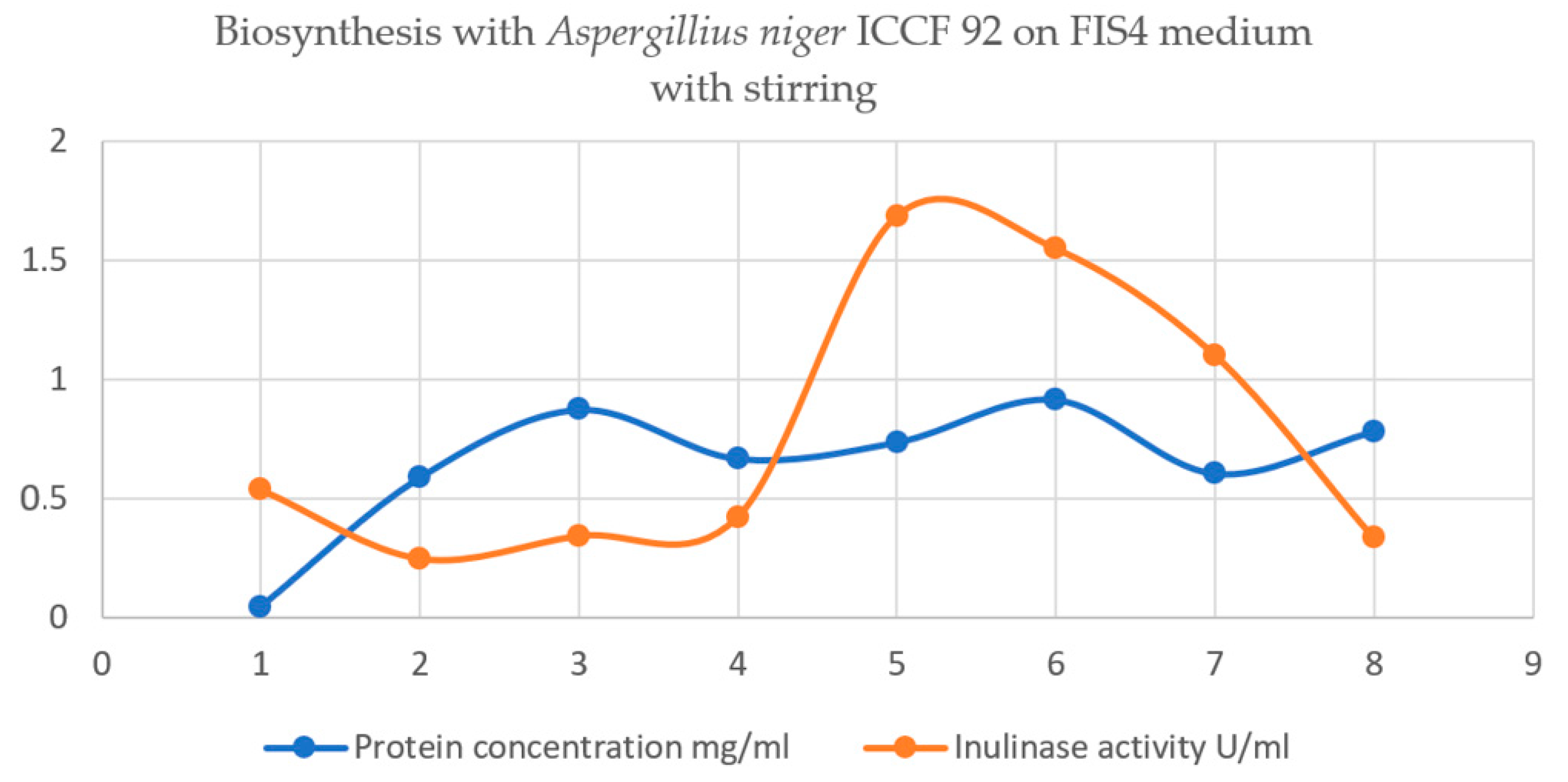
The profile of protein concentration and inulinase activity under stirred conditions (220 rpm) on FIS4 medium indicates distinct dynamics between biomass-associated protein production and enzymatic activity. Protein concentration increased gradually over the first 3–4 days, reaching a moderate plateau (0.7–1.0 mg/mL) by days 5–6, after which it stabilized (Figure 1).
In contrast, inulinase activity showed a lag phase during the first 3 days, followed by a sharp increase, peaking at approximately 1.7 U/mL on day 5. This peak preceded the maximum protein concentration, suggesting that enzyme secretion was transient and may have been induced by substrate availability or stress factors associated with fermentation. After day 5, inulinase activity declined steadily, despite protein levels remaining relatively stable, indicating possible enzyme inactivation, substrate depletion, or feedback inhibition mechanisms.
Overall, the results suggest that agitation supports enzyme biosynthesis but may also accelerate enzyme deactivation over time. Thus, optimal harvesting under stirred conditions should be targeted around day 5, coinciding with the peak in inulinase activity.
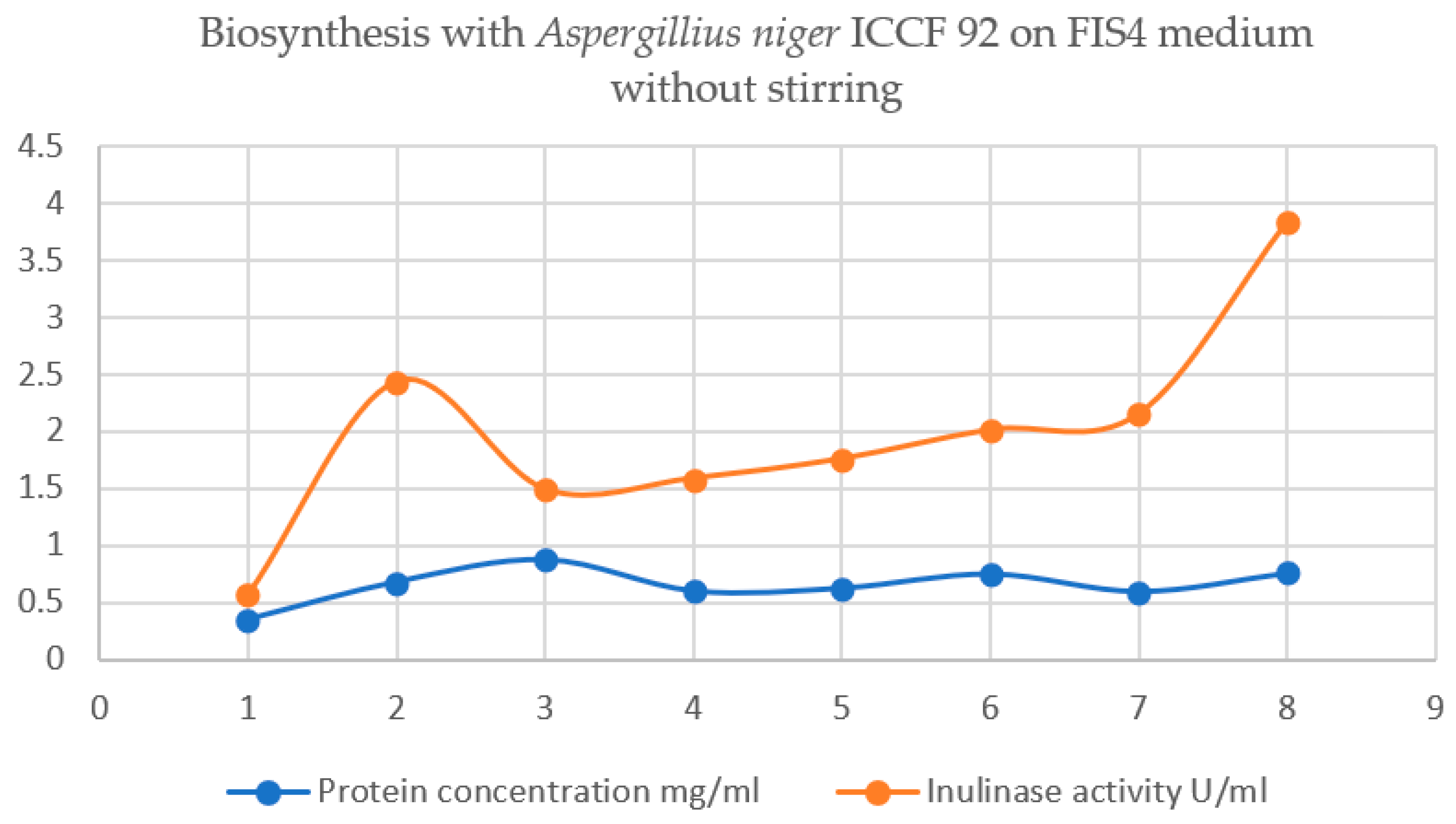
The biosynthesis profile of A. niger ICCF 92 on FIS4 medium without stirring shows a clear distinction between protein concentration and inulinase activity (Figure 2). Protein concentration remained relatively stable throughout fermentation (0.4–0.7 mg/mL), with only minor fluctuations, suggesting limited secretion of non-enzymatic proteins. In contrast, inulinase activity followed a continuous upward trend, with an early peak on day 2 (~2.4 U/mL), a temporary decrease by day 3, and then a steady increase until day 8, when the maximum activity (~3.9 U/mL) was reached.
This profile indicates that under static conditions, enzyme production was both sustained and enhanced over time, likely due to the preservation of stable microenvironments in the culture medium and the avoidance of mechanical stress that could destabilize proteins.
When comparing stirred and static fermentations, two different metabolic patterns emerge. Stirred fermentation accelerated enzyme synthesis, with inulinase activity reaching its peak (~1.7 U/mL) by day 5 but subsequently declining. This may be attributed to faster substrate utilization, higher oxygen transfer, or enzyme denaturation under shear stress.
In static fermentation, however, inulinase activity increased gradually and consistently, achieving more than double the enzymatic activity of the stirred culture (~3.9 U/mL vs. 1.7 U/mL). Protein concentrations remained relatively stable and low, which suggests that most of the secreted protein was enzymatically active.
Overall, the results demonstrate that static conditions are more favorable for prolonged and efficient inulinase production, while agitation promotes earlier but less stable enzyme expression.
The highest inulinase yield was obtained under static fermentation conditions using carob pod decoction as the carbon source. The optimized process resulted in an enzymatic activity of 38.29 U/mL and a protein concentration of 0.7548 mg/mL after ammonium sulfate precipitation and 24 h dialysis in distilled water.
These findings highlight the potential of A. niger ICCF 92 as a viable producer of inulinase and its possible application in mitigating metabolic and nutritional disorders through improved dietary fructan processing.

Author Contributions

Conceptualization, M.G.V. and M.M.P.; methodology, M.G.V., M.M.P., and M.C.E.; software, M.M.P.; validation, M.G.V., M.M.P., and M.C.E.; formal analysis, M.G.V., M.M.P., and M.C.E.; investigation, M.G.V., M.M.P., D.M.M., G.V.S., and M.C.E.; writing—original draft preparation, M.G.V., M.M.P., and M.C.E.; writing—review and editing, M.G.V., M.M.P., and M.C.E.; visualization, M.G.V., M.M.P., and M.C.E.; supervision, M.G.V., M.M.P., and M.C.E.; project administration, M.C.E. All authors have read and agreed to the published version of the manuscript.

Funding

This work was supported by a grant from the Ministry of Education and Research, UEFISCDI, no. 30PED/2025, Liposomal nanosystems containing microbial inulinase for the prevention of metabolic and nutritional diseases (LIPHOIN).

Institutional Review Board Statement

Not applicable.

Informed Consent Statement

Not applicable.

Data Availability Statement

The data supporting the findings of this study are not publicly available because no digital repository was used. The datasets generated during the experiments are held by the authors and are available from the corresponding author upon reasonable request.

Conflicts of Interest

The authors declare no conflicts of interest. The funders had no role in the design of the study; in the collection, analyses, or interpretation of data; in the writing of the manuscript; or in the decision to publish the results.

References

  1. Das, D.; Bhat, M.R.; Selvaraj, R. Review of inulinase production using solid-state fermentation. Ann. Microbiol. 2019, 69, 201–209. [Google Scholar] [CrossRef]
  2. Das, D.; Selvaraj, R.; Bhat, M.R. Optimization of inulinase production by a newly isolated strain Aspergillus flavus var. flavus by solid state fermentation of Saccharum arundinaceum. Biocatal. Agric. Biotechnol. 2019, 22, 101363. [Google Scholar] [CrossRef]
  3. Singh, R.S.; Singh, T.; Hassan, M.; Kennedy, J.F. Updates on inulinases: Structural aspects and biotechnological applications. Int. J. Biol. Macromol. 2020, 164, 193–210. [Google Scholar] [CrossRef] [PubMed]
  4. Treichel, H.; Oliveira, D.; Lerin, L.; Astolfi, V.; Mazutti, M.; Luccio, M.; Oliveira, J. A review on the production and partial characterization of microbial inulinases. Glob. J. Biochem. 2012, 3, 1–3. [Google Scholar]
  5. Temesgen, T.; Periyasamy, S.; Mensur, D.; Berhane, B.; Sunaina; Jayakumar, M. Valorization of Wastes and By-Products of Cane-Based Sugar Industry. In Value Added Products From Food Waste; Cherian, E., Gurunathan, B., Eds.; Springer Nature: Cham, Switzerland, 2024; pp. 185–204. [Google Scholar] [CrossRef]
  6. Yavuz, H.G.H.; Yavuz, I.; Isci, A.; Turhan, I. Harnessing deep eutectic solvent for enhanced inulinase production from agricultural via submerged fermentation with Aspergillus niger. Int. J. Biol. Macromol. 2025, 295, 139592. [Google Scholar] [CrossRef] [PubMed]
  7. da Silva, W.B.; Porto, T.S.; da Silva, S.P.; de Oliveira, R.L. Optimization strategy for inulinase production by Aspergillus niger URM5741 and its biochemical characterization, kinetic/thermodynamic study, and application on inulin and sucrose hydrolysis. 3 Biotech 2023, 13, 376. [Google Scholar] [CrossRef] [PubMed]
  8. Germec, M.; Turhan, I. Evaluation of carbon sources for the production of inulinase by Aspergillus niger A42 and its characterization. Bioprocess Biosyst. Eng. 2019, 42, 1993–2005. [Google Scholar] [CrossRef] [PubMed]
  9. Dinarvand, M.; Ariff, A.B.; Hassan, M.; Masomian, M.; Mousavi, S.S.; Nahavandi, R.; Mustafa, S. Effect of extrinsic and intrinsic parameters on inulinase production by Aspergillus niger ATCC 20611. Electron. J. Biotechnol. 2012, 15, 5. [Google Scholar] [CrossRef]
  10. Bradford, M.M. A rapid and sensitive method for the quantitation of microgram quantities of protein using the principle of protein-dye binding. Anal. Biochem. 1976, 72, 248–254. [Google Scholar] [CrossRef] [PubMed]
  11. Miller, G.L. Use of dinitrosalicylic acid reagent for determination of reducing sugar. Anal. Chem. 1959, 31, 426–428. [Google Scholar] [CrossRef]
  12. Singh, R.S.; Chauhan, K.; Kaur, K.; Pandey, A. Statistical optimization of solid-state fermentation for the production of fungal inulinase from apple pomace. Bioresour. Technol. Rep. 2020, 9, 100364. [Google Scholar] [CrossRef]
Figure 1. Protein concentrations and enzyme activity assay for biosynthesis with A. niger ICCF 92 on FIS4 medium with stirring.
Chemproc 18 00048 g001
Figure 2. Protein concentrations and enzyme activity assay for biosynthesis with A. niger ICCF 92 on FIS4 medium without stirring.
Chemproc 18 00048 g002
Table 1. Protein concentrations and enzymatic activities obtained in the three types of media during fermentation.
Sample Carbon SourceTime
(h)
Protein Concentration
(mg/mL)
Inulinase Activity
(U/mL)
Fis2 Inulin7200.0388
9200.0813
12000.1449
Fis3Molasses7200.2810
9200.5692
12000.2898
Fis4Carob pod720.04735.5642
920.58925.9637
1200.87441.5501
Disclaimer/Publisher’s Note: The statements, opinions and data contained in all publications are solely those of the individual author(s) and contributor(s) and not of MDPI and/or the editor(s). MDPI and/or the editor(s) disclaim responsibility for any injury to people or property resulting from any ideas, methods, instructions or products referred to in the content.