
Proceeding Paper

Comparative Adsorption Performance of Chitosan and Iron-Modified Chitosan for the Removal of a Synthetic Textile Dye †
1
Laboratory of Inorganic Chemistry and Environment, University of Tlemcen, P.O. Box 119, Tlemcen 13000, Algeria
2
Laboratory of Materials Chemistry, Catalysis and Environment, Faculty of Chemistry USTHB El Alia, Bab Ezzouar, P.O. Box 32, Algiers 16111, Algeria
*
Author to whom correspondence should be addressed.
Presented at the 29th International Electronic Conference on Synthetic Organic Chemistry, 14–28 November 2025; Available online: https://sciforum.net/event/ecsoc-29.
Chem. Proc. 2025, 18(1), 26; https://doi.org/10.3390/ecsoc-29-26918
Published: 13 November 2025

Abstract

The present work focuses on the removal of a textile dye from wastewater through adsorption using industrial chitosan and iron-modified chitosan as adsorbents. Characterization was performed through infrared spectroscopy pH point of zero charge analysis. Kinetic results showed that iron modification significantly improved adsorption capacity, achieving 96% removal within 120 min. The initial pH strongly influenced performance: industrial chitosan was more efficient in basic solutions, while iron-chitosan worked best under acidic conditions. Moderate agitation optimized adsorption rate and retention. Findings confirm the promising potential of both materials, particularly iron-chitosan, for textile wastewater treatment applications.

1. Introduction

Water is essential for sustaining life, yet its quality is increasingly compromised by industrialization and human activities that release heavy metals, dyes, pesticides, fertilizers, and other pollutants [1]. Among these, dyes are particularly alarming: over 100,000 are produced annually, exceeding 70,000 tonnes, with nearly 15% lost during dyeing operations [2]. Their complex structures make them poorly biodegradable and often toxic or carcinogenic, posing severe environmental and health risks [3]. Thus, protecting water resources is crucial. Conventional wastewater treatments—adsorption, coagulation, membrane filtration, reverse osmosis, ozonation, sedimentation, advanced oxidation, Fenton, and photocatalysis—are widely applied [4,5,6,7,8,9,10,11,12], yet balancing efficiency, cost, and sustainability remains challenging. Natural adsorbents offer significant advantages such as biodegradability, low energy demand, and high efficiency [13]. Chitosan, a biopolymer derived from chitin, stands out for its biocompatibility, biodegradability, antimicrobial activity, and functional groups that act as binding sites for dyes [14,15,16]. This study investigates both commercial and iron-modified chitosan as adsorbents for the removal of trisodium ferric complex of N-methyl-1,8-naphtalimide-4-sulfonate which is a textile dye, providing a sustainable approach to valorize biological waste while advancing wastewater treatment applications.

2. Materials and Methods

2.1. Dye Preparation

In this study, the selected dye corresponds to a trisodium ferric complex of N-methyl-1,8-naphthalimide-4-sulfonate, characterized by a 1:3 metal–ligand coordination structure and extensive use in textile processes.

2.2. Adsorbent Preparation

Chitosan was functionalized by dispersing 100 g of chitosan in 200 mL of distilled water containing 10 g of ferric chloride hexahydrate and 5 g of ferrous chloride tetrahydrate. The suspension was stirred at room temperature for 10 min to initiate interaction. Subsequently, 37.5 mL of a 15% aqueous ammonia solution was slowly added under continuous stirring. The resulting material was dried at 60 °C to obtain the iron-loaded chitosan.

2.3. Adsorbent Experiments

Kinetic adsorption experiments were performed at room temperature by combining 300 mL of a 100 mg L−1 dye solution with 1 g of chitosan in an Erlenmeyer flask under continuous agitation for 120 min. The concentration of dye remaining in solution was quantified at 710 nm using an Optizen POP UV–Vis spectrophotometer (Laboratory of Inorganic Chemistry and Environment, University of Tlemcen, Algeria).

3. Instrumental Analysis

Fourier Transform InfraRed Spectroscopy

The FTIR spectra of chitosan and iron-modified chitosan were recorded using a PerkinElmer Spectrum Two spectrometer over the wavenumber range of 4000–400 cm−1 (Laboratory of Inorganic and Environmental Chemistry, University of Tlemcen, Algeria). The samples were prepared as KBr pellets by thoroughly mixing approximately 1 mg of finely ground sample with 100 mg of dry spectroscopic-grade KBr, followed by pressing the mixture into a transparent disc using a hydraulic press. The obtained pellets were then placed in the sample holder for spectral analysis.
The Fourier Transform InfraRedspectra of both materials are presented in Figure 1.
The infrared spectra of industrial chitosan and iron–chitosan exhibit several characteristic absorption bands [17,18].
For industrial chitosan, a broad band appears at 3469 cm−1, while for iron–chitosan it is slightly shifted to 3442 cm−1, corresponding to the stretching vibrations of N–H and O–H groups. The bands observed between 2925 cm−1 and 2975 cm−1 for industrial chitosan and at 2925 cm−1 for iron–chitosan are attributed to the C–H stretching vibrations of CH2 and/or CH3 groups. The absorption bands at 1644 cm−1 and 1643 cm−1, respectively, are assigned to the stretching vibrations of the C=O groups.
The bands located at 1550 cm−1 in industrial chitosan and 1560 cm−1 in iron–chitosan correspond to the N–H bending vibrations. Peaks appearing at 1343 cm−1 and 1383 cm−1 are associated with C–H bending in CH3 groups. Similarly, the bands at 1305 cm−1 and 1300 cm−1 are due to C–N stretching vibrations. The absorptions at 1154 cm−1 for industrial chitosan and 1160 cm−1 for iron–chitosan indicate C–O bending vibrations, whereas those at 1079 cm−1 and 1077 cm−1 correspond to C–O–C stretching vibrations. Finally, the bands observed at 597 cm−1 and between 566–624 cm−1 are assigned to the C–H bending vibrations.

4. Results

4.1. Adsorption Kinetics

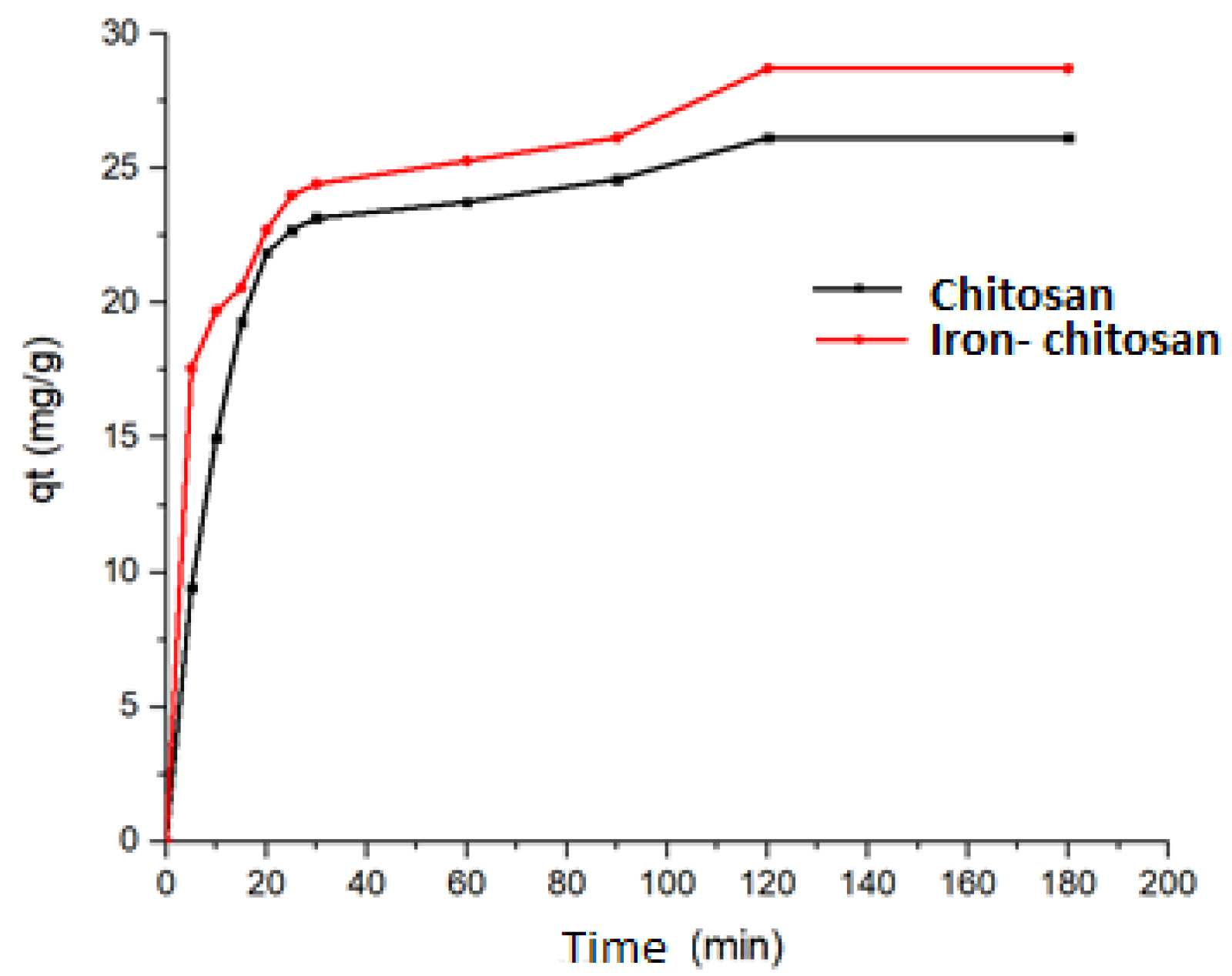
Adsorption kinetics describe the variation over time of pollutant uptake [19]. To establish the optimal time of contact, dye adsorption capacity was monitored as a function of time (Figure 2). Both adsorbents showed a fast initial adsorption phase, which then slowed down progressively until equilibrium, due to progressive full occupancy of active sites [20]. Equilibrium was reached after 120 min for both materials. At this stage, industrial chitosan achieved a removal efficiency of 88%, whereas iron-modified chitosan reached 96%, confirming the enhanced efficiency of the iron-modified adsorbent.

4.2. Influence of the Initial pH on the Adsorption Process

To assess the effect of initial pH on adsorption performance, 300 mL of a 100 mg/L solution was mixed with 1 g of adsorbent. Solution pH was adjusted from 2 to 12 using 0.1 M HCl or 0.1 M NaOH.
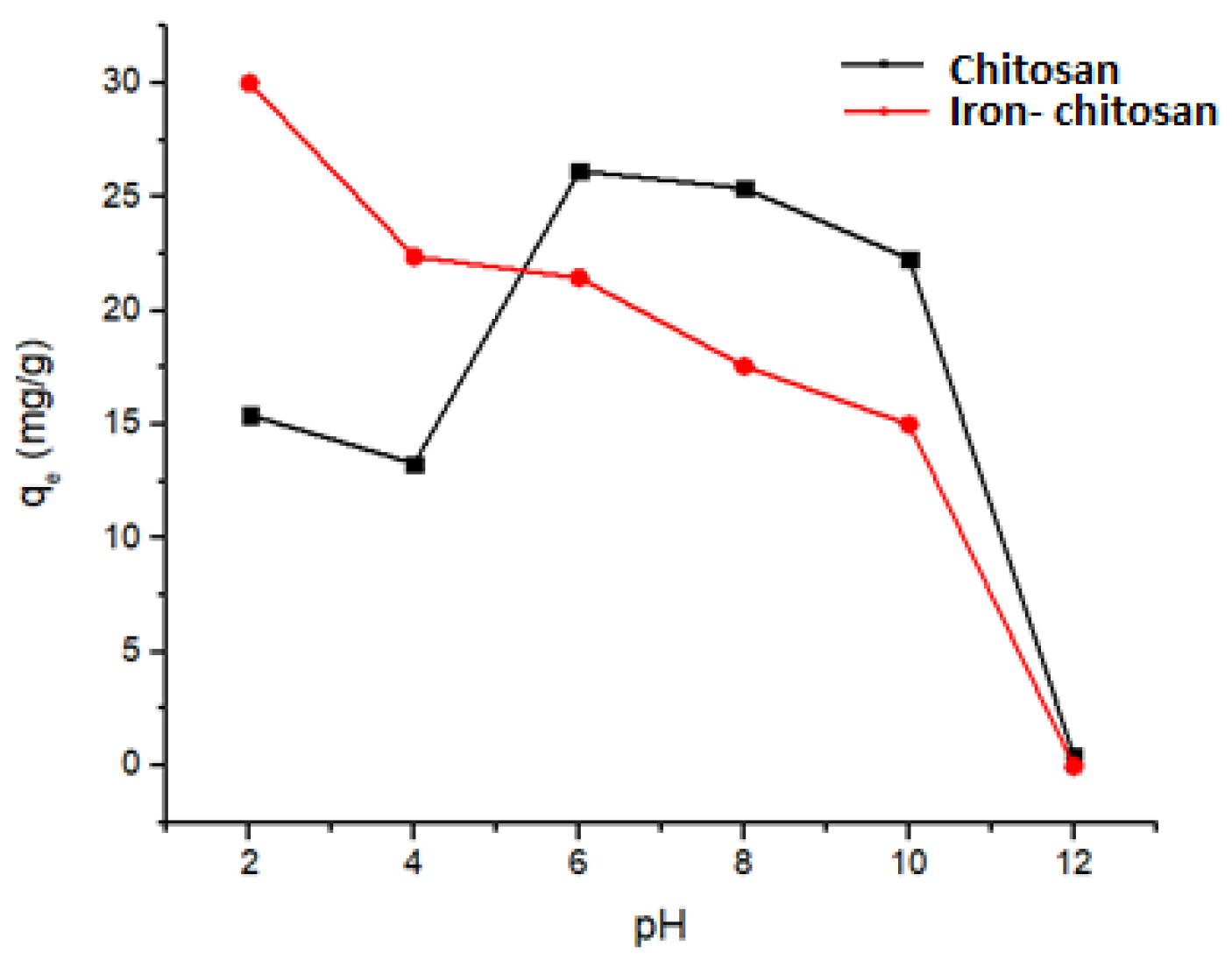
Figure 3 presents the equilibrium dye adsorption on both adsorbents as a function of pH.
The influence of pH on dye adsorption was evaluated, with pHzpc determined as 8 for industrial chitosan and 6.2 for iron-modified chitosan. For industrial chitosan, adsorption increased from pH 2–8 due to electrostatic attraction between the positively charged surface and anionic dye, but decreased above pHzpc because of repulsion. For iron-modified chitosan, maximum adsorption occurred at pH 2 (30 mg/g), then progressively declined with increasing pH, reaching nearly zero at pH 10, also due to electrostatic repulsion.
A comparable pattern was observed in a prior study [21,22], where the influence of pH on the adsorption of anionic dye exhibited similar trends throughout the tested range.

4.3. The Impact of Stirring Rate

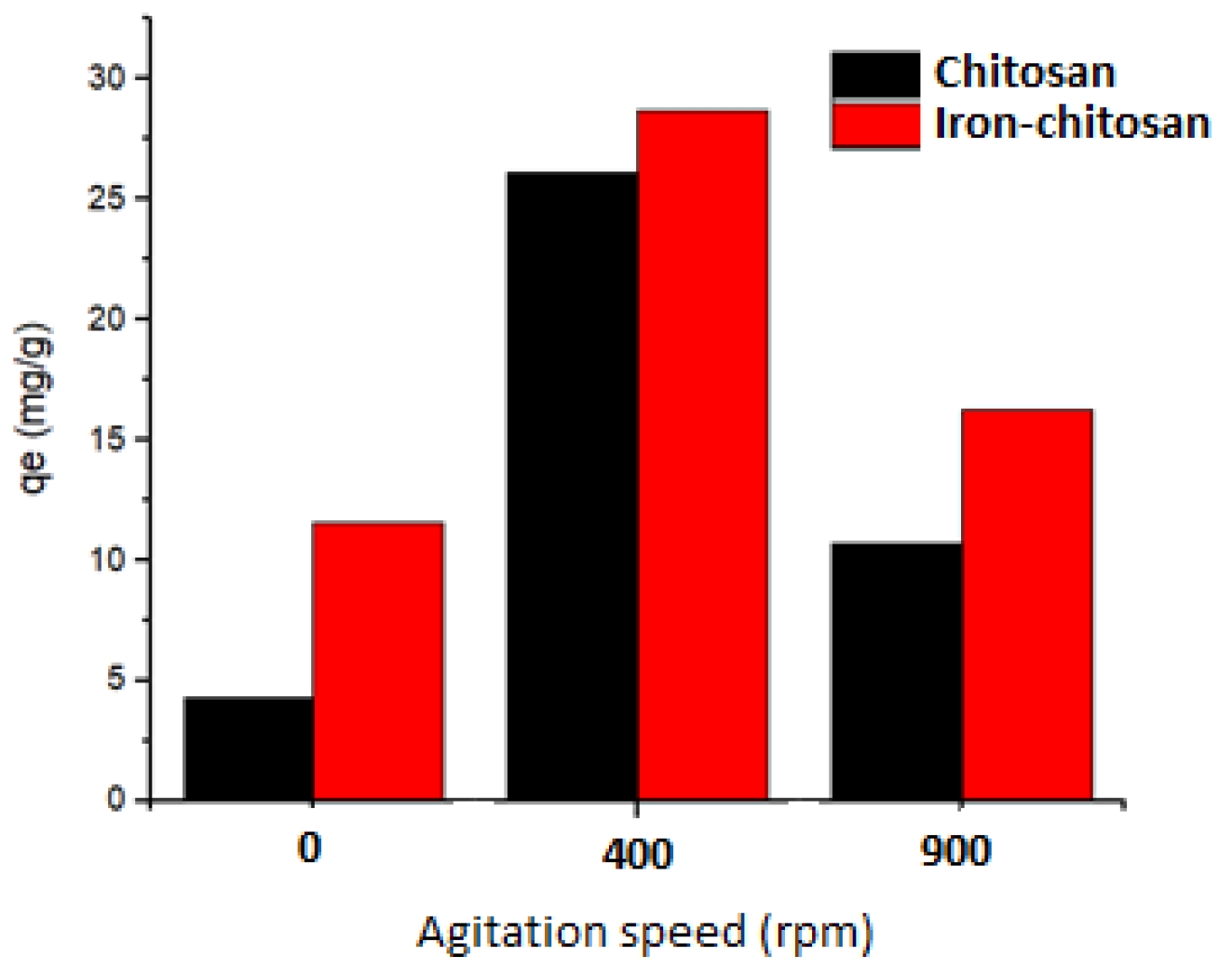
A 100 ppm dye solution (300 mL) was treated with 1 g of adsorbent to examine how agitation speed affects adsorption efficiency on adsorption was assessed (0, 400, and 900 rpm) (Figure 4). For both chitosan types, adsorption increased from static to moderate agitation due to improved mass transfer [23], but decreased at high agitation, likely from partial desorption [24]. Across all speeds, iron-modified chitosan showed higher adsorption than industrial chitosan, confirming the positive impact of modification on adsorptive performance.
Kinetic analysis showed that the highest adsorption rates were achieved at medium agitation speed, with rate constants of 0.0989 min−1 (R2 = 0.99) for industrial chitosan and 0.0962 min−1 (R2 = 0.99) for iron-modified chitosan.

5. Conclusions

This study evaluated the adsorption performance of industrial chitosan and iron-modified chitosan for textile dye removal from wastewater. Kinetic analysis revealed that iron modification significantly improved adsorption efficiency, achieving 96% removal with equilibrium reached in 120 min. The initial solution pH was a key factor: While industrial chitosan performed optimally in basic conditions, iron-chitosan achieved better adsorption in acidic environments. Moreover, medium agitation speed enhanced both adsorption rate and capacity for both materials, outperforming without agitation or high stirring conditions. These findings underscore the potential of chitosan, especially its iron-modified variant, as an efficient biosorbent for wastewater treatment.

Author Contributions

Conception, I.L., K.T. and B.B.; methodology, I.L., K.T. and B.B.; data analysis, I.L., K.T. and B.B.; writing of the manuscript, I.L., K.T. and B.B. All authors contributed equally. All authors have read and agreed to the published version of the manuscript.

Funding

This research received no external funding.

Institutional Review Board Statement

Not applicable. The study did not involve humans or animals.

Informed Consent Statement

Not applicable. No human participants were involved in this study.

Data Availability Statement

No new data were created.

Conflicts of Interest

The authors declare no conflict of interest.

References

  1. Ahmed, Y.; Rahman, M.M.; Alam, M.S.; Miah, M.I.; Choudhury, M.S.H.; Alharb, O.A.; Akhtar, P.; Rahman, S.M. Harnessing neural network model with optimization for enhanced ciprofloxacin antibiotic adsorption from contaminated water: A transparent and objective framework. J. Water Process Eng. 2024, 65, 105724. [Google Scholar] [CrossRef]
  2. Ahmed, Y.; Maya, A.A.S.; Akhtar, P.; Alam, M.S.; AlMohamadi, H.; Islam, M.N.; Alharbi, O.A.; Rahman, S.M. A novel interpretable machine learning and metaheuristic-based protocol to predict and optimize ciprofloxacin antibiotic adsorption with nano-adsorbent. J. Environ. Manage 2024, 370, 122614. [Google Scholar] [CrossRef] [PubMed]
  3. Rita, K. Textile dyeing industry an environmental hazard. Nat. Sci. 2012, 4, 22–26. [Google Scholar] [CrossRef]
  4. Akhtar, P.; Ahmed, Y.; Islam, F.; Alam, K.; Mary, M.; Islam, M.Z.; Bhuiyan, M.M.H.; Yaakob, Z. Efficiency of effluent treatment plants and threat to human health and aquatic environment in Bangladesh. Asian. J. Chem. 2016, 28, 60–68. [Google Scholar] [CrossRef]
  5. Benomara, A.; Guenfoud, F.; Mokhtari, M. Removal of methyl violet 2B by FePO4 as photocatalyst. React. Kinet. Mech. Catal. 2019, 127, 1087–1099. [Google Scholar] [CrossRef]
  6. Chaari, I.; Fakhfakh, E.; Medhioub, M.; Jamoussi, F. Comparative study on adsorption of cationic and anionic dyes by smectite rich natural clays. J. Mol. Struct. 2019, 1179, 672–677. [Google Scholar] [CrossRef]
  7. Charola, S.; Yadav, R.; Das, P.; Maiti, S. Fixed-bed adsorption of Reactive Orange 84 dye onto activated carbon prepared from empty cotton flower agro-waste. Sustain. Environ. Res. 2018, 28, 298–308. [Google Scholar] [CrossRef]
  8. Lansari, I.; Benguella, B.; Kruchinina, N.; Nistratov, A. Adsorption of a textile dye from aqueous solution on natural and modified sawdust. Desalination Water Treat. 2020, 194, 259–268. [Google Scholar] [CrossRef]
  9. Tizaoui, K.; Benguella, B.; Makhoukhi, B. Selective adsorption of heavy metals (Co2+, Ni2+ and Cr3+) from aqueous solution onto natural marne clay. Desalination Water Treat. 2019, 142, 252–259. [Google Scholar] [CrossRef]
  10. Rhaman, M.M.; Karim, M.R.; Hyder, M.K.M.Z.; Ahmed, Y.; Nath, R.K. Removal of chromium (VI) from effluent by a magnetic bioadsorbent based on jute stick powder and its adsorption isotherm, kinetics and regeneration study. Water Air Soil Pollut 2020, 231, 164. [Google Scholar] [CrossRef]
  11. Soares, P.A.; Silva, T.F.C.V.; Manenti, D.R.; Souza, S.M.A.G.U.; Boaventura, R.A.R.; Vilar, V.J.P. Insights into real cotton-textile dyeing wastewater treatment using solar advanced oxidation processes. Environ. Sci. Pollut. Res. 2014, 21, 932–945. [Google Scholar] [CrossRef]
  12. Ahmed, Y.; Siddiqua, A.A.; Maya, P.; Akhtar, P.; AlMohamadi, H.; Mohammad, A.W.; Ashekuzzaman, S.M.; Agnieszka, O.I.; Udin, M.G. Advancements and challenges in Fenton-based advanced oxidation processes for antibiotic removal in wastewater: From the laboratory to practical applications. J. Environ. Chem. Eng. 2024, 13, 115068. [Google Scholar] [CrossRef]
  13. Alsbaiee, A.; Smith, B.J.; Xiao, L.; Ling, Y.; Helbling, D.E.; Dichtel, W.R. Rapid removal of organic micropollutants from water by a porous β-cyclodextrin polymer. Nature 2015, 529, 190–194. [Google Scholar] [CrossRef] [PubMed]
  14. Jyotishka, N.; Mitali, D.; Adrija, G.; Suprakas, S.R.; Jonathan, T.O.; Basudev, L.; Dipankar, C.; Arpita, A. Chitosan-based adsorbents for remediation of toxic dyes from wastewater: A review on adsorption mechanism, reusability, machine learning based modeling and future perspectives. Int. J. Biol. Macromol. 2025, 311 Pt 2, 143388. [Google Scholar] [CrossRef] [PubMed]
  15. Tanvir, S.M.; Mukta, R.S.; Mohammed, F.M.; Chowdhury, M.M.R.; Nuruzzaman, K.M. Electrospun Poly(vinyl alcohol)/Chitosan Nanofibers Embedded with a CuO–GO Nanocomposite for pH-Sensitive Adsorption of Heavy Metal Ions and Organic Dyes. ACS Omega 2025, 10, 19294–19313. [Google Scholar]
  16. Khan, M.N.; Chowdhury, M.; Rahman, M.M. Biobased amphoteric aerogel derived from amine-modified clay-enriched chitosan/alginate for adsorption of organic dyes and chromium (VI) ions from aqueous solution. Mater. Today Sustain. 2021, 13, 100077. [Google Scholar] [CrossRef]
  17. Liu, C.F.; Sun, R.C.; Zhang, A.P.; Ren, J.L. Preparation of sugarcane bagasse cellulosic phthalate using an ionic liquid as reaction mediu. J. Carbohydr. Polym. 2007, 68, 17–25. [Google Scholar] [CrossRef]
  18. Hafsa, J.; Smach, M.A.; Charfeddine, B.; Limem, K.; Majdoub, H.; Rouatbi, S. Antioxidant and antimicrobial proprieties of chitin and chitosan extracted from Parapenaeus Longirostris shrimp shell waste. Ann. Pharm. Fr. 2016, 74, 27–33. [Google Scholar] [CrossRef] [PubMed]
  19. Musah, M.; Azeh, Y.; Mathew, J.T.; Umar, M.T.; Abdulhamid, Z.; Muhammad, A.I. Adsorption Kinetics and Isotherm Models: A Review. Caliphate J. Sci. Technol. 2022, 4, 20–26. [Google Scholar] [CrossRef]
  20. Fayoud, N.H.; Tounsi, L.A.; Tahiri, S.; Abderrahmene, A. Etude cinétique et thermodynamique de l’adsorption de bleu de methylene sur les cendres de bois (Kinetic and thermodynamic study of the adsorption of methylene blue on wood ashes). J. Mater. Environ. Sci. 2015, 6, 3295–3306. [Google Scholar]
  21. Lansari, I.; Benguella, B.; Kruchinina, N.; Nistratov, A. Adsorption of textile dyes from aqueous solution using activated carbon from human hair. React. Kinet. Mech. Catal. 2022, 135, 1891–1903. [Google Scholar] [CrossRef]
  22. Lansari, I.; Tizaoui, K.; Benguella, B.; Bendimerad, F.A.; Bouchaour, S.M. Optimizing chitosan-based adsorbents for the removal of trisodium ferric complex of N-methyl-1,8-naphtalimide-4-sulfonate. React. Kinet. Mech. Catal. 2025, 138, 4097–4114. [Google Scholar] [CrossRef]
  23. Lansari, I.; Tizaoui, K.; Benguella, B.; Bensaid, F.Z.; Chekroun, A.; Kruchinina, N.; Nistratov, A. Kinetic study of removal of reactive violet and bemacid yellow from aqueous solution by adsorption onto activated carbon derived from human hair. React. Kinet. Mech. Catal. 2025, 138, 2597–2611. [Google Scholar] [CrossRef]
  24. Lansari, I.; Benguella, B.; Kruchinina, N.; Nistratov, A. The removal of acid green 4G and anthraquinone orange from aqueous solution using adsorption on activated carbon from human hair. React. Kinet. Mech. Catal. 2022, 135, 987–998. [Google Scholar] [CrossRef]
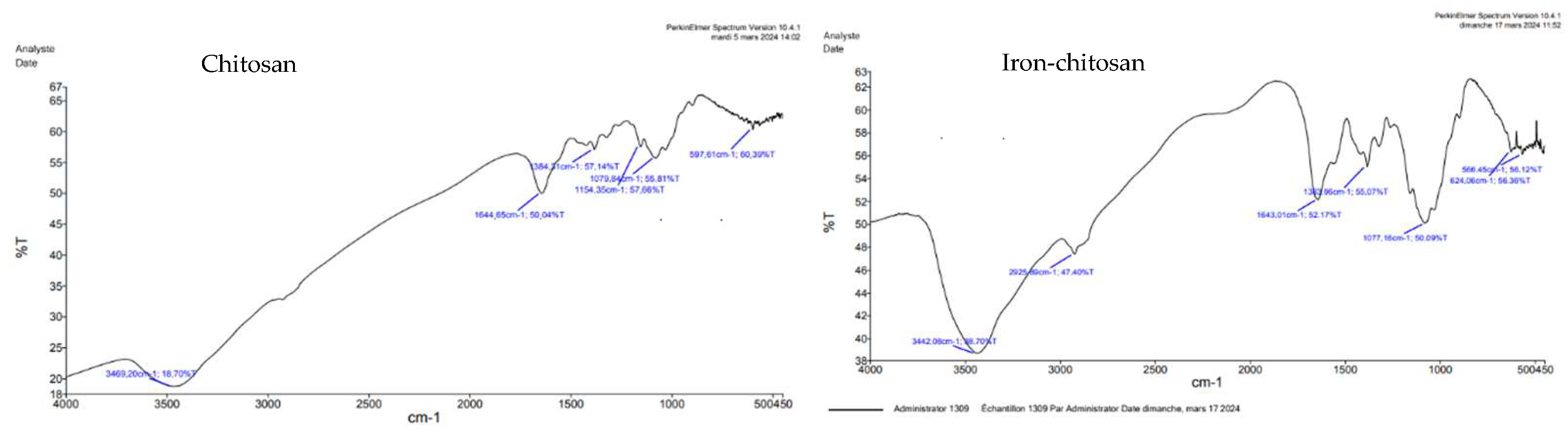
Figure 1. FTIR spectroscopy of chitosan and iron-chitosan.
Chemproc 18 00026 g001
Figure 2. Kinetic study of textile dye adsorption onto industrial and iron-modified chitosan Cdye = 100 mg/L, Vsolution = 300 mL, mAds = 1 g, pH= natural, constant T, stirring speed = medium.
Chemproc 18 00026 g002
Figure 3. Influence of initial pH on the adsorption process of the textile dye onto industrial chitosan, Cdye = 100 mg/L, Vsolution = 300 mL, mAds = 1 g, constant T, stirring speed = medium.
Chemproc 18 00026 g003
Figure 4. Kinetic of stirring rate effect on the adsorption of the textile dye onto chitosan and iron-chitosan, Cdye = 100 mg/L, Vsolution = 300 mL, mAds = 1 g, constant T, pH natural.
Chemproc 18 00026 g004
Disclaimer/Publisher’s Note: The statements, opinions and data contained in all publications are solely those of the individual author(s) and contributor(s) and not of MDPI and/or the editor(s). MDPI and/or the editor(s) disclaim responsibility for any injury to people or property resulting from any ideas, methods, instructions or products referred to in the content.