
Proceeding Paper

Process Optimization of Keratin Extraction from Chicken Feathers Using Alkaline Oxidation: A Taguchi L9 Orthogonal Array Study †
1
Equipe de Chimie des Plantes et de Synthèse Organique et Bioorganique, Département de Chimie, Faculté des Sciences, Université Mohammed V, 4 Avenue Ibn Battouta B.P. 1014 RP, Rabat 10000, Morocco
2
Textile Materials Research Laboratory (REMTEX), Higher School of Textile and Clothing Industries (ESITH), Casablanca 20230, Morocco
3
Chemical & Biochemical Science—Green Process Engineering (CBS), Mohammed VI Polytechnic University, Lot 660, Hay Moulay Rachid, Benguerir 43150, Morocco
*
Authors to whom correspondence should be addressed.
Presented at the 29th International Electronic Conference on Synthetic Organic Chemistry, 14–28 November 2025; Available online: https://sciforum.net/event/ecsoc-29.
Chem. Proc. 2025, 18(1), 27; https://doi.org/10.3390/ecsoc-29-26914
Published: 13 November 2025

Abstract

The valorization of poultry feather waste as a sustainable source of keratin aligns with circular economy principles and offers an environmentally responsible solution to managing agro-industrial residues. In this study, an eco-friendly alkaline oxidative extraction method using hydrogen peroxide (H2O2) was investigated for recovering keratin from chicken feathers. The process was optimized through a Taguchi experimental design to enhance both extraction efficiency and protein regeneration. Four critical parameters, H2O2 concentration, pH, temperature, and extraction time, were studied at three levels each using an L9 orthogonal array. Their effects on solubilization and regeneration yields were systematically evaluated. Statistical analysis revealed that pH and H2O2 concentration had the most significant influence on keratin yield. The optimal conditions for maximum solubilization (2 M H2O2, pH 12, 75 °C, 1.5 h) yielded high extraction efficiency, whereas a lower H2O2 concentration (1 M) favored better regeneration, indicating that excessive oxidation may compromise protein reassembly. Regression models and ANOVA confirmed the statistical significance of these findings, with R2 values of 94.25% for solubilization and 78.23% for regeneration. The extracted keratin maintained essential structural features, as verified through subsequent characterization. This work not only improves the sustainability and effectiveness of keratin recovery but also establishes a statistically robust optimization approach. The methodology and insights provided can support future efforts in developing high-quality keratin-based biomaterials for biomedical, cosmetic, or environmental applications.

1. Introduction

Keratin, a ubiquitous and versatile protein within the natural milieu, assumes a pivotal role as a complex biomolecule characterized by diverse material properties, intricate structural configurations, and exceptional functional attributes [1]. Predominantly found in poultry feathers, comprising approximately 90% of their composition [2], the valorization of waste feathers gains prominence when viewed through the lens of the circular economy. Frequently regarded as a byproduct of the meat industry, poultry feathers stand out as a copious reservoir of keratin. In lieu of allowing these feathers to contribute to environmental challenges [3], their metamorphosis into valuable materials harmonizes with the fundamental tenets of sustainability and waste reduction.
The extraction of keratin traditionally involves processes such as reduction [4], oxidation [5], sulfitolysis [6], and the application of ionic liquids [7]. Historically, strong alkali methods have been employed for keratin extraction, necessitating substantial quantities of alkaline substances for hydrolysis and acids for subsequent neutralization. Unfortunately, this hydrolysis method damages the primary chain of keratin, leading to structural disruptions. While this method has yielded low-molecular-weight keratin derivatives with applications in cosmetic and pet care industries [6], the evolving landscape of keratin applications now demands high-molecular-weight keratins [8]. Consequently, there is a renewed focus on extraction methodologies. One prevalent technique involves the isolation of keratin from feathers through the reduction method, deploying reducing agents like thiols. This method is widely documented for breaking cystine disulfide bonds (R–S–S–R) and inducing the formation of cysteine (R–S–H). Although this method maintains the structural integrity of the keratin chain, the use of costly and potentially toxic substances such as mercaptoethanol and dithiothreitol presents notable drawbacks [9].
Oxidation methodologies have been extensively documented in the scientific literature over several decades [10], showcasing the use of oxidizing agents such as performic acid or peracetic acid [11,12]. These agents are commonly employed to induce the formation of sulfonic acid (RSO3H) in the keratin structure. However, it is crucial to note that these oxidation processes are characterized by an inherent time-intensive nature. Typically, a prolonged reaction period exceeding 24 hours is necessitated to achieve a satisfactory yield [13].
Fernández-d’Arlas investigated an unconventional approach to keratin extraction by employing an in-situ oxidation treatment in basic media [14]. Inspired by studies on wool bleaching, where hydrogen peroxide (H2O2) demonstrated fiber solubilization in alkali conditions, the oxidative method using H2O2 emerged as a promising alternative. This method yielded extraction results comparable to conventional approaches in terms of both yield and molecular weight, while employing fewer hazardous chemicals at lower concentrations. Notably, this extraction route produces water, oxygen, and minimal hydroxyl byproducts, eliminating the need for extensive washing or dialysis purification processes seen in other keratin extraction methods.
The significance of these works extends beyond extraction efficiency and sustainability, encompassing the preservation of keratin’s structural integrity. Conventional methods, marked by the formation of disordered structures, often compromise the mechanical strength, flexibility, and thermal stability of the regenerated keratin [15,16,17]. Fernández-d’Arlas harnessed the extracted keratin from the alkaline oxidative method to develop bioplastic materials, demonstrating commendable thermal stability and mechanical properties comparable to the best-reported protein-based plastics [18].
In this study, we take a step further by employing the Taguchi method to optimize the keratin extraction process from chicken feathers. Known for its application in manufacturing processes [19], the Taguchi method offers a robust design, optimizing process parameters, and minimizing variability [20,21]. By leveraging statistically designed experiments, we aim to determine the optimal conditions for keratin extraction, thereby enhancing efficiency while reducing experimental time. In-depth analysis involved Signal-to-Noise (S/N) ratio calculations and analysis of variance (ANOVA) to assess the significance of parameters.

2. Materials and Methods

2.1. Materials

Chicken feathers (whole feathers with quill and barbs) were gently provided by a local poultry slaughterhouse (Casablanca-Settat region, Morocco), Feathers underwent a rigorous cleaning process involving multiple washes with water and dish detergent to eliminate impurities such as manure, blood, excess mass, and extraneous body parts. Subsequently, the feathers were immersed in a 20% ethanol solution to achieve a pristine, odor-free, and sanitized state. The cleaned feathers were then spread on an iron sheet and dried at room temperature for 2 days. Sodium hydroxide (NaOH) pellets were purchased from Sigma-Aldrich (Stockholm, Sweden), and Hydrogen peroxide (H2O2) 30 (w/w) was obtained from Solvachim (Casablanca, Morocco).

2.2. Protein Extraction Using Alkaline Oxidation Method

For the extraction process, 2 grams of the feathers were suspended in a 100 mL solution containing aqueous H2O2. The pH of the solution was carefully adjusted within a specific range using aqueous NaOH. The keratin extraction reaction ensued under constant mechanical stirring at 300 rpm. After the designated extraction duration, the solution underwent filtration to eliminate any undissolved fibers. The pH of the obtained filtrate was gradually lowered by the additions of concentrated HCl until the isoelectric point of the proteins was reached, typically within the pH range of 3–2. At this stage, the solution exhibited an opaque, white appearance. The precipitated keratins were separated through centrifugation at 9000 rpm and subsequently dried at 50 °C.

2.3. Taguchi Orthogonal Array Design

In the context of four parameters, each with three different levels, a traditional full factorial experimental design would necessitate a staggering 81 individual experiments. Considering the need for each experiment to be replicated three times, the analytical workload becomes substantial. To circumvent this exhaustive combinatorial pattern, a Taguchi orthogonal array method for optimizing solubilization and regeneration yield responses was adopted. H2O2 concentration, pH, temperature, and time were chosen as variables, with each factor set at three levels, as detailed in Table 1. Utilizing the Minitab statistical software (version 19), the experimental data derived from the extraction were analyzed. The objective function for Taguchi design optimization studies is derived from the signal-to-noise ratio (S/N), typically expressed logarithmically as the larger-the-better objective function [22], calculated using Equation (1):
S N = 10 log 1 n i = 1 n 1 y i 2
Here S/N, represents the signal-to-noise ratio; n is the number of experiments conducted; i signifies the experimental run number, and y denotes the output result of the experiment.

3. Results and Discussion

3.1. Taguchi Optimization Methodology of Operating Extraction Conditions

The outcomes of the extraction experiments are systematically presented in Table 2. The primary effects of the examined factors on the mean responses and the mean values for the Signal-to-Noise (S/N) ratio are evaluated based on three replicates for both the solubilization and regeneration of keratin.
The S/N ratio serves as a vital metric in evaluating combinations and their inherent quality deviations from the desired values, considering each experimental variable and its level. In essence, the noise represents the effect of each factor on each operation, while the signal signifies the response to the change in each operational variable. Different S/N methods exist, such as smaller-is-better, larger-is-better, and nominal-is-best [23]. Our study focused on extracting keratin from chicken feathers, a larger S/N ratio denotes better quality characteristics. Employing the Taguchi L9 (34) orthogonal array, we conducted nine sets of experiments, manipulating H2O2 concentration, pH, temperature, and agitation duration. The aim is to maximize the extraction yield of keratin, emphasizing the highest possible quality in the process.
Table 3 displays the S/N ratio response for the solubilization of feathers, where a higher S/N ratio indicates minimal variation between the desired and measured outputs. The analysis reveals that pH is the most influential factor, ranked first, followed by H2O2 concentration, temperature, and time, the latter being the least significant in the solubilization process.
The selected extraction processes in our study are anchored in the reactivity of bisulfide bonds to oxidative reactions. As proposed by Fernández-d’Arlas, the oxidation of cystine in feathers results in the formation of various sulfur oxidation species, as illustrated by the chemical reaction [14,18]
R S S R + 6 H 2 O 2 2 R S O 3 + 6 H 2 O
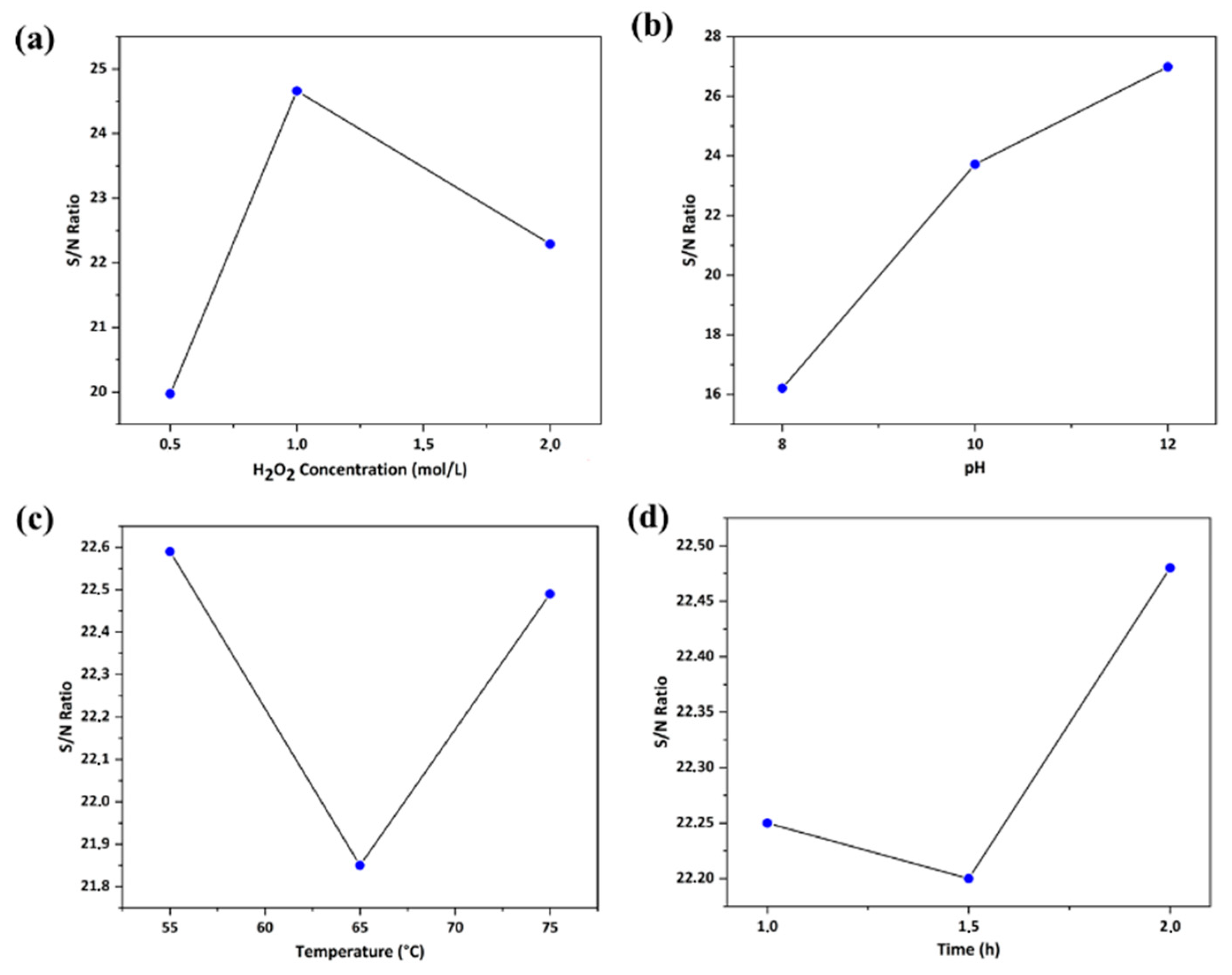
This elucidates the pronounced effect of H2O2 concentration on feather solubilization, with yields increasing proportionally. Taking into account that oxidizing power of H2O2 is higher in lower pH [24]. The diminished yields in weaker pH media may be associated with the reduced solubility of keratins under such pH conditions [25]. Furthermore, solubilization yields exhibit an upward trend with increasing the temperature. Notably, time emerges as the least impactful factor in solubilization, with optimal results achieved after an hour and a half. This suggests that the method not only yields high-quality outcomes but also proves time-efficient. The S/N main effects plot, depicted in Figure 1 and generated using Minitab 19, illustrates that the optimal conditions for feather solubilization (2 M H2O2 concentration, pH 12, 75 °C, and 1.5 hours duration) were identified.
The S/N ratio response table for the regeneration of keratin highlights a similar trend to that observed in the solubilization process (Table 4). Once again, pH emerges as the most influential factor, occupying the top position, followed by H2O2 concentration, temperature, and time, with the latter being the least significant.
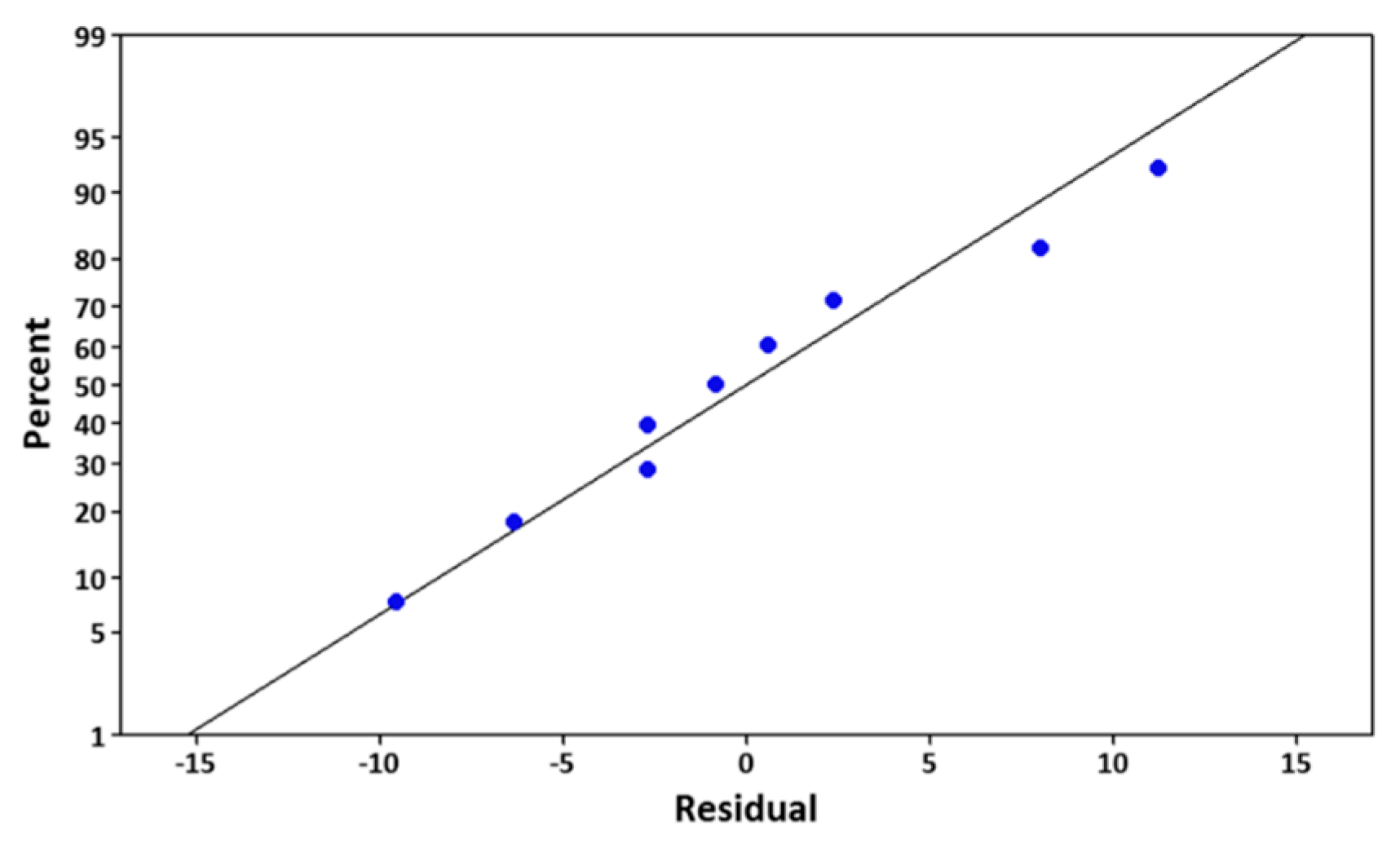
However, the regeneration yield appears somewhat low. This discrepancy could stem from the nature of the regeneration process, which involves reprecipitating keratin from a soluble state. The regeneration mechanism may encounter challenges related to the reassembly of keratin structures, resulting in a slightly diminished yield. The Main Effects plot for S/N ratios, depicted in Figure 2, provides valuable insights into the optimal conditions for the regeneration of keratin. Notably, the plot reveals that the optimum H2O2 concentration for achieving maximum regeneration yield is 1 M. Intriguingly, as the H2O2 concentration increases to 2 M, there is a decrease in the regeneration yield. This counterintuitive observation prompts a closer examination of the underlying mechanisms. The extensive oxidation of cystine is likely a key factor contributing to the decline in regeneration yield at higher H2O2 concentrations [26].

3.2. Development of Regression Models and Analysis of Variance (ANOVA) Results

In this study, a linear regression analysis has been employed to formulate predictive mathematical models that elucidate the relationship between the dependent variables of solubilization and regeneration and the independent factors of H2O2 concentration, pH, temperature, and time. The predictive equation derived from the regression analysis for feather solubilization is expressed as Equation (3). The coefficient of determination (R2) serves as a pivotal metric gauging the goodness of fit for a regression model. An optimal fit is indicated by higher R2 values, with the solubilization response exhibiting an R2 value of 94.25, denoting that 94.25% of the experimental data align with the predictions of the developed model.
S o l u b i l i z a t i o n   % = 114.5 + 21.41   A + 12.88     B + 0.203   C +   3.41   D               R 2 = 94.25
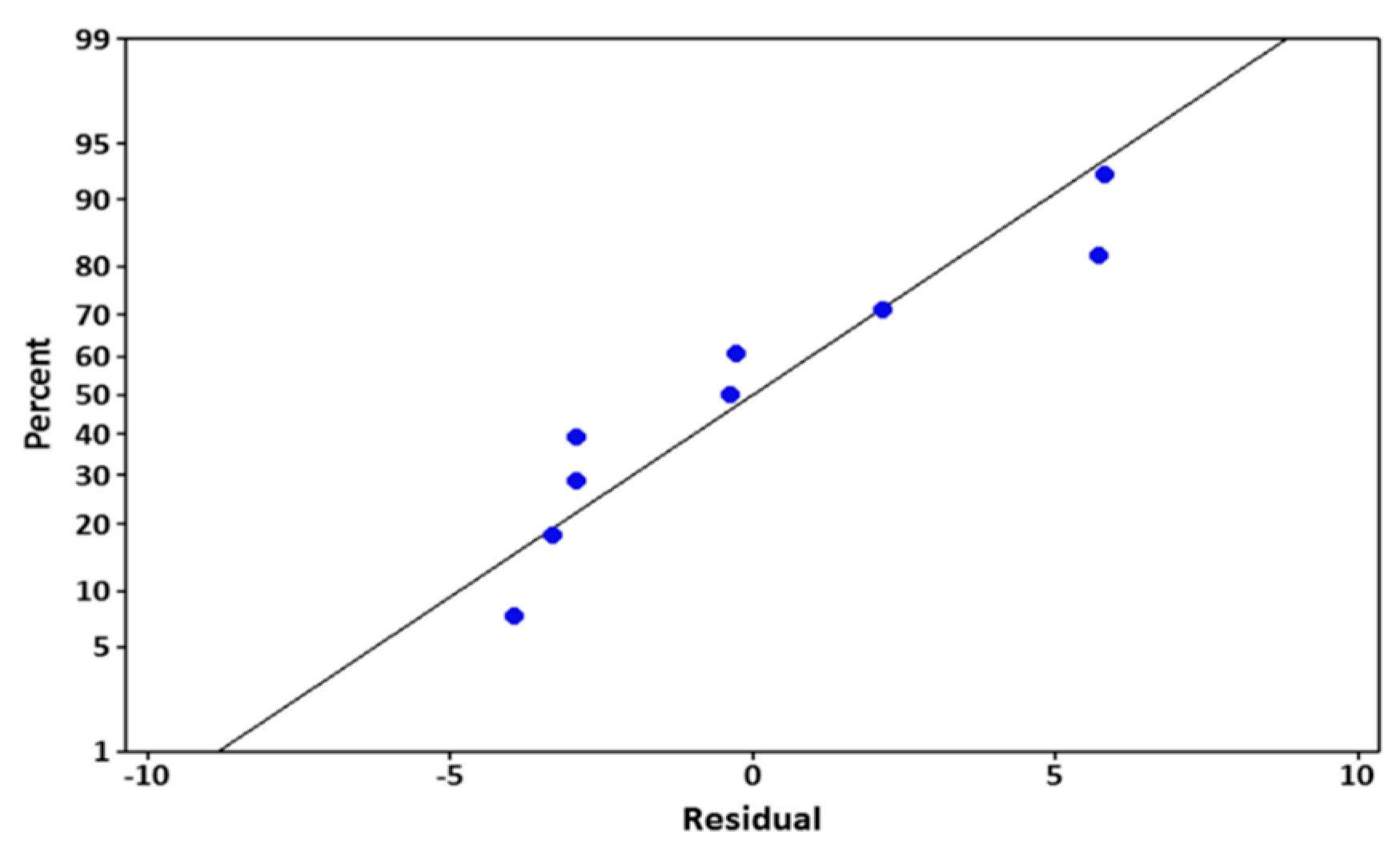
The obtained residual plot, presented in Figure 3 and Figure 4, serves as a diagnostic tool to assess the significance of coefficients in the predicted model. A straight-line pattern in the residual plot indicates that residual errors conform to a normal distribution, affirming the statistical significance of the model coefficients [27]. The observed proximity of residuals to the straight line reinforces the assertion that the developed model coefficients hold significance in explicating the solubilization process for feathers.
The obtained coefficient of determination of 78.23 for the regeneration process, while indicative of a reasonable fit, suggests that the developed model accounts for approximately 78.23% of the variability in the experimental data. This comparatively lower R2 value in comparison to solubilization may signify that there are additional factors or complexities influencing the regeneration of keratin from feathers that are not fully captured by the selected independent variables.
R e g e n e r a t i o n   % = 17.9 + 1.17   A +   4.08   B 0.105   C 1.47     D                   R 2 = 78.23
Even though the R2 is not as high as in the solubilization process, the conformity to a straight-line pattern in the residuals in Figure 4 provides a level of confidence in the validity of the model for regeneration.
ANOVA (Analysis of Variance) was conducted using Minitab 19 to assess the statistical significance and contribution percentages of the various combinations of parameters in the experimental design. The outcomes of the ANOVA for solubilization and keratin regeneration are meticulously presented in Table 5 and Table 6, respectively. The p-value, a critical metric in determining the significance level of the designed parameters on the experiments performance, was analyzed. A p-value less than or equal to 0.05 is deemed statistically significant, signifying rejection of the null hypothesis, which posits that process parameters have no effect on solubilization and keratin regeneration.
For the solubilization, the analysis revealed that only H2O2 concentration and pH achieved p-values less than 0.05, establishing their statistical significance. Furthermore, the contribution of each parameter to the performance was quantified as a percentage. Notably, pH and H2O2 concentration emerged as the most influential factors, contributing 66.67% and 26.87%, respectively, to the variance. These findings underscore the pivotal role played by these parameters in influencing the efficiency of the solubilization process.
Notably, in the case of regeneration, only pH exhibited a p-value below 0.05, indicating its statistically significant impact on the process. Furthermore, the percentage contribution of each parameter towards the variability in the experimental data was assessed. Remarkably, pH emerged as the predominant factor, contributing approximately 74.85% to the variability in the regeneration process.

4. Conclusions

This study demonstrates that an alkaline oxidative process using hydrogen peroxide can efficiently recover high-quality keratin from chicken feathers. Taguchi optimization identified pH and H2O2 concentration as key factors, enabling high solubilization under strongly alkaline conditions (2 M H2O2, pH 12, 75 °C, 1.5 h) and improved protein regeneration at lower oxidant levels. These results provide a statistically validated framework for sustainable keratin extraction and offer valuable guidance for producing keratin-based biomaterials for biomedical, cosmetic, and environmental applications.

Author Contributions

M.B.: Data curation, Software, Investigation, Formal analysis, Writing—original draft; O.C.: Supervision, Validation, Writing—review & editing; K.B.: Supervision, Validation, Writing—review & editing. All authors have read and agreed to the published version of the manuscript.

Funding

This research was financially funded by CNRST Morocco through a PhD-Associate Scholarship (2024 edition) awarded to Mohamed Belhajja.

Institutional Review Board Statement

Not applicable.

Informed Consent Statement

Not applicable.

Data Availability Statement

The data generated in this study are included in the article. Additional information can be provided upon reasonable request to the corresponding authors.

Conflicts of Interest

The authors declare no conflicts of interest.

References

  1. Lazarus, B.S.; Chadha, C.; Velasco-Hogan, A.; Barbosa, J.D.V.; Jasiuk, I.; Meyers, M.A. Engineering with Keratin: A Functional Material and a Source of Bioinspiration. iScience 2021, 24, 102798. [Google Scholar] [CrossRef]
  2. Kamarudin, N.B.; Sharma, S.; Gupta, A.; Kee, C.G.; Chik, S.M.S.B.T.; Gupta, R. Statistical Investigation of Extraction Parameters of Keratin from Chicken Feather Using Design-Expert. 3 Biotech 2017, 7, 127. [Google Scholar] [CrossRef]
  3. Sinkiewicz, I.; Śliwińska, A.; Staroszczyk, H.; Kołodziejska, I. Alternative Methods of Preparation of Soluble Keratin from Chicken Feathers. Waste Biomass Valorization 2017, 8, 1043–1048. [Google Scholar] [CrossRef]
  4. Alahyaribeik, S.; Ullah, A. Methods of Keratin Extraction from Poultry Feathers and Their Effects on Antioxidant Activity of Extracted Keratin. Int. J. Biol. Macromol. 2020, 148, 449–456. [Google Scholar] [CrossRef] [PubMed]
  5. Chen, Y.; Li, W.; Zhang, S. A Multifunctional Eco-Friendly Fertilizer Used Keratin-Based Superabsorbent as Coatings for Slow-Release Urea and Remediation of Contaminated Soil. Prog. Org. Coat. J. 2021, 154, 106158. [Google Scholar] [CrossRef]
  6. Khumalo, M.; Sithole, B.; Tesfaye, T. Valorisation of Waste Chicken Feathers: Optimisation of Keratin Extraction from Waste Chicken Feathers by Sodium Bisulphite, Sodium Dodecyl Sulphate and Urea. J. Environ. Manag. 2020, 262, 110329. [Google Scholar] [CrossRef]
  7. Polesca, C.; Passos, H.; Neves, B.M.; Coutinho, J.A.; Freire, M.G. Valorization of Chicken Feathers Using Aqueous Solutions of Ionic Liquids. Green Chem. 2023, 25, 1424–1434. [Google Scholar] [CrossRef]
  8. He, J.; Xu, D.; Li, J.; Li, L.; Li, W. Highly Efficient Extraction of Large Molecular-Weight Keratin from Wool in a Water/Ethanol Co-Solvent. Text. Res. J. 2020, 90, 1084–1093. [Google Scholar] [CrossRef]
  9. Shavandi, A.; Silva, T.H.; Bekhit, A.A.; Bekhit, A.E.D.A. Keratin: Dissolution, Extraction and Biomedical Application. Biomater. Sci. 2017, 5, 1699–1735. [Google Scholar] [CrossRef]
  10. Woodin, A.M. The Free Amino-Groups of Soluble Feather Keratin. Nature 1955, 176, 1117. [Google Scholar] [CrossRef]
  11. Shavandi, A.; Carne, A.; Bekhit, A.A.; Bekhit, A.E.D.A. An Improved Method for Solubilisation of Wool Keratin Using Peracetic Acid. J. Environ. Chem. Eng. 2017, 5, 1977–1984. [Google Scholar] [CrossRef]
  12. Pakkaner, E.; Yalç, D.; Uysal, B.; Top, A. Self-Assembly Behavior of the Keratose Proteins Extracted from Oxidized Ovis Aries Wool Fibers. Int. J. Biol. Macromol. 2019, 125, 1008–1015. [Google Scholar] [CrossRef] [PubMed]
  13. Blanchard, C.R.; Timmons, S.F.; Smith, R.A. Keratin-based hydrogel for biomedical applications and method of production. U.S. Patent 5932552, 3 August 1999. [Google Scholar]
  14. Fernández-d’Arlas, B. Improved Aqueous Solubility and Stability of Wool and Feather Proteins by Reactive-Extraction with H2O2 as Bisulfide (–S–S–) Splitting Agent. Eur. Polym. J. 2018, 103, 187–197. [Google Scholar] [CrossRef]
  15. Kim, S.Y.; Kim, J.H.; Kang, Y.; Yoo, J.W.; Choi, J.; Lee, H.J. Green Chemistry Method for Hair Strengthening and Setting Using Visible Light-Mediated Protein Crosslinking. J. Clean. Prod. 2022, 363, 132535. [Google Scholar] [CrossRef]
  16. Thonpho, A.; Srihanam, P. Preparation and Characterization of Keratin Blended Films Using Biopolymers for Drug Controlled Release Application. Orient. J. Chem. 2016, 32, 1739–1748. [Google Scholar] [CrossRef]
  17. Aranberri, I.; Montes, S.; Azcune, I.; Rekondo, A.; Grande, H.J. Flexible Biocomposites with Enhanced Interfacial Compatibility Based on Keratin Fibers and Sulfur-Containing Poly(Urea-Urethane)s. Polymers 2018, 10, 1056. [Google Scholar] [CrossRef]
  18. Fernández-d’Arlas, B. Tough and Functional Cross-Linked Bioplastics from Sheep Wool Keratin. Sci. Rep. 2019, 9, 14810. [Google Scholar] [CrossRef]
  19. Maghsoodloo, S.; Ozdemir, G.; Victoria, J.; Chen-Hsiu, H. Strengths and Limitations of Taguchi ’ s Contributions to Quality, Manufacturing, and Process Engineering. J. Manuf. Syst. 2004, 23, 73–126. [Google Scholar] [CrossRef]
  20. Priyadarshi, D.; Karar, K. Optimisation of Biodiesel Production Using Taguchi Model. Waste Biomass Valorization 2017, 10, 1547–1559. [Google Scholar] [CrossRef]
  21. John, I.; Pola, J.; Thanabalan, M.; Appusamy, A. Bioethanol Production from Musambi Peel by Acid Catalyzed Steam Pretreatment and Enzymatic Saccharification: Optimization of Delignification Using Taguchi Design. Waste Biomass Valorization 2019, 11, 2631–2643. [Google Scholar] [CrossRef]
  22. Pădurețu, C.; Isopescu, R.D.; Gîjiu, C.L.; Rău, I.; Apetroaei, M.R.; Schröder, V. Optimization of Chitin Extraction Procedure from Shrimp Waste Using Taguchi Method and Chitosan Characterization. Mol. Cryst. Liq. Cryst. 2020, 695, 19–28. [Google Scholar] [CrossRef]
  23. Lymperopoulou, T.; Georgiou, P.; Tsakanika, L. Optimizing Conditions for Scandium Extraction from Bauxite Residue Using Taguchi Methodology. Minerals 2019, 9, 236. [Google Scholar] [CrossRef]
  24. Gao, J.; Yang, H.; Gao, J.; Yang, H.; Huang, X.; Hung, S.; Cai, W.; Jia, C. Enabling Direct H2O2 Production in Acidic Media through Rational Design of Transition Metal Single Atom Catalyst. Chem 2020, 6, 658–674. [Google Scholar] [CrossRef]
  25. Yamauchi, K.; Yamauchi, A.; Kusunoki, T.; Kohda, A.; Konishi, Y. Preparation of Stable Aqueous Solution of Keratins, and Physiochemical and Biodegradational Properties of Films. J. Biomed. Mater. Res. 1996, 31, 439–444. [Google Scholar] [CrossRef]
  26. Filomeni, G.; Society, D.C.; Desideri, E.; Ciriolo, M.R. Under the ROS: Thiol Network Is the Principal Suspect for Autophagy Commitment. Autophagy 2010, 6, 999–1005. [Google Scholar] [CrossRef] [PubMed]
  27. Song, H.; Dan, J.; Li, J.; Du, J.; Xiao, J.; Xu, J. Experimental Study on the Cutting Force during Laser-Assisted Machining of Fused Silica Based on the Taguchi Method and Response Surface Methodology. J. Manuf. Process. 2019, 38, 9–20. [Google Scholar] [CrossRef]
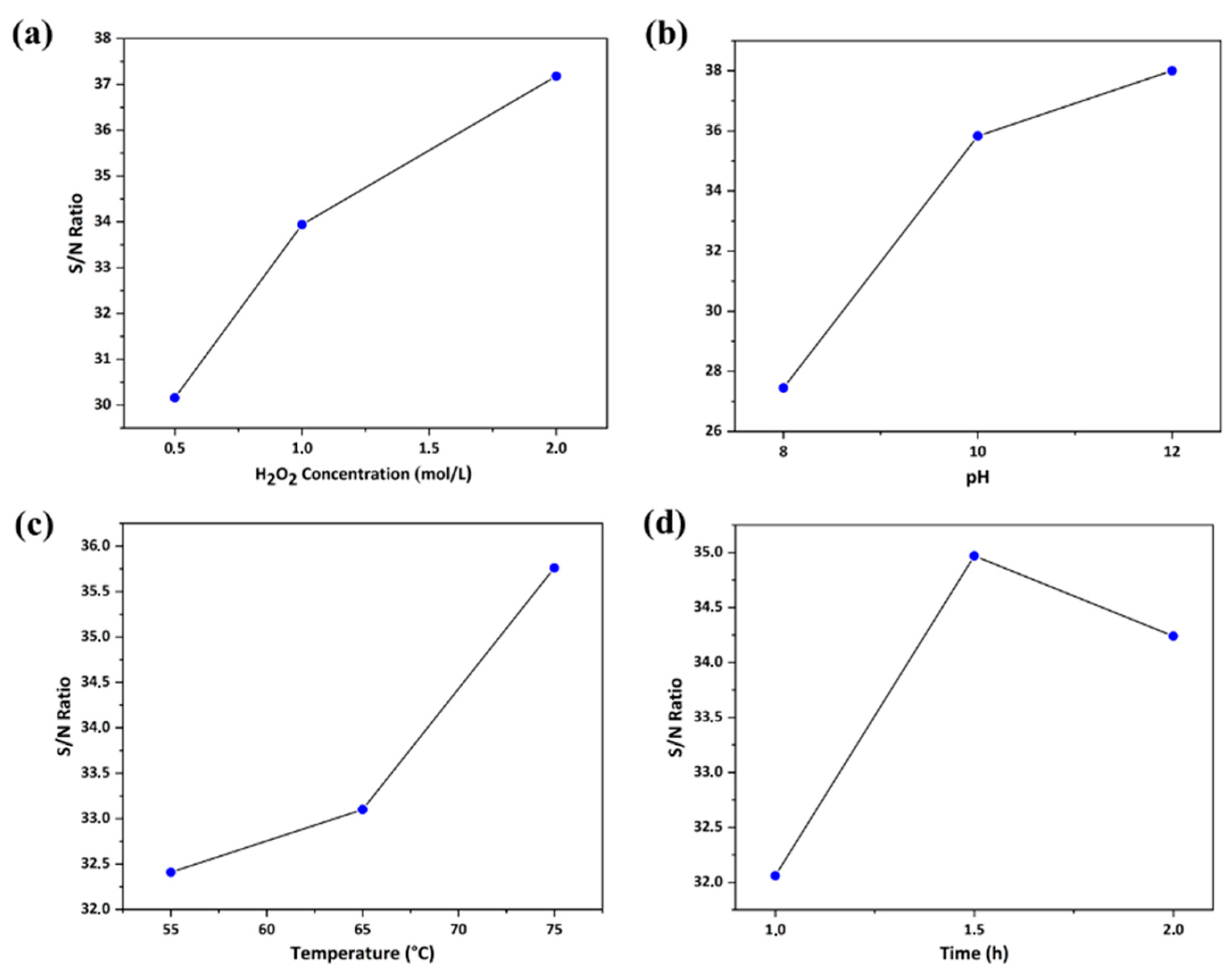
Figure 1. Main effects plot for S/N ratios of the solubilization variables; for (a) H2O2 concentration; (b) pH; (c) Temperature; (d) Time.
Chemproc 18 00027 g001
Figure 2. Main effects plot for S/N ratios of the regeneration variables; for (a) H2O2 concentration; (b) pH; (c) Temperature; (d) Time.
Chemproc 18 00027 g002
Figure 3. Normal probability plot of the residuals for feathers solubilization.
Chemproc 18 00027 g003
Figure 4. Normal probability plot of the residuals for keratin regeneration.
Chemproc 18 00027 g004
Table 1. Extraction process parameters and their levels.
SymbolProcess ParametersUnitsLevels
123
AH2O2 Concentrationmol/L0.512
BpH-81012
CTemperature°C556575
DTimeh11.52
Table 2. Design of experiments, experimental outcomes, and their corresponding signal-to-noise ratios.
Exp. RunsControllable Process
Parameters
Average Experimental ResultsS/N Ratios of Results
ABCDSolubilization (%)Regeneration (%)SolubilizationRegeneration
10.5855111.09005.120020.808214.0921
20.510651.543.880011.086732.788520.8169
30.51275270.086717.856736.892825.0033
41865223.60338.250027.448218.2726
511075165.563320.500036.314926.1931
6112551.580.093329.936738.047329.5096
728751.550.83006.586734.079716.2654
821055283.093316.216738.387424.1534
921265189.900021.116739.069226.4623
Table 3. Mean S/N ratio response table for feathers solubilization.
Process ParametersMean S/N Ration
Level 1Level 2Level 3Max–MinRank
A30.1633.9437.187.022
B27.4535.833810.561
C32.4133.135.763.353
D32.0634.9734.242.914
Table 4. Mean S/N ratio response table for keratin regeneration.
Process ParametersMean S/N Ration
Level 1Level 2Level 3Max–MinRank
A19.9724.6622.294.692
B16.2123.7226.9910.781
C22.5921.8522.490.733
D22.2522.222.480.284
Table 5. Results of ANOVA for feathers solubilization.
SourceDegree of FreedomSum of SquaresMean Squares% ContributionF-Valuep-Value
Regression45628.061407.0194.24868116.390.01
A11604.51604.526.86929618.690.012
B13981.293981.2966.67152346.370.002
C124.8224.820.4156410.290.619
D117.4417.440.29205390.200.676
Error4343.4485.865.7513188
Total85971.5 100
Table 6. Results of ANOVA for keratin regeneration.
SourceDegree of FreedomSum of SquaresMean Squares% ContributionF-Valuep-Value
Regression4414.156103.53978.235047433.590.12
A14.8264.8260.9116428080.170.70
B1399.405399.40575.4485486613.870.02
C16.6786.6781.2614899860.230.66
D13.2463.2460.6131770730.110.75
Error4115.21828.80521.76495257
Total8529.374 100
Disclaimer/Publisher’s Note: The statements, opinions and data contained in all publications are solely those of the individual author(s) and contributor(s) and not of MDPI and/or the editor(s). MDPI and/or the editor(s) disclaim responsibility for any injury to people or property resulting from any ideas, methods, instructions or products referred to in the content.