
Proceeding Paper

Supramolecular Assemblies Driven by N-H…O and O-H…O Hydrogen Bonding Interactions: Experimental and Theoretical Investigation into the Supramolecular Architectures of Dihydropyrimidin-2(1H)-ones †
by
Sunshine Dominic Kurbah
Department of Chemistry, Pandit Deendayal Upadhyaya Adarsha Mahavidyalaya, Eraligool 788723, India
Presented at the 29th International Electronic Conference on Synthetic Organic Chemistry, 14–28 November 2025; Available online: https://sciforum.net/event/ecsoc-29.
Chem. Proc. 2025, 18(1), 28; https://doi.org/10.3390/ecsoc-29-26921
Published: 27 November 2025

Abstract

In this paper, quantum chemical calculations at the DFT/6-311G (d,p) level of theory have been carried out to study the supramolecular structure of dihydropyrimidin-2(1H)-ones. Theoretical studies such as Hirshfeld surface analysis, MEPS (molecular electrostatic potential surface), and HOMO–LUMO calculation were also carried out to obtain the energy gap and to determine the kinetic stability and chemical reactivity. The crystal structure of dihydropyrimidin-2(1H)-ones shows the present of N-H…O and O-H…O hydrogen bonding interactions. The N-H…O bond lengths are 2.102 Å and 2.037 Å, respectively. The theoretical hydrogen bonding interactions were also compared with the available experimental data and found to be closely related.

1. Introduction

In chemistry and materials science, using molecules having supramolecular synthons as building blocks to create network solid and functional materials via non-covalent interactions has become important [1,2,3,4]. It is possible to achieve intriguing chemical and physical properties of the constructed networks by integrating various capabilities into the building elements [5]. One of the most common methods used in the creation of supramolecular network solids is hydrogen bonding. Because of its well defined, repeated, and transferable directionality qualities, hydrogen bonding has been referred to as “the master key interactions in supramolecular chemistry” [6,7,8,9,10].
To achieve the desired molecular ordering in the crystalline state, it is very crucial to comprehend the supramolecular interaction of organic crystals with different secondary bonds, such as hydrogen bonds, π–π interactions, and other non-covalent interactions [2,3,4]. Organic crystals frequently consist of complex molecules with numerous substituents and a relatively large size, which can lead to the creation of complex secondary bonds, in contrast to inorganic crystals with primary simple constituent atomic units.
Hence, the main purpose of this study was to investigate the ability of dihydropyrimidin-2(1H)-ones to form supramolecular structure using different kinds of molecular interactions. Moreover, dihydropyrimidin-2(1H)-one was one of the most important heterocyclic compounds, which exhibits significant biological activities and is widely studied [11,12]. This study focus on dihydropyrimidin-2(1H)-ones, specifically how these molecules with multiple hydrogen bonding sites interact within crystals to establish a synthon hierarchy.

2. Results and Discussion

The optimized geometrical structure of DHP1, DHP2, and DHP3 are shown in Figure 1. The geometry of DHP1 was optimized without any water molecule, whereas the structures of DHP2 and DHP3 were optimized together with water molecules. The optimization was carried out to compare the theoretical hydrogen bonding interactions present inside the crystal lattice with the experimental data obtained from single crystal. As shown in Figure 1, theoretical hydrogen bonding interactions of DHP2 and DHP3 are 1.691 Å and 1.687 Å, respectively. The theoretical hydrogen bonding interactions were also compared with the available data of some of the compounds available in the Cambridge structure data base (CCDC number 1455902) is 1.825 Å (DHP2), and found to be closely related. However, some deviation between experimental data and DFT were observed [13]. These results can be attributed to the experimental data and geometrical (single crystal X-ray crystallography) data being performed in solid state where the intermolecular interactions became prominent, whereas for the theoretical data, the optimization were carried out in gaseous state in which intermolecular interactions are absent and, moreover, its structure is more extended compared to single crystal X-ray data.
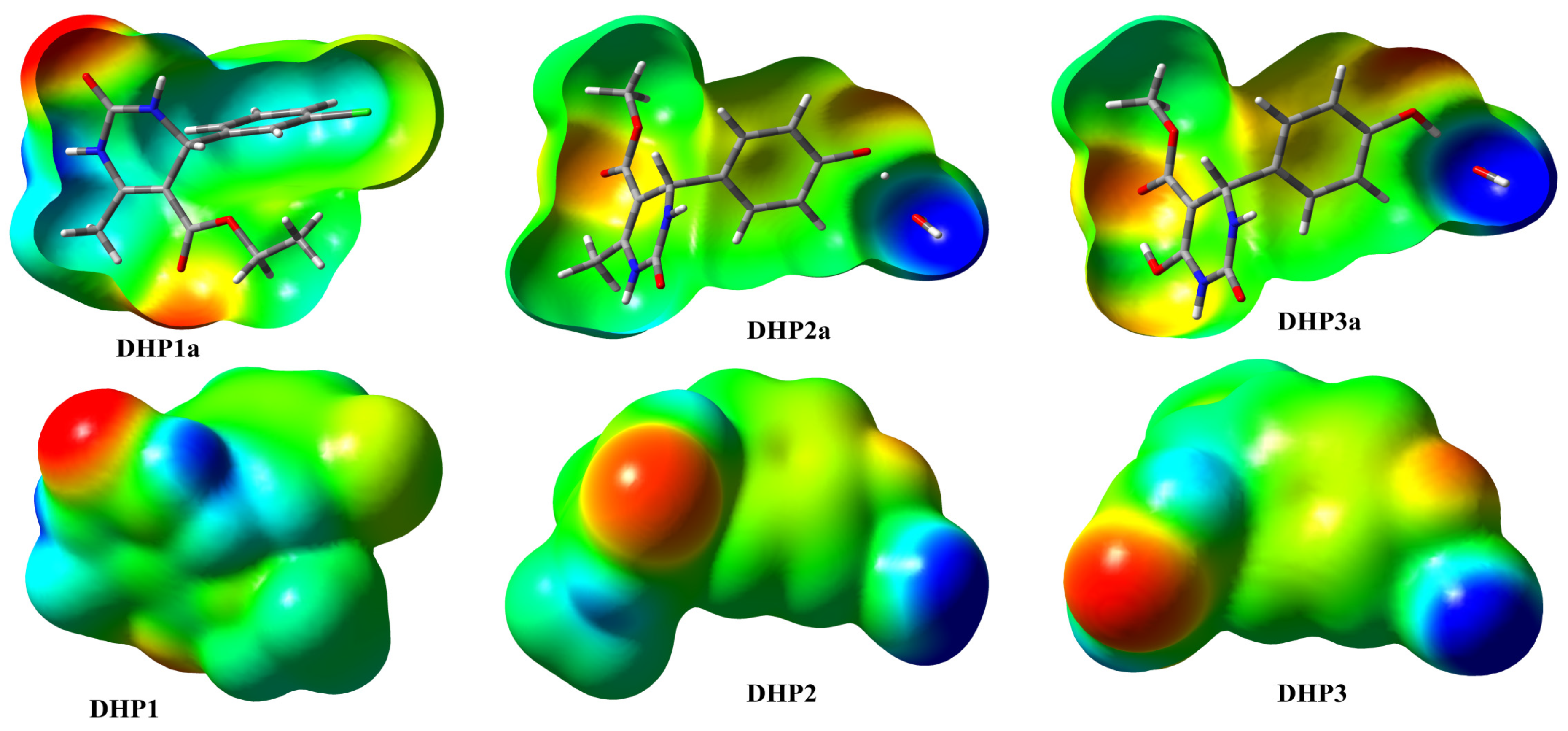
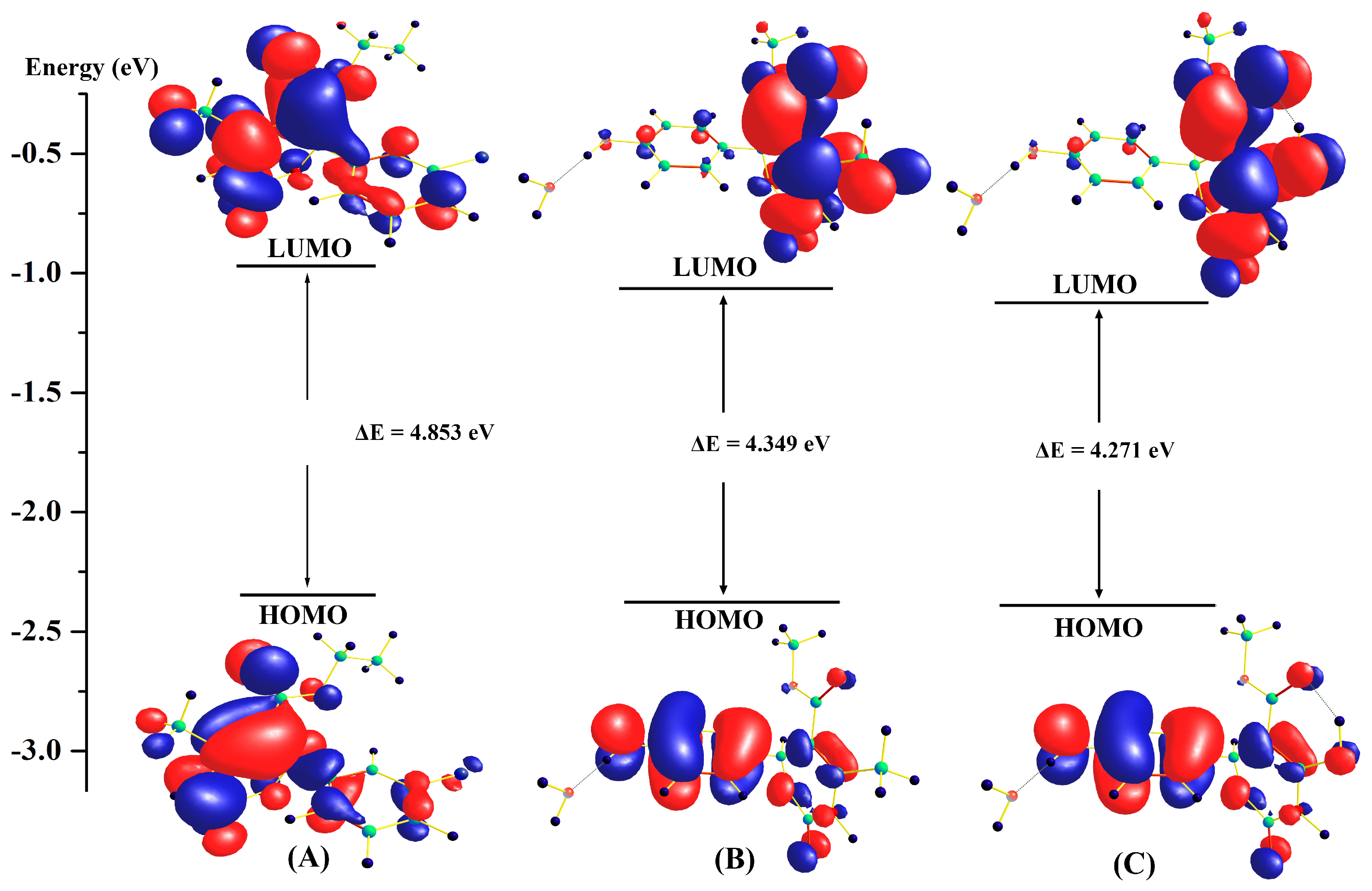
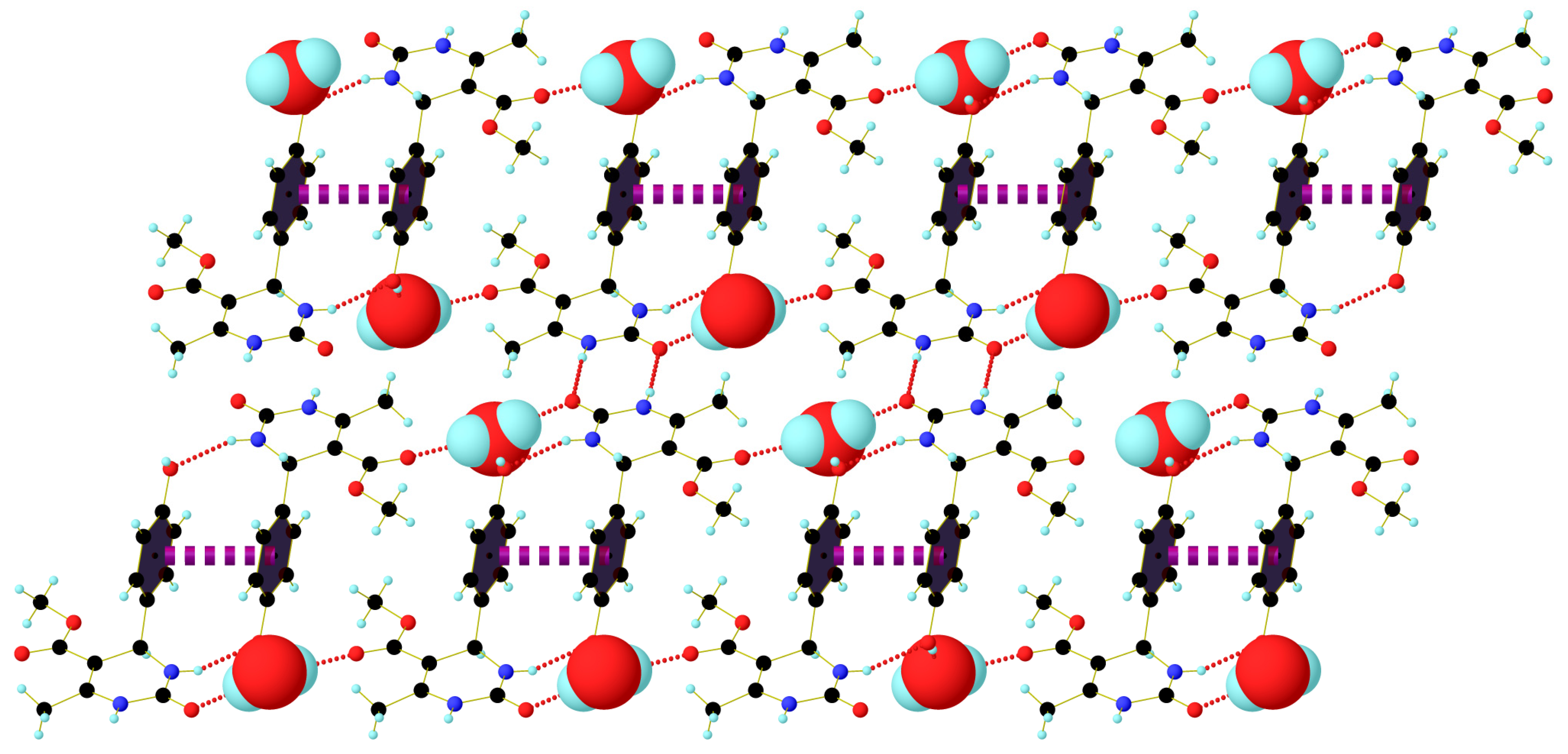
The molecular electrostatic potential surfaces of DHP1, DHP2, and DHP3 are shown in Figure 2. The green colour indicates the zero potential, blue colours represent the positive potential of the compound, and the red colour indicates the negative potential (Figure 2). The red colour regions are due to high electron density and correspond to a strong attraction, whereas the blue colour region corresponds to low electron density with weak interaction. Similarly, regarding the molecular electrostatic potential of DHP1, DHP2, and DHP3, the negative regions are mainly localized over the carbonyl oxygen atom, whereas the maximum positive regions are localized over the oxygen of the water molecule. Counter plots of selected molecular orbitals of DHP1, DHP2, and DHP3 and the HOMO–LUMO energy gap are shown in Figure 3. The energy gap (ΔE) of DHP1, DHP2, and DHP3 are 4.853 eV, 4.349 eV, and 4.271 eV, respectively. Hence, DHP1 has a higher energy gap compared to DHP2 and DHP3; this indicates that DHP1 has high stability and low chemical reactivity, whereas DHP3, with a small energy gap, exhibits high chemical reactivity and is less stable. The crystal structure of DHP2 is shown in Figure 4, the crystal structure showing supramolecular interaction formed by hydrogen bonding interactions mediated by water molecules.

3. Experimental

3.1. Computational Studies

Density functional theory (DFT) has been used in geometric optimizations to ascertain the minimum energy configurations and stable molecular geometries of DHP1, DHP2, and DHP3. The geometrical optimization was carried out using B3LYP level of theory along with 6-311G (d,p) basis set. The calculation on all the compounds have been performed successfully using Gaussian 09 software.

3.2. CSD Search

We have also explored the CSD in order to find some experimental support for the non-covalent interactions discussed above (CCDC number 1455902). Interestingly, we have found the crystal structures of DHP2 where dihydropyrimidin-2(1H)-one derivatives are establishing simultaneous hydrogen bonding and π–π interactions.

4. Conclusions

In this study, the structures of three compounds of dihydropyrimidin-2(1H)-ones (DHP1, DHP2 and DHP3) were successfully optimized using density functional theory (DFT). It was found that the theoretical hydrogen bonding interactions were also compared with the experimental data and found to be closely related. The molecular electrostatic potential surfaces of DHP1, DHP2, and DHP3 show that the negative regions are mainly localized over the carbonyl oxygen atom, whereas the maximum positive regions are localized over the oxygen of the water molecule. Similarly, the energy gap (ΔE) of DHP1, DHP2, and DHP3 were also calculated and we found that DHP1 has a higher energy gap compared to DHP2 and DHP3, indicating that DHP1 has high stability and low chemical reactivity, whereas DHP3, with a small energy gap, exhibits high chemical reactivity and is less stable.

Funding

This research received no external funding.

Institutional Review Board Statement

Not applicable.

Informed Consent Statement

Not applicable.

Data Availability Statement

The data that support the findings of this study are available from the corresponding author upon reasonable request.

Acknowledgments

The author would like to thank the Head SAIF, North-Eastern Hill University, Shillong-793022, India, for computational facility.

Conflicts of Interest

The authors declare no conflicts of interest.

References

  1. Lundberg, D.J.; Brown, C.M.; Bobylev, E.O.; Oldenhuis, N.J.; Alfaraj, Y.S.; Zhao, J.; Kevlishvili, I.; Kulik, H.J.; Johnson, J.A. Nested non-covalent interactions expand the functions of supramolecular polymer networks. Nat. Commun. 2024, 15, 3951. [Google Scholar] [CrossRef] [PubMed]
  2. Lehn, J.M. Supramolecular chemistry. Science 1993, 260, 1762–1763. [Google Scholar] [CrossRef] [PubMed]
  3. Johnson, E.R.; Keinan, S.; Mori-Sanchez, P.; Contreras-Garcia, J.; Cohen, A.J.; Yang, W. Revealing noncovalent interactions. J. Am. Chem. Soc. 2010, 132, 6498–6506. [Google Scholar] [CrossRef] [PubMed]
  4. Yang, Y.; Urban, M.W. Self-healing of polymers via supramolecular chemistry. Adv. Mater. Interfaces 2018, 5, 1800384. [Google Scholar] [CrossRef]
  5. Mukherjee, A. Building upon Supramolecular Synthons: Some Aspects of Crystal Engineering. Cryst. Growth Des. 2015, 15, 3076–3085. [Google Scholar] [CrossRef]
  6. Tian, J.; Han, X.; Yang, H.R.; Liu, J.; Chen, J.-F.; Wei, T.-B.; Yao, H.; Qu, W.-J.; Shi, B.; Lin, Q. Hydrogen-bonded supramolecular polymer networks for effective removal of perchlorate in water via clustered hydrogen-bonding. Nat. Commun. 2025, 16, 6481. [Google Scholar] [CrossRef] [PubMed]
  7. Lugger, S.J.D.; Houben, S.J.A.; Foelen, Y.; Debije, M.G.; Schenning, A.P.H.J.; Mulder, D.J. Hydrogen-bonded supramolecular liquid crystal polymers: Smart materials with stimuli-responsive, self-healing, and recyclable properties. Chem. Rev. 2022, 122, 4946–4975. [Google Scholar] [CrossRef] [PubMed]
  8. Prins, L.J.; Reinhoudt, D.N.; Timmerman, P. Noncovalent synthesis using hydrogen bonding. Angew. Chem. Int. Ed. 2001, 40, 2382–2426. [Google Scholar] [CrossRef]
  9. Concellón, A.; Blasco, E.; Martinez-Felipe, A.; Martínez, J.L.; Sícs, I.; Ezquerra, T.A.; Nogales, A.; Pinol, M.; Oriol, L. Light-responsive self-assembled materials by supramolecular post-functionalization via hydrogen bonding of amphiphilic block copolymers. Macromolecules 2016, 49, 7825–7836. [Google Scholar] [CrossRef]
  10. Feringán, B.; Romero, P.; Serrano, J.L.; Gimenez, R.; Sierra, T. Supramolecular columnar liquid crystals formed by hydrogen bonding between a clicked star-shaped s-triazine and benzoic acids. Chem. Eur. J. 2015, 21, 8859–8866. [Google Scholar] [CrossRef] [PubMed]
  11. Mohammadi, B.; Behbahani, F.K. Recent developments in the synthesis and applications of dihydropyrimidin-2(1H)-ones and thiones. Mol. Divers. 2018, 22, 405–446. [Google Scholar] [CrossRef] [PubMed]
  12. Kappe, C.O. Biologically active dihydropyrimidones of the Biginelli-type a literature survey. Eur. J. Med. Chem. 2000, 35, 1043–1052. [Google Scholar] [CrossRef] [PubMed]
  13. Rani, J.W.S.; Kathing, C.; Singh, N.G.; Nongrum, R.; Rahman, N.; Kharmawlong, G.; Nongkhlaw, R. One-pot synthesis of 3, 4-dihydropyrimidin-2(1H)-ones catalysed by [BMIM] Br under solvent-free condition. Bulg. Chem. Commun. 2016, 48, 3–10. [Google Scholar]
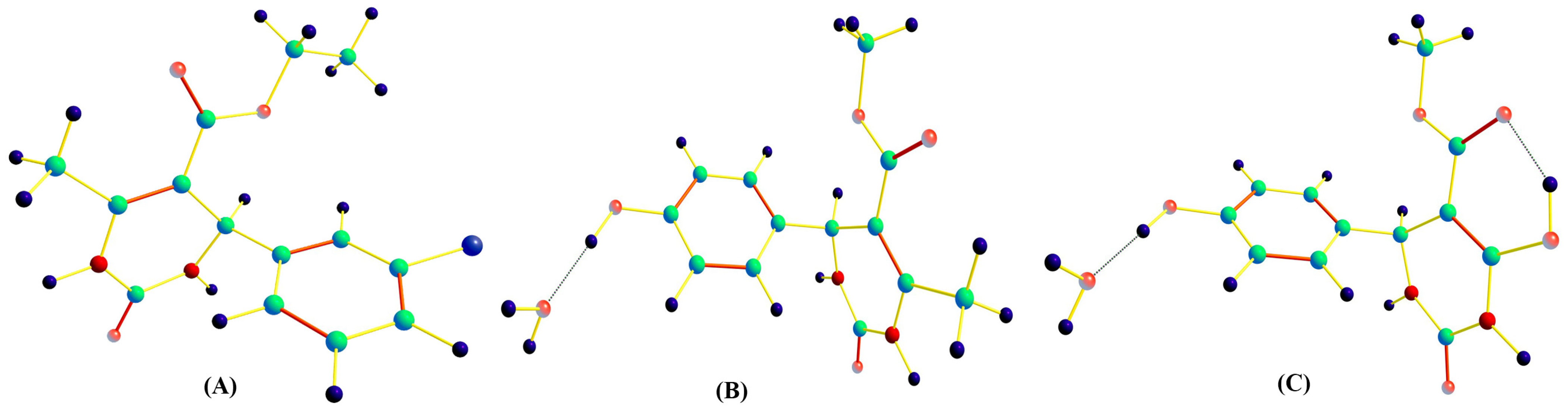
Figure 1. The optimized geometrical structure; (A) DHP1; (B) DHP2; (C) DHP3. Carbon is shown in green colour, oxygen in red colour and hydrogen in blue colour.
Chemproc 18 00028 g001
Figure 2. Molecular electrostatic potential maps of DHP1, DHP2, and DHP3 in the neutral state and in the anion state. The different colour gradient represents the electrostatic potential; the red colour region represents negative potential, whereas the blue colour represents positive potential.
Chemproc 18 00028 g002
Figure 3. HOMO–LUMO plots of (A) DHP1, (B) DHP2, and (C) DHP3 and their energy gaps.
Chemproc 18 00028 g003
Figure 4. Crystal structure of DHP2 showing supramolecular interaction formed by hydrogen bonding interactions.
Chemproc 18 00028 g004
Disclaimer/Publisher’s Note: The statements, opinions and data contained in all publications are solely those of the individual author(s) and contributor(s) and not of MDPI and/or the editor(s). MDPI and/or the editor(s) disclaim responsibility for any injury to people or property resulting from any ideas, methods, instructions or products referred to in the content.