
In Silico Study of Obeticholic Acid Analogs as FXR Agonists †



Abstract
1. Introduction
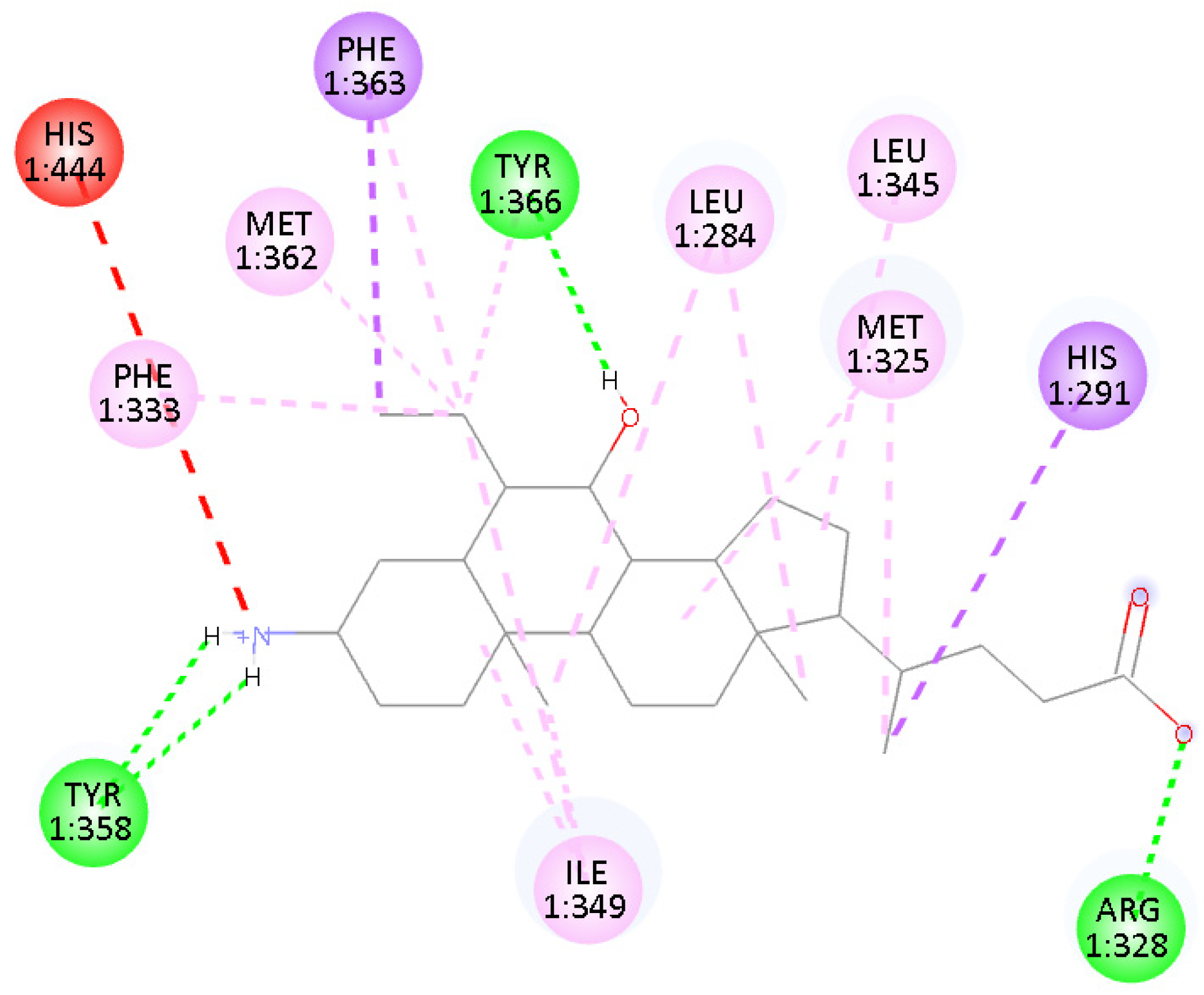
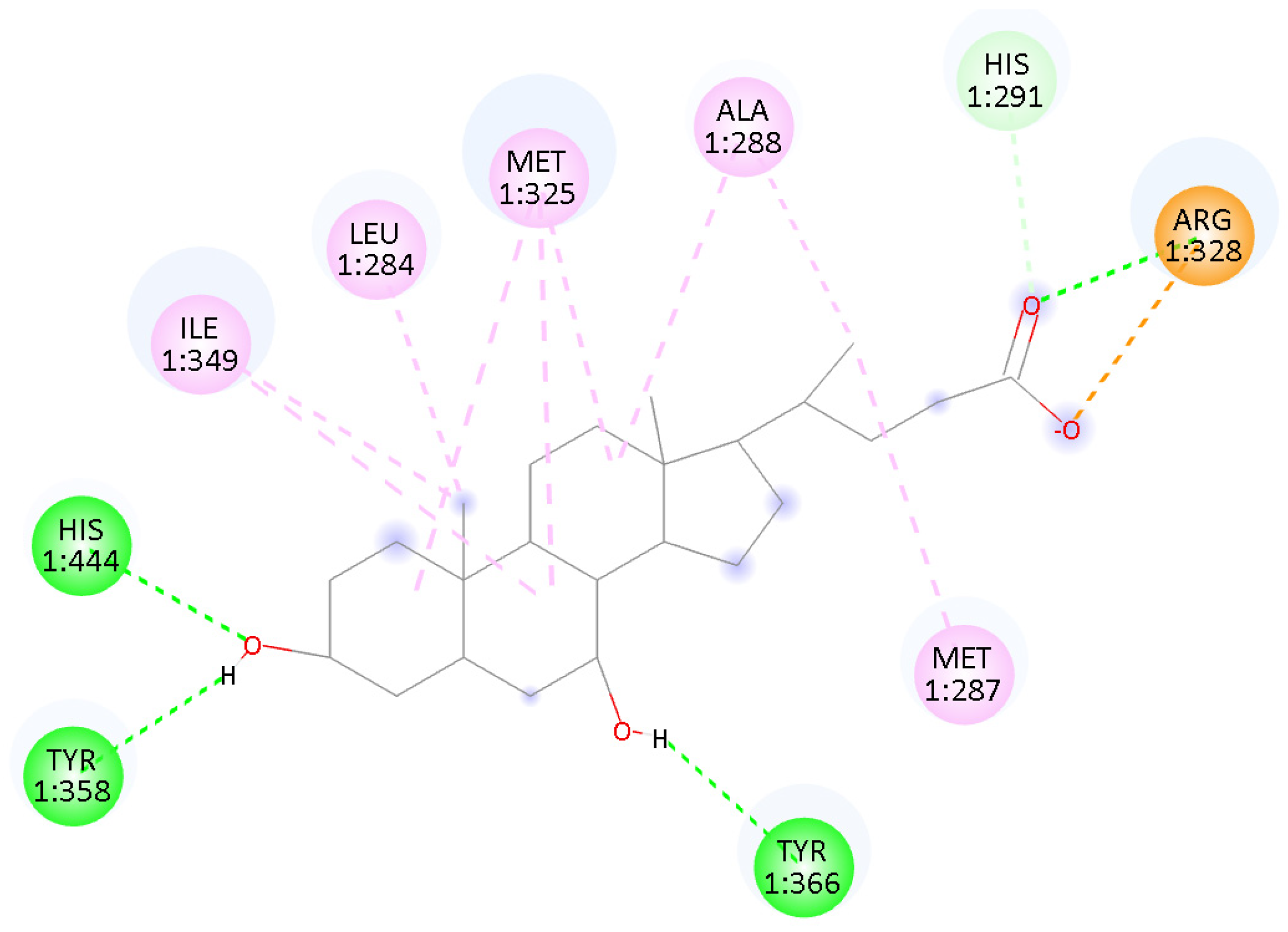
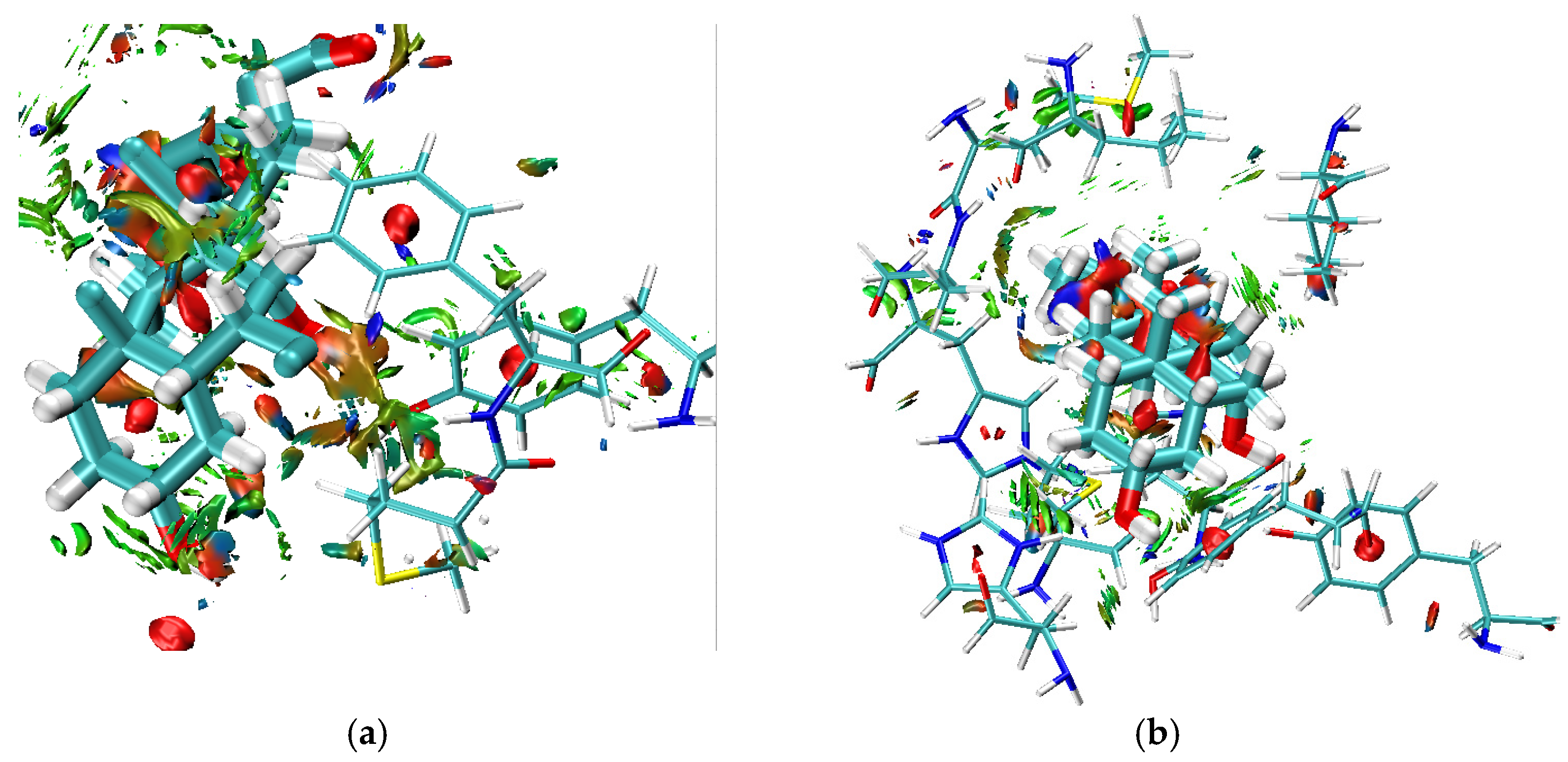
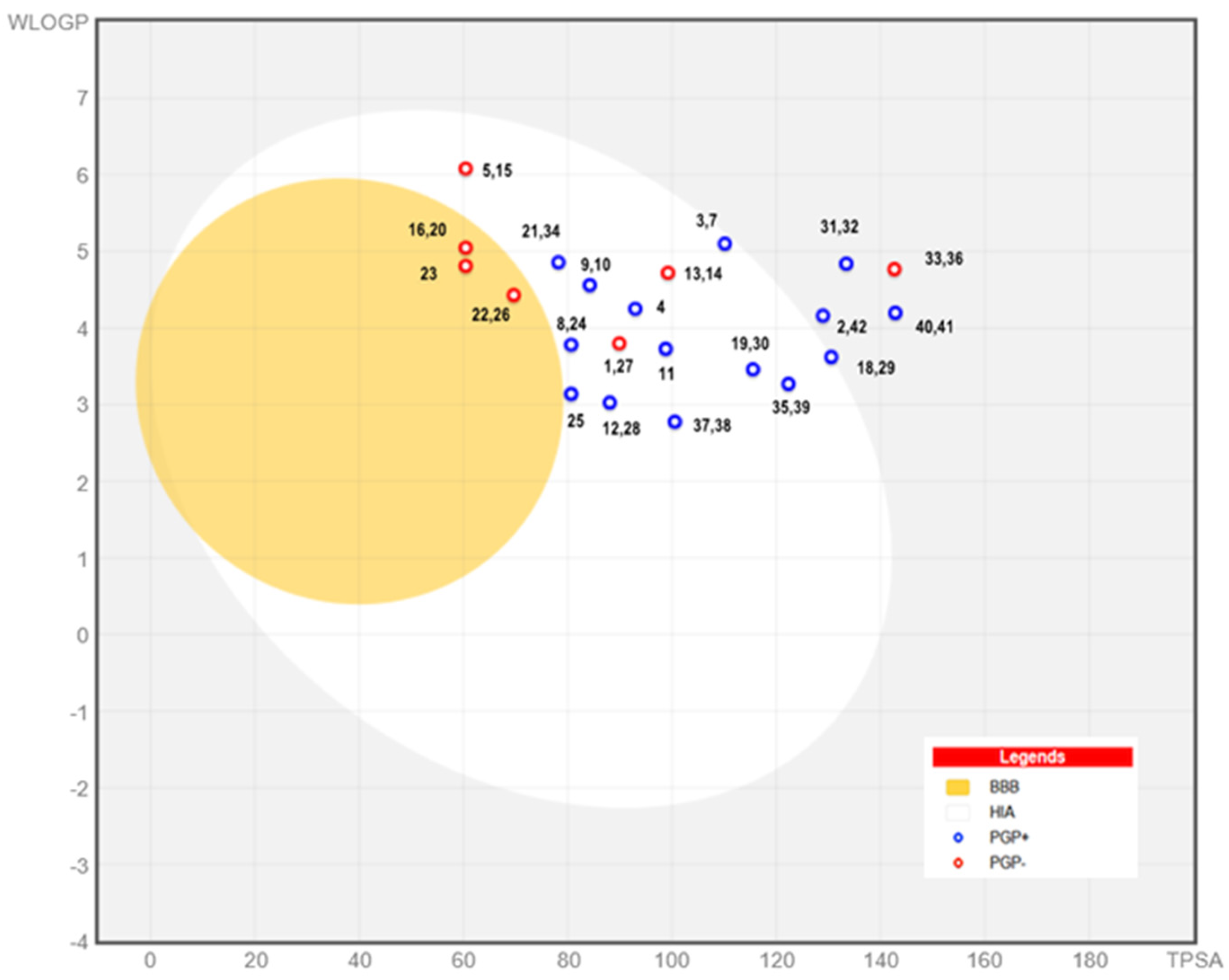
2. Results and Discussion
3. Conclusions
Author Contributions
Funding
Institutional Review Board Statement
Informed Consent Statement
Data Availability Statement
Acknowledgments
Conflicts of Interest
References
- Forman, B.M.; Goode, E.; Chen, J.; Oro, A.E.; Bradley, D.J.; Perlmann, T.; Noonan, D.J.; Burka, L.T.; McMorris, T.; Lamph, W.W.; et al. Identification of a nuclear receptor that is activated by farnesol metabolites. Cell 1995, 81, 687–693. [Google Scholar] [CrossRef] [PubMed]
- Seol, W.; Choi, H.S.; Moore, D.D. Isolation of proteins that interact specifically with the retinoid X receptor: Two novel orphan receptors. Mol. Endocrinol. 1995, 9, 72–85. [Google Scholar] [CrossRef] [PubMed]
- Chen, W.; Owsley, E. Nuclear receptor-mediated repression of human cholesterol 7-α-hydroxylase gene transcription by bile acids. J. Lipid Res. 2001, 42, 1402–1412. [Google Scholar] [CrossRef]
- Jiao, Y.; Lu, Y.; Li, X. Farnesoid X receptor: A master regulator of hepatic Triglyceride and glucose homeostasis. Acta Pharmacol. Sin. 2015, 36, 44–50. [Google Scholar] [CrossRef] [PubMed]
- Iguchi, Y.; Kihira, K.; Nishimaki-Mogami, T.; Une, M. Structure–activity relationship of bile alcohols as human farnesoid X receptor agonist. Steroids 2010, 75, 95–100. [Google Scholar] [CrossRef] [PubMed]
- Pellicciari, R.; Gioiello, A.; Costantino, G.; Sadeghpour, B.M.; Rizzo, G.; Meyer, U.; Parks, D.J.; Entrena-Guadix, A.; Fiorucci, S. Back door modulation of the farnesoid X receptor: Design, synthesis, and biological evaluation of a series of side chain modified chenodeoxycholic acid derivatives. J. Med. Chem. 2006, 49, 4208–4215. [Google Scholar] [CrossRef] [PubMed]
- Fujino, T.; Mizuho, U.; Imanaka, T. Structure-activity relationship of bile acids and bile acid analogs in regard to FXR activation. J. Lipid Res. 2004, 45, 132–138. [Google Scholar] [CrossRef] [PubMed]
- Gioiello, A.; Macchiarulo, A. Extending SAR of bile acids as FXR ligands: Discovery of 23-N-(carbocinnamyloxy)-3α,7α-dihydroxy-6α ethyl-24-nor-5β-cholan-23-amine. Bioorg. Med. Chem. 2011, 19, 2650–2658. [Google Scholar] [CrossRef] [PubMed]
- Pellicciari, R.; Costantino, G. Bile Acid Derivatives as Ligands of the Farnesoid X Receptor. Synthesis, Evaluation, and Structure−Activity Relationship of a Series of Body and Side Chain Modified Analogues of Chenodeoxycholic Acid. J. Med. Chem. 2004, 47, 4559–4569. [Google Scholar] [CrossRef] [PubMed]
- Pellicciari, R.; Costantino, G. Farnesoid X Receptor: From Structure to Potential Clinical Applications. J. Med. Chem. 2005, 48, 5383–5403. [Google Scholar] [CrossRef] [PubMed]
- Mi, L.Z.; Devarakonda, S. Structural basis for bile acid binding and activation of the nuclear receptor FXR. Mol. Cell 2003, 11, 1093–1100. [Google Scholar] [CrossRef] [PubMed]
- Merk, D.; Steinhilber, D.; Schubert-Zsilavecz, M. Medicinal chemistry of farnesoid X receptor ligands: From agonists and antagonists to modulators. Future Med. Chem. 2012, 4, 1015–1036. [Google Scholar] [CrossRef] [PubMed]
- Coleman, J.P.; Kirby, L.C. Metabolic fate and hepatocyte toxicity of reverse amide analogs of conjugated ursodeoxycholate in the rat. J. Steroid Biochem. Mol. Biol. 1998, 64, 91–101. [Google Scholar] [CrossRef] [PubMed]
- Pellicciari, R.; Fiorucci, S.; Camaioni, E.; Clerici, C.; Costantino, G.; Maloney, P.R.; Morelli, A.; Parks, D.J.; Willson, T.M. 6-Ethyl-chenodeoxycholic acid (6- ECDCA), a potent and selective FXR agonist endowed with anticholestatic activity. J. Med. Chem. 2002, 45, 3569–3572. [Google Scholar] [CrossRef] [PubMed]
- Daina, A.; Michielin, O.; Zoete, V. SwissADME: A free web tool to evaluate pharmacokinetics, drug-likeness and medicinal chemistry friendliness of small molecules. Sci. Rep. 2017, 7, 42717. [Google Scholar] [CrossRef]
- Daina, A.; Zoete, V. A BOILED-Egg to predict gastrointestinal absorption and brain penetration of small molecules. ChemMedChem 2016, 11, 1117–1121. [Google Scholar] [CrossRef]
- Discovery Studio Visualizer v25.1.02484. ©2025 Dassault Systèmes Biovia Corp. Available online: https://discover.3ds.com/discovery-studio-visualizer-download (accessed on 12 January 2026).
- Johnson, E.R.; Keinan, S.; Mori-Sánchez, P.; Contreras-García, J.; Cohen, A.J.; Yang, W. Revealing Nocovalent Interactions. J. Am. Chem. Soc. 2010, 132, 6498–6506. [Google Scholar] [CrossRef] [PubMed]
- Lu, T.; Chen, F. Multiwfn: A multifunctional wavefunction analyzer. J. Comput. Chem. 2012, 33, 580–592. [Google Scholar] [CrossRef]
- Lu, T. A comprehensive electron wavefunction analysis toolbox for chemists, Multiwfn. J. Chem. Phys. 2024, 161, 082503. [Google Scholar] [CrossRef] [PubMed]



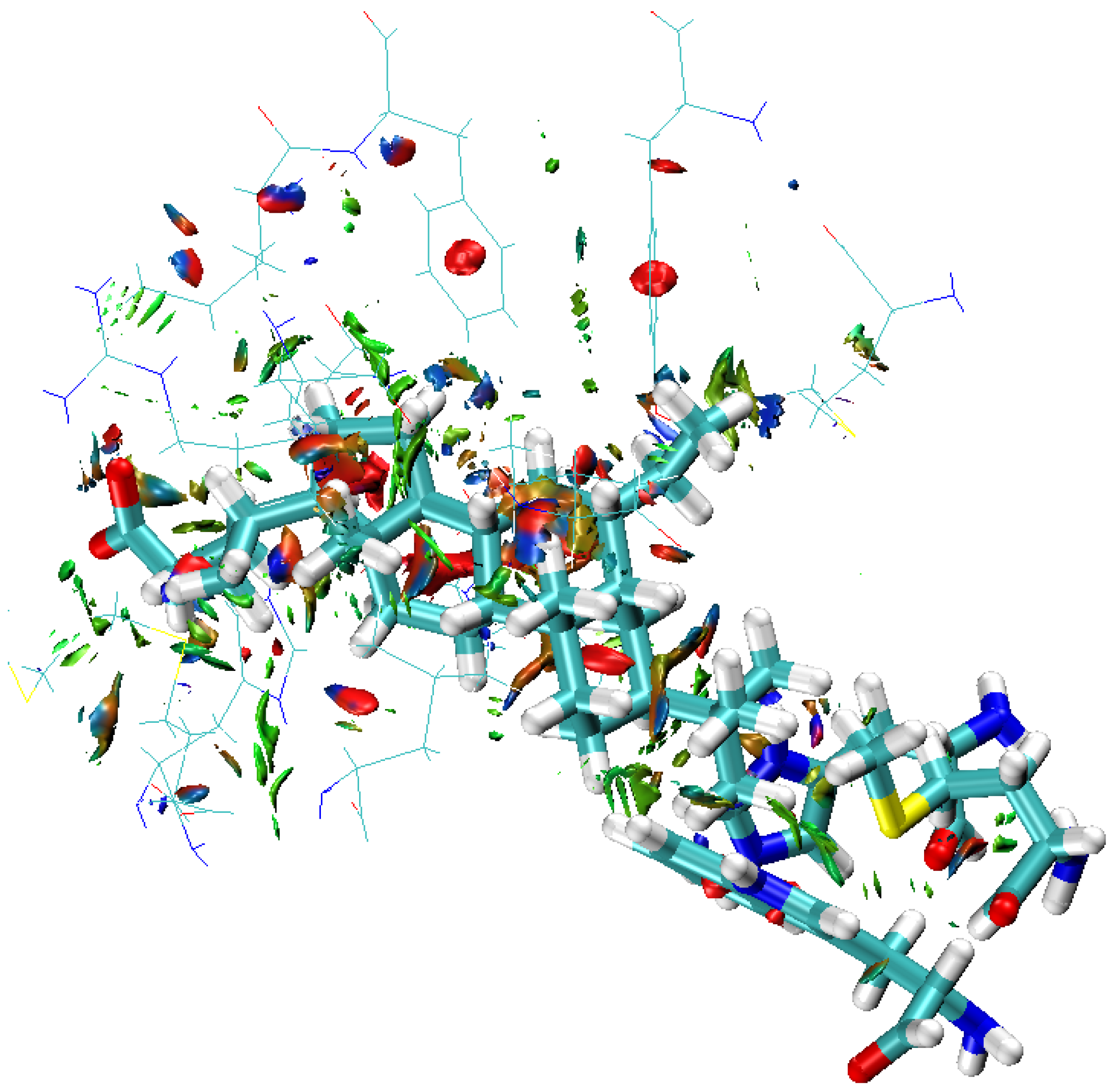


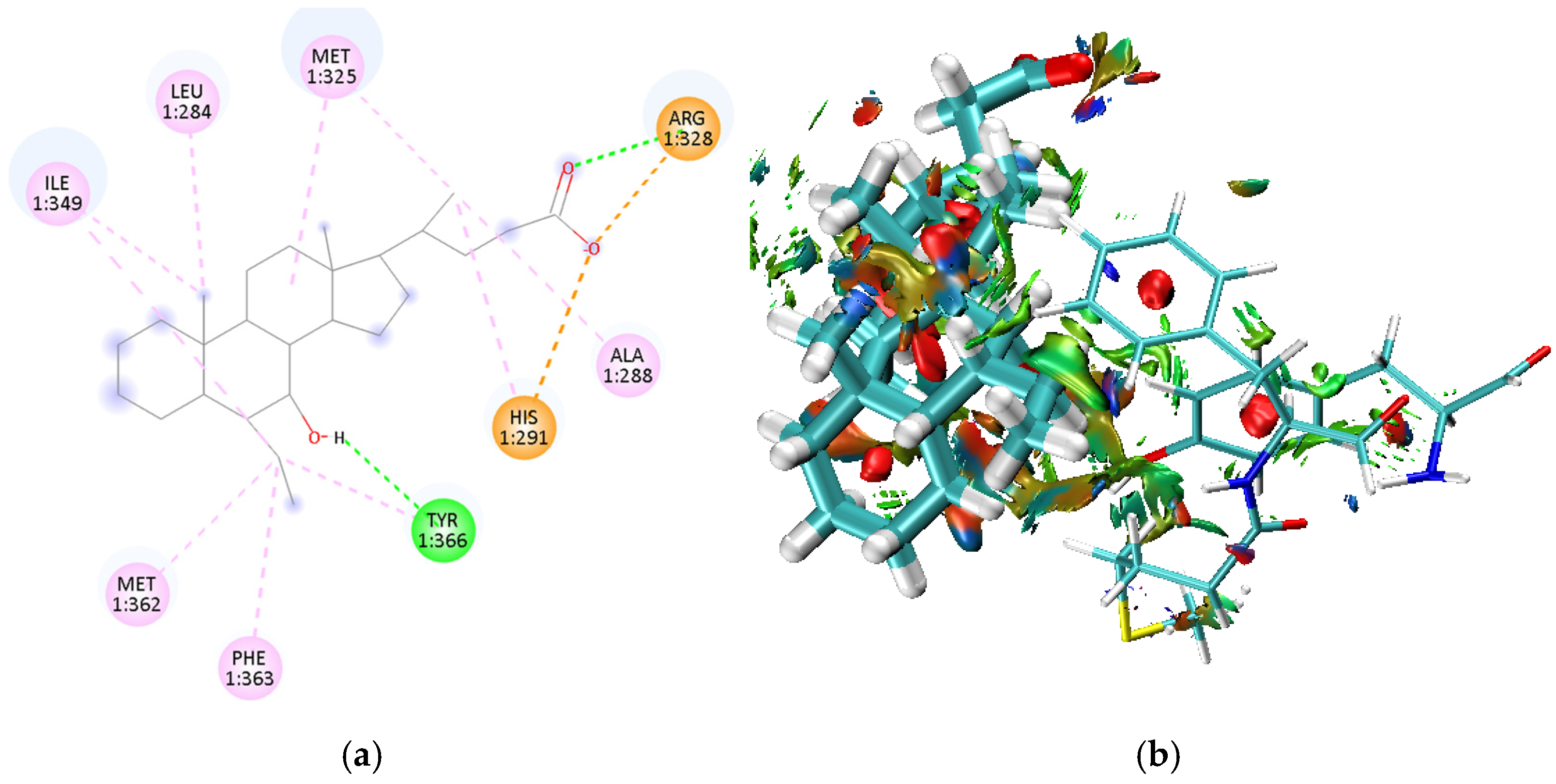

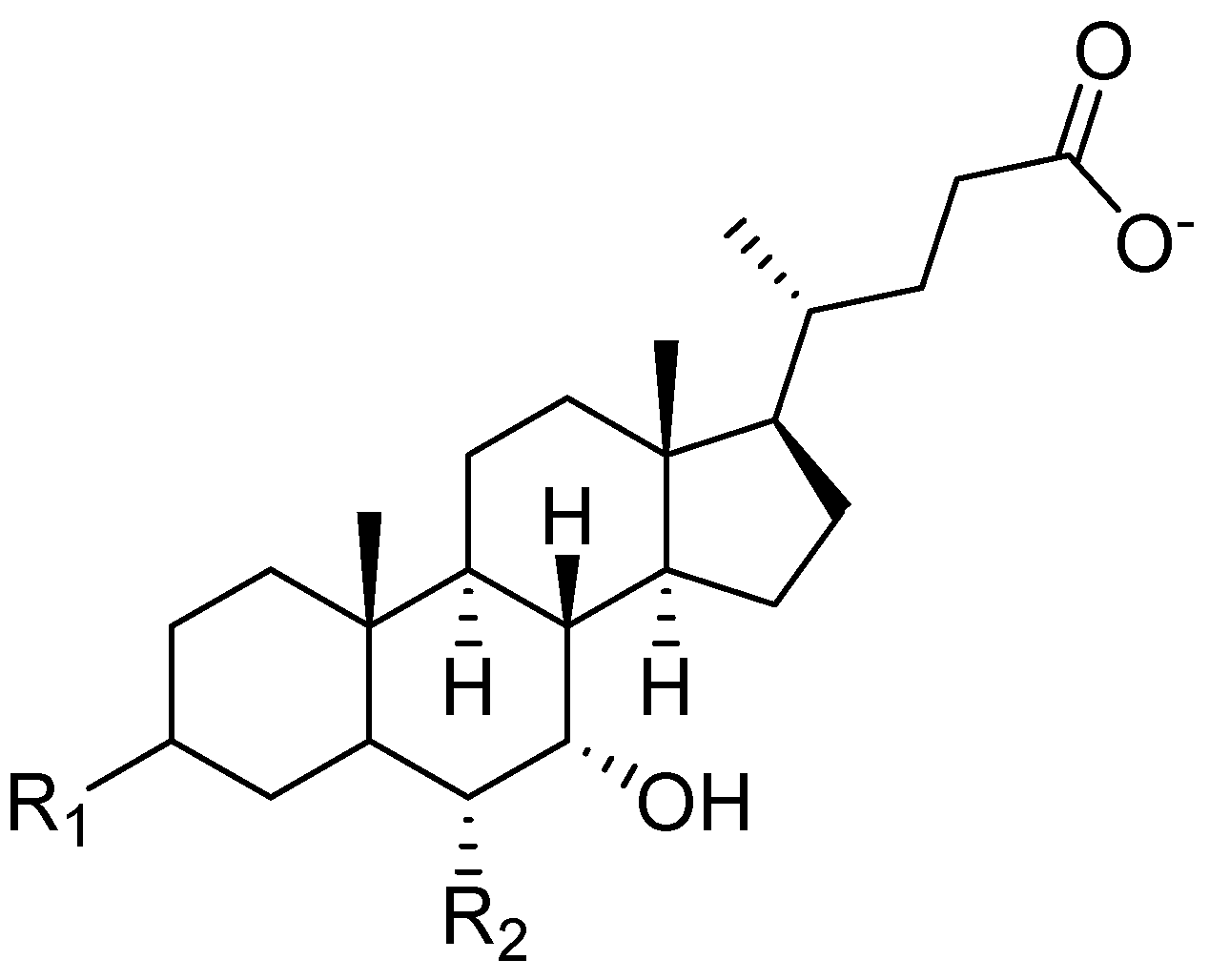
| Compound | -R1 | -R2 | kcal/mol |
|---|---|---|---|
| 1 | β-HOCH2CH2O- | -Et | −13.41 |
| 2 | α-SO3NH2 | -Et | −12.94 |
| 3 | α-azido | -Et | −12.86 |
| 4 | =NOH | -Et | −12.79 |
| 5 | β-t-Bu | -Et | −12.78 |
| 6 | α-OPO3PO3- | -Et | −12.67 |
| 7 | β-N3 | -Et | −12.58 |
| 8 | α-OH (OCA) | -Et | −12.32 |
| 9 | β-CN | -Et | −12.31 |
| 10 | α-CN | -Et | −12.1 |
| 11 | =NHNH2 | -Et | −12.08 |
| 12 | α-NH2 | -Et | −12.07 |
| 13 | α-SH | -Et | −11.99 |
| 14 | β-SH | -Et | −11.96 |
| 15 | α-t-Bu | -Et | −11.94 |
| 16 | β-CH3 | -Et | −11.89 |
| 17 | β-OPO3PO3- | -Et | −11.86 |
| 18 | β-NHCSNH2 | -Et | −11.82 |
| 19 | β-NHCONH2 | -Et | −11.8 |
| 20 | α-CH3 | -Et | −11.79 |
| 21 | β-imidazole | -Et | −11.64 |
| 22 | β-OCH3 | -Et | −11.64 |
| 23 | -H | -Et | −11.53 |
| 24 | β-OH | -Et | −11.44 |
| 25 | α-OH (CDC) | -H | −11.30 |
| 26 | α-OCH3 | -Et | −11.4 |
| 27 | α-HOCH2CH2O- | -Et | −11.22 |
| 28 | β-NH2 | -Et | −11.17 |
| 29 | α-NHCSNH2 | -Et | −11.16 |
| 30 | α-NHCONH2 | -Et | −11.16 |
| 31 | α-PO3 | -Et | −11.16 |
| 32 | β-PO3 | -Et | −10.95 |
| 33 | α-OPO3 | -Et | −10.91 |
| 34 | α-imidazole | -Et | −10.81 |
| 35 | β-NHC(NH)NH2 | -Et | −10.78 |
| 36 | β-OPO3 | -Et | −10.5 |
| 37 | β-CO2 | -Et | −10.42 |
| 38 | α-CO2 | -Et | −9.61 |
| 39 | α-NHC(NH)NH2 | -Et | −9.52 |
| 40 | α-SO3- | -Et | −8 |
| 41 | β-SO3- | -Et | −7.96 |
| 42 | β-SO3NH2 | -Et | −7.61 |
| Cpd | Ha | Hb | TPSA | LOG | GIA | BBB | PGP | CYP1A2 | CYP1A2 | CYP2C19 | CYP2C9 | CYP2D6 |
|---|---|---|---|---|---|---|---|---|---|---|---|---|
| 1.27 | 5 | 2 | 89.82 | 3.89 | High | No | No | No | No | No | No | Yes |
| 2.42 | 6 | 2 | 128.9 | 3.14 | Low | No | Yes | No | No | No | No | No |
| 3.7 | 6 | 1 | 110.11 | 4.35 | High | No | Yes | No | No | No | No | No |
| 4 | 5 | 2 | 92.95 | 4.31 | High | No | Yes | No | No | Yes | No | No |
| 5.15 | 3 | 1 | 60.36 | 6.28 | High | No | No | No | No | No | No | No |
| 6.17 | 10 | 1 | 201.76 | 2.51 | Low | No | No | No | No | No | No | Yes |
| 8.24 | 4 | 2 | 80.59 | 3.90 | High | No | Yes | No | No | No | No | No |
| 9.10 | 4 | 1 | 84.15 | 4.64 | High | No | Yes | No | No | Yes | No | No |
| 11 | 4 | 2 | 98.74 | 4.09 | High | No | Yes | No | No | No | No | No |
| 12.28 | 3 | 2 | 88 | 2.44 | High | No | Yes | No | No | No | No | No |
| 13.14 | 3 | 1 | 99.16 | 4.63 | High | No | No | No | Yes | No | No | No |
| 16.20 | 3 | 1 | 60.36 | 5.03 | High | Yes | No | No | No | No | No | No |
| 18.29 | 3 | 3 | 130.5 | 3.88 | Low | No | Yes | No | Yes | No | No | Yes |
| 19.30 | 4 | 3 | 115.48 | 3.35 | High | No | Yes | No | No | No | No | Yes |
| 21.34 | 4 | 1 | 78.18 | 4.19 | High | No | Yes | No | No | No | No | No |
| 23 | 3 | 1 | 60.36 | 4.80 | High | Yes | No | No | No | No | No | No |
| 25 | 4 | 2 | 80.59 | 3.35 | High | No | Yes | No | No | No | No | No |
| 22.26 | 4 | 1 | 69.59 | 4.32 | High | Yes | No | No | No | No | No | No |
| 31.32 | 6 | 1 | 133.36 | 3.28 | Low | No | Yes | No | Yes | No | No | No |
| 33.36 | 7 | 1 | 142.59 | 3.25 | Low | No | No | No | Yes | No | No | No |
| 35.39 | 4 | 4 | 122.26 | 3.32 | High | No | Yes | No | No | No | No | Yes |
| 37.38 | 5 | 1 | 100.49 | 3.72 | High | No | Yes | No | No | No | No | Yes |
| 40.41 | 6 | 1 | 142.76 | 3.05 | Low | No | Yes | No | Yes | No | No | No |
Disclaimer/Publisher’s Note: The statements, opinions and data contained in all publications are solely those of the individual author(s) and contributor(s) and not of MDPI and/or the editor(s). MDPI and/or the editor(s) disclaim responsibility for any injury to people or property resulting from any ideas, methods, instructions or products referred to in the content. |
© 2025 by the authors. Licensee MDPI, Basel, Switzerland. This article is an open access article distributed under the terms and conditions of the Creative Commons Attribution (CC BY) license (https://creativecommons.org/licenses/by/4.0/).
Share and Cite
Seijas, J.A.; Vázquez-Gómez, S.; Meijide, F.; Vázquez-Tato, M.P. In Silico Study of Obeticholic Acid Analogs as FXR Agonists. Chem. Proc. 2025, 18, 137. https://doi.org/10.3390/ecsoc-29-27271
Seijas JA, Vázquez-Gómez S, Meijide F, Vázquez-Tato MP. In Silico Study of Obeticholic Acid Analogs as FXR Agonists. Chemistry Proceedings. 2025; 18(1):137. https://doi.org/10.3390/ecsoc-29-27271
Chicago/Turabian StyleSeijas, Julio A., Silvia Vázquez-Gómez, Francisco Meijide, and M. Pilar Vázquez-Tato. 2025. "In Silico Study of Obeticholic Acid Analogs as FXR Agonists" Chemistry Proceedings 18, no. 1: 137. https://doi.org/10.3390/ecsoc-29-27271
APA StyleSeijas, J. A., Vázquez-Gómez, S., Meijide, F., & Vázquez-Tato, M. P. (2025). In Silico Study of Obeticholic Acid Analogs as FXR Agonists. Chemistry Proceedings, 18(1), 137. https://doi.org/10.3390/ecsoc-29-27271