
Proceeding Paper

Synthesis and In Silico Evaluation 7-Hydroxycoumarin-4-Acetic Acid as Possible Cytochromes P450 Substrate

1
Faculty of Chemistry, Belarusian State University, 220030 Minsk, Belarus
2
Research Institute for Physical Chemical Problems, Belarusian State University, 220006 Minsk, Belarus
*
Authors to whom correspondence should be addressed.
Chem. Proc. 2025, 18(1), 126; https://doi.org/10.3390/ecsoc-29-26922
Published: 13 November 2025

Abstract

7-hydroxycoumarin-4-acetic acid has been synthesized via Pechman condensation. In silico evaluation 7-hydroxycoumarin-4-acetic acid as a ligand of different structures of CYPs from PDB database was completed. The results of docking reveal possibilities to use this compound as a cytochromes P450 substrate. The best energy binding amongst CYPs database was found for human CYP1A1 structure. Our results provide certain opportunities to use coumarin derivatives as inhibitors or activators of CYPs.

1. Introduction

Cytochromes P450 (CYPs) are a ubiquitous superfamily of heme-containing oxidoreductases with a hem-thiolate moiety. CYPs catalyze hydroxylation and some other oxidation reactions of hydrophobic compounds, including C-N, C-O and C-C bond cleavage. CYPs enzymes play an important role in the metabolism, detoxification of xenobiotics, and biosynthesis of hormones using hydrophobic substrates like sterols, fatty acids, and eicosanoids [1,2,3].
Coumarins are heterocyclic benzo-α-pyrones which have a lactone ring moiety and possess biological activity for diverse proteins [4]. Natural coumarins are found in various species of plants, fungi, and microorganisms [5]. Coumarins may exhibit diverse pharmacological effects including anticoagulant, antimicrobial, anti-inflammatory, neuroprotective, antidiabetic, anticonvulsant, and antiproliferative [6]. Majority of these properties occur due to the binding with different isoforms of CYPs. We consider 7-hydroxycoumarin-4-acetic acid as a CYPs ligand due to fluorescence properties and the binding with various proteins by covalent and intermolecular interactions [7].
Coumarin derivatives are known to be substrates or inhibitors for some CYPs [8]. These ligand–protein interactions are important in pharmacology because many of these P450s regulate metabolism of drugs in vivo and their inhibition or activation may lead to changing the bioactivity of drugs. Despite the knowledge of multiply coumarin-like structures and CYPs isoforms, many interactions between them remain unknown or less studied, even in silico. In this paper, we considered 7-hydroxycoumarin-4-acetic acid as a CYPs substrate and evaluate in silico affine binding with the majority of 3D structures of CYPs from the PDB database.

2. Materials and Methods

The following reagents were used: citric acid, resorcinol, concentrated H2SO4, EtOH, EtOAc, MeOH, K2CO3, and HCl. Reagents and solvents had the qualification “grade” and “p.a.”; EtOH, EtOAc, MeOH were used in various ratios as organic solvents in column chromatography and eluents in TLC.
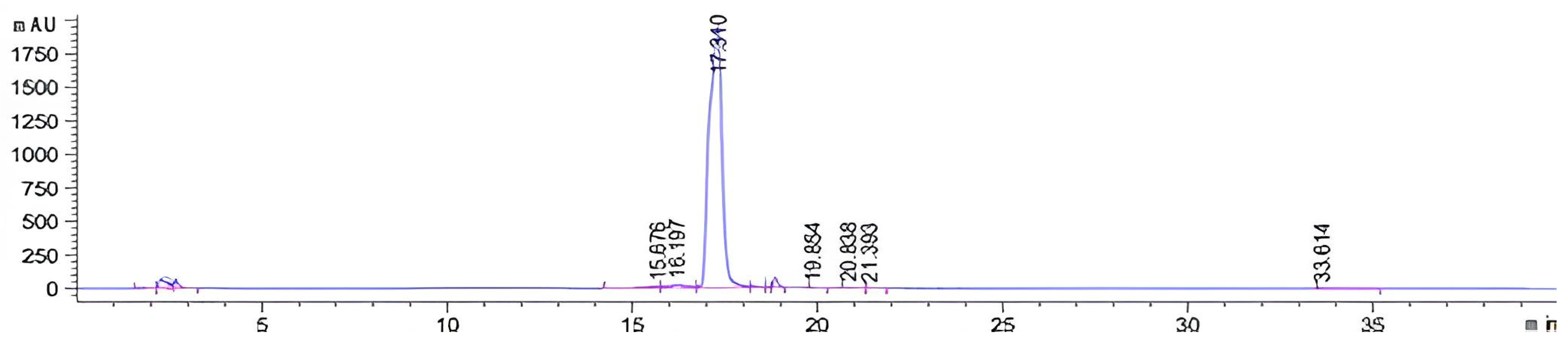
The product was purified by column chromatography. The checking of the uniqueness of obtained and purified products was performed by using high-efficiency liquid chromatography. The single significant peak of the product was registered after 17.3 min in a ACN-H2O (2:8 ratio) solvent system at 325 nm wavelength (Figure 1). The additional evidence of obtaining the given structure was absorbance spectra in acidified and alkaline solutions.
Evaluations and analysis of the docking results were carried via Autodock Vina 1.2.0 and FYTDock 1.0 [8] programs for high throughput virtual screening (HTVS). The structures of cytochromes were downloaded from PDB database. The binding efficiency for coumarin–CYPs pairs was evaluated by the interaction energy parameter calculated by the Autodock Vina program (docking score, binding energy, Ebind) [9].

3. Results and Discussion

The similarity to 7-hydroxycoumarin-4-acetic acid compounds are well-known [10,11]. These compounds have shown anti-inflammatory and analgesic activities [12].
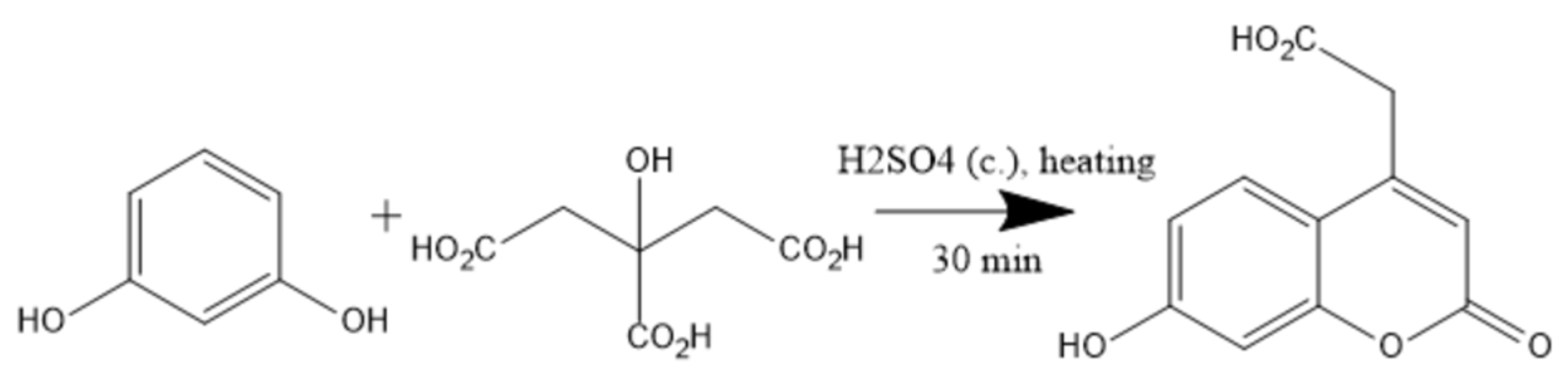
The given structure has been designed with acceptable yield (Figure 2) via Pechman condensation using the publishing method [13]. The product was formed due to decarboxylation of citric acid in concentrated sulfuric acid by heating and the following condensation with resorcinol.
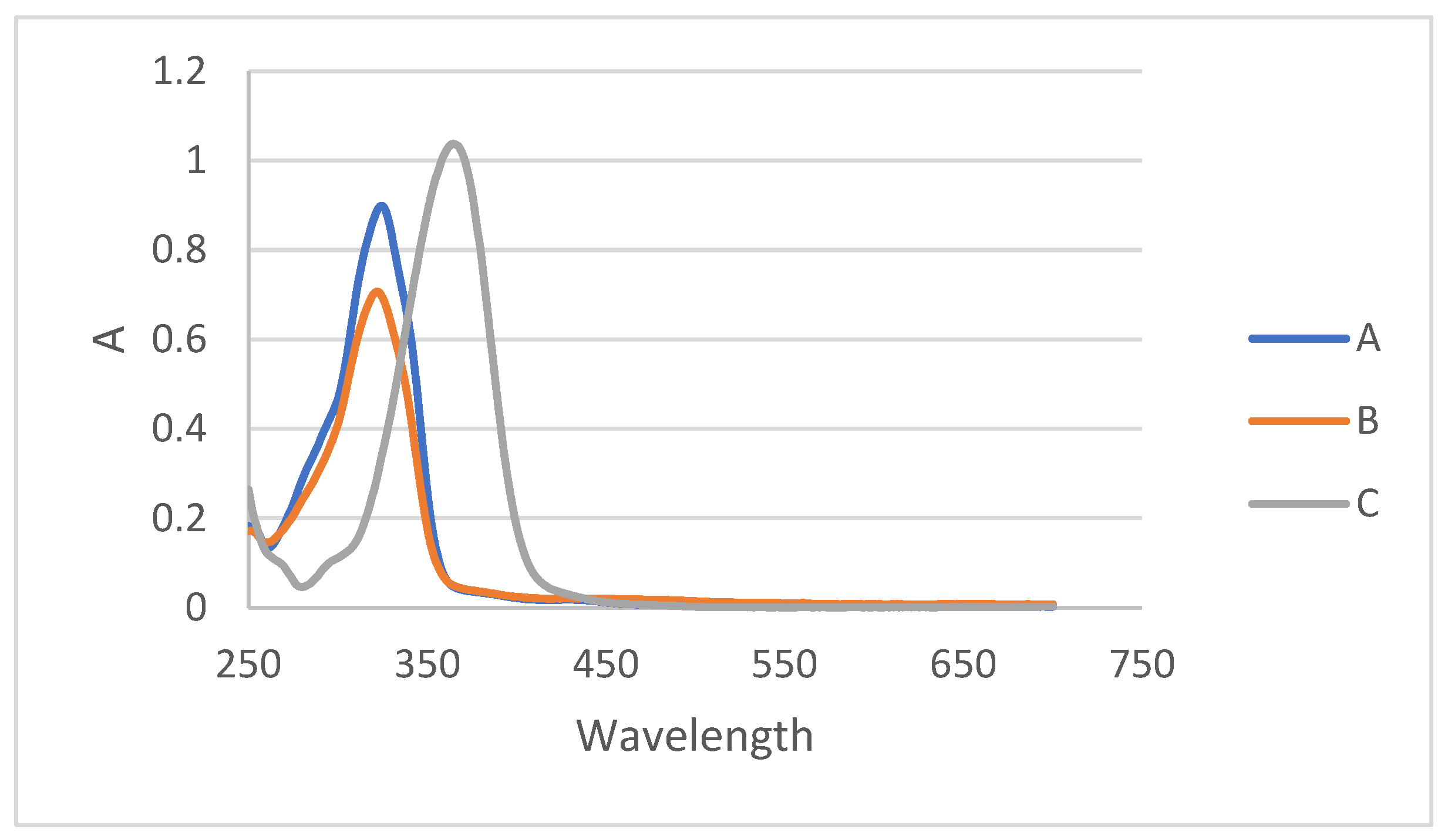
Absorbance spectra indicates shifts in the absorbance maxima from 320 nm in HCl acidified, 325 nm in organic solvent, and 365 nm in K2CO3-buffered water/ethanol (10:1, v:v), respectively (Figure 3). The changes in the UV/vis spectrum provide possibilities to use this coumarin derivative as a pH-indicator dye.
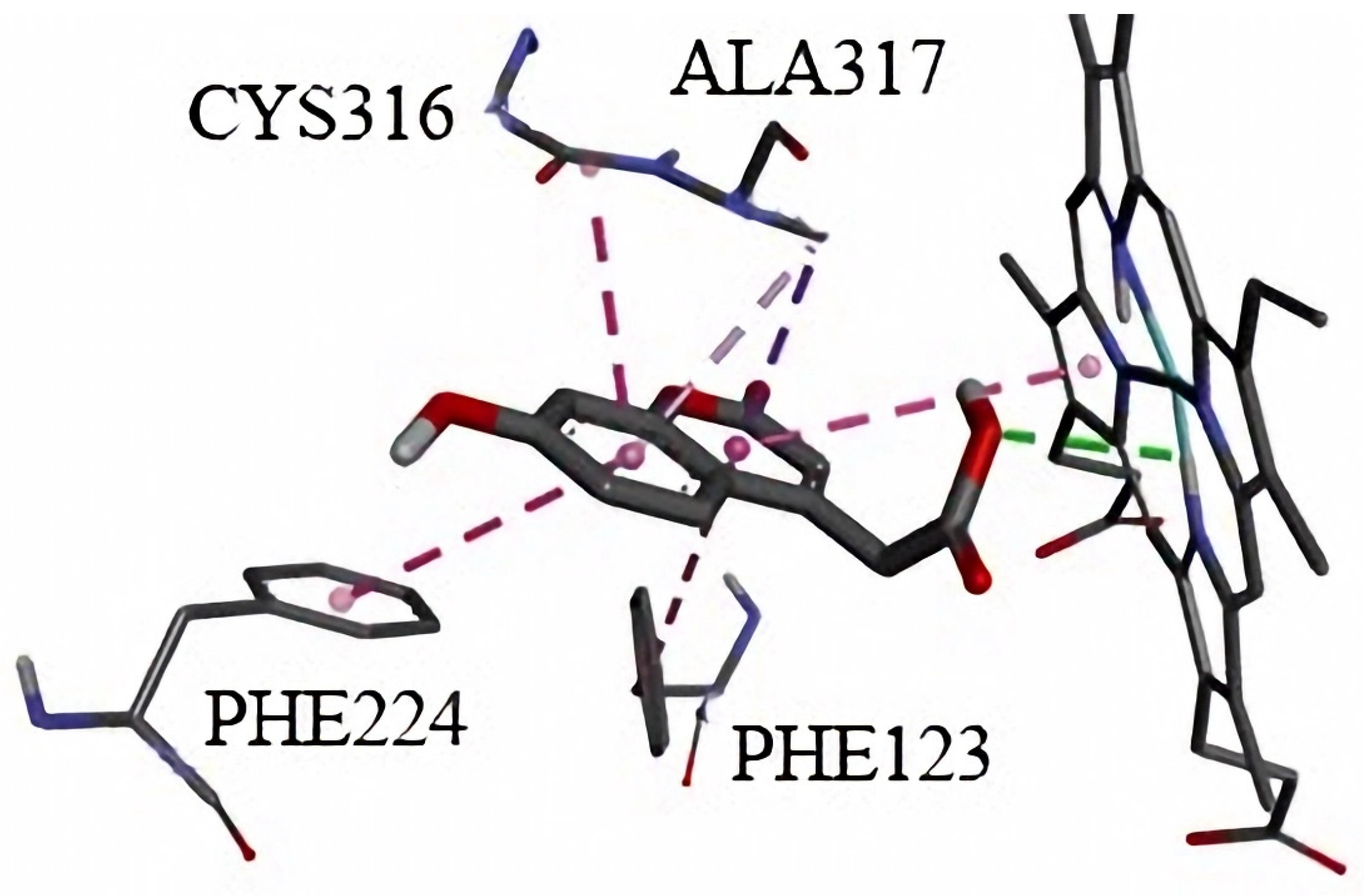
According obtained evaluations from docking, the binding energy in 7-hydroxycoumarin-4-acetic acid–protein pairs vary from 2.8 to 9.8 kJ/mol. It was found that the affine binding with AV scores in range 9 to 9.8 kJ/mol were evaluated for human CYP1A1 structure (Figure 4, PDB code 6DWM), bacterial P450-BM3 (3BEN), OleT (5M0N, 4L40, 4L54), CYP260A1 S276I mutant (6F8C), and P450-CAM (1PHE).

4. Conclusions

The heterocyclic fluorescent derivative of coumarin 7-hydroxycoumarin-4-acetic acid was synthesized. The obtained from high throughput virtual screening computational data reveal 7-hydroxycoumarin-4-acetic acid as possible cytochromes P450 substrate. These results with the literature data about coumarin–CYPs interactions confirm these abilities of the given compound and other similar structures and provide new opportunities to adjust CYPs activity.

Author Contributions

Conceptualization, Y.F., P.Y. and N.F.; writing—original draft preparation, N.E.; writing—review and editing, Y.F.; supervision, Y.F. All authors have read and agreed to the published version of the manuscript.

Funding

The work was supported governmental grants of republic of Belarus No. of registration 20210560 and the grant from the Ministry of Education of the Republic of Belarus No. 20250893.

Institutional Review Board Statement

Not applicable.

Informed Consent Statement

Not applicable.

Data Availability Statement

The original contributions presented in this study are included in the article. Further inquiries can be directed to the corresponding authors.

Conflicts of Interest

The authors declare no conflicts of interest.

References

  1. Omar, S.; Webb, A.J. Nitrite reduction and cardiovascular protection. J. Mol. Cell Cardiol. 2014, 73, 57–69. [Google Scholar] [CrossRef] [PubMed]
  2. Nelson, D.R. Progress in tracing the evolutionary paths of cytochrome P450. Biochim. Biophys. Acta 2011, 1814, 14–18. [Google Scholar] [CrossRef] [PubMed]
  3. Manikandan, P.; Nagini, S. Cytochrome P450 Structure, Function and Clinical Significance: A Review. Curr. Drug Targets 2018, 19, 38–54. [Google Scholar] [CrossRef] [PubMed]
  4. Annunziata, F.; Pinna, C.; Dallavalle, S.; Tamborini, L.; Pinto, A. An Overview of Coumarin as a Versatile and Readily Accessible Scaffold with Broad-Ranging Biological Activities. Int. J. Mol. Sci. 2020, 21, 4618. [Google Scholar] [CrossRef] [PubMed]
  5. Borges, F.; Roleira, F.; Milhanzes, N.; Santana, L.; Uriarte, E. Simple coumarins and analogues in medicinal chemistry: Occurrence, synthesis and biological activity. Curr. Med. Chem. 2005, 12, 887–916. [Google Scholar] [CrossRef] [PubMed]
  6. Srikrishna, D.; Godugu, C.; Dubey, P.K. A Review on Pharmacological Properties of Coumarins. Mini Rev. Med. Chem. 2018, 18, 113–141. [Google Scholar] [CrossRef] [PubMed]
  7. Erland, J.F. Demant Bovine Serum Albumin–(7-Hydroxycoumarin-4-acetic Acid) Complex: Applications to the Fluorometric Measurement of Fatty Acid Concentrations. Anal. Biochem. 1998, 267, 366–372. [Google Scholar]
  8. Foroozesh, M.; Sridhar, J.; Goyal, N.; Liu, J. Coumarins and P450s, Studies Reported to-Date. Molecules 2019, 24, 1620. [Google Scholar] [CrossRef] [PubMed]
  9. Zavalinich, V.; Glinskaya, L.; Yakovets, P.; Faletrov, Y.; Shkumatov, V. Potential Fluorescent Ligands for Zn-Containing Bacterial Enzymes: In Silico Evaluation, Synthesis and Optical Properties. Chem. Proc. 2022, 12, 82. [Google Scholar] [CrossRef]
  10. Manwar, A.; Malde, A.; Verma, J.; Virsodia, V.; Mishra, A.; Upadhyay, K.; Acharya, H.; Coutinho, E.; Shah, A. Synthesis anti-tubercular activity 3D-QSARstudy of coumarin-4-acetic acid benzylidene hydrazides. Eur. J. Med. Chem 2008, 43, 2395–2403. [Google Scholar]
  11. Sethi, P.; Bansal, Y.; Bansal, G. Synthesis and PASS-assisted evaluation of coumarin–benzimidazole derivatives as potential anti-inflammatory and anthelmintic agents. Med. Chem. Res. 2018, 27, 61–71. [Google Scholar] [CrossRef]
  12. Basanagouds, M.; Jadhav, V.B.; Kulkarni, M.V.; Nagendra Rao, R. Computer Aided Prediction of Biological Activity Spectra: Study of Correlation between Predicted and Observed Activities for Coumarin-4-Acetic Acids. Indian J. Pharm. Sci. 2011, 73, 88–92. [Google Scholar]
  13. Al Anshori, J.; Rahayu, D.S.; Hidayat, A.T.; Hidayat, I.W.; Zainuddin, A. Synthesis of fluorescent compound, 7-Hydroxy-4-methyl-2H-chroman-2-one via Pechmann condensation of citric acid and resorcinol. Res. J. Chem. Environ. 2018, 22, 91–96. [Google Scholar]
Figure 1. Chromatogram of 7-hydroxycoumarin-4-acetic acid.
Chemproc 18 00126 g001
Figure 2. Scheme of synthesis 7-hydroxycoumarin-4-acetic acid (2-(7-hydroxy-2-oxo-2H-chromen-4-yl)-acetic acid, Pubchem ID CID: 5338490).
Chemproc 18 00126 g002
Figure 3. Absorbance spectra of 7-hydroxycoumarin-4-acetic acid. A—in EtOH, B—in acidifiedHCl, C—K2CO3-buffered water/ethanol.
Chemproc 18 00126 g003
Figure 4. The active site cavity of the human CYP1A1 with 7-hydroxycoumarin-4-acetic acid ligand.
Chemproc 18 00126 g004
Disclaimer/Publisher’s Note: The statements, opinions and data contained in all publications are solely those of the individual author(s) and contributor(s) and not of MDPI and/or the editor(s). MDPI and/or the editor(s) disclaim responsibility for any injury to people or property resulting from any ideas, methods, instructions or products referred to in the content.