
Proceeding Paper

Convenient Gould–Jacobs Synthesis of 4-Quinolone Core Using Eaton’s Reagent †
by
Daniela S. Mansilla
,
Silvia E. Asís
and
Gisela C. Muscia
*
Facultad de Farmacia & Bioquímica, Universidad de Buenos Aires, Junín 956, Ciudad Autónoma de Buenos Aires, Buenos Aires 1113, Argentina
*
Author to whom correspondence should be addressed.
Presented at the 29th International Electronic Conference on Synthetic Organic Chemistry, 14–28 November 2025; Available online: https://sciforum.net/event/ecsoc-29.
Chem. Proc. 2025, 18(1), 128; https://doi.org/10.3390/ecsoc-29-26900

Published: 13 November 2025

Abstract

The Gould–Jacobs reaction for the synthesis of ethyl 4-quinolone-3-carboxylate derivatives is described. Thus, the condensation of 4-subtituted anilines and EMME to give the corresponding diethyl anilinomethylene malonate was carried out via neat MW irradiation or refluxing ethanol. These intermediates underwent Eaton’s reagent-catalyzed cyclisation with good to excellent yields. For the first step, the MW reaction took only 7 min compared with the two hours required for conventional heating, yet the yields were comparable in almost all cases. A series of eight 4-quinolone derivatives was obtained with good yields under mild conditions and with short reaction times.

1. Introduction

Naturally occurring or synthetic heterocycles with a quinoline nucleus represent an important source of bioactive compounds. Meanwhile, 4-quinolone and 2-quinolone, which are the tautomers of 4-hydroxyquinoline and 2-hydroxyquinoline, respectively, represent the core of several broad-spectrum synthetic antibiotics [1].
Our research group has developed a series of 4-phenyl-3-amino-2-quinolone derivatives, which exhibited activity against Plasmodium falciparum, the parasite that causes malaria, while others were found to inhibit angiogenesis [2]. Later, a series of polycyclic 4-quinolones was synthesized via MW irradiation using a one-pot reaction from anthranilic acid and cyclanones [3]. Furthermore, the selective synthesis of 4-methyl-2-quinolone was described, employing the Eaton’s reagent and avoiding the use of mineral acids and expensive metal catalysts such as those described in the literature [4]. Eaton’s reagent, which consists of 7.7% phosphorus pentoxide dissolved in methanesulfonic acid, is easily available and has advantages such as controlled reaction conditions and a low environmental impact [5]. Although it has a strongly acidic character due to its composition, it is a good solvent because it is an organic acid and has a lower density than mineral acids.
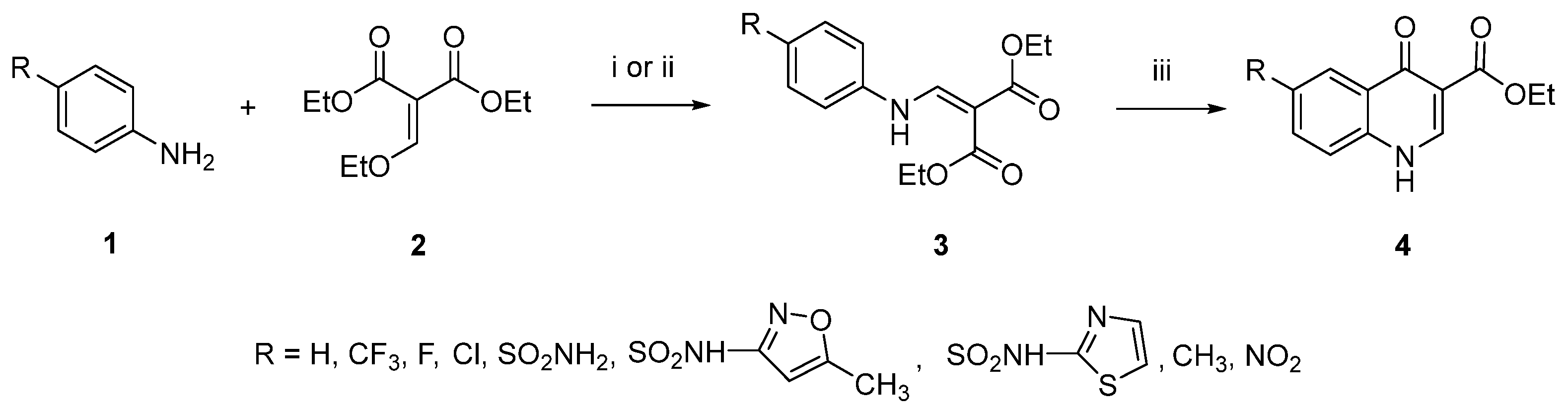
A recent review describes a wide variety of chemical methods leading to quinoline-4-ones [6] and one of the most prominent is the Gould–Jacobs reaction [7]. It involves the condensation of aniline 1 and diethyl ethoxymethylidenedimalonate (EMME) 2 to give the intermediate diethyl anilinomethylene malonate 3, which is cyclized upon further heating, usually under drastic conditions, to give ethyl 4-quinolone-3-carboxylate 4 (Scheme 1). In this work, we describe and improve the Gould–Jacobs reaction promoted by MW in the first step and employing the Eaton’s reagent for the thermal cyclization to afford a series of 6-substituted quinoline-4-ones of pharmaceutical interest.

2. Results and Discussion

The neat reaction of aniline and EMME to prepare the anilinomethylene malonate 3 has been reported and in most cases, it required a temperature between 100 or 120 °C and a reaction time of 4 h [8,9]. Other authors employed ethanol at refluxing temperature [10] and even at room temperature [11]. For this stage, we have carried out two procedures. Thus, an equimolar neat mixture of 4-subtituted anilines and EMME was subjected to MW irradiation and the corresponding intermediate product 3 was achieved in 7 min. On the other hand, the same reaction was developed under refluxing ethanol for 2 h to compare their performance (Scheme 1). Although the yields were higher in EtOH or similar in some cases, MW irradiation shortened the reaction times (Table 1). The intermediate products 3 were crystallized from the proper solvent and the spectroscopical data and melting point values of 3a3e and 3g3i agreed with the literature, whereas 3f was a novel structure.
For the cyclization step to the quinoline-4-one 4, high reaction temperatures were required when diphenyl ether was the solvent [8,9] as well as harsh conditions, such as PPA/POCl3 at 75 °C for 12 h [10], Dowtherm, or flash vacuum pyrolysis (FVP) [12]. The commercially available Eaton’s reagent (1:10 w/w P2O5 in methanesulfonic acid) was found to be an ideal alternative, requiring milder conditions, and resulting in quantitative yields. Only one author reported both the use of the Eaton’s reagent and diphenyl ether to prepare in good yields the sole compound 4a [9].
Therefore, the intermediate products 3a–3i reacted with Eaton’s reagent at 100 °C for 2 h. An average yield of 60% was obtained for the quinoline-4-ones 4a4h, which were further crystallized from EtOH, and their physical data were analyzed and compared with the literature. Derivative 4i, possessing a 4-nitro substituent, could not be isolated. The dark-colored solid obtained after isolation consisted of a mixture of products that was difficult to purify.

3. Materials and Methods

Melting points were determined in a capillary Electrothermal 9100 SERIES-Digital apparatus (Rochford, Essex, UK) and are uncorrected. 1H and 13C NMR spectra were obtained using a Bruker 600 spectrometer (Bruker, Fällanden, Switzerland). The operating frequencies for protons and carbons were 600 and 151 MHz, respectively. The chemical shifts (δ) were given in ppm. IR spectra were recorded on an FT Thermo Scientific (Madison, WI, USA) from KBr disks. Analytical TLCs were performed on DC-Alufolien Kieselgel 60 F 254 Merck (Merck, Darmstadt, Germany). Microwave-assisted reactions were carried out in a Glass vial G10, Anton Paar Monowave 400 (Serial Number: 81920884, Instrument Software Version: 4.10.9376.7, Graz, Austria).

3.1. General Procedure for the Synthesis of Diethyl Anilinomethylene Malonate 3a–3i

Method i: A neat mixture of 2 mmol of 4-substituted aniline and 2 mmol of EMME was subjected to MW irradiation at 170 °C and 850 W for 7 min. The mixture was cooled to room temperature to give a solid product, which was then crystallized from the appropriate solvent. Method ii: A mixture of 3 mmol of 4-substituted aniline and 3 mmol of EMME was refluxed in 10 mL anhydrous EtOH for 2 h. The mixture was cooled to room temperature to give a solid product, except for 3a and 3h, where the EtOH was evaporated before. The spectral characteristics of compounds 3a3e and 3g3i are identical to the reported data. Yields and m.p. values are depicted in Table 1.

Diethyl 2-(((4-(N-(5-Methylisoxazol-3-yl)sulfamoyl)phenyl)amino)methylene)malonate 3f

White powder, 81% yield (method i). 1H NMR (DMSO-d6) δ (ppm): 11.41 (s, 1H, SO2NH), 10.70 (d, J = 13.5 Hz, 1H, NH), 8.39 (d, J = 13.5 Hz, 1H, =CH), 7.84 (d, 2H, arom.), 7.58 (d, 2H, arom.), 6.15 (s, 1H, het.), 4.22 (m, 2H, CH2), 4.13 (m, 2H, CH2), 2.30 (s, 3H, CH3), 1.25 (t, 6H, CH3). 13C NMR (DMSO-d6) δ (ppm): 170.82, 167.24, 165.20, 157.97, 150.02, 143.99, 134.65, 129.06, 118.08, 96.42, 95.87, 60.45, 60.25, 14.68, 14.59, 12.52. IR ν (cm−1): 1671.3, 1637.9, 1589.2, 1250.7, 1165.6, 829.06 (Figures S1–S3).

3.2. General Procedure for the Synthesis of Ethyl 4-Quinolone-3-Carboxylates 4a–3h

A mixture of 2 mmol of derivative 3 and 2 mL of Eaton’s reagent was heated at 100 °C for 2 h. The reaction mixture was cooled to rt and then poured into a saturated NaHCO3 solution. The product was filtered off, washed, and then crystallized from EtOH.

3.2.1. Ethyl 4-oxo-1,4-Dihydroquinoline-3-Carboxylate 4a

Pale yellow powder, 65% yield, m.p. 271–274 °C (Lit. 271–273 °C) [9].

3.2.2. Ethyl 4-oxo-6-(Trifluoromethyl)-1,4-Dihydroquinoline-3-Carboxylate 4b

Pale brown powder, 75% yield, m.p. 288–287 °C (Lit. 290–292 °C) [10].

3.2.3. Ethyl 6-Fluoro-4-oxo-1,4-Dihydroquinoline-3-Carboxylate 4c

Pale brown powder, 40% yield, m.p. 280–285 °C (Lit. 288–290 °C) [10].

3.2.4. Ethyl 6-Chloro-4-oxo-1,4-Dihydroquinoline-3-Carboxylate 4d

Light beige powder, 40% yield, m.p. 295–298 °C (Lit. 295–296 °C) [13].

3.2.5. Ethyl 4-oxo-6-Sulfamoyl-1,4-Dihydroquinoline-3-Carboxylate 4e

Beige powder, 80% yield, m.p. > 290 °C.

3.2.6. Ethyl 6-(N-(5-Methylisoxazol-3-yl)sulfamoyl)-4-oxo-1,4-Dihydroquinoline-3-Carboxylate 4f

Beige powder, 62% yield, m.p. > 290 °C.

3.2.7. Ethyl 4-oxo-6-(N-(Thiazol-2-yl)sulfamoyl)-1,4-Dihydroquinoline-3-Carboxylate 4g

Beige powder, 72% yield, m.p. > 290 °C.

3.2.8. Ethyl 6-Methyl-4-oxo-1,4-Dihydroquinoline-3-Carboxylate 4h

Beige powder, 15% yield, m.p. > 290 °C (Lit. > 280 °C) [14].

4. Conclusions

It was possible to extend the use of Eaton’s reagent in the Gould–Jacobs reaction to prepare structures with a 4-quinolone skeleton, which also represent starting materials in the search for new antimicrobial agents.

Supplementary Materials

The following supporting information can be downloaded at: https://www.mdpi.com/article/10.3390/ecsoc-29-26900/s1, Figures S1–S3: 1H and 13C NMR and IR spectra of 3f.

Author Contributions

Conceptualization, data curation, synthetic investigation, writing—original draft, and review and editing, S.E.A., G.C.M. and D.S.M.; supervision, G.C.M. All authors have read and agreed to the published version of the manuscript.

Funding

This research received no external funding.

Institutional Review Board Statement

Not applicable.

Informed Consent Statement

Not applicable.

Data Availability Statement

Data are available in this manuscript.

Acknowledgments

The MW reactions for compounds 3 were performed on an Anton Paar Monowave 400 equipment, under the supervision of Gustavo Romanelli and Gabriel Sathicq at the CINDECA-CONICET-CCT La Plata, Universidad Nacional de La Plata.

Conflicts of Interest

The authors declare no conflicts of interest.

Abbreviations

The following abbreviations are used in this manuscript:
DMSOdimethyl sulfoxide
EMMEdiethyl ethoxymethylenemalonate
FVPflash vacuum pyrolysis
MWmicrowave
PPApolyphosphoric acid

References

  1. Bisacchi, G.S. Origins of the quinolone class of antibacterials: An expanded “Discovery Story”. J. Med. Chem. 2015, 58, 4874−4882. [Google Scholar] [CrossRef] [PubMed]
  2. Muscia, G.C.; Bollini, M.; Bruno, A.M.; Asís, S.E. Evaluation of antiparasitic, antituberculosis and antiangiogenic activities of 3-aminoquinolin-2-one derivatives. J. Chil. Chem. Soc. 2006, 51, 859–863. [Google Scholar] [CrossRef]
  3. Muscia, G.; Carnevale, J.P.; Buldain, G.Y.; Asis, S.E. Microwave-assisted one-pot synthesis of polycyclic 4-quinolone derivatives. Trends Heterocycl. Chem. 2013, 16, 19–22. Available online: http://www.researchtrends.net/tia/abstract.asp?in=0&vn=16&tid=3&aid=5126&pub=2013&type=3 (accessed on 1 September 2025).
  4. Muscia, G.C.; Luczywo, A.; Carnevale, J.P.; Buldain, G.Y.; Asís, S.E. Selective synthesis of the precursor of bioactive compounds 4-methyl-2-quinolone using Eaton’s reagent. Av. Cien. Ing. 2019, 10, 37–42. [Google Scholar]
  5. Eaton, P.E.; Carlson, G.R.; Lee, J.T. Phosphorus pentoxide-methanesulfonic acid. Convenient alternative to polyphosphoric acid. J. Org. Chem. 1973, 38, 4071–4073. [Google Scholar] [CrossRef]
  6. Gach-Janczak, K.; Piekielna-Ciesielska, J.; Waskiewicz, J.; Krakowiak, K.; Wtorek, K.; Janecka, A. Quinolin-4-ones: Methods of Synthesis and Application in Medicine. Molecules 2025, 30, 163. [Google Scholar] [CrossRef] [PubMed]
  7. Gould, R.G.; Jacobs, W.A. The synthesis of certain substituted quinolines and 5,6-benzoquinolines. J. Am. Chem. Soc. 1939, 61, 2890–2895. [Google Scholar] [CrossRef]
  8. Stern, E.; Muccioli, G.G.; Bosier, B.; Hamtiaux, L.; Millet, R.; Poupaert, J.H.; Hénichart, J.P.; Depreux, P.; Goossens, J.F.; Lambert, D.M. Pharmacomodulations around the 4-oxo-1,4-dihydroquinoline-3-carboxamides, a class of potent CB2-selective cannabinoid receptor ligands: Consequences in receptor affinity and functionality. J. Med. Chem. 2007, 50, 5471–5484. [Google Scholar] [CrossRef] [PubMed]
  9. Davie, B.J.; Valant, C.; White, J.M.; Sexton, P.M.; Ben Capuano, B.; Christopoulos, A.; Scammells, P.J. Synthesis and pharmacological evaluation of analogues of benzyl quinolone carboxylic acid (BQCA) designed to bind irreversibly to an allosteric site of the M1 muscarinic acetylcholine receptor. J. Med. Chem. 2014, 57, 5405–5418. [Google Scholar] [CrossRef] [PubMed]
  10. Medapi, B.; Suryadevara, P.; Renuka, J.; Sridevi, J.P.; Yogeeswari, P.; Sriram, D. 4-Aminoquinoline derivatives as novel Mycobacterium tuberculosis GyrB inhibitors: Structural optimization, synthesis and biological evaluation. Eur. J. Med. Chem. 2015, 103, 1–16. [Google Scholar] [CrossRef] [PubMed]
  11. Ilangovan, A.; Kumar, R.G. 2,2-Bis(ethoxycarbonyl)vinyl (BECV) as a versatile amine protecting group for selective functional-group transformations. Chem. Eur. J. 2010, 16, 2938–2943. [Google Scholar] [CrossRef] [PubMed]
  12. Wernik, M.; Peter, E.; Hartmann, P.E.; Sipos, G.; Darvas, F.; Boese, A.D.; Dallinger, D.; Kappe, C.O. On the regioselectivity of the Gould–Jacobs reaction: Gas-phase versus solution-phase thermolysis. Eur. J. Org. Chem. 2020, 2020, 7051–7061. [Google Scholar] [CrossRef]
  13. Forezi, L.; Tolentino, N.M.C.; de Souza, A.M.T.; Castro, H.C.; Montenegro, R.C.; Dantas, R.F.; Oliveira, M.E.M.; Silva, F.P.; Barreto, L.H.; Burbano, R.M.; et al. Synthesis, cytotoxicity and mechanistic evaluation of 4-oxoquinoline-3-carboxamide derivatives: Finding new potential anticancer drugs. Molecules 2014, 19, 6651–6670. [Google Scholar] [CrossRef] [PubMed]
  14. Malvacio, I.; Mariano, D.; Vera, A.; Moyano, E.L. Microwave assisted synthesis of ethyl-quinolon-4-one-3-carboxylates and hydrolysis to quinolon-4-one-3-carboxylic acids. Curr. Microw. Chem. 2014, 1, 52–58. [Google Scholar] [CrossRef]
Scheme 1. Gould–Jacobs synthesis of ethyl 4-quinolone-3-carboxylates 4. Reagents and conditions in this work: (i) neat, MW, 7 min or (ii) EtOH, reflux, 2 h; (iii) Eaton’s reagent, 80–100 °C, 2 h.
Chemproc 18 00128 sch001
Table 1. Comparative yields for the synthesis of anilinomethylene malonates 3a3i and their melting points values 1.
Chemproc 18 00128 i001
EntryCompd.R% Yield MW% Yield EtOHm.p. °C 2
13aH506043–45
23bCF3406288–89
33cF152566–68
43dCl157476–80
53eSO2NH24075148–150
63fChemproc 18 00128 i0028160166–168
73gChemproc 18 00128 i003d 377168–169
83hCH3758043–45
93iNO28063130–132
1 Purified product; 2 physical data according to literature, except the novel 3f; 3 decomposes after 5 min.
Disclaimer/Publisher’s Note: The statements, opinions and data contained in all publications are solely those of the individual author(s) and contributor(s) and not of MDPI and/or the editor(s). MDPI and/or the editor(s) disclaim responsibility for any injury to people or property resulting from any ideas, methods, instructions or products referred to in the content.