
Proceeding Paper

Studies on the Synthesis, Physical Properties, and Stability of Benzyl Ethers as Potential Heat Transfer Fluids †
1
Solid Mechanical Equipment Company, Mussafah M43, Abu Dhabi P.O. Box 107675, United Arab Emirates
2
Department of Chemistry, College of Science, United Arab Emirates University, Al Ain P.O. Box 15551, United Arab Emirates
*
Author to whom correspondence should be addressed.
Presented at the 29th International Electronic Conference on Synthetic Organic Chemistry, 14–28 November 2025; Available online: https://sciforum.net/event/ecsoc-29.
Chem. Proc. 2025, 18(1), 121; https://doi.org/10.3390/ecsoc-29-26695
Published: 11 November 2025

Abstract

Heat transfer fluids (HTFs) play a crucial role across a range of industries, absorbing and conveying thermal energy in applications, including as essential components in concentrating solar power systems. As a continuation of previous work, we look at extended dibenzyl ethers as HTFs. The physical properties heat capacity and temperature-dependent density of selected dibenzyl ethers are investigated, and their values are compared with computational data using incremental methods for the estimation of group contributions within the structures towards the macroscopic properties of the compounds. The thermal stability of the dibenzyl ethers and their oxidative stability over a longer period of time are studied also.

1. Introduction

A heat transfer fluid (HTF) is a gas or liquid that facilitates heat transfer by acting as an intermediary—absorbing heat in one part of a process (cooling), transporting and storing thermal energy, and releasing it in another part of the process (heating). The choice of HTF is largely determined by the specific process and system design, with the primary goal being to maximize heat transfer efficiency while minimizing energy input and overall cost [1,2]. HTFs and thermal oils used in high-temperature applications differ in their chemical composition; many are synthetic and can originate from either organic or inorganic sources, depending on the application requirements.
Organic HTFs encompass a wide range of compounds, including esters, diesters, polyglycols, water–glycol mixtures, paraffins, and waxes. Silicone-based greases and oils are also commonly used. For systems operating at elevated temperatures, inorganic fluids such as liquid sodium [3] (e.g., in nuclear reactors and in concentrated solar thermal energy systems) and molten nitrate salts (sodium nitrate–potassium nitrate mixtures [4]) are employed. More recently, advanced materials like carbon nanofibers, carbon nanotubes, and metallic nanopowders have been explored as potential HTFs [2].
Historically, most organic HTFs derived from aromatic or aliphatic petrochemicals were used within a temperature range of 0 to 350 °C. At higher temperatures, these compounds are prone to decomposition or oxidation [5]. Nevertheless, synthetic organic HTFs have regained interest due to their superior thermal properties, despite their higher cost.
HTFs and thermal oils are characterized by differences in kinematic viscosity, operating temperature range, and critical points such as the pour point, boiling point, and flash point. Key performance parameters also include thermal energy storage capacity per unit volume, toxicity, and usable temperature range [6]. In evaluating an HTF, essential properties include high heat capacity and thermal conductivity, high flash point, wide operating temperature range (low melting and high boiling points), low viscosity and density, and high vapor pressure [7].
Environmental concerns have also been raised regarding HTFs [8]. Some possess relatively poor thermal performance compared to water. At room temperature, many HTFs exhibit higher viscosity, lower density, and reduced specific heat capacity and thermal conductivity. To compensate, they are often used at higher flow rates, requiring more pumping power to transfer the same amount of energy as water.
The authors have been investigating suitable organic HTFs for application in a newly developed solar thermoelectric generator [9]. This interest aligns with their ongoing work on ether synthesis [10], leading to the development of several new aryl ethers, particularly benzyl ethers, as potential HTFs. The current study focuses on this effort. Preliminary modeling indicated that these molecules may offer a relatively high heat capacity. However, from the outset, the limited thermal stability of benzyl ethers was identified as a potential limitation.
The initial phase of research focused on the synthesis of dibenzyl ethers, supported by a graduation project that modeled the scale-up of production to an industrial level [11]. Subsequently, the scope was expanded to include the synthesis of oligobenzyl ethers, with the understanding that future work would need to establish more scalable production routes if these compounds were to be used as commercial HTFs.
Even 23 years after Metzger’s influential article on chemical sustainability and 33 years after the Rio Earth Summit [12], efficient use of chemical resources remains essential. Purification steps often consume more solvent than the reactions themselves and involve solid-phase materials such as silica gel. However, while solid-phase materials can often be recycled, solvents present greater challenges. From this sustainability perspective, the authors explored solvent reduction strategies and investigated one-pot syntheses, including combined etherification and Suzuki cross-coupling reactions, in some cases performed under solvent-free conditions.
In the current contribution, we extend the scope of benzyl ethers that can be prepared under these conditions. Furthermore, the authors investigate the physical properties such as the heat capacity and the temperature-dependent density of selected dibenzyl ethers and compare the values with computational data using incremental methods for the estimation of group contributions within the structures towards the macroscopic properties of the compounds. Finally, it was realized that while some of the dibenzyl ethers were stable at higher temperatures, some of the studied benzyl ethers were found to degrade oxidatively in air at rt over longer time periods. Possible mechanisms for these degradative transformations are discussed.

2. Experimental

General. Melting points were measured with a Stuart SMP10 melting point apparatus and are un-corrected. 1H NMR (at 400 MHz) and 13C NMR (at 100.5 MHz) spectra were taken on a Varian 400 MHz spectrometer. IR measurements were performed on a Thermo Nicolet FT-IR spectrometer, model Nexus 470. Density measurements were performed on an Anton-Barr DMA 4500M densitometer. TGA measurements were carried out with a Shimadzu TGA-50. Column chromatography was executed on silica gel S (Riedel de Haen) and on silica gel (Merck grade 9385).
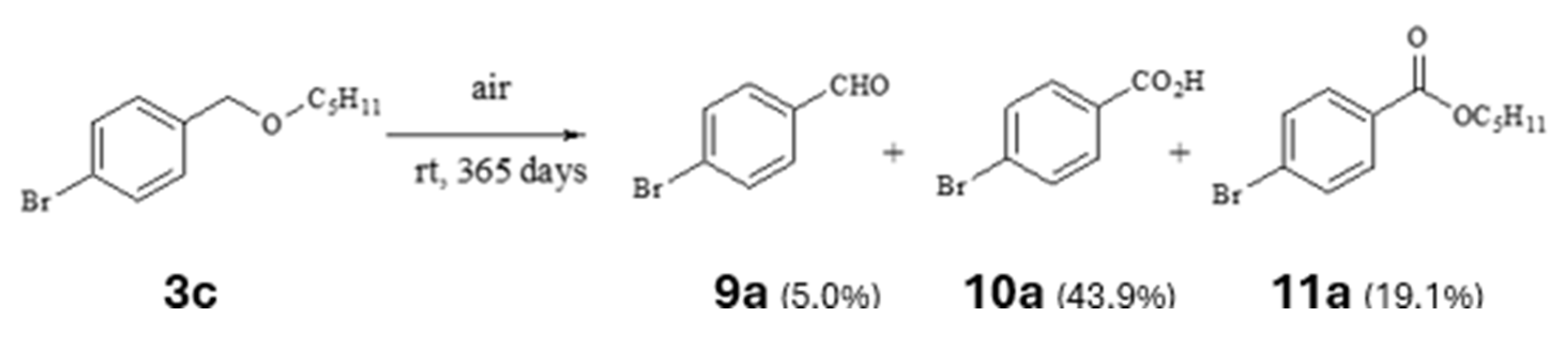
Stability tests for compounds of the 4-bromobenzyl series. 4-bromobenzyl n-pentyl ether (4.19 g, 16.3 mmol) was kept at ambient temperature exposed to air for 12 months. The sample started showing a precipitate after 60 days. After 12 months, the sample was separated by column chromatography on silica gel (hexane/ether/CH2Cl2 4:1:1) after filtering off the precipitate and analyzed to contain 4-bromobenzoic acid (10a, 1.44 g, 43.9%), 4-bromobenzaldehyde (9a, 150 mg, 5.0%), and n-pentyl 4-bromobenzoate (11a, 846 mg, 19.1%): 4-bromobenzoic acid (10a) as colorless needles, mp. 252 °C (Lit. 252–254 °C): νmax (KBr/cm−1) 3420–2050 (bs, OH), 1674, 1567, 1425, 1319, 1296, 1278, 1176, 1127, 1108, 1068, 1011, 927, 849, 756; δH (400 MHz, DMSO-d6) 7.65 (2H, d, 3J = 8.4 Hz), 7.82 (2H, d, 3J = 8.4 Hz); δC (100.5 MHz, CDCl3) 131.0 (Cquat), 131.6 (2C, CH), 131.8 (2C, CH), 132.4 (Cquat), 168.2 (Cquat, CO); δC (100.5 MHz, DMSO-d6) 127.3 (Cquat), 130.4 (Cquat), 131.7 (2C, CH), 132.1 (2C, CH), 167.1 (Cquat); 4-bromobenzaldehyde (9a) as a colorless solid, mp. 61 °C; νmax (KBr/cm−1) 2859, 1698, 1588, 1573, 1382, 1204, 1065, 1009, 834, 811; δH (400 MHz, CDCl3) 7.67–7.73 (4H, m), 9.96 (1H, s, CHO); δC (100.5 MHz, CDCl3) 129.8 (Cquat), 131.0 (2C, CH), 132.4 (2C, CH), 135.0 (Cquat), 191.1 (CHO), and n-pentyl 4-bromobenzoate (11a) [13] as a colorless oil; νmax (KBr/cm−1) 2957, 2932, 2871, 1723, 1591, 1484, 1467, 1397, 1271, 1173, 1103, 1069, 1012, 848, 757, 683; δH (400 MHz, CDCl3) 0.90 (3H, t, 3J = 6.4 Hz, CH3), 1.32–1.39 (4H, m), 1.73–1.77 (2H, m), 4.29 (2H, t, 3J = 6.4 Hz, OCH2) 7.56 (2H, d, 3J = 8.8 Hz), 7.88 (2H, d, 3J = 8.8 Hz); δC (100.5 MHz, CDCl3) 14.0 (CH3), 22.3 (CH2), 28.2 (CH2), 28.4 (CH2), 65.4 (OCH2), 127.9 (Cquat), 129.4 (Cquat), 131.1 (2C, CH), 131.6 (2C, CH), 165.9 (Cquat, CO).
Similarly, for 4-bromobenzyl n-butyl ether, the following was found: n-butyl 4-bromobenzoate: νmax (neat/cm−1) 1721; δH (400 MHz, CDCl3) 0.97 (3H, t, 3J = 7.2 Hz), 1.42–1.51 (2H, m), 1.70–1.77 (2H, m), 4.31 (2H, t, 3J = 6.4 Hz), 7.56 (2H, d, 3J = 8.8 Hz), 7.89 (2H, d, 3J = 8.8 Hz); δC (100.5 MHz, CDCl3) 13.8 (CH3), 19.2 (CH2), 30.7 (CH2), 65.1 (OCH2), 127.9 (Cquat), 129.4 (Cquat), 131.1 (2C, CH), 131.6 (2C, CH), 166.0 (Cquat, CO).
For 4-bromobenzyl n-hexyl ether, the following was found: n-hexyl 4-bromobenzoate: νmax (neat/cm−1) 1722; δH (400 MHz, CDCl3) 0.89 (3H, t, 3J = 6.8 Hz), 1.66–1.77 (2H, m), 1.30–1.44 (6H, m), 4.29 (2H, t, 3J = Hz, OCH2), 7.55 (2H, d, 3J = 8.4 Hz), 7.88 (2H, d, 3J = 8.4 Hz); δC (100.5 MHz, CDCl3) 14.0 (CH3), 25.5 (CH2), 25.7 (CH2), 28.6 (CH2), 31.4 (CH2), 65.4 (OCH2), 127.9 (Cquat), 129.4 (Cquat), 131.1 (2C, CH), 131.6 (2C, CH), 165.9 (Cquat, CO).

3. Results and Discussion

3.1. Typical Synthesis of the Studied Dibenzyl Ethers

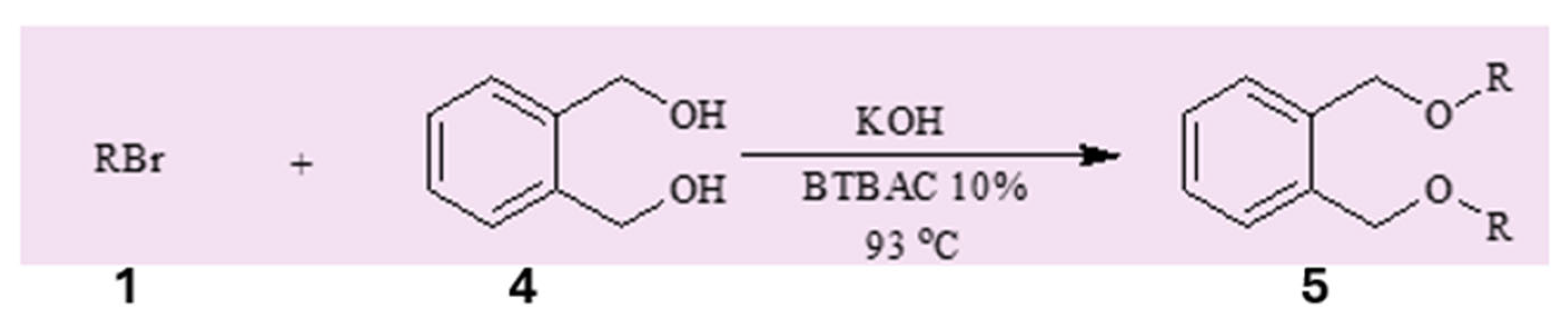
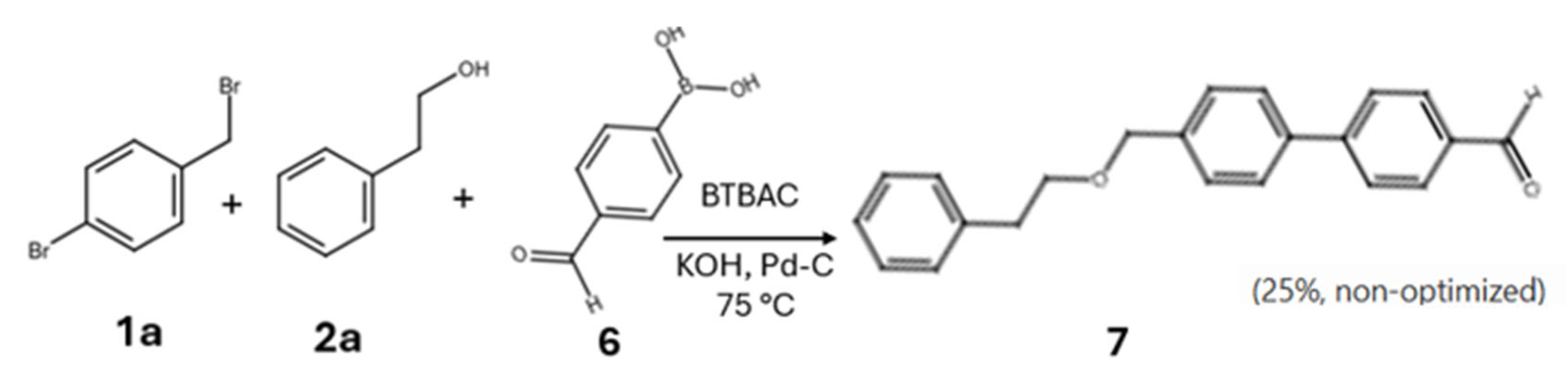
Non-symmetric ethers are commonly prepared by Williamson ether synthesis [14]. Here, the authors prepared simple dibenzyl ethers by the reaction of benzyl bromides and chlorides with benzyl alcohols using powdered KOH as base and DMSO as solvent. In order to circumvent DMSO in the work-up of the reaction and for subsequent reactions where Suzuki cross-coupling was added as a concurrent transformation, the authors changed to solventless systems (Scheme 1) under phase transfer catalysis (PTC), following a procedure analogous to Rao and Senthilkumar [15], utilizing fine KOH as a base and benzyltributylammonium chloride (BTBAC) as PTC. Double Williamson ether syntheses as shown in Scheme 2 led to extended benzyl ether systems. These syntheses can be combined with Suzuki coupling reactions in one pot (Scheme 3). When one utilizes formylphenylboronic acids such as 6, the formyl group in product 7 can be reduced to an alcohol function (NaBH4) and converted to a bromide (PBr3), making these derivatives of 7 precursors of a subsequent Williamson ether synthesis to larger benzyl ethers [1].

3.2. Estimated and Measured Physical Properties of Benzyl Ethers

Important characteristics of potential heat transfer fluids (HTFs) are their thermal properties and other physical properties such as density. A computational pre-investigation was carried out to estimate some of the properties of some of the chemical structures to be synthesized. This study was performed using the available incremental methods for the estimation of group contributions within the structures towards the macroscopic properties of the compounds. Such methods have been developed by Joback and Reid [16], Lydersen [17], Ambrose [18], Klincewicz and Reid [19], Lyman et al. [20], Horvath [21], Marrero and Gani [22], among others, and can estimate certain physical properties such as heat capacities of pure chemical compounds relatively well. Here, the chemical structure of a compound is analyzed and sorted into different contributing groups that make up the molecule. Thereafter, developed equations are used to estimate the thermal or other physical property of the compound based on the incremental contribution of the individual groups/substituents that make up the compound. In this study, we focused on certain properties only, such as on the isobaric heat capacity (Cp), which is very critical for enthalpy calculations in thermal processes. The isobaric heat capacity (Cp) was estimated for selected synthesized ethers using two group contribution computational methods of Kolská et al. [23], which were developed recently, based on Gani’s method [22]. Also, we used Joback and Reid’s method [16], which is an older and more basic method. The obtained values of heat capacity were compared to the measured ones. Kolská’s method [23] is based on three-level group contribution for heat capacity ( C p   l ( T ) ) estimation as a function of temperature (see Equations (1) and (2)).
C p l ( T ) = C p 0 l ( T ) + i N i C p 1 i l ( T ) + w j M j C p 2 j l ( T ) + z k O k C p 3 k l ( T )
with
C p   q t h l e v e l i ,   j ,   o r   k l ( T ) = a q i ,   j ,   o r   k + b q i ,   j ,   o r   k ( T 100 ) + d q i ,   j ,   o r   k ( T 100 ) 2
where in Equation (1) C p 1 i l ( T ) is the contribution of the first-level group of type i, C p 2 j l ( T ) is the contribution of the second-level group of type j, and C p 3 k l ( T ) is the contribution of the third-level group of type k. Ni, Mj, and Ok indicate the number of occurrences of the individual groups (of type i, j, or k, respectively) in a compound. C p 0 l ( T ) (which could be considered as the contribution of the zero-level group) is an additional adjustable parameter. Variables w and z are weighting factors that are assigned 0 or 1, depending on whether the second-level and third-level contributions, respectively, are used or not. In Equation (2), aq−i, j, or k, bq−i, j, or k, and dq−i, j, or k are adjustable parameters for the temperature dependence of C p 0 l ( T ) ,   C p 1 i l ( T ) ,   C p 2 j l ( T ) ,   and C p 3 k l ( T ) .
Within this method, there are two approaches (Nonhierarchic (NH) and Hierarchic (H)), which differ from each other by only the adjustable parameters (aq−i, j, or k, bq−i, j, or k, and dq−i, j, or k). The other group estimation method used, namely, the method of Joback and Reid [16], is a first-order approximation unlike the previous method. It is applied through Equation (3):
C p 0 ( T ) = ( a ) 37.93 + [ ( b ) + 0.201 ] T + [ ( c ) 3.91 × 10 4 ] T 2 +   [ ( d ) + 2.06 × 10 7 ] T 3
where the following is the case: C p 0 ( T ) : ideal gas heat capacity (J/mole·K); T: temperature (K); a, b, c, and d: adjustable parameters; Σ: indicates that, for the particular property of interest, one sums the product of the number of times that a group appears in the compound and the group contributions.
The measured and estimated heat capacities Cp [J/g·K] (J/mole·K) for ethers benzyl phenylethyl ether (E1), 2-benzyloxy dibenzyl ether (E2), and 2-benzyloxymethyl-4′-(4-methoxybenzyloxymethyl]biphenyl (E3) at three different temperatures are shown in Table 1.
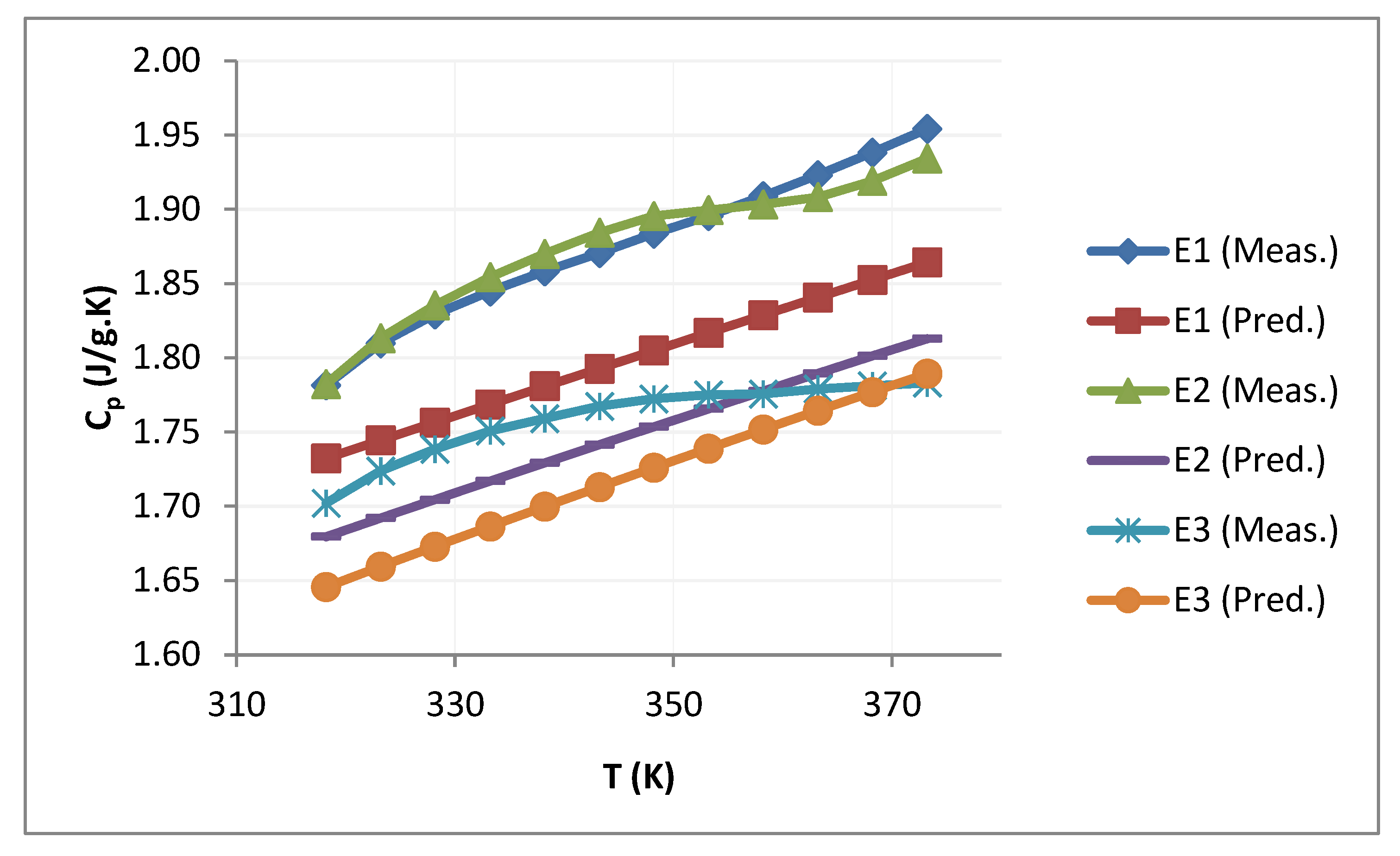
From Table 1, it is obvious that the predicted heat capacities of the specified ethers (E1, E2, and E3) by Kolská’s method [23] are much closer to the measured values compared to Joback and Reid’s approach. This can be justified by the fact that Kolská’s method [23], as recently published, depends on a three-level group contribution analysis that covers the monofunctional molecules’ contribution in groups of the first level, while the groups of the second and third levels improve the more-complex prediction of compounds. In addition, it relies on a higher number of compounds with known properties. At the same time, the Hierarchic (H) approach of Kolská’s method [23] is more reliable than the Nonhierarchic (NH) approach, especially with structurally complicated ethers (E2 and E3). Noting that, there was an average error of less than 0.5% between the experimentally measured [24] and predicted (through H Approach) heat capacities of dibenzyl ether over the studied temperatures’ range, unlike with the (NH) approach (an average error of 23%). Similarly with diphenyl ether [25], the average error was less than 3% considering the (H) approach vs. 12% with the (NH) approach. Thus, the measured heat capacities and predicted values by the (H) approach of Kolská method [23] for ethers (E1E3) at different temperatures are shown in Figure 1.
From Figure 1, one can realize that it is not necessary for the more complicated ethers to have higher specific heat capacities (per mass basis). This can be justified by the fact that the simple structures (e.g., E1) have the potential to form stronger intermolecular bonding compared to the complicated structures (e.g., E2 and E3).
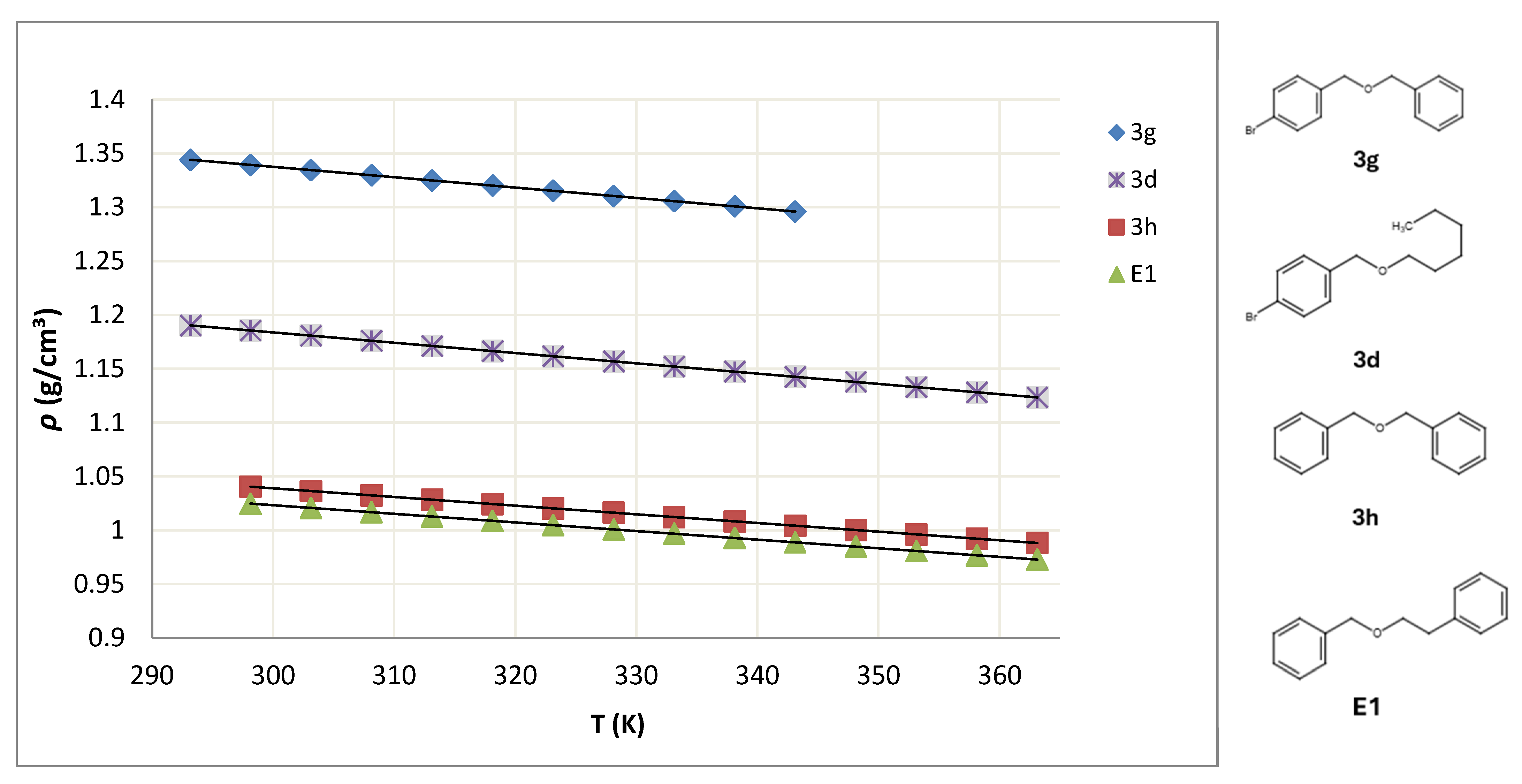
Density measurements of four ethers (3d, 3g, 3h, and E1) were also performed at temperatures up to 363 K (90 °C) (see Figure 2). Interestingly, as can be noted from Figure 2, all of the four studied ethers exhibit an exact linear decrease in density with temperature. The bromo group in 3d and 3g makes their densities higher compared to 3h and E1. Thus, 3d and 3g share the same slope value (−0.001), while also E3 and E4 themselves share the same slope (−0.0008). Moreover, the benzyl group (3g) leads to a higher density of molecules as compared to the hexyl group (3d).
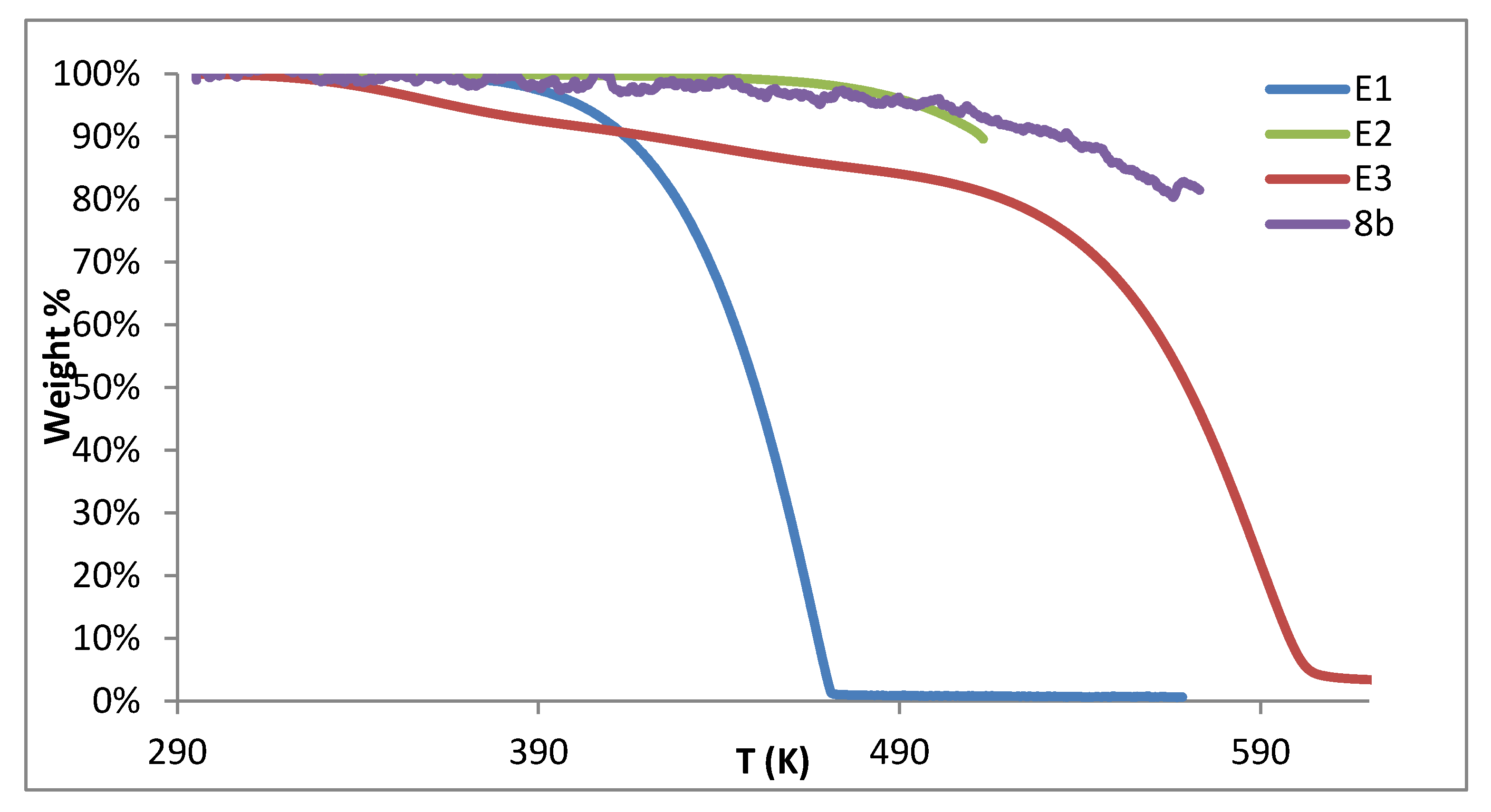
Lastly, thermal gravimetric analysis (TGA) has shown that especially the extended ethers such as 8b are stable up to 573 K (300 °C), even in air without a large weight loss %. Figure 3 shows the thermal stability of four ethers (E1, E2, E3, and 8b).
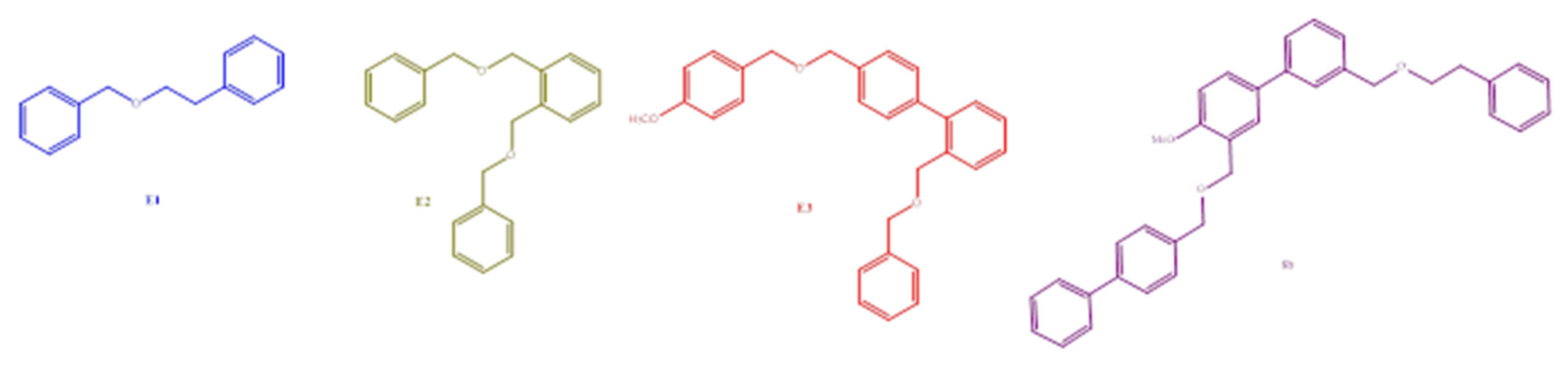
While benzyl phenylethyl ether (E1) already shows volatility and some thermal degradation between 400 K (127 °C) and 475 K (200 °C), the other studied ethers E2, E3, and 8b are thermally stable at temperatures even over 500 K (227 °C), with 8b showing little thermal degradation at temperatures as high as 590 K (317 °C) (Figure 4). At the same time, E2 has a higher heat capacity and can be synthesized more easily than E3 and 8b; thus, the possibility of using E2, as a main component of a new HTF, may be preferable.
In conclusion, for the melting points of the prepared compounds, it can be said that for simple molecules, there was a good agreement between the calculated and measured values. For the extended ethers, this does not hold true. Most likely, due to their complicated geometric structure, molecular packing is frustrated, and so these ethers are liquids at room temperature. Importantly, thermal gravimetric analysis (TGA) has shown that especially the extended ethers, such as 8b, are stable up to over 300 °C, even in air.

3.3. Long-Time Stability of the Compounds at Room Temperature

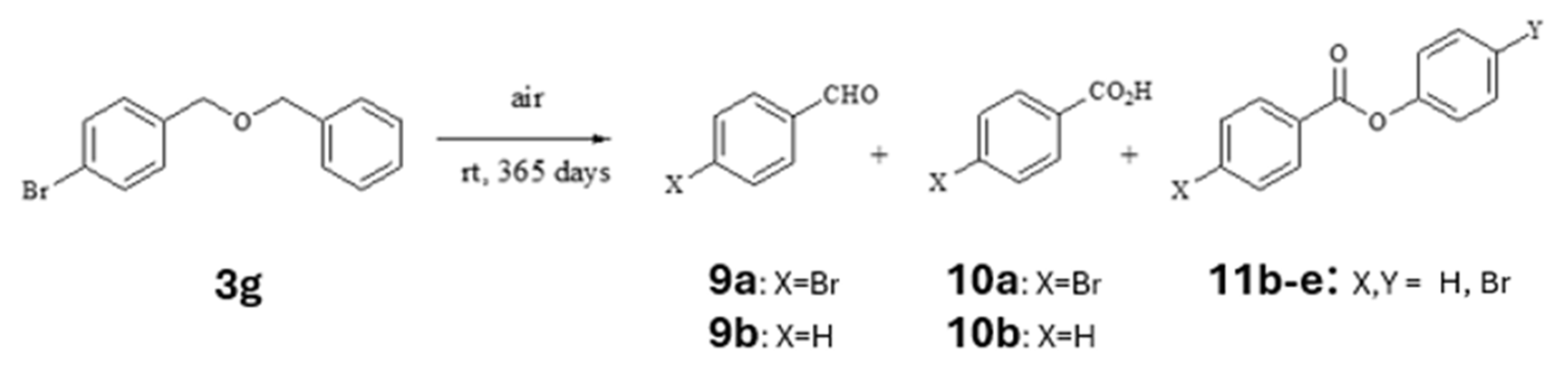
It was found that the materials need to be used and stored under inert, oxygen-free conditions. Nevertheless, most of the solid materials, when packaged in air, could be kept at rt for a long time without noticeable change. Thus, elemental analysis carried out on solid substituted dibenzyl ethers as well as on extended derivatives showed no change of the materials after 12 months. Much less stable over longer periods of time when openly exposed to the laboratory environment are those materials that are oils at rt. This is most likely either due to the known autoxidation of benzyl ethers [26] with a decomposition of the ensuing α-hydroperoxides to esters, carboxylic acids, and aldehydes [27] or a reaction of benzyl ethers [28] with ambient ozone present in the laboratory environment. Thus, prone to oxidation was the 4-bromobenzyl series, where the compounds were kept at ambient temperature in an open space for 12 months. Here, air oxidation of the benzyl function happened readily, giving 4-bromobenzaldehyde (9a), 4-bromobenzoic acid (10a), and the corresponding alkyl 4-bromobenzoates, e.g., 11a (19.1%) (Scheme 4). Under the same conditions, 4-bromobenzyl benzyl ether (3g) was shown to give oxidation products that showed a mixture of 4-bromobenzaldehyde (9a, 2.5%), benzaldehyde (9b, 2.0%), 4-bromobenzoic acid (10a, 25%), and benzoic acid (10b, 20%) and the four possible combinations of benzyl benzoates 11b–e (Scheme 5), indicating that at least a certain percentage of benzyl benzoate (3.0%) is formed through esterification of the benzoic acids and benzyl alcohols formed. However, of these oxidation products, benzyl 4-bromobenzoate (9.5%) is dominant.

Author Contributions

Conceptualization, Y.A.J. and T.T.; methodology, Y.A.J. and T.T.; software, Y.A.J.; validation, Y.A.J. and T.T.; formal analysis, Y.A.J. and T.T.; investigation, Y.A.J. and T.T.; resources, T.T.; data curation, Y.A.J. and T.T.; writing—original draft preparation, T.T.; writing—review and editing, Y.A.J. and T.T.; supervision, T.T.; project administration, T.T. All authors have read and agreed to the published version of the manuscript.

Funding

This research received no external funding.

Institutional Review Board Statement

Not applicable.

Informed Consent Statement

Not applicable.

Data Availability Statement

The original contributions presented in this study are included in the article. Further inquiries can be directed to the corresponding author.

Conflicts of Interest

Yosef Al Jasem was employed by Solid Mechanical Equipment Company. The remaining author declares no conflict of interest.

References

  1. Thiemann, T.; Al Jasem, Y.; Butt, H.; Al Hindawi, B.; Barkhad, M.; Al Khazali, M.; Al Azani, M. New heat transfer fluids (HTF) for solar thermal applications. In Proceedings of the 3rd World Sustainability Forum, Sciforum Electronic Conference Series, Online, 1–30 November 2013; Volume 3, p. d-002. [Google Scholar]
  2. Tumuluri, K.; Alvarado, J.L.; Taherian, H.; Marsh, C. Thermal performance of a novel heat transfer fluid containing multiwalled carbon nanotubes and microencapsulated phase change materials. Int. J. Heat Mass Transf. 2011, 54, 5554–5567. [Google Scholar] [CrossRef]
  3. Ritwik, A.P.D.; Ali, M.S.; Shavik, S.M.; Hasan, M.N. Heat transfer dynamics of liquid sodium: Nanoscale insights into phase change characteristics and Leidenfrost effects. Nanoscale Microscale Thermophys. Eng. 2025, 29, 118–138. [Google Scholar] [CrossRef]
  4. Zhang, P.; Cheng, J.; Jin, Y.; An, X. Evaluation of thermal physical properties of molten nitrate salts with low melting temperature. Sol. Energy Mater. Sol. Cells 2018, 176, 36–41. [Google Scholar] [CrossRef]
  5. Tataroglu, F.S.; Mansoori, Y. Synthetic heat carrier oil compositions based on polyalkylene glycols. Energy Convers. Manag. 2007, 48, 703–708. [Google Scholar] [CrossRef]
  6. Duffie, J.A.; Backman, W.A. Solar Engineering of Thermal Processes, 3rd ed.; John Wiley & Sons, Inc.: Hoboken, NJ, USA, 2006; p. 375. [Google Scholar]
  7. Hall, S. Rules of Thumb for Chemical Engineers, 5th ed.; Butterworth, Heinemann: Waltham, MA, USA, 2012; pp. 203–219. [Google Scholar]
  8. Murphy, L.M.; Keneth, E. Steam Generation in Line-Forced Solar Collectors: A Comparative Assessment of Thermal Performance, Operating Stability, and Cost Issues; SERI/TR-1311; Solar Energy Research Inst. (SERI): Golden, CO, USA, 1982. [Google Scholar]
  9. Al Jasem, Y.; Thiemann, T. A System for Converting Thermal Energy into Electrical Energy. U.S. Patent 20150179910 (A1), 25 June 2015. [Google Scholar]
  10. Thiemann, T. Etherification of (E)-1,3-diaryl- and (E)-1,3-diheteroarylprop-2-en-1-ols with primary and secondary alcohols over platinum on carbon. J. Chem. Res. 2007, 31, 528–534. [Google Scholar] [CrossRef]
  11. Al Nawah, A.A.A.; Al Marri, F.A.S.; Al Jasem, Y. Production of dibenzyl ether, Graduation Project, UAEU. 2014. [Google Scholar]
  12. Essen, M.; Metzger, J.O.; Schmidt, E.; Schneidewind, U. 10 years after Rio—Concepts of the contribution of chemistry to a sustainable development. Angew. Chem. Int. Ed. Engl. 2002, 41, 414–436. [Google Scholar] [CrossRef]
  13. Liu, J.; Shao, C.; Zhang, Y.; Shi, S.; Pan, S. Copper catalyzed high efficient ester formation from carboxylic acids/esters and formates. Org. Biol. Chem. 2014, 12, 2637–2640. [Google Scholar] [CrossRef] [PubMed]
  14. Fuhrmann, E.; Talbiersky, J. Synthesis of aryl alkyl ethers by catalytic Williamson ether synthesis with alkylating agents. Org. Process Res. Dev. 2005, 9, 206–211. [Google Scholar] [CrossRef]
  15. Rao, H.S.P.; Senthilkumar, S.P. A convenient procedure for the synthesis of allyl and benzyl ethers from alcohols and phenols. Proc. Indian Acad. Sci. 2001, 113, 191–196. [Google Scholar] [CrossRef]
  16. Joback, K.G.; Reid, R.C. Estimation of pure-component properties from group-contributions. Chem. Eng. Commun. 1987, 57, 233–243. [Google Scholar] [CrossRef]
  17. Lydersen, A.L. Estimation of Critical Properties of Organic Compounds; Engineering Experimental Station Report 3; College Engineering University Wisconsin: Madison, WI, USA, 1955. [Google Scholar]
  18. Ambrose, D. Correlation and Estimation of Vapor–Liquid Critical Properties. I. Critical Temperatures of Organic Compounds; National Physical Laboratory: Teddington, UK, 1978; NPL Re-port Chem.; Volume 92. [Google Scholar]
  19. Klincewicz, K.M.; Reid, R.C. Estimation of critical properties with group contribution methods. AIChE J. 1984, 30, 137–142. [Google Scholar] [CrossRef]
  20. Lyman, W.J.; Reehl, W.F.; Rosenblatt, D.H. Handbook of Chemical Property Estimation Methods; American Chemical Society: Washington, DC, USA, 1990. [Google Scholar]
  21. Horvath, A.L. Molecular Design; Elsevier: Amsterdam, The Netherlands, 1992. [Google Scholar]
  22. Marrero, J.; Gani, R. Group-contribution based estimation of pure component properties. Fluid Phase Equilibria 2001, 183, 183–208. [Google Scholar] [CrossRef]
  23. Kolská, Z.; Kukal, J.; Zábranský, M.; Růžička, V. Estimation of the heat capacity of organic liquids as a function of temperature by a Three-Level Group contribution method. Ind. Eng. Chem. Res. 2008, 47, 2075–2085. [Google Scholar] [CrossRef]
  24. Becker, L.; Aufderhaar, O.; Gmehling, J. Measurement of heat capacities for nine organic substances by Tian-Calvet calorimetry. J. Chem. Eng. Data 2000, 45, 661–664. [Google Scholar] [CrossRef]
  25. Cabaleiro, D.; Gracia-Fernández, C.; Lugo, L. (Solid + liquid) phase equilibria and heat capacity of (diphenyl ether + biphenyl) mixtures used as thermal energy storage materials. J. Chem. Thermodyn. 2014, 74, 43–50. [Google Scholar] [CrossRef]
  26. Rieche, A.; Meister, R. Modellversuche zur Autoyxdation der Äther. Angew. Chem. 1936, 49, 101–103. [Google Scholar] [CrossRef]
  27. Liu, X.; Zhang, Q.; Ito, S.; Wada, Y. Oxidation characteristics and products of five ethers at low temperature. Fuel 2016, 165, 513–525. [Google Scholar] [CrossRef]
  28. Angibeaud, P.; Defaye, J.; Gadelle, A.; Utille, J.-P. Mild deprotection of benzyl ether protective groups with ozone. Synthesis 1985, 1985, 1123–1125. [Google Scholar] [CrossRef]
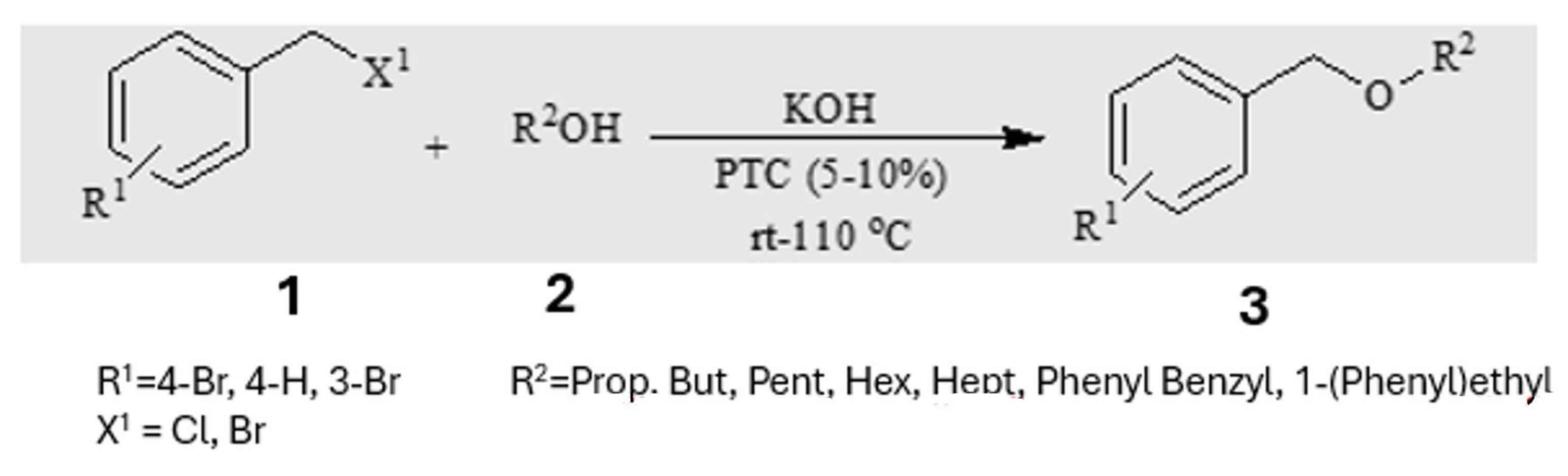
Scheme 1. Typical Williamson ether synthesis to benzyl ethers using phase transfer catalysis.
Chemproc 18 00121 sch001
Scheme 2. Synthesis of bis(benzyl ethers) 5.
Chemproc 18 00121 sch002
Scheme 3. One-pot PTC catalyzed Williamson synthesis/Suzuki coupling to extended benzyl ethers 7.
Chemproc 18 00121 sch003
Figure 1. Measured (Meas.) and predicted (Pred.) heat capacities of ethers (E1E3).
Chemproc 18 00121 g001
Figure 2. Density measurements of ethers 4-bromobenzyl benzyl ether (3g); 4-bromobenzyl hexyl ether (3d); dibenzyl ether (3h); and benzyl phenylethyl ether (E1).
Chemproc 18 00121 g002
Figure 3. Thermal stability study of ethers (E1, E2, E3, and 8b), as weight% remaining vs. temperature (K), performed by TGA.
Chemproc 18 00121 g003
Figure 4. Structures of benzyl ethers E1, E2, E3, and 8b used in the thermal stability studies shown above.
Chemproc 18 00121 g004
Scheme 4. Degradation of 4-bromobenzyl n-pentyl ether (3c) by autoxidation at rt open to ambient air for 1 year.
Chemproc 18 00121 sch004
Scheme 5. Degradation of 4-bromobenzyl benzyl ether (3g) by autoxidation at rt open to ambient air for 1 year.
Chemproc 18 00121 sch005
Table 1. Measured and estimated heat capacities for ethers E1, E2, and E3 at three different temperatures.
Chemproc 18 00121 i001CompoundT(K)Cp [J/g·K] (J/mole·K)
Kolská et al. [22]Joback and Reid [15]Measured
(NH) Approach(H) Approach
E13231.84 (391.1)1.74 (370.3)1.28 (271.0)1.81 (384.2)
3481.89 (400.3)1.80 (383.1)1.37 (290.5)1.88 (399.9)
3731.92 (407.3)1.86 (495.8)1.46 (309.4)1.95 (414.8)
E23232.13 (678.9)1.69 (538.7)1.26 (402.6)1.81 (577.4)
3482.09 (666.9)1.75 (558.3)1.35 (430.5)1.90 (603.5)
3732.05 (653.6)1.81 (577.2)1.44 (457.5)1.93 (615.9)
E33232.27 (963.6)1.66 (704.5)1.27 (538.4)1.72 (731.8)
3482.19 (929.0)1.73 (732.7)1.35 (574.3)1.77 (752.4)
3732.09 (888.4)1.79 (759.6)1.43 (609.1)1.78 (757.0)
Disclaimer/Publisher’s Note: The statements, opinions and data contained in all publications are solely those of the individual author(s) and contributor(s) and not of MDPI and/or the editor(s). MDPI and/or the editor(s) disclaim responsibility for any injury to people or property resulting from any ideas, methods, instructions or products referred to in the content.