
Proceeding Paper

The Influence of Cucurbit[7]uril on the Photophysical Properties of Encapsulated Styryl Dye †

by
Olga P. Kolesnikova
1,2,*,
Denis A. Ivanov
2,
Igor V. Kryukov
2 and
Nikolai Kh. Petrov
1,2
1
Moscow Center for Advanced Studies, Kulakova Str. 20, 123592 Moscow, Russia
2
Photochemistry Center, Federal Scientific Research Centre ‘Crystallography and Photonics’, Str. Novatorov, 7A-1, 119421 Moscow, Russia
*
Author to whom correspondence should be addressed.
Presented at the 29th International Electronic Conference on Synthetic Organic Chemistry, 14–28 November 2025; Available online: https://sciforum.net/event/ecsoc-29.
Chem. Proc. 2025, 18(1), 120; https://doi.org/10.3390/ecsoc-29-26963
Published: 14 November 2025

Abstract

The interaction between the styryl dye 4-{(E)-2-[4-(dimethylamino)phenyl]vinyl}-1-methylpyridinium iodide (DASPI) and cucurbit[7]uril (CB[7]) in aqueous solution was studied by optical spectroscopy methods. Due to negatively charged portals, cucurbit[7]urils can form complexes with cationic styryl dye. This complexation alters the photophysical properties of the dye, such as absorption and fluorescence. It was previously found that the formation of 1:2 inclusion complexes leads to a shift in the absorption band. Such changes were previously attributed to protonation of the dye. To explain this effect, we hypothesize that it arises from the influence of the electrostatic field generated by the negatively charged portals of cucurbit[7]uril on the conjugated π-electron system of the dye.

1. Introduction

Supramolecular chemistry provides versatile tools for the design of host–guest systems with tunable properties. Among the wide variety of synthetic cavitands, cucurbit[n]urils (CB[n]) have attracted considerable attention due to their unique rigid structure, high binding affinities, and selectivity towards cationic guests [1,2,3]. Their applications range from drug delivery [4] and molecular recognition to photochemical transformations [5]. Compared to other macrocyclic hosts such as cyclodextrins and calixarenes, cucurbiturils exhibit stronger electrostatic interactions at their carbonyl-fringed portals, which makes them particularly efficient for encapsulating positively charged dyes [6]. Understanding the influence of CB[n] complexation on the photophysical properties of styryl dyes is therefore essential both for fundamental insights and for the development of new functional materials.
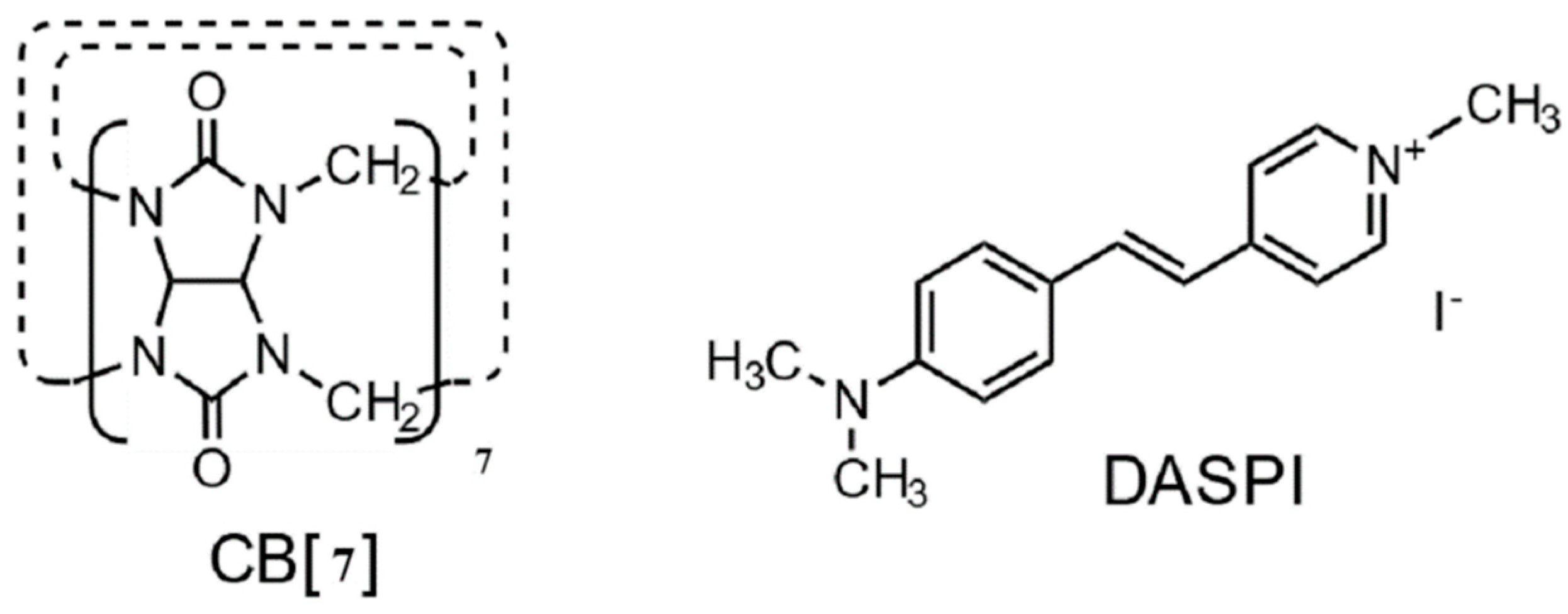
In this work, we studied the interaction between the styryl dye 4-{(E)-2-[4-(dimethylamino)phenyl]vinyl}-1-methylpyridinium iodide (DASPI) and cucurbit[7]uril (CB[7]) in aqueous solution (see Figure 1) by means of optical spectroscopy. Due to their negatively charged portals, CB[7] can form complexes with cationic DASPI, which significantly alters the dye’s absorption and fluorescence behavior (binding constant logK1 = 5.5) [7].

2. Materials and Methods

Cucurbit[7]uril and styryl dye DASPI from Sigma-Aldrich were used without further purification. Millipore Simplicity distilled water was used to prepare the solutions, and the dye concentration was maintained at 1 × 10⁻⁵ M.
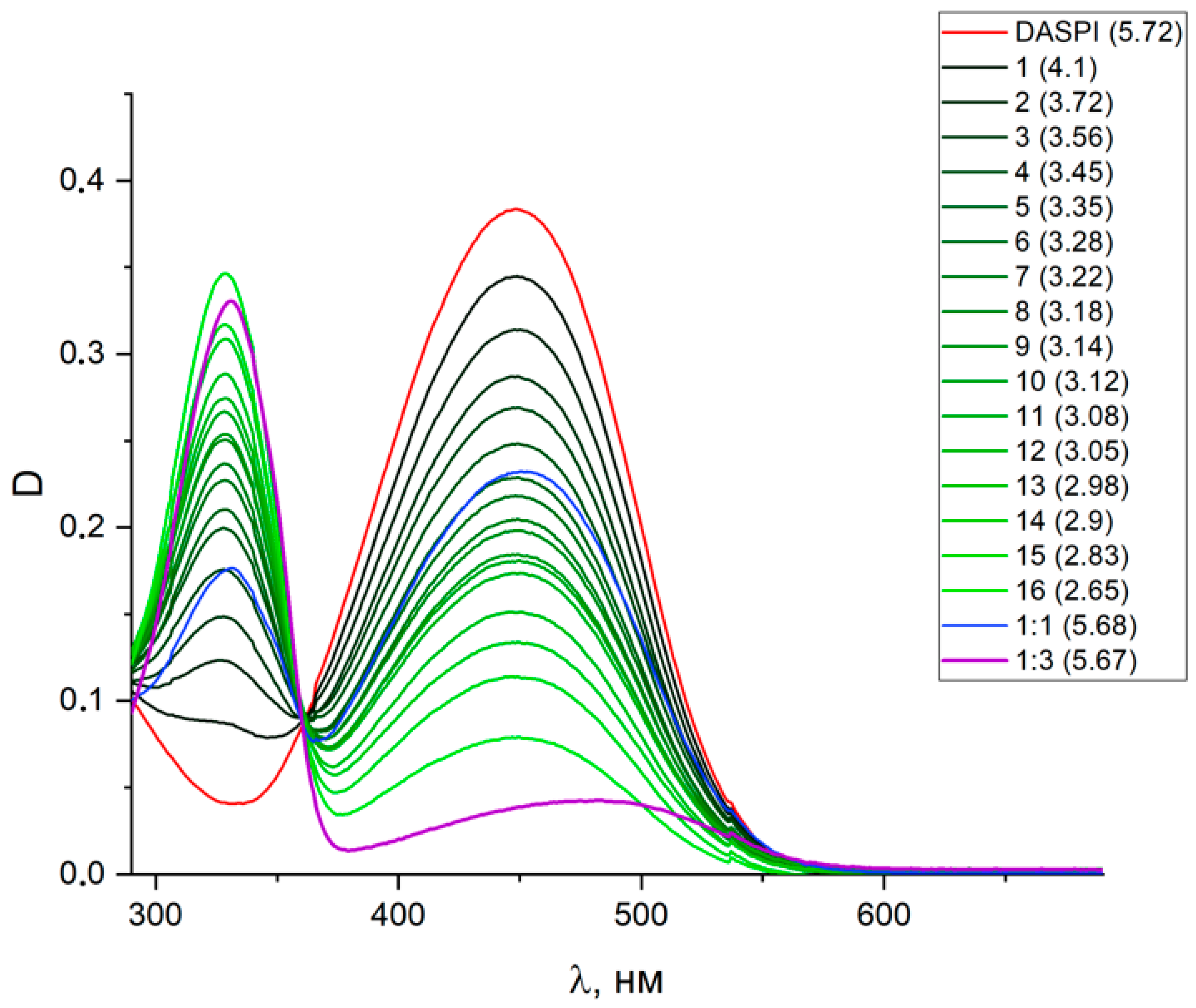
The absorption spectra were recorded using a Shimadzu UVmini 1240 spectrophotometer. Absorption spectra were measured in plastic cuvets with an optical path length of 1 cm, which ensured the reproducibility and comparability of the data in different series of experiments. In addition, absorption spectra were recorded under different pH conditions (see Figure 2): the spectra of unbound DASPI (red line), in the presence of 1 and 3 equivalents of CB[7] (blue and violet lines), as well as at varying pH values adjusted with hydrochloric acid (green lines). The pH values were measured using a Smart Sensor Ph Meter PH818.

3. Results

It was previously found that the formation of 1:2 inclusion complexes leads to a hypsochromic shift in the absorption band to around 330 nm and the appearance of an additional fluorescence band at 450 nm (binding constant logK2 = 5.1) [7]. Such changes were previously attributed to protonation of the dye [8].
However, the direct measurements of pH show that dissolving 10−5 M CB[7] in water does not significantly change the acidity of the solution (pH = 5.67); thus, the observed effects cannot be attributed to dye protonation. Indeed, it can be seen [7] that the molar fraction of the protonated dye x = [DH+]/[D]0 ≈ 1 only when pKa > pH. The experimentally determined value of pKa = 3.23 for DASPI at 23 °C [7] indicates that significant protonation of the dye occurs only when pH ≲ 3.5. Therefore, at the working pH of 5.67, protonation can be neglected. Moreover, absorption spectra in the presence of CB[7] were recorded at pH 5.72, yet the spectral changes observed are even more pronounced than those induced by acidification down to pH ≈ 2.65 (see Figure 2).
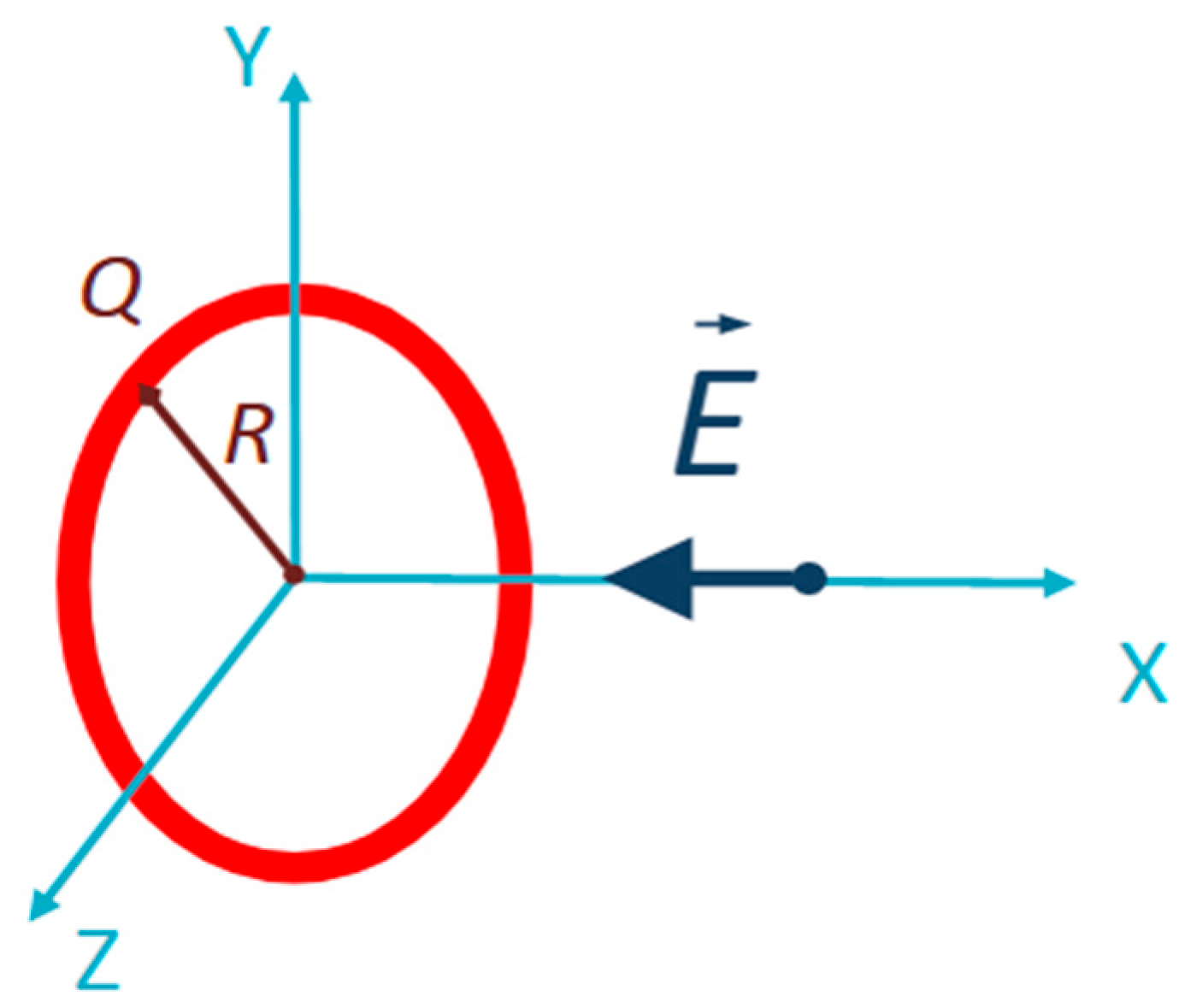
To explain this effect, we hypothesize that it arises from the influence of the electrostatic field generated by the negatively charged portals of cucurbit[7]uril (which can be considered as charged rings with charge Q and radius R (see Figure 3)) on the conjugated π-electron system of the dye.
From the standpoint of the quantum mechanical “particle in a box” model, the energy gap between the HOMO and LUMO levels directly depends on the effective length of the coupled π-system [9]. Exposure to the electrostatic field of CB[7] portals disrupts conjugation and effectively reduces the extent of π-delocalization. This, in turn, increases the HOMO–LUMO gap and causes the shift in the absorption bands observed experimentally (emergence of a band at 330 nm and attenuation at 450 nm).

4. Conclusions

This study demonstrated that the observed changes in the absorption spectra of the styryl dye DASPI upon complexation with cucurbit[7]uril cannot be explained by protonation effects, since the working pH excludes significant protonation. Instead, the data indicate that the spectral shifts arise from the influence of the electrostatic field generated by the negatively charged portals of cucurbit[7]uril, which perturbs the conjugated π-system of the dye and modifies the HOMO–LUMO gap. These findings highlight the crucial role of host guest electrostatic interactions in determining the photophysical behavior of encapsulated styryl dyes.

Author Contributions

Methodology, N.K.P.; validation, N.K.P., O.P.K., I.V.K. and D.A.I.; data curation, O.P.K., I.V.K. and D.A.I.; writing—original draft preparation, O.P.K.; writing—review and editing, N.K.P.; visualization, O.P.K.; supervision, N.K.P.; project administration, N.K.P. All authors have read and agreed to the published version of the manuscript.

Funding

This research received no external funding.

Institutional Review Board Statement

Not applicable.

Informed Consent Statement

Not applicable.

Data Availability Statement

The data presented in this study are available upon request from the corresponding author.

Conflicts of Interest

The authors declare no conflicts of interest.

Abbreviations

The following abbreviations are used in this manuscript:
DASPIthe styryl dye 4-{(E)-2-[4-(dimethylamino)phenyl]vinyl}-1-methylpyridinium iodide
CB[7]Cucurbit[7]uril

References

  1. Lagona, J.; Mukhopadhyay, P.; Chakrabarti, S.; Isaacs, L. The cucurbit[n]uril family. Angew. Chem. Int. Ed. Engl. 2005, 44, 4844–4870. [Google Scholar] [CrossRef] [PubMed]
  2. Isaacs, L. Cucurbit[n]urils: From mechanism to structure and function. Chem. Commun. 2009, 619–629. [Google Scholar] [CrossRef] [PubMed]
  3. Assaf, K.I.; Nau, W.M. Cucurbiturils: From synthesis to high-affinity binding and catalysis. Chem. Soc. Rev. 2015, 44, 394–418. [Google Scholar] [CrossRef] [PubMed]
  4. Walker, S.; Oun, R.; McInnes, F.J.; Wheate, N.J. The potential of Cucurbit[n]urils in drug delivery. Isr. J. Chem. 2011, 51, 616–624. [Google Scholar] [CrossRef]
  5. Jon, S.Y.; Ko, Y.H.; Park, S.H.; Kim, H.-J.; Kim, K. A facile, stereoselective [2 + 2] photoreaction mediated by cucurbit[8]uril. Chem. Commun. 2001, 19, 1938–1939. [Google Scholar] [CrossRef] [PubMed]
  6. Kim, K.; Murray, J.; Selvapalam, N.; Ho Ko, Y.; Hwang, J. Cucurbiturils: Chemistry, Supramolecular Chemistry and Applications; World Scientific: Hackensack, NJ, USA, 2018. [Google Scholar]
  7. Ivanov, D.A.; Kolesnikova, O.P.; Kryukov, I.V.; Petrov, N.K. Features of complexation of a styryl dye dimethylamino derivative with Cucurbit[7]uril. High Energy Chem. 2025, 59, 222–226. [Google Scholar] [CrossRef]
  8. Sun, S.; Yuan, Y.; Li, Z.; Zhang, S.; Zhanga, H.; Peng, X. Interaction of a hemicyanine dye and its derivative with DNA and cucurbit[7]uril. New J. Chem. 2014, 38, 3600–3605. [Google Scholar] [CrossRef]
  9. Autschbach, J. Why the particle-in-a-box model works well for cyanine dyes but not for conjugated polyenes. J. Chem. Educ. 2007, 84, 1840. [Google Scholar] [CrossRef]
Figure 1. Structural formulas of cucurbit[7]uril and DASPI dye.
Chemproc 18 00120 g001
Figure 2. The absorption spectra of water solutions of DASPI 1 × 10⁻⁵ M: unbound (red line), in the presence of 1 and 3 equivalents of CB[7] (blue and violet lines), at varying pH values (green lines).
Chemproc 18 00120 g002
Figure 3. Schematic view of the cucurbit[7]uril portal.
Chemproc 18 00120 g003
Disclaimer/Publisher’s Note: The statements, opinions and data contained in all publications are solely those of the individual author(s) and contributor(s) and not of MDPI and/or the editor(s). MDPI and/or the editor(s) disclaim responsibility for any injury to people or property resulting from any ideas, methods, instructions or products referred to in the content.