
Proceeding Paper

Exploiting the Reactivity of Destabilized Pyrrolylketene for the Stereoselective Synthesis of β-Lactams †
Alumnus, School of Science, Engineering and Environment, University of Salford, Salford M5 4QJ, UK
Presented at the 29th International Electronic Conference on Synthetic Organic Chemistry, 14–28 November 2025; Available online: https://sciforum.net/event/ecsoc-29.
Chem. Proc. 2025, 18(1), 116; https://doi.org/10.3390/ecsoc-29-26697
Published: 11 November 2025

Abstract

β-Lactams are key scaffolds in synthetic and medicinal chemistry, valued for both therapeutic relevance and synthetic utility. Classical ketene-imine [2+2] cycloadditions often employ stabilized aryl ketenes, which display reduced reactivity and modest stereoselective. Disruption of π-conjugation in N-pyrrolylketene has been shown to enhance electrophilicity and direct stereochemical outcomes in reactions with aromatic imines. The ketene, generated in situ from N-pyrrolylpropanoic acid, undergoes cycloaddition under mild conditions to give β-lactams with a strong preference for the trans isomer. Frontier molecular orbital analysis and mechanistic interpretation suggest a polar asynchronous pathway, highlighting ketene destabilization as a practical strategy for stereoselective β-lactam synthesis.

1. Introduction

β-Lactams represent one of the most valuable classes of heterocycles in organic and medicinal chemistry, best known as the core structure of widely used antibiotics and other bioactive agents [1,2,3,4]. The stereochemical arrangement within the β-lactam ring plays a crucial role in determining biological activity, making the development of selective and efficient synthetic methods an important objective [5,6]. Traditionally, β-lactams have been accessed through the Staudinger reaction, a [2+2] cycloaddition between ketenes and imines [7,8,9,10]. While this transformation has proven highly versatile, it often suffers from reduced reactivity when stabilized aryl ketenes are employed, and the stereochemical outcome can be difficult to control. Recent studies have demonstrated that disruption of π-conjugation in N-pyrrolylketenes produces “destabilized” intermediates with enhanced electrophilicity, enabling more efficient and stereoselective cycloadditions with aromatic imines [11,12,13,14]. This approach has provided β-lactams in good yields with a pronounced preference for the trans isomer, offering a significant improvement over conventional methods. Ongoing challenges in this area include balancing reactivity with stereoselective, since small changes in electronic or steric properties of the substrates can affect the diastereomeric outcome [15]. Moreover, although some metal-assisted and multicomponent strategies have been explored to improve efficiency [16,17,18], the search for mild, catalyst-free methods remain highly relevant in the context of sustainable synthesis [19]. Taken together, the growing body of research highlights destabilized N-pyrrolylketenes as powerful intermediates in β-lactam synthesis [12]. Their ability to combine high reactivity with stereochemical control represents an important conceptual advance and provides a promising platform for addressing current challenges in drug discovery and development.
The aim of this work is to analyze and discuss the reactivity of destabilized N-pyrrolylketenes in the stereoselective synthesis of β-lactams. By focusing on mechanistic interpretations, frontier molecular orbital analysis, and reported experimental results, this study seeks to clarify the role of ketene destabilization as a general strategy for controlling both reactivity and stereochemistry in [2+2] cycloadditions.

2. Methodology and Approach

This study is based on previously reported investigations of N-pyrrolylketenes, most notably the cycloaddition reactions with aromatic imines described by Babaei and co-workers [12], along with related literature on ketene-imine chemistry [20,21]. Reported yields, stereochemical data, and substrate scope serve as the basis for further mechanistic interpretation. Frontier molecular orbital (FMO) analysis is employed to rationalize the electronic features governing the [2+2] cycloaddition [22,23,24], with particular attention to the role of π-conjugation disruption in enhancing ketene electrophilicity and stereochemical control. By integrating experimental precedent with theoretical considerations [25], the present approach provides a framework for analyzing the reactivity and stereoselectivity of destabilized ketenes.

3. Results

3.1. In Situ Generation and Cycloaddition of N-Pyrrolylketene

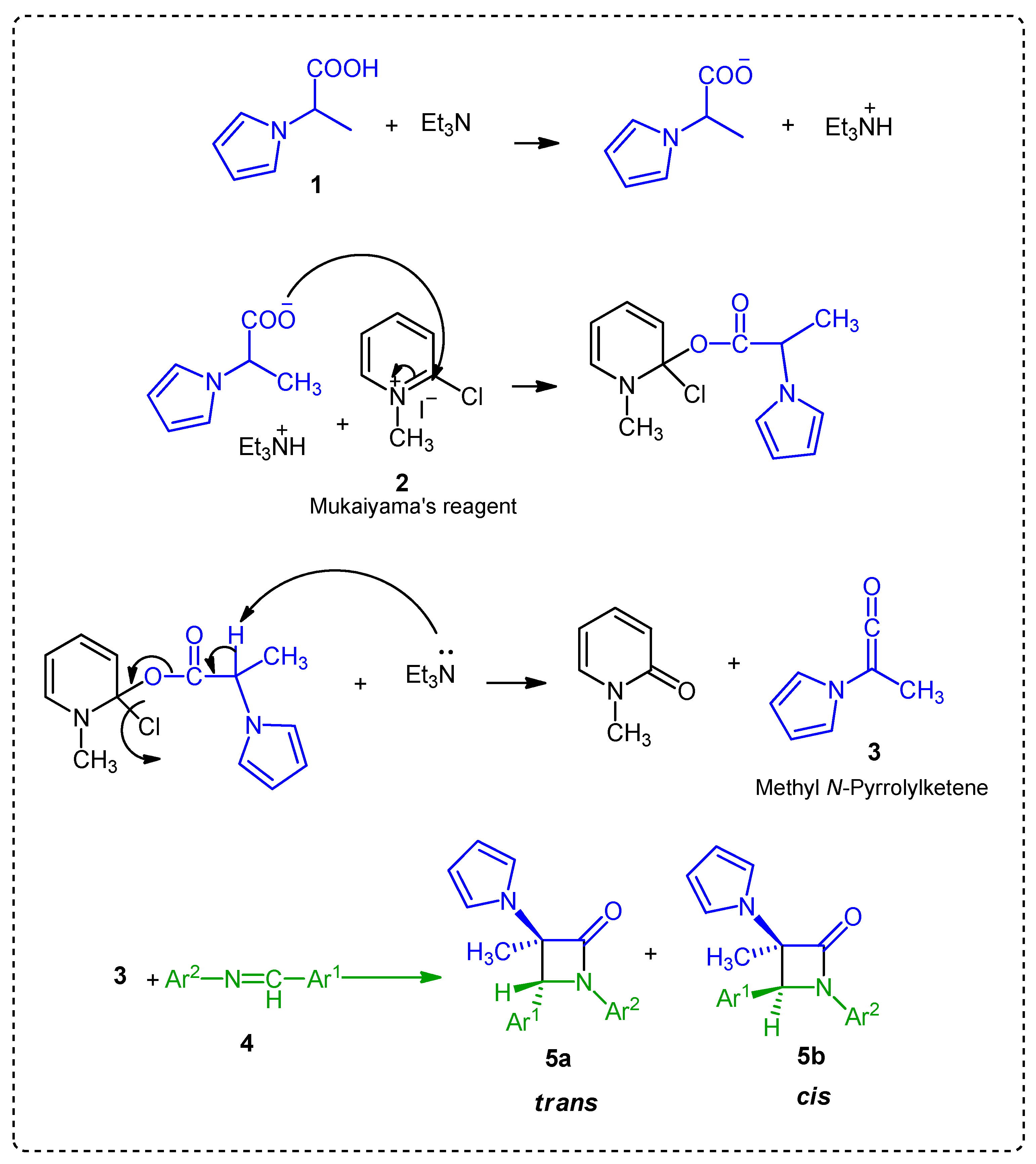
Destabilized N-pyrrolylketene was obtained in situ from N-pyrrolylpropanoic acid, which itself was synthesized starting from alanine and dimethoxytetrahydrofuran following established protocols [26,27]. In the procedure reported by Babaei and co-workers, activation of the acid with Mukaiyama’s reagent (2-chloro-1-methylpyridinium iodide) in the presence of triethylamine promoted the elimination step to generate the ketene intermediate [12]. Because of its instability, the ketene was not isolated and was used directly in [2+2] cycloaddition with aromatic imines. Under mild, catalyst-free conditions, the reactions afforded β-lactams in moderate to good yields and showed tolerance toward both electron-donating and electron-withdrawing substituents. These outcomes demonstrate the high reactivity of destabilized N-pyrrolylketenes. The proposed pathway is shown in Scheme 1.

3.2. Substituent Effects and Stereochemical Preferences

The cycloaddition reactions predominantly furnished trans-β-lactams, with several substrates affording the trans isomer exclusively. For example, N-pyrrolylketene combined with N-benzylideneaniline (Ph_Ph) to give only the trans product. Substituent effects on the imine partner were evident: electron-withdrawing groups (4-Cl, 4-Br) accelerated the reaction and consistently produced trans products, while electron-donating substituents (4-MeO, 4-Me) led to slower reactions and small amounts of the cis isomer alongside the major trans product. These findings indicate that stereoselectivity is determined during the initial nucleophilic attack of the imine nitrogen on the ketene carbon, favoring a transition state geometry that directs the reaction toward the trans configuration. Representative outcomes are summarized in Table 1.
As summarized in Table 1, the cycloaddition of N-pyrrolylketene with aromatic imines consistently favored the formation of trans-β-lactams. In cases where the imines carried electron-withdrawing substituents (e.g., 4-Cl, 4-Br), the reactions proceeded rapidly and delivered exclusively trans products. In contrast, imines bearing electron-donating groups (e.g., 4-MeO, 4-Me) reacted more slowly, and minor amounts of the cis isomer were observed alongside the predominant trans product. The unsubstituted benzylideneaniline (Ph_Ph) provided only the trans isomer, albeit in moderate yield.

3.3. Mechanistic Considerations

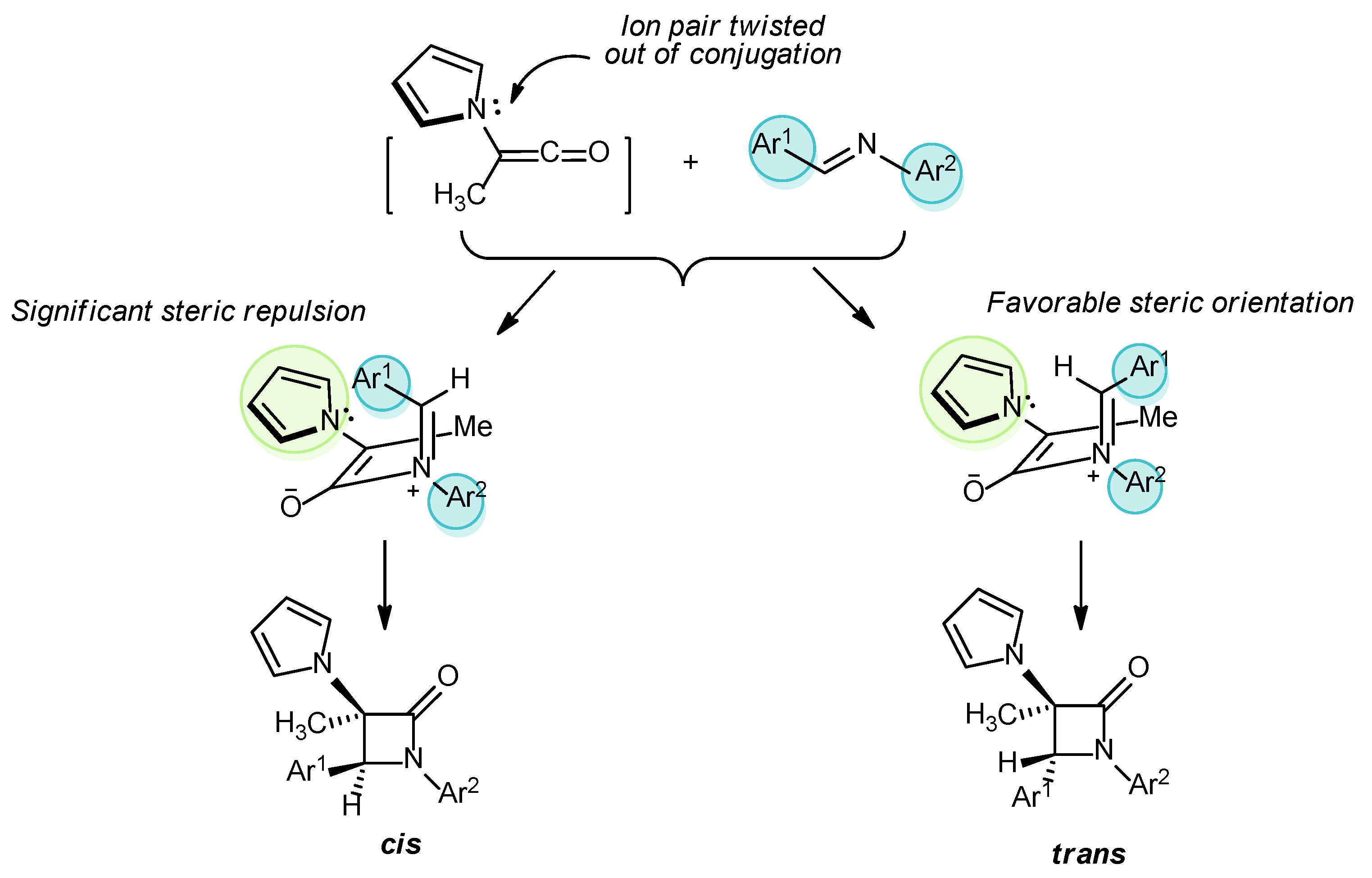
Frontier molecular orbital (FMO) considerations suggest that the [2+2] cycloaddition proceeds through a polar asynchronous pathway. The reaction is initiated by overlap of the imine HOMO (nitrogen lone pair) with the ketene LUMO (π* orbital), giving rise to a zwitterion-like transition structure in which N-C bond formation is more advanced than C-C bond formation. Subsequent closure of the four-membered ring affords the β-lactam framework.
A central electronic feature is the disruption of π-conjugation between the pyrrolyl substituent and the ketenyl group. Because the lone pair on the pyrrolyl nitrogen is twisted out of conjugation, effective overlap with the ketenyl π-system is prevented. This loss of delocalization destabilizes the ketene and increases the electrophilicity of the ketenyl carbon, thereby lowering the barrier for nucleophilic attack. In this sense, the enhanced reactivity of destabilized N-pyrrolylketenes can be directly attributed to their orbital alignment and electronic structure.
The stereochemical outcome is controlled primarily by steric effects. In a cis transition state, the pyrrolyl ring and the aryl substituent of the imine are forced into close proximity, generating significant steric repulsion. By contrast, the trans transition state positions these groups further apart, minimizing steric interactions and favoring the formation of the trans isomer.
Taken together, the interplay of orbital interactions (HOMO–LUMO overlap and conjugation loss) and steric control (repulsion minimized in the trans pathway) accounts for both the high reactivity of destabilized N-pyrrolylketenes and their consistent trans selectivity. The proposed pathway is summarized in Scheme 2.

4. Conclusions

The analysis of destabilized N-pyrrolylketenes has highlighted their unique role as reactive intermediates for the stereoselective construction of β-lactams. Disruption of π-conjugation between the pyrrolyl group and the ketenyl fragment was shown to increase the electrophilicity of the ketene carbon, thereby promoting efficient [2+2] cycloadditions under mild, catalyst-free conditions. The preference for trans isomers was attributed to steric factors in the transition state, where avoidance of unfavorable interactions between the pyrrolyl and aryl substituents favors the trans pathway. These combined electronic and steric effects establish ketene destabilization as a general concept for improving both reactivity and stereoselective in β-lactam synthesis.
Future directions include exploring solvent effects on the stability of zwitterionic intermediates, extending the methodology to encompass aliphatic imines and other heteroaryl ketenes, and applying this strategy to the preparation of β-lactam analogues with potential medicinal relevance. Taken together, these perspectives emphasize the broader utility of ketene destabilization as a guiding principle in synthetic and medicinal chemistry while aligning with the goals of sustainable and catalyst-free methodologies.

Funding

This research received no external funding.

Institutional Review Board Statement

Not applicable.

Informed Consent Statement

Not applicable.

Data Availability Statement

Data are contained within the article.

Conflicts of Interest

The author declares no conflict of interest.

References

  1. Troisi, L.; Granito, C.; Pindinelli, E. Novel and recent synthesis and applications of β-lactams. In Heterocyclic Scaffolds i: β-Lactams; Springer: Berlin/Heidelberg, Germany, 2010; pp. 101–209. [Google Scholar] [CrossRef]
  2. Arer, V.; Kar, D. Biochemical exploration of β-lactamase inhibitors. Front. Genet. 2023, 13, 1060736. [Google Scholar] [CrossRef] [PubMed]
  3. Galletti, P.; Giacomini, D. Monocyclic β-lactams: New structures for new biological activities. Curr. Med. Chem. 2011, 18, 4265–4283. [Google Scholar] [CrossRef] [PubMed]
  4. Thakur, S.; Bhalla, A. Nanomaterial-mediated synthesis of β-lactams and exploration of their enhanced biological activities: Recent advances. Green Approaches Med. Chem. Sustain. Drug Des. 2024, 2, 79–99. [Google Scholar] [CrossRef]
  5. Sarkar, R.; De Joarder, D.; Mukhopadhyay, C. Recent advances in the syntheses and reactions of biologically promising β-lactam derivatives. Tetrahedron 2025, 177, 134565. [Google Scholar] [CrossRef]
  6. Shaikh, A.L.; Ray, D.; Banik, B.K. Recent advances in asymmetric synthesis of β-lactams. Green Approaches Med. Chem. Sustain. Drug Des. 2024, 1, 597–651. [Google Scholar] [CrossRef]
  7. Fu, N.; Tidwell, T.T. Preparation of β-lactams by [2+2] cycloaddition of ketenes and imines. Tetrahedron 2008, 64, 10465–10496. [Google Scholar] [CrossRef]
  8. Li, B.; Wang, Y.; Du, D.-M.; Xu, J. Notable and obvious ketene substituent-dependent effect of temperature on the stereoselectivity in the staudinger reaction. J. Org. Chem. 2007, 72, 990–997. [Google Scholar] [CrossRef]
  9. Zhanhui, Y.; Jiaxi, X. Insights into the β-sultam ring formation in the sulfa-staudinger cycloadditions. J. Org. Chem. 2014, 79, 10703–10708. [Google Scholar] [CrossRef]
  10. Kim, I.; Roh, S.W.; Lee, D.G.; Lee, C. Rhodium-catalyzed oxygenative [2+2] cycloaddition of terminal alkynes and imines for the synthesis of β-lactams. Org. Lett. 2014, 16, 2482–2485. [Google Scholar] [CrossRef]
  11. Islami, M.R.; Allen, A.D.; Vukovic, S.; Tidwell, T.T. N-pyrrolylketene: A nonconjugated heteroarylketene. Org. Lett. 2011, 13, 494–497. [Google Scholar] [CrossRef]
  12. Babaei, E.; Islami, M.R.; Kalantari, M. Stereoselective synthesis of new β-lactams from 2-(1h-pyrrol-1-yl)-1-propen-1-one as a novel ketene. Synlett 2013, 24, 1937–1940. [Google Scholar] [CrossRef]
  13. Cossio, F.P.; Arrieta, A.; Sierra, M.A. The mechanism of the ketene−imine (staudinger) reaction in its centennial: Still an unsolved problem? Acc. Chem. Res. 2008, 41, 925–936. [Google Scholar] [CrossRef] [PubMed]
  14. Kapoor, A.; Rajput, J.K. Staudinger k etene–imine [2+2] cycloaddition of novel azomethines to synthesize biologically active azetidinone derivatives and their in vitro antimicrobial studies. J. Heterocycl. Chem. 2021, 58, 2304–2323. [Google Scholar] [CrossRef]
  15. Yang, Z.; He, W.; Cheng, B.; Xu, J. Stereochemistry and mechanistic insight in the [2k+2i+2i] annulations of ketenes and imines. J. Org. Chem. 2016, 81, 4506–4515. [Google Scholar] [CrossRef]
  16. Qi, Z.; Wang, S. Copper-catalyzed β-lactam formation initiated by 1, 3-azaprotio transfer of oximes and methyl propiolate. Org. Lett. 2021, 23, 5777–5781. [Google Scholar] [CrossRef]
  17. Tong, H.-R.; Zheng, W.; Lv, X.; He, G.; Liu, P.; Chen, G. Asymmetric synthesis of β-lactam via palladium-catalyzed enantioselective intramolecular c (sp3)–h amidation. ACS Catal. 2019, 10, 114–120. [Google Scholar] [CrossRef]
  18. Zhong, F.; Yue, W.-J.; Yin, X.-H.; Zhang, H.-M.; Yin, L. Copper (i)-catalyzed asymmetric synthesis of α-allenylamines and β-lactams through regioselective mannich-type reactions. ACS Catal. 2022, 12, 9181–9189. [Google Scholar] [CrossRef]
  19. Nadiki, H.H.; Islami, M.R.; Soltanian, S. Thermal and microwave-assisted synthesis of new highly functionalized bis-β-lactams from available compounds via bisketene as an intermediate. ACS Omega 2022, 7, 33320–33329. [Google Scholar] [CrossRef]
  20. Allen, A.D.; Tidwell, T.T. Ketenes and other cumulenes as reactive intermediates. Chem. Rev. 2013, 113, 7287–7342. [Google Scholar] [CrossRef] [PubMed]
  21. Hyatt, J.A.; Raynolds, P.W. Ketene cycloadditions. Org. React. 2004, 45, 159–646. [Google Scholar] [CrossRef]
  22. Houk, K.N. Frontier molecular orbital theory of cycloaddition reactions. Acc. Chem. Res. 1975, 8, 361–369. [Google Scholar] [CrossRef]
  23. Kaur, A. Frontier molecular orbital approach to the cycloaddition reactions. In Frontiers in Computational Chemistry: Volume 5; Bentham Science Publishers: Sharjah, United Arab Emirates, 2020; pp. 228–251. [Google Scholar] [CrossRef]
  24. Yamabe, S.; Kuwata, K.; Minato, T. Frontier-orbital analyses of ketene [2+2] cycloadditions. Theor. Chem. Acc. 1999, 102, 139–146. [Google Scholar] [CrossRef]
  25. Palomo, C.; Aizpurua, J.; Ganboa, I.; Oiarbide, M. Asymmetric synthesis of β-lactams through the staudinger reaction and their use as building blocks of natural and nonnatural products. Curr. Med. Chem. 2004, 11, 1837–1872. [Google Scholar] [CrossRef] [PubMed]
  26. Wang, D.; Nanding, H.; Han, N.; Chen, F.; Zhao, G. 2-(1 h-pyrrolyl) carboxylic acids as pigment precursors in garlic greening. J. Agric. Food Chem. 2008, 56, 1495–1500. [Google Scholar] [CrossRef]
  27. Gloede, J.; Poduška, K.; Gross, H.; Rudinger, J. Amino acids and peptides. Lxxix. A-pyrrolo analogues of α-amino acids. Collect. Czechoslov. Chem. Commun. 1968, 33, 1307–1314. [Google Scholar] [CrossRef]
Scheme 1. In situ generation of destabilized N-pyrrolylketene and its [2+2] cycloaddition with aromatic imines.
Chemproc 18 00116 sch001
Scheme 2. Proposed mechanistic pathway for the [2+2] cycloaddition of N-pyrrolylketene with aromatic imines, illustrating asynchronous bond formation and steric effects controlling trans selectivity.
Chemproc 18 00116 sch002
Table 1. Representative outcomes of the [2+2] cycloaddition of N-pyrrolylketene with aromatic imines.
EntryImine Substituents (Ar1_Ar2)Reaction ProfileProduct Distribution
1Ph_PhModerate yieldtrans only
24-ClC6H4_PhFasttrans only
3Ph_4-BrC6H4Fasttrans only
4Ph_4-MeOC6H4Slowtrans major, cis minor
5Ph_4-MeC6H4Slowtrans major, cis minor
6Ph_4-ClC6H4Moderatetrans major, cis minor
Disclaimer/Publisher’s Note: The statements, opinions and data contained in all publications are solely those of the individual author(s) and contributor(s) and not of MDPI and/or the editor(s). MDPI and/or the editor(s) disclaim responsibility for any injury to people or property resulting from any ideas, methods, instructions or products referred to in the content.