
Proceeding Paper

Reimagining QSAR Modeling with Quantum Chemistry: A CYP1B1 Inhibitor Case Study †
by
Abanish Biswas
and
Venkatesan Jayaprakash
*
Department of Pharmaceutical Sciences & Technology, Birla Institute of Technology, Mesra 835215, India
*
Author to whom correspondence should be addressed.
Presented at the 29th International Electronic Conference on Synthetic Organic Chemistry, 14–28 November 2025; Available online: https://sciforum.net/event/ecsoc-29.
Chem. Proc. 2025, 18(1), 109; https://doi.org/10.3390/ecsoc-29-26891
Published: 13 November 2025

Abstract

Cytochrome P450 1B1 (CYP1B1) is an important anticancer target due to its overexpression in tumors and role in carcinogen metabolism. In this work, we attempted to build a first-generation QSAR model for 63 synthesized inhibitors using Quantum Chemical Descriptors (QCDs) and Thermodynamic Descriptors (TCDs) derived from xTB calculations. After descriptor reduction was carried out by multicollinearity analysis, recursive feature elimination (RFE), different regression and classification models were built with eight selected descriptors. Validation included k-fold cross-validation, leave-one-out CV, bootstrapping, Y-randomization, and applicability domain analysis. Among the different classifiers, Support Vector Classifier (rbf kernel) model showed promising internal validation (accuracy ~0.72, ROC-AUC ~0.79); however, stringent validations revealed bias toward predicting actives (recall ~1.0, ROC-AUC collapse). Y-randomization confirmed the non-random nature of the structure–activity relationship, while the Williams plot indicated most compounds were within the applicability domain. Although preliminary, this work demonstrates the feasibility of quantum descriptor-based QSAR modeling of CYP1B1 inhibitors and outlines pathways for improving model balance and predictive power

1. Introduction

Cytochrome P450 1B1 (CYP1B1) is a heme-containing enzyme involved in the metabolism of xenobiotics and endogenous substrates. Overexpression of CYP1B1 has been reported in several cancers, including breast, prostate, and ovarian cancer, where it contributes to the activation of procarcinogens into reactive quinones [1]. Selective inhibition of CYP1B1 has therefore emerged as a promising anticancer strategy [2]. Computational modeling plays a vital role in early-stage drug discovery by prioritizing compounds for experimental testing. In particular, Quantitative Structure–Activity Relationship (QSAR) modeling provides a mathematical framework that correlates chemical structure with biological activity [3]. QSAR has traditionally relied on 2D and 3D descriptors such as topological indices, molecular fingerprints, and geometric parameters. While these approaches have been successful, they may not fully capture the electronic, quantum, and thermodynamic properties that govern enzyme–ligand interactions [4]. Recent studies have highlighted the importance of integrating quantum chemical descriptors (e.g., HOMO, LUMO, energy gaps, molecular charges) and thermodynamic parameters (e.g., enthalpy, entropy, Gibbs free energy) into QSAR models, as they offer deeper physicochemical insights [5]. The semi-empirical extended tight-binding (xTB) method provides a computationally efficient framework for extracting such descriptors, making it suitable for medium-sized QSAR datasets [6]. In this work, we tried to build a first-generation QSAR classification model for CYP1B1 inhibitors using quantum chemical and thermodynamic descriptors derived from xTB calculations. A dataset of 63 compounds synthesized and tested in a single laboratory was employed to ensure biological consistency [7,8,9]. We evaluated the model using multiple validation approaches, including k-fold cross-validation, leave-one-out CV, Y-randomization, bootstrapping, and applicability domain analysis. Our objective was not only to assess predictive performance but also to critically analyze the limitations and future improvements required for deploying quantum descriptor-based QSAR models.

2. Materials and Methods

The dataset consisted of 63 CYP1B1 inhibitors, for which experimentally determined IC50 values were converted into pIC50 for uniformity. Molecular descriptors were generated using the xTB framework on Google Colab, which provided a free and reproducible cloud-based computational environment. The descriptors included quantum properties (HOMO, LUMO, energy gap, gradient norm), charge descriptors (maximum, minimum, and range of atomic charges, and sum of absolute charges), and thermodynamic parameters such as zero-point energy (ZPE), enthalpy, entropy, Gibbs free energy, and heat capacity (Cv). To reduce redundancy and multicollinearity, descriptors were subjected to variance inflation factor (VIF) analysis and recursive feature elimination (RFE), yielding a final subset of eight informative descriptors. A Support Vector Classifier (SVC) with a radial basis function kernel was employed for model development. Model performance was rigorously assessed using 10-fold cross-validation, leave-one-out CV (LOOCV), Y-randomization, bootstrapping (100 iterations), and applicability domain analysis using a Williams plot.

3. Results

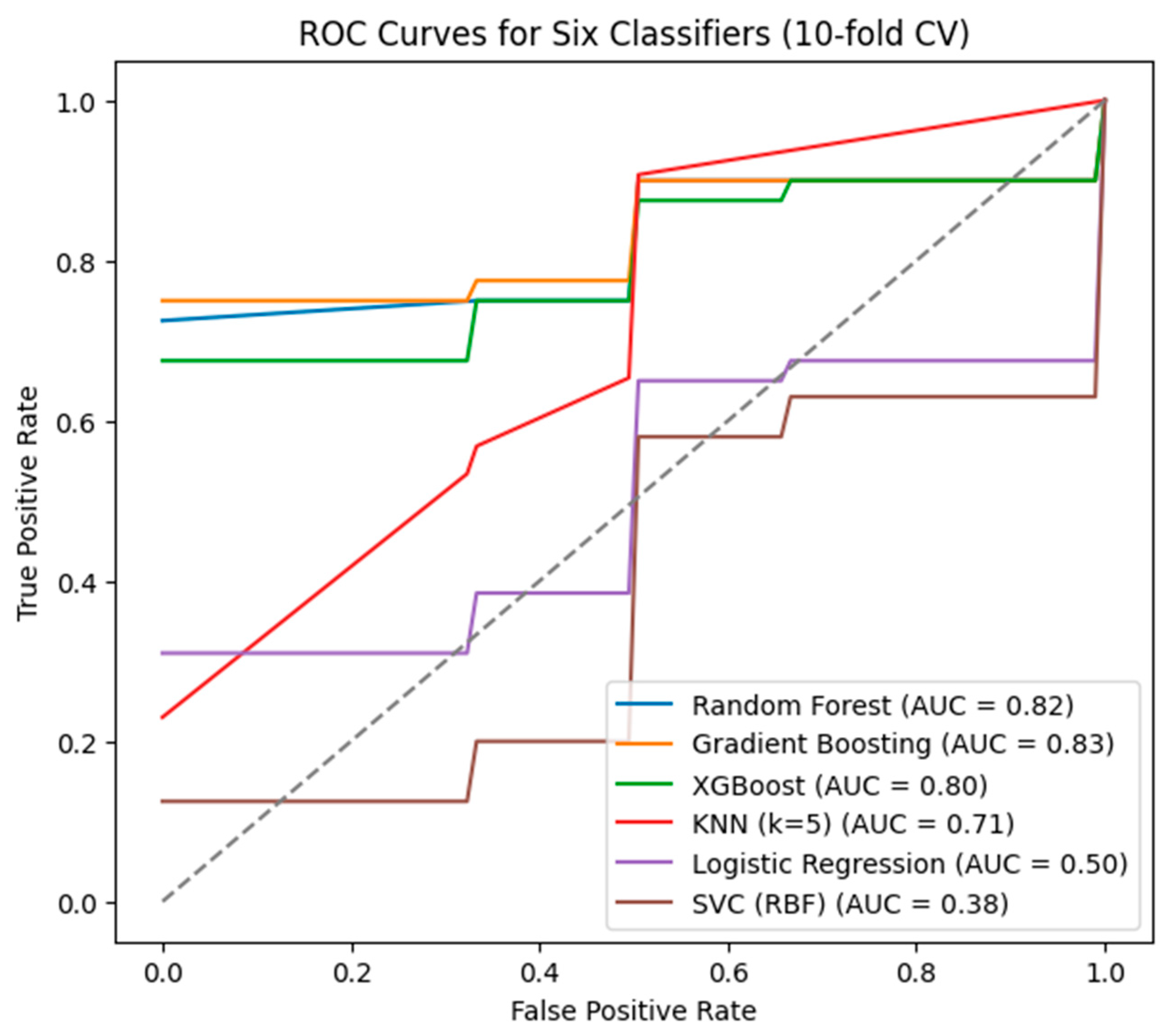
The performance of six machine learning classifiers was evaluated using 10-fold cross-validation on the dataset of 63 CYP1B1 inhibitors. Random Forest gave the highest accuracy (0.846) and F1 score (0.889), with an excellent ROC-AUC of 0.9875, followed by Gradient Boosting and XGBoost (accuracy 0.769, F1 0.842). KNN also showed good performance (accuracy 0.769, ROC-AUC 0.913). Logistic Regression achieved lower accuracy (0.692) but maintained perfect recall (1.0). The SVC model displayed the lowest accuracy (0.615); however, it produced an ROC-AUC of 1.0, suggesting issues with probability calibration rather than genuine separation.

Cross-Validation Metrics

Table 1 highlights key differences among the classifiers. Ensemble approaches such as Random Forest, Gradient Boosting, and XGBoost consistently outperformed single algorithms, reflecting their ability to reduce variance and capture complex, non-linear relationships. Random Forest emerged as the most balanced model, combining high accuracy and F1 score with excellent ROC-AUC.
In contrast, Logistic Regression and SVC illustrate the limitations of linear and margin-based classifiers. Logistic Regression achieved perfect recall but sacrificed accuracy and AUC, indicating a strong bias toward predicting the active class. The SVC model gave the lowest accuracy overall, and its apparent ROC-AUC of 1.0 likely reflects calibration artifacts rather than genuine separation.
The KNN classifier performed moderately well, showing that local similarity in descriptor space can partially capture activity trends; however, ensemble methods offered superior generalization.
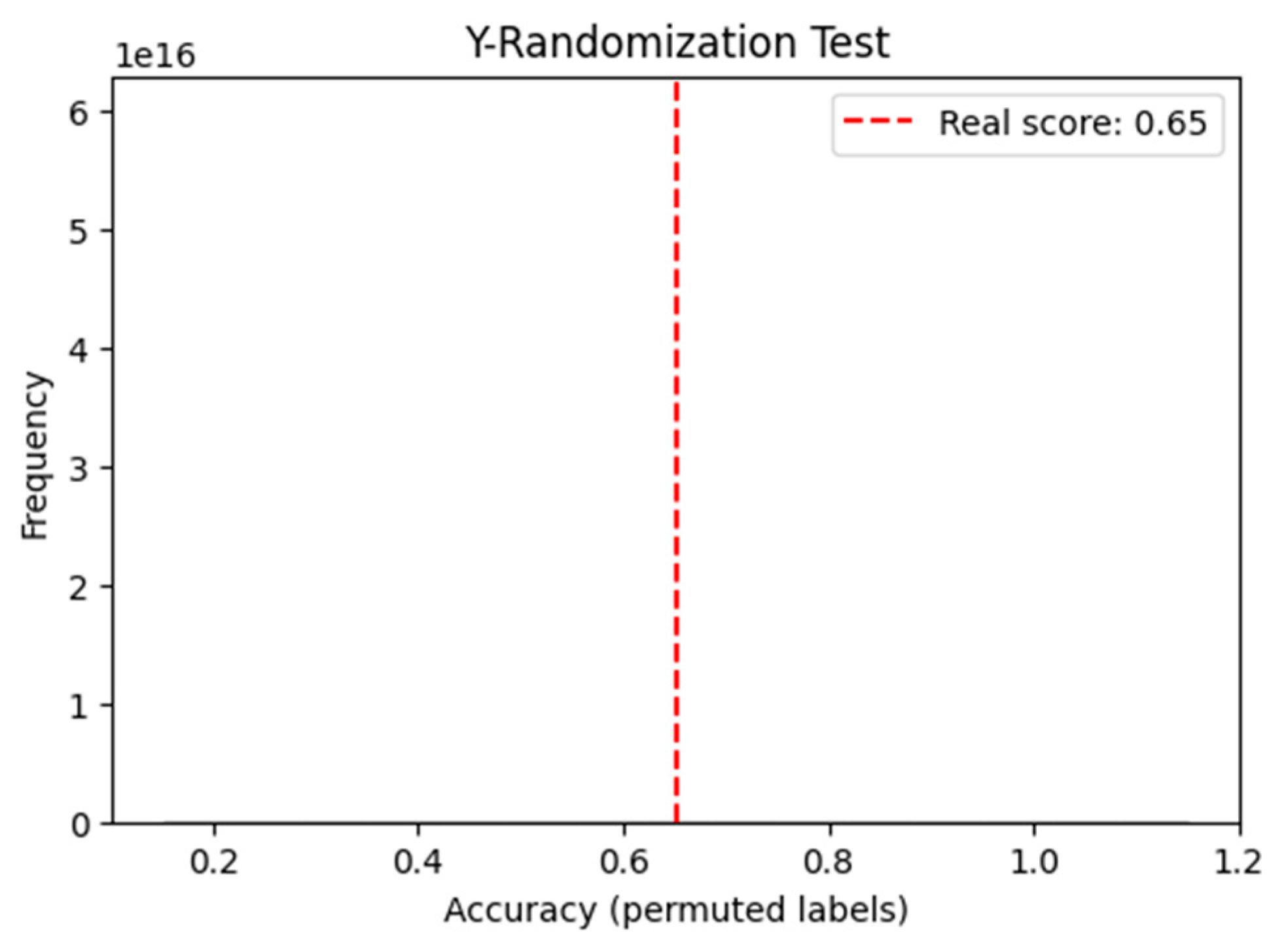
The superiority of ensemble methods is further illustrated in the ROC curves (Figure 1), where Random Forest and Gradient Boosting exhibit the most distinct separation between classes. In addition, the Y-randomization test (Figure 2) confirms that the observed predictive performance is not due to chance: accuracies of randomized models cluster around 0.5, whereas the actual model remains substantially higher, indicating a genuine structure–activity signal.
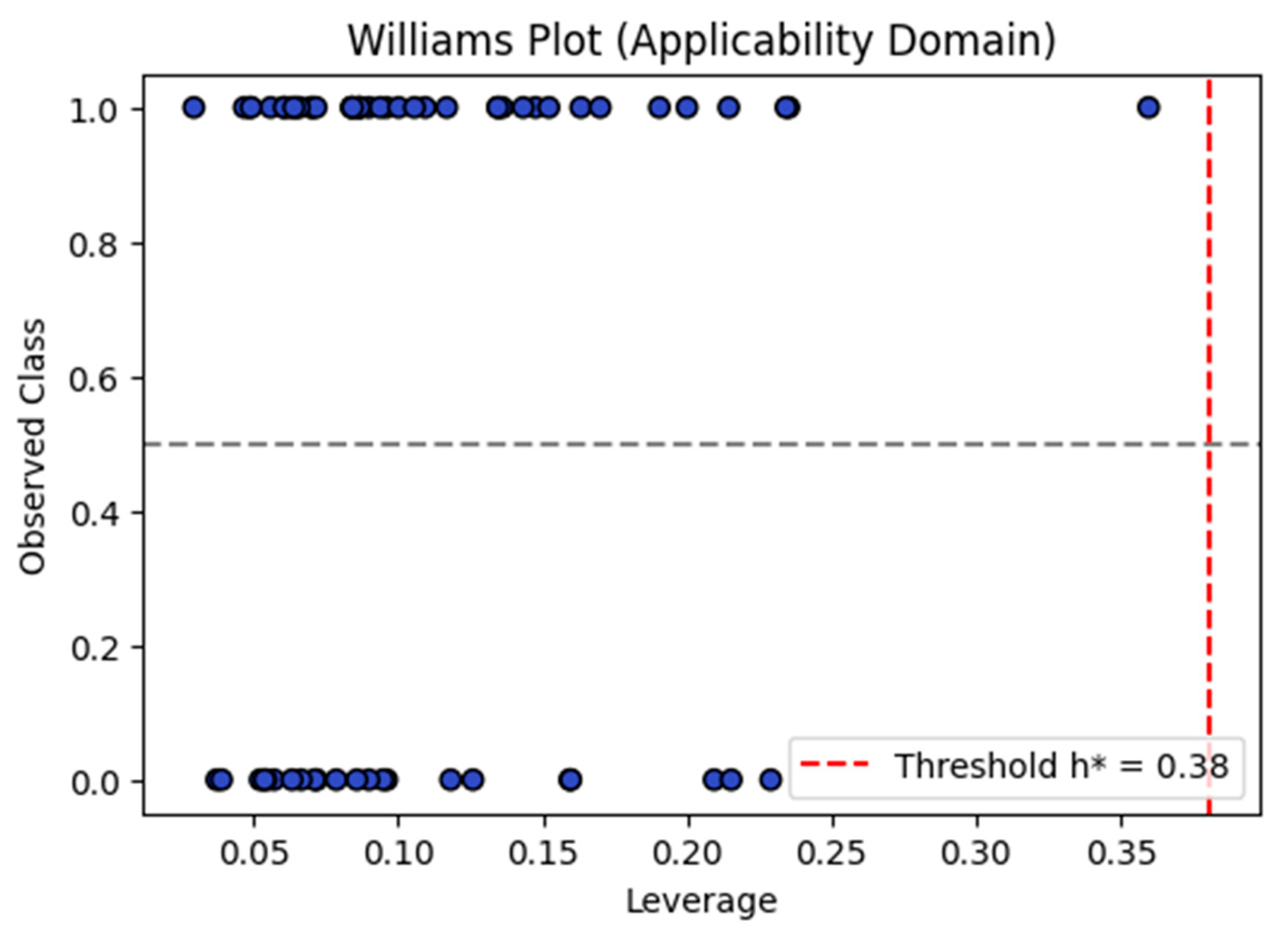
Figure 3 shows the Williams plot for applicability domain analysis. The majority of compounds fall within the critical leverage threshold and the ±3 standardized residual boundary, indicating that the model is applicable to most of the dataset. Only a few compounds were identified as potential outliers, suggesting that predictions are generally reliable within the studied chemical space.

4. Conclusions

In this study, we developed a preliminary classification based QSAR model for CYP1B1 inhibitors using quantum chemical and thermodynamic descriptors obtained from xTB calculations. Although some models showed good internal performance, a closer examination revealed class-bias issues. This highlights the limitation of small dataset and a need for careful interpretation of validation metrics. Overall, this work shows that quantum-based descriptors can be used effectively to build a robust QSAR model for CYP1B1 inhibitors. Future work will focus on increasing the size of dataset, improving the model balance and strengthening its predictive reliability.

Author Contributions

A.B. designed the study, perform the quantum chemical calculation and QSAR modeling, analyzed the data and drafted the manuscript. V.J. supervised the work, provided conceptual guidance and critically revied and revised the manuscript. All authors have read and agreed to the published version of the manuscript.

Funding

This research was funded by the Indian Council of Medical Research. IIRP-2023-1052.

Institutional Review Board Statement

Not applicable.

Informed Consent Statement

Not applicable.

Data Availability Statement

The dataset is available at https://github.com/abanishbiswas/QSAR_QCD_CYP1B1 (accessed on 26 December 2025).

Conflicts of Interest

The authors declare no conflicts of interest. The funders had no role in the design of the study, nor in the collection, analyses, or interpretation of data.

Abbreviations

The following abbreviations are used in this manuscript:
CYP1B1Cytochrome P450 1B1
QSARQuantitative Structure–Activity Relationship
QCDQuantum Chemical Descriptors
TCDThermodynamic Descriptors
xTBExtended Tight-Binding Method
RFERecursive Feature Elimination
CVCross-Validation
ROC-AUCReceiver Operating Characteristic Area Under the Curve
SVCSupport Vector Classifier
RBFRadial Basis Function (kernel)
KNNk-Nearest Neighbors
LOOCVLeave-One-Out Cross-Validation
ZPEZero-Point Energy
VIFVariance Inflation Factor
IC50Half-maximal Inhibitory Concentration
pIC50Negative Logarithm of IC50 (−log10IC50)
CvHeat Capacity at Constant Volume

References

  1. Murray, G.I.; Melvin, W.T.; Greenlee, W.F.; Burke, M.D. Regulation, Function, and Tissue-Specific Expression of Cytochrome P450 CYP1B1. Annu. Rev. Pharmacol. Toxicol. 2001, 41, 297–316. [Google Scholar] [CrossRef] [PubMed]
  2. Biswas, A.; Jayaprakash, V. Phytoestrogens and Their Synthetic Analogues as Substrate Mimic Inhibitors of CYP1B1—An Update (2020–2025). Bioorganic Med. Chem. 2025, 130, 118385. [Google Scholar] [CrossRef] [PubMed]
  3. Cherkasov, A.; Muratov, E.N.; Fourches, D.; Varnek, A.; Baskin, I.I.; Cronin, M.; Dearden, J.; Gramatica, P.; Martin, Y.C.; Todeschini, R.; et al. QSAR Modeling: Where Have You Been? Where Are You Going To? J. Med. Chem. 2014, 57, 4977–5010. [Google Scholar] [CrossRef] [PubMed]
  4. Hansch, C.; Fujita, T. P-σ-π Analysis. A Method for the Correlation of Biological Activity and Chemical Structure. J. Am. Chem. Soc. 1964, 86, 1616–1626. [Google Scholar] [CrossRef]
  5. Gramatica, P. Principles of QSAR Models Validation: Internal and External. QSAR Comb. Sci. 2007, 26, 694–701. [Google Scholar] [CrossRef]
  6. Bannwarth, C.; Ehlert, S.; Grimme, S. GFN2-xTB—An Accurate and Broadly Parametrized Self-Consistent Tight-Binding Quantum Chemical Method with Multipole Electrostatics and Density-Dependent Dispersion Contributions. J. Chem. Theory Comput. 2019, 15, 1652–1671. [Google Scholar] [CrossRef] [PubMed]
  7. Siddique, M.U.M.; McCann, G.J.; Sonawane, V.; Horley, N.; Williams, I.S.; Joshi, P.; Bharate, S.B.; Jayaprakash, V.; Sinha, B.N.; Chaudhuri, B. Biphenyl Urea Derivatives as Selective CYP1B1 Inhibitors. Org. Biomol. Chem. 2016, 14, 8931–8936. [Google Scholar] [CrossRef] [PubMed]
  8. Siddique, M.U.M.; McCann, G.J.; Sonawane, V.R.; Horley, N.; Gatchie, L.; Joshi, P.; Bharate, S.B.; Jayaprakash, V.; Sinha, B.N.; Chaudhuri, B. Quinazoline Derivatives as Selective CYP1B1 Inhibitors. Eur. J. Med. Chem. 2017, 130, 320–327. [Google Scholar] [CrossRef] [PubMed]
  9. Williams, I.S.; Joshi, P.; Gatchie, L.; Sharma, M.; Satti, N.K.; Vishwakarma, R.A.; Chaudhuri, B.; Bharate, S.B. Synthesis and Biological Evaluation of Pyrrole-Based Chalcones as CYP1 Enzyme Inhibitors, for Possible Prevention of Cancer and Overcoming Cisplatin Resistance. Bioorganic Med. Chem. Lett. 2017, 27, 3683–3687. [Google Scholar] [CrossRef] [PubMed]
Figure 1. ROC curves for six classifiers under 10-fold cross-validation.
Chemproc 18 00109 g001
Figure 2. Y-randomization histogram comparing real vs. randomized accuracies.
Chemproc 18 00109 g002
Figure 3. Williams plot showing the applicability domain.
Chemproc 18 00109 g003
Table 1. Performance of classifiers under 10-fold cross-validation.
ModelAccuracyPrecisionRecallF1ROC-AUC
Random Forest0.8460.8001.0000.8890.9875
Gradient Boosting0.7690.7271.0000.8420.9500
XGBoost0.7690.7271.0000.8420.8750
KNN (k = 5)0.7690.7780.8750.8240.9125
Logistic Regression0.6920.6671.0000.8000.7250
SVC (RBF)0.6150.6151.0000.7621.0000
Values represent mean performance metrics from 10-fold cross-validation. ROC-AUC = area under the receiver operating characteristic curve. SVC = Support Vector Classifier.
Disclaimer/Publisher’s Note: The statements, opinions and data contained in all publications are solely those of the individual author(s) and contributor(s) and not of MDPI and/or the editor(s). MDPI and/or the editor(s) disclaim responsibility for any injury to people or property resulting from any ideas, methods, instructions or products referred to in the content.