


Abstract
Spiropyran (SP)–Merocyanine (MC) systems represent versatile molecular switches, with their open–closed equilibrium can be finely tuned by their structural characteristics. In this study, we combined conformational sampling, DFT (Density Functional Theory) calculations to rationalize the distinct behaviors of two recently synthesized derivatives: SP1/MC1 and SP3/MC3. While SP1 primarily exists in the colorless, non-fluorescent SP form, MC3 remains stabilized in the colored, open MC state, displaying intense emission. Our results reveal that allyl and benzyl substituents impose conformational constraints that limit interconversion, while hydroxyl substitution and solvent polarity modulate the relative stability of the SP and MC isomers.
1. Introduction
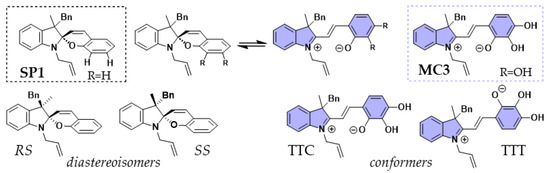
Spiropyran (SP)–Merocyanine (MC) systems are dynamic molecular switches that have been extensively investigated for their tunable optical properties. The equilibrium between the closed (SP) and open (MC) forms can be modulated by structural features, enabling applications in sensing, photoresponsive materials, and fluorescence-based devices [1,2]. In our recent experimental study [3], two SP–MC pairs were synthesized: one bearing a single hydroxyl substituent on the aromatic ring (SP1-MC1) and another featuring a tri-hydroxylated aromatic moiety, also known as gallol (SP3-MC3). While SP1 predominantly adopts the closed configuration, the second system exists exclusively in the open MC3 form and exhibits intense fluorescence. In this work, we present a computational study aimed at rationalizing these contrasting behaviors (Figure 1).
Figure 1.
SP ⇄ MC interconversion (top) and molecules computationally studied: SP1 with its RS and SS diastereoisomers and MC3 with its TTC and TTT conformers (bottom).
2. Computational Methods
Conformational sampling was performed using the CREST 3.0 program with the GFN2-xTB method [4]. The remaining calculations were performed in ORCA 6.1.0 [5]. The most stable conformers were re-optimized at the B97-3c level [6]. Single-point electronic energies were obtained using B3LYP-D4/def2-TZVP [7,8,9]. Solvent effects were included using the SMD model [10]. TDDFT calculations were performed at the ωB97X-D4rev/def2-TZVP level [11].
3. Results and Discussion
3.1. Molecular Features and Structural Constraints
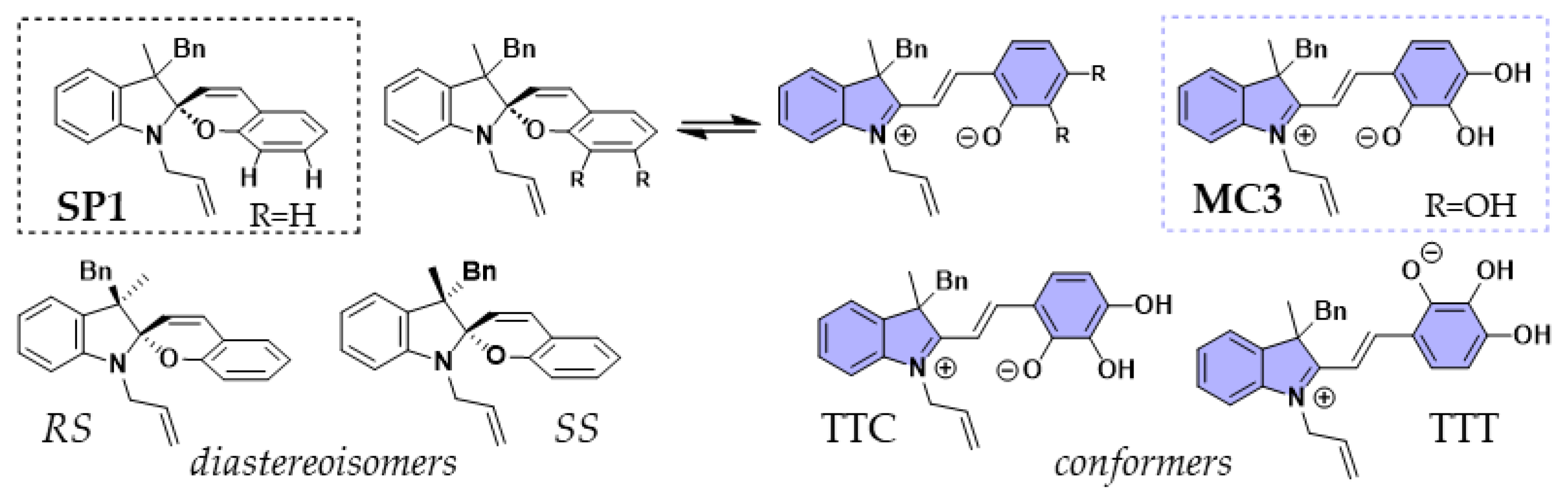
Spiropyrans typically undergo rapid interconversion between their open and closed states in response to external stimuli; however, experimental studies revealed a notable rigidity in both SP1 and MC3, accompanied by a lack of observable interconversion. We suggest that the benzyl and allyl substituents play a significant role in this rigidity, limiting the conformational flexibility required for interconversion between the SP and MC states. We initially evaluated the relative stability of the SP1 diastereoisomers, finding RS to be 2 kcal/mol more stable than SS. Conformational sampling results (Figure 2) further indicate that the most energetically favorable (RS)-SP1 conformers are stabilized by π–π interactions between the benzyl and allyl moieties and the aromatic rings of the Spiropyran framework. Conversely, stabilization of the MC conformers arises predominantly from π–π interactions between the benzyl and allyl groups. The TTT and TTC conformers can coexist (Figure 1), but the TTC conformer is more stable by 2 kcal/mol and is therefore predominantly observed.
Figure 2.
Representative conformers of SP1 and MC1, showing key intramolecular distances that highlight π–π interactions contributing to the structural rigidity of the most stable conformers (xTB/CREST).
3.2. NMR Differentiation of SP1 Diastereoisomers
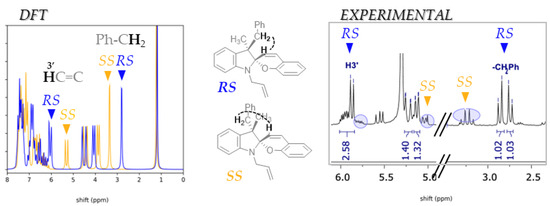
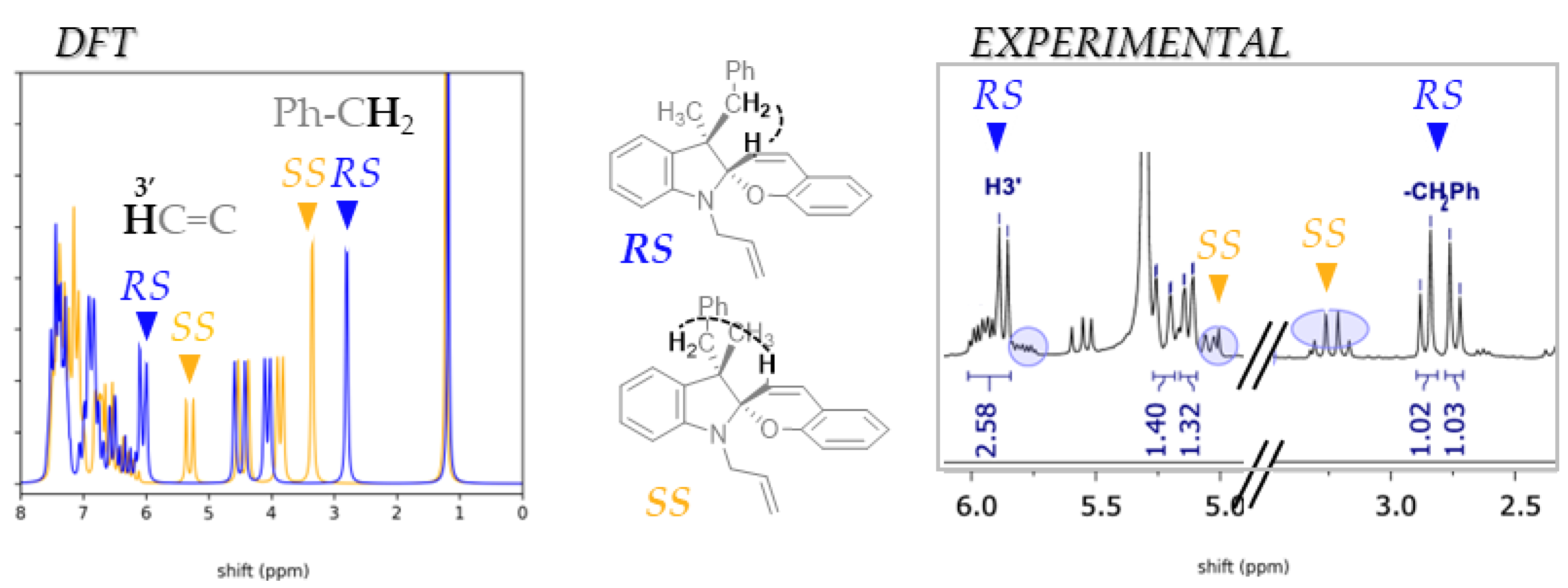
SP1 possesses two stereogenic centers, giving rise to diastereoisomers (Figure 1). These diastereoisomers can be distinguished using NMR spectroscopy. To support this analysis, we performed spectral simulations (Figure 3). In the RS diastereoisomer, the spatial proximity between the Ph–CH2 group and the H3′ proton of the pyran ring results in a pronounced interaction, leading to significant chemical shift displacements. Specifically, the Ph–CH2 resonance appears upfield at 2.8 ppm, whereas H3′ is observed downfield at 6.0 ppm. In contrast, in the SS diastereoisomer, the increased distance between these nuclei reduces their interaction, resulting in the Ph–CH2 signal appearing at 3.3 ppm and H3′ at 5.3 ppm. In the experimental spectrum, the Ph–CH2 signal exhibits splitting despite the absence of vicinal protons. This unusual deshielding pattern is consistent with the limited conformational flexibility of the system and highlights the structural rigidity imposed by the substituents within the Spiropyran framework.
Figure 3.
Comparison of simulated (DFT) and experimental 1H NMR spectra of the SP1 diastereoisomers (RS and SS), highlighting the characteristic chemical shift differences for the Ph–CH2 and H3′ signals. Experimental spectrum adapted from [3].
In the 13C NMR spectra, the primary distinction between the diastereoisomers also arises from the relative positioning of the Ph–CH2 and methyl substituents in relation to the pyran ring. The carbon nucleus in closer proximity to the pyran framework exhibits a higher chemical shift value. This effect is particularly pronounced for the methyl group: in the SS diastereoisomer, when oriented toward the pyran ring, it resonates downfield at 27 ppm, whereas in the RS diastereoisomer, where it is farther away, the same signal appears upfield at 18 ppm. These variations in chemical shifts, together with the agreement between simulated and experimental data, support the stereochemical assignments and validate the computational methods employed.
3.3. SP-MC Relative Stability and Solvents Effect
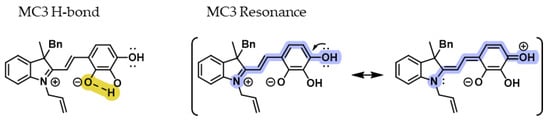
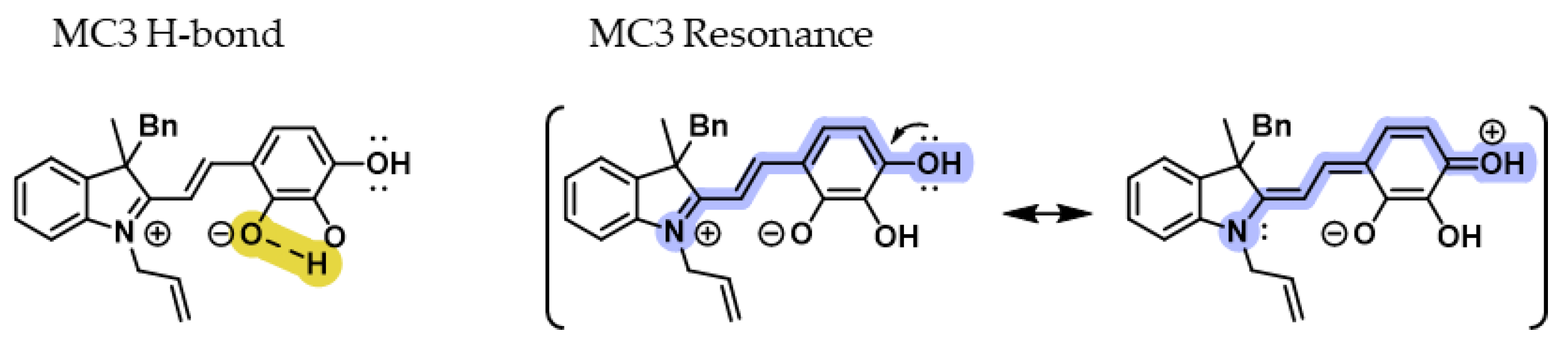
The thermodynamic stability of SP makes it challenging to obtain the colored MC as the predominant form. In contrast, MC3 exists exclusively in its open form. This distinctive feature can be attributed to the resonance effects and hydrogen bonding potential of the tri-hydroxylated moiety (Figure 4), which stabilizes the MC form, preventing interconversion to the closed SP configuration.
Figure 4.
Intramolecular hydrogen bonding (yellow) and resonance stabilization (blue) in MC3, contributing to the enhanced stability of the open Merocyanine form.
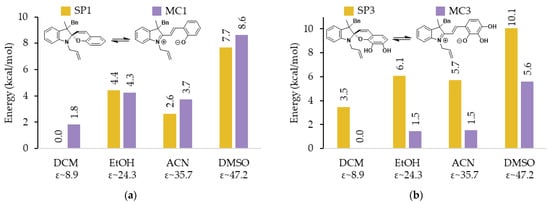
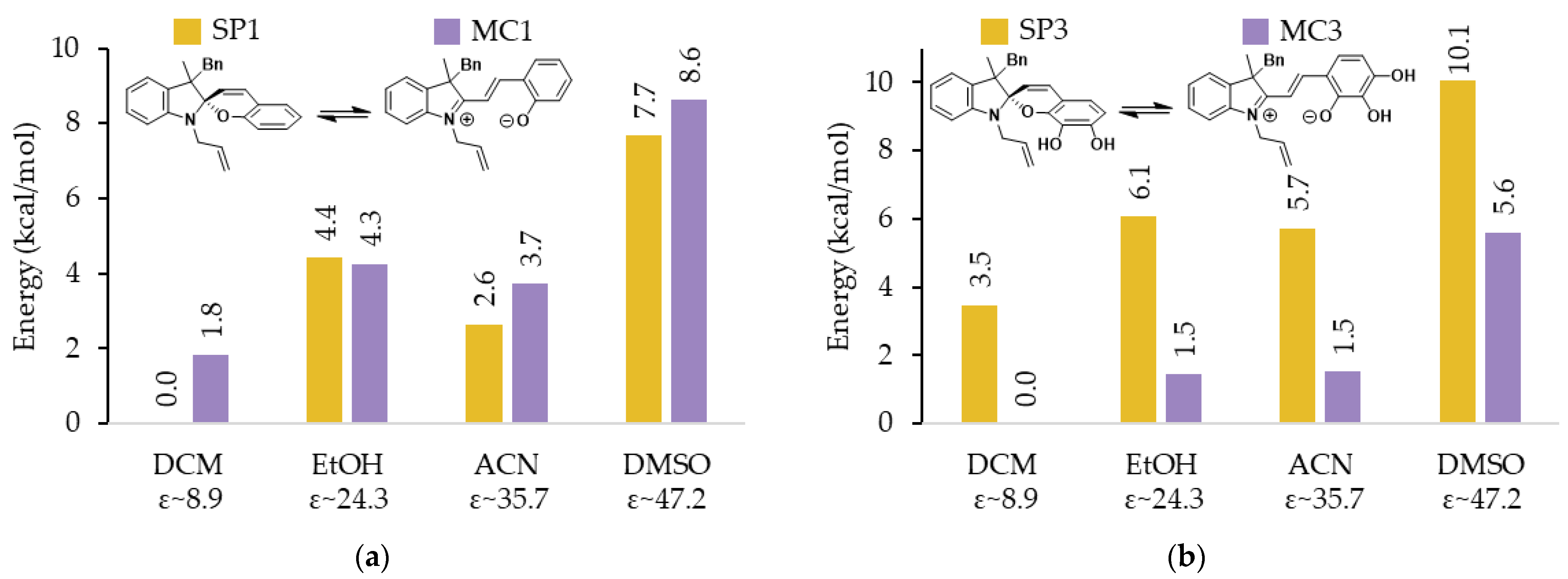
Furthermore, polar solvents preferentially stabilize the open form (more polar) compared to the closed form. This effect is further enhanced by the solvent’s ability to solvate charge-bearing species, thereby increasing the stability of the open form in solution. The relative energy comparison of the SP1–MC1 and SP3–MC3 pairs is shown in Figure 5. SP1 is more stable than MC1, particularly in DCM, although this difference diminishes in more polar solvents, especially protic ethanol. In contrast, MC3 is more stable than SP3 across all solvents, with the stability difference being more pronounced in polar media.
Figure 5.
Relative energy comparison of SP-MC pairs in different solvents: (a) SP1⇄ MC1; (b) SP3⇄ MC3 [B3LYP-D4/def2-TZVP/SMD(solvent)].
3.4. Optical Properties
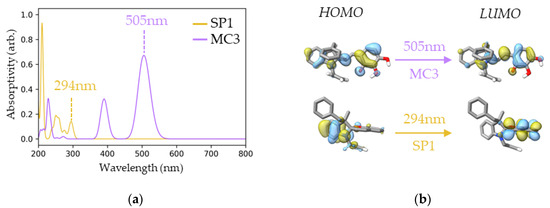
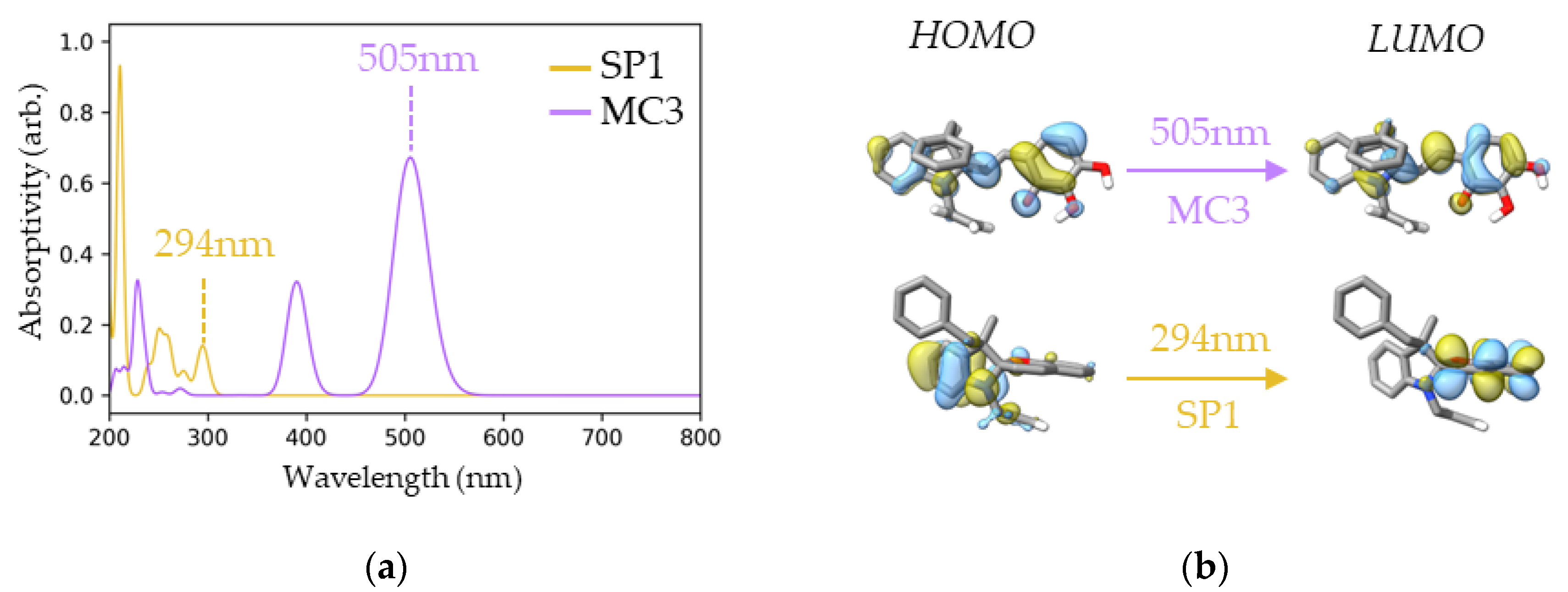
Experimentally, SP1 is colorless and does not exhibit detectable fluorescence, whereas MC3 displays a vivid violet coloration accompanied by intense emission. TDDFT calculations reproduce these contrasting behaviors (Figure 6): SP1 exhibits a first excited state with a low oscillator strength (f = 0.2) at 294 nm, assigned to a charge-transfer transition from the indole to the pyran ring, which is inefficient at promoting radiative decay and thus consistent with its lack of fluorescence. In contrast, MC3 displays a strong π–π* transition (f = 1.0) at 505 nm with high intensity, in agreement with its visible absorption and the observed fluorescence.
Figure 6.
(a) Simulated UV–Vis absorption spectra of SP1 and MC3 showing the first excitations at 294 and 505 nm, respectively; (b) the frontier molecular orbitals (HOMO–LUMO) involved in these transitions. wB97X-D4rev/def2-TZVP/SMD(ethanol) with a –0.5 eV shift applied to improve comparability with the experimental observations.
4. Conclusions
In conclusion, the results indicate that the interconversion of SP–MC systems is influenced not only by electronic substitutions and solvent polarity but also by the conformational rigidity imposed by the benzyl and allyl substituents. While SP1 is consistently maintained in the closed, colorless, and non-fluorescent state, MC3 is restricted to the open, violet, and highly fluorescent form due to the ability of the OH groups of the gallol moiety to form intramolecular hydrogen bonds and to contribute electronically through resonance. The agreement between the computational and experimental findings validates the methodology employed. Future studies may explore in greater depth how different substituents affect the characteristics of Spiropyrans and Merocyanines, thereby providing insights for the design of fluorescent compounds with tunable SP–MC interconversion.
Author Contributions
V.D. carried out the conceptualization, investigation, and writing; M.C. carried out the investigation, methodology, and writing; G.R. carried out the funding acquisition, project administration, investigation, and writing. F.N. carried out the conceptualization, investigation, and writing; J.M.-A. carried out the conceptualization, investigation, and writing. All authors have read and agreed to the published version of the manuscript.
Funding
This research was funded by the Consejo Nacional de Investigaciones Científicas y Técnicas (CONICET, PIP N° 11220200101665CO), Agencia Nacional de Promoción Científica y Tecnológica (ANPCyT, PICT 2018-2471), and Universidad Nacional del Sur (UNS, PGI 24/Q142) from Argentina.
Institutional Review Board Statement
Not applicable.
Informed Consent Statement
Not applicable.
Data Availability Statement
The data presented in this study are available on request from the corresponding author.
Conflicts of Interest
The authors declare no conflicts of interest.
Abbreviations
The following abbreviations are used in this manuscript:
| SP | Spiropyran |
| MC | Merocyanine |
| NMR | Nuclear Magnetic Resonance |
| TDDFT | Time-Dependent Density Functional Theory |
References
- Klajn, R. Spiropyran-Based Dynamic Materials. Chem. Soc. Rev. 2013, 42, 1089–1105. [Google Scholar] [CrossRef] [Scilit]
- Kortekaas, L.; Browne, W.R. The Evolution of Spiropyran: Fundamentals and Progress of an Extraordinarily Versatile Photochrome. Chem. Soc. Rev. 2019, 48, 3406–3424. [Google Scholar] [CrossRef] [Scilit]
- Alonso, B.; Lucea, C.S.; Domini, C.; Radivoy, G.; Mancebo-Aracil, J.; Nador, F. Fluorescent Coating through Melanisation of Merocyanine Based on Catechol Chemistry. Chem. Eur. J. 2025, 31, e202403294. [Google Scholar] [CrossRef] [Scilit]
- Pracht, P.; Grimme, S.; Bannwarth, C.; Bohle, F.; Ehlert, S.; Feldmann, G.; Gorges, J.; Müller, M.; Neudecker, T.; Plett, C.; et al. CREST—A Program for the Exploration of Low-Energy Molecular Chemical Space. J. Chem. Phys. 2024, 160, 234109. [Google Scholar] [CrossRef] [Scilit] [PubMed]
- Neese, F. Software Update: The ORCA Program System—Version 6.0. Wiley Interdiscip. Rev. Comput. Mol. Sci 2025, 15, e70019. [Google Scholar] [CrossRef] [Scilit]
- Brandenburg, J.G.; Bannwarth, C.; Hansen, A.; Grimme, S. B97-3c: A Revised Low-Cost Variant of the B97-D Density Functional Method. J. Chem. Phys. 2018. 2018, 148, 064104. [Google Scholar] [CrossRef] [Scilit] [PubMed]
- Becke, A.D. Density-Functional Thermochemistry. III. The Role of Exact Exchange. J. Chem. Phys. 1998, 98, 5648–5652. [Google Scholar] [CrossRef] [Scilit]
- Caldeweyher, E.; Bannwarth, C.; Grimme, S. Extension of the D3 Dispersion Coefficient Model. J. Chem. Phys. 2017, 147, 034112. [Google Scholar] [CrossRef] [Scilit] [PubMed]
- Weigend, F.; Ahlrichs, R. Balanced Basis Sets of Split Valence, Triple Zeta Valence and Quadruple Zeta Valence Quality for H to Rn: Design and Assessment of Accuracy. Phy. Chem. Chem. Phys. 2005, 7, 3297–3305. [Google Scholar] [CrossRef] [Scilit] [PubMed]
- Marenich, A.V.; Cramer, C.J.; Truhlar, D.G. Universal Solvation Model Based on Solute Electron Density and on a Continuum Model of the Solvent Defined by the Bulk Dielectric Constant and Atomic Surface Tensions. J. Phys. Chem. B 2009, 113, 6378–6396. [Google Scholar] [CrossRef] [Scilit] [PubMed]
- Chai, J.-D.; Head-Gordon, M. Systematic Optimization of Long-Range Corrected Hybrid Density Functionals. J. Chem. Phys. 2008, 128, 084106. [Google Scholar] [CrossRef] [Scilit] [PubMed]
Disclaimer/Publisher’s Note: The statements, opinions and data contained in all publications are solely those of the individual author(s) and contributor(s) and not of MDPI and/or the editor(s). MDPI and/or the editor(s) disclaim responsibility for any injury to people or property resulting from any ideas, methods, instructions or products referred to in the content. |
© 2025 by the authors. Licensee MDPI, Basel, Switzerland. This article is an open access article distributed under the terms and conditions of the Creative Commons Attribution (CC BY) license (https://creativecommons.org/licenses/by/4.0/).