
Proceeding Paper

Silver-Catalyzed Synthesis of Functionalized 1,7-Naphthyridine Derivatives Using 2-Aminobenzamide Derivatives and ortho-Alkynylquinoline Carbaldehydes as Starting Materials †
Catalysis and Fine Chemicals Division, CSIR-Indian Institute of Chemical Technology, Hyderabad 500007, Telangana, India
*
Authors to whom correspondence should be addressed.
Presented at the 29th International Electronic Conference on Synthetic Organic Chemistry, 14–28 November 2025; Available online: https://sciforum.net/event/ecsoc-29.
Chem. Proc. 2025, 18(1), 103; https://doi.org/10.3390/ecsoc-29-26846
Published: 12 November 2025

Abstract

Fused polycyclic 1,7-naphthyridines are important N-heterocyclic scaffolds with potential applications in medicinal chemistry and materials science. Conventional methods for their synthesis often require harsh conditions or multiple steps, limiting functional group compatibility and scalability. Herein, we report a one-pot silver-catalyzed cyclization strategy that proceeds under mild conditions, tolerates diverse functional groups, and is amenable to gram-scale synthesis. The reaction features a simple workup involving celite filtration and standard purification. Preliminary studies indicate that these N-heterocycles exhibit promising photophysical and medicinal properties, highlighting their potential in light-emitting devices and therapeutic development.

1. Introduction

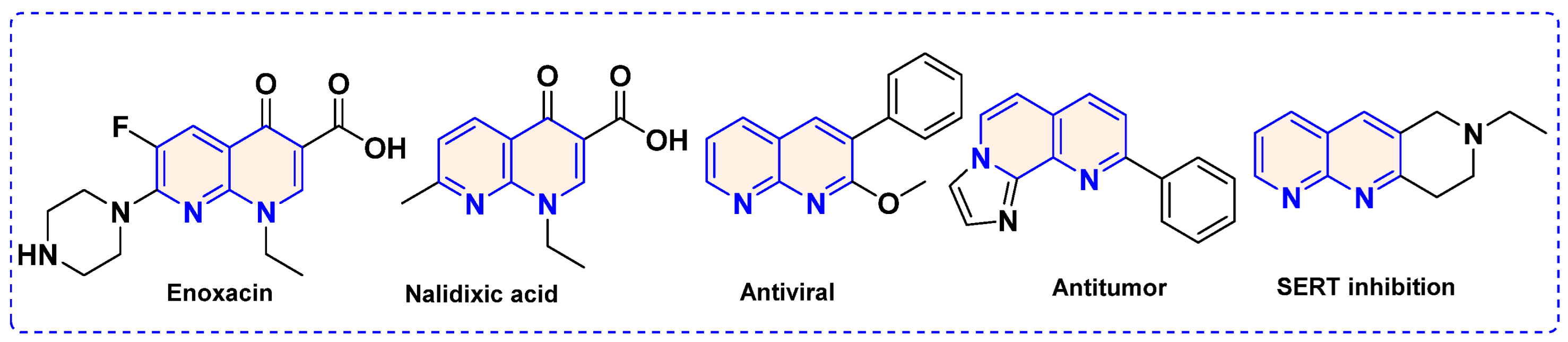
Fused nitrogen-containing heterocycles, such as naphthyridines, are privileged scaffolds with diverse applications in medicinal chemistry, materials science, and optoelectronics [1,2,3]. Their unique electronic and structural features allow interactions with biological targets, enabling activities such as antibacterial, antiviral, anti-inflammatory, and anticancer effects (Figure 1) [4]. Naphthyridines also serve as key components in sensors [5], light-emitting devices [6,7,8,9], and metal–organic frameworks due to their versatile coordination chemistry and photophysical properties [10,11]. The position of nitrogen atoms within the fused ring system gives rise to various isomers (e.g., 1,5-, 1,6-, 1,7-, 2,7-naphthyridines) [12], with electronic and steric effects that influence chemical reactivity and functionalization potential.
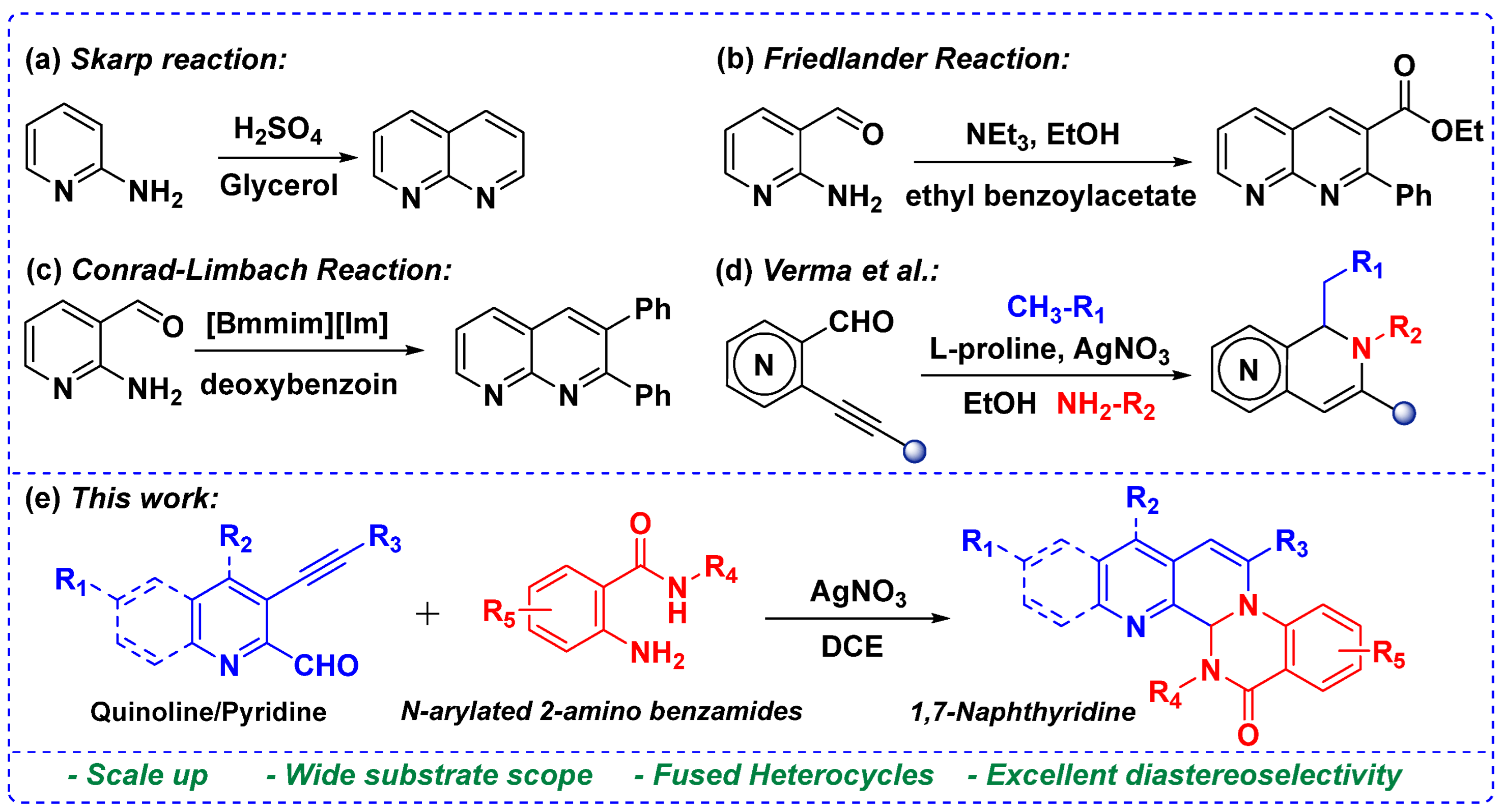
Traditional synthetic methods for naphthyridines, including the Skraup [13], Friedländer [14], and Conrad–Limpach reactions [15], often require multi-step procedures, require harsh conditions, or provide limited regioselectivity (Scheme 1a–c). Recent advances employing ortho-alkynyl aldehyde scaffolds have enabled regio- and stereoselective formation of naphthyridine derivatives under milder conditions using metal catalysis [16], including copper- [17] and silver-catalyzed strategies (Scheme 1d). Building on this progress, our group recently developed a one-pot silver-catalyzed approach for the synthesis of fused polycyclic 1,7-naphthyridines [18], 2,7-naphthyridines [19], and pyrano heterocycles [20]. This method operates under mild conditions, tolerates diverse functional groups, and is scalable to gram quantities, with a simple workup requiring only celite filtration and standard purification.
Herein, we report a novel application of the aldehyde–alkyne strategy for constructing 1,7-naphthyridines, expanding the synthetic utility of this methodology to a previously unexplored class of fused N-heterocycles. The resulting compounds are being evaluated for their photophysical and medicinal properties, highlighting their potential as multifunctional scaffolds for therapeutic and material applications.

2. Results and Discussion

To optimize the reaction, model substrates 1a and 2a were employed (Table 1). A series of silver catalysts were first screened in DCM at room temperature. Among them, AgNO3 (10 mol%) afforded 3a in a 52% yield (entry 1), while other silver and non-silver catalysts provided only a trace or no conversion. Increasing the loading of AgNO3 to 20 mol% improved the yield (entry 2), whereas a further increase to 30 mol% led to a decline (entry 3). Solvent screening identified DCE as the optimal medium, and under these conditions, AgNO3 (20 mol%) delivered 3a in an 80% yield within 6 h (entry 4). Prolonging the reaction to 12 h resulted in a decreased yield. Thus, the optimized conditions were established as 1a (0.2 mmol), 2a (0.2 mmol), and AgNO3 (20 mol%) in DCE (2 mL). NMR analysis revealed diastereomeric peaks, attributed to the formation of two stereogenic centers—one at the aldehyde carbon during cyclization and the other at the amide nitrogen. The latter exhibits hindered inversion, allowing the diastereomers to be observed as distinct signals.
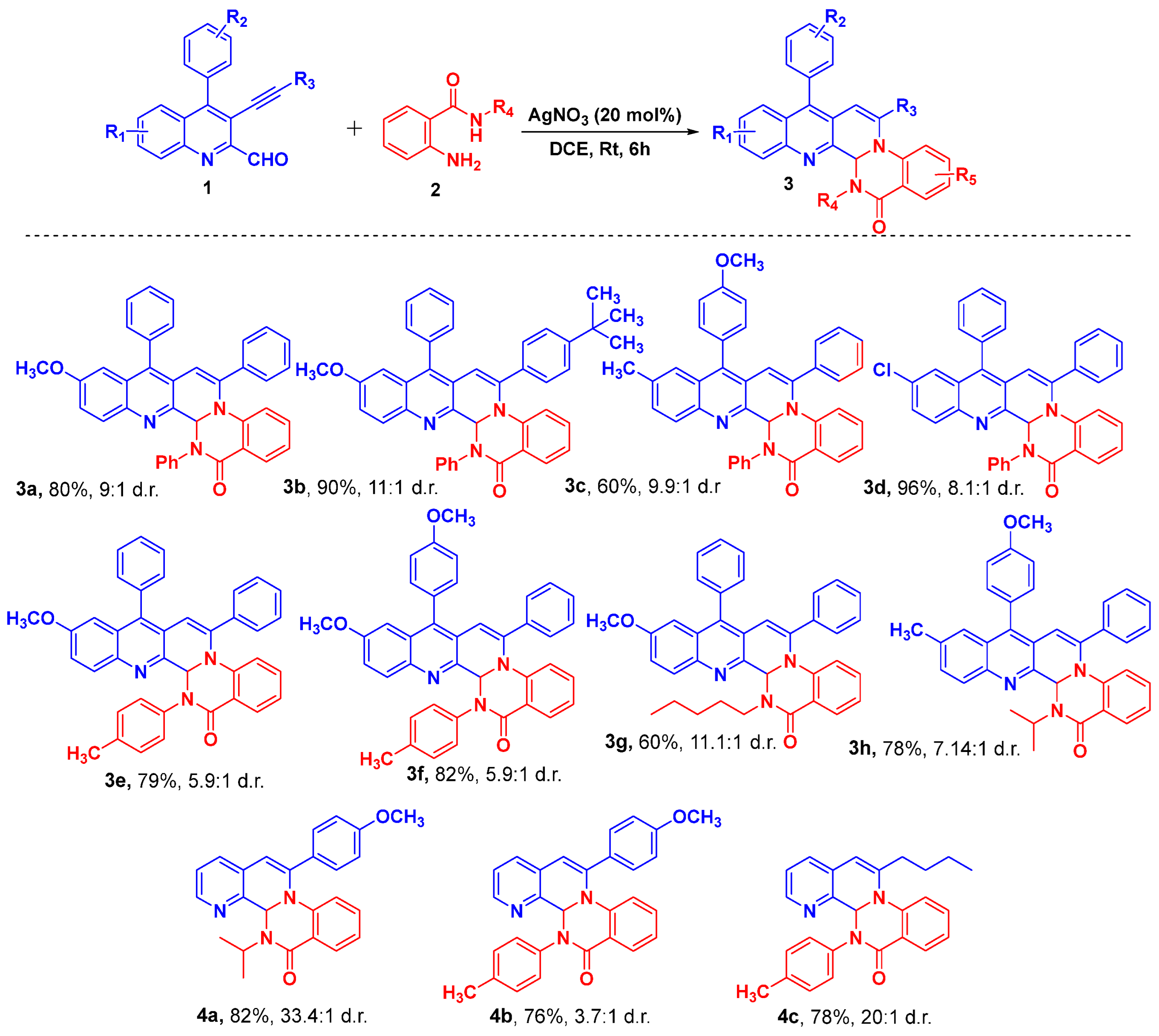
After establishing the optimized conditions (entry 4), the substrate scope of ortho-alkynyl aldehydes and substituted anthranilamides was systematically examined using AgNO3 in DCE at room temperature for 6 h. Reactions of 3-alkynylquinoline-2-carbaldehydes (1a–h) with anthranilamide derivatives (2a–d) afforded the desired products 3a–h in a 60–96% yield with good to excellent diastereoselectivity (Figure 2). Notably, compounds 3b and 3g showed diastereomeric ratios of 11:1 with yields of 90% and 60%, respectively. In contrast, reactions with pyridine-based alkynyl aldehydes (1i–j) furnished the corresponding products 4a–c in good to excellent yields, and compound 4ac displayed an impressive diastereoselectivity of 20:1.

3. Experimental Section

3.1. General Information, Instrumentation and Chemicals

All chemicals were purchased from Sigma-Aldrich (Hyderabad, India), Alfa Aesar (Hyderabad, India), and S. D. Fine Chemicals (Hyderabad, India) and used without further purification. ACME silica gel (100–200 mesh) was used for column chromatography, and thin-layer chromatography was performed on Merck-pre-coated silica gel 60-F254 plates (Hyderabad, India). TLC plates are visualized by UV light and developed by iodine. All the solvents were obtained from commercial sources and purified using standard methods. All 1H, 13C NMR spectra were recorded on Avance-300, Avance-400, and Avance-500 MHz spectrometers (Brüker Biospin, Switzerland). Chemical shifts (δ) are referenced to signals at 7.26 and 77.0 ppm, respectively, using TMS (δ = 0) as an internal standard in CDCl3. The peak patterns are indicated as follows: s, singlet; d, doublet; t, triplet; q, quartet; m, multiplet; dd, doublet of doublet; dt, doublet of triplet; tt, triplet of triplet. The coupling constants (J) are reported in Hertz (Hz). Mass spectral data were compiled using MS (ESI) and (HRMS) high-resolution mass spectrometers (Thermo Fisher Scientific, Massachusetts, USA). Melting points were investigated using a melting point instrument and are uncorrected.

3.2. General Procedure (GP)

A mixture containing 0.2 mmol of compound (1a–j) and 0.2 mmol of compound (2a–d) was stirred in 2 mL of DCE. To this stirring mixture, 20 mol% silver nitrate (AgNO3) was added at room temperature. The reaction was allowed to proceed for 6 h under stirring. After completion, the reaction mixture was filtered through a celite pad to remove any solid particles. The filtrate, containing the desired product(s), was concentrated by evaporating the solvent under reduced pressure, leaving behind a residue. This residue was further purified using column chromatography. This purification process yielded the corresponding products (3a–h and 4a–c).

3.3. Spectral Data

Characterization

10-methoxy-6,8,14-triphenyl-13b,14-dihydro-15H-benzo[2,3][1,7]naphthyridino[7,8-a]quinazolin-15-one (3a)
The compound chromatographed by using 3:10 ethyl acetate/hexane obtained 3a yellow semi-solid (89 mg, 80% yield) (d.r. 9:1). 1H NMR (400 MHz, CDCl3) δ 8.12 − 8.05 (m, 2H), 7.92 (dt, J = 8.8, 1.8 Hz, 2H), 7.74 (dt, J = 4.3, 2.4 Hz, 2H), 7.66 − 7.57 (m, 3H), 7.48 − 7.38 (m, 6H), 7.33 − 7.28 (m, 3H), 7.05 (ddd, J = 8.4, 7.3, 1.6 Hz, 1H), 6.92 (s, 1H), 6.83 (ddd, J = 8.8, 7.8, 1.8 Hz, 2H), 6.30 (d, J = 7.9 Hz, 1H), 6.09 (s, 1H), 3.70 (s, 3H). 13C NMR (101 MHz, CDCl3) δ 162.2, 158.1, 149.9, 144.7, 144.2, 143.2, 141.8, 141.7, 135.3, 134.9, 133.1, 131.5, 130.3, 129.6, 129.6, 129.2, 129.1, 128.9, 128.8, 128.6, 128.5, 128.3, 128.0, 127.6, 126.9, 126.0, 123.4, 120.9, 120.5, 118.8, 116.1, 114.2, 104.7, 55.4. HRMS (ESI) m/z: [M + H]+ Calcd for C38H28N3O2 558.2176; Found 558.2180.
6-(4-(tert-butyl)phenyl)-10-methoxy-8,14-diphenyl-13b,14-dihydro-15H-benzo[2,3][1,7]naphthyridino[7,8-a]quinazolin-15-one (3b)
The compound chromatographed by using 3:10 ethyl acetate/hexane obtained 3b yellow semi-solid (110 mg, 90% yield) (d.r. 11:1). 1H NMR (400 MHz, CDCl3) δ 8.11 − 8.05 (m, 2H), 7.94 − 7.90 (m, 2H), 7.69 − 7.65 (m, 2H), 7.62 − 7.56 (m, 3H), 7.48 − 7.43 (m, 3H), 7.43 − 7.38 (m, 2H), 7.30 (dddd, J = 9.1, 7.5, 3.2, 2.0 Hz, 3H), 7.07 (ddd, J = 8.4, 7.3, 1.6 Hz, 1H), 6.88 (s, 1H), 6.84 (td, J = 7.7, 0.9 Hz, 1H), 6.80 (d, J = 2.8 Hz, 1H), 6.34 (d, J = 7.8 Hz, 1H), 6.06 (s, 1H), 3.69 (s, 3H), 1.34 (s, 9H). 13C NMR (101 MHz, CDCl3) δ 162.3, 158.1, 153.1, 150.1, 145.0, 144.2, 143.2, 141.9, 141.5, 135.5, 133.2, 132.0, 131.6, 130.4, 129.6, 129.1, 128.9, 128.8, 128.7, 128.5, 128.4, 127.8, 127.0, 126.1, 125.8, 123.6, 120.8, 120.5, 118.8, 116.3, 113.5, 104.7, 55.4, 34.8, 31.3. HRMS (ESI) m/z: [M + H]+ Calcd for C42H36N3O2 614.2802; Found 614.2807.
8-(4-methoxyphenyl)-10-methyl-6,14-diphenyl-13b,14-dihydro-15H-benzo[2,3][1,7]naphthyridino[7,8-a]quinazolin-15-one (3c)
The compound chromatographed by using 3:10 ethyl acetate/hexane obtained 3c yellow semi-solid (62 mg, 60% yield) (d.r. 9.9:1). 1H NMR (500 MHz, CDCl3) δ 8.06 (dd, J = 11.9, 5.0 Hz, 2H), 7.94 − 7.90 (m, 2H), 7.79 − 7.74 (m, 2H), 7.48 − 7.38 (m, 6H), 7.34 − 7.31 (m, 2H), 7.29 (d, J = 7.4 Hz, 1H), 7.23 (dd, J = 8.3, 2.0 Hz, 1H), 7.15 (ddd, J = 14.7, 8.4, 2.5 Hz, 2H), 7.07 − 7.03 (m, 1H), 6.98 (s, 1H), 6.85 − 6.81 (m, 1H), 6.30 (d, J = 8.2 Hz, 1H), 6.08 (s, 1H), 3.98 (s, 3H), 2.39 (s, 3H). 13C NMR (101 MHz, CDCl3) δ 162.2, 159.6, 151.5, 145.8, 144.8, 143.8, 142.2, 141.8, 136.8, 134.9, 133.1, 131.7, 131.1, 131.0, 129.9, 129.5, 129.1, 129.0, 128.9, 128.1, 127.6, 127.5, 127.2, 126.9, 126.0, 125.1, 123.4, 120.5, 118.8, 116.1, 114.4, 114.2, 113.9, 55.4, 21.7. HRMS (ESI) m/z: [M + H]+ Calcd for C39H30N3O2 572.2333; Found 572.2336.
10-chloro-6,8,14-triphenyl-13b,14-dihydro-15H-benzo[2,3][1,7]naphthyridino[7,8-a]quinazolin-15-one (3d)
The compound chromatographed by using 3:10 ethyl acetate/hexane obtained 3d yellow semi-solid (107 mg, 96% yield) (d.r. 8.1:1). 1H NMR (400 MHz, CDCl3) δ 8.12 (d, J = 8.9 Hz, 1H), 8.07 (dd, J = 7.8, 1.5 Hz, 1H), 7.90 (dt, J = 8.8, 1.8 Hz, 2H), 7.77 − 7.72 (m, 2H), 7.67 − 7.63 (m, 1H), 7.63 − 7.59 (m, 2H), 7.57 (dd, J = 8.9, 2.3 Hz, 1H), 7.50 − 7.40 (m, 6H), 7.39 − 7.35 (m, 1H), 7.34 − 7.29 (m, 2H), 7.06 (ddd, J = 8.4, 7.4, 1.6 Hz, 1H), 6.91 (s, 1H), 6.89 − 6.83 (m, 1H), 6.29 (d, J = 8.2 Hz, 1H), 6.09 (s, 1H). 13C NMR (101 MHz, CDCl3) δ 162.1, 152.6, 145.5, 144.9, 144.5, 142.0, 141.6, 134.6, 134.4, 133.2, 132.9, 131.7, 130.3, 129.9, 129.8, 129.6, 129.2, 129.1, 128.9, 128.9, 128.8, 128.2, 127.6, 127.1, 126.1, 125.0, 124.0, 120.7, 118.7, 116.2, 113.6. HRMS (ESI) m/z: [M + H]+ Calcd for C37H25ClN3O 562.1681; Found 562.1683.
10-methoxy-6,8-diphenyl-14-(p-tolyl)-13b,14-dihydro-15H-benzo[2,3][1,7]naphthyridino[7,8-a]quinazolin-15-one (3e)
The compound chromatographed by using 3:10 ethyl acetate/hexane obtained 3e yellow semi-solid (90 mg, 79% yield) (d.r. 5.9:1). 1H NMR (400 MHz, CDCl3) δ 8.03 − 7.95 (m, 2H), 7.76 − 7.72 (m, 2H), 7.68 − 7.63 (m, 2H), 7.55 − 7.48 (m, 3H), 7.33 − 7.29 (m, 3H), 7.25 − 7.15 (m, 5H), 6.96 (ddd, J = 8.4, 7.3, 1.6 Hz, 1H), 6.82 (s, 1H), 6.75 (td, J = 7.6, 0.9 Hz, 1H), 6.71 (d, J = 2.7 Hz, 1H), 6.20 (d, J = 7.8 Hz, 1H), 5.98 (s, 1H), 3.61 (s, 3H), 2.28 (s, 3H). 13C NMR (126 MHz, CDCl3) δ 162.3, 158.0, 149.9, 144.6, 144.1, 143.2, 141.7, 139.1, 136.8, 135.3, 134.8, 133.0, 131.5, 130.3, 129.5, 129.5, 129.5, 129.1, 129.0, 128.8, 128.6, 128.5, 128.3, 127.6, 126.0, 123.3, 120.8, 120.5, 118.8, 116.1, 114.1, 104.7, 55.3, 21.1. HRMS (ESI) m/z: [M + H]+ Calcd for C39H30N3O2 572.2333; Found 572.2340.
10-methoxy-8-(4-methoxyphenyl)-6-phenyl-14-(p-tolyl)-13b,14-dihydro-15H-benzo[2,3][1,7]naphthyridino[7,8-a]quinazolin-15-one (3f)
The compound chromatographed by using 3:10 ethyl acetate/hexane obtained 3f yellow semi-solid (99 mg, 82% yield) (d.r. 5.9:1). 1H NMR (400 MHz, CDCl3) δ 8.06 (dd, J = 12.7, 5.3 Hz, 2H), 7.83 − 7.79 (m, 2H), 7.78 − 7.74 (m, 2H), 7.42 − 7.40 (m, 2H), 7.34 − 7.29 (m, 2H), 7.27 (d, J = 2.8 Hz, 1H), 7.25 − 7.22 (m, 2H), 7.14 (ddd, J = 15.5, 8.4, 2.6 Hz, 3H), 7.06 − 7.01 (m, 1H), 6.95 (s, 1H), 6.86 − 6.80 (m, 2H), 6.28 (d, J = 7.8 Hz, 1H), 6.05 (s, 1H), 3.97 (s, 3H), 3.71 (s, 3H), 2.36 (s, 3H). 13C NMR (126 MHz, CDCl3) δ 162.3, 159.6, 158.0, 150.0, 144.7, 143.9, 143.3, 141.6, 139.2, 136.8, 135.0, 133.0, 131.7, 131.5, 130.9, 129.5, 129.5, 129.2, 129.0, 128.6, 127.6, 127.4, 126.0, 123.6, 120.8, 120.4, 118.8, 116.1, 114.4, 114.3, 114.0, 104.7, 55.4, 55.4, 21.1. HRMS (ESI) m/z: [M + H]+ Calcd for C40H32N3O3 594.1743; Found 594.1752.
10-methoxy-14-pentyl-6,8-diphenyl-13b,14-dihydro-15H-benzo[2,3][1,7]naphthyridino[7,8-a]quinazolin-15-one (3g)
The compound chromatographed by using 3:10 ethyl acetate/hexane obtained 3g yellow semi-solid (66 mg, 60% yield) (d.r. 11.1:1). 1H NMR (500 MHz, CDCl3) δ 8.01 (d, J = 9.2 Hz, 1H), 7.98 (dd, J = 7.7, 1.5 Hz, 1H), 7.68 (dd, J = 7.8, 1.6 Hz, 2H), 7.65 − 7.56 (m, 3H), 7.43 (d, J = 7.2 Hz, 1H), 7.39 (d, J = 7.5 Hz, 2H), 7.31 (d, J = 7.2 Hz, 1H), 7.27 (dd, J = 8.8, 2.3 Hz, 1H), 7.01 − 6.95 (m, 1H), 6.87 (s, 1H), 6.81 − 6.77 (m, 2H), 6.20 (d, J = 8.2 Hz, 1H), 5.76 (s, 1H), 4.76 − 4.67 (m, 1H), 3.69 (s, 3H), 3.31 (ddd, J = 14.3, 8.3, 6.1 Hz, 1H), 1.93 − 1.80 (m, 2H), 1.53 − 1.38 (m, 4H), 0.93 (t, J = 7.2 Hz, 3H). 13C NMR (126 MHz, CDCl3) δ 162.3, 158.0, 149.8, 144.0, 143.7, 143.2, 141.5, 135.4, 135.0, 132.5, 131.5, 130.4, 129.5, 129.5, 129.2, 129.0, 128.8, 128.6, 128.5, 128.4, 128.2, 126.0, 123.3, 120.8, 120.3, 118.4, 116.0, 114.0, 104.7, 73.5, 55.3, 46.9, 29.2, 22.6, 14.1. HRMS (ESI) m/z: [M + H]+ Calcd for C37H34N3O2 552.2646; Found 552.2657.
14-isopropyl-8-(4-methoxyphenyl)-10-methyl-6-phenyl-13b,14-dihydro-15H-benzo[2,3][1,7]naphthyridino[7,8-a]quinazolin-15-one (3h)
The compound chromatographed by using 3:10 ethyl acetate/hexane obtained 3h yellow semi-solid (84 mg, 78% yield) (d.r. 7.14:1). 1H NMR (400 MHz, CDCl3) δ 8.15 (t, J = 8.2 Hz, 1H), 7.95 (dd, J = 7.7, 1.4 Hz, 1H), 7.72 − 7.68 (m, 2H), 7.47 − 7.44 (m, 1H), 7.39 (dd, J = 7.1, 4.3 Hz, 3H), 7.32 (s, 1H), 7.23 − 7.20 (m, 1H), 7.16 (ddd, J = 6.6, 4.0, 2.2 Hz, 2H), 6.99 − 6.94 (m, 2H), 6.80 − 6.76 (m, 1H), 6.18 (d, J = 8.1 Hz, 1H), 5.70 (s, 1H), 5.20 (dt, J = 13.2, 6.6 Hz, 1H), 3.99 (s, 3H), 2.39 (s, 3H), 1.51 (d, J = 6.6 Hz, 3H), 1.43 (d, J = 7.0 Hz, 3H). 13C NMR (101 MHz, CDCl3) δ 162.3, 159.7, 151.8, 145.4, 144.2, 142.2, 136.7, 135.0, 132.4, 131.8, 131.1, 131.0, 129.6, 129.5, 129.2, 128.6, 127.4, 127.3, 125.9, 125.1, 123.6, 120.4, 119.6, 115.8, 114.3, 114.2, 113.9, 70.2, 55.4, 46.6, 21.7, 21.3, 20.3. HRMS (ESI) m/z: [M + H]+ Calcd for C36H31N3O2 538.2489; Found 538.2497.
5-isopropyl-12-(4-methoxyphenyl)-4b,5-dihydro-6H-[1,7]naphthyridino[7,8-a]quinazolin-6-one (4a)
The compound chromatographed by using 3:10 ethyl acetate/hexane obtained 4a yellow semi-solid (65 mg, 82% yield) (d.r. 33.4:1). 1H NMR (400 MHz, CDCl3) δ 8.38 (dd, J = 4.9, 1.5 Hz, 1H), 7.92 (dd, J = 7.7, 1.6 Hz, 1H), 7.83 − 7.69 (m, 2H), 7.46 (dd, J = 7.7, 1.5 Hz, 1H), 7.14 (dd, J = 7.6, 4.9 Hz, 1H), 7.00 − 6.95 (m, 3H), 6.95 − 6.92 (m, 1H), 6.77 (td, J = 7.5, 1.0 Hz, 1H), 6.17 − 6.14 (m, 1H), 5.51 (s, 1H), 5.16 (hept, J = 6.8 Hz, 1H), 3.86 (s, 3H), 1.43 (d, J = 6.6 Hz, 3H), 1.29 (d, J = 7.0 Hz, 3H). 13C NMR (101 MHz, CDCl3) δ 162.0, 161.0, 151.0, 147.8, 144.6, 143.5, 132.3, 131.8, 128.4, 128.1, 127.7, 127.1, 123.1, 120.5, 119.8, 116.1, 114.7, 112.4, 69.0, 55.4, 45.9, 21.3, 19.9. HRMS (ESI) m/z: [M + H]+ Calcd for C25H24O2 N3 398.1863; Found 398.1871.
12-(4-methoxyphenyl)-5-(p-tolyl)-4b,5-dihydro-6H-[1,7]naphthyridino[7,8-a]quinazolin-6-one (4b)
The compound chromatographed by using 3:10 ethyl acetate/hexane obtained 4b yellow semi-solid (68 mg, 76% yield) (d.r. 3.7:1). 1H NMR (400 MHz, CDCl3) δ 8.44 (dd, J = 4.9, 1.5 Hz, 1H), 8.02 (dd, J = 7.8, 1.6 Hz, 1H), 7.86 − 7.80 (m, 2H), 7.67 − 7.58 (m, 2H), 7.47 (dd, J = 7.7, 1.5 Hz, 1H), 7.22 (d, J = 8.0 Hz, 2H), 7.19 − 7.15 (m, 1H), 7.01 − 6.97 (m, 3H), 6.95 (s, 1H), 6.92 (s, 1H), 6.82 (td, J = 7.6, 1.0 Hz, 1H), 6.26 − 6.23 (m, 1H), 5.88 (s, 1H), 3.87 (s, 3H), 2.35 (s, 3H). 13C NMR (101 MHz, CDCl3) δ 163.1, 162.5, 160.9, 159.6, 150.0, 147.6, 145.7, 144.0, 143.9, 142.3, 141.9, 140.9, 138.5, 137.1, 136.8, 133.1, 132.5, 132.1, 131.4, 131.2, 130.2, 129.6, 129.3, 128.9, 128.5, 128.4, 127.9, 127.6, 127.1, 126.7, 126.5, 125.1, 124.2, 123.8, 123.4, 120.5, 118.4, 116.3, 114.5, 113.3, 112.3, 101.1, 75.9, 73.8, 55.1, 55.0, 49.3, 49.1, 48.9, 48.7, 48.4, 48.2, 48.0, 20.7. HRMS (ESI) m/z: [M + H]+ Calcd for C29H24N3O2 446.1863; Found 446.1568.
12-butyl-5-(p-tolyl)-4b,5-dihydro-6H-[1,7]naphthyridino[7,8-a]quinazolin-6-one (4c)
The compound chromatographed by using 3:10 ethyl acetate/hexane obtained 4c yellow semi-solid (62 mg, 78% yield) (d.r. 20:1). 1H NMR (500 MHz, CDCl3) δ 8.16 (dd, J = 7.8, 1.4 Hz, 1H), 7.92 (dd, J = 4.7, 1.5 Hz, 1H), 7.49 (td, J = 7.7, 1.6 Hz, 1H), 7.35 (td, J = 7.6, 0.9 Hz, 1H), 7.23 (d, J = 8.0 Hz, 1H), 7.21 (dd, J = 7.9, 1.3 Hz, 1H), 6.93 (dd, J = 7.8, 4.8 Hz, 1H), 6.83 (d, J = 7.2 Hz, 2H), 6.75 (s, 2H), 6.51 (s, 1H), 5.63 (s, 1H), 2.31 − 2.26 (m, 2H), 2.13 (s, 3H), 1.18 (ddd, J = 17.7, 11.2, 3.6 Hz, 4H), 0.72 (t, J = 7.1 Hz, 3H). 13C NMR (126 MHz, CDCl3) δ 165.0, 163.6, 162.8, 149.4, 145.7, 145.6, 143.9, 142.4, 141.5, 140.0, 137.0, 135.2, 134.3, 133.8, 133.2, 131.9, 131.3, 130.3, 129.8, 129.6, 129.3, 129.3, 129.1, 129.0, 128.1, 127.3, 126.4, 124.1, 123.9, 119.9, 103.6, 98.9, 74.5, 31.9, 29.6, 22.2, 21.1, 13.7. HRMS (ESI) m/z: [M + H]+ Calcd for C26H26ON3 396.2070; Found 396.2075.

4. Conclusions

This study expands the synthetic utility of silver catalysis in complex heterocycle construction. The resulting 1,7-naphthyridine derivatives are being further investigated for their photophysical properties with potential applications in light-emitting devices and solar energy materials. Simultaneously, their biological activity is being evaluated to identify leads of therapeutic relevance. Overall, this method provides a versatile platform for accessing functional heterocyclic frameworks relevant to materials science and medicinal chemistry.

Author Contributions

Formal analysis, R.B.; investigation, K.C.; resources, R.B.; writing—original draft preparation, K.C. and K.R.R. All authors have read and agreed to the published version of the manuscript.

Funding

K. C. thanks CSIR-India (SRF; 31/014(2827)/2019-EMR-I) for the financial support in the form of a senior research fellowship (SRF). R. B. thanks CSIR-India (SRF; 31/014(2538)/2013-EMR-I) for the financial support in the form of an SRF. K. R. R. thanks the Director, CSIR-IICT, for financial support.

Institutional Review Board Statement

Not applicable.

Informed Consent Statement

Not applicable.

Data Availability Statement

Data sharing is not applicable to the article.

Conflicts of Interest

The authors declare no conflicts of interest.

References

  1. Umeno, T.; Muroi, L.; Kayama, Y.; Usui, K.; Hamada, K.; Mizutani, A.; Karasawa, S. Naphthyridine-Based Electron Push-Pull-Type Amine-Reactive Fluorescent Probe for Sensing Amines and Proteins in Aqueous Media. Bioconjug. Chem. 2023, 34, 1439–1446. [Google Scholar] [CrossRef]
  2. Fuertes, M.; Masdeu, C.; Martin-Encinas, E.; Selas, A.; Rubiales, G.; Palacios, F.; Alonso, C. Synthetic Strategies, Reactivity and Applications of 1,5-Naphthyridines. Molecules 2020, 25, 3252. [Google Scholar] [CrossRef]
  3. Wójcicka, A. Synthesis and Biological Activity of 2,7-Naphthyridine Derivatives: An Overview. Curr. Org. Chem. 2021, 25, 2740–2764. [Google Scholar] [CrossRef]
  4. Chabowska, G.; Barg, E.; Wójcicka, A. Biological Activity of Naturally Derived Naphthyridines. Molecules 2021, 26, 4324. [Google Scholar] [CrossRef] [PubMed]
  5. Sahoo, P.; Das, S.; Sarkar, H.S.; Maiti, K.; Uddin, M.R.; Mandal, S. Selective Fluorescence Sensing and Quantification of Uric Acid by Naphthyridine-Based Receptor in Biological Sample. Bioorg. Chem. 2017, 71, 315–324. [Google Scholar] [CrossRef] [PubMed]
  6. Wang, K.-Y.; Chen, C.; Liu, J.-F.; Wang, Q.; Chang, J.; Zhu, H.-J.; Li, C. Novel Multifunctional Organic Semiconductor Materials Based on 4,8-Substituted 1,5-Naphthyridine: Synthesis, Single Crystal Structures, Opto-Electrical Properties and Quantum Chemistry Calculation. Org. Biomol. Chem. 2012, 10, 6693–6704. [Google Scholar] [CrossRef] [PubMed]
  7. Shen, Y.F.; Zhao, W.L.; Lu, H.Y.; Wang, Y.F.; Zhang, D.W.; Li, M.; Chen, C.F. Naphthyridine-Based Thermally Activated Delayed Fluorescence Emitters for Highly Efficient Blue OLEDs. Dye. Pigment. 2020, 178, 108324. [Google Scholar] [CrossRef]
  8. Kim, J.H.; Choi, M.W.; Kim, S.Y.; Jung, S.; Choi, Y.S.; Park, S.Y. Novel Organic Semiconductors Based on 1,5-Naphthyridine-2,6-Dione Unit for Blue-Selective Organic Phototransistor. Adv. Opt. Mater. 2020, 8, 2000695. [Google Scholar] [CrossRef]
  9. Stuck, F.; Dietl, M.C.; Meißner, M.; Sebastian, F.; Rudolph, M.; Rominger, F.; Krämer, P.; Hashmi, A.S.K. Modular Two-Step Access to π-Extended Naphthyridine Systems—Potent Building Blocks for Organic Electronics. Angew. Chem. Int. Ed. 2022, 61, e202114277. [Google Scholar] [CrossRef] [PubMed]
  10. Mithula, S.; Nandikolla, A.; Murugesan, S.; Kondapalli, V.G.C.S. 1,8-Naphthyridine Derivatives: An Updated Review on Recent Advancements of Their Myriad Biological Activities. Future Med. Chem. 2021, 13, 1591–1618. [Google Scholar] [CrossRef] [PubMed]
  11. Atsumi, H.; Yoshimoto, K.; Saito, S.; Ohkuma, M.; Maeda, M.; Nagasaki, Y. Luminescence-Based Colorimetric Discrimination of Single-Nucleotide Transversions by the Combined Use of the Derivatives of DOTA-Conjugated Naphthyridine and Its Terbium Complex. Tetrahedron Lett. 2009, 50, 2177–2180. [Google Scholar] [CrossRef][Green Version]
  12. Allen, C.F.H. The Naphthyridines. Chem. Rev. 1950, 47, 275–305. [Google Scholar] [CrossRef] [PubMed]
  13. Margiotta, N.; Savino, S.; Gandin, V.; Marzano, C.; Natile, G. Monofunctional Platinum(II) Complexes with Potent Tumor Cell Growth Inhibitory Activity: The Effect of a Hydrogen-Bond Donor/Acceptor N-Heterocyclic Ligand. Chem. Med. Chem. 2014, 9, 1161–1168. [Google Scholar] [CrossRef] [PubMed]
  14. Rote, R.V.; Shelar, D.P.; Patil, S.R.; Jachak, M.N. Friedlander Synthesis of Benzo[h]Naphthyridines from o-Aminoaldehydes. Org. Prep. Proced. Int. 2011, 43, 457–466. [Google Scholar] [CrossRef]
  15. San, Y.; Sun, J.; Wang, H.; Jin, Z.H.; Gao, H.J. Synthesis of 1,8-Naphthyridines by the Ionic Liquid-Catalyzed Friedlander Reaction and Application in Corrosion Inhibition. ACS Omega 2021, 6, 28063–28071. [Google Scholar] [CrossRef] [PubMed]
  16. Verma, A.K.; Reddy Kotla, S.K.; Choudhary, D.; Patel, M.; Tiwari, R.K. Silver-Catalyzed Tandem Synthesis of Naphthyridines and Thienopyridines via Three-Component Reaction. J. Org. Chem. 2013, 78, 4386–4401. [Google Scholar] [CrossRef] [PubMed]
  17. Prakash, K.S.; Nagarajan, R. An Efficient Synthesis of Indol-3-Yl Benzonaphthyridines via Copper(II) Triflate-Catalyzed Heteroannulation. Tetrahedron Lett. 2013, 54, 3635–3638. [Google Scholar] [CrossRef]
  18. Chahal, K.; Vani, D.; Pranay, K.; Madhu, I.; Sridhar, B.; Reddy, K.R. Silver Catalyzed Cascade Strategy for the Synthesis of Diversely Substituted Polycyclic Fused 1,7-Naphthyridine Scaffolds. ChemistrySelect 2023, 8, e202304260. [Google Scholar] [CrossRef]
  19. Chahal, K.; Badhavath, R.; Reddy, K.V.S.; Vashishtha, K.; Reddy, K.R. Silver-Catalyzed Regioselective Synthesis of Benzo[2,7] Naphthyridines Using Ortho-Alkynyl Quinoline Carbaldehyde and Anthranilic Acid Derivatives. Tetrahedron Lett. 2025, 173, 155835. [Google Scholar] [CrossRef]
  20. Chahal, K.; Badhavath, R.; Matharu, S.K.; Vinod, A.; Vani, D.; Potluri, V.R.; Sridhar, B.; Reddy, K.R. Silver-Catalyzed Regioselective Synthesis of Pyrano Heterocycles: A Versatile Route to Samoquasine A Derivatives. Org. Biomol. Chem. 2024, 22, 8898–8903. [Google Scholar] [CrossRef] [PubMed]
Figure 1. Medicinal properties of naphthyridines.
Chemproc 18 00103 g001
Scheme 1. Previous reports and our approach toward naphthyridines.
Chemproc 18 00103 sch001
Figure 2. Substrate scope of naphthyridines.
Chemproc 18 00103 g002
Table 1. Screening conditions for the synthesis of 3a.
Chemproc 18 00103 i001
EntryCatalystSolventT (°C)Time (h)Yield (%)
1.AgNO3DCMRt1252
2.AgNO3DCMRt1235
3.AgNO3DCMRt1237
4.AgNO3DCERt6/1280/72
Disclaimer/Publisher’s Note: The statements, opinions and data contained in all publications are solely those of the individual author(s) and contributor(s) and not of MDPI and/or the editor(s). MDPI and/or the editor(s) disclaim responsibility for any injury to people or property resulting from any ideas, methods, instructions or products referred to in the content.