1. Introduction
The deadly organism Mycobacterium tuberculosis (Mtb) is the cause of tuberculosis (TB), an infectious disease that has plagued humans for generations. This bacterium has now spread to become a global epidemic that is causing devastation all across the planet [
1]. According to a 2021 study published by the World Health Organization (WHO), TB had a devastating effect on the mortality and morbidity rates worldwide in 2021, killing 1.6 million people (including 187,000 HIV-positive individuals) and affecting over 10.6 million people [
2]. According to the most recent estimations from the WHO, one in four people has an active TB infection. Mtb is a serious bacterial infection that mainly affects the lungs; however, it can spread to other body areas as well. There are difficulties in treating TB infection because of its capacity to switch between respiring and non-respiring situations without losing vitality due to different enzymatic processes [
3]. As a worldwide health concern, it necessitates better living circumstances, easier access to medical care, and greater awareness and prevention initiatives to stop its spread.
The scientific community is now primarily focused on drug research and development due to the rise of infections worldwide. The discovery of p-amino salicylic acid in 1943, streptomycin in 1944, isoniazid, and pyrazinamide in 1952 marked the beginning of the development of antitubercular drugs. Rifampicin (1963), ethambutol (1961). The absence of global funding, resistive old drug targets, unviable new drug targets, and the failure of clinical trials of innovative pharmaceuticals were the main causes of the forty-year research halt that followed. A few clinically approved medications were introduced in an attempt to lessen the horrors connected to infectious tuberculosis: Bedaquiline (2012), Delamanid (2014), and Pretomanid (2019) [
4]. To date, these medications remain the sole option for treating drug-resistant tuberculosis. Due to the rise in many resistance cases, especially DR-TB, MDR-TB, XDR-TB, and TDR-TB cases, TB has recently turned into an epidemic [
5,
6]. These incidences of medication resistance appear to be possibly curable with current treatments. Furthermore, the current situation in combating tuberculosis has been worse due to the co-occurrence of illnesses both before and during the COVID era [
7,
8,
9]. These elements make it necessary to look for new antitubercular drugs that target new targets through new mechanisms of action. This may pave the way for addressing drug resistance [
10].
2. Materials and Methods
2.1. System Specifications and Software Employed
A workstation running Ubuntu 22.04 LTS (64-bit) with an Intel® Core™ i5-12400 CPU operating at 2.30 GHz, 16 GB of RAM, and an 8 GB Nvidia GeForce RTX 3050 GPU was used to execute molecular simulations. The ZINC database was used to download the FDA-approved drug library (fda.smi). AlphaFold and the Protein Data Bank provided the MbtA protein structure. AutoDock-GPU on Google Colab was used for molecular docking and virtual screening, while internal Python 3.1.1 scripts were used to generate ligand conformers and docking summaries. AutoDock 4.2.6 was used to build protein–ligand complexes, and GROMACS 2022.4 was used to perform molecular dynamics simulations. LigPlot+ v.2.2 and PyMOL 3.1.4 were used for visualization.
2.2. Ligand Preparation
Using Open Babel v2.4.0, the FDA-approved ligand set (fda.smi) from the ZINC database was transformed into separate.pdb files for virtual screening. The ligands were produced with the proper bond ordering and hydrogens, energy-minimized, and loaded into AutoDock-GPU on Google Colab. For docking investigations, the best conformations were stored as.pdbqt files.
2.3. Protein Preparation
The AlphaFold database provided the structure of Mycobacterium tuberculosis H37Rv’s Phenyloxazoline Synthetase (MbtB). The active site was identified with the use of PDB-BLAST, which revealed sequence similarities with DhbE from Bacillus subtilis and MbtB from Mycobacterium smegmatis. Water molecules were eliminated, polar hydrogens were added, non-polar hydrogens were merged, AD4 atom types were assigned, and Gasteiger charges were added as part of the protein preparation process in AutoDock 4.2.6 (MGLTools 1.5.6). The protein with the reduced structure was preserved. pdbqt for docking.
2.4. Identification of Binding Site and Receptor Grid Generation
The active site was identified by aligning MbtB with the ligand-bound allowing comparison of conserved residues. A grid box was generated around the co-crystallized ligand’s centroid, with receptor atom parameters set to a 1.00 Å van der Waals radius and 0.25 partial charge. The protein.gpf input file was created, and AutoGrid produced the protein.glg output, providing grid coordinates used for virtual screening (
Table 1).
2.5. Docking-Based Virtual Screening Studies
By re-docking the co-crystallized ligand into the MbtB active site and computing RMSD, docking validation was carried out. The FDA-approved compounds (fda.smi) were then virtually screened using the same grid parameters in AutoDock-GPU (Google Colab). 200 runs for dependable sampling, 27,000 generations, 2,500,000 energy evaluations, and a population size of 150 were among the docking parameters. LigPlot and PyMOL were used to view docked complexes.
2.6. Molecular Dynamics Studies
Molecular dynamics simulations were performed in GROMACS 2022.4 (GPU, single precision) using the CHARMM force field. The MbtB structure was prepared by removing water, adding hydrogens, and energy minimizing (steepest descent, 5 ns). The system was solvated with TIP3P water in a cubic box (10 Å edge), neutralized with counterions, and simulated under NVT and NPT ensembles at 300 K and 1 atm, with PME for electrostatics (12 Å cutoff). Simulations ran for 300 ns, saving data every 10 ps. Outputs (md300.xtc, md300.tpr, md300.edr) were used to calculate RMSD, RMSF, Rg, and SASA, with a stable frame selected for detailed H-bond interaction analysis.
3. Results
3.1. Validation of Docking Procedure
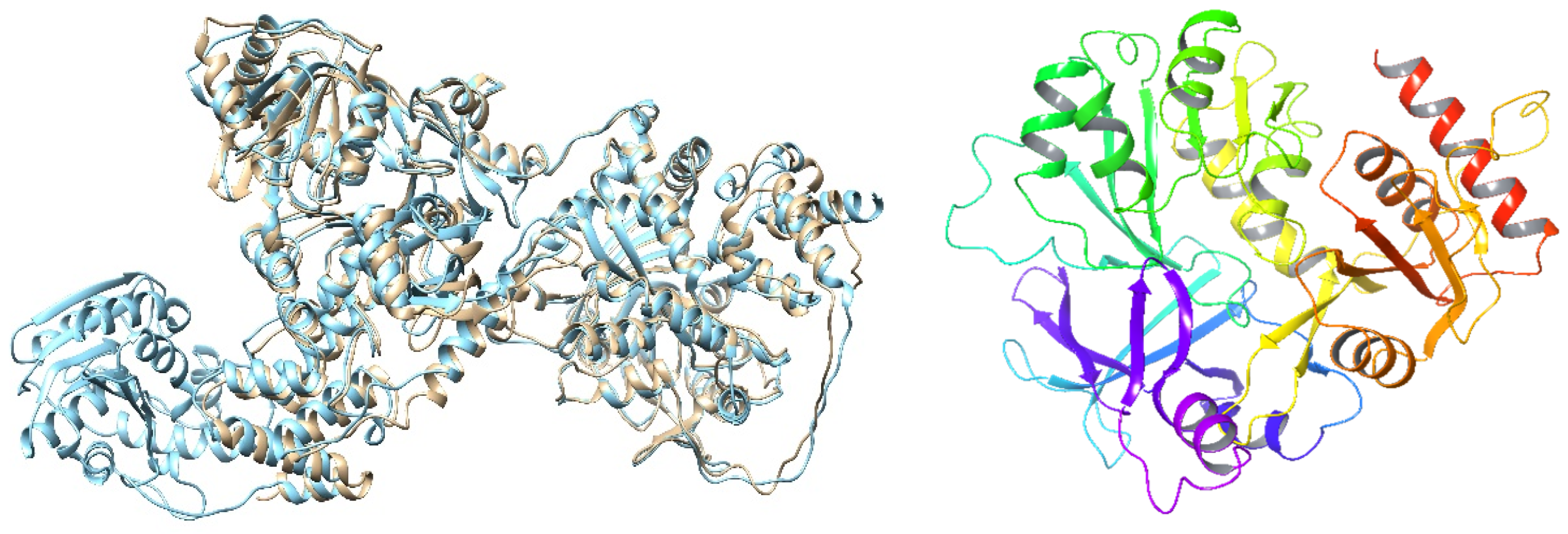
With a binding energy of −6.41 kcal/mol, a Ki of 20.06 µM, and an RMSD of 1.52 Å, redocking of MbtB demonstrated satisfactory stability for a small globular protein. The overlay of the co-crystallized and docked ligand conformations is displayed in
Figure 1.
3.2. Virtual Screening of FDA-Reported Library Through Molecular Docking
Using structure-based drug design, FDA-approved drugs were virtually screened against MbtB to identify safe candidates for TB and AMR therapy. Top hits were selected based on binding energies, docking scores, ligand efficiency, and key interactions, with the ten best-performing molecules detailed in
Table 2.
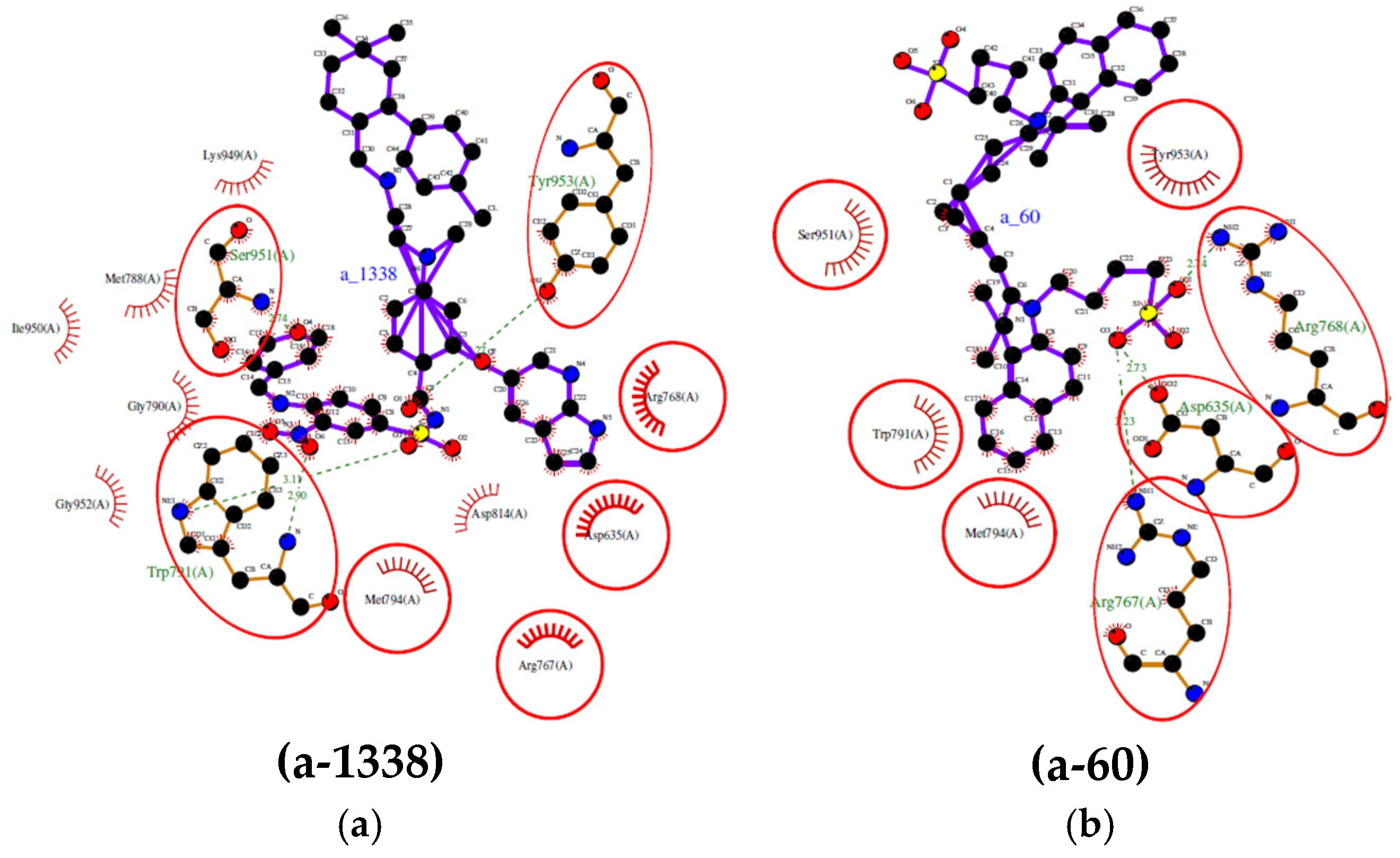
Interaction analysis of the top-scoring compounds obtained through virtual screening.
Molecular docking results are interpreted using descriptors such as binding energy, electrostatic energy, hydrogen bonding, van der Waals energy, and solvation energy. Lower binding energies indicate stronger, more favorable interactions. Electrostatic and van der Waals energies guide ligand orientation and fit, while hydrogen bonds stabilize the complex and enhance specificity. Solvation energies account for physiological context and hydrophobic/hydrophilic balance. Together, these parameters provide a comprehensive view of ligand–receptor compatibility.
4. Principal Component Analysis (PCA)
PCA was used to analyze the primary motions of MbtB-ligand complexes during MD simulations. The first two principal components distinguished the a_1338–MbtB and a_66–MbtB complexes. Notably, both complexes exhibited broader distributions along these components, which is indicative of increased conformational flexibility and a wider range of accessible structural states.
Figure 2. Overall, PCA indicated that ligand binding stabilizes the MbtB active site and restricts essential enzymatic motions, consistent with RMSD, RMSF, Rg, docking scores, and protein–ligand interaction analyses.
5. Discussion
MbtB, essential for mycobactin biosynthesis in M. tuberculosis, was targeted for virtual screening of FDA-approved drugs. Ten top hits showed strong binding (−15.42 to −14.56 kcal/mol), with seven selected for molecular dynamics. Simulations (300 ns) confirmed stable protein–ligand complexes, supported by RMSD, RMSF, Rg, SASA, H-bond, and PCA analyses. Key residues (e.g., Thr462, Gly330, Asp436) mediated stable interactions. These findings suggest seven promising candidates for repurposing as MbtB inhibitors against TB.
6. Conclusions
The rise of drug-resistant Mycobacterium tuberculosis highlights the need for novel therapeutic targets. Our study focused on the dual enzyme system MbtA–MbtB, essential for siderophore biosynthesis and linked to efflux pump activity. Using drug repurposing, FDA-approved drugs were virtually screened against MbtB, leading to the identification of seven promising inhibitors with established ADMET profiles. These findings demonstrate the potential of repurposing existing drugs to disrupt mycobactin biosynthesis and offer a practical strategy against TB and co-infections.
Author Contributions
Conceptualization, V.J. and S.C.; methodology, S.C.; software, S.C.; validation, S.C.; formal analysis, S.C. and V.J.; investigation, S.C.; resources, S.C.; data curation, S.C.; writing—original draft preparation, S.C.; writing—review and editing, S.C. and S.C.; visualization, S.C.; supervision, V.J.; project administration, V.J. All authors have read and agreed to the published version of the manuscript.
Funding
This research received no external funding.
Institutional Review Board Statement
Not applicable.
Informed Consent Statement
Not applicable.
Data Availability Statement
The datasets generated during and analyzed during the current study are available from the corresponding author on reasonable request.
Acknowledgments
The authors express their gratitude to the Department of Pharmaceutical Sciences and Technology at BIT Mesra for providing access to the computational facilities at the CADD laboratory and for granting the use of a workstation to conduct all molecular simulations. Soumi Chakraborty is thankful to Birla Institute of Technology, Mesra. We extend our appreciation to all the open-source Software that has enabled us to conduct our studies with precision.
Conflicts of Interest
The authors declare no conflicts of interest.
References
- Borah, P.; Deb, P.K.; Venugopala, K.N.; Al-Shar’i, N.A.; Singh, V.; Deka, S.; Srivastava, A.; Tiwari, V.; Mailavaram, R.P. Tuberculosis: An Update on Pathophysiology, Molecular Mechanisms of Drug Resistance, Newer Anti-TB Drugs, Treatment Regimens and Host-Directed Therapies. Curr. Top. Med. Chem. 2021, 21, 547–570. [Google Scholar] [CrossRef] [PubMed]
- World Health Organization. Tuberculosis: Key Facts. Available online: https://www.who.int/news-room/fact-sheets/detail/tuberculosis (accessed on 18 September 2025).
- Peddireddy, V.; Doddam, S.N.; Ahmed, N. Mycobacterial Dormancy Systems and Host Responses in Tuberculosis. Front. Immunol. 2017, 8, 84. [Google Scholar] [CrossRef] [PubMed]
- Prasad, R.; Singh, A.; Balasubramanian, V.; Gupta, N. Extensively Drug-Resistant Tuberculosis in India: Current Evidence on Diagnosis & Management. Indian J. Med. Res. 2017, 145, 271. [Google Scholar] [PubMed]
- Velayati, A.A.; Farnia, P.; Hoffner, S. Drug-Resistant Mycobacterium Tuberculosis: Epidemiology and Role of Morphological Alterations. J. Glob. Antimicrob. Resist. 2018, 12, 192–196. [Google Scholar] [CrossRef] [PubMed]
- Rakshit, G.; Jayaprakash, V. Tuberculosis and HIV Responses Threatened by NCOVID-19: A Situation Prompting an in Silico Investigation of Reported MbtA Inhibitors for Combined Inhibition of SARS-CoV-2 and HIV-TB Co-Infection. Struct. Chem. 2023, 34, 655–679. [Google Scholar] [CrossRef]
- Sibi, D.; Sethi Das, C.; Jibin, V.G.; Silvanose, C.D. Emerging Antibiotic Resistance in Post-COVID-19 CoInfections. J. Clin. Med. Case Rep. 2023, 8, 8. [Google Scholar]
- Pawlowski, A.; Jansson, M.; Sköld, M.; Rottenberg, M.E.; Källenius, G. Tuberculosis and HIV Co-Infection. PLoS Pathog. 2012, 8, e1002464. [Google Scholar] [CrossRef] [PubMed]
- Miethke, M.; Marahiel, M.A. Siderophore-Based Iron Acquisition and Pathogen Control. Microbiol. Mol. Biol. Rev. 2007, 71, 413–451. [Google Scholar] [CrossRef] [PubMed]
- Hammer, N.D.; Skaar, E.P. Molecular Mechanisms of Staphylococcus aureus Iron Acquisition. Annu. Rev. Microbiol. 2011, 65, 129–147. [Google Scholar] [CrossRef] [PubMed]
| Disclaimer/Publisher’s Note: The statements, opinions and data contained in all publications are solely those of the individual author(s) and contributor(s) and not of MDPI and/or the editor(s). MDPI and/or the editor(s) disclaim responsibility for any injury to people or property resulting from any ideas, methods, instructions or products referred to in the content. |
© 2025 by the authors. Licensee MDPI, Basel, Switzerland. This article is an open access article distributed under the terms and conditions of the Creative Commons Attribution (CC BY) license (https://creativecommons.org/licenses/by/4.0/).