Abstract
Despite its widespread use in pharmaceuticals, cosmetics, and animal nutrition, the environmental implications of nicotinamide remain largely underexplored. Given its high solubility and prevalent presence in wastewaters, nicotinamide has been proposed as a potential environmental marker and emerging contaminant. This study focuses on the evaluation and modeling of medium and ionic strength effects on the acid-base behavior of nicotinamide in aqueous solution. To this aim, the protonation constants of nicotinamide were determined in aqueous media containing various supporting electrolytes (sodium chloride, tetramethylammonium chloride, tetraethylammonium iodide) at T = 298.15 K and different ionic strengths. The medium and ionic strength dependencies were described through well-established thermodynamic models, including the Extended Debye–Hückel equation, the Specific ion Interaction Theory, and the Pitzer approach. Additionally, the Setschenow constant of nicotinamide was determined through distribution measurements between 1-octanol and NaCl(aq) solutions. Furthermore, a critical data analysis was performed to assess the reliability of the proposed models and provided interaction parameters. Overall, this work thoroughly describes the acid-base behavior of nicotinamide in different aqueous media and its distribution between aqueous and organic phases, offering fundamental insights for the assessment of its chemical speciation in real systems, which is crucial for future applications in environmental monitoring and remediation strategies.
1. Introduction
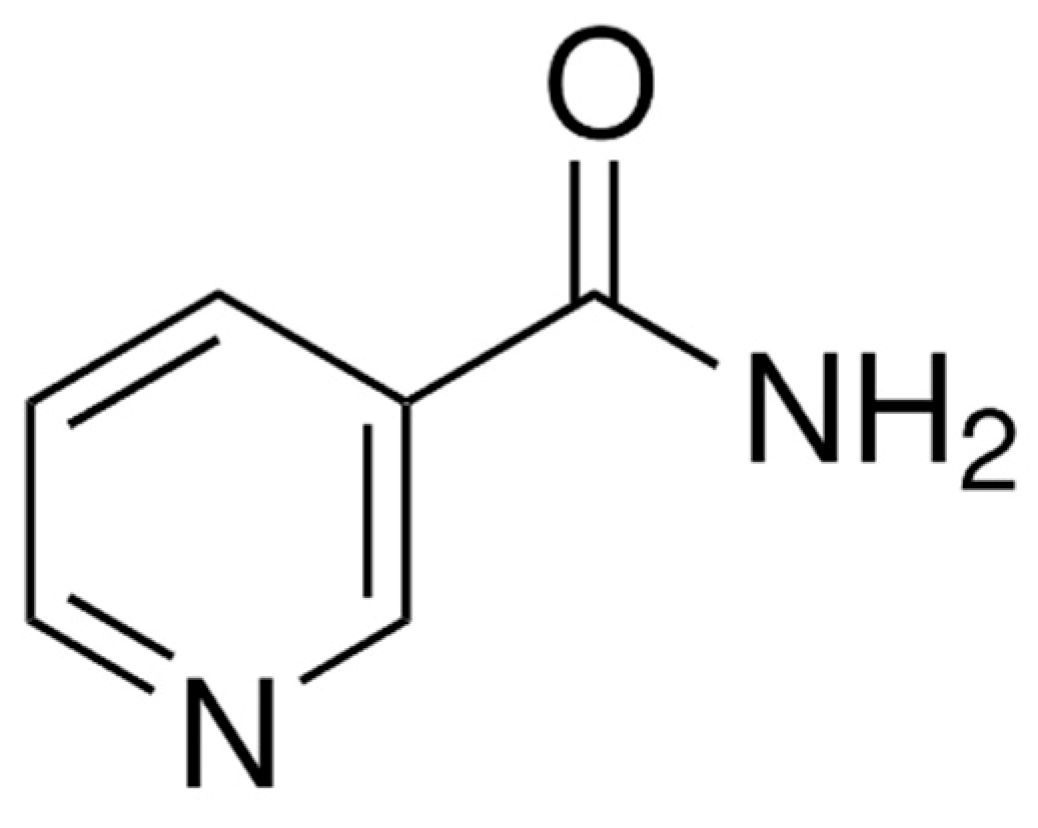
Nicotinamide (Scheme 1, also known as niacinamide; IUPAC name: pyridine-3-carboxamide), the amide form of vitamin B3, is a biologically active compound that plays a key role in cellular metabolism. It serves as a natural precursor of nicotinamide adenine nucleotide (NAD+) and nicotinamide adenine nucleotide phosphate (NADP+), which are involved in a wide range of redox reactions fundamental to energy production, DNA repair, and signal transduction in living organisms [1]. Due to its biochemical significance and structural versatility, nicotinamide has attracted considerable attention across several research fields. In medicine, it has been studied for its anti-inflammatory, antioxidant, and neuroprotective properties, and it is currently used in the treatment of skin problems such as rosacea, pellagra, and acne [2,3,4], as well as in the prevention of type I diabetes mellitus [5]. Insufficient intake of nicotinamide has been associated with an elevated risk of congenital heart defects in infants [6]. In pharmaceutical and nutraceutical sciences, nicotinamide is explored both as a bioactive ligand in the design of metal-based drugs and for the enrichment of grain-derived products [7]. Recently, its non-canonical role as a key driver of cancer cell plasticity has also been highlighted [8]. Although nicotinamide is generally regarded as an essential and environmentally friendly compound with no known toxic effects, its increasing use in pharmaceuticals, cosmetics, agriculture, and nutritional supplements raises concerns about potential environmental and ecological impacts [9,10,11]. While nicotinamide itself is generally considered biodegradable and low-risk at low concentrations, its cumulative discharge into aquatic systems, via wastewater and industrial runoff, may affect microbial communities and aquatic organisms over time [12]. A recent study by Nowacka et al. [13] on quaternary ammonium salts derived from nicotinamide found that, while short-chain derivatives were practically non-toxic, medium- and long-chain analogues exhibited moderate toxicity toward aquatic organisms such as Lemna minor (a freshwater plant), algae, and fish. Nicotinamide has also demonstrated beneficial environmental properties, including the ability to enhance metal tolerance in several plant species [14,15,16,17]. It has also been explored as a green corrosion inhibitor for aluminum in NaCl(aq) and NaOH(aq) solutions [18], and as an electrolyte additive in aqueous zinc-ion batteries [19], contributing to energy storage technologies with potentially low ecological impact. These dual characteristics—low acute toxicity but potential cumulative risk—highlight the importance of balancing its beneficial uses with sustainable management practices, especially considering its rising concentrations in natural and engineered water systems. A recent market analysis estimated that global nicotinamide production exceeded 75,000 tons in 2024. Approximately 65% is allocated to the pharmaceutical and cosmetic industries, while about 25% is used as a dietary supplement in animal husbandry to support health and productivity [20]. Based on these data, the potential for environmental contamination by nicotinamide in both soil and aquatic ecosystems can be inferred. As a result, nicotinamide may reasonably be considered a potential marker compound, as it aligns with key characteristics typically associated with such indicators: high water solubility, widespread transdermal and oral use, and documented presence in wastewater effluents. Despite the current lack of studies specifically focused on nicotinamide, its environmental profile—including fugacity modeling, solubility, and observed occurrence in effluents—suggests that it could serve as a relevant indicator, comparable to other contaminants of emerging concern (CECs) [21]. Chemically, nicotinamide is a heterocyclic molecule featuring a pyridine ring substituted with a carboxamide group at the 3-position, which enables it to form stable complexes by coordinating with metal cations through its nitrogen and oxygen donor atoms. In this context, chemical speciation studies are crucial for characterizing nicotinamide–metal interaction under conditions of biological and environmental relevance. Nevertheless, thermodynamic equilibrium studies on nicotinamide, which are necessary to assess its chemical speciation in biologically and environmentally relevant systems, remain relatively limited in the literature [22,23,24]. Only a few studies report stability constants of nicotinamide with various cations in aqueous solution, while others have been performed in mixed solvents such as water/ethanol and water/dimethyl sulfoxide [25]. In the specific case of its acid-base properties, to our knowledge, Grazdhan et al. [26] provided data in mixed aqueous/organic media, including ethanol and dimethyl sulfoxide, as well as in NaClO4(aq) at I = 0.25 mol dm−3 and T = 298.15 K, whereas data in other aqueous solutions remain scarce [27,28]. Some of these values are available in main databases [29,30,31], generally referring to measurements performed at T = 298.15 K and single ionic strengths.
Scheme 1.
Nicotinamide (L).
In this work, the protonation constants of nicotinamide were determined, by ISE-H+ potentiometric titrations in aqueous solutions containing different supporting electrolytes, namely NaCl(aq), (CH3)4NCl(aq), and (C2H5)4NI(aq), at T = 298.15 K and different ionic strengths. In parallel, distribution studies of nicotinamide between 1-octanol and NaCl(aq) solutions were also performed to determine its Setschenow constants. The obtained data were then used to model the dependency of the acid-base behavior of nicotinamide on medium and ionic strength by well-established thermodynamic models, including the Extended Debye–Hückel equation [32], the Specific ion Interaction Theory [33], and the Pitzer approach [34]. In the latter case, a critical data analysis was performed in terms of reliability of proposed models and provided interaction parameters. Overall, the results contribute to a thorough description of the acid-base behavior of nicotinamide in different aqueous media and its distribution between aqueous and organic phases, providing fundamental information for assessing its chemical speciation in real systems. This is crucial for future applications in environmental monitoring and remediation strategies.
2. Materials and Methods
2.1. Chemicals
All chemicals were purchased from Merck (Darmstadt, Germany) at the highest available purity and were used without further purification. Sodium hydroxide (NaOH), tetramethylammonium hydroxide (CH3)4NOH, tetraethylammonium hydroxide (C2H5)4NOH, and hydrochloric acid (HCl) solutions were prepared from concentrated stock solutions and standardized against potassium hydrogen phthalate (for bases) or sodium carbonate (for acid), both previously dried in an oven at T = 383.15 K for 2 h. Sodium chloride (NaCl), tetramethylammonium chloride (CH3)4NCl and tetraethylammonium iodide (C2H5)4NI (the last two purified before use [35]) solutions were prepared by weighing the solids, previously dried in an oven at T = 383.15 K for 2 h. The concentration of nicotinamide in the solutions was determined by alkalimetric titrations. Strong base solutions were stored in dark bottles, and soda lime traps were used to prevent the dissolution of carbon dioxide (CO2(g)). All solutions were freshly prepared using grade A glassware and ultrapure water (ρ ≥ 18 MΩ cm−1).
2.2. Apparatus and Procedure for Potentiometric Measurements
Potentiometric titrations were performed by using Thermo Scientific, Beverly, MA, USA, apparatus consisting of a combined ISE-H+ glass electrode (Orion 8102 ROSS Ultra) coupled to a potentiometric titrator (Orion Star T940), with accuracy of ±0.002 cm3 for titrant volume and ±0.2 mV for e.m.f. readings. All titrations were carried out in double jacketed glass cells, at T = 298.15 K, kept using a D1-G Haake thermostatic bath (Karlsruhe, Germany) (uncertainty ±0.1 K), under magnetic stirring and continuous N2(g) bubbling to prevent the presence of CO2(g) and O2(g) in solution. Solutions of 25 cm3 were prepared with various concentrations of nicotinamide (2 ≤ cL/mmol dm−3 ≤ 6), HCl(aq) (8 ≤ cH/mmol dm−3 ≤ 10) and background salt (0 < I/mol dm−3 ≤ 1). These were titrated up to pH~10 using standardized NaOH(aq), (CH3)4NOH(aq) or (C2H5)4NOH(aq), in agreement with the selected ionic media, recording 100–120 data points per titration. Each measurement was preceded by electrode calibration (in terms of free H+ concentration, where pH ≡ −log[H+]) via alkalimetric titrations of HCl(aq) (using NaOH(aq), or (CH3)4NOH(aq) or (C2H5)4NOH(aq) under the same temperature, ionic medium, and ionic strength conditions of the subsequent measurements, determining E0 and log Kw.
2.3. Apparatus and Procedure 1-Octanol/Water Distribution Measurements
The log KD values of nicotinamide were determined by the use of the classic shake-flask method [36]. Water and 1-octanol were mutually saturated before the equilibration experiments. A total of 25 cm3 of aqueous solutions containing nicotinamide at known concentrations (cL~10–15 mmol dm−3) and NaCl(aq) (0 < I/mmol dm−3 ≤ 1.0) were added to equal volumes of saturated 1-octanol in 50 cm3 volumetric flasks. The solutions were then shaken for a minimum of 4–6 h in a custom-built thermostatic box protected from light and maintained at constant temperature of T = 298.15 ± 0.10 K. Shaking was carried out using an IKA HS 260 Basic compact flat shaker (Staufen im Breisgau, Germany), which provided optimal swivel motion at 210 rpm. After 24 h of equilibration after shaking, 20 cm3 of the aqueous phases were collected and analyzed by potentiometric titrations to determine the total ligand concentration. The absence of nicotinamide degradation was checked by retative UV-Vis spectra of nicotinamide in water, octanol, and water/octanol mixtures over time, up to approximately 24 h, verifying their superimposition (for each solvent). The ligand concentrations in the organic phase were calculated by difference between the total initial concentrations and those determined in the aqueous phase after equilibrium. To minimize random errors, measurements were repeated at least three times for each experimental condition.
2.4. Calculations
The BSTAC software v0.1.1 [37] was used to determine the protonation constants of nicotinamide, as well as all parameters related to the potentiometric titrations: standard potential (E0), ionic product of water (pKw) and the acidic junction coefficient (ja). The non-linear least square computer program LIANA was used to fit different equations [37]. Conversions from molar (mol dm−3) to the molal (mol kg−1 (H2O)) concentration scales were performed using the appropriate densities [38]. The speciation diagrams were drawn by means of the PyES program [32]. Protonation constants are expressed according to the equilibrium:
where L stands for the fully deprotonated ligand (uncharged).
2.4.1. Medium and Ionic Strength Dependence of Protonation Constants
The dependence of the protonation constants of nicotinamide on medium and ionic strength in the molar concentration scale was taken into account by an Extended Debye-Hückel (EDH) type equation [32]
where is the value at infinite dilution, C is an empirical parameter that can be further split into two terms depending on and p*:
z* is the summation of the squared charges of reactants minus those of the products of species involved in the considered equilibrium
while is the summation of the stoichiometric coefficients (not squared) of reactants minus those of products:
When ionic strength and protonation constants are expressed in the molal concentration scale (mol kg−1 (H2O)), Equation (2) represents the classical SIT (Specific ion Interaction Theory) equation, where C is replaced by Δε (SIT interaction coefficients). The latter was applied to the protonation constants in the three investigated ionic media after appropriate [39] molar to molal conversions, together with the simplified Pitzer approach [40], according to the equation:
where
and p1, p2, p3 are adjustable parameters representing the summation (with sign) of all coefficients of classical Pitzer equations. In particular, for a 1:1 MX electrolyte, p1, accounts for β(0), λ and θ terms; p2 for Cϕ and ψ; and p3 for β(1) (please note that one or more of these coefficients may not be present in the classical Pitzer formalism for the considered interactions).
2.4.2. Distribution, Activity Coefficients and Setschenow Constants
The distribution constants of nicotinamide between 1-octanol and NaCl(aq) solutions were fitted to Equation (7):
where is the distribution constant for msalt ⟶ 0 and is the Setschenow constant of nicotinamide. The latter is, in turn, directly related to the activity coefficients of nicotinamide in aqueous solution at different NaCl(aq) concentrations:
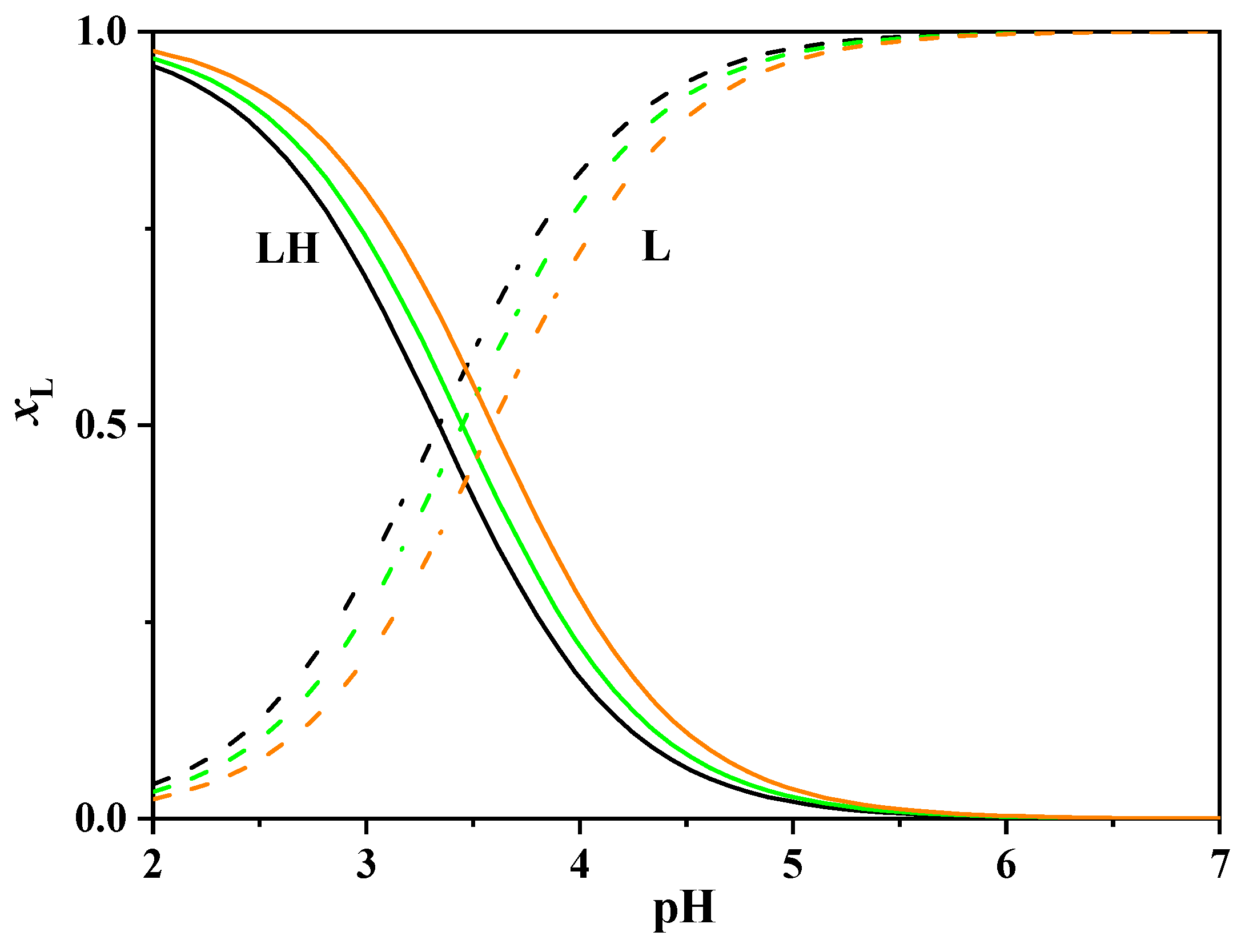
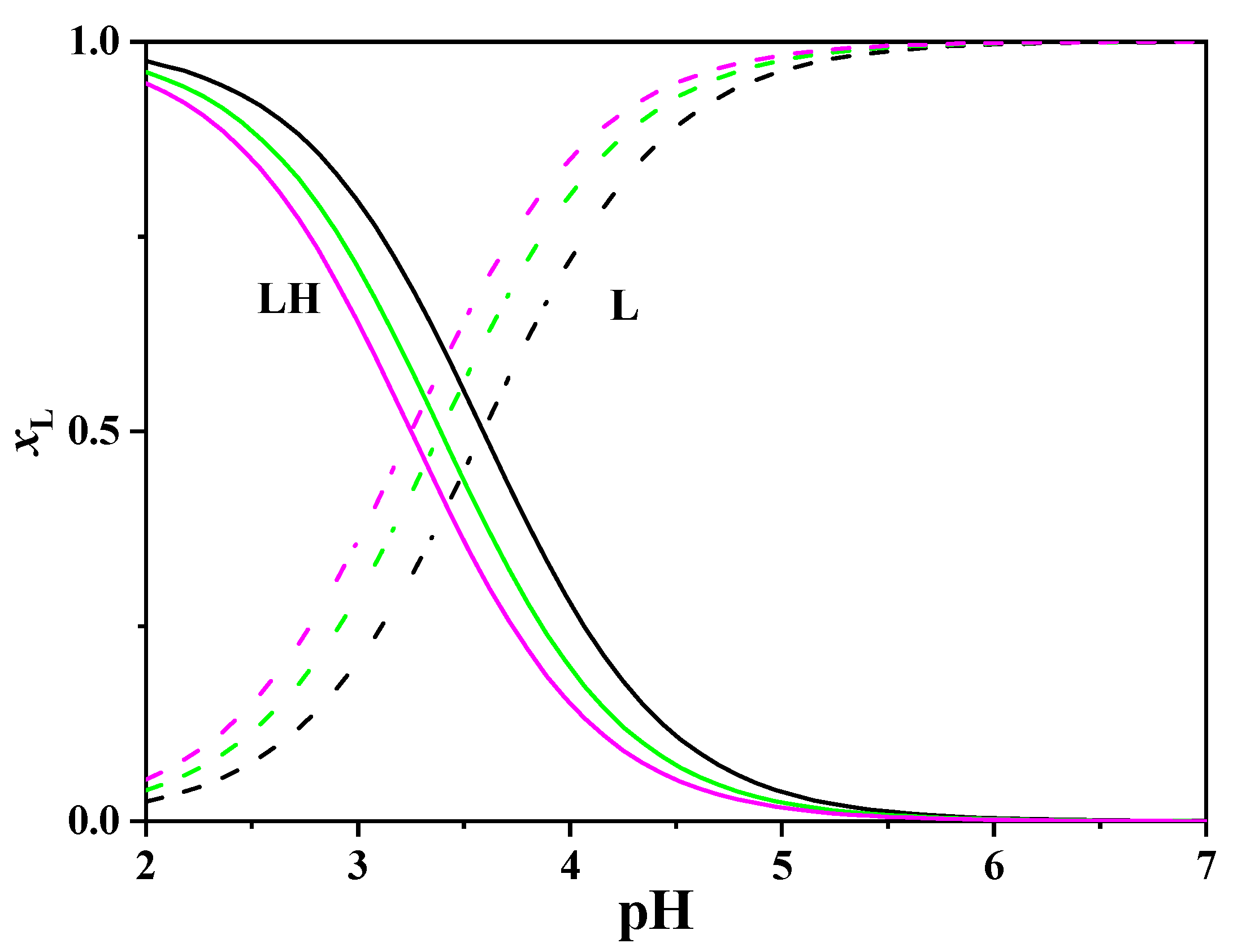
Similar equations can be written in the molar concentration scale with kc replacing km and csalt instead of msalt. Noteworthy, Equation (8) is strictly valid only if dissociation/protonation equilibria do not occur, or if they are considered (by simple mass balance equations) to derive the concentration of the neutral species in the aqueous phase. Fortunately, at the pH experimentally measured during distribution measurements (always pH > 6), nicotinamide is totally present in its neutral form (i.e., unprotonated, see speciation diagrams in Figure 1 and Figure 2), so that cL ≡ [L]. Further details can be found, e.g., in refs. [41,42,43,44,45,46].
Figure 1.
Speciation diagrams (molar fraction of L vs. pH) of nicotinamide in NaCl(aq) at T = 298.15 K and I = 0.1 (black), 0.5 (green) and 1.0 (orange) mol dm−3. Solid lines are relative to protonated LH+ species, dashed lines refer to free nicotinamide species. Analytical concentrations: cL = 0.010 mol dm−3.
Figure 2.
Speciation diagrams (molar fraction of L vs. pH) of nicotinamide at T = 298.15 K and I = 1.0 mol dm−3 in NaCl(aq) (black), (CH3)4NCl(aq) (green), (C2H5)4NI(aq) (magenta). Solid lines are relative to protonated LH+ species, dashed lines refer to free nicotinamide species. Analytical concentrations: cL = 0.010 mol dm−3.
2.4.3. Classical SIT and Pitzer Approaches
When applying the classical SIT approach to the equilibrium (Equation (1)) relative to the protonation constant of nicotinamide, in Equation (2) becomes:
where and are the classical SIT coefficients accounting for the specific interaction between H+ and HL+ species, respectively, with the counterion of the supporting electrolyte (), and is the Setschenow constant of the neutral nicotinamide (L). The experimental determination of this constant in NaCl(aq) as above described, together with the availability of [47], makes it possible to apply the classical SIT approach to nicotinamide protonation in chloride media (otherwise the number of unknowns would make the system of equations indetermined, as in the case of data in (C2H5)4NI(aq), allowing the calculation of both and in (CH3)4NCl(aq). Noteworthy, the calculation of the latter is only possible because, according to classical SIT theory, must be the same in all chloride media (i.e., NaCl(aq) and (CH3)4NCl(aq) and, therefore, in Equation (9) becomes the only unknown in (CH3)4NCl(aq) after is calculated from data in NaCl(aq). More interestingly, this means that, according to classical SIT, the medium effect determining the differences between the protonation constants in NaCl(aq) and (CH3)4NCl(aq) at given ionic strength should only be ascribed to the difference in the activity coefficient of neutral nicotinamide in the two media.
Similarly, the availability of Setschenow constants allows the use of the classical Pitzer formalism to model the dependence of the protonation constant of nicotinamide on medium and ionic strength. The theory of the Pitzer model and general equations can be found, e.g., in refs. [34,48,49,50], while for its direct application to protonation equilibria one can also refer, e.g., to refs. [51,52,53,54]. Here, we only report the equations specifically referred to nicotinamide protonation in NaCl(aq) and (CH3)4NCl(aq). The relative protonation constants at different ionic strengths are given by
where according to Pitzer equations:
with M = Na+ or (CH3)4N+.
3. Results and Discussion
3.1. Distribution Measurements
The 1-octanol/water distribution constant (KD), commonly expressed in the logarithmic form (log KD), represents the ratio between the concentration of a chemical in an 1-octanol phase and that in an aqueous phase at equilibrium, typically measured at T = 298.15 K [55]. Log KD provides insight into a compound’s tendency to solubilize into lipids: positive log KD values generally indicate hydrophobicity, with higher values corresponding to stronger hydrophobic nature; values exceeding 3 typically classify a highly hydrophobic chemical [55]. However, this classification is usually based on in silico screening methods using quantitative structure–property relationships, with few experimental reports on precise log KD values. Log KD experimentally determined at different NaCl(aq) concentrations are reported in Table 1.
Table 1.
Distribution constants of nicotinamide between 1-octanol and water with NaCl(aq) at T = 298.15 K and different ionic strength.
The fitting of these data to Equation (7) allowed the calculation of both the distribution constants at infinite dilution () and the Setschenow constants of nicotinamide in NaCl(aq): = –0.245 ± 0.0x and –0.247 ± 0.0x in the molar and molal concentration scales, respectively, while kc = 0.232 ± 0.07 and km = 0.230 ± 0.07. The log KD value is quite in agreement with the estimated value [36] of –0.38 at T = 295.15 K, whereas no experimental data were present in the literature for the Setschenow constants of nicotinamide. De Stefano et al. [56] proposed a regression tree algorithm to predict Setschenow constants of several organic molecules. Using such chemometric model for nicotinamide, the estimated value is 0.13 ± 0.04. Experimental log KD indicate an inherent hydrophilicity of nicotinamide, while the positive Setschenow constant indicates a mild salting-out effect in the presence of electrolytes. This observation suggests that, although nicotinamide is predominantly hydrophilic, as reflected by its negative distribution constant, it retains a slight hydrophobic character, likely associated with the pyridine ring. Consequently, the addition of salts slightly decreases its aqueous solubility, consistent with the general correlation between positive Setschenow constants and the salting-out phenomenon observed for moderately polar solutes.
3.2. Protonation Constants of Nicotinamide
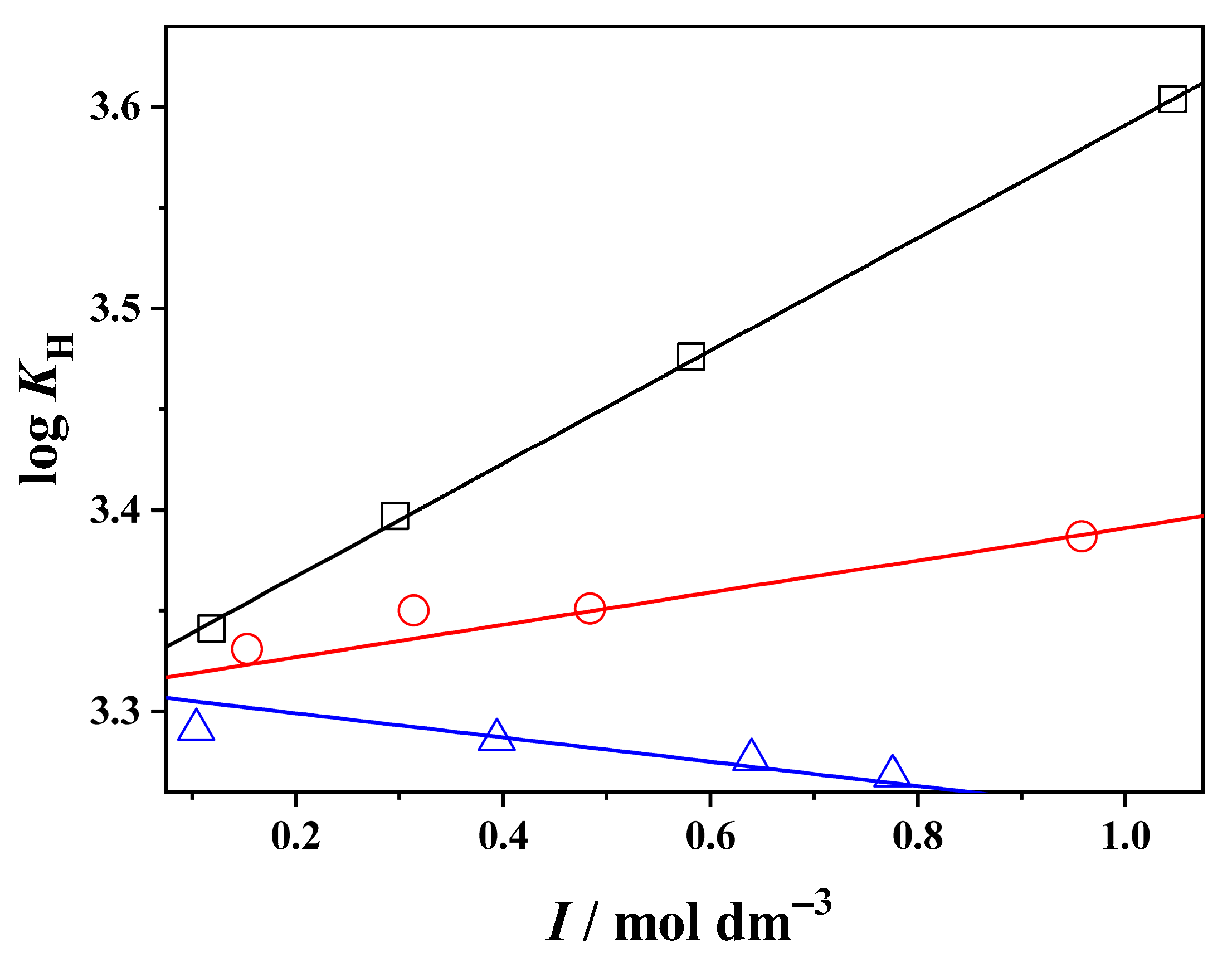
The experimental protonation constants determined in NaCl(aq), (CH3)4NCl(aq), and (C2H5)4NI(aq) at different ionic strengths and T = 298.15 K (Figure 3) are presented in Table 2 in both molar and molal concentration scales. The results agree with the limited data available in the literature [29,30,31]. Specifically, log KH = 3.35 is reported at T = 293.15 K and I = 0, and log KH = 3.31 and 3.41 at T = 298.15 K and I = 0.1 and 0.5 mol dm−3, respectively.
Figure 3.
Protonation constants of nicotinamide vs. ionic strength (molar scale) in NaCl(aq) (squares, black), (CH3)4NCl(aq) (circles, red), and (C2H5)4NI(aq) (triangles, blue), at T = 298.15 K. Lines represent the fitting by the EDH equation (Equation (2)), refined parameters in Table 3).
Table 2.
Protonation constants of nicotinamide in NaCl(aq), (CH3)4NCl(aq) and (C2H5)NI(aq) at T = 298.15 K and different ionic strength.
As is known, nicotinamide is protonated at the pyridine nitrogen, but the proton in the former is more acidic than in the latter (i.e., log KH = 5.20 at T = 298.15 K and I = 0 for Pyridine). This is also consistent with the behavior of pyridines bearing a carbonyl group in the 3-position (i.e., log KH = 4.82 at T = 298.15 K and I = 0 for nicotinic acid) [29,30,31,57]. Most importantly, the acid-base behavior of nicotinamide not only depends on ionic strength, but it is significantly influenced by the ionic medium too, as evidenced plotting the protonation constants in the three investigated media as a function of ionic strength (in the molar scale, Figure 3).
These differences have a direct effect on the fraction of protonated and free nicotinamide and, thus, they may significantly influence its speciation at certain pH. For example, increasing ionic strength from 0.1 to 1.0 mol dm−3 in NaCl(aq) reduces the fraction of free nicotinamide (in favor of the protonated form) of ~15% at pH ~3 (Figure 1), whereas, at I = 1.0 mol dm−3, this difference reaches ~20% changing medium from (C2H5)4NI(aq) to NaCl(aq) (Figure 2).
Protonation data analysis highlights at least two interesting features: (1) the ionic strength effect is more marked in NaCl(aq) than in tetraalkylammonium salts (from I ~0.1 to ~1.0 mol dm−3, Δlog KH ~0.26 in NaCl(aq), vs. ~0.04 and ~0.02 in (CH3)4NCl(aq) and (C2H5)4NI(aq), respectively); (2) at similar ionic strength, log KH follows the trend NaCl(aq) > (CH3)4NCl(aq) ≥ (C2H5)4NI(aq). Both aspects are an indirect confirmation of a weaker interaction of alkali metal cations (Na+ in our case) than tetraalkylammonium cations (i.e., (CH3)4N+ and (C2H5)4NI+ with amino groups (like the pyridinic nitrogen of nicotinamide, involved in the protonation equilibrium) [32,58,59]. In fact, for a generic equilibrium, the greater the interaction of ions of the background salt with reactants, the lower the stoichiometric/apparent equilibrium constant is (obviously, the opposite occurs for products) [33]. Furthermore, stronger interactions with the ions of the supporting electrolyte contribute to lower the effect of ionic strength (flattening ionic strength dependence curves), since increasing it means increasing the concentration of the interacting ions and, thus, increasing deviations from the theorized Debye–Hückel trend [33].
3.3. Medium and Ionic Strength Dependence of Protonation Constant: EDH and Simplified SIT and Pitzer Approaches
As detailed in the experimental section, the dependence of the protonation constant of nicotinamide on medium and ionic strength was modeled by an EDH equation for data in the molar scale, and by the simplified SIT and Pitzer equations for the molal scale. Optimized parameters for the three investigated media are reported in Table 3 together with the corresponding protonation constant(s) at infinite dilution.
Table 3.
Parameters a of EDH b, simplified SIT c and simplified Pitzer d equations for the dependence of the protonation constants of nicotinamide on ionic strength, in NaCl(aq), (CH3)4NCl(aq), and (C2H5)4NI(aq), at T = 298.15 K.
Data reported in Table 3 need some comments, especially in relation to the simplified Pitzer approach. Of the three used fitting functions, the latter is so far that with the higher number of adjustable parameters (i.e., 2 for EDH and simplified SIT, including , constrained for all models, and 4 for simplified Pitzer). This holds for both the classical and simplified approaches. With a relatively limited number of experimental data (i.e., 12 experimentally determined protonation constants, 4 for each medium—see Table 1), the risk of over-parametrization is higher in Pitzer than in the two other equations. To better highlight this aspect, an F-test (at a 0.05 significance level) was carried out by considering all possible combinations of the p1, p2, and p3 parameters (results in Table S2). Some models with fewer adjustable parameters are not statistically different than the accepted one (with three parameters), which would allow one to choose a simpler model. However, it is important to emphasize that the choice to use three parameters was not solely made to improve the fit; rather, it reflects the fact that these are not purely empirical parameters, but each one is directly related to the classical Pitzer coefficients, thus they have a well-defined physicochemical meaning. Neglecting one or more parameters would have been more correct from a statistical point of view, but it would have prevented a meaningful comparison with the classical Pitzer model. Noteworthy, although over-parameterization is recognized as inappropriate and highly discouraged by these authors, it is also worth mentioning that this is anything but rare in the literature when looking at Pitzer models. In fact, high correlation between Pitzer coefficients has always represented one of the main issues behind its theory [33,34]. This is reflected in the high uncertainties reported for Pitzer coefficients in Table 3, which are sometimes comparable with the refined values of the corresponding parameters, clearly showing that some of them could be neglected (i.e., null). Maybe, this is also the reason why, very often, the literature Pitzer coefficients are reported in many papers and collections without associated uncertainties and with not less than three significant digits [40]. For this reason, though this practice should always be discouraged when reporting any kind of parameter/coefficient coming from data fitting, three digits were still kept for adjusted Pitzer coefficients in Table 3.
3.4. Medium and Ionic Strength Dependence of Protonation Constant: Classical SIT and Pitzer Approaches
The application of the simplified SIT and Pitzer models is particularly advantageous when the calculation of the interaction and/or activity coefficients of individual species is not possible. This typically occurs when the system of equations that should be considered during fittings is lower than the number of adjustable parameters, making the system of equations undetermined. A typical example is often represented by the lack of information related to the activity coefficients of neutral species, and/or their interaction coefficients. In these cases, a common strategy is to make some approximations (e.g., considering the activity coefficient of the neutral species as = 1, and/or estimating some coefficients from those of similar systems [33]). However, interaction coefficients obtained in this way are unavoidably affected by systematic errors, influencing, in turn, the modeling ability of proposed equations, at least unless self-consistency is maintained (i.e., keeping using the same approximations in all subsequent modeled systems).
Distribution measurements performed in this work allowed the calculation, through the relative Setschenow constant, of the activity coefficients of neutral nicotinamide in NaCl(aq). Consequently, we were able to apply the classical SIT and Pitzer approaches at least to model the dependence of the protonation constants of nicotinamide in NaCl(aq) and, having the interaction with Cl− in common, in (CH3)4NCl(aq), too. In particular, the simultaneous data fitting to both classical SIT and Pitzer equations allowed the calculation of the Setschenow constant of neutral nicotinamide in (CH3)4NCl(aq). Literature SIT and Pitzer coefficients used during calculations, together with values calculated in this work (including km in (CH3)4NCl(aq)), are reported in Table 4.
Table 4.
Medium and ionic strength dependence parameters of nicotinamide (L) and its protonated species (HL+) according to classical SIT and Pitzer models, including Setschenow constants, in NaCl(aq) and (CH3)4NCl(aq), at T = 298.15 K.
A careful analysis of parameters in Table 4 reveals another interesting aspect. Data treatment using the SIT approach is straightforward, since the nature and number of SIT coefficients to consider are well established by the theory behind the model (in our case, the specific interaction of protons with chloride, that of HL+ species with the same anion, and the activity coefficients/Setschenow constants of neutral nicotinamide in the two media). Conversely, the classical Pitzer approach allows us to consider or neglect some of its coefficients, opening the possibility to different fitting models. As such, several tests must be performed to choose the best. It should be kept in mind that the selection of one or another model cannot be only done on the basis of the simple quality of fitting parameters (e.g., standard deviations, correlation coefficients, etc.), but chemical evaluations of the system under study and experience in Pitzer modeling (e.g., to minimize the effects of the above-cited over-parametrization and co-linearity) should play a key role in the final decision. Further details on the tested models and the selection criteria are provided in the Supplementary Materials. In the case of the model proposed in Table 4, it can be noted that coefficient for the interaction of protonated nicotinamide with chloride is missing, while the and coefficients are considered. In addition to the fairly good uncertainty associated with the two parameters, a direct comparison of simplified Pitzer coefficients for NaCl(aq) and (CH3)4NCl(aq) (Table 3) is helpful to support the choice taken (always keeping in mind the above-discussion about the possibility that some px parameters of Table 3 can be null, based on the corresponding standard deviations). Relatively low differences between p3 are expected, since this parameter accounts for and , which are common for both ionic media. Similarly, slight differences in p1 can be further ascribed to the differences in λ terms (directly related to Setschenow constants) for the interaction of neutral nicotinamide with both cations and anions in NaCl(aq) and (CH3)4NCl(aq), respectively, and, eventually, to same sign terms (Θ), since and are common too. On the contrary, differences between p2 in NaCl(aq) and in (CH3)4NCl(aq) can hardly be justified by the sole presence of , since this value is very close to 0 (−0.004) and = 0. Of the other potentially included , is in common in the two media, and the same would be if would have been considered in the model. So, this possible model was rejected (but tested). It is thus evident that the difference in p2 can only be due to other terms most likely accounting for triple interactions, i.e., and/or . For the sake of correctness, one must say that, for the system considered, the attempt to simultaneously calculate both parameters is not possible because it would give an undetermined system of equations and further experimental data would be necessary (e.g., protonation constants determined in different mixtures of the two electrolytes). As such, tests for the calculation of one or the other coefficients were made, aware that the value of the selected coefficient would eventually be affected (at least marginally) by the absence of the other. Of the two possibilities, the model with gave slightly better fitting results and was thus included in the final model. Furthermore, this choice is also partially supported by the fact that the analysis of the protonation constants in the two chloride media (Table 1) gave already evidence of higher interactions with (CH3)4N+ than Na+, as already discussed. However, one must highlight once again that the two models are only marginally different. Overall, the discussion on the Pitzer coefficients further highlights two main facts. First, the Pitzer approach can be quite complex even for relatively simple systems like the protonation of nicotinamide; second, particular attention should always be paid either when determining these coefficients or simply using them in modeling, since their reliability and applicability depends on several factors.
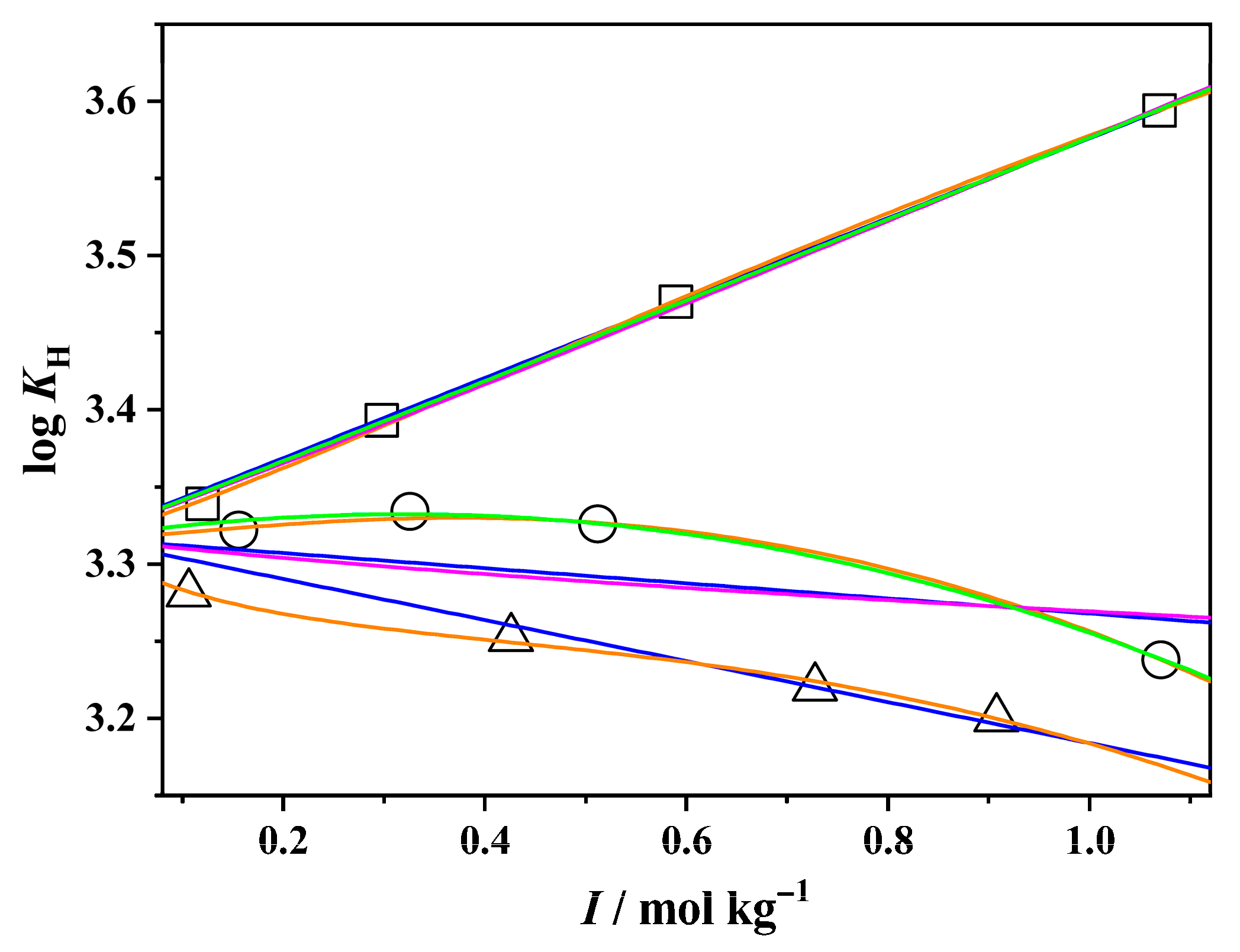
Finally, considerations done on the different approaches (simplified and classical SIT and Pitzer) can be more easily visualized and derived looking at Figure 4, where the experimental protonation constants in the three ionic media are reported at different ionic strengths together with the curves obtained by the four models (i.e., simplified SIT in blue, simplified Pitzer in orange, classical SIT in magenta, and classical Pitzer in green).
Figure 4.
Protonation constants of nicotinamide vs. ionic strength (molal scale) in NaCl(aq) (squares), (CH3)4NCl(aq) (circles), and (C2H5)4NI(aq) (triangles), at T = 298.15 K. Lines represent the fitting by the different models: simplified SIT in blue, simplified Pitzer in orange, classical SIT in magenta, and classical Pitzer in green.
Summarizing:
- (1)
- Simplified vs. classical approaches are absolutely equivalent in terms of modeling power.
- (2)
- Pitzer is better than SIT to model non-canonical dependencies (e.g., data in (CH3)4NCl(aq) that slightly deviate from the linear behavior for nicotinamide protonation equilibrium with z* = 0): the former can also account for interactions not explicitly considered in the latter (e.g., same sign and triple interactions).
- (3)
- SIT is better than Pitzer to model canonical dependencies (e.g., data in (C2H5)4NCl(aq) that have a fairly linear behavior for nicotinamide protonation equilibrium with z* = 0): the former does not show over-parametrization and/or co-linearity issues.
- (4)
- Although it was recognized that a reduced number of parameters could have been employed, the decision was made to retain all three parameters (p1, p2, p3) in order to explicitly highlight these differences, namely the challenges associated with over-parameterization.
4. Conclusions
In this work, the protonation constants of nicotinamide were determined at T = 298.15 K over the ionic strength range 0 < I/mol dm−3 ≤ 1.0 in NaCl(aq), (CH3)4NCl(aq) and (C2H5)4NI(aq), in order to investigate the ionic strength and medium effects on the acid-base properties of this ligand. Under the adopted experimental conditions, ionic strength has a significant influence only in NaCl(aq), where the protonation constant of nicotinamide linearly increases with I (with Δlog KH ~0.26 going from I ~0.1 to ~1.0 mol dm−3). In contrast, this trend is slightly inverted in (CH3)4NCl(aq) and (C2H5)4NI(aq), although the observed minimal differences. Reversely, at constant ionic strength, the nature of the ionic medium strongly affects the values of the protonation constant, with Δlog KH ~0.33 between NaCl(aq) (higher) and (C2H5)4NI(aq) (lower) at I = 1.0 mol dm−3. Furthermore, the ionic strength effect on the distribution of neutral nicotinamide between 1-octanol and different NaCl(aq) solutions was also investigated, allowing the determination of the corresponding Setschenow constant in this medium.
The protonation constants obtained in different media and at various ionic strengths were then fitted using the EDH, SIT, and Pitzer equations, to obtain the corresponding medium and ionic strength dependence parameters. For SIT and Pitzer models, both simplified and classical approaches were adopted. The different models were thoroughly compared to highlight their respective advantages and limitations, not necessarily in terms of goodness of fits and modeling power, but, mainly, focusing on their reliability and applicability from a chemical point of view. In particular, the results clearly demonstrate how, in this kind of study, the selection of a model cannot only be based on the simple analysis of statistical parameters, and it cannot disregard a chemical evaluation of the model.
Overall, the results and insights reported in this work contribute to a comprehensive understanding of the acid–base properties of nicotinamide and its distribution between aqueous and organic phases over a wide range of ionic strengths and medium conditions.
This knowledge provides a fundamental basis for future environmental studies and analytical applications involving this emerging contaminant in surface and wastewaters [61,62,63].
Supplementary Materials
The following supporting information can be downloaded at: https://www.mdpi.com/article/10.3390/analytica7020036/s1, Details on the selection criteria of Pitzer interaction coefficients and Tested Pitzer models. Table S1. Standard deviation and mean deviation at each single ionic strength; Table S2. Standard deviation in the determination of the single p and for their combination F-test (at a 0.05 significance level); Table S3. Tested classical Pitzer models.
Author Contributions
Conceptualization, C.B. and C.D.S.; methodology, R.C., C.B. and S.G.; validation, C.D.S. and D.M.; formal analysis, C.B., S.G. and D.M.; investigation, R.C., C.B. and S.G.; resources, C.D.S. and D.M.; data curation, C.B., S.G. and D.M.; writing—original draft preparation, R.C., C.B. and S.G.; writing—review and editing, C.D.S., S.G. and D.M.; visualization, R.C., C.B. and S.G.; supervision, C.B., C.D.S. and D.M.; project administration, C.B. and D.M.; funding acquisition, D.M. All authors have read and agreed to the published version of the manuscript.
Funding
This research was funded by the Italian Ministry of Education, University and Research that financed the project TRILLI—TRansforming metal Ions and Low-cost LIgands into next-generation metallodrugs. A thermodynamic, spectroscopic, and biological approach for their rational design; COD_PROG PRIN_2022APCTNA_002, CUP J53C24002490006.
Data Availability Statement
Dataset available on request from the authors.
Conflicts of Interest
The authors declare no conflicts of interest.
References
- Chen, M.; Yuan, L.; Chen, B.; Chang, H.; Luo, J.; Zhang, H.; Chen, Z.; Kong, J.; Yi, Y.; Bai, M.; et al. SLC29A1 and SLC29A2 are human nicotinamide cell membrane transporters. Nat. Commun. 2025, 16, 1181. [Google Scholar] [CrossRef]
- Andersen, H.U.; Jørgensen, K.H.; Egeberg, J.; Mandrup-Poulsen, T.; Nerup, J. Nicotinamide Prevents Interleukin-1 Effects on Accumulated Insulin Release and Nitric Oxide Production in Rat Islets of Langerhans. Diabetes 1994, 43, 770–777. [Google Scholar] [CrossRef]
- Knip, M.; Douek, I.F.; Moore, W.P.; Gillmor, H.A.; McLean, A.E.; Bingley, P.J.; Gale, E.A. Safety of high-dose nicotinamide: A review. Diabetologia 2000, 43, 1337–1345. [Google Scholar] [CrossRef]
- Shukla, A.G.; Cioffi, G.A.; John, S.W.M.; Wang, Q.; Liebmann, J.M. American Glaucoma Society-American Academy of Ophthalmology Position Statement on Nicotinamide Use for Glaucoma Neuroprotection. Ophthalmol. Glaucoma 2025, 8, 112–116. [Google Scholar] [CrossRef] [PubMed]
- Kamal, M.; Abbasy, A.-J.; Muslemani, A.; Bener, A. Effect of nicotinamide on newly diagnosed type 1 diabetic children. Acta Pharmacol. Sin. 2006, 27, 724–727. [Google Scholar] [CrossRef][Green Version]
- van Driel, L.M.J.W.; Smedts, H.P.M.; Helbing, W.A.; Isaacs, A.; Lindemans, J.; Uitterlinden, A.G.; van Duijn, C.M.; de Vries, J.H.M.; Steegers, E.A.P.; Steegers-Theunissen, R.P.M. Eight-fold increased risk for congenital heart defects in children carrying the nicotinamide N-methyltransferase polymorphism and exposed to medicines and low nicotinamide. Eur. Heart J. 2008, 29, 1424–1431. [Google Scholar] [CrossRef] [PubMed]
- Meng, Y.; Ren, Z.; Xu, F.; Zhou, X.; Song, C.; Wang, V.Y.; Liu, W.; Lu, L.; Thomson, J.A.; Chen, G. Nicotinamide Promotes Cell Survival and Differentiation as Kinase Inhibitor in Human Pluripotent Stem Cells. Stem Cell Rep. 2018, 11, 1347–1356. [Google Scholar] [CrossRef]
- Narayanan, A.; Saurty-Seerunghen, M.S.; Michieletto, J.; Delaunay, V.; Bruneel, A.; Dupré, T.; Ottolenghi, C.; Pontoizeau, C.; Ciccone, L.; De La Vara, A.; et al. Nicotinamide metabolism reprogramming drives reversible senescence of glioblastoma cells. Cell. Mol. Life Sci. 2025, 82, 126. [Google Scholar] [CrossRef] [PubMed]
- Stachowiak, W.; Kaczmarek, D.K.; Rzemieniecki, T.; Niemczak, M. Sustainable Design of New Ionic Forms of Vitamin B(3) and Their Utilization as Plant Protection Agents. J. Agric. Food Chem. 2022, 70, 8222–8232. [Google Scholar] [CrossRef]
- Olejniczak, A.; Stachowiak, W.; Ziental, D.; Długaszewska, J.; Rzemieniecki, T.; Wysokowski, M.; Jesionowski, T.; Niemczak, M. Unraveling the Potential of Vitamin B3-Derived Salts with a Salicylate Anion as Dermal Active Agents for Acne Treatment. Mol. Pharm. 2024, 21, 4634–4647. [Google Scholar] [CrossRef]
- Bayne, A.-C.V.; Pessi, J.; Bird, J.K.; Stemmler, R.T.; Frerichs, M.; Besheer, A. Vitamins as excipients in pharmaceutical products. Eur. J. Pharm. Sci. 2025, 206, 107020. [Google Scholar] [CrossRef]
- Tsang, P.K.; Zeng, L. Quantitative analysis of nicotinic acid, nicotinamide and 3-cyanopyridine in industrial effluent by high performance liquid chromatography. Front. Chem. China 2007, 2, 270–273. [Google Scholar] [CrossRef]
- Nowacka, A.; Olejniczak, A.; Stachowiak, W.; Niemczak, M. Comprehensive Ecotoxicity Studies on Quaternary Ammonium Salts Synthesized from Vitamin B3 Supported by QSAR Calculations. Plants 2023, 12, 914. [Google Scholar] [CrossRef] [PubMed]
- Li, X.; Hu, N.; Li, Y.; Tang, H.; Huang, X.; Yang, T.; Xu, J. Integrated ultrastructural, physiological, transcriptomic, and metabolomic analysis uncovers the mechanisms by which nicotinamide alleviates cadmium toxicity in Pistia stratiotes L. J. Hazard. Mater. 2024, 467, 133702. [Google Scholar] [CrossRef]
- Ohlsson, A.B.; Landberg, T.; Berglund, T.; Greger, M. Increased metal tolerance in Salix by nicotinamide and nicotinic acid. Plant Physiol. Biochem. 2008, 46, 655–664. [Google Scholar] [CrossRef]
- Qin, M.; Xiao, J.; Wang, X.; Ling, G.; Tang, X.; Li, X. Mitigation Effect of Nicotinamide on Manganese Toxicity in Sugar-cane. Chin. J. Trop. Crops 2021, 42, 3339–3344. [Google Scholar] [CrossRef]
- Smolik, B.; Sędzik, M.; Marcelina, K.-M. Effect of nicotinamide in alleviating stress caused by lead in spring barley seedling. J. Elem. 2018, 24, 281–291. [Google Scholar] [CrossRef]
- Asan, G.; Asan, A. Inhibitor effect of nicotinamide on corrosion of aluminum. J. Mol. Struct. 2020, 1201, 127184. [Google Scholar] [CrossRef]
- Jiang, N.; Zhu, J.; Li, C.; Liu, X.; Guo, X.; Zhu, C.; Chen, Y.; Zhou, Y.; Deng, W.; Li, R. Interfacial modulation of nicotinamide additive enables 9700 h Zn metal batteries. J. Colloid Interface Sci. 2025, 677, 645–654. [Google Scholar] [CrossRef]
- Global Growth Insights. Available online: https://www.globalgrowthinsights.com/market-reports/toc/nicotinamide-naa-aka-niacinamide-market-104664 (accessed on 25 January 2026).
- Manjarrés-López, D.P.; Martínez-Megías, C.; Vitale, D.; Picó, Y.; Rico, A.; Pérez, S. Occurrence, bioaccumulation, and ecological risk assessment of contaminants of emerging concern using native and invasive species as biomonitors. Emerg. Contam. 2025, 11, 100533. [Google Scholar] [CrossRef]
- Cysewski, P.; Przybyłek, M.; Kowalska, A.; Tymorek, N. Thermodynamics and Intermolecular Interactions of Nicotinamide in Neat and Binary Solutions: Experimental Measurements and COSMO-RS Concentration Dependent Reactions Investigations. Int. J. Mol. Sci. 2021, 22, 7365. [Google Scholar] [CrossRef]
- Mohapatra, P.; Panda, S.; Mishra, D.; Singh, S.; Talukdar, M. Interference of potassium chloride and diammonium hydrogen phosphate on volumetric, viscometric and spectroscopic properties of aqueous nicotinamide. RSC Adv. 2025, 15, 1813–1830. [Google Scholar] [CrossRef]
- Subbarao, R.; Vishwam, T. Density, viscosity, ultrasonic and thermoacoustic studies of aqueous nicotinamide (Vitamin B3) binary mixtures: Temperature dependence. J. Chem. Thermodyn. 2025, 202, 107424. [Google Scholar] [CrossRef]
- Sharnin, V.A.; Dushina, S.V.; Zevakin, M.A.; Gushchina, A.S.; Grazhdan, K.V. Potentiometric and calorimetric study on stability of nicotinamide complexes of silver(I) and copper(II) in aqueous ethanol and dimethylsulfoxide. Inorg. Chim. Acta 2009, 362, 437–442. [Google Scholar] [CrossRef]
- Grazhdan, K.V.; Gamov, G.A.; Dushina, S.V.; Sharnin, V.A. Thermochemical characteristics of nicotinamide protolytic equilibria in water-dimethylsulfoxide mixtures. Russ. J. Phys. Chem. A 2012, 86, 694–696. [Google Scholar] [CrossRef]
- Jellinek, H.H.G.; Wayne, M.G. Nicotinamide. Ultraviolet Absorption Spectra and Dissociation Constants. J. Phys. Chem. 1951, 55, 173–180. [Google Scholar] [CrossRef]
- Finholt, P.; Higuchi, T. Rate Studies on the Hydrolysis of Niacinamide. J. Pharm. Sci. 1962, 51, 655–661. [Google Scholar] [CrossRef] [PubMed]
- Martell, A.; Smith, R.; Motekaitis, R. NIST Standard Reference Database 46, Version 8; US Department of Commerce: Gaithersburg, MD, USA, 2004. [CrossRef]
- May, P.M.; Filella, M. Open Access to the JESS Chemical Reaction Database. J. Sol. Chem. 2023, 52, 1149–1152. [Google Scholar] [CrossRef]
- Pettit, L.D.; Powell, K. The IUPAC stability constants database. Chem. Int. 2006, 56, 14–15. [Google Scholar] [CrossRef]
- Castellino, L.; Alladio, E.; Bertinetti, S.; Lando, G.; De Stefano, C.; Blasco, S.; García-España, E.; Gama, S.; Berto, S.; Milea, D. PyES—An open-source software for the computation of solution and precipitation equilibria. Chemom. Intell. Lab. Syst. 2023, 239, 104860. [Google Scholar] [CrossRef]
- Grenthe, I.; Puigdomenech, I. Modelling in Aquatic Chemistry; OECD Publishing: Paris, France, 1997. [Google Scholar]
- Pitzer, K.S.; Press, C. Activity Coefficients in Electrolyte Solutions; CRC Press: Boca Raton, FL, USA, 1991; Volume 2. [Google Scholar]
- Perrin, D.D.; Armarego, W.L.F. Purification of Laboratory Chemicals; Pergamon Press: Oxford, UK, 1988; p. 392. [Google Scholar]
- OECD. Test No. 107: Partition Coefficient (n-octanol/water): Shake Flask Method. In OECD Guidelines for the Testing of Chemicals, Section 1; OECD Publishing: Paris, France, 1995. [Google Scholar]
- De Stefano, C.; Sammartano, S.; Mineo, P.; Rigano, C. Computer tools for the speciation of natural fluids. In Marine Chemistry—An Environmental Analytical Chemistry Approach; Kluwer Academic Publishers: Norwell, MA, USA, 1997; pp. 71–83. [Google Scholar]
- Harned, H.S.; Owen, B.B.; King, C. The physical chemistry of electrolytic solutions. J. Electrochem. Soc. 1959, 106, 15C. [Google Scholar] [CrossRef]
- Martin, J.L.; Schottman, R.W.; McCutcheon, S.C. Hydrodynamics and Transport for Water Quality Modeling; CRC Press: Boca Raton, FL, USA, 2018. [Google Scholar]
- Pitzer, K.S. Thermodynamics of electrolytes. I. Theoretical basis and general equations. J. Phys. Chem. 1973, 77, 268–277. [Google Scholar] [CrossRef]
- Brandariz, I. Salting coefficient of triethanolamine in major seawater salts. Fluid Phase Equilib. 2006, 239, 12–15. [Google Scholar] [CrossRef]
- Atkins, P.; De Paula, J. Physical Chemistry; Macmillan: New York, NY, USA, 2002. [Google Scholar]
- Gomis, V.; Ruiz, F.; Asensi, J.C.; Saquete, M.D. Liquid−Liquid−Solid Equilibria for the Ternary Systems Butanols + Water + Sodium Chloride or + Potassium Chloride. J. Chem. Eng. Data 1996, 41, 188–191. [Google Scholar] [CrossRef]
- Hervø-Hansen, S.; Lin, D.; Kasahara, K.; Matubayasi, N. Free-energy decomposition of salt effects on the solubilities of small molecules and the role of excluded-volume effects. Chem. Sci. 2024, 15, 477–489. [Google Scholar] [CrossRef]
- Setschenow, J. Über die konstitution der salzlösungen auf grund ihres verhaltens zu kohlensäure. Z. Phys. Chem. 1889, 4, 117–125. [Google Scholar] [CrossRef]
- Bretti, C.; De Stefano, C.; Manfredi, G.; Sammartano, S. Solubility, activity coefficients and acid–base properties of three naphthol derivatives in NaCl(aq) at different ionic strengths and at T=298.15K. J. Mol. Liq. 2011, 158, 50–56. [Google Scholar] [CrossRef]
- Bretti, C.; Foti, C.; Sammartano, S. A new approach in the use of SIT in determining the dependence on ionic strength of activity coefficients. Application to some chloride salts of interest in the speciation of natural fluids. Chem. Speciat. Bioavailab. 2004, 16, 105–110. [Google Scholar] [CrossRef]
- Millero, F.J. The Physical Chemistry of Natural Waters; Wiley: Hoboken, NJ, USA, 2001. [Google Scholar]
- Pytkowicz, R.M. (Ed.) Activity Coefficients in Electrolyte Solutions; CRC Press, Inc.: Boca Raton, FL, USA, 1979; Volume I, 288p. [Google Scholar]
- Pytkowicz, R.M. (Ed.) Activity Coefficients in Electrolyte Solutions; CRC Press, Inc.: Boca Raton, FL, USA, 1979; Volume II, 330p. [Google Scholar]
- Humphreys, M.P.; Waters, J.F.; Turner, D.R.; Dickson, A.G.; Clegg, S.L. Chemical speciation models based upon the Pitzer activity coefficient equations, including the propagation of uncertainties: Artificial seawater from 0 to 45 °C. Mar. Chem. 2022, 244, 104095. [Google Scholar] [CrossRef]
- Thakur, P.; Xiong, Y.; Borkowski, M. An improved thermodynamic model for the complexation of trivalent actinides and lanthanide with oxalic acid valid to high ionic strength. Chem. Geol. 2015, 413, 7–17. [Google Scholar] [CrossRef]
- Rey-Castro, C.; Castro-Varela, R.; Herrero, R.; Sastre de Vicente, M.E. Acid-base equilibria of phthalic acid in saline media: Ion association from Pitzer equations. Talanta 2003, 60, 93–101. [Google Scholar] [CrossRef] [PubMed]
- Bretti, C.; De Stefano, C.; Millero, F.J.; Sammartano, S. Modeling of Protonation Constants of Linear Aliphatic Dicarboxylates Containing -S-Groups in Aqueous Chloride Salt Solutions, at Different Ionic Strengths, Using the SIT and Pitzer Equations and Empirical Relationships. J. Sol. Chem. 2008, 37, 763–784. [Google Scholar] [CrossRef]
- Howard, P.H.; Muir, D.C.G. Identifying New Persistent and Bioaccumulative Organics Among Chemicals in Commerce. Environ. Sci. Technol. 2010, 44, 2277–2285. [Google Scholar] [CrossRef]
- De Stefano, C.; Lando, G.; Malegori, C.; Oliveri, P.; Sammartano, S. Prediction of water solubility and Setschenow coefficients by tree-based regression strategies. J. Mol. Liq. 2019, 282, 401–406. [Google Scholar] [CrossRef]
- May, P.M.; Murray, K. Database of Chemical Reactions Designed To Achieve Thermodynamic Consistency Automatically. J. Chem. Eng. Data 2001, 46, 1035–1040. [Google Scholar] [CrossRef]
- Casassas, E.; Alegret Sanromà, S. Miscel·Lània Enric Casassas: Miscel·Lània de Treballs Científics en Homenatge a Enric Casassas, Professor de Química Analítica; Servei de Publicacions de la Universitat Autònoma de Barcelona: Barcelona, Spain, 1991. [Google Scholar]
- Bretti, C.; Cigala, R.M.; Stefano, C.; Lando, G.; Sammartano, S. Thermodynamics for Proton Binding of Pyridine in Different Ionic Media at Different Temperatures. J. Chem. Eng. Data 2013, 59, 143–156. [Google Scholar] [CrossRef]
- Bretti, C.; Foti, C.; Porcino, N.; Sammartano, S. SIT Parameters for 1:1 Electrolytes and Correlation with Pitzer Coefficients. J. Sol. Chem. 2006, 35, 1401–1415. [Google Scholar] [CrossRef]
- Abafe, O.A.; Lawal, M.A.; Chokwe, T.B. Non-targeted screening of emerging contaminants in South African surface and wastewater. Emerg. Contam. 2023, 9, 100246. [Google Scholar] [CrossRef]
- aus der Beek, T.; Weber, F.-A.; Bergmann, A.; Hickmann, S.; Ebert, I.; Hein, A.; Küster, A. Pharmaceuticals in the environment—Global occurrences and perspectives. Environ. Toxicol. Chem. 2016, 35, 823–835. [Google Scholar] [CrossRef] [PubMed]
- Kamika, I.; Azizi, S.; Muleja, A.A.; Selvarajan, R.; El-Liethy, M.A.; Mamba, B.B.; Nkambule, T.T.I. The occurrence of opioid compounds in wastewater treatment plants and their receiving water bodies in Gauteng province, South Africa. Environ. Pollut. 2021, 290, 118048. [Google Scholar] [CrossRef] [PubMed]
Disclaimer/Publisher’s Note: The statements, opinions and data contained in all publications are solely those of the individual author(s) and contributor(s) and not of MDPI and/or the editor(s). MDPI and/or the editor(s) disclaim responsibility for any injury to people or property resulting from any ideas, methods, instructions or products referred to in the content. |
© 2026 by the authors. Licensee MDPI, Basel, Switzerland. This article is an open access article distributed under the terms and conditions of the Creative Commons Attribution (CC BY) license.