
ICH Q14-Based Development of a Chaotropic Chromatography Method for the Determination of Olanzapine and Its Two Oxidative Degradation Products in Tablets

 , , and
Abstract
1. Introduction
2. Materials and Methods
2.1. Solvents, Reagents and Standards
2.2. Chromatographic Conditions
2.3. Preparation of Solutions for the Computation of Design Space and Quantitative Robustness Testing
2.4. Preparation of Solutions for Method Validation
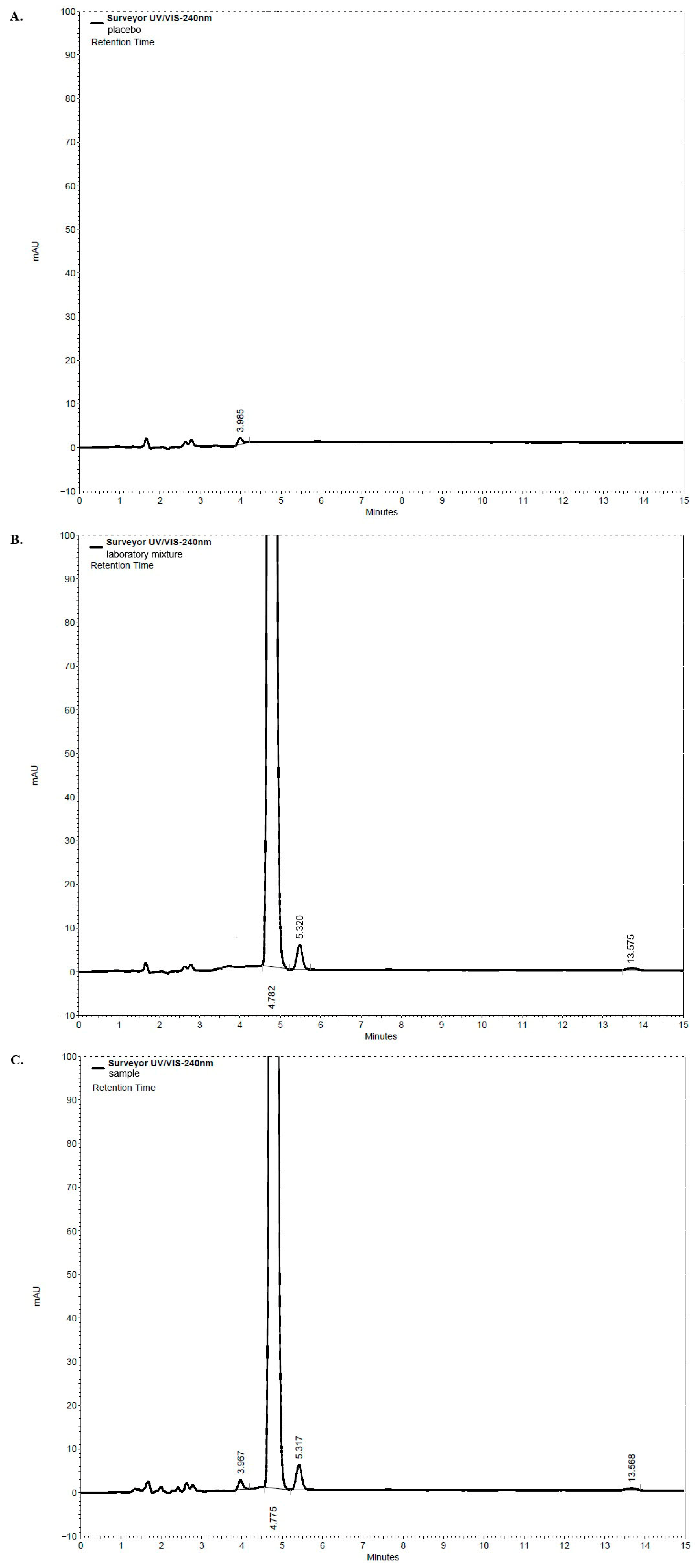
2.4.1. Preparation of Solutions for the Selectivity Estimation
2.4.2. Preparation of Solutions for the Evaluation of the Linearity
2.4.3. Preparation of the Solutions for the Evaluation of Accuracy
2.4.4. Preparation of the Solution for the Evaluation of Precision-Repeatability
2.5. The Analysis of Olpin® Tablets
2.6. Software
3. Results and Discussion
3.1. Definition of the Analytical Target Profile
3.2. Risk Assessment
3.3. Computation of Design Space
3.4. Definition of Control Strategy
3.5. Method Validation
4. Conclusions
Supplementary Materials
Author Contributions
Funding
Data Availability Statement
Conflicts of Interest
References
- European Medicines Agency; Committee for Medicinal Products for Human Use. ICH Q14 Analytical Procedure Development—Scientific Guideline; European Medicines Agency: Amsterdam, The Netherlands, 2024. Available online: https://www.ema.europa.eu/en/documents/scientific-guideline/ich-q14-guideline-analytical-procedure-development-step-5_en.pdf (accessed on 10 January 2026).
- Rozet, E.; Lebrun, P.; Debrus, B.; Boulanger, B.; Hubert, P. Design spaces for analytical methods. TrAC Trends Anal. Chem. 2013, 42, 157–167. [Google Scholar] [CrossRef]
- Dispas, A.; Avohou, H.T.; Lebrun, P.; Hubert, P.; Huber, C. Quality by design approach for the analysis of impurities in pharmaceutical drug products and drug substances. TrAC Trends Anal. Chem. 2018, 101, 24–33. [Google Scholar] [CrossRef]
- Deidda, R.; Orlandini, S.; Hubert, P.; Hubert, C. Risk-based approach for method development in pharmaceutical quality control context: A critical review. J. Pharm. Biomed. Anal. 2018, 161, 110–121. [Google Scholar] [CrossRef]
- Djordjević Filijović, N.; Antonijević, M.D.; Pavlović, A.; Vučković, I.; Nikolić, K.; Agbaba, D. The stress stability of olanzapine: Studies of interactions with excipients in solid state pharmaceutical formulations. Drug Dev. Ind. Pharm. 2015, 41, 502–514. [Google Scholar] [CrossRef] [PubMed]
- Hiriyanna, S.G.; Basavaiah, K.; Goud, P.S.K.; Dhayanithi, V.; Raju, K.; Pati, H.P. Identification and characterization of olanzapine degradation products under oxidative stress conditions. Acta Chromatogr. 2008, 20, 81–93. [Google Scholar] [CrossRef]
- Baertschi, S.W.; Brunner, H.; Bunnell, A.C.; Cooke, G.G.; Diseroad, B.; Dorman, D.E.; Jansen, P.J.; Kemp, C.A.; Maple, S.R.; McCune, K.A.; et al. Isolation, identification, and synthesis of two oxidative degradation products of olanzapine (LY170053) in solid oral formulations. J. Pharm. Sci. 2008, 97, 883–892. [Google Scholar] [CrossRef]
- Rao, P.S.; Ray, U.K.; Hiriyanna, S.G.; Rao, S.V.; Sharma, H.K.; Handa, V.K.; Mukkanti, K. Identification of oxidative degradation impurities of olanzapine drug substance as well as drug product. J. Pharm. Biomed. Anal. 2011, 56, 413–418. [Google Scholar] [CrossRef]
- United States Pharmacopeial Convention. United States Pharmacopeia–National Formulary (USP–NF), 51st ed.; United States Pharmacopeial Convention: Rockville, MD, USA, 2026. [Google Scholar]
- European Pharmacopoeia Commission. European Pharmacopoeia, 12th ed.; Council of Europe: Strasbourg, France, 2022. [Google Scholar]
- Cui, D.; Li, Y.; Lian, M.; Yang, F.; Meng, Q. Development of a simple and stability-indicating RP-HPLC method for determining olanzapine and related impurities generated in the preparative process. Analyst 2011, 136, 3149–3155. [Google Scholar]
- Krishnaiah, C.; Murthy, M.V.; Kumar, R.; Mukkanti, K. Development of a stability-indicating UPLC method for determining olanzapine and its associated degradation products present in active pharmaceutical ingredients and pharmaceutical dosage forms. J. Pharm. Biomed. Anal. 2011, 54, 667–673. [Google Scholar] [CrossRef]
- Alam, M.I.; Siddiqui, A.U.-R. Statistically optimized and Box–Behnken design assisted method development and validation of an antipsychotic medication olanzapine and its related impurities by reverse-phase HPLC-UV spectroscopy. Int. J. Appl. Pharm. 2021, 13, 241–246. [Google Scholar]
- Tumpa, A.; Stajić, A.; Jančić-Stojanović, B.; Medenica, M. Quality by design in the development of hydrophilic interaction liquid chromatography method with gradient elution for the analysis of olanzapine. J. Pharm. Biomed. Anal. 2017, 134, 18–26. [Google Scholar] [CrossRef]
- Cecchi, T. Ion-Pair Chromatography and Related Techniques; CRC Press: Boca Raton, FL, USA, 2010. [Google Scholar]
- Čolović, J.; Kalinić, M.; Vemić, A.; Erić, S.; Malenović, A. Investigation into the phenomena affecting the retention behavior of basic analytes in chaotropic chromatography: Joint effects of the most relevant chromatographic factors and analytes’ molecular properties. J. Chromatogr. A 2015, 1425, 150–157. [Google Scholar] [CrossRef] [PubMed]
- Gkountanas, K.; Rmandić, M.; Protić, A.; Malenović, A.; Dotsikas, Y. Investigation of different counterions and molecular structure effect on the retention behavior of protonated basic solutes in chaotropic chromatography. Acta Chromatogr. 2026, 38, 151–163. [Google Scholar] [CrossRef]
- International Council for Harmonisation of Technical Requirements for Pharmaceuticals for Human Use (ICH). ICH Harmonised Guideline Q2(R2): Validation of Analytical Procedures—Text and Methodology; ICH: Geneva, Switzerland, 2023. [Google Scholar]
- ChemAxon. MarvinSketch, Calculator Plugin and Chemical Terms Demo. Available online: https://www.chemaxon.com/marvin/sketch/index.php (accessed on 10 October 2025).
- Ermer, J.; Nethercote, P.W. Method Validation in Pharmaceutical Analysis: A Guide to Best Practice, 3rd ed.; Wiley-VCH Verlag GmbH & Co., KGaA: Weinheim, Germany, 2025. [Google Scholar]
- European Medicines Agency; Committee for Medicinal Products for Human Use. ICH Q9 Quality Risk Management—Scientific Guideline; European Medicines Agency: Amsterdam, The Netherlands, 2023. Available online: https://www.ema.europa.eu/en/documents/scientific-guideline/international-conference-harmonisation-technical-requirements-registration-pharmaceuticals-human-use-ich-guideline-q9-r1-quality-risk-management-step-5-revision-2_en.pdf (accessed on 10 January 2026).
- Martin, G.P.; Barnett, K.; Burgess, C.; Curry, P.D.; Ermer, J.; Gratzl, G.S.; Hammond, J.; Herrmann, J.; Kovacs, E.; LeBlond, D.J.; et al. Lifecycle management of analytical procedures: Method development, procedure performance qualification, and procedure performance verification. Pharmacop. Forum 2013, 39, 1–14. Available online: https://www.uspnf.com/sites/default/files/usp_pdf/EN/USPNF/revisions/lifecycle_pdf.pdf (accessed on 10 January 2026).
- Rašević, M.; Malenović, A.; Protić, A.; Zečević, M. Analytical method development supported by DoE-DS approach for enantioseparation of (S,S)- and (R,R)-moxifloxacin. J. Pharm. Biomed. Anal. 2023, 235, 115645. [Google Scholar] [CrossRef]
- Rmandić, M.; Rašević, M.; Stanković, J.; Zečević, M.; Otašević, B.; Protić, A.; Malenović, A. Development and robust optimization of the RP-HPLC method for the determination of riociguat and its four impurities in tablets using the AQbD approach. J. Pharm. Biomed. Anal. 2025, 258, 116742. [Google Scholar] [CrossRef]
- Basso, J.; Ramos, M.L.; Pais, A.; Vitorino, R.; Fortuna, A.; Vitorino, C. Expediting disulfiram assays through a systematic analytical quality by design approach. Chemosensors 2021, 9, 172. [Google Scholar] [CrossRef]
- Prajapati, P.; Patel, H.B.; Shah, S. DoE-based failure mode effect analysis (FMEA) for development of a stability-indicating HPTLC method for estimation of apremilast. SN Appl. Sci. 2020, 2, 1371. [Google Scholar] [CrossRef]
- Schoenmakers, P. Optimization of Chromatographic Selectivity: A Guide to Method Development; Elsevier: Amsterdam, The Netherlands, 1986. [Google Scholar]
- Bezerra, M.A.; Santelli, R.E.; Oliveira, E.P.; Villar, L.S.; Escaleira, L.A. Response surface methodology (RSM) as a tool for optimization in analytical chemistry. Talanta 2008, 76, 965–977. [Google Scholar] [CrossRef]
- Laky, D.; Xu, S.; Rodriguez, J.S.; Vaidyaraman, S.; García Muñoz, S.; Laird, C. An optimization-based framework to define the probabilistic design space of pharmaceutical processes with model uncertainty. Processes 2019, 7, 96. [Google Scholar] [CrossRef]
- Vander Heyden, Y.; Nijhuis, A.; Smeyers-Verbeke, J.; Vandeginste, B.G.M.; Massart, D.L. Guidance for robustness/ruggedness tests in method validation. J. Pharm. Biomed. Anal. 2001, 24, 723–753. [Google Scholar] [CrossRef] [PubMed]
- Crowther, J.B. Validation of pharmaceutical test methods. In Handbook of Modern Pharmaceutical Analysis; Ahuja, S., Scypinski, S., Eds.; Academic Press: New York, NY, USA, 2001; Volume 3, pp. 415–443. [Google Scholar]



| Isocratic Elution Mode | |
|---|---|
| ATP | Robust chaotropic chromatography method for baseline separation and reliable quantification of olanzapine and its two oxidative degradation products Probability: π ≥ 95% Selectivity factor between critical peak pairs: more than 1.1 Retention factor of last eluting peak: less than 7.5 Recovery values: 98.0–102.0% for olanzapine, 70.0–130.0% for impurities Limit of detection: not less than 0.03% Limit of quantification: not less than 0.10% |
| APPs | x1—ACN content (%) x2—HClO4 concentration (mM) x3—pH of the aqueous part of the mobile phase |
| APAs | αolaznapine/impD kimpB |
| Failure Mode | Effect | S | O | D | RPN | Proposed Strategy |
|---|---|---|---|---|---|---|
| Mobile phase composition | Multiple | 10 | 4 | 4 | 160 | Evaluate as APP |
| pH value of aqueous phase | Multiple | 8 | 4 | 4 | 128 | Evaluate as APP |
| Chaotropic agent concentration in aqueous phase | Multiple | 10 | 4 | 4 | 160 | Evaluate as APP |
| Mobile phase mixing method | Multiple | 10 | 2 | 2 | 40 | Lower risk, evaluation through robustness study |
| Mobile phase flow rate | Multiple | 10 | 2 | 2 | 40 | Lower risk, evaluation through robustness study |
| Injection volume | Sensitivity | 6 | 2 | 2 | 24 | Non-critical, fixed at constant value |
| Column type | Multiple | 8 | 2 | 2 | 32 | Lower risk, evaluation through robustness study |
| Column temperature | Multiple | 8 | 4 | 2 | 64 | Lower risk, evaluation through robustness study |
| Detection wavelength | Sensitivity | 8 | 2 | 2 | 32 | Lower risk, evaluation through robustness study |
| Model Coefficients | lnkO | lnkimpD | lnkimpB |
|---|---|---|---|
| b0 | 0.71 | 0.83 | 2.09 |
| b1 | −0.35 * | −0.35 * | −0.28 * |
| b2 | 0.13 * | 0.12 * | −0.004579 |
| b3 | 0.027 | −0.0004842 | −0.11 |
| R2 | 0.9536 | 0.9731 | 0.9515 |
| adj. R2 | 0.9420 | 0.9664 | 0.9394 |
| pred. R2 | 0.9340 | 0.9557 | 0.9156 |
| Quantitative Method Performances | Graphically Significant Factors | Quantitative Method Performances | Graphically Significant Factors |
|---|---|---|---|
| PimpB | H + K + L | H + K + L | - |
| PimpD | K + L | K + L | K + L |
| PO | K + L | K + L | K + L |
| Substance | LOD (μg/mL) | Linearity | Accuracy | Precision-Repeatability | |||||
|---|---|---|---|---|---|---|---|---|---|
| Concentration Range (μg/mL) | Slope | Intercept | r | Concentration Level (μg/mL) | Recovery * (%) | Concentration Level (μg/mL) | RSD ** (%) | ||
| Olanzapine | - | 50.0–150.0 | 82.40 | 94.58 | 0.9981 | 80.0 | 98.45 | 100 | 0.90 |
| 100.0 | 101.98 | ||||||||
| 120.0 | 101.19 | ||||||||
| Impurity B | 0.25 | 0.75–4.50 | 40.06 | −7.08 | 0.9966 | 0.75 | 88.58 | 3.00 | 1.30 |
| 3.75 | 84.07 | ||||||||
| 4.50 | 83.63 | ||||||||
| Impurity D | 0.15 | 0.50–3.00 | 124.49 | −0.55 | 0.9969 | 0.50 | 91.33 | 2.50 | 2.60 |
| 2.50 | 85.18 | ||||||||
| 3.00 | 92.44 | ||||||||
Disclaimer/Publisher’s Note: The statements, opinions and data contained in all publications are solely those of the individual author(s) and contributor(s) and not of MDPI and/or the editor(s). MDPI and/or the editor(s) disclaim responsibility for any injury to people or property resulting from any ideas, methods, instructions or products referred to in the content. |
© 2026 by the authors. Licensee MDPI, Basel, Switzerland. This article is an open access article distributed under the terms and conditions of the Creative Commons Attribution (CC BY) license.
Share and Cite
Rmandić, M.; Rašević, M.; Gkountanas, K.; Protić, A.; Malenović, A.; Dotsikas, Y. ICH Q14-Based Development of a Chaotropic Chromatography Method for the Determination of Olanzapine and Its Two Oxidative Degradation Products in Tablets. Analytica 2026, 7, 24. https://doi.org/10.3390/analytica7010024
Rmandić M, Rašević M, Gkountanas K, Protić A, Malenović A, Dotsikas Y. ICH Q14-Based Development of a Chaotropic Chromatography Method for the Determination of Olanzapine and Its Two Oxidative Degradation Products in Tablets. Analytica. 2026; 7(1):24. https://doi.org/10.3390/analytica7010024
Chicago/Turabian StyleRmandić, Milena, Marija Rašević, Kostas Gkountanas, Ana Protić, Anđelija Malenović, and Yannis Dotsikas. 2026. "ICH Q14-Based Development of a Chaotropic Chromatography Method for the Determination of Olanzapine and Its Two Oxidative Degradation Products in Tablets" Analytica 7, no. 1: 24. https://doi.org/10.3390/analytica7010024
APA StyleRmandić, M., Rašević, M., Gkountanas, K., Protić, A., Malenović, A., & Dotsikas, Y. (2026). ICH Q14-Based Development of a Chaotropic Chromatography Method for the Determination of Olanzapine and Its Two Oxidative Degradation Products in Tablets. Analytica, 7(1), 24. https://doi.org/10.3390/analytica7010024