1. Introduction
Photolabile protecting groups play an important role in organic chemical synthesis [
1] and the caging of biological molecules [
2]. Their sensitivity to light permits high-resolution spatial control of chemical reactions. This feature has proven to be essential for combinatorial solid-phase synthesis of biopolymers [
3]. A particularly attractive application is the manufacturing of high-density DNA chips that are used for oligonucleotide and gene sequencing via hybridization [
4].
By far the most widespread type of photolabile protecting groups is
o-nitrobenzyl derivatives, which are used to protect a wide range of functional groups [
5,
6,
7]. Classical examples of light-sensitive protecting groups used to synthesize DNA microarrays are 5′-(α-methyl-2-nitropiperonyl)-oxycarbonyl (MeNPOC) [
8] and 2-(2-nitrophenyl)-propoxycarbonyl (NPPOC) [
9]. Their suitability for DNA synthesis is defined by photolytic efficiency, the product of the quantum yield of photolysis and the extinction coefficient. It is an important characteristic related not only to the product yield but also to the amount of light required to initiate the photoreaction and thus also the risk of photochemical side reactions. Here, we evaluate benzoyl-2-(2-nitrophenyl)propoxycarbonyl (BzNPPOC)—an NPPOC derivative with an improved photolytic efficiency [
10]. The quantum yield and photolytic efficiency of BzNPPOC with 365 nm illumination are 0.84 and 202 M
−1cm
−1, respectively, while the corresponding values of NPPOC are 0.40 and 104 M
−1cm
−1. The additional benzoyl moiety in BzNPPOC results in the larger quantum efficiency of deprotection. The quantum yield of photolysis is commonly extracted from the kinetics of photoproduct formation under continuous irradiation in solution [
11]. The kinetics, in turn, is evaluated by analyzing the photoproducts in multiple rounds of HPLC [
12]. Alternative approaches have been proposed based on the measurement of absorbance changes during the photochemical reaction [
13,
14,
15]. However, in these methods, the numerical integration of differential equations that cannot be solved analytically is required and therefore necessitates the use of specialized software solutions. Conversely, in this work, we demonstrate a facile way to simplify the procedure by extracting the photolysis kinetics and then also the quantum yield from a straightforward measurement of the absorbance spectra after different periods of deprotecting illumination and fitting of the kinetics with a single exponential function. The obtained value for the quantum yield of BzNPPOC is in close agreement with the value determined previously [
10]. The suggested approach can therefore be used for fast evaluation when designing photolabile groups with improved properties.
2. Materials and Methods
BzNPPOC-protected thymidine phosphoramidite was purchased from Orgentis (LV-4498, Gatersleben, Germany). For each series of absorbance measurements, the samples were freshly prepared by dissolving 10 mg of phosphoramidite in 1 mL of acetonitrile (MeCN) and further diluting it in appropriate solvent such that the absorbance of the initial compound in the quartz cuvette at the wavelength of the maximum of UV illumination was about 0.05 and did not exceed 0.2 after the UV exposure.
The absorbance spectra of BzNPPOC-protected thymidine phosphoramidite in different solvents were measured with a Jasco V-670 spectrophotometer (Agilent Technologies, Santa Clara, CA, USA). The parameters of the measurement were the following: 1 nm bandwidth and 200 nm/min scan speed.
To perform the deprotection reaction, the samples in the 5 mm optical path quartz cuvette were illuminated for defined periods of time with a UV transilluminator. The sample was not stirred since with low concentration, the absorbance at the illumination wavelength was such that the attenuation of the illumination intensity in the sample was negligible. The transilluminator was kept switched on during the experiment to maintain the UV intensity constant, and the irradiation timing was controlled by manually switching it off to place the cuvette, switching it on for a defined period, and switching it off at the end of the irradiation period. The exposure periods were 0.33, 0.66, 1, 1.5, 2, 3, 4, 5, 6, 8, and 10 min. The maximum intensity of the UV lamp (USHIO G15T8E Midrange, 14.7 W, Tokyo, Japan) was 306 nm. The intensity of the UV illumination at the cuvette window was measured with a calibrated optical power meter (Nova II with PD300-UV sensor, Ophir, Jerusalem, Israel). The intensity measured with the power meter set to 306 nm was 1.5 mW/cm2.
3. Results
Photolytic efficiency, the product of the extinction coefficient and photolysis quantum yield, is an important parameter used to characterize photolabile protecting groups and their suitability for various applications. An absolute photolytic quantum yield can be determined through the numerical integration of the photokinetic factor in combination with multiple rounds of HPLC analysis required to trace the time dependence of the protected compound concentration [
10]. Here, we evaluate the quantum yield of BzNPPOC from a much less time-consuming measurement of the absorbance spectra. An absorbance spectrum of the sample was measured after each period of UV illumination. The resulting sequence of the absorbance spectra was used to derive the change in the concentration of the initial protected compound. Then, at the limit of the low concentrations and correspondingly low absorbances of the irradiation wavelength, the concentration of the photolabile substance depends on the irradiation time as a single exponential function. The kinetic rate constant of this dependence is related to the absolute photolytic quantum yield, and thus, the latter can be extracted from the former.
We will first revisit the relationship between the kinetic rate constant and photolytic quantum yield and also relate the concentration change in the protected substance to the measured absorbance spectra.
Under steady-state illumination, the rate of concentration decrease in the protected compound can be expressed as
where Δ
N/
t is the number of photons absorbed per unit time,
V is the sample volume, and
Φ is the quantum efficiency of deprotection reaction.
Illumination intensity
, where
N is the number of photons impinging on the surface area
S. Then,
, where Δ
I is the change in the illumination intensity due to the absorbance by the photolabile substance. With this, Equation (1) becomes
In the present case, the initial compound and the products of the photochemical reaction absorb the UV illumination. Therefore, the differential form of the Beer–Lambert law involves the absorbance by the initial compound 1 and product 2:
where d
z is the differential of the sample thickness,
c is the molar concentration,
σ is the absorbance cross-section,
ε is the molar extinction coefficient, and
NA is the Avogadro number.
Integration of Equation (3) yields the known Beer–Lambert law:
or
where
I0 is the initial intensity of illumination,
d is the sample thickness, and
A is the absorbance of the sample.
From the differential Beer–Lambert law in Equation (3), light intensity absorbed by the protected compound can be expressed as
Inserting Equation (4) into (6) and integrating with variable substitution yields
In our experiment, the concentration of the photolabile substance is adjusted such that the absorbance of the sample at 306 nm before applying the UV illumination is about 0.05. After the UV exposure, the resulting absorbance at 306 nm is smaller than 0.2. Therefore, it can be considered that
. Then, exploiting the fact that
in the limit of small
x, Equation (7) can be reduced to
That is, in the limit of weak absorbance, illumination intensity absorbed by the initial substance is independent of the photoproduct formation. Here, we would like to point out that for simplicity, starting with Equation (3), we assumed the formation of a single photoproduct. However, the derivation can be generalized to an arbitrary number of photoproducts by substituting the second term in Equation (3) with the sum of the product terms. The main conclusion of Equation (8) is that in the low-absorbance regime, the absorption by the initial substance being independent of the photoproducts would still be valid.
Inserting Equation (8) into (2) produces
In our case, the illumination area is the same as the sample surface area, and
with
C =
cNA; thus,
Integrating Equation (11) yields
where
is the kinetic rate constant of the deprotection reaction. Then,
To calculate k, the kinetic rate constant of deprotection, one needs the irradiation time dependence of the photolabile substance concentration c1(t). This dependence can be evaluated from the absorbance spectra measured after each period of irradiation as follows.
The initial absorbance of the protected compound is
After irradiation for time
t, the sample absorbance can be expressed as
If the conversion of the substrate to the product is assumed to be clean, then
Substituting Equation (16) to (15) results in
where
p(
t) =
c1(
t)/
c1(0) is the proportion of unprotected initial compound,
A1(0) is the absorbance before the UV irradiation, and
A2(
tfin) is the absorbance after all of the protected compound was converted to the product.
In Equation (17), p(t) is a fitting parameter in the expression of the measured absorbance spectrum as a sum of the first and last measured spectra in the time series. Thus, the obtained p(t) is then fit with a single exponential, Equation (12), to obtain the kinetic rate constant of the deprotection reaction.
We would like to note that for simplicity, Equation (17) was derived assuming a single photoproduct. However, it is trivial to show that additional terms of more photoproducts can be added to Equation (15) without altering the final expression of Equation (17), provided that the ratios of concentrations of different photoproducts remain constant during the UV illumination-induced reaction. Therefore, the provided analysis is valid and can be used in the case of an arbitrary number of photoproducts.
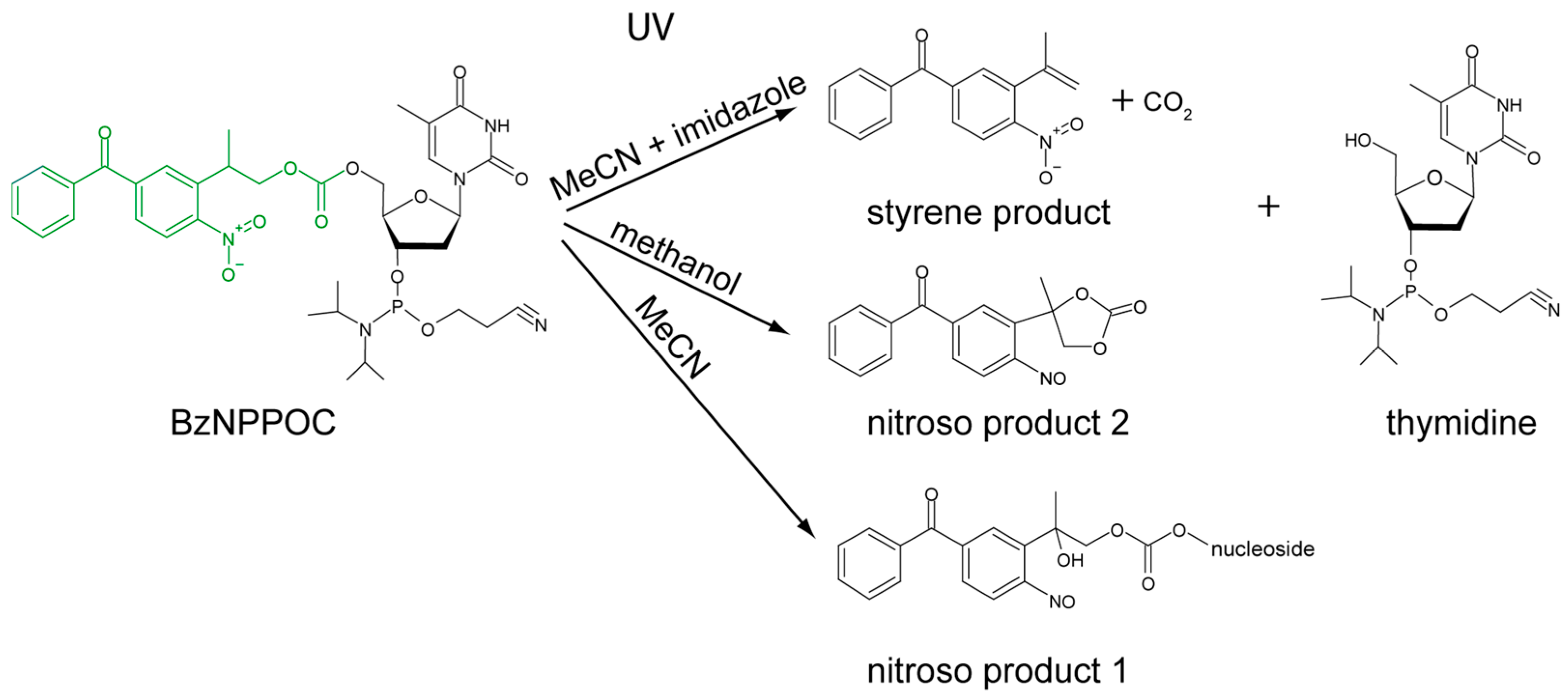
The deprotection reaction of BzNPPOC (
Figure 1) starts with H abstraction by the excited nitro group and proceeds through the formation of the aci-nitro intermediate [
16]. Subsequent reaction pathways and products depend on the reaction medium [
11]. In MeCN, the prevalent pathway is where the aci-nitro form converts to nitroso product 1 without the cleavage of the protecting group or the release of the thymidine. In methanol, nitroso product 1 further transforms to nitroso product 2 with concomitant cleavage of the protecting group and the release of the thymidine. In acetonitrile, with the addition of a small amount of weak base such as imidazole, the reaction follows a different pathway of β-elimination process with the formation of intermediate aci-nitro anion and the final styrene product with the release of nucleoside and carbon dioxide [
10]. However, upon continuing UV irradiation, the styrene product further transforms into other compounds [
11]. At the same time, in our model, we suppose a clean conversion of the initial compound to the products so that the absorbance at any stage of the UV irradiation can be represented by the sum of the absorbance of the protected substance and the products. Therefore, to be able to employ our approach, we further considered the photoreaction of BzNPPOC in MeCN and methanol.
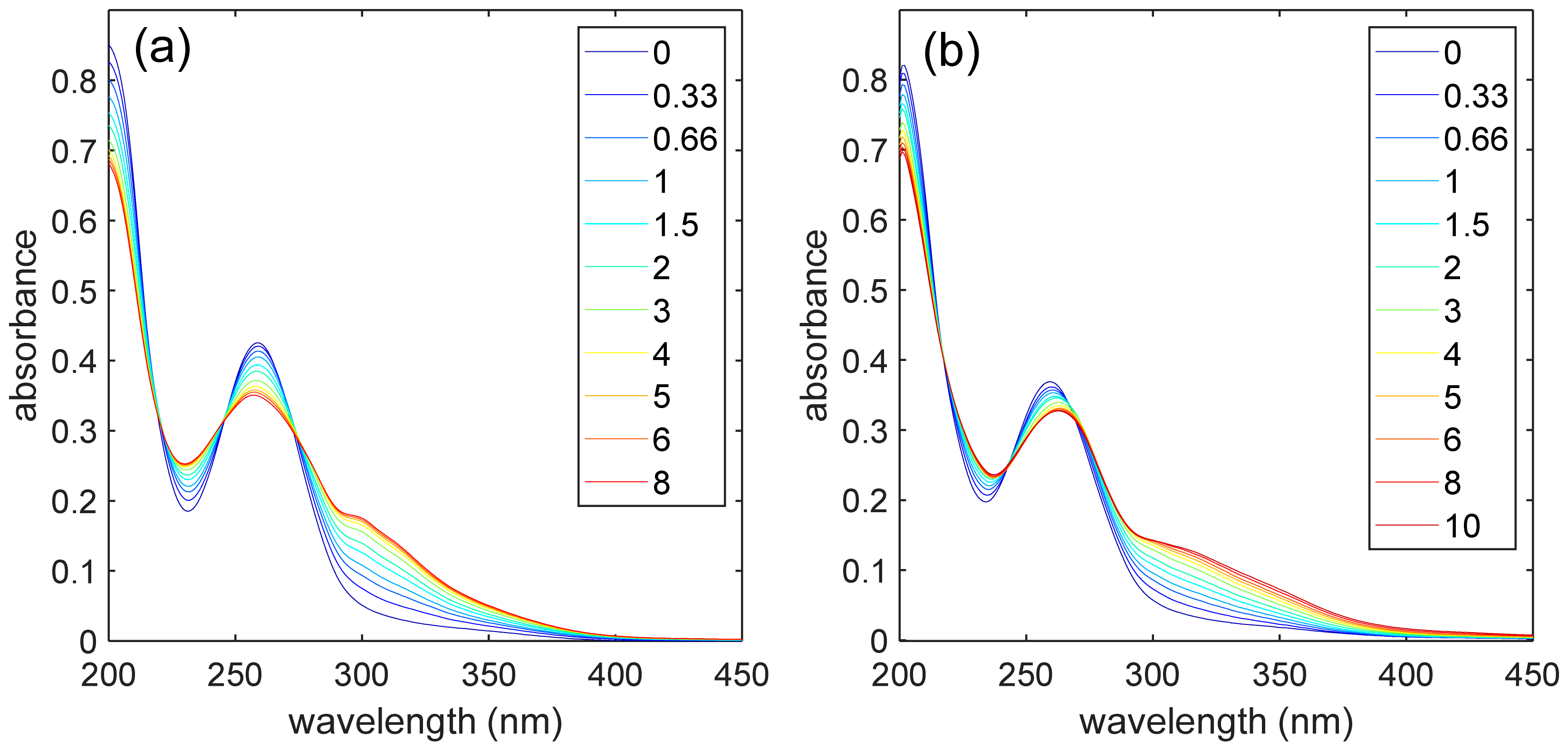
An experiment of continuous photolysis was performed by irradiating a solution of BzNPPOC-protected thymidine phosphoramidite in a quartz cuvette for defined periods of time with the UV transilluminator peaking at 306 nm. The extinction at 306 nm was several-fold larger than at the customarily used 366 nm line of the Hg lamp, which allows for a quicker measurement with photolysis brought to completion in less time. The absorbance spectra after different irradiation times for the samples in MeCN and methanol are presented in
Figure 2. Spectral changes in the course of illumination are observed in both media and are due to the fact that the absorbance spectra of the initial compound and those of the product are different. Also, the spectral changes observed in the two solvents differ due to the formation of different photoproducts.
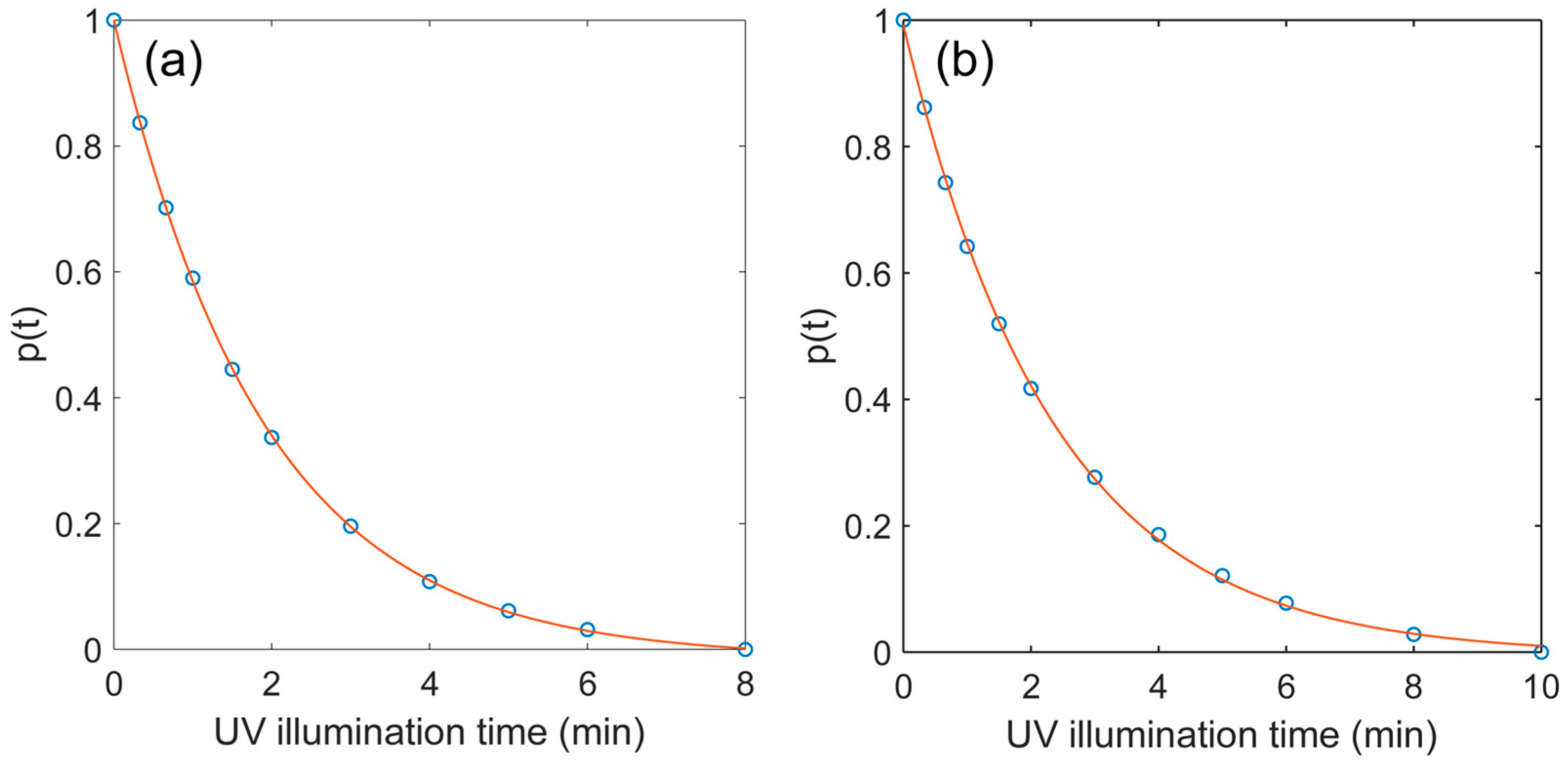
The photolysis kinetics was obtained by fitting the absorbance spectra with the sum of the first and the last measured absorbance spectra in the time series according to Equation (17) (
Figure 3). Fitting the kinetics with the single exponential function yields the kinetic rate constants of the photolysis. In MeCN,
k = 0.53 min
−1, while in methanol,
k = 0.43 min
−1. The molar concentration of the protected compound in MeCN was 70 μM, and in methanol, 105 μM. From the measured absorbance spectra of the protected compound, we calculated the molar extinction coefficients at the illumination wavelength of 306 nm according to Equation (5). In MeCN,
ε = 1220 M
−1cm
−1, while in methanol, ε = 942 M
−1cm
−1. Inserting the kinetic rate constant and the molar extinction coefficients into Equation (13), we finally obtained the absolute quantum yields of the photolysis. In MeCN,
Φ = 0.82, while in methanol,
Φ = 0.86. The obtained values of quantum efficiency in both media are similar and are closely compatible with the value of 0.84 obtained by other authors in DMSO [
10].
Admittedly, the proposed method requires that the absorbances of the initial substance and the photoproduct are different in order to be able to extract the kinetics of the photoconversion. Therefore, the scope of application of the proposed approach is limited to photolabile groups that exhibit such changes upon photo-activation. However, one of the most widely used photo-protecting groups is
o-nitrobenzyl and it does exhibit absorption changes, as was clearly demonstrated in this work. Some other examples of important classes of protecting groups with conspicuous changes upon uncaging are coumarin [
17,
18] and BODIPY (boron dipyrromethene) [
19,
20].