


Abstract
Impurity profiling is of significant analytical and regulatory importance, particularly in the context of lifecycle quality management. A robust chaotropic chromatography method was developed for the determination of olanzapine and its two oxidative degradation products in tablets, in accordance with the ICH Q14 guideline and the principles of Analytical Quality by Design (AQbD). Risk assessment was performed using a combination of the Ishikawa diagram, CNX (Control, Noise and eXperimental) classification, and Failure Mode and Effect Analysis (FMEA). This multistep evaluation identified the critical analytical procedure parameters (APPs) as the acetonitrile content in the mobile phase, the concentration of perchloric acid in the aqueous phase, and the pH of the aqueous phase. These APPs were studied using an experimental design approach to model their effects on key analytical procedure attributes and to compute a multidimensional design space. Robust optimization supported by Monte Carlo simulations ensured compliance with predefined acceptance criteria with a probability of at least 95%. Method validation demonstrated adequate selectivity, limits of quantification of 0.75 µg/mL and 0.5 µg/mL for impurities B and D, linearity with correlation coefficients ≥0.990, accuracy of 98–102% for olanzapine and 70–130% for impurities, and repeatability with RSD ≤2% for the assay and ≤10% for impurities. The method was successfully applied to commercial tablet analysis.
1. Introduction
Recent developments in pharmaceutical regulation increasingly emphasize adopting a risk-based Analytical Quality by Design (AQbD) framework for analytical method development. The ICH Q14 guideline states that analytical method development should be based on a systematic understanding of parameters influencing HPLC separation, with Design of Experiments (DoE) and risk assessment playing a central role in ensuring method robustness and performance. The AQbD paradigm enables the design of inherently robust analytical methods, reducing the risk of out-of-specification results and enhancing the reliability and long-term performance of analytical data [1].
At the core of the AQbD approach is the structured evaluation of analytical procedure parameters (APPs) and their influence on analytical procedure attributes (APAs), allowing for the computation of a design space (DS). The DS is a multidimensional region in which small, intentional variations in method conditions do not cause significant changes in analytical performance. By integrating scientific knowledge with regulatory expectations, AQbD supports a lifecycle-oriented approach to analytical methods, promoting flexibility and consistent quality throughout routine use [1].
Within this framework, HPLC method development typically begins with defining the Analytical Target Profile (ATP), which outlines the analytical purpose and performance requirements of the method. Risk assessment is then used to identify APPs that may affect method performance, followed by DoE-based modeling to establish a robust DS. Together, these elements provide a scientifically sound basis for developing reliable analytical methods aligned with contemporary regulatory guidance [2,3,4].
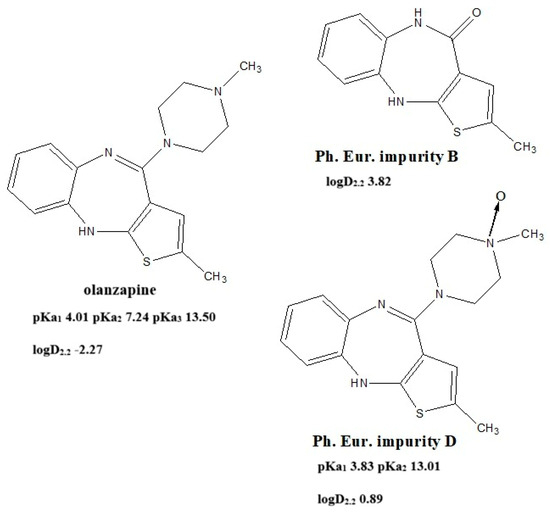
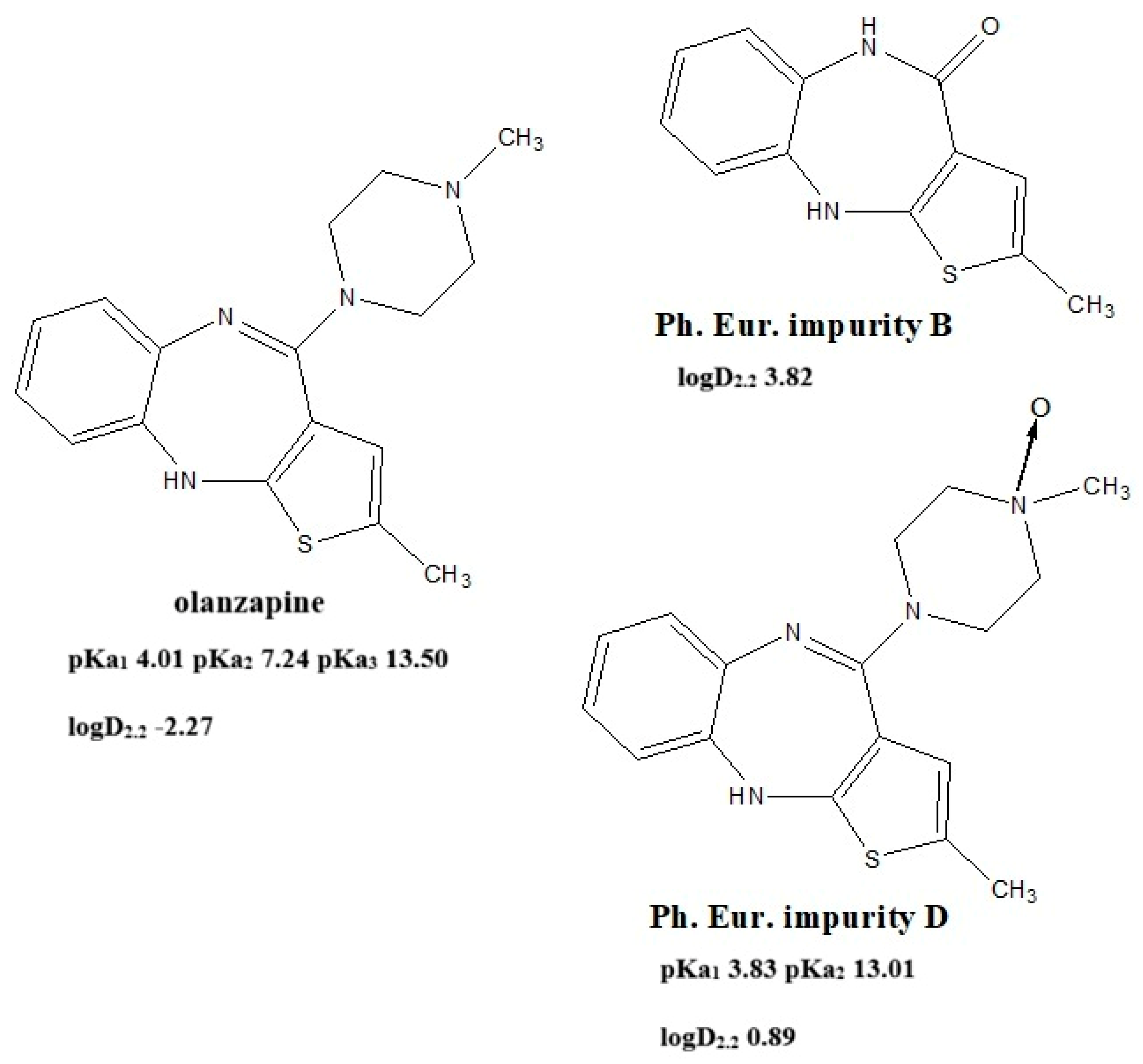
This study aims to develop a robust chaotropic chromatography method for determining olanzapine and its two oxidative degradation products (Figure 1) in tablets, in accordance with ICH Q14 guideline and the principles of AqbD approach. Olanzapine (2-methyl-4-(4-methylpiperazin-1-yl)-10H-thieno[2,3-b][1,5]benzodiazepine) is a thienobenzodiazepine atypical antipsychotic drug. It is sensitive to heat, moisture, and light, with its stability depending heavily on formulation, storage conditions, and physical form (crystalline or amorphous) [5]. The primary degradation pathway of olanzapine is oxidation, and several studies have reported its oxidative degradation products [6,7,8]. Key USP-identified impurities in tablets include related compound B (olanzapine amide), related compound C (olanzapine N-oxide), thiolactam, lactam, as well as acetyl open ring analog and open ring analog if present [9]. For the separation of olanzapine and degradation products on an L11 (phenyl) stationary phase, USP 51 defines gradient elution using a mobile phase containing acetonitrile, sodium dodecyl sulfate, perchloric acid, and sodium hydroxide [9]. In Ph. Eur. 12, key impurities in olanzapine bulk drug include related substances arising from synthesis of the drug substance (impurities A and C) or oxidative degradation (impurities B and D) [10]. For the determination of related impurities, Ph. Eur. 12 specifies gradient elution on a C8 stationary phase with a mobile phase composed of acetonitrile, sodium dodecyl sulfate, and phosphoric acid, with the pH adjusted to 2.5 by slowly adding strong sodium hydroxide. If a precipitate forms, it must be re-dissolved before the final pH adjustment [10].
Figure 1.
Chemical structures, logD and pKa of the olanzapine and its two oxidative degradation products.
In the literature, several RP-HPLC methods [11,12,13] and HILIC method [14] for the separation of olanzapine and its impurities are available. The proposed stability-indicating methods achieved separation on C18 stationary phases with gradient elution, using mobile phases containing methanol and triethylamine in water, with the pH adjusted to 3.73 by acetic acid [11], or acetonitrile, methanol, NaH2PO4, and triethylamine buffer (pH 6.8) [12]. Alam and Siddiqui [13] separated olanzapine and impurities A, B and D on a C18 stationary phase with a methanol–acetonitrile–0.01 M monobasic sodium phosphate mixture, pH 6, adjusted with 1 M NaOH (40:30:30, v/v/v) under isocratic conditions. Tumpa et al. [14] used Quality by Design (QbD) approach to develop a HILIC method with gradient elution for the analysis of olanzapine and its seven impurities.
Furthermore, chaotropic chromatography offers strategic advantages for basic drugs such as olanzapine and its oxidative degradation products (Figure 1). Chaotropic chromatography involves adding ion-interaction agents, known as chaotropic agents, to the mobile phase in RP-HPLC systems. This suppresses undesirable secondary interactions with residual silanol groups, improves peak symmetry, and allows controlled modulation of retention through counterion and ionic strength effects. Incorporating column-compatible chaotropic reagents into the mobile phase provides significant benefits for adjusting analyte retention and improving peak shape and separation efficiency for fully protonated basic compounds [15]. Recent research has clarified both theoretical and practical aspects of this technique, including how the pH of the aqueous phase and the concentration of the chaotropic salt affect retention behavior [16]. Additionally, the effects of different counterions (K+, Na+, and NH4+ from both the chaotropic salt and ionic strength modifier) and molecular structure on the retention behavior of protonated basic solutes in chaotropic chromatography have been resolved [17].
Robust optimization and risk-based evaluation were applied to ensure that the method consistently meets predefined acceptance criteria with a high probability (π ≥ 95%). A key contribution of this work is the implementation of a probabilistic design space (DS) concept, in which uncertainty propagation to the analytical procedure attributes (APAs) was performed using Monte Carlo simulations to estimate their full predictive distributions rather than relying solely on point estimates. This approach enables a quantitative assessment of method robustness and provides a scientifically justified basis for selecting an operating region with controlled risk of failure. The integration of probabilistic DS computation with chaotropic separation principles thus represents a forward-looking framework for developing robust, risk-managed analytical methods aligned with modern regulatory expectations and applicability to other basic pharmaceutical compounds.
2. Materials and Methods
2.1. Solvents, Reagents and Standards
Acetonitrile, perchloric acid, and sodium hydroxide p.a. (Fluka, Sigma-Aldrich, Steinheim, Germany) were used to prepare the mobile phases. Water was purified to HPLC grade using the Adrona Onsite+ Bio water purification system (Adrona Ltd., Riga, Latvia). Reference standards of olanzapine and its impurities B and D were obtained from LGC GmbH (Luckenwalde, Germany).
2.2. Chromatographic Conditions
Chromatographic separations were performed using a Thermo Finnigan Surveyor HPLC System (Thermo Scientific, Waltham, MA, USA) equipped with a Thermo Finnigan Surveyor LC Pump Plus, Thermo Finnigan Surveyor UV-VIS Detector Plus, and Thermo Finnigan Surveyor Autosampler Plus. ChromQuest was used for data collection and analysis. The partial loop injection volume was 5 μL. An XTerra RP18 column (150 mm × 4.6 mm, 3.5 μm; Waters, Drinagh, Ireland) was used for the separation.
During the optimization stage, the mobile phase composition was systematically varied according to the experimental plan shown in Table S1 in the Supplementary Materials. Based on the computed DS, the optimal conditions were determined to be 29.5% (v/v) acetonitrile and 70.5% (v/v) 160 mM HClO4 in the aqueous phase, adjusted to pH 2.20 with 10 mol/L NaOH. All mobile phases prepared for method development and validation were filtered through a 0.45 µm nylon filter membrane (Agilent Technologies, Santa Clara, CA, USA) and degassed under vacuum before use. Chromatographic conditions held constant included a mobile phase flow rate of 1.0 mL/min, detection at 240 nm, column temperature maintained at 25 °C and autosampler temperature maintained at 15 °C.
2.3. Preparation of Solutions for the Computation of Design Space and Quantitative Robustness Testing
Stock solutions were prepared by dissolving 25.0 mg of olanzapine reference standard in 25 mL of an acetonitrile-water mixture (50:50, v/v) to obtain a concentration of 1 mg/mL. The corresponding impurity standards were dissolved in the same solvent to yield separate stock solutions at 0.1 mg/mL (10.0 mg in 100 mL volumetric flasks). These stock solutions were subsequently diluted to prepare a mixed solution containing 100 μg/mL of olanzapine and 5 μg/mL of impurities B and D. The latter solution was employed for the computation of DS and for the evaluation of the robustness of the method’s quantitative performance.
2.4. Preparation of Solutions for Method Validation
2.4.1. Preparation of Solutions for the Selectivity Estimation
A placebo mixture containing the tablet excipients in proportions matching their formulation levels was prepared and processed in the same manner as the samples used for precision assessment. Method selectivity was evaluated using a sample solution with 500 μg/mL olanzapine spiked with impurities at their respective LOQs and a standard solution containing the impurities at concentrations equal to their respective LOQs.
2.4.2. Preparation of Solutions for the Evaluation of the Linearity
Linearity was evaluated separately for the active pharmaceutical ingredient and each impurity. For olanzapine, five calibration solutions were prepared across a concentration range of 50–150 μg/mL, corresponding to 50–150% of the target level. Additionally, five calibration levels were prepared for each impurity, spanning from the limit of quantification to 120% of the specification limit. The investigated ranges were 0.75–4.5 μg/mL for impurity B and 0.5–3.0 μg/mL for impurity D. The relationship between concentration and response was evaluated using a least-squares linear regression model.
2.4.3. Preparation of the Solutions for the Evaluation of Accuracy
Laboratory mixtures of placebo with olanzapine and placebo with impurities were dissolved in an acetonitrile-water mixture (50:50, v/v) and sonicated for 15 min. The accuracy of olanzapine quantification was evaluated using three sets of three solutions at concentrations of 80, 100, and 120 μg/mL, corresponding to 80%, 100%, and 120% of the target level. According to ICH Q2 (R2) for impurity accuracy assessment, three sets of three solutions were prepared at the LOQ, 100%, and 120% of the specification level [18]. The concentrations were 0.75, 3.75, and 4.5 μg/mL for impurity B, and 0.5, 2.5, and 3.0 μg/mL for impurity D.
2.4.4. Preparation of the Solution for the Evaluation of Precision-Repeatability
Stock solutions for evaluating method precision-repeatability of olanzapine and its impurities B and D were prepared as follows. Tablet powder equivalent to 50 mg and 250 mg of olanzapine was separately weighed, extracted in 50 mL of acetonitrile–water (50:50, v/v), and sonicated for 15 min, then diluted to volume to obtain stock solutions of 1 mg/mL and 5 mg/mL, respectively. After filtration through 0.45 µm nylon syringe filter Agilent Technologies, Santa Clara, CA, USA), these stock solutions were further diluted to prepare six replicate solutions for precision assessment: 100 μg/mL of olanzapine for active substance repeatability, and 500 μg/mL of olanzapine with impurities spiked at 0.5% of the API for impurity quantification repeatability.
2.5. The Analysis of Olpin® Tablets
The olanzapine assay and impurity determination were performed using separate sample solutions.
For the olanzapine assay, ten Olpin® 10 mg tablets (Ave Pharmaceutical d.o.o., Belgrade, Serbia) were powdered, and an amount equivalent to 50 mg of olanzapine was extracted in a 50 mL volumetric flask with acetonitrile-water (50:50, v/v) using sonication for 15 min. The solution was filtered (1 mg/mL olanzapine), and six independent dilutions were prepared at 100 μg/mL olanzapine.
For impurity analysis, ten Olpin® 10 mg tablets (Ave Pharmaceutical d.o.o., Belgrade, Serbia) were powdered, and an amount equivalent to 250 mg of olanzapine was extracted in the same manner to yield a 5 mg/mL solution. Six dilutions were prepared at 500 μg/mL olanzapine. Impurities were quantified using external standard calibration.
2.6. Software
The pKa and logD values of olanzapine and impurities B and D were calculated using MarvinSketch 17.1.2 (ChemAxon, Budapest, Hungary) [19]. The plan of experiments and data analysis were performed in Design-Expert 11.0.0 (Stat-Ease, Minneapolis, MN, USA), while MATLAB R2019b (MathWorks, Eagan, MN, USA) was used for grid search, indirect modeling, Monte Carlo simulations, and DS computation. Method validation results were analyzed with Microsoft Excel 2010 (Microsoft, Redmond, WA, USA).
3. Results and Discussion
The ICH Q14 guideline introduces a modern, science- and risk-based framework for analytical method development, emphasizing robustness, probabilistic assessment, and lifecycle management. Its principles are relevant for olanzapine, a basic and pH-sensitive drug, whose stability and impurity profile are strongly influenced by formulation, pH, and mobile phase conditions. Traditional method development approaches, which focus on single-point optimization, are often insufficient for such compounds, as they do not capture variability in method performance across the full operational space or account for uncertainty in quantitative measurements.
The enhanced AQbD approach addresses these limitations by generating systematic knowledge throughout the method lifecycle. For olanzapine, this involves defining a probabilistic design space (DS) using Monte Carlo simulations to propagate uncertainty to analytical procedure attributes (APAs) [3], rather than relying solely on classical robustness testing at a few discrete points. This enables quantitative assessment of the probability of meeting acceptance criteria (π ≥ 95%) across the multidimensional method parameter space. Additionally, lifecycle flexibility ensures that the method can accommodate minor formulation changes, technological upgrades, or evolving regulatory expectations while maintaining reliable impurity profiling. By integrating risk assessment, DoE modeling, and probabilistic DS evaluation, this study provides a scientifically justified, forward-looking approach for developing robust analytical methods for olanzapine and similar basic, pH-sensitive drugs.
In addition to the activities performed in the traditional approach, the enhanced approach includes several key elements [1,20]: (i) definition of the analytical target profile (ATP), (ii) risk assessment, (iii) identification of APPs across the reportable range, (iv) identification of APAs, and (v) application of DoE and modeling to evaluate APP interactions, define the method operable design region (also referred to as design space, DS), and establish the analytical control strategy.
3.1. Definition of the Analytical Target Profile
The foundation of the AQbD concept is the analytical target profile (ATP), which defines the intended purpose and performance requirements of the analytical method. The ATP includes quality requirements such as the expected confidence level of reported results, enabling a scientifically sound assessment of method performance. Table 1 presents the ATP, specifying what is to be measured, in which matrix and concentration range, as well as the required performance characteristics of the method. Based on knowledge, previous experience [16,17], and the nature of the analytes of interest (Figure 1), chaotropic chromatography was selected to achieve optimal peak symmetry, retention, and separation of the studied analytes. Common anions used in this type of chromatography include hexafluorophosphate, perchlorate, and trifluoroacetate. Their presence enhances retention, efficiency, and separation selectivity of fully protonated basic analytes through multiple mechanisms, as detailed by Cecchi [15] and Vemić et al. [16]. During method development, the mobile phase composition, chaotropic agent type and concentration were systematically varied to accommodate the different lipophilicities of the analytes. The perchlorate anion provided an appropriate starting point for further retention and separation adjustment on the C18 stationary phase.
Table 1.
Application of AQbD Principles in Chaotropic Method Development for Olanzapine and its two oxidative degradation products determination in tablets.
3.2. Risk Assessment
In the next step, quality risk was assessed. Risk management analysis aims to identify potential risks and determine measures to control or mitigate them. To maintain method quality during routine use throughout its lifecycle, and in accordance with regulatory body recommendations, this step is increasingly mandatory and should be taken seriously. Various tools for risk analysis are available [21,22] and the main shortcoming of all these tools, which must always be acknowledged, is the unavoidable subjective assessment by the analyst.
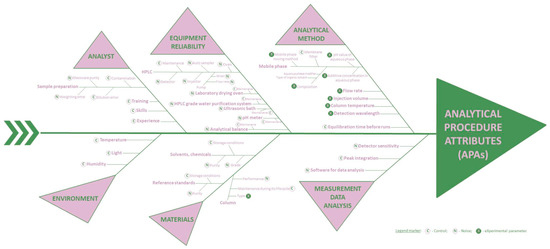
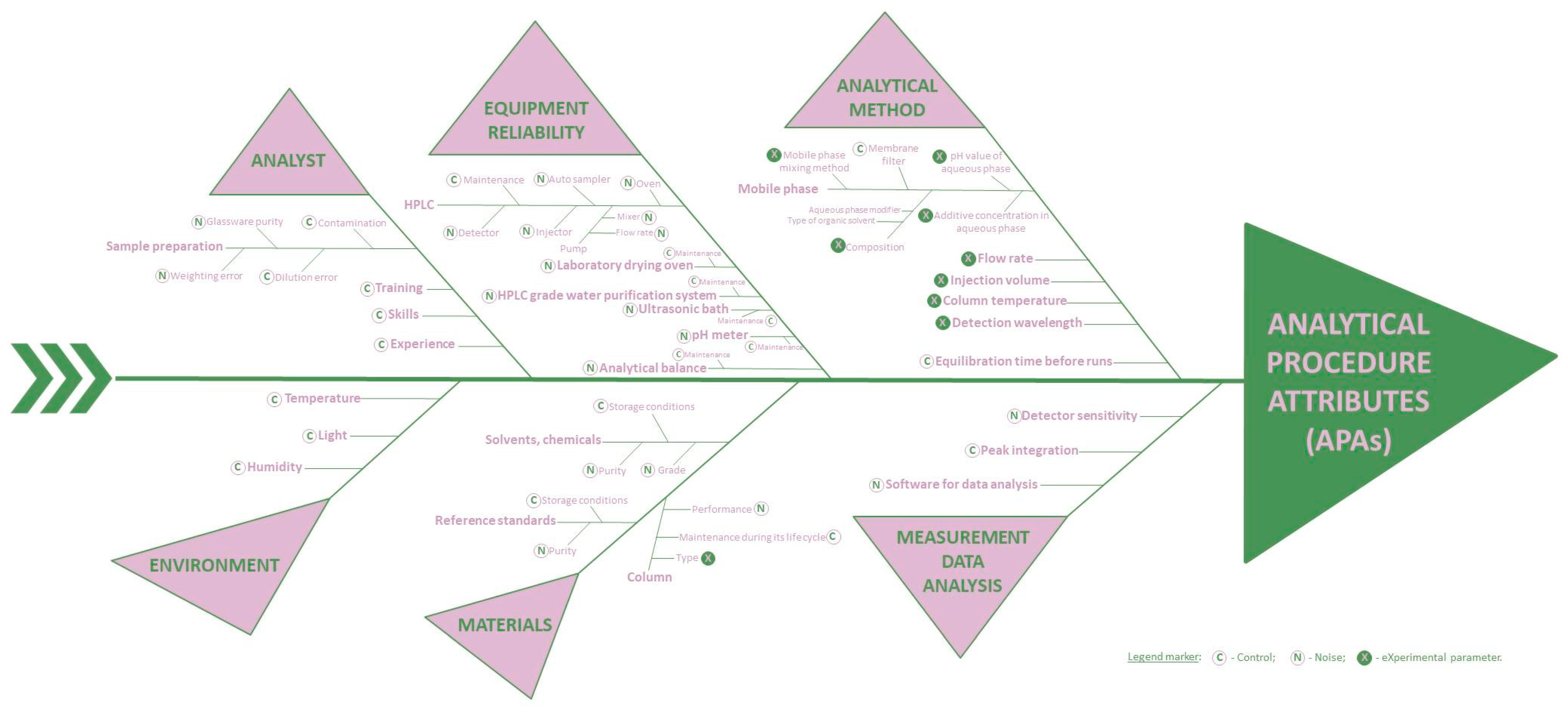
To ensure the method’s performance, a risk analysis is conducted to select APPs from all potential risk factors related to equipment, materials, analytical methods, reagents and chemicals, measurement and data analysis, environmental conditions, human factors, and more. We found the three-step methodology we previously used [23,24] to be effective and acceptable, and all methods employed are also recommended in recent relevant literature [20]. In this three-step strategy, all potential variables that could make the system vulnerable are first identified. The Ishikawa (fishbone) diagram is typically used to list all factors that could potentially affect the selected APAs. At this stage, the effect of each factor is considered equivalent, although in reality they are not equal and can be either negligible or very significant. Based on assumptions and the analysts’ existing knowledge and experience, all relevant factors and hazards were considered (Figure 2).
Figure 2.
Ishikawa (fishbone) diagram with applied CNX test.
This is followed by a Control, Noise and Experimental (CNX) test, which is used to categorize and prioritize factors according to their severity for the system. The CNX test classifies factors into three categories: C—controlled, N—noise, and X—experimental factors (see Figure 2) [23,24]. Controlled factors are those that must be kept under strict control and maintained at a constant value, such as the environment or storage conditions. The Noise category includes factors that are well controlled and considered low risk, such as chemicals with an adequate certificate of analysis and within the expiration date (reference standards, reagents of proper quality and purity, etc.). Noise factors also include qualified apparatus and generally properly maintained equipment by human factors. In Figure 2, the mark X stands for a factor that is experimental, meaning a chromatographic-dependent factor that could have the greatest impact on the method and directly or indirectly on its intended purpose, specifically on selected APAs. These X factors must undergo a detailed assessment to determine whether they should be evaluated experimentally during a certain stage of analytical procedure development or if there is a reasonable explanation for why that is unnecessary. For this purpose, further evaluation using the Failure Mode and Effect Analysis (FMEA) tool followed.
In this phase of risk management, X factors were identified as potential failure modes and quantified by their severity (S), occurrence (O), and detectability (D). Based on the assigned values for S, O, and D, the risk priority number (RPN) for each was calculated as RPN = S × O × D (Table 2). The severity and occurrence of failure modes were ranked as follows: very low (2), low (4), medium (6), high (8), and very high (10). According to our assessment, all multiple-effect failure modes (mobile phase composition, pH value of the aqueous phase, chaotropic agent concentration in the aqueous phase, mobile phase mixing method, mobile phase flow rate, column type, and column temperature) should have an assigned S value higher than or equal to that of the sensitivity failure modes (injection volume and detection wavelength). Additionally, based on our assessment, injection volume should have a lower S value than detection wavelength. Therefore, we assigned an S value of 8 to detection wavelength and 6 to injection volume. The probability of detecting an error was ranked from 2 (very certain to be detected) to 10 (very uncertain to be detected). Thus, the maximum possible RPN value could theoretically be 1000. In further analysis, all factors with a calculated RPN > 100 (RPN threshold) were considered high-risk failure modes [23,24,25,26]. In addition to listing the potential effects that each failure mode could have on the APAs, it is also important to emphasize and propose strategy measures for each failure mode (Table 2). The most critical factors (those with the highest RPN) must be defined as APPs, and their influence on the APAs should be further investigated in detail using DoE. In this study, factors with an RPN above the defined threshold were mobile phase composition, concentration of chaotropic agent in the aqueous part of the mobile phase and pH value of the aqueous part of the mobile phase, so they were designated as APPs.
Table 2.
Failure mode and effect analysis (FMEA) for establishing APPs.
As shown in Table 2, several other factors (mobile phase mixing mode, mobile phase flow rate, column type, column temperature and detection wavelength) had calculated RPN values below 100. Our strategic decision was not to disregard their influence, but to examine them through the quantitative robustness study. Among the observed failure modes, injection volume had the lowest RPN value of 24, so we made an exception and declared it non-critical, with the requirement to set it to a constant value in accordance with the sensitivity of the detector.
3.3. Computation of Design Space
A DoE approach was applied to systematically evaluate how APPs affect APAs, enabling the definition of the DS, an essential part of the AQbD framework. The choice of experimental design depends on the nature of the investigated factors; quantitative variables are typically studied using response surface designs such as Box–Behnken. The experimental plan (Table S1) consisted of 16 runs, including four replicates at the center point to estimate experimental variability. To minimize the potential impact of uncontrolled external factors, the experiments were conducted in randomized order. The corresponding response values (kO, kimpD, kimpB) obtained from these experiments are summarized in Table S1. These responses were directly modeled, with a logarithmic transformation applied to all response variables before model construction [27]. Regression coefficients were estimated using coded factor levels (Table 3). The suitability of the developed linear models was evaluated through analysis of variance (ANOVA), lack-of-fit assessment, and determination of goodness-of-fit parameters, including the coefficient of determination (R2), adjusted R2, and predicted R2. The lack of fit was not statistically significant, and the obtained values of R2, adjusted R2, and predicted R2 were satisfactory (Table 3), confirming that the models adequately describe the retention behavior of the analytes across the experimental domain.
Table 3.
Model coefficients calculated for coded factor values and statistically significant parameters.
The influence of individual factors on each response was evaluated by examining the coefficients calculated for the coded factor values. Factors with p-values below 0.05 were considered to have a statistically significant effect on the corresponding response. The sign of each coefficient indicates the direction of the effect: a positive coefficient denotes an increase in the response with increasing factor level, while a negative coefficient indicates a decrease. The magnitude of the coefficient reflects the relative strength of the factor’s influence, with higher absolute values corresponding to a more pronounced effect on the system response [28].
The results showed that the acetonitrile content in the mobile phase and the concentration of the chaotropic agent in the aqueous part of the mobile phase significantly affected the lnkO and lnkimpD responses. The regression coefficient for acetonitrile content was negative, indicating that increasing acetonitrile content decreases retention time. In contrast, the coefficient for the concentration of the chaotropic agent was positive, demonstrating that increasing HClO4 concentration prolongs the retention of olanzapine and impurity D. Considering the chemical structures and physicochemical properties of these two compounds (Figure 1), this behavior was expected. Within the investigated pH range (2.0–3.0), both analytes are predominantly ionized and therefore, increasing the chaotropic agent concentration enhances their retention in the RP system according to the established mechanisms of chaotropic chromatography. Conversely, increasing the proportion of acetonitrile decreases the polarity of the mobile phase, which, in the presence of chaotropic ions, increases the analytes’ affinity for the mobile phase, resulting in faster elution. Although it may seem unexpected that variation in pH (factor x3) does not significantly influence the retention of ionizable analytes, this observation is consistent with our previously reported findings. Specifically, when the acetonitrile content of the mobile phase ranges from 25% to 30%, the retention behavior of basic compounds is only marginally affected by pH once complete protonation has been achieved [16]. For the lnkimpB response, only the proportion of acetonitrile in the mobile phase had a statistically significant effect, while neither the concentration of HClO4 nor the pH of the aqueous phase showed a meaningful influence. As the most lipophilic analyte in the studied set, impurity B is highly sensitive to changes in mobile phase polarity, explaining the pronounced influence of acetonitrile content.
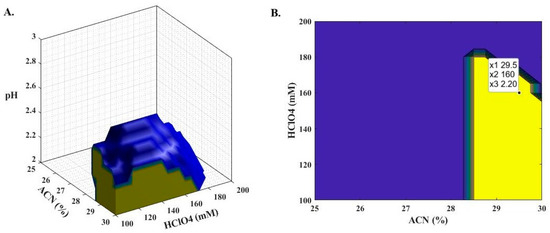
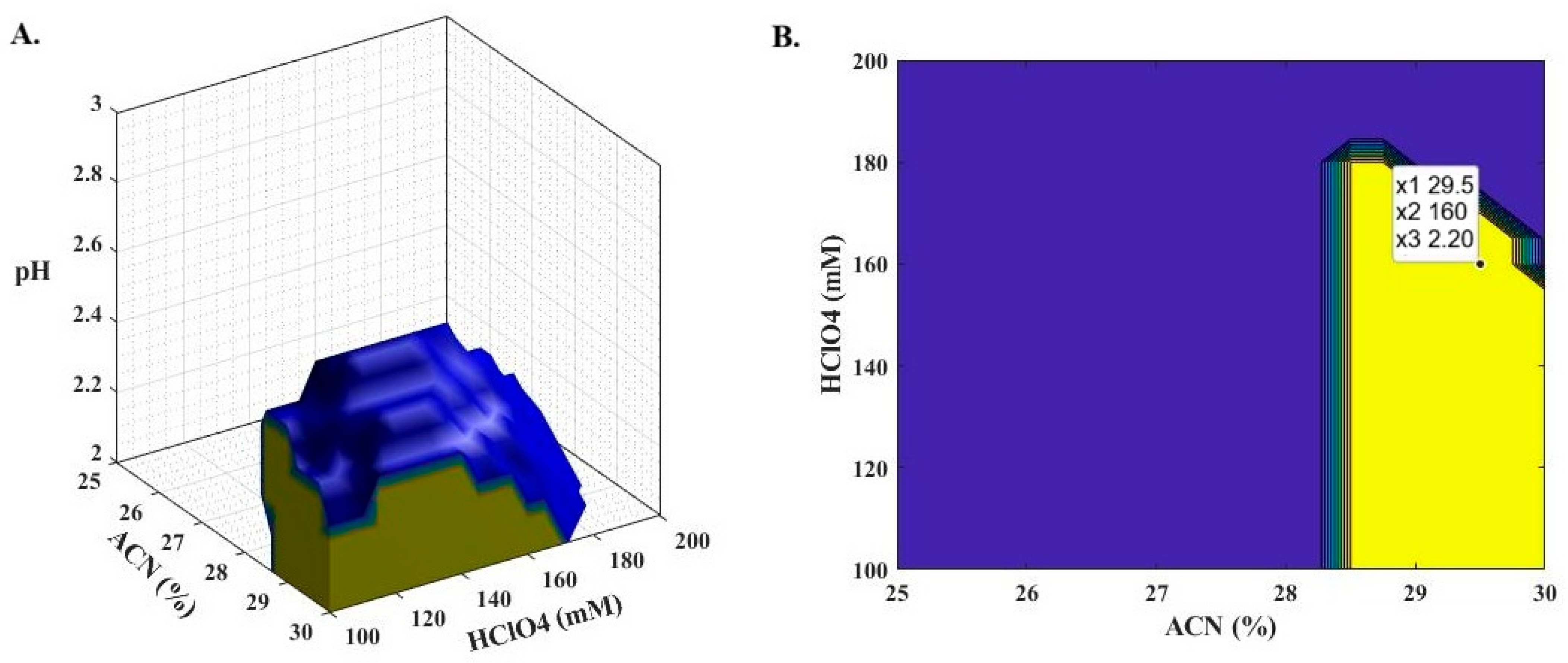
The derived mathematical models relating APPs and APAs were further used to compute the DS. To define the DS, a region of experimental space must be selected where the desired properties of the analytical method meet the criteria and the probability with which the APAs assure quality is also calculated. To obtain such a DS, the robust optimization approach can be used because it provides assurance of method quality. This process involves discretizing the experimental domain into a grid of APP combinations: acetonitrile content [25–30%, step 0.25], HClO4 concentration [100–200 mM, step 5], and pH of the aqueous part of the mobile phase [2.00–3.00, step 0.1]. This discretization resulted in a total of 4851 grid points (21 × 21 × 11). For each grid point, the corresponding retention factors (kO, kimpD, kimpB) and selectivity for a critical peak pair (αolanzapine/impD) were calculated in MATLAB R2019b. Based on the predefined ATP, the experimental domain was examined to identify conditions that ensure baseline separation of olanzapine and impurity D, as well as appropriate retention of impurity B within an acceptable analysis time. Accordingly, the APAs were required to simultaneously meet the following criteria: kimpB ≤ 7.5 and αolanzapine/impD ≥ 1.1. The DS was established by evaluating the probability that all APAs remain within their acceptance limits. Model-related uncertainty was propagated through Monte Carlo simulations [3,29] by adding a uniformly distributed error, equal to the calculated standard error, to the estimated model coefficients. This approach enabled indirect modeling of the distributions of kimpB and αolanzapine/impD for each grid point. For every operating condition, 5000 Monte Carlo iterations were performed across all 4851 grid points. The DS was defined as the region of the experimental domain in which all APAs met the acceptance criteria with a probability of at least 95% (π ≥ 95%), as shown in Figure 3.
Figure 3.
(A) 3D representation of DS for the predefined APAs achieved with a probability π ≥ 95%. (B) 2D representation of DS after setting a fixed value for the pH of the aqueous part of the mobile phase at 2.20. The yellow part corresponds to the region of the DS where the working point should be located. In the insert the chromatographic conditions corresponding to the selected working point are presented: 29.5% of acetonitrile (x1) and 160 mM HClO4 in the aqueous part of the mobile phase (x2), the pH of the aqueous part of the mobile phase 2.20 (x3).
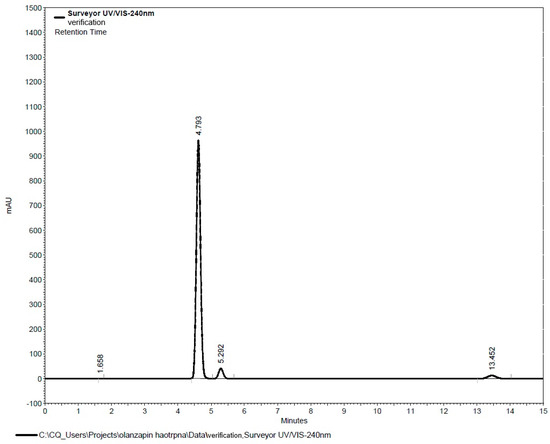
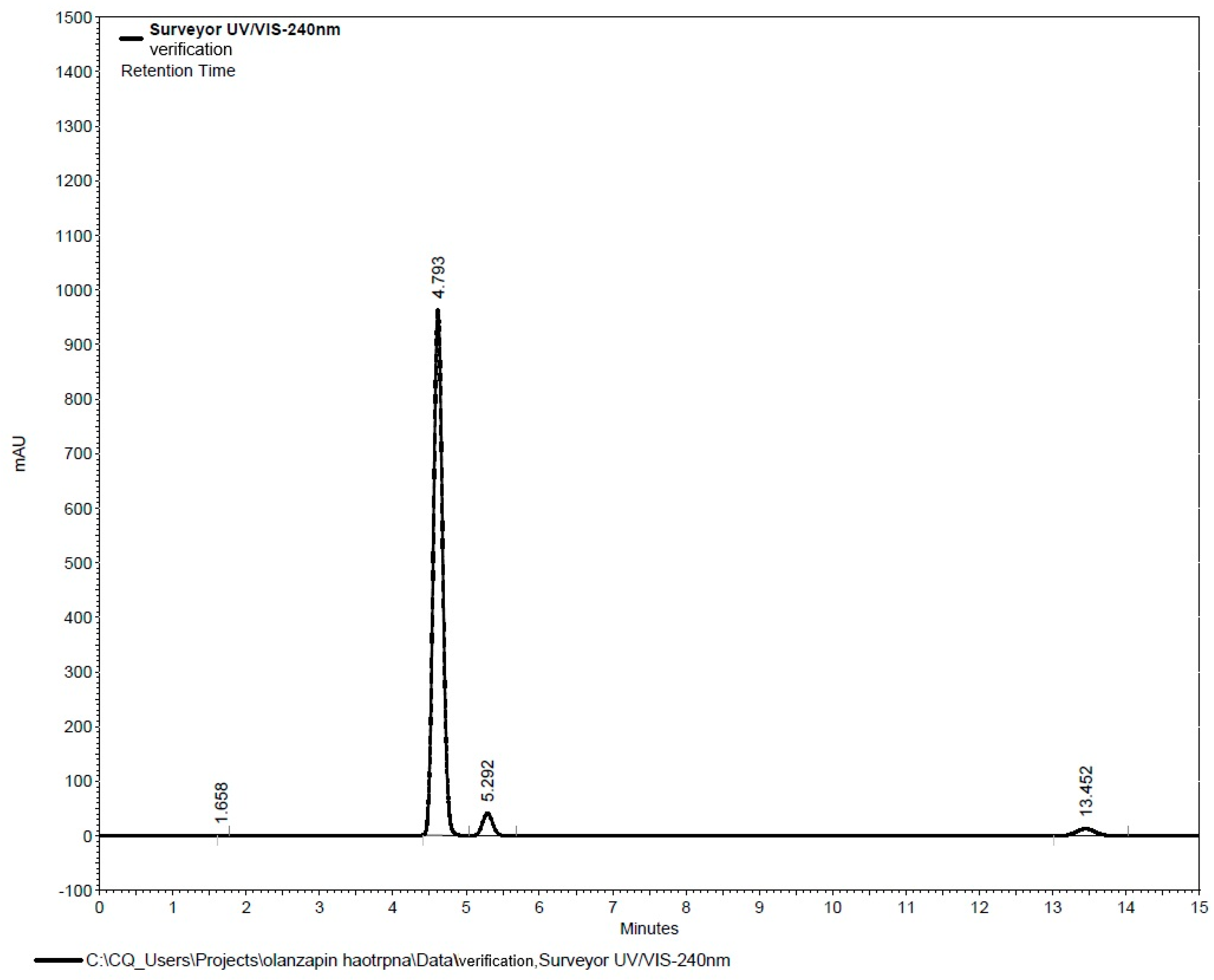
Once the DS has been established, an appropriate working point must be selected, followed by method validation and the definition of system suitability parameters as part of the analytical control strategy. An appropriate working point was selected for routine application of the method: 29.5% (v/v) acetonitrile, 70.5% (v/v) aqueous phase containing 160 mM HClO4, and pH of the aqueous part of the mobile phase adjusted to 2.20. The chromatographic separation was carried out using an XTerra RP18 column (150 mm × 4.6 mm, 3.5 µm particle size). The analysis of the working solution at the selected working point during method optimization confirmed that all predefined APAs were met under the optimized chromatographic conditions (kimpB = 7.11 and αolanzapine/impD = 1.104, while corresponding chromatographic resolution factor (Rs) at the optimized working point was 1.835). A representative verification chromatogram is presented in Figure 4.
Figure 4.
Verification chromatogram obtained by analyzing the laboratory mixture (olanzapine concentration 100 µg/mL, each impurity 5 µg/mL) under conditions corresponding to the working point: tr_olanzapine = 4.793 min, tr_impD = 5.292 min. and tr_impB = 13.452 min.
3.4. Definition of Control Strategy
The application of robust optimization within the AQbD framework ensures the robustness of qualitative method performance, as expressed through the APAs, across the DS. In parallel, evaluation of the quantitative robustness of the method, particularly with respect to signal response (e.g., peak area), provides the necessary basis for defining an effective control strategy. The control strategy is intended to ensure that the analytical procedure consistently delivers the expected performance during routine use throughout its entire life cycle. Quantitative robustness can be assessed using screening experimental designs, such as the Plackett–Burman design, to evaluate the impact of APPs and other factors identified during risk assessment on the quantitative performance of the method. The experimental plan based on the Plackett–Burman design is shown in Table S2 in the Supplementary Materials. Experimental runs were conducted in randomized order, and the resulting data (Table S2) were evaluated using statistical and graphical methods. Statistical analysis included error estimation derived from dummy effects and application of the Dong algorithm, while graphical interpretation used Pareto charts [29].
Graphical and statistical evaluation of the results (Table 4) indicated that flow rate (K) and column type (L) have a statistically significant effect on all quantitative performance parameters. Additionally, column temperature (H) was identified as relevant, although its influence was limited to the response PimpB. Therefore, these APPs (H, K, L) should be carefully controlled during the quantification of olanzapine and its oxidative degradation products B and D using the developed chaotropic chromatography method. Non-significance intervals for the statistically significant factors were estimated according to the approach proposed by Vander Heyden et al. [30], but only for column temperature, which was determined to be within the range 24–26 °C. Under conditions of a stable and well-qualified HPLC system, variations in flow rate are expected to affect the peak areas of both standards and samples proportionally, resulting in no meaningful impact on quantification. Therefore, strict control of flow rate between runs is not required, provided that chromatographic resolution remains unaffected. As anticipated, column type was identified as a significant factor; however, this parameter can be considered operationally irrelevant when analyses are performed using the same column type on which method development and optimization were conducted.
Table 4.
Graphically and statistically significant factors.
3.5. Method Validation
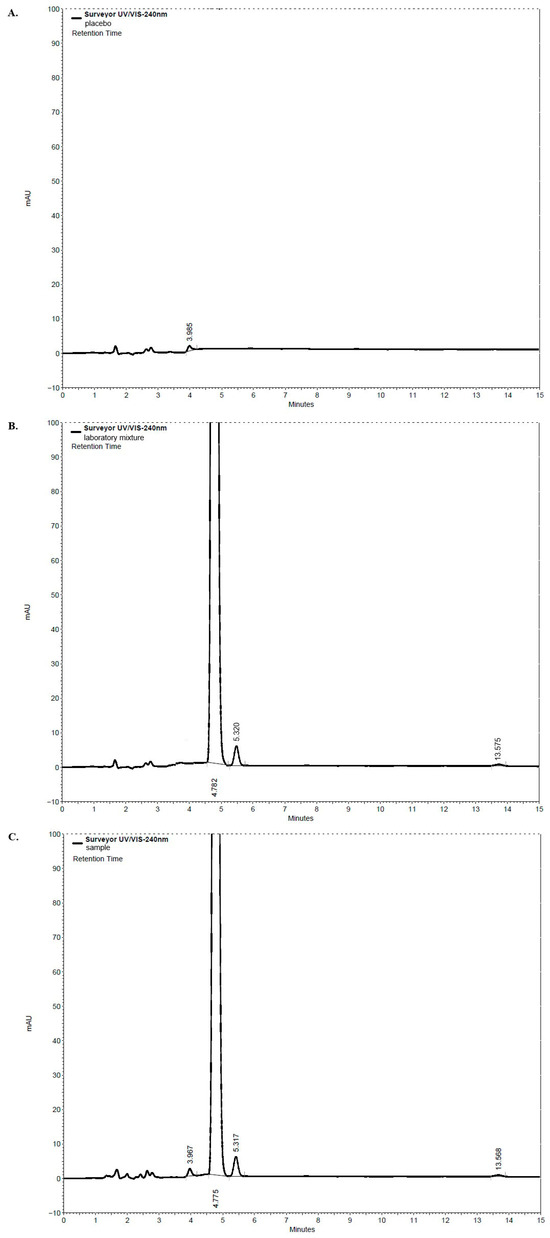
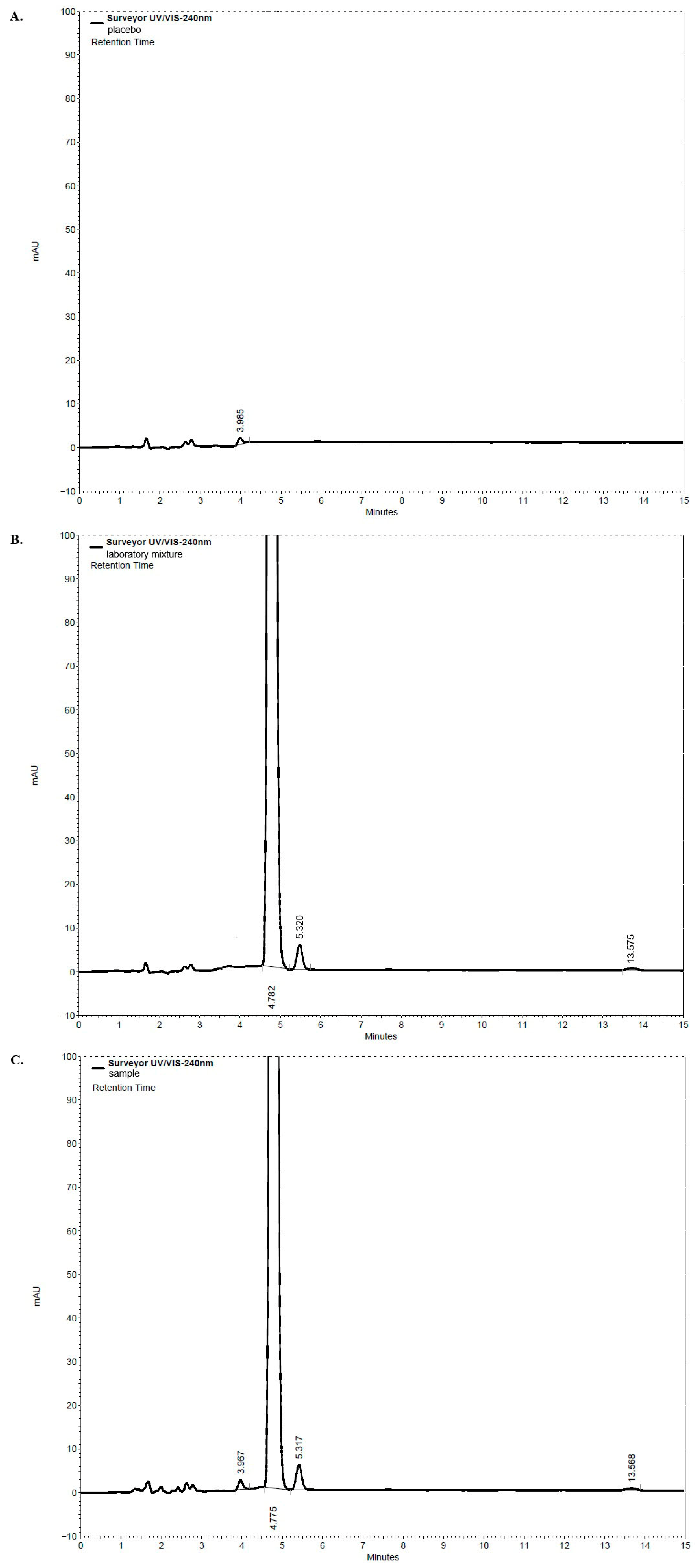
The suitability of the developed chaotropic chromatography method to meet the predefined ATP was demonstrated by evaluating sensitivity, selectivity, linearity, accuracy, and precision-repeatability. Method selectivity was assessed by injecting a placebo solution containing the excipients of the tested formulation (lactose monohydrate, microcrystalline cellulose, low-substituted hydroxypropyl cellulose, crospovidone type B, colloidal anhydrous silicon dioxide, talc, magnesium stearate), a laboratory mixture comprising impurities at the LOQ level and olanzapine at a concentration of 500 µg/mL and a tablet sample solution with the same olanzapine concentration. Examination of the obtained chromatograms (Figure 5) revealed no interfering peaks, confirming that the developed method is selective.
Figure 5.
Chromatograms obtained under conditions corresponding to the working point: (A). placebo mixture, (B). laboratory mixture of impurities at LOQ and olanzapine at 500 µg/mL, (C). tablet solution containing 500 μg/mL of olanzapine spiked with impurities at their respective LOQs.
Method sensitivity was assessed by experimentally determining the limits of detection (LOD) and quantification (LOQ). The suitability of the LOQ was verified by evaluating precision at the LOQ level through repeated injections of an impurity standard solution at concentrations of 0.75 µg/mL impurity B and 0.5 µg/mL impurity D, corresponding to an impurity level of 0.10%. Under these conditions, the signal-to-noise ratio (S/N) exceeded 10 and the RSD was ≤10%. For LOD determination, the criterion of S/N > 3 was met at impurity concentrations of 0.25 µg/mL impurity B and 0.15 µg/mL impurity D. These results demonstrate that the method is sufficiently sensitive for determining olanzapine oxidative degradation products in tablets.
Linearity was evaluated by assessing the relationship between peak areas and concentrations of olanzapine and impurities B and D. Calibration curves were constructed, yielding correlation coefficients greater than 0.998 for olanzapine and greater than 0.990 for the impurities. Furthermore, in accordance with ICH Q2(R2), linearity was confirmed across the investigated concentration ranges by visual inspection of calibration plots, residual analysis, and evaluation of the significance of the slope and intercept [18,31]. Linearity parameters are summarized in Table 5, which also presents the results of the accuracy and precision-repeatability studies. Accuracy was demonstrated by Recovery values ranging from 98% to 102% for olanzapine, with RSD ≤ 2%, and from 70% to 130% for the impurities (for impurities with the specification limit from 0.1% to 0.5%), with RSD ≤ 10%, all of which comply with the predefined acceptance criteria [31]. Method precision-repeatability was expressed as relative standard deviation (RSD, %) for 6 replicates. The calculated RSD values met the acceptance limits (≤2% for olanzapine and ≤10% for impurities with a specification limit of 0.50%), confirming satisfactory repeatability of the proposed method [18,31].
Table 5.
Validation parameters: limit of detection, linearity, accuracy and precision-repeatability of the proposed chaotropic chromatography method.
The assay of olanzapine in the analyzed tablet samples was 100.72%, while all impurities were below the corresponding LOQ values.
4. Conclusions
In this study, a robust and stability-indicating chaotropic chromatography method for the determination of olanzapine and its oxidative degradation products in tablets was successfully developed in accordance with the ICH Q14 guideline using an enhanced Analytical Quality by Design approach. Systematic risk assessment and DoE-based modeling enabled the identification and control of critical analytical procedure parameters and the establishment of a multidimensional design space ensuring reliable method performance with a high level of confidence. Robust optimization and quantitative robustness evaluation supported the definition of an effective control strategy, contributing to consistent method performance throughout its lifecycle. The validated method demonstrated adequate selectivity, sensitivity, linearity, accuracy, and precision, and its applicability was confirmed through the analysis of commercial tablet formulations. Overall, the proposed approach illustrates the practical implementation of ICH Q14 principles and highlights the suitability of chaotropic chromatography as a reliable tool for routine quality control and lifecycle management of olanzapine pharmaceutical products.
Supplementary Materials
The following supporting information can be downloaded at: https://www.mdpi.com/article/10.3390/analytica7010024/s1, Table S1: Plan of experiments defined by Box–Behnken experimental design to investigate the simultaneous effects and interactions of multiple APPs on the APAs and experimentally obtained results; Table S2: Plan of experiments defined by Plackett-Burman design and experimentally determined values of quantitative method performances.
Author Contributions
Conceptualization, A.M.; methodology, A.M., Y.D. and A.P.; formal analysis, M.R. (Milena Rmandić), M.R. (Marija Rašević) and K.G.; investigation, M.R. (Milena Rmandić), M.R. (Marija Rašević) and K.G.; resources, A.M. and Y.D.; data curation, M.R. (Milena Rmandić), M.R. (Marija Rašević) and A.M.; writing—original draft preparation, M.R. (Milena Rmandić), M.R. (Marija Rašević) and K.G.; writing—review and editing, A.M., Y.D. and A.P.; supervision, A.M.; All authors have read and agreed to the published version of the manuscript.
Funding
This research was funded by the Ministry of Science, Technological Development and Innovation, Republic of Serbia through two Grant Agreements with University of Belgrade-Faculty of Pharmacy No. 451-03-65/2024-03/200161 and No. 451-03-66/2024-03/200161.
Data Availability Statement
The original contributions presented in this study are included in the article/Supplementary Materials. Further inquiries can be directed to the corresponding authors.
Conflicts of Interest
The authors declare no conflicts of interest.
References
- European Medicines Agency; Committee for Medicinal Products for Human Use. ICH Q14 Analytical Procedure Development—Scientific Guideline; European Medicines Agency: Amsterdam, The Netherlands, 2024. Available online: https://www.ema.europa.eu/en/documents/scientific-guideline/ich-q14-guideline-analytical-procedure-development-step-5_en.pdf (accessed on 10 January 2026).
- Rozet, E.; Lebrun, P.; Debrus, B.; Boulanger, B.; Hubert, P. Design spaces for analytical methods. TrAC Trends Anal. Chem. 2013, 42, 157–167. [Google Scholar] [CrossRef] [Scilit]
- Dispas, A.; Avohou, H.T.; Lebrun, P.; Hubert, P.; Huber, C. Quality by design approach for the analysis of impurities in pharmaceutical drug products and drug substances. TrAC Trends Anal. Chem. 2018, 101, 24–33. [Google Scholar] [CrossRef] [Scilit]
- Deidda, R.; Orlandini, S.; Hubert, P.; Hubert, C. Risk-based approach for method development in pharmaceutical quality control context: A critical review. J. Pharm. Biomed. Anal. 2018, 161, 110–121. [Google Scholar] [CrossRef] [Scilit]
- Djordjević Filijović, N.; Antonijević, M.D.; Pavlović, A.; Vučković, I.; Nikolić, K.; Agbaba, D. The stress stability of olanzapine: Studies of interactions with excipients in solid state pharmaceutical formulations. Drug Dev. Ind. Pharm. 2015, 41, 502–514. [Google Scholar] [CrossRef] [Scilit] [PubMed]
- Hiriyanna, S.G.; Basavaiah, K.; Goud, P.S.K.; Dhayanithi, V.; Raju, K.; Pati, H.P. Identification and characterization of olanzapine degradation products under oxidative stress conditions. Acta Chromatogr. 2008, 20, 81–93. [Google Scholar] [CrossRef] [Scilit]
- Baertschi, S.W.; Brunner, H.; Bunnell, A.C.; Cooke, G.G.; Diseroad, B.; Dorman, D.E.; Jansen, P.J.; Kemp, C.A.; Maple, S.R.; McCune, K.A.; et al. Isolation, identification, and synthesis of two oxidative degradation products of olanzapine (LY170053) in solid oral formulations. J. Pharm. Sci. 2008, 97, 883–892. [Google Scholar] [CrossRef] [Scilit]
- Rao, P.S.; Ray, U.K.; Hiriyanna, S.G.; Rao, S.V.; Sharma, H.K.; Handa, V.K.; Mukkanti, K. Identification of oxidative degradation impurities of olanzapine drug substance as well as drug product. J. Pharm. Biomed. Anal. 2011, 56, 413–418. [Google Scholar] [CrossRef] [Scilit]
- United States Pharmacopeial Convention. United States Pharmacopeia–National Formulary (USP–NF), 51st ed.; United States Pharmacopeial Convention: Rockville, MD, USA, 2026. [Google Scholar]
- European Pharmacopoeia Commission. European Pharmacopoeia, 12th ed.; Council of Europe: Strasbourg, France, 2022. [Google Scholar]
- Cui, D.; Li, Y.; Lian, M.; Yang, F.; Meng, Q. Development of a simple and stability-indicating RP-HPLC method for determining olanzapine and related impurities generated in the preparative process. Analyst 2011, 136, 3149–3155. [Google Scholar]
- Krishnaiah, C.; Murthy, M.V.; Kumar, R.; Mukkanti, K. Development of a stability-indicating UPLC method for determining olanzapine and its associated degradation products present in active pharmaceutical ingredients and pharmaceutical dosage forms. J. Pharm. Biomed. Anal. 2011, 54, 667–673. [Google Scholar] [CrossRef] [Scilit]
- Alam, M.I.; Siddiqui, A.U.-R. Statistically optimized and Box–Behnken design assisted method development and validation of an antipsychotic medication olanzapine and its related impurities by reverse-phase HPLC-UV spectroscopy. Int. J. Appl. Pharm. 2021, 13, 241–246. [Google Scholar]
- Tumpa, A.; Stajić, A.; Jančić-Stojanović, B.; Medenica, M. Quality by design in the development of hydrophilic interaction liquid chromatography method with gradient elution for the analysis of olanzapine. J. Pharm. Biomed. Anal. 2017, 134, 18–26. [Google Scholar] [CrossRef] [Scilit]
- Cecchi, T. Ion-Pair Chromatography and Related Techniques; CRC Press: Boca Raton, FL, USA, 2010. [Google Scholar]
- Čolović, J.; Kalinić, M.; Vemić, A.; Erić, S.; Malenović, A. Investigation into the phenomena affecting the retention behavior of basic analytes in chaotropic chromatography: Joint effects of the most relevant chromatographic factors and analytes’ molecular properties. J. Chromatogr. A 2015, 1425, 150–157. [Google Scholar] [CrossRef] [Scilit] [PubMed]
- Gkountanas, K.; Rmandić, M.; Protić, A.; Malenović, A.; Dotsikas, Y. Investigation of different counterions and molecular structure effect on the retention behavior of protonated basic solutes in chaotropic chromatography. Acta Chromatogr. 2026, 38, 151–163. [Google Scholar] [CrossRef] [Scilit]
- International Council for Harmonisation of Technical Requirements for Pharmaceuticals for Human Use (ICH). ICH Harmonised Guideline Q2(R2): Validation of Analytical Procedures—Text and Methodology; ICH: Geneva, Switzerland, 2023. [Google Scholar]
- ChemAxon. MarvinSketch, Calculator Plugin and Chemical Terms Demo. Available online: https://www.chemaxon.com/marvin/sketch/index.php (accessed on 10 October 2025).
- Ermer, J.; Nethercote, P.W. Method Validation in Pharmaceutical Analysis: A Guide to Best Practice, 3rd ed.; Wiley-VCH Verlag GmbH & Co., KGaA: Weinheim, Germany, 2025. [Google Scholar]
- European Medicines Agency; Committee for Medicinal Products for Human Use. ICH Q9 Quality Risk Management—Scientific Guideline; European Medicines Agency: Amsterdam, The Netherlands, 2023. Available online: https://www.ema.europa.eu/en/documents/scientific-guideline/international-conference-harmonisation-technical-requirements-registration-pharmaceuticals-human-use-ich-guideline-q9-r1-quality-risk-management-step-5-revision-2_en.pdf (accessed on 10 January 2026).
- Martin, G.P.; Barnett, K.; Burgess, C.; Curry, P.D.; Ermer, J.; Gratzl, G.S.; Hammond, J.; Herrmann, J.; Kovacs, E.; LeBlond, D.J.; et al. Lifecycle management of analytical procedures: Method development, procedure performance qualification, and procedure performance verification. Pharmacop. Forum 2013, 39, 1–14. Available online: https://www.uspnf.com/sites/default/files/usp_pdf/EN/USPNF/revisions/lifecycle_pdf.pdf (accessed on 10 January 2026).
- Rašević, M.; Malenović, A.; Protić, A.; Zečević, M. Analytical method development supported by DoE-DS approach for enantioseparation of (S,S)- and (R,R)-moxifloxacin. J. Pharm. Biomed. Anal. 2023, 235, 115645. [Google Scholar] [CrossRef] [Scilit]
- Rmandić, M.; Rašević, M.; Stanković, J.; Zečević, M.; Otašević, B.; Protić, A.; Malenović, A. Development and robust optimization of the RP-HPLC method for the determination of riociguat and its four impurities in tablets using the AQbD approach. J. Pharm. Biomed. Anal. 2025, 258, 116742. [Google Scholar] [CrossRef] [Scilit]
- Basso, J.; Ramos, M.L.; Pais, A.; Vitorino, R.; Fortuna, A.; Vitorino, C. Expediting disulfiram assays through a systematic analytical quality by design approach. Chemosensors 2021, 9, 172. [Google Scholar] [CrossRef] [Scilit]
- Prajapati, P.; Patel, H.B.; Shah, S. DoE-based failure mode effect analysis (FMEA) for development of a stability-indicating HPTLC method for estimation of apremilast. SN Appl. Sci. 2020, 2, 1371. [Google Scholar] [CrossRef] [Scilit]
- Schoenmakers, P. Optimization of Chromatographic Selectivity: A Guide to Method Development; Elsevier: Amsterdam, The Netherlands, 1986. [Google Scholar]
- Bezerra, M.A.; Santelli, R.E.; Oliveira, E.P.; Villar, L.S.; Escaleira, L.A. Response surface methodology (RSM) as a tool for optimization in analytical chemistry. Talanta 2008, 76, 965–977. [Google Scholar] [CrossRef] [Scilit]
- Laky, D.; Xu, S.; Rodriguez, J.S.; Vaidyaraman, S.; García Muñoz, S.; Laird, C. An optimization-based framework to define the probabilistic design space of pharmaceutical processes with model uncertainty. Processes 2019, 7, 96. [Google Scholar] [CrossRef] [Scilit]
- Vander Heyden, Y.; Nijhuis, A.; Smeyers-Verbeke, J.; Vandeginste, B.G.M.; Massart, D.L. Guidance for robustness/ruggedness tests in method validation. J. Pharm. Biomed. Anal. 2001, 24, 723–753. [Google Scholar] [CrossRef] [Scilit] [PubMed]
- Crowther, J.B. Validation of pharmaceutical test methods. In Handbook of Modern Pharmaceutical Analysis; Ahuja, S., Scypinski, S., Eds.; Academic Press: New York, NY, USA, 2001; Volume 3, pp. 415–443. [Google Scholar]

Disclaimer/Publisher’s Note: The statements, opinions and data contained in all publications are solely those of the individual author(s) and contributor(s) and not of MDPI and/or the editor(s). MDPI and/or the editor(s) disclaim responsibility for any injury to people or property resulting from any ideas, methods, instructions or products referred to in the content. |
© 2026 by the authors. Licensee MDPI, Basel, Switzerland. This article is an open access article distributed under the terms and conditions of the Creative Commons Attribution (CC BY) license.