
Article

Early Survival Signal for Normothermic Machine Perfusion in Liver Transplantation Amidst Limited Registry Data

1
Office of Student Affairs, Baylor College of Medicine, Houston, TX 77030, USA
2
Office of Student Affairs, Baylor University, Waco, TX 76706, USA
3
Division of Abdominal Transplantation, Michael E. DeBakey Department of Surgery, Baylor College of Medicine, Houston, TX 77030, USA
*
Author to whom correspondence should be addressed.
Livers 2026, 6(4), 62; https://doi.org/10.3390/livers6040062
Submission received: 17 November 2025 / Revised: 11 May 2026 / Accepted: 23 June 2026 / Published: 2 July 2026
(This article belongs to the Special Issue Transforming Liver Transplantation: Breakthroughs and Boundaries)

Abstract

Background/Objectives: There is a critical disparity between donor organs and recipients awaiting liver transplantation. Normothermic machine perfusion (NMP) has emerged as a promising strategy with which to address this shortage. This study aimed to evaluate the association between NMP and short-term outcomes following liver transplantation using a large, multivariable-adjusted national dataset. Methods: A retrospective analysis of the de-identified United Network for Organ Sharing (UNOS) database was conducted for adult liver transplant recipients between January 2020 and July 2024. Standard and deceased donor data were merged according to donor identification number. Multivariable logistic and Cox regression models were used to evaluate patient mortality, graft failure, and hospital length of stay (LOS). Results: Among 34,115 patients, adjusted regression demonstrated lower one-year patient mortality (OR 0.68, CI 0.54–0.86, p = 0.001) and graft failure (OR 0.72, CI 0.60–0.87, p = 0.001) with NMP compared to static cold storage. NMP was also associated with reduced 30-day (OR 0.67, CI 0.47–0.95, p = 0.03) and 90-day mortality (OR 0.72, CI 0.54–0.94, p = 0.02) and shorter LOS (HR 1.06, CI 1.01–1.12, p = 0.02). Kaplan–Meier and Cox analyses showed no significant differences in overall patient mortality or graft failure. Conclusions: NMP was associated with improved short-term survival in time-independent analysis; however, it failed to reach significance in time-dependent Cox regression. These findings suggest that NMP could play a role in improving short-term outcomes and expanding the donor pool for liver transplant candidates. Additional studies are needed to fully elucidate the impact of NMP on short-term survival outcomes.

1. Introduction

Liver transplantation exists as the only curative treatment for end-stage liver disease. While the waiting list has diminished slightly in recent years, over ten thousand Americans are still pending life-saving treatment [1]. Consequently, intent-to-treat survival outcomes for liver transplant candidates have remained relatively static over the last three decades, leading into the mid-2010s [2]. The stagnation of this compound metric is tied to the limited donor supply in the context of continued demand. It is worth noting, however, that there has been a recent increase in the relative donor pool, which may affect outcomes [1]. The variability in these trends contrasts with other fields of medicine, such as oncology and critical care, which have seen continued improvement in intent-to-treat survival over the past several years [3,4].
A promising breakthrough for the nearly 40-year plateau in liver transplant intent-to-treat mortality may be brought about by machine perfusion (MP). Currently, the standard method for liver preservation is static cold storage (SCS), which leaves allografts susceptible to ischemic reperfusion injury (IRI) [5]. MP lowers the incidence of IRI through ex situ introduction of nutrients, notably oxygenation [6]. MP can be performed via one of two primary techniques: normothermic machine perfusion (NMP) or hypothermic machine perfusion (HMP). NMP functions by simulating physiological conditions (37 °C) with a cannulation of arterial inflow analogous to the hepatic artery and venous inflow analogous to the portal venous system [7]. Either blood or an oxygen-carrying acellular fluid is oxygenated and perfused through the hepatic vasculature. HMP similarly perfuses the allograft but uses artificial solutions under hypothermic conditions (4–11 °C) to slow the metabolic rate of the liver. NMP is currently employed as the predominant MP strategy, with clinical trials demonstrating a reduction in early allograft dysfunction (EAD) and IRI after reperfusion [8,9]. NMP allows for viability assessment prior to transplantation to evaluate the organ in real time [10]. The utility of NMP is especially apparent with respect to marginal allografts as it has been shown to increase transplantation of macrosteatotic livers [11]. Consequently, expanding donor criteria for allografts could make NMP a breakthrough in reducing liver transplant candidate mortality.
The literature has delineated the association between NMP and increased organ utilization; however, short-term patient and graft survival outcomes remain unclear [8,12]. While a handful of studies have demonstrated a relationship between NMP and lower mortality in certain populations, aggregate database and meta-analyses have not reached a consensus on short-term survival benefits [13,14,15,16]. The increase in NMP has been exponential over the past few years, providing more statistical power to NMP cohorts [17]. As such, the population size is now sufficient for a comprehensive, adjusted, large-database analysis of short-term outcomes following NMP. This study aims to build upon previous national investigations of short-term patient and graft survival outcomes following NMP through a robust, multivariable analysis.

2. Materials and Methods

2.1. Study Population

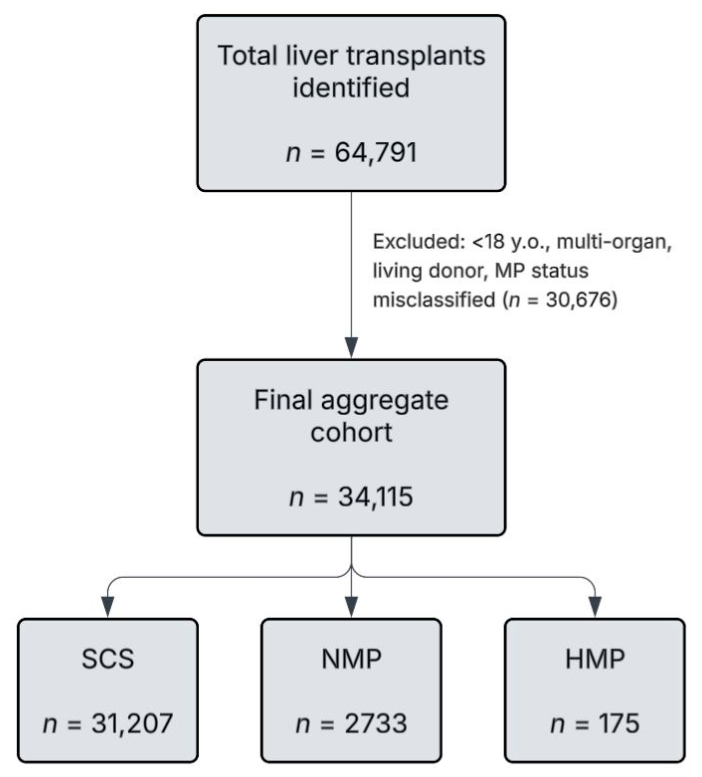
A retrospective analysis of the de-identified United Network for Organ Sharing (UNOS) database reported to the Organ Procurement and Transplantation Network (OPTN) was performed, limited to adult (age > 18 years) recipients of liver transplants between January 2020 and July 2024 [18]. Standard and deceased donor data were combined in a single data set, merged by donor identification number. Characteristics were reported at the time of the transplantation. The variable “li_machine_perfusion_ty” was associated with the usage of machine perfusion with NMP corresponding to a coded value of 1 and HMP to a coded value of 2. Patients with an ambiguous coded value of 999 for machine perfusion were excluded from the study. The UNOS dataset has been used in prior large-registry studies to identify NMP cases [13,16]. Unfortunately, the UNOS database does not currently capture whether cases utilize normothermic regional perfusion (NRP). Multi-organ-transplantation patients were excluded from the population. Analyses followed patients until death (n = 3165) or the last reported follow-up (n = 30,950) within the study period. The total population included 34,115 patients. Per the de-identified nature of the UNOS database, institutional review board approval was waived. See Figure 1 for a schematic of the study population selection.

2.2. Statistical Analysis

The data was analyzed using the Stata statistical software package, Stata® 18.5 (Stata Corp, College Station, TX, USA) [19]. Continuous variables were reported using the mean ± the standard deviation. The means were compared using a two-tailed Student’s t-test. Categorical variables were reported as percentages and compared using Pearson’s χ2 test. In all analyses, a p-value of <0.05 was considered significant. Short-term survival was considered any survival interval within one year of transplantation. All primary and secondary outcomes are considered for NMP. The HMP cohort is of insufficient size to uncover any meaningful statistical associations. The primary outcomes were one-year patient mortality and graft failure. The time-to-event (TTE) start point was defined as the date of transplantation up to either the patient’s death or graft failure. TTE analysis was performed using Kaplan–Meier survival analysis, univariable and multivariable logistic regression, and Cox proportional hazards modeling. Secondary outcomes included both patient mortality and graft failure at 30 days and 90 days, Cox TTE, and patient length of stay (LOS). LOS was defined as a prolonged LOS > 30 days in logistic regression and the time until patient discharge in Cox regression.

2.3. Risk Factors

In the regression analyses, 108 covariables were analyzed, corresponding to particular donor or recipient characteristics. These covariables are listed under the study groups. The broad range of covariables helps adjust for baseline differences between study groups. Characteristics that are seen as standard or applicable to the majority of patients were considered the reference group. The reference group for the OPTN Region in multivariable regression included all regions that were insignificant in univariable regression for the corresponding test. In all tests, significant risk factors in univariable regression were included as covariables in multivariable regression. NMP was considered in all statistical tests, irrespective of its significance in univariable regression.

3. Results

3.1. Study Demographics

A total of 34,115 patients (12,209 women, mean [SD] age: 54.7 [11.8] years) were identified within the timeframe using the parameters outlined in the Materials and Methods. Of these, 2733 (8.0%) patients received NMP preserved livers, and 175 (0.5%) received HMP preserved livers. A total of 31,207 (91.5%) patients received SCS preserved livers, serving as the reference group. The discrepancy in the cohort population sizes reflects current clinical practices and usage of machine perfusion. Demographic and clinical characteristics for the groups can be seen in Table 1. Notably, there were some demographic differences between the SCS and NMP groups in terms of donor age (42.8 years for SCS and 46.9 years for NMP, p < 0.01), percentage of African American donors (18.4% for SCS vs. 15.3% for NMP, p < 0.01), donor height (171.1 cm for SCS vs. 170.6 cm for NMP, p = 0.01), donor weight (83.2 kg for SCS vs. 86.4 kg for NMP, p < 0.01), donor creatinine (1.9 mg/dL for SCS and 1.7 mg/dL for NMP, p < 0.01), cold ischemia time (6.3 h for SCS vs. 14.3 h for NMP, p < 0.01), anoxia as a cause of death (43.7% for SCS vs. 51.9% for NMP, p < 0.01), head trauma as a cause of death (26.1% for SCS vs. 18.3% for NMP, p < 0.01), recipient age (54.3 years for SCS vs. 56.6 years for NMP, p < 0.01), percentage of African American recipients (7.3% for SCS vs. 4.8% for NMP, p < 0.01), recipient INR (2.1 for SCS vs. 1.8 for NMP, p < 0.01), recipient creatinine (1.4 mg/dL for SCS vs. 1.2 mg/dL for NMP, p < 0.01), MELD score (25.3 for SCS vs. 21.0 for NMP, p < 0.01), percentage of liver failure caused by nonalcoholic steatohepatitis (15.6% for SCS vs. 19.6% for NMP, p < 0.01), and percentage of liver failure caused by alcoholic cirrhosis (31.1% for SCS vs. 31.2% for NMP, p < 0.01).

3.2. Data Entry Rate

The data entry rate for all variables is displayed in Tables S1–S6. The majority of variables were well-populated, with some exceptions being MP type (8.9%), donation after circulatory death (DCD) (14.5%) and diagnosis of hepatocellular carcinoma (HCC) (52.9%). MP type and DCD status were included in the final model because these variables were primarily coded by presence; thus, the lack of an entry was treated as the absence of the characteristic rather than missing data. A sensitivity analysis involving multiple imputation of HCC was performed but did not meaningfully change study results. Entries that were unfilled were not discarded but instead added to the reference group under the assumption that the particular characteristic did not apply to the patient or that missing entries would be distributed randomly.

3.3. Outcomes

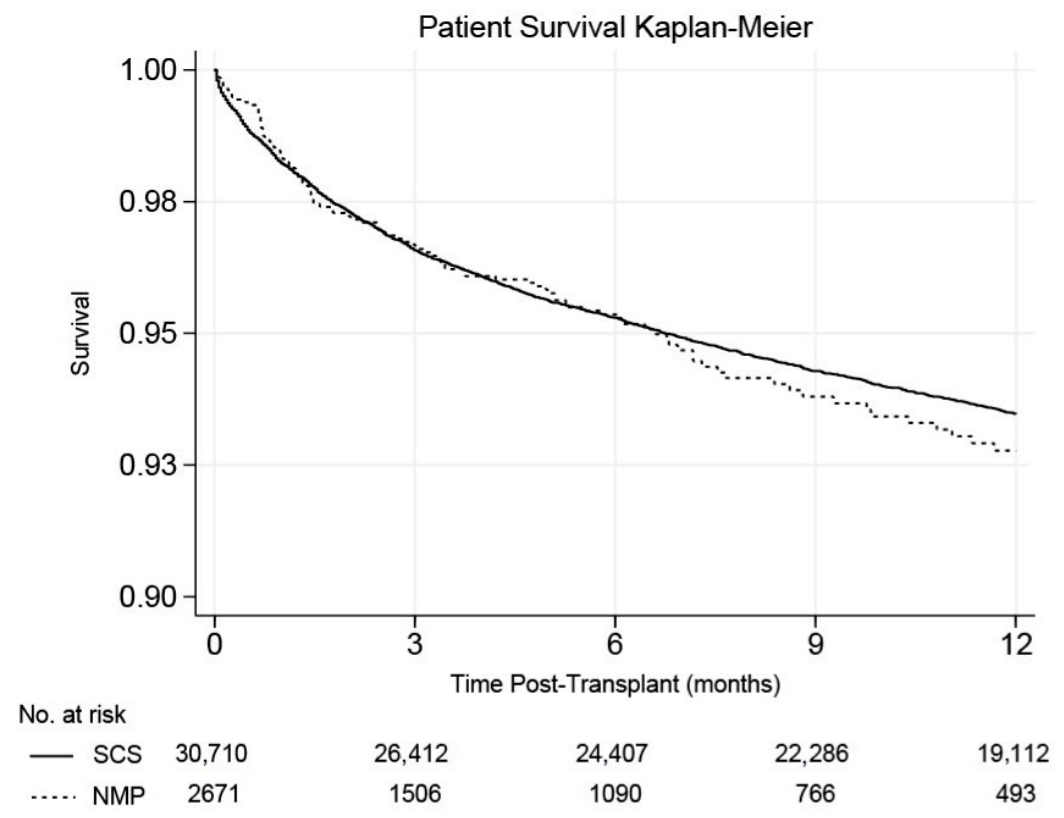
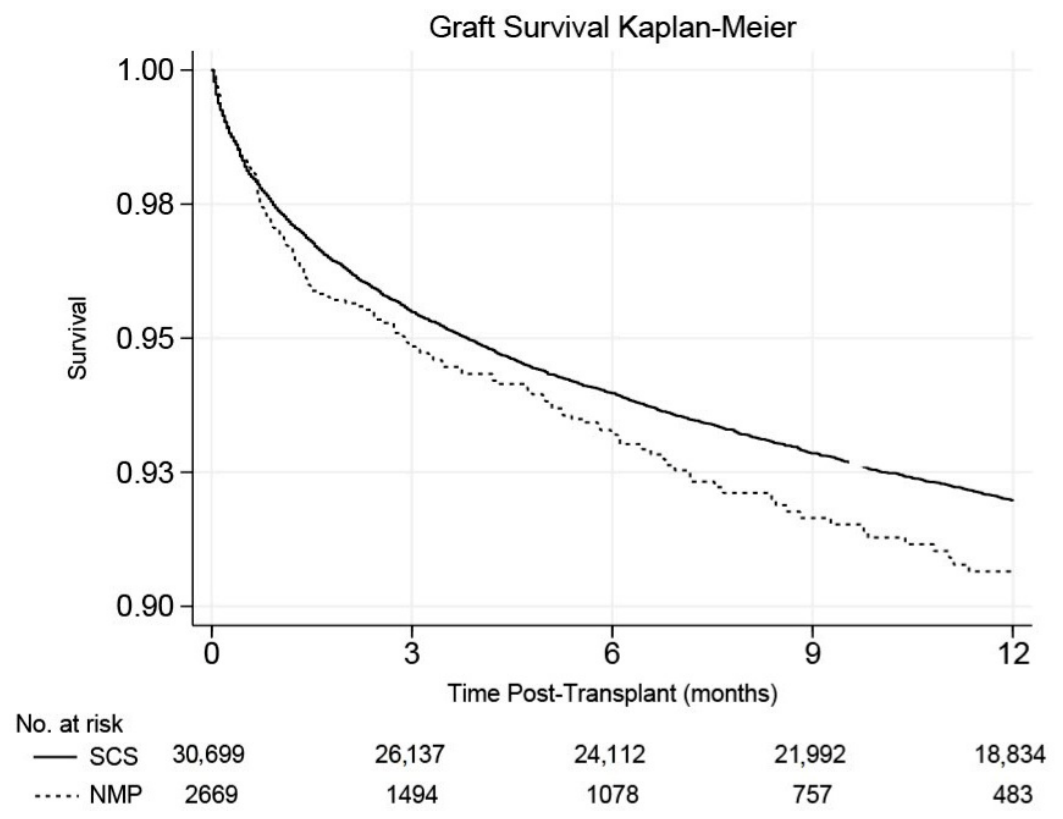
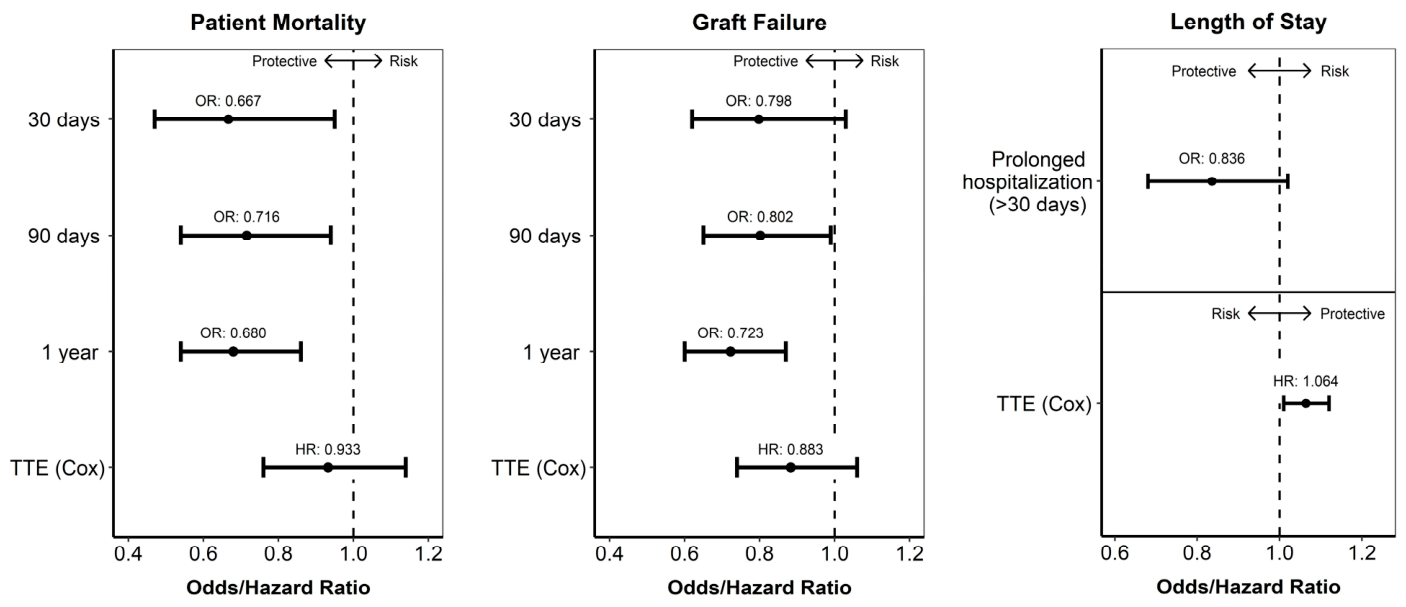
The one-year mortality for NMP livers was significantly lower than that for SCS livers in multivariable time-independent analysis (OR 0.68, CI 0.54–0.86, p = 0.001). The one-year graft failure was also lower in NMP livers than in SCS livers in multivariable time-independent analysis (OR 0.72, CI 0.60–0.87, p = 0.001). All numeric primary and secondary outcomes for NMP can be seen in Table 2. Figure 2 and Figure 3 demonstrate the Kaplan–Meier survival curves for both patient and graft survival. The Kaplan–Meier curves suggest greater survival for SCS, possibly reflecting limited follow-up in the NMP cohort with an insignificant difference in Cox regression. Specifically, the mean six-month follow-up for the SCS cohort was 84%, while it was only 48% in the NMP cohort. Multivariable logistic regression at the one-year time point did indicate a significant protective association for NMP, which contrasts with the trends seen in the Kaplan–Meier curves.
The secondary outcomes exhibited a similar trend, with 30-day mortality being significantly lower in the NMP group than in the SCS group (OR 0.67, CI 0.47–0.95, p = 0.03). Graft failure did not differ at 30 days between NMP and SCS livers (OR 0.80, CI 0.62–1.03, p = 0.08) (Table S3). The 90-day mortality was lower in NMP livers (OR 0.72, CI 0.54–0.94, p = 0.02), and so was 90-day graft failure (OR, 0.80, CI, 0.65–0.99, p = 0.04) (Table S4). In Cox multivariable regression, NMP was insignificant with respect to patient mortality (HR 0.93, CI 0.76–1.14, p = 0.499) and graft failure (HR 0.88, CI 0.74–1.06, p = 0.18) (Table S5). NMP had a protective association with LOS, with a faster time to discharge (HR 1.06, CI 1.01–1.12, p = 0.02). However, there was no difference in the risk of prolonged (>30 days) hospitalizations (OR 0.84, CI 0.68–1.02, p = 0.08) (Table S6). See Figure 4 for summarized results of all the primary and secondary outcomes. The results of the cumulative-incidence function showed visually improved patient survival in the NMP cohort (Figure S1).

4. Discussion

This large-database analysis of short-term liver transplant outcomes following machine perfusion found NMP to be a significant protective factor for short-term survival for both patients and allografts in time-independent logistic regression; however, NMP failed to achieve significance in the time-dependent Cox regression models. Therefore, the results of this study must be interpreted cautiously. In the present dataset, NMP allograft recipients had shorter and less uniform follow-up, which constrains the ability of TTE models to fully characterize differences in early post-transplant outcomes. In this regard, the observed association between NMP and improved short-term survival should be interpreted as a signal that persists after extensive multivariable adjustment rather than definitive evidence of independent survival benefit. Additional analyses with more complete follow-up are necessary to ascertain more definitive conclusions, as Cox regression remains preferred for TTE methodology.
Previous studies have established that NMP has the profound potential to expand the scarce pool of available livers for transplantation [8,11,12]. The impact on short-term survival outcomes, however, is less clear. Many studies have ascertained that there is no difference in patient or graft survival with respect to NMP utilization [12,14,20,21,22]. Most notably, the results of the present investigation can be compared to the 2025 publication by Zhou et al., who also utilized the UNOS database to evaluate various short-term outcomes following NMP [16]. Their findings demonstrated no significant differences in one-year post-transplant survival under multivariable Cox regression. The present study corroborated this result by demonstrating no differences in survival across all time points using Cox regression. A key difference in our study, however, was the utilization of logistic regression to characterize the time-independent survival at various short-term intervals. Even with adjustment for over 100 covariables in multivariable logistic regression, NMP was still highly protective of one-year post-transplant survival. This trend suggests that with more robust follow-up data, a similar result could be seen in a TTE-dependent manner such as Cox regression.
Other studies have explored the concept of NMP and short-term survival across various targeted cohorts. A 2025 single-center study by Nguyen et al. found NMP to be associated with significantly lower patient mortality and graft failure compared to patients with livers preserved with SCS [23]. A recent meta-analysis suggested, conversely, there is no significant favorable effect of using NMP, except in livers with extended donor criteria [15]. Nevertheless, this conclusion is not universal. Okumura et al. performed a retrospective analysis of NMP utilization in regard to DCD livers and saw improved two-year overall patient and graft survival [13]. Markmann et al. found a significant decrease in early allograft dysfunction in their PROTECT randomized clinical trial [9]. Likewise, a meta-analysis by Parente et al. revealed lower rates of EAD in both NMP and HMP cohorts [24]. Regardless, all of these studies should be interpreted within the context of the current state of NMP usage. Centers that utilize MP have been shown to transplant more livers from donors with elevated BMI values, DCD donors, and livers with longer cold ischemia times [25]. Perhaps the great variability in these confounders as well as the general notion that NMP is used primarily on marginal livers can help explain the lack of previous studies’ consensus regarding short-term survival outcomes.
The present study contributes the largest NMP cohort analyzed to date, with over 2700 patients. Other investigations such as Zhou et al.’s study focused on actuarial survival data, which is consistent with our insignificant time-dependent Kaplan–Meier survival analysis. The use of logistic regression, however, does demonstrate a protective effect of NMP on various short-term survival intervals. This highlights a difference between the actual and actuarial survival calculated from a dataset that has rather incomplete follow-up information, especially in the NMP cohort. Visually, this can be demonstrated by comparing the results of the Kaplan–Meier curves to the cumulative incidence function. Taken together, these represent the lower and upper limits of censoring, bounding the range in which the true survival function would be expected to fall. The ability to achieve statistical significance in multivariable adjusted logistic regression, despite the incomplete follow-up, uncovers a potential underlying trend wherein NMP does have a positive association with short-term post-transplant survival.
One area of the literature that does see consensus pertains to the impact of NMP on LOS. The present study is in concordance with several others that saw a decrease in LOS for patients following NMP liver transplantations [8,13,14,20]. Wang et al. corroborated these results, citing a 20% decrease in LOS in recipients of NMP livers. Their analysis also included a time-of-day assessment, as peak case load for NMP livers occurred at 11 a.m. vs. 9 p.m. for SCS [14]. Shorter hospital admissions and more favorable operating times support the potential to enhance efficiency in hospitals and reduce strain. Interestingly, the rate of prolonged hospitalization was insignificant in the present study, suggesting that NMP reduces average LOS but may not prevent more complicated hospital courses.
HMP is an important area to study; however, the limited numbers did not allow a robust retrospective analysis. Early clinical trials have conflicting but cautiously optimistic results regarding the impact of HMP on survival outcomes, graft failure, and length of stay [26,27]. Analogous to NMP, HMP is often utilized in marginal allografts and could help expand the donor pool. A larger sample size is needed to elucidate more generalizable conclusions.
The findings of the present study are promising; however, they need to be considered in the broader context of the current state of liver transplantation. While increasing, the usage of NMP is still relatively limited and in many ways unnecessary as SCS tends to yield excellent results in the absence of steatosis or fibrosis [28,29]. As NMP becomes more logistically feasible, this sentiment could change. Improved survival outcomes and the utilization of increasingly marginal allografts offer the potential for NMP to become the standard of care in the future. Such a practice would likely generate the most benefit, not through short-term survival outcomes following transplantation but rather through creating a broader pool of donor livers to reduce waitlist times and improve intent-to-treat survival outcomes. Some logistical hurdles of mass NMP adoption could be ameliorated by the usage of “end-ischemic liver reconditioning,” where preservation of the liver initially utilizes SCS and is switched to NMP at the recipient hospital [30]. This technique was studied back in 2019 when Ceresa et al. found no differences in outcomes between the SCS-to-NMP technique and continuous NMP [31]. The scope of NMP could be further elucidated in future studies by creating a donor risk index and survival outcomes index score that incorporates MP into the calculation. Future studies may also analyze the impact of NMP on various classifications of marginal livers to promote optimal utilization.

5. Limitations

The key limitation involves the UNOS database itself. One significant limitation is the relatively high number of missing follow-up data in NMP cases. The mean six-month follow-up for the SCS cohort was nearly double that of the NMP cohort. This suggests data immaturity, and thus the results of this analysis must be interpreted cautiously. Consequently, models such as Kaplan–Meier analysis underestimate survival in intervals with fewer follow-up data. As a result, we used a cumulative-incidence function to generate a graphical representation of survival with the imperfect assumption that no mortality occurred beyond the last follow-up. The true survival curve falls between the Kaplan–Meier and the cumulative-incidence functions. Additionally, it is known that the UNOS database does not accurately capture all cases of NMP. Due to the nature of the variable, it is unlikely that cases of SCS would be miscoded as NMP; however, there are likely several instances of NMP that were miscoded as SCS and were thus added to the reference group. Despite this, we were still able to achieve statistical significance in logistic regression, highlighting the strength of the association between NMP and improved survival outcomes. Furthermore, the UNOS database tends to exclude end-ischemic liver reconditioning cases from the NMP cohort, adding additional instances of NMP to the reference group [32]. There is also no way to determine NRP cases—posing a potential limitation to the study design; however, this would likely strengthen the overconservative assessment of NMP’s association with improved survival in logistic regression. Unaccounted selection criteria may also differ between NMP and SCS allografts, which could affect outcomes. Lack of completion and accuracy of the variables themselves could have further obfuscated this analysis. While the database presents many limitations, the large numbers are key to adjusting for confounders on a national scale and producing generalizable results. Prospective trials are necessary for establishing causal relationships.

6. Conclusions

This is the largest NMP cohort study to date using the entire OPTN database. Adjusted one-year outcomes provide a signal of improved survival for NMP compared with SCS, while other analyses and follow-up considerations offer additional context for interpretation. Given the current landscape of a long waitlist and increasing utilization of MP, these results suggest that NMP could be one lever for reducing overall mortality for liver transplant candidates. Additional studies are needed to fully elucidate the impact of NMP on short-term survival outcomes.

Supplementary Materials

The following supporting information can be downloaded at https://www.mdpi.com/article/10.3390/livers6040062/s1. Figure S1: One-year cumulative incidence survival function for NMP versus SCS allografts. Table S1: One-year logistic regression for patient survival. Table S2: One-year logistic regression for graft survival. Table S3: 30-day logistic regression for patient and graft survival. Table S4: 90-day logistic regression for patient and graft survival. Table S5: Cox regression for patient, graft survival and length of stay. Table S6: Logistic regression for prolonged (>30 days) length of hospital stay.

Author Contributions

Conceptualization, C.B., Z.M.S.H. and A.R.; methodology, C.B., G.H., Z.M.S.H. and A.R.; software, C.B.; writing—original draft preparation, C.B. and R.V.; writing—review and editing, all authors; visualization, C.B. and R.V.; supervision, J.G. and A.R.; project administration, A.R. All authors have read and agreed to the published version of the manuscript.

Funding

This research received no external funding.

Institutional Review Board Statement

The Baylor College of Medicine Institutional Review Board determined that this study did not constitute human subject research because the study utilized publicly available de-identified OPTN/UNOS data. Therefore, IRB review and approval were not required in accordance with 45 CFR 46.102(e)(5) and 45 CFR 46.102(e)(6). Determination date: 27 February 2025.

Informed Consent Statement

Patient consent was waived because the study utilized publicly available de-identified data and did not involve identifiable human subjects.

Data Availability Statement

The data that support the findings of this study are available from the United Network for Organ Sharing (UNOS) under a data use agreement with the Organ Procurement and Transplantation Network (OPTN). Restrictions apply to the availability of these data, which were used under license for this study. De-identified data may be requested directly from UNOS at https://hrsa.unos.org/RequestData/ (accessed on 3 September 2024).

Conflicts of Interest

The authors declare no conflicts of interest.

Abbreviations

The following abbreviations are used in this manuscript:
BMIBody mass index
CIConfidence Interval
DCDDonation after circulatory death
EADEarly allograft dysfunction
HMPHypothermic machine perfusion
HRHazard ratio
INRInternational normalized ratio
IRIIschemic reperfusion injury
LOSLength of stay
MELDModel for end-stage liver disease
MPMachine perfusion
NMPNormothermic machine perfusion
NRPNormothermic regional perfusion
OPTNOrgan Procurement and Transplantation Network
OROdds ratio
SCSStatic cold storage
TTETime-to-event
UNOSUnited Network for Organ Sharing

References

  1. Kwong, A.J.; Kim, W.R.; Lake, J.R.; Schladt, D.P.; Schnellinger, E.M.; Gauntt, K.; McDermott, M.; Weiss, S.; Handarova, D.K.; Snyder, J.J.; et al. OPTN/SRTR 2022 Annual Data Report: Liver. Am. J. Transplant. 2024, 24, S176–S265. [Google Scholar] [CrossRef] [PubMed]
  2. Rana, A.; Godfrey, E.L. Outcomes in solid-organ transplantation: Success and stagnation. Tex Heart Inst. J. Tex. Heart Inst. 2019, 46, 75–76. [Google Scholar] [CrossRef] [PubMed]
  3. Darmon, M.; Bourmaud, A.; Georges, Q.; Soares, M.; Jeon, K.; Oeyen, S.; Rhee, C.K.; Gruber, P.; Ostermann, M.; Hill, Q.A.; et al. Changes in critically ill cancer patients’ short-term outcome over the last decades: Results of systematic review with meta-analysis on individual data. Intensive Care Med. 2019, 45, 977–987. [Google Scholar] [CrossRef] [PubMed]
  4. Ebata, T.; Shimizu, T.; Koyama, T.; Shimomura, A.; Iwasa, S.; Kondo, S.; Kitano, S.; Yonemori, K.; Fujiwara, Y.; Yamamoto, N. Improved survival among patients enrolled in oncology phase 1 trials in recent decades. Cancer Chemother. Pharmacol. 2020, 85, 449–459. [Google Scholar] [CrossRef] [PubMed]
  5. Xu, J.; Buchwald, J.E.; Martins, P.N. Review of Current Machine Perfusion Therapeutics for Organ Preservation. Transplant. Lippincott Williams Wilkins 2020, 104, 1792–1803. [Google Scholar] [CrossRef] [PubMed]
  6. Liew, B.; Nasralla, D.; Iype, S.; Pollok, J.M.; Davidson, B.; Raptis, D.A. Liver transplant outcomes after ex vivo machine perfusion: A meta-analysis. Br. J. 2021, 108, 1409–1416. [Google Scholar] [CrossRef] [PubMed]
  7. Clarke, G.; Mergental, H.; Hann, A.; Perera, M.T.P.R.; Afford, S.C.; Mirza, D.F. How machine perfusion ameliorates hepatic ischaemia reperfusion injury. Int. J. Mol. Sci. 2021, 22, 7523. [Google Scholar] [CrossRef] [PubMed]
  8. Robinson, T.; Vargas, P.A.; Yemini, R.; Goldaracena, N.; Pelletier, S. Are we on track to increase organ utilization? An analysis of machine perfusion preservation for liver transplantation in the United States. Artif. Organs. 2024, 48, 1275–1287. [Google Scholar] [CrossRef] [PubMed]
  9. Markmann, J.F.; Abouljoud, M.S.; Ghobrial, R.M.; Bhati, C.S.; Pelletier, S.J.; Lu, A.D.; Ottmann, S.; Klair, T.; Eymard, C.; Roll, G.R.; et al. Impact of Portable Normothermic Blood-Based Machine Perfusion on Outcomes of Liver Transplant: The OCS Liver PROTECT Randomized Clinical Trial. JAMA Surg. 2022, 157, 189–198. [Google Scholar] [CrossRef] [PubMed]
  10. Li, J.; Lu, H.; Zhang, J.; Li, Y.; Zhao, Q. Comprehensive Approach to Assessment of Liver Viability During Normothermic Machine Perfusion. J. Clin. Transl. Hepatol. 2023, 11, 466–479. [Google Scholar] [CrossRef] [PubMed]
  11. Cywes, C.; Banker, A.; Muñoz, N.; Levine, M.; Gazala, S.A.; Bittermann, T.; Abt, P. The Potential Utilization of Machine Perfusion to Increase Transplantation of Macrosteatotic Livers. Transplantation 2024, 108, e370–e375. [Google Scholar] [CrossRef] [PubMed]
  12. Macconmara, M.; Hanish, S.I.; Hwang, C.S.; De Gregorio, L.; Desai, D.M.; Feizpour, C.A.; Tanriover, B.; Markmann, J.F.; Zeh, H., III; Vagefi, P.A. Making Every Liver Count: Increased Transplant Yield of Donor Livers Through Normothermic Machine Perfusion. Ann. Surg. 2020, 272, 397–401. [Google Scholar] [CrossRef] [PubMed]
  13. Okumura, K.; Dhand, A.; Misawa, R.; Sogawa, H.; Veillette, G.; Nishida, S. Normothermic Machine Perfusion Is Associated with Improvement in Mortality and Graft Failure in Donation after Cardiac Death Liver Transplant Recipients in the United States. Transpl. Direct. 2024, 10, e1679. [Google Scholar] [CrossRef] [PubMed]
  14. Wang, B.K.; Shubin, A.D.; Harvey, J.A.; MacConmara, M.M.; Hwang, C.S.; Patel, M.S.; Vagefi, P.A. From Patients to Providers: Assessing Impact of Normothermic Machine Perfusion on Liver Transplant Practices in the US. J. Am. Coll. Surg. 2024, 238, 844–852. [Google Scholar] [CrossRef] [PubMed]
  15. Liang, A.; Cheng, W.; Cao, P.; Cai, S.; Zhang, L.; Zhong, K.; Nie, Y. Effects of machine perfusion strategies on different donor types in liver transplantation: A systematic review and meta-analysis. Int. J. Surg. 2023, 109, 3617–3630. [Google Scholar] [CrossRef] [PubMed]
  16. Zhou, A.L.; Akbar, A.F.; Ruck, J.M.; Weeks, S.R.; Wesson, R.; Ottmann, S.E.; Philosophe, B.; Cameron, A.M.; Meier, R.P.H.; King, E.A. Use of Ex Situ Machine Perfusion for Liver Transplantation: The National Experience. Transplantation 2025, 109, 967–975. [Google Scholar] [CrossRef] [PubMed]
  17. Croome, K.P. Introducing Machine Perfusion into Routine Clinical Practice for Liver Transplantation in the United States: The Moment Has Finally Come. J. Clin. Med. 2023, 12, 909. [Google Scholar] [CrossRef] [PubMed]
  18. Organ Procurement and Transplant Network (OPTN). LIVER_DATA, July 2024. Standard Transplant Analysis and Research (STAR) File. United Network for Organ Sharing (UNOS). Available online: https://hrsa.unos.org/RequestData (accessed on 3 September 2024).
  19. StataCorp. Stata Statistical Software: Release 18.5; StataCorp LLC: College Station, TX, USA, 2024. [Google Scholar]
  20. Shubin, A.D.; Feizpour, C.A.; Hwang, C.S.; Hanish, S.I.; Raschzok, N.; Wang, B.K.; Desai, D.M.; Shah, J.A.; Vagefi, P.A.; MacConmara, M.P.; et al. Normothermic machine perfusion for older transplant recipients. Artif. Organs 2023, 47, 1184–1191. [Google Scholar] [CrossRef] [PubMed]
  21. Chapman, W.C.; Barbas, A.S.; D’Alessandro, A.M.; Vianna, R.; Kubal, C.A.; Abt, P.; Sonnenday, C.; Barrh, R.; Alvarez-Casas, J.; Yersiz, H.; et al. Normothermic Machine Perfusion of Donor Livers for Transplantation in the United States: A Randomized Controlled Trial. Ann. Surg. 2023, 278, E912–E921. [Google Scholar] [CrossRef] [PubMed]
  22. Jeddou, H.; Tzedakis, S.; Prudhomme, H.; Wautier, A.; Summer, C.; Nejma, E.B.; Zorkot, M.A.; De Rosa, R.V.; Mazzarella, G.; Chaouch, M.A.; et al. Normothermic Perfusion Versus Static Cold Storage in Liver Transplantation: A Meta-Analysis of Randomized Trials. Clin. Transplant. 2025, 39, e70372. [Google Scholar] [CrossRef] [PubMed]
  23. Nguyen, M.C.; Zhang, C.; Chang, Y.H.; Li, X.; Ohara, S.Y.; Kumm, K.R.; Cosentino, C.P.; Aqel, B.A.; Lizaola-Mayo, B.C.; Frasco, P.E.; et al. Improved Outcomes and Resource Use with Normothermic Machine Perfusion in Liver Transplantation. JAMA Surg. 2025, 160, 322–330. [Google Scholar] [CrossRef] [PubMed]
  24. Parente, A.; Tirotta, F.; Pini, A.; Eden, J.; Dondossola, D.; Manzia, T.M.; Dutkowski, P.; Schlegel, A. Machine perfusion techniques for liver transplantation-A meta-analysis of the first seven randomized-controlled trials. J. Hepatol. 2023, 79, 1201–1213. [Google Scholar] [CrossRef] [PubMed]
  25. Canizares, S.; Montalvan, A.; Chumdermpadetsuk, R.; Modest, A.; Eckhoff, D.; Lee, D.D. Liver machine perfusion technology: Expanding the donor pool to improve access to liver transplantation. Am. J. Transplant. 2024, 24, 1664–1674. [Google Scholar] [CrossRef] [PubMed]
  26. Guarrera, J.V.; Henry, S.D.; Samstein, B.; Reznik, E.; Musat, C.; Lukose, T.I.; Ratner, L.E.; Brown, R.S.; Kato, T.; Emond, J.C. Hypothermic machine preservation facilitates successful transplantation of “orphan” extended criteria donor livers. Am. J. Transplant. 2015, 15, 161–169. [Google Scholar] [CrossRef] [PubMed]
  27. Schlegel, A.; Muller, X.; Kalisvaart, M.; Muellhaupt, B.; Perera, M.T.P.R.; Isaac, J.R.; Clavien, P.; Muiesan, P.; Dutkowski, P. Outcomes of DCD liver transplantation using organs treated by hypothermic oxygenated perfusion before implantation. J. Hepatol. 2019, 70, 50–57. [Google Scholar] [CrossRef] [PubMed]
  28. van Beekum, C.J.; Vilz, T.O.; Glowka, T.R.; von Websky, M.W.; Kalff, J.C.; Manekeller, S. Normothermic machine perfusion (NMP) of the liver–current status and future perspectives. Ann. Transplant. 2021, 26, e931664. [Google Scholar] [CrossRef] [PubMed]
  29. Muller, X.; Marcon, F.; Sapisochin, G.; Marquez, M.; Dondero, F.; Rayar, M.; Doyle, M.M.B.; Callans, L.; Li, J.; Nowak, G.; et al. Defining Benchmarks in Liver Transplantation: A Multicenter Outcome Analysis Determining Best Achievable Results. Ann. Surg. 2018, 267, 419–425. [Google Scholar] [CrossRef] [PubMed]
  30. Mergental, H.; Roll, G.R. Normothermic machine perfusion of the liver. Clin. Liver Dis. 2017, 10, 97–99. [Google Scholar] [CrossRef] [PubMed]
  31. Ceresa, C.D.L.; Nasralla, D.; Watson, C.J.E.; Butler, A.; Coussios, C.C.; Crick, K.; Hodson, L.; Imber, C.; Jassem, W.; Knighr, S.R.; et al. Transient Cold Storage Prior to Normothermic Liver Perfusion May Facilitate Adoption of a Novel Technology. Liver Transplant. 2019, 25, 1503–1513. [Google Scholar] [CrossRef] [PubMed]
  32. Akabane, M.; Sasaki, K. Letter to the editor: Liver machine perfusion technology in liver transplantation. Am. J. Transplant. 2024, 24, 1909–1910. [Google Scholar] [CrossRef] [PubMed]
Figure 1. Patient selection flow chart showing exclusions and final cohort stratified by preservation type. HMP = hypothermic machine perfusion; MP = machine perfusion; NMP = normothermic machine perfusion; SCS = static cold storage.
Livers 06 00062 g001
Figure 2. Kaplan–Meier survival curve for patient survival. The apparent lower patient survival for NMP reflects limited and shorter follow-up in the NMP cohort and did not reach statistical significance. Patients were excluded past the point of the last known follow-up. NMP = normothermic machine perfusion; SCS = static cold storage.
Livers 06 00062 g002
Figure 3. Kaplan–Meier survival curve for graft survival. The apparent lower graft survival for NMP reflects limited and shorter follow-up in the NMP cohort and did not reach statistical significance. Patients are excluded past the point of the last known follow-up. NMP = normothermic machine perfusion; SCS = static cold storage.
Livers 06 00062 g003
Figure 4. Summary of odds and hazard ratios for primary and secondary outcomes. All odds and hazard ratios are representative of the normothermic machine perfusion cohort compared to the static cold storage reference group. In all analyses except Cox regression for length of stay, an odds ratio of <1 is considered protective. HR = hazard ratio; OR = odds ratio; TTE = time-to-event.
Livers 06 00062 g004
Table 1. Demographic characteristics of donors and recipients.
SCS
(n = 31,207)
NMP
(n = 2733)
pHMP
(n = 175)
p
Donor Characteristics
Age (years)42.8 ± 15.746.9 ± 14.8<0.0147.3 ± 16.2<0.01
% Female39.0%39.5%0.3138.5%0.66
% African American18.4%15.3%<0.0112.8%0.05
Height (cm)171.1 ± 10.7170.6 ± 10.80.01172.1 ± 9.70.24
Weight (kg)83.2 ± 21.286.4 ± 23.2<0.0184.3 ± 22.40.51
Creatinine (mg/dL)1.9 ± 2.01.7 ± 2.0<0.011.9 ± 2.00.84
Cold Ischemia Time (hours)6.3 ± 3.014.3 ± 5.9<0.0112.0 ± 6.0<0.01
Cause of Death
Anoxia43.7%51.9%<0.0149.7%0.27
CVA27.7%26.5%0.6723.0%0.12
Head Trauma26.1%18.3%<0.0124.6%0.84
Recipient Characteristics
Age (years)54.3 ± 11.956.6 ± 11.2<0.0156.8 ± 11.00.01
% Female35.5%36.1%0.5038.5%0.72
% African American7.3%4.8%<0.014.8%0.26
Height (cm)171.9 ± 10.4171.8 ± 10.40.46172.1 ± 12.00.83
Weight (kg)86.4 ± 21.086.8 ± 20.40.3587.2 ± 24.00.64
INR2.1 ± 1.41.8 ± 0.9<0.011.8 ± 0.7<0.01
Creatinine (mg/dL)1.4 ± 1.11.2 ± 0.7<0.011.2 ± 0.9<0.01
MELD25.3 ± 10.621.0 ± 9.3<0.0120.3 ± 18.9<0.01
Cause of Liver Failure
Alcoholic Cirrhosis31.1%31.2%<0.0133.2%0.30
Nonalcoholic Steatohepatitis15.6%19.6%<0.0121.4%0.28
CVA = cerebrovascular accident; HMP = hypothermic machine perfusion; INR = international normalized ratio; MELD = model for end-stage liver disease; NMP = normothermic machine perfusion; SCS = static cold storage.
Table 2. Summarized NMP regression results.
Univariable OR/HRp95% CIMultivariable OR/HRp95% CI
Patient Mortality
Cox TTE1.110.2580.93–1.330.930.4990.76–1.14
One year0.670.0000.55–0.810.680.0010.54–0.86
90 days0.700.0050.54–0.890.720.0160.54–0.94
30 days0.680.0220.49–0.950.670.0260.47–0.95
Graft Mortality
Cox TTE1.190.0301.02–1.380.880.1750.74–1.06
One year0.740.0000.63–0.880.720.0010.60–0.87
90 days0.840.0740.69–1.020.800.0370.65–0.99
30 days0.870.2680.69–1.110.800.0810.62–1.03
Length of Stay
Cox TTE1.220.0001.17–1.271.060.0171.01–1.12
Prolonged stay (>30 days)0.640.0000.55–0.750.840.0800.68–1.02
Note: CI = confidence interval; Cox = Cox proportional-hazards model; HR = hazard ratio; OR = odds ratio; TTE = time to event. For full regression results including covariable and data entry rate, please see Supplemental Information.
Disclaimer/Publisher’s Note: The statements, opinions and data contained in all publications are solely those of the individual author(s) and contributor(s) and not of MDPI and/or the editor(s). MDPI and/or the editor(s) disclaim responsibility for any injury to people or property resulting from any ideas, methods, instructions or products referred to in the content.