1. Introduction
Chronic liver diseases pose a rising global health challenge, contributing substantially to morbidity and mortality worldwide [
1]. Their major causes include hepatitis B virus (HBV) and hepatitis C virus (HCV) infections, alcohol-related liver disease, and metabolic dysfunction-associated steatotic liver disease (MASLD). These conditions can lead to progressive liver injury, resulting in fibrosis, cirrhosis, and hepatocellular carcinoma (HCC), often remaining asymptomatic until advanced stages [
2].
The stage of liver fibrosis is a key determinant of prognosis in chronic liver disease. Advanced fibrosis (F3) and cirrhosis (F4) are strongly associated with increased liver-related morbidity and mortality [
3,
4]. Early detection of individuals at risk of clinically significant fibrosis (≥F2) is thus crucial for timely intervention and the prevention of severe outcomes [
5,
6].
Despite the critical healthcare and economic consequences, data on liver fibrosis and cirrhosis are limited in Morocco. To date, no nationwide or population-based study has estimated their prevalence. Existing evidence is primarily derived from studies conducted in selected high-risk populations and hospital-based cohorts, which limits the generalizability of the findings.
This study aimed to systematically review the available evidence on the prevalence of liver fibrosis and cirrhosis in Morocco, with a focus on studies conducted in high-risk populations. Additionally, hospital-based cohorts were included to provide a contextual narrative synthesis of the clinical burden, complications, and etiological patterns of cirrhosis. The review also sought to characterize the study populations, diagnostic methods, and to identify key gaps in the current literature. In Morocco, research on liver fibrosis has predominantly focused on HCV, with limited data available regarding the burden of HBV-related liver disease.
Due to the absence of population-based studies in Morocco, this review focuses on high-risk populations and hospital-based cohorts, which are the primary sources of available evidence. This pragmatic approach allows for a structured synthesis of data while highlighting important gaps in the country’s epidemiological knowledge.
2. Materials and Methods
We conducted a systematic review with narrative synthesis, using a structured search of PubMed, ScienceDirect, and Web of Science from inception to 26 October 2025. Additionally, we screened Google Scholar and Moroccan repositories (e.g., IMIST) to capture the relevant local literature. Eligible studies included Moroccan populations and reported quantitative estimates of liver fibrosis and/or cirrhosis using predefined histology, transient elastography (FibroScan
®,Echosens, Paris, France), validated serum panels, or validated non-invasive scores with clearly specified thresholds. We limited inclusion to peer-reviewed human studies in English or French. This systematic review was conducted in accordance with the PRISMA 2020 guidelines. The PRISMA checklist is provided in
Supplementary Material S1.
2.1. Search Strategy
We used combined controlled vocabulary and free-text terms in English and French: (Morocco OR Maroc) AND (“liver fibrosis” OR “hepatic fibrosis” OR cirrhosis OR “fibrose hépatique” OR cirrhose) AND (prevalence OR epidemiology OR “prévalence” OR “épidémiologie”). Filters: Humans; peer-reviewed articles; English or French; inception to 26 October 2025.
In addition, the reference lists of included articles were manually screened to identify any additional relevant studies. Grey literature sources were also explored to capture potentially relevant publications not indexed in major databases. The full search strategies are provided in
Supplementary Material S2.
2.2. Inclusion Criteria
The primary outcomes included any stage of liver fibrosis and cirrhosis, with particular emphasis on advanced fibrosis (≥F3) and cirrhosis (F4), as reported.
Condition studied: hepatic fibrosis and cirrhosis, diagnosed by biopsy, transient elastography (FibroScan®), validated serum panels (FibroTest/ActiTest), or validated non-invasive scores (e.g., APRI (Aspartate Platelet Ratio Index), FIB-4 (Fibrosis-4 Index), NAFLD Fibrosis Score) with clearly defined thresholds (e.g., FIB-4 > 1.45 for significant fibrosis, FIB-4 > 3.25 for advanced fibrosis/cirrhosis; APRI ≥ 2.0 for cirrhosis; transient elastography cut-offs as specified by each study). Outcomes: Prevalence of fibrosis and/or cirrhosis, reported directly or derivable as n/N.
2.3. Exclusion Criteria
Animal studies, case reports, or case series with fewer than 10 participants. Lack of clear or validated diagnostic criteria (e.g., undefined or non-validated cut-offs for TE (Transient elastography)/APRI/FIB-4/FibroTest). Lack of prevalence data or inability to calculate prevalence (no denominator or n/N not derivable).
Reviews, meta-analyses, editorials, letters, commentaries, qualitative studies, conference abstracts without sufficient data, or incomplete abstracts. Studies not conducted in Morocco or not providing extractable Moroccan-specific data. Publications in languages other than English or French, or not peer-reviewed (e.g., preprints, theses, dissertations, reports without peer review). Duplicate publications or overlapping cohorts: when multiple reports used the same cohort/timeframe, we retained the most complete and informative article.
2.4. Study Designs
Cross-sectional prevalence studies, baseline cohort data, screening program reports, and retrospective chart reviews that report (or allow calculation of) prevalence. Population/setting: Moroccan populations (studies conducted in Morocco, or multi-country studies with extractable Moroccan-specific data). Language/timeframe: Peer-reviewed human studies in English or French, from inception to 26 October 2025. Hospital-based cirrhosis cohorts from Morocco reporting burden/severity/complications were included for contextual synthesis but not pooled with prevalence estimates. The methodological quality of the included studies was assessed using the JBI Checklist for Studies Reporting Prevalence Data. Two reviewers independently evaluated the studies across the checklist items, and disagreements were resolved through discussion.
2.5. Study Selection
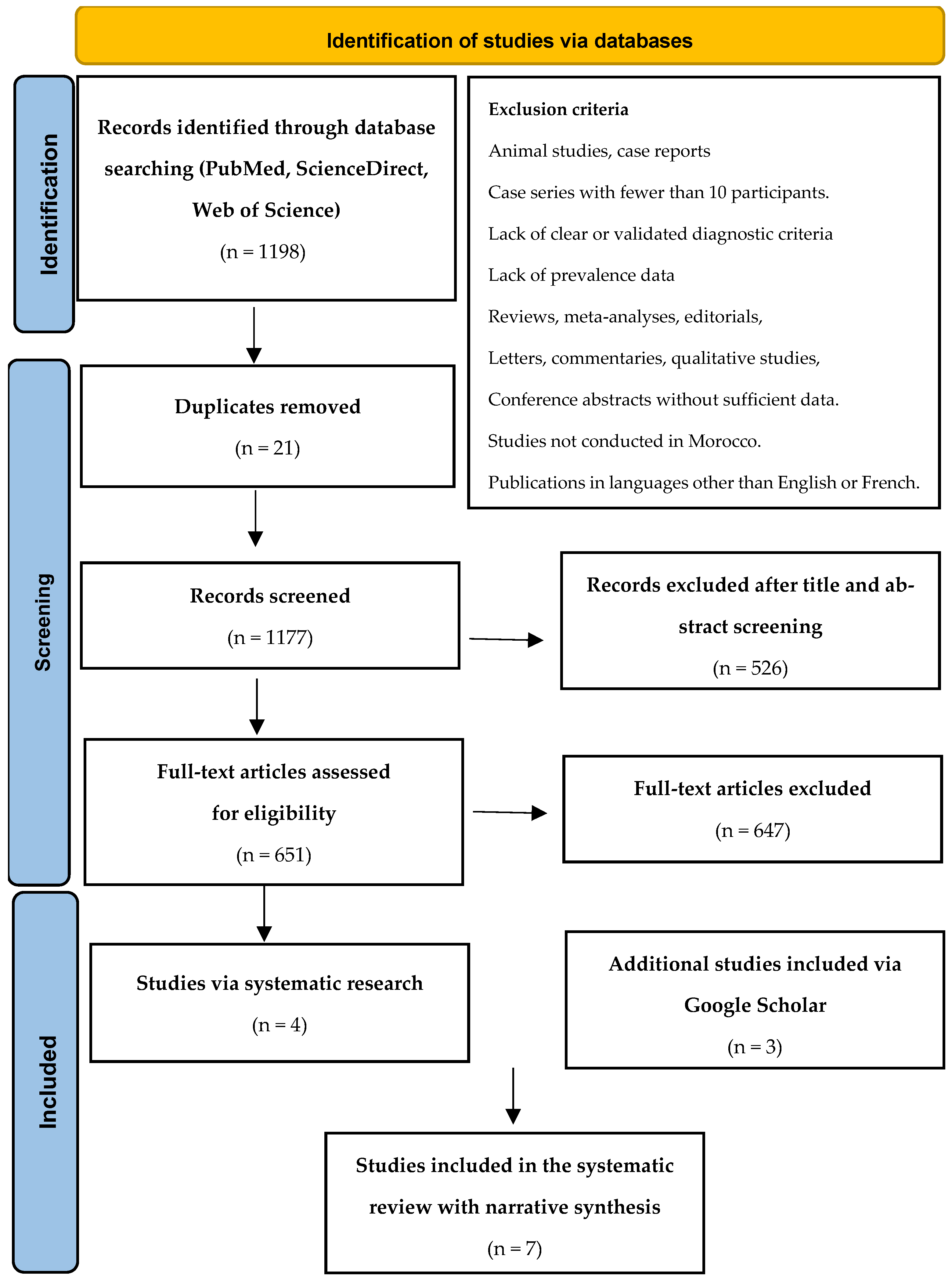
Across PubMed, ScienceDirect, and Web of Science, 1198 records were identified; 21 duplicates were removed. After excluding 526 records at the title/abstract screening stage, 651 full texts were assessed; 647 were excluded, leaving four studies included in this systematic review with narrative synthesis.
In addition to the database search, a complementary search using Google Scholar was conducted to identify relevant Moroccan studies not captured in the primary databases. This search identified three hospital-based cirrhosis cohort studies. Since these studies did not provide prevalence estimates but instead described clinical characteristics, complications, and etiological patterns, they were not included in the prevalence synthesis.
To ensure methodological clarity, we distinguished between two lines of evidence: (1) prevalence studies included in the systematic review (n = 4), and (2) hospital-based cohorts included solely for contextual narrative analysis (n = 3). The latter were analyzed separately and used to complement the interpretation of disease burden without contributing to prevalence estimates.
The PRISMA flow diagram (
Figure 1) summarizes identification, screening, eligibility, and inclusion.
Due to substantial heterogeneity across the included studies, a meta-analysis was not performed. The sources of heterogeneity included differences in study populations (e.g., patients with chronic hepatitis C, HIV mono-infection, rheumatoid arthritis, and hospital-based cirrhosis cohorts), variability in diagnostic methods (FibroTest/ActiTest, FibroScan, FIB-4, APRI, Child–Pugh classification), and differences in study design (cross-sectional, retrospective, and prospective studies). Therefore, a narrative synthesis approach was adopted.
2.6. Risk of Bias
The methodological quality and risk of bias of the included studies were independently assessed using the Joanna Briggs Institute (JBI) Critical Appraisal Checklists appropriate for each study design. For studies reporting prevalence data, the JBI checklist for prevalence studies was applied. Two reviewers independently conducted the quality assessment.
The JBI tool evaluates several domains, including the appropriateness of the sample frame, sampling method, sample size adequacy, validity of the condition measurement, statistical analysis, and response rate. Each item was rated as “Yes,” “No,” “Unclear,” or “Not applicable,” and the overall methodological quality of each study was determined based on the number of criteria met.
3. Results
The systematic review identified a total of 1198 records from PubMed, ScienceDirect, and Web of Science. Twenty-one duplicates were removed and 526 records excluded based on the title/abstract screening, while 651 full-text articles were assessed for eligibility. Of these, 647 were excluded for not meeting the inclusion criteria such as being conducted outside Morocco, involving non-human populations, or unrelated outcomes. Ultimately, four studies met all predefined criteria and were included in the detailed analysis (Bouayad et al. 2021; Arrayhani et al. 2015; Tahiri et al. 2013; Hilal et al. 2020) [
7,
8,
9,
10], focusing on their methods, diagnostic thresholds, and prevalence estimates (
Figure 1).
A complementary search using Google Scholar was conducted to identify additional Moroccan studies not indexed in the selected databases. This approach captured three hospital-based cirrhosis cohorts (Driouiche et al., 2023; Aouroud et al., 2023; Elfarouki et al., 2020) [
11,
12,
13]. Since these studies included only patients with established cirrhosis and did not report prevalence estimates, they were not included in the prevalence synthesis.
To enhance clarity and methodological rigor, the results were organized into two distinct lines of evidence: prevalence studies (n = 4), which provided estimates of fibrosis and cirrhosis in defined populations, and hospital-based cohorts (n = 3), which were analyzed separately to describe clinical characteristics, complications, and etiological patterns. In total, seven studies were included, with prevalence and contextual findings reported in separate sections.
3.1. Overview of Included Studies
The seven included studies, conducted between 1990 and 2023 across Moroccan university hospital centers, demonstrate both geographical and methodological diversity. The study populations included patients with chronic HCV, individuals living with HIV without HBV/HCV co-infection, patients undergoing hemodialysis for chronic renal failure, and patients with rheumatoid arthritis receiving methotrexate therapy.
Four studies reported data relevant to the prevalence of liver fibrosis or cirrhosis in specific high-risk populations. Bouayad et al. conducted a multicenter cross-sectional study at the Pasteur Institute of Morocco between January 2014 and December 2017, enrolling 699 patients with chronic hepatitis C infection confirmed by anti-HCV antibodies and HCV Ribonucleic Acid RNA. Liver fibrosis and necroinflammatory activity were assessed using validated serum panels (FibroTest/ActiTest) [
7]. At the Hospital University Center Hassan II in Fez (January–March 2011), a cross-sectional study of 95 hemodialysis patients, 29 of whom were HCV-positive, was conducted [
8]. Fibrosis assessment combined FibroScan
®, APRI, FIB-4, and Forns scores. The study underscored the feasibility of non-invasive tests when biopsy is contraindicated. At the Hospital University Center Ibn Rochd in Casablanca (September 1990–September 2012), a cross-sectional analysis of 619 HIV-monoinfected patients without HBV/HCV co-infection was undertaken. Liver fibrosis was evaluated using the FIB-4 index [
9]. Within the rheumatology department at CHU Hassan II in Fez (January 2012–March 2019), 319 patients with rheumatoid arthritis and treated with methotrexate [
10] were examined. Liver fibrosis was assessed using non-invasive tests. Three additional hospital-based cohorts of cirrhotic patients were identified through complementary searches and were included to provide contextual information on the clinical burden and complications of cirrhosis in Morocco. Driouiche et al. conducted a retrospective cohort study at the CHU Hassan II in Fez between May 2017 and May 2019; this included 124 patients hospitalized with cirrhosis [
11].
At CHU Mohammed VI in Marrakesh (June 2020–May 2021), a prospective descriptive and analytical study was conducted on 135 cirrhotic patients [
12].
Another descriptive cross-sectional study (February 2018–February 2019) was conducted by Elfarouki et al. on 120 cirrhotic patients [
13] with viral etiologies (HBV/HCV), followed by MASLD/NAFLD and alcohol.
3.2. Quality Assessment
The methodological quality of the included studies was assessed using the Joanna Briggs Institute (JBI) Critical Appraisal Checklist for Studies Reporting Prevalence Data. Overall, most studies met the majority of the methodological criteria, particularly regarding clearly defined study populations and appropriate measurement of outcomes. However, some studies presented limitations related to sample size, representativeness of the study population, and incomplete reporting of demographic characteristics. The detailed risk of bias assessment for each study is provided in
Appendix A.
However, some limitations were identified across studies, including small sample sizes, single-center designs, potential selection bias due to the inclusion of specific high-risk populations, and a lack of population-based sampling. The detailed results of the quality assessment are presented in
Appendix A.
3.3. Prevalence of Fibrosis and Cirrhosis
Four studies reported prevalence estimates of liver fibrosis and/or cirrhosis in specific high-risk populations in Morocco (
Table 1). In the HCV cohort reported by Bouayad et al., fibrosis stages were skewed toward advanced disease: F0 20.7%, F1 19%, F2 10.7%, F3 17.7%, and F4 31.8% [
7]. Accordingly, 49.5% of patients had advanced disease (F3–F4), highlighting the burden of chronic HCV in Morocco. Among cirrhotic patients (
n = 222), 14.6% were classified as F4.1 (uncomplicated), 13.9% as F4.2 (varices without severe complications), and 3.3% as F4.3 (severe events).
In the hemodialysis cohort examined by Arrayhani et al., 30.5% of patients were HCV-infected. Fibrosis was assessed non-invasively using FibroScan
®, APRI, Forns, and FIB-4. FibroScan
® identified severe fibrosis/cirrhosis-range stiffness in six patients (27.3%) [
8].
In the HIV cohort (
n = 619), the prevalence of significant fibrosis (FIB-4 > 1.45) was 15.5%, whereas the prevalence of advanced fibrosis (FIB-4 > 3.25) was 1.45% [
9]. Although severe fibrosis was uncommon, moderate fibrosis was relatively frequent, consistent with the potential hepatic impact of HIV and/or prolonged antiretroviral exposure. Increases in FIB-4 with age and treatment duration reinforce its value as a simple, reproducible screening tool in Moroccan HIV cohorts.
In the rheumatoid arthritis cohort treated with methotrexate, six of 319 patients (2%) were reported to have liver fibrosis [
10], using non-invasive evaluation methods.
Three additional hospital-based cohorts of cirrhotic patients were identified through complementary searches by Driouiche et al., Aouroud et al., and Elfarouki et al. [
11,
12,
13]. These studies described clinical characteristics, etiological patterns, and complications of cirrhosis in Moroccan hospital settings but did not provide prevalence estimates. Therefore, they were included for contextual narrative synthesis rather than prevalence analysis.
To ensure methodological clarity, these studies were separated from prevalence studies and were not included in the quantitative synthesis. Instead, they were analyzed separately as part of a contextual narrative synthesis, aimed at complementing the understanding of disease severity and clinical burden in Morocco.
The last three studies represent hospital-based cohorts of patients with established cirrhosis and therefore do not provide prevalence estimates.
3.4. Demographic Characteristics
The demographic characteristics of participants varied across the included studies (
Table 1). In the HCV cohort reported by Bouayad et al., the mean age was 59 years (IQR 51–68), with a female predominance (62.5%) [
7]. In the hemodialysis cohort with HCV examined by Arrayhani et al., the mean age was 52.38 ± 16.8 years with a female predominance (sex ratio 0.71) [
8]. Among patients with HIV studied by Tahiri et al., the mean age was 39.85 ± 9.56 years with a female predominance (57.18%) [
9]. In the rheumatoid arthritis cohort treated with methotrexate analyzed by Hilal et al., 319 patients had a mean age of 53 ± 12.4 years and a marked female predominance (86.52%).
In the retrospective hospital series of cirrhosis reported by Driouiche et al., 124 cases had a mean age of 54.24 years (range 19–91) with a male predominance (sex ratio 1.19) [
11]. In the prospective cohort described by Aouroud et al., 135 cirrhotic patients had a mean age of 50 years (range 18–81) with a female predominance (67%; sex ratio 0.48) [
12]. In the cross-sectional study by Elfarouki et al., 120 cirrhotic patients had a mean age of 53.5 years (range 18–86) with a slight male predominance (51%; sex ratio 0.96) [
13].
These hospital-based studies included patients with established cirrhosis and did not report prevalence estimates; therefore, they were not included in the prevalence synthesis. Instead, they were analyzed to provide contextual insights into the clinical burden of cirrhosis.
3.5. Necroinflammatory Activity
Across Moroccan studies, necroinflammation emerges as a central driver of progression to advanced fibrosis and cirrhosis, although its assessment varies by protocol and population. In the HCV cohort reported by Bouayad et al., ActiTest indicated minimal activity (A < 2) in 41.5% and significant activity (A ≥ 2) in 58.5% [
7]. In the haemodialysis cohort analyzed by Arrayhani et al., necroinflammation was not captured by a dedicated activity score but could be inferred from non-invasive serum indices such as APRI, FIB-4, Forns and transaminase levels [
8].
In hospital-based cirrhosis cohorts [
11,
12,
13], necroinflammation- indicated by elevated AST (Aspartate Aminotransferase)/ALT (Alanine Aminotransferase), hyperbilirubinemia, and hypoalbuminemia- is a marker of active hepatocellular damage. These biomarkers are often accompanied by malnutrition and systemic inflammation. Conversely, in non-viral contexts such as Tahiri et al.’s HIV and Hilal et al.’s methotrexate-treated rheumatoid arthritis cohorts, necroinflammatory activity tends to be low to moderate. This activity frequently results from drug- or metabolism-related cytolysis and may be reversible with treatment adjustments. In these cases, progression to advanced fibrosis appears rare with proper monitoring.
3.6. Risk Factors Associated with Advanced Fibrosis and Cirrhosis
Across Moroccan studies, multiple determinants drive the progression to advanced liver fibrosis and cirrhosis, with age and persistent inflammatory activity recurring as the strongest signals. Chronic hepatitis C infection represented one of the most frequently reported conditions associated with advanced liver disease. Evidence from Bouayad et al. shows markedly higher odds of cirrhosis in patients aged ≥ 55 years (OR = 7.68; 95% CI: 4.9–12.2;
p < 0.0001), alongside an influential association with necroinflammatory activity (OR = 24.4; 95% CI: 13.3–45;
p < 0.0001) [
7]. No association with sex was found. In Arrayhani et al., among haemodialysis patients with HCV, older age (>50 years) and metabolic comorbidities (diabetes, hypertension) were correlated with higher APRI and FIB-4 scores [
8]. In Tahiri et al., advanced age, longer antiretroviral exposure, and chronically elevated transaminases were key correlates of fibrosis among patients with HIV; age was independently associated with FIB-4 > 1.45 (OR = 1.10; 95% CI: 1.07–1.13) [
9].
In Hilal et al., among methotrexate-treated rheumatoid arthritis patients, fibrosis was associated with hepatic cytolysis (p < 0.001), combination therapy with other DMARDs (p < 0.05), and age > 55 years; sex was not associated.
In the hospital cohort of Driouiche et al., decompensation related to advanced age, HBV/HCV infection, alcohol use, portal vein thrombosis, and ascites- without sex differences- highlighted multifactorial, predominantly viral, drivers [
11]. Finally, Aouroud et al. linked low socioeconomic status, hepatic encephalopathy, salt-restricted diet, and haemorrhagic complications to malnutrition and greater severity [
12], while Elfarouki et al. associated malnutrition, advanced age, and higher Child–Pugh class with worse outcomes, reinforcing undernutrition as both a risk factor and a prognostic marker [
13].
3.7. Complications
Patterns of complications vary across populations and disease stages, but collectively indicate substantial morbidity at presentation. In Bouayad et al., among patients with cirrhosis, 13.9% had varices without severe complications (F4.2), and 3.3% had severe events (F4.3) [
7], a profile that underscores the importance of systematic screening and timely intervention. The hospital cohort of Driouiche et al. documented gastrointestinal bleeding as the most frequent complication (40.3%), with an in-hospital mortality of 9.6%, hepatic encephalopathy in 17%, renal failure in 6%, and HCC in 1.6% [
11]. In Aouroud et al., the prevalence of hepatic encephalopathy reached 25.92% [
12], highlighting a considerable burden of decompensation. Nutritional and metabolic complications are also prominent: severe malnutrition affected 46.6% of patients in Elfarouki et al. [
13] and up to 41% in Aouroud et al. [
12], contributing meaningfully to morbidity.
4. Discussion
This systematic review with narrative synthesis identified a limited number of studies reporting data on liver fibrosis and cirrhosis in Morocco. Four studies provided estimates of fibrosis or cirrhosis prevalence in specific clinical populations, while three additional hospital-based cohorts were included to provide contextual information on the clinical burden and complications of cirrhosis. These studies included patients with chronic viral hepatitis, HIV mono-infection, metabolic diseases, methotrexate-treated rheumatoid arthritis, and hospitalized cirrhotic patients, reflecting the heterogeneity of routine clinical practice and the variability in local research methodologies. Across prevalence studies, advanced fibrosis (F3) ranged from 1.45% to 17.7%, and cirrhosis (F4) ranged from 27.3% to 31.8%, with estimates contingent on the population and diagnostic approach (FibroTest/ActiTest, FibroScan, FIB-4, Child–Pugh). The most significant burdens appeared in chronic HCV cohorts. In contrast, advanced fibrosis was uncommon (<5%) in HIV and rheumatoid arthritis cohorts. However, these estimates should be interpreted cautiously, as all included studies were conducted in selected clinical populations and do not reflect the general population.
The heterogeneity of diagnostic approaches poses an important limitation. Different non-invasive tools were used across studies, including FibroTest, FibroScan® combined with APRI or FIB-4, and FIB-4 alone, each with varying sensitivity and specificity. This variability may partly explain differences in reported prevalence and limits direct comparison between studies. Therefore, observed differences across studies may reflect methodological heterogeneity rather than true epidemiological variation.
The determinants associated with more advanced fibrosis stages were broadly consistent across studies and included older age or prolonged exposure to underlying risk factors, such as chronic viral infection or long-term hepatotoxic therapies. In hospital-based cirrhosis cohorts, undernutrition was frequently reported and was correlated with more advanced Child–Pugh stages. These studies also described common complications at presentation, including gastrointestinal bleeding, hepatic encephalopathy, ascites, and, less often, HCC.
Chronic viral hepatitis remains one of the leading causes of liver fibrosis and cirrhosis worldwide. In this review, the highest proportions of advanced liver disease were observed in cohorts of patients with chronic HCV infection, which suggests that viral hepatitis continues to play an important role in the liver disease burden in Morocco. Similar patterns have been described globally, where HBV and HCV are major contributors to cirrhosis and HCC [
14].
Morocco, like many countries in the Middle East and North Africa (MENA) region, is undergoing an epidemiological transition characterized by an increasing prevalence of obesity, type 2 diabetes, and metabolic syndrome. These factors are known to be associated with metabolic dysfunction-associated steatotic liver disease (MASLD). Although current studies have not specifically examined its prevalence in the general Moroccan population, no population-based studies assessing MASLD prevalence in Morocco were identified in this review. This absence of data represents an important gap in the literature. Given the rising prevalence of metabolic risk factors in Morocco [
15,
16], MASLD may represent an emerging contributor to liver disease, although its true burden remains unknown.
Importantly, this review does not allow for the estimation of the national prevalence of liver fibrosis or cirrhosis in Morocco. The available evidence is limited to selected clinical populations and hospital-based cohorts. Nevertheless, the findings suggest that liver disease may represent a substantial burden in high-risk groups, while population-level estimates remain unknown.
A major finding of this review is the absence of population-based data on MASLD/NAFLD in Morocco. This gap is particularly concerning given the ongoing epidemiological transition, characterized by an increasing prevalence of obesity, type 2 diabetes, and metabolic syndrome. The lack of epidemiological data limits the ability to accurately assess the current and future burden of liver disease in Morocco and underscores an urgent need for well-designed population-based studies.
Hospital-based cohorts, although not ideal for estimating prevalence, provide useful insights into the clinical presentation and complications of cirrhosis. The reported frequency of complications such as ascites, variceal bleeding, hepatic encephalopathy, and HCC is consistent with advanced disease stages, as described in the literature [
17,
18]. Several factors may contribute to late-stage presentation, including limited systematic screening, variability in access to specialized care, and potential delays in diagnosis.
International comparisons should be interpreted cautiously. The higher proportions observed in Moroccan HCV cohorts compared with general population estimates from high-income countries likely reflect differences in study populations rather than true differences in population-level prevalence. Variations across studies may also be explained by differences in methodology, case-mix, and diagnostic thresholds.
The observed heterogeneity across studies, including differences in populations, diagnostic tools, and study designs, limits direct comparability and precludes the estimation of pooled prevalence.
The methodological quality assessment using the JBI checklist indicated an overall moderate quality across studies, with common limitations including small sample sizes, hospital-based recruitment, and heterogeneity in diagnostic methods. These limitations may introduce bias and further restrict the generalizability of the findings.
Overall, the limited number of studies, their heterogeneity, and focus on selected populations constrain the strength of the conclusions. These findings highlight the need for well-designed, population-based studies to better characterize the epidemiology of liver fibrosis and cirrhosis in Morocco. The interpretation of these findings takes into account the moderate methodological quality of the included studies, along with their heterogeneity in design, populations, and diagnostic methods. Additionally, the limited number of available studies may further restrict the generalizability of the findings.
This review offers a pragmatic contribution by synthesizing evidence from high-risk populations and hospital-based cohorts in the absence of population-based studies in Morocco. Instead of attempting to estimate national prevalence without sufficient data, this approach enables a structured understanding of liver disease within real-world clinical settings. It reflects the available evidence while explicitly acknowledging its limitations and identifying key gaps for future research.
5. Limitations
This review highlights significant limitations due to the lack of comprehensive, population-based studies in Morocco, with only four studies providing prevalence estimates and a total of seven studies included overall, most of which were conducted in hospital-based settings with relatively small sample sizes.
The absence of population-based studies represents a major limitation, as it prevents any reliable estimation of the national prevalence of liver fibrosis and cirrhosis in Morocco and limits the generalizability of the findings to the broader population. Heterogeneity across the included studies in terms of study design, patient populations, and diagnostic methods used to assess liver fibrosis (including FibroScan®, FibroTest/ActiTest, APRI, and FIB-4). This variability makes direct comparisons between studies challenging and limits the ability to synthesize prevalence estimates.
In addition, the restriction to studies published in English and French may have led to language bias. Publication bias cannot be excluded, as relevant data from unpublished studies or grey literature may not have been captured, despite the additional search conducted through Google Scholar. Uneven geographical representation across studies further limits the generalizability of the findings.
Finally, the lack of longitudinal studies and large prospective cohorts limits the ability to assess disease progression over time. An important gap identified in this review is the absence of studies assessing the prevalence of metabolic dysfunction-associated steatotic liver disease (MASLD/NAFLD) in the general Moroccan population, which further limits understanding of the overall burden of liver disease.
6. Conclusions
This systematic review with narrative synthesis offers a comprehensive overview of the current evidence on liver fibrosis and cirrhosis in Morocco, primarily derived from high-risk populations and hospital-based cohorts. Although the findings indicate a potentially significant burden of advanced liver disease and late-stage presentation in these settings, the evidence remains limited and heterogeneous, necessitating cautious interpretation. Variations between local and international data may reflect differences in epidemiological context, HCV prevalence, diagnostic methodologies, and study designs. Consistently, age was associated with more advanced disease across the included studies, suggesting that age-based risk stratification warrants further investigation through prospective studies in Morocco.
A notable gap identified in this review is the absence of data on MASLD/NAFLD, highlighting a critical knowledge gap amid raising metabolic risk factors. To better understand the burden of liber fibrosis and cirrhosis, multicenter, population-based epidemiological studies are urgently needed. Strengthening epidemiological surveillance, establishing a national liver disease registry, and expanding access to validated non-invasive diagnostic tools could significantly improve early detection and clinical management of chronic liver diseases in Morocco and similar settings.



 ,
,