Review

The Future of Liver-Targeted Protein Synthesis Inhibition: Current Treatments, Emerging Strategies, and Next-Generation Therapeutics


Department of Internal Medicine and Clinical Pharmacology, School of Medicine in Katowice, Medical University of Silesia in Katowice, Medyków 18, 40-752 Katowice, Poland
*
Author to whom correspondence should be addressed.
Livers 2026, 6(2), 25; https://doi.org/10.3390/livers6020025
Submission received: 29 November 2025 / Revised: 21 January 2026 / Accepted: 25 February 2026 / Published: 1 April 2026

Abstract

The liver produces the majority of plasma proteins, maintaining the metabolic homeostasis. The dysregulation of liver protein synthesis underlies many systemic conditions. Therefore, there is a great potential in therapies that inhibit the hepatic protein production. This is the mechanism of action of antisense oligonucleotides (ASOs) and small interfering RNA (siRNA). These therapeutics have undergone rapid development and are revolutionizing the pharmacological landscape of many liver-related diseases (e.g., inclisiran in familial hypercholesterolemia). Furthermore, gene-editing technologies that allow a direct correction of impaired genes in the liver are currently being evaluated. They hold a promise for future advances in treatment, especially of monogenic disorders such as hereditary transthyretin amyloidosis or alpha-1 antitrypsin deficiency. In this review, we describe the most relevant systemic diseases caused by dysfunction of protein synthesis in liver cells, in which significant therapeutic progress has been made over the last decades. Moreover, we present currently available drugs and their mechanisms of action, including six siRNA agents and five ASOs that have been approved to date. Finally, we discuss emerging strategies, focusing on novel RNA-based therapeutics that are the subjects of ongoing clinical trials.

1. Introduction

The liver plays a central role in maintaining systemic metabolic balance, largely through its extensive capacity for protein synthesis. It is responsible for the production of 85–90% of circulating protein volume [1]. Hepatocytes synthesize a wide variety of plasma proteins, including albumin, clotting factors, transport proteins, growth factors, acute-phase reactants, and numerous enzymes that catalyze biochemical reactions essential for the metabolism [2]. Additionally, the liver exerts control over the breakdown of excess or misfolded proteins, metabolism of amino acids that comprise them, and disposal of nitrogen generated during amino acid catabolism via the urea cycle [3]. The balance between hepatic protein synthesis and degradation, responsive to nutritional, hormonal, inflammatory and pathological stimuli, is not only crucial for supporting vascular volume, nutrient transport, immune responses, and coagulation, but underlies metabolic homeostasis at large [1].
Dysregulation of liver protein synthesis, whether by genetic mutations, infection, metabolic disturbance, or malignant transformation, can cause or contribute to a wide range of pathological states. Examples include genetic disorders such as alpha-1 antitrypsin deficiency (AATD) and familial hypercholesterolemia (FH); amyloidosis, especially transthyretin amyloidosis (ATTR); metabolic disorders such as metabolic dysfunction-associated steatotic liver disease (MASLD); and primary or secondary liver cancers. These diseases, stemming from liver protein synthesis dysregulation, may provoke systemic effects due to toxic protein accumulation, inflammation, or failure of metabolic regulation, as well as impair the liver’s ability to produce essential proteins (leading to, e.g., coagulopathy or hypoalbuminemia) [2,4,5].
The mechanism of the majority of currently available drugs relies on ago/antagonism or inhibition/activation of synthesized proteins. Despite substantial therapeutic advances, many liver-related diseases remain inadequately treated, often requiring lifelong therapy that fails to address the underlying molecular cause. Current treatments frequently show limited specificity, suboptimal efficacy, or cumulative toxicity. Moreover, some patients exhibit incomplete responses or develop treatment resistance. Therefore, in some cases a more direct way to achieve therapeutic goals seems more suitable. RNA-based agents and gene-editing approaches enable target-specific modulation of disease-causing genes at the transcriptomic or genomic level. By directly reducing pathogenic protein synthesis or permanently correcting genetic defects, these technologies hold the potential for more durable therapeutic outcomes with reduced systemic burden. As a result, a growing interest in these therapies has emerged [1]. The aim of this review is to describe existing treatments targeting liver protein synthesis and assess their mechanisms of action, efficacy, safety and limitations. We also discuss emerging and next-generation pharmacological and molecular strategies (such as RNA interference technologies, liver-targeted drug delivery systems, and gene editing) designed to more precisely and effectively block or modulate protein synthesis in the liver.

2. Diseases Stemming from Liver Protein Synthesis Dysregulation

The overproduction or pathological expression of certain liver proteins underlie a variety of human diseases. In this review, we focus on the metabolic disorders, mainly stemming from imbalances in lipid metabolism, such as FH, familial chylomicronemia syndrome (FCS), MASLD, but also including conditions of a different origin—primary hyperoxaluria (PH) and acute hepatic porphyria (AHP). Moreover, we discuss rare, systemic diseases caused by liver protein synthesis dysregulation, such as AATD and ATTR. The mentioned disorders, along with the genes responsible for their development or progression and therapeutic targets used in currently available or tested drugs, are presented in Table 1.

3. Mechanisms to Block Protein Synthesis in the Liver

3.1. RNA-Based Therapeutics

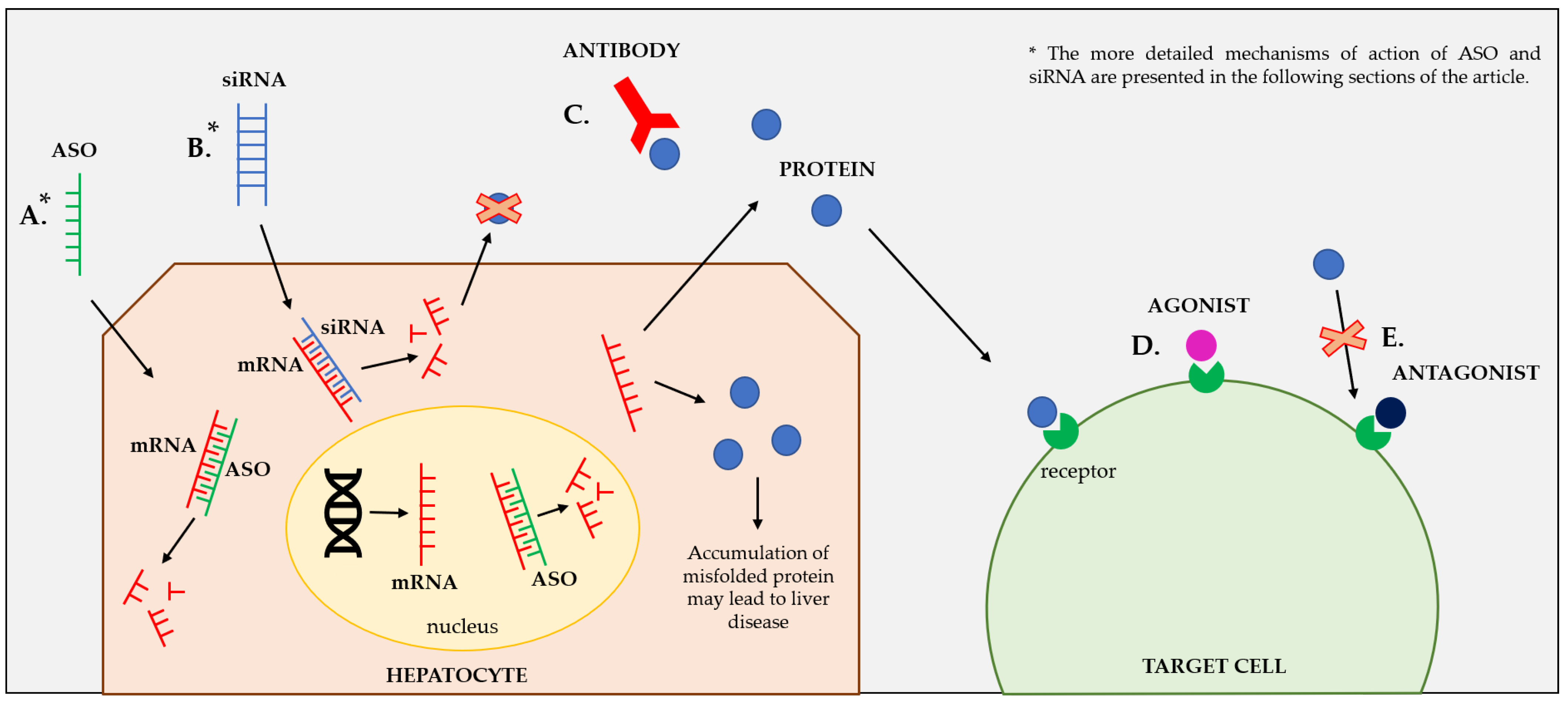
RNA-based medications are a rapidly evolving class of therapeutics that act directly on RNA particles to regulate gene expression and protein synthesis. Unlike conventional protein-targeted drugs, these therapies use short, synthetic oligonucleotides designed to bind complementary RNA sequences with high specificity, subsequently silencing disease-causing genes or correcting abnormal RNA processing [42]. This review will discuss two categories of RNA therapeutics: antisense oligonucleotides (ASOs) and small interfering RNAs (siRNAs). The difference in mechanism of action of ASOs and siRNAs in comparison with “classical” drugs (agonists, antagonists and antibodies) is presented in Figure 1.
ASOs are single-stranded synthetic nucleic acids. They are designed to recognize and bind specific RNA sequences through Watson–Crick base pairing, modulating gene expression through various mechanisms [43]. Some ASOs, known as gapmers (ASOs consisting of a central DNA “gap” with artificially modified ribonucleotides on both sides), recruit ribonuclease H1 (RNase H1), which cleaves the RNA strand from an RNA–DNA duplex. The cleavage leads to a degradation of RNA fragments by 5′- and 3′-exonucleases, thereby reducing protein synthesis [43,44]. Other ASOs bind to target transcripts and block the protein translation by precluding the interaction between messenger RNA (mRNA) and ribosomes. Another mechanism of action is altering splicing, either by exon skipping or exon inclusions [45]. Advances in chemical modifications (nucleobase, sugar, backbone) have greatly increased ASOs’ stability, affinity to the target, and safety, enabling their clinical application in the therapy of many diseases [46].
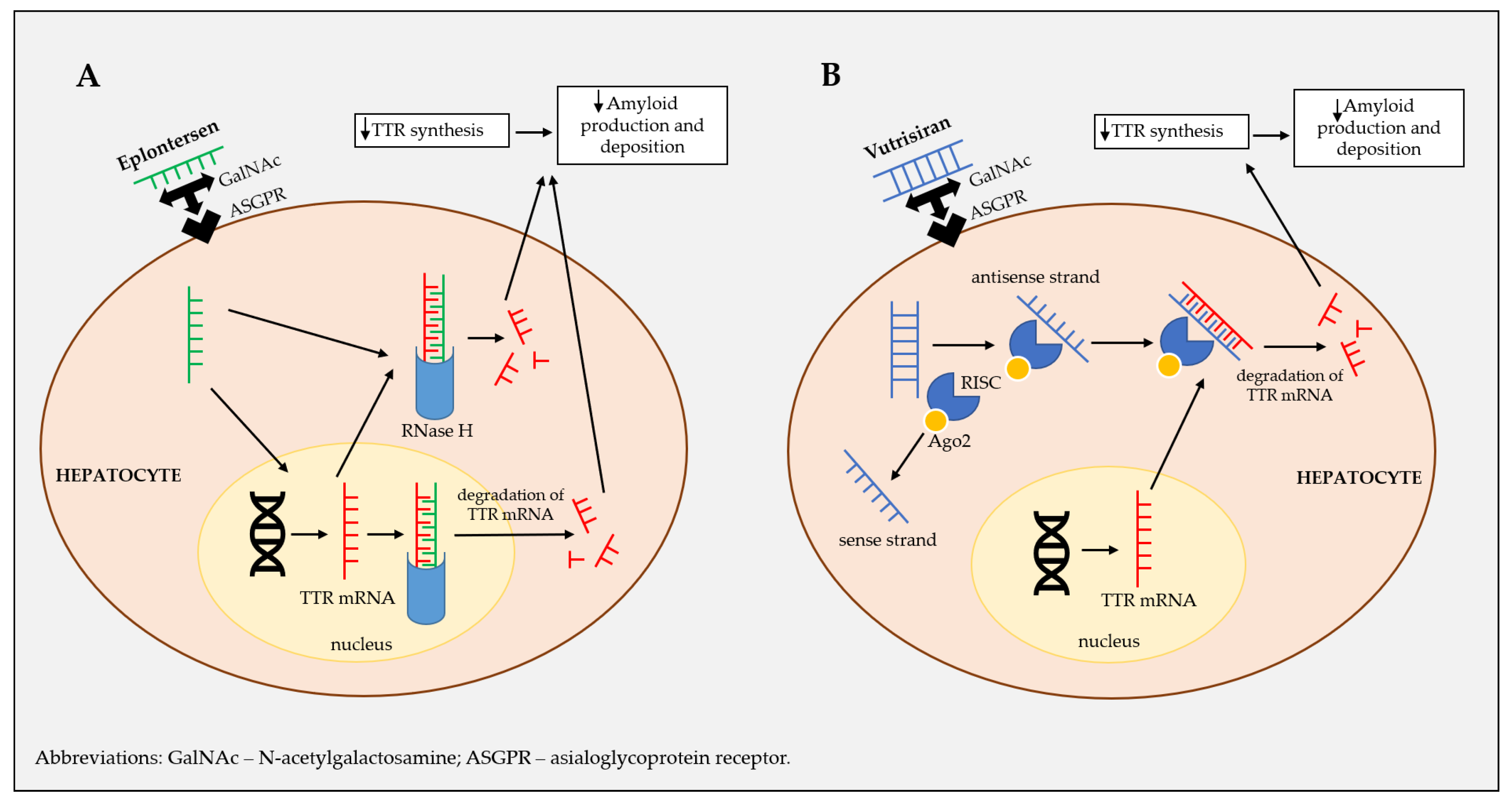
RNA interference (RNAi) is a naturally occurring cellular defense mechanism that regulates gene expression, acting as a post-transcriptional silencing pathway [47]. SiRNA harnesses this system to accomplish targeted gene silencing by degrading specific RNA molecules [48]. It is the product of the cleavage of double-stranded RNA (dsRNA) and contains a sense (passenger) strand and an antisense (guide) strand. The siRNA is incorporated into the RNA-induced silencing complex (RISC), where the sense strand is unwound and removed by the interaction with the Argonaute 2 (Ago2) protein [49]. The antisense strand, linked to the Ago2 protein within the RISC, binds with the target mRNA, causing its degradation. Therefore, the synthesis of the corresponding protein is suppressed [48,49]. RNAi therapeutics can potentially revolutionize the treatment of human diseases, especially liver-associated disorders, with seven approved siRNA agents to date and more in ongoing studies [50]. Figure 2 shows basic differences in the mechanism of action between ASO and siRNA.

3.2. Gene Editing (CRISPR/Cas)

The above-mentioned RNA-based medications offer temporary effects on disease-causing protein synthesis, while the novel gene-editing technologies are a potential permanent cure. The CRISPR/Cas (clustered regularly interspaced short palindromic repeats/CRISPR-associated) technology is a promising tool. It is a system originally discovered as part of the adaptive immune system in bacteria, which use short RNA molecules to guide the Cas protein (DNA endonuclease) to foreign DNA, leading to its cleavage [51].
The type II CRISPR, consisting of Cas9 nuclease and a single guide RNA, is the most commonly used system [51,52]. In biotechnology, it has been adapted so that guide RNA directs the Cas protein to a chosen DNA sequence, resulting in double-strand breaks. This allows a precise suppression of gene expression, enabling the inhibition of potentially disease-causing protein synthesis [53,54].
CRISPR technology rapidly evolved over the past decade and now holds a significant promise for future therapeutic options in genetic conditions. However, further investigation of its long-term efficacy and safety is necessary. In December 2023, the first, and so far only, CRISPR/Cas9-based drug (Casgevy) was approved by the Food and Drug Administration (FDA) for treatment of severe sickle cell disease. Plenty of therapeutics are a subject of ongoing clinical trials [55].
The key differences between ASOs, siRNA, and gene editing approaches are summarized in Table 2 [56,57,58].

4. Currently Available Drugs and Their Mechanisms

4.1. Amyloidosis

4.1.1. Patisiran

Patisiran was approved by the FDA for the treatment of ATTR in August 2018 as a first siRNA therapeutic. It is an siRNA agent, with lipid nanoparticle (LNP) encapsulation, that targets TTR mRNA, thereby inhibiting the production of TTR, both mutant and wild-type [59]. Patisiran is administered intravenously. Using lipid particles as a carrier ensures targeted drug delivery into hepatocytes and prevents its degradation by endogenous enzymes [60].
The phase 3, placebo-controlled, double-blind, randomized APOLLO trial (NCT01960348) enrolled participants with hATTR-associated polyneuropathy. The clinical manifestations were measured in different scales, including modified Neuropathy Impairment Score + 7 (mNIS + 7, with range 0–304, higher scores meaning more impairment). At month 18, the difference from baseline in the patisiran group was −34.0 points, compared with placebo group (p < 0.001). Non-severe infusion-related reactions were the most common adverse effects. The efficacy of patisiran was demonstrated in the APOLLO study, resulting in its approval for therapy in polyneuropathy in hATTR patients [61]. The five-year open-label extension (OLE) study (NCT02510261) for participants of previous APOLLO trials showed a maintained efficacy and acceptable safety profile of patisiran. The results emphasized the importance of early treatment initiation, since the patients from patisiran groups (in parent studies) had greater outcomes and much lower long-term mortality than expected from natural history compared with patients from placebo groups [62].
Patisiran was also evaluated in the phase 3, placebo-controlled, double-blind, randomized APOLLO-B study (NCT03997383), which enrolled participants with ATTR and cardiomyopathy. Despite some positive effects, such as lower decline in the 6 min walk distance among patients treated with patisiran, in October 2023 the FDA declined its approval for treatment of ATTR with cardiomyopathy due to clinically insignificant results [63,64]. The APOLLO-B trial is currently ongoing as an OLE period, with estimated completion date in March 2027 [65].

4.1.2. Vutrisiran

Vutrisiran is another siRNA therapeutic indicated for the treatment of polyneuropathy in hATTR patients. The mechanisms of vutrisiran and patisiran are similar; however, N-acetylgalactosamine (GalNAc) serves as a ligand for vutrisiran instead of patisiran’s LNP-based formulation. Conjugation to GalNAc ensures effective delivery to hepatocytes via the asialoglycoprotein receptor (ASGPR). Moreover, vutrisiran is administered subcutaneously, which does not require premedication and allows extended dosing intervals [66].
HELIOS-A (NCT03759379), the phase 3, open-label study, assessed vutrisiran’s efficacy by randomizing patients to vutrisiran and patisiran groups and comparing clinical results with the external APOLLO-A placebo group. The trial achieved its primary and secondary endpoints, as treatment with vutrisiran resulted in significant improvement in neurological function with an acceptable safety profile [67].
The phase 3, placebo-controlled, double-blind HELIOS-B trial (NCT04153149) investigated the effects of vutrisiran in participants with ATTR-associated cardiomyopathy. The results were assessed in two different subgroups: the overall patient population and the monotherapy population (the patients with no history of tafamidis [TTR stabilizer] use at baseline). Compared with placebo, vutrisiran reduced the risk of death from any cause and cardiovascular events. The preservation of quality of life and functional capacity were noticed in both vutrisiran-treated populations (measured by the change from baseline in the distance of the 6 min walk test and in the Kansas City Cardiomyopathy Questionnaire Overall Summary score) [68]. The indication for use of vutrisiran has been recently expanded, as it is now approved also for treatment of cardiomyopathy in ATTRwt and hATTR patients [69].

4.1.3. Inotersen

Inotersen is an ASO that has been approved for use in the therapy of polyneuropathy of hATTR since 2018. It disrupts the TTR mRNA, inhibiting its hepatic synthesis. The therapeutic reduces the amount of TTR, subsequently slowing or stopping disease progression [66].
The safety and efficacy of inotersen was evaluated in the phase 3, placebo-controlled, double-blind, randomized NEURO-TTR study (NCT01737398). The clinical outcomes were assessed using the change in the mNIS + 7 and the change in the score on the patient-reported Norfolk Quality of Life-Diabetic Neuropathy (Norfolk QoL-DN) questionnaire, with a decrease in scores demonstrating improvement. The treatment in the inotersen group resulted in significantly lower scores in both scales compared with the placebo group (p < 0.001). However, the safety issues that were observed during the study led to the necessity of enhanced patient monitoring. Severe thrombocytopenia and glomerulonephritis occurred in 3% of participants treated with the drug. Furthermore, there was one death due to intracranial hemorrhage as a complication of thrombocytopenia [70].
In summary, inotersen preserves or improves the quality of life of hATTR patients; nevertheless, the treatment requires careful and regular monitoring [70,71].

4.1.4. Eplontersen

Eplontersen is an ASO with a design similar to inotersen (the same nucleotide sequence), but it is additionally linked to GalNAc. The ligand facilitates the targeted delivery to hepatocytes, making the eplontersen treatment more effective and safer than inotersen [72].
Like above-mentioned RNAi therapeutics, eplontersen is also approved for the treatment of polyneuropathy in hATTR patients [66]. In the open-label, phase 3, NEURO-TTRansform trial (NCT04136184), participants were randomized for treatment with eplontersen or inotersen in a 6:1 ratio; then, their results were compared with an external placebo group (from NEURO-TTR). The efficacy of eplontersen was proven with a difference in adjusted mean percentage reduction in serum TTR between eplontersen and placebo groups −70.4% [95% CI: (−75.2%)–(−65.7%), p < 0.001]. Moreover, eplontersen improved the quality of life, decreasing the scores of participants in mNIS + 7 as well as in Norfolk QoL-DN. The study showed an acceptable safety profile of the drug, with no glomerulonephritis in the eplontersen group, and thrombocytopenia reported in 2% of both the eplontersen and placebo groups (all cases were classified as mild, with no complications). There were also no treatment-related deaths [73].
Currently, the safety and efficacy of eplontersen in participants with ATTR-mediated cardiomyopathy is being evaluated in the CARDIO-TTRansform study (NCT04136171). The phase 3, double-blind, placebo-controlled trial will assess medication effect on cardiovascular mortality and recurrent cardiovascular clinical events. The results are expected in August 2026 [74].

4.2. Porphyria

Givosiran

Givosiran is a subcutaneously administered siRNA drug approved in 2019 for the treatment of AHP based on the positive results of the phase 3 ENVISION study (NCT03338816) [35,75]. Givosiran is an agent with a trivalent GalNAc conjugation, which enables selective delivery to liver cells [76]. Targeting and degrading mRNA that encodes ALAS1, the drug inhibits ALAS1 expression, subsequently preventing toxic accumulation of ALA and PBG, leading to biochemical and clinical improvement [77,78]. The placebo-controlled ENVISION trial enrolled 94 patients with AHP, and the results showed a significantly lower rate of porphyria attacks among patients treated with givosiran compared with placebo (p < 0.001) [76]. After the OLE period of the ENVISION trial, the long-term givosiran treatment (administered monthly) demonstrated a sustained and continued improvement in clinical manifestations of AHP, with good tolerability [78].

4.3. Primary Hyperoxaluria

4.3.1. Lumasiran

Lumasiran is the first RNA-based medication with an indication for the treatment of PH type 1 (PH1) in patients at any age and stage of kidney function [79]. It is a subcutaneously administered, GalNAc-conjugated siRNA therapeutic that targets the hydroxyacid oxidase 1 (HAO1) mRNA encoding glyoxylate oxidase (GO) [77]. By blocking the synthesis of GO, lumasiran reduces conversion of glycolate to glyoxylate, which is the substrate for oxalate production, subsequently leading to inhibition of hepatic oxalate overproduction [80].
Lumasiran’s efficacy and safety in PH1 was assessed in three separate, phase 3 clinical studies: the placebo-controlled, double-blind, randomized ILLUMINATE-A, the open-label ILLUMINATE-B, and the open-label ILLUMINATE-C [79].
ILLUMINATE-A (NCT03681184) enrolled patients aged ≥6 years and estimated glomerular filtration rate (eGFR) ≥ 30 mL/min/1.73 m2 [81]. At month 6, the least-squares mean difference in the change in 24 h UOx excretion (lumasiran minus placebo) was −53.5 percentage points (p < 0.001), with a decrease in the lumasiran group of 65.4%. Moreover, 84% of patients in the lumasiran group reached a 24 h UOx ≤ 1.5 times the upper limit of normal range, compared with 0% of patients in the placebo group (p < 0.001) [82]. The significant and sustained effect of lumasiran treatment was then confirmed with the results of a 51-month OLE period [81].
ILLUMINATE-B (NCT03905694) was a trial eligible for infants and young children (age < 6 years) with eGFR > 45 mL/min/1.73 m2 if ≥12 months old or normal serum creatinine if <12 months old and UOx to creatinine ratio (UOx:Cr) greater than the upper limit of normal [83]. At month 6, mean percent change from baseline in spot UOx:Cr was −71.97 [95% CI: (−77.52)–(−66.42)]. In the extension period (months 6 to 60), the mean percent change in spot UOx:Cr was −74.48. Kidney function remained stable, with mean change from baseline in eGFR −4.525 mL/min/1.73 m2 at month 60 [84].
ILLUMINATE-C (NCT04152200) enrolled patients of all ages with advanced PH1 (with eGFR ≤ 45 mL/min/1.73 m2 [if age ≥ 12 months] or increased serum creatinine level [if age < 12 months] and plasma oxalate ≥ 20 µmol/L at screening). The participants were further divided into cohort A (without hemodialysis at baseline) and cohort B (on hemodialysis at baseline) [85]. Lumasiran resulted in a significant decrease in plasma oxalate at month 6 in both groups, with least-squares mean reductions of 33.3% [95% CI: (−15.2%)–(81.8%)] in cohort A and 42.4% [95% CI: (34.2%)–(50.7%)] in cohort B [86]. After the 6-month initial study, the patients continued treatment in the 54-month extension period, which was completed in June 2025; however, to date, the final results have not yet been published [85].
In summary, all mentioned clinical trials confirmed lumasiran’s efficacy in treatment of PH1 patients, with a favorable safety profile. Injection-site reactions were the most common adverse events of lumasiran [82,83,86].

4.3.2. Nedosiran

Nedosiran is a second RNAi treatment therapy approved for adults and children aged ≥2 years with PH1 and relatively intact kidney function (eGFR ≥ 30 mL/min/1.73 m2). Nedosiran is a double-stranded siRNA oligonucleotide targeting mRNA that encodes LDH in hepatocytes. The drug inhibits the activity of the enzyme and subsequently reduces hepatic oxalate production [87]. Due to its GalNac conjugation, nedosiran is delivered specifically to the liver, which prevents the potential off-target effects in different tissues, including muscles (even though LDH is expressed in muscles as well) [88].
Initially, nedosiran was designed as a drug effective for all PH subtypes. However, the results from clinical trials PHYOX1 (NCT03392896) and PHYOX2 (NCT03847909), which enrolled both PH1 and PH type 2 (PH2) patients, demonstrated significant reduction in UOx only in PH1 patients [89]. Moreover, in PHYOX4 (NCT04555486), the phase 1 study of nedosiran in participants with PH type 3 (PH3), despite potential positive response, the primary endpoints were not achieved [89]. The review by Wanders et al. presented a possible explanation of these disappointing results. It revisited glyoxylate metabolism in humans and pointed to the fact that glyoxylate/oxalate metabolism involves multiple different organs, not only the liver, causing the lack of nedosiran’s efficacy in patients with PH2 and PH3 [89].
However, nedosiran is still a good treatment option for PH1, since its efficacy and safety were evaluated in numerous studies. In the phase 2, placebo-controlled, double-blind, randomized PHYOX2 trial, in the PH1 subgroup nedosiran led to constant and durable reduction in mean 24 h UOx excretion, entering the near-normal range by day 120 (with the percent reduction from baseline, as assessed by area under the curve from day 90 to day 180, least-squares mean +4575.1 vs. −1316.7 [p < 0.001] in the nedosiran group and the placebo group, respectively). Nedosiran was well tolerated, with mild injection site erythema as the most common adverse event [90,91]. Nedosiran is still being evaluated in ongoing clinical trials: phase 3, open-label, PHYOX3 (NCT04042402) enrolling participants from any previous PHYOX trial and their siblings (<18 years old) with genetically confirmed PH, assessing the long-term safety and efficacy of nedosiran up to 6 years of treatment [92]; and phase 2, open-label, PHYOX7 (NCT04580420) testing nedosiran in patients with PH1 and ESRD, with or without dialysis [93].

4.4. Familial Hypercholesterolemia

4.4.1. Inclisiran

Inclisiran is a long-acting, GalNAc-conjugated siRNA that targets PCSK9 mRNA, inhibiting its synthesis in the liver. Reduced PCSK9 secretion results in increased numbers of LDLRs available on the hepatocytes’ surface, and subsequently, enhances clearance of plasma LDL-C—lowering its level in the circulation [94]. Inclisiran was thoroughly tested in the series of ORION trials, which led to its European Medicines Agency (EMA) approval in 2020, followed by the FDA approval in 2021. It is now intended for treatment of adults with primary hypercholesterolemia (HeFH or non-familial) or mixed dyslipidemia. Inclisiran is indicated as an addition to a low-fat diet and usually is combined with statins and other lipid-lowering drugs; however, it also can be used alone in case of statin therapy intolerance [95]. The administration of inclisiran is convenient for patients, as it is given in a single subcutaneous injection once every 6 months, after the first dose, and the next dose at day 90 [96].
The efficacy of inclisiran as a lipid-lowering drug was demonstrated in the results of the ORION-10 (NCT03399370) and ORION-11 (NCT03400800) studies in patients with ASCVD or an ASCVD equivalent (type 2 diabetes, FH, or a Framingham Risk Score of ≥20%) and LDL-C levels ≥ 100 mg/dL, respectively. Both studies were phase 3, placebo-controlled, double-blind, randomized studies, in which significant reduction in LDL-C level in inclisiran-treated patients was observed. The LDL-C levels were decreased by 52.3% [95% CI: (48.8)–(55.7), p < 0.001] in ORION-10 and by 49.9% [95% CI: (46.6)–(53.1), p < 0.001] in ORION-11 [97]. Inclisiran was also assessed as a treatment for HeFH patients who have not reached the therapeutic goal (serum LDL-C levels ≥ 100 mg/dL at enrollment) with the maximum tolerated dose of a statin, with or without ezetimibe, in the phase 3, placebo-controlled, double-blind ORION-9 (NCT03397121) trial. Inclisiran caused a reduction of 39.7% [95% CI: (−43.7)–(−35.7)] in the LDL-C levels, compared with an increase of 8.2% [95% CI: (4.3)–(12.2)] in patients receiving placebo, with a between-group difference of −47.9 percentage points [95% CI: (−53.5)–(42.3), p < 0.001] [98]. Moreover, the long-term efficacy and tolerability of inclisiran were confirmed in the OLE trial ORION-8 (NCT03814187), which enrolled participants from the previous ORION studies. After three years of treatment with inclisiran, significant and durable decreases in LDL-C levels were observed, with 78.4% of patients reaching their predefined LDL-c goals [99]. In all of the above-mentioned trials, inclisiran showed a similar, acceptable safety profile, with mild, nonpersistent injection-site reactions as the most common adverse events [97,98,99].
However, in opposition to the previously described positive results, the ORION-5 (NCT03851705) trial demonstrated limitations in inclisiran’s use in patients with HoFH. Despite reduction of 60.6% in the PCSK9 levels (p < 0.0001), reduction in LDL-C levels was insignificant, with the placebo-corrected percentage change −1.68% [95% CI: (−29.19%)–(25.83%), p = 0.90]. The lack of efficacy can be possibly explained by the limited number of functional LDLRs in HoFH patients [100].
Currently, there are several ongoing, multicenter clinical trials with inclisiran: the VICTORION-1 PREVENT (NCT05739383), evaluating its efficacy in reducing major adverse cardiovascular events (MACEs) in high-risk patients without prior major ASCVD events [101]; the ORION-4 (NCT03705234), investigating if inclisiran lowers the risk of MACEs in patients with established ASCVD [102]; and the VICTORION-2 PREVENT (NCT05030428), which also assesses the impact of inclisiran on MACEs in participants with ASCVD [103].

4.4.2. Mipomersen

ApoB-100, the form of apoB, acts as a crucial structural component of LDL and very low-density lipoprotein cholesterol (VLDL). Cholesterol particles, which are synthesized de novo in the liver, are combined with triglycerides and apoB-100, forming VLDL particles, which are then secreted into the bloodstream [6]. Mipomersen is a subcutaneously administered, second-generation ASO, which targets the apoB-100 mRNA in the liver, degrading it and therefore resulting in the inhibition of apoB-100 synthesis [104]. Reduced production of apoB-100 disrupts the assembly of VLDL, LDL, and lipoprotein(a) [Lp(a)], subsequently lowering their concentration in plasma [105].
Mipomersen has been investigated in several clinical studies, and its ability to reduce LDL-c was proved in both HoFH and HeFH patients [104]. However, adverse effects during mipomersen treatment, such as hepatoxicity (including elevated liver enzymes and increases in hepatic steatosis), flu-like symptoms, and injection-site reactions, were reported frequently in multiple studies. The safety issues have limited the use of the drug [106]. It was initially approved for use only in HoFH patients, who have failed other therapies, by the U.S. FDA. Marketing authorization was rejected by the EMA [105]. Currently, mipomersen is no longer commercially available even in the U.S.

4.5. Hypertriglyceridemia

4.5.1. Volanesorsen

Volanesorsen is a therapeutic indicated for treating individuals with familial chylomicronemia syndrome (FCS) in the European Union. Elevated serum apoC-III levels are connected with hypertriglyceridemia; thus, apoC-III has become a target for inhibition by therapeutic intervention in patients with FCS and other diseases associated with severe hypertriglyceridemia [11].
Volanesorsen is a second-generation ASO targeting hepatic APOC3 mRNA that prevents its translation, reducing apoC-III levels, thereby causing a significant reduction in plasma TG through LPL-independent pathways [12]. It was assessed in several clinical studies in patients with FCS or multifactorial chylomicronemia with severe hypertriglyceridemia. The phase 3, placebo-controlled, double-blind, randomized trial for participants with FCS (APPROACH, NCT02211209) showed a sustained 77% decrease in TG levels in the volanesorsen group, compared with an 18% increase in the placebo group (p < 0.001) [107]. The phase 3, placebo-controlled, double-blind, randomized COMPASS study (NCT02300233) enrolled patients with multifactorial chylomicronemia and basal TG levels ≥ 500 mg/dL. At month 3 of volanesorsen treatment, a 71.2% [95% CI: (−79.3)–(−63.2)] TG reduction was observed, compared with only 0.9% [95% CI: (−13.9)–(12.2)] in the placebo group (p < 0.0001) [108]. Additionally, volanesorsen’s long-term safety and efficacy was evaluated in the APPROACH OLE trial (NCT02658175) in three groups: the patients who completed the APPROACH study, the patients previously enrolled in the COMPASS trial, and treatment-naïve individuals with FCS. Mean decreases in fasting plasma TGs at 3, 6, 12, and 24 months from baseline were 48%, 55%, 50%, and 50%, respectively (APPROACH group); 65%, 43%, 42%, and 66%, respectively (COMPASS group); and 60%, 51%, 47%, and 46%, respectively (treatment-naïve group) [13]. Volanesorsen efficacy was clearly proved; however, all mentioned studies demonstrated that volanesorsen-treated patients were much more likely to develop thrombocytopenia [13,107,108]. Decreased platelet count led to dose adjustments, which possibly explains the diminution in TG level reductions over time. As a result, the U.S. FDA declined volanesorsen’s approval due to its strong association with thrombocytopenia and an increased risk of bleeding [109]. The injection-site reactions were reported as the most common adverse events. Moreover, during the volanesorsen treatment, a significant increase in LDL-c was observed (with a mean increase of 136% in the APPROACH trial and 95.5% in the COMPASS trial), presumably due to increased lipolysis [107,108].
Volanesorsen was also evaluated as a therapy in patients with familial partial lipodystrophy. The BROADEN study, a phase 2/3, placebo-controlled, randomized study, confirmed volanesorsen efficacy, with least-squares mean percent change in TG from baseline to 3 months −88% [95% CI: (−134)–(−43)] in the volanesorsen group vs. −22% [95% CI: (−61)–(18)] in the placebo group (p < 0.0009) [110].

4.5.2. Olezarsen

Volanesorsen was a revolutionary step in the management of FCS; however, the safety concerns have limited its use. For this reason, there was a need for new therapeutic options. Olezarsen is a GalNAc-conjugated hepatic-targeted ASO, with a molecular design similar to volanesorsen (the same nucleic acid sequence), also targeting APOC3 mRNA, thereby inhibiting apoC-III production [111]. Conjugation to the GalNAc molecule ensures enhanced hepatic uptake of olezarsen, therefore reducing the risk of systemic exposure, which is substantially higher in cases of unconjugated ASOs.
The phase 3, placebo-controlled, double-blind, randomized BALANCE study (NCT04568434) enrolled individuals with genetically confirmed FCS and with plasma TG levels > 880 mg/dL. Patients were treated with either 80 mg or 50 mg of olezarsen or placebo, monthly, for 53 weeks. At month 6, olezarsen treatment led to TG reductions of 43.5% (with the 80 mg doses, p < 0.001) and 22.4% (with the 50 mg doses, p < 0.08), compared with placebo. Moreover, acute pancreatitis was observed less often in the olezarsen group, with 11 episodes in the placebo group and only 1 episode in each olezarsen group. Treatment-related adverse events of moderate severity (such as myalgia, trismus, chills, diarrhea, vomiting, chest discomfort, alopecia, and transient decrease in platelet count) were reported in four patients in the 80 mg olezarsen group. Overall, adverse events occurred more frequently in the placebo group than in any of the olezarsen groups [112]. Following these promising results, olezarsen was approved for adults with FCS by the U.S. FDA in December 2024 and recently also in the European Union, with the approval granted by the European Commission in September 2025 [113].
Olezarsen’s efficacy was further assessed in participants with severe hypertriglyceridemia (with fasting TG ≥ 500 mg/dL at screening and qualification) in the CORE (NCT05079919) and CORE2 (NCT05552326) trials, completed in July 2025 and September 2025, respectively. CORE and CORE2 were phase 3, placebo-controlled, double-blind studies, in which patients were randomized to receive 50 mg or 80 mg of olezarsen or placebo every 4 weeks for 12 months [114,115]. According to the press release, both trials achieved their primary endpoint, with both 80 mg and 50 mg doses of olezarsen resulting in a statistically significant placebo-adjusted mean decrease in fasting TG levels at 6 months (placebo-adjusted reduction of 72% [80 mg doses] and 63% [50 mg doses], p < 0.0001 in CORE; and 55% [80 mg doses] and 49% [50 mg doses], p < 0.0001 in CORE2) [116].
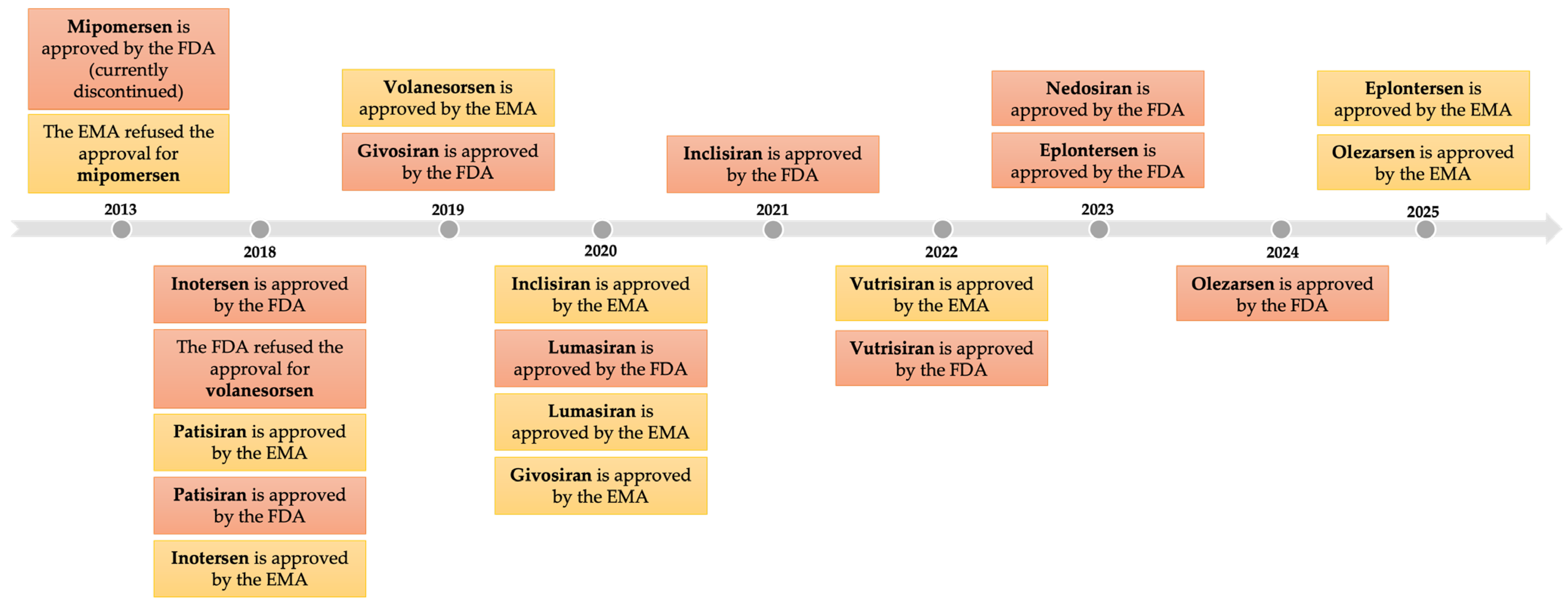
Olezarsen is currently under evaluation in several clinical studies: the OLE trial for participants from the CORE and CORE2 trials (NCT05681351); the OLE study for patients with FCS from the BALANCE trial (NCT05130450); and an open-label, phase 3 trial for individuals with FCS currently on or previously treated with volanesorsen (NCT05185843). Figure 3 shows ASOs and siRNAs currently approved for therapeutic use.

5. Drugs in Development and Emerging Strategies

While the previous section categorized therapies by disease indication, the following section focuses on the technological evolution of these therapies, categorizing emerging treatments by their molecular mechanism (siRNA, ASO, and gene editing).

5.1. siRNA Therapies

5.1.1. Familial Hypercholesterolemia

Angiopoietin-like 3 (ANGPTL3) is a protein synthesized by the hepatocytes, inhibiting LPL and endothelial lipase, consequently regulating lipid metabolism. Its increased serum levels are strongly associated with high TG and LDL-C concentrations [117]. Therefore, ANGPTL3 has become a target in hypercholesterolemia treatment, even though its LDL-C lowering mechanism is still not precisely explained. As an LDLR-independent therapy, the inhibition of ANGPTL3 can be especially beneficial for HoFH patients, which was confirmed with the use of the anti-ANGPTL3 monoclonal antibody evinacumab [118,119].
Zodasiran (formerly ARO-ANG3) is currently a subject of the phase 3, placebo-controlled, randomized YOSEMITE trial (NCT07037771). It is an siRNA targeting ANGPTL3 synthesis. The study will investigate its safety and efficacy in patients with HoFH. The participants will receive five subcutaneous doses of either zodasiran or placebo in the 12-month randomized period, and then they will be able to continue the therapy in the OLE period. The trial completion in expected in August 2027 [120]. The interim data from the previous, phase 2 GATEWAY trial (NCT05217667) showed mean reductions in LDL-C of 48.1% and 44.0% in the 200 mg and 300 mg zodasiran groups, respectively. According to the press release, the drug was characterized by good tolerability, with no observed treatment-related serious adverse events [121]. The final results from this study should be published relatively soon.
Zodasiran has been also previously tested in the ARCHES-2 study (NCT04832971) for patients with mixed dyslipidemia. In this phase 2b, placebo-controlled, double-blind trial, the reductions in both TG and LDL-C levels were demonstrated in a dose-dependent manner (up to −63 percent, and up to −20 percent with the highest dose, respectively, p < 0.0001). Zodasiran had an acceptable safety profile, although a temporary increase in glycated hemoglobin levels occurred in diabetic patients treated with the highest dose [122].

5.1.2. Severe Hypertriglyceridemia and Familial Chylomicronemia Syndrome

Plozasiran (also known as ARO-APOC3) is a first-in-class, investigational, GalNAc-conjugated siRNA that suppresses APOC3 mRNA [123]. Plozasiran targets hepatocytes, where it reduces apoC-III, leading to significant and durable decreases in TG and TRL levels [14].
The ongoing, phase 3, placebo-controlled, double-blind PALISADE study (NCT05089084) enrolled patients with persistent chylomicronemia (with or without a genetic diagnosis). The participants were randomized to treatment with subcutaneous plozasiran (25 mg or 50 mg) or placebo every 3 months. At 10 months, median fasting TG levels decreased by 80% in the 25 mg plozasiran group, 78% in the 50 mg group, and 17% in the placebo group (p < 0.001); therefore, the study achieved its primary endpoint. Additionally, a significantly lower rate of acute pancreatitis was observed among patients in the plozasiran group compared with the placebo group. Plozasiran was well tolerated, with a similar risk of adverse events across groups [124]. The OLE trial’s completion is expected in April 2026 [125].
The SHASTA-2 study (NCT04720534) evaluated plozasiran in participants with severe hypertriglyceridemia (fasting TG levels ≥ 500 mg/dL). In this phase 2b, dose-ranging, placebo-controlled trial, the patients were randomized to receive either plozasiran (10, 25, or 50 mg) or placebo at baseline and week 12. Treatment with plozasiran resulted in significant placebo-adjusted least-squares mean reductions in TG levels of −57% [95% CI: (−71.9%)–(42.1%), p < 0.001)] at week 24 with the highest dose. The study demonstrated a generally good safety profile of plozasiran [126].
Furthermore, plozasiran’s injection efficacy and safety in individuals with severe hypertriglyceridemia are currently under assessment in two separate phase 3, placebo-controlled, double-blind studies (SHASTA-3, NCT06347003 and SHASTA-4, NCT06347016) [127,128]. Another phase 3, double-blind, placebo-controlled trial, MUIR-3 (NCT06347133), investigates plozasiran’s safety and efficacy in participants with hypertriglyceridemia (mean fasting TG levels ≥ 150 mg/dL and ≤ 499 mg/dL) [129].
Another therapeutic option for patients with severe hypertriglyceridemia is the inhibition of ANGTLP3. Zodasiran has proved its efficacy as a TG-lowering drug in the ARCHES-2 trial for patients with mixed dyslipidemia, which was described above [122]. Solbinsiran (or LY3561774) is a second siRNA-targeting hepatic ANGTLP3. It is a GalNAc-bound, subcutaneously administered agent that has been evaluated in the phase 2b, double-blind, placebo-controlled PROLONG-ANG3 study (NCT05256654) in participants with mixed dyslipidemia. The recently published results confirmed a significant, dose-dependent reduction in TG levels in solbinsiran groups compared with the placebo group (with the reductions up to −52.5% at day 180 and up to −44.8% at day 270, both p < 0.0001). The safety profile of solbinsiran was acceptable, with similar incidence of adverse events in all participant groups, including the placebo group. The most common adverse events (such as gastroenteritis, nasopharyngitis, hypertension, COVID-19) were generally mild or moderate [130].

5.1.3. Hyperlipoproteinemia (a)

Lipoprotein(a) [Lp(a)] is a highly atherogenic lipoprotein that is similar to LDL; however, it has an additional component—apolipoprotein(a) [apo(a)], which is linked to apoB-100. Apo(a) is a glycoprotein encoded by the LPA gene and synthesized by the liver [131]. The Lp(a) particles vary in sizes—an increase in Lp(a) levels is associated with smaller isoforms [132]. Hyperlipoproteinemia (a), characterized by serum Lp(a) concentration > 30–50 mg/dL (75–125 nmol/L), is a mainly genetically determined disorder. Elevated plasma Lp(a) levels are an independent risk factor for ASCVD [131].
Olpasiran is an siRNA agent linked to a triantenary GalNAc, which is designed to suppress LPA expression, inhibiting the synthesis of apo(a), and therefore, blocking the assembly of Lp(a) in the liver. The phase 2, double-blind, placebo-controlled OCEAN(a)-DOSE trial (NCT04270760) enrolled patients with Lp(a) levels > 150 nmol/L and established ASCVD. The study assessed the efficacy, safety and tolerability of olpasiran, randomizing the participants into four olpasiran groups (each with a different dose) and a placebo group. The results showed a significant, dose-dependent reduction in Lp(a) concentration, with the placebo-adjusted mean percent change up to −101.1% with the highest dose of olpasiran (p < 0.001). The prevalence of adverse events was similar in all groups, including the placebo group. The most common treatment-related adverse events were injection-site reactions [133].
Olpasiran is currently being investigated in the multicenter OCEAN(a)-DOSE outcomes trial (NCT05581303) for patients with elevated Lp(a) levels (≥200 nmol/L at enrollment) and history of ASCVD. It is a phase 3, double-blind, placebo-controlled study, which will evaluate the effect of olpasiran treatment on the risk of MACE compared with the placebo. The study’s estimated completion date is December 2026 [134].
Another two siRNA therapeutics (zerlasiran and lepodisiran), with mechanisms of action similar to olpasiran, are being developed.
Zerlasiran (or SLN360) was evaluated in the phase 2, placebo-controlled ALPACAR-360 trial (NCT05537571) for participants with Lp(a) concentration ≥ 125 nmol/L and high risk of ASVCD events. The treatment resulted in the least-squares mean placebo-adjusted percent change in Lp(a) plasma levels up to −85.6% with the highest dose of zerlasiran (p < 0.0001). The drug was generally well tolerated, with mild injection site reactions being the most common adverse events. The presented data encourages further evaluation of zerlasiran in phase 3 clinical trials [135].
Lepodisiran’s efficacy was proved in the phase 2, placebo-controlled, double-blind ALPACA trial (NCT05565742) for patients with Lp(a) levels ≥ 175 nmol/L. The study results demonstrated a significant decrease in Lp(a) serum concentration from day 60 through day 180, with the placebo-adjusted percent change up to −93.9 percentage points with the highest dose of lepodisiran (p < 0.001). The safety profile was good, with mild injection-site reactions as the most common adverse events [136].
The multicenter, phase 3, placebo-controlled, double-blind ACCLAIM-Lp(a) study (NCT06292013) is currently evaluating the efficacy of lepodisiran in reducing the risk of MACE in patients with Lp(a) levels ≥ 175 nmol/L and either established ASCVD with prior cardiovascular event or high risk for a first cardiovascular event. The study’s completion is expected in March 2029 [137].

5.1.4. Alpha-1 Antitrypsin Deficiency

Fazirsiran is an investigational RNA-based therapeutic that consists of a synthetic, double-stranded, siRNA duplex and a GalNAc conjugate [138,139]. Fazirsiran is designed to treat AATD-associated liver disease by degrading AAT and Z-AAT mRNA in hepatocytes, resulting in inhibition of their synthesis [138,140]. In a small, phase 2, open-label trial with fazirsiran in adults with AATD (PI ZZ genotype) and liver fibrosis, accumulation of Z-ATT in the liver was significantly reduced [median percentage change at week 24 or 48,−83.3%; 95% CI: (−89.7)–(−76.4)], and periodic acid-Schiff-diastase (PAS-D) histologic globule burden was decreased (from a mean score of 7.4 at baseline [scores range from 0 to 9, with higher scores indicating a greater globule burden] to 2.3 at week 24 or 48). During the study, regression of liver fibrosis was observed in 7 of 15 patients, whereas progression of fibrosis occurred in 2 patients, albeit both had significant reduction in PAS-D histologic globule burden (both reached a score 0, from 9 and 4 at baseline) and in liver enzymes concentrations [17].
Based on these promising findings, the SEQUOIA placebo-controlled, dose-finding trial for AATD patients (18–75 years of age) with PI ZZ genotype was initiated. Data from the SEQUOIA phase 2 study shows impressive reduction in serum Z-AAT concentrations in a dose-dependent manner (with least-squares mean percentage declines of −61%, −83%, and −94% with fazirsiran 25, 100, and 200 mg, respectively, vs. placebo, all p < 0.0001) along with reduction at postdose liver biopsy in median liver Z-AAT concentration (by 93% compared with an increase of 26% with placebo). The study also highlights the safety of fazirsiran, stating that no adverse events led to discontinuation, and pulmonary function test results for both fazirsiran and placebo remained stable over time [140]. Currently, fazirsiran is being tested in an ongoing, worldwide, placebo-controlled, phase 3 trial (NCT05677971) to evaluate the treatment effects in patients with AATD-associated liver disease and also the long-term liver and lung safety [139,140].

5.1.5. Metabolic Dysfunction-Associated Steatotic Disease

GSK4532990 (formerly known as ARO-HSD) is a subject of the phase 2b, double-blind, placebo-controlled HORIZON trial (NCT05583344). It is an siRNA targeting HSD17B13 in hepatocytes. The study will assess its safety and efficacy in patients with MASH and advanced fibrosis [141]. The data from the phase 1/2 study demonstrated a promising efficacy of GSK4532990, with mean change in hepatic HSD17B13 mRNA up to −93.4% (p < 0.0001), and mean change in alanine aminotransferase (ALT) up to −42.3% (p < 0.001), both with the highest dose. The treatment was generally well tolerated [142].
NASHGEN-2 (NCT05519475), a phase 2, open-label, placebo-controlled trial, is evaluating another siRNA agent silencing the HSD17B13 expression for the treatment of MASH [143]. Rapirosiran (or ALN-HSD) is a GalNAc-conjugated medication for which safety has been investigated in the previous phase 1 study. The most common drug-related adverse events were injection-site reactions; additionally, no serious adverse events in groups of patients treated with rapirosiran were observed. Moreover, the results showed a dose-dependent reduction in hepatic HSD17B13 mRNA, which encourages the further clinical development of rapirosiran [144].
Next siRNA therapeutics, in this case targeting PNPLA3, are currently in ongoing, phase 1 clinical trials: ALN-PNP and LY3849891 (NCT05648214 and NCT05395481, respectively) [145,146]. Therefore, new treatment options for patients with MASLD or MASH might be available relatively soon.

5.1.6. Hypertension

Despite multiple therapeutic options available, hypertension still cannot be adequately managed in some patients. Zilebesiran is a potential revolution in the treatment of uncontrolled hypertension, with a convenient, subcutaneous, twice a year dosing regimen [147].
Zilebesiran is an siRNA linked to GalNAc, targeting mRNA of angiotensinogen (AGT), which is a key regulator of the renin–angiotensin–aldosterone system (RAAS). By inhibiting AGT synthesis in the liver, the drug decreases angiotensin II levels, thereby lowering blood pressure [148]. Zilebesiran has been evaluated in a series of phase 2, randomized, double-blind, placebo-controlled clinical trials: KARDIA-1, KARDIA-2, and KARDIA-3.
KARDIA-1 (NCT04936035) enrolled participants with mild to moderate hypertension without antihypertensive medication. At month 3, a significant reduction in 24 h mean ambulatory systolic blood pressure (SBP), with placebo-adjusted least-squares mean differences from baseline −14.1 mm Hg, −16.7 mm Hg, and −15.7 mm Hg (with 150 mg, 300 mg, and 600 mg dose of zilebesiran, respectively, p < 0.001) was observed. The most common drug-related adverse events were injection-site reactions and mild hyperkalemia [149].
KARDIA-2 (NCT05103332) assessed zilebesiran as add-on therapy in patients with inadequately controlled hypertension while using indapamide, amlodipine, or olmesartan. The adjusted mean differences from placebo in reducing the 24 h mean SBP were: −12.1 mm Hg in the indapamide group (p < 0.001); −9.7 mm Hg in the amlodipine group (p < 0.001); and −4.5 mm Hg in the olmesartan group (p < 0.02). In patients treated with zilebesiran, episodes of hyperkalemia, hypotension, and acute kidney failure were observed, although they were mostly mild [150].
KARDIA-3 (NCT06272487) also evaluated zilebesiran in combination with other antihypertensive drugs, enrolling patients with established cardiovascular disease or high risk for cardiovascular disease. According to the press release, the treatment resulted in reduction in office SBP, with placebo-adjusted decrease up to −5.0 mm Hg in the 300 mg dose group. However, the outcomes were not statistically significant (p < 0.0431) [151].
Recently, the phase 3, global, placebo-controlled, double-blind, randomized ZENITH study (NCT07181109) was initiated. The trial will investigate the efficacy of zilebesiran, as an addition to standard therapeutics, in reducing MACE in patients with uncontrolled hypertension and either established cardiovascular disease or high risk for its development. The estimated completion date is October 2030 [152].

5.2. Novel ASOs

5.2.1. Hyperlipoproteinemia (a)

Pelacarsen is a GalNAc-conjugated, second-generation ASO targeting hepatic LPA that inhibits the synthesis of apo(a), and consequently, of Lp(a). The results from a phase 2, placebo-controlled, double-blind study for participants with Lp(a) levels ≥ 60 mg/dL and established ASCVD demonstrated the efficacy and acceptable safety profile of pelacarsen. The treatment resulted in dose-dependent reduction in Lp(a) levels, with mean percent decreases of 35% with the lowest dose and 80% with the highest dose (p ranging from 0.003 to < 0.001). Most of the adverse events were mild or moderate, with injection-site reactions being the most common ones. There were no platelet-count decreases and no kidney or liver impairment observed during the study [153].
Lp(a)HORIZON (NCT04023552) is an ongoing, phase 3, double-blind, placebo-controlled study, which evaluates pelacarsen’s efficacy in reducing the risk of MACE in patients with Lp(a) levels ≥ 70 mg/dL and established ASCVD. The participants are receiving subcutaneously either an 80 mg dose of pelacarsen or placebo. The trial will assess the drug’s efficacy in lowering the risk of MACE in the full study population and in a subpopulation of patients with Lp(a) levels ≥ 90 mg/dL at enrollment. The change in Lp(a) concentration from baseline to year 1 is also measured as a secondary endpoint. The study completion is expected in February 2026 [144].

5.2.2. Metabolic Dysfunction-Associated Steatotic Liver Disease

Several ASOs have been evaluated in treatment of patients with MASLD or MASH in recent years; however, their development has been discontinued [23]. The most advanced, phase 2b FORTUNA study (NCT05809934) assessed AZD2693, the ASO targeting PNPLA3 in MASH patients. AZD2693 previously showed a clinical potential and an acceptable safety in two phase 1 clinical trials [154]. Surprisingly, the company responsible for the drug ceased its development due to lack of efficacy in early November 2025 [155]. Currently, the landscape of emerging RNA-based therapeutics in MASLD/MASH has shifted towards the siRNAs, as described above.

5.3. CRISPR and Gene Editing

5.3.1. Familial Hypercholesterolemia

VERVE-101 was the first CRISPR-based investigational drug that targeted PCSK9, efficiently decreasing LDL-C levels in HeFH patients with established ASCVD. It was evaluated in the phase 1b, open-label Heart-1 trial (NCT05398029) [156]. Initially, the study was supposed to enroll about 44 participants; however, it stopped the recruitment with 13 patients due to safety concerns. There were serious treatment-related adverse events reported, including one patient that suffered a myocardial infarction and another one with elevated ALT and thrombocytopenia, which required hospitalization [157].
The biotechnology company responsible for VERVE-101 is currently focused on the development of VERVE-102. It is a CRISPR adenine base editor that consists of mRNA and a guide RNA, designed to turn off PCSK9 in the liver. The improved delivery system using GalNAc-LNP carrier resulted in better drug tolerance at higher doses compared with VERVE-101, according to non-clinical data [158]. Heart-2 (NCT06164730) is an ongoing, phase 1b, open-label trial that assesses the safety of VERVE-102 as a single-dose, intravenously administered therapeutic for patients with HeFH or premature coronary artery disease [159]. In April 2025, the initial data from 14 participants was published. A dose-dependent LDL-C reduction was observed (with maximum mean reduction of 53% in the 0.6 mg/kg dose group). There were no drug-related serious adverse events [160]. The study completion is expected in August 2026 [159].
Another gene-editing agent, VERVE-201, targeting ANGPLT3 is undergoing evaluation. It is composed of base editor and a GalNAc-LNP platform that enhances its liver-specific delivery. The aim is to durably reduce LDL-C levels in two groups of patients: those with HoFH and those with refractory hypercholesterolemia (individuals who cannot achieve their therapeutic LDL-C goal with maximal tolerable doses of standard lipid-lowering treatments) [161]. The currently recruiting, phase 1b, open-label Pulse-1 trial (NCT06451770) will assess the safety of VERVE-201 in patients with refractory hypercholesterolemia [162].

5.3.2. Alpha-1 Antitrypsin Deficiency

AATD is a monogenic disorder; therefore, it is currently a popular target for gene editing since the correction of a single gene would normalize the mutant phenotype [163]. The main goal in gene therapy, using CRISPR/Cas9, for AATD patients is to knock out the PI Z allele and knock in the wild-type M allele, resulting in reduction in the hepatic accumulation of Z-AAT and increased production of normal human M-ATT [163]. Nowadays, in the field of AATD there are numerous clinical trials testing novel treatments, including gene-editing drugs [139,163].
In the currently recruiting, phase 1b/2a, single ascending doses and multiple ascending doses, open-label RestorAATion-2 trial (NCT06405633), patients with PI ZZ genotype are undergoing treatment with an experimental drug, WVE-006 [164]. WVE-006 is an investigational GalNAc-conjugated RNA-editing oligonucleotide causing mRNA correction of a single G-to-A point mutation (Z allele) in the SERPINA1 gene [165]. In the previous studies on transgenic mice, treatment with WVE-006 showed promising results, increasing the synthesis of normal M-AAT protein [165]. The RestorAATion-2 trial investigates tolerability, safety, pharmacokinetics and pharmacodynamics in humans [164].
The purpose of an ongoing phase 1/2, dose-exploration and dose-expansion, open-label study (NCT06389877) is to assess the efficacy and safety of BEAM-302 in participants with AATD-associated lung disease and/or liver disease [166]. BEAM-302 is a liver-targeting agent, consisting of a guide RNA and an mRNA encoding a base editor with LNP formulation, designed to correct the PI Z mutation. According to the press release, preliminary results from the first three single-ascending dose groups showed that single doses of BEAM-302 led to sustained, dose-dependent editing of the disease-causing mutation, with an increase in total and functional AAT, synthesis of corrected M-ATT, and decrease in mutant Z-ATT in blood. A biotechnology company responsible for the study also stated that the drug was well tolerated at each dose [167].

5.3.3. Primary Hyperoxaluria

The HAO1 gene has recently become a target of two separate novel gene-editing therapies for patients with PH1. Currently, both agents are being evaluated in ongoing clinical studies.
The purpose of the phase 1/2 redePHine trial (NCT06839235) is to investigate the tolerability, safety, pharmacodynamics, and pharmacokinetics of ABO-101 in patients with PH1 (6–64 years of age) [168]. ABO-101 is an investigational medicine that consists of an LNP formulation of mRNA expressing a novel V CRISPR-Cas12i2 nuclease and guide RNA specifically targeting the human HAO1 gene. ABO-101 is created as a one-time liver-directed gene-editing approach that reduces PH1-associated oxalate production by causing a permanent loss of function of the HAO1 gene [169]. According to the press release, preclinical data showed highly specific and sustained editing of HAO1 with durable decrease in UOx levels [169].
YOLT-203 is another investigational in vivo gene-editing agent that targets HAO1 in liver cells. It consists of the CRISPR-Cas12 nuclease and target-specific guide RNA, delivered intravenously via LNPs that travel to the liver [170]. YOLT-203 is being assessed in an early phase 1, open-label study (NCT06511349) for patients aged ≥2 years [171]. According to the press release, the interim clinical data demonstrated excellent safety and the potential to effectively decrease UOx levels in patients with PH1 [172].

5.3.4. Transthyretin Amyloidosis

The gene-editing therapeutic NTLA-2001 (or nexiguran ziclumeran, nex-z) is currently being tested in patients with ATTR-associated cardiomyopathy. The drug is tested as a single intravenous infusion in the phase 3, placebo-controlled, double-blind, MAGNITUDE study (NCT06128629). The trial completion is estimated in April 2028 [173].
NTLA-2001 is a novel, in vivo gene-editing medication created using the CRISPR/Cas9 technology. The LNP-based delivery system directly targets hepatocytes, in which NTLA-2001 is supposed to correct the TTR gene, inhibiting the production of wild-type and mutant proteins [174]. The preclinical results in animal models demonstrated a durable and significant decrease in serum TTR, with no serious adverse events [175]. The interim data from the first in-human NTLA-2001 open-label, phase 1 study (NCT04601051) were promising. One dose of NTLA-2001 decreased the serum TTR levels in each enrolled participant (ATTR patients with polyneuropathy or cardiomyopathy), with mean TTR reduction > 90% at 28 days. The drug was well tolerated, and the only treatment-related adverse events were nonpersistent infusion reactions [176]. The study is still ongoing, currently in the dose expansion phase; the final results (expected in August 2026) will present data on long-term efficacy and safety of NTLA-2001 [177]. Table 3 summarizes ongoing clinical trials with the use of siRNAs or ASOs.

6. Challenges and Limitations of RNA-Based Therapeutics

Despite impressive clinical success, the process of development of novel RNA-based therapeutics, which inhibit liver protein synthesis, still faces various and complex obstacles.
One significant challenge is overcoming the durability and delivery issues, since the unmodified RNA molecules are unstable, and only a fraction of internalized therapeutics reach the cytosol or RISC complex due to degradation by nucleases. Moreover, other prominent concerns are the initiation of immune responses by both the oligonucleotides and the delivery vehicle (carrier system designed to protect the nucleic acid from degradation and enable efficient delivery to the target), hepatotoxicity at high or repeated dosing, and unknown long-term consequences of chronic RNA modulation. In addition, the persisting limitations are also potential off-target or cross-target effects, where RNA molecules bind to and suppress non-intended transcripts due to partial sequence complementarity [178,179].
Therefore, chemical modifications are necessary to enhance the stability, affinity to the target, and to reduce the immunological reactions and off-target effects of siRNAs and ASOs. The most commonly used alterations are phosphorothioate (backbone modification) and replacing the 2′-hydroxyl with 2′-O-methyl, 2′-O-methoxyethyl, and 2′-fluoro (sugar modifications) [49,180]. Furthermore, the efficient transport into hepatocytes or across biological barriers requires specialized carriers such as GalNAc conjugates or LNPs [179].
Beyond these efficacy and safety considerations, it is worth mentioning that for numerous liver-related conditions, such as Wilson disease or hereditary hemochromatosis, RNA-based therapeutic strategies are still in early stages or largely unexplored. These diseases represent areas in need of further research and development of new treatment options.

7. Perspectives for Developing New Liver Protein Synthesis Blockers

In the field of liver-targeted delivery, over the past decade the most impactful advance has been the development of the GalNAc conjugation strategy. Multivalent GalNAc binds the asialoglycoprotein receptor (ASGPR) on hepatocytes, ensuring the efficient uptake of the oligonucleotides [181]. Encapsulation in LNPs is another delivery system with hepatocellular tropism, which is also responsible for the progress made in RNA-based therapeutics applications in treatment [182]. However, other delivery platforms, such as extracellular vesicles, polymeric (hyaluronic acid and chitosan) nanoparticles, or inorganic nanoparticles, have been studied and might be used in future liver-targeted drugs. Moreover, the fusion of available methods has particular potential in forthcoming years [183].
Combination therapies present a promising route to increase efficacy while lowering the dose, and therefore toxicity, of a single protein synthesis blocker. In chronic liver diseases, co-administration of RNA-based therapeutics with small molecules, monoclonal antibodies, or anti-fibrotic agents could block complementary disease mechanisms. Preclinical and early clinical studies in oncology and MASLD/MASH highlight the advantages of combination therapies [184,185].
Innovations in proteomics, high-resolution transcriptomics, and human genetic mapping are effectively revealing the next liver proteins implicated in metabolic, inflammatory, and cancer diseases. Identifying new targets for inhibition will create new possibilities for the development of novel drugs that treat and prevent diseases of hepatic origin [186,187,188].

8. Limitations

This article focuses mainly on metabolic conditions, mostly associated with dyslipidemia and atherosclerosis, and on genetic systemic disorders of hepatic origin. However, the landscape of diseases resulting from liver protein synthesis dysregulation, and then of potential novel therapies, is much wider. It is especially worth mentioning that significant progress in the development of new RNA-based drugs has been made in oncology, including the field of HCC [189], and also in the treatment of viral infection such as hepatitis B [190]. In these areas, there are plenty of clinical trials and promising therapeutics, making the subject of liver-targeted novel protein synthesis blockers almost impossible to cover as a whole in a single review article. Therefore, for clarity and integrity of this manuscript, we decided to narrow down the range of discussed disorders.

9. Summary

The treatment of diseases stemming from dysregulation of liver protein production is undergoing transformation due to the rapid development of RNA-based protein synthesis inhibitors. Several siRNAs and ASOs are already approved for regular therapy, and many more are being evaluated in ongoing clinical trials. The progress made in drug-delivery systems allows liver-specific delivery, enhancing the efficacy and decreasing the off-target effects of RNA-based therapeutics. Almost all currently approved siRNAs are bound to GalNAc, except for patisiran, which is the LNP-encapsulated agent. The GalNAc conjugation has also been used in novel ASOs, improving their safety profile compared with unconjugated therapeutics (eplontersen vs. inotersen or olezarsen vs. volanesorsen). Furthermore, the gene-editing medicines, based on CRISPR/Cas technology, demonstrate a future potential in revolutionizing the treatment of liver-originated genetic disorders. The most advanced clinical study of a gene-editing agent (for transthyretin amyloidosis) is currently in phase 3. In the coming years, the RNA-based liver protein synthesis blockers may evolve from specialty, limited-indication niche therapies to mainstream tools with broad clinical use. Nevertheless, the further assessment of their long-term safety and efficacy is necessary.

Author Contributions

Conceptualization, J.H., M.M. and Ł.B. Methodology, J.H., M.M. and Ł.B. Resources, J.H., M.M. and Ł.B. Writing—original draft preparation, J.H., M.M. and Ł.B. Writing—review and editing, M.M. and Ł.B. Supervision, Ł.B. and B.O. Project administration, M.M., Ł.B. and B.O. All authors have read and agreed to the published version of the manuscript.

Funding

The study was supported by a research grant from Medical University of Silesia (Grant No. BNW-1-157/N/4/K).

Institutional Review Board Statement

Not applicable.

Informed Consent Statement

Not applicable.

Data Availability Statement

No new data were created or analyzed in this study. Data sharing is not applicable to this article.

Conflicts of Interest

The authors have no potential conflicts of interest to declare.

Abbreviations

The following abbreviations are used in this manuscript:
AATAlpha-1 antitrypsin
AATDAlpha-1 antitrypsin deficiency
AGTAngiotensinogen
AGXTAlanine-glyoxylate aminotransferase
AHPAcute hepatic porphyria
ALLight chain amyloidosis
ALADDelta-aminolevulinic acid dehydratase
ALAS1Delta-aminolevulinate synthase 1
ALTAlanine aminotransferase
ANGPTL3Angiopoietin-like 3
apo(a)Apolipoprotein(a)
APOA5Apolipoprotein A-V
apoBApolipoprotein B
APOC2Apolipoprotein C-II
apoC-IIIApolipoprotein C-III
Ago2Argonaute 2
ASCVDAtherosclerotic cardiovascular disease
ASGPRAsialoglycoprotein receptor
ASOAntisense oligonucleotide
ATTRTransthyretin amyloidosis
ATTRwtWild-type transthyretin amyloidosis
CaOxCalcium oxalate
CKDChronic kidney disease
COPDChronic obstructive pulmonary disease
CPOXCoproporphyrinogen oxidase
CRISPR/CasClustered regularly interspaced short palindromic repeats/CRISPR-associated
dsRNADouble-stranded RNA
eGFREstimated glomerular filtration rate
EMAEuropean Medicines Agency
ESRDEnd-stage renal disease
FCSFamilial chylomicronemia syndrome
FDAFood and Drug Administration
FHFamilial hypercholesterolemia
GalNAcN-acetylgalactosamine
GOGlyoxylate oxidase
GP1HBP1High-density lipoprotein binding protein 1
GR/HPRGlyoxylate reductase/hydroxypyruvate reductase
HAO1Hydroxyacid oxidase 1
hATTRHereditary transthyretin amyloidosis
HCCHepatocellular carcinoma
HeFHHeterozygous familial hypercholesterolemia
HoFHHomozygous familial hypercholesterolemia
HOGA4-hydroxy-2-oxogluterate aldolase
HMBSHydroxymethylbilane synthase
HSD17B1317-beta hydroxysteroid dehydrogenase 13
IHDIschemic heart disease
LDHLactate dehydrogenase
LDL-CLow-density lipoprotein cholesterol
LDL-cLow-density lipoprotein cholesterol concentration
LDLRLow-density lipoprotein receptor
LMF1Lipase maturation factor 1
LNPLipid nanoparticle
Lp(a)Lipoprotein(a)
LPLLipoprotein lipase
MACEMajor adverse cardiovascular event
MAFLDMetabolic dysfunction-associated steatotic liver disease
MASHMetabolic dysfunction-associated steatohepatitis
mNIS + 7Modified Neuropathy Impairment Score + 7
mRNAMessenger RNA
Norfolk QoL-DNNorfolk Quality of Life-Diabetic Neuropathy
OLEOpen-label extension
PAS-DPeriodic acid-Schiff-diastase
PBGPorphobilinogen
PCSK9Proprotein convertase subtilisin/kexin 9
PHPrimary hyperoxaluria
PH1Primary hyperoxaluria type 1
PH2Primary hyperoxaluria type 2
PH3Primary hyperoxaluria type 3
PPOXProtoporphyrinogen oxidase
PNPLA3Patatin-like phospholipase domain-containing 3
RISCRNA-induced silencing complex
RNAiRNA interference
RNaseH1Ribonuclease H1
SBPSystolic blood pressure
SERPINA1Serine proteinase inhibitor, group A, member 1
siRNASmall interfering RNA
TGTriglyceride
TM6SF2Transmembrane 6 superfamily member 2
TRLTriglyceride-rich lipoprotein
TTRTransthyretin
UOxUrinary oxalate
UOx:CrUrinary oxalate to creatinine ratio
VLDLVery low-density lipoprotein

References

  1. Trefts, E.; Gannon, M.; Wasserman, D.H. The Liver. Curr. Biol. 2017, 27, R1147–R1151. [Google Scholar] [CrossRef] [Scilit]
  2. Kuscuoglu, D.; Janciauskiene, S.; Hamesch, K.; Haybaeck, J.; Trautwein, C.; Strnad, P. Liver—Master and Servant of Serum Proteome. J. Hepatol. 2018, 69, 512–524. [Google Scholar] [CrossRef] [Scilit] [PubMed]
  3. Trefts, E.; Williams, A.S.; Wasserman, D.H. Exercise and the Regulation of Hepatic Metabolism. Prog. Mol. Biol. Transl. Sci. 2015, 135, 203–225. [Google Scholar] [CrossRef] [Scilit] [PubMed]
  4. Gligorijević, N.; Minić, S.; Nedić, O. Structural Changes of Proteins in Liver Cirrhosis and Consequential Changes in Their Function. World J. Gastroenterol. 2022, 28, 3780–3792. [Google Scholar] [CrossRef] [Scilit] [PubMed]
  5. Kwo, P.Y.; Cohen, S.M.; Lim, J.K. ACG Clinical Guideline: Evaluation of Abnormal Liver Chemistries. Am. J. Gastroenterol. 2017, 112, 18–35. [Google Scholar] [CrossRef] [Scilit]
  6. Kallapur, A.; Sallam, T. Pharmacotherapy in Familial Hypercholesterolemia—Current State and Emerging Paradigms. Trends Cardiovasc. Med. 2023, 33, 170–179. [Google Scholar] [CrossRef] [Scilit]
  7. Di Taranto, M.D.; Giacobbe, C.; Palma, D.; Iannuzzo, G.; Gentile, M.; Calcaterra, I.; Guardamagna, O.; Auricchio, R.; Di Minno, M.N.D.; Fortunato, G. Genetic Spectrum of Familial Hypercholesterolemia and Correlations with Clinical Expression: Implications for Diagnosis Improvement. Clin. Genet. 2021, 100, 529–541. [Google Scholar] [CrossRef] [Scilit]
  8. Mirzai, S.; Chevli, P.A.; Rikhi, R.; Shapiro, M.D. Familial Hypercholesterolemia: From Clinical Suspicion to Novel Treatments. Rev. Cardiovasc. Med. 2023, 24, 311. [Google Scholar] [CrossRef] [Scilit]
  9. Ogura, M. PCSK9 Inhibition in the Management of Familial Hypercholesterolemia. J. Cardiol. 2018, 71, 1–7. [Google Scholar] [CrossRef] [Scilit]
  10. Chemello, K.; García-Nafría, J.; Gallo, A.; Martín, C.; Lambert, G.; Blom, D. Lipoprotein Metabolism in Familial Hypercholesterolemia. J. Lipid Res. 2021, 62, 100062. [Google Scholar] [CrossRef] [Scilit]
  11. Kosmas, C.E.; Bousvarou, M.D.; Tsamoulis, D.; Gianniou, M.; Papakonstantinou, E.J.; Rallidis, L.S. Novel RNA-Based Therapies in the Management of Dyslipidemias. Int. J. Mol. Sci. 2025, 26, 1026. [Google Scholar] [CrossRef] [Scilit]
  12. Esan, O.; Wierzbicki, A.S. Volanesorsen in the Treatment of Familial Chylomicronemia Syndrome or Hypertriglyceridaemia: Design, Development and Place in Therapy. Drug Des. Dev. Ther. 2020, 14, 2623–2636. [Google Scholar] [CrossRef] [Scilit] [PubMed]
  13. Witztum, J.L.; Gaudet, D.; Arca, M.; Jones, A.; Soran, H.; Gouni-Berthold, I.; Stroes, E.S.G.; Alexander, V.J.; Jones, R.; Watts, L.; et al. Volanesorsen and Triglyceride Levels in Familial Chylomicronemia Syndrome: Long-Term Efficacy and Safety Data from Patients in an Open-Label Extension Trial. J. Clin. Lipidol. 2023, 17, 342–355. [Google Scholar] [CrossRef] [Scilit] [PubMed]
  14. Izar, M.C.; Fonseca, F.A.H. Novel Therapeutics for Familial Chylomicronemia Syndrome. Curr. Atheroscler. Rep. 2025, 27, 51. [Google Scholar] [CrossRef] [Scilit] [PubMed]
  15. Karatas, E.; Bouchecareilh, M. Alpha 1-Antitrypsin Deficiency: A Disorder of Proteostasis-Mediated Protein Folding and Trafficking Pathways. Int. J. Mol. Sci. 2020, 21, 1493. [Google Scholar] [CrossRef] [Scilit]
  16. Dasí, F. Alpha-1 Antitrypsin Deficiency. Med. Clin. 2024, 162, 336–342. [Google Scholar] [CrossRef] [Scilit]
  17. Strnad, P.; Mandorfer, M.; Choudhury, G.; Griffiths, W.; Trautwein, C.; Loomba, R.; Schluep, T.; Chang, T.; Yi, M.; Given, B.D.; et al. Fazirsiran for Liver Disease Associated with Alpha1-Antitrypsin Deficiency. N. Engl. J. Med. 2022, 387, 514–524. [Google Scholar] [CrossRef] [Scilit]
  18. Stoller, J.K.; Aboussouan, L.S. A Review of α1-Antitrypsin Deficiency. Am. J. Respir. Crit. Care Med. 2012, 185, 246–259. [Google Scholar] [CrossRef] [Scilit]
  19. Pipitone, R.M.; Ciccioli, C.; Infantino, G.; La Mantia, C.; Parisi, S.; Tulone, A.; Pennisi, G.; Grimaudo, S.; Petta, S. MAFLD: A Multisystem Disease. Ther. Adv. Endocrinol. Metab. 2023, 14, 20420188221145549. [Google Scholar] [CrossRef] [Scilit]
  20. Li, Y.; Yang, P.; Ye, J.; Xu, Q.; Wu, J.; Wang, Y. Updated Mechanisms of MASLD Pathogenesis. Lipids Health Dis. 2024, 23, 117. [Google Scholar] [CrossRef] [Scilit]
  21. Bołdys, A.; Bułdak, Ł.; Maligłówka, M.; Surma, S.; Okopień, B. Potential Therapeutic Strategies in the Treatment of Metabolic-Associated Fatty Liver Disease. Medicina 2023, 59, 1789. [Google Scholar] [CrossRef] [Scilit]
  22. Sangro, P.; de la Torre Aláez, M.; Sangro, B.; D’Avola, D. Metabolic Dysfunction-Associated Fatty Liver Disease (MAFLD): An Update of the Recent Advances in Pharmacological Treatment. J. Physiol. Biochem. 2023, 79, 869–879. [Google Scholar] [CrossRef] [Scilit] [PubMed]
  23. Caddeo, A.; Romeo, S. Precision Medicine and Nucleotide-Based Therapeutics to Treat Steatotic Liver Disease. Clin. Mol. Hepatol. 2025, 31, S76–S93. [Google Scholar] [CrossRef] [Scilit] [PubMed]
  24. Milliner, D.S.; Harris, P.C.; Sas, D.J.; Cogal, A.G.; Lieske, J.C. Primary Hyperoxaluria Type 1. In GeneReviews®; Adam, M.P., Feldman, J., Mirzaa, G.M., Pagon, R.A., Wallace, S.E., Amemiya, A., Eds.; University of Washington: Seattle, WA, USA, 1993. [Google Scholar]
  25. Hopp, K.; Cogal, A.G.; Bergstralh, E.J.; Seide, B.M.; Olson, J.B.; Meek, A.M.; Lieske, J.C.; Milliner, D.S.; Harris, P.C. Rare Kidney Stone Consortium. Phenotype-Genotype Correlations and Estimated Carrier Frequencies of Primary Hyperoxaluria. J. Am. Soc. Nephrol. 2015, 26, 2559–2570. [Google Scholar] [CrossRef] [Scilit] [PubMed]
  26. Singh, P.; Viehman, J.K.; Mehta, R.A.; Cogal, A.G.; Hasadsri, L.; Oglesbee, D.; Olson, J.B.; Seide, B.M.; Sas, D.J.; Harris, P.C.; et al. Clinical Characterization of Primary Hyperoxaluria Type 3 in Comparison with Types 1 and 2. Nephrol. Dial. Transplant. 2022, 37, 869–875. [Google Scholar] [CrossRef] [Scilit]
  27. Hoppe, B.; Beck, B.B.; Milliner, D.S. The Primary Hyperoxalurias. Kidney Int. 2009, 75, 1264–1271. [Google Scholar] [CrossRef] [Scilit]
  28. Fargue, S.; Acquaviva Bourdain, C. Primary Hyperoxaluria Type 1: Pathophysiology and Genetics. Clin. Kidney J. 2022, 15, i4–i8. [Google Scholar] [CrossRef] [Scilit]
  29. Moochhala, S.H.; Worcester, E.M. Primary Hyperoxaluria: The Adult Nephrologist’s Point of View. Clin. Kidney J. 2022, 15, i29–i32. [Google Scholar] [CrossRef] [Scilit]
  30. Garrelfs, S.F.; Rumsby, G.; Peters-Sengers, H.; Erger, F.; Groothoff, J.W.; Beck, B.B.; Oosterveld, M.J.S.; Pelle, A.; Neuhaus, T.; Adams, B.; et al. Patients with Primary Hyperoxaluria Type 2 Have Significant Morbidity and Require Careful Follow-Up. Kidney Int. 2019, 96, 1389–1399. [Google Scholar] [CrossRef] [Scilit]
  31. Milliner, D.S.; Wilson, D.M.; Smith, L.H. Phenotypic Expression of Primary Hyperoxaluria: Comparative Features of Types I and II. Kidney Int. 2001, 59, 31–36. [Google Scholar] [CrossRef] [Scilit]
  32. Riedel, T.J.; Knight, J.; Murray, M.S.; Milliner, D.S.; Holmes, R.P.; Lowther, W.T. 4-Hydroxy-2-Oxoglutarate Aldolase Inactivity in Primary Hyperoxaluria Type 3 and Glyoxylate Reductase Inhibition. Biochim. Biophys. Acta 2012, 1822, 1544–1552. [Google Scholar] [CrossRef] [Scilit] [PubMed]
  33. Phillips, J.D. Heme Biosynthesis and the Porphyrias. Mol. Genet. Metab. 2019, 128, 164–177. [Google Scholar] [CrossRef] [Scilit] [PubMed]
  34. Dickey, A.K.; Leaf, R.K.; Balwani, M. Update on the Porphyrias. Annu. Rev. Med. 2024, 75, 321–335. [Google Scholar] [CrossRef] [Scilit] [PubMed]
  35. Majeed, C.N.; Ma, C.D.; Xiao, T.; Rudnick, S.; Bonkovsky, H.L. Spotlight on Givosiran as a Treatment Option for Adults with Acute Hepatic Porphyria: Design, Development, and Place in Therapy. Drug Des. Dev. Ther. 2022, 16, 1827–1845. [Google Scholar] [CrossRef] [Scilit]
  36. Thapar, M.; Singh, A.; Robinson, K.M.; Bonkovsky, H.L. Obstacles to Early Diagnosis of Acute Hepatic Porphyria: Current Perspectives on Improving Early Diagnosis and Clinical Management. Clin. Exp. Gastroenterol. 2024, 17, 1–8. [Google Scholar] [CrossRef] [Scilit]
  37. Muchtar, E.; Dispenzieri, A.; Magen, H.; Grogan, M.; Mauermann, M.; McPhail, E.D.; Kurtin, P.J.; Leung, N.; Buadi, F.K.; Dingli, D.; et al. Systemic Amyloidosis from A (AA) to T (ATTR): A Review. J. Intern. Med. 2021, 289, 268–292. [Google Scholar] [CrossRef] [Scilit]
  38. Leung, N.; Nasr, S.H. 2024 Update on Classification, Etiology, and Typing of Renal Amyloidosis: A Review. Am. J. Kidney Dis. 2024, 84, 361–373. [Google Scholar] [CrossRef] [Scilit]
  39. Adrogue, H.E. Amyloidosis of the Heart and Kidney. Methodist Debakey Cardiovasc. J. 2022, 18, 27–33. [Google Scholar] [CrossRef] [Scilit]
  40. Siddiqi, O.K.; Ruberg, F.L. Cardiac Amyloidosis: An Update on Pathophysiology, Diagnosis, and Treatment. Trends Cardiovasc. Med. 2018, 28, 10–21. [Google Scholar] [CrossRef] [Scilit]
  41. Senigarapu, S.; Driscoll, J.J. A Review of Recent Clinical Trials to Evaluate Disease-Modifying Therapies in the Treatment of Cardiac Amyloidosis. Front. Med. 2024, 11, 1477988. [Google Scholar] [CrossRef] [Scilit]
  42. Zhu, Y.; Zhu, L.; Wang, X.; Jin, H. RNA-Based Therapeutics: An Overview and Prospectus. Cell Death Dis. 2022, 13, 644. [Google Scholar] [CrossRef] [Scilit] [PubMed]
  43. Sparmann, A.; Vogel, J. RNA-based Medicine: From Molecular Mechanisms to Therapy. EMBO J. 2023, 42, e114760. [Google Scholar] [CrossRef] [Scilit] [PubMed]
  44. Adachi, H.; Hengesbach, M.; Yu, Y.-T.; Morais, P. From Antisense RNA to RNA Modification: Therapeutic Potential of RNA-Based Technologies. Biomedicines 2021, 9, 550. [Google Scholar] [CrossRef] [Scilit] [PubMed]
  45. Dhuri, K.; Bechtold, C.; Quijano, E.; Pham, H.; Gupta, A.; Vikram, A.; Bahal, R. Antisense Oligonucleotides: An Emerging Area in Drug Discovery and Development. J. Clin. Med. 2020, 9, 2004. [Google Scholar] [CrossRef] [Scilit]
  46. Takakusa, H.; Iwazaki, N.; Nishikawa, M.; Yoshida, T.; Obika, S.; Inoue, T. Drug Metabolism and Pharmacokinetics of Antisense Oligonucleotide Therapeutics: Typical Profiles, Evaluation Approaches, and Points to Consider Compared with Small Molecule Drugs. Nucleic Acid Ther. 2023, 33, 83–94. [Google Scholar] [CrossRef] [Scilit]
  47. Buchon, N.; Vaury, C. RNAi: A Defensive RNA-Silencing against Viruses and Transposable Elements. Heredity 2006, 96, 195–202. [Google Scholar] [CrossRef] [Scilit]
  48. Bajan, S.; Hutvagner, G. RNA-Based Therapeutics: From Antisense Oligonucleotides to miRNAs. Cells 2020, 9, 137. [Google Scholar] [CrossRef] [Scilit]
  49. Yin, W.; Rogge, M. Targeting RNA: A Transformative Therapeutic Strategy. Clin. Transl. Sci. 2019, 12, 98–112. [Google Scholar] [CrossRef] [Scilit]
  50. Tang, Q.; Khvorova, A. RNAi-Based Drug Design: Considerations and Future Directions. Nat. Rev. Drug Discov. 2024, 23, 341–364. [Google Scholar] [CrossRef] [Scilit]
  51. Jinek, M.; Chylinski, K.; Fonfara, I.; Hauer, M.; Doudna, J.A.; Charpentier, E. A Programmable Dual-RNA–Guided DNA Endonuclease in Adaptive Bacterial Immunity. Science 2012, 337, 816–821. [Google Scholar] [CrossRef] [Scilit]
  52. Cong, L.; Ran, F.A.; Cox, D.; Lin, S.; Barretto, R.; Habib, N.; Hsu, P.D.; Wu, X.; Jiang, W.; Marraffini, L.A.; et al. Multiplex Genome Engineering Using CRISPR/Cas Systems. Science 2013, 339, 819–823. [Google Scholar] [CrossRef] [Scilit] [PubMed]
  53. Qi, L.S.; Larson, M.H.; Gilbert, L.A.; Doudna, J.A.; Weissman, J.S.; Arkin, A.P.; Lim, W.A. Repurposing CRISPR as an RNA-Guided Platform for Sequence-Specific Control of Gene Expression. Cell 2013, 152, 1173–1183. [Google Scholar] [CrossRef] [Scilit] [PubMed]
  54. Hille, F.; Charpentier, E. CRISPR-Cas: Biology, Mechanisms and Relevance. Philos. Trans. R. Soc. B 2016, 371, 20150496. [Google Scholar] [CrossRef] [Scilit] [PubMed]
  55. Laurent, M.; Geoffroy, M.; Pavani, G.; Guiraud, S. CRISPR-Based Gene Therapies: From Preclinical to Clinical Treatments. Cells 2024, 13, 800. [Google Scholar] [CrossRef] [Scilit]
  56. Rueda, J.; De Miguel Beriain, Í.; Montoliu, L. Affordable Pricing of CRISPR Treatments Is a Pressing Ethical Imperative. CRISPR J. 2024, 7, 220–226. [Google Scholar] [CrossRef] [Scilit]
  57. Sehgal, I.; Eells, K.; Hudson, I. A Comparison of Currently Approved Small Interfering RNA (siRNA) Medications to Alternative Treatments by Costs, Indications, and Medicaid Coverage. Pharmacy 2024, 12, 58. [Google Scholar] [CrossRef] [Scilit]
  58. Shahid, U. Advances in RNA Therapeutics: Classes, Innovations and Clinical Applications. J. Precis. Med. Health Dis. 2025, 3, 100016. [Google Scholar] [CrossRef] [Scilit]
  59. Zhang, X.; Goel, V.; Attarwala, H.; Sweetser, M.T.; Clausen, V.A.; Robbie, G.J. Patisiran Pharmacokinetics, Pharmacodynamics, and Exposure-Response Analyses in the Phase 3 APOLLO Trial in Patients with Hereditary Transthyretin-Mediated (hATTR) Amyloidosis. J. Clin. Pharmacol. 2020, 60, 37–49. [Google Scholar] [CrossRef] [Scilit]
  60. Moazzam, M.; Zhang, M.; Hussain, A.; Yu, X.; Huang, J.; Huang, Y. The Landscape of Nanoparticle-Based siRNA Delivery and Therapeutic Development. Mol. Ther. 2024, 32, 284–312. [Google Scholar] [CrossRef] [Scilit]
  61. Adams, D.; Gonzalez-Duarte, A.; O’Riordan, W.D.; Yang, C.-C.; Ueda, M.; Kristen, A.V.; Tournev, I.; Schmidt, H.H.; Coelho, T.; Berk, J.L.; et al. Patisiran, an RNAi Therapeutic, for Hereditary Transthyretin Amyloidosis. N. Engl. J. Med. 2018, 379, 11–21. [Google Scholar] [CrossRef] [Scilit]
  62. Adams, D.; Wixner, J.; Polydefkis, M.; Berk, J.L.; Conceição, I.M.; Dispenzieri, A.; Peltier, A.; Ueda, M.; Bender, S.; Capocelli, K.; et al. Five-Year Results with Patisiran for Hereditary Transthyretin Amyloidosis with Polyneuropathy: A Randomized Clinical Trial with Open-Label Extension. JAMA Neurol. 2025, 82, 228–236. [Google Scholar] [CrossRef] [Scilit] [PubMed]
  63. Fontana, M.; Ioannou, A.; Cuddy, S.; Dorbala, S.; Masri, A.; Moon, J.C.; Singh, V.; Clerc, O.; Hanna, M.; Ruberg, F.; et al. The Last Decade in Cardiac Amyloidosis. JACC Cardiovasc. Imaging 2025, 18, 478–499. [Google Scholar] [CrossRef] [Scilit] [PubMed]
  64. Maurer, M.S.; Kale, P.; Fontana, M.; Berk, J.L.; Grogan, M.; Gustafsson, F.; Hung, R.R.; Gottlieb, R.L.; Damy, T.; González-Duarte, A.; et al. Patisiran Treatment in Patients with Transthyretin Cardiac Amyloidosis. N. Engl. J. Med. 2023, 389, 1553–1565. [Google Scholar] [CrossRef] [Scilit] [PubMed]
  65. APOLLO-B: A Study to Evaluate Patisiran in Participants with Transthyretin Amyloidosis with Cardiomyopathy (ATTR Amyloidosis with Cardiomyopathy). Available online: https://clinicaltrials.gov/study/NCT03997383 (accessed on 2 November 2025).
  66. Ferrari Chen, Y.F.; Aimo, A.; Castiglione, V.; Chubuchna, O.; Morfino, P.; Fabiani, I.; Buda, G.; Emdin, M.; Vergaro, G. Etiological Treatment of Cardiac Amyloidosis: Standard of Care and Future Directions. Curr. Heart Fail. Rep. 2025, 22, 16. [Google Scholar] [CrossRef] [Scilit]
  67. Adams, D.; Tournev, I.L.; Taylor, M.S.; Coelho, T.; Planté-Bordeneuve, V.; Berk, J.L.; González-Duarte, A.; Gillmore, J.D.; Low, S.-C.; Sekijima, Y.; et al. Efficacy and Safety of Vutrisiran for Patients with Hereditary Transthyretin-Mediated Amyloidosis with Polyneuropathy: A Randomized Clinical Trial. Amyloid 2023, 30, 18–26. [Google Scholar] [CrossRef] [Scilit]
  68. Fontana, M.; Berk, J.L.; Gillmore, J.D.; Witteles, R.M.; Grogan, M.; Drachman, B.; Damy, T.; Garcia-Pavia, P.; Taubel, J.; Solomon, S.D.; et al. Vutrisiran in Patients with Transthyretin Amyloidosis with Cardiomyopathy. N. Engl. J. Med. 2025, 392, 33–44. [Google Scholar] [CrossRef] [Scilit]
  69. Alnylam Pharmaceuticals Inc. US Prescribing Information: AMVUTTRA (Vutrisiran) Injection, for Subcutaneous Use. Available online: https://www.alnylam.com/sites/default/files/pdfs/amvuttra-us-prescribing-information.pdf (accessed on 2 November 2025).
  70. Benson, M.D.; Waddington-Cruz, M.; Berk, J.L.; Polydefkis, M.; Dyck, P.J.; Wang, A.K.; Planté-Bordeneuve, V.; Barroso, F.A.; Merlini, G.; Obici, L.; et al. Inotersen Treatment for Patients with Hereditary Transthyretin Amyloidosis. N. Engl. J. Med. 2018, 379, 22–31. [Google Scholar] [CrossRef] [Scilit]
  71. Coelho, T.; Yarlas, A.; Waddington-Cruz, M.; White, M.K.; Sikora Kessler, A.; Lovley, A.; Pollock, M.; Guthrie, S.; Ackermann, E.J.; Hughes, S.G.; et al. Inotersen Preserves or Improves Quality of Life in Hereditary Transthyretin Amyloidosis. J. Neurol. 2020, 267, 1070–1079. [Google Scholar] [CrossRef] [Scilit]
  72. Anwar, I.M.B.; Ahmed, I.M.F.; Mahmood, F.M.; Haseeb, A.M.; Ahmed, K.M.A.H.M. Hope on the Horizon: FDA Approves Eplontersen for Hereditary Transthyretin-Mediated Amyloidosis. Ann. Med. Surg. 2025, 87, 20–23. [Google Scholar] [CrossRef] [Scilit]
  73. Coelho, T.; Marques, W.; Dasgupta, N.R.; Chao, C.-C.; Parman, Y.; França, M.C.; Guo, Y.-C.; Wixner, J.; Ro, L.-S.; Calandra, C.R.; et al. Eplontersen for Hereditary Transthyretin Amyloidosis with Polyneuropathy. J. Am. Med. Assoc. 2023, 330, 1448–1458. [Google Scholar] [CrossRef] [Scilit]
  74. CARDIO-TTRansform: A Study to Evaluate the Efficacy and Safety of Eplontersen (Formerly Known as ION-682884, IONIS-TTR-LRx and AKCEA-TTR-LRx) in Participants with Transthyretin-Mediated Amyloid Cardiomyopathy (ATTR CM). Available online: https://clinicaltrials.gov/study/NCT04136171 (accessed on 3 November 2025).
  75. ENVISION: A Study to Evaluate the Efficacy and Safety of Givosiran (ALN-AS1) in Patients with Acute Hepatic Porphyrias (AHP). Available online: https://clinicaltrials.gov/study/NCT03338816 (accessed on 6 October 2025).
  76. Balwani, M.; Sardh, E.; Ventura, P.; Peiró, P.A.; Rees, D.C.; Stölzel, U.; Bissell, D.M.; Bonkovsky, H.L.; Windyga, J.; Anderson, K.E.; et al. Phase 3 Trial of RNAi Therapeutic Givosiran for Acute Intermittent Porphyria. N. Engl. J. Med. 2020, 382, 2289–2301. [Google Scholar] [CrossRef] [Scilit]
  77. Traber, G.M.; Yu, A.-M. RNAi-Based Therapeutics and Novel RNA Bioengineering Technologies. J. Pharmacol. Exp. Ther. 2023, 384, 133–154. [Google Scholar] [CrossRef] [Scilit] [PubMed]
  78. Ventura, P.; Bonkovsky, H.L.; Gouya, L.; Aguilera-Peiró, P.; Montgomery Bissell, D.; Stein, P.E.; Balwani, M.; Anderson, D.K.E.; Parker, C.; Kuter, D.J.; et al. Efficacy and Safety of Givosiran for Acute Hepatic Porphyria: 24-Month Interim Analysis of the Randomized Phase 3 ENVISION Study. Liver Int. 2022, 42, 161–172. [Google Scholar] [CrossRef] [Scilit] [PubMed]
  79. Kang, C. Lumasiran: A Review in Primary Hyperoxaluria Type 1. Drugs 2024, 84, 219–226. [Google Scholar] [CrossRef] [Scilit] [PubMed]
  80. Gang, X.; Liu, F.; Mao, J. Lumasiran for Primary Hyperoxaluria Type 1: What We Have Learned? Front. Pediatr. 2023, 10, 1052625. [Google Scholar] [CrossRef] [Scilit]
  81. A Study to Evaluate Lumasiran in Children and Adults with Primary Hyperoxaluria Type 1 (ILLUMINATE-A). Available online: https://clinicaltrials.gov/study/NCT03681184 (accessed on 12 October 2025).
  82. Garrelfs, S.F.; Frishberg, Y.; Hulton, S.A.; Koren, M.J.; O’Riordan, W.D.; Cochat, P.; Deschênes, G.; Shasha-Lavsky, H.; Saland, J.M.; Van’T Hoff, W.G.; et al. Lumasiran, an RNAi Therapeutic for Primary Hyperoxaluria Type 1. N. Engl. J. Med. 2021, 384, 1216–1226. [Google Scholar] [CrossRef] [Scilit]
  83. Frishberg, Y.; Hayes, W.; Shasha-Lavsky, H.; Sas, D.J.; Michael, M.; Sellier-Leclerc, A.-L.; Hogan, J.; Willey, R.; Gansner, J.M.; Magen, D. Efficacy and Safety of Lumasiran for Infants and Young Children with Primary Hyperoxaluria Type 1: 30-Month Analysis of the Phase 3 ILLUMINATE-B Trial. Front. Pediatr. 2024, 12, 1392644. [Google Scholar] [CrossRef] [Scilit]
  84. A Study of Lumasiran in Infants and Young Children with Primary Hyperoxaluria Type 1 (ILLUMINATE-B). Available online: https://www.clinicaltrials.gov/study/NCT03905694 (accessed on 13 October 2025).
  85. A Study to Evaluate Lumasiran in Patients with Advanced Primary Hyperoxaluria Type 1 (ILLUMINATE-C). Available online: https://clinicaltrials.gov/study/NCT04152200 (accessed on 13 October 2025).
  86. Michael, M.; Groothoff, J.W.; Shasha-Lavsky, H.; Lieske, J.C.; Frishberg, Y.; Simkova, E.; Sellier-Leclerc, A.-L.; Devresse, A.; Guebre-Egziabher, F.; Bakkaloglu, S.A.; et al. Lumasiran for Advanced Primary Hyperoxaluria Type 1: Phase 3 ILLUMINATE-C Trial. Am. J. Kidney Dis. 2023, 81, 145–155.e1. [Google Scholar] [CrossRef] [Scilit]
  87. Zhang, S.; Gamallo, P.; Rawson, V. Population Pharmacokinetic and Pharmacodynamic Modelling and Simulation for Nedosiran Clinical Development and Dose Guidance in Pediatric Patients with Primary Hyperoxaluria Type 1. Clin. Pharmacokinet. 2025, 64, 1395–1411. [Google Scholar] [CrossRef] [Scilit]
  88. Bacchetta, J.; Lieske, J.C. Primary Hyperoxaluria Type 1: Novel Therapies at a Glance. Clin. Kidney J. 2022, 15, i17–i22. [Google Scholar] [CrossRef] [Scilit]
  89. Wanders, R.J.A.; Groothoff, J.W.; Deesker, L.J.; Salido, E.; Garrelfs, S.F. Human Glyoxylate Metabolism Revisited: New Insights Pointing to Multi-organ Involvement with Implications for siRNA-based Therapies in Primary Hyperoxaluria. J. Inherit. Metab. Dis. 2025, 48, e12817. [Google Scholar] [CrossRef] [Scilit]
  90. Syed, Y.Y. Nedosiran: First Approval. Drugs 2023, 83, 1729–1733. [Google Scholar] [CrossRef] [Scilit]
  91. Baum, M.A.; Langman, C.; Cochat, P.; Lieske, J.C.; Moochhala, S.H.; Hamamoto, S.; Satoh, H.; Mourani, C.; Ariceta, G.; Torres, A.; et al. PHYOX2: A Pivotal Randomized Study of Nedosiran in Primary Hyperoxaluria Type 1 or 2. Kidney Int. 2023, 103, 207–217. [Google Scholar] [CrossRef] [Scilit]
  92. Long Term Extension Study in Patients with Primary Hyperoxaluria (PHYOX3). Available online: https://clinicaltrials.gov/study/NCT04042402 (accessed on 14 October 2025).
  93. Safety & Efficacy of DCR-PHXC in Patients with PH1 and ESRD (PHYOX7). Available online: https://clinicaltrials.gov/study/NCT04580420 (accessed on 14 October 2025).
  94. Dec, A.; Niemiec, A.; Wojciechowska, E.; Maligłówka, M.; Bułdak, Ł.; Bołdys, A.; Okopień, B. Inclisiran—A Revolutionary Addition to a Cholesterol-Lowering Therapy. Int. J. Mol. Sci. 2023, 24, 6858. [Google Scholar] [CrossRef] [Scilit] [PubMed]
  95. Marrs, J.C.; Anderson, S.L. Inclisiran for the Treatment of Hypercholesterolaemia. Drugs Context 2024, 13. [Google Scholar] [CrossRef] [Scilit] [PubMed]
  96. European Medicines Agency. Leqvio: EPAR—Product Information. Available online: https://www.ema.europa.eu/en/medicines/human/EPAR/leqvio (accessed on 1 November 2025).
  97. Ray, K.K.; Wright, R.S.; Kallend, D.; Koenig, W.; Leiter, L.A.; Raal, F.J.; Bisch, J.A.; Richardson, T.; Jaros, M.; Wijngaard, P.L.J.; et al. Two Phase 3 Trials of Inclisiran in Patients with Elevated LDL Cholesterol. N. Engl. J. Med. 2020, 382, 1507–1519. [Google Scholar] [CrossRef] [Scilit] [PubMed]
  98. Raal, F.J.; Kallend, D.; Ray, K.K.; Turner, T.; Koenig, W.; Wright, R.S.; Wijngaard, P.L.J.; Curcio, D.; Jaros, M.J.; Leiter, L.A.; et al. Inclisiran for the Treatment of Heterozygous Familial Hypercholesterolemia. N. Engl. J. Med. 2020, 382, 1520–1530. [Google Scholar] [CrossRef] [Scilit]
  99. Wright, R.S.; Raal, F.J.; Koenig, W.; Landmesser, U.; Leiter, L.A.; Vikarunnessa, S.; Lesogor, A.; Maheux, P.; Talloczy, Z.; Zang, X.; et al. Inclisiran Administration Potently and Durably Lowers LDL-C over an Extended-Term Follow-up: The ORION-8 Trial. Cardiovasc. Res. 2024, 120, 1400–1410. [Google Scholar] [CrossRef] [Scilit]
  100. Raal, F.; Durst, R.; Bi, R.; Talloczy, Z.; Maheux, P.; Lesogor, A.; Kastelein, J.J.P.; on behalf of the ORION-5 Study Investigators. Efficacy, Safety, and Tolerability of Inclisiran in Patients with Homozygous Familial Hypercholesterolemia: Results From the ORION-5 Randomized Clinical Trial. Circulation 2024, 149, 354–362. [Google Scholar] [CrossRef] [Scilit]
  101. A Study of Inclisiran to Prevent Cardiovascular Events in High-Risk Primary Prevention Patients. Available online: https://clinicaltrials.gov/study/NCT05739383 (accessed on 1 November 2025).
  102. A Randomized Trial Assessing the Effects of Inclisiran on Clinical Outcomes Among People with Cardiovascular Disease (ORION-4). Available online: https://clinicaltrials.gov/study/NCT03705234 (accessed on 1 November 2025).
  103. Study of Inclisiran to Prevent Cardiovascular (CV) Events in Participants with Established Cardiovascular Disease (VICTORION-2P). Available online: https://www.clinicaltrials.gov/study/NCT05030428 (accessed on 1 November 2025).
  104. Parham, J.S.; Goldberg, A.C. Mipomersen and Its Use in Familial Hypercholesterolemia. Expert Opin. Pharmacother. 2019, 20, 127–131. [Google Scholar] [CrossRef] [Scilit]
  105. Chambergo-Michilot, D.; Alur, A.; Kulkarni, S.; Agarwala, A. Mipomersen in Familial Hypercholesterolemia: An Update on Health-Related Quality of Life and Patient-Reported Outcomes. Vasc. Health Risk Manag. 2022, 18, 73–80. [Google Scholar] [CrossRef] [Scilit]
  106. Zhao, H.; Wang, Y.; Li, Y.; Cheng, R.; Chen, W. Research Advances in Current Drugs Targeting Hyperlipidemia (Review). Mol. Med. Rep. 2025, 32, 258. [Google Scholar] [CrossRef] [Scilit] [PubMed]
  107. Witztum, J.L.; Gaudet, D.; Freedman, S.D.; Alexander, V.J.; Digenio, A.; Williams, K.R.; Yang, Q.; Hughes, S.G.; Geary, R.S.; Arca, M.; et al. Volanesorsen and Triglyceride Levels in Familial Chylomicronemia Syndrome. N. Engl. J. Med. 2019, 381, 531–542. [Google Scholar] [CrossRef] [Scilit] [PubMed]
  108. Gouni-Berthold, I.; Alexander, V.J.; Yang, Q.; Hurh, E.; Steinhagen-Thiessen, E.; Moriarty, P.M.; Hughes, S.G.; Gaudet, D.; Hegele, R.A.; O’Dea, L.S.L.; et al. Efficacy and Safety of Volanesorsen in Patients with Multifactorial Chylomicronaemia (COMPASS): A Multicentre, Double-Blind, Randomised, Placebo-Controlled, Phase 3 Trial. Lancet Diabetes Endocrinol. 2021, 9, 264–275. [Google Scholar] [CrossRef] [Scilit] [PubMed]
  109. Akcea and Ionis Receive Complete Response Letter for WAYLIVRA from FDA. Available online: https://ir.ionis.com/news-releases/news-release-details/akcea-and-ionis-receive-complete-response-letter-waylivra-fda (accessed on 17 October 2025).
  110. Oral, E.A.; Garg, A.; Tami, J.; Huang, E.A.; O’Dea, L.S.L.; Schmidt, H.; Tiulpakov, A.; Mertens, A.; Alexander, V.J.; Watts, L.; et al. Assessment of Efficacy and Safety of Volanesorsen for Treatment of Metabolic Complications in Patients with Familial Partial Lipodystrophy: Results of the BROADEN Study. J. Clin. Lipidol. 2022, 16, 833–849. [Google Scholar] [CrossRef] [Scilit]
  111. Tardif, J.-C.; Karwatowska-Prokopczuk, E.; Amour, E.S.; Ballantyne, C.M.; Shapiro, M.D.; Moriarty, P.M.; Baum, S.J.; Hurh, E.; Bartlett, V.J.; Kingsbury, J.; et al. Apolipoprotein C-III Reduction in Subjects with Moderate Hypertriglyceridaemia and at High Cardiovascular Risk. Eur. Heart J. 2022, 43, 1401–1412. [Google Scholar] [CrossRef] [Scilit]
  112. Stroes, E.S.G.; Alexander, V.J.; Karwatowska-Prokopczuk, E.; Hegele, R.A.; Arca, M.; Ballantyne, C.M.; Soran, H.; Prohaska, T.A.; Xia, S.; Ginsberg, H.N.; et al. Olezarsen, Acute Pancreatitis, and Familial Chylomicronemia Syndrome. N. Engl. J. Med. 2024, 390, 1781–1792. [Google Scholar] [CrossRef] [Scilit]
  113. TRYNGLOZA® (Olezarsen) Approved in the European Union for Familial Chylomicronemia Syndrome (FCS). Available online: https://ir.ionis.com/news-releases/news-release-details/tryngolzar-olezarsen-approved-european-union-familial (accessed on 18 October 2025).
  114. A Study of Olezarsen Administered Subcutaneously to Participants with Severe Hypertriglyceridemia. Available online: https://www.clinicaltrials.gov/study/NCT05552326 (accessed on 18 October 2025).
  115. A Study of Olezarsen (ISIS 678354) Administered to Participants with Severe Hypertriglyceridemia. Available online: https://www.clinicaltrials.gov/study/NCT05079919 (accessed on 18 October 2025).
  116. Olezarsen Significantly Reduces Triglycerides and Acute Pancreatitis Events in Landmark Pivotal Studies for People with Severe Hypertriglyceridemia (sHTG). Available online: https://ir.ionis.com/news-releases/news-release-details/olezarsen-significantly-reduces-triglycerides-and-acute (accessed on 18 October 2025).
  117. Kersten, S. ANGPTL3 as Therapeutic Target. Curr. Opin. Lipidol. 2021, 32, 335–341. [Google Scholar] [CrossRef] [Scilit]
  118. Pawlos, A.; Khoury, E.; Gaudet, D. Emerging Therapies for Refractory Hypercholesterolemia: A Narrative Review. Future Cardiol. 2024, 20, 317–334. [Google Scholar] [CrossRef] [Scilit]
  119. Maligłówka, M.; Sojka, A.; Dec, A.; Okopień, B.; Bułdak, Ł. Achieving the Impossible: Effective Reduction of Low-Density Lipoprotein Cholesterol (LDL-C) in a Patient with Homozygous Familial Hypercholesterolemia. Endokrynol. Pol. 2025, 76, 688–689. [Google Scholar] [CrossRef] [Scilit]
  120. A Phase 3 Study of Zodasiran in Adolescent and Adult Subjects with Homozygous Familial Hypercholesterolemia (YOSEMITE). Available online: https://clinicaltrials.gov/study/NCT07037771 (accessed on 6 November 2025).
  121. Arrowhead Presents Interim Data from ARO-ANG3 Phase 2 GATEWAY Study in Patients with HoFH. Available online: https://ir.arrowheadpharma.com/news-releases/news-release-details/arrowhead-presents-interim-data-aro-ang3-phase-2-gateway-study (accessed on 6 November 2025).
  122. Rosenson, R.S.; Gaudet, D.; Hegele, R.A.; Ballantyne, C.M.; Nicholls, S.J.; Lucas, K.J.; San Martin, J.; Zhou, R.; Muhsin, M.; Chang, T.; et al. Zodasiran, an RNAi Therapeutic Targeting ANGPTL3, for Mixed Hyperlipidemia. N. Engl. J. Med. 2024, 391, 913–925. [Google Scholar] [CrossRef] [Scilit] [PubMed]
  123. Gouni-Berthold, I.; Schwarz, J.; Berthold, H.K. Updates in Drug Treatment of Severe Hypertriglyceridemia. Curr. Atheroscler. Rep. 2023, 25, 701–709. [Google Scholar] [CrossRef] [Scilit]
  124. Watts, G.F.; Rosenson, R.S.; Hegele, R.A.; Goldberg, I.J.; Gallo, A.; Mertens, A.; Baass, A.; Zhou, R.; Muhsin, M.; Hellawell, J.; et al. Plozasiran for Managing Persistent Chylomicronemia and Pancreatitis Risk. N. Engl. J. Med. 2025, 392, 127–137. [Google Scholar] [CrossRef] [Scilit]
  125. Study of ARO-APOC3 (Plozasiran) in Adults with Familial Chylomicronemia Syndrome (FCS) (PALISADE). Available online: https://www.clinicaltrials.gov/study/NCT05089084 (accessed on 18 October 2025).
  126. Gaudet, D.; Pall, D.; Watts, G.F.; Nicholls, S.J.; Rosenson, R.S.; Modesto, K.; San Martin, J.; Hellawell, J.; Ballantyne, C.M. Plozasiran (ARO-APOC3) for Severe Hypertriglyceridemia: The SHASTA-2 Randomized Clinical Trial. JAMA Cardiol. 2024, 9, 620–630. [Google Scholar] [CrossRef] [Scilit] [PubMed]
  127. Study of Plozasiran (ARO-APOC3) in Adults with Severe Hypertriglyceridemia (SHASTA-3). Available online: https://clinicaltrials.gov/study/NCT06347003 (accessed on 19 October 2025).
  128. Study of Plozasiran in Adults with Severe Hypertriglyceridemia (SHASTA-4). Available online: https://clinicaltrials.gov/study/NCT06347016 (accessed on 19 October 2025).
  129. Phase 3 Study of Plozasiran in Adults with Hypertriglyceridemia (MUIR-3). Available online: https://clinicaltrials.gov/study/NCT06347133 (accessed on 19 October 2025).
  130. Ray, K.K.; Oru, E.; Rosenson, R.S.; Jones, J.; Ma, X.; Walgren, J.; Haupt, A.; Verma, S.; Gaudet, D.; Nicholls, S.J.; et al. Durability and Efficacy of Solbinsiran, a GalNAc-Conjugated siRNA Targeting ANGPTL3, in Adults with Mixed Dyslipidaemia (PROLONG-ANG3): A Double-Blind, Randomised, Placebo-Controlled, Phase 2 Trial. Lancet 2025, 405, 1594–1607. [Google Scholar] [CrossRef] [Scilit] [PubMed]
  131. Boffa, M.B.; Koschinsky, M.L. Lipoprotein(a) and Cardiovascular Disease. Biochem. J. 2024, 481, 1277–1296. [Google Scholar] [CrossRef] [Scilit]
  132. Lampsas, S.; Xenou, M.; Oikonomou, E.; Pantelidis, P.; Lysandrou, A.; Sarantos, S.; Goliopoulou, A.; Kalogeras, K.; Tsigkou, V.; Kalpis, A.; et al. Lipoprotein(a) in Atherosclerotic Diseases: From Pathophysiology to Diagnosis and Treatment. Molecules 2023, 28, 969. [Google Scholar] [CrossRef] [Scilit]
  133. O’Donoghue, M.L.; Rosenson, R.S.; Gencer, B.; López, J.A.G.; Lepor, N.E.; Baum, S.J.; Stout, E.; Gaudet, D.; Knusel, B.; Kuder, J.F.; et al. Small Interfering RNA to Reduce Lipoprotein(a) in Cardiovascular Disease. N. Engl. J. Med. 2022, 387, 1855–1864. [Google Scholar] [CrossRef] [Scilit]
  134. Olpasiran Trials of Cardiovascular Events and Lipoprotein(a) Reduction (OCAEAN(a))—Outcomes Trial. Available online: https://clinicaltrials.gov/study/NCT05581303 (accessed on 14 November 2025).
  135. Nissen, S.E.; Wang, Q.; Nicholls, S.J.; Navar, A.M.; Ray, K.K.; Schwartz, G.G.; Szarek, M.; Stroes, E.S.G.; Troquay, R.; Dorresteijn, J.A.N.; et al. Zerlasiran—A Small-Interfering RNA Targeting Lipoprotein(a): A Phase 2 Randomized Clinical Trial. J. Am. Med. Assoc. 2024, 332, 1992. [Google Scholar] [CrossRef] [Scilit]
  136. Nissen, S.E.; Ni, W.; Shen, X.; Wang, Q.; Navar, A.M.; Nicholls, S.J.; Wolski, K.; Michael, L.; Haupt, A.; Krege, J.H. Lepodisiran —A Long-Duration Small Interfering RNA Targeting Lipoprotein(a). N. Engl. J. Med. 2025, 392, 1673–1683. [Google Scholar] [CrossRef] [Scilit]
  137. A Study to Investigate the Effect of Lepodisiran on the Reduction of Major Adverse Cardiovascular Events in Adults with Elevated Lipoprotein(a)—ACCLAIM-Lp(a). Available online: https://clinicaltrials.gov/study/NCT06292013 (accessed on 14 November 2025).
  138. Liaquat, T.; Malik, B.T.; Hashmi, T.H.; Arain, H.; Ali, M.H.; Haque, M.A. Fazirsiran for the Treatment of Alpha-1 Antitrypsin Deficiency-Associated Liver Disease Findings from the SEQUOIA Phase 2 Trial. Ann. Med. Surg. 2025, 87, 4014–4016. [Google Scholar] [CrossRef] [Scilit]
  139. Fromme, M.; Klebingat, F.; Ellis, P.; Strnad, P. Alpha-1 Antitrypsin Deficiency-Associated Liver Disease: From Understudied Disorder to the Poster Child of Genetic Medicine. Hepatol. Commun. 2025, 9, e0699. [Google Scholar] [CrossRef] [Scilit]
  140. Clark, V.C.; Strange, C.; Strnad, P.; Sanchez, A.J.; Kwo, P.; Pereira, V.M.; Van Hoek, B.; Barjaktarevic, I.; Corsico, A.G.; Pons, M.; et al. Fazirsiran for Adults with Alpha-1 Antitrypsin Deficiency Liver Disease: A Phase 2 Placebo Controlled Trial (SEQUOIA). Gastroenterology 2024, 167, 1008–1018.e5. [Google Scholar] [CrossRef] [Scilit]
  141. Phase 2b Study of GSK4532990 in Adults with NASH (HORIZON). Available online: https://www.clinicaltrials.gov/study/NCT05583344 (accessed on 9 November 2025).
  142. Mak, L.-Y.; Gane, E.; Schwabe, C.; Yoon, K.T.; Heo, J.; Scott, R.; Lee, J.-H.; Lee, J.I.; Kweon, Y.O.; Weltman, M.; et al. A Phase I/II Study of ARO-HSD, an RNA Interference Therapeutic, for the Treatment of Non-Alcoholic Steatohepatitis. J. Hepatol. 2023, 78, 684–692. [Google Scholar] [CrossRef] [Scilit] [PubMed]
  143. A Precision Medicine Approach Using Gene Silencing to Treat a Chronic Liver Disease Called Metabolic Dysfunction-Associated Steatohepatitis (MASH) in Adult Participants at Increased Genetic Risk of This Condition (NASHGEN-2). Available online: https://clinicaltrials.gov/study/NCT05519475 (accessed on 9 November 2025).
  144. Sanyal, A.J.; Taubel, J.; Badri, P.; Bond, S.; Makarova, N.; Zhao, W.; Duggal, S.; Kajbaf, F.; Olenchock, B.A.; Gansner, J.M. Phase I Randomized Double-Blind Study of an RNA Interference Therapeutic Targeting HSD17B13 for Metabolic Dysfunction-Associated Steatohepatitis. J. Hepatol. 2025, 83, 838–848. [Google Scholar] [CrossRef] [Scilit] [PubMed]
  145. A Single-Ascending and Repeated Dose Study of LY3849891 in Participants with Metabolic Dysfunction-Associated Steatotic Liver Disease (MASLD). Available online: https://clinicaltrials.gov/study/NCT05395481 (accessed on 9 November 2025).
  146. A Trial to Learn If ALN-PNP Is Safe and Well Tolerated in Healthy Adults and Adult Participants with Non-Alcoholic Fatty Liver Disease (NAFLD). Available online: https://clinicaltrials.gov/study/NCT05648214 (accessed on 9 November 2025).
  147. Morosan, P.A.; Bobu, A.M.; Carauleanu, A.; Popa, R.; Costea, C.F.; Filip, C.; Buzduga, C.M.; Patrascanu, E.; Cucu, A.I.; Tudosa, R.I.; et al. Zilebesiran as an Innovative siRNA-Based Therapeutic Approach for Hypertension: Emerging Perspectives in Cardiovascular Medicine. Int. J. Mol. Sci. 2025, 26, 10717. [Google Scholar] [CrossRef] [Scilit] [PubMed]
  148. Siddiqui, E.; Siddiqui, A.H.; Moeed, A.; Laique, F.; Najeeb, H.; Al Hasibuzzaman, M. Advancing Hypertension Management: The Role of Zilebesiran as an siRNA Therapeutic Agent. Ann. Med. Surg. 2025, 87, 577–582. [Google Scholar] [CrossRef] [Scilit]
  149. Bakris, G.L.; Saxena, M.; Gupta, A.; Chalhoub, F.; Lee, J.; Stiglitz, D.; Makarova, N.; Goyal, N.; Guo, W.; Zappe, D.; et al. RNA Interference with Zilebesiran for Mild to Moderate Hypertension: The KARDIA-1 Randomized Clinical Trial. J. Am. Med. Assoc. 2024, 331, 740–749. [Google Scholar] [CrossRef] [Scilit]
  150. Desai, A.S.; Karns, A.D.; Badariene, J.; Aswad, A.; Neutel, J.M.; Kazi, F.; Park, W.; Stiglitz, D.; Makarova, N.; Havasi, A.; et al. Add-On Treatment with Zilebesiran for Inadequately Controlled Hypertension: The KARDIA-2 Randomized Clinical Trial. J. Am. Med. Assoc. 2025, 334, 46. [Google Scholar] [CrossRef] [Scilit]
  151. Roche and Alnylam Advance Zilebesiran into Global Phase III Cardiovascular Outcomes Trial for People with Uncontrolled Hypertension. Available online: https://www.roche.com/media/releases/med-cor-2025-08-30 (accessed on 25 November 2025).
  152. Zilebesiran in Patients with Hypertension Not Adequately Controlled and with Either Established Cardiovascular Disease or High Risk for Cardiovascular Disease (ZENITH). Available online: https://clinicaltrials.gov/study/NCT07181109 (accessed on 25 November 2025).
  153. Tsimikas, S.; Karwatowska-Prokopczuk, E.; Gouni-Berthold, I.; Tardif, J.-C.; Baum, S.J.; Steinhagen-Thiessen, E.; Shapiro, M.D.; Stroes, E.S.; Moriarty, P.M.; Nordestgaard, B.G.; et al. Lipoprotein(a) Reduction in Persons with Cardiovascular Disease. N. Engl. J. Med. 2020, 382, 244–255. [Google Scholar] [CrossRef] [Scilit]
  154. Armisen, J.; Rauschecker, M.; Sarv, J.; Liljeblad, M.; Wernevik, L.; Niazi, M.; Knöchel, J.; Eklund, O.; Sandell, T.; Sherwood, J.; et al. AZD2693, a PNPLA3 Antisense Oligonucleotide, for the Treatment of MASH in 148M Homozygous Participants: Two Randomized Phase I Trials. J. Hepatol. 2025, 83, 31–42. [Google Scholar] [CrossRef] [Scilit] [PubMed]
  155. AstraZeneca. 9M and Q3 2025 Results. Clinical Trials Appendix. Available online: https://www.astrazeneca.com/investor-relations/clinical-trials-appendix.html (accessed on 9 November 2025).
  156. A Study of VERVE-101 in Patients with Familial Hypercholesterolemia and Cardiovascular Disease. Available online: https://clinicaltrials.gov/study/NCT05398029 (accessed on 5 November 2025).
  157. Hooper, A.J.; Tang, X.L.; Burnett, J.R. VERVE-101, a CRISPR Base-Editing Therapy Designed to Permanently Inactivate Hepatic PCSK9 and Reduce LDL-Cholesterol. Expert Opin. Investig. Drugs 2024, 33, 753–756. [Google Scholar] [CrossRef] [Scilit] [PubMed]
  158. Nonclinical Data Demonstrate Potent and Precise Inactivation of Liver PCSK9 in Vivo with Clinical Stage GalNAc Base Editing Medicine, VERVE-102. In Proceedings of the European Atherosclerosis Society 93rd Congress, Glasgow, UK, 4–7 May 2025; Available online: https://www.vervetx.com/sites/default/files/2025-05/EAS%2725%20DRAFT%20Presentation%20FINAL_for%20website.pdf (accessed on 5 November 2025).
  159. A Study of VERVE-102 in Patients with Familial Hypercholesterolemia or Premature Coronary Artery Disease. Available online: https://clinicaltrials.gov/study/NCT06164730 (accessed on 5 November 2025).
  160. Transforming the Care of Cardiovascular Disease Through Single-Course Gene Editing Medicines. Initial Data from Heart-2 Clinical Trial of VERVE-102. Available online: https://www.vervetx.com/sites/default/files/2025-04/VERV%20Heart-2%20Data%20Call%20Deck_041425_PP%20page.pdf (accessed on 5 November 2025).
  161. VERVE-201. ANGPTL3 Program. Available online: https://www.vervetx.com/our-programs/verve-201 (accessed on 5 November 2025).
  162. Phase 1b Study of VERVE-201 in Patients with Refractory Hyperlipidemia. Available online: https://clinicaltrials.gov/study/NCT06451770 (accessed on 5 November 2025).
  163. Pires Ferreira, D.; Gruntman, A.M.; Flotte, T.R. Gene Therapy for Alpha-1 Antitrypsin Deficiency: An Update. Expert Opin. Biol. Ther. 2023, 23, 283–291. [Google Scholar] [CrossRef] [Scilit]
  164. A Phase 1b/2a, Open-Label Single Ascending Doses and Multiple Ascending Doses Study in Participants with Pi*ZZ AATD. Available online: https://clinicaltrials.gov/study/NCT06405633 (accessed on 5 October 2025).
  165. Monian, P.; Shivalila, C.; Lu, G.; Bowman, K.; Byrne, M.; Xie, L.; Desai, J.; Ghosh, A.; Kawamoto, T.; Kandasamy, P.; et al. An RNA Editing Approach for the Treatment of Alpha-1 Antitrypsin Deficiency (AATD). In Proceedings of the B70. Copd in the Spotlight: Insights into Disease Pathogenesis, San Diego, CA, USA, 6 May 2024; American Thoracic Society: New York, NY, USA, 2024; p. A4287. [Google Scholar]
  166. A Study to Evaluate the Safety and Efficacy of BEAM-302 in Adult Patients with Alpha-1 Antitrypsin Deficiency (AATD). Available online: https://clinicaltrials.gov/study/NCT06389877 (accessed on 5 October 2025).
  167. Beam Therapeutics Announces Positive Initial Data for BEAM-302 in the Phase 1/2 Trial in Alpha-1 Antitrypsin Deficiency (AATD), Demonstrating First Ever Clinical Genetic Correction of a Disease-Causing Mutation. Available online: https://investors.beamtx.com/news-releases/news-release-details/beam-therapeutics-announces-positive-initial-data-beam-302-phase (accessed on 5 October 2025).
  168. Phase 1/2 Study of ABO-101 in Primary Hyperoxaluria Type 1 (redePHine). Available online: https://clinicaltrials.gov/study/NCT06839235 (accessed on 13 October 2025).
  169. Arbor Biotechnologies to Present Preclinical Data for ABO-101 in PH1 at the American Society of Gene and Cell Therapy (ASGCT) 28th Annual Meeting. Available online: https://arbor.bio/arbor-biotechnologies-to-present-preclinical-data-for-abo-101-in-ph1-at-the-american-society-of-gene-and-cell-therapy-asgct-28th-annual-meeting (accessed on 14 October 2025).
  170. YOLT-203 Awarded EMA Orphan Drug Designation for Treatment of Primary Hyperoxaluria Type 1. Available online: https://crisprmedicinenews.com/news/yolt-203-awarded-ema-orphan-drug-designation-for-treatment-of-primary-hyperoxaluria-type-1 (accessed on 14 October 2025).
  171. Clinical Exploration Study of YOLT-203 in the Treatment of Type 1 Primary Hyperoxaluria (PH1). Available online: https://clinicaltrials.gov/study/NCT06511349 (accessed on 14 October 2025).
  172. YOLT-203 Receives Orphan Drug Designation from EMA. Available online: https://www.yoltx.com/news/press-release/101 (accessed on 14 October 2025).
  173. MAGNITUDE: A Phase 3 Study of NTLA-2001 in Participants with Transthyretin Amyloidosis with Cardiomyopathy (ATTR-CM). Available online: https://clinicaltrials.gov/study/NCT06128629 (accessed on 3 November 2025).
  174. Gillmore, J.D.; Gane, E.; Taubel, J.; Kao, J.; Fontana, M.; Maitland, M.L.; Seitzer, J.; O’Connell, D.; Walsh, K.R.; Wood, K.; et al. CRISPR-Cas9 In Vivo Gene Editing for Transthyretin Amyloidosis. N. Engl. J. Med. 2021, 385, 493–502. [Google Scholar] [CrossRef] [Scilit] [PubMed]
  175. Finn, J.D.; Smith, A.R.; Patel, M.C.; Shaw, L.; Youniss, M.R.; Van Heteren, J.; Dirstine, T.; Ciullo, C.; Lescarbeau, R.; Seitzer, J.; et al. A Single Administration of CRISPR/Cas9 Lipid Nanoparticles Achieves Robust and Persistent In Vivo Genome Editing. Cell Rep. 2018, 22, 2227–2235. [Google Scholar] [CrossRef] [Scilit]
  176. Kotit, S. Lessons from the First-in-Human in Vivo CRISPR/Cas9 Editing of the TTR Gene by NTLA-2001 Trial in Patients with Transthyretin Amyloidosis with Cardiomyopathy. Glob. Cardiol. Sci. Pract. 2023, 2023, e202304. [Google Scholar] [CrossRef] [Scilit]
  177. Study to Evaluate Safety, Tolerability, Pharmacokinetics, and Pharmacodynamics of NTLA-2001 in Patients with Hereditary Transthyretin Amyloidosis with Polyneuropathy (ATTRv-PN) and Patients with Transthyretin Amyloidosis-Related Cardiomyopathy (ATTR-CM). Available online: https://clinicaltrials.gov/study/NCT04601051 (accessed on 3 November 2025).
  178. Chery, J. RNA Therapeutics: RNAi and Antisense Mechanisms and Clinical Applications. Postdoc J. 2016, 4, 35. [Google Scholar] [CrossRef] [Scilit]
  179. Makkar, S.K. Advances in RNA-Based Therapeutics: Current Breakthroughs, Clinical Translation, and Future Perspectives. Front. Genet. 2025, 16, 1675209. [Google Scholar] [CrossRef] [Scilit]
  180. Dong, Y.; Siegwart, D.J.; Anderson, D.G. Strategies, Design, and Chemistry in siRNA Delivery Systems. Adv. Drug Deliv. Rev. 2019, 144, 133–147. [Google Scholar] [CrossRef] [Scilit]
  181. Debacker, A.J.; Voutila, J.; Catley, M.; Blakey, D.; Habib, N. Delivery of Oligonucleotides to the Liver with GalNAc: From Research to Registered Therapeutic Drug. Mol. Ther. 2020, 28, 1759–1771. [Google Scholar] [CrossRef] [Scilit]
  182. Wang, J.; Ding, Y.; Chong, K.; Cui, M.; Cao, Z.; Tang, C.; Tian, Z.; Hu, Y.; Zhao, Y.; Jiang, S. Recent Advances in Lipid Nanoparticles and Their Safety Concerns for mRNA Delivery. Vaccines 2024, 12, 1148. [Google Scholar] [CrossRef] [Scilit]
  183. Liu, Y.; Ou, Y.; Hou, L. Advances in RNA-Based Therapeutics: Challenges and Innovations in RNA Delivery Systems. Curr. Issues Mol. Biol. 2024, 47, 22. [Google Scholar] [CrossRef] [Scilit]
  184. Dufour, J.-F.; Caussy, C.; Loomba, R. Combination Therapy for Non-Alcoholic Steatohepatitis: Rationale, Opportunities and Challenges. Gut 2020, 69, 1877–1884. [Google Scholar] [CrossRef] [Scilit] [PubMed]
  185. Kumar, K.; Rani, V.; Mishra, M.; Chawla, R. New Paradigm in Combination Therapy of siRNA with Chemotherapeutic Drugs for Effective Cancer Therapy. Curr. Res. Pharmacol. Drug Discov. 2022, 3, 100103. [Google Scholar] [CrossRef] [Scilit] [PubMed]
  186. Jia, D.; Jiang, Z.; Cui, M.; Ding, X. Proteomics Efforts for Hepatocellular Carcinoma Drug Development. Clin. Cancer Bull. 2024, 3, 22. [Google Scholar] [CrossRef] [Scilit]
  187. Zhang, X.-M.; Yang, T.; Zeng, Y.-X.; Yang, X.; Rao, H.-T.; Hu, N.; Xia, G.-D. Revealing Potential Drug Targets in Liver Dysfunction through Proteome-Wide Mendelian Randomization. Medicine 2025, 104, e44628. [Google Scholar] [CrossRef] [Scilit]
  188. Xiao, Q.-A.; Zhao, W.-J.; Yu, J.; Qin, L.; Zhang, X.-L.; Yu, J. Identification of Novel Drug Targets for Liver Cirrhosis and Its Potential Side-Effects by Human Plasma Proteome. Sci. Rep. 2024, 14, 28884. [Google Scholar] [CrossRef] [Scilit]
  189. Zhang, J.; Chen, B.; Gan, C.; Sun, H.; Zhang, J.; Feng, L. A Comprehensive Review of Small Interfering RNAs (siRNAs): Mechanism, Therapeutic Targets, and Delivery Strategies for Cancer Therapy. Int. J. Nanomed. 2023, 18, 7605–7635. [Google Scholar] [CrossRef] [Scilit]
  190. Hui, R.W.-H.; Mak, L.-Y.; Seto, W.-K.; Yuen, M.-F. Investigational RNA Interference Agents for Hepatitis B. BioDrugs 2025, 39, 21–32. [Google Scholar] [CrossRef] [Scilit]
Figure 1. Mechanisms of action of “classical” drugs and novel RNA-based therapeutics. A. ASO (acting in nucleus or cytoplasm) or B. siRNA (acting in cytoplasm) binds to the complementary mRNA encoding a protein, subsequently degrading it, and therefore, directly preventing the synthesis of a protein. C. An antibody binds to a mature protein, resulting in its inhibition. D. An agonist binds to a receptor and activates it, acting as a protein. E. An antagonist binds to a receptor, preventing a protein from binding.
Livers 06 00025 g001
Figure 2. The difference in mechanism of action of ASO (A) and siRNA (B), exemplified by eplontersen and vutrisiran in ATTR.
Livers 06 00025 g002
Figure 3. ASO and siRNA agents approved to date.
Livers 06 00025 g003
Table 1. The diseases stemming from liver protein synthesis dysregulation.
DiseaseDescription of DiseaseGenes Involved in the DiseaseCurrent Therapeutic TargetsReferences
Familial hypercholesterolemia (FH)FH leads to a lifelong highly elevated LDL-C concentration, enhancing the risk of premature ASCVD, including IHD. The liver is one of the key regulators of LDL serum concentration. The LDL particle, with apoB as its ligand, binds to the LDLR located on the hepatocyte, which results in cholesterol endocytosis and subsequent decrease in LDL-c in plasma. The process is inhibited by PCSK9, which binds with LDLRs and promotes their degradation, thereby increasing the level of plasma LDL-c. The clinical phenotype of FH is further described as heterozygous (HeFH) or homozygous (HoFH).LDLR, APOB, PCSK9PCSK9, APOB-100, ANGPTL3[6,7,8,9,10]
Familial chylomicronemia syndrome (FCS)FCS is caused by a defect of LPL (the enzyme that degrades TGs in TRLs, such as chylomicrons and VLDL particles). In FCS, the inability to break down TRLs causes severe elevation in circulating TG concentration, enhancing the risk of complications (e.g., acute pancreatitis). ApoC-III, mainly secreted by the liver, reduces LPL activity, subsequently leading to increased plasma TG levels. Therefore, apoC-III has become a target for inhibition by therapeutic intervention in patients with FCS.LPL, APOC2, APOA5, GP1HBP1, LMF1APOC3[11,12,13,14]
Alpha-1 antitrypsin deficiency (AATD)The main function of AAT (a glycoprotein synthesized by hepatocytes) is the protection of lung tissues from proteolytic damage during infectious or inflammatory processes. In AATD, the most severe disease-causing Z allele results in polymerization of the misfolded AAT, leading to the accumulation of protein called Z-ATT in hepatocytes. AATD, characterized by low serum levels of AAT, predisposes to lung diseases (e.g., emphysema, COPD and bronchiectasis) and, due to its toxic hepatic retention, may also result in chronic liver diseases (e.g., hepatitis, cirrhosis and hepatoma).SERPINA1SERPINA1[15,16,17,18]
Metabolic dysfunction-associated steatotic liver disease (MASLD)MASLD is currently a global health issue as a result of the worldwide epidemic of obesity and its complications. Hepatic steatosis, defined as an excess of lipids deposition in the liver, is the first stage of MASLD. It results in lipotoxicity, leading to induction of stress signals and inflammatory responses, and consequently, to the activation of death cell program. Therefore, when untreated, MASLD may progress to MASH, and then to fibrosis, followed by cirrhosis, and eventually HCC. MASLD is a disease of a complex origin; however, some genetic determinants have been identified.e.g., PNPLA3, TM6SF2, HSD17B13PNPLA3, HSD17B13[19,20,21,22,23]
Primary hyperoxaluria (PH)Each of the three known types of PH is caused by mutations in gene-encoding enzymes relevant for the hepatic metabolism of glyoxylate. The cause of PH is, driven by the liver, the excess endogenous synthesis of oxalate, which cannot be metabolized and has to be eliminated by the kidneys. It results in high UOx excretion and then formation of insoluble CaOx crystals. Urinary CaOx crystals aggregate, leading to recurrent kidney stone disease, nephrocalcinosis, and ultimately, development of CKD. Patients with advanced CKD may present symptoms of systemic oxalosis due to deposition of CaOx in other than kidney tissues, including i.e., bone, retina, or myocardium.AGXT, GRHPR, HOGA1HAO1, LDH[24,25,26,27,28,29,30,31,32]
Acute hepatic porphyria (AHP)Each type of AHP is caused by a deficiency in one of the enzymes involved in the heme biosynthetic pathway in hepatocytes, leading to depletion of the free heme pool and induction of ALAS1. ALAS1 is the first and rate-limiting step in heme biosynthesis. The increased activity of ALAS1 leads to overproduction and accumulation of porphyrins and porphyrin precursors, including the toxic metabolites ALA and PBG in AHP cases. Patients with AHP suffer from acute attacks, mostly of severe, generalized and poorly localized abdominal pain, typically with a non-focal abdominal exam in physical examination. The other symptoms that may occur are, i.e., vomiting, constipation, tachycardia, hypertension, or altered mental status.HMBS, CPOX, PPOX, ALADALAS1[33,34,35,36]
Transthyretin amyloidosis (ATTR)Amyloidosis is a systemic disorder resulting from deposition of protein aggregates of diverse origin. ATTR is the subtype directly stemming from dysregulation of liver protein synthesis. TTR is a plasma protein, which in its correct tetramer form is responsible for transport of thyroxin and retinol. The dissociation of TTR into monomers results in its misfolding and aggregation into amyloid fibrils. Amyloid, which is an insoluble and degradation-resistant product of misfolded proteins, may accumulate in different organs. ATTRwt is often primarily diagnosed as a cause of heart failure in the older population, whereas hATTR has a wider clinical presentation, i.e., polyneuropathy, cardiomyopathy and visual impairment, and it also affects patients of younger age.TTRTTR[37,38,39,40,41]
Abbreviations: LDL-C—low-density lipoprotein cholesterol; ASCVD—atherosclerotic cardiovascular disease; IHD—ischemic heart disease; LDL-c—low-density lipoprotein cholesterol concentration; apoB—apolipoprotein B; LDLR—low-density lipoprotein receptor; PCSK9—proprotein convertase subtilisin/kexin 9; HeFH—heterozygous familial hypercholesterolemia; HoFH—homozygous familial hypercholesterolemia; ANGPTL3—angiopoietin-like 3; LPL—lipoprotein lipase; TG—triglyceride; TRL—triglyceride-rich lipoprotein; VLDL—very low-density lipoprotein; apoC-III—apolipoprotein C-III; APOC2—apolipoprotein C-II; APOA5—apolipoprotein A-V; GP1HBP1—high-density lipoprotein-binding protein 1; LMF1—lipase maturation factor 1; AAT—alpha-1 antitrypsin; COPD—chronic obstructive pulmonary disease; SERPINA1—serine proteinase inhibitor, group A, member 1; MASH—metabolic dysfunction-associated steatohepatitis; HCC—hepatocellular carcinoma; PNPLA3—patatin-like phospholipase domain-containing 3; TM6SF2—transmembrane 6 superfamily member 2; HSD17B13—17-beta hydroxysteroid dehydrogenase 13; UOx—urinary oxalate; CaOx—calcium oxalate; CKD—chronic kidney disease; ESRD—end-stage renal disease; AGXT—alanine-glyoxylate aminotransferase; GRHPR—glyoxylate reductase/hydroxypyruvate reductase; HOGA 1—4-hydroxy-2-oxogluterate aldolase 1; HAO1—hydroxyacid oxidase 1; LDH—lactate dehydrogenase; ALAS1—delta-aminolevulinate synthase 1; ALA—delta-aminolevulinic acid; PBG—porphobilinogen; HMBS—hydroxymethylbilane synthase; CPOX—coproporphyrinogen oxidase; PPOX—protoporphyrinogen oxidase; ALAD—delta-aminolevulinic acid dehydratase; TTR—transthyretin; ATTRwt—wild-type transthyretin amyloidosis; hATTR—hereditary transthyretin amyloidosis.
Table 2. Comparison of main characteristics of ASO, siRNA, and gene editing agents.
ASOsiRNAGene Editing (CRISPR/Base/Prime Editors)
Mechanism of actionSingle-stranded oligonucleotides hybridize to target RNA, recruit RNase H or block translation/splicing.Double-stranded RNA incorporated into RISC, catalyzing mRNA cleavage.Precise modification of DNA sequence via CRISPR nucleases or editors (base/prime), altering genomic code permanently.
Duration of effectWeeks to months, often requires repeated dosing.Weeks to months, usually with lower dosing frequency.Long-lasting or permanent—potentially one-time corrective therapy.
Safety considerationsOff-target interactions, immune activation, dosing-related toxicity.Immune activation, off-target cleavage, endosomal delivery stress.Off-target genome changes, chromosomal rearrangements, immune responses to gene editors, potential long-term consequences.
CostChronic therapy, high annual cost, usually similar to siRNA (~$300–$700 k/year).Chronic therapy, high annual cost, usually similar to ASO (~$300–$700 k/year).Very high cost; however, potential one-time administration (~$1–3 M +).
Clinical maturityOver a dozen approved ASOs to date, some in phase 3 clinical trials.Seven FDA-approved siRNAs to date, many more in phase 3 clinical trials.One approved gene therapy to date, multiple agents in early clinical trials, one in phase 3 clinical trials.
Table 3. Novel RNA-based therapeutics under development.
AgentTypeTargetConditionClinical TrialPhaseEstimated Completion Date
ZodasiransiRNAANGPTL3HoFHYOSEMITEPhase 3August 2027
DyslipidemiaARCHES-2Phase 2Completed
PlozasiransiRNAAPOC3FCSPALISADEPhase 3April 2026
Severe hypertriglyceridemiaSHASTA-3, SHASTA 4Phase 3September 2026
DyslipidemiaSHASTA-2 and MUIR extension studyPhase 2September 2025
SolbinsiransiRNAANGPTL3DyslipidemiaPROLONG-ANG3Phase 2Completed
OlpasiransiRNALPAHyperlipoproteinemia (a)OCEAN(a)-OutcomesPhase 3December 2026
LepodisiransiRNALPAHyperlipoproteinemia (a)ACCLAIM-Lp(a)Phase 3March 2029
ZerlasiransiRNALPAHyperlipoproteinemia (a)ALPACAR-360Phase 2Completed
PelacarsenASOLPAHyperlipoproteinemia (a)Lp(a)HORIZONPhase 3February 2026
VERVE-102Gene editingPCSK9HeFH, Premature coronary artery diseaseHeart-2Phase 1August 2026
VERVE-201Gene editingANGPLT3Refractory hypercholesterolemiaPulse-1Phase 1March 2027
GSK4532990siRNAHSD17B13MASHHORIZONPhase 2April 2027
RapirosiransiRNAHSD17B13MASHNASHGEN-2Phase 2September 2027
ALN-PNPsiRNAPNPLA3MASLDNCT05648214Phase 1October 2025
LY3849891siRNAPNPLA3MASLDNCT05395481Phase 1October 2026
ZilebesiransiRNAAGTHypertensionZENITHPhase 3October 2030
FazirsiransiRNASERPINA1AATDNCT05677971Phase 3August 2030
WVE-006Gene editingSERPINA1AATDRestorAATion-2Phase 1/2September 2026
BEAM-302Gene editingSERPINA1AATDNCT06389877Phase 1/2August 2027
ABO-101Gene editingHAO1PH1redePHinePhase 1/2February 2043
YOLT-203Gene editingHAO1PH1NCT06511349Early Phase 1December 2026
NTLA-2001Gene editingTTRATTRMAGNITUDEPhase 3April 2028
Disclaimer/Publisher’s Note: The statements, opinions and data contained in all publications are solely those of the individual author(s) and contributor(s) and not of MDPI and/or the editor(s). MDPI and/or the editor(s) disclaim responsibility for any injury to people or property resulting from any ideas, methods, instructions or products referred to in the content.