

Article

Association Among Liver Enzymes, Liver-to-Spleen Hounsfield Unit Ratio, and Glycemic Profiles After Sleeve Gastrectomy in Diabetic and Non-Diabetic Japanese Patients with Obesity: A Retrospective Pilot Study


1
Department of Endocrinology, Metabolism, Rheumatology and Nephrology, Faculty of Medicine, Oita University, Yufu City 879-5593, Oita, Japan
2
Obesity and Diabetes Center for Advanced Medicine, Faculty of Medicine, Oita University, Yufu City 879-5593, Oita, Japan
3
Department of Practical Nursing Sciences, Faculty of Medicine, Oita University, Yufu City 879-5593, Oita, Japan
4
Research Center for Global and Local Infectious Diseases, Oita University, Yufu City 879-5593, Oita, Japan
5
Department of Gastroenterological and Pediatric Surgery, Faculty of Medicine, Oita University, Yufu City 879-5593, Oita, Japan
*
Authors to whom correspondence should be addressed.
Livers 2026, 6(2), 26; https://doi.org/10.3390/livers6020026
Submission received: 24 October 2025 / Revised: 8 December 2025 / Accepted: 25 February 2026 / Published: 1 April 2026

Abstract

Background and Objectives: This study investigated the correlation of the liver-to-spleen (L/S) Hounsfield unit ratio on abdominal CT with liver function and diabetic indicators before and after laparoscopic sleeve gastrectomy (LSG), comparing patients with and without diabetes mellitus (DM and non-DM groups). Methods: Patients undergoing LSG were categorized into DM and non-DM groups. Metabolic parameters and abdominal CT scans were assessed preoperatively and one year postoperatively. Correlations among these variables were analyzed, and intergroup comparisons were performed. Results: Preoperative body weight and postoperative weight loss were comparable between the DM and non-DM groups. Before surgery, the DM group showed significantly higher levels of fasting plasma glucose (FPG), hemoglobin A1c (HbA1c), aspartate transaminase (AST), alanine transaminase (ALT), and γ-glutamyl transpeptidase (γ-GTP). After LSG, both groups exhibited significant reductions in FPG, HbA1c, AST, ALT, and γ-GTP, along with a significant increase in the L/S ratio. The reduction in γ-GTP was more pronounced in the DM group. In the DM group, changes in glycemic markers (FPG and HbA1c) were significantly correlated with changes in liver enzymes and with the change in L/S ratio. Conclusions: LSG reduced body weight and fat mass and improved glucose metabolism and liver function in patients with obesity, regardless of their diabetes status. Improvements in liver enzymes and/or the L/S ratio were more marked in diabetic patients and might be closely linked to better glycemic control following surgery.

1. Introduction

The global rise in obesity is closely tied to the growing incidence and severity of nonalcoholic fatty liver disease (NAFLD), particularly its advanced form, nonalcoholic steatohepatitis (NASH) [1,2]. To better reflect the metabolic origins of these conditions and reduce the associated stigma, NAFLD and NASH have recently been renamed as metabolic dysfunction associated steatotic liver disease (MASLD) and metabolic dysfunction-associated steatohepatitis (MASH), respectively [3,4].
Weight loss remains the primary therapeutic strategy for MASLD, given that obesity is its most common risk factor. Lifestyle modifications such as diet and exercise, as well as surgical approaches, can facilitate weight reduction. Among these, bariatric procedures such as laparoscopic sleeve gastrectomy (LSG) have demonstrated superior efficacy in reversing fatty liver disease compared to intensive medical treatment [5,6].
Histological analyses following bariatric surgery have shown substantial improvements: steatosis decreased by 56%, hepatocellular ballooning by 49%, inflammation by 45%, and fibrosis by 25% [7]. While liver biopsy remains the diagnostic gold standard for MASLD/MASH, its invasiveness and potential risks limit its use. In contrast, computed tomography (CT) offers a non-invasive alternative for evaluating MASLD. Our previous research found that the liver-to-spleen (L/S) Hounsfield unit ratio increased in all patients after LSG, supporting the effectiveness of LSG as a treatment for MASLD in individuals with obesity [8].
More specifically, a decrease in the liver-to-spleen (L/S) CT attenuation ratio, a quantitative imaging marker of hepatic steatosis, was correlated with MASLD [9]. A correlation between changes in the L/S ratio and metabolic improvements following bariatric surgery was also demonstrated. The L/S ratio could serve as a valuable index for assessing MAFLD severity and monitoring the outcomes in patients undergoing bariatric surgery [9]. However, the association between improved liver function and L/S ratios after LSG between patients with and without diabetes (DM) has not been investigated.
MASLD has emerged as the most common form of chronic liver disease, with type 2 diabetes mellitus (T2DM) recognized as a key contributing factor. Both MASLD and T2DM share underlying mechanisms, such as insulin resistance and chronic inflammation, and their coexistence significantly heightens the risk of adverse health outcomes [10]. Notably, elevated hemoglobin A1c (HbA1c) levels show a stronger link to steatohepatitis than obesity itself, giving rise to the concept of diabetic steatohepatitis [11]. Conversely, individuals without diabetes (non-DM) tend to have a lower prevalence of fatty liver disease, reinforcing the notion that diabetes accelerates the development and severity of MASLD [10].
In DM livers, gluconeogenesis is upregulated, driven by increased expressions of key enzymes such as phosphoenolpyruvate carboxykinase (PEPCK) and glucose-6-phosphatase (G6Pase), which contributes to hyperglycemia [12,13]. Glycolysis is impaired due to reduced glucokinase activity, limiting the liver’s ability to utilize glucose effectively, and lipogenesis is markedly increased, promoting triglyceride accumulation and hepatic steatosis. Simultaneously, fatty acid oxidation is suppressed, partly due to elevated activity of acetyl-CoA carboxylase (ACC), further exacerbating fat buildup [14,15].
A decrease of one standard deviation in the liver-to-spleen (L/S) ratio measured by CT is associated with an approximately 1.4-fold increased risk of developing T2DM [16]. Hepatic steatosis, typically defined by an L/S ratio below 1, is also linked to a heightened risk of diabetes [10]. Furthermore, elevated serum levels of liver enzymes—such as alanine transaminase (ALT), aspartate transaminase (AST), and γ-glutamyl transpeptidase (γ-GTP)—have been associated with an increased likelihood of developing T2DM [17]. These observations indicate that both liver enzyme levels and the L/S ratio may function not only as markers of liver impairment but also as indicators of glucose metabolic status.
While numerous studies have explored the connection between T2DM and MASLD, few have specifically examined how improvements in liver function relate to changes in glycemic control following LSG, or whether these changes differ over time between individuals with and without diabetes. Therefore, we aimed to primarily investigate the longitudinal changes in liver enzymes, L/S ratio, and glycemic parameters after LSG in DM and non-DM patients with obesity. We also aimed to examine the differences in these parameter changes between groups.

2. Materials and Methods

2.1. Research Design and Participants

This investigation was designed as a retrospective analysis based on a prospectively maintained institutional database. The database comprised 182 Japanese patients who underwent laparoscopic sleeve gastrectomy (LSG) for the management of obesity at our institution between December 2007 and October 2024. For the purposes of the present study, strict inclusion criteria were applied: only those patients who had undergone abdominal computed tomography (CT) examinations both prior to surgery and at one year postoperatively were considered eligible. In accordance with these criteria, 54 patients were ultimately included in the analytic cohort.
Of the remaining 128 patients, follow-up data could not be obtained. The reasons for exclusion were systematically documented and consisted of transfer to another hospital (n = 24), discordant or non-comparable CT findings that precluded reliable analysis (n = 69), interruption of follow-up due to COVID-19 infection (n = 7), and discontinuation of treatment for personal or medical reasons (n = 28). By delineating these exclusion factors in detail, the study sought to ensure methodological rigor and to preserve the validity of comparisons between preoperative and postoperative CT-based assessments.
Among the 54 patients analyzed (26 males and 28 females), 30 had DM, while 24 did not (non-DM). The patients in this study were assessed for fatty liver disease using the MASLD criteria proposed by the European Association for the Study of the Liver, the American Association for the Study of Liver Diseases, and Latin American guidelines. Baseline characteristics are presented in Table 1. The patients’ average age was 43.7 years, with males comprising 48.1% of the cohort. The mean body mass index (BMI) prior to surgery was 44.2 kg/m2, and the average waist circumference was 125.3 cm. Regarding glycemic indicators, the mean fasting plasma glucose (FPG) was 117.6 mg/dL, and the mean hemoglobin A1c (HbA1c) was 6.7%.

2.2. Surgical Procedure

The LSG technique used in this study has been previously documented. All patients underwent LSG under general anesthesia in the supine reverse Trendelenburg position. A standard five-port laparoscopic approach was employed. Pneumoperitoneum was created using carbon dioxide insufflation under a maintained intra-abdominal pressure of 15 mmHg. The greater curvature of the stomach was mobilized from approximately 4–5 cm proximal to the pylorus up to the His angle using an energy device, with careful dissection of the short gastric vessels. A flexible upper gastrointestinal endoscope was inserted during surgery to calibrate the sleeve and guide the resection. The stomach was resected using a linear stapler aligned with the endoscope, extending from the antrum to the fundus. The staple line was routinely reinforced with continuous suturing using 3-0 absorbable sutures. The resected portion of the stomach was removed through an enlarged umbilical port.

2.3. Blood Sampling

Venous blood samples were collected from the antecubital vein between 8:00 and 11:00 a.m. at the initial consultation prior to LSG and again one year after surgery. Laboratory tests included FPG, HbA1c, liver enzymes (AST, ALT, γ-GTP), and lipid profile components such as triglycerides (TG), low-density lipoprotein (LDL), and high-density lipoprotein (HDL).

2.4. CT Imaging

CT scans were performed using a 16-detector row scanner (Canon, Tokyo, Japan). Single-slice imaging was conducted at the L3–L5 vertebral level. Measurements included abdominal circumference (cm), cross-sectional area (cm2), and average Hounsfield unit (HU) values for visceral adipose tissue (VAT). Liver and spleen densities were assessed using semi-automated tracing methods, applying HU thresholds between −250 and −50. Each patient underwent CT imaging both before surgery and one year postoperatively. Scans were taken at the umbilical level to evaluate abdominal visceral fat. The CT imaging protocol was performed under the condition of fasting using 1mm slices without contrast medium. Data were analyzed using Fat Scan version 3 software (N2 Systems, Osaka, Japan), which was used to calculate the total abdominal adipose tissue, subcutaneous adipose tissue (SAT), and VAT areas [18]. SAT was measured by manually tracing the subcutaneous region outside the abdominal muscle wall, followed by automated computation. The SAT and VAT areas (cm2) were recorded for each patient using single-slice CT.

2.5. Evaluation of the L/S Ratio

Plain abdominal CT scans were performed before surgery and one year afterward. To ensure accurate measurements, liver HU values were obtained while excluding the portal vein. Circular regions of interest (ROIs), each measuring 4.0 cm2, were placed in two locations within the right hepatic lobe and one within the left hepatic lobe. Care was taken to avoid vessels, artifacts, and other factors that could artificially alter the attenuation measurements. Similar-sized ROIs were used to measure splenic attenuation. The liver-to-spleen (L/S) ratio was calculated using the formula: (liver HU1 + liver HU2 + liver HU3)/3 ÷ spleen HU [9].

2.6. Statistical Analyses

Continuous variables are expressed as means ± standard deviations, while categorical variables are reported as counts. Group comparisons were conducted using the Wilcoxon rank-sum test to evaluate statistical significance for continuous variables, as normality was not confirmed by Shapiro–Wilk test in the dataset. Linear regression analysis was conducted to examine the relationship between liver enzymes (AST, ALT, γ-GTP) and the L/S ratio. A p-value less than 0.05 was considered statistically significant. All analyses were performed using JMP version 18 (SAS Institute Inc., Cary, NC, USA).

3. Results

3.1. One-Year Postoperative Outcomes in All Patients

Table 1 summarizes the outcomes one year after laparoscopic sleeve gastrectomy (LSG) for all patients. %TBWL was 31.2% ± 9.5%, and %EBWL was 77.5% ± 28.3%. Significant reductions were observed in body weight, body mass index (BMI), and waist circumference (all p < 0.001), while the systolic and diastolic blood pressure did not show significant changes (both p > 0.1). Metabolic indicators—including FPG, HbA1c, and TG—decreased significantly (all p < 0.001), and HDL cholesterol levels increased significantly while LDL cholesterol levels remained stable. AST, ALT, and γ-GTP also showed significant reductions (p < 0.001 for each) following LSG, as did VAT, SAT, and the V/S ratio (p < 0.001 for each).

3.2. Comparison Between DM and Non-DM Groups

Both DM and non-DM groups exhibited significant reductions in body weight and BMI one year after LSG (p < 0.01), with no notable differences between the groups in terms of weight or BMI (Table 2). At baseline, the DM group had significantly higher FPG and HbA1c levels compared to the non-DM group (both p < 0.01). Postoperatively, both groups showed significant improvements in FPG and HbA1c (p < 0.01 for each), but the DM group exhibited a significantly greater reduction in both ΔFPG and ΔHbA1c (p < 0.05 for each) than the non-DM group.
TG levels significantly decreased and HDL cholesterol levels increased in both the DM and non-DM groups following LSG (both p < 0.01), while LDL cholesterol levels remained unchanged. No significant differences were observed between the two groups regarding lipid profiles. Both groups also exhibited significant reductions in VAT and SAT areas (p < 0.01 for each). At baseline, the DM group had significantly higher VAT and V/S ratios compared to the non-DM group (p < 0.01 for both). Levels of liver enzymes (AST, ALT, and γ-GTP) were also significantly elevated in the DM group at baseline (all p < 0.05), and one year after LSG, both groups showed marked reductions in these levels, with γ-GTP showing a significantly greater decrease in the DM group (p < 0.05). Liver attenuation values on CT and L/S ratios improved significantly in both groups postoperatively. However, there were no significant differences between the groups in the degree of change in CT values or L/S ratios.

3.3. Correlations Among Changes in Metabolic Parameters, Liver Enzymes, and L/S Ratio in All Patients

Across all patients, reductions in VAT and SAT were positively correlated with decreases in ΔBW and ΔHbA1c. Improvements in liver enzymes AST, ALT, and γ-GTP were also positively associated with reductions in both ΔHbA1c and ΔFPG. Additionally, the L/S ratio demonstrated a significant inverse correlation with ΔHbA1c, indicating that better glycemic control was linked to increased hepatic attenuation relative to the spleen.

3.4. Correlations in the DM and Non-DM Groups After LSG

As anticipated, changes in VAT and SAT areas were positively correlated with weight loss in both the DM and non-DM groups following LSG (see Table 3). In the non-DM group, VAT reduction was significantly associated with improvements in ΔHbA1c. In contrast, in the DM group, SAT reduction showed a significant correlation with ΔHbA1c. Liver enzymes exhibited moderate to strong correlations, with improvements in ΔHbA1c and ΔFPG exclusively in the DM group (p < 0.05 or p < 0.01). Notably, the L/S ratio was inversely correlated with ΔHbA1c only in the DM group. No significant correlations between liver enzymes or the L/S ratio and glycemic parameters were observed in the non-DM group.

4. Discussion

This study demonstrated that LSG led to improvements in body weight, glycemic control, and liver function one year postoperatively. These findings highlight the multifaceted benefits of LSG—not only in reducing weight and improving glucose metabolism but also in enhancing hepatic metabolic health.
Previous research has shown that bariatric surgery is effective in slowing the progression of obesity-related liver conditions, including MASLD [19,20]. Patients with MASLD who undergo bariatric procedures have a markedly lower risk of disease progression [19]. Additionally, bariatric surgery has been shown to delay the advancement of MASH and reduce cardiometabolic complications [20]. Building on these findings, our study observed postoperative improvements in liver enzymes and the L/S ratio, along with favorable changes in HDL cholesterol and triglyceride levels—further supporting the cardiometabolic advantages of LSG.
We confirmed that LSG reduced body weight and fat mass in both DM and non-DM patients, with similar degrees of weight loss. Changes in VAT, SAT, and body weight were positively correlated in both groups. Interestingly, VAT reduction was more strongly associated with glycemic improvement in non-DM patients, whereas the DM group showed greater reductions in fasting glucose and HbA1c, suggesting that LSG may exert a more pronounced effect on glycemic regulation in individuals with impaired glucose metabolism.
A key observation was that preoperative liver enzyme levels were higher in the DM group and showed greater postoperative improvement, supporting the hypothesis that LSG offers therapeutic benefits for MASLD/MASH, particularly in patients with diabetes.
Diabetic patients have a higher baseline liver fat content, introducing confounding factors, and there may be greater room for improvement in this study.
Multiple studies have established that diabetes is closely linked to more severe forms of MASLD/MASH [21,22], including an increased risk of hepatic fibrosis and progression to steatohepatitis. MASLD complicated by diabetes tends to accelerate fibrotic changes, and patients with T2DM typically exhibit higher fibrosis scores than those without diabetes [23]. Elevated liver enzyme levels are also more frequently observed in individuals with metabolic dysfunction, even before the onset of full metabolic syndrome [24,25].
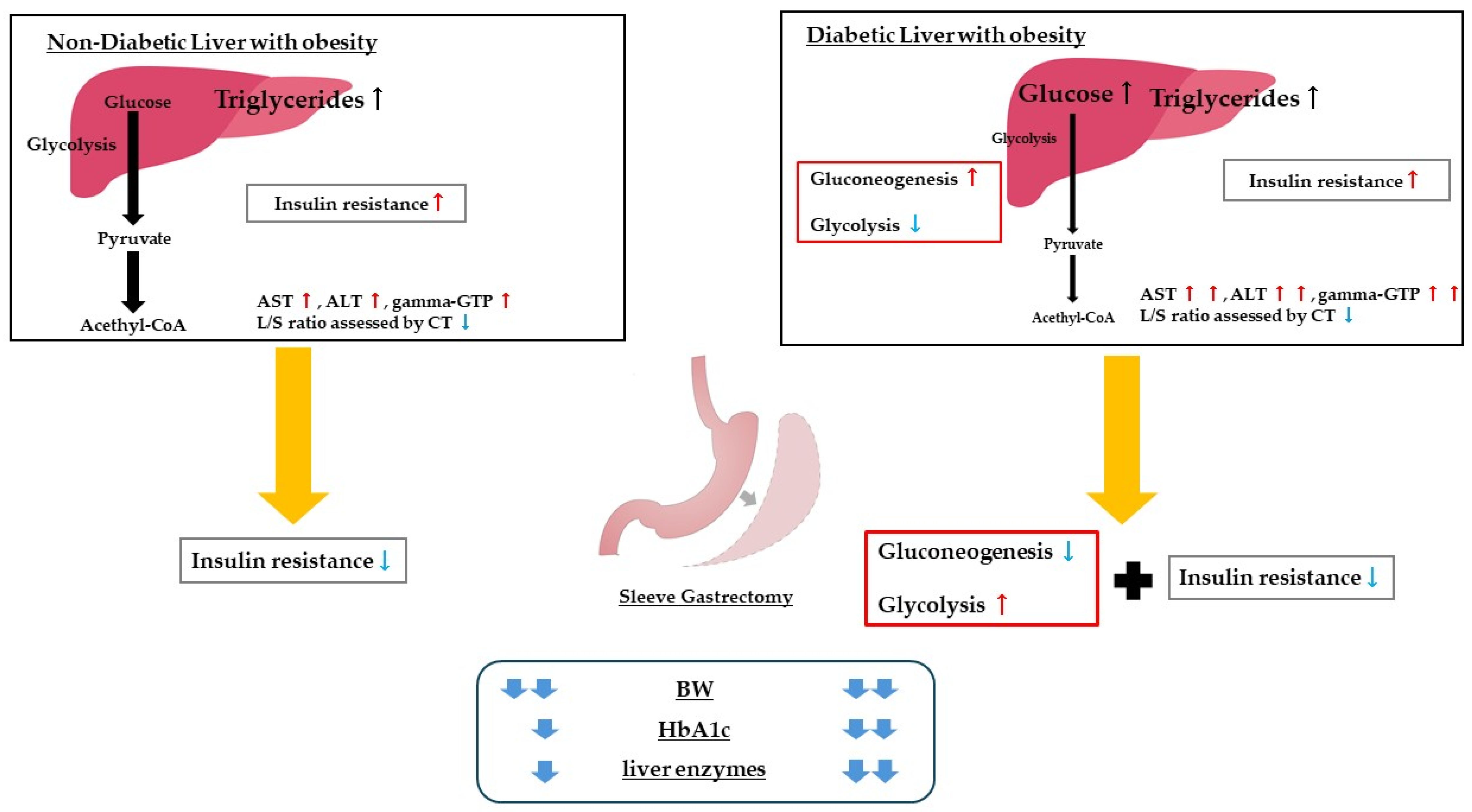
In non-DM individuals, the liver metabolism maintains a healthy balance between glycolysis and gluconeogenesis, ensuring stable blood glucose and triglyceride levels and that fatty acid oxidation proceeds efficiently. Liver enzymes are typically within normal limits, indicating a healthy liver function. In patients with DM, the liver metabolic balance is disrupted: gluconeogenesis and lipogenesis increase and glycolysis and fat oxidation decrease, leading to a fatty liver and elevated liver enzymes [12,13,14,15], indicating hepatocellular injury. CT imaging has also revealed a reduced L/S ratio, consistent with fatty infiltration of the DM liver. LSG has been shown to reverse many of these pathological changes. Postoperatively, patients often experience enhanced glycolysis and improved glucose utilization. These changes result in a significant reduction in hepatic fat content, normalization of liver enzyme levels, and an increase in the L/S ratio, as shown by CT scans (Figure 1).
LSG helps reverse these changes by improving glucose metabolism, reducing fat accumulation, and normalizing liver function and imaging findings. In addition, DM patients suffer from chronic inflammation, a disrupted adipokine balance, and mitochondrial dysfunction in the liver [26,27,28]. LSG reduces pro-inflammatory cytokines, increases beneficial adiponectin, and restores mitochondrial function—leading to improved insulin sensitivity, lipotoxicity, reduced liver fat, and enhanced metabolic health [29,30].
This study highlights a strong association between glucose metabolism and liver dysfunction in diabetic patients following LSG. In the DM group, reductions in liver enzyme levels were significantly correlated with improvements in HbA1c and FPG, suggesting that enhanced glycemic control after LSG may contribute to hepatic recovery—potentially reflecting decreased hepatic fat accumulation. Notably, these correlations were absent in the non-DM group, indicating that the interplay between fatty liver disease and glucose metabolism may be more clinically relevant in individuals with diabetes. These findings support the potential utility of liver enzymes and the L/S ratio as early indicators of diabetes risk and metabolic dysfunction.
Understanding the underlying mechanisms of diabetes and MASLD/MASH is essential. Insulin resistance and hyperglycemia promote hepatic fat deposition, which triggers inflammation and oxidative stress, leading to hepatocellular injury and elevated liver enzyme levels [31]. This damage is further exacerbated by inflammatory cytokines and dysregulated fatty acid metabolism, contributing to the progression of both diabetes and liver disease [32].
In recent years, diagnostic approaches for MASLD/MASH have continued to evolve. With the global prevalence of these conditions rising, it is increasingly important to identify individuals at risk of progressing to advanced stages so that timely interventions and appropriate management can be provided [33,34]. Although liver biopsy is still considered the gold standard for diagnosing and staging MASLD/MASH, its invasive nature and associated risks limit its widespread use. As a result, there has been growing interest in non-invasive diagnostic methods, particularly for detecting steatohepatitis and fibrosis. These approaches often rely on biomarkers and algorithms derived from anthropometric data and serum-based tests [33]. Commonly used blood-based tools include the Fibrosis-4 index, the NAFLD Fibrosis Score, and the Enhanced Liver Fibrosis test. Imaging techniques such as vibration-controlled transient elastography and magnetic resonance elastography have also shown promise [34]. Together, these non-invasive modalities are expected to play an increasingly important role in the future clinical assessment of MASLD/MASH.
This study has several limitations. First, the findings demonstrate correlations rather than causation. Larger, prospective studies are needed to establish causal relationships and identify reliable predictors. Therefore, the current results should be regarded as hypothesis-generating rather than definitive evidence. Second, MASLD/MASH diagnoses were based on serum liver enzyme levels and CT imaging. More accurate methods, such as non-invasive elastography or liver biopsy, were not used. While liver biopsy remains the gold standard, its invasiveness limited its application in this study, thereby reducing diagnostic precision. As a result, the findings provide preliminary associations but lack the robustness required for direct clinical application. Third, the study is further limited by its retrospective design, diagnostic methods, and imaging approach. Future research should adopt prospective designs and incorporate liver biopsy and non-invasive elastography to validate these findings and strengthen their clinical relevance.

5. Conclusions

This study highlights that LSG is an option for treating obesity by reducing fat mass, improving glycemic control, and enhancing liver function in both diabetic and non-diabetic patients. Notably, liver function improvements were more pronounced in individuals with diabetes, underscoring the therapeutic potential of LSG in managing MASLD/MASH, especially among those with T2DM. The strong correlation between improved liver enzymes and better glycemic outcomes in the diabetic group highlights the hepato-metabolic impact of LSG and emphasizes the importance of incorporating liver health management into the holistic management of obesity and diabetes.

Author Contributions

Conceptualization, Y.O., T.M. and H.S.; methodology, Y.O., Y.E. and Y.Y.; software, Y.O., S.M. and T.M.; validation, Y.O. and M.M.; formal analysis, Y.O., N.I., T.M. and H.S.; investigation: Y.O., T.N. and K.G.; resources, Y.O., Y.M. and H.S.; data curation, Y.O., Y.Y. and M.I.; writing—original draft preparation, Y.O., Y.E. and T.M.; writing—review and editing, Y.O., T.M. and H.S.; visualization, Y.O. and C.Y.; supervision, Y.O., T.M. and H.S.; project administration, Y.O.; funding acquisition, Y.O., T.M. and H.S. All authors have read and agreed to the published version of the manuscript.

Funding

This research was funded by JSPS KAKENHI (JP 21K16425).

Institutional Review Board Statement

This study was conducted in accordance with the Declaration of Helsinki and approved by the Ethics Committee of Oita University (protocol code 279 (date of approval: 20 April 2009), 762 (date of approval: 18 September 2014) and 1761 (date of approval: 21 January 2020)).

Informed Consent Statement

Informed consent was obtained from all participants involved in this study.

Data Availability Statement

The original contributions presented in this study are included in the article, and further inquiries can be directed to the corresponding authors.

Conflicts of Interest

The authors declare no conflicts of interest.

Abbreviations

The following abbreviations are used in this manuscript:
ACCAcetyl-CoA carboxylase
ALTAlanine transaminase
ASTAspartate transaminase
BMIBody mass index
BWBody weight
CTComputed tomography
DMDiabetes mellitus
FPGFasting plasma glucose
G6Paseglucose-6-phosphatase
HbA1cHemoglobin A1c
HDLHigh-density lipoprotein
LDLLow-density lipoprotein
LSGLaparoscopic sleeve gastrectomy
L/SLiver to spleen
MASLDMetabolic dysfunction-associated steatotic liver disease
MASHMetabolic dysfunction-associated steatohepatitis
NAFLDNonalcoholic fatty liver disease
NASHNonalcoholic steatohepatitis
ROIRegion of interest
PEPCKPhosphoenolpyruvate carboxykinase
SATSubcutaneous adipose tissue
T2DMType 2 diabetes mellitus
TGTriglycerides
VATVisceral adipose tissue
γ-GTPγ-Glutamyl transpeptidase

References

  1. Polyzos, S.A.; Kountouras, J.; Mantzoros, C.S. Obesity and nonalcoholic fatty liver disease: From pathophysiology to therapeutics. Metabolism 2019, 92, 82–97. [Google Scholar] [CrossRef]
  2. Saltiel, A.R.; Olefsky, J.M. Inflammatory mechanisms linking obesity and metabolic disease. J. Clin. Investig. 2017, 127, 1–4. [Google Scholar] [CrossRef]
  3. Eslam, M.; Sanyal, A.J.; George, J.; International Consensus Panel. MAFLD: A consensus-driven proposed nomenclature for metabolic associated fatty liver disease. Gastroenterology 2020, 158, 1999–2014. [Google Scholar] [CrossRef]
  4. Rinella, M.E.; Lazarus, J.V.; Ratziu, V.; Francque, S.M.; Sanyal, A.J.; Kanwal, F.; Romero, D.; Abdelmalek, M.F.; Anstee, Q.M.; Arab, J.P.; et al. A multisociety Delphi consensus statement on new fatty liver disease nomenclature. Hepatology 2023, 79, 1542–1556. [Google Scholar] [CrossRef]
  5. Schauer, P.R.; Bhatt, D.L.; Kirwan, J.P.; Wolski, K.; Aminian, A.; Brethauer, S.A.; Navaneethan, S.D.; Singh, R.P.; Pothier, C.E.; Nissen, S.E.; et al. Bariatric surgery versus intensive medical therapy for diabetes—5-year outcomes. N. Engl. J. Med. 2017, 376, 641–651. [Google Scholar] [CrossRef]
  6. Hussein, A.; Awashra, A.; Rajab, I.; Bdair, M.; Hamdan, D.; Nouri, A.; Khatib, E.; Khatib, G.; Latt, N. Comparative effectiveness of bariatric surgery versus GLP-1 receptor agonists in reducing the risk of new-onset of NASH: A retrospective multinational cohort study from North America and Europe. Endocrinol. Diabetes Metab. 2025, 8, e70075. [Google Scholar] [CrossRef]
  7. Zhou, H.; Luo, P.; Li, P.; Wang, G.; Yi, X.; Fu, Z.; Sun, X.; Cui, B.; Zhu, L.; Zhu, S. Bariatric surgery improves nonalcoholic fatty liver disease: Systematic review and meta-analysis. Obes. Surg. 2022, 32, 1872–1883. [Google Scholar] [CrossRef]
  8. Endo, Y.; Ohta, M.; Tada, K.; Nakanuma, H.; Saga, K.; Masuda, T.; Hirashita, T.; Iwashita, Y.; Ozeki, Y.; Masaki, T.; et al. Improvement of non-alcoholic fatty liver disease after laparoscopic sleeve gastrectomy in Japanese obese patients. Ann. Gastroenterol. Surg. 2019, 3, 285–290. [Google Scholar] [CrossRef]
  9. Park, S.H.; Kim, D.J. Correlation between liver-to-spleen Hounsfield unit ratio and metabolic improvement in patients with bariatric surgery. J. Metab. Bariatr. Surg. 2025, 14, 24–31. [Google Scholar] [CrossRef]
  10. Cho, E.E.L.; Ang, C.Z.; Quek, J.; Fu, C.E.; Lim, L.K.E.; Heng, Z.E.Q.; Tan, D.J.H.; Lim, W.H.; Yong, J.N.; Zeng, R.; et al. Global prevalence of non-alcoholic fatty liver disease in type 2 diabetes mellitus: An updated systematic review and meta-analysis. Gut 2023, 72, 2138–2148. [Google Scholar] [CrossRef]
  11. Sako, S.; Takeshita, Y.; Takayama, H.; Goto, H.; Nakano, Y.; Ando, H.; Tsujiguchi, H.; Yamashita, T.; Arai, K.; Kaneko, S.; et al. Trajectories of liver fibrosis and gene expression profiles in nonalcoholic fatty liver disease associated with diabetes. Diabetes 2023, 72, 1297–1306. [Google Scholar] [CrossRef]
  12. Samuel, V.T.; Shulman, G.I. Mechanisms for insulin resistance: Common threads and missing links. Cell 2012, 148, 852–871. [Google Scholar] [CrossRef]
  13. Haeusler, R.A.; Camastra, S.; Astiarraga, B.; Nannipieri, M.; Anselmino, M.; Ferrannini, E. Decreased expression of hepatic glucokinase in type 2 diabetes. Mol. Metab. 2014, 4, 222–226. [Google Scholar]
  14. Zhu, Z.; Zhang, X.; Pan, Q.; Zhang, L.; Chai, J. In-depth analysis of de novo lipogenesis in non-alcoholic fatty liver disease: Mechanism and pharmacological interventions. Liver Res. 2023, 7, 285–295. [Google Scholar]
  15. Chow, J.D.; Lawrence, R.T.; Healy, M.E.; Dominy, J.E.; Liao, J.A.; Breen, D.S.; Byrne, F.L.; Kenwood, B.M.; Lackner, C.; Okutsu, S.; et al. Genetic inhibition of hepatic acetyl-CoA carboxylase activity increases liver fat and alters global protein acetylation. Mol. Metab. 2014, 3, 419–431. [Google Scholar]
  16. Fuse, K.; Kadota, A.; Kondo, K.; Morino, K.; Fujiyoshi, A.; Hisamatsu, T.; Kadowaki, S.; Miyazawa, I.; Ugi, S.; Maegawa, H.; et al. Liver fat accumulation assessed by computed tomography is an independent risk factor for diabetes mellitus in a population-based study: SESSA (Shiga Epidemiological Study of Subclinical Atherosclerosis). Diabetes Res. Clin. Pract. 2020, 160, 108002. [Google Scholar]
  17. Noroozi Karimabad, M.; Khalili, P.; Ayoobi, F.; Esmaeili-Nadimi, A.; La Vecchia, C.; Jamali, Z. Serum liver enzymes and diabetes from the Rafsanjan cohort study. BMC Endocr. Disord. 2022, 22, 127. [Google Scholar] [CrossRef]
  18. Ozeki, Y.; Masaki, T.; Yoshida, Y.; Okamoto, M.; Anai, M.; Gotoh, K.; Endo, Y.; Ohta, M.; Inomata, M.; Shibata, H. Relationships between computed tomography-assessed density, abdominal fat volume, and glucose metabolism after sleeve gastrectomy in Japanese patients with obesity. Endocr. J. 2019, 66, 605–613. [Google Scholar] [CrossRef]
  19. Wirth, K.M.; Sheka, A.C.; Kizy, S.; Irey, R.; Benner, A.; Sieger, G.; Simon, G.; Ma, S.; Lake, J.; Aliferis, C.; et al. Bariatric surgery is associated with decreased progression of nonalcoholic fatty liver disease to cirrhosis: A retrospective cohort analysis. Ann. Surg. 2020, 272, 32–39. [Google Scholar] [CrossRef]
  20. Aminian, A.; Aljabri, A.; Wang, S.; Bena, J.; Allende, D.S.; Rosen, H.; Arnold, E.; Wilson, R.; Milinovich, A.; Loomba, R.; et al. Long-term liver outcomes after metabolic surgery in compensated cirrhosis due to metabolic dysfunction-associated steatohepatitis. Nat. Med. 2025, 31, 988–995. [Google Scholar]
  21. Barb, D.; Repetto, E.M.; Stokes, M.E.; Shankar, S.S.; Cusi, K. Type 2 diabetes mellitus increases the risk of hepatic fibrosis in individuals with obesity and nonalcoholic fatty liver disease. Obesity 2021, 29, 1950–1960. [Google Scholar] [CrossRef] [PubMed]
  22. Shah, A.; Bakerywala, A.; Brahmbhatt, R.N.; Shaikh, H.; Bhutak, N.S.; Singh, R. The occurrence of non-alcoholic fatty liver disease among individuals with diabetes mellitus: A comparative study. J. Pharm. Bioallied Sci. 2025, 17, S767–S769. [Google Scholar] [CrossRef] [PubMed]
  23. Chhabra, S.; Singh, S.P.; Singh, A.; Mehta, V.; Kaur, A.; Bansal, N.; Sood, A. Diabetes mellitus increases the risk of significant hepatic fibrosis in patients with non-alcoholic fatty liver disease. J. Clin. Exp. Hepatol. 2022, 12, 409–416. [Google Scholar] [CrossRef]
  24. Islam, S.; Rahman, S.; Haque, T.; Sumon, A.H.; Ahmed, A.M.; Ali, N. Prevalence of elevated liver enzymes and its association with type 2 diabetes: A cross-sectional study in Bangladeshi adults. Endocrinol. Diabetes Metab. 2020, 3, e00116. [Google Scholar] [CrossRef] [PubMed]
  25. Raya-Cano, E.; Molina-Luque, R.; Vaquero-Abellán, M.; Molina-Recio, G.; Jiménez-Mérida, R.; Romero-Saldaña, M. Metabolic syndrome and transaminases: Systematic review and meta-analysis. Diabetol. Metab. Syndr. 2023, 15, 220. [Google Scholar] [CrossRef]
  26. Gramignoli, R.; Ranade, A.R.; Venkataramanan, R.; Strom, S.C. Effects of pro-inflammatory cytokines on hepatic metabolism in primary human hepatocytes. Int. J. Mol. Sci. 2022, 23, 14880. [Google Scholar] [CrossRef]
  27. Tilg, H.; Ianiro, G.; Gasbarrini, A.; Adolph, T.E. Adipokines: Masterminds of metabolic inflammation. Nat. Rev. Immunol. 2025, 25, 250–265. [Google Scholar]
  28. Myint, M.; Oppedisano, F.; De Giorgi, V.; Kim, B.M.; Marincola, F.M.; Alter, H.J.; Nesci, S. Inflammatory signaling in NASH driven by hepatocyte mitochondrial dysfunctions. J. Transl. Med. 2023, 21, 757. [Google Scholar] [CrossRef]
  29. Bayoumy, I.E. Effect of sleeve gastrectomy on fatty liver in diabetes type 2 patients: Systematic Review. J. Diabetes Metab. 2023, 14, 1018. [Google Scholar]
  30. Wysocki, M.; Mizera, M.; Karpińska, I.; Ptaszkiewicz, K.; Małczak, P.; Pisarska-Adamczyk, M.; Kania, M.; Major, P. Analysis of changes in glucose and lipid metabolism in patients with clinically severe obesity and type 2 diabetes mellitus undergoing laparoscopic sleeve gastrectomy—Prospective observational study. Obes. Surg. 2024, 34, 467–478. [Google Scholar]
  31. Mandal, A.; Bhattarai, B.; Kafle, P.; Khalid, M.; Jonnadula, S.K.; Lamicchane, J.; Kanth, R.; Gayam, V. Elevated liver enzymes in patients with type 2 diabetes mellitus and non-alcoholic fatty liver disease. Cureus 2018, 10, e3626. [Google Scholar] [CrossRef] [PubMed]
  32. Sattar, N.; Scherbakova, O.; Ford, I.; O’Reilly, D.S.; Stanley, A.; Forrest, E.; Macfarlane, P.W.; Packard, C.J.; Cobbe, S.M.; Shepherd, J.; et al. Elevated alanine aminotransferase predicts new-onset type 2 diabetes independently of classical risk factors, metabolic syndrome, and C-reactive protein in the West of Scotland Coronary Prevention Study. Diabetes 2004, 53, 2855–2860. [Google Scholar] [CrossRef]
  33. Qu, B.; Li, Z. Exploring non-invasive diagnostics for metabolic dysfunction-associated fatty liver disease. World J. Gastroenterol. 2024, 30, 3447–3451. [Google Scholar] [CrossRef]
  34. Dawod, S.; Brown, K. Non-invasive testing in metabolic dysfunction-associated steatotic liver disease. Front. Med. 2024, 11, 1499013. [Google Scholar] [CrossRef] [PubMed]
Figure 1. Potential mechanisms of sleeve gastrectomy regarding glucose tolerance, liver enzymes, and hepatic fat content in diabetic and non-diabetic patients with obesity.
Livers 06 00026 g001
Table 1. Basal clinical characteristics and time-course changes.
Pre-LSG1 Yearp Value
Age (years)43.7 ± 8.3
Male/female26/28
Body weight (kg)117.1 ± 20.380.4 ± 17.6<0.001 **
%TBWL31.2 ± 9.5
%EBWL77.5 ± 28.3
BMI (kg/m2)44.2 ± 7.330.2 ± 5.8<0.001 **
Waist circumstance (cm)125.3 ± 13.6100.1 ± 13.9<0.001 **
Systolic blood pressure (mmHg)125.8 ± 12.2123.1 ± 13.60.27
Diastolic blood pressure (mmHg)76.9 ± 10.375.1 ± 11.40.19
FPG (mg/dL)117.6 ± 40.793.0 ± 20.0<0.001 **
HbA1c (%)6.7 ± 1.55.5 ± 0.7<0.001 **
Triglycerides (mg/dL)170.8 ± 87.587.1 ± 71.1<0.001 **
HDL cholesterol (mg/dL)44.7 ± 11.860.5 ± 17.6<0.001 **
LDL cholesterol (mg/dL)118.8 ± 28.1113.2 ± 28.90.25
BUN (mg/dL)12.2 ± 3.813.6 ± 3.90.01 *
Creatinine (mg/dL)0.67 ± 0.150.69 ± 0.150.17
AST (IU/L)36.1 ± 30.917.9 ± 5.6<0.001 **
ALT (IU/L)47.2 ± 36.215.5 ± 7.2<0.001 **
GTP (IU/L)48.8 ± 37.616.9 ± 10.4<0.001 **
VAT area (cm2)174.4 ± 70.365.7 ± 42.4<0.001 **
SAT area (cm2) 476.5 ± 187.3248.6 ± 141.7<0.001 **
V/S ratio0.41 ± 0.220.31 ± 0.20<0.001 **
* p < 0.05; ** p < 0.01 (significant changes compared with pre-LSG). LSG, laparoscopic sleeve gastrectomy; TBWL, total body weight loss; EBWL, excessive body weight loss; BMI, body mass index; FPG, fasting plasma glucose; HbA1c, hemoglobin A1c; HDL, high-density lipoprotein; LDL, low-density lipoprotein; BUN, blood urea nitrogen; AST, aspartate transaminase; ALT, alanine transaminase; GTP, glutamyl transpeptidase; VAT, visceral adipose tissue; SAT, subcutaneous adipose tissue; V/S ratio, visceral adipose tissue-to-subcutaneous adipose tissue ratio.
Table 2. Time-course changes in patients with DM and without DM.
Non-DM Group (n = 24)DM Group (n = 30)
Pre-LSG1 YearPre-LSG1 Year
Body weight (kg)118.2 ± 21.579.4 ± 17.3 **116.2 ± 19.581.1 ± 18.0 **
BMI (kg/m2)45.5 ± 7.530.5 ± 5.8 **43.2 ± 7.2 30.0 ± 5.8 **
Systolic blood pressure (mmHg)124.8 ± 12.7120.1 ± 10.3126.6 ± 12.0125.5 ± 13.6
Diastolic blood pressure (mmHg)76.7 ± 10.371.4 ± 10.2 *77.0 ± 10.678.0 ± 11.6
FPG (mg/dL)95.8 ± 13.984.3 ± 12.2 **135.0 ± 46.5 ††99.3 ± 22.3 **#
HbA1c (%)5.8 ± 0.35.3 ± 0.3 **7.5 ± 1.6 ††5.7 ± 0.9 **##
TG (mg/dL)144.2 ± 73.361.5 ± 18.0 **192.1 ± 93.1108.4 ± 90.0 **
HDL cholesterol (mg/dL)44.9 ± 10.260.8 ± 16.4 **44.4 ± 13.060.2 ± 18.8 **
LDL cholesterol (mg/dL)118.9 ± 21.5111.5 ± 33.5118.8 ± 32.9114.7 ± 24.8
BUN (mg/dL)11.5 ± 3.713.3 ± 4.4 *12.9 ± 3.913.8 ± 3.4
Cr (mg/dL)0.68 ± 0.170.68 ± 0.140.66 ± 0.140.70 ± 0.16
AST (IU/L)25.9 ± 13.815.9 ± 3.6 **44.3 ± 37.9 †19.5 ± 6.4 **
ALT (IU/L)34.8 ± 20.513.4 ± 6.3 **57.1 ± 42.8 †17.2 ± 7.5 **
GTP (IU/L)34.8 ± 34.513.5 ± 9.8 **59.9 ± 36.8 †19.6 ± 10.2 **##
VAT area (cm2)152.7 ± 68.452.0 ± 34.5 **198.1 ± 64.9 ††75.8 ± 44.4 **
SAT area (cm2)503.9 ± 167.6257.8 ± 147.7 **462.6 ± 192.2239.9 ± 138.1 **
V/S ratio0.33 ± 0.170.25 ± 0.17 **0.49 ± 0.23 ††0.36 ± 0.21 **
Liver CT value (HU)38.8 ± 16.460.6 ± 5.2 **43.3 ± 15.858.0 ± 7.2 **
Spleen CT value (HU)46.0 ± 7.246.6 ± 5.151.4 ± 11.8 †47.3 ± 7.3
L/S ratio0.84 ± 0.351.32 ± 0.19 **0.86 ± 0.281.24 ± 0.16 **
* p < 0.05; ** p < 0.01 (pre-LSG versus 1 year). † p < 0.05; †† p < 0.01 (DM group versus non-DM group). # p < 0.05; ## p < 0.01 (ΔDM group versus Δ non-DM group). DM, diabetes mellitus; LSG, laparoscopic sleeve gastrectomy; BMI, body mass index; FPG, fasting plasma glucose; HbA1c, hemoglobin A1c; HDL, high-density lipoprotein; LDL, low-density lipoprotein; BUN, blood urea nitrogen; Cr, creatinine; AST, aspartate transaminase; ALT, alanine transaminase; GTP, glutamyl transpeptidase; VAT, visceral adipose tissue; SAT, subcutaneous adipose tissue; V/S ratio, visceral adipose tissue-to-subcutaneous adipose tissue ratio; CT, computed tomography; L/S ratio, liver-to-spleen ratio.
Table 3. Correlation between each Δ parameter and ΔBW, ΔFPG, and ΔHbA1c.
VariableΔBWΔHbA1cΔFPG
rp Valuerp Valuerp Value
Patients without T2DM
  VAT area (cm2)0.490.01 *0.450.04 *0.080.73
  SAT area (cm2)0.460.02 *0.220.330.170.46
  AST (IU/L)<0.010.970.150.500.240.29
  ALT (IU/L)<0.010.940.060.800.080.74
  GTP (IU/L)−0.160.45−0.060.79−0.240.28
  L/S ratio−0.260.23−0.050.820.180.42
Patients with T2DM
  VAT area (cm2)0.360.050.300.100.250.19
  SAT area (cm2)0.73<0.001 **0.400.03 *0.280.13
  AST(IU/L)0.030.890.66<0.001 **0.480.01 *
  ALT (IU/L)0.030.890.62<0.001 **0.420.02 *
  GTP (IU/L)0.110.580.440.02 *0.420.02 *
  L/S ratio−0.010.93−0.400.03 *−0.290.12
* p < 0.05 and ** p < 0.01 indicate significant changes compared with pre-laparoscopic sleeve gastrectomy, assessed by analysis of variance. Variable, delta (0–1 year) variable. ΔBW, change in body weight; ΔFPG, change in fasting plasma glucose; ΔHbA1c, change in hemoglobin A1c; T2DM, type 2 diabetes mellitus; VAT, visceral adipose tissue; SAT, subcutaneous adipose tissue; AST, aspartate transaminase; ALT, alanine transaminase; GTP, glutamyl transpeptidase; L/S ratio, liver-to-spleen ratio.
Disclaimer/Publisher’s Note: The statements, opinions and data contained in all publications are solely those of the individual author(s) and contributor(s) and not of MDPI and/or the editor(s). MDPI and/or the editor(s) disclaim responsibility for any injury to people or property resulting from any ideas, methods, instructions or products referred to in the content.


