

Review

Intrahepatic Cholangiocarcinoma: Contemporary Approaches to Surgical, Systemic, and Liver-Directed Therapy

1
Department of Surgery, The Ohio State University Wexner Medical Center, 395 West 12th Avenue, Suite 670, Columbus, OH 43210, USA
2
Department of Gastroenterological Surgery, Yokohama City University, Yokohama 236-0004, Japan
*
Author to whom correspondence should be addressed.
Livers 2026, 6(2), 24; https://doi.org/10.3390/livers6020024
Submission received: 15 January 2026 / Revised: 13 February 2026 / Accepted: 24 March 2026 / Published: 27 March 2026

Abstract

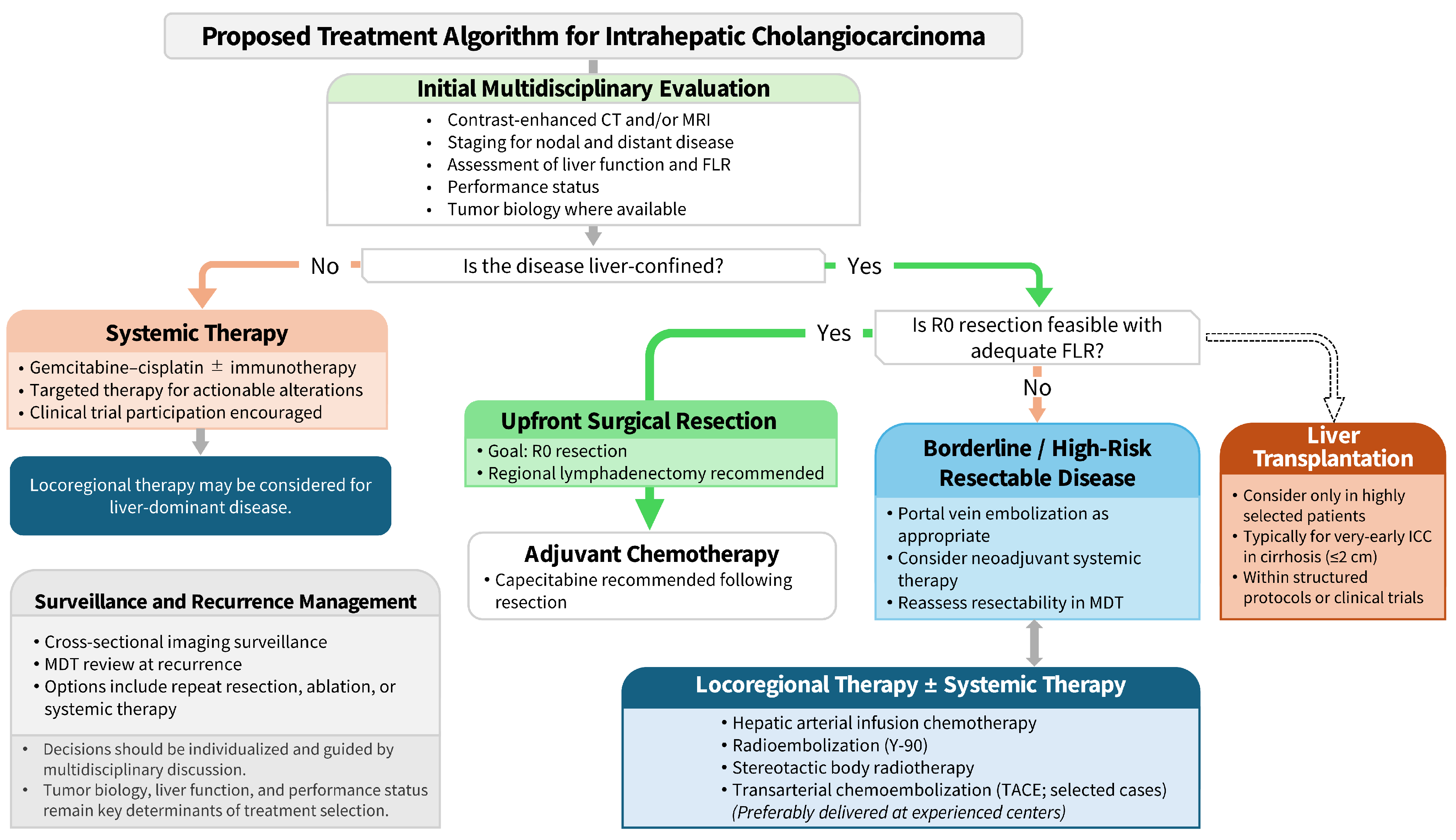
Background: Intrahepatic cholangiocarcinoma (ICC) is an uncommon but increasingly recognized primary liver malignancy with a poor prognosis. Although surgical resection offers the only realistic opportunity for cure, recurrence is common and the optimal integration of surgery with systemic and liver-directed therapies continues to evolve. Summary: This review summarizes contemporary evidence on the diagnosis and multidisciplinary management of ICC with particular emphasis on surgical, systemic, locoregional, and transplant-based strategies. Cross-sectional imaging plays a central role in staging and assessing resectability including evaluation of vascular invasion and the future liver remnant. Upfront resection is appropriate for selected patients with resectable disease and preserved liver function, with margin-negative resection and lymphadenectomy remaining key oncologic goals. Systemic therapy continues to evolve with cytotoxic chemotherapy forming the backbone of treatment for advanced disease and immunotherapy and targeted agents demonstrating promise in biomarker-defined subgroups. Locoregional modalities such as hepatic arterial infusion therapy and radioembolization may provide disease control in liver-dominant ICC and are increasingly used within a multidisciplinary framework. Liver transplantation remains investigational but may offer favorable outcomes in highly selected early-stage disease.
Keywords: intrahepatic cholangiocarcinoma; liver resection; systemic therapy; immunotherapy; targeted therapy; hepatic arterial infusion pump; radioembolization; liver transplantation; multidisciplinary management intrahepatic cholangiocarcinoma; liver resection; systemic therapy; immunotherapy; targeted therapy; hepatic arterial infusion pump; radioembolization; liver transplantation; multidisciplinary management


