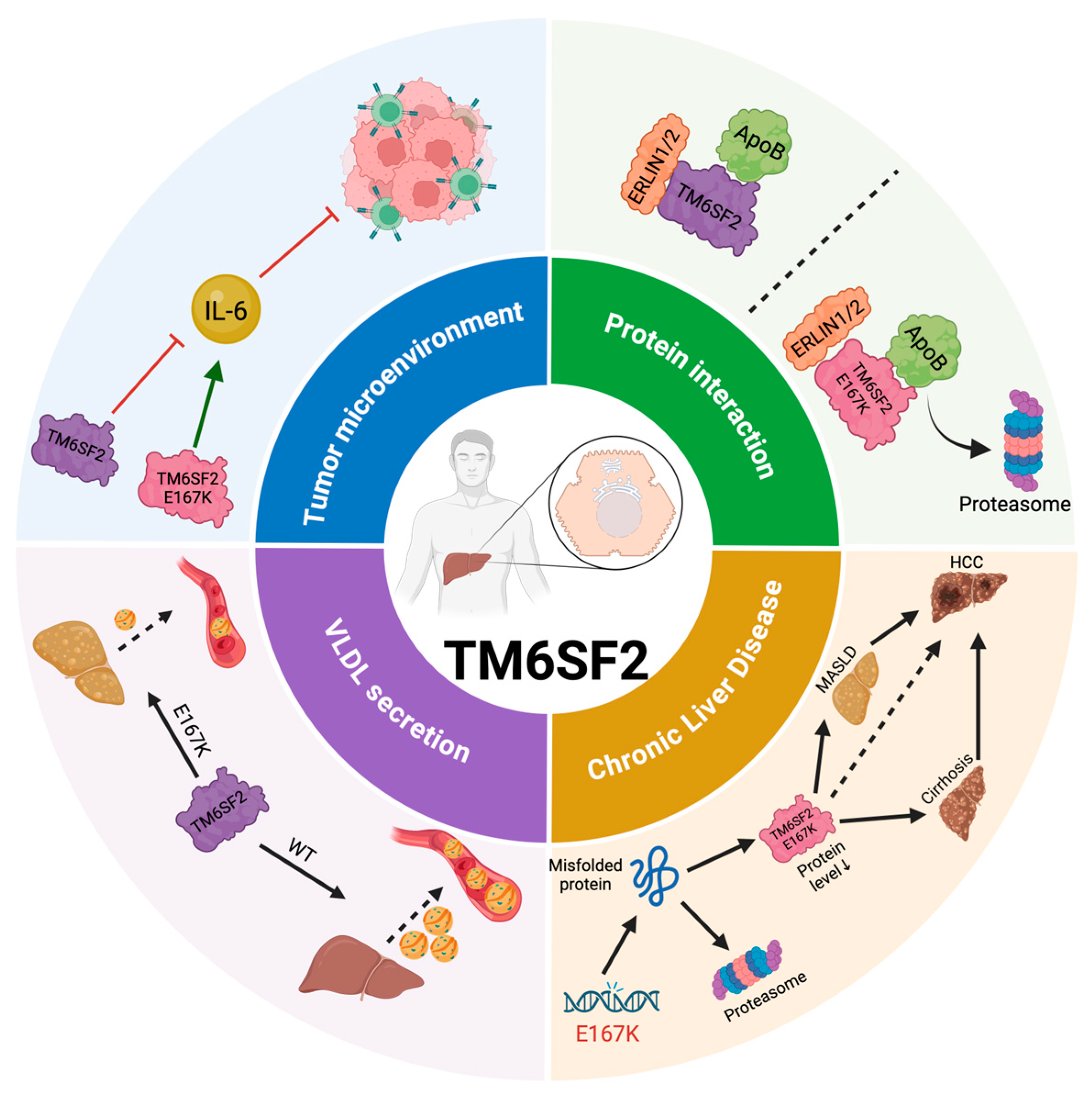

TM6SF2 in Hepatic Lipid Metabolism and Chronic Liver Disease

Abstract
1. Introduction
2. TM6SF2: Structure, Expression and Variants
3. TM6SF2 in Lipid Metabolism
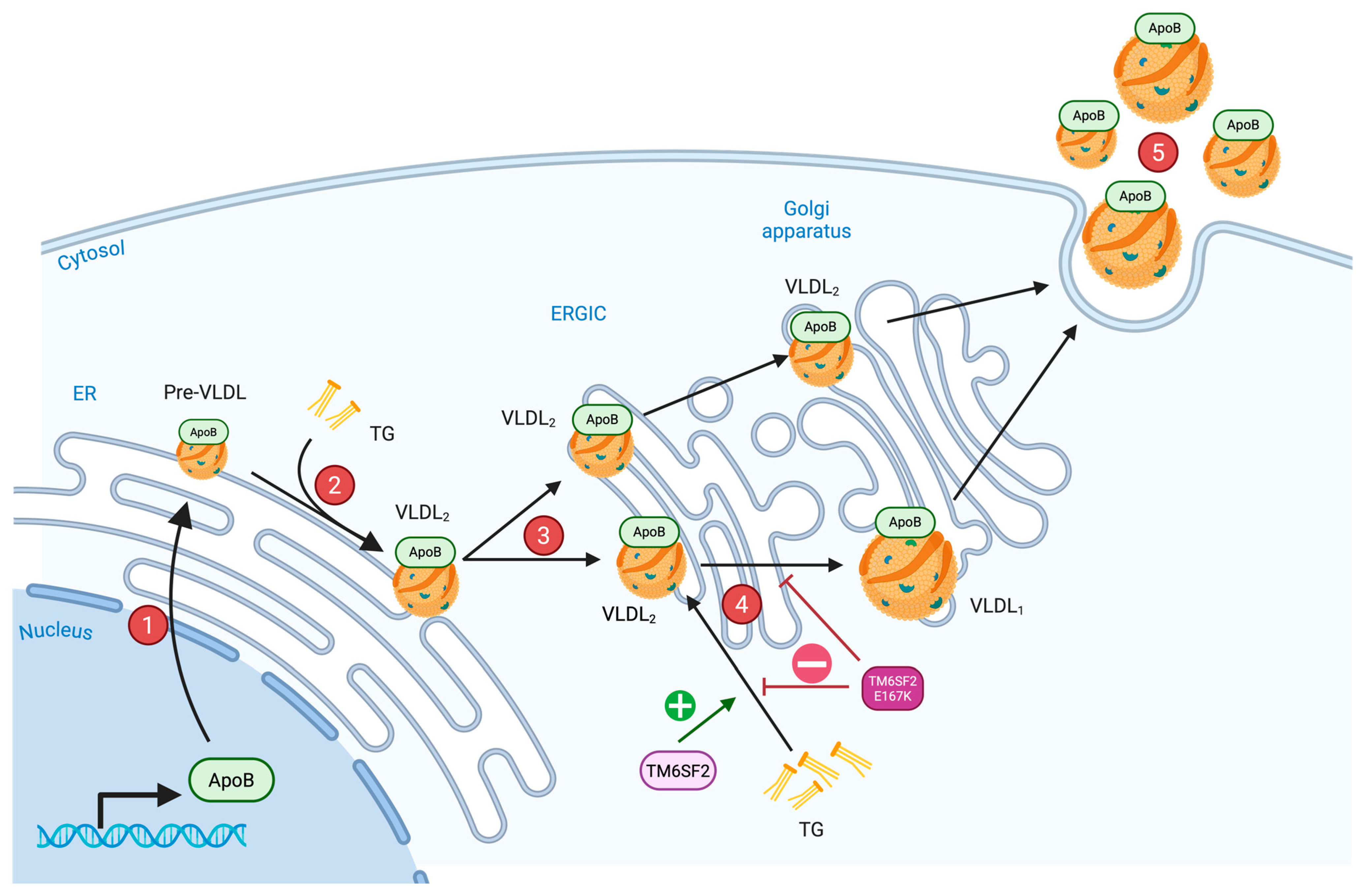
3.1. TM6SF2 in VLDL Assembly and Secretion
3.2. TM6SF2-ApoB Interaction
4. TM6SF2 in Chronic Liver Disease
4.1. Alcohol- and Viral-Associated Liver Disease
4.2. TM6SF2 in HCC
5. Discussion
Author Contributions
Funding
Institutional Review Board Statement
Informed Consent Statement
Data Availability Statement
Conflicts of Interest
References
- Amini-Salehi, E.; Letafatkar, N.; Norouzi, N.; Joukar, F.; Habibi, A.; Javid, M.; Sattari, N.; Khorasani, M.; Farahmand, A.; Tavakoli, S.; et al. Global Prevalence of Nonalcoholic Fatty Liver Disease: An Updated Review Meta-Analysis comprising a Population of 78 million from 38 Countries. Arch. Med. Res. 2024, 55, 103043. [Google Scholar] [CrossRef] [Scilit] [PubMed]
- Younossi, Z.M.; Golabi, P.; Paik, J.M.; Henry, A.; Van Dongen, C.; Henry, L. The global epidemiology of nonalcoholic fatty liver disease (NAFLD) and nonalcoholic steatohepatitis (NASH): A systematic review. Hepatology 2023, 77, 1335–1347. [Google Scholar] [CrossRef] [Scilit]
- Bessone, F.; Razori, M.V.; Roma, M.G. Molecular pathways of nonalcoholic fatty liver disease development and progression. Cell. Mol. Life Sci. 2019, 76, 99–128. [Google Scholar] [CrossRef] [Scilit] [PubMed]
- Chalasani, N.; Younossi, Z.; Lavine, J.E.; Charlton, M.; Cusi, K.; Rinella, M.; Harrison, S.A.; Brunt, E.M.; Sanyal, A.J. The diagnosis and management of nonalcoholic fatty liver disease: Practice guidance from the American Association for the Study of Liver Diseases. Hepatology 2018, 67, 328–357. [Google Scholar] [CrossRef] [Scilit]
- Marrero, J.A.; Fontana, R.J.; Su, G.L.; Conjeevaram, H.S.; Emick, D.M.; Lok, A.S. NAFLD may be a common underlying liver disease in patients with hepatocellular carcinoma in the United States. Hepatology 2002, 36, 1349–1354. [Google Scholar] [CrossRef]
- Huang, D.Q.; Mathurin, P.; Cortez-Pinto, H.; Loomba, R. Global epidemiology of alcohol-associated cirrhosis and HCC: Trends, projections and risk factors. Nat. Rev. Gastroenterol. Hepatol. 2023, 20, 37–49. [Google Scholar] [CrossRef] [Scilit]
- Cotter, T.G.; Charlton, M. Nonalcoholic Steatohepatitis After Liver Transplantation. Liver Transplant. 2020, 26, 141–159. [Google Scholar] [CrossRef] [Scilit]
- Younossi, Z.M.; Henry, L. Epidemiology of non-alcoholic fatty liver disease and hepatocellular carcinoma. JHEP Rep. 2021, 3, 100305. [Google Scholar] [CrossRef] [Scilit]
- Chen, Y.; Du, X.; Kuppa, A.; Feitosa, M.F.; Bielak, L.F.; O’Connell, J.R.; Musani, S.K.; Guo, X.; Kahali, B.; Chen, V.L.; et al. Genome-wide association meta-analysis identifies 17 loci associated with nonalcoholic fatty liver disease. Nat. Genet. 2023, 55, 1640–1650. [Google Scholar] [CrossRef] [Scilit]
- Borén, J.; Adiels, M.; Björnson, E.; Matikainen, N.; Söderlund, S.; Rämö, J.; Ståhlman, M.; Ripatti, P.; Ripatti, S.; Palotie, A.; et al. Effects of TM6SF2 E167K on hepatic lipid and very low-density lipoprotein metabolism in humans. JCI Insight 2020, 5, e144079. [Google Scholar] [CrossRef] [Scilit]
- Sookoian, S.; Castaño, G.O.; Scian, R.; Mallardi, P.; Fernández Gianotti, T.; Burgueño, A.L.; San Martino, J.; Pirola, C.J. Genetic variation in transmembrane 6 superfamily member 2 and the risk of nonalcoholic fatty liver disease and histological disease severity. Hepatology 2015, 61, 515–525. [Google Scholar] [CrossRef] [Scilit]
- Liu, Y.-L.; Reeves, H.L.; Burt, A.D.; Tiniakos, D.; McPherson, S.; Leathart, J.B.S.; Allison, M.E.D.; Alexander, G.J.; Piguet, A.-C.; Anty, R.; et al. TM6SF2 rs58542926 influences hepatic fibrosis progression in patients with non-alcoholic fatty liver disease. Nat. Commun. 2014, 5, 4309. [Google Scholar] [CrossRef] [Scilit]
- Tang, S.; Zhang, J.; Mei, T.-T.; Guo, H.-Q.; Wei, X.-H.; Zhang, W.-Y.; Liu, Y.-L.; Liang, S.; Fan, Z.-P.; Ma, L.-X.; et al. Association of TM6SF2 rs58542926 T/C gene polymorphism with hepatocellular carcinoma: A meta-analysis. BMC Cancer 2019, 19, 1128. [Google Scholar] [CrossRef] [Scilit]
- Yang, J.; Trépo, E.; Nahon, P.; Cao, Q.; Moreno, C.; Letouzé, E.; Imbeaud, S.; Gustot, T.; Deviere, J.; Debette, S.; et al. PNPLA3 and TM6SF2 variants as risk factors of hepatocellular carcinoma across various etiologies and severity of underlying liver diseases. Int. J. Cancer 2019, 144, 533–544. [Google Scholar] [CrossRef] [Scilit] [PubMed]
- Luukkonen, P.K. Subtypes of MASLD confer distinct clinical trajectories. J. Hepatol. 2025, 82, 1138–1139. [Google Scholar] [CrossRef] [Scilit] [PubMed]
- Kocas-Kilicarslan, Z.N.; Cetin, Z.; Faccioli, L.A.P.; Motomura, T.; Amirneni, S.; Diaz-Aragon, R.; Florentino, R.M.; Sun, Y.; Pla-Palacin, I.; Xia, M.; et al. Polymorphisms Associated With Metabolic Dysfunction-Associated Steatotic Liver Disease Influence the Progression of End-Stage Liver Disease. Gastro Hep Adv. 2024, 3, 67–77. [Google Scholar] [CrossRef] [Scilit] [PubMed]
- Huang, H.Y.R.; Vitali, C.; Zhang, D.; Hand, N.J.; Phillips, M.C.; Creasy, K.T.; Scorletti, E.; Park, J.; Regeneron, C.; Schneider, K.M.; et al. Deep metabolic phenotyping of humans with protein-altering variants in TM6SF2 using a genome-first approach. JHEP Rep. 2025, 7, 101243. [Google Scholar] [CrossRef] [Scilit]
- Sanchez-Pulido, L.; Ponting, C.P. TM6SF2 and MAC30, new enzyme homologs in sterol metabolism and common metabolic disease. Front. Genet. 2014, 5, 439. [Google Scholar] [CrossRef] [Scilit]
- Kozlitina, J.; Smagris, E.; Stender, S.; Nordestgaard, B.G.; Zhou, H.H.; Tybjaerg-Hansen, A.; Vogt, T.F.; Hobbs, H.H.; Cohen, J.C. Exome-wide association study identifies a TM6SF2 variant that confers susceptibility to nonalcoholic fatty liver disease. Nat. Genet. 2014, 46, 352–356. [Google Scholar] [CrossRef] [Scilit]
- Mahdessian, H.; Taxiarchis, A.; Popov, S.; Silveira, A.; Franco-Cereceda, A.; Hamsten, A.; Eriksson, P.; van’t Hooft, F. TM6SF2 is a regulator of liver fat metabolism influencing triglyceride secretion and hepatic lipid droplet content. Proc. Natl. Acad. Sci. USA 2014, 111, 8913–8918. [Google Scholar] [CrossRef] [Scilit]
- Holmen, O.L.; Zhang, H.; Fan, Y.; Hovelson, D.H.; Schmidt, E.M.; Zhou, W.; Guo, Y.; Zhang, J.; Langhammer, A.; Løchen, M.-L.; et al. Systematic evaluation of coding variation identifies a candidate causal variant in TM6SF2 influencing total cholesterol and myocardial infarction risk. Nat. Genet. 2014, 46, 345–351. [Google Scholar] [CrossRef] [Scilit]
- Smagris, E.; Gilyard, S.; BasuRay, S.; Cohen, J.C.; Hobbs, H.H. Inactivation of Tm6sf2, a Gene Defective in Fatty Liver Disease, Impairs Lipidation but Not Secretion of Very Low Density Lipoproteins. J. Biol. Chem. 2016, 291, 10659–10676. [Google Scholar] [CrossRef] [Scilit]
- Fan, Y.; Lu, H.; Guo, Y.; Zhu, T.; Garcia-Barrio, M.T.; Jiang, Z.; Willer, C.J.; Zhang, J.; Chen, Y.E. Hepatic Transmembrane 6 Superfamily Member 2 Regulates Cholesterol Metabolism in Mice. Gastroenterology 2016, 150, 1208–1218. [Google Scholar] [CrossRef] [Scilit]
- Ruhanen, H.; Nidhina Haridas, P.A.; Eskelinen, E.L.; Eriksson, O.; Olkkonen, V.M.; Kakela, R. Depletion of TM6SF2 disturbs membrane lipid composition and dynamics in HuH7 hepatoma cells. Biochim. Biophys. Acta Mol. Cell Biol. Lipids 2017, 1862, 676–685. [Google Scholar] [CrossRef] [Scilit]
- Pant, A.; Chen, Y.; Kuppa, A.; Du, X.; Halligan, B.D.; Speliotes, E.K. Perturbation of TM6SF2 Expression Alters Lipid Metabolism in a Human Liver Cell Line. Int. J. Mol. Sci. 2021, 22, 9758. [Google Scholar] [CrossRef] [Scilit]
- Faccioli, L.A.P.; Sun, Y.; Animasahun, O.; Motomura, T.; Liu, Z.; Kurihara, T.; Hu, Z.; Yang, B.; Cetin, Z.; Baratta, A.M.; et al. Human-induced pluripotent stem cell–based hepatic modeling of lipid metabolism–associated TM6SF2-E167K variant. Hepatology 2025, 82, 638–654. [Google Scholar] [CrossRef] [Scilit] [PubMed]
- Mai, C.T.; Le, Q.G.; Ishiwata-Kimata, Y.; Takagi, H.; Kohno, K.; Kimata, Y. 4-Phenylbutyrate suppresses the unfolded protein response without restoring protein folding in Saccharomyces cerevisiae. FEMS Yeast Res. 2018, 18, foy016. [Google Scholar] [CrossRef] [Scilit]
- Hirai, A.; Yoneyama, Y.; Assi, I.; Osonoi, S.; Sakai, S.; Ohtsu, K.; Takebe, T. Modeling Transmembrane 6 Superfamily Member 2 p.Glu167Lys-associated Steatotic Liver Disease Using Androgen-treated Human Induced Pluripotent Stem Cell-derived Hepatocyte-like Cells. Gastro Hep Adv. 2025, 5, 100774. [Google Scholar] [CrossRef] [Scilit]
- Wong, R.J. Epidemiology of metabolic dysfunction-associated steatotic liver disease (MASLD) and alcohol-related liver disease (ALD). Metab. Target. Organ. Damage 2024, 4, 35. [Google Scholar] [CrossRef] [Scilit]
- Bostrom, K.; Boren, J.; Wettesten, M.; Sjoberg, A.; Bondjers, G.; Wiklund, O.; Carlsson, P.; Olofsson, S.O. Studies on the assembly of apo B-100-containing lipoproteins in HepG2 cells. J. Biol. Chem. 1988, 263, 4434–4442. [Google Scholar] [CrossRef] [Scilit] [PubMed]
- Stillemark-Billton, P.; Beck, C.; Borén, J.; Olofsson, S.-O. Relation of the size and intracellular sorting of apoB to the formation of VLDL 1 and VLDL 2. J. Lipid Res. 2005, 46, 104–114. [Google Scholar] [CrossRef] [Scilit]
- Ehrhardt, N.; Doche, M.E.; Chen, S.; Mao, H.Z.; Walsh, M.T.; Bedoya, C.; Guindi, M.; Xiong, W.; Ignatius Irudayam, J.; Iqbal, J.; et al. Hepatic Tm6sf2 overexpression affects cellular ApoB-trafficking, plasma lipid levels, hepatic steatosis and atherosclerosis. Hum. Mol. Genet. 2017, 26, 2719–2731. [Google Scholar] [CrossRef] [Scilit]
- Newberry, E.P.; Hall, Z.; Xie, Y.; Molitor, E.A.; Bayguinov, P.O.; Strout, G.W.; Fitzpatrick, J.A.J.; Brunt, E.M.; Griffin, J.L.; Davidson, N.O. Liver-Specific Deletion of Mouse Tm6sf2 Promotes Steatosis, Fibrosis, and Hepatocellular Cancer. Hepatology 2021, 74, 1203–1219. [Google Scholar] [CrossRef] [Scilit]
- Luo, F.; Smagris, E.; Martin, S.A.; Vale, G.; McDonald, J.G.; Fletcher, J.A.; Burgess, S.C.; Hobbs, H.H.; Cohen, J.C. Hepatic TM6SF2 Is Required for Lipidation of VLDL in a Pre-Golgi Compartment in Mice and Rats. Cell Mol. Gastroenterol. Hepatol. 2022, 13, 879–899. [Google Scholar] [CrossRef] [Scilit] [PubMed]
- Oka, K.; Kobayashi, K.; Sullivan, M.; Martinez, J.; Teng, B.-B.; Ishimura-Oka, K.; Chan, L. Tissue-specific Inhibition of Apolipoprotein B mRNA Editing in the Liver by Adenovirus-mediated Transfer of a Dominant Negative Mutant APOBEC-1 Leads to Increased Low Density Lipoprotein in Mice. J. Biol. Chem. 1997, 272, 1456–1460. [Google Scholar] [CrossRef] [Scilit] [PubMed]
- Li, B.-T.; Sun, M.; Li, Y.-F.; Wang, J.-Q.; Zhou, Z.-M.; Song, B.-L.; Luo, J. Disruption of the ERLIN–TM6SF2–APOB complex destabilizes APOB and contributes to non-alcoholic fatty liver disease. PLoS Genet. 2020, 16, e1008955. [Google Scholar] [CrossRef] [Scilit]
- Rendel, M.D.; Vitali, C.; Creasy, K.T.; Zhang, D.; Scorletti, E.; Huang, H.; Seeling, K.S.; Park, J.; Hehl, L.; Vell, M.S.; et al. The common p.Ile291Val variant of ERLIN1 enhances TM6SF2 function and is associated with protection against MASLD. Med 2024, 5, 963–980.e5. [Google Scholar] [CrossRef] [Scilit]
- Kruk, B.; Liebe, R.; Milkiewicz, M.; Wunsch, E.; Raszeja-Wyszomirska, J.; Lammert, F.; Milkiewicz, P.; Krawczyk, M. PNPLA3 p.I148M and TM6SF2 p.E167K variants do not predispose to liver injury in cholestatic liver diseases: A prospective analysis of 178 patients with PSC. PLoS ONE 2018, 13, e0202942. [Google Scholar] [CrossRef] [Scilit]
- Buch, S.; Stickel, F.; Trépo, E.; Way, M.; Herrmann, A.; Nischalke, H.D.; Brosch, M.; Rosendahl, J.; Berg, T.; Ridinger, M.; et al. A genome-wide association study confirms PNPLA3 and identifies TM6SF2 and MBOAT7 as risk loci for alcohol-related cirrhosis. Nat. Genet. 2015, 47, 1443–1448. [Google Scholar] [CrossRef] [Scilit] [PubMed]
- Stickel, F.; Buch, S.; Nischalke, H.D.; Weiss, K.H.; Gotthardt, D.; Fischer, J.; Rosendahl, J.; Marot, A.; Elamly, M.; Casper, M.; et al. Genetic variants in PNPLA3 and TM6SF2 predispose to the development of hepatocellular carcinoma in individuals with alcohol-related cirrhosis. Off. J. Am. Coll. Gastroenterol. | ACG 2018, 113, 1475–1483. [Google Scholar] [CrossRef] [Scilit]
- Falleti, E.; Cussigh, A.; Cmet, S.; Fabris, C.; Toniutto, P. PNPLA3 rs738409 and TM6SF2 rs58542926 variants increase the risk of hepatocellular carcinoma in alcoholic cirrhosis. Dig. Liver Dis. 2016, 48, 69–75. [Google Scholar] [CrossRef] [Scilit]
- Coppola, N.; Rosa, Z.; Cirillo, G.; Stanzione, M.; Macera, M.; Boemio, A.; Grandone, A.; Pisaturo, M.; Marrone, A.; Adinolfi, L.E.; et al. TM6SF2 E167K variant is associated with severe steatosis in chronic hepatitis C, regardless of PNPLA3 polymorphism. Liver Int. 2015, 35, 1959–1963. [Google Scholar] [CrossRef] [Scilit]
- Milano, M.; Aghemo, A.; Mancina, R.M.; Fischer, J.; Dongiovanni, P.; De Nicola, S.; Fracanzani, A.L.; D’Ambrosio, R.; Maggioni, M.; De Francesco, R.; et al. Transmembrane 6 superfamily member 2 gene E167K variant impacts on steatosis and liver damage in chronic hepatitis C patients. Hepatology 2015, 62, 111–117. [Google Scholar] [CrossRef] [Scilit] [PubMed]
- Eslam, M.; Mangia, A.; Berg, T.; Chan, H.L.; Irving, W.L.; Dore, G.J.; Abate, M.L.; Bugianesi, E.; Adams, L.A.; Najim, M.A.; et al. Diverse impacts of the rs58542926 E167K variant in TM6SF2 on viral and metabolic liver disease phenotypes. Hepatology 2016, 64, 34–46. [Google Scholar] [CrossRef] [Scilit] [PubMed]
- Hui, J.M.; Kench, J.; Farrell, G.C.; Lin, R.; Samarasinghe, D.; Liddle, C.; Byth, K.; George, J. Genotype-specific mechanisms for hepatic steatosis in chronic hepatitis C infection. J. Gastroenterol. Hepatol. 2002, 17, 873–881. [Google Scholar] [CrossRef] [Scilit] [PubMed]
- Petta, S.; Maida, M.; Grimaudo, S.; Pipitone, R.M.; Macaluso, F.S.; Cabibi, D.; Cammà, C.; Di Marco, V.; Sferrazza, S.; Craxì, A. TM6SF2 rs58542926 is not associated with steatosis and fibrosis in large cohort of patients with genotype 1 chronic hepatitis C. Liver Int. 2016, 36, 198–204. [Google Scholar] [CrossRef] [Scilit]
- Liu, Z.; Que, S.; Zhou, L.; Zheng, S.; Romeo, S.; Mardinoglu, A.; Valenti, L. The effect of the TM6SF2 E167K variant on liver steatosis and fibrosis in patients with chronic hepatitis C: A meta-analysis. Sci. Rep. 2017, 7, 9273. [Google Scholar] [CrossRef] [Scilit]
- Tu, T.; Ajoyan, H.; Nur Umami, R.; Veeraraghavan, V.; Boldbaatar, D.; Najim, M.A.M.; Khan, A.; Bayoumi, A.; Ho, V.; Eslam, M.; et al. Inhibition of Cellular Factor TM6SF2 Suppresses Secretion Pathways of Hepatitis B, Hepatitis C, and Hepatitis D Viruses. J. Infect. Dis. 2024, 230, 970–981. [Google Scholar] [CrossRef] [Scilit]
- Boyer, A.; Park, S.B.; de Boer, Y.S.; Li, Q.; Liang, T.J. TM6SF2 Promotes Lipidation and Secretion of Hepatitis C Virus in Infected Hepatocytes. Gastroenterology 2018, 155, 1923–1935.e8. [Google Scholar] [CrossRef] [Scilit]
- Zhang, Y.; Xie, M.; Wen, J.; Liang, C.; Song, Q.; Liu, W.; Liu, Y.; Song, Y.; Lau, H.C.H.; Cheung, A.H.; et al. Hepatic TM6SF2 activates antitumour immunity to suppress metabolic dysfunction-associated steatotic liver disease-related hepatocellular carcinoma and boosts immunotherapy. Gut 2025, 74, 639–651. [Google Scholar] [CrossRef] [Scilit]
- Du, S.; Liao, S.; Liu, S.; Xin, Y. TM6SF2 E167K Variant Overexpression Promotes Expression of Inflammatory Cytokines in the HCC Cell Line HEPA 1-6. J. Clin. Transl. Hepatol. 2019, 7, 27–31. [Google Scholar] [CrossRef] [Scilit] [PubMed]
- Steigemann, P.; Braeuer, N.; Puetter, V.; Zablowsky, N.; Juenemann, K.; von Nussbaum, F.; Lesche, R.; Dittmar, N.; Schaller, D.; Makowska, Z.; et al. Identification of NUV-244 as a PNPLA3 I148M degrading small molecule. iScience 2025, 28, 112384. [Google Scholar] [CrossRef] [Scilit] [PubMed]



| Authors | Experimental Model | Specification | Main Findings |
|---|---|---|---|
| Kozlitina et al. [19] | In-vivo and in-vitro studies | TM6SF2 knockdown in mice | Reduced plasma TG and LDL-c levels in TM6SF2 E167K carriers Reduced plasma cholesterol, TG, LDL-c, HDL-c and TG content of VLDL in mice; HTGC increased threefold in mice |
| Holmen et al. [21] | In-vivo study | TM6SF2 knockdown and overexpression in mice | Knockdown: Reduced TC levels Overexpression: TC, LDL-c and TG increased; HDL-c levels decreased |
| Smagris et al. [22] | In-vivo study | TM6SF2 KO in mice | Reduced TG in the VLDL fraction |
| Fan et al. [23] | In-vivo study | TM6SF2 KO and overexpression in mice | Overexpression: increased TC, LDL-c and HTGC. Plasma TG levels were not affected. KO: reduced plasma TC and HDL-c levels; LDL-c and HTGC were not affected; TG levels increased |
| Ruhanen et al. [24] | In-vitro study | TM6SF2 KO in Huh-7 cells | Increased HTGC and CE concentration; Lipid profile shift to TG with saturated and monounsaturated fatty acids with shorter side chain length |
| Pant et al. [25] | In-vitro study | TM6SF2 WT overexpression, knockdown and TM6SF2 E167K overexpression in Huh-7 cells | TM6SF2 knockdown showed increased HTGC, cholesterol esters concentration and enrichment of triglycerides with saturated and monounsaturated fatty acids with short side chains |
| Faccioli et al. [26] | In-vitro study | TM6SF2 WT and TM6SF2 E167K in iHeps cells; | ApoB100 expression and TC increased intracellularly in TM6SF2 E167K cells, while secretion of ApoB100 and VLDL was reduced; iHeps-TM6SF2 E167K cells showed 153 upregulated genes and 267 downregulated genes connected to metabolic pathways |
| Mai et al. [27] | In-vitro study | Saccharomyces cerevisiae treated with 4-phenylbutyrate | 4-Phenylbutyrate showed to reduce ER stress |
| Hirai et al. [28] | In-vitro study | Hepatocyte-like cells supplemented with linoleic acid, arachidonic acid and liver x receptor agonist | TM6SF2 E167K HLCs: Increased HTGC and enlarged lipid droplets; decrease in arachidonic acid-containing polyunsaturated PC species; DHT treatment led to lipid droplet accumulation and impairment in arachidonic acid incorporation into PC |
| Wong, R.J. [29] | Epidemiological study | Epidemiological study on MASLD and ALD prevalence | Prevalence of MASLD is higher in men than in women |
| Bostrom et al. [30] | In-vitro study | ApoB100-containing lipoprotein assembly study in HepG2 cells | The ApoB100-containing lipoprotein assembly undergoes multiple steps; ApoB100 co-translationally bounds to the ER membrane and gets lipidated sequentially |
| Stillemark-Billton [31] | In-vitro study | VLDL-lipidation observation in McA-RH7777 cells | VLDL1 and VLDL2 undergo separate lipidation pathways; VLDL1 undergoes a two-step process, while VLDL2 is formed through ApoB size-dependent lipidation |
| Borén et al. [10] | Clinical study | Examination of humans homozygous for TM6SF2 E167K | Decreased total plasma ApoB and TG levels; Decrease in relative abundance of PUFAs in VLDL1 and VLDL2; VLDL1 had a 50% reduced TG content |
| Ehrhardt et al. [32] | In-vivo study | TM6SF2 overexpression in mice | 34% reduction in TG secretion rate; reduced TG content in LDL and VLDL fractions and reduced LDL-c, HDL-c and VLDL-c fractions; reduced ApoB100 and ApoB48 levels |
| Newberry et al. [33] | In-vivo study | TM6SF2 KO in mice with WT and E167K variant | KO mice showed reduced VLDL triglyceride secretion with similar ApoB100 levels and slightly higher ApoB48 levels |
| Luo et al. [34] | In-vivo study | TM6SF2 KO in rats | 6-fold higher HTGC; plasma ApoB levels showed no difference to WT |
| Oka et al. [35] | In-vivo study | Liver-specific inhibition of APOBEC-1 | In contrast to humans, ApoB48 is also produced in the liver and not just in the intestine |
| Li et al. [36] | In-vivo and in-vitro studies | TAP- mass spectrometry; TM6SF2/ERLIN1/2 Knockdown and overexpression in Huh-7 and HEK293 cells; TM6SF2 Knockdown in mice | ERLIN 1 and 2, TM6SF2 and ApoB may physically interact. |
| Rendel et al. [37] | Epidemiological study | ERLIN1 p.Ile291Val variant interaction with TM6SF2 | The protective effect of the ERLIN1 variant was absent in TM6SF2 E167K carriers indicating protein interaction |
| Authors | Model | Specification | Main Findings |
|---|---|---|---|
| Kruk et al. [38] | Epidemiological study | Candidate gene association study in PSC patients | TM6SF2 E167K does not appear to influence primary sclerosing cholangitis |
| Buch et al. [39] | Epidemiological study | GWAS | TM6SF2 E167K is a risk locus for ALD-related cirrhosis |
| Stickel et al. [40] | Epidemiological study | Candidate gene association study in alcohol-related cirrhosis | TM6SF2 E167K is an additional risk factor for HCC in patients with alcohol-related cirrhosis |
| Falleti et al. [41] | Epidemiological study | Candidate gene association study in cirrhotic patients | TM6SF2 and PNPLA3 polymorphisms are associated with increased HCC risk in alcohol-related cirrhosis, but not in viral cirrhosis |
| Coppola et al. [42] | Clinical study | HCV positive patients were genotyped for TM6SF2 E167K | TM6SF2 E167K is an independent risk factor for steatosis in chronic Hepatitis C Virus (HCV) patients |
| Milano et al. [43] | Clinical study | HCV patients were genotyped for TM6SF2 E167K | Association of TM6SF2 E67K with cirrhosis in chronic HCV patients |
| Eslam et al. [44] | Clinical study | Candidate gene association study in MASLD and viral hepatitis patients | Homozygous TM6SF2 E167K carriers had a significantly lower HCV viral load than control; the variant is associated with the degree of steatosis in chronic HCV patients; TM6SF2 E167K is associated with an increase in HBV DNA levels |
| Hui et al. [45] | Clinical study | Analysis of metabolic risk factors and viral genotype as predictors for steatosis and fibrosis | HCV genotype 3 influences steatosis independently of the TM6SF2 variant |
| Petta et al. [46] | Clinical study | Candidate gene association study in genotype 1 HCV patients | TM6SF2 E167K did not affect severity of liver damage in genotype 1 HCV carriers |
| Liu et al. [47] | Meta-analysis | Meta-analysis of TM6SF2 E167K in chronic HCV patients | TM6SF2 E167K is associated with fibrosis progression in chronic HCV patients |
| Tu et al. [48] | In-vitro study and human cohort validation | TM6SF2 KO and knockdown in Huh-7.1 cells and primary human hepatocytes; HBV patient cohort correlation | TM6SF2 E167K carriers showed reduction in circulating HBsAg levels and increased intracellular HBsAg retention; increase of HCV levels in TM6SF2 KO cells; reduced secretion of infectious HDV virions in TM6SF2 knockdown cells. |
| Boyer et al. [49] | In-vivo and in-vitro studies | TM6SF2 knockdown and overexpression in Huh7.5.1 cells; Liver tissue analysis from chronic HCV patients | TM6SF2 knockdown is showed reduced secretion of infectious HCV lipoviroparticles; overexpression led to enhanced lipoviroparticles release |
| Zhang et al. [50] | In-vivo and in-vitro studies | TM6SF2 KO and overexpression in mice; Human MASLD-HCC liver tissue | Liver tissue of human HHC patients showed decreased TM6SF2 expression; TM6SF2 KO in mice showed increased tumor diameter and tumor number in mice; TM6SF2 overexpression showed the opposite effect in mice; TM6SF2 might promote antitumor immunity by suppression of IL-6 |
| Du et al. [51] | In-vitro study | HEPA 1-6 cells with TM6SF2 WT, overexpression and E167K overexpression | The two overexpression groups showed higher expression of IL-8 than WT; IL2 and IL-6 increased in TM6SF2 E167K overexpression in comparison to WT and WT overexpression |
Disclaimer/Publisher’s Note: The statements, opinions and data contained in all publications are solely those of the individual author(s) and contributor(s) and not of MDPI and/or the editor(s). MDPI and/or the editor(s) disclaim responsibility for any injury to people or property resulting from any ideas, methods, instructions or products referred to in the content. |
© 2026 by the authors. Licensee MDPI, Basel, Switzerland. This article is an open access article distributed under the terms and conditions of the Creative Commons Attribution (CC BY) license.
Share and Cite
Al-Nakeb, M.; Haep, N. TM6SF2 in Hepatic Lipid Metabolism and Chronic Liver Disease. Livers 2026, 6, 17. https://doi.org/10.3390/livers6020017
Al-Nakeb M, Haep N. TM6SF2 in Hepatic Lipid Metabolism and Chronic Liver Disease. Livers. 2026; 6(2):17. https://doi.org/10.3390/livers6020017
Chicago/Turabian StyleAl-Nakeb, Mustafa, and Nils Haep. 2026. "TM6SF2 in Hepatic Lipid Metabolism and Chronic Liver Disease" Livers 6, no. 2: 17. https://doi.org/10.3390/livers6020017
APA StyleAl-Nakeb, M., & Haep, N. (2026). TM6SF2 in Hepatic Lipid Metabolism and Chronic Liver Disease. Livers, 6(2), 17. https://doi.org/10.3390/livers6020017