1. Introduction
Pediatric liver transplantation (PLT) has markedly improved outcomes for children with end-stage liver disease, with contemporary one-year survival frequently exceeding 90% in high-volume centers [
1]. Globally, an estimated 700–1000 pediatric liver transplants are performed annually, with the highest activity concentrated in North America, Europe, and East Asia. Recent international registry reports indicate that the United States performs approximately 500 pediatric liver transplants each year, while European programs collectively contribute 250–300 procedures annually [
2,
3,
4]. Despite these advances, pediatric recipients continue to present distinct perioperative challenges, including small circulating volume, disease-specific hemostatic alterations, and a higher susceptibility to rapid hemodynamic deterioration. Despite major advances in surgical techniques, anesthetic management, and postoperative care, intraoperative bleeding remains one of the main challenges during PLT [
5,
6]. Excessive blood loss has been associated with graft dysfunction, increased reoperation rates, prolonged intensive care stays, and higher perioperative morbidity and mortality [
7,
8]. In addition, massive transfusions contribute to transfusion-related complications, immunomodulation, and inferior long-term outcomes [
9,
10].
Accurate preoperative prediction of bleeding risk is essential for optimizing perioperative planning, patient blood management (PBM), and resource allocation. However, identifying pediatric recipients at higher risk remains difficult due to the complex interplay of factors such as portal hypertension, coagulopathy, prior abdominal surgery, and patient size. Conventional coagulation tests, including prothrombin time (PT)/international normalized ratio (INR) and platelet count, have limited predictive value because they do not reflect the rebalanced hemostasis characteristic of pediatric liver failure [
11,
12].
Previous studies have identified several factors associated with massive bleeding in PLT, such as prolonged INR, thrombocytopenia, anemia, previous abdominal surgery, and longer operative times [
13,
14,
15]. However, most analyses have been retrospective, based on small or heterogeneous cohorts, and have focused on describing associations rather than developing validated predictive models [
5,
13,
14,
15].
Viscoelastic testing methods, including thromboelastography (TEG; Haemonetics Corporation, Braintree, MA, USA) and rotational thromboelastometry (ROTEM; Tem International GmbH, Munich, Germany), are increasingly used to guide intraoperative transfusion therapy. Although certain ROTEM parameters have been correlated with intraoperative bleeding [
9,
16], their preoperative predictive role remains unvalidated.
In adult liver transplantation, recent studies have explored more advanced predictive approaches, including machine-learning techniques, to improve estimation of transfusion requirements and intraoperative bleeding [
17,
18]. These investigations highlight the growing interest in developing more sophisticated prediction tools; however, comparable models are lacking in pediatric settings, where variability in age, size, and underlying liver disease adds complexity.
The present study describes the development and internal validation of a multivariable predictive model for intraoperative blood loss in pediatric liver transplantation, based on a prospectively collected single-center cohort. By integrating preoperative clinical, biochemical, and intraoperative variables, this model aims to provide an interpretable and clinically applicable tool for individualized bleeding risk assessment.
2. Materials and Methods
2.1. Study Design and Ethical Approval
This prospective, observational, single-center study was conducted at Hospital Infantil Universitario La Paz (Madrid, Spain). The study complied with the ethical principles of the Declaration of Helsinki and was approved by the Institutional Review Board of La Paz University Hospital (Ethics approval code: PI-2286). Written informed consent was obtained from the parents or legal guardians of all participants. All patient data were anonymized before statistical analysis to ensure confidentiality and data protection compliance.
2.2. Study Population
All consecutive pediatric patients (<18 years) undergoing orthotopic liver transplantation (OLT), hepato-intestinal, or multivisceral transplantation between May 2008 and August 2009 were included. Patients were eligible if they presented with end-stage liver disease requiring transplantation, regardless of etiology. No exclusion criteria were applied to ensure a representative sample of this high-risk population.
2.3. Data Collection and Variables
A comprehensive dataset was prospectively collected for each patient, including:
Demographic variables: age (years), sex, weight (kg), height (cm), blood group, and Rh factor.
Clinical variables: indication for transplantation, United Network for Organ Sharing (UNOS) status (
Table 1) [
19], presence of ascites (detected by preoperative ultrasound or physical examination), and history of prior abdominal surgery.
Laboratory parameters: hemoglobin (g/dL), fibrinogen (mg/dL), platelet count (×109/L), prothrombin time (PT), international normalized ratio (INR), bilirubin (mg/dL), and creatinine (mg/dL).
Intraoperative variables: surgical technique, operative time (minutes), estimated blood loss (EBL, mL), and fluid and blood product administration.
Missing data management: All collected variables were complete with no missing observations. The dataset was prospectively monitored for completeness, allowing a full complete-case analysis without the need for imputation techniques.
2.4. Definition of Outcomes
The primary outcome was intraoperative blood loss (IBL), calculated using the modified Bourke–Smith formula, which considers the estimated blood volume and the net intraoperative fluid balance [
20].
2.5. Statistical Analysis
A multiple linear regression model was developed to predict IBL. Variable selection followed a stepwise approach based on Mallows’ Cp criterion, aiming to minimize residual variance and prevent overfitting. Categorical variables were binary coded (e.g., ascites: 1 = yes, 0 = no).
Model assumptions were verified through:
Linearity between predictors and outcome.
Normality of residuals (P–P plot).
Homoscedasticity (residuals vs. predicted values).
Independence of residuals (Durbin–Watson statistic).
Multicollinearity (variance inflation factors, VIF).
A note on sample size requirements: Although traditional rules of thumb recommend 10–15 subjects per predictor in linear regression, recent methodological research indicates that smaller ratios may still yield stable estimates when model parsimony is ensured and key assumptions are satisfied. In our study, Mallows’ Cp was used to minimize overfitting, collinearity was low (all VIF < 2), and internal validation confirmed model stability. Therefore, the use of six predictors in a cohort of 43 patients is considered methodologically acceptable in this context.
Continuous variables are presented as mean ± standard deviation (SD) or median [interquartile range, IQR], as appropriate. Categorical variables are expressed as frequencies and percentages. Statistical significance was set at p < 0.05. All analyses were performed using SPSS version 15.0 (SPSS Inc., Chicago, IL, USA).
A summary of the diagnostic tests used to verify normality, homoscedasticity, independence of residuals, and multicollinearity is provided in
Supplementary Table S1.
2.6. Declaration of Generative AI and AI-Assisted Technologies in the Writing Process
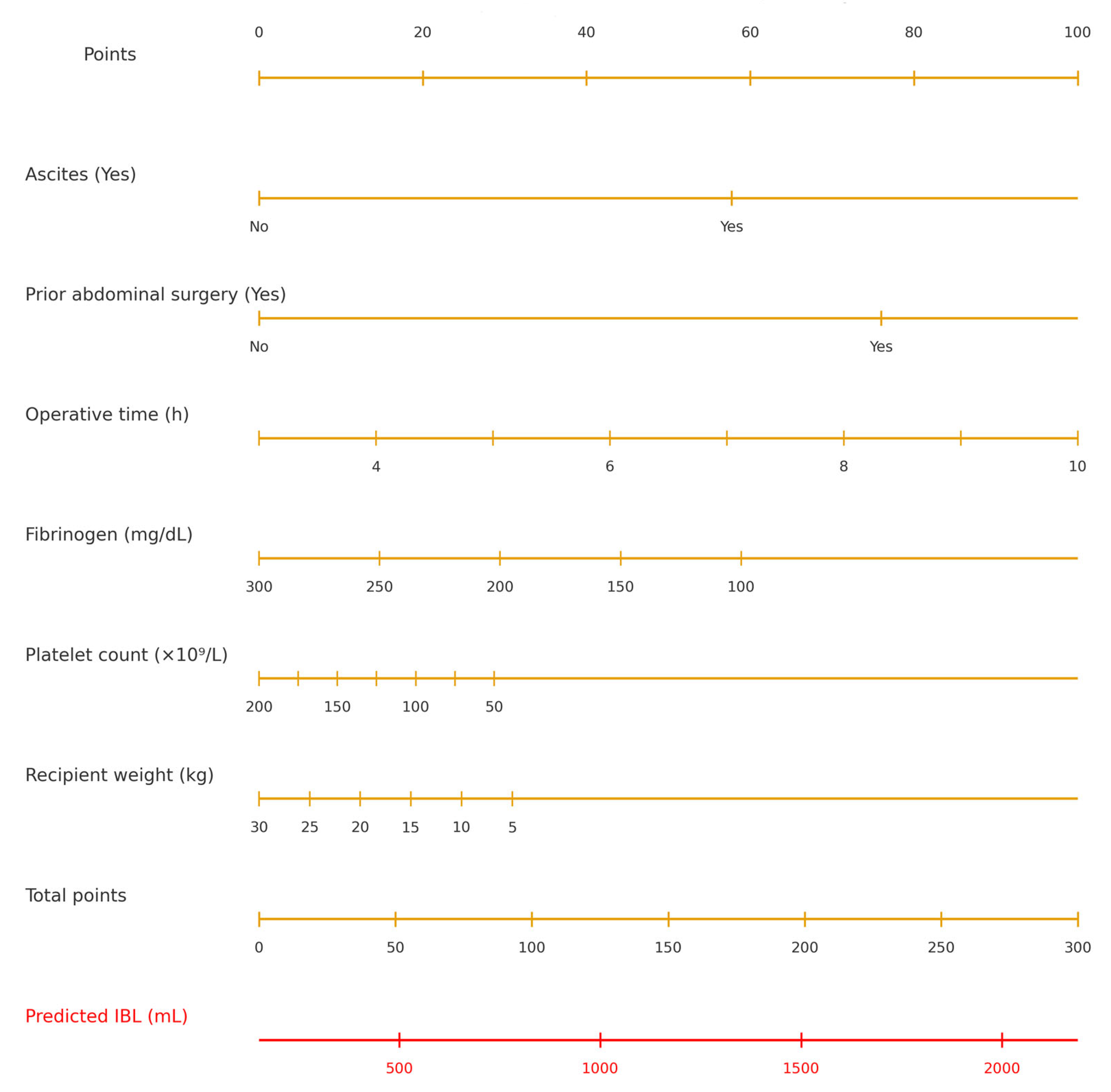
During the preparation of this manuscript, the authors used ChatGPT-4 (OpenAI, San Francisco, CA, USA) to assist in language editing and the graphical design of
Figure 1. After using this tool, the authors carefully reviewed and edited the content to ensure accuracy and take full responsibility for the integrity of the work.
3. Results
3.1. Patient Characteristics
A total of 43 pediatric patients underwent liver-inclusive transplantation between May 2008 and August 2009. The median age was 2.8 years (range: 0.3–13 years), and 53.5% (n = 23) were female. The mean weight at transplantation was 11.5 ± 6.1 kg.
The primary indications for transplantation were biliary atresia (39.5%), fulminant hepatic failure (27.9%), and metabolic liver diseases (18.6%). Ascites was present in 62.8% of patients, while 37.2% had a history of prior abdominal surgery.
Preoperative laboratory values showed a mean fibrinogen level of 175 ± 47 mg/dL and platelet count of 97 ± 34 ×109/L.
Patient characteristics are summarized in
Table 2.
3.2. Estimated Intraoperative Blood Loss
Estimated intraoperative blood loss (IBL) showed a right-skewed distribution with substantial variability across patients. The median IBL was 2100 mL (IQR: 500 mL), with percentile values of P5 = 1050 mL and P95 = 4100 mL, illustrating the wide range of bleeding severity observed during surgery. The mean IBL was 1173 mL (range: 50–7870 mL), corresponding to an average of 121 mL/kg (range: 5–872 mL/kg). Massive blood loss, defined as >50 mL/kg, occurred in 65.1% of patients, underscoring the high transfusion demand and hemodynamic instability characteristic of pediatric liver transplantation [
13,
14].
3.3. Predictive Model Development
Fifteen preoperative variables were analyzed for their association with intraoperative blood loss. Using Mallows’ Cp criterion, six variables were retained in the final multivariable linear regression model: presence of ascites, prior abdominal surgery, operative time, fibrinogen concentration, platelet count, and recipient weight.
The model explained 35.2% of the variance in IBL (adjusted R2 = 0.352, F = 7.68, p < 0.001).
Table 3 summarizes the model coefficients, 95% confidence intervals, and significance levels.
Following the multivariable analysis, a nomogram was constructed to facilitate bedside estimation of IBL using the final regression model (
Figure 1). The tool translates each predictor into a point value proportional to its regression coefficient, allowing clinicians to obtain an individualized prediction of expected IBL by summing the points corresponding to the patient’s characteristics. A brief description of the stepwise use of the nomogram is provided below to ensure its correct application.
3.4. Regression Equation for Intraoperative Blood Loss
The final regression equation for the prediction of IBL was as follows:
Ascites and prior abdominal surgery were coded as binary variables (1 = Yes, 0 = No). This model integrates clinically relevant, easily measurable parameters and can be implemented in preoperative evaluation to identify patients at high risk of excessive bleeding.
3.5. Model Validation
Diagnostic analysis confirmed that the regression model met all key statistical assumptions.
Residuals demonstrated approximate normality, as assessed by the Shapiro–Wilk test (p = 0.127) and Kolmogorov–Smirnov test (p = 0.200).
No evidence of skewness or kurtosis was observed. Visual inspection of residuals versus predicted values did not suggest heteroscedasticity.
The Durbin–Watson statistic was 2.009, indicating no significant autocorrelation of residuals.
Multicollinearity was excluded, with variance inflation factors (VIFs) < 2 for all predictors.
Visual inspection of residuals-versus-fitted plots and normal Q–Q plots also supported linearity, homoscedasticity, and approximate normality, with no influential outliers detected.
These results confirm the robustness, internal consistency, and stability of the model for estimating intraoperative blood loss in pediatric liver transplantation.
The results of the statistical tests supporting these diagnostic findings are detailed in
Supplementary Table S1.
To facilitate clinical application, an interactive web-based tool—the
Pedi-LT Bleeding Risk Calculator—was developed to estimate intraoperative blood loss using patient-specific variables (
Supplementary File S1).
The calculator stratifies patients into the following risk categories:
To ensure transparency and reproducibility, we also provide the complete source code (
Supplementary File S2), enabling adaptation to different institutional settings, as well as a user manual with step-by-step implementation instructions (
Supplementary File S3). These resources are designed to promote clinical integration and support external validation of the model.
Regression diagnostic tests confirming the fulfillment of key statistical assumptions (normality, homoscedasticity, independence of residuals, and multicollinearity) are summarized in
Supplementary Table S1. A structured comparison of the feasibility and requirements of multivariable linear regression versus machine-learning approaches, developed in response to reviewer feedback, is presented in
Supplementary Table S2.
4. Discussion
4.1. Principal Findings
This study presents the first validated multivariable model to predict intraoperative blood loss in PLT, achieving an adjusted R2 of 0.35 and thereby fulfilling the primary objective of identifying clinically relevant preoperative predictors of bleeding. By integrating six easily measurable variables—ascites, prior abdominal surgery, operative time, fibrinogen concentration, platelet count, and recipient weight—the model provides a practical, interpretable framework for individualized bleeding-risk estimation. Unlike previous reports, our work introduces a clinically applicable preoperative risk-stratification tool derived from a homogeneous pediatric cohort. The model’s explanatory power is consistent with similar multivariable approaches in perioperative prediction research, underscoring both its robustness and its immediate potential for integration into pediatric PBM strategies.
4.2. Comparison with Previous Literature
Most existing studies have focused on adult liver transplant recipients or small, heterogeneous pediatric cohorts.
For example, Fanna et al. and Jin et al. identified associations between prior abdominal surgery, low coagulation factor levels, ascites, and increased bleeding risk in pediatric recipients; however, these studies did not develop or validate predictive models for preoperative use [
5,
15].
Similarly, investigations of ROTEM parameters in pediatric liver transplantation have confirmed their intraoperative diagnostic utility but have not extended to preoperative multivariable prediction frameworks [
16].
In adult liver transplantation, factors such as low fibrinogen levels, prolonged operative time, and prior abdominal interventions have consistently been associated with greater bleeding and transfusion requirements [
7,
8].
Recent studies have continued to explore preoperative and intraoperative determinants of hemorrhage in both pediatric and adult liver transplantation. Ma et al. (2024) analyzed 569 pediatric liver transplant recipients and demonstrated that the intraoperative red blood cell transfusion-to-blood-loss ratio is independently associated with early postoperative complications, emphasizing the clinical impact of transfusion balance in this setting [
21]. Similarly, Zhang et al. (2025) identified preoperative biochemical markers—including alanine and aspartate aminotransferase levels (ALT and AST)—as independent predictors of massive intraoperative bleeding in adult recipients, highlighting the prognostic value of hepatic function parameters in bleeding risk assessment [
22].
Our findings are in line with these observations, confirming that these parameters—together with recipient weight and platelet count—are key contributors to intraoperative blood loss in the pediatric setting. In terms of predictive accuracy, the adjusted R
2 of 0.35 achieved by our pediatric model is comparable to values reported in adult bleeding-prediction models, where multivariable regression typically explains 30–40% of the variance in intraoperative blood loss or transfusion requirements [
7,
8]. Although machine-learning approaches in adult cohorts have achieved higher AUROC values (0.80–0.85), these methods rely on substantially larger datasets and frequently incorporate intraoperative variables that are not available preoperatively. Thus, the performance observed in our preoperative pediatric model is consistent with expectations for linear regression frameworks in this clinical context and demonstrates a level of predictive accuracy appropriate for clinical application.
4.3. Novelty and Clinical Implications
The present model addresses a critical gap in preoperative risk stratification for PLT. Early identification of high-risk patients facilitates personalized PBM strategies, optimized transfusion protocols, and better intraoperative planning [
9,
10].
Although viscoelastic testing such as ROTEM was routinely used at our center during the study period, these parameters were deliberately excluded from the final model to ensure that the tool is applicable across centers without universal access to such technology.
In centers where viscoelastic testing is routinely available, our preoperative model can be integrated into ROTEM-guided hemostatic treatment algorithms to refine transfusion thresholds and support individualized intraoperative management. Viscoelastic testing provides real-time information on clot formation, firmness, and fibrinolysis, enabling targeted administration of coagulation factors and blood components rather than empiric transfusion. Previous work from our group and collaborators has demonstrated the effectiveness of ROTEM-guided transfusion protocols in both pediatric and adult liver transplantation, contributing to reduced allogeneic blood product use and improved perioperative hemostatic stability [
23,
24]. The integration of our preoperative bleeding-risk model with viscoelastic monitoring thus represents a complementary approach within the framework of PBM, ensuring broad applicability across centers while enhancing precision in those with advanced coagulation monitoring capabilities.
To enhance clinical translation, an interactive web-based calculator (
Supplementary File S1: Pedi-LT Bleeding Risk Calculator) was developed. This tool enables clinicians to estimate predicted blood loss and stratify patients into low-, moderate-, or high-risk categories in real time. By embedding this tool into perioperative workflows, surgical and anesthetic teams can improve preparedness and optimize resource allocation. To enhance interpretability and clinical decision-making, the bleeding-risk thresholds used in the Pedi-LT Calculator (<10, 10–30, and >30 mL/kg) were derived from established pediatric transfusion literature and PBM guidelines, where blood loss exceeding 30 mL/kg is associated with massive transfusion, hemodynamic instability, and increased postoperative morbidity. Losses between 10 and 30 mL/kg correspond to moderate bleeding requiring anticipatory transfusion preparedness, while values below 10 mL/kg generally indicate minimal hemodynamic impact. These categories therefore provide clinically meaningful guidance that can be directly applied to perioperative decision-making and align with current pediatric PBM practice.
In addition to the digital calculator, we provide a graphical nomogram derived directly from the final multivariable model (
Figure 1). This representation allows clinicians to obtain individualized estimates of intraoperative blood loss by assigning a weighted point value to each predictor in proportion to its regression coefficient. By summing these points and projecting the total onto the predicted bleeding scale, the nomogram offers an intuitive, bedside tool that facilitates rapid interpretation without the need for computational resources. Its simplicity and transparency make it particularly useful in settings where electronic decision-support systems are not available, further enhancing the clinical applicability of the model.
Although the model was not designed to perform a formal cost-effectiveness analysis, its potential economic implications are relevant within pediatric PBM programs. Early identification of children at high risk of excessive bleeding may help reduce unnecessary preoperative testing, improve blood-product preparation and allocation, and support targeted rather than prophylactic transfusion practices. These strategies are known to decrease overall blood product utilization, minimize transfusion-related complications, and optimize perioperative resource consumption [
10]. Therefore, the implementation of this predictive model may indirectly contribute to more cost-efficient perioperative management in pediatric liver transplantation.
To contextualize the feasibility of the linear regression approach used in this study, we provide a comparative summary of linear models versus machine-learning methods in
Supplementary Table S2. This table outlines key aspects including dataset size requirements, risk of overfitting, interpretability, and clinical practicality, highlighting why a parsimonious linear model represents the most appropriate and reliable approach for preoperative bleeding-risk prediction in PLT given the characteristics of the available dataset.
4.4. Study Limitations
Although the data used in this study were collected prospectively in 2008–2009, several considerations support their ongoing relevance and clinical validity. First, the main physiological and surgical determinants of intraoperative bleeding in pediatric liver transplantation—such as ascites, prior abdominal surgery, coagulation status, operative time, and recipient size—have remained fundamentally stable over the past two decades. The mechanisms by which these variables influence bleeding risk have not changed, and therefore the relationships captured by the model remain applicable to contemporary practice.
Second, although perioperative management strategies and transfusion algorithms have evolved, these changes primarily influence treatment thresholds rather than the core predictors of blood loss. As such, the model provides a robust and interpretable baseline framework that is independent of center-specific technologies, including viscoelastic testing.
Third, high-quality, prospectively collected pediatric datasets with detailed clinical and intraoperative variables remain extremely scarce. The granularity and internal consistency of this cohort strengthen the reliability of the regression coefficients and mitigate concerns related to temporal distance.
Finally, despite their age, these data retain substantial methodological value because they form a structured, high-fidelity foundation that can support the development of modern decision-support systems. Recent machine-learning studies in adult liver transplantation have demonstrated that advanced algorithms outperform traditional regression and can effectively model complex, non-linear interactions between preoperative and intraoperative variables [
17,
18]. These findings highlight that validated, well-curated datasets—such as the one presented here—remain highly useful as a baseline model for benchmarking, feature selection, and calibration in future pediatric-focused predictive systems.
4.5. Conclusions of the Discussion
In summary, this study provides a robust, validated preoperative model for estimating intraoperative blood loss in pediatric liver transplantation. The model has immediate clinical applicability, complements existing PBM strategies, and establishes a platform for the development of advanced ML-based predictive systems aimed at improving perioperative safety and outcomes in children undergoing liver transplantation.
5. Conclusions
The validated multivariable predictive model presented here provides the first structured framework for estimating intraoperative blood loss in PLT. By integrating six easily measurable variables—ascites, prior abdominal surgery, operative time, fibrinogen concentration, platelet count, and recipient weight—the model enables individualized preoperative bleeding-risk assessment with demonstrated robustness and clinical interpretability.
Its implementation can strengthen PBM programs, optimize transfusion strategies, and enhance perioperative preparedness in this vulnerable population. Furthermore, the structured dataset underpinning the model offers a reliable foundation for future research integrating ML approaches to refine prediction accuracy and develop next-generation, real-time decision-support systems in pediatric liver transplantation.