Systematic Review

Indeterminate-Grey Zone of HBeAg-Negative Chronic Hepatitis B Is Associated with a Higher Risk of Hepatocellular Carcinoma Compared to HBeAg-Negative Chronic Infection—A Systematic Review and Meta-Analysis


by
Rodanthi Syrigou
1,†,
Dimitra Tiganiti
1,†,
Kyriakos Kintzoglanakis
2,
Vasileios Lekakis
3 and
Dimitrios S Karagiannakis
4,*
1
Therapeutics Clinic, Alexandra General Hospital, School of Medicine, National and Kapodistrian University of Athens, 11528 Athens, Greece
2
Local Health-Team Unit of Thebes, 32200 Thebes, Greece
3
First Academic Department of Gastroenterology, Laiko General Hospital, School of Medicine, National and Kapodistrian University of Athens, 11527 Athens, Greece
4
Fourth Department of Internal Medicine, Attikon University Hospital, School of Medicine, National and Kapodistrian University of Athens, 12462 Athens, Greece
*
Author to whom correspondence should be addressed.
These authors contributed equally to this work.
Submission received: 16 November 2025 / Revised: 15 December 2025 / Accepted: 22 January 2026 / Published: 4 February 2026

Abstract

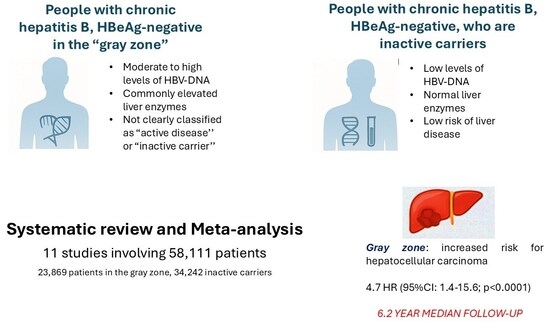
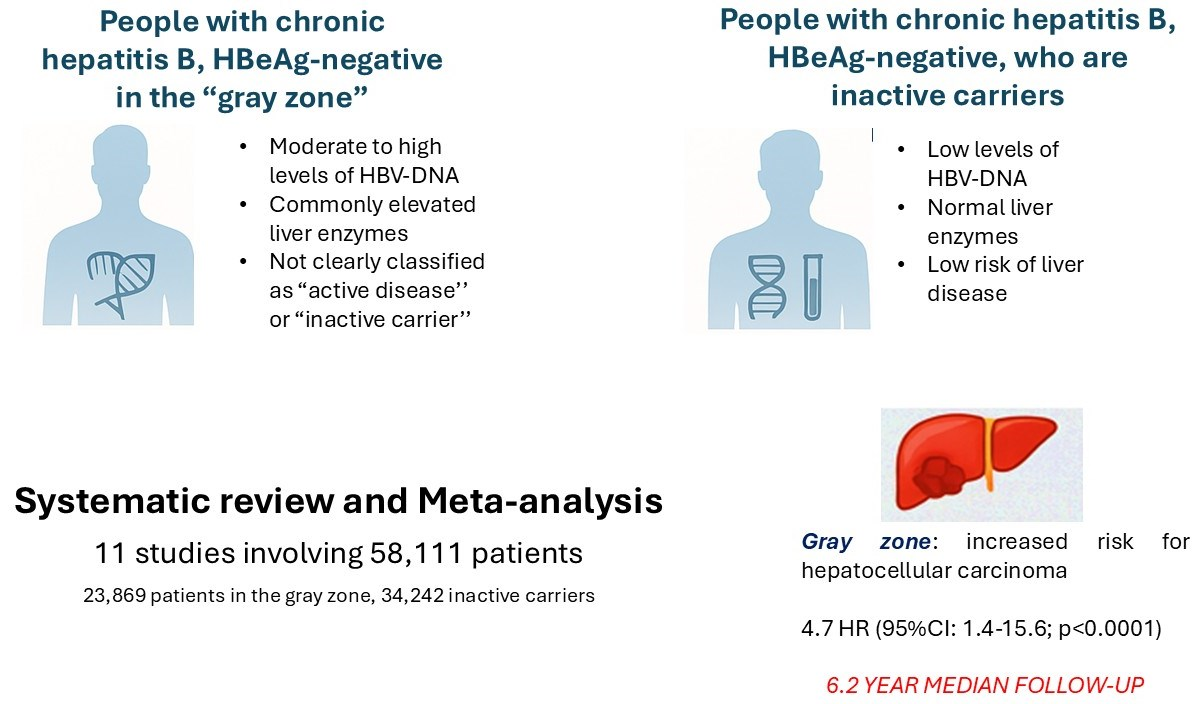
Background and Aim: The management of patients with chronic Hepatitis B Virus (HBV) HBeAg-negative infection in the indeterminate-grey zone (GZ) remains debatable. We conducted a systematic review and meta-analysis to compare these patients with those with chronic HBV HBeAg-negative infection (inactive carriers; IC/HBeAg-negative), regarding the severity of liver inflammation and fibrosis and the risk of developing hepatocellular carcinoma (HCC). Methods: A literature search was conducted to identify all published studies comparing GZ/HBeAg-negative patients with IC/HBeAg-negative patients. Data on the severity of liver inflammation and fibrosis were extracted, and pooled relative risks (RR) and 95% confidence intervals (CI) were calculated. The risk of HCC was estimated by pooled hazard ratios (HR). A random-effects meta-analysis model was performed using R v4.1.2. Results: Eleven studies were finally included. GZ/HBeAg-negative patients had significantly higher mean HBV-DNA and alanine transferase (ALT) levels, compared to their IC/HBeAg-negative counterparts (4089.9 ± 4840.5 vs. 215.9 ± 318.1 IU/mL; p = 0.0004, and 39.6 ± 26.9 IU/L and 20.1 ± 7.6 IU/L/; p < 0.0001, respectively). GZ/HBeAg-negative patients showed a trend towards a higher risk of significant liver inflammation (RR: 5.11; 95%CI: 0.68–38.33; p = 0.1), F2/F3 fibrosis (RR: 2.13; 95%CI: 0.89–5.1; p = 0.09), and cirrhosis (RR: 14.39; 95%CI: 0.5–417.08; p = 0.12), respectively, compared to IC/HBeAg-negative patients. After a median follow-up of 6.2 years, the former group demonstrated a significantly higher risk of developing HCC (HR: 4.7; 95% CI: 1.4–15.6; p < 0.0001). Conclusions: GZ/HBeAg-negative patients have a higher risk of developing HCC compared to IC/HBeAg-negative patients, which raises concerns about the potential need to initiate treatment in this patient group.

1. Introduction

Hepatitis B Virus (HBV) represents a major global health concern, being a significant contributor to liver cirrhosis and hepatocellular carcinoma (HCC). It is estimated that over 250 million individuals are affected by HBV, with more than 1.2 million new infections projected annually [1]. Current therapeutic approaches primarily involve the administration of nucleos(t)ide analogs or pegylated interferon. Although these treatment options exhibit low rates of achieving complete viral eradication, they play an essential role in effectively suppressing viral replication [2]. This suppression is instrumental in mitigating hepatic inflammation and reducing the likelihood of progression to liver cirrhosis. Moreover, while these interventions reduce the risk of developing HCC, they do not eliminate it [2].
Leading hepatology societies, including AASLD, EASL, and APASL, recommend a comprehensive assessment of chronic hepatitis B patients based on HBV-DNA levels (to gauge viral replication), serum ALT concentrations (to evaluate liver inflammation), and the degree of fibrosis (determined by biopsy or non-invasive modalities like elastography) [2,3,4]. For HBeAg-negative individuals—who make up most HBV cases in Europe [5]—the latest EASL guidance advises initiating therapy in all cases with advanced fibrosis or cirrhosis and detectable HBV-DNA, regardless of viral load. In non-cirrhotic patients, treatment is recommended if HBV-DNA is at least 2000 IU/mL and ALT exceeds the upper normal limit (UNL), which defines active chronic hepatitis B in this context [3]. Conversely, those with HBV-DNA below 2000 IU/mL, normal ALT, and no significant fibrosis or HCC risk factors typically do not require treatment because their risk of liver-related complications is minimal [3]. These patients are classified as having HBeAg-negative chronic infection, previously termed inactive carriers (IC/HBeAg-negative).
Among patients with chronic HBV hepatitis and those situated in the inactive carrier state, there exists a distinct group characterized by HBV-DNA levels equal to or exceeding 2000 IU, coupled with ALT levels below the upper normal limit (UNL), or HBV-DNA levels less than 2000 IU with ALT levels equal to or exceeding UNL. This cohort has been classified as individuals with chronic HBV in the HBeAg-negative indeterminate-grey zone (GZ/HBeAg-negative) [6]. It is recommended that this group undergo monitoring without immediate treatment unless specific conditions arise. These conditions include the presence of significant fibrosis, as demonstrated through liver biopsy or non-invasive testing, a documented family history of HCC, or a transition from the grey zone to chronic HBV HBeAg-negative hepatitis [3]. It is noteworthy that numerous studies have reported substantial inflammation and fibrosis in many patients categorized as GZ/HBeAg-negative at the time of recruitment. However, other research has questioned these findings [7,8]. Additionally, existing evidence shows an increased risk of HCC in patients considered to be in the grey zone. However, caution is warranted, as most studies have not analyzed GZ/HBeAg-negative and GZ/HBeAg-positive patients as separate groups [9].
This systematic review and meta-analysis aim to determine whether GZ/HBeAg-negative patients exhibit worse characteristics at enrollment, including liver inflammation and fibrosis, compared to IC/HBeAg-negative patients, who serve as the standard group that does not require treatment. Additionally, it seeks to investigate whether the GZ/HBeAg-negative group is at higher risk of HCC, to assess whether the management strategies proposed by current guidelines are safe or may need revision.

2. Methods

2.1. Data Sources and Searches

This meta-analysis was performed according to the Preferred Reporting Items for Systematic Reviews and Meta-Analyses (PRISMA) statement [10] (Supplementary Table S1). We searched in PubMed, Embase, Scopus, Web of Science, and Google Scholar databases from 1 December 2024 to 31 May 2025, to identify all medical articles containing the terms “Hepatitis B” or “Chronic Hepatitis B” or “HBeAg-negative Hepatitis B” or “e antigen negative Hepatitis B” or “HBV” AND “Inactive carrier” or “Chronic Hepatitis B infection” or “grey zone” or “indeterminate zone” or “indeterminate phase” or “indeterminate stage” AND “Inflammation” or “Histology” or “Fibrosis” or “Cirrhosis” AND “Hepatocellular Carcinoma” or “HCC” or “Liver Cancer”, using both MeSH terms and free-text keywords in our search strategy.
Additionally, we manually searched for potential studies, reviewing the reference lists of included studies and relevant reviews. The protocol was predefined and registered on the International Prospective Register of Systematic Reviews (PROSPERO) [11] with the designated ID: CRD420251064154.

2.2. Study Selection

All studies published were considered eligible for inclusion in our meta-analysis if they fulfilled the following criteria: (1) they were either clinical trials or prospective and retrospective observational studies, (2) they included adult patients (>18 years), (3) they included both patients with HBV in the GZ/HBeAg-negative and IC/HBeAg-negative state, (4) they provided sufficient data to assess the outcome of interest of this meta-analysis, (5) they were written in the English language. We excluded: (1) studies merely including GZ/HBeAg-positive patients, (2) studies that investigated both GZ/HBeAg-negative and GZ/HBeAg-positive patients as a single group without a separate presentation and analysis of the exact number and characteristics of GZ/HBeAg-negative patients, (3) systematic reviews, commentaries, and editorials, (4) studies not written in the English language, and (5) studies not providing adequate data to evaluate the outcome of interest of this meta-analysis. The EndNote deduplication process automatically removed duplicates. Additionally, we manually included the most up-to-date study when multiple studies using the same databases were conducted.

2.3. Methodology and Data Extraction

Two authors (RS, DA) independently performed a literature search, screening titles and abstracts, and then reviewing the full text of the selected articles to determine which studies could be included. A third reviewer (DK) independently evaluated the preselected list of papers to determine which met the inclusion criteria. Possible arguments were resolved with consensus. Data regarding the first author, date of publication, country of origin, type of study, sample size, age of patients, HBV-DNA levels in IC/HBeAg-negative and GZ/HBeAg-negative patients, and ALT levels in IC/HBeAg-negative and GZ/HBeAg-negative patients were recorded.

2.4. Quality Assessment

The quality of the included studies was independently assessed by two investigators (RS, DN) using the Newcastle-Ottawa scale, a nine-item instrument with a rating scale of 0 to 9 stars. Studies with scores equal to or greater than seven were considered high quality, while those with scores lower than seven were deemed low quality (Supplementary Table S2). Disagreements were resolved by consensus or discussion with a third author (DK).

2.5. Statistical Analysis

To synthesize data, we employed a generalized linear mixed model (GLMM) [12] to calculate pooled relative risks (RRs). Confidence intervals (CIs) for proportions from single studies were derived using the Clopper–Pearson method [13]. We quantified between-study variance (τ2) with the maximum likelihood approach and assessed heterogeneity by both the I2 statistic (interpreting <25% as low, ~50% as moderate, and >75% as high heterogeneity [14]) and additional chi-squared and tau-squared metrics to address I2 limitations. Subgroup heterogeneity was evaluated with a significance threshold of p < 0.10, aligning with standard meta-analytic practice. We also reported pooled proportions, CIs, and prediction intervals (PIs) [15]. For continuous outcomes, weighted means and pooled standard deviations (SDs) were calculated, with weights proportional to each study’s sample size and pooled SDs reflecting both within- and between-study variability. Pooled mean differences (MDs) and hazard ratios (HRs) with 95% CIs were estimated using the inverse variance method and a random-effects model (DerSimonian–Laird) [16]. All analyses utilized R software (v4.3.1), specifically the ‘meta’ and ‘metafor’ packages [17]. Statistical significance was set at p < 0.05 (two-sided).

3. Results

3.1. Literature Search Results

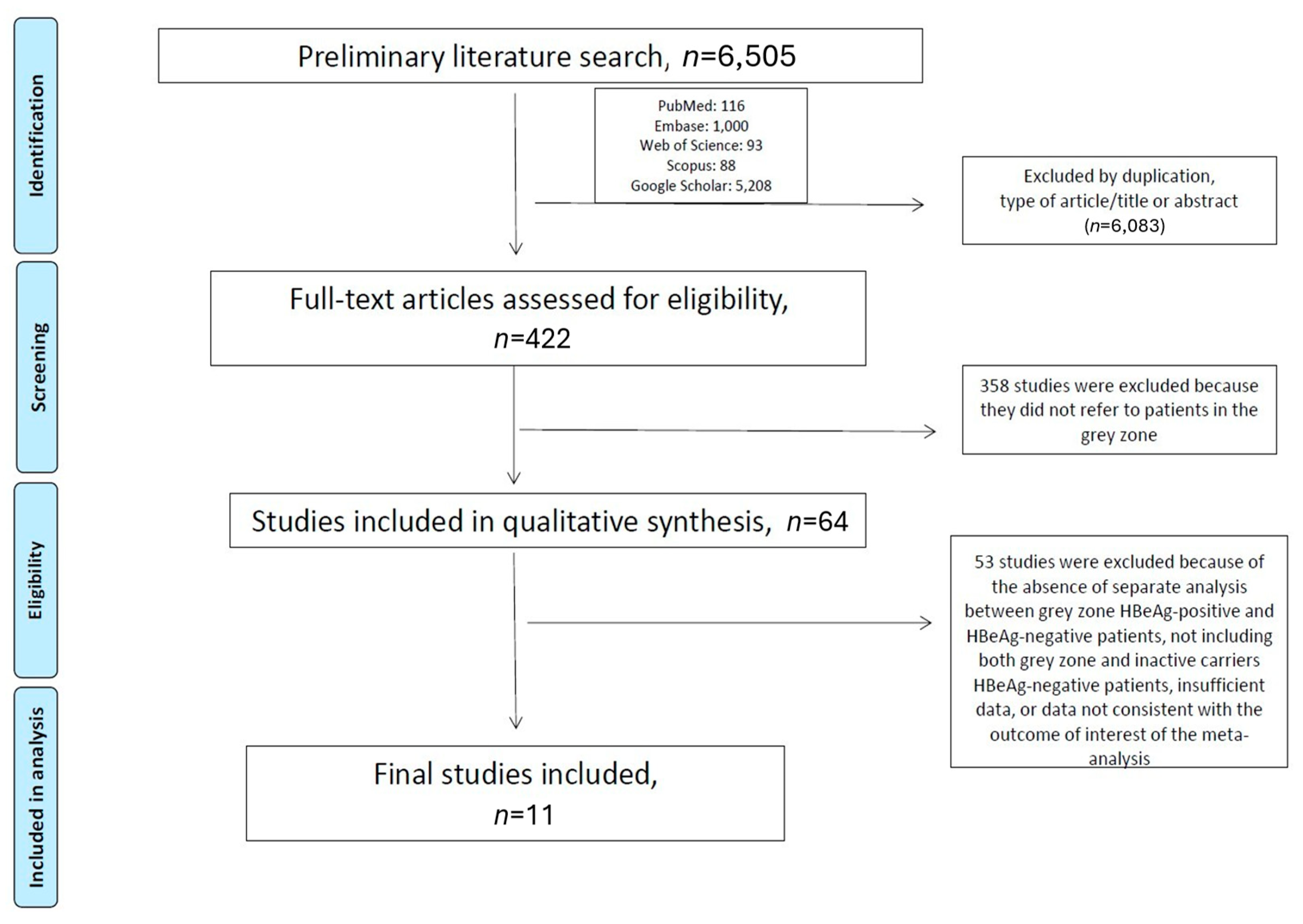
The initial search yielded 6505 studies. Two hundred eighteen articles were deemed eligible for full-text screening, following title and abstract screening (Supplementary Table S3). Sixty-four articles were considered eligible for qualitative synthesis, and 11 ultimately met the inclusion criteria for meta-analysis [7,9,18,19,20,21,22,23,24,25,26]. The PRISMA flow diagram illustrates the study selection process (Figure 1).
Nine of these studies were conducted in Asia, one in Europe, and one had mixed populations from Asia and the USA. All studies were retrospective, and their main characteristics are described in Table 1. A total of 23,869 (57.3% males) GZ/HBeAg-negative and 34,242 (36.7% males) IC/HBeAg-negative patients were enrolled. The pooled mean age of GZ/HBeAg-negative and IC/HBeAg-negative patients was 52 ± 11.9 and 52.1 ± 12.3 years, respectively, without any significant difference between the two groups (p = 0.2682).

3.2. Risk of Bias

A funnel plot asymmetry assessment and an Egger’s test were conducted to investigate the presence of publication bias [27]. The examination of the funnel plot revealed a certain degree of asymmetry, with smaller studies exhibiting greater dispersion or skewness (Supplementary Figure S1). Conversely, the results of Egger’s regression test demonstrated no evidence of publication bias (z = 1.6425, p = 0.1005). It is important to note that Egger’s test may have limited statistical power when used in meta-analyses comprising a small number of studies, such as ours. Moreover, visual asymmetry does not invariably signify publication bias; alternative factors, including between-study heterogeneity or small-study effects, may account for the observed pattern.

3.3. Difference Between GZ/HBeAg-Negative and IC/HBeAg-Negative Patients Regarding HBV-DNA and ALT Levels

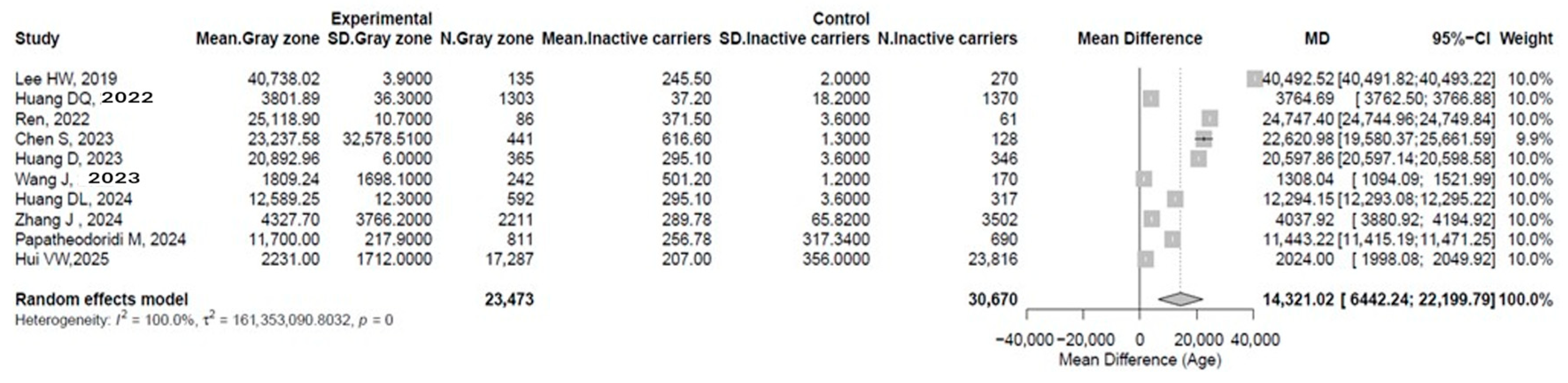
HBV-DNA levels were evaluated across ten studies involving 23,473 and 30,670 GZ/HBeAg-negative and IC/HBeAg-negative patients, respectively. The former group of patients had significantly higher mean HBV-DNA levels (p = 0.0004), with values of 4089.9 ± 4840.5 IU/mL and 215.9 ± 318.1 IU/mL, respectively. The MD in HBV-DNA levels between the two groups was 14,321 IU/mL (95% CI: 6442.2–22,199.8) (Figure 2).
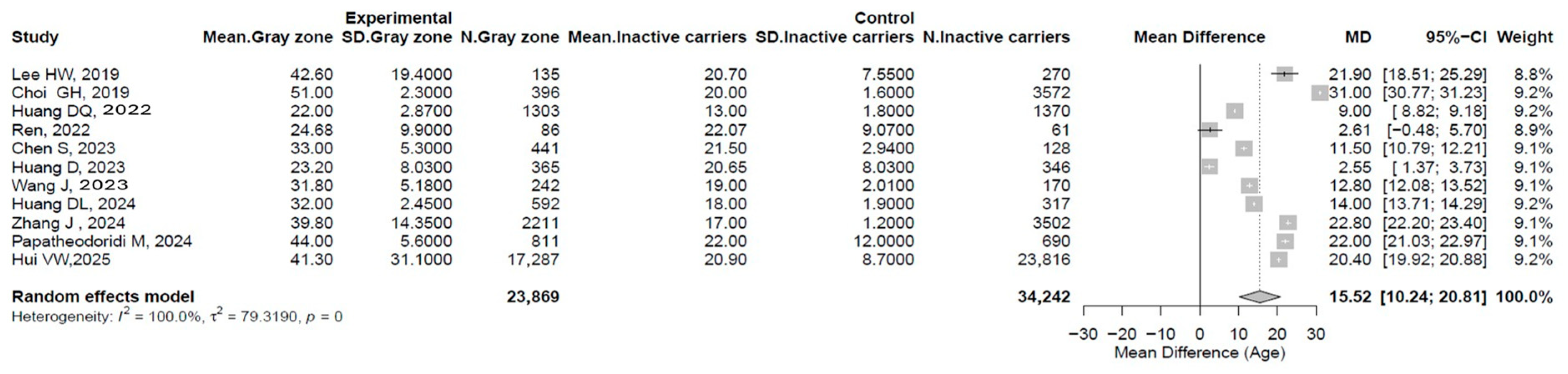
ALT levels were reported in 11 studies, encompassing 23,869 GZ/HBeAg-negative patients, and 34,242 IC/HBeAg-negative patients. The mean ALT levels were significantly higher in GZ/HBeAg-negative patients than in their IC/HBeAg-negative counterparts (p < 0.0001), with mean ALT levels of 39.6 ± 26.9 IU/L and 20.1 ± 7.6 IU/L, respectively. The MD in ALT levels between the two groups was 15.52 IU/L (95%CI: 10.2–20.8) (Figure 3).

3.4. Difference Between GZ/HBeAg-Negative and IC/HBeAg-Negative Patients Regarding the Degree of Inflammation in Liver Biopsy

Three studies assessed liver inflammation through liver biopsies in a total of 1109 GZ/HBeAg-negative patients and 506 IC/HBeAg-negative patients. The GZ/HBeAg-negative group of patients had a 5.11 times higher relative risk (RR) (95%CI: 0.68–38.33) of presenting significant inflammation (defined as >A2 according to the METAVIR score) compared to the IC/HBeAg-negative group, but the difference was not statistically significant (p = 0.1) (Figure 4).

3.5. Difference Between GZ/HBeAg-Negative and IC/HBeAg-Negative Patients Regarding the Severity of Fibrosis

A liver biopsy assessed liver fibrosis in three studies comprising 1398 GZ/HBeAg-negative patients and 791 IC/HBeAg-negative patients. The former group of patients demonstrated a 2.13-fold higher RR (95%CI: 0.89–5.10) of presenting with significant fibrosis, defined as F2/F3 according to the METAVIR scoring system. Still, this trend did not reach statistical significance (p = 0.09) (Figure 5). In addition, the GZ/HBeAg-negative patients had a 14.39-fold higher RR (95% CI: 0.5–417.08; p = 0.12) of presenting with liver cirrhosis than their IC/HBeAg-negative counterparts, but again, this difference was not statistically significant (p = 0.12) (Figure 6).

3.6. Risk of HCC Development Between GZ/HBeAg-Negative and IC/HBeAg-Negative Patients

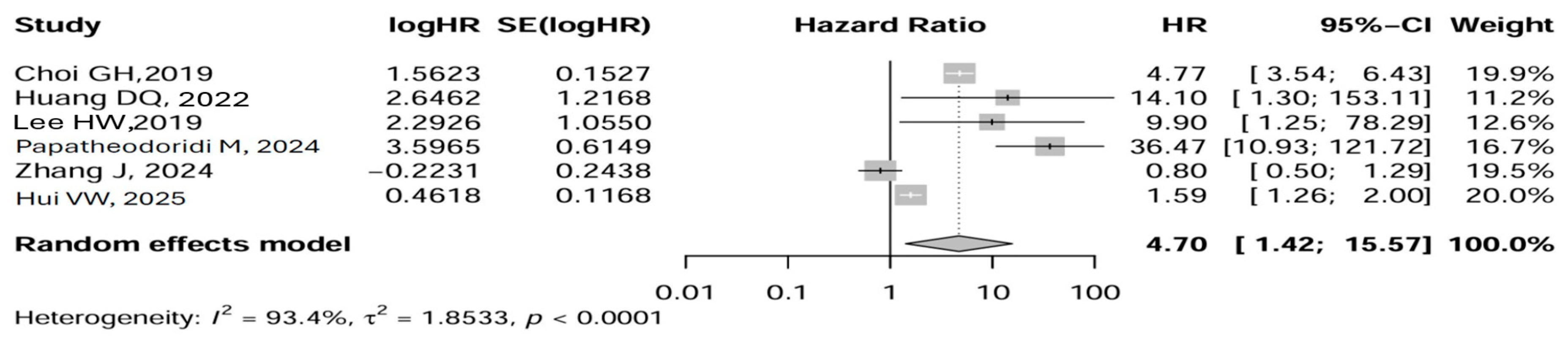
Six studies examined the risk of developing HCC in GZ/HBeAg-negative patients compared with IC/HBeAg-negative patients. Five of these studies concluded that the former group is at a higher risk of HCC than the latter. Conversely, one study reported no significant difference between the two groups. The median follow-up period was 75.1 (55.1–138) months. Patients with GZ/HBeAg-negative status had an increased risk of HCC compared to IC/HBeAg-negative patients, with a pooled hazard ratio (HR) of 4.7 (95%CI: 1.4–15.6, p < 0.0001) (Figure 7).

4. Discussion

The optimal management strategies for patients diagnosed with HBV at the HBeAg-negative GZ stage remain a contentious issue among healthcare professionals and researchers [28]. In a 2023 study by Zhou et al., patients receiving treatment had a 89% lower risk of progressing to liver cirrhosis compared to their untreated counterparts (HR: 0.11, 95% CI: 0.14–0.91, p = 0.041) [29]. This finding underscores the potential benefits of therapeutic intervention in this specific patient population. Additionally, a previous investigation by Choi et al. [19] highlighted a concerning disparity in outcomes between treated and untreated individuals at the GZ/HBeAg-negative stage. Their results indicated that untreated patients faced more than double the risk of mortality or the necessity for liver transplantation, with an HR of 2.14 (95% CI: 1.09–4.21, p = 0.03). Conversely, research conducted by Bonacci et al. [30] presented a more optimistic view, revealing that Caucasian patients with GZ/HBeAg-negative status often enjoy favourable long-term outcomes, with minimal progression to cirrhosis even in the absence of treatment. Interestingly, they reported that approximately 40% of these patients may spontaneously transition to the IC state.
These conflicting findings across studies may stem from inherent heterogeneity in GZ patient populations. It is crucial to recognize that both HBeAg-negative and HBeAg-positive patients can be classified under the GZ stage; however, significant differences exist between these two groups [31]. Despite this, most research tends to group individuals at the GZ stage together, failing to recognize them as two distinct entities and to examine them separately. Furthermore, the criteria employed to define GZ differ across the studies [31].
To address these controversies, we conducted this meta-analysis of strictly GZ/HBeAg-negative patients whose diagnosis was based solely on the EASL criteria. Only studies comparing GZ/HBeAg-negative patients with their IC/HBeAg-negative counterparts were included, as the latter represent a typical population that does not require treatment due to its proven negligible risk of developing liver-related events [3]. According to our findings, GZ/HBeAg-negative patients exhibit significantly higher HBV-DNA and ALT levels than IC/HBeAg-negative individuals. In addition, the GZ/HBeAg-negative group showed a trend towards a higher risk of significant liver inflammation, significant fibrosis (F2/F3), and cirrhosis at the time of diagnosis. These results increase concerns about the prognosis of GZ/HBeAg-negative patients and the necessity of potential treatment initiation.
A critical issue that warrants further evaluation is whether all subjects characterized as GZ/HBeAg-negative are genuinely in the GZ state, as many may transition between states over time. Hence, a single baseline measurement of HBV-DNA and ALT is not necessarily sufficient to accurately classify an individual as GZ/HBeAg-negative [32]. Nevertheless, most studies have categorized patients in the GZ zone solely based on baseline characteristics. This approach is mainly due to the challenges of prolonged follow-up in everyday clinical practice and the lack of a validated observation period necessary to make reliable conclusions about a patient’s condition. The studies included in our meta-analysis employed a consistent strategy that stratified patients into the GZ or IC state based on their baseline characteristics.
Apart from the progression to liver cirrhosis, individuals with HBV are at an elevated risk for developing HCC even in the absence of cirrhosis. While that risk is relatively low in individuals at the IC/HBeAg-negative state, the risk for patients in the GZ zone needs further validation [9,33,34]. As previously noted, both HBeAg-negative and HBeAg-positive patients can be classified into the GZ stage. However, there are significant differences between these two groups concerning their risk of HCC. Studies indicate that patients in the GZ stage who are HBeAg-positive may have a higher risk of developing HCC compared to IC/HBeAg-negative subjects. Still, it remains unclear whether the same increased risk applies to GZ stage patients who are HBeAg-negative [2,9,33].
In our study, we showed that GZ/HBeAg-negative patients had an increased risk of developing HCC compared to their IC/HBeAg-negative counterparts, with an HR of 4.7 (95% CI: 1.4–15.6, p < 0.0001) over a median follow-up of 6.2 years. Evidence supports a correlation between HBV-DNA levels and the risk of HCC, with higher HBV-DNA levels associated with a higher risk. The REVEAL-HBV study group demonstrated that, although HCC may still develop in individuals with low or undetectable HBV-DNA levels, the risk escalates when HBV-DNA levels exceed 2000 IU/mL, irrespective of ALT levels and HBeAg status [35]. Considering the above, we can speculate that the higher HBV-DNA levels in GZ/HBeAg-negative patients may contribute to a higher HCC risk compared to IC/HBeAg-negative patients. Likewise, according to EASL guidelines, the grey zone in the HBeAg-negative state consists of GZ/HBeAg-negative subjects with HBV-DNA levels equal to or greater than 2000 IU/mL and normal ALT levels, and those with HBV-DNA levels below 2000 IU/mL and elevated ALT levels. Based on the data provided, the first group may have a higher risk of HCC compared to the second group, likely due to elevated HBV-DNA levels. However, our analysis could not conclusively address this issue because the data extracted from the included studies did not allow HCC risk stratification across varying HBV-DNA or ALT levels.
To the best of our knowledge, this is the first meta-analysis comparing GZ/HBeAg-negative and IC/HBeAg-negative patients with respect to the risk of HCC development, with such an extended follow-up period. Our findings raise concerns about the need to initiate treatment to mitigate that risk, potentially. To date, studies have yielded conflicting findings on this issue. For instance, Huang DQ et al. [20] demonstrated that antiviral therapy is an independent predictor of reduced HCC risk in patients with GZ (adj. HR= 0.3, 95% CI: 0.1–0.6, p = 0.001). Still, the authors did not differentiate between HBeAg-negative and HBeAg-positive GZ patients. Conversely, Papatheodoridi et al., in a study exclusively involving GZ/HBeAg-negative participants, found no differences in the cumulative rates of HCC development at 1, 5, and 10 years between treated and untreated GZ/HBeAg-negative patients [36]. Factors such as patients’ age at treatment initiation, variations in HBV-DNA levels, the severity of liver inflammation and fibrosis, and the duration of time in the GZ state may influence HCC risk and the likelihood of a positive treatment response. Clearly, extensive prospective studies are needed to determine whether and to what extent antiviral treatment can reduce the elevated HCC risk observed in GZ/HBeAg-negative patients.
The strength of our meta-analysis lies in being the first to directly compare GZ/HBeAg-negative patients with their IC/HBeAg-negative counterparts. Another recent meta-analysis evaluated the risk of HCC across the entire GZ population, without differentiating between GZ/HBeAg-negative and GZ/HBeAg-positive individuals. Instead, it focused on assessing the different risk levels of HCC within the GZ group, taking into account patients’ characteristics, HBV-DNA levels, and ALT levels [33].
Another strength of our analysis is that the GZ/HBeAg-negative patients enrolled were diagnosed using the same criteria. This is an important issue, as the use of clear, universally applied criteria helps ensure the homogeneity of the study population. Furthermore, the diagnosis of liver inflammation and fibrosis was based on the same method, a liver biopsy, and the same criteria, the METAVIR score.
This study does have some limitations. First, all the included studies were retrospective. Second, most studies were conducted in Asia, resulting in a small number of Caucasian participants enrolled. Hence, it is unclear whether our findings can be extrapolated to non-Asian populations. Third, the use of strict criteria reduced the number of studies that could be included. Fourth, the high heterogeneity found across the included studies raises concerns about the robustness of the results. However, the lack of data in the included studies, or the small number of studies included regarding the degree of inflammation, the severity of fibrosis, and the presence of cirrhosis, did not allow meta-regression analyses to explore sources of heterogeneity. Finally, HCC risk stratification among GZ/HBeAg-negative patients, considering the HBV-DNA or ALT levels, was not performed due to a lack of data. In addition, the potential effect of host genetics or HBV genotype on HCC risk was not evaluated. Unfortunately, the number and design of the studies included did not allow for a sub-analysis stratified by these parameters. Regarding genotype, most studies in our meta-analysis have been conducted in Asia, where genotype C is prevalent. This raises concerns about the reproducibility of our results in other geographic regions, such as Europe, the Middle East, or Africa, where other genotypes predominate (i.e., in Europe, genotypes A and D are the most common). Nonetheless, we believe our results on HCC risk are of great importance and will likely add value to the current management of GZ/HBeAg-negative patients.
In conclusion, our meta-analysis indicates that GZ/HBeAg-negative individuals have higher HBV-DNA and ALT levels than the IC/HBeAg-negative ones. In addition, patients in this state have a trend towards a higher risk of presenting significant liver inflammation, fibrosis, or cirrhosis, and a significantly higher risk of developing HCC. The HCC risk probably varies among patients within that group, influenced by factors such as HBV-DNA levels and the duration spent in the GZ state. Thus, an individualized approach including repeated HBV-DNA measurements and assessments of liver inflammation and fibrosis may be the most effective management strategy for these patients. The determination of monitoring frequency and the identification of specific factors that could signal the optimal timing for treatment initiation remain to be established. Given the complexity of this approach, since patients in the GZ can experience fluctuations in HBV-DNA levels and transitions from one stage to the other, a universal treatment initiation for all GZ/HBeAg-negative patients could be justified. Extensive prospective studies with long follow-up periods, along with cost-effectiveness analyses, are essential for a thorough assessment of this issue.

Supplementary Materials

The following supporting information can be downloaded at: https://www.mdpi.com/article/10.3390/livers6010009/s1, Supplementary Figure S1. Funnel plot asymmetry test for the evaluation of publication bias. Supplementary Table S1. PRISMA checklist. Supplementary Table S2. The Newcastle-Ottawa scale. Supplementary Table S3. Final list of studies evaluated for potential inclusion in the meta-analysis [7,9,18,19,20,21,22,23,24,25,26].

Author Contributions

D.S.K.: Writing—review and editing, Supervision, Resources, Methodology, Investigation, Formal analysis, Data curation, Conceptualization. R.S.: Writing of the original draft, Data curation, Methodology, Project administration. D.T.: Writing of the original draft, Data curation, Methodology, Project administration. K.K.: Data curation, Methodology, Project administration. V.L.: Data curation, Formal analysis, Investigation, Methodology. All authors have read and agreed to the published version of the manuscript.

Funding

This research has no external funding.

Institutional Review Board Statement

Not applicable.

Informed Consent Statement

Not applicable.

Data Availability Statement

The original contributions presented in this study are included in the article/Supplementary Material. Further inquiries can be directed to the corresponding author(s).

Conflicts of Interest

The authors declare no conflicts of interest.

References

  1. World Health Organization. Global Hepatitis Report 2024: Action for Access in Low- and Middle-Income Countries. 2024. Available online: https://www.who.int/publications/i/item/9789240091672 (accessed on 16 March 2025).
  2. Terrault, N.A.; Lok, A.S.F.; McMahon, B.J.; Chang, K.M.; Hwang, J.P.; Jonas, M.M.; Brown, R.S., Jr.; Bzowej, N.H.; Wong, J.B. Update on prevention, diagnosis, and treatment of chronic hepatitis B: AASLD 2018 hepatitis B guidance. Hepatology 2018, 67, 1560–1599. [Google Scholar] [CrossRef] [PubMed]
  3. European Association for the Study of the Liver. EASL Clinical Practice Guidelines on the management of hepatitis B virus infection. J Hepatol. 2025, 83, 502–583. [Google Scholar] [CrossRef] [PubMed]
  4. Lau, G.; Yu, M.-L.; Wong, G.; Thompson, A.; Ghazinian, H.; Hou, J.L.; Piratvisuth, T.; Jia, J.D.; Mizokami, M.; Cheng, G.; et al. APASL clinical practice guideline on hepatitis B reactivation related to the use of immunosuppressive therapy. Hepatol. Int. 2021, 15, 1031–1048. [Google Scholar] [CrossRef]
  5. Chevaliez, S.; Roudot-Thoraval, F.; Brouard, C.; Gordien, E.; Zoulim, F.; Brichler, S.; Brodard, V.; Pioche, C.; Pawlotsky, J.M.; Leroy, V. Clinical and virological features of chronic hepatitis B in the French national surveillance program, 2008–2012: A cross-sectional study. JHEP Rep. 2022, 4, 100593. [Google Scholar] [CrossRef]
  6. Yao, K.; Liu, J.; Wang, J.; Yan, X.; Xia, J.; Yang, Y.; Wu, W.; Liu, Y.; Chen, Y.; Zhang, Z.; et al. Distribution and clinical characteristics of patients with chronic hepatitis B virus infection in the grey zone. J. Viral Hepat. 2021, 28, 1025–1033. [Google Scholar] [CrossRef] [PubMed]
  7. Huang, D.; Zhou, G.; Peng, J.; Cai, Q.; Li, G.; Yu, H.; Zhu, Z.; Chen, Y.; Lai, H.; Jiang, J.; et al. Significant histological changes are not rare in indeterminate-phase chronic hepatitis B patients with hepatitis B e antigen-negative and normal alanine aminotransferase levels. iLABMED 2023, 1, 158–170. [Google Scholar] [CrossRef]
  8. Tseng, T.C.; Liu, C.J.; Yang, W.T.; Hsu, C.Y.; Hong, C.M.; Su, T.H.; Tsai, C.H.; Chen, C.L.; Yang, H.C.; Liu, C.H.; et al. Serum hepatitis B core-related antigen level stratifies risk of disease progression in chronic hepatitis B patients with intermediate viral load. Aliment. Pharmacol. Ther. 2021, 53, 908–918. [Google Scholar] [CrossRef]
  9. Zhang, J.; Yu, S.; Zhu, K.; Li, S.; Huang, Y. Probability analysis of hepatocellular carcinoma in hepatitis patients in the gray zone. Front. Med. 2024, 11, 1464981. [Google Scholar] [CrossRef]
  10. Page, M.J.; McKenzie, J.E.; Bossuyt, P.M.; Boutron, I.; Hoffmann, T.C.; Mulrow, C.D.; Shamseer, L.; Tetzlaff, J.M.; Akl, E.A.; Brennan, S.E.; et al. The PRISMA 2020 statement: An updated guideline for reporting systematic reviews. BMJ 2021, 372, n71. [Google Scholar] [CrossRef]
  11. Schiavo, J.H. PROSPERO: An International Register of Systematic Review Protocols. Med. Ref. Serv. Q. 2019, 38, 171–180. [Google Scholar] [CrossRef]
  12. Stijnen, T.; Hamza, T.H.; Ozdemir, P. Random effects meta-analysis of event outcome in the framework of the generalized linear mixed model with applications in sparse data. Stat. Med. 2010, 29, 3046–3672. [Google Scholar] [CrossRef]
  13. Clopper, C.J.P.E. The use of confidence or fiducial limits illustrated in the case of the binomial. Biometrica 1934, 26, 404–413. [Google Scholar] [CrossRef]
  14. Higgins, J.P.; Thompson, S.G.; Deeks, J.J.; Altman, D.G. Measuring inconsistency in meta-analyses. BMJ 2003, 327, 557–560. [Google Scholar] [CrossRef]
  15. IntHout, J.; Ioannidis, J.P.; Rovers, M.M.; Goeman, J.J. Plea for routinely presenting prediction intervals in meta-analysis. BMJ Open. 2016, 6, e010247. [Google Scholar] [CrossRef]
  16. DerSimonian, R.; Laird, N. Meta-analysis in clinical trials. Control. Clin. Trials 1986, 7, 177–188. [Google Scholar] [CrossRef]
  17. Team, R.C. R: A Language and Environment for Statistical Computing; R Foundation for Statistical Computing: Vienna, Austria, 2020; Available online: https://www.r-project.org/ (accessed on 16 March 2025).
  18. Lee, H.W.; Kim, S.U.; Baatarkhuu, O.; Park, J.Y.; Kim, D.Y.; Ahn, S.H.; Han, K.H.; Kim, B.K. Progression of Untreated Minimally Active Chronic HBV Infection Compared to Inactive Infection. Clin. Gastroenterol. Hepatol. 2019, 17, 2808–2810.e2. [Google Scholar] [CrossRef] [PubMed]
  19. Choi, G.H.; Kim, G.A.; Choi, J.; Han, S.; Lim, Y.S. High risk of clinical events in untreated HBeAg-negative chronic hepatitis B patients with high viral load and no significant ALT elevation. Aliment. Pharmacol. Ther. 2019, 50, 215–226. [Google Scholar] [CrossRef]
  20. Huang, D.Q.; Li, X.; Le, M.H.; Le, A.K.; Yeo, Y.H.; Trinh, H.N.; Zhang, J.; Li, J.; Wong, C.; Wong, C.; et al. Natural History and Hepatocellular Carcinoma Risk in Untreated Chronic Hepatitis B Patients with Indeterminate Phase. Clin. Gastroenterol. Hepatol. 2022, 20, 1803–1812.e5. [Google Scholar] [CrossRef] [PubMed]
  21. Ren, S.; Wang, W.; Lu, J.; Wang, K.; Ma, L.; Zheng, Y.; Zheng, S.; Chen, X. Effect of the change in antiviral therapy indication on identifying significant liver injury among chronic hepatitis B virus infections in the grey zone. Front. Immunol. 2022, 13, 1035923. [Google Scholar] [CrossRef] [PubMed]
  22. Chen, S.; Dai, X.; Zhao, Y.; Li, J.; Zou, X.; Huang, H. Clinical Distribution Characteristics and Identification for Significant Liver Inflammation of Patients in Chronic Hepatitis B with Indeterminate Phase. Gastroenterol. Res. Pract. 2023, 2023, 7264601. [Google Scholar] [CrossRef]
  23. Wang, J.; Yan, X.; Zhu, L.; Liu, J.; Qiu, Y.; Li, Y.; Liu, Y.; Xue, R.; Zhan, J.; Jiang, S.; et al. Significant histological disease of patients with chronic hepatitis B virus infection in the grey zone. Aliment. Pharmacol. Ther. 2023, 57, 464–474. [Google Scholar] [CrossRef]
  24. Huang, D.L.; Cai, Q.X.; Zhou, G.D.; Yu, H.; Zhu, Z.B.; Peng, J.H.; Chen, J. Liver histological changes in untreated chronic hepatitis B patients in indeterminate phase. World J. Hepatol. 2024, 16, 920–931. [Google Scholar] [CrossRef]
  25. Papatheodoridi, M.; Paraskevopoulou, S.; Ioannidou, P.; Fytili, P.; Karagiannakis, D.; Cholongitas, E.; Vlachogiannakos, I.; Papatheodoridis, G. Long-term outcomes of baseline grey-zone (GZ) patients with HBeAg-negative chronic hepatitis B virus infection (CHBVE-) in Greece. Hepatology 2024, 80, S198. [Google Scholar]
  26. Hui, V.W.; Wong, G.L.; Dai, J.; Tse, Y.K.; Lai, M.S.M.; Lai, J.C.T.; Chan, H.L.Y.; Wong, V.W.S.; Yip, T.C.F. Increased risk of hepatocellular carcinoma in HBeAg-negative indeterminate phase compared to HBeAg-negative chronic infection. Hepatology 2025, 83, 156–168. [Google Scholar] [CrossRef]
  27. Egger, M.; Smith, G.D.; Schneider, M.; Minder, C. Bias in meta-analysis detected by a simple, graphical test. BMJ 1997, 315, 629–634. [Google Scholar] [CrossRef]
  28. Sheng, Q.; Wang, N.; Zhang, C.; Fan, Y.; Li, Y.; Han, C.; Wang, Z.; Wei, S.; Dou, X.; Ding, Y. HBeAg-negative Patients with Chronic Hepatitis B Virus Infection and Normal Alanine Aminotransferase: Wait or Treat? J. Clin. Transl. Hepatol. 2022, 10, 972–978. [Google Scholar] [CrossRef] [PubMed]
  29. Zhou, J.; Wang, F.D.; Li, L.Q.; Li, Y.J.; Wang, S.Y.; Chen, E.Q. Antiviral Therapy Favors a Lower Risk of Liver Cirrhosis in HBeAg-negative Chronic Hepatitis B with Normal Alanine Transaminase and HBV DNA Positivity. J. Clin. Transl. Hepatol. 2023, 11, 1465–1475. [Google Scholar] [CrossRef] [PubMed]
  30. Bonacci, M.; Lens, S.; Mariño, Z.; Londoño, M.C.; Rodríguez-Tajes, S.; Mas, A.; García-López, M.; Pérez-del-Pulgar, S.; Sánchez-Tapias, J.M.; Forns, X. Anti-viral therapy can be delayed or avoided in a significant proportion of HBeAg-negative Caucasian patients in the Grey Zone. Aliment. Pharmacol. Ther. 2018, 47, 1397–1408. [Google Scholar] [CrossRef]
  31. Lai, J.C.; Wong, G.L.; Tse, Y.K.; Hui, V.W.K.; Lai, M.S.M.; Chan, H.L.Y.; Wong, V.W.S.; Yip, T.C.F. Histological severity, clinical outcomes and impact of antiviral treatment in indeterminate phase of chronic hepatitis B: A systematic review and meta-analysis. J. Hepatol. 2025, 82, 992–1003. [Google Scholar] [CrossRef]
  32. Jeng, W.J.; Chien, R.N. Unsolved issues in treatment for grey zone chronic hepatitis B patients. Hepatol. Int. 2022, 16, 976–977. [Google Scholar] [CrossRef] [PubMed]
  33. Mak, L.Y.; Yee, L.J.; Wong, R.J.; Ramers, C.B.; Frenette, C.; Hsu, Y.C. Hepatocellular carcinoma among patients with chronic hepatitis B in the indeterminate phase. J. Viral Hepat. 2024, 31, 27–35. [Google Scholar] [CrossRef]
  34. Huang, R.; Trinh, H.N.; Yasuda, S.; Chau, A.; Maeda, M.; Do, A.T.; Huang, D.Q.; Ito, T.; Honda, T.; Ishigami, M.; et al. Differential HCC risk among HBV indeterminate types at baseline and by phase transition. Gut 2025, 74, 1873–1882. [Google Scholar] [CrossRef] [PubMed]
  35. Chen, C.J.; Yang, H.I.; Su, J.; Jen, C.L.; You, S.L.; Lu, S.N.; Huang, G.T.; Iloeje, U.H.; REVEAL-HBV Study Group. Risk of hepatocellular carcinoma across a biological gradient of serum hepatitis Bvirus DNA level. JAMA 2006, 295, 65–73. [Google Scholar] [CrossRef] [PubMed]
  36. Papatheodoridi, M.; Paraskevopoulou, S.; Ioannidou, P.; Fytili, P.; Karagiannakis, D.; Cholongitas, E.; Vlachogiannakos, I.; Papatheodoridis, G. The effect of antiviral therapy on the outcomes of baseline grey-zone (GZ) patients with HBeAg-negative chronic hepatitis B virus infection (CHBVe-). J. Hepatol. 2025, 82, S800. [Google Scholar] [CrossRef]
Figure 1. PRISMA flow diagram of the studies’ selection.
Livers 06 00009 g001
Figure 2. Differences in HBV-DNA levels between GZ/HBeAg-negative and IC/HBeAg-negative patients [7,9,18,20,21,22,23,24,25,26].
Livers 06 00009 g002
Figure 3. Comparison of ALT between GZ/HBeAg-negative and IC/HBeAg-negative subjects [7,9,18,19,20,21,22,23,24,25,26].
Livers 06 00009 g003
Figure 4. Significant inflammation in GZ/HBeAg-negative and IC/HBeAg-negative patients [21,22,24].
Livers 06 00009 g004
Figure 5. Proportion of patients with significant-advanced fibrosis in GZ/HBeAg-negative and IC/HBeAg-negative states [7,22,24].
Livers 06 00009 g005
Figure 6. Percentages of liver cirrhosis between GZ/HBeAg-negative and IC/HBeAg-negative patients [7,22,24].
Livers 06 00009 g006
Figure 7. The risk of HCC development in the GZ/HBeAg-negative compared to the IC/HBeAg-negative zone [9,18,19,20,25,26].
Livers 06 00009 g007
Table 1. Characteristics of the included studies.
Study [Reference]OriginTypeNumber of Patients (Males%)Gray zone Number of Patients (Males%)Gray zone: Age in Years (Mean ± SD)Gray zone: HBV-DNA in IU/mL (Mean ± SD)Gray zone: ALT in IU/L (Mean ± SD)Inactive Carriers:
Number of Patients (Males%)
Inactive Carriers: Age in Years (Mean ± SD)Inactive Carriers: HBV-DNA in IU/mL (Mean ± SD)Inactive Carriers: ALT in IU/L (Mean ± SD)NOR
Lee HW, et al. (2019) [18]AsiaRetrospective405 (52.3%)135 (54.8%)55.1 ± 10.140,738 ± 3.942.6 ± 19.4270 (51.1%)55.9 ± 10245.5220.7 ± 7.68
Choi GH, et al. (2019) [19]AsiaRetrospective5414 (55.8%)396 (77%)46 ± 10251,188.6 51 ± 2.3 3572 (54%)47 ± 11undetectable20 ± 1.6 9
Huang DQ, et al. (2022) [20]Asia/USARetrospective3366 (68.7%)1303 (68.9%)46 ± 10.83801.9 ± 36.322 ± 2.91370 (70.5%)46.5 ± 10.537.2 ± 18.213 ± 1.88
Ren S, et al. (2022) [21]AsiaRetrospective347 (60.5%)86 (50%)43 ± 8.725,118.9 ± 371.524.7 ± 9.961 (63.9%)40 ± 8371.5 ± 3.622.1 ± 9.16
Chen S, et al. (2023) [22]AsiaRetrospective602 (64.5%)441 (56.2%)41 ± 2.319,952.6 ± 1.933 ± 5.3 128 (59.4%)41.9 + 2.9616.6 ± 1.321.5 + 2.94 7
Huang D, et al. (2023) [7]AsiaRetrospective711 (67.7%)365 (51.3%)41.1 ± 8.1208,923 ± 6.223.2 ± 8346 (69.1%)40.2 ± 9.2295.13.620.67 ± 86
Wang J, et al. (2023) [23]AsiaRetrospective1043 (65.5%)242 (63.6%)42 ± 2.91584.9 ± 50.131.8 ± 5.2170 (55.3%)43.9 ± 2.6501.2 ± 1.219 ± 27
Huang DL, et al. (2024) [24]AsiaRetrospective1532 (70%)592 (74.5%)40.7 ± 8.612,589.3 ± 12.332 ± 2.5317 (70%)40.19.4295.1 ± 3.6181.9 6
Zhang J, et al. (2024) [9]AsiaRetrospective8319 (65.1%)2211 (67.6%)51.49 ± 2.94327.7 ± 3766.239.8 ± 14.43502 (61.6%)54 ± 2.7289.8 ± 65.817 ± 1.2 6
Papatheodoridi M, et al. (2024) [25]EuropeRetrospective1501 (60%)811 (64%)45 ± 1411,70049 ± 33690 (56%)45 ± 14256.8 ± 317.323 ± 88
Hui VW, et al. (2025) [26] *AsiaRetrospective41,10317,287 (50%)54.1 ± 132231 ± 171241.3 ± 31.123,816 (42%) 53.6 ± 13.5207 ± 35620.9 ± 8.78
* The study of Hui VW, et al. [26], compared the grey zone HBeAg-negative patients to HBeAg-negative inactive carrier patients only in terms of the risk for hepatocellular carcinoma development. Abbreviations: SD: Standard deviation; ALT: Alanine transaminase; HBV: Hepatitis B virus; NOR: Newcastle-Ottawa scale.
Disclaimer/Publisher’s Note: The statements, opinions and data contained in all publications are solely those of the individual author(s) and contributor(s) and not of MDPI and/or the editor(s). MDPI and/or the editor(s) disclaim responsibility for any injury to people or property resulting from any ideas, methods, instructions or products referred to in the content.