


Abstract
Herb-induced liver injury (HILI) is an increasingly recognized cause of liver damage, associated with the widespread global use of herbal products. Despite its rising incidence, HILI remains underrecognized and underreported due to the absence of specific biomarkers, limited regulatory oversight, and the complexity of multi-ingredient formulations. Diagnostic efforts rely heavily on the Roussel Uclaf Causality Assessment Method (RUCAM), with clinical presentations often nonspecific and dominated by hepatocellular patterns of injury. Epidemiological data demonstrate regional variation, with notably higher case numbers in Asia and the Americas. Mechanistically, HILI may result from either intrinsic (predictable, dose-dependent) or idiosyncratic (unpredictable, immune-mediated) reactions. Genetic predispositions, including certain HLA alleles, have been identified as risk factors. Hepatotoxicity is often linked to specific phytochemicals such as pyrrolizidine alkaloids, catechins, anthraquinones, and diterpenoids, which may contribute to oxidative stress, mitochondrial damage, or immune activation. Additionally, product inconsistencies and contamination complicate risk assessment and safety evaluation. Current management focuses on immediate discontinuation of the suspected product and supportive care, though severe cases may require liver transplantation. Future directions include the development of specific diagnostic tools, implementation of globally harmonized regulatory standards, improved pharmacovigilance systems, and enhanced public and professional education. Addressing these priorities is crucial for reducing HILI-related morbidity while supporting the safe use of herbal therapies.
1. Introduction
Herb-induced liver injury (HILI) is a distinct and increasingly recognized cause of liver damage, often presenting with clinical features that closely resemble those of drug-induced liver injury (DILI) [1,2]. One of the major challenges in diagnosing HILI is the lack of specific biomarkers for identifying the exact herbal substance responsible [3]. Moreover, the global use of herbal medicines often occurs without sufficient legal regulation or systematic safety monitoring. Notable exceptions include contemporary China, where the composition and usage of selected traditional Chinese medicine herbs are formally regulated, and Taiwan, where 9 out of 10 hospitals have established dedicated departments for traditional medicine using herbal materials [2,4]. The liver, as the body’s central detoxification organ, is particularly vulnerable to plant-derived toxic substances. Diagnosis remains complex and is largely guided by the Roussel Uclaf Causality Assessment Method (RUCAM), originally introduced in 1993 and updated in 2016 [5]. According to a review by Soares et al., 72.3% of scientifically described HILI cases were evaluated using RUCAM, highlighting its central role in diagnostic protocols [6]. Hepatotoxicity is the most frequently reported adverse effect of herbal remedies, and clinical manifestations are typically nonspecific [7]. Common symptoms include abdominal pain, flatulence, fatigue, and signs of hepatitis [7]. Among these, jaundice is the most frequently reported symptom, and the predominant pattern of liver injury is hepatocellular [6]. Interestingly, according to Lin et al., HILI is reported 2.75 times more frequently in Europe than in Asia, though this discrepancy may reflect differences in healthcare access and public awareness rather than true prevalence [2]. One significant barrier to accurate diagnosis is underreporting: many patients do not disclose herbal product use unless specifically asked, placing the burden on physicians to inquire proactively [7]. Epidemiological estimates reflect this underrecognition. Although most HILI cases are self-limiting, a subset may progress to acute liver failure or chronic liver disease, both associated with significant morbidity and mortality [8]. Some studies report that up to 7.6% of hospitalizations for HILI result in death or liver transplantation [6]. Management of HILI centers on the immediate discontinuation of the suspected herbal product, followed by close monitoring of liver function [7]. In this review, we explore the definition and classification of herbal products, the diagnostic challenges they pose, and the mechanisms underlying hepatotoxicity. Additionally, we assess the scale of risk associated with herbal medicine use, drawing on the latest available evidence. While much of the current understanding of liver injury mechanisms is based on DILI, the literature specifically addressing HILI remains relatively limited. Therefore, this review places particular emphasis on HILI, aiming to highlight its clinical relevance, emerging patterns, and the need for further focused research.
2. Global Use and Regulatory Landscape of Herbal Products
Herbal products and traditional medicines are defined as medicinal preparations derived from plants or plant materials, including leaves, flowers, roots, seeds, bark, and other parts [9]. These products are used in various formulations such as teas, powders, oils, capsules, and creams. They are central to traditional healthcare systems like Traditional Chinese Medicine, Ayurveda, and numerous indigenous practices, and often contain multiple bioactive compounds responsible for their therapeutic effects [9,10]. Producers are not generally required to indicate hepatotoxicity risks on product labels unless the herbal item is registered as a medicinal product with recognized safety data supporting such a warning [7]. In the United States, herbal supplements fall under the Dietary Supplement Health and Education Act (DSHEA), which classifies them as food supplements rather than drugs. As a result, manufacturers are not required to obtain the Food and Drug Administration (FDA) approval before marketing [11]. Additionally, quality control measures can vary significantly [11]. In contrast, the European Union (EU) enforces more rigorous regulation through Directive 2004/24/EC, which covers traditional herbal medicinal products. Under this directive, herbal medicines must be registered and meet standards for manufacturing, quality, and safety prior to market approval [11]. The EU also operates a Traditional Herbal Medicines Registration Scheme, allowing herbal products with at least 30 years of traditional use (including 15 years within the EU) to be registered through a simplified procedure [11]. However, herbal products not registered under these mechanisms are legally treated similarly to U.S. dietary supplements and are not subject to the same strict oversight [12]. A further safety consideration is label guidance for known higher-risk botanicals. A United States Pharmacopeia expert panel concluded that hepatotoxicity from green tea extracts is uncommon but plausible at high catechin exposure. The panel recommended cautionary labeling (“take with food” and “discontinue if symptoms develop”) to mitigate risk [13]. Globally, the popularity of herbal remedies is vast. It is estimated that 70–80% of the world’s population, equivalent to approximately 6 billion people, use herbal medicines for health purposes [14]. The global herbal medicine market was valued at $148.5 billion as of 2022, reflecting widespread consumer demand [14]. Regionally, Asia remains a major hub of herbal medicine use. In India, around 65% of the population uses herbal remedies, while in China, the figure is approximately 40% [9,14]. In Europe, interest in herbal medicines is steadily growing, with many products available as over-the-counter remedies or marketed as food supplements [15]. Countries such as Belgium, France, and Canada report notable usage rates of 31%, 49%, and 70%, respectively [9,14]. In North America, particularly the United States, the use of herbal and complementary medicine is on the rise, often driven by dissatisfaction with conventional healthcare and a perception that herbal remedies are safer and more affordable [14]. South America also shows high usage rates, particularly for herbs like ginseng, though product authenticity issues are a growing concern in that region [16]. Despite their widespread use and cultural significance, the lack of standardized regulation and safety monitoring continues to pose challenges for ensuring the safe and informed use of herbal products worldwide.
3. Epidemiology
HILI has been increasingly recognized worldwide, and its inclusion in literature reflects its growing clinical importance. The global epidemiology of HILI remains difficult to define due to the heterogeneity of data sources, small sample sizes, and inconsistent diagnostic criteria across regions. According to global estimates, between 2014 and early 2019, a total of 12,068 HILI cases were assessed using RUCAM, alongside 46,266 cases of DILI overall [3]. HILI has been most frequently reported in countries such as China, the United States, Germany, and South Korea [3]. In Korea, a 2017 study found the incidence of HILI among inpatients to be 0.6% [17]. A subsequent Korean meta-analysis, which combined data from nine studies involving a total of 8625 patients, estimated an overall HILI incidence of 0.49% [18]. Notably, the incidence was higher in males (0.57%) than in females (0.30%), and significantly greater among inpatients (0.62%) compared to outpatients (0.03%) [18]. In China, traditional medicine and herbal products continue to represent a significant source of liver injury. Data from a large-scale study from China analyzed data from the China National Adverse Drug Reaction (ADR) Monitoring System, which included 6.673 million ADR reports collected between 2012 and 2016 [19]. Among 94,593 cases of DILI, 4.5% were associated with herbal medicines. Notably, the annual reporting rate of liver-related ADRs in individuals over 80 years of age significantly exceeded the annual incidence rate of DILI in the general population, highlighting increased vulnerability in the elderly [19]. Southeast Asian countries have also documented notable cases of both HILI and DILI. The Thai DILI Registry (2023), which evaluated individuals with suspected DILI between 2018 and 2020, identified a total of 200 confirmed cases [20]. Outside of Asia, both North and South America have reported cases of drug- and herb-induced liver injury. In Latin America, the LATINDILI network study reported 367 cases of DILI between 2011 and 2019, with the majority occurring in young women [21]. European data from the prospective DILI Registry study, conducted between 2016 and 2021, revealed that out of 446 adjudicated cases, 246 were confirmed as DILI. Most of these patients were women (57%), and antibacterials were the most frequently implicated drug class [22]. Similarly, data from the Spanish DILI Registry indicate a relatively low prevalence of DILI across Europe, with 843 cases enrolled over a 20-year period up to 2019 [23]. In contrast, data from developing countries remains sparse and outdated. One of the few available studies from Nigeria, dating back to 2012, showed that 45.5% of liver disease admissions in a tertiary hospital were related to ingestion of herbal products [24]. Unfortunately, few updates have emerged since then, highlighting the urgent need for more recent epidemiological research in underrepresented regions. Even though HILI and DILI are globally recognized contributor to liver injury, their true prevalence remains uncertain due to regional differences in reporting, inconsistent diagnostic standards, and underrepresentation of data from low-income countries.
4. Common Herbal Products Implicated
A growing body of evidence highlights a wide range of herbal products associated with hepatotoxicity. Many of these products are widely used in traditional and complementary medicine systems for purposes such as immune support, digestive health, stress relief, and weight loss. However, certain herbs contain bioactive compounds that have been linked to liver injury in case reports and clinical observations. While some agents have well-documented associations with liver toxicity, others remain poorly characterized and underregulated. Table 1 presents selected herbal products for which HILI has been confirmed using RUCAM, including information on their reported uses, and causality grading.
Table 1.
Herbal products with confirmed herbal-induced liver injury based on RUCAM.
5. HILI Classification
The hepatotoxic mechanisms of HILI can be broadly divided into two categories: intrinsic and idiosyncratic. Understanding the distinction between these types is essential for evaluating clinical presentation, risk factors, and underlying pathophysiology.
5.1. Intrinsic Toxicity
The mechanisms underlying intrinsic toxicity are generally predictable, dose-dependent, and reproducible in animal models [31]. It typically manifests with rapid onset and occurs in nearly all exposed individuals once a toxic threshold is exceeded [31]. However, environmental and genetic factors can modulate susceptibility to intrinsic toxic factors. One such environmental factor is inflammatory stress. Inflammation can sensitize tissues to injury, meaning that individuals with underlying inflammation may develop toxicity even within the therapeutic dose range [32]. This occurs because inflammation can shift the dose–response curve to the left, increasing vulnerability [32]. Intrinsic toxicity is often mediated by cytochrome P450 (CYP450). CYP450 bioactivates drugs into reactive metabolites, which can covalently bind to macromolecules such as proteins or DNA, leading to oxidative stress and loss of protein function [33].
5.2. Idiosyncratic Toxicity
Idiosyncratic toxicity, the more common mechanism, does not depend on dose and typically arises unpredictably after a variable latency period [34]. These reactions, also called spontaneous reactions, cannot be reliably reproduced in animal models. A hallmark of idiosyncratic liver injury is the activation of T lymphocytes [35]. In these cases, the drug or its metabolite may bind to CYP450 enzymes, forming hapten-like drug–protein adducts. These complexes are presented by antigen-presenting cells to CD8+ cytotoxic T cells, initiating an adaptive immune response [35]. This process results in the recruitment of additional immune cells and ultimately leads to hepatocellular injury [35]. Genetic predisposition plays a significant role, with certain human leukocyte antigen (HLA) alleles, such as HLA-B*57:01, increasing susceptibility to these reactions [36]. Lesion patterns in liver injury are typically classified as hepatocellular, cholestatic, or mixed [34]. Intrinsic toxicity is most often associated with hepatocellular injury, while idiosyncratic reactions can present with any of the three patterns [37]. The key differences between intrinsic and idiosyncratic liver injury mechanisms are summarized in Table 2 [31,34].
Table 2.
Comparison of intrinsic and idiosyncratic mechanisms in herb-induced liver injury [31,34].
6. Mechanisms of Hepatotoxicity
The pathogenesis of HILI is multifactorial, involving both direct hepatocellular toxicity and immune-mediated mechanisms. Factors such as individual genetic variability, unsupervised use of herbal products, and the poorly characterized interactions within complex herbal mixtures further complicate the picture [38]. Many of these combinations, often used in traditional medicine, remain insufficiently studied in terms of safety and metabolic effects [38]. Clinically, liver injury caused by herbal products can be categorized into hepatocellular, cholestatic, or mixed patterns [39]. Mechanistically, two major hypotheses have been proposed to explain HILI: “the damage hypothesis” and “the hapten hypothesis” [39]. The damage hypothesis suggests that plant-derived compounds are metabolized into reactive intermediates or bind irreversibly to cellular proteins, directly damaging hepatocytes [39]. This model includes mechanisms such as oxidative stress, mitochondrial dysfunction, endoplasmic reticulum stress, and deoxyribonucleic acid (DNA) damage, all potentially leading to apoptosis or necrosis [39]. Herbs such as kava, usnic acid, and green tea extract are among those most commonly implicated in this pathway [38]. In turn, these cellular changes can trigger the release of damage-associated molecular patterns and reactive metabolites, which stimulate immune responses. This forms the basis of the hapten hypothesis, where herb-derived metabolites function as haptens, modifying host proteins and provoking immune-mediated liver injury [39]. Another critical mechanism is bioactivation, where herbal compounds are converted into reactive metabolites. For example, monkorothaline and amotidine (isolated from knotweed root) have been shown to induce apoptosis in hepatocytes through mitochondrial pathways [40]. Furthermore, these reactive metabolites may bind to proteins, lipids, and nucleic acids, depleting glutathione and amplifying oxidative stress [40]. These injuries are further amplified in individuals with genetic susceptibility. The HLA-B*35:01 allele, found in 5–15% of the U.S. population, was identified in 72% of patients with green tea extract-induced liver injury [41].
7. Risk Factors
Several risk factors predisposing individuals to HILI development have been increasingly recognized. Byeon et al. conducted a meta-analysis of 31 studies, encompassing 7511 cases of HILI/DILI, and reported that 25.0% (1874 cases) were attributed to herbal products. The incidence of HILI was notably higher in females, accounting for 69.8% of cases compared to 30.2% in males [42]. Similarly, HILI tends to occur more frequently in middle-aged individuals, with a reported mean age of 45 years [7]. Alcohol consumption may also contribute to risk; women consuming more than two alcoholic drinks daily and men consuming more than three fall into higher-risk categories for liver injury [7]. In addition to lifestyle and clinical risk factors, genetic and immunological susceptibility appears to play a key role in the development and severity of HILI. A growing body of evidence has linked the HLA-B*35:01 genotype to liver damage in patients using specific herbal supplements, such as turmeric and green tea extract [43]. Individuals with this genetic variant typically experience a shorter latency period, earlier age of onset, higher alanine transaminase (ALT) levels, and more severe liver injury [43]. Beyond HILI, associations between HLA haplotypes and liver injury have been demonstrated for numerous drugs, including flucloxacillin, amoxicillin–clavulanate, azathioprine, abacavir, and isoniazid [44]. Similar observations apply to selected plant materials. In a study by Li et al., the prevalence of HLA-B35:01 was markedly higher in patients with DILI attributed to Polygonum multiflorum compared with controls (45.4% vs. 2.7%) [26]. Notably, the currently identified HLA associations have a low positive predictive value but a high negative predictive value, limiting their standalone utility for predicting HILI and underscoring the need for further validation [43,45]. Another important issue is the quality and content variability of herbal supplements on the market. Veatch-Blohm et al. found substantial inconsistencies in antioxidant and flavonoid concentrations across different supplement brands, and even between tablets from the same package [46]. Some tested samples were found to be contaminated with unidentified or harmful substances [46]. These findings raise concerns about the reliability of herbal products, especially when regulation is lacking. In the United States, FDA does not require pre-market approval or routine safety assessments for herbal products, unlike pharmaceutical drugs. The Coronavirus disease 2019 (COVID-19) pandemic further amplified these risks. Media-driven misinformation and growing public distrust in conventional medicine led many individuals to abandon evidence-based treatments, including vaccines, in favor of so-called “natural” remedies. During this time, it was estimated that only 23% of herbal products were recommended by healthcare professionals [47]. As a result, many individuals began using multiple unregulated supplements simultaneously, heightening the potential for drug-herb interactions [47]. Given the wide array of risk factors associated with HILI, there is a growing need for preventive strategies. Raising awareness among both clinicians and the public is critical.
8. Diagnosis of HILI
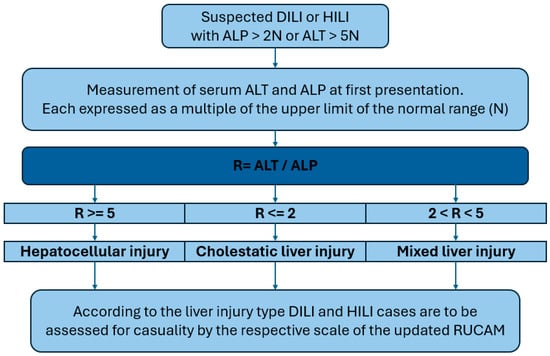
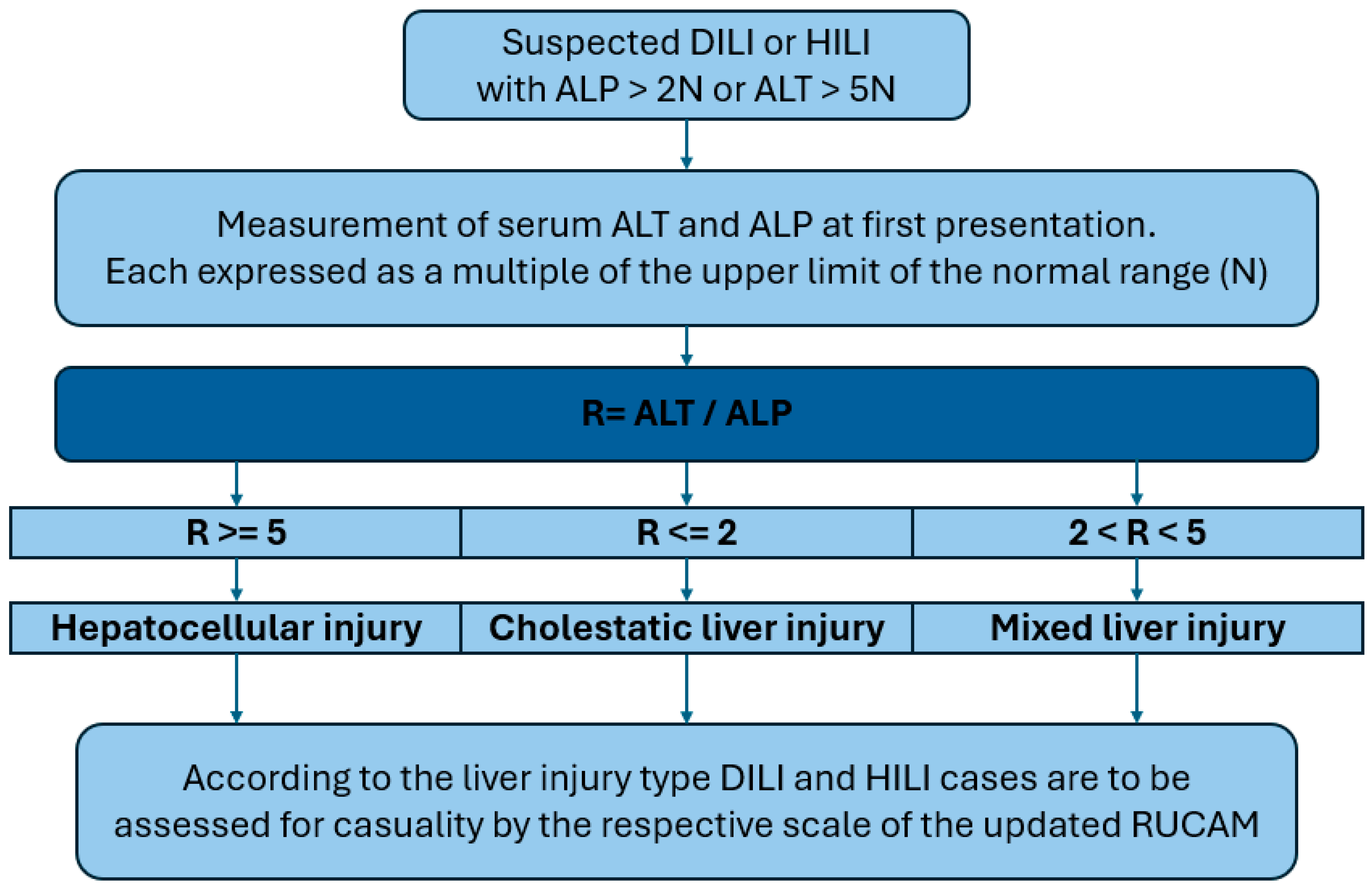
Diagnosing HILI remains a significant clinical challenge due to its nonspecific presentation and overlap with other liver diseases. Patients may present with general symptoms such as abdominal pain, bloating, weakness, jaundice, or a clinical picture resembling acute hepatitis [2]. Given the absence of specific biomarkers, diagnosis is largely based on exclusion and differential diagnosis. A detailed patient history is essential, as many individuals do not voluntarily disclose the use of herbal products. This process is guided by RUCAM, which remains the most commonly used tool for evaluating suspected cases. The RUCAM model incorporates clinical and laboratory criteria, including ALT/alkaline phosphatase (ALP) ratios, the R index, and a structured scoring system, to estimate the likelihood of herb-induced liver damage [5]. Importantly, the definition and classification of liver injury type should be established before applying the updated RUCAM (Figure 1) [5]. HILI must be differentiated from several other hepatic conditions, including viral hepatitis, alcoholic liver disease, biliary and vascular disorders, and importantly, autoimmune hepatitis (AIH) [43]. A particular diagnostic challenge arises in cases of herb-induced autoimmune hepatitis (HIAIH), a subtype of HILI characterized by overlapping features with AIH [48,49]. These include elevated serum autoantibodies, such as antinuclear antibodies (ANA), anti-smooth muscle antibodies (ASMA), and soluble liver antigen (SLA) antibodies, and liver histology showing immune cell infiltration [49]. HIAIH resembles drug-induced autoimmune hepatitis (DIAIH), where autoimmune features emerge during liver injury caused by a drug [50,51]. However, these syndromes must be carefully distinguished from idiopathic AIH, which is chronic, of unknown etiology, and typically requires long-term immunosuppressive treatment [52]. Unlike idiopathic AIH, HIAIH and DIAIH generally resolve upon withdrawal of the offending agent, and corticosteroid therapy, if needed, can usually be tapered without relapse [50,51]. In contrast, non-immune HILI reflects direct hepatotoxicity, lacking autoimmune markers and histological inflammation typical of AIH [4]. RUCAM is an objective, algorithmic, and validated tool for causality assessment; external studies have reported acceptable inter-rater reproducibility when it is applied by trained assessors [53]. However, several items remain debated, specifically the weighting of alcohol use, age (>55 years), and sex, which have not been consistently shown to add diagnostic value [54]. Persisting challenges in HILI largely reflect case documentation and product-related uncertainties rather than inherent subjectivity of the instrument: multi-ingredient formulations with variable composition, incomplete exposure timelines, missing laboratory data, and the impracticality of re-exposure can all limit attainable scores [53]. In this context, Wang et al. described a nine-step “chain of evidence” for suspected HILI, based on guidance from the China Association of Chinese Medicine (CACM) [55]. However, this framework has not been formally validated nor compared head-to-head with RUCAM, it should therefore be viewed as a pragmatic checklist to structure clinical work-up rather than a replacement for validated causality assessment. The diagnostic framework is summarized in Table 3.
Figure 1.
Classification of liver injury required for causality assessment of suspected DILI and HILI cases by the updated RUCAM. Adapted from [5], with permission from MDPI, 2025. Abbreviations: ALP, Alkaline phosphatase; ALT, Alanine aminotransferase; DILI, Drug-induced liver injury; HILI, Herb-induced liver injury; RUCAM, Roussel Uclaf Causality Assessment Method. ALT units of measure: U/L. ALP units of measure: U/L.
Table 3.
Nine-step chain of evidence for diagnosing HILI [55].
9. HILI Treatment
The primary treatment for HILI is the immediate discontinuation of the suspected herbal product, which often results in clinical improvement in most cases [56]. Supportive care is crucial and includes close monitoring of liver function and symptomatic management, as no specific antidotes exist for most herbal toxins [25]. In severe cases, such as acute liver failure, hospitalization and, in rare instances, liver transplantation may be necessary [25]. Although certain herbal and antioxidant compounds, such as silymarin, have demonstrated hepatoprotective effects in animal studies and other liver diseases, there is currently no established clinical evidence supporting their efficacy in treating HILI in humans [57]. In cases where HILI presents with autoimmune feature, the use of short-term immunosuppressive therapy, particularly corticosteroids, may be warranted [58]. Equally important is patient education, especially regarding the avoidance of re-exposure to the causative herb, as recurrent episodes can be more severe. To mitigate future risk, improved pharmacovigilance and stricter regulation of herbal products are strongly recommended [56].
10. Conclusions and Future Directions
HILI represents a growing clinical and public health concern as the global use of herbal products continues to expand. Despite increasing awareness, the current literature on HILI remains limited, compared to DILI, and clinical management is hindered by diagnostic challenges, underreporting, and inconsistent regulation. Moving forward, several strategies are critical to improving the safety and management of HILI. Stronger and more harmonized regulatory frameworks are urgently needed. This includes mandatory safety testing, clearer labeling of hepatotoxic risks, and rigorous quality control standards for herbal products. Achieving this can be challenging, due to lack of conclusive studies and methodological problems associated with HILI [29]. Improved pharmacovigilance is also essential. National and international reporting systems dedicated to herbal products-related adverse events would facilitate early detection, better data collection, and more accurate epidemiological tracking. In the current absence of specific HILI biomarkers, systematic use of the updated RUCAM provides an objective, standardized pathway to improve diagnostic certainty and comparability across centers. Embedding RUCAM into routine evaluation, alongside meticulous exposure histories, exclusion of competing etiologies, and timely dechallenge monitoring, can substantially mitigate the practical impact of biomarker scarcity and accelerate earlier recognition. Complementing this, the Revised Electronic Causality Assessment Method (RECAM) offers a web-based, user-friendly platform developed to streamline structured assessments and assist clinicians in decision-making [59]. However, RECAM has so far been validated mainly in non-herbal DILI cohorts and has not been specifically tested for HILI, meaning that it should be considered an adjunctive tool, while RUCAM continues to serve as the current reference standard [59]. Research should focus on identifying molecular or genetic markers that could predict susceptibility or confirm the source of hepatotoxicity. In this context, personalized medicine approaches also hold promise. Pharmacogenetic profiling could help identify individuals with certain HLA alleles, who are more likely to develop severe liver injury after exposure to specific herbal compounds. Education and public awareness must also be prioritized. Healthcare professionals should be trained to routinely inquire about herbal product use, especially in patients presenting with liver injury of unclear etiology. Simultaneously, public health campaigns should counteract the misconception that “natural” equates to “safe” and encourage consumers to use herbal products only with informed guidance. Multi-center registries and interdisciplinary studies focused specifically on HILI would help unify diagnostic criteria, generate high-quality data, and support evidence-based guidelines for prevention and treatment. While herb-induced liver injury continues to pose diagnostic and regulatory challenges, targeted improvements in research, clinical awareness, pharmacovigilance, and policy have the potential to significantly mitigate its impact. To strengthen global HILI surveillance and response, the creation of an international herbal hepatotoxicity registry should be considered. Additionally, the development of clinical screening checklists incorporating genetic risk factors could facilitate early identification of high-risk individuals and enable personalized preventive strategies.
Author Contributions
Conceptualization, J.J. and K.Ł.; investigation, J.J., K.Ł., A.N., A.J., A.P., J.S., Ł.I., and A.K.; data curation, J.J., K.Ł., A.N., A.J., A.P., J.S., Ł.I., and A.K.; writing—original draft preparation, J.J., K.Ł., A.N., A.J., A.P., J.S., Ł.I., and A.K.; writing—review and editing, J.J. and K.Ł.; supervision, J.J. and K.Ł.; project administration, K.Ł. and J.J.; All authors have read and agreed to the published version of the manuscript.
Funding
This research received no external funding.
Institutional Review Board Statement
Not applicable.
Informed Consent Statement
Not applicable.
Data Availability Statement
No new data were created or analyzed in this study. Data sharing is not applicable to this article.
Conflicts of Interest
The authors declare no conflicts of interest.
Abbreviations
The following abbreviations are used in this manuscript:
| ADR | Adverse Drug Reaction |
| AIH | Autoimmune Hepatitis |
| ALP | Alkaline Phosphatase |
| ALT | Alanine Aminotransferase |
| CYP450 | Cytochrome P450 |
| DAMPs | Damage-Associated Molecular Patterns |
| DILI | Drug-Induced Liver Injury |
| DNA | Deoxyribonucleic Acid |
| ER | Endoplasmic Reticulum |
| FDA | Food and Drug Administration |
| GPCRs | G Protein-Coupled Receptors |
| HBV | Hepatitis B Virus |
| HDS | Herbal and Dietary Supplements |
| HILI | Herb-Induced Liver Injury |
| HLA | Human Leukocyte Antigen |
| NDGA | Nordihydroguaiaretic Acid |
| RUCAM | Roussel Uclaf Causality Assessment Method |
References
- De Assis, M.H.; Alves, B.C.; Luft, V.C.; Dall’alba, V. Liver Injury Induced by Herbal and Dietary Supplements: A Pooled Analysis of Case Reports. Arq. Gastroenterol. 2022, 59, 522–530. [Google Scholar] [CrossRef] [Scilit] [PubMed]
- Lin, N.-H.; Yang, H.-W.; Su, Y.-J.; Chang, C.-W. Herb Induced Liver Injury after Using Herbal Medicine: A Systemic Review and Case-Control Study. Medicine 2019, 98, e14992. [Google Scholar] [CrossRef] [Scilit]
- Teschke, R.; Eickhoff, A.; Schulze, J.; Danan, G. Herb-Induced Liver Injury (HILI) with 12,068 Worldwide Cases Published with Causality Assessments by Roussel Uclaf Causality Assessment Method (RUCAM): An Overview. Transl. Gastroenterol. Hepatol. 2021, 6, 51. [Google Scholar] [CrossRef] [Scilit]
- Ma, Z.-T.; Shi, Z.; Xiao, X.-H.; Wang, J.-B. New Insights into Herb-Induced Liver Injury. Antioxid. Redox Signal. 2023, 38, 1138–1149. [Google Scholar] [CrossRef] [Scilit]
- Danan, G.; Teschke, R. RUCAM in Drug and Herb Induced Liver Injury: The Update. Int. J. Mol. Sci. 2015, 17, 14. [Google Scholar] [CrossRef] [Scilit]
- Soares, P.F.; Fernandes, M.T.C.F.; Souza, A.d.S.; Lopes, C.M.; Dos Santos, D.A.C.; Oliveira, D.P.R.; Pereira, M.G.; Prado, N.M.D.B.L.; Gomes, G.S.d.S.; Junior Santos, G.; et al. Causality Imputation between Herbal Products and HILI: An Algorithm Evaluation in a Systematic Review. Ann. Hepatol. 2021, 25, 100539. [Google Scholar] [CrossRef] [Scilit]
- Nunes, D.R.d.C.M.A.; Monteiro, C.S.d.J.; Dos Santos, J.L. Herb-Induced Liver Injury-A Challenging Diagnosis. Healthcare 2022, 10, 278. [Google Scholar] [CrossRef] [Scilit]
- Philips, C.A.; Theruvath, A.H. A Comprehensive Review on the Hepatotoxicity of Herbs Used in the Indian (Ayush) Systems of Alternative Medicine. Medicine 2024, 103, e37903. [Google Scholar] [CrossRef] [Scilit]
- Balkrishna, A.; Sharma, N.; Srivastava, D.; Kukreti, A.; Srivastava, S.; Arya, V. Exploring the Safety, Efficacy, and Bioactivity of Herbal Medicines: Bridging Traditional Wisdom and Modern Science in Healthcare. Future Integr. Med. 2024, 3, 35–49. [Google Scholar] [CrossRef] [Scilit]
- Wang, H.; Chen, Y.; Wang, L.; Liu, Q.; Yang, S.; Wang, C. Advancing Herbal Medicine: Enhancing Product Quality and Safety through Robust Quality Control Practices. Front. Pharmacol. 2023, 14, 1265178. [Google Scholar] [CrossRef] [Scilit] [PubMed]
- Woo, S.M.; Davis, W.D.; Aggarwal, S.; Clinton, J.W.; Kiparizoska, S.; Lewis, J.H. Herbal and Dietary Supplement Induced Liver Injury: Highlights from the Recent Literature. World J. Hepatol. 2021, 13, 1019–1041. [Google Scholar] [CrossRef] [Scilit]
- Herbal Medicinal Products. Available online: https://www.ema.europa.eu/en/human-regulatory-overview/herbal-medicinal-products (accessed on 22 July 2025).
- Oketch-Rabah, H.A.; Roe, A.L.; Rider, C.V.; Bonkovsky, H.L.; Giancaspro, G.I.; Navarro, V.; Paine, M.F.; Betz, J.M.; Marles, R.J.; Casper, S.; et al. United States Pharmacopeia (USP) Comprehensive Review of the Hepatotoxicity of Green Tea Extracts. Toxicol. Rep. 2020, 7, 386–402. [Google Scholar] [CrossRef] [Scilit]
- Ahmed, S. The Global Revival of Interest in the Herbal Medicine. Phytopharmacol. Com. 2022, 2, 1. [Google Scholar] [CrossRef] [Scilit]
- Heinrich, M.; Reiken, B.; Roether, B.; Müller, A.; Rumsch, J.; Symma, N. Consensus Statement on the Outcome of the European Herbal Health Products Summit—Which Way Forward? Planta Med. 2024, 90, 1052–1055. [Google Scholar] [CrossRef] [Scilit]
- Ichim, M.C.; de Boer, H.J. A Review of Authenticity and Authentication of Commercial Ginseng Herbal Medicines and Food Supplements. Front. Pharmacol. 2021, 11, 612071. [Google Scholar] [CrossRef] [Scilit]
- Cho, J.-H.; Oh, D.-S.; Hong, S.-H.; Ko, H.; Lee, N.-H.; Park, S.-E.; Han, C.-W.; Kim, S.-M.; Kim, Y.-C.; Kim, K.-S.; et al. A Nationwide Study of the Incidence Rate of Herb-Induced Liver Injury in Korea. Arch. Toxicol. 2017, 91, 4009–4015. [Google Scholar] [CrossRef] [Scilit]
- Lee, N.-H.; Lee, G.-Y.; Park, C.-R.; Kim, S.-K.; Ahn, Y.-C.; Cho, J.-H.; Son, C.-G. Risk Levels of Herb-Induced Liver Injury in Korea: From a Meta-Analysis. Integr. Med. Res. 2021, 10, 100705. [Google Scholar] [CrossRef] [Scilit]
- Wang, J.; Song, H.; Ge, F.; Xiong, P.; Jing, J.; He, T.; Guo, Y.; Shi, Z.; Zhou, C.; Han, Z.; et al. Landscape of DILI-Related Adverse Drug Reaction in China Mainland. Acta Pharm. Sin. B 2022, 12, 4424–4431. [Google Scholar] [CrossRef] [Scilit] [PubMed]
- Chirapongsathorn, S.; Sukeepaisarnjaroen, W.; Treeprasertsuk, S.; Chaiteerakij, R.; Surawongsin, P.; Hongthanakorn, C.; Siramolpiwat, S.; Chamroonkul, N.; Bunchorntavakul, C.; Chotiyaputta, W.; et al. Characteristics of Drug-Induced Liver Injury in Chronic Liver Disease: Results from the Thai Association for the Study of the Liver (THASL) DILI Registry. J. Clin. Transl. Hepatol. 2023, 11, 88–96. [Google Scholar] [CrossRef] [Scilit] [PubMed]
- Bessone, F.; García-Cortés, M.; Medina-Caliz, I.; Hernandez, N.; Parana, R.; Mendizabal, M.; Schinoni, M.I.; Ridruejo, E.; Nunes, V.; Peralta, M.; et al. Herbal and Dietary Supplements-Induced Liver Injury in Latin America: Experience from the LATINDILI Network. Clin. Gastroenterol. Hepatol. 2022, 20, e548–e563. [Google Scholar] [CrossRef] [Scilit] [PubMed]
- Björnsson, E.S.; Stephens, C.; Atallah, E.; Robles-Diaz, M.; Alvarez-Alvarez, I.; Gerbes, A.; Weber, S.; Stirnimann, G.; Kullak-Ublick, G.; Cortez-Pinto, H.; et al. A New Framework for Advancing in Drug-Induced Liver Injury Research. The Prospective European DILI Registry. Liver Int. 2023, 43, 115–126. [Google Scholar] [CrossRef] [Scilit]
- Stephens, C.; Robles-Diaz, M.; Medina-Caliz, I.; Garcia-Cortes, M.; Ortega-Alonso, A.; Sanabria-Cabrera, J.; Gonzalez-Jimenez, A.; Alvarez-Alvarez, I.; Slim, M.; Jimenez-Perez, M.; et al. Comprehensive Analysis and Insights Gained from Long-Term Experience of the Spanish DILI Registry. J. Hepatol. 2021, 75, 86–97. [Google Scholar] [CrossRef] [Scilit]
- Nwokediuko, S.C.; Osuala, P.C.; Uduma, U.V.; Alaneme, A.K.; Onwuka, C.C.; Mesigo, C. Pattern of Liver Disease Admissions in a Nigerian Tertiary Hospital. Niger. J. Clin. Pract. 2013, 16, 339–342. [Google Scholar] [CrossRef] [Scilit]
- Ballotin, V.R.; Bigarella, L.G.; de Mello Brandão, A.B.; Balbinot, R.A.; Balbinot, S.S.; Soldera, J. Herb-Induced Liver Injury: Systematic Review and Meta-Analysis. World J. Clin. Cases 2021, 9, 5490–5513. [Google Scholar] [CrossRef] [Scilit]
- Li, C.; Rao, T.; Chen, X.; Zou, Z.; Wei, A.; Tang, J.; Xiong, P.; Li, P.; Jing, J.; He, T.; et al. HLA—B*35:01 Allele Is a Potential Biomarker for Predicting Polygonum Multiflorum–Induced Liver Injury in Humans. Hepatology 2019, 70, 346–357. [Google Scholar] [CrossRef] [Scilit]
- Tan, Y.; Chen, H.; Zhou, X.; Sun, L. RUCAM-Based Assessment of Liver Injury by Xiang-Tian-Guo (Swietenia Macrophylla) Seeds, a Plant Used for Treatment of Hypertension and Diabetes. Ann. Hepatol. 2019, 18, 406–407. [Google Scholar] [CrossRef] [Scilit]
- Soares, R.B.; Dinis-Oliveira, R.J.; Oliveira, N.G. An Updated Review on the Psychoactive, Toxic and Anticancer Properties of Kava. J. Clin. Med. 2022, 11, 4039. [Google Scholar] [CrossRef] [Scilit] [PubMed]
- Stati, G.; Rossi, F.; Sancilio, S.; Basile, M.; Di Pietro, R. Curcuma Longa Hepatotoxicity: A Baseless Accusation. Cases Assessed for Causality Using RUCAM Method. Front. Pharmacol. 2021, 12, 780330. [Google Scholar] [CrossRef] [Scilit] [PubMed]
- Jing, J.; Teschke, R. Traditional Chinese Medicine and Herb-Induced Liver Injury: Comparison with Drug-Induced Liver Injury. J. Clin. Transl. Hepatol. 2018, 6, 57–68. [Google Scholar] [CrossRef] [Scilit]
- Kozielewicz, D.M.; Stalke, P.; Skrzypek, J. Drug-Induced Liver Injury. Part I: Classification, Diagnosis and Treatment. Clin. Exp. Hepatol. 2025, 11, 25–33. [Google Scholar] [CrossRef] [Scilit] [PubMed]
- Roth, R.A.; Ganey, P.E. Intrinsic versus Idiosyncratic Drug-Induced Hepatotoxicity--Two Villains or One? J. Pharmacol. Exp. Ther. 2010, 332, 692–697. [Google Scholar] [CrossRef] [Scilit] [PubMed]
- Villanueva-Paz, M.; Morán, L.; López-Alcántara, N.; Freixo, C.; Andrade, R.J.; Lucena, M.I.; Cubero, F.J. Oxidative Stress in Drug-Induced Liver Injury (DILI): From Mechanisms to Biomarkers for Use in Clinical Practice. Antioxidants 2021, 10, 390. [Google Scholar] [CrossRef] [Scilit] [PubMed]
- Fontana, R.J. Pathogenesis of Idiosyncratic Drug-Induced Liver Injury and Clinical Perspectives. Gastroenterology 2014, 146, 914–928. [Google Scholar] [CrossRef] [Scilit] [PubMed]
- Allison, R.; Guraka, A.; Shawa, I.T.; Tripathi, G.; Moritz, W.; Kermanizadeh, A. Drug Induced Liver Injury—A 2023 Update. J. Toxicol. Environ. Health B Crit. Rev. 2023, 26, 442–467. [Google Scholar] [CrossRef] [Scilit]
- Ananthula, S.; Krishnaveni Sivakumar, K.; Cardone, M.; Su, S.; Roderiquez, G.; Abuzeineh, H.; Kleiner, D.E.; Norcross, M.A.; Puig, M. Development of Mouse Models with Restricted HLA-B∗57:01 Presentation for the Study of Flucloxacillin-Driven T-Cell Activation and Tolerance in Liver Injury. J. Allergy Clin. Immunol. 2023, 152, 486–499.e7. [Google Scholar] [CrossRef] [Scilit]
- Katarey, D.; Verma, S. Drug-Induced Liver Injury. Clin. Med. 2016, 16, s104–s109. [Google Scholar] [CrossRef] [Scilit]
- Zhu, J.; Seo, J.-E.; Wang, S.; Ashby, K.; Ballard, R.; Yu, D.; Ning, B.; Agarwal, R.; Borlak, J.; Tong, W.; et al. The Development of a Database for Herbal and Dietary Supplement Induced Liver Toxicity. Int. J. Mol. Sci. 2018, 19, 2955. [Google Scholar] [CrossRef] [Scilit]
- Liu, C.; Fan, H.; Li, Y.; Xiao, X. Research Advances on Hepatotoxicity of Herbal Medicines in China. Biomed. Res. Int. 2016, 2016, 7150391. [Google Scholar] [CrossRef] [Scilit]
- Li, D.; Yang, M.; Zuo, Z. Overview of Pharmacokinetics and Liver Toxicities of Radix Polygoni Multiflori. Toxins 2020, 12, 729. [Google Scholar] [CrossRef] [Scilit]
- Halegoua-DeMarzio, D.; Navarro, V.; Barnhart, H.; Bonkovsky, H.L.; Fontana, R.; Hayashi, P.; Koh, C.; Likhitsup, A.; Serrano, J.; Stolz, A.; et al. S1670 A Recent Epidemiologic Shift in Herbal and Dietary Supplement-Induced Liver Injury: Two Decades of Experience from the US Drug-Induced Liver Injury Network. Am. J. Gastroenterol. 2024, 119, S1217–S1218. [Google Scholar] [CrossRef] [Scilit]
- Byeon, J.-H.; Kil, J.-H.; Ahn, Y.-C.; Son, C.-G. Systematic Review of Published Data on Herb Induced Liver Injury. J. Ethnopharmacol. 2019, 233, 190–196. [Google Scholar] [CrossRef] [Scilit]
- Fontana, R.J.; Liou, I.; Reuben, A.; Suzuki, A.; Fiel, M.I.; Lee, W.; Navarro, V. AASLD Practice Guidance on Drug, Herbal, and Dietary Supplement-Induced Liver Injury. Hepatology 2023, 77, 1036–1065. [Google Scholar] [CrossRef] [Scilit]
- Teschke, R.; Larrey, D.; Melchart, D.; Danan, G. Traditional Chinese Medicine (TCM) and Herbal Hepatotoxicity: RUCAM and the Role of Novel Diagnostic Biomarkers Such as MicroRNAs. Medicines 2016, 3, 18. [Google Scholar] [CrossRef] [Scilit]
- Teschke, R.; Danan, G. Advances in Idiosyncratic Drug-Induced Liver Injury Issues: New Clinical and Mechanistic Analysis Due to Roussel Uclaf Causality Assessment Method Use. Int. J. Mol. Sci. 2023, 24, 10855. [Google Scholar] [CrossRef] [Scilit]
- Veatch-Blohm, M.E.; Chicas, I.; Margolis, K.; Vanderminden, R.; Gochie, M.; Lila, K. Screening for Consistency and Contamination within and between Bottles of 29 Herbal Supplements. PLoS ONE 2021, 16, e0260463. [Google Scholar] [CrossRef] [Scilit] [PubMed]
- Patel-Rodrigues, P.A.; Cundra, L.; Alhaqqan, D.; Gildea, D.T.; Woo, S.M.; Lewis, J.H. Herbal- and Dietary-Supplement-Induced Liver Injury: A Review of the Recent Literature. Livers 2024, 4, 94–118. [Google Scholar] [CrossRef] [Scilit]
- Andrade, R.J.; Aithal, G.P.; de Boer, Y.S.; Liberal, R.; Gerbes, A.; Regev, A.; Terziroli Beretta-Piccoli, B.; Schramm, C.; Kleiner, D.E.; De Martin, E.; et al. Nomenclature, Diagnosis and Management of Drug-Induced Autoimmune-like Hepatitis (DI-ALH): An Expert Opinion Meeting Report. J. Hepatol. 2023, 79, 853–866. [Google Scholar] [CrossRef] [Scilit] [PubMed]
- Björnsson, E.S.; Medina-Caliz, I.; Andrade, R.J.; Lucena, M.I. Setting up Criteria for Drug-Induced Autoimmune-like Hepatitis through a Systematic Analysis of Published Reports. Hepatol. Commun. 2022, 6, 1895–1909. [Google Scholar] [CrossRef] [Scilit]
- Teschke, R.; Eickhoff, A.; Danan, G. Drug-Induced Autoimmune Hepatitis: Robust Causality Assessment Using Two Different Validated and Scoring Diagnostic Algorithms. Diagnostics 2025, 15, 1588. [Google Scholar] [CrossRef] [Scilit]
- Teschke, R. Immunology Highlights of Four Major Idiosyncratic DILI Subtypes Verified by the RUCAM: A New Evidence-Based Classification. Livers 2025, 5, 8. [Google Scholar] [CrossRef] [Scilit]
- Sebode, M.; Hartl, J.; Vergani, D.; Lohse, A.W. The International Autoimmune Hepatitis Group (IAIHG) Autoimmune Hepatitis: From Current Knowledge and Clinical Practice to Future Research Agenda. Liver Int. 2018, 38, 15–22. [Google Scholar] [CrossRef] [Scilit]
- Teschke, R.; Danan, G. Idiosyncratic DILI and RUCAM under One Hat: The Global View. Livers 2023, 3, 397–433. [Google Scholar] [CrossRef] [Scilit]
- Rochon, J.; Protiva, P.; Seeff, L.B.; Fontana, R.J.; Liangpunsakul, S.; Watkins, P.B.; Davern, T.; McHutchison, J.G. Drug-Induced Liver Injury Network (DILIN) Reliability of the Roussel Uclaf Causality Assessment Method for Assessing Causality in Drug-Induced Liver Injury. Hepatology 2008, 48, 1175–1183. [Google Scholar] [CrossRef] [Scilit]
- Wang, J.-B.; Zhu, Y.; Bai, Z.-F.; Wang, F.-S.; Li, X.-H.; Xiao, X.-H. Branch Committee of Hepatobiliary Diseases and Branch Committee of Chinese Patent Medicines, China Association of Chinese Medicine Guidelines for the Diagnosis and Management of Herb-Induced Liver Injury. Chin. J. Integr. Med. 2018, 24, 696–706. [Google Scholar] [CrossRef] [Scilit] [PubMed]
- Reyes, J.V.M.; Khan, H.; Seen, T.; Ahmad, S. S2646 Herbal Supplement-Induced Liver Injury: A Case Series. Am. J. Gastroenterol. 2021, 116, S1110. [Google Scholar] [CrossRef] [Scilit]
- Rani, J.; Dhull, S.B.; Rose, P.K.; Kidwai, M.K. Drug-Induced Liver Injury and Anti-Hepatotoxic Effect of Herbal Compounds: A Metabolic Mechanism Perspective. Phytomedicine 2024, 122, 155142. [Google Scholar] [CrossRef] [Scilit] [PubMed]
- Mathavan, A.; Mathavan, A.; Krekora, U.; Daily, K. Immune-Mediated Herb-Induced Liver Injury: A Potential Association with Herbal Artemisinin Use as Supported by the Updated RUCAM. BMJ Case Rep. 2023, 16, e251852. [Google Scholar] [CrossRef] [Scilit]
- Hayashi, P.H.; Lucena, M.I.; Fontana, R.J. RECAM: A New and Improved, Computerized Causality Assessment Tool for DILI Diagnosis. Am. J. Gastroenterol. 2022, 117, 1387–1389. [Google Scholar] [CrossRef] [Scilit] [PubMed]

Disclaimer/Publisher’s Note: The statements, opinions and data contained in all publications are solely those of the individual author(s) and contributor(s) and not of MDPI and/or the editor(s). MDPI and/or the editor(s) disclaim responsibility for any injury to people or property resulting from any ideas, methods, instructions or products referred to in the content. |
© 2025 by the authors. Licensee MDPI, Basel, Switzerland. This article is an open access article distributed under the terms and conditions of the Creative Commons Attribution (CC BY) license (https://creativecommons.org/licenses/by/4.0/).