

Development of a Risk Assessment Method Under the Multi-Hazard of Earthquake and Tsunami for a Nuclear Power Plant †
 and
and
Abstract
1. Introduction
2. Framework for Assessing Plant Risk Under the Superposition of Earthquake and Tsunami
2.1. Prerequisite for Development of an Evaluation Methodology
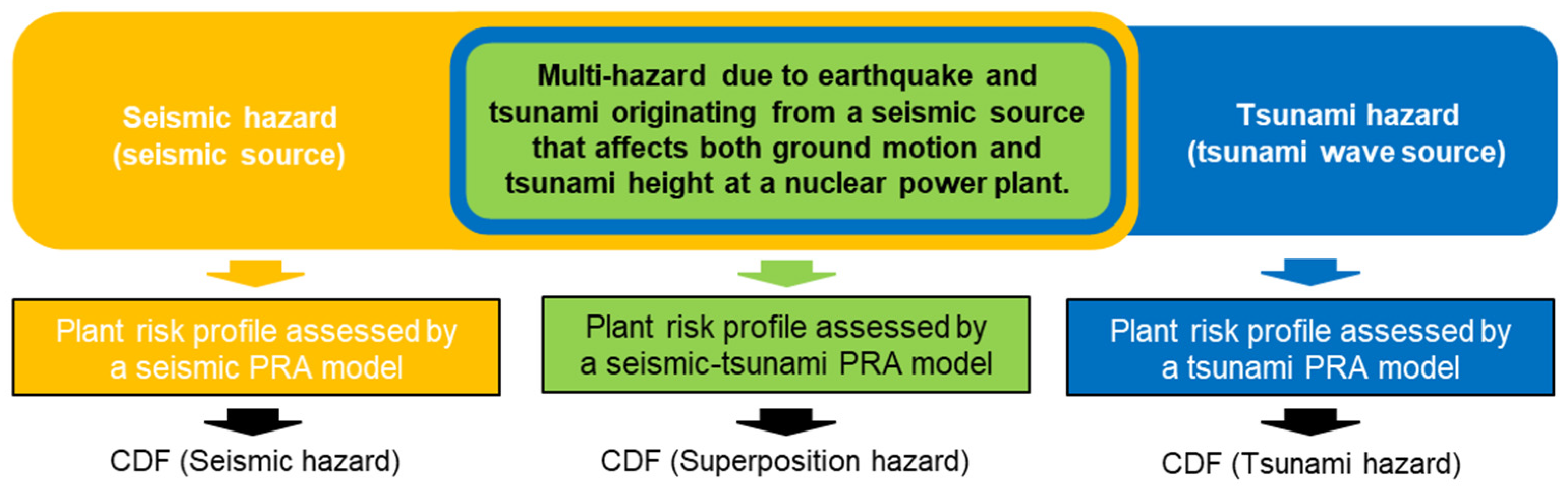
2.2. Relationship Between Independent Events and Superposition Events

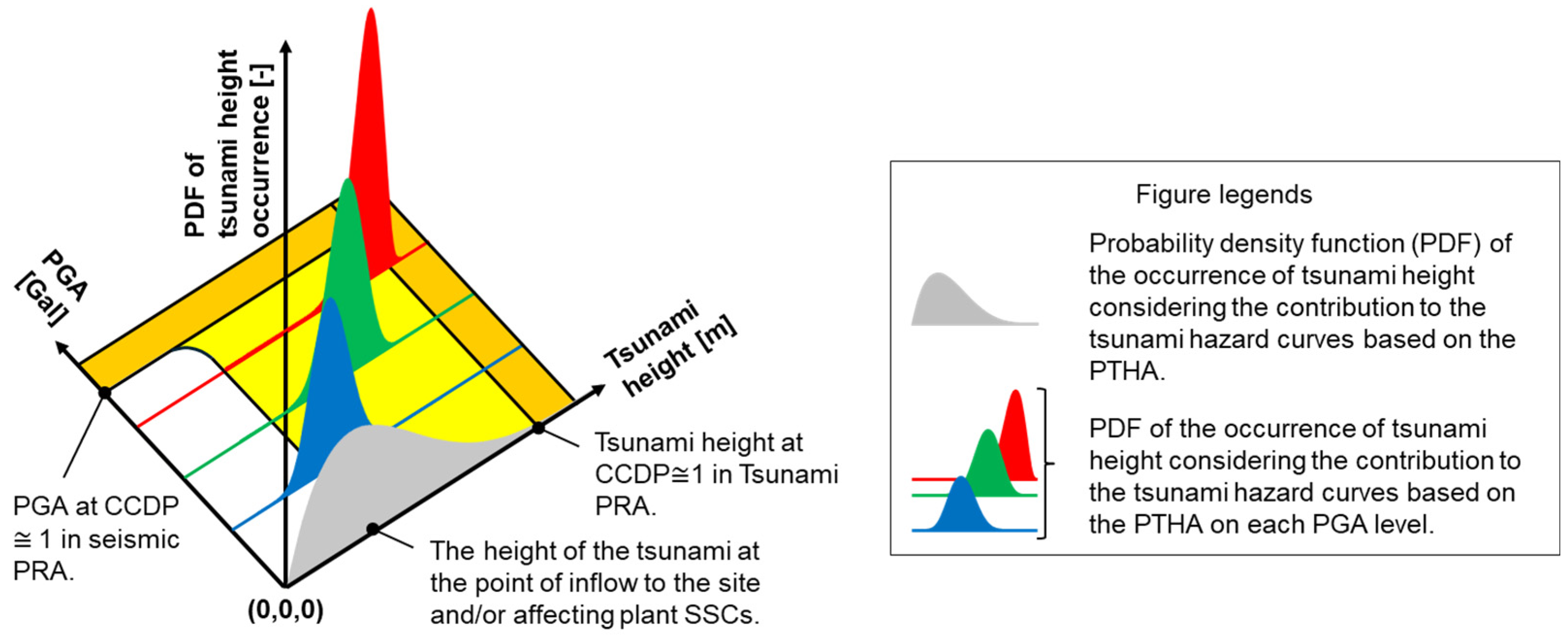
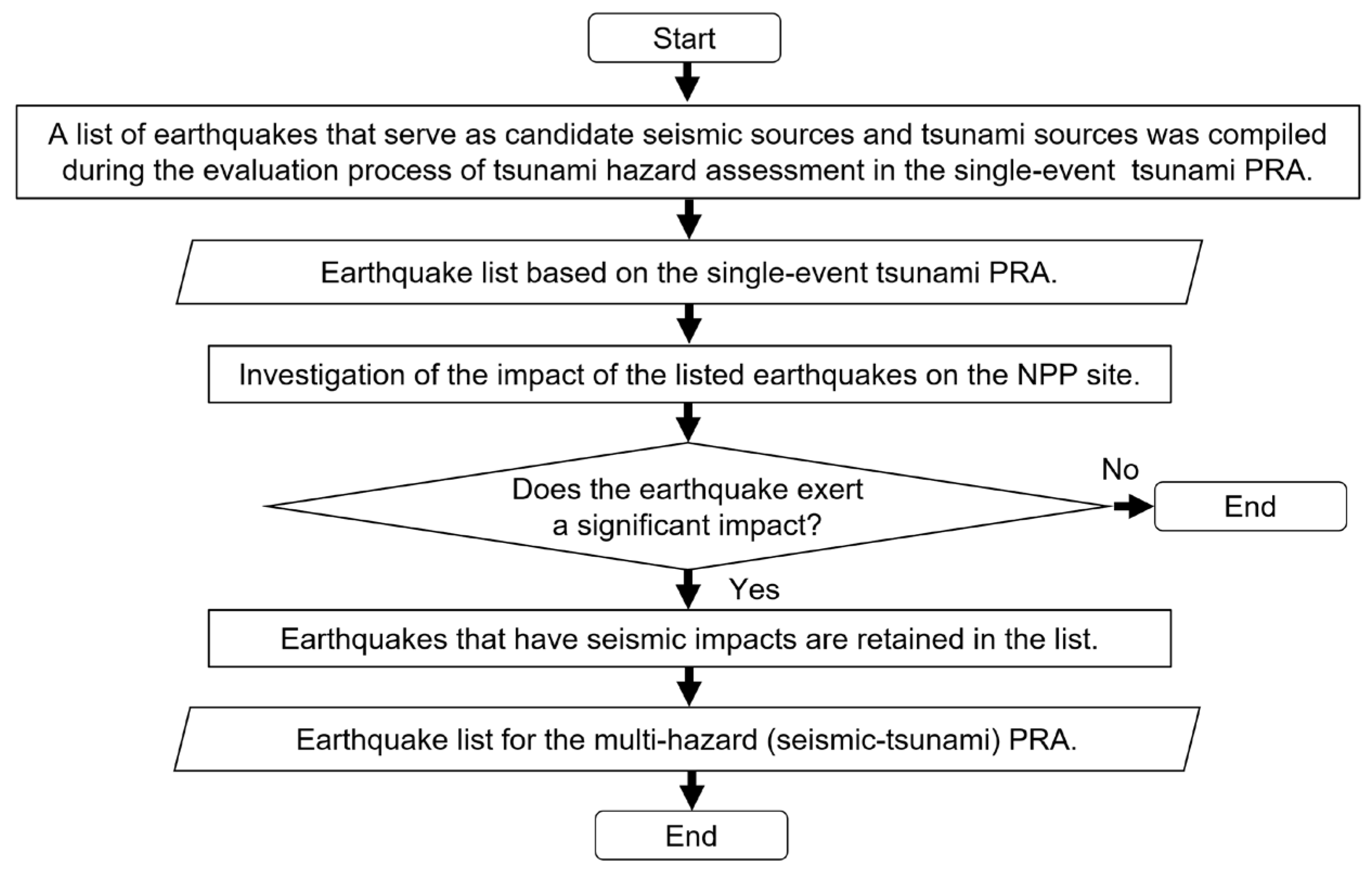
2.3. Range of Hazard Input Levels on the Seismic-Tsunami PRA
2.4. Fundamental Considerations Under the Multi-Hazard of Earthquake and Tsunami
- Occurrence of IEs due to preceding hazards, and damage or degradation of accident mitigation systems.
- Damage or degradation of tsunami protection equipment caused by preceding hazards.
- Complex accident scenarios unique to the multi-hazard conditions, as influenced by the two aforementioned factors.
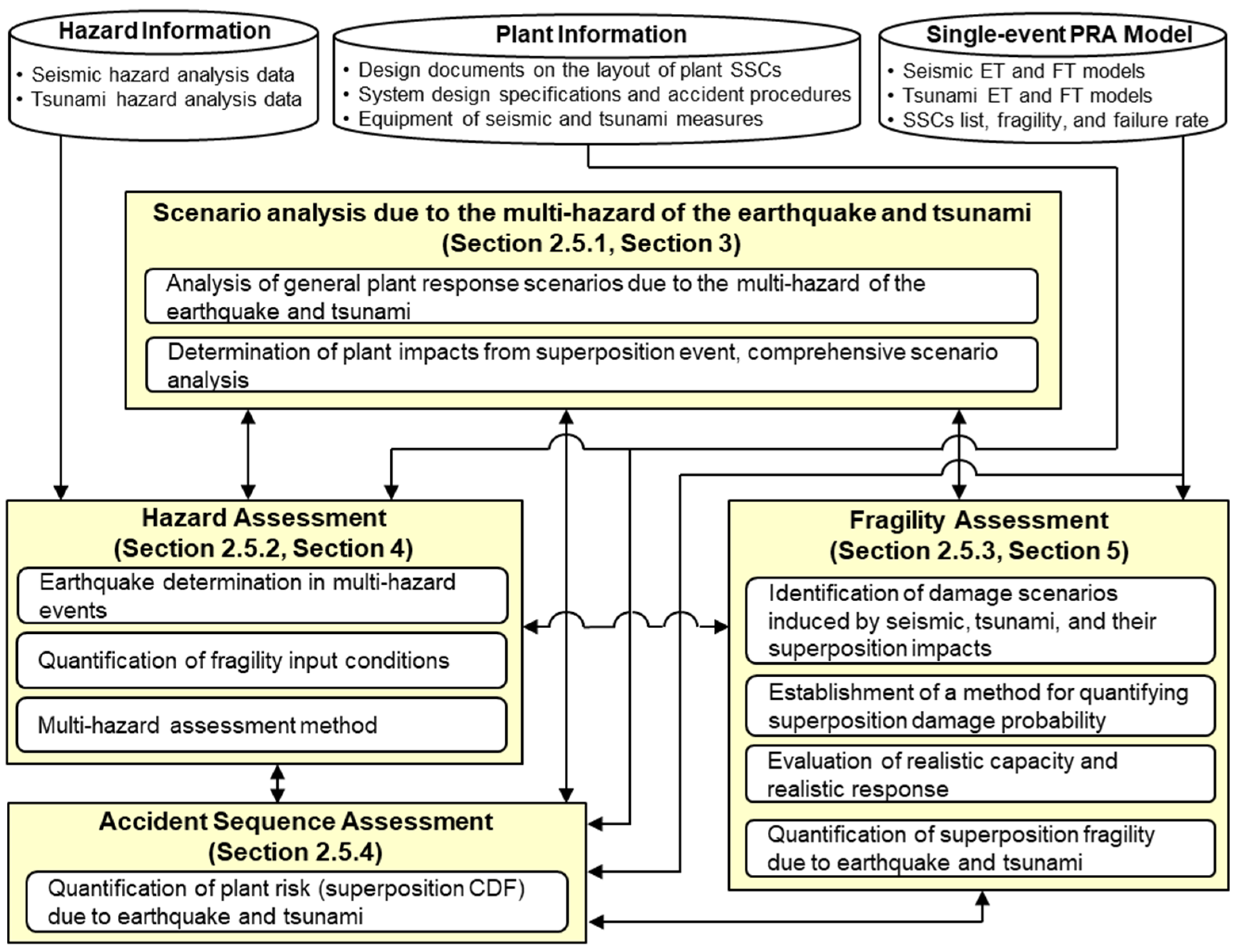
2.5. Framework of the Risk Assessment Under the Multi-Hazard of Earthquake and Tsunami
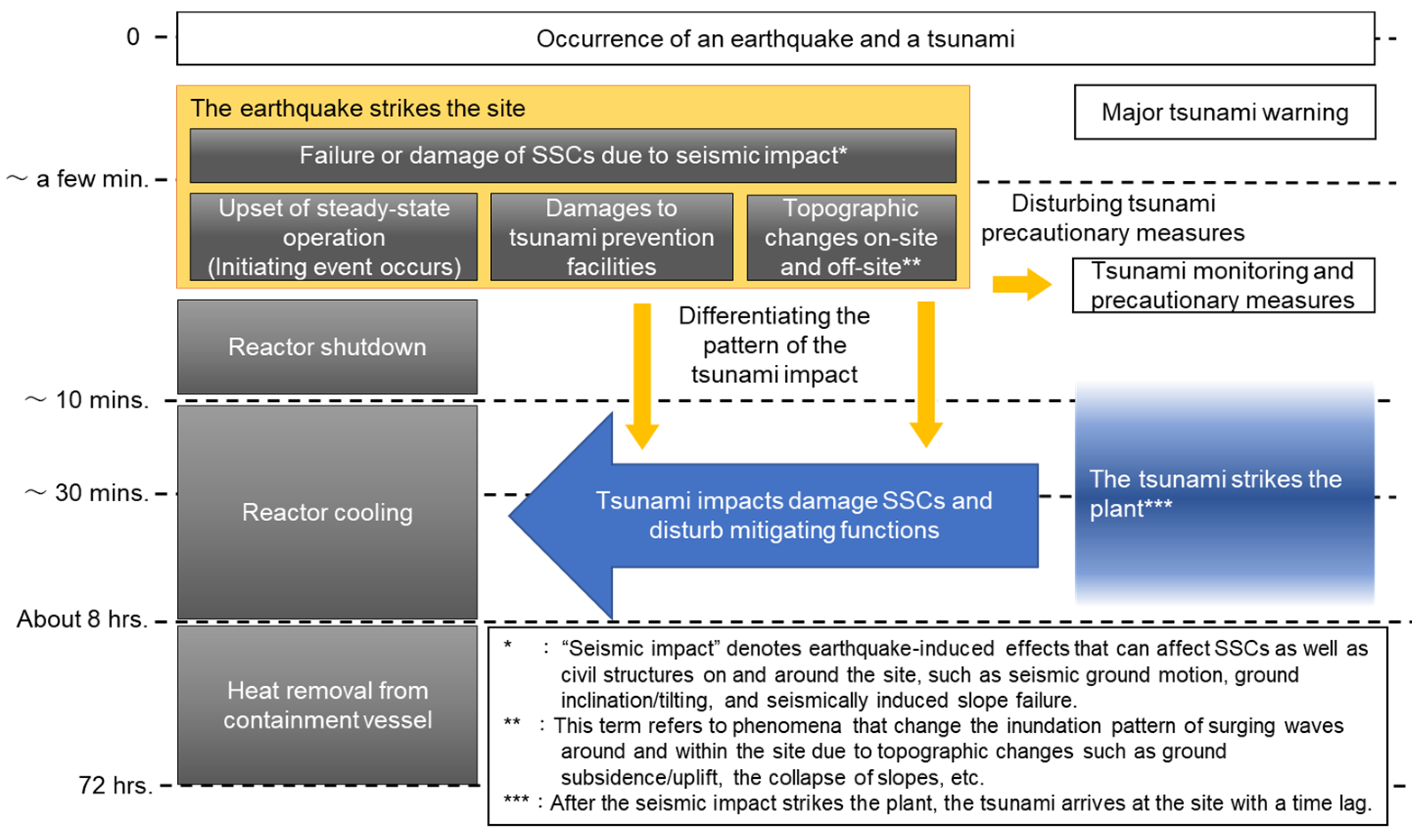
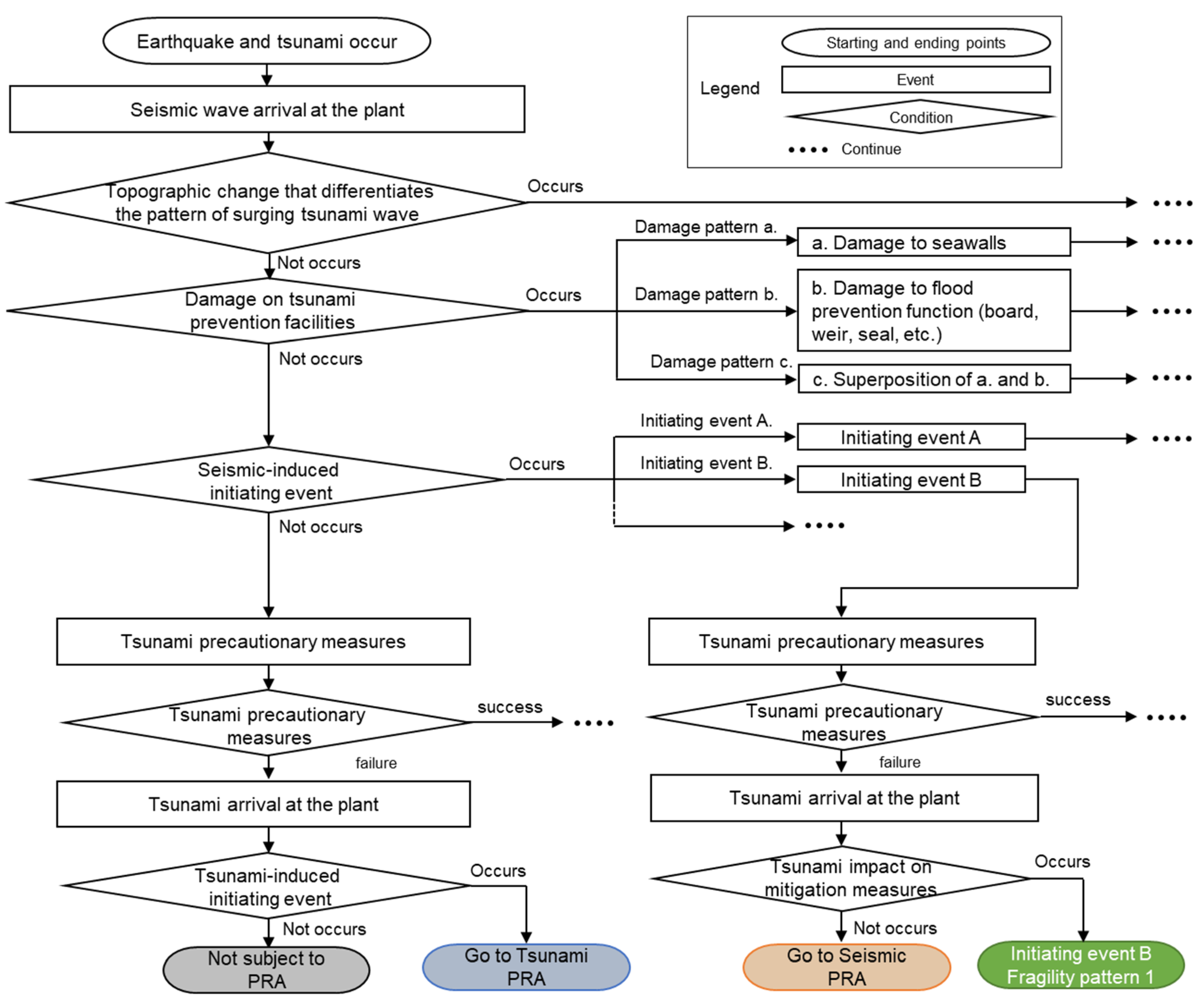
2.5.1. Analysis of General Plant Response Scenarios Due to the Multi-Hazard of Earthquake and Tsunami
2.5.2. Hazard Assessment
- (1)
- Quantification of the Multi-hazard of Earthquake and Tsunami

- (2)
- Quantification of Fragility Input Conditions
2.5.3. Site and Plant Condition Surveys Under the Multi-Hazard of Earthquake and Tsunami
2.5.4. Fragility Assessment
2.5.5. Accident Sequence Assessment
3. Methodology of Superposition Scenario Analysis

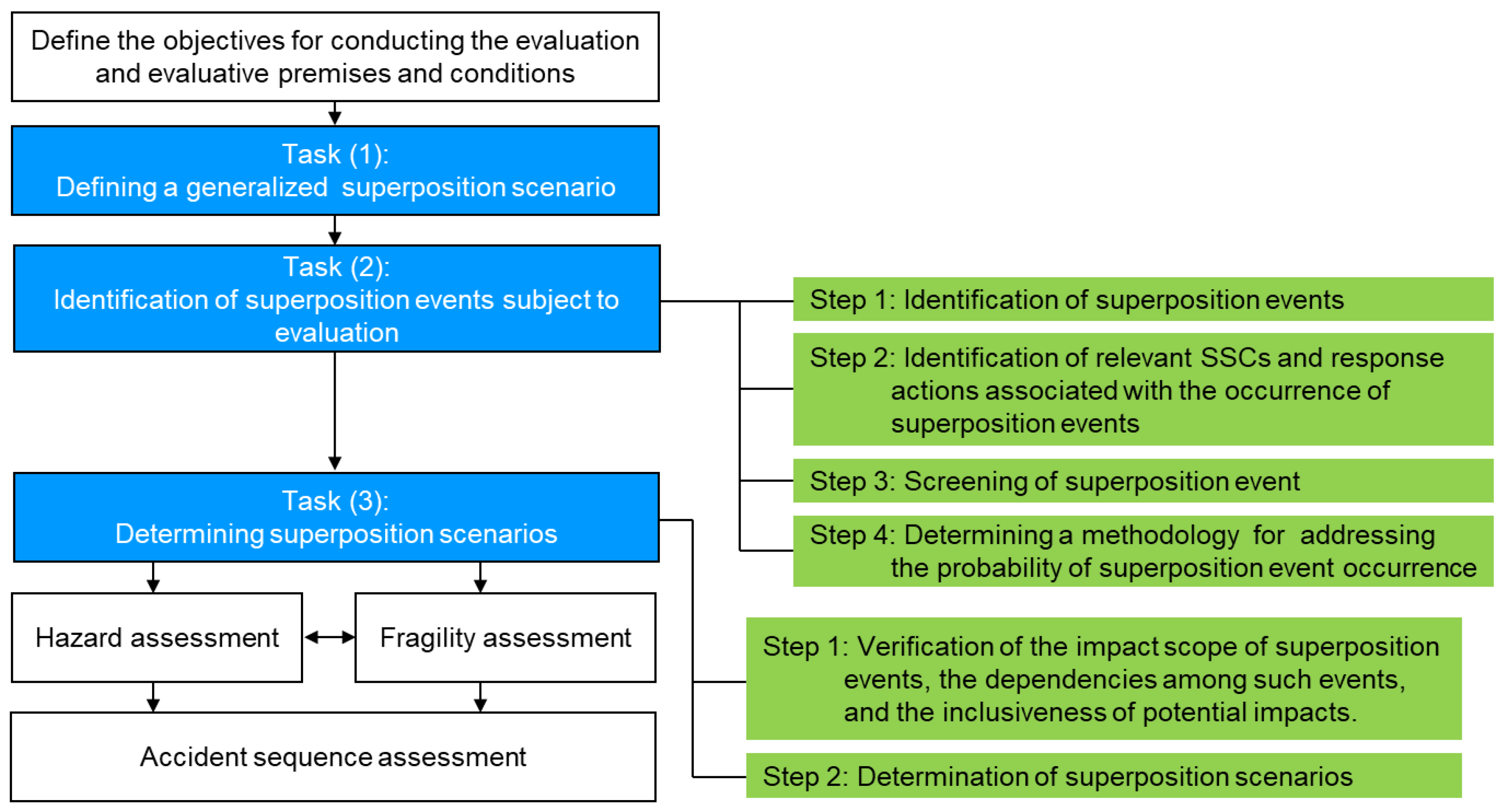
3.1. Task (1): Defining a Generalized Superposition Scenarios
3.2. Task (2): Identification of Superposition Events Subject to Evaluation
- Changes in the behavior of subsequent hazards caused by the influence of preceding hazards acting on the plant.
- Tsunami inundation conditions influenced by ground deformation, differing from those caused by a single hazard.
- Tsunami inundation conditions that differ from those caused by a single hazard, due to the impact of preceding hazards or damage to tsunami protection facilities resulting from combined hazard effects.
- Changes in the characteristics of subsequent hazard impacts due to the influence of preceding hazards acting on the plant.
- Damage to SSCs, including secondary effects, caused by the impact of preceding hazards or by combined hazard effects that results in conditions that differ from those under single-hazard scenarios.
- Accident response conditions differ from those under single-hazard scenarios, due to the impact of preceding hazards or the combined effects of the multi-hazards.
- Impact on accident response due to differences in hazard arrival times.
- Events and scenarios arising from a combination of aspects 1 and 2.

| General Superposition Events | |
|---|---|
| 1 | Change in the route of tsunami arrival at the site due to seismic damage to civil engineering structures around the site. |
| 2 | Change in tsunami behavior due to ground deformation (uplift/subsidence) over the entire site. |
| 3 | Damage to tsunami protection facilities due to rock slope collapse caused by seismic motion. |
| 4 | Changes in site inundation behavior due to seismic or superposed impacts on the tsunami prevention facility or drainage facilities. |
| 5 | Change in tsunami propagation path due to topographical changes in the site (landslide, etc.). |
| 6 | Damage to outdoor SSCs by superposed impacts. |
| 7 | Water intake function failure due to seismic-induced sloshing. |
| 8 | Generation of drifting of outdoor SSCs damaged by seismic impact (or superposed impact). |
| 9 | Inundation of buildings and propagation of tsunamis between buildings due to damage to tsunami inundation protection facilities caused by seismic impact (or superposed impact). |
| 10 | Change in the tsunami propagation path inside the building due to damage to internal flooding prevention equipment, etc., caused by seismic impacts (or superposed impacts). |
| 11 | Damage to indoor SSCs by superposed impacts. |
| 12 | Generation of new inundation paths or bypassing of inundation due to inundation in the system and containment due to damage to storage tanks, piping, containment, etc., caused by seismic impacts (or superposed impacts). |
| 13 | Tsunami inundation due to damage to the building structural wall caused by seismic impacts (or superposed impacts). |
| 14 | Impact of seismic impacts on tsunami protection response and countermeasures. |
| 15 | Changes in post-earthquake evacuation response and routes under superposition events. |
| 16 | Damage to facilities to ensure water intake when water levels drop due to seismic motion (or superposed action). |
| 17 | Restoration of work sites, access routes, and other areas that are newly generated or are more complicated than when a single hazard was present due to superposition events. |
| 18 | The actions for accident mitigation differ from those for a single hazard because hazards are superposed. |
| 19 | Interruption of accident management or damage to mitigation facilities due to the tsunami arrival during the response to an accident caused by an earthquake |
| 20 | Insufficient resources (equipment, personnel, time margin) when responding to superposed seismic and tsunami impacts. |
- Screening based on the defined scope and the potential for simultaneous occurrence of initiating events.
- The applicability of the event should be evaluated to determine whether it falls outside the scope of the multi-hazard PRA to be conducted.
- As a result of the detailed examination, it may be determined that the SSCs and related components are not associated with the occurrence of superposition events.
- Verification is required to determine whether the equipment is installed in a location that is demonstrably unaffected by potential hazards.
- An evaluation is required to determine whether the capacity of other SSCs, which may contribute to the same superposition event, is significantly lower than that of the SSCs under consideration.
- 2.
- Screening based on the impact difference depending on event occurrence.
- 3.
- Screening based on capacity/fragility.
3.3. Task (3): Determining Superposition Scenarios
3.3.1. Step 1: Confirmation of the Scope of Influence of Superposition Events, the Dependency Between Superposition Events, and the Envelopment of Their Effects
- Scope of impact of superposition events.
- Utilized to assess the necessity of introducing scenario branching in the development of multi-hazard scenarios.
- Dependence among events and potential common cause factors.
- Utilized to establish the order of scenario branching during the development of superposition scenarios.
- Inclusiveness of potential impacts.
- Utilized to investigate the necessity of incorporating scenario branching and to establish representative superposition scenarios for evaluation.
3.3.2. Step 2: Determination of Superposition Scenarios

4. Proposal of Simplified Multi-Hazard Assessment Method
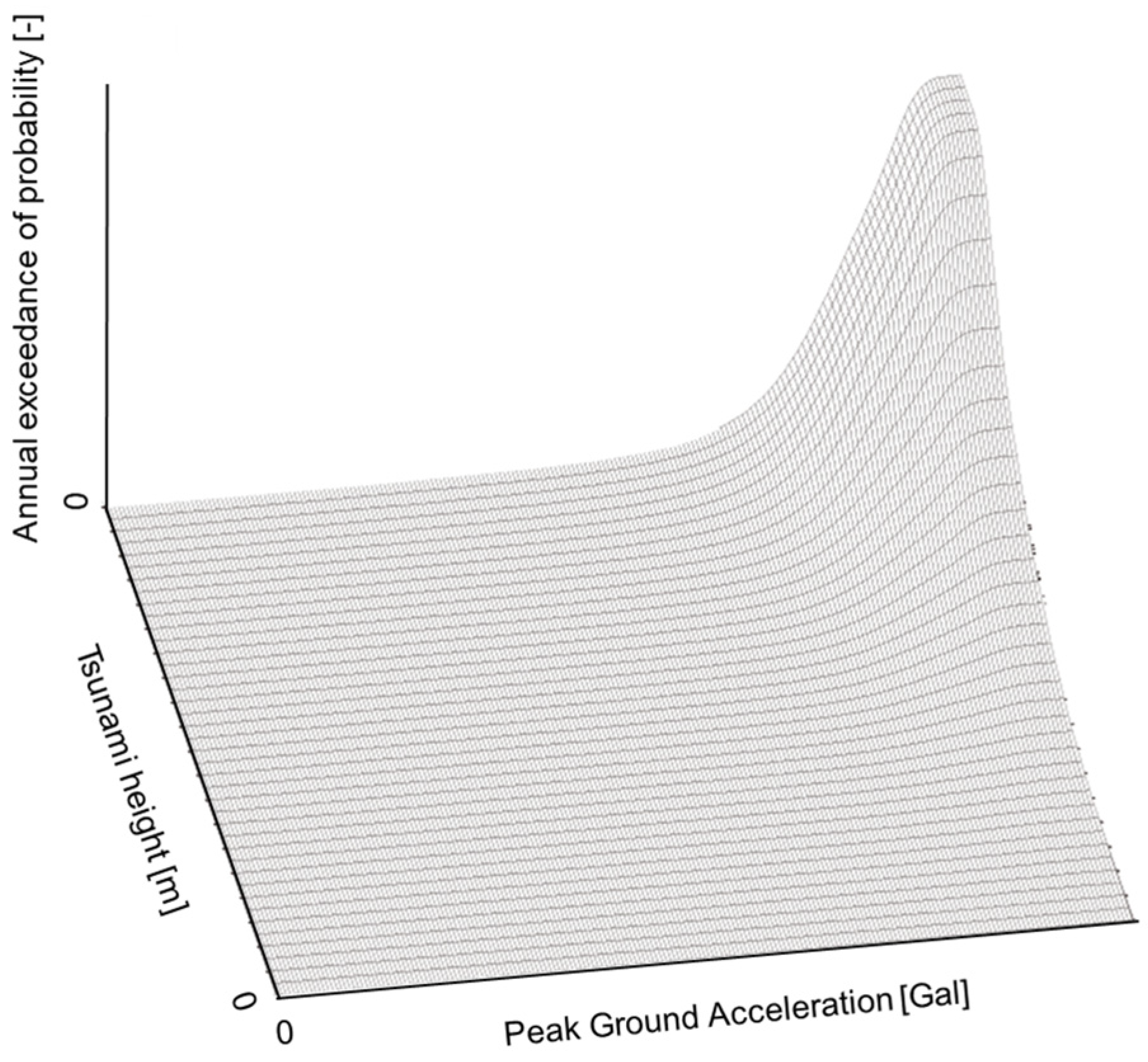
- Probability density function of seismic ground motion level variability: provided by the model used in the single-event PSHA.
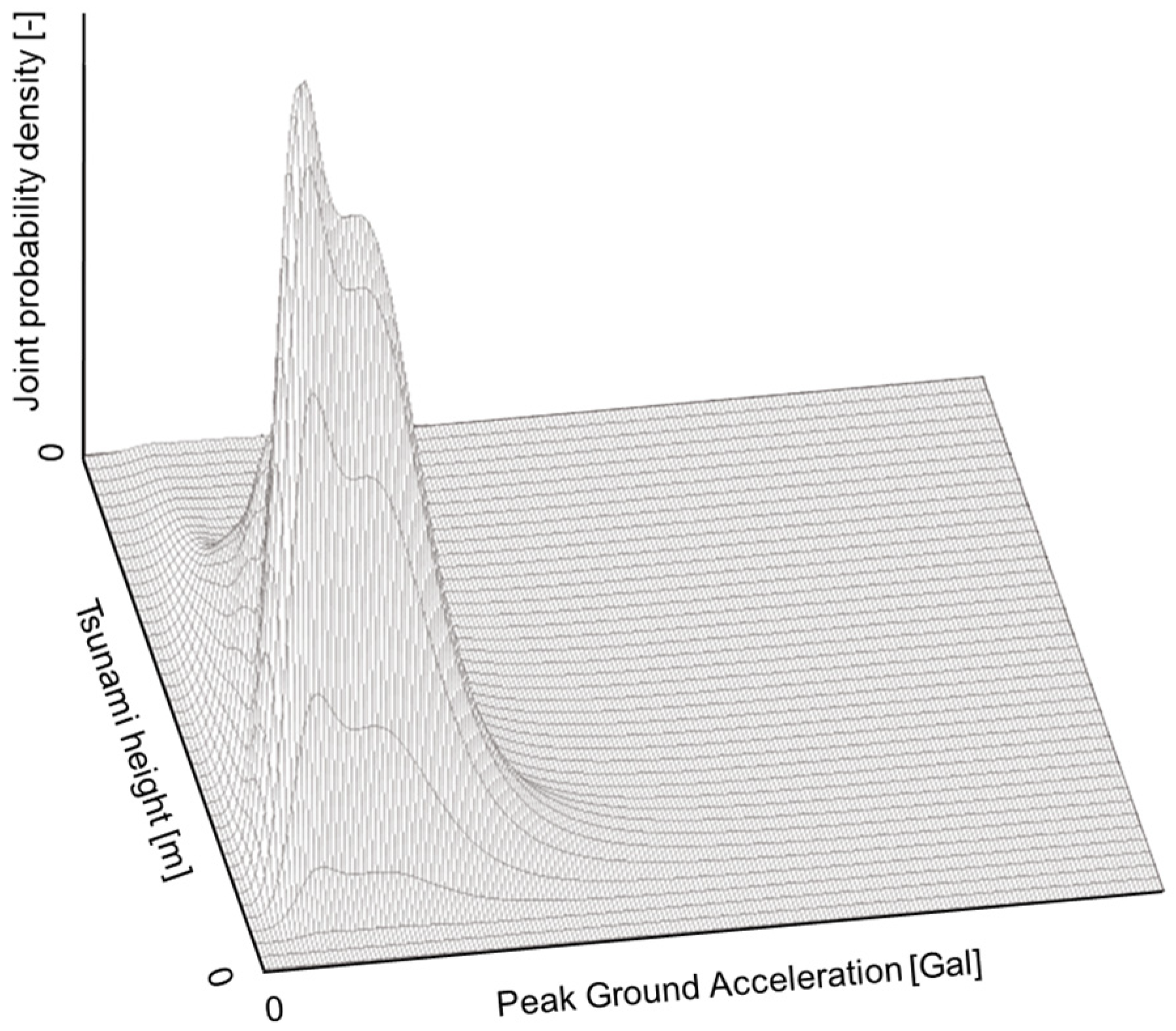
- Joint probability density function of the variability in seismic ground motion intensity and tsunami height : provided in the form of a joint probability density function defined by the combination of variability from the seismic ground motion model and the tsunami height model.
- Probability that seismic ground motion intensity falls within the interval < < : this represents the exceedance probability within a specified ground motion intensity range and is calculated and output by the probabilistic seismic hazard analysis (PSHA).
- Probability that tsunami height exceeds a given value h: this represents the exceedance probability of tsunami height over a specified threshold h and is calculated and output through probabilistic tsunami hazard analysis (PTHA).
- (a)
- The uncertainty in seismic ground motion intensity is represented by the dispersion around the median predicted by the GMPE adopted in the seismic ground motion model based on single-event PSHA.
- (b)
- The uncertainty in tsunami height is adopted from the logic tree used in the single-event PTHA.
5. Development of a Multi-Hazard Fragility Assessment Method
- Determination of damaged parts and damage modes.
- Investigate the spatial layout, structure, and functions of the SSCs under assessment, including the inundation protection equipment, seismic capacity, tsunami capacity, and tsunami inundation routes, to identify the damaged parts and damage modes of the SSCs.
- Analysis of superposition damage scenario.
- Investigate the impact of seismic effects from a single hazard (earthquake) on the damaged parts and damage modes of functional systems affected by post-earthquake tsunamis. Furthermore, identify the dependency and envelope relationships between the events and their effects.
- Establishment of a method for quantifying superposition damage probability.
- Establish a method for quantifying realistic capacity and response under superposition events, which is based on the analysis of damaged parts, damage modes, and superposition damage scenarios.
- Assessment of superposition damage probability.
- The damage probability is derived from ultimate-strength tests, numerical analysis, and other relevant methods that implement the approach established in the preceding step.
5.1. Multi-Hazard Fragility Assessment for the Same Damaged Part and Damage Mode
5.1.1. SSCs Subject to Evaluation
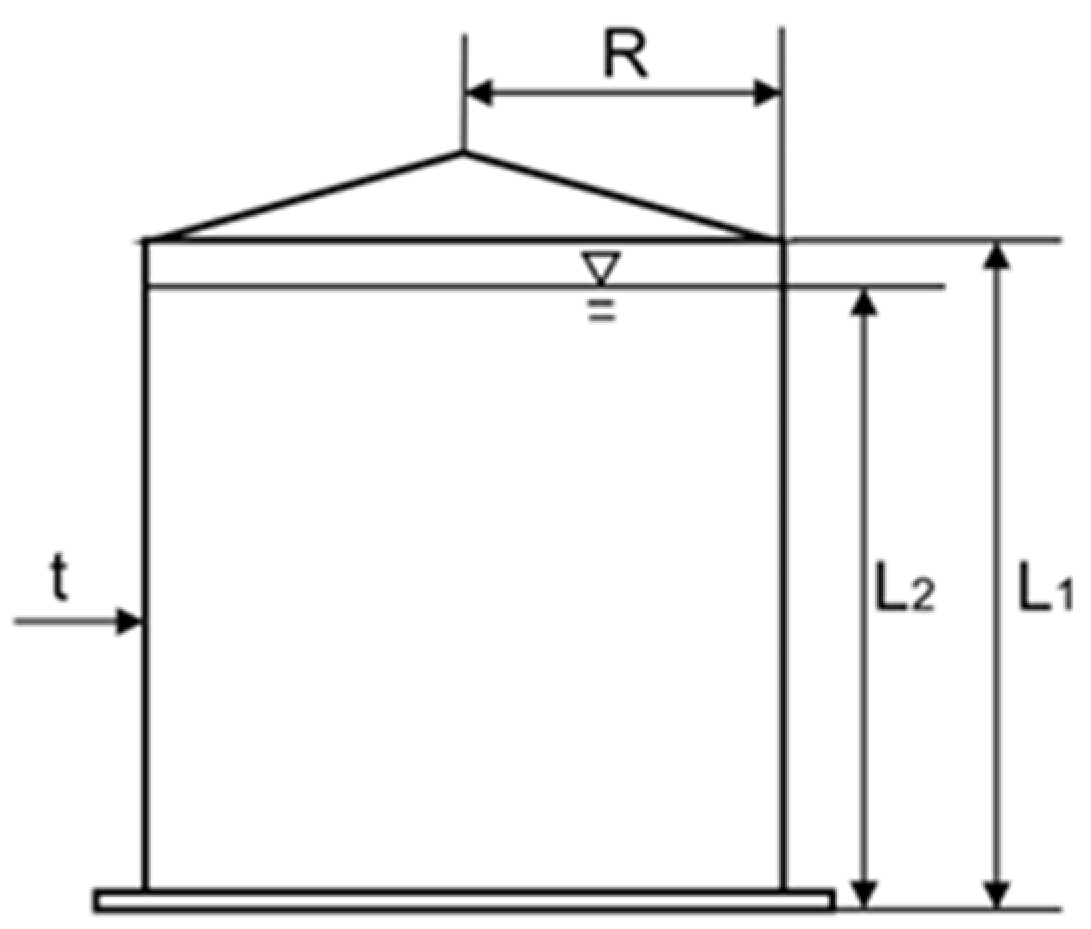
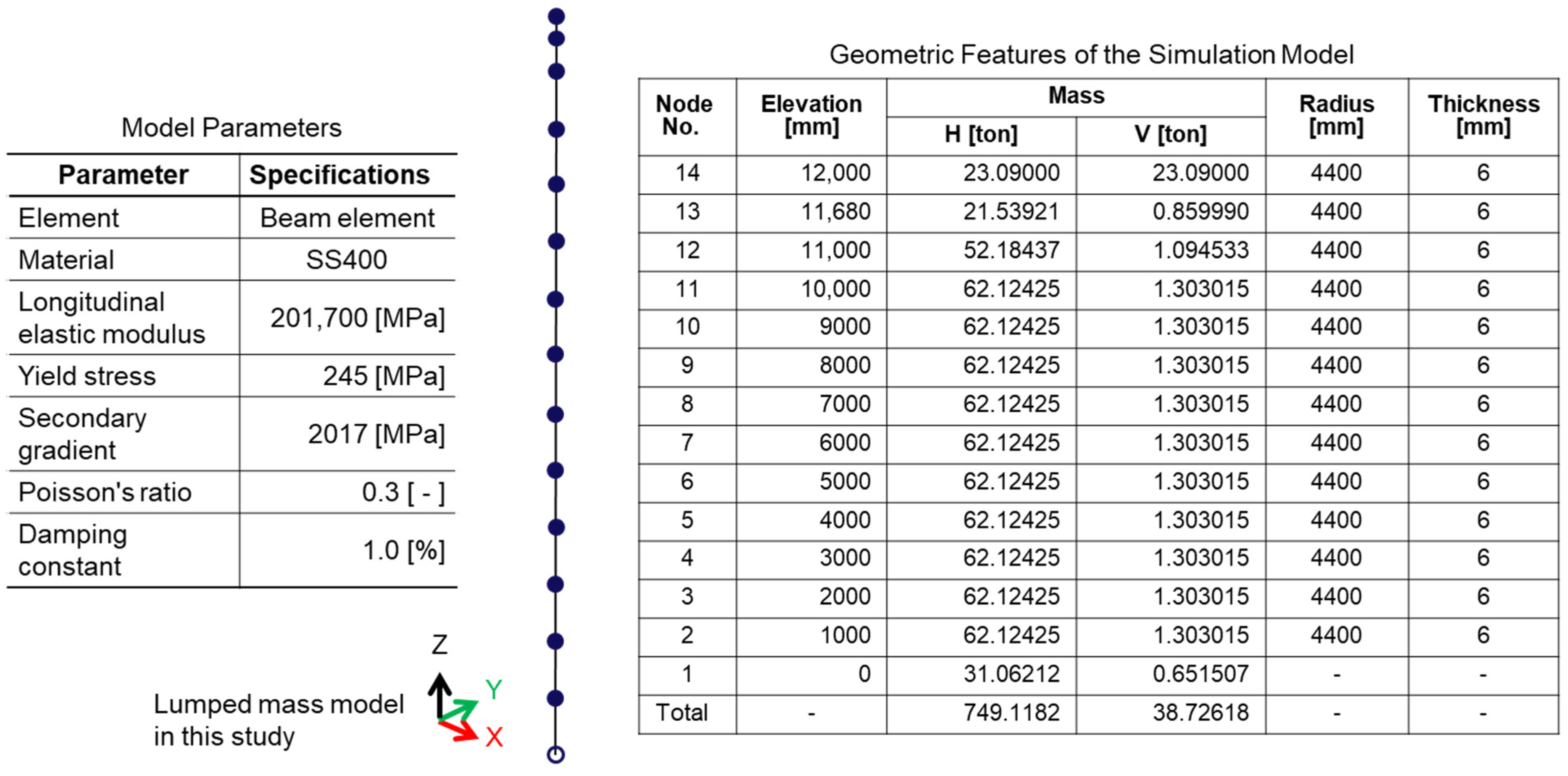
| Item | Specification |
|---|---|
|
Material
(Body plate, Anchor bolt) | SS400 |
| Plate thickness t [mm] | 6 |
| Height L1 [mm] | 12,000 |
| Liquid level (Height) L2 [mm] | 11,680 |
| Radius R [mm] | 4400 |
| R/t | 733 |
| L1/R | 2.73 |

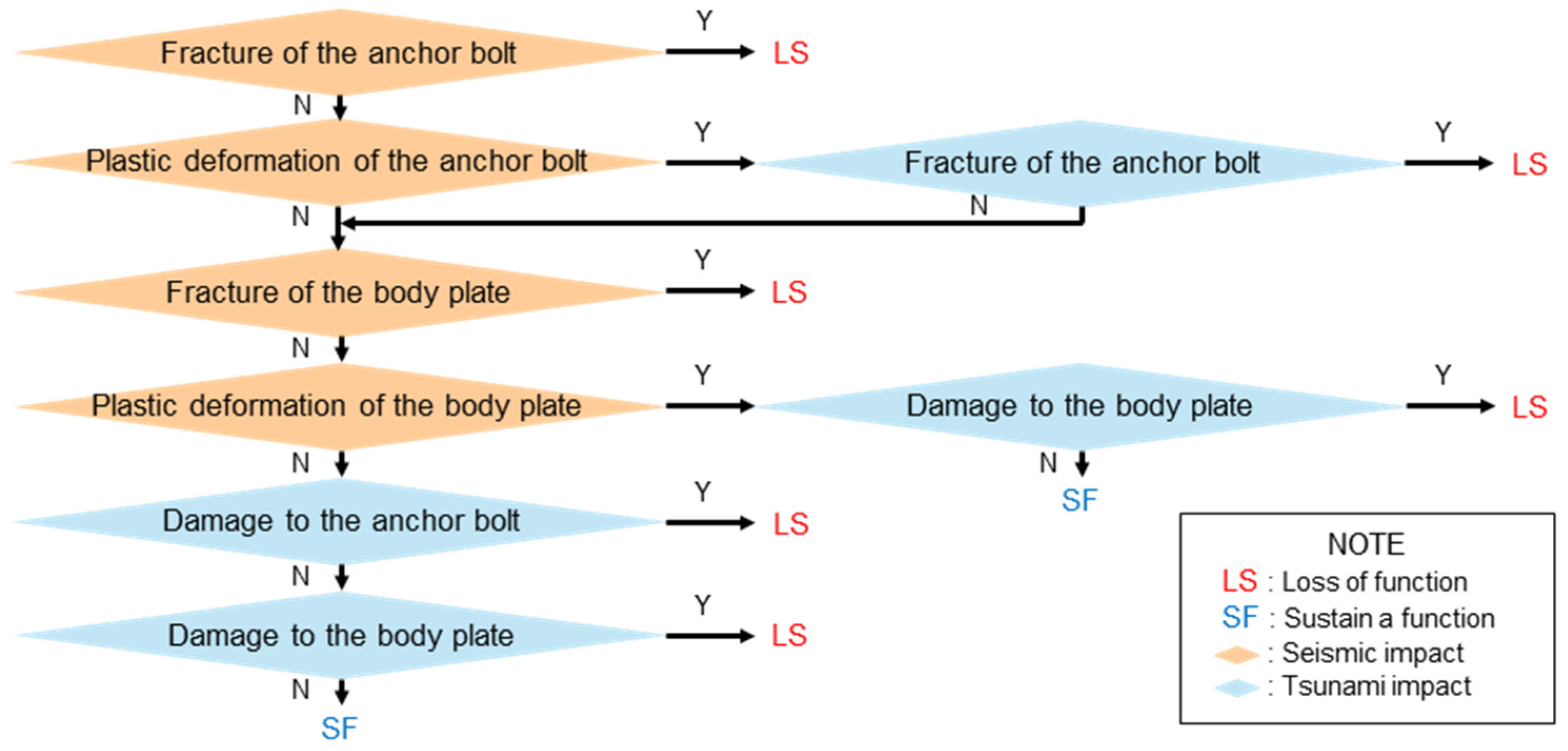
5.1.2. Determination of Damaged Part and Damage Mode
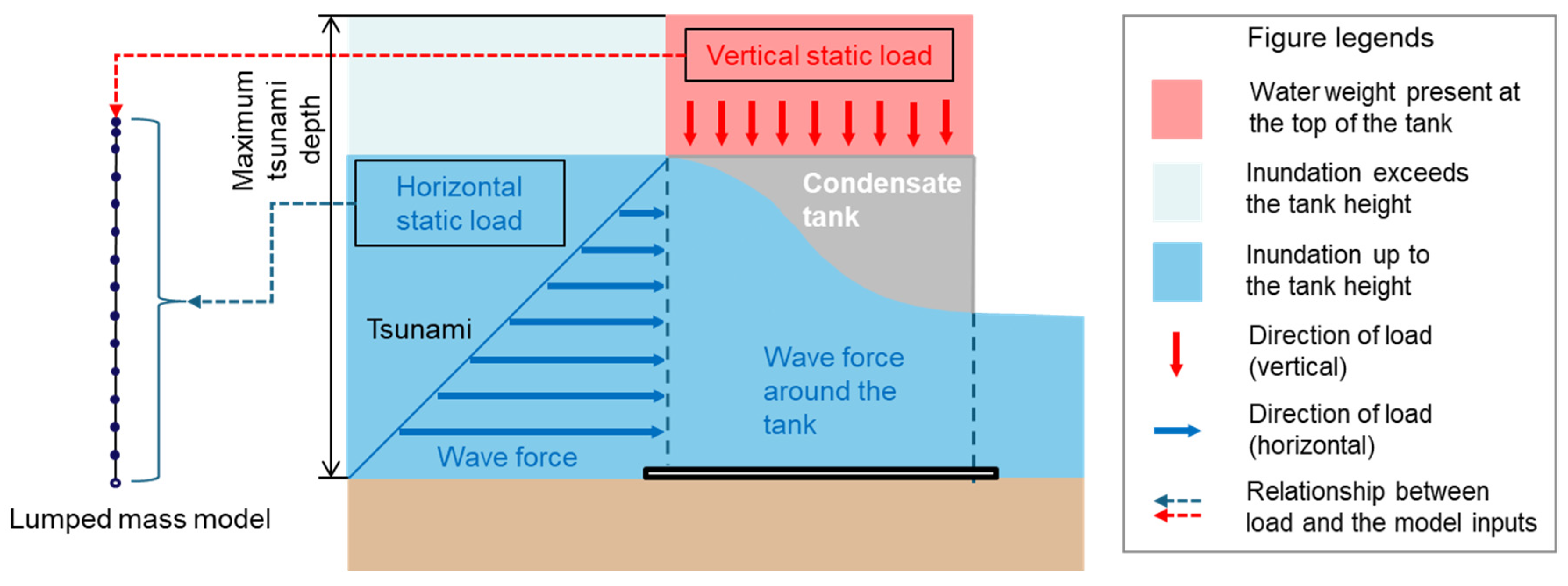
5.1.3. Analysis of Superposition Damage Scenario

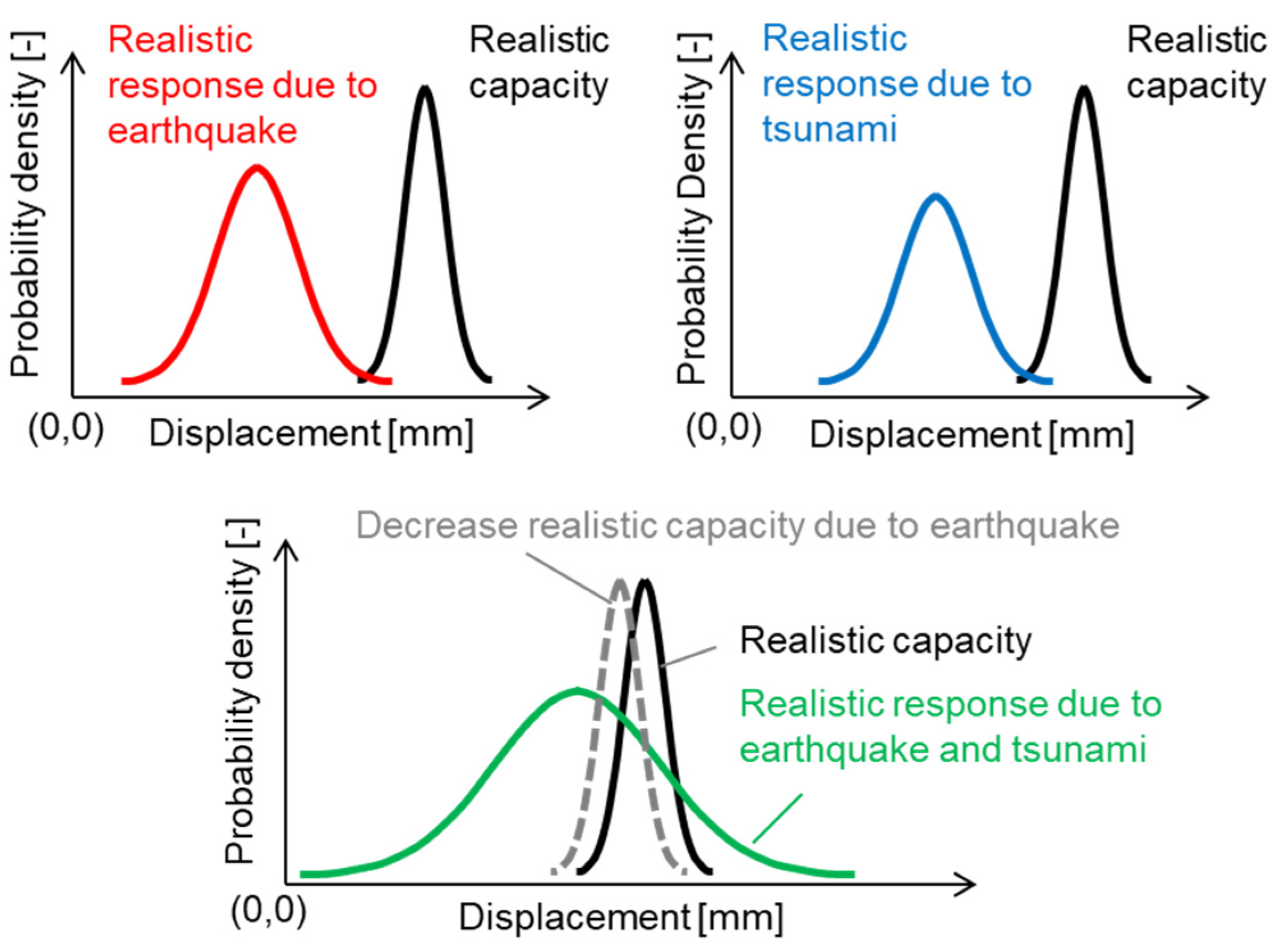
5.1.4. Establishment of a Method for Quantifying Superposition Damage Probability
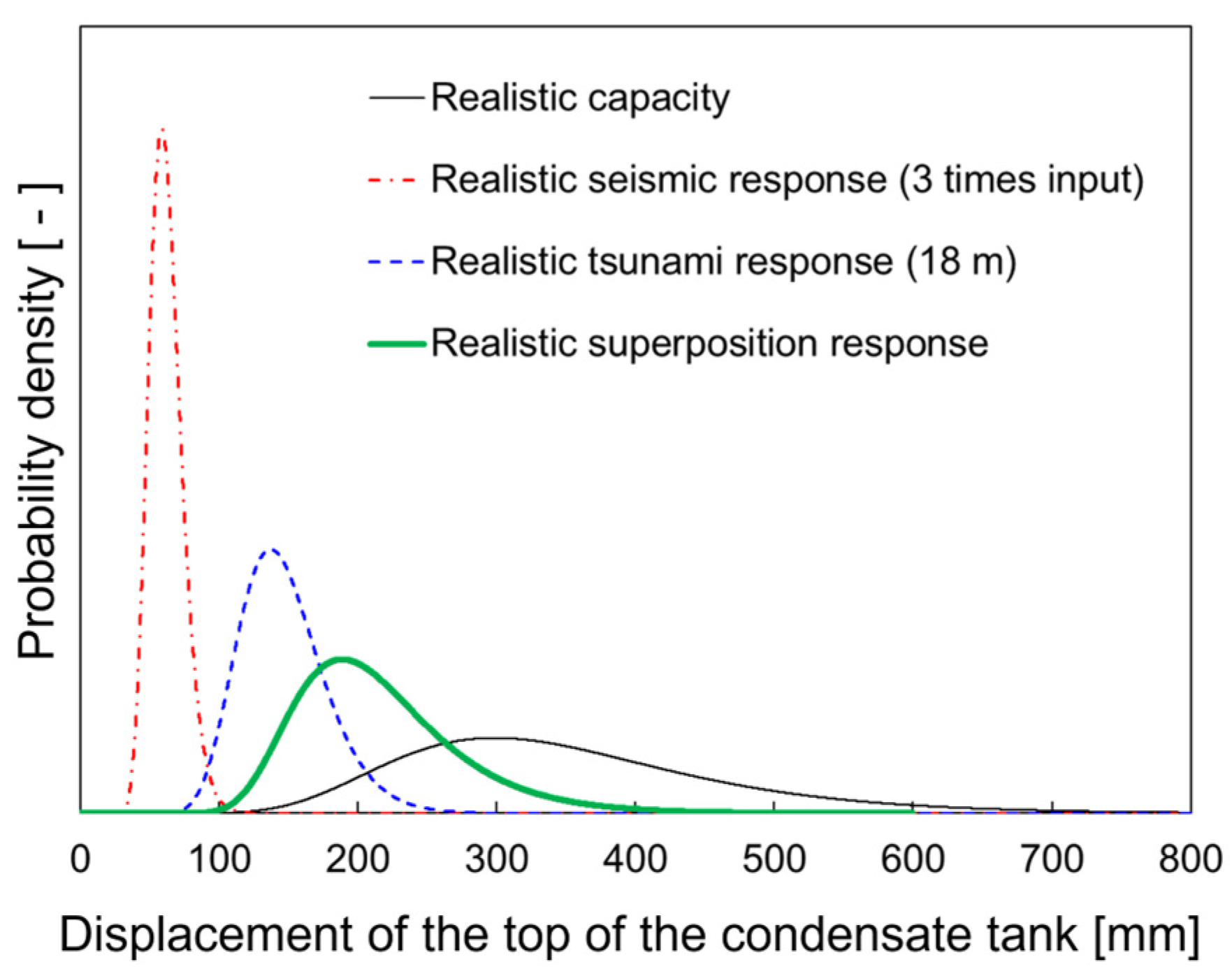
5.1.5. Assessment of Superposition Damage Probability
| Type of External Force | Tolerance Limit | Median Capacity (Displacement of the Top of the Tank Roof) |
|---|---|---|
| Seismic (Dynamic load) | Buckling of body plate [19] | 50 mm [19] |
| Tsunami (Static load) | Ultimate displacement [19] | 333 mm [19] |
| Breakage of the body plate due to buckling | 720 mm (Based on the breaking strain of SS400 is 17% [19]) | |
| Seismic and tsunami (Dynamic load + Static load) | Ultimate displacement [19] | 333 mm [19] |

5.2. Multi-Hazard Fragility Assessment for Different Damaged Parts and Damage Modes
5.2.1. SSCs Subject to Evaluation
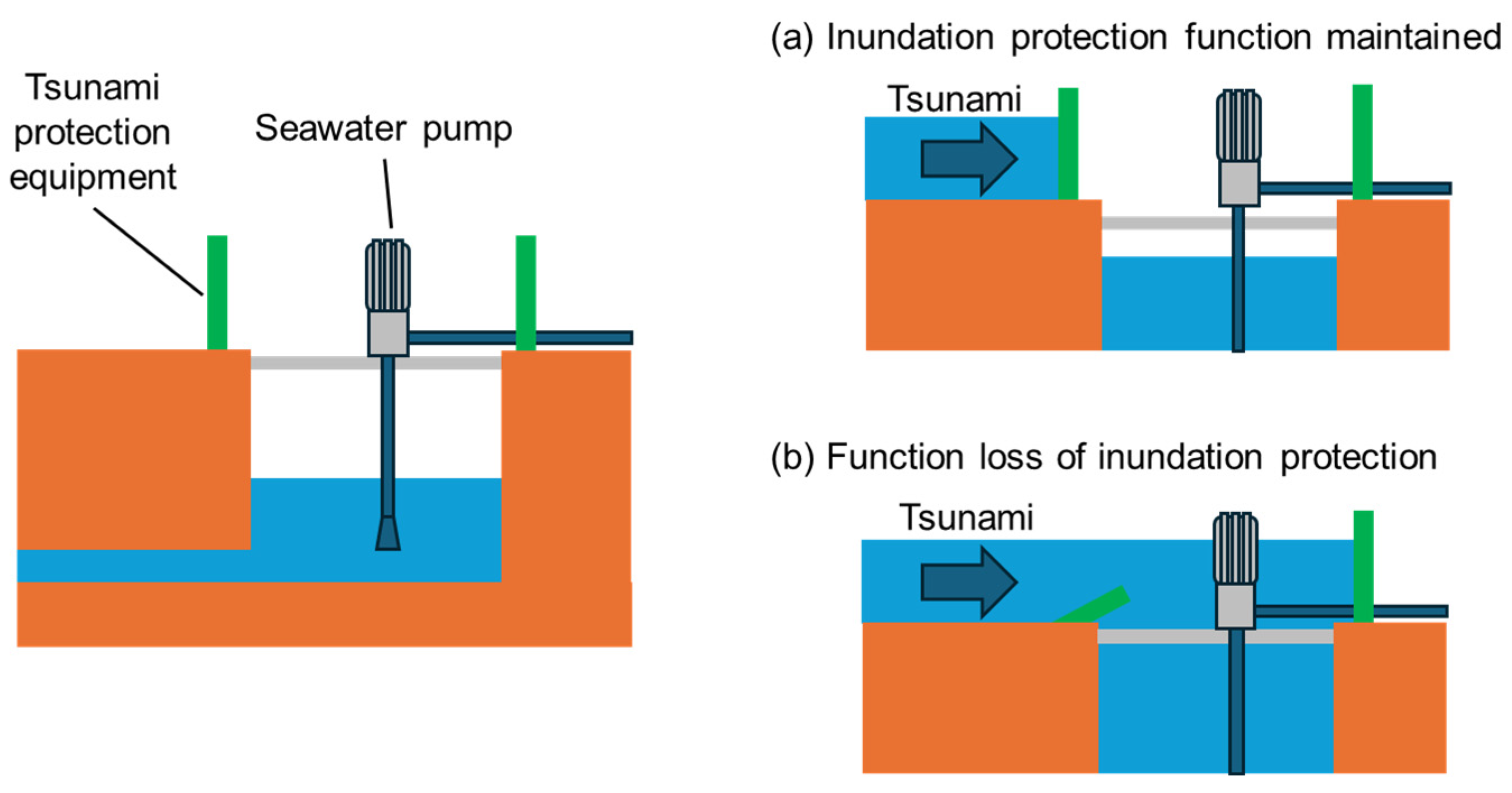
5.2.2. Determination of Damaged Part and Damage Mode
5.2.3. Analysis of Superposition Damage Scenario
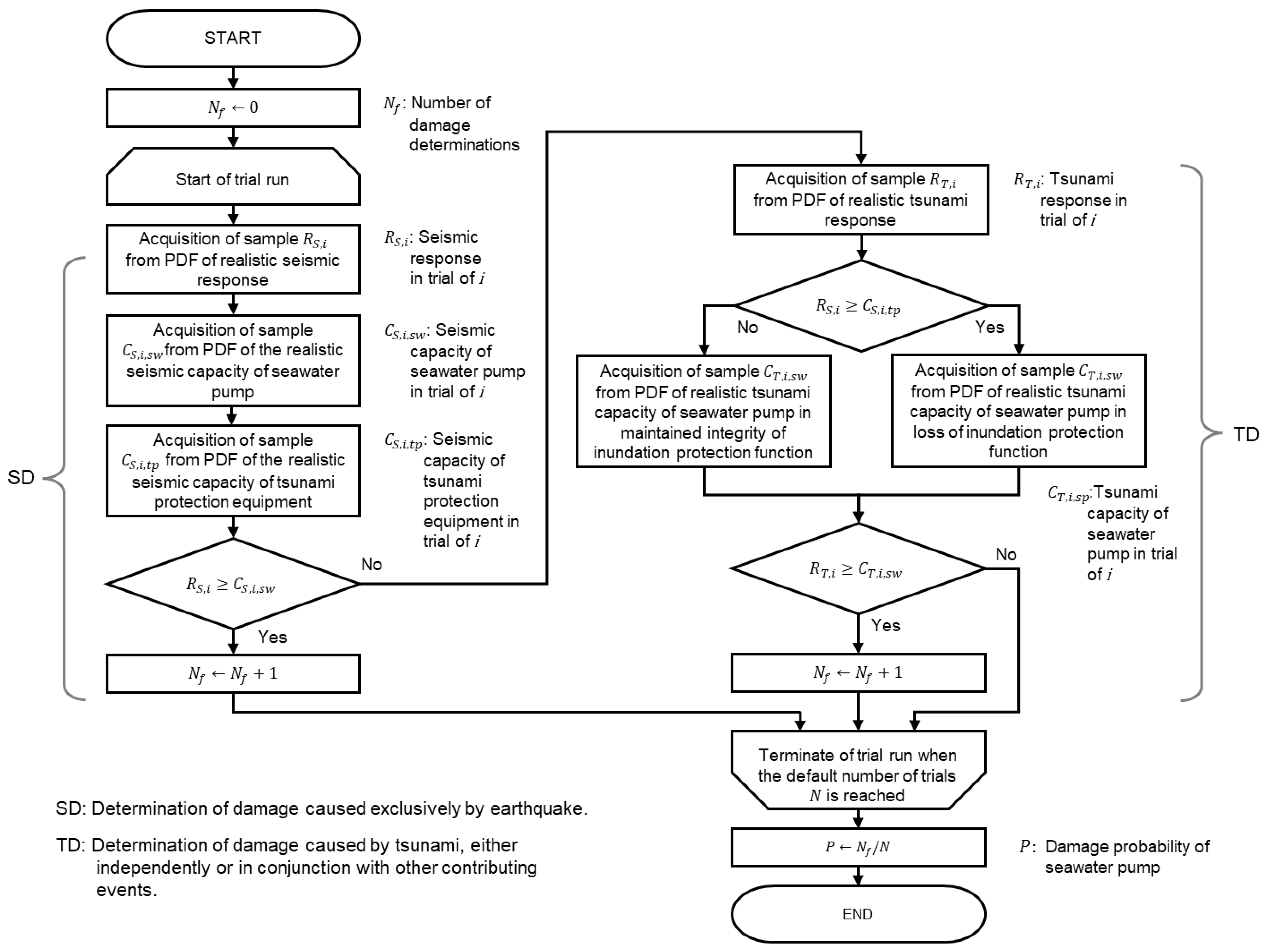
5.2.4. Establishment of a Method for Quantifying Superposition Damage Probability
| Realistic Response and Realistic Capacity | Seawater Pump | Tsunami Protection Equipment | ||
|---|---|---|---|---|
| Seismic | Median of R 3: μ | |||
| LSD 2 of R 3: σ | ||||
| Median of C 4: μ | ||||
| LSD 2 of C 4: σ | ||||
| Tsunami | Median of R 3: μ | |||
| LSD 2 of R 3: σ | ||||
| Integrity of TPE 1 is maintained | Median of C 4: μ | |||
| LSD 2 of C 4: σ | ||||
| TPE 1 is damaged | Median of C 4: μ | |||
| LSD 2 of C 4: σ | ||||

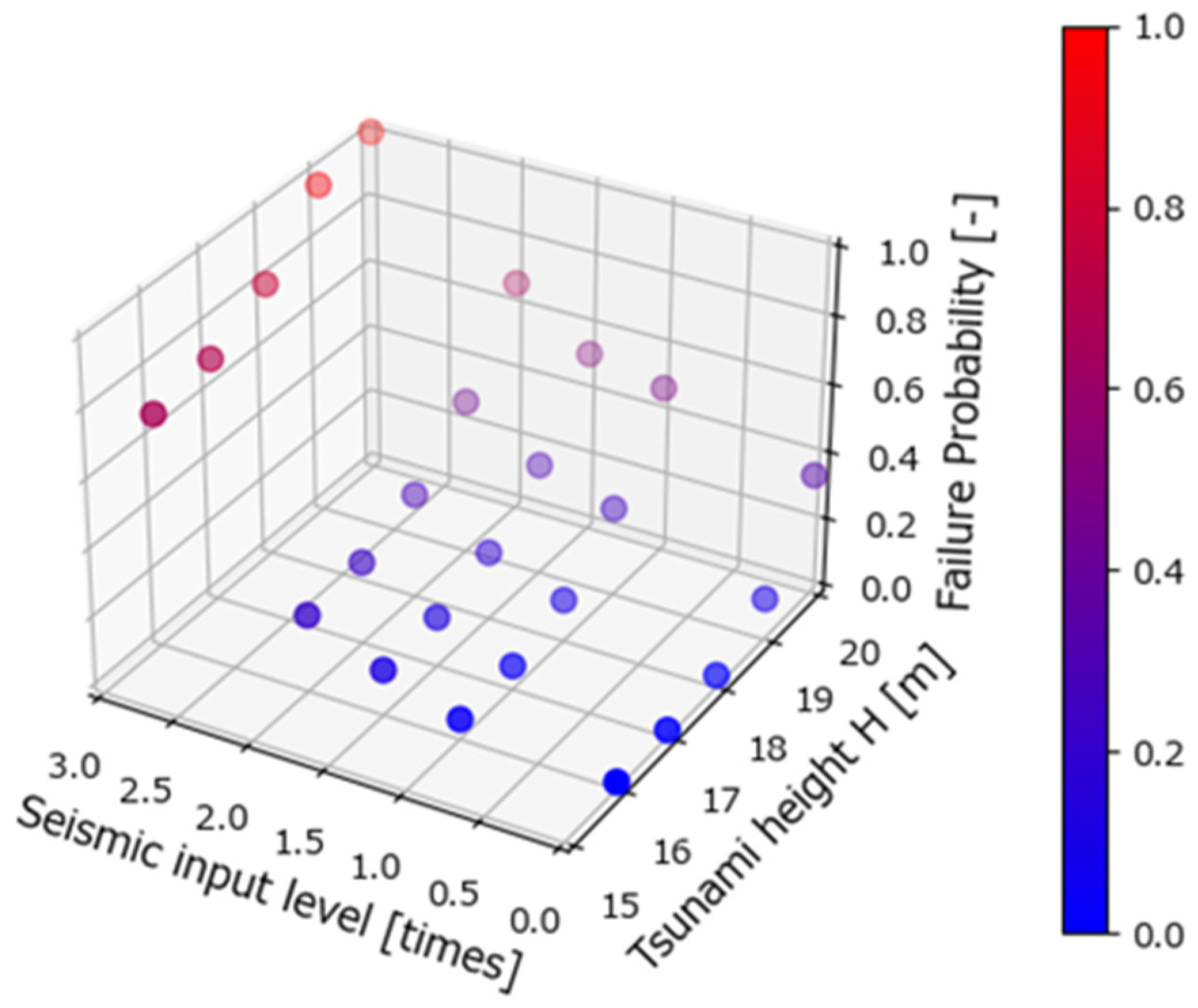
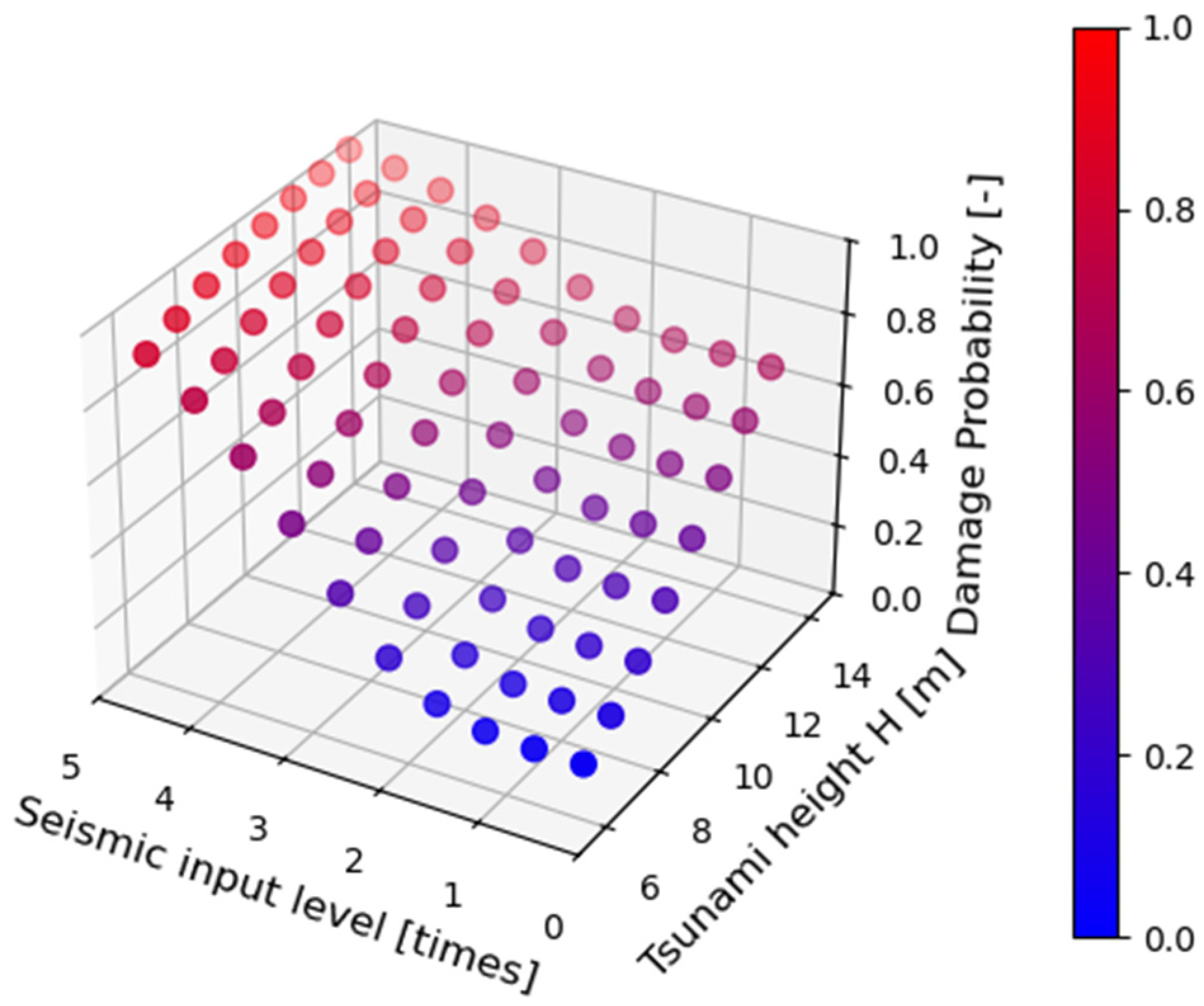
5.2.5. Assessment of Superposition Damage Probability
| Realistic Capacity | Seawater Pump | Tsunami Protection Equipment | ||
|---|---|---|---|---|
| Seismic | 1600 [Gal] | 1200 [Gal] | ||
| LSD 2: σ | 0.1 | 0.1 | ||
| Tsunami | Integrity of TPE 1 is maintained | Median: μ | 12 [m] | |
| LSD 2: σ | 0.15 | |||
| TPE 1 is damaged | Median: μ | 8 [m] | ||
| LSD 2: σ | 0.15 | |||

6. Conclusions
Author Contributions
Funding
Data Availability Statement
Conflicts of Interest
List of Abbreviations and Acronyms
| AESJ | Atomic Energy Society of Japan. |
| ASME | The American Society of Mechanical Engineers. |
| CCDP | Conditional Core Damage Probability. |
| CDF | Core Damage Frequency. |
| ET | Event Tree. |
| FEM | Finite Element Method. |
| FT | Fault Tree. |
| GMPEs | Ground Motion Prediction Equations. |
| HRA | Human Reliability Analysis. |
| IAEA | International Atomic Energy Agency. |
| IEs | Initiating Events. |
| NPPs | Nuclear Power Plants. |
| NRA | Nuclear Regulation Authority of Japan. |
| NRRC | Nuclear Risk Research Center. |
| Probability Density Function. | |
| PGA | Peak Ground Acceleration. |
| PRA | Probabilistic Risk Assessment. |
| PSAM 17& ASRAM2024 | The International Conference on Probabilistic Safety Assessment and Management 17 & Asian Symposium on Risk Assessment and Management 2024. |
| PSHA | Probabilistic Seismic Hazard Assessment. |
| PTHA | Probabilistic Tsunami Hazard Assessment. |
| SAR | Safety Assessment Report. |
| SOV | Separation of Variables. |
| SSCs | Structures, Systems, and Components. |
| SSMRP | Seismic Safety Margins Research Program. |
References
- Yamada, H.; Haraguchi, R.; Mihara, Y.; Miura, H.; Higo, E. Proposal of a method for risk quantification under the multi hazard of the earthquake and tsunami for nuclear power plant. In Proceedings of the PSAM 17 & ASRAM 2024, Miyagi, Japan, 7–11 October 2024. [Google Scholar]
- International Atomic Energy Agency (IAEA). IAEA Report on Protection Against Extreme Earthquakes and Tsunamis in the Light of the Accident at the Fukushima Daiichi Nuclear Power Plant. In Proceedings of the International Experts’ Meeting, Vienna, Austria, 4–7 September 2012; IAEA: Vienna, Austria, 2012. [Google Scholar]
- Nuclear Regulation Authority. Convention on Nuclear Safety National Report of Japan for 9th Review Meeting; C, ARTICLE 6, 3–4; Nuclear Regulation Authority: Tokyo, Japan, July 2022; p. 36. Available online: https://www.nra.go.jp/data/000402805.pdf (accessed on 12 September 2025).
- Nuclear Regulation Authority. Operational Guide for Safety Improvement Evaluation of Commercial Power Reactors; Nuclear Regulation Authority: Tokyo, Japan, November 2013. Available online: https://www.nra.go.jp/data/000334912.pdf (accessed on 12 September 2025). (In Japanese)
- Ebisawa, K.; Kameda, H.; Hirano, M. Concept for Developing Seismic–Tsunami PSA Methodology Considering Combination of Seismic and Tsunami Events at Multi-Units. In Proceedings of the International Symposium on Engineering Lessons Learned from the 2011 Great East Japan Earthquake, Tokyo, Japan, 1–4 March 2012; pp. 1575–1585. [Google Scholar]
- IAEA. Consideration of External Hazards in Probabilistic Safety Assessment for Single Unit and Multi-Unit Nuclear Power Plant; Safety Reports Series No. 92; IAEA: Vienna, Austria, 2018.
- Hahm, D.; Park, J.; Kwag, S. Recent Research Activities in Korea on the Multi-Hazard External Events PSA. In Proceedings of the ASRAM 2017, Yokohama, Japan, 13–15 November 2017. [Google Scholar]
- Kwag, S.; Gupta, A. Probabilistic Risk Assessment Framework for Structural Systems under Multiple Hazards Using Bayesian Statistics. Nucl. Eng. Des. 2017, 315, 20–34. [Google Scholar] [CrossRef]
- Muta, H.; Ohtori, Y.; Yamakawa, H. Development of Seismic–Tsunami Accident Sequence Analysis Methodology. In Proceedings of the ASRAM 2018, Xiamen, China, 10–12 October 2018. [Google Scholar]
- Electric Power Research Institute (EPRI). Seismic Probabilistic Risk Assessment Implementation Guide; EPRI Technical Report 1002989; EPRI: Palo Alto, CA, USA, 2003. [Google Scholar]
- ASME/ANS RA-S-1.1-2024; Standard for Level 1/Large Early Release Frequency Probabilistic Risk Assessment for Nuclear Power Plant Applications. ASME: New York, NY, USA, 2024.
- Central Research Institute of Electric Power Industry (CRIEPI). Report for Technology Development Project to Develop a Common Infrastructure to Improve Nuclear Safety (Development of Infrastructure Related to Risk Assessment and Research of Nuclear Power Plants); CRIEPI: Tokyo, Japan, 2022. (In Japanese) [Google Scholar]
- Nakajima, M.; Ohtori, Y. Development of Evaluation Method for Probabilistic Seismic and Tsunami Hazards Considering Events Superimposition. In Proceedings of the PSAM 13, Seoul, Republic of Korea, 2–7 October 2016. [Google Scholar]
- Kihara, N.; Kaida, H.; Takahashi, Y.; Nishi, A.; Kimura, T.; Fujii, N.; Fujioka, B.; Oda, S.; Ohtori, Y.; Mihara, Y. Tsunami Flooding Analysis Graded-Approach Framework for Tsunami Probabilistic Risk Assessment. J. Nucl. Sci. Technol. 2023, 60, 1454–1480. [Google Scholar] [CrossRef]
- Electric Power Research Institute (EPRI). Seismic Fragility and Seismic Margin Guidance for Seismic Probabilistic Risk Assessments; EPRI Technical Report 3002012994; EPRI: Palo Alto, CA, USA, 2018. [Google Scholar]
- Cover, L.E.; Bohn, M.P.; Campbell, R.D.; Wesley, D.A. Handbook of Nuclear Power Plant Seismic Fragilities, Seismic Safety Margins Research Program; NUREG/CR-3558; Lawrence Livermore National Laboratory: Livermore, CA, USA, 1983. [Google Scholar] [CrossRef]
- AESJ-SC-RK013:2024; A Standard for Procedure of Seismic Probabilistic Risk Assessment for Nuclear Power Plants: 2024. Atomic Energy Society of Japan (AESJ): Tokyo, Japan, 2024; ISBN 978-4-89047-469-1. (In Japanese)
- Central Research Institute of Electric Power Industry (CRIEPI). Report for Technology Development Project to Develop a Common Infrastructure to Improve Nuclear Safety (Development of Infrastructure Related to Risk Assessment and Research of Nuclear Power Plants); CRIEPI: Tokyo, Japan, 2024. (In Japanese) [Google Scholar]
- Japan Nuclear Energy Safety Organization (JNES). Tests and Surveys on Seismic Evaluation Technology for Nuclear Facilities—Component Capacity No. 4 (PWR Tank); JNES: Tokyo, Japan, 2008. (In Japanese) [Google Scholar]
- JEAC 4629-2014; Design Code for Seismic and Tsunami Resistance of Nuclear Power Plants. Nuclear Standards Committee of the Japan Electric Association: Tokyo, Japan, 2014. (In Japanese)
- Central Research Institute of Electric Power Industry (CRIEPI); Nuclear Risk Research Center (NRRC). Human Reliability Analysis (HRA) Guide (FY2018 Edition)—Development of Qualitative Analysis Methods and Analysis Models for Tasks under Extreme Conditions; CRIEPI Research Report O18011; CRIEPI: Tokyo, Japan, 2019. [Google Scholar]


| Seismic event | Damaged part |
|
| Damage mode |
| |
| Tsunami event | Damaged part |
|
| Damage mode |
| |
| Superposition of seismic events and tsunami events | Damaged part |
|
| Damage mode |
| |
| Adjoint scenario |
|
| Seismic Input Level [Times] | Displacement (Absolute Value) | Deformed State |
|---|---|---|
| 0.2 | 5.5 mm | Elastic |
| 0.5 | 13.8 mm | After buckling (Buckling occurred at 12.3 mm) |
| 1.0 | 27.3 mm | After buckling |
| 1.5 | 35.9 mm | After buckling |
| 2.0 | 43.4 mm | After buckling |
| 3.0 | 79.1 mm | After buckling |
| 3.5 | 91.1 mm | After buckling |
| Tsunami Input Level | Displacement (Absolute Value) | Deformed State |
|---|---|---|
| 12 m | 21.5 mm | After buckling |
| 14 m | 27.9 mm | After buckling |
| 16 m | 62.2 mm | After buckling |
| 17 m | 97.1 mm | After buckling |
| 18 m | 143.4 mm | After buckling |
| 19 m | 202.2 mm | After buckling |
| 20 m | 282.0 mm | After buckling |
| Seismic | Tsunami | Seismic + Tsunami | |
|---|---|---|---|
| Capacity | = 0.32 | = 0.24 | = 0.24 |
| Response | βr = --- 1, βu = 0.19 | = 0.15 | = 0.21 |
| Seawater pump | Seismic event | Structural damage | Damaged part |
|
| Damage mode |
| |||
| Functional damage | Damaged part |
| ||
| Damage mode |
| |||
| Tsunami event | Functional damage | Damaged part |
| |
| Damage mode |
| |||
| Tsunami protection equipment (inundation prevention wall) | Seismic event | Structural damage | Damaged part |
|
| Damage mode |
| |||
| Tsunami event | Structural damage | Damaged part |
| |
| Damage mode |
| |||
| Functional damage | Damaged part |
| ||
| Damage mode (Function failure) |
|
Disclaimer/Publisher’s Note: The statements, opinions and data contained in all publications are solely those of the individual author(s) and contributor(s) and not of MDPI and/or the editor(s). MDPI and/or the editor(s) disclaim responsibility for any injury to people or property resulting from any ideas, methods, instructions or products referred to in the content. |
© 2026 by the authors. Licensee MDPI, Basel, Switzerland. This article is an open access article distributed under the terms and conditions of the Creative Commons Attribution (CC BY) license.
Share and Cite
Yamada, H.; Nakajima, M.; Miura, H.; Haraguchi, R.; Mihara, Y.; Higo, E. Development of a Risk Assessment Method Under the Multi-Hazard of Earthquake and Tsunami for a Nuclear Power Plant. J. Nucl. Eng. 2026, 7, 7. https://doi.org/10.3390/jne7010007
Yamada H, Nakajima M, Miura H, Haraguchi R, Mihara Y, Higo E. Development of a Risk Assessment Method Under the Multi-Hazard of Earthquake and Tsunami for a Nuclear Power Plant. Journal of Nuclear Engineering. 2026; 7(1):7. https://doi.org/10.3390/jne7010007
Chicago/Turabian StyleYamada, Hiroyuki, Masato Nakajima, Hiromichi Miura, Ryusuke Haraguchi, Yoshinori Mihara, and Eishiro Higo. 2026. "Development of a Risk Assessment Method Under the Multi-Hazard of Earthquake and Tsunami for a Nuclear Power Plant" Journal of Nuclear Engineering 7, no. 1: 7. https://doi.org/10.3390/jne7010007
APA StyleYamada, H., Nakajima, M., Miura, H., Haraguchi, R., Mihara, Y., & Higo, E. (2026). Development of a Risk Assessment Method Under the Multi-Hazard of Earthquake and Tsunami for a Nuclear Power Plant. Journal of Nuclear Engineering, 7(1), 7. https://doi.org/10.3390/jne7010007