
Article

Objective Neural Network-Based Flow Regime Classifiers with Application to Vertical, Narrow, Rectangular Channels and Round Pipe Geometry

School of Nuclear Engineering, Purdue University, West Lafayette, IN 47906, USA
*
Author to whom correspondence should be addressed.
J. Nucl. Eng. 2026, 7(1), 15; https://doi.org/10.3390/jne7010015
Submission received: 29 November 2025 / Revised: 18 January 2026 / Accepted: 28 January 2026 / Published: 10 February 2026
(This article belongs to the Special Issue Advances in Thermal Hydraulics of Nuclear Power Plants)

Abstract

Objective neural network-based two-phase flow regime classifiers are developed for vertical, narrow, rectangular channels and a 1 inch round pipe using Kohonen Self-Organizing Maps. In the rectangular channel, the classifier uses five geometric inputs obtained from a two-sensor droplet-capable conductivity probe (DCCP-2): the bulk gas void fraction α g , ligament void fraction α lig , normalized ligament chord length y lig , normalized large bubble chord length y , bb , and a droplet indicator. These parameters allow for the objective identification of bubbly/distorted bubbly, cap-turbulent, churn-turbulent, annular, rolling wispy, and wispy flow regimes, and yield quantitative transition boundaries in the ( j f , j g ) plane for a densely populated test matrix. In the round pipe, a four-sensor droplet-capable conductivity probe (DCCP-4) provides the mean and standard deviation of droplet, bubble, and ligament chord length distributions, which are used as inputs to a Self-Organizing Map (SOM) classifier that separates rolling annular and wispy annular regimes at high void fractions. The resulting regime maps are discussed in terms of the associated phase geometries and their impact on interfacial area, drag, and entrainment, providing regime-dependent geometric inputs that can be used to improve Two-Fluid Model closures for reactor downcomers, core channels, and other nuclear thermal–hydraulic applications.

1. Introduction

In the Two-Fluid Model (TFM), the gas and liquid are modeled as continuous fluids interacting through the interface. This interface has a complex geometry, and modeling it requires the knowledge about the flow regime (like bubbly, cap-bubbly, slug, churn-turbulent, annular, etc.). Flow regimes are flow patterns that are geometrically different from each other for the modeling of two-phase flow in TFM. A widely used strategy for incorporating flow regimes in TFM requires the use of static flow regime maps [1].
Historically, flow regime maps have been developed using experimentation and via the observation of the experimental results, usually through visual observation like high-speed videos [2,3,4]. These types of results are at best subjective to the experimenter making the observation. Often, a flow video of same experimental condition can be identified differently by different observers. This problem is exacerbated in the cases of very complex flows such as churn turbulent, annular, or wispy flows. Thus, objective flow classification techniques are needed for the better modeling of two-phase flow, their more accurate design, and the safety analysis of two-phase flow systems.
Many researchers [5,6,7,8,9,10] have tried using neural networks (NNs) and fuzzy logic to objectively identify flow regimes in two-phase flow. Most of these studies make use of signals from impedance probes. Such probes are fabricated to have very small axial lengths so that the resultant signals can be assumed to be of the area-averaged void fraction. The NNs make use of various statistical parameters (mostly mean and standard deviation) as inputs. This type of NN is very well suited for the identification of flow regimes that are significantly different in their area-averaged void characteristics. However, they are not capable of distinguishing between complex flow regimes found in two-phase flow near and beyond churn-turbulent flow. (This is because the flow regimes in this region are very similar in their area-averaged void characteristics, whereas the difference lies in the complex geometry and trajectory of the two-phase interface).
Many researchers have explored the use of machine learning (ML) techniques for the determination of various flow regimes in two-phase flows of various mixtures. These studies feature the use of Convolutional NNs [11,12,13], Support Vector Machines (SVMs) [14,15,16], Image Correlation Analysis [12,17,18], Feature Extraction Machines [16,19,20], Deep Learning Techniques [18,21], etc. Most of these analyses were done by using flow visualization images or void measurements. The main drawback of such techniques is the lack of use of the geometric data of the flow regime, which is the key signature and basis of the use of the flow regimes in TFM.
In recent years, data-driven approaches have been increasingly employed to overcome the subjectivity and limited generality of traditional flow regime maps. For example, self-supervised learning schemes using ultrasonic measurements have been proposed to identify complex gas–liquid flow regimes in riser systems without requiring extensive labeled datasets [22]. Complementary studies of modern machine learning and deep learning techniques have demonstrated that such models can reliably classify gas–liquid flow patterns over wide operating ranges when provided with appropriately engineered features [23,24].
Many existing flow regime classification studies rely on image-based pattern recognition, where regimes are assigned from high-speed visualizations either by direct inspection or through automated image processing [5,6,8]. This strategy works reasonably well when the interfacial topology is simple (e.g., clearly defined bubbly or slug flow), but it becomes increasingly ambiguous in high-void-fraction annular conditions, where ligaments, droplets, and wispy structures overlap in space and time, and the regime assignment may depend on viewing conditions and observer judgment [5,8]. In contrast, the present study bases the classification on local geometric quantities obtained from droplet-capable conductivity probes—void fractions, ligament and bubble chord lengths, and droplet indicators—which are directly related to the interfacial area and phase connectivity, and therefore provide a more objective and physically interpretable basis for distinguishing annular, rolling annular, and wispy annular flows [6].
The NN Classifiers presented in this study use of the geometric data of the flow regime along with various neural network units arranged in a tree-like set-up. The classifiers’ efficiencies are then explored using densely packed geometric data gathered by the two-sensor droplet-capable conductivity probe (DCCP-2) in a vertical rectangular channel and the four-sensor droplet-capable probe (DCCP-4) in the 1-inch round pipe test section.

2. Materials and Methods

2.1. Two-Phase Flow Classifiers

2.1.1. Narrow Rectangular Channel

For an objective flow regime classifier, the important features of each flow regime needs to be identified. Bubbly flow can be classified just on the basis of gas void fraction ( α g ). For any flow where α g is less than 0.3, the flow is considered bubbly flow. (Some exceptions can be seen in mini and micro-channels, although they also have an α g limitation).
The choice of gas void fraction as the primary discriminator between bubbly/distorted bubbly and higher-void-fraction regimes follows the phenomenological criteria developed for vertical gas–liquid flows [25,26]. In the two-fluid and drift flux formulations, bubbly flow is characterized by a dispersed field of nearly spherical or mildly distorted bubbles in a continuous liquid phase, and the transition to cap- or slug-type structures occurs once the area-averaged void fraction exceeds a threshold on the order of α g 0.3 , where bubble coalescence produces channel-spanning structures rather than isolated bubbles [25,26]. Flows with α g < 0.3 are therefore classified here as bubbly or distorted bubbly, while larger void fractions are further separated into cap-turbulent, churn-turbulent, annular, rolling wispy, and wispy regimes using the ligament void fraction α lig and the normalized ligament and large bubble chord lengths y lig and y , bb . These quantities capture the changes in phase continuity and characteristic interfacial length scales identified as governing regime transitions between dispersed bubbly, slug/cap-bubbly, churn, and annular flows, and thus form an adequate set of underlying variables for the present classifier [25,26].
The flow regimes, other than bubbly flow, can be classified into two groups based on the ligament void fraction ( α l i g ). For flows like slug flow, α l i g = 1 α g . For flows like annular flow or wispy flow, α l i g 1 α g , as there are certain fluid elements entrained in the gas core. The group of low α l i g should contain annular and neighboring flows, whereas the group of high α l i g should contain slug and wispy flows. These groups are named zone 1 and zone 2, respectively, for ease of nomenclature.
For flows in zone 1, the chord length of the ligament ( y l i g ) can be used to distinguish between annular flows and neighboring flow regimes. For annular flow, y l i g should be very small as virtually no ligament exist in annular flow other than the liquid film itself. The neighboring flow regimes will have some ligament present. Let us call the neighborhood of annular flow zone 3.
Flows in zone 2 can be classified on the basis of chord lengths of the slug bubble or large bubble ( y l b b ). For slug flow, y l b b should be relatively larger than that for the wispy flow as the interface in wispy flow is highly irregular and breaks off the large bubble into multiple pieces. (Another way of thinking could be to imagine that the liquid layer in wispy flow is highly irregular, thus resulting in the appearance of a slug bubble broken up into multiple pieces, all larger than the small bubbles present in the wake of slug bubbles).
Flow in the neighborhood of annular flow (zone 3) should contain flows similar to churn-turbulent and wispy flow. In churn-turbulent flow, the liquid can not be entrained, as the gas flow rate is typically lower than entrainment limit. Thus, the existence of droplets can make for an excellent candidate for the geometric parameter to distinguish flow regimes in this neighborhood.
To objectively determine the distinction between the various flow regimes described above, Kohonen SOM’s [27] are used as units of the NN Classifier. With each iteration, a SOM adjusts a hypersurface in an n-dimensional hyperspace to create a topological map that reflects the similarities of the n-dimensional input data. The divided hyperspaces now reflect one cluster each, which have similar identities.
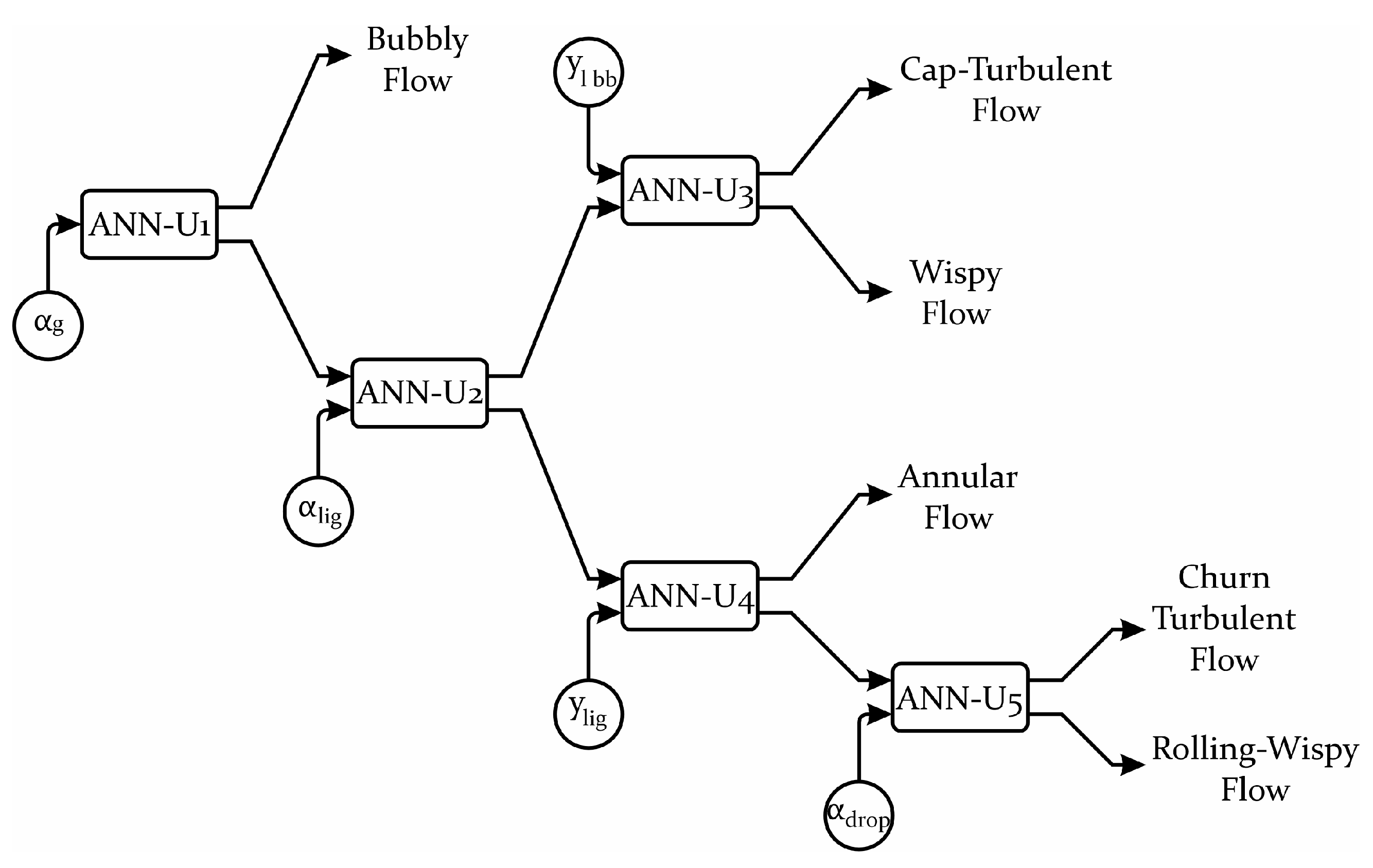
Using this information, a tree-like NN Classifier can be created to identify the flow regimes mentioned above. The architecture of this classifier is given in Figure 1. The NN units are shown in the figure as ANN-Ux, where x is a number denoting the unit.
The neural network classifier of two-phase flow is evaluated by analyzing the stability of each unit. A unit is considered stable when the classified results from the unit do not change for 100 epochs. Once stable, the unit results are used to train the subsequent unit.

2.1.2. 1-Inch Round Pipe

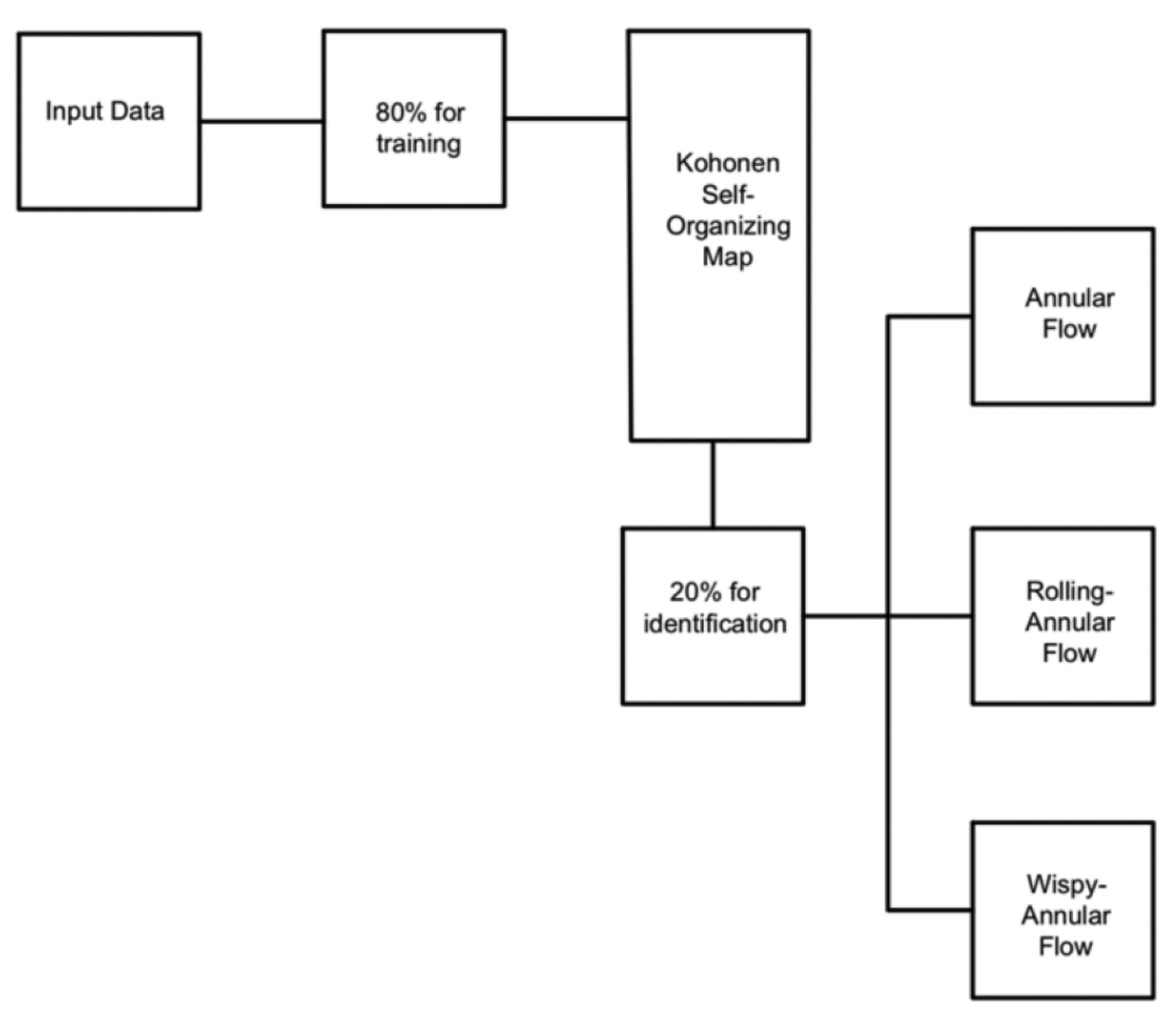
A similar methodology has been developed for objective high-void-fraction flow identification in round pipe geometry. In this approach, a Kohonen Self-Organizing Map (SOM) is used as a single unsupervised neural network rather than a multi-unit hierarchy. The SOM consists of three output neurons, each representing a cluster associated with a distinct high-void-fraction (annular) flow. The network adjusts a set of weight vectors in a multidimensional space in a similar way. With each iteration, the neuron whose weight vector is closest to the input becomes the “winning” unit, while neighboring neurons undergo coordinated adjustments that preserve topological consistency. As an unsupervised learning algorithm, the SOM does not require pre-labeled data points during training and testing. The specific model is chosen in order to discover unknown flow regimes that have not previously been identified. Figure 2 shows the identification algorithm for flow identification in round pipe.
The input dataset for this network is constructed from two statistical identifiers of the phase geometrical structures: the mean and standard deviation of the droplet, bubble, and ligament chord length distribution are utilized. These parameters are chosen as it is expected that there will be significant fluctuations in the chord length distribution.
The axial velocity of the j-th flow structure is calculated as
v j = d z δ t j ,
where d z is the known axial spacing between the two sensors and δ t j is the difference in the time of sensing of the j-th structure in the leading and trailing sensors. Using this velocity, the chord length of the same structure is computed by
C L j = v j Δ t j = d z δ t j Δ t j .
where Δ t j is the residence time of the j-th structure at the leading sensor. The mean chord length over N measurements is used as a representative first-moment statistic of the distribution, defined as
C L ¯ = 1 N j = 1 N C L j .
To quantify the spread of chord length within a given flow regime, the standard deviation of the distribution is computed as
σ C L = 1 N j = 1 N C L j C L ¯ 2 .
The SOM used for the round pipe classification was implemented in MATLAB (MathWorks, R2023a). A one-dimensional grid with three neurons, [ 3 × 1 ] , was selected so that each output neuron represents one of the three high-void-fraction flow categories.
The initial weights are generated by linear initialization along the principal directions of the input data. Training is performed for 100 epochs with a batch SOM algorithm. The initial learning rate is set to α 0 = 0.5 and decays linearly to α final = 0.01 over the training process. A Gaussian neighborhood function is used on the one-dimensional output grid, with an initial neighborhood width of σ 0 = 1.0 neuron spacings that decreases linearly to σ final = 0.1 by the end of training. For each epoch, the neuron whose weight vector is closest (Euclidean norm) to a given input sample is taken as the winning unit, and the weights of the winning unit and its neighbors are updated according to these learning rate and neighborhood schedules.
To define a stability criterion, the SOM is monitored after each epoch; training is regarded as stable when the cluster assignment of all the training samples does not change for 100 consecutive epochs. After convergence, the three neurons form distinct clusters in the feature space, which are interpreted as different annular flow sub-regimes (rolling annular and wispy annular), based on their measured phase geometries.

2.2. Application to a Vertical Narrow Rectangular Channel

The NN-based classifier of two-phase flow is now developed using the geometric parameters of the flow field as inputs and Kohonen SOMs as ANN units in a tree-like structure. To test the efficacy of the classifier, the geometric parameters for various flow regimes are obtained in a dense test matrix using a DCCP-2 for a vertical, narrow, rectangular channel. The details of the experimental facility are provided in Section 2.2.2. The processed data from DCCP-2 is fed to the NN Classifier to obtain various flow regime clusters. A static flow regime map is then obtained. This process is detailed below:

2.2.1. DCCP-2

The study of two-phase flows requires accurate descriptions of the interface and fluid structures. Neal and Bankoff [30] first suggested that the interface in air–water flow can be detected by employing a conductivity sensor which can take advantage of the difference in the conductivity of air and water. Kataoka [31] first suggested the design of a conductivity probe which has two sensors, namely leading and trailing. Such probes can not distinguish between the gas phase and dispersed liquid phase. Thus, the droplet-capable probes were developed by Y. Liu [32] for two sensors, and then improved by G. Wang [33] for four sensors. The droplet-capable probe consists of an additional sensor called a common sensor. The common sensor provides for a separate local ground for the dispersed liquid, and is thus capable of identifying droplets. The sensing probes (leading and trailing) measure the connection between them and the common sensor. The required parameters for the flow regime classifier can be obtained by the use of a DCCP-2. This allows for a very accurate determination of the interface in a two-phase flow.
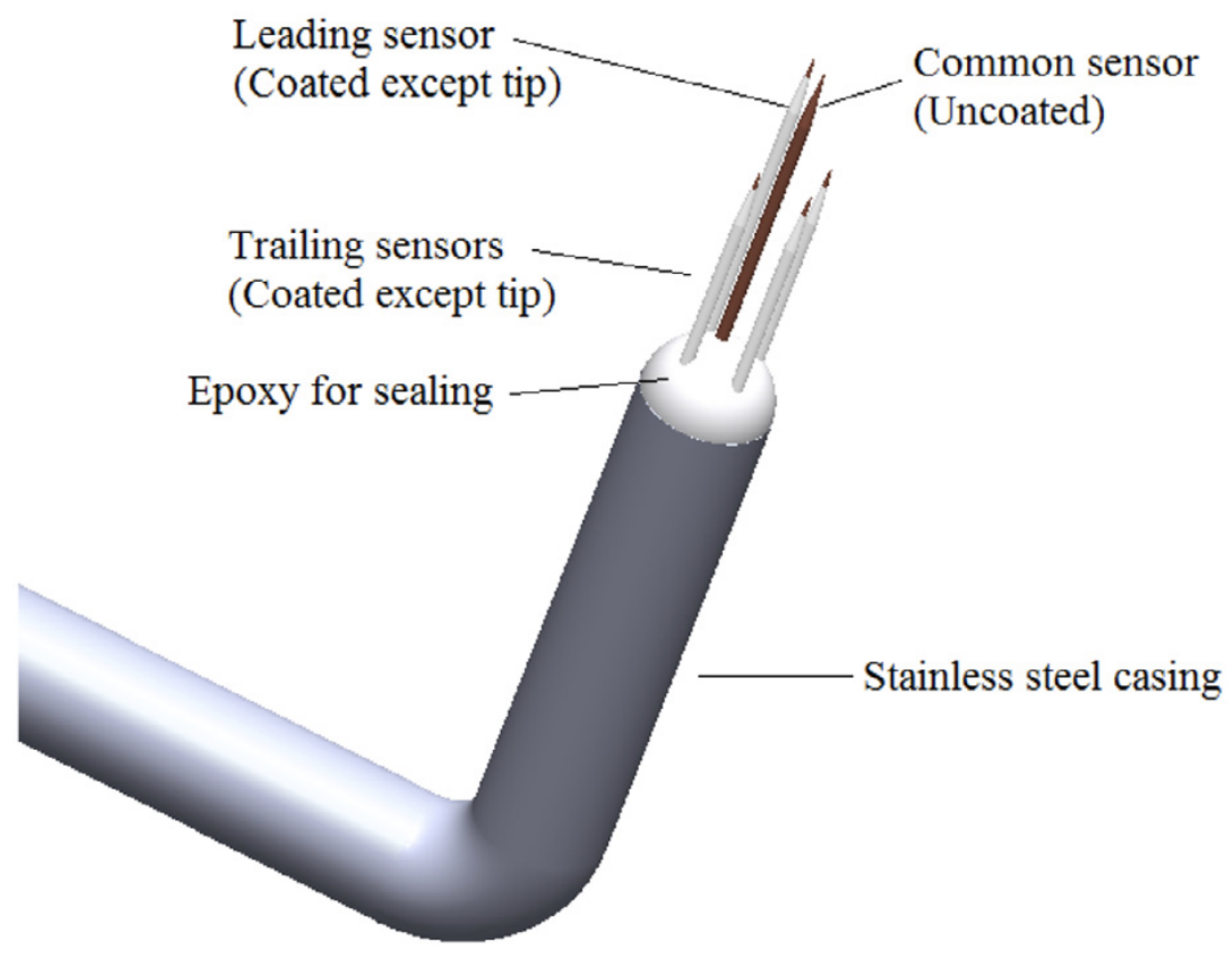
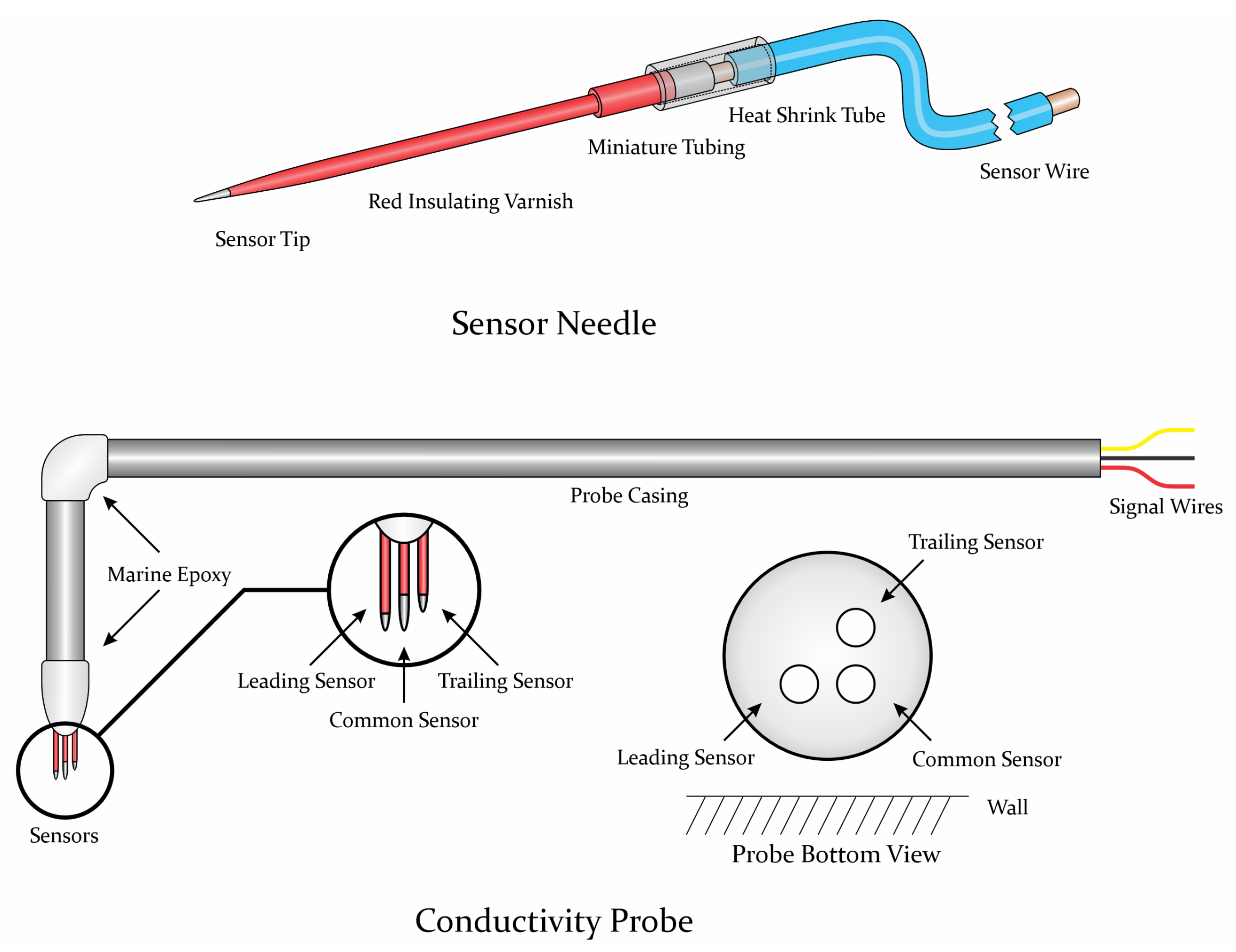
The DCCP-2 is constructed by using three sensors. One of the three sensors serves as a local common ground and is called the common sensor. The other two sensors are arranged in a leading and trailing configuration. The common sensor can be used to detect dispersed liquid in flow (droplets). The leading and trailing sensors measure the voltage between the common sensor and themselves. The common sensor also senses voltage between the probe casing and itself. This configuration allows for the probe to detect four phases in a two-phase flow, according to Table 1.
The schematic of DCCP-2 is shown in Figure 3. The sensor needle is prepared by using an acupuncture needle covered by an insulating red varnish. The sharp, tapered shape of the tip of an acupuncture needle makes it desirable to be the sensor in DCCP-2. The varnish has very high wet insulation characteristics, thus making it a suitable candidate for insulation. The sensor needle is connected to the sensor wire using a miniature tubing and heat shrink tube. The sensors are fitted in a probe casing to make the DCCP-2. The configuration of the probe sensors is also shown in the figure.
The signal from the DCCP-2 needs to be converted to provide the desirable geometric parameters like the void fraction and chord length of various interfacial structures. The void fraction is equivalent to the time fraction of residence time of the phasic structure. The chord length of a phasic structure is measured by estimating the velocity from the front interface of the structure and rear interface of the structure. The velocity multiplied by residence time results in the chord length of that structure.
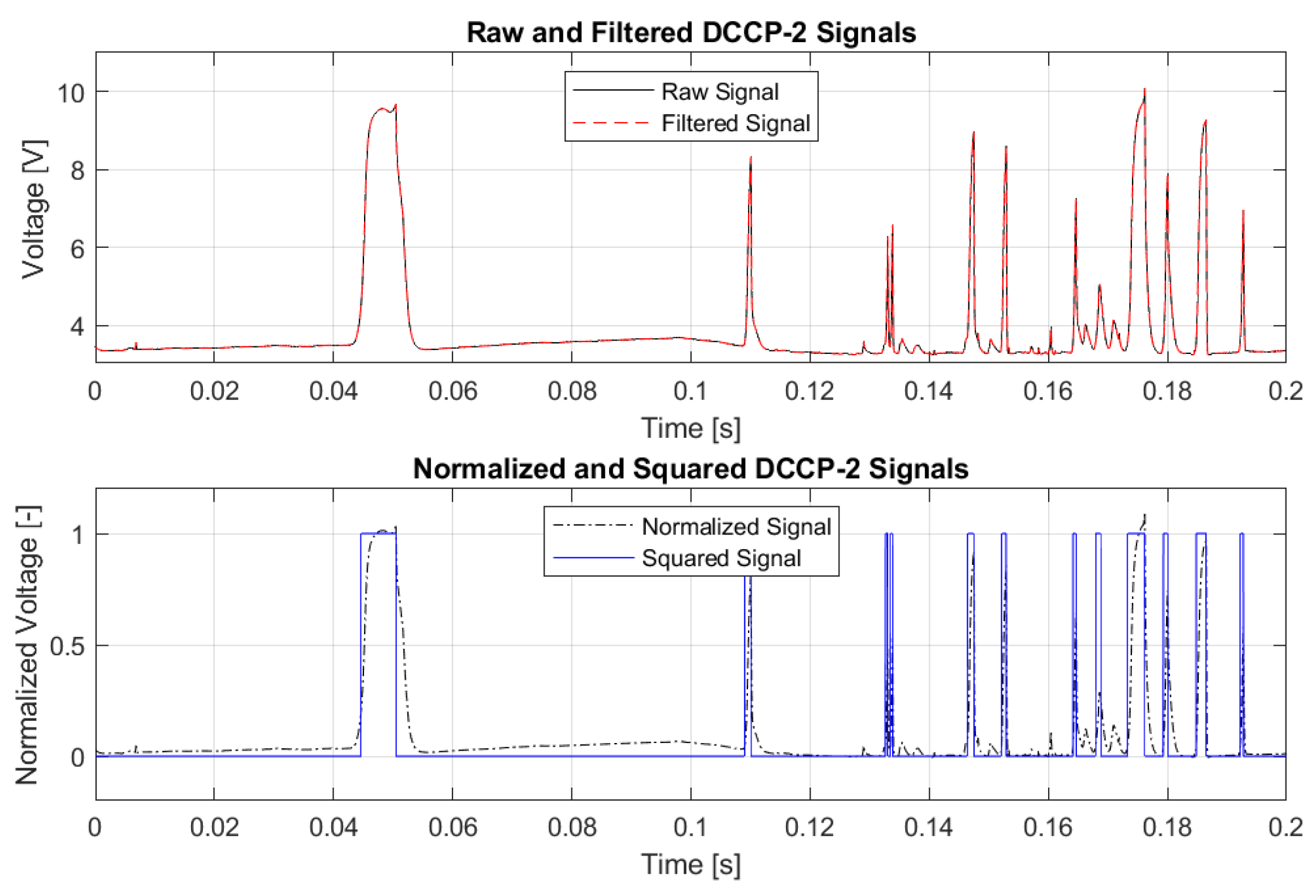
The raw signal from the DCCP-2 is median filtered and then normalized. The normalized signal is then converted into square signals based on the sensed voltage level and the gradient of the signal. A rectification algorithm is created to back track and refine the real starting point and end point of the normalized signal. The rectification algorithm analyzes all the points in the neighborhood of the rise and fall signal points to find the most appropriate squaring point. Figure 4 shows the process of signal squaring. The squared signal can now be used to find the void fraction, velocity, and chord length of the phasic structure sensed by the probe.

2.2.2. Experimental Data

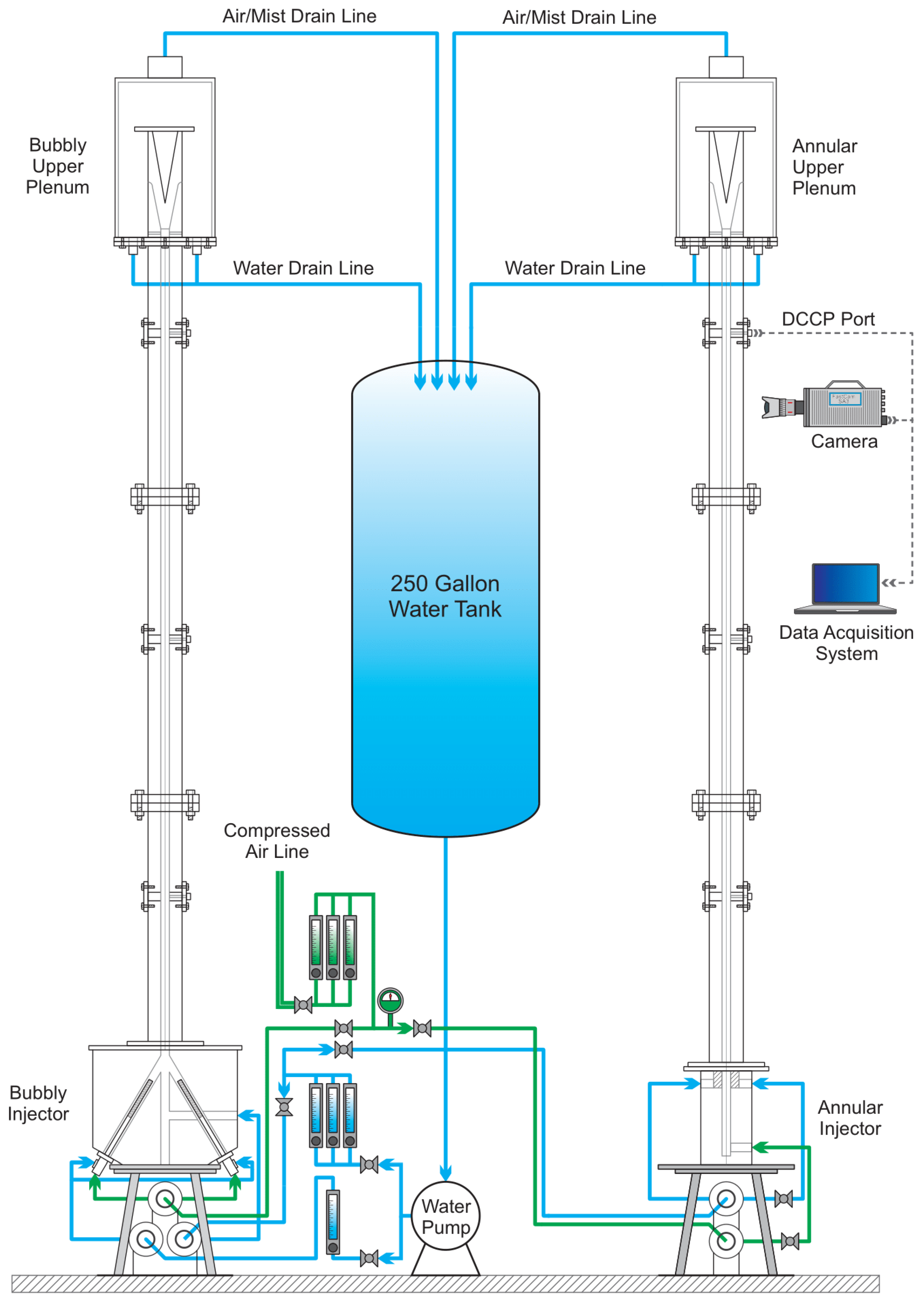
A vertical rectangular channel is used to generate the data for application to the NN Classifier. The schematic of the experimental facility is shown in Figure 5.
The experimental facility is designed and constructed at TRSL of Purdue University. It is an adiabatic two-phase flow facility. The gas phase consists of air which is injected in the facility through a 45 m3 compressed gas tank at 10 atm gauge pressure. The liquid phase consists of water which is recirculating in the channel by the help of a variable speed water pump. The channel is about 3 m in height with a cross section of 20 × 1 cm2. The facility is capable of producing liquid superficial velocity ( j f ) of around 3 m/s and gas superficial velocity ( j g ) of around 30 m/s. Only the annular injector side of the test facility is used in this study. See Sharma [34] for details of the test facility.
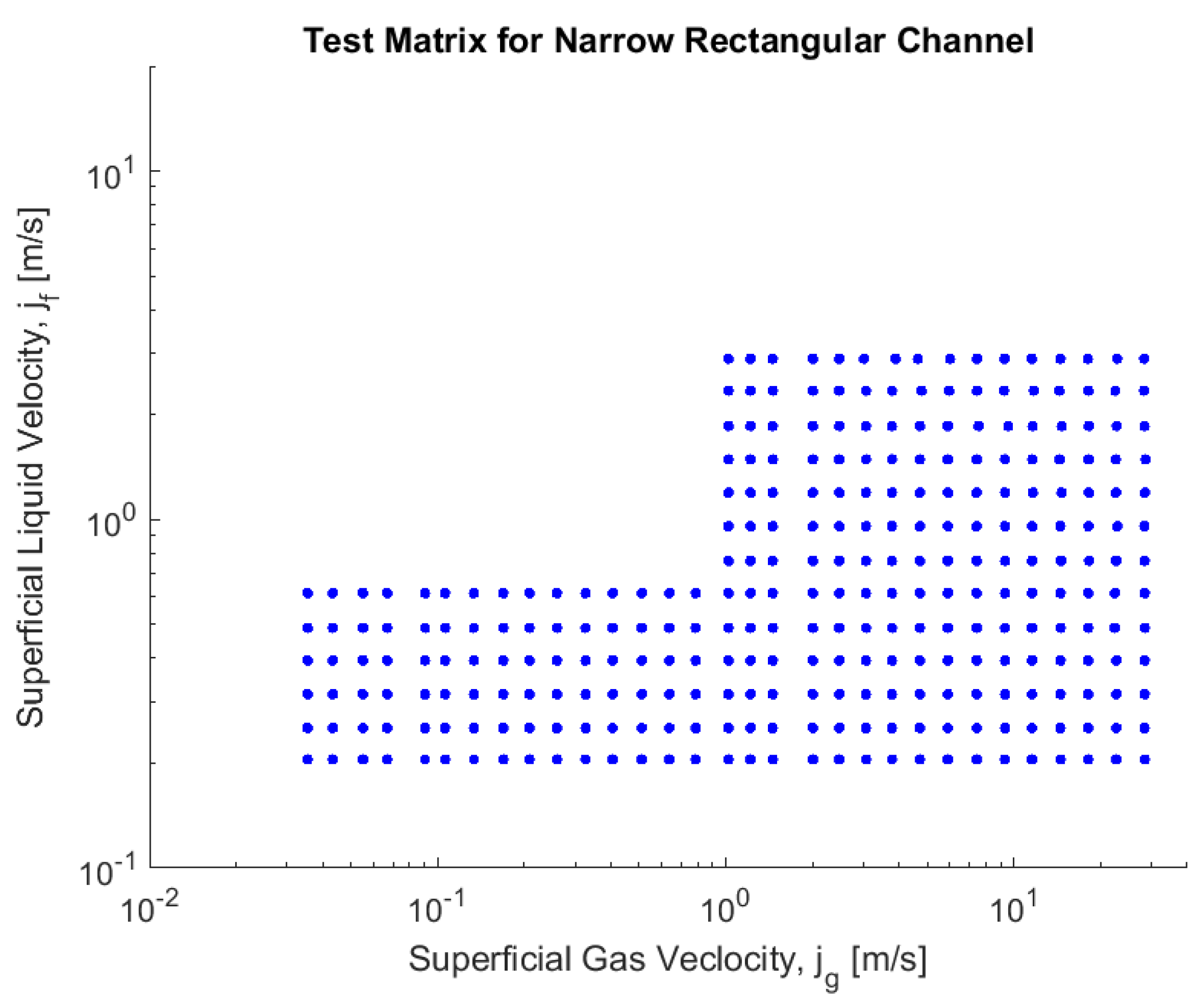
The data from DCCP-2 is acquired at the most downstream location possible on the channel by using a DAQ system capable of read rates of 600 kHz. A total of 298 experimental conditions are used for this study. The flow conditions are equally spaced on a log–log scale of j f vs. j g . j f ranges from 0.2 m/s to 2.9 m/s. j g ranges from 0.035 m/s to 28.5 m/s. The test matrix is shown in Figure 6.
For a rectangular channel, the flow patterns for most of the channel cross-section is same as that for the channel mid-point [35,36,37]. Thus, data from DCCP-2 at the channel mid-point is the representative of the whole channel and can be used for flow regime identification. (For narrow channels, the flow drastically changes near the walls, so these regions were avoided).
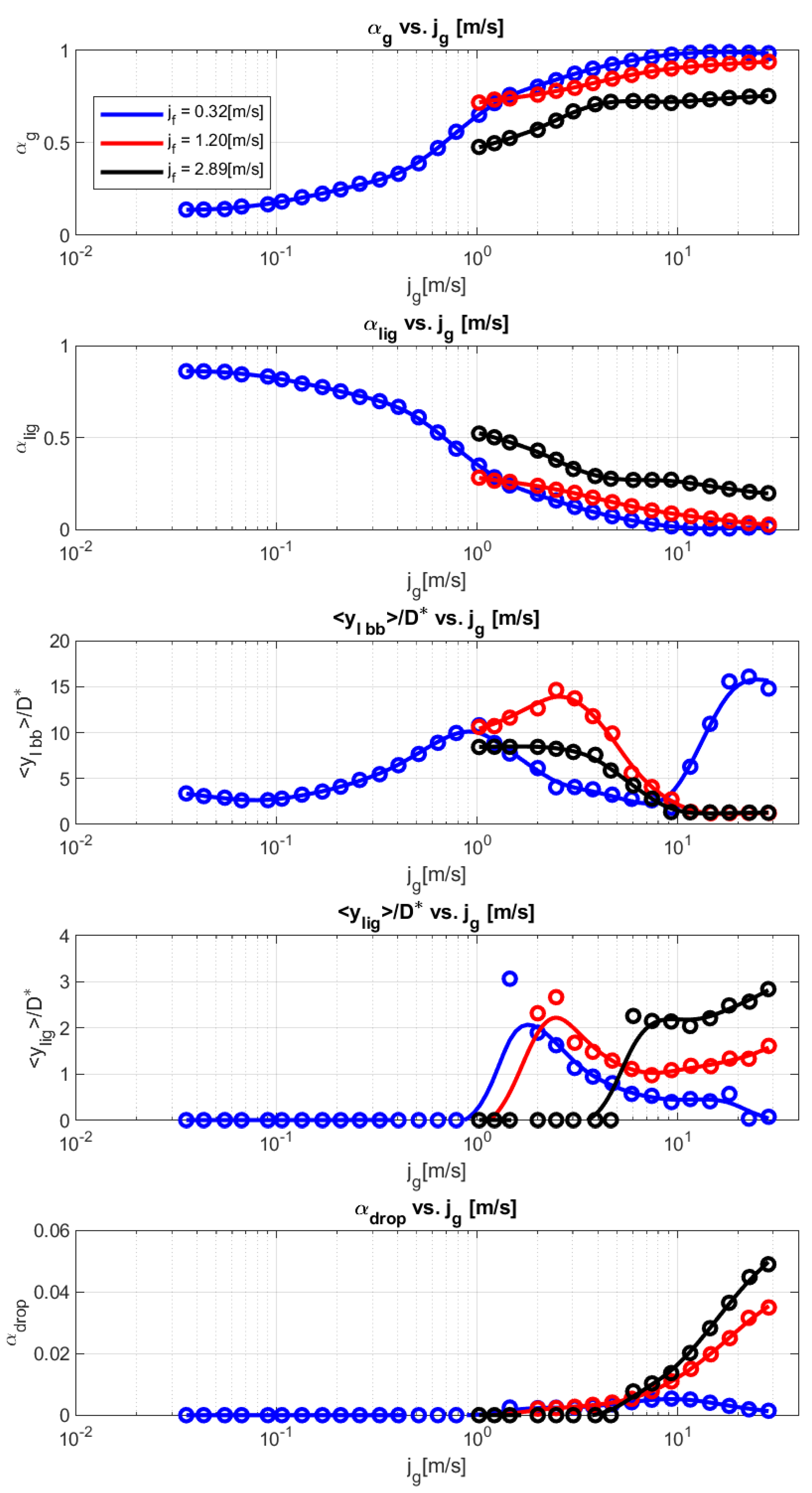
The data acquired from 298 experimental conditions is processed and the desired parameters are calculated. The five geometric parameters that are needed for the study are α g , α l i g , y l i g , y l b b , and α d r o p . The chord lengths are dimensional and hence are fluid system specific. To ease this requirement, a normalization can be performed. The Taylor wavelength is used for this purpose, which is given by
D * = σ g Δ ρ ,
where σ is the surface tension of the fluid interface, g is acceleration due to gravity, and Δ ρ is the density difference between the two-phases. This normalization eases the fluid similarity requirement of the study, and hence the same analysis can be applied to any fluid system.
The required parameters for three different liquid flow rates vs. increasing gas flow rates are shown in the Figure 7.
The number of experimental data points used in this study for flow regime identification is one of the most dense experimental test matrices for similar tests. The dataset is considered most complete in this regard. For flow regime identification using neural networks, a fraction of experimental conditions can provide stable results. See [5,6].
For each operating condition, the geometric parameters α g , α lig , y lig / D * , y l , b b / D * , and α drop are aggregated within the SOM clusters to obtain representative mean values and fluctuations. The clustering shown in Figure 8 therefore reflects systematic trends in these parameters across the j f j g test matrix. Moving from group 1 to group 6, α g and α drop increase, while y l , b b / D * and y lig / D * decrease, indicating a progression from dispersed bubbles to highly fragmented wispy structures with strong droplet entrainment.

2.3. Application to 1-Inch ID Round Pipe Geometry

2.3.1. DCCP-4

The DCCP-4 was developed to address a major limitation of traditional conductivity probes: the inability to differentiate between dispersed liquid and dispersed gas in high-void-fraction environments. Conventional probes compare the sensor voltages only to the probe casing, which is often wetted by the continuous liquid film in annular flow. As a result, droplets disconnected from the wall liquid layer appear electrically similar to bubbles, leading to an overestimation of gas structures. The DCCP-4 overcomes this issue by reorganizing the sensing configuration and introducing an additional electrical pathway.
The probe consists of five electrodes in total: a leading sensor (L) at the front, three trailing (T) sensors positioned behind it, and the common sensor. The L/T sensors are insulated with a coating, leaving only a short exposed tip. When the flow structure comes into contact with any of these electrodes, the electrical resistance between the electrodes changes according to whether the structure is a droplet, bubble, ligament, or gas core. The two voltage pathways respond differently depending on whether the contacting liquid is electrically connected to the film coating the wall or is isolated as a detached droplet (droplet signal vs. phase signal). The schematic of DCCP-4 is given in Figure 8.
The DCCP-4 incorporates all the advantages of the miniaturized four-sensor conductivity probe as well as the ability to differentiate between the dispersed liquid and dispersed gas. The main advantage of the four sensor geometry is the capacity to characterize deformed, non-spherical interfacial structures without imposing geometric assumptions. In annular flows, the dispersed and continuous phases can be highly deformed. The flows contain elongated ligaments, sheared droplets which may not be spherical, and other such structures. Therefore, it was considered optimal to use DCCP-4 for identification purposes. The construction and signal processing techniques are the same as in the case of DCCP-2.

2.3.2. Experimental Data

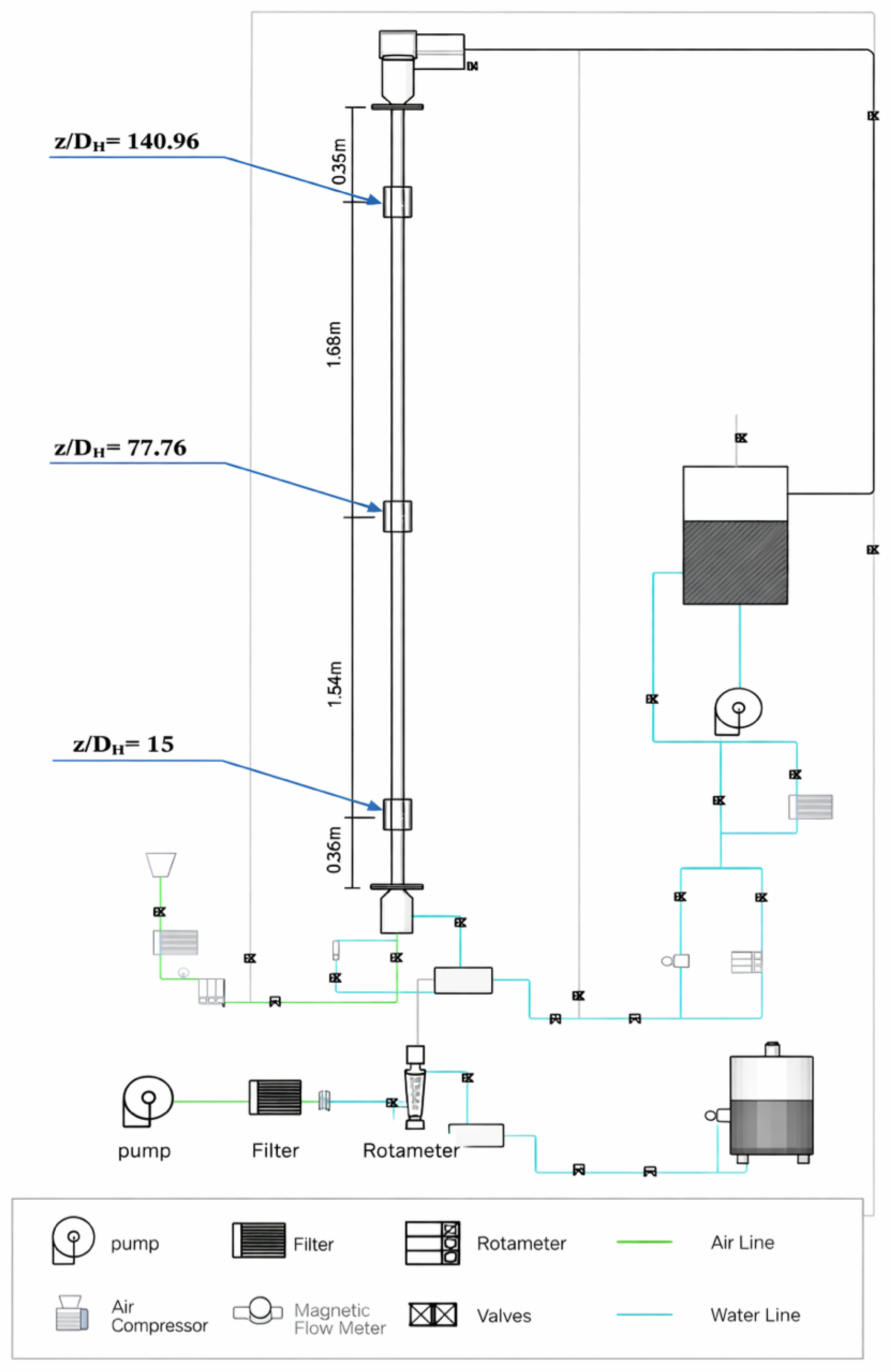
The experimental work was carried out in a vertical air–water two-phase flow facility specifically designed to generate controlled flow conditions. The schematic of the facility is shown in Figure 9 The loop is organized into four major subsystems: a fluid injection unit, a transparent test section, a storage and separation tank, and a mechanism that allows for switching between upward and downward flow operation.
The injection unit contains a centrifugal pump, a magnetic flow meter capable of measuring liquid velocities up to approximately 3.5 m / s , a compressed air supply line, and an air buffer tank used to stabilize the incoming gas flow. Gas flow of velocities up to 27 m / s are monitored using rotameters. The main test section consists of a clear acrylic tube with an inner diameter of 25.4 mm (1 inch). Multiple axial locations include measurement ports designed to accommodate conductivity probes as well as differential pressure transducers. The loop can be operated with either upward or downward flow.
Once it has flown through the test section, the two-phase mixture flows into an upper buffer tank and subsequently into a separation vessel, where gravity helps to the separate air and water. The water returns to the pump, while the air is released from the system. The liquid flow is supplied by a 25 hp centrifugal pump and gas is delivered from a compressed air system maintained at a pressure of approximately 960 kPa . The facility employs standard instrumentation, including pressure transducers, electromagnetic and magnetic flow meters, and rotameters.
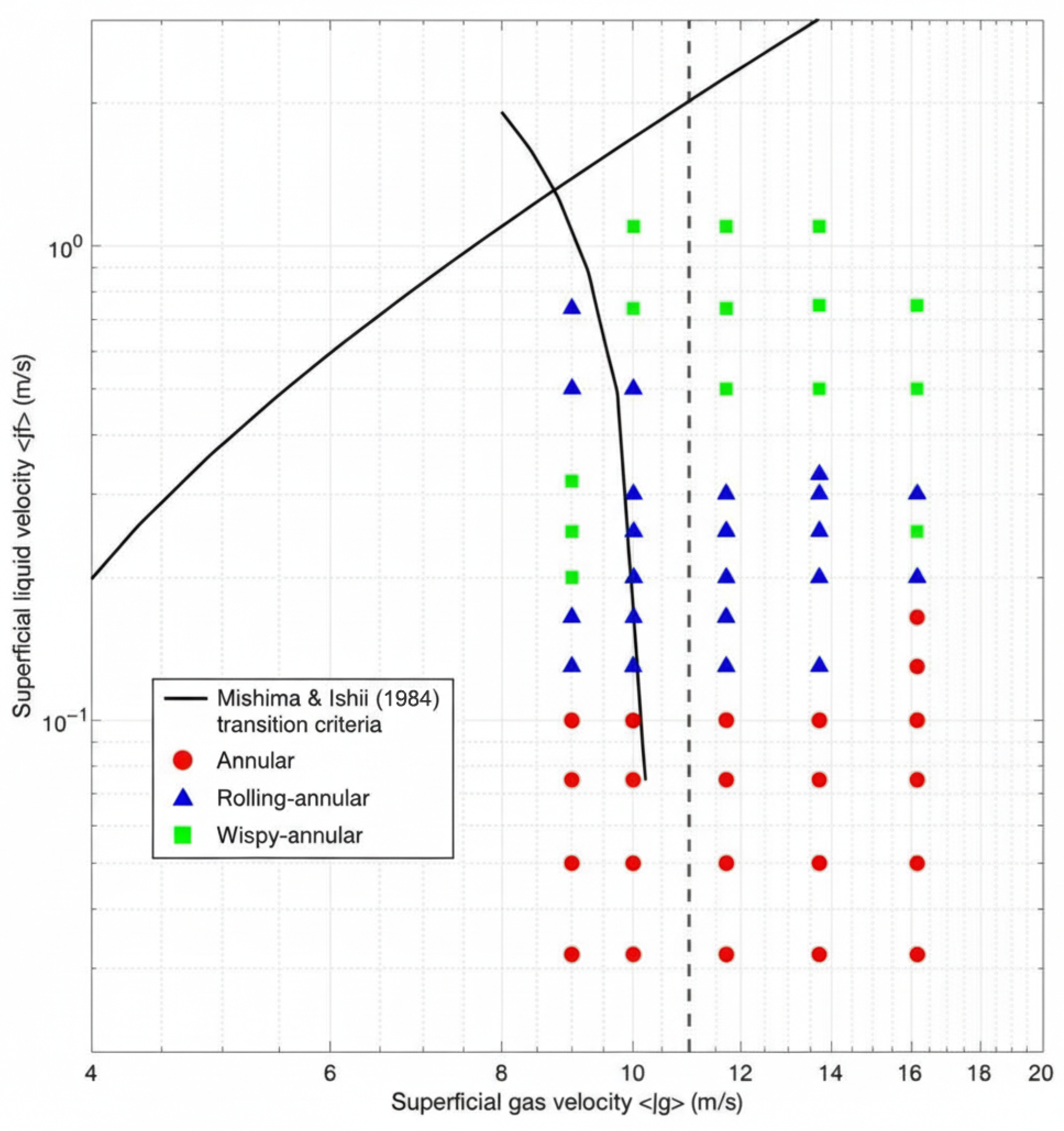
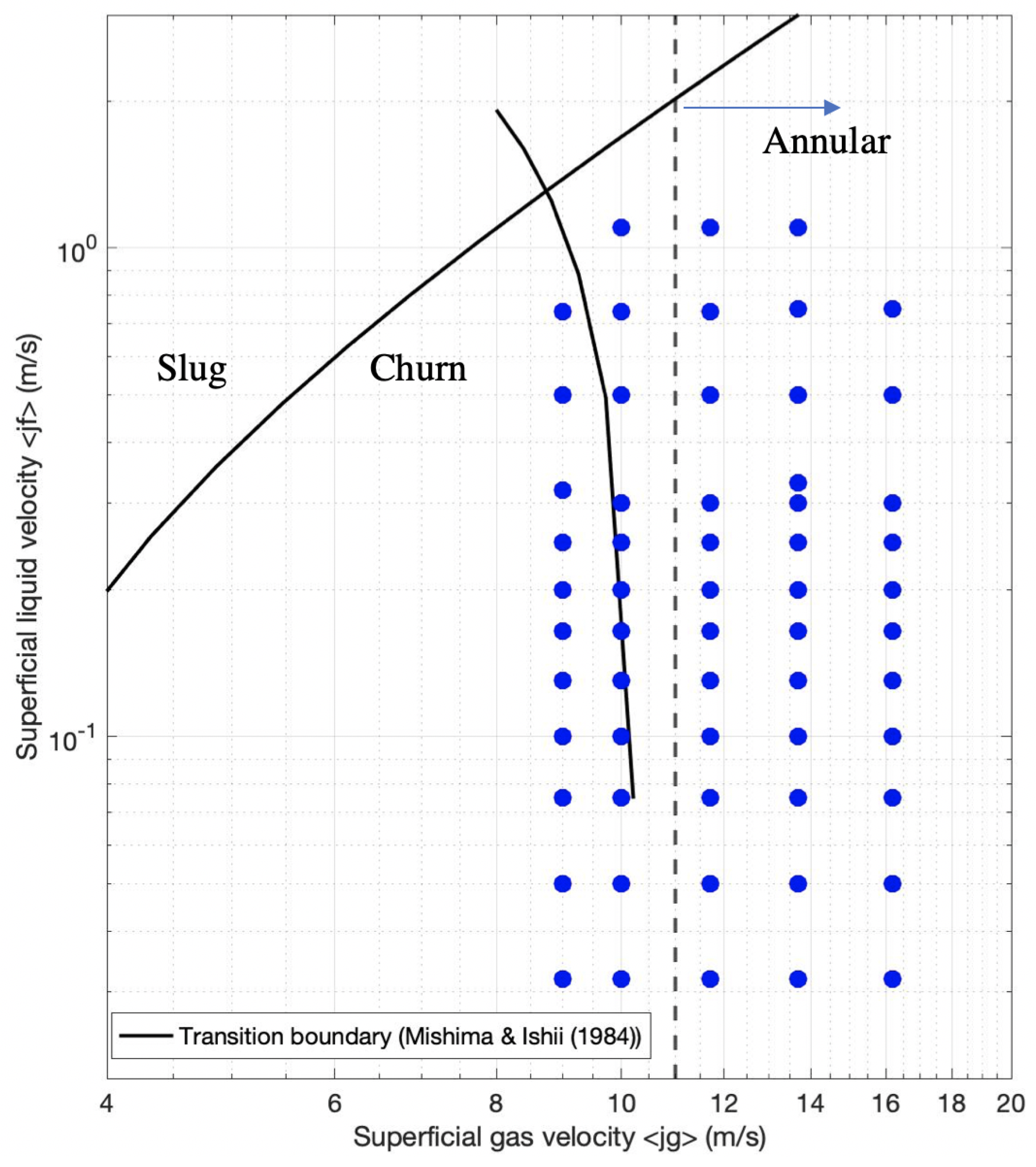
All experiments were performed at room temperature (23 °C) and atmospheric pressure. The test matrix for the experimental conditions is shown in Figure 10. The conductivity probe was mounted at an axial location of L / D = 77.76 and operated using a traversing system equipped with a micrometer screw gauge for precise radial positioning. A total of 59 operating conditions were investigated, as summarized in Figure 11. For each condition, data were collected at the pipe centerline for 20 s at an acquisition frequency of 400 kHz . The sampling duration ensured converged void fraction statistics for all flow regimes, while the acquisition frequency was selected to resolve small, high-velocity droplets commonly observed in annular flows. Under the expected velocity ranges, the spatial resolution of the system is approximately 150 μ m .

3. Results

3.1. Narrow Channel

The 298 experimental conditions are clustered into six groups listed below:
  • Group 1 is bubbly and distorted bubbly flow;
  • Group 2 is cap-turbulent flow (slug flow in round pipe is equivalent to cap-turbulent flow in rectangular channels);
  • Group 3 is churn-turbulent flow;
  • Group 4 is annular flow;
  • Group 5 is rolling wispy flow (identified in a previous study [28]);
  • Group 6 is wispy flow.
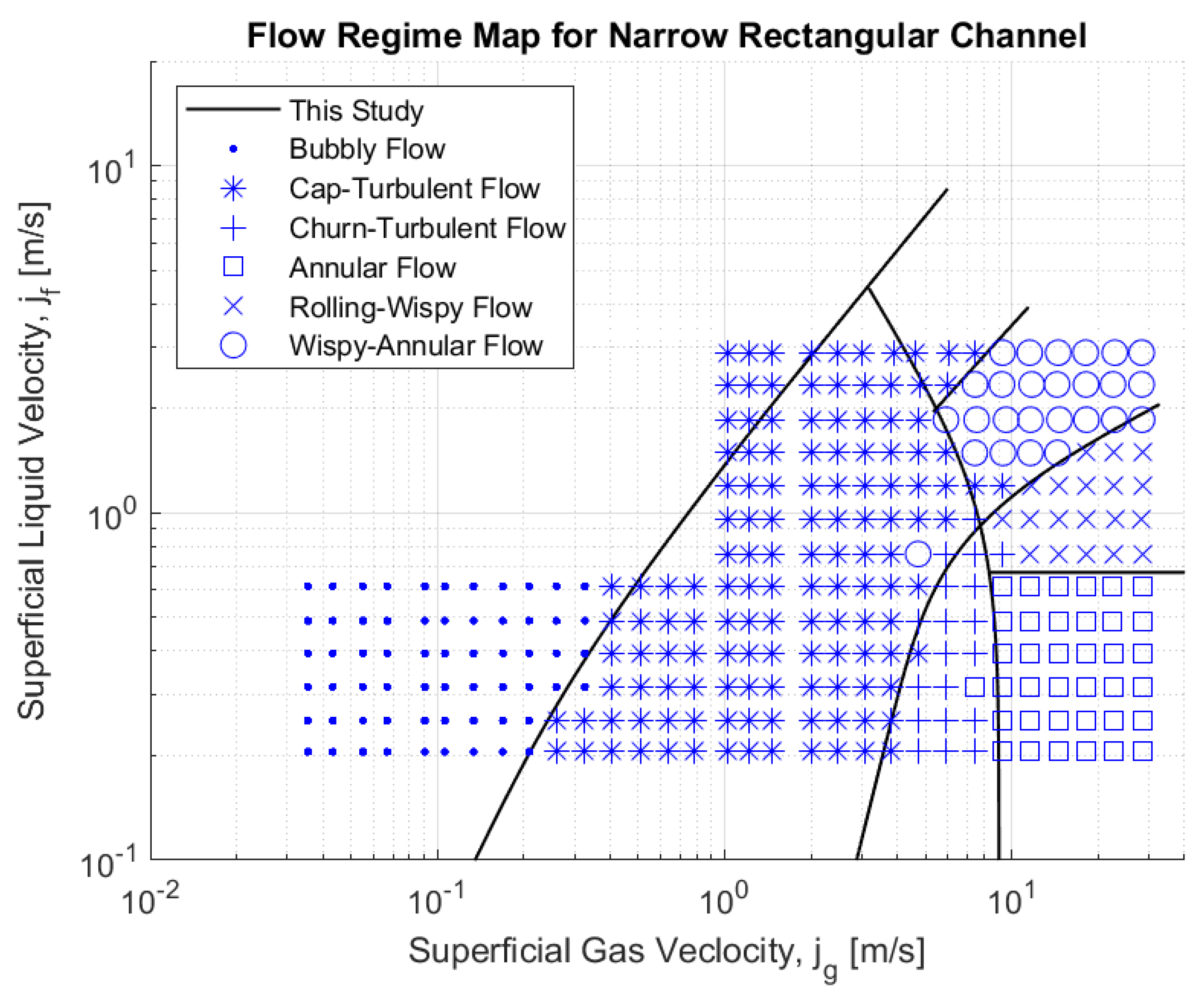
The cluster trends provide a useful picture of the dominant mechanisms in each regime. In group 1 (bubbly/distorted bubbly), low α g and negligible α drop indicate isolated bubbles carried by the liquid core, and the subsequent increase in y l , b b / D marks the onset of coalescence as cap-turbulent structures develop in group 2. Group 3 (churn-turbulent) is characterized by higher α lig and large variations in y l , b b / D , which is consistent with vigorous interface breakup and large-scale oscillation of the liquid core. In group 4 (annular), y lig / D is small and α lig is reduced, suggesting a comparatively smooth wall film with limited penetration of liquid into the core. Groups 5 and 6 (rolling wispy and wispy) show increased α drop along with more irregular chord length statistics, indicating wave-induced ligament stripping and subsequent droplet entrainment from the film. The results of the NN two-phase flow classifier are shown in Figure 11. The boundary for the flow regime map is the best estimate of the boundary between the flow regimes as classified by the neural network-based two-phase flow classifier.
A phenomenological explanation of the flow regime transition boundaries can therefore be obtained directly from the measured geometric statistics: the churn-turbulent to annular transition is associated with a marked reduction in ligament chord length and entrainment, whereas the annular to wispy transition is accompanied by an increase in droplet fraction and fragmentation of the wall film. These changes are expected to coincide with shifts in interfacial area concentration, wall shear, and film thickness, and thus with changes in pressure drop and wall heat transfer coefficients in two-fluid and subchannel analyses.

3.2. Round Pipe

The experimental observations indicate that as the liquid flow rate increases, three distinct flow regimes emerge. For cases with a superficial gas velocity of j g = 9 m / s , the classification of the flow becomes more diverse as the superficial liquid velocity rises. These operating points lie close to the transition region between churn-turbulent and annular flow.
When the velocity of the liquid increases to the range 0.1 j f 0.5 m / s , periodic disturbances appear on the film surface. These interfacial structures propagate axially and correspond to the well-known roll waves. Because these waves periodically transport both momentum and liquid mass along the interface, this regime is referred to in the present study as “rolling annular”. At even higher liquid velocities, the interface becomes increasingly fragmented. Thin filaments of liquid detach from the wall film and extend into the core region, forming a wispy, irregular layer. Droplets in this regime are primarily entrained by shear acting on the roll wave crests. This regime, denoted as wispy annular flow, exhibits more complex and chaotic behavior than classical annular flow.
The SOM output neurons can be related to these three annular sub-regimes by examining the droplet, bubble, and ligament chord length statistics used as inputs to the network. One cluster shows relatively small droplet chord lengths, moderate ligament chords, and comparatively low droplet event rates, which is consistent with a classical annular flow with a smoother wall film. A second cluster has longer ligament chords and a more pronounced temporal modulation of the mean ligament length, indicating roll waves that periodically thicken the film and transport liquid axially; this cluster is interpreted as rolling annular flow. The third cluster has the highest droplet event rate together with small and highly variable ligament chord lengths, indicating strong ligament breakup and the shear-driven entrainment characteristic of wisp annular flow.
The distribution of conditions among the clusters in Figure 12 shows that the rolling annular to wispy annular transition occurs over a narrow band of j f at high j g , where droplet fraction and chord length variability increase. In this region the SOM highlights conditions where the wall film is likely to thin, interfacial area and droplet loading increase, and both interfacial friction and convective heat transfer are expected to change.

4. Discussion

The present classifiers inherit the measurement uncertainties associated with the DCCP family of probes. Liu et al. and Zhu et al. have quantified the spatial resolution and void fraction accuracy of droplet-capable conductivity probes by benchmarking against high-speed imaging and by analyzing the effect of probe tip spacing on the reconstruction of local interfacial structures [7,32]. Wang et al. further examined the error in chord length and droplet size estimation in annular and churn-turbulent flows, showing that uncertainties arise from both electronic noise and the assumption that the structures convect past the probe at a single characteristic velocity [33]. In the current work, the minimum resolvable chord length is constrained by the sampling rate and the DCCP tip spacing, so that very small droplets and thin ligaments may be underestimated, and the conversion from residence time to spatial chord length relies on a convection–velocity estimate that introduces additional bias at high turbulence levels. These limitations primarily affect the quantitative values of the geometric inputs but do not alter the qualitative separation of the main flow regime clusters; nevertheless, they should be considered when extending the present regime maps beyond air–water conditions or to substantially larger hydraulic diameters and different fluid properties, where surface tension and density ratios modify both the interfacial scales and the probe response [32,33].
The following conclusions can be drawn based on the present study:
  • Neural-network-based flow regime classifiers that use geometric information on the interface have been developed for a vertical narrow rectangular channel and a 1-inch round pipe.
  • The classifiers separate regimes that are similar in void fraction or visual appearance by clustering on interfacial chord length and phase fraction statistics obtained from droplet-capable conductivity probes.
  • Application to a 298-point test matrix in the rectangular channel yields a six-region regime map in which each cluster shows distinct trends in gas fraction, ligament fraction, ligament and large bubble chord lengths, and droplet fraction, allowing a direct interpretation in terms of breakup, coalescence, and entrainment processes.
  • In the 1-inch round pipe, SOM clustering of droplet, bubble, and ligament chord length statistics identifies three annular sub-regimes—classical annular, rolling annular, and wispy annular—that are consistent with the roll waves and wispy structures described in Section 3.2 and occupy distinct regions of the j f j g plane in Figure 12.
  • The regime boundaries obtained from the classifiers correspond to changes in measured geometric parameters such as ligament fraction, droplet fraction, and chord length distributions, which can be associated with variations in interfacial area, wall shear, and film thickness and, in turn, with momentum and heat transfer behavior in two-fluid and subchannel models.
  • Because the inputs and outputs of the classifiers are defined in terms of geometric quantities rather than subjective visual labels, the method offers a reproducible way to construct flow regime maps and to supply regime-dependent closure information, such as interfacial area density and entrained droplet fraction, for advanced multiphase flow simulations.
  • This method of flow regime identification cannot be directly applied in the field to assess the changing flow regimes in a flow channel like in a nuclear reactor core or other flow systems. However, the same idea can be used to train a Long Short-Term Memory (LSTM) neural network to classify the flow regimes based on the DCCP data. Such an LSTM would be configured to accept the squared signal prepared by a signal conditioning algorithm. As LSTM remembers the recent data it received, it can learn patterns exhibited by the squared data for various flow regimes. This method can be used to create instrumentation that is able to identify flow-regimes on the fly in flow systems.
The regime maps and transition boundaries obtained in this work have direct implications for the development of Two-Fluid Model (TFM) closures in nuclear thermal–hydraulic analysis [25,34,38]. In the vertical narrow rectangular channel, the classifier provides quantitative boundaries between bubbly/distorted bubbly, cap-turbulent, churn-turbulent, annular, rolling wispy, and wispy flows in the ( j f , j g ) plane, expressed in terms of the geometric inputs α g , α lig , y lig , y , bb , and the droplet indicator. These quantities are directly related to the interfacial area, characteristic length scales, and phase connectivity that appear in interfacial drag, interfacial area transport, and entrainment/de-entrainment correlations used in TFM formulations for reactor core channels and narrow rectangular fuel assemblies [25,34,38].
For the 1-inch round pipe, the rolling annular and wispy annular regimes are distinguished by the mean and standard deviation of the droplet, bubble, and ligament chord length distributions measured by DCCP-4. These statistics describe the structure of the liquid film, ligaments, and entrained droplets, and can be used to constrain regime-dependent closures for interfacial friction and droplet entrainment in high-void-fraction annular flows relevant to reactor downcomers and steam generator risers [26,39,40]. In both geometries, the objective classifiers replace subjective visual criteria with geometric metrics that can be coupled directly to constitutive relations in system codes and CFD frameworks employing the TFM, providing a consistent way to incorporate experimentally based phase geometries into nuclear thermal-hydraulic models [25,34,38].

Author Contributions

Conceptualization, A.K.K., Y.Z. and M.I.; methodology, A.K.K., C.A.T., Y.Z. and M.I.; software, A.K.K. and C.A.T.; validation, Y.Z. and M.I.; formal analysis, A.K.K., C.A.T., Y.Z. and M.I.; investigation, A.K.K., C.A.T. and Y.Z.; resources, M.I.; data curation, A.K.K., C.A.T. and Y.Z.; writing—original draft preparation, A.K.K. and C.A.T.; writing—review and editing, A.K.K., C.A.T., Y.Z. and M.I.; visualization, A.K.K. and C.A.T.; supervision, M.I.; project administration, M.I. All authors have read and agreed to the published version of the manuscript.

Funding

This research received no external funding.

Data Availability Statement

The data presented in this study are available on request from the corresponding author due to intellectual property restrictions.

Conflicts of Interest

The authors declare no conflicts of interest.

References

  1. Ishii, M.; Hibiki, T. Thermo-Fluid Dynamics of Two-Phase Flow, 2nd ed.; Springer: Berlin/Heidelberg, Germany, 2006. [Google Scholar]
  2. Wallis, G.B.; Block, J.A.; Crowley, C.J. Flow Regimes in a Simulated PWR Downcomer Annulus; Technical Report; Thayer School of Engineering, Dartmouth College: Hanover, NH, USA, 1974. [Google Scholar]
  3. Wallis, G.B. One-Dimensional Two-Phase Flow; Courier Dover Publications: Mineola, NY, USA, 2020. [Google Scholar]
  4. Govier, G.W.; Aziz, K. The Flow of Complex Mixtures in Pipes; Van Nostrand Reinhold: New York, NY, USA, 1972; Volume 469. [Google Scholar]
  5. Mi, Y.; Ishii, M.; Tsoukalas, L.H. Vertical two-phase flow identification using advanced instrumentation and neural networks. Nucl. Eng. Des. 1998, 184, 409–420. [Google Scholar] [CrossRef]
  6. Mi, Y.; Ishii, M.; Tsoukalas, L.H. Flow regime identification methodology with neural networks and two-phase flow models. Nucl. Eng. Des. 2001, 204, 87–100. [Google Scholar] [CrossRef]
  7. Mi, Y.; Ishii, M.; Tsoukalas, L.H. Investigation of vertical slug flow with advanced two-phase flow instrumentation. Nucl. Eng. Des. 2001, 204, 69–85. [Google Scholar] [CrossRef]
  8. Tsoukalas, L.H.; Ishii, M.; Mi, Y. A neurofuzzy methodology for impedance-based multiphase flow identification. Eng. Appl. Artif. Intell. 1997, 10, 545–555. [Google Scholar] [CrossRef]
  9. Smith, T.R. Two-Group Interfacial Area Transport Equation in Large Diameter Pipes. Ph.D. Thesis, Purdue University, West Lafayette, IN, USA, 2002. [Google Scholar]
  10. Dang, Z.; Ishii, M. Two-phase flow regime prediction using LSTM based deep recurrent neural network. arXiv 2019. [Google Scholar] [CrossRef]
  11. Xu, H.; Tang, T.; Zhang, B.; Liu, Y. Identification of two-phase flow regime in the energy industry based on modified convolutional neural network. Prog. Nucl. Energy 2022, 147, 104191. [Google Scholar] [CrossRef]
  12. Nie, F.; Wang, H.; Song, Q.; Zhao, Y.; Shen, J. Image identification for two-phase flow patterns based on CNN algorithms. Int. J. Multiph. Flow 2022, 152, 104067. [Google Scholar] [CrossRef]
  13. Zhang, Y.; Azman, A.N.; Xu, K.W.; Kang, C.; Kim, H.B. Two-phase flow regime identification based on the liquid-phase velocity information and machine learning. Exp. Fluids 2020, 61, 212. [Google Scholar] [CrossRef]
  14. Roshani, M.; Phan, G.T.T.; Ali, P.J.M.; Roshani, G.H. Evaluation of flow pattern recognition and void fraction measurement in two phase flow independent of oil pipeline’s scale layer thickness. Alex. Eng. J. 2021, 60, 1955–1966. [Google Scholar] [CrossRef]
  15. Ambrosio, J.d.S.; Lazzaretti, A.E.; Pipa, D.R. Two-phase flow pattern classification based on void fraction time series and machine learning. Flow Meas. Instrum. 2022, 83, 102084. [Google Scholar] [CrossRef]
  16. Dong, F.; Zhang, S.; Shi, X.; Wu, H. Flow regimes identification-based multidomain features for gas–liquid two-phase flow in horizontal pipe. IEEE Trans. Instrum. Meas. 2021, 70, 7502911. [Google Scholar] [CrossRef]
  17. Rafałko, G.; Mosdorf, R.; Górski, G. Two-phase flow pattern identification in minichannels using image correlation analysis. Int. Commun. Heat Mass Transf. 2020, 113, 104508. [Google Scholar] [CrossRef]
  18. Ahmad, H.; Kim, S.K.; Park, J.H.; Jung, S.Y. Development of two-phase flow regime map for thermally stimulated flows using deep learning and image segmentation technique. Int. J. Multiph. Flow 2022, 146, 103869. [Google Scholar] [CrossRef]
  19. Li, X.; Li, L.; Ma, W.; Wang, W. Two-phase flow patterns identification in porous media using feature extraction and SVM. Int. J. Multiph. Flow 2022, 156, 104222. [Google Scholar] [CrossRef]
  20. Ali, N.; Viggiano, B.; Tutkun, M.; Cal, R.B. Cluster-based reduced-order descriptions of two phase flows. Chem. Eng. Sci. 2020, 222, 115660. [Google Scholar] [CrossRef]
  21. Lin, Z.; Liu, X.; Lao, L.; Liu, H. Prediction of two-phase flow patterns in upward inclined pipes via deep learning. Energy 2020, 210, 118541. [Google Scholar] [CrossRef]
  22. Kuang, B.; Nnabuife, S.G.; Whidborne, J.F.; Sun, S.; Zhao, J.; Jenkins, K. Self-supervised learning-based two-phase flow regime identification using ultrasonic sensors in an S-shape riser. Expert Syst. Appl. 2024, 236, 121414. [Google Scholar] [CrossRef]
  23. Schmid, D.; Verlaat, B.; Petagna, P.; Revellin, R. Machine learning for two-phase gas–liquid flow regime evaluation in vertical channels. Exp. Therm. Fluid Sci. 2024. accepted manuscript. [Google Scholar]
  24. Ling, C.; Hibiki, T. Advances in machine learning for data-driven classification of gas–liquid flow regimes. Int. Commun. Heat Mass Transf. 2025, 169, 109582. [Google Scholar] [CrossRef]
  25. Ishii, M.; Mishima, K. Two-fluid model and hydrodynamic constitutive relations. Nucl. Eng. Des. 1984, 82, 107–126. [Google Scholar] [CrossRef]
  26. Mishima, K.; Ishii, M. Flow regime transition criteria for upward two-phase flow in vertical tubes. Int. J. Heat Mass Transf. 1984, 27, 723–737. [Google Scholar] [CrossRef]
  27. Kohonen, T. Self-organized formation of topologically correct feature maps. Biol. Cybern. 1982, 43, 59–69. [Google Scholar] [CrossRef]
  28. Khandelwal, A.K.; Zhao, Y.; Ishii, M. Neural network based two-phase flow classification in a vertical narrow rectangular channel. Int. J. Multiph. Flow 2025, 182, 105012. [Google Scholar] [CrossRef]
  29. Tsoukalas, C.A.; Zhao, Y.; Ishii, M. Identification of high void fraction flows using conductivity measurements and machine learning techniques. Int. J. Multiph. Flow 2025, 185, 105145. [Google Scholar] [CrossRef]
  30. Neal, L.G.; Bankoff, S.G. A high resolution resistivity probe for determination of local void properties in gas-liquid flow. AIChE J. 1963, 9, 490–494. [Google Scholar] [CrossRef]
  31. Kataoka, I.; Ishii, M.; Serizawa, A. Local formulation and measurements of interfacial area concentration in two-phase flow. Int. J. Multiph. Flow 1986, 12, 505–529. [Google Scholar] [CrossRef]
  32. Liu, Y.; Yang, X.; Zhu, Q.; Ju, P.; Ishii, M.; Buchanan, J.R. Development of the droplet-capable conductivity probe for measurement of liquid-dispersed two-phase flow. Int. J. Multiph. Flow 2017, 88, 238–250. [Google Scholar] [CrossRef]
  33. Wang, G.; Zhu, Q.; Ishii, M.; Buchanan, J.R. Four-sensor droplet capable conductivity probe for measurement of churn-turbulent to annular transition flow. Int. J. Heat Mass Transf. 2020, 157, 119949. [Google Scholar] [CrossRef]
  34. Sharma, S.L. Investigation of Gas-Liquid Two-Phase Flow Using Three-Field Two-Fluid Model and Two-Group Interfacial Area Transport Equation in CFD Code. Ph.D. Thesis, Purdue University, West Lafayette, IN, USA, 2016. [Google Scholar]
  35. Wilmarth, T.; Ishii, M. Two-phase flow regimes in narrow rectangular vertical and horizontal channels. Int. J. Heat Mass Transf. 1994, 37, 1749–1758. [Google Scholar] [CrossRef]
  36. Liu, Y.; Roy, T.; Lee, D.Y.; Ishii, M.; Buchanan, J.R. Experimental study of non-uniform inlet conditions and three-dimensional effects of vertical air-water two-phase flow in a narrow rectangular duct. Int. J. Heat Fluid Flow 2013, 39, 173–186. [Google Scholar] [CrossRef]
  37. Mishima, K.; Hibiki, T.; Nishihara, H. Some characteristics of gas-liquid flow in narrow rectangular ducts. Int. J. Multiph. Flow 1993, 19, 115–124. [Google Scholar] [CrossRef]
  38. Hibiki, T.; Mishima, K. Flow regime transition criteria for upward two-phase flow in vertical narrow rectangular channels. Nucl. Eng. Des. 2001, 203, 117–131. [Google Scholar] [CrossRef]
  39. Taitel, Y.; Barnea, D.; Dukler, A.E. Modelling flow pattern transitions for steady upward gas-liquid flow in vertical tubes. AIChE J. 1980, 26, 345–354. [Google Scholar] [CrossRef]
  40. Wang, G.; Dang, Z.; Ishii, M. Wave structure and velocity in vertical upward annular two-phase flow. Exp. Therm. Fluid Sci. 2021, 120, 110205. [Google Scholar] [CrossRef]
Figure 1. Five unit self-organizing neural network classifier of two-phase flow. Reprinted with permission from Ref. [28]. Copyright 2025, Elsevier.
Jne 07 00015 g001
Figure 2. Identification algorithm for annular flow in round pipe. Reprinted with permission from Ref. [29]. Copyright 2025, Elsevier.
Jne 07 00015 g002
Figure 3. Two-sensor droplet-capable conductivity probe (DCCP-2). Reprinted with permission from Ref. [28]. Copyright 2025, Elsevier.
Jne 07 00015 g003
Figure 4. Signal−conditioning of raw signal to obtain squared signal. Reprinted with permission from Ref. [28]. Copyright 2025, Elsevier.
Jne 07 00015 g004
Figure 5. Schematic of vertical, rectangular channel experimental facility. Reprinted with permission from Ref. [28]. Copyright 2025, Elsevier.
Jne 07 00015 g005
Figure 6. Test−matrix for vertical rectangular. Reprinted with permission from Ref. [28]. Copyright 2025, Elsevier.
Jne 07 00015 g006
Figure 7. Variation of required flow parameters for increasing gas flow rates.
Jne 07 00015 g007
Figure 8. Schematic of DCCP-4. Reprinted with permission from Ref. [33]. Copyright 2020, Elsevier.
Jne 07 00015 g008
Figure 9. Schematic of vertical round pipe channel experimental facility. Adapted with permission from Ref. [29]. Copyright 2025, Elsevier.
Jne 07 00015 g009
Figure 10. Test−matrix for round pipe channel. Reprinted with permission from Ref. [29]. Copyright 2025, Elsevier.
Jne 07 00015 g010
Figure 11. Flow−regime clustering by NN Classifier. Reprinted with permission from Ref. [28]. Copyright 2025, Elsevier.
Jne 07 00015 g011
Figure 12. Flow−regime clustering by SOM. Reprinted with permission from Ref. [29]. Copyright 2025, Elsevier.
Jne 07 00015 g012
Table 1. Phase identification by DCCP-2.
Voltage: Common vs. GroundVoltage: Leading vs. CommonPhase
HighHighContinuous Gas
HighLowDroplet
LowHighBubble
LowLowContinuous Liquid
Disclaimer/Publisher’s Note: The statements, opinions and data contained in all publications are solely those of the individual author(s) and contributor(s) and not of MDPI and/or the editor(s). MDPI and/or the editor(s) disclaim responsibility for any injury to people or property resulting from any ideas, methods, instructions or products referred to in the content.