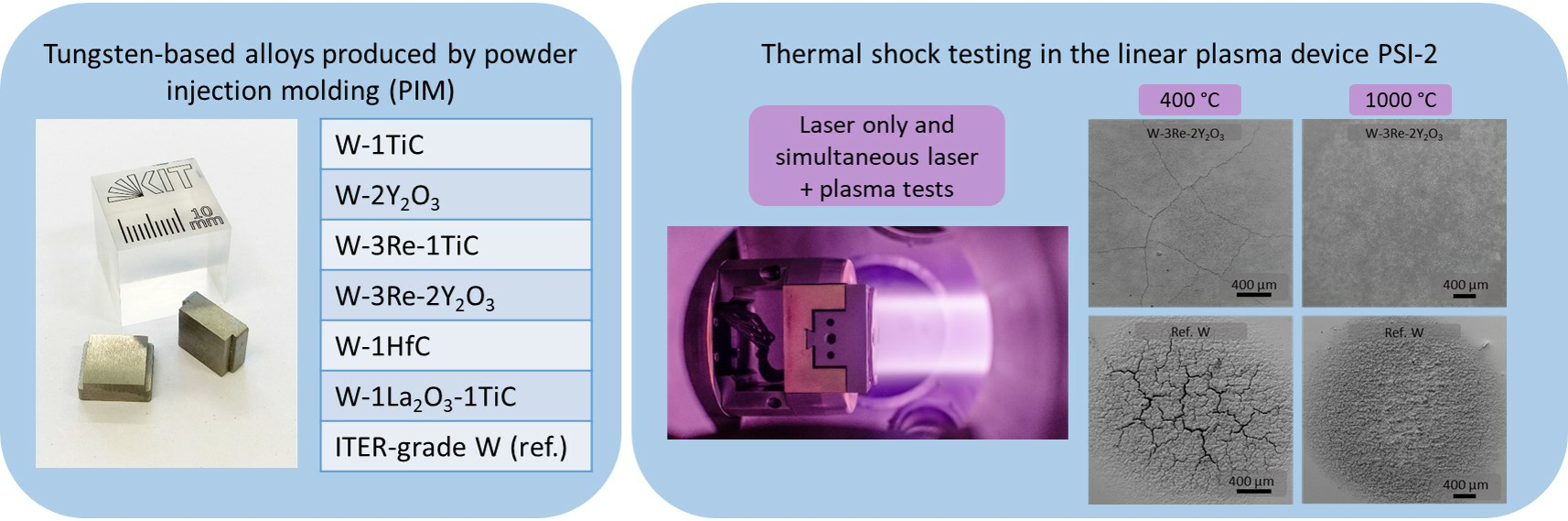

Thermal Shock and Synergistic Plasma and Heat Load Testing of Powder Injection Molding Tungsten-Based Alloys

 ,
,  ,
,  , ,
, , Abstract
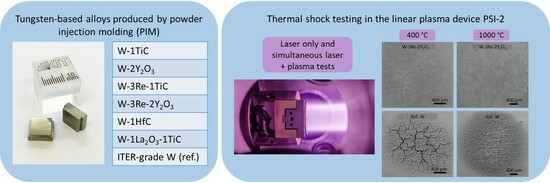
Share and Cite
Gago, M.; Antusch, S.; Klein, A.; Kreter, A.; Linsmeier, C.; Rieth, M.; Unterberg, B.; Wirtz, M. Thermal Shock and Synergistic Plasma and Heat Load Testing of Powder Injection Molding Tungsten-Based Alloys. J. Nucl. Eng. 2025, 6, 25. https://doi.org/10.3390/jne6030025
Gago M, Antusch S, Klein A, Kreter A, Linsmeier C, Rieth M, Unterberg B, Wirtz M. Thermal Shock and Synergistic Plasma and Heat Load Testing of Powder Injection Molding Tungsten-Based Alloys. Journal of Nuclear Engineering. 2025; 6(3):25. https://doi.org/10.3390/jne6030025
Chicago/Turabian StyleGago, Mauricio, Steffen Antusch, Alexander Klein, Arkadi Kreter, Christian Linsmeier, Michael Rieth, Bernhard Unterberg, and Marius Wirtz. 2025. "Thermal Shock and Synergistic Plasma and Heat Load Testing of Powder Injection Molding Tungsten-Based Alloys" Journal of Nuclear Engineering 6, no. 3: 25. https://doi.org/10.3390/jne6030025
APA StyleGago, M., Antusch, S., Klein, A., Kreter, A., Linsmeier, C., Rieth, M., Unterberg, B., & Wirtz, M. (2025). Thermal Shock and Synergistic Plasma and Heat Load Testing of Powder Injection Molding Tungsten-Based Alloys. Journal of Nuclear Engineering, 6(3), 25. https://doi.org/10.3390/jne6030025