1. Introduction
The genitourinary syndrome of menopause (GSM) encompasses a spectrum of symptoms and signs associated with hypoestrogenism in postmenopausal women, affecting approximately 50–70% of this population [
1,
2]. Vulvovaginal atrophy (VVA), a core manifestation of GSM, occurs in about half of postmenopausal women [
3] and is characterized by thinning of the vulvovaginal tissues and loss of elasticity, leading to vaginal dryness (reported by nearly all affected women), burning, itching, irritation, dyspareunia, decreased lubrication, and post-coital bleeding [
4,
5]. These symptoms substantially impair quality of life (QoL), affecting sexual function, emotional well-being, and daily comfort.
The underlying pathophysiology is largely driven by estrogen deficiency, which alters the vulva, vagina, and lower urinary tract. Estrogen deprivation leads to reduced collagen and elastin content, epithelial thinning, altered smooth muscle cell function, and decreased vascularization, leading to anatomical changes such as labia minora hypotrophy and introital retraction [
6,
7,
8].
Current guidelines recommend management based on symptom severity. Non-hormonal treatments may offer short-term relief for mild to moderate symptoms but do not reverse tissue degeneration. Persistent or severe symptoms are managed with hormone therapy, either topical or systemic, tailored to individual patient profiles, with local estrogen therapy remaining the gold standard [
9,
10].
Menopause also reduces the synthesis of hyaluronic acid (HA) and mucopolysaccharides in the extracellular matrix (ECM), impairing urogenital tissue integrity [
11]. The ECM, composed of collagen (mainly types IV and VII), elastin, HA, proteoglycans, and glycoproteins like fibronectin, ensures tissue support, elasticity, and hydration. Aging disrupts ECM homeostasis through decreased fibroblast activity and hydration loss, contributing to VVA.
HA, a non-sulfur glycosaminoglycan, is essential for tissue hydration and fibroblast activity, and low molecular weight HA (LMWHA) promotes ECM synthesis [
12,
13,
14]. Moreover, amino acids such as glycine, L-proline, L-lysine, L-leucine, L-valine, and L-alanine support fibroblast function and collagen production [
15].
Topical HA products are widely used for symptomatic relief by hydrating superficial mucosa. However, their limited tissue penetration may reduce their ability to stimulate fibroblasts or promote sustained ECM remodeling. As a result, clinical benefits are often temporary or insufficient for meaningful regeneration [
5,
16].
Intradermal injections of HA combined with amino acids allow targeted delivery into deeper dermal and submucosal layers, providing more consistent fibroblast stimulation and ECM renewal. Although no randomized controlled trials directly compare intradermal and topical HA for VVA, clinical practice increasingly favors injectable approaches based on theoretical and mechanistic advantages, such as longer-lasting and more profound tissue regeneration [
15].
With increasing life expectancy, women may spend up to 40% of their lives in postmenopause, often experiencing symptoms of vulvovaginal atrophy, one of the main components of the Genitourinary Syndrome of Menopause (GSM) [
17].
Therefore, we conducted a multicenter prospective clinical study to evaluate the safety, tolerability, and efficacy of Sunekos Inticare, an injectable combination of non-crosslinked HA and amino acids, in treating GSM-related symptoms. The primary aim was to assess safety, tolerability, and patient satisfaction, with secondary objectives including changes in symptom severity and quality of life. The formulation of Sunekos Inticare is designed to restore elasticity and support soft tissue regeneration in the vulvovaginal area by promoting long-lasting physiological rehydration through ECM renewal.
2. Results
A total of 84 women with clinically confirmed VVA who met the study’s inclusion and exclusion criteria were enrolled. All participants completed the three scheduled treatment sessions and responded to the study questionnaires. However, the total number of patients included in specific analyses may vary due to incomplete follow-up data or missing responses. Any withdrawals and their reasons (e.g., loss to follow-up, lack of motivation) were documented during follow-up visits.
The demographic characteristics of the study population are presented in
Table 1. The mean age was 54.9 ± 4.1 years. Participants included 12 Turkish, 11 German, 20 Jordanian, 20 Polish, and 22 Italian women.
2.1. Symptoms
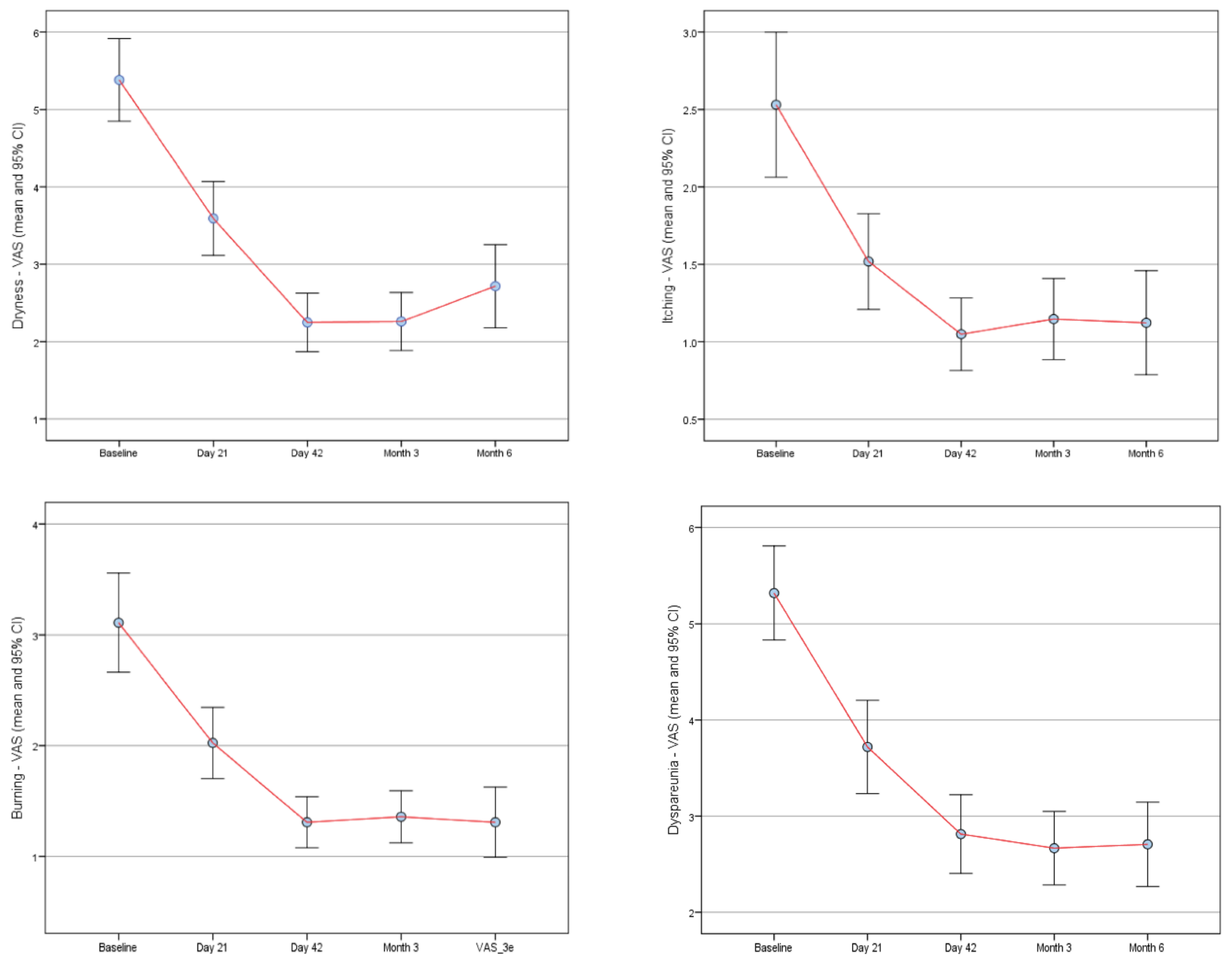
Table 2 shows the mean ± standard deviation (SD) scores for the four core symptoms—vaginal dryness, itching, burning, and dyspareunia—assessed at baseline (T0), 3 months (T3), and 6 months (T5) post-treatment initiation. Statistically significant improvements were observed in all symptoms at both follow-up timepoints compared to baseline (all
p < 0.001).
Specifically, vaginal dryness decreased from 5.4 ± 2.4 at baseline to 2.2 ± 1.7 at 3 months, and remained improved at 2.7 ± 2.4 at 6 months. Similar reductions were observed in itching, burning, and dyspareunia scores. Paired Student’s
t-tests were used to compare symptom scores between baseline and each follow-up point (see
Table 2 footnote and
Figure 1).
2.2. Tolerability with Treatment
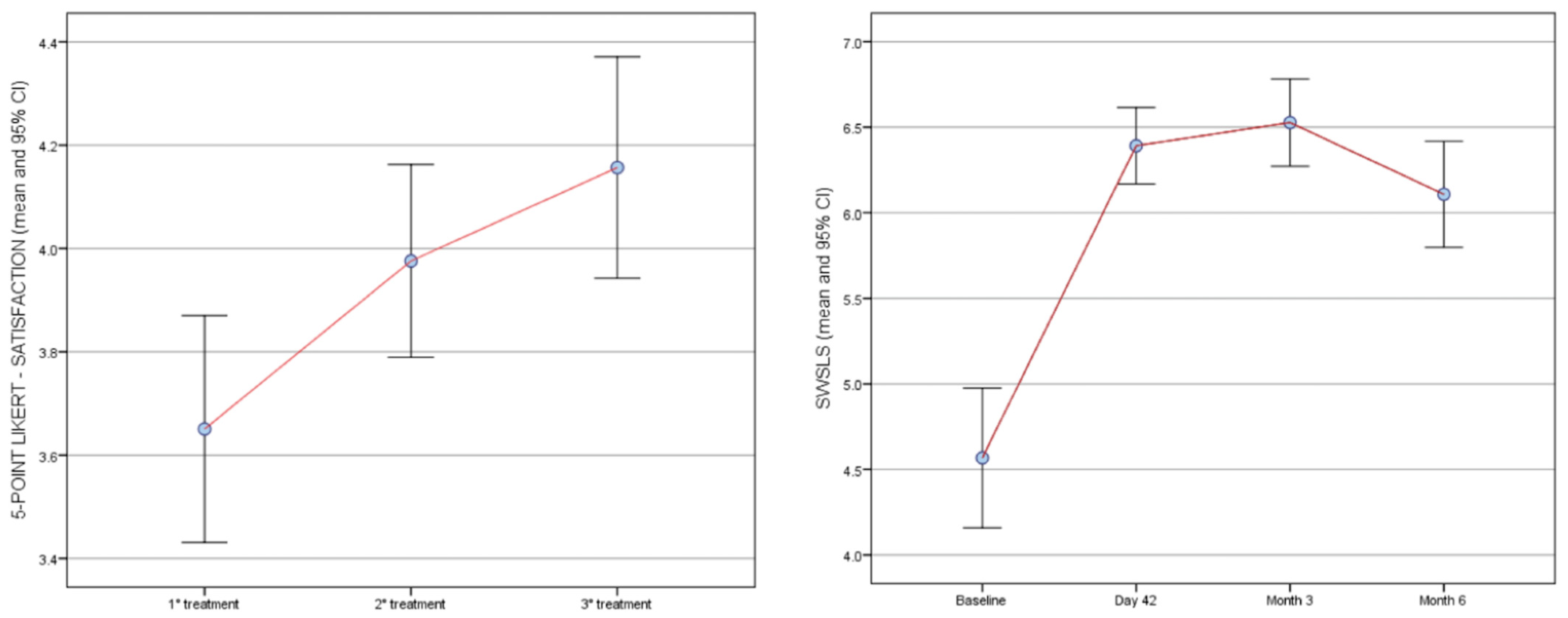
Tolerability of the treatment was evaluated at each injection session using a 5-point Likert scale. At T1 (after the first session), 59.0% of women (49/83; 95% CI: 48.6–69.7%) reported being satisfied or very satisfied, including 21.7% (18/83; 95% CI: 13.3–32.0%) who were very satisfied. Conversely, 26.5% (22/83; 95% CI: 17.4–37.3%) were neutral, while 13.3% (11/83; 95% CI: 6.7–22.7%) were dissatisfied and 1.2% (1/83; 95% CI: 0.03–6.5%) were very dissatisfied.
At T2, the proportion of satisfied or very satisfied participants increased to 65.1% (54/83; 95% CI: 53.8–75.2%), with 26.5% remaining neutral, and only 8.4% (7/83; 95% CI: 3.4–16.6%) reporting dissatisfaction.
By T3, satisfaction levels further increased: 80.7% (67/83; 95% CI: 70.5–88.5%) reported being satisfied or very satisfied, 8.4% (7/83; 95% CI: 3.4–16.6%) were neutral, and 10.8% (9/83; 95% CI: 5.0–19.5%) expressed dissatisfaction (
Table 3 and
Figure 2).
Patient satisfaction with treatment increased progressively from 59.0% after the first session to 80.7% after the third session, with a decreasing proportion of dissatisfied participants. Overall quality of life, assessed using the Satisfaction With Life Scale (SWLS), showed significant improvement over time, peaking at 3 months and remaining elevated at 6 months. Data are presented as means with 95% confidence intervals (CI). See
Table 3 for detailed statistics.
2.3. Satisfaction with Life Scale (SWLS)
At baseline, participants reported a moderate level of life satisfaction, with a mean SWLS score of 4.57 ± 1.76. A notable increase was observed at Day 42 (mean score: 6.39 ± 0.96), which further improved at 3 months (6.53 ± 1.10). Although there was a slight decrease at 6 months (6.11 ± 1.34), the score remained significantly higher than at baseline.
Repeated measures GLM analysis confirmed a statistically significant effect of time on SWLS scores (
p < 0.001), indicating that participants experienced a marked and sustained improvement in perceived quality of life throughout the study period (see
Table 3 and
Figure 2).
3. Discussion
Our findings confirm the efficacy and safety of intradermal injections of Sunekos Inticare for the local treatment of genitourinary symptoms in postmenopausal women. Significant improvements were observed in all assessed symptoms—vaginal dryness, itching, burning, and dyspareunia—at both the 3- and 6-month follow-ups compared to baseline. Notably, the marked reduction in dyspareunia may contribute to improved sexual experience, a critical component of quality of life (QoL) in postmenopausal women. Additionally, participants reported significant improvements in overall well-being, as measured by the Satisfaction with Life Scale (SWLS), further underscoring the clinical relevance of this therapeutic approach.
Symptoms of genitourinary syndrome of menopause (GSM) are often underreported by patients and underrecognized by clinicians, despite their substantial impact on health-related quality of life (HRQoL) [
9,
10]. While topical hyaluronic acid (HA) products such as gels and creams offer short-term symptom relief primarily through mucosal hydration, their limited penetration into deeper tissue layers curbs their regenerative potential, as they inadequately stimulate fibroblast activity and extracellular matrix (ECM) remodeling [
5,
16]. In contrast, intradermal injections deliver active components directly into the submucosal layers, promoting sustained fibroblast stimulation and increased synthesis of collagen, elastin, and other ECM constituents, thereby supporting longer-lasting tissue regeneration [
15].
It is worth noting that placebo responses in GSM clinical trials—particularly those involving procedural interventions—are notably high, often ranging from 30% to 50% [
16,
18]. This emphasizes the need for rigorously designed, randomized controlled trials (RCTs) with adequate blinding to validate the observed therapeutic benefits.
Hyaluronic acid (HA), a naturally occurring glycosaminoglycan, is integral to tissue hydration and elasticity. It is widely used across various medical disciplines, including dermatology, ophthalmology, urology, and orthopedics, due to its excellent safety profile [
10,
19,
20,
21,
22,
23,
24]. Intradermal HA injections have demonstrated satisfactory results in esthetic medicine, including genital applications. For instance, Angelucci et al. confirmed the safety and cost-effectiveness of vulvovaginal HA injections in postmenopausal women with vulvovaginal atrophy (VVA) [
25]. However, existing data remain limited, and further clinical research is warranted. The present study adds to this emerging body of evidence, demonstrating that Sunekos Inticare, combining low molecular weight HA with specific amino acids, promotes ECM remodeling and collagen synthesis, resulting in significant symptom relief and improved sexual health and quality of life. These benefits were already evident after two treatment sessions and sustained for at least six months.
Fractional CO
2 laser therapy has also been proposed as a procedural treatment for GSM. Several observational studies have reported improvements in vaginal health, symptom relief, and sexual function [
26,
27]. However, this modality remains controversial. The U.S. Food and Drug Administration (FDA) has issued warnings regarding potential adverse effects, including pain, burns, and scarring [
28]. Furthermore, a recent systematic review by Zerzan et al. concluded that CO
2 laser therapy yields minimal or no significant differences in outcomes compared to sham treatments or vaginal estrogen, with overall limited and uncertain evidence [
18]. Given these considerations, intradermal HA injections offer a minimally invasive, well-tolerated alternative and may be more acceptable to patients. Comparative studies between these treatment modalities are needed to better delineate their relative efficacy and safety. Although vulvovaginal biostimulation has been reported using other products [
25], the injection technique presented here is novel and, to the best of our knowledge, has not been previously described. This technique was developed by the first author (Dr. Fasola) and represents a new approach for optimizing safety, tolerability, and patient-reported outcomes.
4. Strengths and Limitations
Vulvovaginal treatment with intradermal injections of HA and amino acids appears to be a valid, safe, and effective non-hormonal option, especially when performed by experienced clinicians. The procedure is associated with minimal side effects and high tolerability. Nevertheless, further clinical studies, particularly randomized, double-blind trials, are essential to confirm these preliminary findings.
This study offers several strengths, including its prospective multicenter design, the use of both clinician- and patient-reported outcomes, and a high adherence rate (96%), with 81 out of 84 participants completing all treatment sessions and follow-up visits. These factors likely reflect strong patient motivation, procedural tolerability, and effective clinical engagement. Importantly, no financial incentives were offered, and all procedures were conducted in real-world outpatient settings.
Nevertheless, the lack of a randomized, placebo-controlled design and the absence of a comparison group limit the ability to draw definitive causal conclusions. The study was primarily designed as a single-arm observational study to assess safety, tolerability, and patient-reported outcomes in a real-world setting. Additionally, no formal sample size or power calculation was performed prior to the study, which limits the statistical strength of the conclusions and should be considered when interpreting the results. Future trials, including randomized controlled designs with appropriate comparator groups and formal power calculations, are warranted to validate and expand upon these findings.
Furthermore, the relatively small number of participants at each center limits the generalizability of our findings. Repeated intradermal injections may also have a placebo effect, which cannot be excluded in this single-arm observational study. Future randomized controlled trials with larger sample sizes are warranted to confirm and expand upon these preliminary results.
5. Materials and Methods
5.1. Study Design
This open-label, prospective, multicenter, single-arm pilot observational study was conducted between March 2024 and January 2025 at the following sites: Gyplast Medical Institute (Milan, Italy); Mira-Beau Gender Esthetics (Berlin, Germany); Andeera Clinic (Abdoun Al Shamali, Amman, Jordan); and Estebelle Clinic (Ul Sarmacka 13/129, 02-972 Warszawa, Poland). The objective was to evaluate the safety, tolerability, and clinical outcomes of Inticare® (Professional Dietetics S.p.A.) in postmenopausal women presenting with symptoms of vulvovaginal atrophy (VVA). The study followed Good Clinical Practice (GCP) guidelines, the principles of the Declaration of Helsinki, and national regulations concerning observational studies. All participants provided written informed consent after receiving detailed counseling.
5.2. Study Population
A total of 84 postmenopausal women aged 46–60 years were consecutively enrolled according to predefined eligibility criteria. No formal sample size calculation was performed, as this was an exploratory real-world study. All eligible patients consented to participate, and no participants withdrew after enrollment. Recruitment occurred without financial compensation.
Eligibility was based on clearly predefined inclusion and exclusion criteria, as outlined below.
Women were referred or self-referred due to moderate to severe VVA symptoms. Diagnosis was confirmed through clinical evaluation and vulvovaginal inspection by trained gynecologists.
Exclusion criteria included a history of anaphylaxis or severe polyallergic diathesis; hypersensitivity to any component of the treatment; current use of anticoagulant or anti-inflammatory medications; active genitourinary infections (e.g., herpes simplex, herpes zoster, bacterial vaginosis, candidiasis, cystitis); major autoimmune soft tissue diseases (e.g., systemic lupus erythematosus, rheumatoid arthritis, systemic sclerosis, autoimmune myositis, eosinophilic fasciitis); untreated or poorly controlled diabetes; or ongoing oncological disease or cancer treatment.
5.3. Patient Evaluation
VVA severity was assessed through both gynecological examination and patient-reported outcomes, collected before and after treatment. All assessments were conducted by trained gynecologists.
Gynecological evaluation included inspection of the vulva, vestibule, and vaginal walls using a speculum under standard illumination. Objective signs of atrophy—such as pallor, dryness, fragility or petechiae, loss of rugae, and introital narrowing—were documented. Diagnosis of VVA was confirmed according to clinical criteria consistent with the International Society for the Study of Women’s Sexual Health (ISSWSH) and North American Menopause Society (NAMS) guidelines [
29,
30].
Vaginal health was also qualitatively graded through the clinician’s assessment of mucosal trophism and lubrication at baseline and follow-up visits.
Gynecological assessment was performed to confirm diagnosis at baseline and to document clinical characteristics and was not considered an efficacy outcome.
5.4. Outcomes and Endpoints
Participants completed standardized questionnaires during clinic visits to assess symptoms and quality of life related to VVA. These were administered in person on paper forms, under staff supervision, to ensure consistency and clarify any participant questions.
The primary endpoint was to assess the safety, tolerability, and patient satisfaction associated with Sunekos Inticare. Safety was defined as the absence or occurrence of adverse events, which were collected and documented at each treatment session and during follow-up visits. Tolerability and satisfaction were evaluated at each session using a 5-point Likert scale (very satisfied, satisfied, neither satisfied nor dissatisfied, dissatisfied, very dissatisfied), specifically assessing discomfort or pain during the intradermal injection procedure.
Symptom severity, including vaginal dryness, itching, burning, and dyspareunia, was measured using a Visual Analog Scale (VAS) ranging from 0 (no symptoms) to 10 (maximum symptom intensity) at the following timepoints: baseline (T0), after the second injection (T2), after the third injection (T3), and at 3-month (T4) and 6-month (T5) follow-ups.
Quality of life was assessed using the Satisfaction With Life Scale (SWLS), a validated 5-item instrument that measures global cognitive judgments of life satisfaction on a 7-point Likert scale (1 = completely disagree, 7 = completely agree). This is an internationally validated instrument with robust psychometric properties, chosen for its brevity to minimize patient burden while reliably capturing key aspects of life satisfaction. Higher scores indicate greater life satisfaction. Although SWLS does not specifically evaluate sexual QoL, overall improvement may reflect changes across various aspects of well-being, including sexual health [
31].
Safety and adverse events were monitored throughout the study period. At each treatment session and at all follow-up visits, participants were asked about any local or systemic adverse effects, and spontaneous reports between visits were also recorded. Both patient self-reports and clinical observations were documented using a standardized checklist completed by the treating gynecologist. For each event, onset, duration, severity, and relationship to the treatment were recorded.
5.5. The Study Procedure
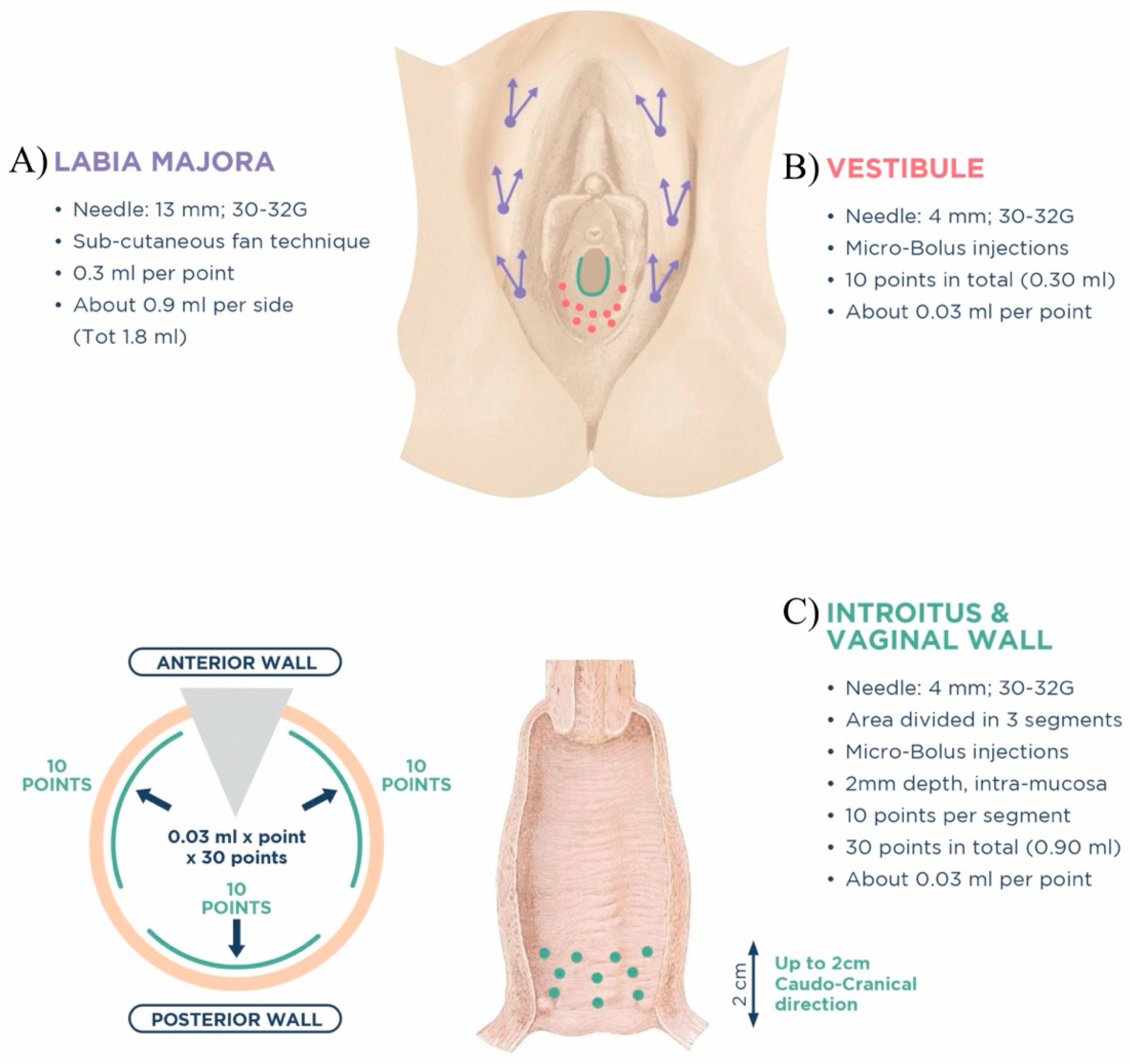
Participants received three intradermal injection sessions, spaced 21 days apart (T1, T2, T3), using a patented formulation combining low molecular weight hyaluronic acid (200 kDa) and six amino acids (glycine, L-proline, L-lysine, L-leucine, L-valine, and L-alanine) (Sunekos Inticare, Professional Dietetics S.p.A., Milan, Italy). Each session included a total of 46 microinjections: 6 in the labia majora, 10 in the vestibule, and 30 in the lower third of the vaginal wall (distal vagina), following a standardized injection protocol (
Figure 3).
Procedures were conducted under aseptic conditions using fine needles (30–32 gauge; 4 mm for the vestibule and vaginal wall, 13 mm for the labia majora). A topical anesthetic cream (lidocaine 2.5% + prilocaine 2.5%) was applied to the vulvar area 20–30 min before treatment to enhance tolerability in most cases. All procedures were performed on an outpatient basis by trained gynecologists. No systemic analgesia or sedation was required. Reported adverse effects were mild (e.g., erythema, swelling, or minor ecchymoses) and resolved spontaneously within a few days.
5.6. Timing of Interventions and Assessments
Table 4 illustrates the treatment schedule and assessment timeline. Injections were administered at T1, T2, and T3 (every 21 days), while evaluations and questionnaires were conducted at T0 (baseline), T2, T3, and at follow-up visits T4 (3 months) and T5 (6 months).
5.7. Statistical Analysis
Descriptive statistics were used to summarize all variables. Continuous variables are reported as means ± standard deviations (SD), with 95% confidence intervals (CIs) calculated for key outcomes. Within-subject changes over time were analyzed using the paired Student’s t-test. For ordinal variables assessed at multiple time points (e.g., symptom severity), the non-parametric Friedman test was used. Post hoc pairwise comparisons were conducted using the Wilcoxon signed-rank test, with Bonferroni correction for multiple comparisons. Categorical variables were analyzed using the chi-squared test or Fisher’s exact test, as appropriate. All analyses were performed using IBM SPSS Statistics® version 29 (IBM Corp., Armonk, NY, USA). A p-value < 0.05 was considered statistically significant.
Given the single-arm, observational design of the study and the descriptive nature of the endpoints, more complex statistical modeling was not appropriate. The analyses applied are sufficient to provide a rigorous and reliable characterization of safety, tolerability, and patient-reported outcomes.
6. Conclusions
This prospective study suggests that intradermal injections of hyaluronic acid and amino acids are a well-tolerated, non-hormonal option for managing genitourinary symptoms in postmenopausal women. Significant improvements were observed in vaginal dryness, itching, burning, and dyspareunia, accompanied by enhanced quality of life and high patient satisfaction. The treatment was associated with minimal adverse effects. As this was a single-arm observational study, results should be interpreted with caution, and future randomized controlled trials are needed to confirm safety, efficacy, and long-term outcomes. These preliminary findings provide valuable insight into non-hormonal strategies for genitourinary syndrome of menopause and support further investigation of injectable ECM-targeted therapies.
Author Contributions
Conceptualization and methodology, E.F.; formal analysis and data curation, G.R.; investigation and resources, E.F., U.M., A.A.I., A.N. and M.C.; writing—original draft preparation, D.D.; writing—review and editing, E.F., E.P., C.O. and D.D.; supervision, E.F.; project administration, E.F., U.M., A.A.I. and A.N.; funding acquisition, E.F. All authors have read and agreed to the published version of the manuscript.
Funding
This study was founded by Professional Dietetics S.p.a.
Institutional Review Board Statement
The study was conducted according to the guidelines of the Declaration of Helsinki. The product investigated in the study is commercially available and was used within the context of routine medical practice by board-certified physicians. Therefore, Ethics Committee approval was deemed unnecessary and was waived, in accordance with national regulations and ethical standards.
Informed Consent Statement
Informed consent was obtained from all subjects involved in the study.
Data Availability Statement
All data generated or analyzed during this study are included in this published article.
Conflicts of Interest
E.F., U.M., A.A.I. and A.N.: are scientific consultant for Professional Dietetics S.p.a. D.D: is medical consultant for Professional Dietetics S.p.a. The other authors declare no conflicts of interest. This does not alter the author’s adherence to all the journal policies on sharing data and materials. The funders had no role in the design of the study; in the collection, analyses, or interpretation of data; in the writing of the manuscript; or in the decision to publish the results.
References
- Angelou, K.; Grigoriadis, T.; Diakosavvas, M.; Zacharakis, D.; Athanasiou, S. The Genitourinary Syndrome of Menopause: An Overview of the Recent Data. Cureus 2020, 12, e7586. [Google Scholar] [CrossRef] [PubMed]
- Moral, E.; Delgado, J.L.; Carmona, F.; Caballero, B.; Guillán, C.; González, P.M.; Suárez-Almarza, J.; Velasco-Ortega, S.; Nieto, C.; as the writing group of the GENISSE study. Genitourinary syndrome of menopause. Prevalence and quality of life in Spanish postmenopausal women. The GENISSE study. Climacteric 2018, 21, 167–173. [Google Scholar] [CrossRef]
- Parish, S.J.; Nappi, R.E.; Krychman, M.L.; Kellogg-Spadt, S.; Simon, J.A.; Goldstein, J.A.; Kingsberg, S.A. Impact of vulvovaginal health on postmenopausal women: A review of surveys on symptoms of vulvovaginal atrophy. Int. J. Women’s Health 2013, 5, 437–447. [Google Scholar] [CrossRef]
- Kershaw, V.; Jha, S. Practical Guidance on the Use of Vaginal Laser Therapy: Focus on Genitourinary Syndrome and Other Symptoms. Int. J. Women’s Health 2024, 16, 1909–1938. [Google Scholar] [CrossRef]
- Kingsberg, S.A.; Wysocki, S.; Magnus, L.; Krychman, M.L. Vulvar and vaginal atrophy in postmenopausal women: Findings from the REVIVE (REal Women’s VIews of Treatment Options for Menopausal Vaginal ChangEs) survey. J. Sex. Med. 2013, 10, 1790–1799. [Google Scholar] [CrossRef]
- Portman, D.J.; Gass, M.L.S.; Panel, V.A.T.C.C. Genitourinary syndrome of menopause. Menopause 2014, 21, 1063–1068. [Google Scholar] [CrossRef]
- Gandhi, J.; Chen, A.; Dagur, G.; Suh, Y.; Smith, N.; Cali, B.; Khan, S.A. Genitourinary syndrome of menopause: An overview of clinical manifestations, pathophysiology, etiology, evaluation, and management. Am. J. Obstet. Gynecol. 2016, 215, 704–711. [Google Scholar] [CrossRef] [PubMed]
- Nappi, R.E.; Martini, E.; Cucinella, L.; Martella, S.; Tiranini, L.; Inzoli, A.; Brambilla, E.; Bosoni, D.; Cassani, C.; Gardella, B. Addressing Vulvovaginal Atrophy (VVA)/Genitourinary Syndrome of Menopause (GSM) for Healthy Aging in Women. Front. Endocrinol. 2019, 10, 561. [Google Scholar] [CrossRef]
- Cuccu, I.; Golia D’Augè, T.; Firulli, I.; De Angelis, E.; Buzzaccarini, G.; D’Oria, O.; Besharat, A.R.; Caserta, D.; Bogani, G.; Muzii, L.; et al. Update on Genitourinary Syndrome of Menopause: A Scoping Review of a Tailored Treatment-Based Approach. Life 2024, 14, 1504. [Google Scholar] [CrossRef] [PubMed]
- Nappi, R.E.; Martella, S.; Albani, F.; Cassani, C.; Martini, E.; Landoni, F. Hyaluronic Acid: A Valid Therapeutic Option for Early Management of Genitourinary Syndrome of Menopause in Cancer Survivors? Healthcare 2022, 10, 1528. [Google Scholar] [CrossRef]
- Berreni, N.; Salerno, J.; Chevalier, T.; Alonso, S.; Mares, P. Evaluation of the effect of multipoint intra-mucosal vaginal injection of a specific cross-linked hyaluronic acid for vulvovaginal atrophy: A prospective bi-centric pilot study. BMC Women’s Health 2021, 21, 322. [Google Scholar] [CrossRef]
- Dos Santos, C.C.M.; Uggioni, M.L.R.; Colonetti, T.; Colonetti, L.; Grande, A.J.; Da Rosa, M.I. Hyaluronic Acid in Postmenopause Vaginal Atrophy: A Systematic Review. J. Sex. Med. 2021, 18, 156–166. [Google Scholar] [CrossRef] [PubMed]
- Donders, G.G.G.; Ruban, K.; Bellen, G.; Grinceviciene, S. Pharmacotherapy for the treatment of vaginal atrophy. Expert Opin. Pharmacother. 2019, 20, 821–835. [Google Scholar] [CrossRef] [PubMed]
- Salwowska, N.M.; Bebenek, K.A.; Żądło, D.A.; Wcisło-Dziadecka, D.L. Physiochemical properties and application of hyaluronic acid: A systematic review. J. Cosmet. Dermatol. 2016, 15, 520–526. [Google Scholar] [CrossRef]
- De Servi, B.; Orlandini, A.; Caviola, E.; Meloni, M. Amino acid and hyaluronic acid mixtures differentially regulate extra cellular matrix genes in cultured human fibroblasts. J. Biol. Regul. Homeost. Agents 2018, 32, 517–527. [Google Scholar] [PubMed]
- Santen, R.J.; Allred, D.C.; Ardoin, S.P.; Archer, D.F.; Boyd, N.; Braunstein, G.D.; Burger, H.G.; Colditz, G.A.; Davis, S.R.; Gambacciani, M.; et al. Postmenopausal hormone therapy: An Endocrine Society scientific statement. J. Clin. Endocrinol. Metab. 2010, 95, s1–s66. [Google Scholar] [CrossRef]
- Redfern, N.; Gallagher, P. The ageing anaesthetist. Anaesthesia 2014, 69, 1–5. [Google Scholar] [CrossRef]
- Zerzan, N.L.; Greer, N.; Ullman, K.E.; Sowerby, C.; Diem, S.; Ensrud, K.; Forte, M.L.; Anthony, M.C.; Landsteiner, A.; Butler, M.; et al. Energy-based interventions for genitourinary syndrome of menopause: A systematic review of randomized controlled trials and prospective observational studies. Menopause 2025, 32, 176–183. [Google Scholar] [CrossRef]
- Bukhari, S.N.A.; Roswandi, N.L.; Waqas, M.; Habib, H.; Hussain, F.; Khan, S.; Sohail, M.; Ramli, N.A.; Thu, H.E.; Hussain, Z. Hyaluronic acid, a promising skin rejuvenating biomedicine: A review of recent updates and pre-clinical and clinical investigations on cosmetic and nutricosmetic effects. Int. J. Biol. Macromol. 2018, 120, 1682–1695. [Google Scholar] [CrossRef]
- Toole, B.P. Hyaluronan: From extracellular glue to pericellular cue. Nat. Rev. Cancer 2004, 4, 528–539. [Google Scholar] [CrossRef]
- Maltese, A.; Borzacchiello, A.; Mayol, L.; Bucolo, C.; Maugeri, F.; Nicolais, L.; Ambrosio, L. Novel polysaccharides-based viscoelastic formulations for ophthalmic surgery: Rheological characterization. Biomaterials 2006, 27, 5134–5142. [Google Scholar] [CrossRef]
- Miodosky, M.; Abdul-Hai, A.; Tsirigotis, P.; Or, R.; Bitan, M.; Resnick, I.B.; Gesundheit, B.; Zilberman, I.; Ioffe, L.; Leubovic, A.; et al. Treatment of post-hematopoietic stem cell transplantation hemorrhagic cystitis with intravesicular sodium hyaluronate. Bone Marrow Transplant. 2006, 38, 507–511. [Google Scholar] [CrossRef] [PubMed][Green Version]
- Morales, A.; Emerson, L.; Nickel, J.C. Intravesical hyaluronic acid in the treatment of refractory interstitial cystitis. Urology 1997, 49, 111–113. [Google Scholar] [CrossRef]
- Gidwani, S.; Fairbank, A. The orthopaedic approach to managing osteoarthritis of the knee. BMJ 2004, 329, 1220–1224. [Google Scholar] [CrossRef] [PubMed]
- Angelucci, M.; Frascani, F.; Franceschelli, A.; Lusi, A.; Garo, M.L. Efficacy of intradermal hyaluronic acid plus polynucleotides in vulvovaginal atrophy: A pilot study. Climacteric 2022, 25, 490–496. [Google Scholar] [CrossRef] [PubMed]
- Di Donato, V.; D’Oria, O.; Giannini, A.; Scudo, M.; Sher, C.; Fischetti, M.; Perniola, G.; Palaia, I.; Monti, M.; Muzii, L.; et al. The Efficacy of Fractional CO2 Laser in the Treatment of Genitourinary Syndrome of Menopause: A Large Prospective Observational Study. Clin. Exp. Obstet. Gynecol. 2022, 49, 212. [Google Scholar] [CrossRef]
- Mezzana, P. “Two wavelengths endovaginal laser system”: Clinical evaluation of a new device for mild SUI and vaginal atrophy treatment. Dermatol. Ther. 2020, 33, e14445. [Google Scholar] [CrossRef]
- Cruz, V.L.; Steiner, M.L.; Pompei, L.M.; Strufaldi, R.; Fonseca, F.L.A.; Santiago, L.H.S.; Wajsfeld, T.; Fernandes, C.E. Randomized, double-blind, placebo-controlled clinical trial for evaluating the efficacy of fractional CO2 laser compared with topical estriol in the treatment of vaginal atrophy in postmenopausal women. Menopause 2018, 25, 21–28. [Google Scholar] [CrossRef]
- Faubion, S.S.; Larkin, L.C.; Stuenkel, C.A.; Bachmann, G.A.; Chism, L.A.; Kagan, R.; Kaunitz, A.M.; Krychman, M.L.; Parish, S.J.; Partridge, A.H.; et al. Management of genitourinary syndrome of menopause in women with or at high risk for breast cancer: Consensus recommendations from The North American Menopause Society and The International Society for the Study of Women’s Sexual Health. Menopause 2018, 25, 596–608. [Google Scholar] [CrossRef]
- The North American Menopause Society (NAMS). The 2020 Genitourinary Syndrome of Menopause Position Statement of The North American Menopause Society. Menopause 2020, 27, 976–992. [Google Scholar] [CrossRef]
- Diener, E.; Emmons, R.A.; Larsen, R.J.; Griffin, S. The Satisfaction with Life Scale. J. Pers. Assess. 1985, 49, 71–75. [Google Scholar] [CrossRef] [PubMed]
| Disclaimer/Publisher’s Note: The statements, opinions and data contained in all publications are solely those of the individual author(s) and contributor(s) and not of MDPI and/or the editor(s). MDPI and/or the editor(s) disclaim responsibility for any injury to people or property resulting from any ideas, methods, instructions or products referred to in the content. |





 ,
,