1. Introduction
Ginger essential oil (GEO), extracted from the rhizomes of
Zingiber officinale, has garnered significant interest across the food, pharmaceutical, and cosmetic industries. This attention is primarily due to its rich composition of bioactive compounds, which impart notable antioxidant, antimicrobial, anti-inflammatory, and anticancer properties [
1]. However, the widespread application of GEO is met with considerable challenges. Its high concentration of volatile and unstable terpene compounds makes it susceptible to degradation from environmental factors such as oxygen, light, and heat, leading to a rapid loss of aroma and bioactivity [
2]. Furthermore, the inherent hydrophobicity of GEO hinders its uniform dispersion in aqueous-based products.
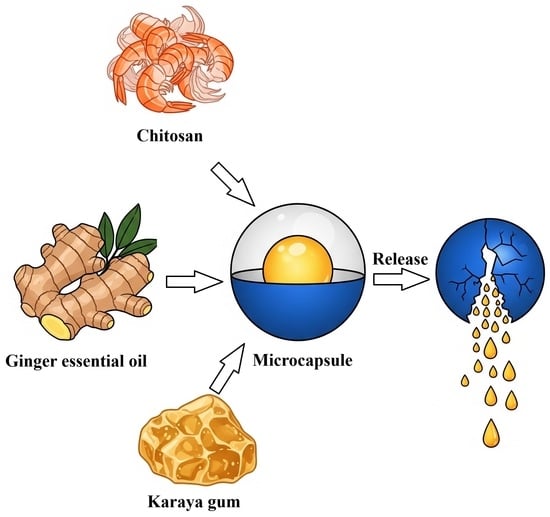
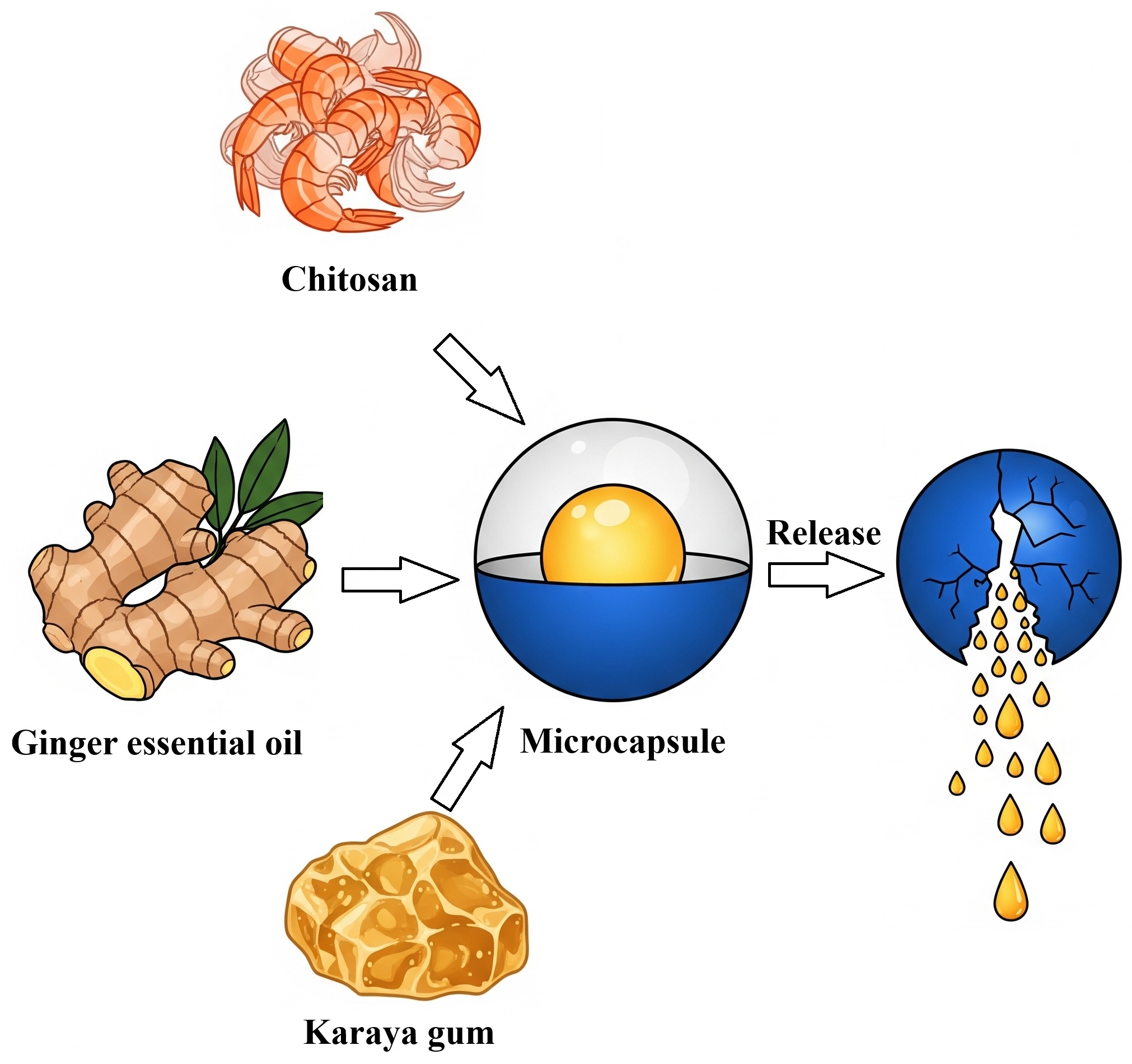
To overcome these limitations, microencapsulation has emerged as an effective strategy. This technique involves entrapping small droplets of the essential oil (the core material) within a protective membrane (the wall material) to form microcapsules. This process not only shields the active compounds from degradation but also allows for controlled release, masks undesirable flavors, and converts the oil from a liquid to a solid powder, thereby improving its handling and incorporation into various matrices [
3]. Among the various microencapsulation methods, complex coacervation is particularly appealing due to its simple, room-temperature process and high encapsulation efficiency.
Complex coacervation is driven by the electrostatic interaction between two oppositely charged polymers in an aqueous solution. Current trends favor the use of natural polymers owing to their safety, biocompatibility, and biodegradability [
4,
5]. In this study, chitosan (CS) and hydrolyzed karaya gum (HKG) were selected as the wall materials. CS, a cationic polysaccharide derived from chitin, is well-regarded for its antimicrobial, non-toxic, and biocompatible characteristics [
6]. In an acidic medium, the amino groups (-NH
2) on the CS backbone are protonated to form ammonium groups (-NH
3+), creating a polycation. Conversely, karaya gum is a natural polysaccharide exudate from the
Sterculia urens tree, which can act as a polyanion due to the presence of galacturonic and glucuronic acid residues, which provide negatively charged carboxyl groups (-COO
−). However, native karaya gum possesses a high degree of acetylation, which results in poor water solubility and limits its application in aqueous-based systems. To overcome this, an alkaline hydrolysis treatment is employed to remove these acetyl groups. This deacetylation process significantly enhances the gum’s solubility, making it a suitable polyanion for the complex coacervation technique [
7]. The combination of positively charged CS and negatively charged HKG presents an ideal pairing for the complex coacervation process [
8].
The efficacy of coacervate formation and the properties of the resulting microcapsules are highly dependent on process conditions, such as pH, the mass ratio of the two polymers, and the core-to-wall material ratio. The pH of the medium dictates the degree of ionization of the functional groups, thereby directly influencing the strength of the electrostatic interactions. An optimal polymer mass ratio ensures the most effective charge neutralization, leading to the maximum coacervate yield [
9]. While the use of CS in combination with other anionic polysaccharides, such as gum arabic [
10,
11] or sodium alginate [
12,
13], has been extensively investigated for microencapsulation, the application of HKG for this purpose represents a significant innovation. To the best of our knowledge, this study is the first to systematically optimize the complex coacervation between CS and HKG for encapsulating GEO. HKG presents a compelling alternative to conventional gums due to its enhanced aqueous solubility following deacetylation, a critical improvement over its native form. This property, combined with its inherent efficacy as a natural emulsifier and stabilizer, suggests that the CS-HKG system could form a more robust and stable encapsulation matrix. This clear research gap and the unique potential advantages of the CS-HKG system motivated the present work.
Therefore, this study was conducted with the following primary objectives: (1) to investigate the influence of pH and the CS:HKG mass ratio to determine the optimal conditions for complex formation; (2) to fabricate GEO-loaded CS-HKG microcapsules under these optimal conditions and examine the effect of the core–wall ratio on encapsulation efficiency; and (3) to characterize the microcapsules in terms of their morphology, solubility, swelling index, hygroscopicity and in vitro release kinetics of GEO in simulated gastrointestinal fluids (acidic and neutral pH) to elucidate their potential as a delivery system for bioactive compounds.
2. Materials and Methods
2.1. Alkaline Hydrolysis of Karaya Gum
Crude karaya gum granules, purchased from Xuan Hong Co., Ltd. (Ho Chi Minh City, Vietnam), were initially ground into a fine powder. Subsequently, 2 g of the gum powder was dispersed in 100 mL of distilled water to prepare a 2% (
w/
v) suspension. The suspension was stirred for 2 h to ensure uniform dispersion and complete swelling of the gum. For hydrolysis, 33.3 mL of a 1 M NaOH solution (Xilong Scientific Co., Ltd., Shantou, China) was added to the suspension, and the mixture was stirred for an additional 30 min. The excess NaOH was then neutralized to pH 4.0 by the addition of 1 M HCl (Xilong Scientific Co., Ltd., Shantou, China), followed by another 30 min of stirring. The hydrolyzed gum was precipitated by adding 300 mL of 95% ethanol (Chemsol Co., Ltd., Ho Chi Minh City, Vietnam). The resulting precipitate was collected by filtration, washed twice with 95% ethanol, and subsequently dried in an oven at 100 °C for 24 h. The dried product was ground into a powder and stored in a sealed glass vial for subsequent use [
14].
2.2. Zeta Potential Measurement
For zeta potential analysis, stock solutions of HKG (0.5% w/v in distilled water) and CS (0.5% w/v in 1% acetic acid) were prepared. The polyelectrolyte complex dispersion was formed by mixing equal volumes of these two stock solutions. The zeta potentials of three separate samples—the CS solution, the HKG solution, and the resulting complex dispersion—were then measured. For each measurement, the pH of the sample was adjusted from 2.0 to 7.0 using 0.1 M HCl or 0.1 M NaOH. All measurements were performed at 25 °C using a Zetasizer Pro (Malvern Panalytical Ltd., Malvern, UK).
2.3. Maximization of CS-HKG Complex Formation
Turbidity measurements and complexation yield were employed to determine the pH and mass ratio for the maximal formation of the CS-HKG polyelectrolyte complex.
2.3.1. Determination of Optimal pH
Stock solutions of CS (0.5%
w/
v in 1% acetic acid) and HKG (0.5%
w/
v in distilled water) were mixed at the following volume ratios (CS:HKG): 1:1, 1:2, 1:4, and 4:1. These volume ratios correspond directly to the mass ratios of CS and HKG in the resulting mixtures. The pH was adjusted over a pH range of 2.0 to 7.0 by the dropwise addition of 0.1 M HCl or 0.1 M NaOH under continuous stirring. The absorbance (turbidity) of each mixture was measured at 600 nm using a UH5300 UV-Vis spectrophotometer (Hitachi High-Tech Corp., Tokyo, Japan). The pH value corresponding to the highest absorbance, indicating maximum turbidity, was considered optimal for complexation [
15].
2.3.2. Determination of Optimal Mass Ratio of CS and HKG
Stock solutions of CS (0.5%
w/
v in 1% acetic acid) and HKG (0.5%
w/
v in distilled water) were mixed at the following volume ratios (CS:HKG): 1:1, 1:2, 1:4, and 4:1, and the pH of each mixture was adjusted to the predetermined optimal value from the previous step. The resulting mixtures were centrifuged, and the solid precipitate was collected and dried at 100 °C to a constant weight. The complexation yield H (%) was calculated using the following equation [
16]:
where m
c is the mass of dried complex precipitated, and
mCS and
mHKG are the masses of CS and HKG used, respectively.
The CS:HKG ratio that resulted in the highest complexation yield was selected for subsequent experiments.
2.3.3. Effect of Electrolyte Concentration
To four identical mixtures of CS and HKG at the previously determined optimal pH and mass ratio, 3 mL of NaCl solution at varying concentrations (0.5 M, 1.0 M, 1.5 M, and 2.5 M) was added. The mixtures were stirred for 30 min, after which the solid precipitate was collected, dried at 100 °C to a constant weight, and the complexation yield was calculated using Equation (1).
2.4. Microencapsulation of GEO
A CS:HKG mass ratio of 1:2 was used to prepare the wall material for microcapsules of GEO. The mass ratios of wall material (CS + HKG) to core material (GEO) were investigated at 1:1, 2:1, 3:1, and 4:1.
An oil-in-water emulsion was formed by gradually adding GEO and Tween 80 as an emulsifier (1% w/w of GEO) to the stock 0.5% CS solution (in 1% acetic acid). This emulsion was then homogenized at 9000 rpm for 5 min. Subsequently, the stock 0.5% HKG solution was slowly added to the emulsion, followed by a second homogenization step for 5 min.
The pH of the resulting mixture was adjusted to the predetermined optimum pH of 4.6 by dropwise addition of 1 M HCl under continuous stirring. The mixture was then stirred for an additional 30 min at room temperature, followed by refrigeration at 4 °C for at least 5 h to facilitate complex coacervation. Finally, the microcapsules were harvested by centrifugation, and the resulting pellet was dried in a convection oven at 55 °C to obtain a fine powder [
17].
The process yield was calculated as the ratio of the mass of the final dried microcapsule powder to the total initial mass of all materials:
where
mf is the mass of the dried microcapsules and
mi is the total mass of initial materials (CS, HKG, GEO).
2.5. Characterization of Microcapsules
2.5.1. GEO Encapsulation Efficiency (EE)
The encapsulation efficiency was determined by quantifying the surface oil and the total encapsulated oil.
2.5.2. Preparation of a Standard Calibration Curve
To quantify the amount of GEO for calculating encapsulation efficiency, a standard calibration curve was established following [
17]. A 100 mg/L stock solution of GEO was prepared in a solvent mixture of hexane and ethanol (80:20
v/
v). The absorbance of serially diluted standards was measured at a wavelength of 248 nm using a UV-Vis spectrophotometer.
2.5.3. Determination of Surface Oil Content
A mass of 0.5 g of microcapsule powder was dispersed in 15 mL of hexane (Chemsol Co., Ltd., Ho Chi Minh City, Vietnam) and stirred for 10 min to dissolve the unencapsulated oil from the particle surfaces. The suspension was filtered through a quantitative filter paper (Whatman No. 42) to ensure all microcapsule particles were retained. To ensure complete recovery of surface oil and minimize errors from adsorption, the retained solids on the filter paper were thoroughly washed three times with 15 mL portions of fresh hexane. The initial filtrate and all washings were combined. Finally, ethanol was added to the collected solution to achieve a final hexane–ethanol ratio of 80:20 (v/v), and its absorbance was measured at 248 nm. The quantity of surface oil (mso) was then determined using the standard calibration curve.
2.5.4. Determination of Total Encapsulated Oil Content
The solid residue retained on the filter paper from the surface oil determination was air-dried in a fume hood for 30 min to evaporate any residual hexane. The powder was then re-dispersed in 10 mL of 4 M HCl and stirred for 2 h to dissolve the polymer wall. Subsequently, 15 mL of hexane was added, and the mixture was stirred for 30 min to extract the released GEO. The mixture was centrifuged at 6000 rpm for 5 min. The upper organic phase was collected, and ethanol was added to achieve an 80:20 (v/v) hexane–ethanol ratio. The absorbance was measured at 248 nm, and the quantity of encapsulated oil (meo) was determined from the calibration curve.
The encapsulation efficiency was calculated as the ratio of the encapsulated oil mass to the total oil mass present in the powder sample.
Scanning Electron Microscopy
The surface morphology of the microcapsules was captured using a TM4000Plus scanning electron microscope (Hitachi High-Tech Corp., Tokyo, Japan). Samples were mounted on carbon tapes and observed using a back-scattered electron detector with an accelerating voltage of 10 kV. The SEM images, together with their scale bars, were analyzed using ImageJ software (v1.54p, National Institutes of Health, Bethesda, MD, USA) to measure the sizes of the microcapsules.
Hygroscopicity
Approximately 0.5 g of microcapsules was placed in an environment with 75% relative humidity (RH), maintained by a saturated NaCl solution at 30 °C. After 5 days, the samples were reweighed. Hygroscopicity was expressed as the grams of water absorbed per 100 g of powder.
Solubility
A 0.5 g sample of microcapsule powder was dispersed in 50 mL of distilled water and stirred for 30 min at room temperature. Then, the mixture was centrifuged at 9000 rpm for 5 min. The supernatant was transferred to a pre-weighed Petri dish (
m1) and dried at 70 °C to a constant weight (
m2). Solubility was calculated as follows:
To evaluate the solubility at various temperatures, the procedure was repeated in a thermostatic water bath. To evaluate the effect of pH on solubility, the procedure was repeated in aqueous solutions with pH values adjusted to 2, 4, and 6 using 0.5 M HCl or NaOH.
Swelling Index
A 0.5 g sample of dried microcapsules (
mo) was immersed in 50 mL of distilled water for 1 h to allow for complete swelling. The swollen particles were then collected by filtration, and their final mass (
m1) was recorded. The swelling index was calculated using the following formula [
18]:
Color
The color of the microcapsule powder was measured using an LS171 portable colorimeter (Shenzhen Linshang Technology Co., Ltd., Shenzhen, China). A layer of powder approximately 5 mm thick was spread on a white surface. Measurements were taken at five different locations for each sample.
In Vitro Release of GEO
The release profile of GEO from the microcapsules was studied in three different media: distilled water (pH ≈ 6.6), simulated gastric fluid (SGF, pH 2.0), and simulated intestinal fluid (SIF, pH 7.4). To prepare SGF, 11.9 mL of 0.1 M HCl was mixed with 88.1 mL of 0.1 M KCl and diluted to 1 L with distilled water. To prepare SIF, 8 g NaCl, 0.2 g KCl, 1.42 g Na
2HPO
4, and 0.24 g KH
2PO
4 were completely dissolved in distilled water and diluted to 1 L [
19].
For each experiment, 0.5 g of the microcapsule powder was suspended in 50 mL of the release medium and stirred at room temperature. Every 20 min, a 5 mL aliquot of the suspension was withdrawn. The released GEO from the aliquot was extracted with 10 mL of hexane, and the mixture was centrifuged at 6000 rpm for 5 min. The upper organic layer was collected and diluted to 10 mL with the hexane–ethanol (80:20 v/v) solvent mixture. The amount of released GEO was quantified by measuring the absorbance at 248 nm and using the standard calibration curve.
To quantitatively analyze the mechanism and rate of GEO release from the CS-HKG microcapsules, the in vitro cumulative release data (Qt) over time (
t) across all media (pH 2.0, pH 7.4, and water) were fitted to four common kinetic models using non-linear regression analysis using OriginPro 2021 [
20,
21]:
The zero-order model describes release at a constant rate: .
The first-order model describes release proportional to the amount remaining: .
The Higuchi model describes diffusion-controlled release from a matrix: .
The semi-empirical Korsmeyer–Peppas model was used to determine the release mechanism: .
The model with the highest adjusted coefficient of determination was selected as the best-fitting model. The release exponent (n) from the Korsmeyer–Peppas model was then used to elucidate the dominant release mechanism for spherical particles:
n ≤ 0.45 indicates Fickian diffusion, where the release is controlled by the diffusion of the core material through the polymer matrix.
0.45 < n < 0.89 indicates anomalous (non-Fickian) transport, a mechanism controlled by a combination of Fickian diffusion and polymer swelling or relaxation.
n ≈ 0.89 indicates case-II transport, where the release is primarily controlled by polymer swelling or erosion.
2.6. Statistical Analysis
All experiments were performed in triplicate, and the results are expressed as mean ± standard deviation (SD). To determine whether significant differences existed between the means of the groups, a one-way analysis of variance (ANOVA) was conducted. When a significant difference was found, Tukey’s Honestly Significant Difference (HSD) post hoc test was used for pairwise comparisons to identify which specific groups were different from each other. All statistical analyses were performed using IBM SPSS Statistics (v26.0, IBM Corp., Armonk, NY, USA), and a p-value of less than 0.05 was considered to indicate a statistically significant difference.
3. Results and Discussion
3.1. Zeta Potential of CS, HKG, and Polyelectrolyte Complex
The formation of a polyelectrolyte complex between CS and HKG is primarily driven by electrostatic interactions. Therefore, the zeta potential of each biopolymer was determined as a function of pH to evaluate its surface charge characteristics.
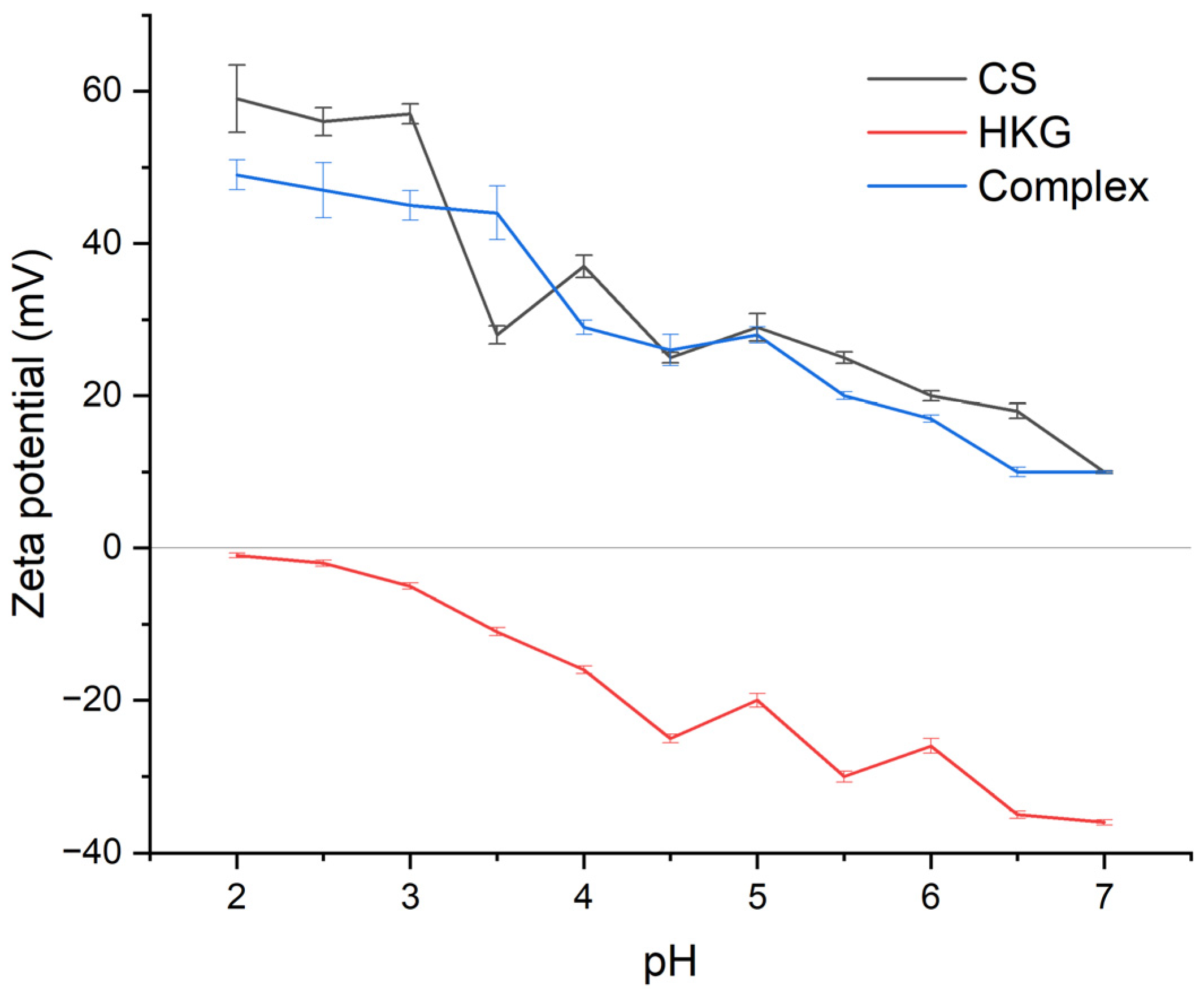
Figure 1 shows that throughout the investigated pH range from 2 to 7, HKG consistently exhibited a negative zeta potential. The magnitude of this negative charge increased as the solution became more alkaline. This behavior is characteristic of an anionic polysaccharide, as the HKG structure is rich in carboxyl groups. As the pH increases, the carboxyl groups (–COOH) deprotonate, forming carboxylate groups (-COO
−) and leading to an increase in the net negative charge.
In contrast, CS displayed a positive zeta potential across the entire pH range, a result of its high density of primary amino groups. The positive charge became more pronounced at lower pH values, with the zeta potential increasing significantly from +10 mV at pH 7.0 to +59 mV at pH 2.0. In acidic environments, the amino groups (–NH
2) are readily protonated to form positively charged ammonium groups (–NH
3+), resulting in a stronger positive surface charge [
22].
However,
Figure 1 demonstrates that the CS:HKG complex at a 1:1 mass ratio exhibited a positive zeta potential across the entire investigated pH range. This suggests that at this ratio, excess CS adsorbs onto the surface of the complex particles, causing them to carry a net positive charge. The electrostatic repulsion between these charged particles hinders their aggregation and precipitation, making it difficult to recover the complex using methods such as filtration or centrifugation. Therefore, the CS:HKG ratio is a critical factor that needs to be investigated to find the optimal ratio that yields the maximum amount of complex. To this end, we employed turbidity measurements (light absorbance) and weighed the mass of the complex obtained after centrifugation and washing, in order to identify the optimal combination of pH and CS:HKG ratio for maximizing complex yield.
3.2. Effects of pH and CS:HKG Ratios on Complex Formation
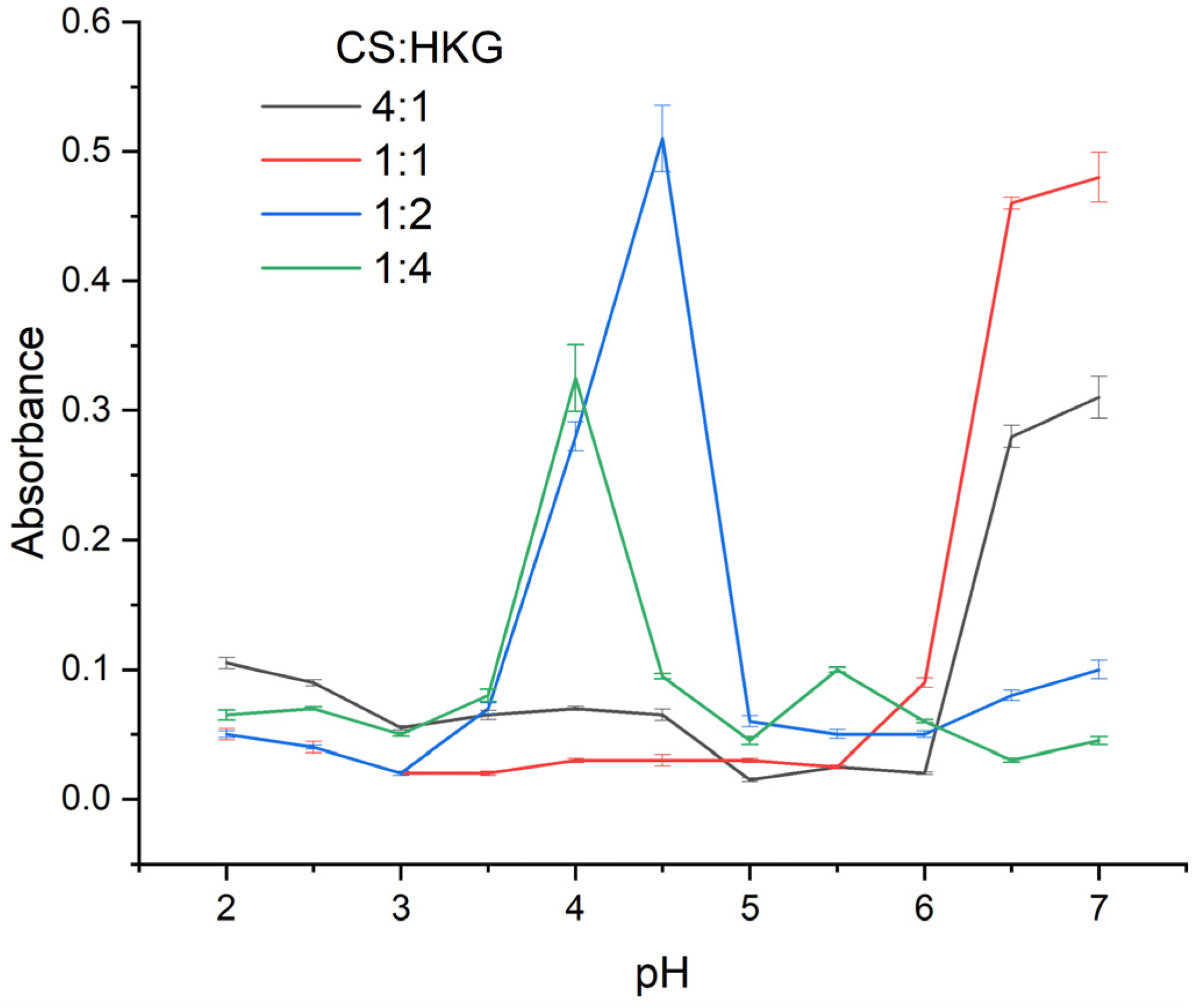
Figure 2 shows that mixtures with excess or equal amounts of CS (1:1 and 4:1 ratios) exhibited very low turbidity across the acidic pH range (below pH 5.5), suggesting that limited complex formation occurred under these conditions. At pH 6.5 and 7, turbidity increased significantly, which coincides with the precipitation pH range of CS. Therefore, the high turbidity is likely due to the precipitation of CS itself, rather than the CS:HKG complex. Consequently, a CS ratio exceeding 50% in the polymer mixture is not suitable for complex formation.
In contrast, mixtures containing a higher proportion of HKG (1:2 and 1:4 CS:HKG ratios) exhibited distinct peaks in turbidity, occurring at pH 4.6 for the 1:2 ratio and pH 4.0 for the 1:4 ratio. These peaks represent the respective pH values where charge neutralization between the CS polycation and HKG polyanion is most effective, leading to the maximum formation and precipitation of the insoluble CS-HKG complex. Beyond this optimal pH (i.e., moving toward higher pH), the absorbance decreases because the carboxyl groups in both HKG and CS begin to deprotonate, weakening the electrostatic attraction and causing complex dissociation. Similarly, if the pH is too low, the protonation of CS amino groups leads to excess net positive charge and electrostatic repulsion between aggregates, resulting in the complex dissociation (
Figure 2).
We then recovered the CS:HKG complex using centrifugation at the polymer ratios and pH values that yielded the highest turbidity in
Figure 2. The results in
Table 1 show that the CS:HKG ratio of 1:2 at pH 4.6 was optimal, providing the highest complexation yield of 76.4%, which aligns with its significant turbidity.
To verify the precision of the optimal pH, the recovery yield was measured in a narrow pH range around 4.6 for the optimal 1:2 CS:HKG ratio. The results presented in
Table 2 confirmed that pH 4.6 indeed resulted in the maximum yield (77.3%). This outcome validates the reliability of the turbidimetric analysis for identifying the most favorable conditions for complexation.
While the 1:2 CS:HKG ratio yielded the maximum complexation efficiency among the ratios tested (
Table 1), suggesting the optimal region lies between 1:1 and 1:4, we recognize that this preliminary screening provides room for further improvement. Subsequent research may aim at maximizing coacervate yield, using a statistical approach like the response surface methodology (RSM) to precisely model and optimize the combined influence of the CS:HKG ratio and pH.
3.3. Effect of Ionic Strength on Complex Formation
In addition to pH and the biopolymer ratio, the ionic strength of the medium can significantly influence polyelectrolyte complex formation [
23]. The effect of NaCl concentration on the yield of the complex, prepared under the optimal conditions (1:2 CS:HKG ratio, pH 4.6), is presented in
Table 3.
As shown in
Table 3, the complexation yield decreased as the NaCl concentration increased beyond 0.03 M. This phenomenon can be attributed to a charge screening effect. The added Na
+ and Cl
− ions condense around the oppositely charged polymer chains (Na
+ with -COO
− groups of HKG and Cl
− with -NH
3+ groups of CS). This electrostatic shielding neutralizes the polymer charges, which weakens the attractive forces between CS and HKG. This disruption inhibits further complexation and can lead to the partial dissociation of already-formed complexes, thereby reducing the recovered yield. This observation is in agreement with previous studies, which also reported that increasing NaCl concentration enhances the solubility of polyelectrolyte complexes [
24].
The observed loss of complex integrity beyond 0.03 M NaCl suggests that the CS-HKG complexes would undergo significant dissolution or breakdown under physiological salt concentrations (~0.15 M), such as those present in the stomach. This ion-sensitivity, combined with the low pH-induced disintegration (
Figure 2), is a highly desirable functional characteristic for a controlled-release system, ensuring effective GEO release in the target gastric environment.
3.4. Influence of Homogenization Speed and Tween Concentration on GEO Droplet Size
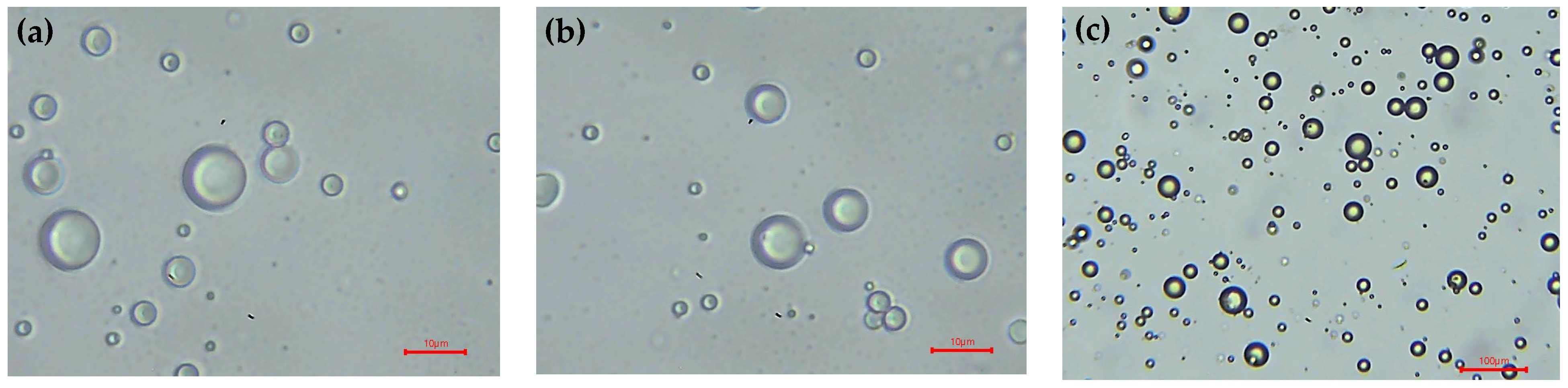
The particle size of the emulsion prior to drying is a critical factor affecting the final product’s quality. The effects of homogenization speed and emulsifier concentration were investigated using light microscopy (
Figure 3).
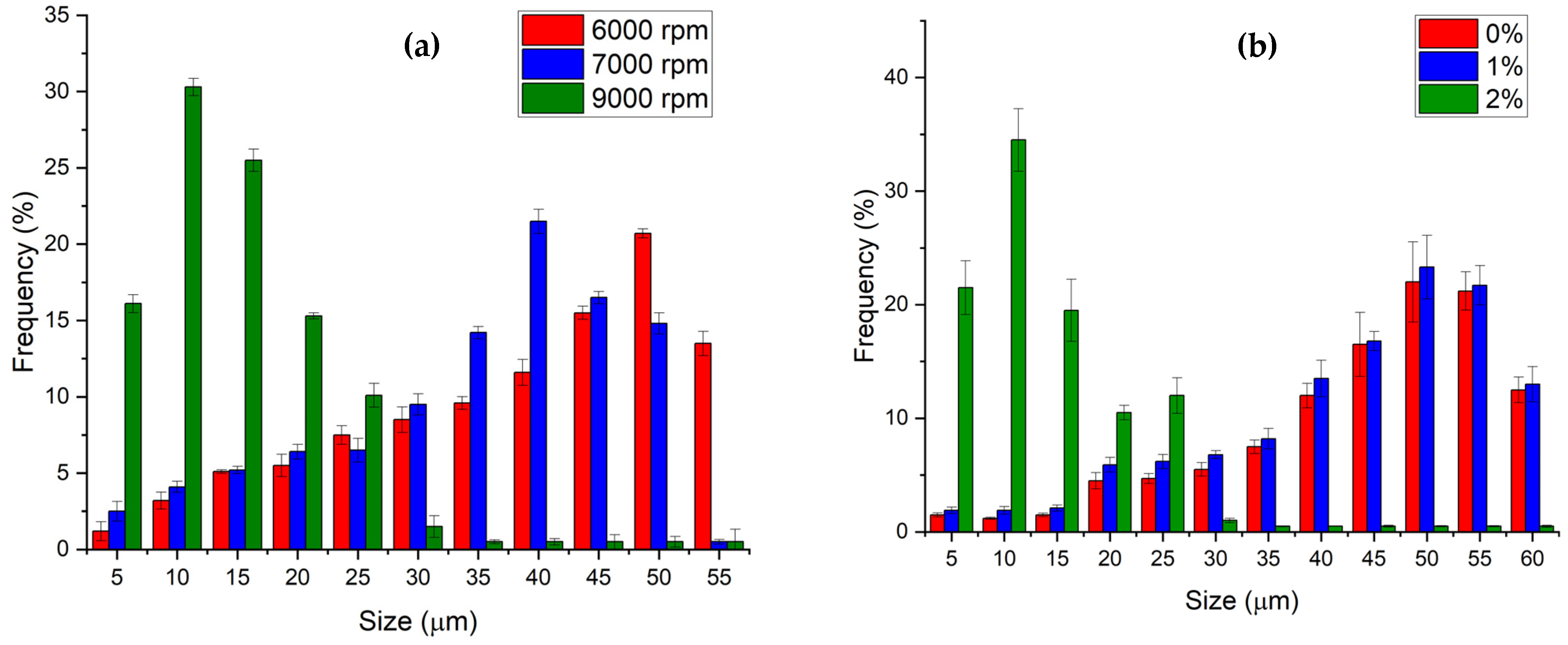
As the homogenization speed was increased from 6000 rpm to 9000 rpm, a significant reduction in the average particle size of the emulsion was observed (
Figure 4a). At 9000 rpm, the particles were smaller and more uniform, with very few particles larger than 30 µm. The higher shear forces more effectively break down the oil droplets, allowing for more efficient coating by the polymer complex. This is consistent with findings by Fernandes et al. [
18], who noted that optimal shear is required, as excessively high speeds can disrupt newly formed complexes and cause aggregation.
Figure 4b shows that in the absence of Tween 80, larger and more non-uniform oil droplets were formed after homogenization due to their quick coalescence. When added to the emulsion before homogenization, the emulsifier reduced the interfacial tension between the oil and water phases, facilitating the formation of a stable emulsion with smaller droplets and preventing their coalescence. A concentration of 1% Tween 80 was found to be optimal (
Figure 4b), producing small and uniform particles, particularly when combined with a homogenization speed of 9000 rpm.
3.5. Microencapsulation of GEO
Encapsulation Efficiency and Process Yield
Encapsulation efficiency (EE) is an important criterion for evaluating the success of the microencapsulation process. The EE, surface oil content, and overall process yield (PY) for microcapsules prepared with different wall-to-core ratios are presented in
Table 4 and
Table 5, respectively.
The results demonstrate a clear and positive correlation between the proportion of wall material and the encapsulation performance. Both EE and PY increased with an increasing wall-to-core ratio, reaching an optimal value at a 3:1 ratio.
Notably, while increasing the ratio from 1:1 to 2:1 resulted in only a modest EE improvement (~6%), the increase from 2:1 to 3:1 yielded a substantial improvement of nearly 16%. This suggests that, at lower ratios (1:1 and 2:1), there was insufficient wall material to completely coat all the oil droplets. This leads to a significant amount of unencapsulated oil lost during processing (high “Oil in Filtrate”) and a higher proportion of oil adsorbed on the capsule surface. Increasing the wall material to a 3:1 ratio provides superior coverage, forming a more robust and complete matrix around the core. This effectively reduces surface oil and enhances the retention of the core material within the capsules. This trend is consistent with numerous studies on essential oil encapsulation, where higher wall-to-core ratios were found to improve encapsulation efficiency [
25,
26]. Therefore, the 3:1 wall-to-core ratio was identified as the optimal condition.
The maximum EE achieved in our CS-HKG system was 65.73%, which is comparable to, though slightly lower than, values reported in other chitosan-based systems. For instance, EE for
Angelica sinensis essential oil using a gelatin/chitosan complex reached 82.68% at a 1.50:1 wall-to-core ratio [
27]. Similarly, the retention efficiency of garlic phenolics was reported at 84% for whey protein isolate (WPI)/chitosan and 78% for gum arabic/chitosan systems [
10]. The observed differences in EE are highly multifaceted. They are influenced by the nature and volatility of the core material (GEO is a highly volatile essential oil, which presents a challenge to retention compared to the less volatile phenolic compounds in garlic extract). Furthermore, the EE is dependent on the chemical identity of the polyanion—such as HKG (a polysaccharide), gelatin, or WPI (proteins)—which dictates the strength of the electrostatic interaction and the final density of the complex wall. Finally, EE values are highly dependent on specific processing parameters, including the wall-to-core ratio, the method of homogenization, and, critically, the drying conditions, while the encapsulation process in this study was not fully optimized, and further research using statistical methods may lead to substantially higher EE values.
3.6. Swelling Index of Microcapsules
The swelling index is a crucial property that influences the release characteristics of the microcapsules.
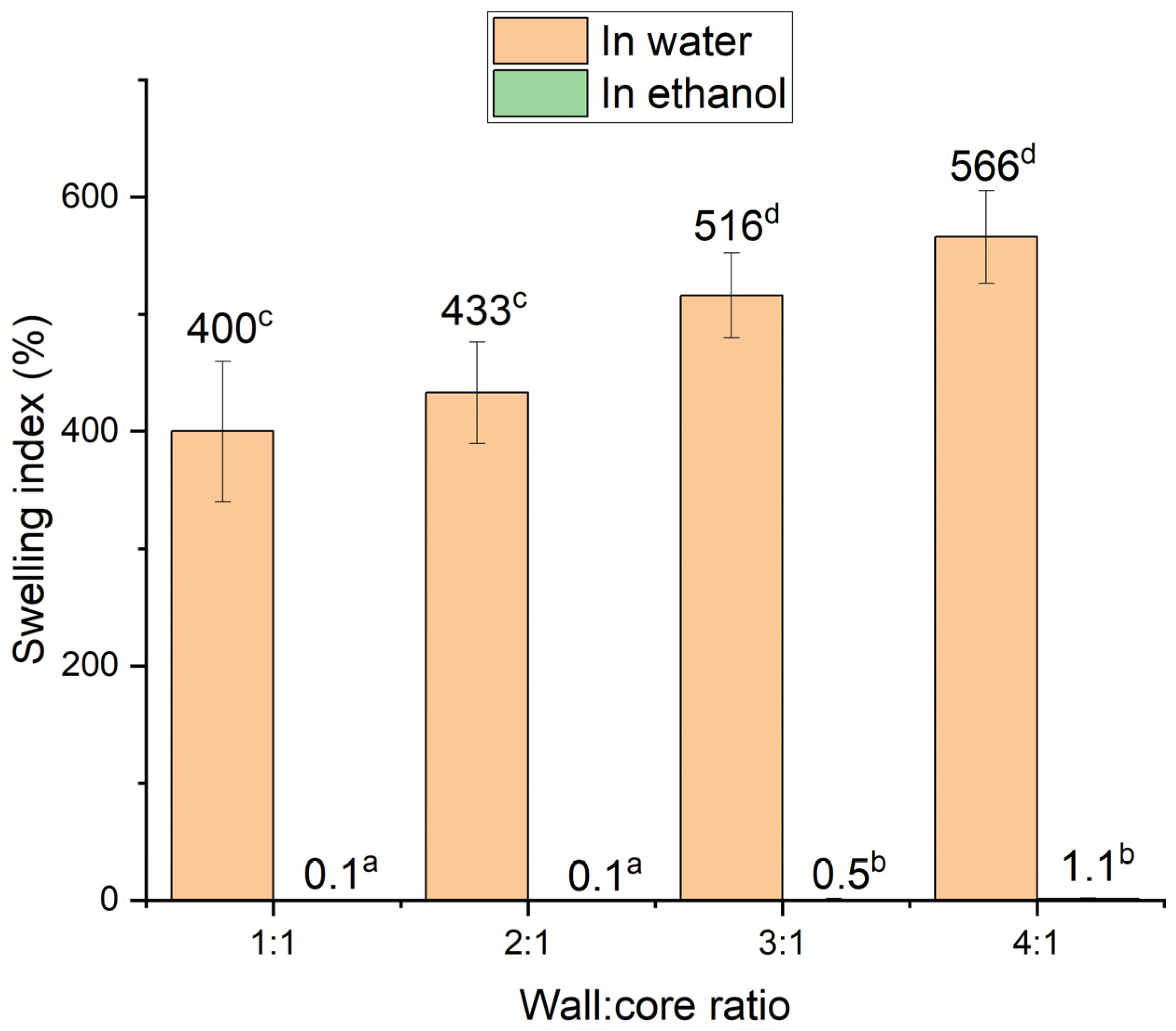
Figure 5 shows that the swelling index of the microcapsules increased as the wall-to-core ratio increased. This is attributed to the hydrophilic nature of the wall materials, CS and HKG. A higher proportion of these polymers increases the number of available hydrophilic sites (e.g., hydroxyl, carboxyl, and amino groups) for interaction with water molecules, thus leading to greater water uptake. In contrast, swelling in ethanol was minimal, confirming the predominantly hydrophilic character of the capsule wall.
3.7. Solubility of Microcapsules
The solubility of the microcapsule powder is a critical factor for its application in aqueous systems. The solubility was investigated as a function of temperature and pH.
Table 6 shows that the solubility of all oven-dried samples increased with temperature. For instance, raising the temperature from 30 °C to 100 °C enhanced solubility. This is expected, as increased thermal energy can disrupt the intermolecular hydrogen bonds within the polymer matrix, weakening the capsule structure and facilitating its dissolution.
In this study, we investigated the effect of pH on the solubility of microcapsules in the neutral to acidic pH range to simulate the conditions of the human digestive system. The results showed that the higher the acidity of the medium, the greater the solubility of the microcapsules. This is consistent with the results in
Figure 2, which show that a smaller amount of CS-HKG complex was formed at lower pH.
Table 6 also shows that microcapsules with a higher wall-to-core ratio generally exhibited lower solubility, likely due to a more densely packed polymer network. Furthermore, a general observation was that freeze-dried microcapsules consistently demonstrated higher solubility than their oven-dried counterparts, which can be ascribed to the more porous and amorphous structure produced by freeze-drying.
Hygroscopicity of microcapsules
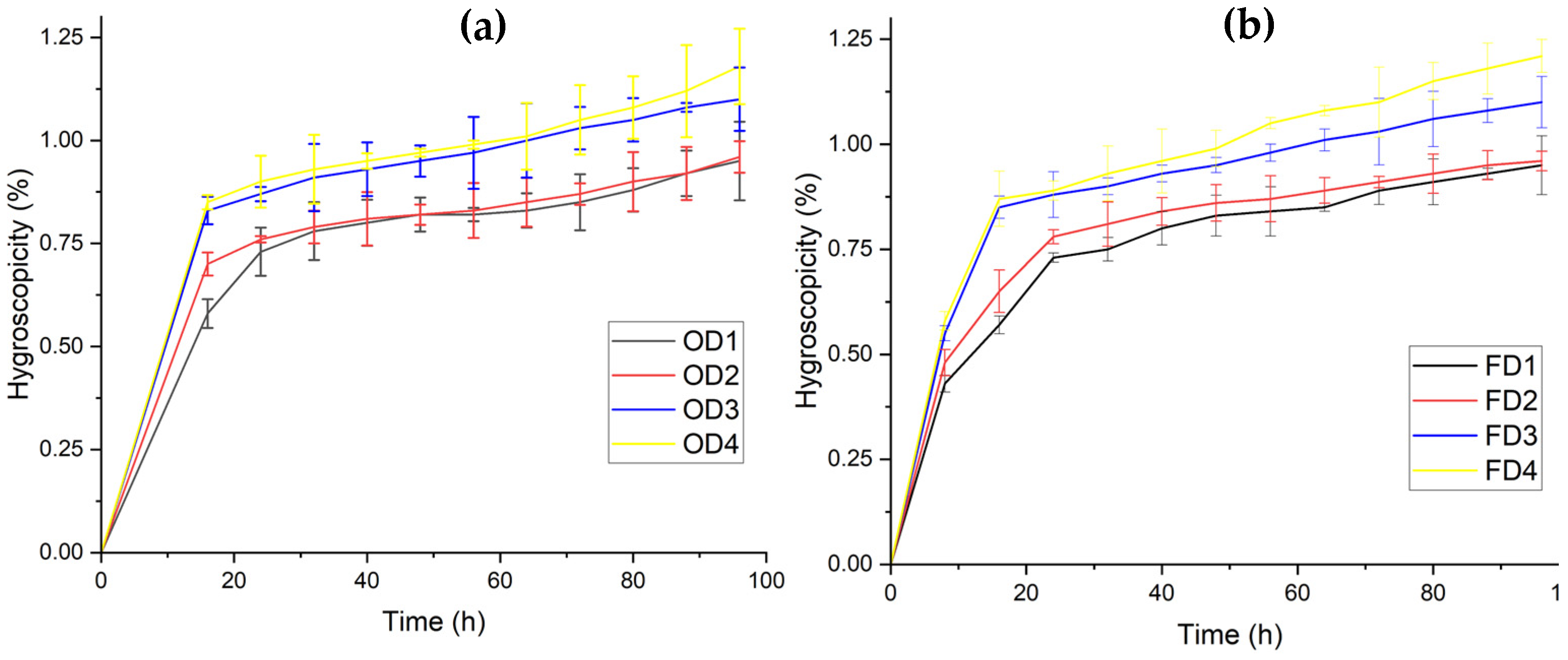
Hygroscopicity, the tendency of a powder to absorb moisture from the air, is a critical parameter for determining storage stability. The hygroscopicity of the microcapsules was evaluated over 120 h in an environment with 75% relative humidity (RH), with results for oven-dried and freeze-dried samples presented in
Figure 6.
All samples exhibited low hygroscopicity, with final moisture uptakes after 100 h ranging from a minimum of 0.95% (oven-dried, 1:1 ratio) to a maximum of 1.21% (freeze-dried, 4:1 ratio). Two consistent trends were observed. First, freeze-dried samples consistently showed slightly higher hygroscopicity than their oven-dried counterparts. This is attributed to the highly porous and amorphous structure created by the freeze-drying process, which provides a larger surface area for water vapor adsorption. Second, for both drying methods, hygroscopicity increased with a higher wall-to-core ratio, which is expected as this increases the proportion of hydrophilic biopolymers in the powder.
Overall, the low hygroscopicity of all formulations is a highly desirable characteristic. It indicates good physical stability during storage, minimizing the risks of caking, clumping, and potential chemical degradation that can be accelerated by moisture. While the low hygroscopicity confirms good physical stability, future research must include chemical analysis (e.g., GC-MS) to evaluate the long-term retention of key volatile compounds and chemical integrity of the encapsulated ginger essential oil under extended storage conditions.
3.8. Morphology of Dried Microcapsules
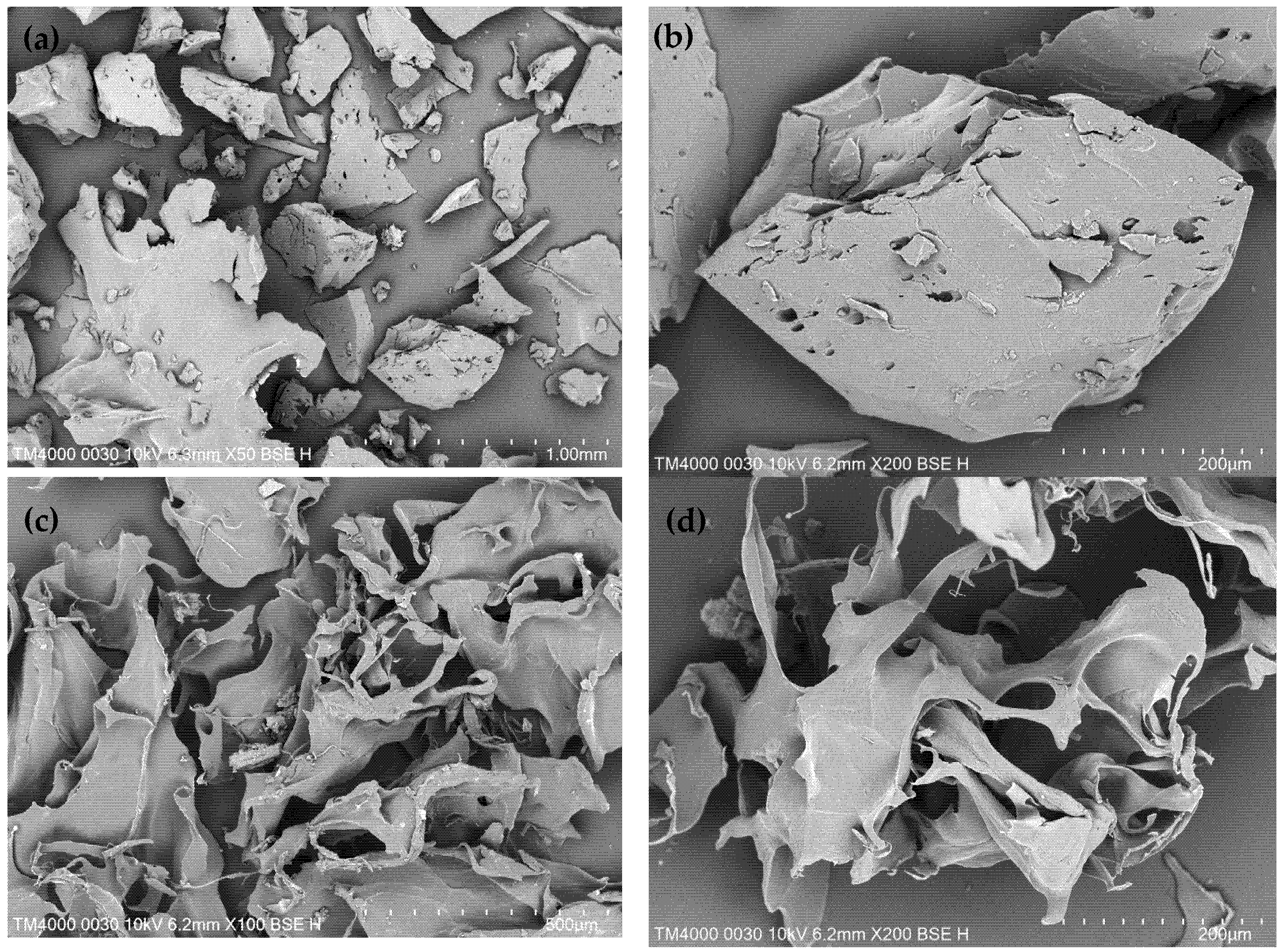
SEM images show that the microcapsules dried by convection (
Figure 7a,b) had a denser structure, likely due to the structural collapse that occurred as liquid water evaporated. In contrast, freeze-dried microcapsules exhibited a more porous morphology (
Figure 7c,d). This is attributed to the sublimation of ice from a solid state at low temperatures, which resulted in minimal collapse of the polymer structure [
28]. This finding is also consistent with the higher solubility and moisture absorption observed in the freeze-dried microcapsules compared to those dried by convection.
3.9. Color of Microcapsules
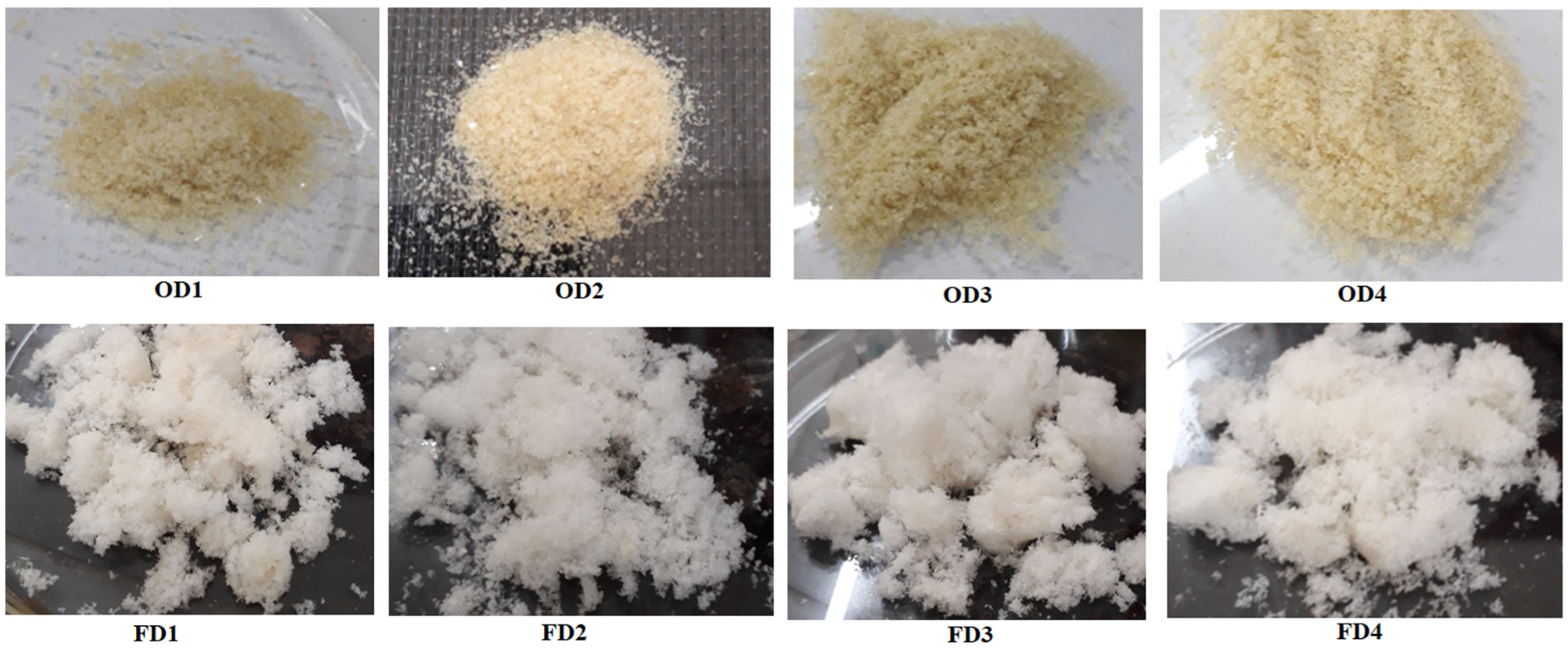
As shown in
Figure 8, with the same drying method, there was no significant color difference between the microcapsules with different core-to-shell ratios. However, the drying method had a pronounced effect on the color of the microcapsules: oven-dried samples were light brown, while the freeze-dried samples were bright white.
The color was quantitatively analyzed using a colorimeter, and the results in
Table 7 indicate that the freeze-dried samples exhibited significantly higher L* values, confirming their lighter color compared to the oven-dried samples. Furthermore, the oven-dried samples also showed higher b* values, indicating a more dominant yellow hue than their freeze-dried counterparts.
The pronounced color difference between OD and FD microcapsules was primarily attributed to thermal- and oxygen-induced chemical degradation. The convection oven-drying at 55 °C under atmospheric conditions significantly accelerates the oxidation and polymerization of the terpene compounds within the GEO core [
29]. This degradation results in the formation of colored by-products, leading to the light brown hue of the OD powder. In contrast, the low temperature and high vacuum environment during FD effectively minimizes these oxidative effects, preserving the native bright-white color of the polymer matrix. However, this visual evidence of chemical alteration raises a critical question regarding the functionality of the encapsulated GEO payload. Therefore, future studies should include a comparative chemical analysis (e.g., GC-MS) and antioxidant activity assay to rigorously quantify the effect of both oven-drying and freeze-drying methods on the chemical integrity and bioactivity of the encapsulated GEO.
3.10. In Vitro Release of GEO from Microcapsules
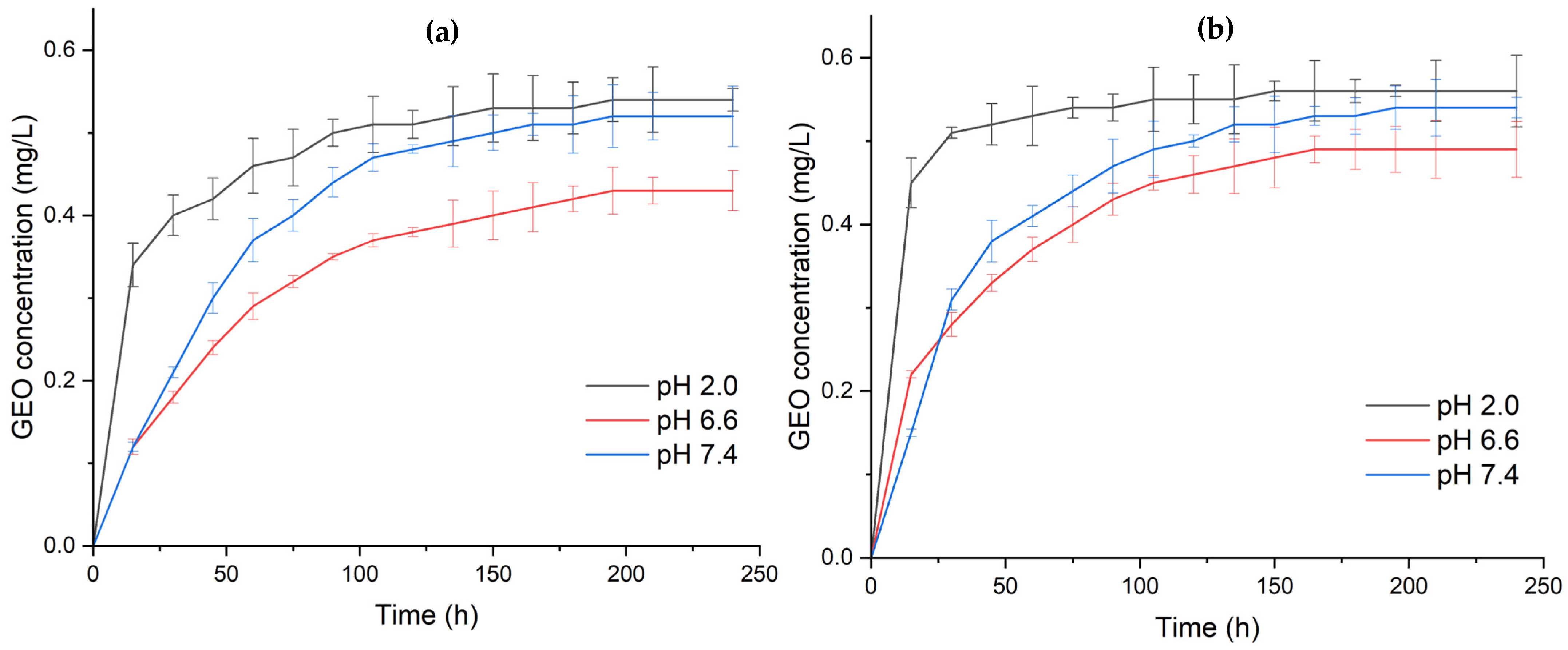
The in vitro release profiles of GEO from the optimized microcapsules (3:1 ratio) were investigated in three different media to simulate physiological conditions: pH 2.0 (simulated gastric fluid), pH 7.4 (simulated intestinal fluid), and distilled water (neutral control) (
Figure 9).
A consistent observation across all three media was that the freeze-dried microcapsules exhibited a faster release of GEO compared to the oven-dried samples. This can be attributed to the porous, sponge-like structure of the freeze-dried particles, as indicated in the SEM micrographs (
Figure 7). This high porosity allows for rapid penetration of the release medium, leading to faster swelling of the polymer matrix and quicker diffusion of the core material to the surrounding environment.
The pH of the release medium had the most profound impact on the release rate. The fastest and most extensive release for both sample types occurred in the acidic medium at pH 2.0. At this low pH, the primary amino groups (–NH
2) on the CS chains become fully protonated to form ammonium ions (–NH
3+). The resulting strong electrostatic repulsion between the positively charged polymer chains causes the capsule wall to swell significantly. This weakens the matrix structure and opens up diffusion channels, facilitating the rapid release of the encapsulated oil. This result aligns with the findings of Dima et al. (2016), who also observed the highest swelling and a release rate of approximately 80% for similar CS/alginate/inulin microcapsules at pH 2.0 [
19].
Conversely, the release was significantly slower in both neutral water and at pH 7.4. In these environments, the CS is largely deprotonated, which reduces electrostatic repulsion and allows the polymer matrix to remain in a more collapsed, precipitated state. This compact structure restricts water flows and limits the diffusion of the oil. This pH-dependent release behavior is consistent with the initial complex formation study, which demonstrated that the complex is most stable and insoluble in the pH 4–5 range and begins to change form at pH values below 3.5 (
Figure 2). This pH-responsive characteristic is highly desirable for applications targeting delivery in the acidic environment of the stomach, specifically for GEO-based products requiring a rapid onset of action (e.g., anti-emetics or digestive aids) or local antimicrobial activity in the upper gastrointestinal tract.
Quantitative Analysis of GEO Release Kinetics
To gain deeper insight into the mechanism governing GEO release, the in vitro profiles were fitted to four common kinetic models: zero-order, first-order, Higuchi, and Korsmeyer–Peppas.
Table 8 demonstrates that the Korsmeyer–Peppas (K-P) model provided the best fit for all release data across all tested media, evidenced by the highest coefficient of determination (R
2 > 0.98) compared to the other three models. The K-P model is thus appropriate for characterizing the release mechanism.
The
kK release rate constant from the Korsmeyer–Peppas model (
Table 8) quantitatively confirmed the high pH-dependency of the kinetics, demonstrating the fastest GEO release in pH 2.0 (0.21 to 0.28 min
−n) and a significantly slower release in near-neutral media (pH 6.6 and SIF, 0.12 to 0.18 min
−n), where the complex wall maintains greater structural integrity.
Furthermore, FD microcapsules consistently showed a higher kK value than their OD counterparts under the same pH condition, thus quantitatively validating that the porous, amorphous structure of FD particles facilitates faster penetration of the medium and quicker release of the core material.
The release exponent (
n) derived from the Korsmeyer–Peppas model provides crucial quantitative insight into the physical mechanism controlling the release of the hydrophobic GEO from the hydrophilic CS-HKG matrix. The determined
n values exhibit a distinct dependence on the pH of the medium (
Table 8), demonstrating a clear shift in the dominant release mechanism.
In simulated gastric fluid (pH 2.0), the exponent
n consistently fell between 0.58 and 0.65 (n > 0.45), indicating anomalous (non-Fickian) transport. This mechanism is characterized as a composite of Fickian diffusion and polymer chain relaxation or swelling. This outcome is directly attributed to the low structural stability of the CS-HKG complex at this highly acidic pH, which was demonstrated in
Figure 2. The protonation of the CS amino groups generates strong electrostatic repulsion, causing the hydrophilic polymer matrix to rapidly swell and relax. This significant structural change actively contributes to the release process alongside simple concentration-gradient diffusion, leading to the fastest overall release rate observed.
Conversely, in neutral water (pH 6.6) and simulated intestinal fluid (pH 7.4), the exponent n was ≤0.45 (ranging from 0.39 to 0.45), indicating Fickian diffusion. This confirms that the release under neutral conditions is primarily limited by the rate of GEO diffusion through the compact polymer network. At these near-neutral pH values, the CS-HKG complex maintains a compact, precipitated, and stable structure. The resulting dense matrix effectively limits water influx, making diffusion the rate-limiting step and slowing the release of the hydrophobic GEO core.
These quantitative findings strongly validate the pH-responsive nature of the CS-HKG microcapsules, demonstrating a clear and desirable shift in the dominant release mechanism from swelling-aided transport (anomalous) in the acidic gastric environment to diffusion-controlled transport (Fickian) in the neutral intestinal environment.
While these in vitro results strongly demonstrate a pH-triggered release, future studies are essential to confirm the practical applicability of this system. A crucial next step would be to quantify the bioactivity (e.g., antioxidant or antimicrobial capacity) of the GEO after its release to ensure that the encapsulation and release processes do not compromise its functional properties. Furthermore, investigating the performance of these microcapsules in specific food matrices or simulated application environments would validate their potential as an effective delivery vehicle. Finally, a comprehensive toxicological assessment is necessary to formally verify the safety of the microcapsules before they can be considered for food or pharmaceutical applications.
3.11. Limitations and Future Perspectives
This study successfully established and characterized an optimized CS-HKG micro-delivery system; however, its current scope presents several limitations that must be addressed for scaling and commercialization. The primary constraint is the reliance on in vitro data for functional evaluation. Follow-up in vivo studies are required to confirm the kinetics and mechanism of pH-responsive release of GEO in a physiological setting. Furthermore, a crucial next step would be to quantify the bioactivity (e.g., antioxidant or antimicrobial capacity) of the GEO after its release to ensure that the encapsulation and release processes do not compromise its functional properties. For practical validation, the microcapsules’ efficacy as a delivery vehicle must be demonstrated by testing their performance in specific functional food or drug matrices under simulated end-use conditions. Finally, a comprehensive toxicological assessment is necessary to formally verify the safety of the microcapsules before they can be considered for food or pharmaceutical applications.
Beyond functional assessment, opportunities remain in process optimization and scale-up. Our initial screening of optimal conditions (pH, CS:HKG ratio, homogenization speed, emulsifier concentration) was limited, suggesting that further fine-tuning and optimization using statistical methods, such as response surface methodology (RSM), is warranted to maximize microcapsule yield and microencapsulation efficiency. Finally, scaling up the complex coacervation process presents inherent challenges for commercialization due to the high sensitivity of complex formation to mixing parameters (shear rate, viscosity) and environmental factors (pH, concentration, temperature) in large-volume reactors, demanding specialized equipment to ensure industrial reproducibility and efficiency.
Successful resolution of these functional and scaling challenges will fully unlock the robust potential of the CS-HKG system as a highly effective, pH-triggered delivery vehicle for the functional food and pharmaceutical markets.