Review

Advances in Succinoglycan-Based Biomaterials: Structural Features, Functional Derivatives, and Multifunctional Applications

1
Department of Bioscience and Biotechnology, Microbial Carbohydrate Resource Bank (MCRB), Konkuk University, 120 Neungdong-ro, Gwangjin-gu, Seoul 05029, Republic of Korea
2
Department of System Biotechnology, Microbial Carbohydrate Resource Bank (MCRB), Konkuk University, 120 Neungdong-ro, Gwangjin-gu, Seoul 05029, Republic of Korea
*
Author to whom correspondence should be addressed.
Polysaccharides 2025, 6(4), 106; https://doi.org/10.3390/polysaccharides6040106
Submission received: 31 October 2025 / Revised: 15 November 2025 / Accepted: 25 November 2025 / Published: 28 November 2025
(This article belongs to the Collection Current Opinion in Polysaccharides)

Abstract

Succinoglycan (SG), a rhizobial exopolysaccharide produced by Sinorhizobium meliloti, has attracted increasing attention as a sustainable biomaterial due to its unique molecular structure and versatile physicochemical properties. Over the past decade, an expanding number of studies have explored SG in biomedical, pharmaceutical, and materials-science contexts; however, a comprehensive understanding linking its biosynthetic mechanisms, structural features, chemical modifications, and functional performances has not yet been systematically summarized. This review therefore aims to bridge this gap by providing an integrated overview of recent advances in SG research from biosynthesis and molecular design to emerging multifunctional applications, while highlighting the structure, property, and function correlations that underpin its material performance. This review summarizes recent advances in SG biosynthesis, structural characterization, chemical modification, and multifunctional applications. Progress in oxidation, succinylation, and phenolic grafting has yielded derivatives with remarkably enhanced rheological stability, antioxidant capacity, antibacterial activity, and multi-stimuli responsiveness. These developments have supported the creation of biodegradable and bioactive smart films possessing superior barrier, mechanical, and optical properties, thereby extending their potential use in bio-medical and biotechnological applications such as food packaging and wound dressings. In parallel, SG-based hydrogels exhibit self-healing, adhesive, and injectable characteristics with tunable multi-stimuli responsiveness, offering innovative platforms for con-trolled drug delivery and tissue engineering. Despite these advances, industrial translation remains hindered by challenges including the need for scalable fermentation, reproducible quality control, and standardized modification protocols to ensure batch-to-batch consistency. Overall, the structural tunability and multifunctionality of SG highlight its promise as a next-generation platform for polysaccharide-based biomaterials.

1. Introduction

In recent years, polymeric materials synthesized through conventional chemical processes have demonstrated remarkable potential across a wide range of applications, including hydrogels, scaffolds, films, and bio-inks [1,2,3,4,5]. With industrialization and the advancement of petrochemical synthesis, synthetic polymers have an integral part of modern life, forming the foundation of today’s plastics and textiles [6,7,8].
However, the extensive use of these chemically synthesized polymers has raised serious concerns about their environmental impact and biocompatibility, highlighting the need for eco-friendly and bio-derived alternatives [9,10,11]. Consequently, significant research efforts have shifted toward the development of biomaterials, which are functional materials that combine environmental sustainability with biological compatibility and offer the potential to replace conventional synthetic polymers [12,13,14].
Among various biomaterials, polysaccharides, naturally occurring carbohydrate-based polymers, have attracted particular attention. They serve as essential components of biological systems, fulfilling diverse structural and functional roles [15,16]. The advantages of polysaccharides as functional materials include biodegradability, biocompatibility, and abundant natural availability, making them promising candidates for polymer research and biomedical applications [17,18].
Polysaccharides such as glucose-, galactose-, and mannose-based polymers exhibit distinct physicochemical properties depending on their constituent monosaccharides, types of glycosidic linkages, and nature of functional substituents [19,20,21]. Accordingly, continuous efforts have been made to utilize polysaccharides as functional polymeric backbones for biomedical and industrial materials [22,23].
Polysaccharide-based polymeric structures that preserve the intrinsic chemical and biological functionalities of the parent molecules demonstrate strong potential in bio-medical, cosmetic, and food applications, where both biocompatibility and biodegradability are essential [24,25,26]. Moreover, recent research has expanded into commercial and industrial domains, including bioplastics and sustainable packaging, emphasizing their potential as environmentally responsible alternatives to petroleum-derived materials [27,28,29].
Among various polysaccharides, succinoglycan (SG) is a bacterial exopolysaccharide (EPS) containing succinyl substituents, first studied in the context of nitrogen fixation and rhizobial symbiosis [30,31,32]. Initial investigations focused on elucidating its structural and functional roles in root–bacteria interactions, whereas recent studies have explored its potential as a functional polysaccharide for advanced polymeric applications [33,34].
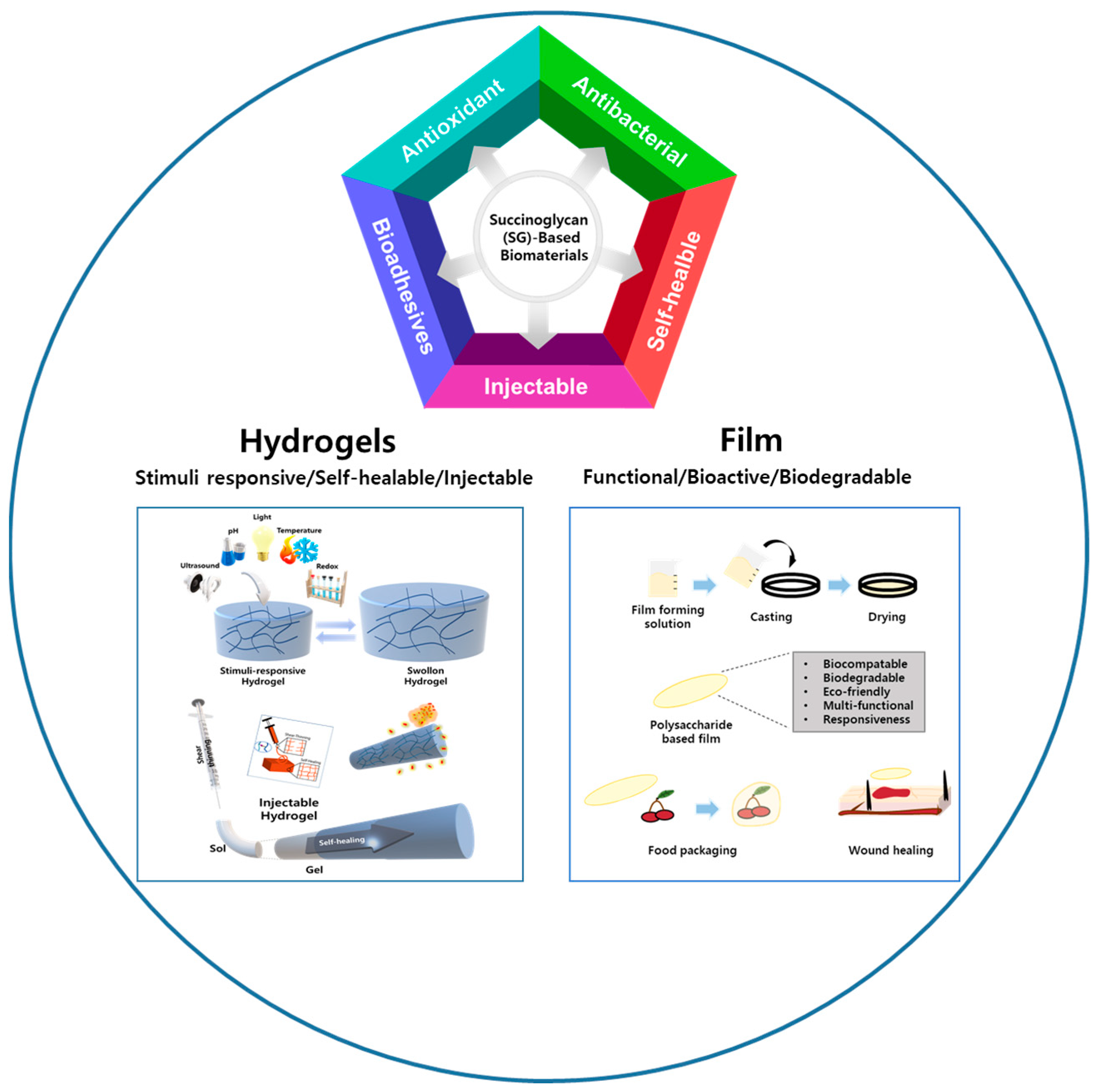
SG possesses an anionic β-glycosidic backbone that enables the formation of poly-meric networks, making it a promising component for hydrogel and film matrices [35,36]. As shown in Figure 1, subsequent studies have sought to further enhance its functionality through chemical modifications and crosslinking with bioactive molecules, producing functional polymeric composites with tailored physicochemical and biological properties [37,38].
This review aims to summarize current progress in SG-based materials, providing a comprehensive discussion of their synthesis, structural modification, and applications as biomaterial platforms for the development of functional and sustainable polymers.

2. Overview of Succinoglycan and Its Biosynthesis

2.1. Comparative Overview of Polysaccharides and Succinoglycan

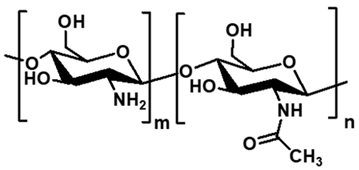
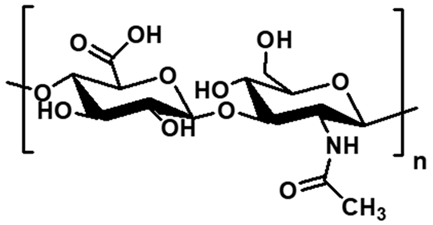
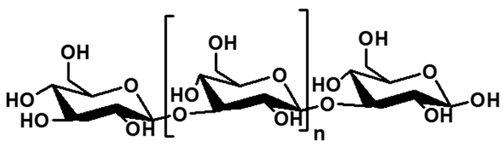
Various polysaccharides have been explored as promising biomaterials for constructing polymeric structures due to their structural diversity and functional versatility [39]. Representative examples include starch, pectin, cellulose, alginate, chitosan, hyaluronic acid, xanthan, gellan gum, pullulan, curdlan, fucopol, and SG [40,41]. For instance, starch undergoes thermal gelatinization in aqueous environments, enabling the formation of viscoelastic networks suitable for biodegradable films, packaging materials, and hydrogel matrices [42,43]. Its thermo-responsive swelling behavior and ability to form intermolecular hydrogen-bonded structures have been widely utilized in polymer blending, drug delivery carriers, and mechanically reinforced composite systems [44]. Pectin, a plant-derived anionic polysaccharide rich in galacturonic acid, forms polymeric structures through metal chelated crosslinking or pH-responsive gelation mechanisms [45]. These gelation pathways allow pectin to be engineered into hydrogels, mucoadhesive films, and controlled-release matrices used in wound dressings and gastrointestinal drug delivery [46]. Alginate has been widely employed to form ionically crosslinked hydrogels for tissue engineering and drug delivery applications with metal chelation [47,48]. Chitosan, owing to its cationic amine groups, has been utilized for antibacterial coatings and wound healing materials [49,50]. Hyaluronic acid and gellan gum are often incorporated into bioinks and injectable scaffolds due to their high biocompatibility and tunable viscoelasticity [51,52]. Cellulose- and pullulan-based derivatives have found applications in biodegradable films and sustainable packaging systems [53,54,55].
As summarized in Table 1, these polysaccharides exhibit distinct structural features and functional groups that enable their application in a wide range of polymer-based materials. Polysaccharide application in polymer field have focused on utilizing their intrinsic chemical functionalities, such as hydroxyl, carboxyl, and amine groups, or their natural abundance to design biocompatible and sustainable polymeric systems.
Among these, SG is an anionic polysaccharide containing succinyl functional groups, which impart high water solubility and remarkable viscoelasticity [56,57]. It is produced by various soil microorganisms, including Rhizobium, Agrobacterium, and Enterobacter species, with subtle differences in backbone structure and substituent composition depending on the strain [57,58,59]. Unlike plant polysaccharides that depend on extraction and seasonal variation, SG biosynthesis can be controlled under fermentation conditions, allowing adjustment of molecular weight, and substitution level through microbial strain engineering and process regulation. This tunable biosynthetic flexibility enables SG to act as a designable biopolymer platform, suitable for creating stimuli-responsive hydrogels, self-healing films. Furthermore, combination of carboxylated and acetylated substituents facilitates both ionic and covalent crosslinking, providing superior viscoelasticity and environmental stability compared to most natural polysaccharides. Recent studies have investigated SG derived from different microbial sources for its potential in polymeric material development, and these advancements are comprehensively reviewed in this paper.
Table 1. Overview of polysaccharides and their applications in polymer research.
PolysaccharideSourceStructureComponentsMolecular Weight (Da)Main PropertiesMain ApplicationRefs
StarchPlants
(corn, potato,
cassava, rice)
Polysaccharides 06 00106 i001Amylose,
Amylopectin
~1 × 10⁵–1 × 10⁷Thermo-gelatinization, viscoelasticity, biodegradabilityHydrogels, biodegradable films, packaging materials, drug delivery[60,61,62]
PectinPlants
(Citrus peel,
apple pomace)
Polysaccharides 06 00106 i002Galacturonic acid~5 × 10⁴–3 × 10⁵pH-responsive gelation, Ca2+ chelation, mucoadhesivenessHydrogels, mucoadhesive films, wound dressing, drug delivery[46,63]
CellulosePlants, bacteria
(Acetobacter sp.)
Polysaccharides 06 00106 i003Glucose~1 × 10⁵–106High crystallinity, water-insoluble, high mechanical strengthFilms, scaffolds, drug delivery, wound dressing[64,65,66]
AlginatePseudomonas sp., Azotobacter sp., brown algaePolysaccharides 06 00106 i004Mannuronic acid, Glucuronic acid<1.3 × 10⁶Anionic
Hydrocolloid,
biocompatibility, metal chelation
Food hydrocolloid, wound dressing, drug release systems[67,68,69]
ChitosanCrustacean shells (chitin deacetylation)Polysaccharides 06 00106 i005Glucosamine, N-acetylglucosamine1 × 105–1 × 10⁶Cationic,
antimicrobial,
primary amine based crosslinking
Antibacterial
component,
drug delivery, wound healing,
tissue engineering
[70,71,72]
Hyaluronic acidDiplococcus sp., Streptococcus sp., Staphylococcus sp.Polysaccharides 06 00106 i006Glucuronic acid, N-acetylglucosamine~2 × 10⁵Hydration capacity, viscoelastic
behavior,
biocompatibility
Drug delivery, wound healing scaffolds, tissue engineering[73,74]
XanthanXanthomonas sp.Polysaccharides 06 00106 i007Glucose, Mannose, Glucuronic acid,
Acetate, Pyruvate
<5 × 10⁶Anionic,
High viscosity, pH/salt stability,
Hydrocolloid
Food thickener, oil recovery, pharmaceuticals[75,76,77]
Gellan gumSphingomonas paucimobilisPolysaccharides 06 00106 i008Glucose, Rhamnose, Glucuronic acid,
Acetate
~5 × 10⁵Anionic,
Thermo-reversible gelation,
pH stability
Food, pharmaceuticals, electrophoresis gels[78,79,80]
PullulanAureobasidium sp.Polysaccharides 06 00106 i009Glucose4.0 × 104–2.0 × 10⁶Water-soluble, film-forming, adhesive, biocompatible, non-toxicEdible films, drug delivery, tissue engineering, food coatings, biodegradable packaging[81,82]
CurdlanAgrobacterium sp.Polysaccharides 06 00106 i010Glucose1.0 × 105–3.6 × 10⁶Water-insoluble, thermogelation, high mechanical strength,
Biocompatible
Food gelation, biomedical scaffolds, drug delivery, wound dressing, tissue engineering[83,84]
FucoPolEnterobacter A47Polysaccharides 06 00106 i011Fucose, Galactose, Glucose,
Glucuronic acid
1.5 × 10⁶Emulsifying, film-forming, biocompatibleEmulsifiers, wound dressing, coatings[85,86]
SuccinoglycanRhizobium sp.,
Agrobacterium sp.,
Polysaccharides 06 00106 i012Glucose, Galactose, Acetate, Pyruvate, SuccinateLMW < 5 × 10³, HMW > 1 × 10⁶High viscosity, anionic, stable under acidic conditionsCosmetics, food thickener, emulsifier, stabilizer, biofilms[87,88]

2.2. Biosynthesis of Succinoglycan Mediated by the Exo Gene Cluster

SG is an exopolysaccharide released by soil bacteria such as Rhizobium and Agrobacterium during growth and metabolism. These bacteria use quorum sensing to coordinate group behaviors and form biofilms, promoting collective stability and survival. These biofilms are composed of various biomolecules, including polysaccharides and proteins, with SG representing one of the key exopolysaccharides secreted into the extracellular matrix [89,90]. SG contributes to the formation of biofilms and facilitates symbiotic relationships with plants by creating protective extracellular environments [15,30,91,92].
The biosynthesis of SG is governed by the exo gene cluster, which encodes a series of glycosyltransferases responsible for stepwise assembly of the polymer backbone [31,59,93,94]. Specifically, enzymes encoded by exoY, exoF, exoA, exoL, exoM, exoO, exoU, and exoW utilize UDP-glucose and UDP-galactose to form the repeating octasaccharide unit of SG. Subsequently, post-glycosylation modification enzymes, encoded by exoV, exoZ, and exoH, introduce pyruvyl, succinyl, and acetyl groups, respectively, to the backbone, yielding the final substituted polysaccharide structure. The completed SG polymer is transported to the periplasmic space by exoP and exoQ, and is secreted to the extracellular environment through the exoQ/exsA system, where it forms high-molecular-weight polymeric aggregates.
The biosynthesis of SG is not only determined by genetic factors but also highly dependent on environmental conditions such as pH, phosphate availability, and carbon source concentration. Variations in these parameters significantly affect the degree of substitution, molecular weight distribution, and overall yield of the polymer [95,96]. Therefore, a comprehensive understanding of both genetic regulation and cultivation conditions is essential for the optimization of SG production [97]. Such optimization strategies, including media composition adjustment, controlled fermentation parameters, and selective post-processing, will be critical to tailoring SG with desired physicochemical and functional properties for advanced applications in biomaterials.

2.3. Regulation of Succinoglycan Biosynthesis

The expression of the SG biosynthetic pathway is tightly controlled by the ExoR–ExoS/ChvI two-component regulatory system and MucR gene [98,99].
Under neutral pH and nutrient-rich conditions, the ExoR protein inhibits ExoS kinase activity, thereby preventing phosphorylation of ChvI and suppressing SG biosynthesis. Conversely, under acidic pH, phosphate limitation, or plant root stress signals, ExoR undergoes proteolytic cleavage and inactivation. This activates ExoS, enabling phosphorylation of ChvI to form ChvI-P. The phosphorylated form acts as a transcriptional activator by binding to promoter regions of exoY, exoA, and exsB, enhancing SG expression while simultaneously repressing EPS II (galactoglucan) synthesis.
Another regulatory pathway involves the MucR gene, which plays a role in SG production [100]. Under phosphate-limited conditions, activation of the MucR gene suppresses the synthesis of EPS II (galactoglucan) while enhancing the production of EPS I (succinoglycan). Conversely, when phosphate is abundant, MucR expression is inhibited, thereby promoting the biosynthesis of EPS II (galactoglucan) rather than EPS I.
As a result, SG production is favored under low-pH and phosphate-deficient conditions, whereas galactoglucan production dominates under phosphate-rich environments [58]. Thus, to maximize SG biosynthesis, cultivation under mildly acidic and phosphate-limited conditions is desirable. Other ways: some studies have reported that random mutagenesis can suppress the expression of regulatory genes, leading to enhanced production of SG. The resulting mutants exhibited significantly increased yield while maintaining the fundamental structural features, molecular weight, and physicochemical properties of the native polymer [97,101,102].

2.4. Molecular Weight Distribution Under Different Biosynthetic Conditions

The molecular weight of SG varies depending on the extent of polymerization and enzymatic cleavage. High- and low-molecular-weight forms are primarily regulated by extracellular β-glucanase enzymes, encoded by exoK and exoI, which cleave the polymeric chain [56,92]. High-molecular-weight SG exhibits higher viscosity and plays an important role in facilitating plant root symbiosis, whereas lower molecular weight forms display distinct rheological and mechanical characteristics [56]. Previous studies have reported that low-molecular-weight SG plays a crucial role in establishing symbiotic interactions with plants [15,93,103].
For practical applications as a biopolymeric material, understanding and controlling this molecular weight distribution is essential, as it directly influences the mechanical strength, viscoelasticity, and processability of the resulting polymeric structures [103]. In particular, high-molecular-weight polysaccharide tends to form stronger and more stable hydrogel and film networks, which are advantageous for applications such as food packaging, wound dressings, and tissue scaffolds [102]. However, its high viscosity and limited solubility can complicate large-scale processing. In contrast, low-molecular-weight polysaccharide exhibits lower mechanical strength but offers superior injectability, rapid diffusivity, and easier processability, making it suitable for applications in drug delivery, self-healing hydrogels, and bioinks for 3D bioprinting [104]. Moreover, the molecular weight strongly impacts biodegradation kinetics and in vivo stability, with high-molecular-weight fractions providing longer residence times, while low-molecular-weight fractions are more rapidly metabolized [105].
Therefore, precise regulation of molecular weight, through optimization of fermentation conditions, control of β-glucanase activity, or downstream fractionation methods, is a critical factor in tailoring SG for specific biomedical and industrial applications. Establishing standardized strategies to produce SG with defined molecular weight and narrow polydispersity will be essential for its translation into scalable and reproducible biopolymeric materials.

2.5. Production and Purification of Succinoglycan from Bacterial Cultures

To obtain and utilize SG effectively, it is essential to establish an optimal culture environment for its production and extraction from bacterial strains. Although Sinorhizobium species can grow in various media, the Glutamic Mannitol Salt (GMS) medium is commonly employed to promote SG biosynthesis with Sinorhizobium meliloti 1021 strain [106,107].
The basal composition of the medium includes mannitol (5 g/L) as the carbon source, L-glutamic acid (1 g/L) as the nitrogen source, and potassium phosphate dibasic (1 g/L) to maintain phosphate balance [33,96,108,109]. In addition, magnesium sulfate (0.2 g/L) and calcium chloride (0.04 g/L) are supplied as cofactors required for enzymatic activity during metabolism. After autoclaving, a small amount of trace element solution is aseptically added to the medium to support microbial growth and exopolysaccharide production. For the production culture of SG, the concentration of mannitol in the GMS medium was increased to 10 g/L, and potassium phosphate monobasic (1 g/L) was added to enhance phosphate availability. The pH of the medium was adjusted to 7.0, and cultures were incubated at 30 °C under aerobic conditions.
The cultivation process was performed in three sequential stages [97,108,110]. Briefly, lyophilized Sinorhizobium cells were rehydrated and inoculated into 30 mL of GMS medium to initiate the seed culture stage, which was incubated for 24 h. The grown culture was then transferred to a fresh 30 mL GMS medium for sub-culture stage to ensure active cell proliferation. Subsequently, 1% (v/v) of the subculture was inoculated into 1 L of production GMS medium for production stage, followed by 7 days of incubation at 30 °C to maximize SG production.
The cultured bacterial broth undergoes a purification process to isolate SG [111,112]. Since SG is an extracellular polysaccharide, the initial step involves centrifugation to pellet the cells and collect the supernatant. The clarified supernatant is then subjected to solvent precipitation using organic solvents such as ethanol or isopropanol. To enhance precipitation efficiency, the supernatant is concentrated by evaporation to one-fifth to one-third of its original volume prior to solvent addition. Ethanol is subsequently added at three times the volume of the concentrated solution, resulting in EPS precipitation. The precipitate is dried, weighed, and further purified by dialysis to remove residual impurities, followed by freeze-drying to obtain purified SG. Additional purification steps may include protein removal by the Sevag method or alkaline treatment [105]. However, alkaline conditions may cause cleavage of glycosidic bonds, leading to reduced molecular weight and loss of functional groups [113]. Therefore, the choice of purification strategy should be carefully considered to ensure recovery of SG in a state most suitable for subsequent experimental applications.
The production of various structural forms of SG polysaccharides has been reported from different microbial strains. Table 2 summarizes the extraction of EPSs obtained under strain-specific culture media compositions, cultivation conditions, and incubation periods. The procedure described in Figure 2 ensures high reproducibility in both yield and structural uniformity of SG when identical medium composition and culture conditions are maintained in various study [58,114,115]. This is primarily attributed to the genetically conserved exo gene cluster in Sinorhizobium meliloti Rm1021, which governs the sequential synthesis and export of the octasaccharide repeating unit [98,99]. Previous studies have demonstrated that under consistent culture parameters (30 °C, 150 rpm, GMS medium), SG production yields of 3–4 g L−1 and molecular weights ranging from 2–3 × 10⁵ Da are reproducible across independent fermentation batches [97,112,116]. Furthermore, NMR and FTIR analyses have confirmed the retention of characteristic substituents (succinyl, acetyl, and pyruvyl groups) in each batch, supporting structural consistency of the biosynthesized polymer [110,117]. Therefore, the process in Figure 2 not only describes a standard extraction route but also represents a reproducible biosynthetic workflow capable of generating SG with stable molecular characteristics suitable for downstream functionalization.

3. Structural Features and Physicochemical Properties of Succinoglycan

3.1. Structural Characteristics of Succinoglycan

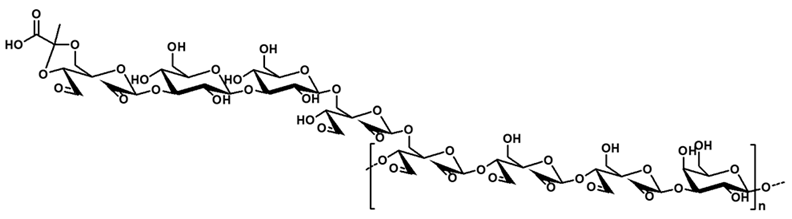
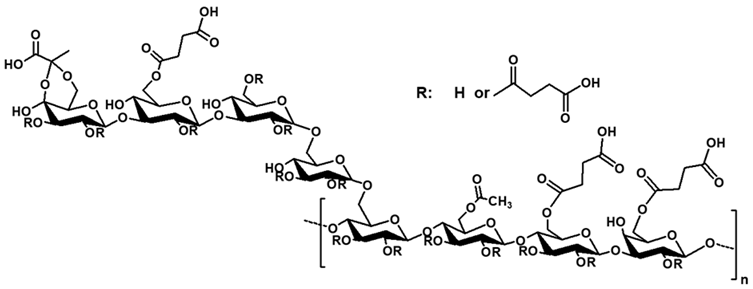
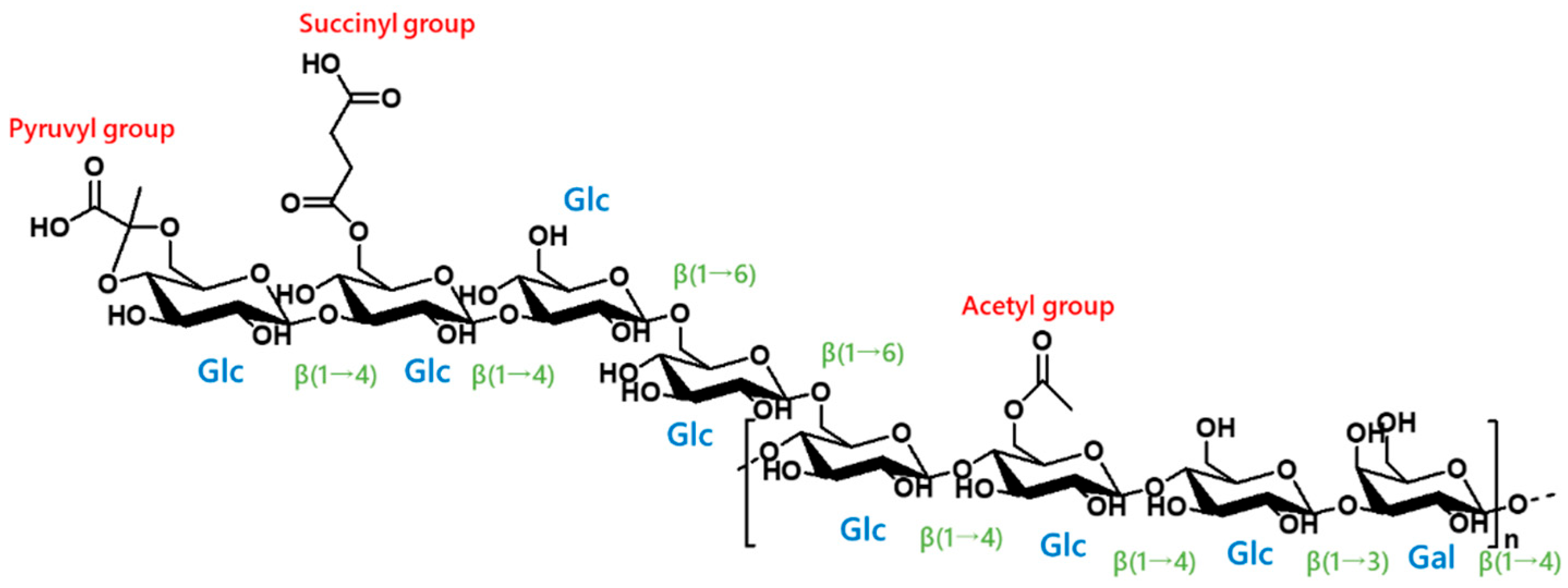
The structural characteristics of SG have been extensively investigated in relation to its role in symbiotic interactions between Rhizobium species and leguminous plants. Through analytical techniques such as nuclear magnetic resonance (NMR) and Fourier-transform infrared (FT-IR) spectroscopy, its detailed molecular architecture has been elucidated. SG consists of a repeating octasaccharide unit composed of seven glucoses and one galactose residue connected through β-(1→3), β-(1→4), and β-(1→6) glycosidic linkages [106,119]. The terminal glucose at the C6 position is substituted with a pyruvyl group, and one acetyl group is attached to a glucose residue [92]. The structural image of the SG repeating unit is presented in Figure 3. Depending on the bacterial strain and cultivation conditions, up to two succinyl groups may also be present [93]. These structural features have been confirmed through 1H and 13C NMR as well as FT-IR analyses [35,120,121].
In the 1H NMR spectrum obtained in D2O, multiple overlapping peaks appear in the 3–4 ppm region, corresponding to protons of the glucose and galactose residues forming the polysaccharide backbone. Distinct resonances originating from substituent groups are observed at lower chemical shifts. The methylene (–CH2–) protons of the succinyl group typically appear at 2.6–2.7 ppm as a doublet or singlet, while the methyl (–CH3) proton of the acetyl group appears as a singlet around 2.0 ppm. The methyl (–CH3) signal from the pyruvyl group is detected at approximately 1.5 ppm. The combination of these three characteristic peaks with the carbohydrate backbone region represents a well-established spectral signature of SG [120].
In the 13C NMR spectrum, the anomeric carbon (C1) appears between 100 and 105 ppm, and the ring carbons (C2–C6) of glucose and galactose residues are distributed from 60 to 85 ppm. The carbonyl carbons of succinyl or acetyl groups are detected in the 170–180 ppm range, whereas their methylene carbons typically resonate between 25 and 35 ppm [121]. The methyl carbon of the pyruvyl group appears at 20–25 ppm, consistent with previous reports on substituted bacterial polysaccharides.
FT-IR spectroscopy further supports these findings [88,122]. A broad O–H stretching band is observed near 3300 cm−1, while C–H stretching of the polysaccharide backbone appears around 2900–2800 cm−1. A strong absorption at 1725 cm−1 corresponds to the C=O stretching vibration of carbonyl groups, and asymmetric and symmetric stretching of carboxylate (COO) groups are observed at 1620 and 1400 cm−1, respectively. Peaks around 1100 cm−1 indicate C–O–C glycosidic linkages, and a distinct band near 890 cm−1 is characteristic of β-glycosidic linkages.
Although these spectral features are generally consistent, certain variations in peak intensity or position can occur depending on the producing strain or purification process. Therefore, when analyzing SG samples from different sources, reference to strain-specific structural studies is necessary to ensure accurate interpretation of spectral data.

3.2. Rheological Properties of Succinoglycan

Characterizing the mechanical and rheological behavior of polysaccharides is essential for assessing their potential as polymeric materials. Rheological measurements provide valuable information on how these materials respond to external deformation, including their viscosity, storage modulus (G′), and loss modulus (G″).
SG displays distinctive rheological properties among naturally derived polysaccharides owing to its anionic β-glycosidic backbone and substituent groups such as succinyl, acetyl, and pyruvyl moieties [87,123]. These groups contribute to electrostatic repulsion and extensive hydrogen bonding within aqueous media, leading to the formation of a highly viscoelastic network. Compared with other microbial and plant-derived polysaccharides, including xanthan gum, gellan gum, and alginate, SG exhibits superior shear-thinning (pseudoplastic) behavior and maintains stable viscosity across a wide range of pH, ionic strengths, and temperatures [88,102].
At a concentration of 1 wt%, SG solutions show apparent viscosities of 0.8–1.2 Pa·s at a shear rate of 10 s−1, decreasing to 0.05–0.1 Pa·s at 100 s−1, demonstrating a pronounced pseudoplastic response [97,124,125]. These values are comparable to, or even greater than, those of xanthan gum (0.5–1.0 Pa·s at 10 s−1). The storage modulus (G′ = 50–200 Pa) consistently exceeds the loss modulus (G″ = 20–80 Pa) at low frequencies, confirming the predominantly elastic and gel-like nature of SG, even at low concentrations (≤1 wt%).
As a non-Newtonian fluid, SG solutions exhibit a sharp decrease in viscosity with increasing shear rate, which allows facile processing under applied stress while maintaining structural integrity under static conditions [111]. This shear-thinning effect arises from reversible alignment and disentanglement of polymer chains under shear flow, followed by re-entanglement once stress is removed. The strong balance between intermolecular associations and chain flexibility enables SG-based systems to demonstrate superior flow adaptability, combining xanthan-like pseudoplasticity with enhanced elasticity and recovery.
Furthermore, the rheological behavior of SG is influenced by the composition of the production medium. When the mannitol concentration in the GMS medium was increased (e.g., to 50 g/L), the resulting SG showed significantly enhanced viscosity and elasticity [116]. This improvement is attributed to a higher degree of succinyl substitution, which strengthens intramolecular and candidate for applications in hydrogels, films, scaffolds, and bio-inks, where controlled rheological intermolecular interactions. The tunable viscoelasticity of SG, depending on fermentation conditions and chemical composition, positions it as a promising behavior is essential. Its inherent mechanical robustness provides a strong foundation for further functional modification and composite formation in polymer engineering [126,127].
Overall, rheological profile of SG highlights its capacity to form stable hydrogel or thickening matrices at low concentrations, functioning as an effective rheology modifier and stabilizer in formulations such as hydrogels, emulsions, and bioinks. Its unique combination of high pseudoplasticity, environmental stability, and tunable viscoelastic strength underscores its promise as a next-generation bio-based polymer system.

3.3. Thermal Stability of Succinoglycan

Polysaccharides generally exhibit higher thermal stability than proteins due to their more rigid and less conformationally flexible structures. Whereas proteins typically denature at temperatures around 100 °C, polysaccharides can maintain structural integrity at significantly higher temperatures. Building on their intrinsic thermal stability, polysaccharides have also been investigated for commercial applications requiring high heat resistance among bio-derived materials. In particular, starch, and xanthan gum have been widely employed in enhanced oil recovery and drilling fluid formulations [128,129]. Their characteristic shear-thinning behavior provides effective viscosity control under high temperature dynamic conditions. Polysaccharides and their derivatives have demonstrated temperature tolerance in the range of 100–150 °C while maintaining viscosity, thereby validating their versatility for industrial utilization in high-temperature environments.
Thermogravimetric analysis (TGA) of SG reveals a three-step degradation profile [57]. The initial weight loss corresponds to the removal of residual moisture, while the major decomposition phase (second stage) begins above 250 °C. Compared with other polysaccharides such as dextran or pullulan (which decompose at 210–230 °C) and hyaluronic acid (≈200 °C), SG demonstrates superior thermal stability, with degradation temperatures more than 25% higher. When heated above 250 °C, SG undergoes an order–disorder transition in its polymeric chain structure, resulting in altered viscoelastic behavior [36].
A third degradation phase observed above 400 °C suggests the presence of a thermally stable polysaccharide backbone. The residual mass (30–50%) at 600 °C further indicates a strong carbonaceous structure resistant to complete degradation.
This enhanced thermal resistance is attributed to the presence of succinyl, pyruvyl, and acetyl substituents, which promote extensive hydrogen bonding and electrostatic
Interactions within the polymer matrix [36,92]. Consequently, SG can serve as a structurally stable precursor for the fabrication of thermally durable polymeric composites and hydrogels.

3.4. Antibacterial Activity of Succinoglycan

SG is an exopolysaccharide secreted by bacterial cells that contributes to biofilm formation and protection against environmental stress and microbial invasion [36,130]. As such, its potential antibacterial properties have been investigated, and various chemical modifications have been explored to enhance its biological activity.
In contrast, chitosan, the only naturally occurring cationic polysaccharide, exhibits strong antibacterial properties due to the presence of protonated amine groups [131,132]. These positively charged groups interact with negatively charged bacterial membranes, disrupting membrane integrity and leading to cell death. The incorporation of chitosan into polymeric matrices often improves mechanical properties and imparts antibacterial activity through electrostatic interactions.
However, anionic polysaccharides, including SG, generally exhibit weaker intrinsic antibacterial effects [97]. The negative surface charge limits direct electrostatic interaction with bacterial membranes, resulting in only mild inhibitory activity. Reported antibacterial effects of unmodified SG are modest and primarily associated with its biofilm-related barrier function rather than direct bactericidal activity [133]. In particular, weak inhibitory effect can often be attributed to its formation of a hydrated, viscoelastic extracellular matrix which inhibits bacterial adhesion and biofilm maturation rather than directly killing cells [134]. Its high anionic charge density fosters binding of divalent cations (e.g., Ca2+, Mg2+) and formation of dense polysaccharide networks that block nutrient diffusion and microbial infiltration. Furthermore, the succinyl and pyruvyl substituents enhance water retention and gel strength, reinforcing the physical barrier against microbial colonization [127].
Therefore, numerous studies have proposed chemical modifications, such as introducing cationic moieties, metal ions, or phenolic groups to enhance the antibacterial functionality of polysaccharide-based materials [135,136,137]. Such strategies aim to expand its utility in antimicrobial hydrogels, wound dressings, and biomedical coatings, where biocompatibility and controlled antibacterial activity are both desirable [138,139].

3.5. Antioxidant Activity of Succinoglycan

Several polysaccharides have been reported to exhibit antioxidant activity through their charged functional groups or backbone conformations, demonstrating their potential for biomedical and material applications [140,141]. Furthermore, extensive research has focused on enhancing this antioxidant capacity by introducing structural modifications or developing polysaccharide derivatives with improved radical-scavenging properties [142].
Similar to other antioxidant polysaccharides with diverse structural features, SG has also been recognized for its inherent antioxidant activity. It has been reported that cultivation under high mannitol concentrations promotes greater succinyl group substitution in SG, a structural modification that correlates with enhanced antioxidant activity [116]. Moreover, chemically modified SG derivatives containing additional succinyl groups have demonstrated a significant improvement in radical-scavenging efficiency [110]. Therefore, SG can be regarded as a promising biomaterial candidate for polymeric composite systems, possessing both intrinsic antioxidant capability and the potential for further enhancement through functional group modification.

3.6. Anti-Inflammatory Properties of Succinoglycan

For biomaterials intended for in vivo applications, not only structural functionality but also stable biocompatibility and physiological adaptability are essential [143]. Recent studies have demonstrated that polysaccharides, when utilized as polymeric scaffolds or hydrogel matrices, exhibit inherent anti-inflammatory properties [144].
This low inflammatory behaviour supports tissue regeneration and wound healing while mitigating the risk of chronic inflammation. When combined with additional functionalities such as controlled drug release, antioxidant activity, or antibacterial effects, the inclusion of anti-inflammatory characteristics further enhances the biomedical potential and practical applicability of polysaccharide based materials.
A derivative known as succinoglycan riclin, obtained through alkaline treatment of purified SG, has been reported to possess markedly enhanced anti-inflammatory activity [105]. Experimental studies have shown that riclin downregulates the expression of key inflammatory cytokines, including TNF-α, IL-1β, and IL-6, at both the mRNA and protein levels [145]. Moreover, riclin modulates immune balance by suppressing pro-inflammatory Th1 responses while promoting anti-inflammatory Th2 pathways [146].
Therefore, the intrinsic and modifiable anti-inflammatory characteristics of the SG backbone highlight its potential as a versatile biomaterial platform for developing multifunctional and biocompatible polymeric systems.

4. Modification of Succinoglycan and Its Derivatives

4.1. Periodate Oxidation of Succinoglycan

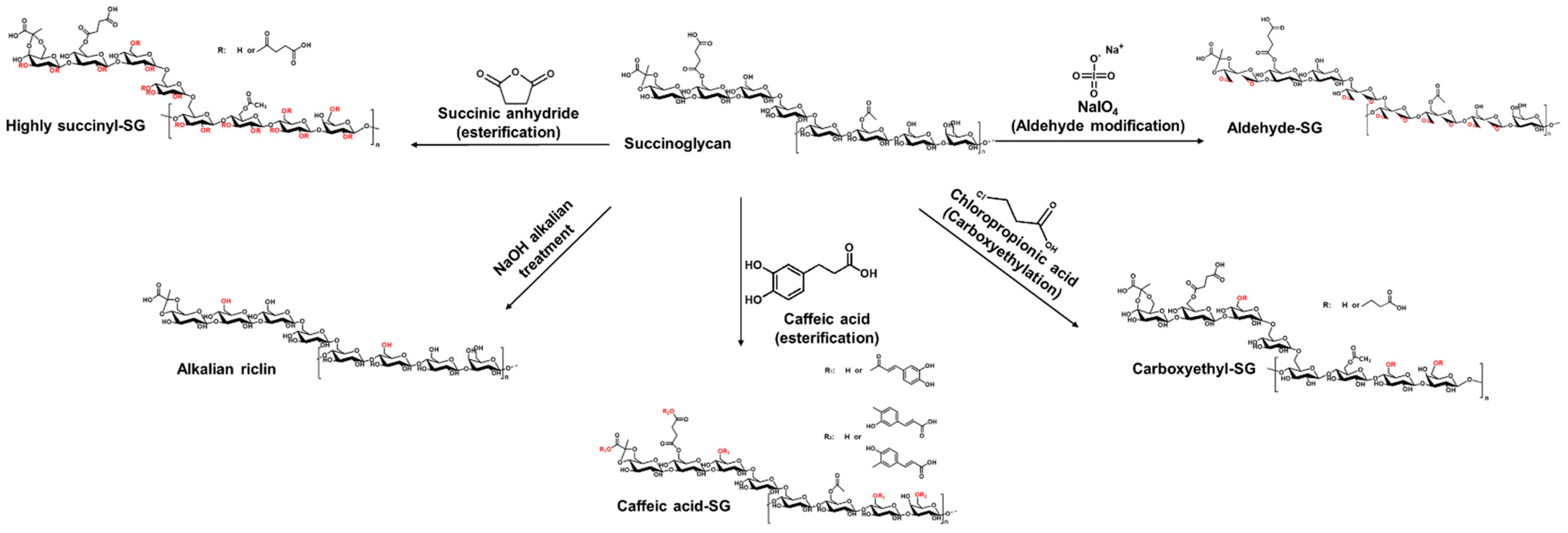
Periodate-mediated oxidation converts vicinal diol groups in polysaccharides into dialdehyde groups [147]. This reaction typically occurs at the C2–C3 diol positions of hexose units in the polysaccharide backbone, resulting in the formation of SG dialdehyde (SGDA) derivatives [148]. The aldehyde functionalities introduced by periodate oxidation enable further chemical modifications through various pathways [149,150]. In particular, SGDA can form imine bonds via Schiff base reactions with primary amine groups, or hydrazone linkages through reactions with hydrazine groups [112,148]. Several studies have demonstrated the preparation of hydrogels by crosslinking SGDA with polymers containing amine groups. These dynamic crosslinks are reversible and can be hydrolyzed under acidic conditions, allowing the formation of pH-responsive hydrogels suitable for controlled drug delivery applications. However, excessive periodate oxidation may degrade the polysaccharide backbone, reducing molecular weight and impairing mechanical properties. Therefore, optimizing oxidation duration, reagent stoichiometry, and quenching strategy is crucial to preserve polymer integrity.
Furthermore, periodate oxidation not only introduces reactive aldehyde groups but also disrupts crystalline regions and hydrogen-bonded networks within the polysaccharide matrix, often resulting in reduced viscosity and altered gelation behavior. In hydrogel systems, aldehyde incorporation can further support dual-crosslinking designs (e.g., combining hydrazone linkages with boronate ester bonds) to enhance mechanical stability and confer multi-stimuli responsiveness (pH, redox, sugar triggers). Finally, proper quenching (e.g., via ethylene glycol) and dialysis are essential to remove residual oxidant and prevent polymer fragmentation or unintended reactive oxygen species formation.

4.2. Succinylation of Succinoglycan

Among the structural features of SG, the carbonyl-containing succinyl and pyruvyl groups have been reported to enhance its physicochemical and functional properties. An increased content of succinyl groups in SG improves viscoelasticity and ionic interactions, and also enhances antioxidant activity. In a study employing DMAP-catalyzed organic modification using succinic anhydride, the introduction of succinyl groups significantly increased the material’s functional performance [110]. As the degree of succinylation increased, the viscoelasticity was enhanced up to fivefold compared to native SG, and the DPPH and hydroxyl radical scavenging activities were also markedly improved, demonstrating superior antibacterial performance. Specifically, HS-SG 50 (succinic anhydride molar ratio 1:50) exhibited a viscosity that was approximately 250% higher than native SG at a shear rate of 10 s−1, and unlike SG, which retained less than 1% of its viscosity above 60 °C, HS-SG 50 maintained about 30% of its viscosity under the same conditions. Furthermore, its thermal stability was improved, with the endothermic peak shifting from 93 °C (SG) to 151 °C (HS-SG 50). In terms of antioxidant capacity, HS-SG 50 achieved a DPPH radical scavenging activity of ~82.9% and a hydroxyl radical scavenging activity of ~78.2% at 1 mg/mL concentration, which were significantly higher than those of native SG (~67.5% and ~35%, respectively). These enhancements are attributed to the increased presence of anionic charged groups, which strengthen intramolecular interactions. Consequently, the introduction of such functional moieties broadens the applicability of polysaccharides as functional biomaterials.

4.3. Carboxyethylation of Succinoglycan

To introduce additional carboxyl groups into SG, a carboxyethylation reaction was carried out under mildly basic conditions using 3-chloropropionic acid [151]. The resulting derivative, carboxyethyl succinoglycan (CE-SG), was characterized by NMR and FT-IR spectroscopy, which confirmed the emergence of new carboxymethylene peaks, indicating successful modification. The degree of carboxyethylation was directly proportional to improvements in rheological and thermal properties. For example, at a molar ratio of SG:CPA = 1:100, the viscosity of CE-SG increased to 6.612 Pa·s at 10 s−1, which was 21.18-fold higher than that of unmodified SG (0.312 Pa·s). The storage modulus (G′) of highly substituted CE-SG (CE-SG_11) also remained above the loss modulus (G″) up to 90 °C, demonstrating enhanced gel-like elasticity even under elevated temperatures. Thermal analysis further showed that the endothermic peak shifted from 99.7 °C in SG to 127 °C in CE-SG, confirming higher thermal stability. In terms of bioactivity, CE-SG derivatives exhibited markedly enhanced antibacterial and antioxidant properties. The CE-SG_11 sample showed 90.18% inhibition against E. coli and 91.78% against S. aureus, compared to only ~76% and 74% for native SG. Antioxidant tests revealed that CE-SG_11 reached 65.85% DPPH scavenging activity and 72.34% hydroxyl radical scavenging activity at 4 mg/mL, both substantially higher than native SG (≈50–56%). These results demonstrate that the introduction of carboxyethyl groups not only strengthens intramolecular and intermolecular interactions, leading to improved viscosity and viscoelasticity, but also significantly enhances antioxidant and antibacterial activities. Thus, CE-SG derivatives represent promising candidates for biomedical hydrogels and drug delivery systems.

4.4. Phenolic Grafting of Succinoglycan

Phenolic compounds have attracted significant attention due to their diverse functionalities, particularly their antioxidant and antimicrobial properties. Naturally derived phenolics from plant sources have been investigated as eco-friendly alternatives to synthetic chemicals. These compounds can be grafted onto polysaccharide backbones to generate derivatives that retain the intrinsic bioactivity of the phenolic moieties, yielding functional biopolymers.
In recent study, caffeic acid was grafted onto SG via an EDC/DMAP-catalyzed esterification reaction, producing caffeic acid–succinoglycan (Ca-SG) [152]. The successful grafting was confirmed by NMR and FT-IR analyses, as well as by quantitative evaluation using the Folin–Ciocalteu assay. The grafting degree of caffeic acid increased in a dose-dependent manner, with the highest substitution reaching 161.13 mg Ca/g SG. Ca-SG exhibited significantly enhanced antioxidant capacity, with DPPH radical scavenging activity increasing from 34.4% (native SG) to 63.6%, and ABTS scavenging rising from 45.5% to 93.7%. Antibacterial performance was also markedly improved: inhibition against E. coli rose from 14.3% (SG) to 92.1% (Ca-SG), and against S. aureus from 48.0% to 99.0%, demonstrating strong bactericidal efficacy compared to native SG. Ca-SG also improved material-level properties. For instance, thermogravimetric analysis showed a ~20 °C increase in degradation onset temperature compared to SG, confirming improved thermal stability. These results demonstrate that phenolic grafting enhances bioactivity.

4.5. Alkaline Treatment of Succinoglycan for Riclin Formation

When polysaccharides are exposed to highly alkaline environments, β-1,3 and β-1,4 glycosidic linkages are partially hydrolyzed, leading to depolymerization and the removal of labile substituents such as succinyl and acetyl groups. This deacylation and purification process yields a refined form of SG known as riclin.
Alkaline-treated riclin has been reported to exhibit potent biological activities, including inhibition of tumor growth without significant cytotoxicity and notable anti-inflammatory effects, highlighting its potential as a natural biopolymer with therapeutic applications [153]. In murine xenograft models, riclin treatment reduced tumor volume by approximately 45–60% compared to untreated controls, while maintaining high cell viability in normal tissues [133]. Furthermore, riclin significantly downregulated inflammatory cytokines such as TNF-α, IL-1β, and IL-6, with reductions in serum IL-6 levels exceeding 70% relative to LPS-stimulated groups. In addition, riclin demonstrated strong antibacterial effects against Listeria monocytogenes, enhancing clearance rates in macrophage infection models by nearly 2-fold at 400 μg/mL treatment. This protective activity was mechanistically linked to activation of the MAPK/IL-6 signaling pathway, which upregulated IL-6 expression by more than 700-fold at the transcriptional level and increased secreted IL-6 protein concentrations to ~1.6 ng/mL compared to ~60 pg/mL in untreated infected controls. These findings suggest that therapeutic efficacy of riclin derives from its dual ability to suppress excessive inflammation while boosting host defense responses. Alkaline treatment generates riclin with improved bioactivity, including anti-tumor, anti-inflammatory, and antibacterial effects, making it a promising candidate for biomedical applications such as cancer therapy, infection control, and tissue regeneration. Figure 4 and Table 3 present a summary of the structural modifications of the SG derivatives resulting from the respective reactions, along with the relevant research information.

5. Succinoglycan-Based Multifunctional Films and Hydrogels

Applications of polysaccharide-based materials as platforms include hydrogels [157], and films [158]. SG (SG) has also been explored for integration into these types of applications. Various studies on SG-based polymeric structures are summarized in Table 4.

5.1. Succinoglycan-Based Films

In recent years, extensive research efforts have focused on developing polysaccharide-based films as sustainable alternatives to conventionally used synthetic polymer films. Through the utilization of natural polysaccharides and their chemically modified derivatives, various functional films have been fabricated exhibiting biodegradability, environmental sustainability, antioxidant activity, and antibacterial properties. Among these, anionic polysaccharides such as SG have attracted particular interest as polymeric building blocks for film formation. Representative studies on SG-derived polymeric films and related anionic polysaccharide systems are summarized below.
To verify the potential application as a film, a biodegradable and eco-friendly packaging material was produced using polysaccharides extracted from FucoPol, derived from Enterobacter A47. This demonstrated the potential of the FucoPol as an environmentally friendly packaging. Furthermore, by applying inorganic coatings through plasma deposition, liquid flame spray (LFS), and atomic layer deposition (ALD) on FucoPol films, the permeability to water and oxygen was effectively reduced, while achieving stable hydrophilic and hydrophobic surfaces. This demonstrates the potential for developing eco-friendly food packaging materials [169].
Additionally, there are reports of successful fabrication of bilayer films by utilizing the succinyl groups and anionic functional groups in FucoPol, along with electrostatic interactions with cationic polysaccharides such as chitosan. The resulting bilayer film exhibited strong mechanical strength, high swelling capacity, and low oxygen and water vapor permeability, demonstrating its potential for use as a hydrophobic/hydrophilic/hydrophobic barrier material [170]. A comparative study with conventional non-biodegradable packaging materials showed that, even under accelerated storage conditions, the oxidation levels and quality of walnut oil remained well-preserved, with sensory evaluations revealing no significant differences. These results support the potential of FucoPol/chitosan bilayer films as eco-friendly packaging solutions suitable for food preservation [171]. In addition to FucoPol, there have been recent attempts to develop films based on SG (SG) extracted from Agrobacterium and S. meliloti, which have been reported to possess a range of functional properties. A biodegradable, eco-friendly film was fabricated by blending the environmentally friendly polymers polyvinyl alcohol (PVA) and SG. The PVA/SG-based film demonstrated excellent UV-blocking capability, high tensile strength, and significant moisture transport properties, highlighting strong intermolecular interactions. These features suggested its application as an industrial packaging industry [159].
Additionally, by incorporating anthocyanins into the PVA/SG-based film, a pH-responsive food freshness monitoring film was developed. This film demonstrated antioxidant activity, strong water resistance, durability, and the ability to detect extended freshness. The anthocyanins quickly respond to pH changes, visibly altering color to provide real-time indicators of food freshness, highlighting its potential as a smart packaging material for quality monitoring [160]. A study reported the development of a film by chemically modifying SG with natural caffeic acid (Ca) to impart antibacterial and antioxidant properties to the polysaccharide. This modified SG was then blended with polyvinyl alcohol (PVA) to produce the film. The resulting composite exhibited various functionalities, including high thermal stability, antibacterial and antioxidant effects, and UV blocking. Additionally, it demonstrated biodegradability and reusability, proved to be effective for blueberry preservation, and showed promising potential as an environmentally friendly packaging material [152].

5.2. Succinoglycan-Based Hydrogels

Polysaccharide-based hydrogel structures have attracted increasing attention as next-generation biomaterial platforms due to their superior biocompatibility, functionality, and biodegradability compared to conventional chemically synthesized polymeric materials [172,173]. For example, alginate forms physically robust hydrogels through metal-ion chelation, while cellulose and chitosan derivatives modified to improve solubility have been widely employed to construct functional hydrogel networks [174,175].
Chitosan-based hydrogels exhibit intrinsic antibacterial properties owing to their cationic nature, whereas gellan gum enables gelation through its characteristic three-dimensional entanglement behavior [176]. By leveraging their inherent chemical functionalities, various polysaccharides have been successfully utilized to form 3D hydrogel platforms with diverse structural and functional characteristics.
Similarly, SG has been explored as a promising candidate for hydrogel formation through multiple crosslinking strategies. Like alginate, SG exhibits metal-chelating capability, forming stable hydrogels via coordination with metal ions such as Fe3+ and Cr3+ [122,161]. These SG–metal hydrogels demonstrated pH- and redox-responsive controlled release of Congo red in ascorbic acid and sodium lactate environments. Additionally, composite hydrogels composed of SG and agarose were developed, where the gelation ratio was optimized to achieve enhanced swelling capacity and pH responsiveness [37]. SG has also been successfully incorporated with chitosan and poly(N-isopropylacrylamide) (pNIPAM) to produce hydrogels exhibiting antibacterial and thermoresponsive properties while maintaining structural integrity after crosslinking [177].
To further introduce multifunctionality, chemically modified SG derivatives have been developed for advanced hydrogel systems. Periodate-oxidized succinoglycan dialdehyde (SGDA) contains aldehyde groups capable of reacting with amine-containing components through Schiff base reactions, forming imine bonds [164]. The resulting SGDA hydrogels exhibit pH responsiveness and self-healing properties, and when combined with amine-rich components, they demonstrate antibacterial functionality. Such imine bond–based SGDA hydrogels show strong potential for biomedical and tissue-engineering applications.
Furthermore, carboxyethylated succinoglycan (CE-SG) derivatives have been synthesized to enhance anionic charge density, leading to improved antioxidant and antibacterial performance [151]. CE-SG retains the ability to form hydrogels through Fe3+ chelation, producing hydrogels with superior mechanical strength compared to native SG. This improvement is attributed to the strengthened electronic interactions between Fe3+ ions and the carboxyethyl groups of CE-SG, highlighting its promise as a robust and functional biomaterial platform.

6. Challenges and Future Perspectives

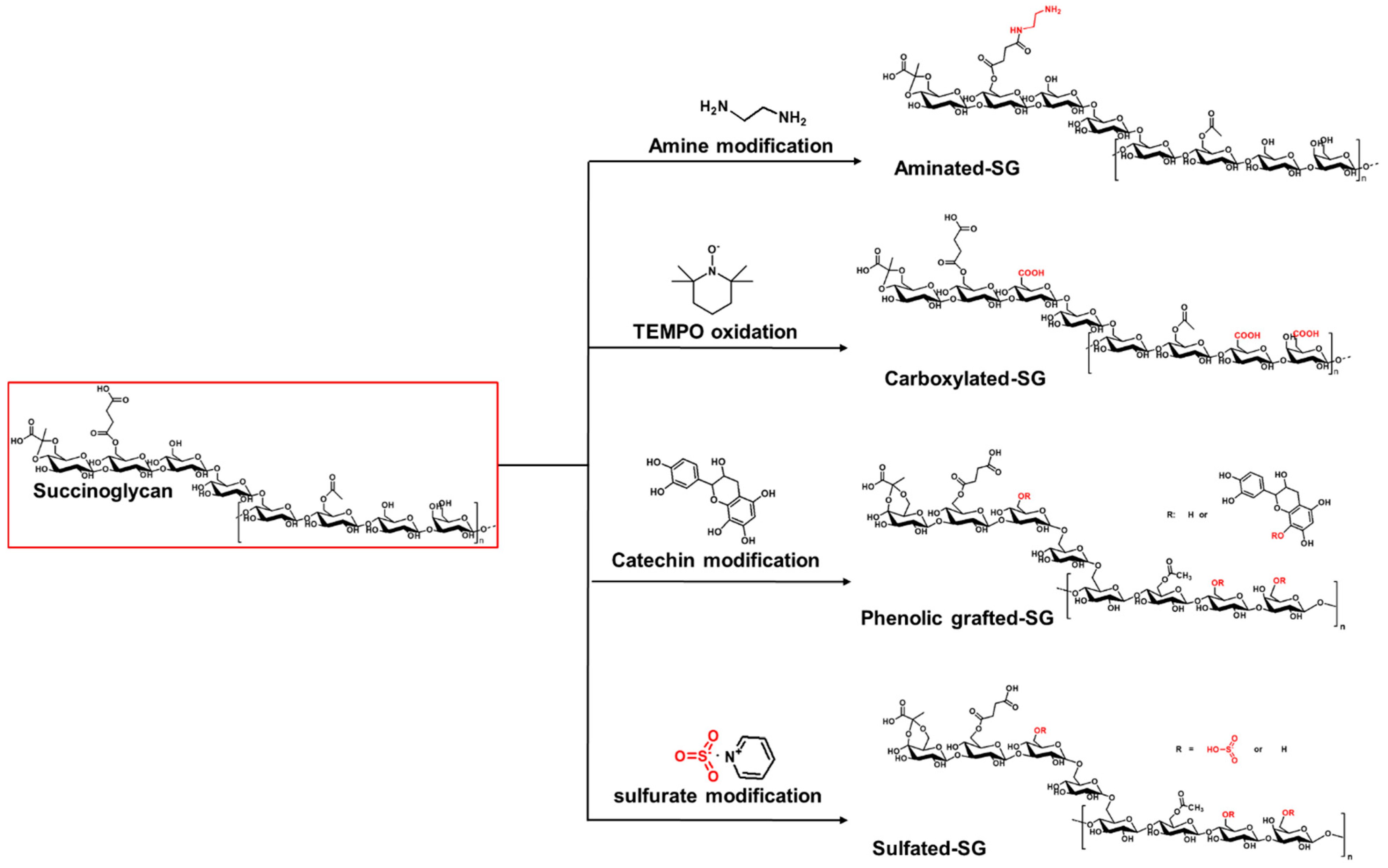
Expanding the functionality and versatility of SG for polymeric applications requires further exploration of diverse chemical modification strategies and polymer formation techniques. The field of polymer materials is rapidly evolving, proposing new forms and uses while industrial research increasingly targets commercial scalability. Accordingly, researchers can explore several directions to enhance the applicability of SG and develop novel functional architectures. Figure 5 presents a schematic overview of various SG derivatives that can be discussed.

6.1. Amination of Succinoglycan

Naturally occurring cationic polysaccharides are rare; however, introducing cationic functional groups provides significant chemical and biological advantages. Polysaccharides bearing primary amine groups, such as chitosan, serve as well-known examples. Their amine groups can readily participate in Schiff base reactions with aldehyde-functionalized polysaccharides or in amide bond formation with carboxyl-containing polysaccharides through EDC/NHS coupling, resulting in stable crosslinked polymeric networks [178].
Beyond their versatile reactivity, cationic polysaccharides also exhibit intrinsic antibacterial activity. The protonated amine groups strongly interact with negatively charged bacterial membranes, causing disruption of membrane integrity and leakage of intracellular contents, which in turn leads to bacterial cell death [179]. For instance, aminated dextran has demonstrated a nearly 2.5-fold increase in antibacterial activity against E. coli compared to its unmodified form, attributed to the introduction of protonated amine groups that disrupt bacterial membranes. Similarly, aminated cellulose nanofibers exhibited an approximately 40% improvement in tensile strength and a 35% increase in water absorption capacity, demonstrating how cationic substitution can simultaneously reinforce mechanical robustness and enhance hydrophilicity. In the case of aminated chitosan derivatives, studies report up to a 60% higher inhibition rate of S. aureus compared to native chitosan, highlighting the enhanced bactericidal efficiency from cationic modification. When integrated into hydrogel or polymeric composites, these cationic functionalities can provide both structural reinforcement and inherent antimicrobial properties, making them highly attractive for biomedical applications.
Additionally, the introduction of primary amine groups increases the charge density of polysaccharide chains, thereby enhancing electrostatic interactions and intermolecular associations. This structural modification leads to improved viscoelasticity, elasticity recovery, and mechanical robustness of the polymeric system [180]. The balance between enhanced bioactivity and strengthened mechanical properties positions aminated SG as a highly promising platform for multifunctional biomaterials, with potential applications in hydrogels, wound dressings, tissue engineering scaffolds, and controlled drug delivery systems.

6.2. TEMPO Oxidation of Succinoglycan

2,2,6,6-Tetramethylpiperidine 1-oxyl(TEMPO)-mediated oxidation enables selective conversion of primary alcohol groups into aldehyde or carboxyl groups, providing reactive sites for further chemical modification [181,182]. Conventional oxidation methods, such as periodate oxidation, typically target the C2–C3 diol of the sugar backbone, often leading to cleavage of the glycosidic chain, reduced molecular weight, and loss of intrinsic polysaccharide properties.
In contrast, TEMPO oxidation proceeds under mild and regioselective conditions, minimizing backbone degradation while improving solubility and reactivity. This approach has been successfully applied to other polysaccharides, including cellulose and curdlan, where FTIR and NMR analyses confirmed the introduction of carboxyl functionalities and improved reactivity for polymer formation. For example, TEMPO-oxidized cellulose typically exhibits a carboxylate content of ~0.7–1.1 mmol g−1, accompanied by a marked increase in water retention values from ~60% to nearly 280%, demonstrating significantly enhanced hydrophilicity and processability [182]. In solid-state 13C NMR spectra, the C6 –CH2OH signal around 64 ppm decreases or disappears, while a new carboxylate carbon resonance emerges at ~175 ppm, confirming selective oxidation at the primary hydroxyl groups. Similarly, in TEMPO-oxidized curdlan, over 90% of C6 primary hydroxyls can be converted to carboxylates, with solubility achieved once ~60% substitution is reached [183]. FTIR measurements further support these changes, showing the appearance of COO stretching vibrations at 1600–1650 cm−1 and attenuation of the C–O–H band near 3300 cm−1. However, excessive oxidation can induce substantial depolymerization, with the weight-average degree of polymerization of curdlan decreasing under high NaClO loading. These examples highlight the importance of tuning TEMPO reaction conditions to balance functionality and backbone integrity.
In the case of SG, whose structural substituents are sensitive to alkaline environments, employing acidic or near-neutral TEMPO oxidation systems could therefore provide controlled introduction of reactive carboxyl groups without compromising molecular integrity. To prevent chain scission or loss of substituents, acidic or near-neutral TEMPO oxidation systems could be explored to achieve controlled modification without compromising molecular integrity [184,185].

6.3. Sulfation of Succinoglycan

Modification of polysaccharides with sulfate groups enhances their anionic charge density and capacity for hydrogen-bond network formation, which in turn influences both structure and biological functionality. Sulfated polysaccharides have been widely reported to exhibit anti-inflammatory and anticoagulant activities, making them promising platforms for blood-contacting biomedical materials. For example, a sulfated cellulose derivative with a degree of substitution of approximately 1.0 exhibited an activated partial thromboplastin time (APTT) prolongation nearly fourfold compared to its unmodified counterpart, demonstrating a markedly enhanced anticoagulant potential [186,187]. In another case, sulfation of a fucoidan polysaccharide increased its sulfate/sugar ratio from 1.28 to 1.98, yielding up to 140% of the anticoagulant activity of heparin as measured by thrombin time (TT) assays [188]. Additionally, a recent study demonstrated that after sulfation the antioxidant capacity of a polysaccharide improved by more than 60%, along with enhanced anti-inflammatory cytokine modulation [189].
These studies suggest that sulfation of the succinyl/acetyl-modified backbone could similarly enhance its functional profile. By introducing sulfate esters into the backbone of SG, one can anticipate improved anticoagulant performance (e.g., prolongation of clotting times), greater anti-inflammatory activity (e.g., reduction of IL-6/TNF-α levels by >50%), as well as enhanced mechanical and hydration features due to stronger electrostatic repulsion and hydrogen-bonding networks. Such multifunctional enhancements would further advance using of SG as a biomaterial in hemostatic dressings, vascular graft coatings, blood-filtering membranes, and other biomedical polymer matrices.

6.4. Phenolic Radical Grafting of Succinoglycan

Incorporation of phenolic functional groups offers another promising route to diversify SG functionality. Phenolic compounds such as catechin, dopamine, tannic acid, and phenylboronic acid have been grafted onto polysaccharide backbones to impart antioxidant, antibacterial, and adhesive properties. These phenolic derivatives are typically introduced through reactions conducted in organic solvents; however, limited solubility of SG in organic solvent often restricts the degree of substitution.
To overcome this, aqueous radical grafting reactions have been proposed as more efficient alternatives. Recent studies demonstrated successful incorporation of catechin and EGCG (epigallocatechin gallate) onto polysaccharide chains through radical-mediated reactions in water, yielding derivatives with enhanced substitution ratios and functional performance. For example, catechin-grafted Tremella fuciformis polysaccharide (catechin-g-TPS) achieved a noticeable new FTIR absorption band in the 1300–1600 cm−1 region and 1H NMR signals at δ ≈ 6.00 and 6.80 ppm, consistent with catechin attachment; the antioxidant (DPPH) radical-scavenging activity improved substantially compared to unmodified TPS [190]. In another study, radical grafting of polyphenols onto alginate/inulin via an ascorbic acid/H2O2 redox pair resulted in polysaccharide conjugates whose reducing power rose by approximately 40–60% compared to the parent polymer [191].
Such phenolic radical grafted SG derivatives could thus serve as versatile polymeric platforms with improved antioxidant activity, adhesion strength, and biocompatibility, expanding their applicability across biomedical and material science domains.

6.5. Succinoglycan-Based Adhesive Materials

Adhesiveness of polymeric materials has emerged as a highly valued property in biomedical and tissue-engineering applications. Adhesive polymers enable therapeutic platforms to rapidly seal wound sites, providing a physical barrier that prevents infection and promotes healing. Moreover, when polymeric structures possess additional properties such as antibacterial activity, biocompatibility, and cell-regenerative capacity, they demonstrate significant potential as next-generation biomedical materials.
This characteristic has garnered substantial interest in the development of polysaccharide-based adhesive systems, where efforts are directed toward designing derivatives or crosslinked polymeric networks that exhibit strong adhesion under physiological conditions. Incorporating catechol-containing molecules, such as dopamine, into polysaccharide backbones has been shown to effectively mimic natural bio-adhesion mechanisms. For example, in one study an injectable dopamine-polysaccharide hydrogel achieved a lap-shear adhesion strength of ≈345 kPa, which was about 43-times greater than that of fibrin glue, driven by dopamine-metal coordination and catechol–tissue interactions [192]. If SG modified with dopamine or other catecholic compounds demonstrates similarly robust adhesion in skin and wet environments, it could serve as a promising platform material for advanced biomedical and wound-healing applications.

6.6. Bioplastic Applications of Succinoglycan

As environmental concerns and regulatory pressures increase, the development of bioplastics derived from renewable biomass has gathered significant momentum. Bioplastics, polymeric materials sourced from natural, renewable feedstocks, offer the potential to replace petroleum based plastics, particularly in packaging, agricultural films, and certain biomedical devices. For example, the review by Abdullah et al. discusses how polysaccharide- and protein-based films are being engineered to improve mechanical, barrier, optical, and bioactive properties in advanced packaging applications [193].
In this context, SG has emerged as a promising candidate for bioplastic applications. With SG and poly(vinyl alcohol) (PVA), biocomposite films were prepared via solvent casting [159]. The PVA/SG films exhibited excellent transparency, UV-blocking ability (up to ~80% transmittance reduction at increasing SG content), and rapid biodegradation (highest SG content films degraded fastest within 5 days) when tested under soil burial conditions.
Such findings emphasize that SG-based films are able to combine structural functionality, such as film-forming capacity and mechanical integrity, with environmental sustainability, including biodegradability and renewable sourcing [152]. The anionic backbone of SG, together with its strong viscoelasticity, shear-thinning behavior, and tunable substituent composition, enables it to function both as a film matrix and as a functional filler in composite formulations. Its integration into bioplastic systems provides improvements in film mechanics and processability, enhanced UV shielding and moisture control, and compatibility with other polymers such as PVA, while also offering opportunities to introduce additional bioactivities through chemical modifications.
In terms of environmental sustainability, SG-based bioplastics offer clear advantages over conventional petroleum-derived polymers. Unlike synthetic plastics that persist for decades in the environment, SG exhibits rapid biodegradability under natural soil and composting conditions, ensuring minimal ecological footprint after disposal [159]. As an anionic polysaccharide with high film-forming ability, SG shows strong potential to replace traditional polyethylene or polypropylene films used in agricultural mulching and food packaging. SG-based films can degrade naturally after crop cultivation or product use, thereby preventing microplastic accumulation in soil and aquatic ecosystems. Their inherent oxygen barrier and moisture regulation properties further support application in eco-friendly packaging systems. Collectively, these attributes position SG as a promising candidate for developing next-generation sustainable polymers that align with global initiatives toward carbon neutrality.
Looking ahead, SG shows strong potential for application in bioplastics not only in packaging but also in disposable medical devices, agricultural mulch films, and compostable single-use products. Its tunable molecular structure and scalable production through bacterial fermentation further support its development as a versatile biopolymer for next-generation sustainable plastics.

6.7. Potential Regulatory and Huddle of Succinoglycan for Application

While succinoglycan (SG) shows strong potential as a next-generation sustainable polymer, its translation from laboratory research to large-scale industrial use faces several regulatory and commercialization challenges [194]. Comprehensive safety evaluation, including cytocompatibility, long-term degradation behavior, and environmental impact, remains necessary before SG-based materials can be certified for biomedical or food-contact applications [195].
On the commercialization side, consistent large-scale fermentation and downstream purification represent major hurdles. Batch-to-batch variations in molecular weight and substituent composition can affect product quality and reproducibility, complicating industrial standardization [102]. Additionally, the cost of fermentation substrates, purification, and drying still exceeds that of conventional petroleum-based polymers, reducing short-term competitiveness in packaging and film markets [196]. Nevertheless, recent progress in bioprocess optimization, genetic engineering, and green chemical modification strategies is expected to lower production costs and improve product uniformity.

7. Conclusions

Succinoglycan (SG) represents a distinctive class of bacterial exopolysaccharides with exceptional structural versatility and tunable physicochemical properties, positioning it as a promising candidate for next-generation biomaterials. Through advances in biosynthetic regulation, chemical modification, and composite formation, SG has evolved from a naturally occurring bio-thickener into a multifunctional polymeric platform capable of forming films, hydrogels, and smart, stimuli-responsive materials with tailored functionalities.
Recent progress in oxidation, amination, and phenolic grafting techniques has ena-bled precise control over its reactivity, mechanical strength, and biological activity. These engineered derivatives exhibit enhanced antioxidant, antibacterial, and adhesive perfor-mances, broadening their potential applications in biomedical, environmental, and packaging fields. Furthermore, the development of SG-based hydrogels with self-healing, injectable, and multi-stimuli-responsive behaviors highlights its adaptability for tissue engineering and drug-delivery systems.
Despite these advances, several challenges remain. Scalable and cost-effective production of high-purity SG, consistent control over molecular weight distribution, and comprehensive in vivo biocompatibility assessments are critical for successful industrial translation. Moreover, interdisciplinary strategies integrating synthetic biology, polymer chemistry, and materials engineering are expected to facilitate the design of novel SG architectures with superior performance and sustainability.
In conclusion, the structural complexity and functional tunability of SG make it a versatile and compelling biomaterial platform. Continued exploration of its derivatives and applications will likely accelerate its integration into future biomedical and biotechnological innovations, bridging natural polysaccharide chemistry with advanced materials science.

Author Contributions

S.J. designed, supervised, and edited the paper. K.K. and performed analysis on polysaccharide and application wrote the initial paper; J.-p.J. performed paper analysis on the application for film. All authors have read and agreed to the published version of the manuscript.

Funding

This work was supported by the National Research Foundation of Korea (NRF) grants funded by the Korea government (RS-2024-00355944) SDG.

Institutional Review Board Statement

Not applicable.

Data Availability Statement

No new data were created or analyzed in this study. Data sharing is not applicable to this article.

Conflicts of Interest

The authors declare no conflict of interest.

References

  1. Levin, M.; Tang, Y.; Eisenbach, C.D.; Valentine, M.T.; Cohen, N. Understanding the response of poly (ethylene glycol) diacrylate (PEGDA) hydrogel networks: A statistical mechanics-based framework. Macromolecules 2024, 57, 7074–7086. [Google Scholar] [CrossRef]
  2. Hebeish, A.; Farag, S.; Sharaf, S.; Shaheen, T.I. Thermal responsive hydrogels based on semi interpenetrating network of poly (NIPAm) and cellulose nanowhiskers. Carbohydr. Polym. 2014, 102, 159–166. [Google Scholar] [CrossRef]
  3. Souza, R.D.; Lopes, E.R.; Ramos, E.M.; de Oliveira, T.V.; de Oliveira, C.P. Active packaging: Development and characterization of polyvinyl alcohol (PVA) and nitrite film for pork preservation. Food Chem. 2024, 437, 137811. [Google Scholar] [CrossRef] [PubMed]
  4. Yang, L.; Li, X.; Wu, Y.; Du, P.; Sun, L.; Yu, Z.; Song, S.; Yin, J.; Ma, X.; Jing, C. Preparation of PU/fibrin vascular scaffold with good biomechanical properties and evaluation of its performance in vitro and in vivo. Int. J. Nanomed. 2020, 15, 8697–8715. [Google Scholar] [CrossRef]
  5. Narayanan, L.K.; Huebner, P.; Fisher, M.B.; Spang, J.T.; Starly, B.; Shirwaiker, R.A. 3D-bioprinting of polylactic acid (PLA) nanofiber–alginate hydrogel bioink containing human adipose-derived stem cells. ACS Biomater. Sci. Eng. 2016, 2, 1732–1742. [Google Scholar] [CrossRef] [PubMed]
  6. Datta, J.; Kasprzyk, P. Thermoplastic polyurethanes derived from petrochemical or renewable resources: A comprehensive review. Polym. Eng. Sci. 2018, 58, E14–E35. [Google Scholar] [CrossRef]
  7. Delidovich, I.; Hausoul, P.J.; Deng, L.; Pfützenreuter, R.; Rose, M.; Palkovits, R. Alternative monomers based on lignocellulose and their use for polymer production. Chem. Rev. 2016, 116, 1540–1599. [Google Scholar] [CrossRef]
  8. Satchanska, G.; Davidova, S.; Petrov, P.D. Natural and synthetic polymers for biomedical and environmental applications. Polymers 2024, 16, 1159. [Google Scholar] [CrossRef]
  9. Samir, A.; Ashour, F.H.; Hakim, A.A.; Bassyouni, M. Recent advances in biodegradable polymers for sustainable applications. npj Mater. Degrad. 2022, 6, 68. [Google Scholar] [CrossRef]
  10. Zhang, H.; Li, Y.; Fu, Y.; Jiao, H.; Wang, X.; Wang, Q.; Zhou, M.; Yong, Y.-C.; Liu, J. A structure-functionality insight into the bioactivity of microbial polysaccharides toward biomedical applications: A review. Carbohydr. Polym. 2024, 335, 122078. [Google Scholar] [CrossRef]
  11. Abdullaev, S.S.; Althomali, R.H.; Abdu Musad Saleh, E.; Robertovich, M.R.; Sapaev, I.; Romero-Parra, R.M.; Alsaab, H.O.; Gatea, M.A.; Fenjan, M.N. Synthesis of novel antibacterial and biocompatible polymer nanocomposite based on polysaccharide gum hydrogels. Sci. Rep. 2023, 13, 16800. [Google Scholar] [CrossRef] [PubMed]
  12. Gurunathan, M.K.; Navasingh, R.J.H.; Selvam, J.D.R.; Čep, R. Development and characterization of starch bioplastics as a sustainable alternative for packaging. Sci. Rep. 2025, 15, 15264. [Google Scholar] [CrossRef] [PubMed]
  13. Marichelvam, M.; Kanadakodeeeswaran, K.; Dheenesh, D.; Easwarapandiyan, S.; Lokeshkumar, B. Developing eco-friendly bio-plastics from natural sources for sustainable packaging. Sustain. Chem. Pharm. 2025, 46, 102105. [Google Scholar] [CrossRef]
  14. Dong, X.; Cheng, Q.; Long, Y.; Xu, C.; Fang, H.; Chen, Y.; Dai, H. A chitosan based scaffold with enhanced mechanical and biocompatible performance for biomedical applications. Polym. Degrad. Stab. 2020, 181, 109322. [Google Scholar] [CrossRef]
  15. Mendis, H.C.; Madzima, T.F.; Queiroux, C.; Jones, K.M. Function of succinoglycan polysaccharide in Sinorhizobium meliloti host plant invasion depends on succinylation, not molecular weight. mBio 2016, 7, e00606-16. [Google Scholar] [CrossRef]
  16. Junges, R.; Salvadori, G.; Shekhar, S.; Åmdal, H.A.; Periselneris, J.N.; Chen, T.; Brown, J.S.; Petersen, F.C. A quorum-sensing system that regulates Streptococcus pneumoniae biofilm formation and surface polysaccharide production. mSphere 2017, 2, e00324-17. [Google Scholar] [CrossRef]
  17. Yodsanga, S.; Poeaim, S.; Chantarangsu, S.; Swasdison, S. Investigation of Biodegradation and Biocompatibility of Chitosan–Bacterial Cellulose Composite Scaffold for Bone Tissue Engineering Applications. Cells 2025, 14, 723. [Google Scholar] [CrossRef] [PubMed]
  18. Dong, M.; Mastroianni, G.; Bilotti, E.; Zhang, H.; Papageorgiou, D.G. Biodegradable starch-based nanocomposite films with exceptional water and oxygen barrier properties. ACS Sustain. Chem. Eng. 2024, 12, 11056–11066. [Google Scholar] [CrossRef]
  19. Kaewkumsan, P.; Gavahian, M.; Tseng, W.-T.; Guo, J.-H. Structural and immunomodulatory properties of bioactive polysaccharide from solid-state fermented brown rice with Antrodia cinnamomea mycelia. Qual. Assur. Saf. Crops Foods 2025, 17, 237–258. [Google Scholar] [CrossRef]
  20. Casillo, A.; Fabozzi, A.; Russo Krauss, I.; Parrilli, E.; Biggs, C.I.; Gibson, M.I.; Lanzetta, R.; Appavou, M.-S.; Radulescu, A.; Tutino, M.L. Physicochemical approach to understanding the structure, conformation, and activity of mannan polysaccharides. Biomacromolecules 2021, 22, 1445–1457. [Google Scholar] [CrossRef]
  21. Berglund, J.; Azhar, S.; Lawoko, M.; Lindström, M.; Vilaplana, F.; Wohlert, J.; Henriksson, G. The structure of galactoglucomannan impacts the degradation under alkaline conditions. Cellulose 2019, 26, 2155–2175. [Google Scholar] [CrossRef]
  22. Zeng, K.; Xu, D.; Gong, S.; Lu, Y.-T.; Vana, P.; Groth, T.; Zhang, K. Thermoresponsive hydrogels with sulfated polysaccharide-derived copolymers: The effect of carbohydrate backbones on the responsive and mechanical properties. Cellulose 2023, 30, 8355–8368. [Google Scholar] [CrossRef]
  23. Duan, H.; Donovan, M.; Foucher, A.; Schultze, X.; Lecommandoux, S. Multivalent and multifunctional polysaccharide-based particles for controlled receptor recognition. Sci. Rep. 2018, 8, 14730. [Google Scholar] [CrossRef]
  24. Coelhoso, I. Polysaccharide Films/Membranes for Food and Industrial Applications. Polysaccharides 2025, 6, 48. [Google Scholar] [CrossRef]
  25. Rodrigues, S.; Cardoso, L.; Da Costa, A.M.R.; Grenha, A. Biocompatibility and stability of polysaccharide polyelectrolyte complexes aimed at respiratory delivery. Materials 2015, 8, 5647–5670. [Google Scholar] [CrossRef]
  26. Gossla, E.; Tonndorf, R.; Bernhardt, A.; Kirsten, M.; Hund, R.-D.; Aibibu, D.; Cherif, C.; Gelinsky, M. Electrostatic flocking of chitosan fibres leads to highly porous, elastic and fully biodegradable anisotropic scaffolds. Acta Biomater. 2016, 44, 267–276. [Google Scholar] [CrossRef]
  27. Teixeira-Costa, B.E.; Andrade, C.T. Natural polymers used in edible food packaging—History, function and application trends as a sustainable alternative to synthetic plastic. Polysaccharides 2021, 3, 32–58. [Google Scholar] [CrossRef]
  28. Ding, Z.; Chang, X.; Fu, X.; Kong, H.; Yu, Y.; Xu, H.; Shan, Y.; Ding, S. Fabrication and characterization of pullulan-based composite films incorporated with bacterial cellulose and ferulic acid. Int. J. Biol. Macromol. 2022, 219, 121–137. [Google Scholar] [CrossRef]
  29. Simões, A.; Ramos, A.; Domingues, F.; Luís, Â. Pullulan-Tween 40 emulsified films containing geraniol: Production and characterization as potential food packaging materials. Eur. Food Res. Technol. 2024, 250, 1721–1732. [Google Scholar] [CrossRef]
  30. Cheng, H.-P.; Walker, G.C. Succinoglycan is required for initiation and elongation of infection threads during nodulation of alfalfa by Rhizobium meliloti. J. Bacteriol. 1998, 180, 5183–5191. [Google Scholar] [CrossRef] [PubMed]
  31. Reuber, T.L.; Walker, G.C. Biosynthesis of succinoglycan, a symbiotically important exopolysaccharide of Rhizobium meliloti. Cell 1993, 74, 269–280. [Google Scholar] [CrossRef]
  32. Simsek, S.; Wood, K.; Reuhs, B.L. Structural analysis of succinoglycan oligosaccharides from Sinorhizobium meliloti strains with different host compatibility phenotypes. J. Bacteriol. 2013, 195, 2032–2038. [Google Scholar] [CrossRef] [PubMed]
  33. Jones, K.M. Increased production of the exopolysaccharide succinoglycan enhances Sinorhizobium meliloti 1021 symbiosis with the host plant Medicago truncatula. J. Bacteriol. 2012, 194, 4322–4331. [Google Scholar] [CrossRef] [PubMed]
  34. Wang, L.-X.; Wang, Y.; Pellock, B.; Walker, G.C. Structural characterization of the symbiotically important low-molecular-weight succinoglycan of Sinorhizobium meliloti. J. Bacteriol. 1999, 181, 6788–6796. [Google Scholar] [CrossRef] [PubMed]
  35. Evans, L.R.; Linker, A.; Impallomeni, G. Structure of succinoglycan from an infectious strain of Agrobacterium radiobacter. Int. J. Biol. Macromol. 2000, 27, 319–326. [Google Scholar] [CrossRef]
  36. Halder, U.; Banerjee, A.; Bandopadhyay, R. Structural and functional properties, biosynthesis, and patenting trends of bacterial succinoglycan: A review. Indian J. Microbiol. 2017, 57, 278–284. [Google Scholar] [CrossRef]
  37. Hu, Y.; Kim, Y.; Hong, I.; Kim, M.; Jung, S. Fabrication of flexible pH-responsive agarose/succinoglycan hydrogels for controlled drug release. Polymers 2021, 13, 2049. [Google Scholar] [CrossRef]
  38. Lu, W.; Wang, X.; Kong, C.; Chen, S.; Hu, C.; Zhang, J. Hydrogel based on riclin cross-linked with polyethylene glycol diglycidyl ether as a soft filler for tissue engineering. Biomacromolecules 2024, 25, 1119–1132. [Google Scholar] [CrossRef]
  39. Jabeen, N.; Atif, M. Polysaccharides based biopolymers for biomedical applications: A review. Polym. Adv. Technol. 2024, 35, e6203. [Google Scholar] [CrossRef]
  40. Yermagambetova, A.; Tazhibayeva, S.; Takhistov, P.; Tyussyupova, B.; Tapia-Hernández, J.A.; Musabekov, K. Microbial Polysaccharides as Functional Components of Packaging and Drug Delivery Applications. Polymers 2024, 16, 2854. [Google Scholar] [CrossRef]
  41. Kostag, M.; El Seoud, O.A. Sustainable biomaterials based on cellulose, chitin and chitosan composites-A review. Carbohydr. Polym. Technol. Appl. 2021, 2, 100079. [Google Scholar] [CrossRef]
  42. Chipón, J.; Ramírez, K.; Morales, J.; Díaz-Calderón, P. Rheological and thermal study about the gelatinization of different starches (potato, wheat and waxy) in blend with cellulose nanocrystals. Polymers 2022, 14, 1560. [Google Scholar] [CrossRef]
  43. Paes, S.S.; Yakimets, I.; Mitchell, J.R. Influence of gelatinization process on functional properties of cassava starch films. Food Hydrocoll. 2008, 22, 788–797. [Google Scholar] [CrossRef]
  44. Koev, T.T.; Muñoz-García, J.C.; Iuga, D.; Khimyak, Y.Z.; Warren, F.J. Structural heterogeneities in starch hydrogels. Carbohydr. Polym. 2020, 249, 116834. [Google Scholar] [CrossRef]
  45. Said, N.S.; Olawuyi, I.F.; Lee, W.Y. Pectin hydrogels: Gel-forming behaviors, mechanisms, and food applications. Gels 2023, 9, 732. [Google Scholar] [CrossRef]
  46. Szekalska, M.; Czajkowska-Kośnik, A.; Maciejewski, B.; Misztalewska-Turkowicz, I.; Wilczewska, A.Z.; Bernatoniene, J.; Winnicka, K. Mucoadhesive alginate/pectin films crosslinked by calcium carbonate as carriers of a model antifungal drug—Posaconazole. Pharmaceutics 2023, 15, 2415. [Google Scholar] [CrossRef] [PubMed]
  47. Farshidfar, N.; Iravani, S.; Varma, R.S. Alginate-based biomaterials in tissue engineering and regenerative medicine. Mar. Drugs 2023, 21, 189. [Google Scholar] [CrossRef] [PubMed]
  48. Tomić, S.L.; Babić Radić, M.M.; Vuković, J.S.; Filipović, V.V.; Nikodinovic-Runic, J.; Vukomanović, M. Alginate-based hydrogels and scaffolds for biomedical applications. Mar. Drugs 2023, 21, 177. [Google Scholar] [CrossRef] [PubMed]
  49. Bai, Q.; Zheng, C.; Chen, W.; Sun, N.; Gao, Q.; Liu, J.; Hu, F.; Pimpi, S.; Yan, X.; Zhang, Y. Current challenges and future applications of antibacterial nanomaterials and chitosan hydrogel in burn wound healing. Mater. Adv. 2022, 3, 6707–6727. [Google Scholar] [CrossRef]
  50. Thirupathi, K.; Raorane, C.J.; Ramkumar, V.; Ulagesan, S.; Santhamoorthy, M.; Raj, V.; Krishnakumar, G.S.; Phan, T.T.V.; Kim, S.-C. Update on chitosan-based hydrogels: Preparation, characterization, and its antimicrobial and antibiofilm applications. Gels 2022, 9, 35. [Google Scholar] [CrossRef]
  51. Yang, X.; Wang, B.; Peng, D.; Nie, X.; Wang, J.; Yu, C.-Y.; Wei, H. Hyaluronic acid-based injectable hydrogels for wound dressing and localized tumor therapy: A review. Adv. NanoBiomed Res. 2022, 2, 2200124. [Google Scholar] [CrossRef]
  52. Martorana, A.; Pitarresi, G.; Palumbo, F.S.; Barberi, G.; Fiorica, C.; Giammona, G. Correlating rheological properties of a gellan gum-based bioink: A study of the impact of cell density. Polymers 2022, 14, 1844. [Google Scholar] [CrossRef]
  53. Le, N.-M.N.; Le-Vinh, B.; Friedl, J.D.; Jalil, A.; Kali, G.; Bernkop-Schnürch, A. Polyaminated pullulan, a new biodegradable and cationic pullulan derivative for mucosal drug delivery. Carbohydr. Polym. 2022, 282, 119143. [Google Scholar] [CrossRef]
  54. Hussain, S.A.; Yadav, M.P.; Sharma, B.K.; Qi, P.X.; Jin, T.Z. Biodegradable food packaging films using a combination of hemicellulose and cellulose derivatives. Polymers 2024, 16, 3171. [Google Scholar] [CrossRef]
  55. Wypij, M.; Rai, M.; Zemljič, L.F.; Bračič, M.; Hribernik, S.; Golińska, P. Pullulan-based films impregnated with silver nanoparticles from the Fusarium culmorum strain JTW1 for potential applications in the food industry and medicine. Front. Bioeng. Biotechnol. 2023, 11, 1241739. [Google Scholar] [CrossRef]
  56. Simsek, S.; Mert, B.; Campanella, O.H.; Reuhs, B. Chemical and rheological properties of bacterial succinoglycan with distinct structural characteristics. Carbohydr. Polym. 2009, 76, 320–324. [Google Scholar] [CrossRef]
  57. Andhare, P.; Delattre, C.; Pierre, G.; Michaud, P.; Pathak, H. Characterization and rheological behaviour analysis of the succinoglycan produced by Rhizobium radiobacter strain CAS from curd sample. Food Hydrocoll. 2017, 64, 1–8. [Google Scholar] [CrossRef]
  58. Stredansky, M.; Conti, E.; Bertocchi, C.; Matulova, M.; Zanetti, F. Succinoglycan production by Agrobacterium tumefaciens. J. Ferment. Bioeng. 1998, 85, 398–403. [Google Scholar] [CrossRef]
  59. Glucksmann, M.; Reuber, T.; Walker, G. Genes needed for the modification, polymerization, export, and processing of succinoglycan by Rhizobium meliloti: A model for succinoglycan biosynthesis. J. Bacteriol. 1993, 175, 7045–7055. [Google Scholar] [CrossRef] [PubMed]
  60. Bora, A.; Sarmah, D.; Rather, M.A.; Mandal, M.; Karak, N. Nanocomposite of starch, gelatin and itaconic acid-based biodegradable hydrogel and ZnO/cellulose nanofiber: A pH-sensitive sustained drug delivery vehicle. Int. J. Biol. Macromol. 2024, 256, 128253. [Google Scholar] [CrossRef] [PubMed]
  61. Troncoso, V.T.; Hernández-Hernández, O.; Alvarez, M.V.; Ponce, A.G.; Mendieta, J.R.; Gutiérrez, T.J. Organocatalytically salicylated starch-based food packaging obtained via reactive extrusion/thermo-molding. Int. J. Biol. Macromol. 2025, 320, 146116. [Google Scholar] [CrossRef] [PubMed]
  62. Lu, J.; Wu, M.; Luo, L.; Lu, R.; Zhu, J.; Li, Y.; Cai, Y.; Xiang, H.; Song, C.; Yu, B. Incorporating iron oxide nanoparticles in polyvinyl alcohol/starch hydrogel membrane with biochar for enhanced slow-release properties of compound fertilizers. Carbohydr. Polym. 2025, 348, 122834. [Google Scholar] [CrossRef]
  63. Rezvanian, M.; Ng, S.-F.; Alavi, T.; Ahmad, W. In-vivo evaluation of Alginate-Pectin hydrogel film loaded with Simvastatin for diabetic wound healing in Streptozotocin-induced diabetic rats. Int. J. Biol. Macromol. 2021, 171, 308–319. [Google Scholar] [CrossRef]
  64. Das, M.; Zandraa, O.; Mudenur, C.; Saha, N.; Sáha, P.; Mandal, B.; Katiyar, V. Composite scaffolds based on bacterial cellulose for wound dressing application. ACS Appl. Bio Mater. 2022, 5, 3722–3733. [Google Scholar] [CrossRef]
  65. Tang, L.; Wang, B.; Bai, S.; Fan, B.; Zhang, Z.; Zhang, L.; Wang, F. Structure regulation of oxidized soybean cellulose nanocrystals/poly-acrylamide hydrogel and its application potential in wound dressing. Int. J. Biol. Macromol. 2024, 281, 136541. [Google Scholar] [CrossRef]
  66. Shishparenok, A.N.; Koroleva, S.A.; Dobryakova, N.V.; Gladilina, Y.A.; Gromovykh, T.I.; Solopov, A.B.; Kudryashova, E.V.; Zhdanov, D.D. Bacterial cellulose films for L-asparaginase delivery to melanoma cells. Int. J. Biol. Macromol. 2024, 276, 133932. [Google Scholar] [CrossRef]
  67. Thu, H.-E.; Zulfakar, M.H.; Ng, S.-F. Alginate based bilayer hydrocolloid films as potential slow-release modern wound dressing. Int. J. Pharm. 2012, 434, 375–383. [Google Scholar] [CrossRef]
  68. Wang, X.; Yang, S.; Bai, X.; Zhu, Y.; Gao, X.; Balah, M.A.; Mao, X.; Jiang, H. Eco-friendly food packaging films: Sustainable alginate extraction from Sargassum via enzymatic engineering. Food Hydrocoll. 2025, 171, 111760. [Google Scholar] [CrossRef]
  69. Nazemoroaia, M.; Bagheri, F.; Mirahmadi-Zare, S.Z.; Eslami-Kaliji, F.; Derakhshan, A. Asymmetric natural wound dressing based on porous chitosan-alginate hydrogel/electrospun PCL-silk sericin loaded by 10-HDA for skin wound healing: In vitro and in vivo studies. Int. J. Pharm. 2025, 668, 124976. [Google Scholar] [CrossRef] [PubMed]
  70. Sethi, S.; Mahajan, P.; Thakur, S.; Sharma, N.; Singh, N.; Kumar, A.; Kaur, A.; Kaith, B.S. Design and evaluation of fluorescent chitosan-starch hydrogel for drug delivery and sensing applications. Int. J. Biol. Macromol. 2024, 274, 133486. [Google Scholar] [CrossRef] [PubMed]
  71. Ma, L.; Lu, L.; Zhao, X.; Zhou, Q.; Luo, L.; Ma, D.; Wang, W.; Zhang, W. Dual-crosslinked cirsiumsetosum polysaccharide/quaternary chitosan self-healing hydrogel promotes wound healing. Carbohydr. Res. 2025, 556, 109616. [Google Scholar] [CrossRef]
  72. Han, Y.; Sun, M.; Lu, X.; Xu, K.; Yu, M.; Yang, H.; Yin, J. A 3D printable gelatin methacryloyl/chitosan hydrogel assembled with conductive PEDOT for neural tissue engineering. Compos. Part B Eng. 2024, 273, 111241. [Google Scholar] [CrossRef]
  73. Nabizadeh, Z.; Nasrollahzadeh, M.; Heidari, F.; Nasrabadi, D. A drug-loaded nano chitosan/hyaluronic acid hydrogel system as a cartilage tissue engineering scaffold for drug delivery. Int. J. Biol. Macromol. 2024, 283, 137314. [Google Scholar] [CrossRef]
  74. Zhai, X.; Hu, H.; Hu, M.; Ji, S.; Lei, T.; Wang, X.; Zhu, Z.; Dong, W.; Teng, C.; Wei, W. A nano-composite hyaluronic acid-based hydrogel efficiently antibacterial and scavenges ROS for promoting infected diabetic wound healing. Carbohydr. Polym. 2024, 334, 122064. [Google Scholar] [CrossRef] [PubMed]
  75. Hadde, E.K.; Mossel, B.; Chen, J.; Prakash, S. The safety and efficacy of xanthan gum-based thickeners and their effect in modifying bolus rheology in the therapeutic medical management of dysphagia. Food Hydrocoll. Health 2021, 1, 100038. [Google Scholar] [CrossRef]
  76. Ghoumrassi-Barr, S.; Aliouche, D. A rheological study of xanthan polymer for enhanced oil recovery. J. Macromol. Sci. Part B 2016, 55, 793–809. [Google Scholar] [CrossRef]
  77. Jadav, M.; Pooja, D.; Adams, D.J.; Kulhari, H. Advances in xanthan gum-based systems for the delivery of therapeutic agents. Pharmaceutics 2023, 15, 402. [Google Scholar] [CrossRef]
  78. Huang, H.; Lin, J.; Wang, W.; Li, S. Biopolymers produced by Sphingomonas strains and their potential applications in petroleum production. Polymers 2022, 14, 1920. [Google Scholar] [CrossRef]
  79. Das, M.; Giri, T.K. Hydrogels based on gellan gum in cell delivery and drug delivery. J. Drug Deliv. Sci. Technol. 2020, 56, 101586. [Google Scholar] [CrossRef]
  80. Bian, Z.; Wu, X.; Sun, X.; Huang, X.; Zhuo, X.; Wang, H.; Komarneni, S.; Zhang, K.; Ni, Z.; Hu, G. Gellan gum and pullulan-based films with triple functionalities of antioxidant, antibacterial and freshness indication properties for food packaging. Int. J. Biol. Macromol. 2024, 278, 134825. [Google Scholar] [CrossRef] [PubMed]
  81. Singh, R.S.; Kaur, N.; Rana, V.; Kennedy, J.F. Recent insights on applications of pullulan in tissue engineering. Carbohydr. Polym. 2016, 153, 455–462. [Google Scholar] [CrossRef] [PubMed]
  82. Pedro, S.N.; Valente, B.F.; Vilela, C.; Oliveira, H.; Almeida, A.; Freire, M.G.; Silvestre, A.J.; Freire, C.S. Switchable adhesive films of pullulan loaded with a deep eutectic solvent-curcumin formulation for the photodynamic treatment of drug-resistant skin infections. Mater. Today Bio 2023, 22, 100733. [Google Scholar] [CrossRef] [PubMed]
  83. Nurzynska, A.; Klimek, K.; Swierzycka, I.; Palka, K.; Ginalska, G. Porous curdlan-based hydrogels modified with copper ions as potential dressings for prevention and management of bacterial wound infection—An in vitro assessment. Polymers 2020, 12, 1893. [Google Scholar] [CrossRef]
  84. Mangolim, C.S.; Silva, T.T.d.; Fenelon, V.C.; Koga, L.N.; Ferreira, S.B.d.S.; Bruschi, M.L.; Matioli, G. Description of recovery method used for curdlan produced by Agrobacterium sp. IFO 13140 and its relation to the morphology and physicochemical and technological properties of the polysaccharide. PLoS ONE 2017, 12, e0171469. [Google Scholar] [CrossRef]
  85. Baptista, S.; Freitas, F. Formulation of the polysaccharide FucoPol into novel emulsified creams with improved physicochemical properties. Molecules 2022, 27, 7759. [Google Scholar] [CrossRef]
  86. Baptista, S.; Torres, C.A.; Sevrin, C.; Grandfils, C.; Reis, M.A.; Freitas, F. Extraction of the bacterial extracellular polysaccharide FucoPol by membrane-based methods: Efficiency and impact on biopolymer properties. Polymers 2022, 14, 390. [Google Scholar] [CrossRef]
  87. Jeong, J.-p.; Kim, Y.; Hu, Y.; Jung, S. Bacterial succinoglycans: Structure, physical properties, and applications. Polymers 2022, 14, 276. [Google Scholar] [CrossRef]
  88. Delani, T.C.d.O.; Miyoshi, J.H.; Nascimento, M.G.; Sampaio, A.R.; Palácios, R.d.S.; Sato, F.; Reichembach, L.H.; Petkowicz, C.L.d.O.; Ruiz, S.P.; Matioli, G. Evaluation of the biosynthesis, structural and rheological characterization of succinoglycan obtained from a formulation composed of whole and deproteinized whey. Food Sci. Technol. 2023, 43, e105922. [Google Scholar] [CrossRef]
  89. Rinaudi, L.V.; González, J.E. The low-molecular-weight fraction of exopolysaccharide II from Sinorhizobium meliloti is a crucial determinant of biofilm formation. J. Bacteriol. 2009, 191, 7216–7224. [Google Scholar] [CrossRef]
  90. Glenn, S.A.; Gurich, N.; Feeney, M.A.; Gonzalez, J.E. The ExpR/Sin quorum-sensing system controls succinoglycan production in Sinorhizobium meliloti. J. Bacteriol. 2007, 189, 7077–7088. [Google Scholar] [CrossRef] [PubMed]
  91. Tomlinson, A.D.; Ramey-Hartung, B.; Day, T.W.; Merritt, P.M.; Fuqua, C. Agrobacterium tumefaciens ExoR represses succinoglycan biosynthesis and is required for biofilm formation and motility. Microbiology 2010, 156, 2670–2681. [Google Scholar] [CrossRef]
  92. York, G.M.; Walker, G.C. The succinyl and acetyl modifications of succinoglycan influence susceptibility of succinoglycan to cleavage by the Rhizobium meliloti glycanases ExoK and ExsH. J. Bacteriol. 1998, 180, 4184–4191. [Google Scholar] [CrossRef]
  93. Skorupska, A.; Janczarek, M.; Marczak, M.; Mazur, A.; Król, J. Rhizobial exopolysaccharides: Genetic control and symbiotic functions. Microb. Cell Factories 2006, 5, 7. [Google Scholar] [CrossRef]
  94. Schmid, J.; Sieber, V.; Rehm, B. Bacterial exopolysaccharides: Biosynthesis pathways and engineering strategies. Front. Microbiol. 2015, 6, 496. [Google Scholar] [CrossRef]
  95. Hawkins, J.P.; Geddes, B.A.; Oresnik, I.J. Succinoglycan production contributes to acidic pH tolerance in Sinorhizobium meliloti Rm1021. Mol. Plant-Microbe Interact. 2017, 30, 1009–1019. [Google Scholar] [CrossRef]
  96. Niemeyer, D.; Becker, A. The molecular weight distribution of succinoglycan produced by Sinorhizobium meliloti is influenced by specific tyrosine phosphorylation and ATPase activity of the cytoplasmic domain of the ExoP protein. J. Bacteriol. 2001, 183, 5163–5170. [Google Scholar] [CrossRef]
  97. Kim, J.; Jeong, J.-p.; Kim, Y.; Jung, S. Physicochemical and Rheological Properties of Succinoglycan Overproduced by Sinorhizobium meliloti 1021 Mutant. Polymers 2024, 16, 244. [Google Scholar] [CrossRef]
  98. Cheng, H.-P.; Walker, G.C. Succinoglycan production by Rhizobium meliloti is regulated through the ExoS-ChvI two-component regulatory system. J. Bacteriol. 1998, 180, 20–26. [Google Scholar] [CrossRef] [PubMed]
  99. Yao, S.-Y.; Luo, L.; Har, K.J.; Becker, A.; RübErg, S.; Yu, G.-Q.; Zhu, J.-B.; Cheng, H.-P. Sinorhizobium meliloti ExoR and ExoS proteins regulate both succinoglycan and flagellum production. J. Bacteriol. 2004, 186, 6042–6049. [Google Scholar] [CrossRef] [PubMed]
  100. Becker, A.; Ruberg, S.; Baumgarth, B.; Bertram-Drogatz, P.A.; Quester, I.; Puhler, A. Regulation of succinoglycan and galactoglucan biosynthesis in Sinorhizobium meliloti. J. Mol. Microbiol. Biotechnol. 2002, 4, 187–190. [Google Scholar] [CrossRef] [PubMed]
  101. Heyraud, A.; Courtois, J.; Dantas, L.; Colin-Morel, P.; Courtois, B. Structural characterization and rheological properties of an extracellular glucuronan produced by a Rhizobium meliloti M5N1 mutant strain. Carbohydr. Res. 1993, 240, 71–78. [Google Scholar] [CrossRef]
  102. Gao, H.; Yang, L.; Tian, J.; Huang, L.; Huang, D.; Zhang, W.; Xie, F.; Niu, Y.; Jin, M.; Jia, C. Characterization and rheological properties analysis of the succinoglycan produced by a high-yield mutant of Rhizobium radiobacter ATCC 19358. Int. J. Biol. Macromol. 2021, 166, 61–70. [Google Scholar] [CrossRef] [PubMed]
  103. González, J.E.; Semino, C.E.; Wang, L.-X.; Castellano-Torres, L.E.; Walker, G.C. Biosynthetic control of molecular weight in the polymerization of the octasaccharide subunits of succinoglycan, a symbiotically important exopolysaccharide of Rhizobium meliloti. Proc. Natl. Acad. Sci. USA 1998, 95, 13477–13482. [Google Scholar] [CrossRef]
  104. Solanki, R.; Dhanka, M.; Thareja, P.; Bhatia, D. Self-healing, injectable chitosan-based hydrogels: Structure, properties and biological applications. Mater. Adv. 2024, 5, 5365–5393. [Google Scholar] [CrossRef]
  105. Cheng, R.; Wang, L.; Li, J.; Fu, R.; Wang, S.; Zhang, J. In vitro and in vivo anti-inflammatory activity of a succinoglycan Riclin from Agrobacterium sp. ZCC3656. J. Appl. Microbiol. 2019, 127, 1716–1726. [Google Scholar] [CrossRef]
  106. Jofré, E.; Liaudat, J.P.; Medeot, D.; Becker, A. Monitoring succinoglycan production in single Sinorhizobium meliloti cells by Calcofluor white M2R staining and time-lapse microscopy. Carbohydr. Polym. 2018, 181, 918–922. [Google Scholar] [CrossRef]
  107. Arnold, M.F.; Penterman, J.; Shabab, M.; Chen, E.J.; Walker, G.C. Important late-stage symbiotic role of the Sinorhizobium meliloti exopolysaccharide succinoglycan. J. Bacteriol. 2018, 200, e00665-17. [Google Scholar] [CrossRef]
  108. Zevenhuizen, L. Succinoglycan and galactoglucan. Carbohydr. Polym. 1997, 33, 139–144. [Google Scholar] [CrossRef]
  109. Breedveld, M.; Zevenhuizen, L.; Zehnder, A. Osmotically induced oligo-and polysaccharide synthesis by Rhizobium meliloti SU-47. Microbiology 1990, 136, 2511–2519. [Google Scholar] [CrossRef]
  110. Kim, K.; Jeong, J.-P.; Park, S.; Park, S.-I.; Jung, S. Enhanced physicochemical, rheological and antioxidant properties of highly succinylated succinoglycan exopolysaccharides obtained through succinic anhydride esterification reaction. Int. J. Biol. Macromol. 2025, 298, 140007. [Google Scholar] [CrossRef] [PubMed]
  111. Andhare, P.; Goswami, D.; Delattre, C.; Pierre, G.; Michaud, P.; Pathak, H. Edifying the strategy for the finest extraction of succinoglycan from Rhizobium radiobacter strain CAS. Appl. Biol. Chem. 2017, 60, 339–348. [Google Scholar] [CrossRef]
  112. Kim, S.; Jung, S. Biocompatible and self-recoverable succinoglycan dialdehyde-crosslinked alginate hydrogels for pH-controlled drug delivery. Carbohydr. Polym. 2020, 250, 116934. [Google Scholar] [CrossRef]
  113. Knirel, Y.A.; Naumenko, O.I.; Sof’ya, N.S.; Perepelov, A.V. Chemical methods for selective cleavage of glycosidic bonds in the structural analysis of bacterial polysaccharides. Russ. Chem. Rev. 2019, 88, 406. [Google Scholar] [CrossRef]
  114. Bertram-Drogatz, P.; Quester, I.; Becker, A.; Pühler, A. The Sinorhizobium meliloti MucR protein, which is essential for the production of high-molecular-weight succinoglycan exopolysaccharide, binds to short DNA regions upstream of exoH and exoY. Mol. General Genet. MGG 1998, 257, 433–441. [Google Scholar] [CrossRef] [PubMed]
  115. Harada, T.; Yoshimuka, T.; Hidaka, H.; Koreeda, A. Production of a new acidic polysaccharide, succinoglucan by Alcaligenes faecalis var. myxogenes. Agric. Biol. Chem. 1965, 29, 757–762. [Google Scholar] [CrossRef]
  116. Kim, Y.; Park, S.; Kim, J.; Jeong, J.-p.; Jung, S. Rheological, antibacterial, antioxidant properties of D-mannitol-induced highly viscous succinoglycans produced by Sinorhizobium meliloti Rm 1021. Food Hydrocoll. 2024, 147, 109346. [Google Scholar] [CrossRef]
  117. Kim, J.; Kim, Y.; Jeong, J.-p.; Kim, J.-M.; Kim, M.S.; Jung, S. A pH-sensitive drug delivery using biodegradable succinoglycan/chitosan hydrogels with synergistic antibacterial activity. Int. J. Biol. Macromol. 2023, 242, 124888. [Google Scholar] [CrossRef]
  118. Freitas, F.; Alves, V.D.; Pais, J.; Costa, N.; Oliveira, C.; Mafra, L.; Hilliou, L.; Oliveira, R.; Reis, M.A. Characterization of an extracellular polysaccharide produced by a Pseudomonas strain grown on glycerol. Bioresour. Technol. 2009, 100, 859–865. [Google Scholar] [CrossRef]
  119. Reinhold, B.B.; Chan, S.Y.; Reuber, T.L.; Marra, A.; Walker, G.C.; Reinhold, V.N. Detailed structural characterization of succinoglycan, the major exopolysaccharide of Rhizobium meliloti Rm1021. J. Bacteriol. 1994, 176, 1997–2002. [Google Scholar] [CrossRef]
  120. Chouly, C.; Colquhoun, I.J.; Jodelet, A.; York, G.; Walker, G.C. NMR studies of succinoglycan repeating-unit octasaccharides from Rhizobium meliloti and Agrobacterium radiobacter. Int. J. Biol. Macromol. 1995, 17, 357–363. [Google Scholar] [CrossRef]
  121. Matulová, M.; Toffanin, R.; Navarini, L.; Gilli, R.; Paoletti, S.; Cesàro, A. NMR analysis of succinoglycans from different microbial sources: Partial assignment of their 1H and 13C NMR spectra and location of the succinate and the acetate groups. Carbohydr. Res. 1994, 265, 167–179. [Google Scholar] [CrossRef]
  122. Kim, D.; Kim, S.; Jung, S. Fabrication and characterization of polysaccharide metallohydrogel obtained from succinoglycan and trivalent chromium. Polymers 2021, 13, 202. [Google Scholar] [CrossRef] [PubMed]
  123. Gravanis, G.; Milas, M.; Rinaudo, M.; Clarke-Sturman, A.J. Rheological behaviour of a succinoglycan polysaccharide in dilute and semi-dilute solutions. Int. J. Biol. Macromol. 1990, 12, 201–206. [Google Scholar] [CrossRef] [PubMed]
  124. Kaneda, I.; Onodera, Y. Consistency change of succinoglycan aqueous sodium chloride solution during cooling process. Nihon Reoroji Gakkaishi 2009, 37, 167–172. [Google Scholar] [CrossRef][Green Version]
  125. Moosavi-Nasab, M.; Taherian, A.R.; Bakhtiyari, M.; Farahnaky, A.; Askari, H. Structural and rheological properties of succinoglycan biogums made from low-quality date syrup or sucrose using agrobacterium radiobacter inoculation. Food Bioprocess Technol. 2012, 5, 638–647. [Google Scholar] [CrossRef]
  126. Ju, Y.; Wang, Z.; Chang, Z.; Jiang, J.; Li, P.; Lei, F.; Yao, X.; Wang, K. Tunable and self-healing properties of polysaccharide-based hydrogels through polymer architecture modulation. ACS Sustain. Chem. Eng. 2022, 10, 14053–14063. [Google Scholar] [CrossRef]
  127. Xu, L.; Qiu, Z.; Gong, H.; Zhu, C.; Li, Z.; Li, Y.; Dong, M. Rheological behaviors of microbial polysaccharides with different substituents in aqueous solutions: Effects of concentration, temperature, inorganic salt and surfactant. Carbohydr. Polym. 2019, 219, 162–171. [Google Scholar] [CrossRef]
  128. Zhu, W.; Zheng, X. Effective modified xanthan gum fluid loss agent for high-temperature water-based drilling fluid and the filtration control mechanism. ACS Omega 2021, 6, 23788–23801. [Google Scholar] [CrossRef]
  129. Wang, R.; Sun, H.; Shi, X.; Xu, X.; Zhang, L.; Zhang, Z. Fundamental investigation of the effects of modified starch, carboxymethylcellulose sodium, and xanthan gum on hydrate formation under different driving forces. Energies 2019, 12, 2026. [Google Scholar] [CrossRef]
  130. Rinaudi, L.V.; Giordano, W. An integrated view of biofilm formation in rhizobia. FEMS Microbiol. Lett. 2010, 304, 1–11. [Google Scholar] [CrossRef]
  131. Rinaudo, M. Chitin and chitosan: Properties and applications. Prog. Polym. Sci. 2006, 31, 603–632. [Google Scholar] [CrossRef]
  132. Guarnieri, A.; Triunfo, M.; Scieuzo, C.; Ianniciello, D.; Tafi, E.; Hahn, T.; Zibek, S.; Salvia, R.; De Bonis, A.; Falabella, P. Antimicrobial properties of chitosan from different developmental stages of the bioconverter insect Hermetia illucens. Sci. Rep. 2022, 12, 8084. [Google Scholar] [CrossRef] [PubMed]
  133. Wu, Z.; Cheng, Y.; Yang, Y.; Gao, Y.; Sun, X.; Wang, L.; Sun, Q.; Zhang, J.; Xu, X. In vitro and in vivo anti-Listeria effect of Succinoglycan Riclin through regulating MAPK/IL-6 axis and metabolic profiling. Int. J. Biol. Macromol. 2020, 150, 802–813. [Google Scholar] [CrossRef] [PubMed]
  134. Nocelli, N.; Bogino, P.C.; Banchio, E.; Giordano, W. Roles of extracellular polysaccharides and biofilm formation in heavy metal resistance of rhizobia. Materials 2016, 9, 418. [Google Scholar] [CrossRef]
  135. Ruan, H.; Aulova, A.; Ghai, V.; Pandit, S.; Lovmar, M.; Mijakovic, I.; Kádár, R. Polysaccharide-based antibacterial coating technologies. Acta Biomater. 2023, 168, 42–77. [Google Scholar] [CrossRef]
  136. Xu, W.; Lin, Z.; Cortez-Jugo, C.; Qiao, G.G.; Caruso, F. Antimicrobial phenolic materials: From assembly to function. Angew. Chem. Int. Ed. 2025, 64, e202423654. [Google Scholar] [CrossRef]
  137. Haktaniyan, M.; Bradley, M. Polymers showing intrinsic antimicrobial activity. Chem. Soc. Rev. 2022, 51, 8584–8611. [Google Scholar] [CrossRef] [PubMed]
  138. Cui, R.; Zhang, L.; Ou, R.; Xu, Y.; Xu, L.; Zhan, X.-Y.; Li, D. Polysaccharide-based hydrogels for wound dressing: Design considerations and clinical applications. Front. Bioeng. Biotechnol. 2022, 10, 845735. [Google Scholar] [CrossRef]
  139. Sun, Y.; Li, D.; Yu, Y.; Zheng, Y. Insights into the role of natural polysaccharide-based hydrogel wound dressings in biomedical applications. Gels 2022, 8, 646. [Google Scholar] [CrossRef]
  140. Su, Y.; Li, L. Structural characterization and antioxidant activity of polysaccharide from four auriculariales. Carbohydr. Polym. 2020, 229, 115407. [Google Scholar] [CrossRef]
  141. Jiang, J.; Kong, F.; Li, N.; Zhang, D.; Yan, C.; Lv, H. Purification, structural characterization and in vitro antioxidant activity of a novel polysaccharide from Boshuzhi. Carbohydr. Polym. 2016, 147, 365–371. [Google Scholar] [CrossRef]
  142. Chen, N.; Jiang, T.; Xu, J.; Xi, W.; Shang, E.; Xiao, P.; Duan, J.-A. The relationship between polysaccharide structure and its antioxidant activity needs to be systematically elucidated. Int. J. Biol. Macromol. 2024, 270, 132391. [Google Scholar] [CrossRef] [PubMed]
  143. Safarzadeh Kozani, P.; Safarzadeh Kozani, P.; Hamidi, M.; Valentine Okoro, O.; Eskandani, M.; Jaymand, M. Polysaccharide-based hydrogels: Properties, advantages, challenges, and optimization methods for applications in regenerative medicine. Int. J. Polym. Mater. Polym. Biomater. 2022, 71, 1319–1333. [Google Scholar] [CrossRef]
  144. Balasubramaniyam, T.; Ahn, H.-B.; Lim, J.; Basu, A.; Kubiak, J.Z.; Rampogu, S.; Nathan, V.K. Therapeutic potential of polysaccharides in inflammation: Current insights and future directions. Int. Immunopharmacol. 2025, 166, 115538. [Google Scholar] [CrossRef]
  145. Lu, W.; Kong, C.; Cheng, S.; Xu, X.; Zhang, J. Succinoglycan riclin relieves UVB-induced skin injury with anti-oxidant and anti-inflammatory properties. Int. J. Biol. Macromol. 2023, 235, 123717. [Google Scholar] [CrossRef]
  146. Ding, Z.; Cheng, R.; Yang, Y.; Zhao, Y.; Ge, W.; Sun, X.; Xu, X.; Wang, S.; Zhang, J. The succinoglycan riclin restores beta cell function through the regulation of macrophages on Th1 and Th2 differentiation in type 1 diabetic mice. Food Funct. 2021, 12, 11611–11624. [Google Scholar] [CrossRef] [PubMed]
  147. Kumar, M.R.; Muzzarelli, R.A.; Muzzarelli, C.; Sashiwa, H.; Domb, A. Chitosan chemistry and pharmaceutical perspectives. Chem. Rev. 2004, 104, 6017–6084. [Google Scholar] [CrossRef]
  148. Kim, S.; Jeong, D.; Lee, H.; Kim, D.; Jung, S. Succinoglycan dialdehyde-reinforced gelatin hydrogels with toughness and thermal stability. Int. J. Biol. Macromol. 2020, 149, 281–289. [Google Scholar] [CrossRef]
  149. Zhai, Z.; Edgar, K.J. Polysaccharide aldehydes and ketones: Synthesis and reactivity. Biomacromolecules 2024, 25, 2261–2276. [Google Scholar] [CrossRef]
  150. Nypelö, T.; Berke, B.; Spirk, S.; Sirviö, J.A. Periodate oxidation of wood polysaccharides—Modulation of hierarchies. Carbohydr. Polym. 2021, 252, 117105. [Google Scholar] [CrossRef] [PubMed]
  151. Kim, Y.; Kim, K.; Jeong, J.-p.; Jung, S. Drug delivery using reduction-responsive hydrogel based on carboxyethyl-succinoglycan with highly improved rheological, antibacterial, and antioxidant properties. Carbohydr. Polym. 2024, 335, 122076. [Google Scholar] [CrossRef]
  152. Jeong, J.-p.; Kim, K.; Yoon, I.; Jang, S.; Jung, S. Multifunctional biodegradable films of caffeic acid–grafted succinoglycan and polyvinyl alcohol with enhanced antioxidant, antibacterial, and UV-shielding properties. Int. J. Biol. Macromol. 2025, 321, 146327. [Google Scholar] [CrossRef]
  153. Yang, Y.; Sun, X.; Zhao, Y.; Ge, W.; Ding, Z.; Liu, J.; Wang, L.; Xu, X.; Zhang, J. Anti-tumor activity and immunogenicity of a succinoglycan riclin. Carbohydr. Polym. 2021, 255, 117370. [Google Scholar] [CrossRef] [PubMed]
  154. Yang, Y.; Zhuo, Y.; Zhu, C.; Zhang, H.; Wang, Y. Characterization of gelatin-oxidized riclin cryogels and their applications as reusable ice cubes in shrimp preservation. Food Res. Int. 2024, 192, 114766. [Google Scholar] [CrossRef] [PubMed]
  155. Zhang, J.; Chen, Z.; Zeng, D.; Xia, Y.; Fan, Y.; Zhang, X.; Li, N.; Liu, X.; Sun, X.; Zhao, S. Antibacterial and rapidly absorbable hemostatic sponge by aldehyde modification of natural polysaccharide. Commun. Mater. 2024, 5, 129. [Google Scholar] [CrossRef]
  156. Yun, D.; Jeong, D.; Cho, E.; Jung, S. Colorimetric detection of some highly hydrophobic flavonoids using polydiacetylene liposomes containing pentacosa-10, 12-diynoyl succinoglycan monomers. PLoS ONE 2015, 10, e0143454. [Google Scholar] [CrossRef]
  157. Nie, J.; Pei, B.; Wang, Z.; Hu, Q. Construction of ordered structure in polysaccharide hydrogel: A review. Carbohydr. Polym. 2019, 205, 225–235. [Google Scholar] [CrossRef]
  158. Cazón, P.; Velazquez, G.; Ramírez, J.A.; Vázquez, M. Polysaccharide-based films and coatings for food packaging: A review. Food Hydrocoll. 2017, 68, 136–148. [Google Scholar] [CrossRef]
  159. Jeong, J.-p.; Yoon, I.; Kim, K.; Jung, S. Structural and Physiochemical Properties of Polyvinyl Alcohol–Succinoglycan Biodegradable Films. Polymers 2024, 16, 1783. [Google Scholar] [CrossRef]
  160. Miao, Y.; Chen, Z.; Zhang, J.; Li, N.; Wei, Z.; Zhang, Y.; Wu, X.; Liu, J.; Gao, Q.; Sun, X. Exopolysaccharide riclin and anthocyanin-based composite colorimetric indicator film for food freshness monitoring. Carbohydrate Polymers 2023, 314, 120882. [Google Scholar] [CrossRef]
  161. Hu, Y.; Jeong, D.; Kim, Y.; Kim, S.; Jung, S. Preparation of succinoglycan hydrogel coordinated with Fe3+ ions for controlled drug delivery. Polymers 2020, 12, 977. [Google Scholar] [CrossRef]
  162. Shin, Y.; Kim, D.; Hu, Y.; Kim, Y.; Hong, I.K.; Kim, M.S.; Jung, S. pH-responsive succinoglycan-carboxymethyl cellulose hydrogels with highly improved mechanical strength for controlled drug delivery systems. Polymers 2021, 13, 3197. [Google Scholar] [CrossRef]
  163. Hu, Y.; Shin, Y.; Park, S.; Jeong, J.-p.; Kim, Y.; Jung, S. Multifunctional oxidized succinoglycan/poly (N-isopropylacrylamide-co-acrylamide) hydrogels for drug delivery. Polymers 2022, 15, 122. [Google Scholar] [CrossRef]
  164. Kim, Y.; Hu, Y.; Jeong, J.-p.; Jung, S. Injectable, self-healable and adhesive hydrogels using oxidized Succinoglycan/chitosan for pH-responsive drug delivery. Carbohydr. Polym. 2022, 284, 119195. [Google Scholar] [CrossRef]
  165. Shin, Y.; Hu, Y.; Park, S.; Jung, S. Novel succinoglycan dialdehyde/aminoethylcarbamoyl-β-cyclodextrin hydrogels for pH-responsive delivery of hydrophobic drugs. Carbohydr. Polym. 2023, 305, 120568. [Google Scholar] [CrossRef]
  166. Jeong, J.-p.; Kim, K.; Kim, J.; Kim, Y.; Jung, S. New polyvinyl alcohol/succinoglycan-based hydrogels for pH-responsive drug delivery. Polymers 2023, 15, 3009. [Google Scholar] [CrossRef] [PubMed]
  167. Kong, C.; Chen, S.; Ge, W.; Zhao, Y.; Xu, X.; Wang, S.; Zhang, J. Riclin-capped silver nanoparticles as an antibacterial and anti-inflammatory wound dressing. Int. J. Nanomed. 2022, 17, 2629–2641. [Google Scholar] [CrossRef] [PubMed]
  168. Yang, Y.; Zhang, H.; Zhang, X.; Shen, S.; Wu, B.; Peng, D.; Yin, J.; Wang, Y. A Succinoglycan-Riclin-Zinc-Phthalocyanine-Based Composite Hydrogel with Enhanced Photosensitive and Antibacterial Activity Targeting Biofilms. Gels 2025, 11, 672. [Google Scholar] [CrossRef] [PubMed]
  169. Ferreira, A.R.; Torres, C.A.; Freitas, F.; Reis, M.A.; Alves, V.D.; Coelhoso, I.M. Biodegradable films produced from the bacterial polysaccharide FucoPol. Int. J. Biol. Macromol. 2014, 71, 111–116. [Google Scholar] [CrossRef]
  170. Ferreira, A.R.; Torres, C.A.; Freitas, F.; Sevrin, C.; Grandfils, C.; Reis, M.A.; Alves, V.D.; Coelhoso, I.M. Development and characterization of bilayer films of FucoPol and chitosan. Carbohydr. Polym. 2016, 147, 8–15. [Google Scholar] [CrossRef]
  171. Ferreira, A.R.V.; Bandarra, N.M.; Moldão-Martins, M.; Coelhoso, I.M.; Alves, V.D. FucoPol and chitosan bilayer films for walnut kernels and oil preservation. LWT 2018, 91, 34–39. [Google Scholar] [CrossRef]
  172. Rumon, M.M.H.; Akib, A.A.; Sarkar, S.D.; Khan, M.A.R.; Uddin, M.M.; Nasrin, D.; Roy, C.K. Polysaccharide-based hydrogels for advanced biomedical engineering applications. ACS Polym. Au 2024, 4, 463–486. [Google Scholar] [CrossRef]
  173. Berradi, A.; Aziz, F.; Achaby, M.E.; Ouazzani, N.; Mandi, L. A comprehensive review of polysaccharide-based hydrogels as promising biomaterials. Polymers 2023, 15, 2908. [Google Scholar] [CrossRef]
  174. Wang, Y.; Shen, Z.; Wang, H.; Song, Z.; Yu, D.; Li, G.; Liu, X.; Liu, W. Progress in research on metal ion crosslinking alginate-based gels. Gels 2024, 11, 16. [Google Scholar] [CrossRef] [PubMed]
  175. Yilmaz Atay, H. Antibacterial activity of chitosan-based systems. In Functional Chitosan: Drug Delivery and Biomedical Applications; Springer: Berlin/Heidelberg, Germany, 2020; pp. 457–489. [Google Scholar] [CrossRef]
  176. Trucco, D.; Riacci, L.; Vannozzi, L.; Manferdini, C.; Arrico, L.; Gabusi, E.; Lisignoli, G.; Ricotti, L. Primers for the Adhesion of Gellan Gum-Based Hydrogels to the Cartilage: A Comparative Study. Macromol. Biosci. 2022, 22, 2200096. [Google Scholar] [CrossRef] [PubMed]
  177. Hu, Y.; Kim, Y.; Jeong, J.-p.; Park, S.; Shin, Y.; Hong, I.K.; Kim, M.S.; Jung, S. Novel temperature/pH-responsive hydrogels based on succinoglycan/poly (N-isopropylacrylamide) with improved mechanical and swelling properties. Eur. Polym. J. 2022, 174, 111308. [Google Scholar] [CrossRef]
  178. Fischer, M.J. Amine coupling through EDC/NHS: A practical approach. In Surface Plasmon Resonance: Methods and Protocols; Springer: Berlin/Heidelberg, Germany, 2010; pp. 55–73. [Google Scholar] [CrossRef]
  179. Jardine, A. Amino-functionalized polysaccharide derivatives: Synthesis, properties and application. Curr. Res. Green Sustain. Chem. 2022, 5, 100309. [Google Scholar] [CrossRef]
  180. Feng, X.; Hong, S.; Zhao, H.; Vuong, T.V.; Master, E.R. Biocatalytic cascade to polysaccharide amination. Biotechnol. Biofuels Bioprod. 2024, 17, 34. [Google Scholar] [CrossRef]
  181. Pierre, G.; Punta, C.; Delattre, C.; Melone, L.; Dubessay, P.; Fiorati, A.; Pastori, N.; Galante, Y.M.; Michaud, P. TEMPO-mediated oxidation of polysaccharides: An ongoing story. Carbohydr. Polym. 2017, 165, 71–85. [Google Scholar] [CrossRef] [PubMed]
  182. Saito, T.; Isogai, A. TEMPO-mediated oxidation of native cellulose. The effect of oxidation conditions on chemical and crystal structures of the water-insoluble fractions. Biomacromolecules 2004, 5, 1983–1989. [Google Scholar] [CrossRef]
  183. Tamura, N.; Wada, M.; Isogai, A. TEMPO-mediated oxidation of (1→3)-β-d-glucans. Carbohydr. Polym. 2009, 77, 300–305. [Google Scholar] [CrossRef]
  184. Tamura, N.; Hirota, M.; Saito, T.; Isogai, A. Oxidation of curdlan and other polysaccharides by 4-acetamide-TEMPO/NaClO/NaClO2 under acid conditions. Carbohydr. Polym. 2010, 81, 592–598. [Google Scholar] [CrossRef]
  185. Tanaka, R.; Saito, T.; Isogai, A. Cellulose nanofibrils prepared from softwood cellulose by TEMPO/NaClO/NaClO2 systems in water at pH 4.8 or 6.8. Int. J. Biol. Macromol. 2012, 51, 228–234. [Google Scholar] [CrossRef]
  186. Dace, R.; McBride, E.; Brooks, K.; Gander, J.; Buszko, M.; Doctor, V. Comparison of the anticoagulant action of sulfated and phosphorylated polysaccharides. Thromb. Res. 1997, 87, 113–121. [Google Scholar] [CrossRef]
  187. Groth, T.; Wagenknecht, W. Anticoagulant potential of regioselective derivatized cellulose. Biomaterials 2001, 22, 2719–2729. [Google Scholar] [CrossRef]
  188. Cui, J.; Li, Y.; Wang, S.; Chi, Y.; Hwang, H.; Wang, P. Directional preparation of anticoagulant-active sulfated polysaccharides from Enteromorpha prolifera using artificial neural networks. Sci. Rep. 2018, 8, 3062. [Google Scholar] [CrossRef]
  189. Zhang, Y.; Liu, Y.; Ni, G.; Xu, J.; Tian, Y.; Liu, X.; Gao, J.; Gao, Q.; Shen, Y.; Yan, Z. Sulfated modification, basic characterization, antioxidant and anticoagulant potentials of polysaccharide from Sagittaria trifolia. Arab. J. Chem. 2023, 16, 104812. [Google Scholar] [CrossRef]
  190. Liu, J.; Meng, C.-g.; Yan, Y.-h.; Shan, Y.-n.; Kan, J.; Jin, C.-h. Structure, physical property and antioxidant activity of catechin grafted Tremella fuciformis polysaccharide. Int. J. Biol. Macromol. 2016, 82, 719–724. [Google Scholar] [CrossRef] [PubMed]
  191. Spizzirri, U.G.; Parisi, O.I.; Iemma, F.; Cirillo, G.; Puoci, F.; Curcio, M.; Picci, N. Antioxidant–polysaccharide conjugates for food application by eco-friendly grafting procedure. Carbohydr. Polym. 2010, 79, 333–340. [Google Scholar] [CrossRef]
  192. Chen, X.; Du, D.; Zhang, Z.; Shi, C.; Hua, Z.; Chen, J.; Shi, D. Injectable dopamine–polysaccharide in situ composite hydrogels with enhanced adhesiveness. ACS Biomater. Sci. Eng. 2022, 9, 427–436. [Google Scholar] [CrossRef]
  193. Abdullah; Cai, J.; Hafeez, M.A.; Wang, Q.; Farooq, S.; Huang, Q.; Tian, W.; Xiao, J. Biopolymer-based functional films for packaging applications: A review. Front. Nutr. 2022, 9, 1000116. [Google Scholar] [CrossRef]
  194. Fradinho, J.; Allegue, L.; Ventura, M.; Melero, J.; Reis, M.; Puyol, D. Up-scale challenges on biopolymer production from waste streams by Purple Phototrophic Bacteria mixed cultures: A critical review. Bioresour. Technol. 2021, 327, 124820. [Google Scholar] [CrossRef] [PubMed]
  195. Lestido-Cardama, A.; Barbosa-Pereira, L.; Sendón, R.; Bustos, J.; Losada, P.P.; de Quirós, A.R.B. Chemical safety and risk assessment of bio-based and/or biodegradable polymers for food contact: A review. Food Res. Int. 2025, 202, 115737. [Google Scholar] [CrossRef] [PubMed]
  196. Chavez, B.A.; Raghavan, V.; Tartakovsky, B. A comparative analysis of biopolymer production by microbial and bioelectrochemical technologies. RSC Adv. 2022, 12, 16105–16118. [Google Scholar] [CrossRef] [PubMed]
Figure 1. Bioactive multifunctional matrix based on succinoglycan (SG).
Polysaccharides 06 00106 g001
Figure 2. Culture and extraction procedure for succinoglycan using Sinorhizobium meliloti 1021 strain.
Polysaccharides 06 00106 g002
Figure 3. Chemical structure of the repeating unit of succinoglycan.
Polysaccharides 06 00106 g003
Figure 4. SG based derivatives with different reaction methods.
Polysaccharides 06 00106 g004
Figure 5. Schematic representation of functional SG derivatives obtained through chemical modification reactions.
Polysaccharides 06 00106 g005
Table 2. Succinoglycan-producing bacterial strains and their culture conditions.
StrainMediaEPS Production Media ComponentCulture
Condition
YieldRefs
Sinorhizobium
meliloti 1021
GMS mediumMannitol (C source)
L-glutamic acid (N source)
Potassium phosphate dibasic
Potassium phosphate monobasic
Magnesium sulfate
Calcium chloride
Trace element
168 h,
30 °C,
7.0 pH,
200 rpm
7.8 g/L[97]
Sinorhizobium meliloti
Rm 2011
GMS mediumMannitol (C source)
L-glutamic acid (N source)
Potassium phosphate dibasic
Potassium phosphate monobasic
Magnesium sulfate
Calcium chloride
Trace element
240 h,
30 °C,
200 rpm
0.81 g/L[96,114]
Rhizobium radiobacter
ATCC 19358
Sugar-yeast extract
Medium
Sucrose (C source)
Yeast extract (N source)
CaCO3
72 h,
30 °C,
7.2 pH,
500–1000 rpm,
DO 40~60%
14 g/L[102]
Rhizobium radiobacter
strain CAS
Bushnell Hass brothSucrose (C source)
Ammonium Nitrate (N source)
Potassium phosphate dibasic
Potassium phosphate monobasic
Magnesium sulfate
Calcium chloride
Ferric chloride
96 h,
30 °C,
7.0 pH,
150 rpm
3.01 g/L[111,115]
Agrobacterium
sp. ZCC3656
M9 mediumSucrose (C source)
Ammonium nitrate (N source)
Potassium phosphate dibasic
Potassium phosphate monobasic
Magnesium sulfate
Calcium chloride
Ferric chloride
72 h,
30 °C,
7.2 pH,
250 rpm
21.1 g/L[105]
Agrobacterium
tumefaciens
GMS mediumSucrose (C source)
Lysine (N source)
Potassium phosphate dibasic
Potassium phosphate monobasic
Magnesium sulfate
Calcium chloride
Ferric chloride
96 h,
30 °C,
7.0 pH,
150, 500–1100 rpm,
DO 40~60%
13.7 g/L[58]
Pseudomonas
oleovorans
NRRL B-14682
Medium E*Glycerol (C source)
Ammonium dihydrogen phosphate (N source)
Potassium phosphate dibasic
Potassium phosphate monobasic
Magnesium sulfate
Microelement
96 h,
30 °C,
6.75–6.85 pH
200, 400–800 rpm
DO 10%
8.11 g/L[118]
Table 3. Reaction mechanisms and properties of succinoglycan-based derivatives.
DerivativesStructureReaction
Mechanism
Structure AnalysisMain PropertiesRefs
Alkalian succinoglycan riclinPolysaccharides 06 00106 i013NaOH condition FTIR, NMR, XPS Antioxidant activity, Anti-inflammatory activity, Anti-tumor activity, biocompatibility[133,153]
Aldehyde-modified riclin (AR)Polysaccharides 06 00106 i014NaOH condition,
Periodate oxidation
FTIR, XPS, XRDAntibacterial activity, antioxidant activity, biocompatibility, blood coagulation, gelation, tissue adhesiveness[154,155]
Succinoglycan dialdehydePolysaccharides 06 00106 i015Periodate oxidationFTIR, NMR, XRDAdhesiveness, biodegradability, biocompatibility, imine bond based gelation, thermal stability[112,148]
Carboxyethyl succinoglycan Polysaccharides 06 00106 i0163-Chloropropionic acid
SN2 reaction with 0.25M NaOH
FTIR, NMRAntioxidant activity, antibacterial activity, biocompatibility, increased rheological property, thermal stability[151]
Highly succinylated succinoglycanPolysaccharides 06 00106 i017Succinic anhydride
esterification with DMAP
FTIR, NMR, XRDAntioxidant activity, biocompatibility,
increased rheological property,
thermal stability
[110]
Caffeic acid succinoglycanPolysaccharides 06 00106 i018EDC/DMAP method with caffeic acidFTIR, NMRAntibacterial activity, antioxidant activity biocompatibility, biodegradability, hydrophobicity, UV blocking property[152]
Pentacosa-10,12-diynoyl SuccinoglycanPolysaccharides 06 00106 i019Reductive amination with DMSONMR, MALDI-TOFColorimetric detection[156]
Table 4. Applications of succinoglycan as a component of polymeric structures.
PolymerComponentReaction
Mechanism
Structure AnalysisMain PropertiesRefs
FilmSG, Polyvinyl alcohol (PVA)Hydrogen bonding, casting methodFTIR, SEM, DSCBiodegradability,
tensile strength,
film-forming property
[159]
Caffeic acid modified SG,
Polyvinyl alcohol (PVA)
Phenol grafting, casting methodFTIR, NMR, SEMAntibacterial activity,
antioxidant activity,
biodegradability,
tensile strength,
UV blocking
[152]
Riclin, AnthocyaninHydrogen bonding &
physical blending
FTIR, SEM, UV-vispH-sensitive colorimetric indicator, food freshness monitoring[160]
HydrogelAgarose, SGPhysical blending & pH-responsive gelationFTIR, SEM, RheologypH-responsiveness,
sustained drug release,
biocompatibility,
hydrogel flexibility,
stimuli-responsive controlled drug releasing
[37]
SG, Cr3+ ionsIonic crosslinking via
trivalent chromium
coordination
FTIR, XRD, RheologyHigh mechanical strength, thermal stability,
metal ion coordination,
controlled swelling
[122]
SG, Fe3+ ionsIonic coordination
between SG carboxyl groups and Fe3+
FTIR, SEM, Rheology,
UV-vis
Sustained release kinetics, pH-responsive swelling,
biocompatibility
[161]
HydrogelSG,
Carboxymethyl Cellulose
Electrostatic interaction & hydrogen bonding networkFTIR, XRD,
Rheology, SEM
Enhanced mechanical strength,
pH-responsiveness,
improved swelling behavior, controlled drug releasing
[162]
SG, ChitosanElectrostatic interaction & ionic crosslinking (NH3+ of chitosan with COO of SG)FTIR, SEM, RheologySynergistic
antibacterial activity,
pH-responsive drug release, biocompatibility
[117]
SGDA, GelatinSchiff base crosslinking
(aldehyde–amine)
FTIR, NMR, XRD,
Rheology
High toughness,
improved thermal stability, biocompatibility, controlled drug releasing
[148]
SGDA, AlginateImine bond
(aldehyde–hydrazine
interaction)
FTIR, SEM, RheologySelf-healing,
pH-controlled release,
biocompatibility
[112]
SGDA/Poly(NIPAAm-co-AAm)Radical polymerization, Schiff base crosslinkingFTIR, SEM, Rheology,
DSC
Thermo-responsive behavior, multifunctional drug release, biocompatibility[163]
SGDA, ChitosanSchiff base dynamic
covalent bonding
FTIR, Rheology, SEMSelf-healing, adhesiveness, injectability, pH-responsive[164]
SGDA, Amino-β-cyclodextrinSchiff base bonding
(aldehyde–amine)
FTIR, NMR, SEMEncapsulation of hydrophobic drugs, pH-responsiveness, sustained release[165]
HydrogelSG, Polyvinyl alcohol (PVA)Hydrogen bonding &
physical blending
FTIR, SEM, XRDpH-responsive swelling, sustained drug release,
biocompatibility
[166]
Carboxyethyl-SG (CE-SG), Fe3+ ionmetal–carboxylate coordination crosslinking between Fe3+ and –COO groups of CE-SGFTIR, NMR, Rheology,
SEM
Improved antibacterial & antioxidant activity, reduction-responsive swelling,
enhanced rheology
[151]
Gelatin, Oxidized RiclinSchiff base crosslinkingFTIR, SEM, RheologyReusable cryogels, thermal stability, shrimp preservation[154]
Riclin, Ag nanoparticlesRiclin reduction & capping of Ag+FTIR, UV-vis, TEMAntibacterial activity,
anti-inflammatory wound healing, sustained releasing
[167]
Riclin, Zn-PhthalocyaninePhotodynamic composite formationFTIR, UV-vis, RheologyPhotodynamic antibacterial activity, biofilm inhibition, photodynamic wound
therapy
[168]
Riclin/PEGDGEEpoxy crosslinking with hydroxyl groups of riclinFTIR, SEM, RheologySoft filler, biocompatibility, tissue engineering application[38]
Aldehyde-modified riclinPeriodate oxidation,
Schiff base crosslinking
FTIR, SEMHemostatic sponge,
antibacterial activity,
fast absorbability
[155]
Disclaimer/Publisher’s Note: The statements, opinions and data contained in all publications are solely those of the individual author(s) and contributor(s) and not of MDPI and/or the editor(s). MDPI and/or the editor(s) disclaim responsibility for any injury to people or property resulting from any ideas, methods, instructions or products referred to in the content.