


Abstract
Background: Active video games (AVG) may offer an alternative strategy to increase physical activity in adults with obesity. This study compared the acute effects of AVG, moderate-intensity continuous training (MICT), and a seated control condition on capillary blood glucose, physiological responses, and exercise enjoyment in sedentary office workers with overweight or obesity. Methods: Seventeen sedentary middle-aged adults with obesity (41 ± 8 years; BMI: 30.6 ± 5.3 kg/m2) participated in this randomized crossover study conducted at the Human Movement Biosciences Laboratory of the Autonomous University of Baja California, Mexico. Participants completed three conditions: 30 min of AVG, 30 min of treadmill-based MICT, and a seated control session. Capillary blood glucose was measured at baseline, immediately post-exercise, and 24 h post-exercise. Heart rate (HR), rating of perceived exertion (RPE), and exercise enjoyment were also assessed. Results: A significant main effect of time on capillary blood glucose was observed (p = 0.003), with reductions observed immediately and 24 h post-exercise. No significant condition or interaction effects were found. Significant reductions were observed in the AVG condition from baseline to 24 h post-exercise (p = 0.004). AVG and MICT elicited similar moderate-intensity physiological responses (HR and RPE), while AVG produced greater exercise enjoyment than MICT (p = 0.026). Conclusions: AVG appeared to elicit similar moderate-intensity physiological responses in sedentary office workers with overweight or obesity. Additionally, AVG was associated with greater exercise enjoyment and reductions in capillary blood glucose over time, suggesting that AVG could represent a feasible and engaging alternative strategy for promoting physical activity and supporting metabolic health in workplace settings.
1. Introduction
The percentage of physical inactivity worldwide continues to increase, a phenomenon that has been directly associated with an increase in chronic non-communicable diseases [1]. According to the latest reports, approximately 31% of the global population (about 1.8 billion adults) does not meet the minimum recommended physical activity (PA), and projections for 2030 anticipate an alarming increase in physical inactivity, which would reach 35% [1].
The inherent risk of physical inactivity is further aggravated by the daily accumulation of sedentary time, which ranges between 5 and more than 8 h in the general population [2,3]. Sedentary behavior is defined as any activity performed while awake, while sitting, reclining, or lying down, with low energy expenditure (≤1.5 MET) [4]. Spending long periods in sedentary behavior has been linked to higher rates of mortality and cardiovascular diseases [5].
In the case of office workers, the situation is especially critical, as they can spend up to 70% of their workday in a sitting position, reaching up to 10 h daily [6,7]. This prolongation of sedentary time and low PA has been associated with increases in glucose levels, a marker that correlates with greater risk of heart attack, pancreatic cancer, liver cancer, and Alzheimer’s disease [8,9].
In workplace contexts, various studies have found a direct relationship between long work hours and alterations in glucose metabolism. For example, Nasr et al. [10] and Lee et al. [11] demonstrated an association between the number of work hours, glucose intolerance, and diabetes risk. Each additional hour in a sitting position can increase the probability of developing diabetes by 22% to 39% [12]. Given this evidence, it is urgent to implement strategies that promote a higher level of PA before, during, or after the workday to safeguard workers’ health [13].
PA has been recognized as one of the most effective strategies for regulating glucose levels, both in healthy people and in those with diabetes or pre-diabetes [14,15]. Performing ~30 min of daily walking has been associated with up to a 50% reduction in the occurrence of type 2 diabetes [16]. In more recent studies, it has been observed that even 10-min walks at moderate intensity after each meal can significantly reduce blood glucose concentrations, compared to not exercising or walking for 30 continuous minutes after each meal [17]. This beneficial effect is largely due to muscle contraction and improved insulin sensitivity, which stimulates the translocation of glucose transporters (GLUT) in key tissues such as the brain (GLUT-1 and GLUT-3, essential for neuronal metabolism) and skeletal muscle (GLUT-4, fundamental for exercise-induced glucose uptake) [18,19,20].
Additionally, recent studies demonstrate that even a single session of moderate-intensity aerobic exercise can significantly improve glycemic control during the following 24 h, reducing both postprandial hyperglycemia and glycemic variability [21,22], with effects that can persist for up to 48 h [23].
Although most academic support comes from traditional exercises such as walking, running, or resistance training [24,25], it is also relevant to explore the effect of new technologies, such as active video games (AVG), on health-related variables, such as glucose concentrations. AVGs constitute an innovative tool that has evolved from consoles with cables and controls to sophisticated systems that allow broad and dynamic body movements. These video games require people to perform gross motor movements, depending on the type of task in the game (e.g., aerobic exercises, balance, or strength), to interact with the main character. It has been found that AVGs can induce considerable energy expenditure, favoring the reduction in body weight and adiposity.
Most studies examining changes in glucose levels 24 h after PA have focused on aerobic, resistance, and high-intensity exercise. For example, Minnock et al. [26], reported that 40 min of combined exercise (aerobic and resistance training) was more effective in reducing interstitial glucose levels than performing the same duration of each exercise modality separately in individuals with type 1 diabetes (n = 12). In the study by Scott et al. [27], no significant changes in glucose levels were observed before and after 30 min of high-intensity exercise, moderate-intensity exercise, or a seated control condition, in participants with type 1 diabetes (n = 14). Similarly, Babir et al. [28] reported no significant differences between an 11-min bodyweight exercise session and a control session in physically inactive individuals (n = 27). Most studies comparing different types of PA include moderate-intensity walking or jogging because these are among the most commonly performed forms of exercise in the general population [29].
AVG that incorporate extended reality headsets are becoming increasingly prevalent as a means of promoting vigorous PA, and they also represent an effective tool for improving cardiometabolic health in individuals with mobility impairments [30]. Previous studies have reported improvements in the glycemic profile of people with prediabetes [31] and with type 1 diabetes [32], comparing the effects of AVGs with exercises such as running or cycling. More recently, De Brito et al. [33] reported that capillary glucose levels remained similar to those obtained after running (30 min), even 24 h after a session with AVGs. In addition to the above, sessions carried out with AVGs are mostly reported as more pleasant and fun despite reporting higher perceived exertion (RPE) [34,35].
Physical inactivity is a major health concern leading to obesity and increased health concerns. To increase PA, researchers are now considering the impact of affective variables, such as enjoyment and pleasure [36]. AVGs represent a key opportunity to advance understanding of how brief but strategically designed technological interventions can contribute to improving glycemic control in populations with high metabolic risk. This study aims to investigate the acute effects of AVGs compared to moderate-intensity continuous training (MICT) on capillary blood glucose responses in sedentary office workers with overweight or obesity. Additionally, it seeks to explore differences in exercise enjoyment, heart rate (HR), and RPE between the exercise modalities to assess their feasibility as alternative exercise interventions. We hypothesize that both AVGs and MICT will produce significant reductions in capillary blood glucose levels compared to the control condition, with no significant differences between exercise modalities in glycemic responses. Furthermore, we expect AVGs to yield higher exercise enjoyment scores than traditional continuous exercise while maintaining similar physiological responses. This study contributes to existing literature by examining the potential of technology-enhanced exercise as an alternative intervention for metabolic health in sedentary populations, with implications for exercise prescription strategies and adherence in occupational health programs.
2. Materials and Methods
A pilot study was conducted with five participants to estimate the required sample size. Participants completed a 30-min AVG training session, and capillary glucose was measured before (116.0 ± 16.9 mg/dL) and 24 h after exercise (98.6 ± 12.5 mg/dL). Using a paired-samples t-test, with an effect size of 1.67, an alpha level of 0.05, and a power of 0.95, it was determined that 6 participants would be required for the study. Subsequently, a recruitment announcement was posted in the workplace to invite all academic and administrative staff who met the participant criteria.
Participants were recruited from academic and administrative staff members of the Faculty of Sports at the Autonomous University of Baja California. An invitation describing the study objectives and participant eligibility criteria was distributed through the institutional email system. Eligible participants were required to present overweight or obesity (BMI ≥ 25 kg/m2), report physical inactivity (<600 MET-min/week), and spend at least four hours per day in sedentary behavior. A total of 19 office workers expressed interest in participating by responding to the invitation email. Of these, two individuals did not attend the initial assessment session and were therefore excluded. The remaining 17 participants completed all study procedures and were included in the final analyses.
2.1. Participants
Seventeen sedentary middle-aged office workers (9 females and 8 males) were recruited to participate in this study. Participants had a mean age of 41 ± 8 years. All participants were able to walk independently without the use of an assistive device. Individuals were excluded if they had any musculoskeletal, neurological, cardiovascular, or respiratory conditions that could affect their ability to perform the study interventions, which included treadmill walking and AVGs using the Nintendo Switch (Kyoto, Japan). This study was conducted in accordance with the principles outlined in the Declaration of Helsinki and was approved by the Teaching Support and Research Department from the Autonomous University of Baja California (Protocol #340/3849). Written informed consent was obtained from each participant before any study-related procedures, including the initial survey administration and physical assessments.
2.2. Procedure
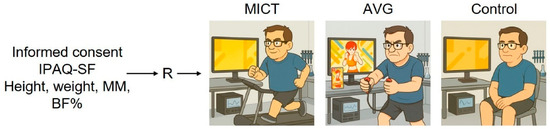
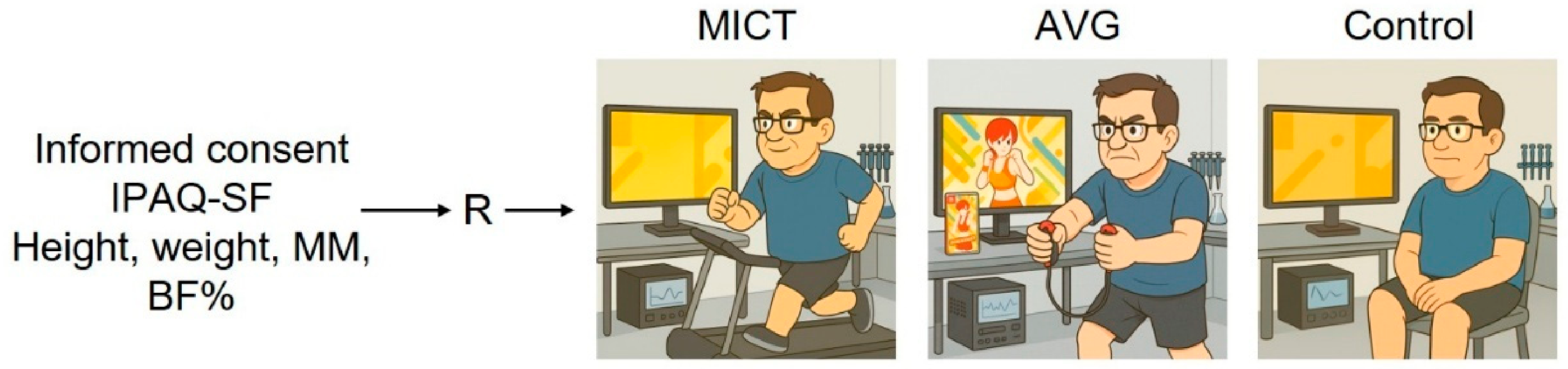
All participants attended the Human Movement Biosciences Laboratory on four occasions. During the first session, participants read and signed an informed consent form and completed all demographic assessments. PA levels (425 ± 232.2 MET/min/week) and sedentary time (6.9 ± 2.6 h per day) were determined using the International Physical Activity Questionnaire Short Form (IPAQ-SF). Additionally, height (166.5 ± 9.2 cm; InBody BSM170; Seoul, Republic of Korea), body mass (85.6 ± 19.8 kg), BMI (30.6 ± 5.3 kg/m2), muscular mass (29.7 ± 7.4 kg), and body fat percentage (35.7 ± 8.7%) were measured using the InBody 770 (Seoul, Republic of Korea). Finally, theoretical maximum heart rate (HRmax) was calculated using the formula HRmax = 207 − 0.7 × age [37] to establish the target intensity for the AVG and MICT. The subsequent three sessions were randomly assigned to one of three study conditions, with a minimum 48-h interval between sessions: MICT, AVG, and a control seated condition (Figure 1).
Figure 1.
Study design under different conditions. Abbreviations: IPAQ-SF: International Physical Activity Questionnaire Short Form, MM: muscle mass, BF%: body fat percentage, R: Randomization, MICT: Moderate Intensity Continuous Training, AVG: Active Video Games.
2.2.1. Inclusion Criteria
Participants were required to be university office workers, physically inactive (<600 MET-min/week), to spend more than 4 h/day in sedentary behavior, and to have a BMI ≥ 25 kg/m2. Additionally, participants were required to be free of musculoskeletal limitations or cardiovascular conditions that could contraindicate exercise participation. Participants were required to have no prior experience with AVG. Because participants did not meet the minimum recommended weekly PA levels and maintained a sedentary lifestyle, they were classified as overweight or obese based on a body mass index (BMI) ≥ 25 kg/m2.
2.2.2. AVG Session
Participants completed 30.8 min of physical exercise using the Fitness Boxing 2 video game (Nintendo Switch). They completed the session in Free Training Mode, which allows manual selection of exercises, intensity (adjusted to maintain 67 ± 3% HRmax), and duration. The AVG provides a full-body workout featuring boxing movements and combinations (jab, straight, uppercut, and crochet; see Table 1).
Table 1.
Description of the Boxing-Based AVG Protocol.
2.2.3. MICT Session
Participants completed 30.8 min of continuous treadmill exercise at a prescribed intensity of 67 ± 3% HRmax. The treadmill remained at ground level throughout all sessions.
2.2.4. Control Session
Participants remained seated for 30.8 min without performing any physical exercise.
It is important to note that, for randomization, slips of paper containing all possible combinations of the three study conditions were prepared, and each participant randomly selected one of the six slips (double-blind design). Each participant completed the full protocol after finishing the final assessment of the third visit.
All participants attended sessions in a fasted state (8 h) at the same time of day. Capillary blood glucose samples (Accu-Chek Active; Vienna, Austria) were collected at baseline (pre-exercise), immediately post-exercise, and 24 h post-exercise (after an 8-h fast). HR (Polar Verity Sense; Kempele, Finland) and RPE (6 to 20) [38] were recorded minute-by-minute during each session. Following the AVG and MICT sessions, the Physical Activity Enjoyment Scale (PACES) questionnaire was administered to quantify exercise enjoyment [39,40].
2.3. Statistical Analysis
All statistical analyses were performed using SPSS 23 software. Descriptive statistics (mean ± SD) were calculated for all variables. Data normality was assessed using the Shapiro–Wilk Test, and homogeneity of variance was evaluated using Levene’s test. Capillary blood glucose responses were analyzed using a two-way repeated measures ANOVA with time (baseline, immediately after exercise, 24 h after exercise) as the within-subjects factor and condition (Control, AVG, MICT) as the between-subjects factor. When significant interactions were identified, simple-effects analyses were performed using pairwise comparisons of estimated marginal means (EMMEANS), with a Bonferroni adjustment to control for Type I error. Specifically, conditions were compared within each measurement time point.
HR and RPE data were analyzed using separate one-way ANOVAs with condition as the between-subjects factor. Exercise enjoyment was compared between the two exercise conditions using an independent samples t-test. For significant effects, post hoc comparisons were conducted using a Bonferroni correction for repeated-measures analyses and between-groups comparisons. Effect sizes were reported using partial eta-squared (ηp2) for ANOVA analyses and Cohen’s d for t-test comparisons. Statistical significance was set at α = 0.05 for all analyses, and results are presented as mean ± standard deviation.
3. Results
All 17 participants who initiated the study completed it. Therefore, there was no participant attrition (see Table 2). It is important to note that a minimum interval of 48 h was maintained between sessions. Each participant was evaluated within a maximum period of two weeks.
Table 2.
Characteristics of the participants.
3.1. Capillary Blood Glucose Responses
Although some variables showed slight deviations from normality, a repeated-measures ANOVA was retained because it is considered robust to moderate violations of normality in crossover designs with repeated measures. A two-way repeated measures ANOVA revealed a significant main effect of time on capillary blood glucose, indicating that glucose levels changed significantly across the three measurement points (baseline, immediately post-exercise, and 24 h post-exercise). However, there was no significant main effect of condition and no significant interaction between time and condition (see Table 3).
Table 3.
Repeated-measures ANOVA for capillary blood glucose across conditions and time points.
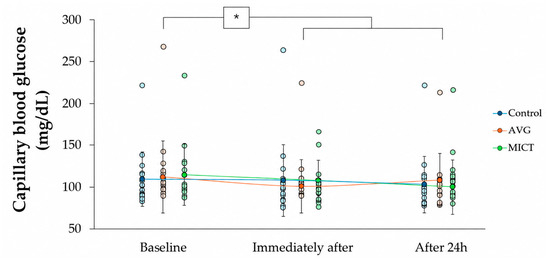
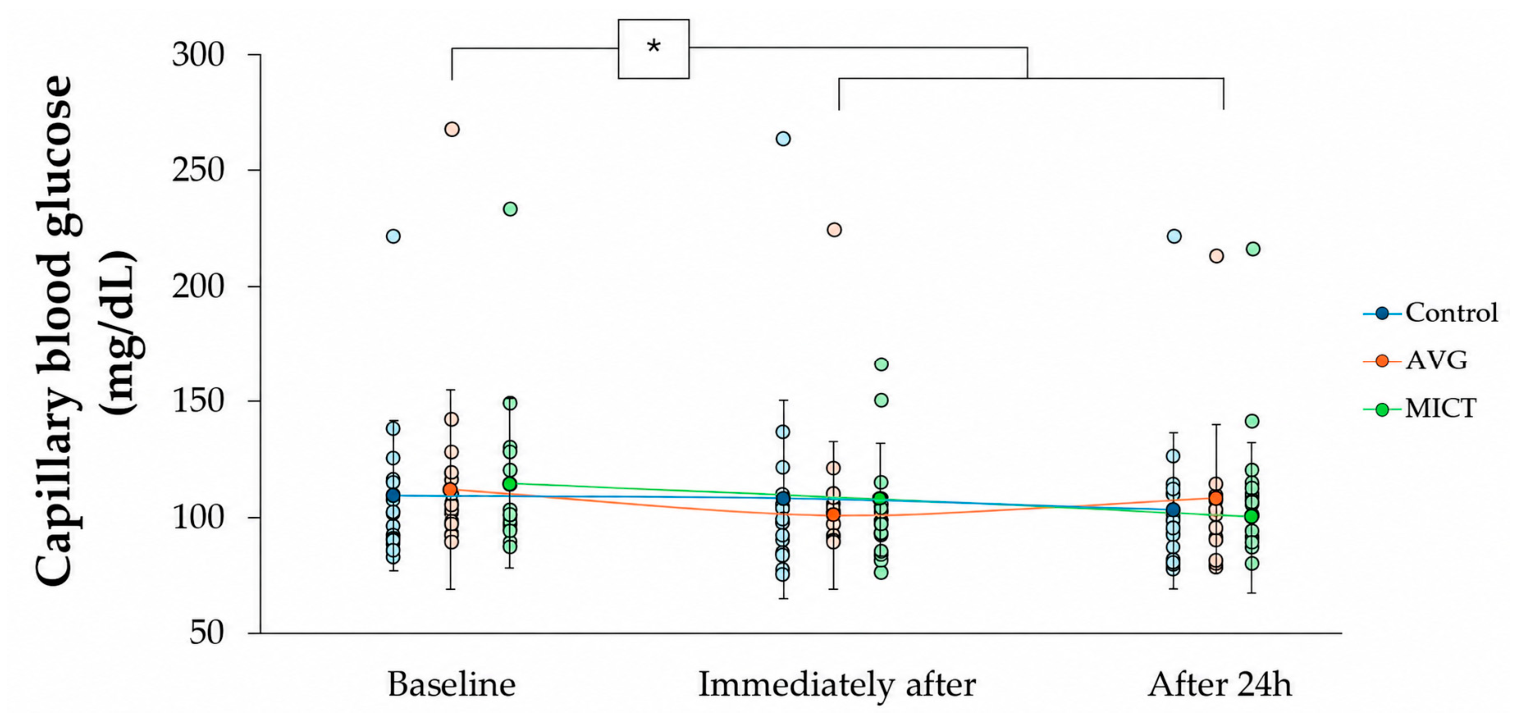
Post hoc analysis using Bonferroni correction revealed significant differences between time points. Capillary blood glucose levels decreased significantly from baseline (114.3 ± 35.6 mg/dL) to immediately post-exercise (107.7 ± 32.1 mg/dL; p = 0.021) and from baseline to 24 h post-exercise (106.0 ± 31.7 mg/dL; p < 0.001). No significant difference was observed between immediate post-exercise and 24-h measurements (p = 1.000). Baseline glucose levels were similar across all conditions: Control (111.9 ± 31.0 mg/dL), AVG (116.9 ± 41.0 mg/dL), and MICT (114.2 ± 34.8 mg/dL) (Figure 2).
Figure 2.
Changes in capillary blood glucose across time in the Control, AVG, and MICT conditions. Scatter points indicate individual participant measurements, while central markers and error bars represent mean ± SD. The light-colored circles represent the values of each participant in their respective conditions. * Significant difference between the baseline measurement and the Immediately after and After 24 h (p < 0.05).
Although pairwise comparisons revealed significant differences within the AVG condition between baseline and 24 h post-exercise (p = 0.004, 95%CI 4.193–23.454, Cohen’s d = 0.931), as well as between immediately after exercise and 24 h post-exercise (p = 0.032, 95%CI 0.530–14.058, Cohen’s d = 0.699), the absence of a significant condition × time interaction indicates that these changes were not different from those observed in the MICT and control conditions. No significant differences were found in the remaining comparisons within the MICT or control conditions (p > 0.05; see Table 3).
3.2. Heart Rate Responses
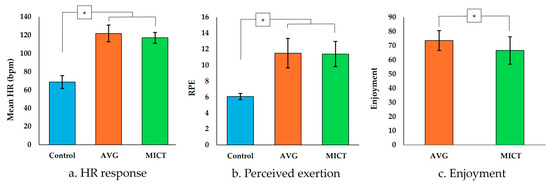
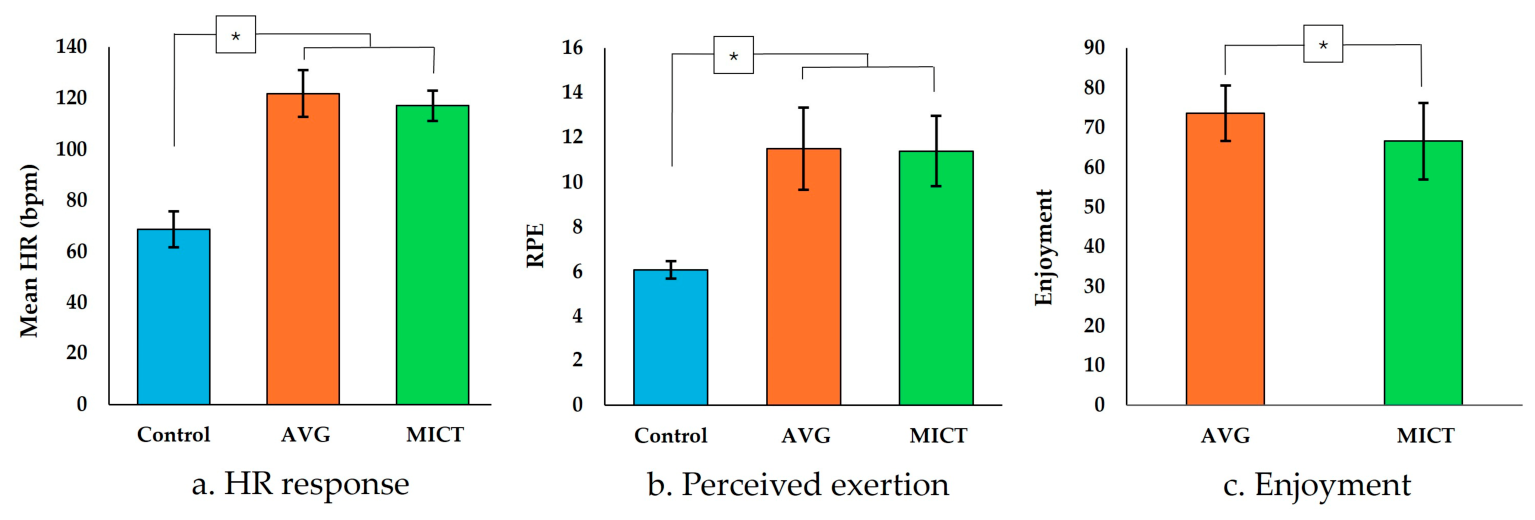
HR differed significantly between conditions (F = 397.519, p < 0.001, ηp2 = 0.961), indicating a large effect size. Mean HR during the control condition (68.8 ± 6.9 bpm) was significantly lower than both exercise conditions (p < 0.001 for both comparisons). The AVG condition elicited a slightly higher mean HR (121.9 ± 9.1 bpm) compared to MICT (117.2 ± 5.9 bpm); however, this difference was not statistically significant (p = 0.165). Both exercise conditions achieved the target moderate-intensity range (67 ± 3% HRmax), confirming that the exercise prescription maintained the desired intensity across modalities (Figure 3a).
Figure 3.
HR (a) and RPE (b) represent the average obtained during the 30-min exercise intervention, whereas enjoyment (c) represents post-intervention scores. Notes: * Significant differences; error bars show standard deviations.
3.3. Rating of Perceived Exertion
RPE varied significantly between conditions (F = 102.84, p < 0.001, ηp2 = 0.865). As expected, the control condition resulted in minimal RPE (6.1 ± 0.4), which was significantly lower than in both exercise conditions (p < 0.001 for both). Both the AVG (11.5 ± 1.8) and MICT (11.4 ± 1.6) conditions produced similar moderate levels of RPE, with no significant difference between them (p = 0.845). The RPE values for both exercise conditions fell within the moderate-intensity range (11–13 on the Borg 6–20 scale), further confirming that participants exercised at the intended intensity across both modalities (Figure 3b).
3.4. Exercise Enjoyment
A significant difference in exercise enjoyment was observed between the two exercise conditions (t = 2.445, p = 0.026). Participants reported significantly higher enjoyment scores for the AVG condition (73.6 ± 7.0) compared to the MICT condition (66.6 ± 9.6), with a moderate effect size (Cohen’s d = 0.593 [95% CI: 0.068–1.102]) (Figure 3c).
4. Discussion
This study examined the acute effects of AVGs and MICT on capillary blood glucose responses in sedentary office workers who are overweight or obese. Our findings revealed several important points that deepen our understanding of how exercise types influence glycemic control and exercise preference. First, significant reductions in capillary blood glucose were observed only in the AVG condition, particularly between baseline and 24 h post-exercise, and between immediately post-exercise and 24 h post-exercise. In contrast, no significant within-condition changes were observed in the MICT or control conditions, suggesting that the glycemic response may have been more sustained following the AVG session. Second, there were no significant differences between AVG and treadmill exercise in HR or RPE, indicating that both methods achieved comparable physiological effects at the prescribed moderate intensity. Lastly, the AVG session resulted in significantly greater enjoyment than traditional continuous exercise, suggesting greater potential for adherence in this group while delivering equivalent metabolic benefits.
Although we initially hypothesized that the AVG session would produce greater reductions in capillary glucose after 24 h compared to the MICT session due to greater muscle group involvement and multidirectional movements, the overall analysis did not reveal significant differences between exercise conditions. However, pairwise comparisons showed significant reductions in glucose only in the AVG condition. These findings may suggest that the interactive and dynamic nature of AVGs could promote a more sustained glycemic response over time.
Since skeletal muscle is primarily responsible for glucose uptake [41], the multidirectional and whole-body movements involved in AVG participation may have provided sufficient muscular stimulus to enhance glucose utilization during the recovery period. Nevertheless, these findings should be interpreted cautiously given the absence of a significant interaction effect between condition and time. In addition, boxing-based AVG may require greater simultaneous involvement of upper- and lower-body musculature than treadmill walking, potentially increasing overall muscular demand despite similar average exercise intensity. Previous studies comparing exercise modalities have suggested that characteristics such as movement patterns and muscular involvement may differentially influence glucose responses [26,33].
Additionally, the rapid acceleration and deceleration involved in punching movements may have introduced eccentric muscular components that could have influenced glucose regulation responses through differences in contraction-induced glucose uptake and overall metabolic demand. However, current evidence regarding acute eccentric exercise and glycemic control remains inconsistent and has primarily been derived from locomotor exercise models rather than boxing-related exercise modalities [42,43,44]. Furthermore, the higher enjoyment observed during AVG participation may have contributed to greater engagement and a more positive affective experience during the session, potentially influencing psychophysiological responses associated with exercise participation [36].
The results of this study are consistent with those reported by De Brito et al. [33], who recruited 10 participants (24.9 ± 2.5 years old; 11.5 ± 2.5 years since diagnosis) with type I diabetes mellitus to evaluate the impact of an AVG session (Kinect Adventure; Xbox 360) compared to a running session (treadmill) and a control session (sitting in a chair) on capillary glucose over 24 h. The researchers found that both AVG and running sessions produce similar effects on glucose, concluding that AVG is effective for reducing hypoglycemia in people with type I diabetes.
In this study, participants enjoyed the AVG session more than the MICT session, despite exercising at the same intensity (moderate), with the same perceived exertion (light), and for the same duration (30 min) in both sessions. This increased enjoyment could be attributed to the background music that accompanies the AVG, which may lead to higher dopamine production and make the session more pleasant and satisfying, thereby increasing enjoyment [45]. Therefore, it is important to explore strategies that motivate this population to engage in PA with benefits comparable to or greater than those of conventional exercise.
A limitation of the study is that dietary intake during the 24-h recovery period was neither standardized nor objectively monitored. Because capillary blood glucose is highly sensitive to nutritional intake, variations in meal composition, timing, and caloric intake across conditions may have influenced glycemic responses independent of the exercise intervention. Although participants were instructed to “eat what you usually eat” in a similar manner across sessions, and the repeated-measures crossover design likely reduced some interindividual variability, the absence of dietary control remains a potential confounding factor when interpreting the 24-h glucose responses. Another limitation of this study is the relatively small sample size, which may have reduced statistical power to detect subtle between-condition differences and interaction effects, particularly for acute capillary blood glucose responses immediately after exercise.
The AVG condition used in this study is capable of eliciting high exercise intensities (75 to 80% HRmax). Future research should examine AVG sessions performed at self-selected (ad libitum) intensities, since individuals often regulate effort differently when exercising independently. It would also be valuable to compare AVG with additional exercise modalities and intensities, while incorporating psychological variables such as satisfaction, frustration, and stress to provide deeper insights into exercise behavior among sedentary office workers with overweight or obesity. Although participants reported no prior experience with AVG, volunteers in this study may have had greater interest in or a positive predisposition toward AVG participation, which could have influenced their enjoyment responses. Future studies should assess participants’ attitudes and preferences toward AVG before enrollment and consider incorporating dietary logs, standardized meals, or continuous glucose monitoring to better isolate the specific effects of AVG and MICT on post-exercise glycemic regulation. Lastly, studies with larger samples are needed to confirm these preliminary findings and more accurately determine the comparative effects of AVG and traditional exercise modalities on glycemic responses.
Aligned with the 2024 fitness trend of “Worksite health promotion” [46], the primary practical implication of this study is that AVG can be feasibly implemented in workplace settings to promote daily PA. This approach may help employees meet the recommended guideline of at least 150 min per week of moderate-to-vigorous PA while simultaneously enhancing enjoyment and adherence. Nevertheless, translating AVG interventions into occupational settings may pose practical challenges related to organizational infrastructure, environmental constraints, and access to technological resources. Despite these potential barriers, future studies should continue to explore the use of virtual reality to further enhance exercise enjoyment, as it may offer greater immersion and more robust multisensory stimulation than traditional AVG, potentially diverting attentional focus away from unpleasant exercise-related sensations [36].
5. Conclusions
In conclusion, AVG appear to be a feasible and enjoyable strategy for promoting moderate-intensity PA in sedentary adults with obesity. AVG elicited acute reductions in capillary blood glucose over time, physiological responses comparable to MICT exercise, and greater enjoyment than traditional exercise. These findings suggest that AVG may support adherence to PA programs, particularly in workplace settings where time-efficient and engaging interventions are needed. Future studies should examine self-selected AVG intensities, include additional exercise modalities and psychological variables, and evaluate the long-term effects of AVG interventions on metabolic health and PA adherence in adults with overweight or obesity.
Author Contributions
Conceptualization, C.T.-H., A.L.-M. and B.M.-H.; methodology, C.T.-H., A.L.-M., B.M.-H., J.J.C.-N. and J.A.A.-C.; formal analysis, K.S.-G. and J.A.A.-C.; investigation, C.T.-H., A.L.-M., R.E.-G., J.J.C.-N. and J.A.A.-C.; resources, R.E.-G., J.J.C.-N. and E.C.G.-G.; data curation, K.S.-G. and J.A.A.-C.; writing—original draft preparation, B.M.-H. and R.E.-G.; writing—review and editing, B.M.-H., K.S.-G. and J.A.A.-C.; supervision, E.C.G.-G.; project administration, E.C.G.-G. and J.A.A.-C. All authors have read and agreed to the published version of the manuscript.
Funding
This research received no external funding.
Institutional Review Board Statement
The study was conducted in accordance with the Declaration of Helsinki and was reviewed by the Evaluation Committee for Research and Postgraduate Studies from Autonomous University of Baja California, Mexico (Protocol #340/3849 25 August 2025).
Informed Consent Statement
Informed consent was obtained from all subjects involved in the study.
Data Availability Statement
The original data presented in the study are openly available in Open Science Framework at http://doi.org/10.17605/OSF.IO/TZDNY (accessed on 1 March 2026).
Conflicts of Interest
The authors declare no conflicts of interest.
Abbreviations
The following abbreviations are used in this manuscript:
| AVG | Active Video Game |
| MICT | Moderate Intensity Continuous Training |
| RPE | Rate of Perceived Exertion |
| MET | Metabolic Equivalent of Task |
| GLUT | Glucose Transporters |
| mg/dL | Milligrams per Deciliter |
| BMI | Body Mass Index |
| IPAQ-SF | International Physical Activity Questionnaire Short Form |
| HRmax | Maximum Heart Rate |
| PACES | Physical Activity Enjoyment Scale |
| EMMEANS | Estimated Marginal Means |
References
- WHO. Nearly 1.8 Billion Adults at Risk of Disease from Not Doing Enough Physical Activity. Available online: https://www.who.int/news/item/26-06-2024-nearly-1.8-billion-adults-at-risk-of-disease-from-not-doing-enough-physical-activity (accessed on 21 October 2025).
- Mclaughlin, M.; Atkin, A.J.; Starr, L.; Hall, A.; Wolfenden, L.; Sutherland, R.; Wiggers, J.; Ramirez, A.; Hallal, P.; Pratt, M.; et al. Worldwide Surveillance of Self-Reported Sitting Time: A Scoping Review. Int. J. Behav. Nutr. Phys. Act. 2020, 17, 111. [Google Scholar] [CrossRef] [Scilit]
- Ussery, E.N.; Fulton, J.E.; Galuska, D.A.; Katzmarzyk, P.T.; Carlson, S.A. Joint Prevalence of Sitting Time and Leisure-Time Physical Activity Among US Adults, 2015–2016. JAMA 2018, 320, 2036–2038. [Google Scholar] [CrossRef] [Scilit]
- Tremblay, M.S.; Aubert, S.; Barnes, J.D.; Saunders, T.J.; Carson, V.; Latimer-Cheung, A.E.; Chastin, S.F.M.; Altenburg, T.M.; Chinapaw, M.J.M.; Altenburg, T.M.; et al. Sedentary Behavior Research Network (SBRN)—Terminology Consensus Project Process and Outcome. Int. J. Behav. Nutr. Phys. Act. 2017, 14, 75. [Google Scholar] [CrossRef] [Scilit] [PubMed]
- Ekelund, U.; Brown, W.J.; Steene-Johannessen, J.; Fagerland, M.W.; Owen, N.; Powell, K.E.; Bauman, A.E.; Lee, I.-M. Do the Associations of Sedentary Behaviour with Cardiovascular Disease Mortality and Cancer Mortality Differ by Physical Activity Level? A Systematic Review and Harmonised Meta-Analysis of Data from 850 060 Participants. Br. J. Sports Med. 2019, 53, 886–894. [Google Scholar] [CrossRef] [Scilit]
- Clemes, S.A.; O’Connell, S.E.; Edwardson, C.L. Office Workers’ Objectively Measured Sedentary Behavior and Physical Activity during and Outside Working Hours. J. Occup. Environ. Med. 2014, 56, 298–303. [Google Scholar] [CrossRef] [Scilit]
- Smith, L.; Hamer, M.; Ucci, M.; Marmot, A.; Gardner, B.; Sawyer, A.; Wardle, J.; Fisher, A. Weekday and Weekend Patterns of Objectively Measured Sitting, Standing, and Stepping in a Sample of Office-Based Workers: The Active Buildings Study. BMC Public Health 2015, 15, 9. [Google Scholar] [CrossRef] [Scilit]
- Aune, D.; Schlesinger, S.; Neuenschwander, M.; Feng, T.; Janszky, I.; Norat, T.; Riboli, E. Diabetes Mellitus, Blood Glucose and the Risk of Heart Failure: A Systematic Review and Meta-Analysis of Prospective Studies. Nutr. Metab. Cardiovasc. Dis. 2018, 28, 1081–1091. [Google Scholar] [CrossRef] [Scilit]
- Gonzales, P.N.G.; Ampil, E.R.; Catindig-Dela Rosa, J.-A.S.; Villaraza, S.G.; Joson, M.L.C. Increased Risk of Alzheimer’s Disease with Glycemic Variability: A Systematic Review and Meta-Analysis. Cureus 2024, 16, e73353. [Google Scholar] [CrossRef] [Scilit] [PubMed]
- Nasr, M.; Rahimian, F.; Rahmanian, S.; Aliasghari, F.; Soleimani, E.; Aryaei, M.; Daneshmandi, H. Lipid Profile and Fast Blood Glucose in Office Workers: BMI and Sex Differences. Obes. Med. 2022, 32, 100412. [Google Scholar] [CrossRef] [Scilit]
- Lee, Y.; Seo, E.; Lee, W. Long Working Hours and the Risk of Glucose Intolerance: A Cohort Study. Int. J. Environ. Res. Public Health 2022, 19, 11831. [Google Scholar] [CrossRef] [Scilit]
- Van Der Berg, J.D.; Stehouwer, C.D.A.; Bosma, H.; Van Der Velde, J.H.P.M.; Willems, P.J.B.; Savelberg, H.H.C.M.; Schram, M.T.; Sep, S.J.S.; Van Der Kallen, C.J.H.; Henry, R.M.A.; et al. Associations of Total Amount and Patterns of Sedentary Behaviour with Type 2 Diabetes and the Metabolic Syndrome: The Maastricht Study. Diabetologia 2016, 59, 709–718. [Google Scholar] [CrossRef] [Scilit] [PubMed]
- Gao, W.; Sanna, M.; Chen, Y.-H.; Tsai, M.-K.; Wen, C.-P. Occupational Sitting Time, Leisure Physical Activity, and All-Cause and Cardiovascular Disease Mortality. JAMA Netw. Open 2024, 7, e2350680. [Google Scholar] [CrossRef] [Scilit]
- Asfaw, M.S.; Dagne, W.K. Physical Activity Can Improve Diabetes Patients’ Glucose Control; A Systematic Review and Meta-Analysis. Heliyon 2022, 8, e12267. [Google Scholar] [CrossRef] [Scilit]
- Mikus, C.R.; Oberlin, D.J.; Libla, J.L.; Taylor, A.M.; Booth, F.W.; Thyfault, J.P. Lowering Physical Activity Impairs Glycemic Control in Healthy Volunteers. Med. Sci. Sports Exerc. 2012, 44, 225–231. [Google Scholar] [CrossRef] [Scilit] [PubMed]
- Hamasaki, H. Daily Physical Activity and Type 2 Diabetes: A Review. World J. Diabetes 2016, 7, 243–251. [Google Scholar] [CrossRef] [Scilit]
- Shambrook, P.; Kingsley, M.I.; Taylor, N.F.; Wundersitz, D.W.; Wundersitz, C.E.; Paton, C.D.; Gordon, B.A. A Comparison of Acute Glycaemic Responses to Accumulated or Single Bout Walking Exercise in Apparently Healthy, Insufficiently Active Adults. J. Sci. Med. Sport 2020, 23, 902–907. [Google Scholar] [CrossRef] [Scilit]
- Chandrasekaran, B.; Pesola, A.J.; Rao, C.R.; Arumugam, A. Does Breaking up Prolonged Sitting Improve Cognitive Functions in Sedentary Adults? A Mapping Review and Hypothesis Formulation on the Potential Physiological Mechanisms. BMC Musculoskelet. Disord. 2021, 22, 274. [Google Scholar] [CrossRef] [Scilit]
- Magnon, V.; Vallet, G.T.; Auxiette, C. Sedentary Behavior at Work and Cognitive Functioning: A Systematic Review. Front. Public Health 2018, 6, 239. [Google Scholar] [CrossRef] [Scilit]
- Wheeler, M.J.; Dempsey, P.C.; Grace, M.S.; Ellis, K.A.; Gardiner, P.A.; Green, D.J.; Dunstan, D.W. Sedentary Behavior as a Risk Factor for Cognitive Decline? A Focus on the Influence of Glycemic Control in Brain Health. Alzheimers Dement. 2017, 3, 291–300. [Google Scholar] [CrossRef] [Scilit] [PubMed]
- Tanaka, Y.; Ogata, H.; Park, I.; Ando, A.; Ishihara, A.; Kayaba, M.; Yajima, K.; Suzuki, C.; Araki, A.; Osumi, H.; et al. Effect of a Single Bout of Morning or Afternoon Exercise on Glucose Fluctuation in Young Healthy Men. Physiol. Rep. 2021, 9, e14784. [Google Scholar] [CrossRef] [Scilit]
- van Dijk, J.-W.; Venema, M.; van Mechelen, W.; Stehouwer, C.D.A.; Hartgens, F.; van Loon, L.J.C. Effect of Moderate-Intensity Exercise versus Activities of Daily Living on 24-Hour Blood Glucose Homeostasis in Male Patients with Type 2 Diabetes. Diabetes Care 2013, 36, 3448–3453. [Google Scholar] [CrossRef] [Scilit]
- Cartee, G.D. Mechanisms for Greater Insulin-Stimulated Glucose Uptake in Normal and Insulin-Resistant Skeletal Muscle after Acute Exercise. Am. J. Physiol. Endocrinol. Metab. 2015, 309, E949–E959. [Google Scholar] [CrossRef] [Scilit]
- Momma, H.; Kawakami, R.; Honda, T.; Sawada, S.S. Muscle-Strengthening Activities Are Associated with Lower Risk and Mortality in Major Non-Communicable Diseases: A Systematic Review and Meta-Analysis of Cohort Studies. Br. J. Sports Med. 2022, 56, 755–763. [Google Scholar] [CrossRef] [Scilit]
- Wang, Y.; Lee, D.-C.; Brellenthin, A.G.; Eijsvogels, T.M.H.; Sui, X.; Church, T.S.; Lavie, C.J.; Blair, S.N. Leisure-Time Running Reduces the Risk of Incident Type 2 Diabetes. Am. J. Med. 2019, 132, 1225–1232. [Google Scholar] [CrossRef] [Scilit]
- Minnock, D.; Annibalini, G.; Le Roux, C.W.; Contarelli, S.; Krause, M.; Saltarelli, R.; Valli, G.; Stocchi, V.; Barbieri, E.; De Vito, G. Effects of Acute Aerobic, Resistance and Combined Exercises on 24-h Glucose Variability and Skeletal Muscle Signalling Responses in Type 1 Diabetics. Eur. J. Appl. Physiol. 2020, 120, 2677–2691. [Google Scholar] [CrossRef] [Scilit]
- Scott, S.N.; Cocks, M.; Andrews, R.C.; Narendran, P.; Purewal, T.S.; Cuthbertson, D.J.; Wagenmakers, A.J.M.; Shepherd, S.O. Fasted High-Intensity Interval and Moderate-Intensity Exercise Do Not Lead to Detrimental 24-Hour Blood Glucose Profiles. J. Clin. Endocrinol. Metab. 2019, 104, 111–117. [Google Scholar] [CrossRef] [Scilit]
- Babir, F.J.; Riddell, M.C.; Adamo, L.M.; Richards, D.L.; Gibala, M.J. The Effect of Bodyweight Exercise on 24-h Glycemic Responses Determined by Continuous Glucose Monitoring in Healthy Inactive Adults: A Randomized Crossover Study. Sci. Rep. 2023, 13, 20884. [Google Scholar] [CrossRef] [Scilit]
- Hulteen, R.M.; Smith, J.J.; Morgan, P.J.; Barnett, L.M.; Hallal, P.C.; Colyvas, K.; Lubans, D.R. Global Participation in Sport and Leisure-Time Physical Activities: A Systematic Review and Meta-Analysis. Prev. Med. 2017, 95, 14–25. [Google Scholar] [CrossRef] [Scilit]
- Lai, B.; Logan, M.; Young, R.; Wright, A.; Terrell, J.; Bright, L.; Davis, D.; Mendonca, C.J. Feasibility of Vigorous Extended Reality Tele-Exergaming for Cardiometabolic Health in Youth with Mobility Disabilities: Protocol for a Case Series Study. JMIR Res. Protoc. 2026, 15, e85246. [Google Scholar] [CrossRef] [Scilit]
- Bock, B.C.; Dunsiger, S.I.; Wu, W.-C.; Ciccolo, J.T.; Serber, E.R.; Lantini, R.; Marcus, B.H. Reduction in HbA1c with Exercise Videogames among Participants with Elevated HbA1c: Secondary Analysis of the Wii Heart Fitness Trial. Diabetes Res. Clin. Pract. 2019, 154, 35–42. [Google Scholar] [CrossRef] [Scilit]
- de Brito Gomes, J.L.; Martins Vancea, D.M.; Cappato de Araújo, R.; Soltani, P.; de Sá Pereira Guimarães, F.J.; da Cunha Costa, M. Cardiovascular and Enjoyment Comparisons after Active Videogame and Running in Type 1 Diabetes Patients: A Randomized Crossover Trial. Games Health J. 2021, 10, 339–346. [Google Scholar] [CrossRef] [Scilit]
- De Brito Gomes, J.L.; Vancea, D.M.M.; Farinha, J.B.; Barros, C.B.A.; Costa, M.C. 24-h Blood Glucose Responses after Exergame and Running in Type-1 Diabetes: An Intensity- and Duration-Matched Randomized Trial. Sci. Sports 2023, 38, 726–733. [Google Scholar] [CrossRef] [Scilit]
- Moreno, P.; Corrales, N.; Espinoza-Gutiérrez, R.; Calleja-Núñez, J.; Montero-Herrera, B.; Cerna, J.; Aburto-Corona, J.A. Energy Expenditure Validation of an Exergame Platform: Ring Fit Adventure Use in Adults with Overweight and Obesity. Games Health J. 2024, 13, 288–296. [Google Scholar] [CrossRef] [Scilit]
- Philippe, A.G.; Goncalves, A.; Korchi, K.; Deshayes, M. Exergaming in Augmented Reality Is Tailor-Made for Aerobic Training and Enjoyment among Healthy Young Adults. Front. Public Health 2024, 12, 1307382. [Google Scholar] [CrossRef] [Scilit]
- Junkersfeld, S.E.; Braun-Trocchio, R. Virtual Reality and Exercise: Impacts on Affective Responses, Ratings of Perceived Exertion, Attention, and Rowing Performance. Res. Q. Exerc. Sport 2026, 1–12. [Google Scholar] [CrossRef] [Scilit]
- Gellish, R.L.; Goslin, B.R.; Olson, R.E.; McDonald, A.; Russi, G.D.; Moudgil, V.K. Longitudinal Modeling of the Relationship between Age and Maximal Heart Rate. Med. Sci. Sports Exerc. 2007, 39, 822–829. [Google Scholar] [CrossRef] [Scilit]
- Borg, G. Psychophysical Bases of Perceived Exertion. Med. Sci. Sports Exerc. 1982, 14, 377–381. [Google Scholar] [CrossRef] [Scilit]
- Carraro, A.; Young, M.C.; Robazza, C. A Contribution to the Validation of the Physical Activity Enjoyment Scale in an Italian Sample. Soc. Behav. Personal. 2008, 36, 911–918. [Google Scholar] [CrossRef] [Scilit]
- Moreno, J.-A.; González-Cutre, D.; Martínez, C.; Alonso, N.; López, M. Propiedades psicométricas de la Physical Activity Enjoyment Scale (PACES) en el contexto español. Estud. Psicol. 2008, 29, 173–180. [Google Scholar] [CrossRef] [Scilit]
- Merz, K.; Thurmond, D. Role of Skeletal Muscle in Insulin Resistance and Glucose Uptake. Compr. Physiol. 2020, 10, 785–809. [Google Scholar] [CrossRef] [Scilit]
- Philippe, M.; Krüsmann, P.; Mersa, L.; Eder, E.; Gatterer, H.; Melmer, A.; Ebenbichler, C.; Burtscher, M. Acute Effects of Concentric and Eccentric Exercise on Glucose Metabolism and Interleukin-6 Concentration in Healthy Males. Biol. Sport 2016, 33, 153–158. [Google Scholar] [CrossRef] [Scilit] [PubMed]
- Andersen, O.E.; Nielsen, O.B.; Overgaard, K. Early Effects of Eccentric Contractions on Muscle Glucose Uptake. J. Appl. Physiol. 2019, 126, 376–385. [Google Scholar] [CrossRef] [Scilit]
- Vogt, M.; Hoppeler, H.H. Eccentric Exercise: Mechanisms and Effects When Used as Training Regime or Training Adjunct. J. Appl. Physiol. 2014, 116, 1446–1454. [Google Scholar] [CrossRef] [Scilit]
- Klimmt, C.; Possler, D.; May, N.; Auge, H.; Wanjek, L.; Wolf, A.-L. Effects of Soundtrack Music on the Video Game Experience. Media Psychol. 2019, 22, 689–713. [Google Scholar] [CrossRef] [Scilit]
- Newsome, A.M.; Sansone, J.; McAvoy, C. 2024 ACSM Worldwide Fitness Trends: Future Directions of the Health and Fitness Industry. ACSM’s Health Fit. J. 2024, 28, 14–26. [Google Scholar] [CrossRef] [Scilit]

Disclaimer/Publisher’s Note: The statements, opinions and data contained in all publications are solely those of the individual author(s) and contributor(s) and not of MDPI and/or the editor(s). MDPI and/or the editor(s) disclaim responsibility for any injury to people or property resulting from any ideas, methods, instructions or products referred to in the content. |
© 2026 by the authors. Licensee MDPI, Basel, Switzerland. This article is an open access article distributed under the terms and conditions of the Creative Commons Attribution (CC BY) license.