1. Introduction
Obesity and excess adiposity remain major public health challenges worldwide, increasingly affecting working-age populations and contributing substantially to cardiometabolic morbidity, reduced productivity, and rising healthcare costs. Importantly, cardiometabolic risk is not determined solely by total body mass, but also by fat distribution, with central and visceral adiposity conferring disproportionately higher metabolic risk compared with generalized obesity. Consequently, contemporary obesity research increasingly emphasizes phenotyping beyond body mass index (BMI), integrating indices that better capture body fat percentage and intra-abdominal adiposity, such as the Clínica Universidad de Navarra–Body Adiposity Estimator (CUN-BAE) and the Metabolic Score for Visceral Fat (METS-VF) [
1,
2,
3].
Sleep has emerged as a critical yet underrecognized determinant of adiposity and metabolic health. Experimental and epidemiological evidence consistently demonstrates that insufficient or poor-quality sleep promotes positive energy balance through increased energy intake, hormonal dysregulation, circadian misalignment, and preferential abdominal fat accumulation [
4,
5,
6]. In parallel, METS-VF has been validated as a practical surrogate of visceral adiposity and cardiometabolic risk, showing strong associations with metabolic outcomes and mortality across populations [
7].
Dietary quality and physical activity constitute central pillars of obesity prevention. Adherence to the Mediterranean diet has been repeatedly associated with lower obesity prevalence and improved cardiometabolic profiles [
8]. An expanding body of literature also supports bidirectional links between dietary patterns and sleep, with Mediterranean diet adherence associated with better sleep quality and duration, potentially mediated by anti-inflammatory, antioxidant, and chrono-nutritional mechanisms [
9,
10]. Likewise, regular physical activity is particularly effective in reducing central and visceral fat depots and may mitigate the metabolic consequences of poor sleep [
11,
12].
Despite this growing evidence base, important gaps remain. Most population studies rely primarily on BMI, limiting insights into central and visceral adiposity phenotypes. Moreover, relatively few investigations have simultaneously evaluated sleep quality, dietary patterns, and physical activity within the same analytical framework using validated instruments, particularly in large occupational cohorts. Evidence regarding sex-specific vulnerability and socioeconomic gradients across multiple adiposity indices also remains limited, despite their relevance for workplace health strategies.
Working populations represent a particularly important context in which to explore these relationships, as occupational factors can influence sleep, physical activity, and dietary behaviors, thereby shaping obesity risk in real-world settings. Furthermore, the combined and potentially synergistic effects of healthy lifestyle behaviors on adiposity outcomes have not been adequately quantified using composite approaches.
Therefore, leveraging a large occupational cohort of Spanish workers, the present study aimed to: (i) examine the independent associations of sleep quality, Mediterranean diet adherence, and physical activity with four complementary adiposity indices (BMI, waist-to-height ratio, CUN-BAE, and METS-VF); (ii) evaluate effect modification by sex and lifestyle behaviors; and (iii) assess dose–response relationships using a composite healthy lifestyle score. We hypothesized that poor sleep quality would be independently associated with higher odds of general, central, and visceral obesity, and that adherence to the Mediterranean diet and regular physical activity would attenuate these associations, with differential susceptibility by sex and occupational social class.
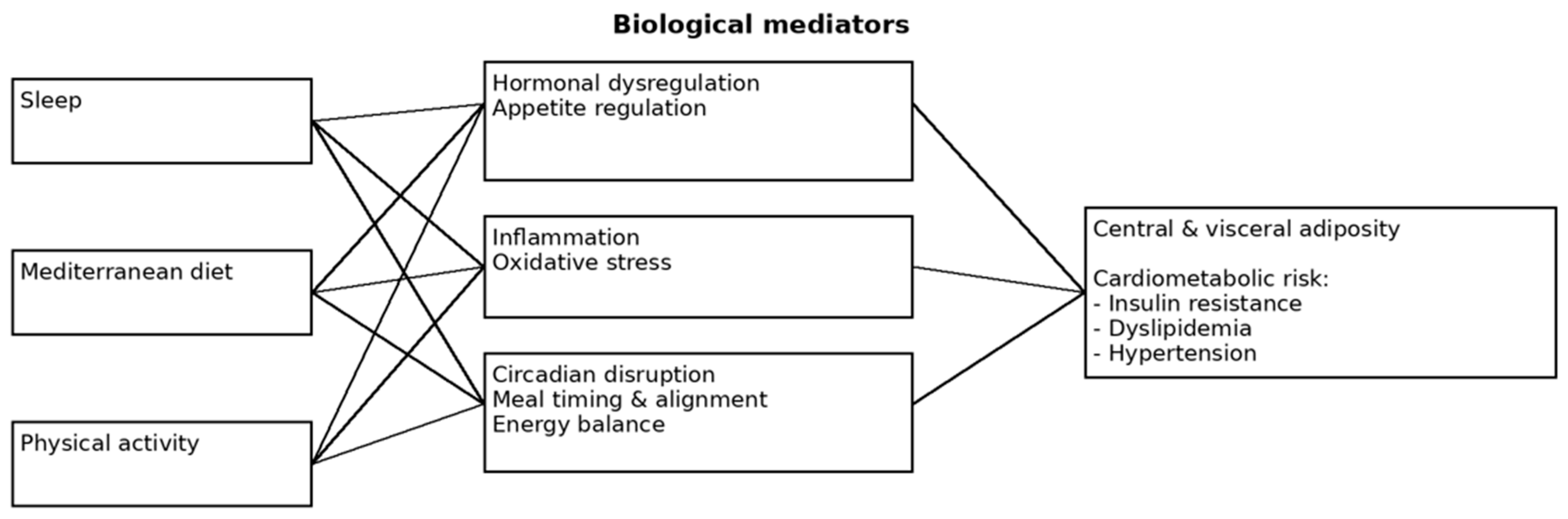
The hypothesized pathways linking sleep quality, Mediterranean diet adherence, physical activity, and visceral adiposity are summarized in
Figure 1.
Poor sleep quality may promote positive energy balance through increased appetite, hormonal dysregulation, and circadian disruption, thereby favoring visceral fat accumulation. In contrast, adherence to the Mediterranean diet and regular physical activity may counteract inflammation, oxidative stress, and impaired fat oxidation, mitigating central and visceral adiposity. These lifestyle behaviors are hypothesized to interact synergistically, ultimately influencing cardiometabolic outcomes, including insulin resistance, dyslipidemia, and hypertension.
2. Materials and Methods
2.1. Study Design and Population
We performed a cross-sectional analysis within the Ibermutua occupational health cohort, a large database of actively employed adults from multiple economic sectors across Spain. For the present study, we included 88,343 workers who underwent standardized occupational health examinations between January 2021 and December 2024. The study protocol was approved by the institutional ethics committee, and all participants provided written informed consent prior to participation in accordance with the Declaration of Helsinki.
2.2. Inclusion and Exclusion Criteria
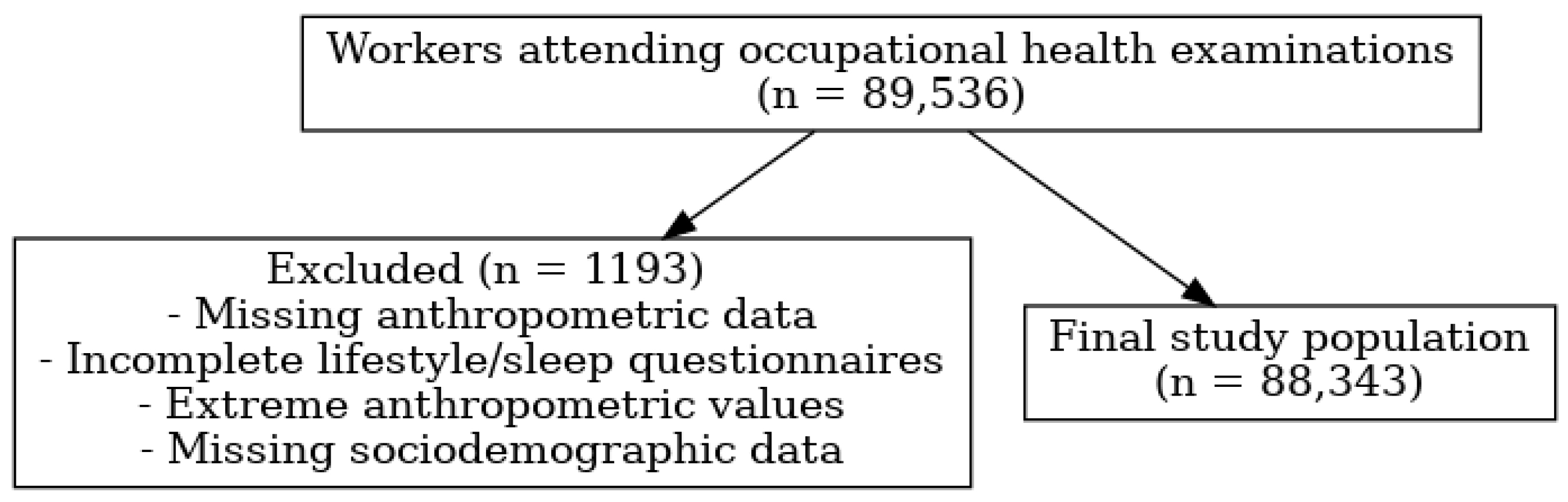
Eligible participants were men and women aged 18–69 years who attended a routine occupational health assessment during the study period. The age cut-off was chosen to reflect the active working population and to avoid distortions related to retirement age. Exclusion criteria were (
Figure 2):
Missing information on anthropometric variables (height, weight, or waist circumference).
Absence of validated responses to lifestyle questionnaires (International Physical Activity Questionnaire [IPAQ], Mediterranean Diet Adherence Screener [MEDAS], or Pittsburgh Sleep Quality Index.
Extreme anthropometric values suggestive of measurement error (BMI < 15 kg/m2 or >60 kg/m2; waist circumference < 50 cm or >180 cm).
Incomplete sociodemographic data (age, sex, or occupational social class).
No exclusions were applied based on pre-existing chronic diseases, as the primary aim was to reflect the obesity burden in a real-world working population. Sensitivity analyses were planned to test the robustness of results by excluding participants with extreme metabolic values.
2.3. Sociodemographic Variables
Age was recorded in years and classified into five categories: 18–29, 30–39, 40–49, 50–59, and 60–69 years. Sex was self-reported. Occupational social class was derived from the Spanish National Classification of Occupations (CNAE-11) and categorized into three groups: Class I (managers and professionals), Class II (clerical and intermediate occupations), and Class III (manual and service workers) [
13].
2.4. Lifestyle Factors
Lifestyle behaviors were systematically assessed:
Smoking status: Participants were classified as current smokers, former smokers, or never smokers. For regression models, smoking was analyzed as a dichotomous variable (current vs. non-smoker).
Physical activity: Evaluated with the validated short version of the IPAQ. Participants reporting ≥150 min/week of moderate activity, ≥75 min/week of vigorous activity, or an equivalent combination were classified as physically active; others were considered inactive [
14].
Dietary habits: Adherence to the Mediterranean diet was assessed using the 14-item MEDAS questionnaire, validated in Spanish populations. A score ≥ 9 indicated adherence, whereas <9 indicated non-adherence [
15].
Lifestyle score: A composite score ranging from 0 to 3 was created by summing physical activity (yes = 1), Mediterranean diet adherence (yes = 1), and good sleep quality (yes = 1).
2.5. Sleep Quality
Sleep was measured using the Spanish-validated version of the Pittsburgh Sleep Quality Index (PSQI). A global score ≤ 5 defined good sleep quality, while >5 indicated poor sleep. This dichotomization has been widely applied in epidemiological research of occupational populations [
16].
2.6. Anthropometric and Obesity Indices
Height, weight, and waist circumference were measured by trained staff following standardized procedures. BMI was calculated as weight (kg)/height
2 (m
2), with obesity defined as BMI ≥ 30 kg/m
2. The waist-to-height ratio (WHtR) was computed as waist circumference/height, with central obesity defined as WHtR > 0.50. Body fat percentage was estimated with the Clínica Universidad de Navarra-Body Adiposity Estimator (CUN-BAE), validated in Spanish populations, using ≥25% in men and ≥35% in women as cut-offs [
17]. Visceral adiposity was estimated using the Metabolic Score for Visceral Fat (METS-VF), applying previously validated sex-specific cut-off values (≥7.18 in men and ≥5.92 in women) [
18].
2.7. Clinical and Biochemical Measurements
Blood samples were obtained by trained healthcare personnel during routine occupational health examinations following standardized procedures. Participants were instructed to attend after an overnight fast of at least 8–12 h. Venous blood samples were collected using standard vacuum tubes and processed in certified clinical laboratories.
Biochemical parameters, including total cholesterol, HDL cholesterol, LDL cholesterol, and glucose, were determined using automated enzymatic methods with validated analyzers according to standard laboratory protocols. Internal and external quality control procedures were applied to ensure accuracy and reliability of the measurements.
2.8. Statistical Analysis
Continuous variables are presented as mean ± standard deviation, and categorical variables as frequencies and percentages. Group comparisons were performed using Student’s t test for continuous variables and χ2 test for categorical variables.
Associations between sociodemographic, lifestyle, and sleep quality variables and each obesity outcome (BMI-obesity, WHtR-high, CUN-BAE obesity, METS-VF high) were examined using multivariable logistic regression. Odds ratios (ORs) with 95% confidence intervals (CIs) were reported. Models were adjusted sequentially for (1) sociodemographic factors (age, sex, social class); (2) lifestyle factors (smoking, physical activity, Mediterranean diet); and (3) sleep quality. We tested multiplicative interaction terms (sex × sleep, physical activity × sleep, and Mediterranean diet × sleep) in multivariable logistic regression models. p-values for interaction were obtained from these product terms. Stratified analyses were conducted by sex, focusing on BMI-obesity and WHtR-high. A dose–response relationship was assessed for the lifestyle score (0–3 points) using logistic regression.
To explore potential non-linear dose–response associations, PSQI score was additionally modeled as a continuous variable using restricted cubic spline functions for central obesity (WtHR-high), with knots placed at the 10th, 50th, and 90th percentiles of its distribution. Models were adjusted for age, sex, occupational social class, smoking status, physical activity, and Mediterranean diet adherence. Additional spline models were fitted for METS-VF (continuous) and BMI-defined obesity, with results presented in
Supplementary Figures S2–S4. All spline analyses were performed using logistic regression models with binary outcomes. Results are presented as predicted probabilities to ensure consistency and comparability across adiposity indices.
To evaluate socioeconomic gradients, social class was modeled as an ordinal variable (I–III), and p-trend values were obtained. Multicollinearity was checked using variance inflation factors (VIF), with values > 5 considered problematic. Sensitivity analyses were conducted, excluding extreme anthropometric values and using alternative PSQI cut-offs. Missing data were handled using complete-case analysis; the proportion of excluded cases was reported.
To improve consistency and interpretability, analyses were structured according to the type of exposure and outcome: (i) primary analyses used categorical outcomes (obesity indices defined by standard cut-offs) and categorical exposures; (ii) secondary analyses explored dose–response relationships using continuous exposure (PSQI score) modeled with restricted cubic splines; and (iii) joint exposure analyses evaluated combined lifestyle profiles. This structured approach allows comparison across analytical frameworks while maintaining clinical interpretability.
All analyses were systematically performed for the four adiposity indices (BMI, WHtR, CUN-BAE, and METS-VF), although only selected outcomes are presented in the main tables for clarity.
All statistical analyses were conducted with SPSS version 29.0 (IBM Corp., Armonk, NY, USA). Two-tailed p-values < 0.05 were considered statistically significant.
3. Results
Among 88,343 workers (60.1% men), obesity prevalence varied substantially according to the index used, ranging from 18.9% for BMI-defined obesity to 55.6% for CUN-BAE obesity. Central obesity (WHtR > 0.50) and high METS-VF increased markedly with age and lower social class. Poor sleep quality, physical inactivity, and low Mediterranean diet adherence were consistently associated with higher odds of obesity across all indices, with physical inactivity emerging as the strongest predictor. Significant interactions indicated that both physical activity and Mediterranean diet adherence attenuated the adverse association between poor sleep and obesity outcomes. Results are presented following a structured analytical framework, including (i) categorical exposure–categorical outcome models, (ii) joint exposure analyses, and (iii) continuous exposure models assessing dose–response relationships. For clarity, the main tables focus on BMI and WHtR as representative adiposity outcomes, while the full set of analyses for all indices is provided in the
Supplementary Materials.
Table 1 summarizes baseline characteristics by sex. Men showed higher body weight, waist circumference, and blood pressure, whereas women had higher HDL-c levels and reported healthier lifestyle profiles, including greater Mediterranean diet adherence, higher physical activity, and better sleep quality (all
p < 0.001).
Table 2 shows obesity prevalence across sociodemographic and lifestyle categories. A marked age gradient was observed for all indices, particularly for central obesity. Clear socioeconomic differences were evident, with higher prevalence in lower occupational classes. Unhealthy lifestyle behaviors were consistently associated with substantially higher obesity prevalence: non-adherence to the Mediterranean diet, physical inactivity, and poor sleep quality showed the largest contrasts, especially for WHtR. Across both sexes, physically inactive participants (men:
n = 28,804; women:
n = 16,927) and individuals with poor sleep quality (men:
n = 16,018; women:
n = 3806) exhibited the highest prevalence of central obesity.
Table 3 summarizes the multivariable-adjusted associations between sociodemographic and lifestyle factors and obesity outcomes. Female sex, older age, and lower occupational social class were consistently associated with higher odds of obesity across indices. Among lifestyle factors, non-adherence to the Mediterranean diet and especially physical inactivity showed the strongest associations, particularly for central and visceral adiposity. Poor sleep quality remained independently associated with obesity after full adjustment, with the largest effects observed for WtHR-defined central obesity.
Stratified analyses are presented in
Table 4. The association between poor sleep quality and obesity outcomes varied across levels of sex, physical activity, and Mediterranean diet adherence. Formal tests of interaction were conducted using multiplicative interaction terms, with corresponding p-interaction values reported in the table. The adverse association between poor sleep quality and obesity was stronger in women than in men. Moreover, both regular physical activity and adherence to the Mediterranean diet attenuated the magnitude of the association between poor sleep and obesity outcomes. In contrast, the association was substantially amplified among physically inactive workers and those not adhering to a Mediterranean diet, particularly for central obesity (WHtR-high).
Joint exposure analyses combining sleep quality, physical activity, and Mediterranean diet adherence are shown in
Table 5.
Joint exposure analyses across BMI, CUN-BAE, and METS-VF (
Supplementary Tables S2–S4) showed consistent graded associations, with the strongest effects observed for visceral adiposity (METS-VF), supporting the robustness of the combined lifestyle model across adiposity phenotypes.
Marked combined effects were observed. Compared with participants reporting good sleep, regular physical activity, and Mediterranean diet adherence, those with concurrent poor sleep, physical inactivity, and low Mediterranean diet adherence exhibited nearly five-fold higher odds of central obesity (OR 4.67, 95% CI 4.20–5.19). Intermediate profiles showed graded increases in risk, indicating cumulative adverse effects of unhealthy lifestyle behaviors.
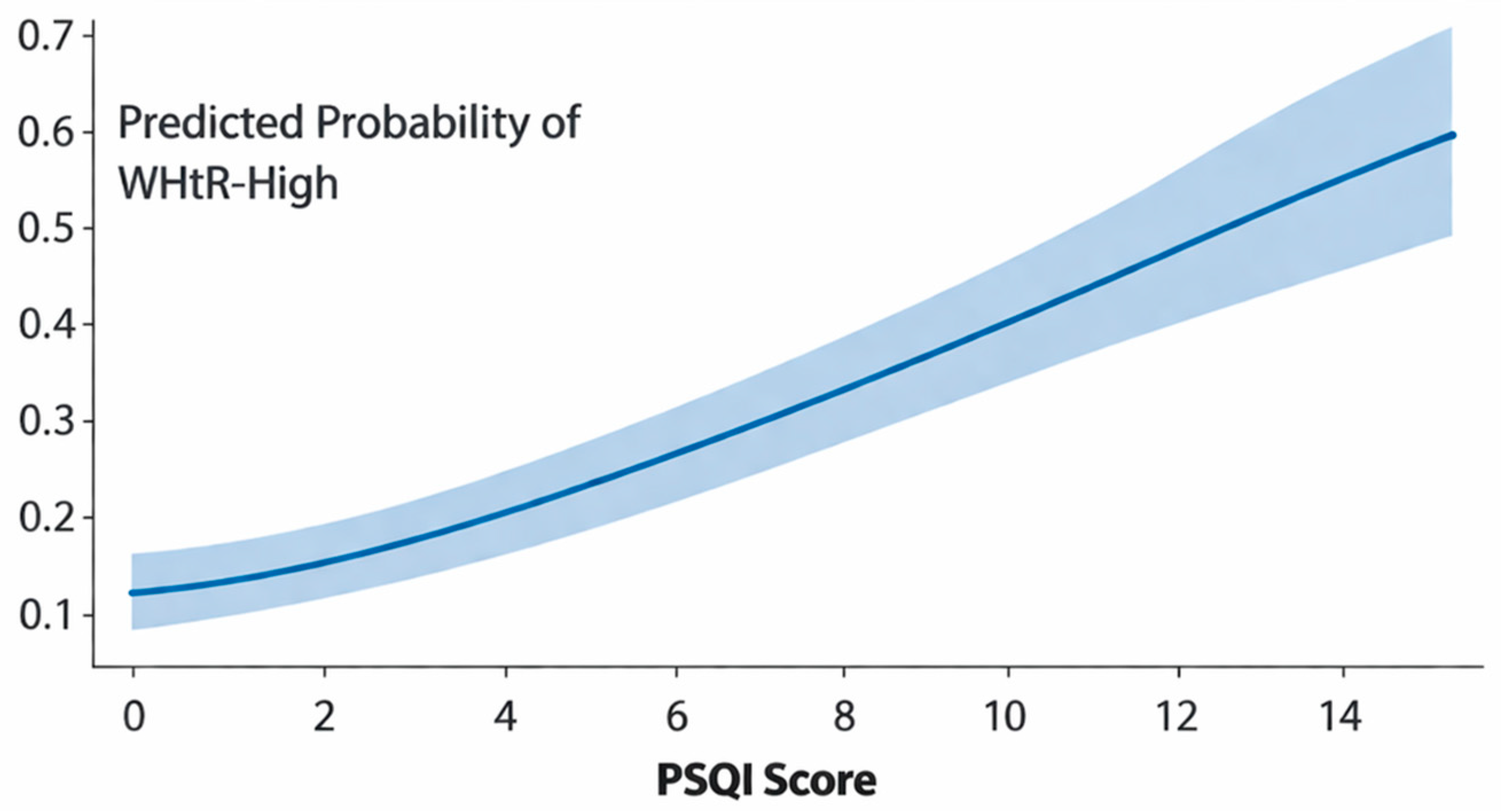
To explore the dose–response association between sleep quality and central obesity beyond the dichotomous cut-off, PSQI score was modeled as a continuous variable using restricted cubic splines (
Figure 3).
A progressive dose–response association was observed between increasing PSQI score and the probability of central obesity (WHtR-high). The relationship was approximately linear across most of the distribution, with progressively higher odds at increasing PSQI values.
Consistent dose–response patterns were observed across all adiposity indices when PSQI was modeled as a continuous variable, and results were expressed as predicted probabilities of the corresponding obesity outcomes, including BMI-defined obesity, CUN-BAE-defined obesity, and high METS-VF
(Supplementary Figures S2–S4).
Sex-stratified analyses are presented in
Table 6. Age, occupational social class, smoking, physical inactivity, low Mediterranean diet adherence, and poor sleep quality were consistently associated with both BMI-obesity and WHtR-high in men and women. Across all models, effect sizes were systematically larger in women, particularly for poor sleep and physical inactivity, indicating greater susceptibility. Sex-stratified analyses were additionally conducted for CUN-BAE and METS-VF using the same modeling approach. To maintain clarity in the main manuscript, these results are presented in the
Supplementary Materials (Supplementary Tables S5 and S6), ensuring full comparability across adiposity indices.
Table 7 shows a clear inverse dose–response relationship between the lifestyle score and obesity outcomes. Each additional healthy lifestyle component was associated with progressively lower odds of both BMI-obesity and WHtR-high, with participants scoring 3 exhibiting approximately 70–75% lower odds compared with those scoring 0 (
p-trend < 0.001).
4. Discussion
Guided by the conceptual framework presented in
Figure 1, this large occupational study demonstrates that poor sleep quality, physical inactivity, and low adherence to the Mediterranean diet are not only independent but also interacting determinants of obesity, particularly central and visceral adiposity. Among the most notable findings, poor sleep quality was associated with substantially higher odds of abdominal obesity, with stronger effects observed in women. Physical inactivity emerged as the dominant risk factor across all adiposity indices, while Mediterranean diet adherence and regular physical activity significantly attenuated the detrimental impact of poor sleep. Beyond previously reported individual associations, the main contribution of this study lies in the joint and integrative evaluation of sleep quality, physical activity, and Mediterranean diet adherence within a large occupational cohort.
These findings provide empirical support for the proposed combined effects model, indicating that lifestyle behaviors operate jointly rather than in isolation. The joint exposure analyses further showed that the coexistence of poor sleep, physical inactivity, and low Mediterranean diet adherence was associated with markedly higher odds of central obesity, suggesting cumulative adverse effects. Conversely, combining healthy behaviors conferred progressive protection against adverse adiposity profiles in working populations.
4.1. Comparison with Previous Literature
Our findings align with and extend prior evidence linking sleep disturbances to obesity and central adiposity. Large cohort studies have consistently demonstrated that poor sleep quality and reduced duration are associated with higher BMI, waist circumference, and visceral fat accumulation [
19,
20]. A recent meta-analysis reported that sleep restriction promotes positive energy balance and weight gain through increased appetite and altered hormonal regulation [
21]. Importantly, our observation that women are more susceptible to the adverse effects of poor sleep parallels reports from both clinical and population-based studies, which suggest that hormonal, behavioral, and psychosocial factors may contribute to sex-specific vulnerabilities [
22].
Physical inactivity showed the strongest associations with obesity indices in our cohort, confirming its central role in adiposity development. Evidence from prospective studies highlights that higher levels of physical activity reduce visceral adipose tissue independent of diet [
23], and workplace-based interventions have shown beneficial effects on weight and metabolic risk [
24]. The interaction between sleep quality and physical activity observed in our study is supported by recent reports indicating that regular exercise may buffer the metabolic consequences of inadequate sleep [
25].
Dietary quality, assessed through adherence to the Mediterranean diet, was another strong determinant. Previous research has shown that the Mediterranean diet not only reduces the risk of obesity but also improves sleep quality [
26]. Our results indicate that diet may attenuate the impact of poor sleep on adiposity, supporting mechanistic studies highlighting anti-inflammatory and chrono-nutritional effects of Mediterranean dietary patterns [
27].
The consistency of results across four different obesity indices—including BMI, WtHR, CUN-BAE, and METS-VF—underscores the robustness of our findings. Prior studies have indicated that BMI underestimates adiposity and fails to capture central fat distribution, while indices such as WHtR and METS-VF better predict cardiometabolic risk [
28,
29]. Our work adds to this literature by demonstrating that lifestyle factors exert similar, yet more pronounced effects when obesity is assessed using refined measures of central and visceral adiposity. Importantly, these findings reflect combined and modifying effects rather than formally demonstrated biological synergy. To our knowledge, this is one of the largest occupational studies to simultaneously examine sleep quality, diet, and physical activity in relation to multiple adiposity phenotypes, including central and visceral obesity. Unlike most previous studies relying solely on BMI, our study incorporates multiple complementary indices (WHtR, CUN-BAE, and METS-VF), allowing a more precise characterization of central and visceral adiposity and strengthening the consistency of the findings.
In addition, tobacco consumption deserves consideration in the context of obesity. Although smoking has traditionally been associated with lower body weight due to appetite-suppressing and metabolic effects, accumulating evidence indicates a complex and paradoxical relationship. Current smokers in our cohort showed higher odds of obesity across all indices, consistent with reports linking smoking to greater central fat accumulation and adverse metabolic profiles despite lower average BMI in some populations. Recent occupational studies have highlighted that smoking may exacerbate visceral adiposity and cardiometabolic risk, possibly through chronic inflammation, oxidative stress, and unfavorable fat distribution rather than total body weight reduction [
30]. These findings suggest that the apparent protective effect of smoking on body weight is misleading and reinforce the need for comprehensive workplace health interventions that address smoking cessation alongside diet, physical activity, and sleep hygiene.
4.2. Interaction Effects and Sex Differences
The interaction analyses underscore that the impact of poor sleep on obesity is not uniform across the population. Women appeared particularly susceptible, which may reflect sex-specific pathways involving hormonal regulation, circadian rhythms, and psychosocial stressors [
31]. Furthermore, physical activity attenuated the association between poor sleep and both general and central obesity. These findings suggest that workplace health promotion strategies should adopt an integrated approach that simultaneously targets sleep hygiene and regular physical activity, especially among women and inactive employees. However, these interactions should be interpreted as effect modification rather than evidence of biological synergy, as additive interaction was not formally assessed. This approach goes beyond independent effects and provides evidence on the interaction and synergy between lifestyle behaviors, an aspect that remains insufficiently explored in large-scale epidemiological studies.
Socioeconomic position also emerged as a relevant determinant of obesity. We observed a clear gradient, with workers in lower occupational classes exhibiting higher odds of obesity across all indices. These findings are consistent with previous European and Spanish studies showing that lower socioeconomic status is associated with greater central adiposity and higher cardiometabolic burden, largely explained by differences in diet quality, physical activity opportunities, and psychosocial stressors [
32]. Importantly, the persistence of this gradient after adjustment for lifestyle behaviors suggests that structural and contextual factors—such as work conditions, economic insecurity, and access to health-promoting resources—play a substantial role. Our results, therefore, highlight the need for equity-oriented public health strategies specifically targeting obesity prevention in lower occupational classes, where lifestyle interventions alone may not fully counterbalance social determinants.
An additional interaction between adherence to the Mediterranean diet and sleep quality revealed that diet may buffer the adverse effect of poor sleep. Among workers not adhering to a Mediterranean dietary pattern, poor sleep was strongly associated with both BMI-defined obesity and abdominal obesity, whereas among adherents the magnitude of these associations was substantially weaker. These findings reinforce previous evidence that the Mediterranean diet confers combined metabolic benefits and may help mitigate behavioral or circadian disruptions [
33,
34].
In this context, our study contributes to the literature by providing robust evidence from a large occupational cohort in which these factors have rarely been evaluated simultaneously.
4.3. Strengths and Limitations
The main strengths of this study include its exceptionally large sample size, the standardized collection of anthropometric and lifestyle data, and the use of multiple validated indices to capture different dimensions of obesity, including central obesity (WHtR) and visceral adiposity estimated by METS-VF. The comprehensive assessment of sleep quality, Mediterranean diet adherence, and physical activity within the same population enabled evaluation of both independent and interacting lifestyle effects. Moreover, modeling sleep quality as both a categorical and continuous exposure using restricted cubic splines provided a nuanced assessment of dose–response relationships. However, dose–response analyses using restricted cubic splines were not presented uniformly across all adiposity indices, which may limit the comparability of non-linear associations. The inclusion of workers across diverse occupational sectors further enhances the relevance of findings for the active working population.
Nevertheless, certain limitations should be acknowledged. First, the cross-sectional design precludes causal inference, and reverse causality cannot be ruled out, as obesity itself may impair sleep quality or reduce physical activity. Second, lifestyle factors were self-reported, which may introduce recall or social desirability bias, although validated instruments (PSQI, IPAQ, MEDAS) were used to mitigate this limitation. Third, residual confounding from unmeasured factors such as psychological stress or chronotype remains possible. Additionally, specific occupational factors such as shift work or occupational physical activity were not available in this cohort and could not be included in the analyses, which may contribute to residual confounding. Missing data were handled using complete-case analysis, which may introduce selection bias if excluded participants differ systematically from those included. Although sensitivity analyses using alternative PSQI cut-offs and exclusion of extreme anthropometric values yielded consistent results, the potential impact of this approach on the representativeness of the sample cannot be fully ruled out. However, given the large sample size and the consistency of associations across multiple adiposity indices, the overall impact of potential selection bias is likely limited, although it should be considered when interpreting the findings. Additionally, although interaction analyses were performed, the study did not assess additive interaction using formal measures (e.g., RERI or attributable proportion), which limits the ability to infer true biological synergy between lifestyle factors. In addition, METS-VF provides an indirect estimate of visceral adiposity and was not validated against imaging in this cohort. Finally, the study population consisted exclusively of actively employed adults, which may underestimate the true burden of obesity compared with unemployed or retired populations, but increases applicability to workplace health strategies.
4.4. Implications for Public Health and Occupational Health
These findings have important implications for both public health and occupational health policies. The workplace represents a strategic setting for implementing lifestyle interventions targeting diet, physical activity, and sleep hygiene. Given the observed combined effects, these findings support the need for integrated strategies addressing multiple lifestyle behaviors simultaneously, rather than isolated interventions. In particular, promoting sleep health should be considered a priority in occupational health strategies, as sleep remains an underrecognized determinant of obesity. Given the observed synergistic effects, these findings support the need for integrated strategies addressing multiple lifestyle behaviors simultaneously, rather than isolated interventions.
From a broader perspective, the observed socioeconomic gradients highlight the need for equity-oriented policies. Workers in lower occupational classes were disproportionately affected, suggesting that structural interventions—such as flexible work schedules, access to healthy food options, and workplace exercise programs—are essential to reduce inequalities in obesity risk.
In summary, this large occupational study shows that poor sleep quality, physical inactivity, and low adherence to the Mediterranean diet act jointly to shape central and visceral adiposity. Addressing these modifiable factors through integrated workplace health programs may represent an effective and scalable strategy to curb the growing burden of obesity and its cardiometabolic consequences, particularly among socioeconomically vulnerable workers.
5. Conclusions
This large occupational study demonstrates that poor sleep quality, physical inactivity, and low adherence to the Mediterranean diet act as independent and combined determinants of obesity, with particularly strong effects on central and visceral adiposity. Women appeared more susceptible to the adverse impact of poor sleep, while both physical activity and dietary adherence significantly attenuated these associations. The graded inverse relationship observed with the composite lifestyle score highlights the cumulative benefits of adopting multiple healthy behaviors simultaneously.
Our findings also emphasize the importance of moving beyond traditional anthropometric measures such as BMI and incorporating indices that better reflect adiposity distribution, including WHtR, CUN-BAE, and METS-VF. By capturing different dimensions of obesity, these tools provide a more comprehensive understanding of how lifestyle factors influence adverse fat accumulation.
From a public health and occupational health perspective, integrated interventions promoting sleep hygiene, regular physical activity, and Mediterranean diet adherence may substantially reduce obesity risk among workers. Tailored strategies addressing sex differences and socioeconomic disparities are especially warranted. Overall, workplace-based, multifaceted health promotion programs represent a promising and scalable approach to mitigate obesity and its cardiometabolic consequences.
Supplementary Materials
The following supporting information can be downloaded at:
https://www.mdpi.com/article/10.3390/obesities6020021/s1. Figure S1. Social gradient in obesity outcomes. Figure S2. Dose-response relationship between PSQI score and METS-VF (continuous). Figure S3. Dose-response relationship between PSQI score and probability of BMI-defined obesity. Figure S4. Predicted Probability of BMI. Table S1. Odds ratios (95%CI) per increment in social class (I→III) for BMI-obesity and WtHR-high. Table S2. Joint associations with BMI-defined obesity. Table S3. Joint associations with CUN-BAE-defined obesity. Table S4. Joint associations with METS-VF-defined visceral obesity. Table S5. Sex-stratified association between lifestyle factors and CUN-BAE-defined obesity. Table S6. Sex-stratified association between lifestyle factors and high METS-VF.
Author Contributions
Conceptualization: L.L.V., J.O.d.H. and Á.A.L.-G.; Data collection and analysis: P.J.T.L., C.B.-C. and L.L.V.; Data curation: L.L.V. and P.J.T.L. Methodology: Á.A.L.-G., M.T.V.H. and C.B.-C. Validation: J.I.R.-M.; Formal analysis: M.T.V.H. and J.O.d.H.; Investigation L.L.V.; Draft: L.L.V., P.J.T.L., C.B.-C. and J.I.R.-M., and Revision: Á.A.L.-G., J.O.d.H., M.T.V.H. and J.I.R.-M. All authors have read and agreed to the published version of the manuscript.
Funding
This study was conducted independently and did not receive financial support from external agencies, institutional grants, or sponsorship from either public or private organizations.
Institutional Review Board Statement
All procedures complied with national and international ethical standards for biomedical research, including the principles of the Declaration of Helsinki. The study protocol was approved by the Research Ethics Committee of the Balearic Islands (CEI-IB; reference IB 4383/20, approval date 26 November 2020). Participation was voluntary, and all individuals provided written informed consent after receiving comprehensive information about the study’s aims, procedures, and scope. To safeguard confidentiality, personal identifiers were encrypted and accessible only to the principal investigator. The study fully adhered to Spain’s Organic Law 3/2018 on Personal Data Protection and Digital Rights and to the General Data Protection Regulation (EU Regulation 2016/679). Participants were informed of their legal rights regarding access, rectification, erasure, and objection to the processing of personal data.
Informed Consent Statement
Informed consent was obtained from all subjects involved in the study.
Data Availability Statement
All data generated or analyzed in this study are securely stored at ADEMA University School and managed in strict compliance with data protection regulations. Oversight is ensured by the institutional Data Protection Officer, Ángel Arturo López González.
Acknowledgments
The authors express their sincere gratitude to all participants for their invaluable contribution, which was fundamental to the success of this research. We also thank the occupational health professionals and data management teams for their essential work in the collection, anonymization, and processing of clinical and lifestyle data. Special recognition is extended to the technical and administrative staff of ADEMA University School for their ongoing support, as well as to the collaborating institutions that provided infrastructure and database access critical to the study’s execution.
Conflicts of Interest
The authors declare no conflicts of interest, financial or otherwise, regarding the design, conduct, interpretation, or publication of this research.
Abbreviations
The following abbreviations are used in this manuscript:
| BMI | Body Mass Index |
| BP | Blood Pressure |
| CI | Confidence Interval |
| CUN-BAE | Clínica Universidad de Navarra–Body Adiposity Estimator |
| HDL-c | High-Density Lipoprotein Cholesterol |
| IPAQ | International Physical Activity Questionnaire |
| LDL-c | Low-Density Lipoprotein Cholesterol |
| MEDAS | Mediterranean Diet Adherence Screener |
| METS-VF | Metabolic Score for Visceral Fat |
| OR | Odds Ratio |
| PSQI | Pittsburgh Sleep Quality Index |
| SD | Standard Deviation |
| VIF | Variance Inflation Factor |
| WtHR | Waist-to-Height Ratio |
References
- Gómez-Ambrosi, J.; Silva, C.; Catalán, V.; Rodríguez, A.; Galofré, J.C.; Escalada, J.; Valentí, V.; Rotellar, F.; Romero, S.; Ramírez, B.; et al. Clinical usefulness of a new equation for estimating body fat. Diabetes Care 2012, 35, 383–388. [Google Scholar] [CrossRef] [Scilit] [PubMed] [PubMed Central]
- Liu, Q.; Cui, H.; Si, F.; Wu, Y.; Yu, J. Association of Cumulative Exposure to Metabolic Score for Visceral Fat with the Risk of Cardiovascular Disease and All-Cause Mortality: A Prospective Cohort Study. J. Cachexia Sarcopenia Muscle 2025, 16, e13702. [Google Scholar] [CrossRef] [Scilit] [PubMed] [PubMed Central]
- Jia, S.; Huo, X.; Zuo, X.; Zhao, L.; Liu, L.; Sun, L.; Chen, X. Association of metabolic score for visceral fat with all-cause mortality, cardiovascular mortality, and cancer mortality: A prospective cohort study. Diabetes Obes. Metab. 2024, 26, 5870–5881. [Google Scholar] [CrossRef] [Scilit] [PubMed]
- Chaput, J.-P.; McHill, A.W.; Cox, R.C.; Broussard, J.L.; Dutil, C.; da Costa, B.G.G.; Sampasa-Kanyinga, H.; Wright, K.P. The role of insufficient sleep and circadian misalignment in obesity. Nat. Rev. Endocrinol. 2023, 19, 82–97. [Google Scholar] [CrossRef] [Scilit] [PubMed] [PubMed Central]
- Covassin, N.; Singh, P.; McCrady-Spitzer, S.K.; Louis, E.K.S.; Calvin, A.D.; Levine, J.A.; Somers, V.K. Effects of Experimental Sleep Restriction on Energy Intake, Energy Expenditure, and Visceral Obesity. J. Am. Coll. Cardiol. 2022, 79, 1254–1265. [Google Scholar] [CrossRef] [Scilit] [PubMed] [PubMed Central]
- Markwald, R.R.; Melanson, E.L.; Smith, M.R.; Higgins, J.; Perreault, L.; Eckel, R.H.; Wright, K.P. Impact of insufficient sleep on total daily energy expenditure, food intake, and weight gain. Proc. Natl. Acad. Sci. USA 2013, 110, 5695–5700. [Google Scholar] [CrossRef] [Scilit] [PubMed] [PubMed Central]
- Torun, C.; Ankaralı, H.; Caştur, L.; Uzunlulu, M.; Erbakan, A.N.; Akbaş, M.M.; Gündüz, N.; Doğan, M.B.; Oğuz, A. Is Metabolic Score for Visceral Fat (METS-VF) a Better Index Than Other Adiposity Indices for the Prediction of Visceral Adiposity. Diabetes Metab. Syndr. Obes. 2023, 16, 2605–2615. [Google Scholar] [CrossRef] [Scilit] [PubMed] [PubMed Central]
- Martínez-González, M.A.; García-Arellano, A.; Toledo, E.; Salas-Salvadó, J.; Buil-Cosiales, P.; Corella, D.; Covas, M.I.; Schröder, H.; Arós, F.; Gómez-Gracia, E.; et al. A 14-item Mediterranean diet assessment tool and obesity indexes among high-risk subjects: The PREDIMED trial. PLoS ONE 2012, 7, e43134. [Google Scholar] [CrossRef] [Scilit] [PubMed] [PubMed Central]
- Godos, J.; Ferri, R.; Lanza, G.; Caraci, F.; Vistorte, A.O.R.; Torres, V.Y.; Grosso, G.; Castellano, S. Mediterranean Diet and Sleep Features: A Systematic Review of Current Evidence. Nutrients 2024, 16, 282. [Google Scholar] [CrossRef] [Scilit] [PubMed] [PubMed Central]
- Scoditti, E.; Tumolo, M.R.; Garbarino, S. Mediterranean Diet on Sleep: A Health Alliance. Nutrients 2022, 14, 2998. [Google Scholar] [CrossRef] [Scilit] [PubMed] [PubMed Central]
- Ross, R.; Neeland, I.J.; Yamashita, S.; Shai, I.; Seidell, J.; Magni, P.; Santos, R.D.; Arsenault, B.; Cuevas, A.; Hu, F.B.; et al. Waist circumference as a vital sign in clinical practice: A Consensus Statement from the IAS and ICCR Working Group on Visceral Obesity. Nat. Rev. Endocrinol. 2020, 16, 177–189. [Google Scholar] [CrossRef] [Scilit] [PubMed] [PubMed Central]
- Dolezal, B.A.; Neufeld, E.V.; Boland, D.M.; Martin, J.L.; Cooper, C.B. Interrelationship between Sleep and Exercise: A Systematic Review. Adv. Prev. Med. 2017, 2017, 1364387, Erratum in Adv. Prev. Med. 2017, 2017, 5979510. https://doi.org/10.1155/2017/5979510. [Google Scholar] [CrossRef] [Scilit] [PubMed] [PubMed Central]
- Aguiló Juanola, M.C.; López-González, A.A.; Tomás-Gil, P.; Paublini, H.; Tárraga-López, P.J.; Ramírez-Manent, J.I. Influence of tobacco consumption and other variables on the values of different cardiovascular risk factors in 418,343 Spanish workers. Acad. J. Health Sci. 2024, 39, 89–95. [Google Scholar] [CrossRef]
- Mestre-Font, M.; Busquets-Cortés, C.; Ramírez-Manent, J.I.; Tomás-Gil, P.; Paublini, H.; López-González, A.A. Influence of sociodemographic variables and healthy habits on the values of type 2 diabetes risk scales. Acad. J. Health Sci. 2024, 39, 99–106. [Google Scholar] [CrossRef]
- Mestre Font, M.; Busquets-Cortés, C.; Ramírez-Manent, J.I.; Vallejos, D.; Sastre Alzamora, T.; López-González, A.A. Influence of sociodemographic variables and healthy habits on the values of cardiometabolic risk scales in 386,924 Spanish workers. Acad. J. Health Sci. 2024, 39, 112–121. [Google Scholar] [CrossRef]
- Zitser, J.; Allen, I.E.; Falgàs, N.; Le, M.M.; Neylan, T.C.; Kramer, J.H.; Walsh, C.M. Pittsburgh Sleep Quality Index (PSQI) responses are modulated by total sleep time and wake after sleep onset in healthy older adults. PLoS ONE 2022, 17, e0270095. [Google Scholar] [CrossRef] [Scilit] [PubMed] [PubMed Central]
- Tosoratto, J.; Carriedo, B.; Cantón, C. Cardiometabolic risk level in 43074 Spanish office workers: Associated variables. Acad. J. Health Sci. 2024, 39, 48–56. [Google Scholar] [CrossRef]
- Bello-Chavolla, O.Y.; Antonio-Villa, N.E.; Vargas-Vázquez, A.; Viveros-Ruiz, T.L.; Almeda-Valdes, P.; Gomez-Velasco, D.; Mehta, R.; Elias-López, D.; Cruz-Bautista, I.; Roldán-Valadez, E.; et al. Metabolic Score for Visceral Fat (METS-VF), a novel estimator of intra-abdominal fat content and cardio-metabolic health. Clin. Nutr. 2020, 39, 1613–1621. [Google Scholar] [CrossRef] [Scilit] [PubMed]
- Itani, O.; Jike, M.; Watanabe, N.; Kaneita, Y. Short sleep duration and health outcomes: A systematic review, meta-analysis, and meta-regression. Sleep Med. 2017, 32, 246–256. [Google Scholar] [CrossRef] [Scilit] [PubMed]
- St-Onge, M.P.; Mikic, A.; Pietrolungo, C.E. Effects of Diet on Sleep Quality. Adv. Nutr. 2016, 7, 938–949. [Google Scholar] [CrossRef] [Scilit] [PubMed] [PubMed Central]
- Depner, C.M.; Stothard, E.R.; Wright, K.P., Jr. Metabolic consequences of sleep and circadian disorders. Curr. Diab. Rep. 2014, 14, 507. [Google Scholar] [CrossRef] [Scilit] [PubMed] [PubMed Central]
- Grandner, M.A.; Alfonso-Miller, P.; Fernandez-Mendoza, J.; Shetty, S.; Shenoy, S.; Combs, D. Sleep: Important considerations for the prevention of cardiovascular disease. Curr. Opin. Cardiol. 2016, 31, 551–565. [Google Scholar] [CrossRef] [Scilit] [PubMed] [PubMed Central]
- Zhuo, H.; Zhang, X. Dose-response relationships of physical activity with bone mineral density and muscle mass in visceral obesity: A metabolic heterogeneity perspective. PLoS ONE 2025, 20, e0327987. [Google Scholar] [CrossRef] [Scilit] [PubMed] [PubMed Central]
- Ramezani, M.; Tayefi, B.; Zandian, E.; SoleimanvandiAzar, N.; Khalili, N.; Hoveidamanesh, S.; Massahikhaleghi, P.; Rampisheh, Z. Workplace interventions for increasing physical activity in employees: A systematic review. J. Occup. Health. 2022, 64, e12358. [Google Scholar] [CrossRef] [Scilit] [PubMed] [PubMed Central]
- Chou, F.-Y.; Chiu, T.-F.; Huang, F.-W.; Hsu, T.-Y.; Liu, C.-Y.; Lin, C.-H.; Huang, P.-Y.; Lin, K.-M.; Wu, S.-H. The effect of exercise on the risk of metabolic syndrome associated with sleep insufficiency: A cross-sectional study. Front. Cardiovasc. Med. 2023, 10, 1192241. [Google Scholar] [CrossRef] [Scilit] [PubMed] [PubMed Central]
- Godos, J.; Grosso, G.; Castellano, S.; Galvano, F.; Caraci, F.; Ferri, R. Association between diet and sleep quality: A systematic review. Sleep Med. Rev. 2021, 57, 101430. [Google Scholar] [CrossRef] [Scilit] [PubMed]
- Fallah, M.; Aminianfar, A.; Esmaillzadeh, A. Mediterranean diet adherence and sleep pattern: A systematic review of observational studies. BMC Nutr. 2024, 10, 45. [Google Scholar] [CrossRef] [Scilit] [PubMed] [PubMed Central]
- Feng, Y.; Yang, X.; Li, Y.; Wu, Y.; Han, M.; Qie, R.; Huang, S.; Wu, X.; Zhang, Y.; Liu, D.; et al. Metabolic Score for Visceral Fat: A reliable indicator of visceral obesity for predicting risk for hypertension. Nutrition 2022, 93, 111443. [Google Scholar] [CrossRef] [Scilit] [PubMed]
- Wang, C.; Huang, X.; He, S.; Kuang, M.; Xie, G.; Sheng, G.; Zou, Y. The Clínica Universidad de Navarra-Body Adiposity Estimator index is a reliable tool for screening metabolic dysfunction-associated steatotic liver disease: An analysis from a gender perspective. Lipids Health Dis. 2024, 23, 311. [Google Scholar] [CrossRef] [Scilit] [PubMed] [PubMed Central]
- Aguiló Juanola, M.C.; López-González, A.A.; Tomás-Gil, P.; Paublini, H.; Tárraga-López, P.J.; Ramírez-Manent, J.I. Influence of tobacco consumption on the values of different cardiometabolic risk scales in 418,343 Spanish workers. Acad. J. Health Sci. 2024, 39, 92–98. [Google Scholar] [CrossRef]
- Mallampalli, M.P.; Carter, C.L. Exploring sex and gender differences in sleep health: A Society for Women’s Health Research Report. J. Womens Health 2014, 23, 553–562. [Google Scholar] [CrossRef] [Scilit] [PubMed] [PubMed Central]
- Dinsa, G.D.; Goryakin, Y.; Fumagalli, E.; Suhrcke, M. Obesity and socioeconomic status in developing countries: A systematic review. Obes. Rev. 2012, 13, 1067–1079. [Google Scholar] [CrossRef] [Scilit] [PubMed] [PubMed Central]
- Wilson, K.; St-Onge, M.P.; Tasali, E. Diet Composition and Objectively Assessed Sleep Quality: A Narrative Review. J. Acad. Nutr. Diet. 2022, 122, 1182–1195. [Google Scholar] [CrossRef] [Scilit] [PubMed] [PubMed Central]
- Martínez-González, M.Á.; Hershey, M.S.; Zazpe, I.; Trichopoulou, A. Transferability of the Mediterranean Diet to Non-Mediterranean Countries. What Is and What Is Not the Mediterranean Diet. Nutrients 2017, 9, 1226, Erratum in Nutrients 2018, 10, 823. https://doi.org/10.3390/nu10070823. [Google Scholar] [CrossRef] [Scilit] [PubMed] [PubMed Central]
| Disclaimer/Publisher’s Note: The statements, opinions and data contained in all publications are solely those of the individual author(s) and contributor(s) and not of MDPI and/or the editor(s). MDPI and/or the editor(s) disclaim responsibility for any injury to people or property resulting from any ideas, methods, instructions or products referred to in the content. |




 ,
,