Article

Analysis of Hydrogen Storage Methods for Decarbonizing Maritime Transport: A Multi-Criteria Decision Analysis Tool


by
Rocio Maceiras
1,*,
Victor Alfonsin
1,
Miguel A. Alvarez-Feijoo
2,
Jorge Feijoo
1 and
Adrian Lopez-Granados
3
1
Defense University Center at the Spanish Naval Academy of Marin (CUD-ENM), 36920 Marin, Spain
2
Faculty of Industrial Engineering, Department of Engineering Design, University of Vigo, 36310 Vigo, Spain
3
Spanish Naval Academy of Marin, 36920 Marin, Spain
*
Author to whom correspondence should be addressed.
Hydrogen 2026, 7(2), 61; https://doi.org/10.3390/hydrogen7020061
Submission received: 31 March 2026 / Revised: 27 April 2026 / Accepted: 29 April 2026 / Published: 2 May 2026
(This article belongs to the Special Issue Women’s Special Issue Series: Hydrogen)

Abstract

Decarbonizing maritime transport requires hydrogen storage technologies that are efficient, safe, and compatible with fuel cell systems. This study evaluates three hydrogen storage technologies (compressed hydrogen (CH2), liquid hydrogen (LH2), and metal hydrides (MH)) based on five key criteria: safety, autonomy, environmental impact, cost, and implementation feasibility. Applying two multi-criteria decision-making (MCDM) methods, Analytic Hierarchy Process (AHP) and Technique for Order Preference by Similarity to Ideal Solution (TOPSIS), the alternatives are systematically ranked to identify the most suitable option. Both methods consistently highlight compressed hydrogen as the most viable storage solution, offering a good balance of safety, infrastructure maturity, and economic performance. Liquid hydrogen, despite its superior autonomy, is limited by high energy and infrastructure costs. Metal hydrides, although safer and more compact in terms of volumetric density, are limited by low gravimetric efficiency at the system level due to the additional weight of the storage material and associated components.

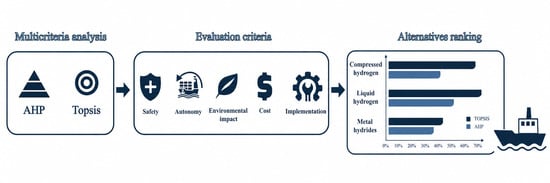
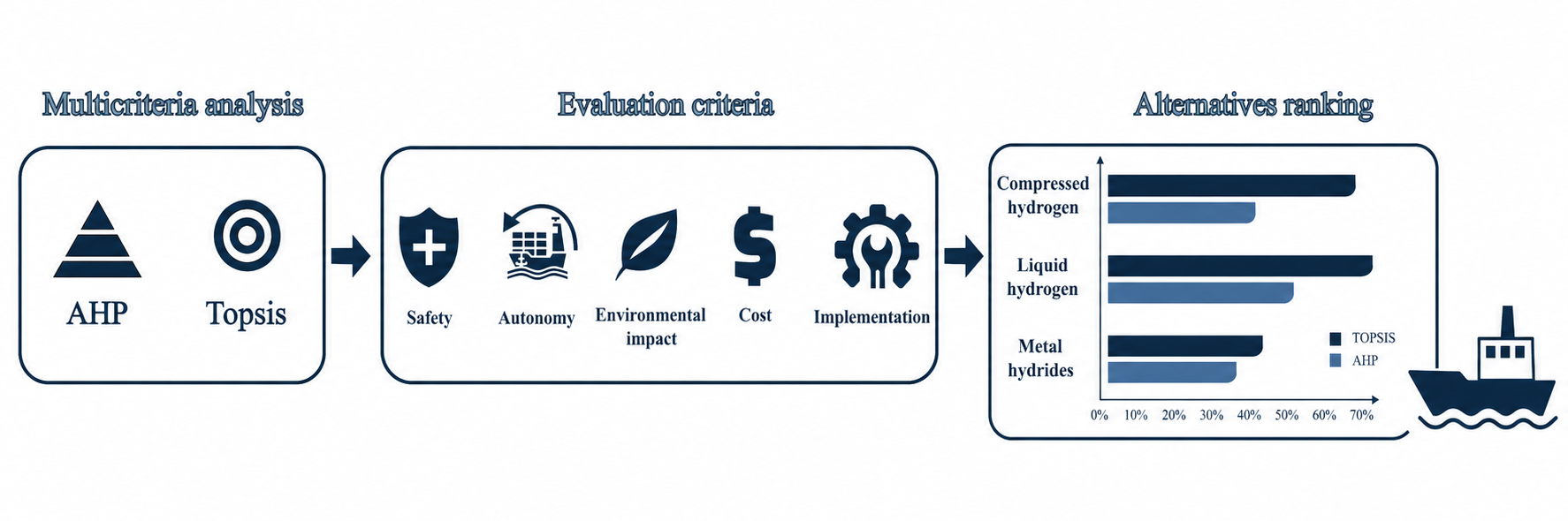
Graphical Abstract

1. Introduction

Hydrogen has emerged as a promising clean energy carrier in the global effort to decarbonize the transport sector [1]. Its use in fuel cells enables high-efficiency power generation without emitting harmful pollutants such as nitrogen oxides (NOx), sulfur oxides (SOx), carbon monoxide (CO), or carbon dioxide (CO2) [2], making it an attractive alternative to conventional fossil fuels across multiple transport modes, including road, rail, aviation, and maritime.
Despite this potential, large-scale adoption of hydrogen technologies is still hindered by critical barriers, such as the high cost of green hydrogen production and the underdevelopment of hydrogen supply infrastructure [3]. In recent years, hydrogen-powered vehicles have demonstrated technical viability, especially in long-haul trucking and public transit applications, where fast refueling and extended range offer significant advantages over battery-electric alternatives [4]. Similarly, the aviation industry explores liquid hydrogen use in modified combustion engines and fuel cell systems for future commercial flights [5]. However, maritime transport remains a particularly challenging frontier for hydrogen integration [6].
Maritime transport, while recognized as the most energy-efficient mode of cargo movement, accounts for approximately 2–3% of global greenhouse gas (GHG) emissions, a figure projected to increase by up to 50% by 2050 under current trends [7]. This has intensified efforts to explore alternative propulsion systems capable of meeting the sector’s stringent energy and environmental requirements [8].
Among the most promising technologies for shipboard decarbonization, proton exchange membrane (PEM) fuel cells stand out due to their high efficiency, modularity, and zero-emission operation [9]. These systems electrochemically convert hydrogen into electricity, producing only water and heat as byproducts. However, the effectiveness of PEM systems in maritime environments depends heavily on the suitability and stability of the onboard hydrogen storage method [10].
Hydrogen storage onboard ships presents unique technical challenges, including space limitations, safety concerns, cryogenic or high-pressure storage requirements, and integration with vessel power systems [6,11]. Economic feasibility is further constrained by high system costs and limited hydrogen bunkering infrastructure at ports [12], while regulatory gaps and the absence of standardized frameworks complicate widespread adoption.
Among the available storage options, three technologies are particularly relevant due to their technical maturity and applicability to the maritime sector: liquid hydrogen (LH2), compressed hydrogen gas (CH2), and metal hydrides (MHs). Each storage method presents distinct advantages and disadvantages in terms of energy density, safety, operating conditions, and technological readiness (Table 1). Compressed hydrogen stands out for its technological maturity and relatively simple infrastructure [13]. However, the need for heavy high-pressure tanks, energy losses during compression, and safety concerns limit its practicality for large-scale maritime applications. Liquid hydrogen offers better energy storage capacity in a compact form, making it suitable for larger vessels [14]. Yet, the energy-intensive liquefaction process and the complexity of cryogenic storage systems present significant technical and economic challenges. Metal hydrides provide a solid-state storage solution with high volumetric density and enhanced safety [15]. Despite these benefits, their low energy-to-weight ratio and the complexity of thermal management systems, along with lower technological maturity, remain key limitations [16,17].
Hydrogen storage shares similarities with conventional gaseous fuels such as methane (CH4), which can also be stored either as compressed gas (CNG) or in liquefied form (LNG). In the maritime sector, LNG has become a widely adopted solution due to its higher volumetric energy density compared to compressed gas and the development of dedicated bunkering infrastructure [6,14]. However, important differences remain, as hydrogen requires significantly lower liquefaction temperatures and presents lower volumetric energy density, which introduces additional technical and economic challenges. Therefore, while parallels can be drawn, hydrogen storage systems cannot be directly extrapolated from methane-based technologies.
The main properties of the selected hydrogen storage technologies are summarized in Table 1. The reported values correspond to hydrogen storage properties obtained from the literature and primarily refer to the storage medium or hydrogen itself. They do not explicitly account for the additional weight or volume of storage systems (e.g., tanks or auxiliary equipment), which may affect practical system-level performance. Therefore, parameters such as gravimetric efficiency at the system level may differ significantly from the values presented.
It should be noted that the CO2 emission values reported in Table 1 are indicative and primarily reflect the energy requirements associated with hydrogen storage processes (e.g., compression or liquefaction). These values do not represent a complete life-cycle assessment and may vary significantly depending on the hydrogen production pathway (e.g., green, blue, or gray hydrogen) [18,19]. Therefore, the reported emissions should be interpreted with caution when comparing different storage technologies.
Table 1. Summary of hydrogen storage technologies for maritime applications [20,21,22].
ParameterCH2 (700 bar)LH2MH
Quantitative Parameters
 Density (kg H2/m3)4070.85100–150
 Energy Content (kJ/kg)720016,8101080–3470
 Stored Energy (kJ/kg)14,88342,6006226–10,865
 Energy Losses (%)12–15 (compression)>30 (liquefaction)Heating losses
 Spent Energy/Stored Energy0.120.360.06–0.15
 CO2 Emissions (kg CO2eq/kg H2)1.343.830.66–1.58
 Operating Pressure350–700 bar1 bar2–30 bar
 Operating TemperatureAmbient20 K300–600 K
Qualitative Assessment
 Storage EfficiencyModerateLowHigh (if heat managed)
 SafetyLowMediumHigh
 Technological MaturityHighMediumLow to Medium
In Table 1, the ratio “Spent Energy/Stored Energy” represents the energy required for hydrogen storage relative to the energy content of the stored hydrogen. The reported values are based on literature data and should be considered indicative. In the case of metal hydrides, these values primarily account for the energy required for hydrogen absorption and desorption processes, and may not fully include additional energy demands associated with thermal management, which can vary depending on system design.
In addition to physical hydrogen storage methods, alternative approaches based on chemical conversion have gained increasing attention, including hydrogen carriers such as liquid organic hydrogen carriers (LOHCs), as well as hydrogen-derived fuels such as methanol [23] and ammonia [24]. These options offer advantages in terms of storage stability, transport, and compatibility with existing fuel infrastructure. However, they involve additional conversion steps, which introduce efficiency losses and increase system complexity.
This work focuses on direct hydrogen storage technologies (CH2, LH2, and MH), as they represent the most established and directly applicable solutions for integration with fuel cell systems in maritime environments. The aim of this research is to evaluate hydrogen storage technologies specifically for maritime applications. Using Multi-Criteria Decision-Making (MCDM) methodologies, the objective is to identify the most suitable storage technologies for integration into shipboard energy systems, considering the operational, technical, and economic demands specific to maritime applications.
To ensure a consistent and meaningful comparison, this study considers a representative maritime operational scenario. The analysis is focused on medium-sized vessels operating over short-to-medium distances, such as regional transport ships, ferries, or service vessels, where hydrogen infrastructure is still limited or under development. Therefore, the results should be interpreted within this specific operational context and may differ for other vessel types, such as long-distance ocean-going ships.
Under these conditions, storage technologies are evaluated assuming typical constraints in space availability, safety requirements, and refueling accessibility at ports. Large-scale transoceanic vessels and routes with established liquid hydrogen infrastructure are not the primary focus of this study. Consequently, the relative performance of the evaluated storage technologies may vary under different operational scenarios.
This study aims to provide a consistent and application-oriented comparison of hydrogen storage technologies under maritime-specific conditions. Unlike previous studies, which often focus on individual storage technologies or generic applications, this work evaluates CH2, LH2, and MH systems under a unified framework and a common set of technical, economic, and operational criteria. This approach allows for a more consistent comparison and provides practical insights for technology selection in maritime applications.

2. Hydrogen Storage Alternatives for Maritime Applications

Hydrogen storage onboard ships can be achieved through several technologies, each offering distinct benefits and limitations in terms of energy density, safety, and integration complexity [25]. Among the available options, three technologies stand out due to their technical maturity and relevance to maritime applications: compressed hydrogen gas, metal hydrides, and liquid hydrogen.

2.1. Compressed Hydrogen Gas

Compressed hydrogen (CH2) storage is the most mature and widely implemented hydrogen storage method, particularly in land-based mobility applications. Due to hydrogen’s low density at ambient conditions (0.08 kg/m3) [26], it must be compressed to pressures between 350 and 700 bar to achieve sufficient volumetric energy density for practical use.
Four main tank types (Type I to Type IV) are commonly used, classified according to their construction materials and pressure resistance [27]. Type I and II tanks, made from steel or metal composites, are more affordable but significantly heavier. In contrast, Type III and IV tanks incorporate carbon fiber composites, enabling higher operating pressure and substantial weight reduction, which makes them more suitable for maritime applications where space and mass are limited [28].
Despite its advantages in terms of simplicity and availability, compressed hydrogen poses safety risks related to high-pressure containment. Hydrogen’s wide flammability range (4–77% in air) and its high diffusion rate require robust safety protocols and corrosion-resistant piping [29]. Additionally, refueling can induce adiabatic heating, which may damage system components if not properly managed [26].
Despite these limitations, compressed hydrogen tanks have been successfully implemented in fuel cell electric vehicles such as the Toyota Mirai and Honda Clarity [30], achieving gravimetric energy densities up to ten times greater than low-pressure storage systems. In the maritime sector, compressed hydrogen is gaining traction; for instance, the H2 Barge 1, launched in 2023, became the world’s first inland cargo ship powered by hydrogen fuel cells utilizing compressed hydrogen storage [31].

2.2. Metal Hydrides

Metal hydrides (MHs) store hydrogen by chemically bonding it to solid metal alloys, allowing high volumetric storage at low pressures (typically 2–30 bar). This form of storage is particularly advantageous in terms of safety, as hydrogen is only released under controlled thermal conditions, reducing the risk of spontaneous leaks or explosions [6].
Among various hydride materials, magnesium hydride (MgH2) has received special attention due to its abundance and capacity to store up to 7.6% hydrogen by weight [32]. However, MH systems suffer from low gravimetric energy density and require substantial thermal management. Hydrogen desorption generally requires temperatures above 300 °C, and the system’s overall mass increases significantly due to the heavy metal matrix [33].
Although metal hydride systems are not yet widely implemented in commercial vessels due to their low gravimetric efficiency and thermal requirements, they have been integrated in specialized applications [15]. A notable example is the German Type 212 submarine, which uses metal hydride storage as part of its air-independent propulsion (AIP) system, demonstrating its viability in closed, controlled naval environments [34].

2.3. Liquid Hydrogen

Liquid hydrogen (LH2) is obtained by cooling hydrogen to its boiling point of −253 °C. This method achieves a high volumetric density (70 kg/m3), making it well-suited for long-range or high-capacity maritime applications [35]. Liquefaction allows large amounts of hydrogen to be stored at near-atmospheric pressure, making it suitable for long-range or high-demand maritime applications [36].
However, maintaining cryogenic conditions presents significant technical challenges. Boil-off due to heat ingress results in hydrogen losses and pressure buildup, necessitating advanced insulation and venting systems [37]. Moreover, only high-purity hydrogen can be liquefied, increasing the overall cost of production and conditioning [38]. All system components in contact with liquid hydrogen must be capable of withstanding extremely low temperatures, and ice formation poses mechanical risks such as pipe rupture or valve failure [14]. These technical complexities have limited its widespread adoption.
Nonetheless, several vessels have begun to implement liquid hydrogen technology [39]. Other projects, such as the concept vessel GAIA, are also exploring large-scale integration of liquid hydrogen systems [40], often inspired by LNG carrier technologies already in use in the maritime industry.
Table 2 summarizes the advantages and limitations of the selected hydrogen storage methods, complementing the detailed technical descriptions presented above.

3. Hydrogen-Powered Vessels

Hydrogen propulsion in maritime transport has evolved significantly over the past two decades, progressing from early experimental prototypes to commercially operational vessels [39]. This demonstrates the increasing feasibility of hydrogen as a marine fuel and reflects a variety of technological approaches to address the challenges of onboard hydrogen storage and fuel cell propulsion.
Globally, a wide range of vessels, ranging from small passenger ferries and sailboats to offshore supply ships, have been powered or are currently being developed with hydrogen-based propulsion systems. Table 3 summarizes the main hydrogen-powered vessels completed or under development, including technical specifications such as fuel cell type, storage method, vessel class, and operational status.
Europe, Japan, and China have been at the forefront of adopting hydrogen fuel cell technology [39]. In 2000, Germany’s Hydra was one of the first hydrogen-powered vessels, though it was later withdrawn from service [39]. Since then, hydrogen-powered vessels have increasingly become a viable alternative to conventional fuels in both commercial and experimental vessels.
In Europe, Norway, a pioneer in maritime innovation, launched the Viking Lady in 2009 [41], an offshore supply vessel using compressed hydrogen and molten carbonate fuel cells, and more recently, the MF Hydra, launched in 2023 as the world’s first ferry powered by liquid hydrogen and PEM fuel cells [42], operates using liquid hydrogen sourced from Germany. This supply chain involves transport times ranging from 15 to 20 h [43]. Similarly, France’s Energy Observer (2017), a research catamaran equipped with PEM fuel cells and compressed hydrogen [44], stands out for integrating multiple renewable energy sources and serving as a platform for long-distance sustainable navigation. The vessel exemplifies the potential of modular hydrogen systems for self-sufficient maritime energy.
In Asia, China has rapidly expanded its hydrogen-powered fleet. The Xinhau 1 (2021), a small cruise ship using compressed hydrogen and PEM fuel cells [45], marked the beginning of commercial-scale hydrogen maritime operations in the region. In 2023, China introduced the Sanxia Qingzhou 1, a hydrogen-powered passenger catamaran, marking a significant step towards commercializing hydrogen propulsion in China [46]. These vessels are primarily using compressed hydrogen for storage, reflecting the technology’s maturity and versatility in maritime operations.
Italy and the UK have also contributed to hydrogen ship innovation through research platforms such as Zeus [47] and Ross Barlow [48], respectively. These vessels have explored metal hydride storage technologies and advanced control systems, contributing valuable data to support future designs. The United States is currently constructing the Robert Gordon Sproul, a research vessel powered by liquid hydrogen and fuel cells, scheduled for launch in 2025 [49]. Other projects, including Norway’s Ulstein SX190 [45] and Hydrogen Viking [50], reflect a broader trend toward scaling up hydrogen systems for larger vessels, including offshore installations.
The distribution of storage technologies across these vessels reveals clear patterns: compressed hydrogen (CH2) remains the most widely used solution, particularly in small- and mid-size vessels due to its technological maturity and ease of integration. Liquid hydrogen (LH2) is emerging as the preferred option for larger ferries and long-range applications, while metal hydrides (MHs) are found mainly in niche platforms such as submarines or experimental research vessels where safety and compactness are critical [51]. These trends indicate that hydrogen propulsion is no longer limited to demonstration projects. With an increasing number of vessels entering service or advanced development, hydrogen is proving to be a technically viable and scalable alternative for a decarbonized maritime sector.
Table 3. Hydrogen-powered vessels completed and under development.
YearNameCountryH2 Energy ConversionH2 Storage MethodVessel TypeLength (m)StatusRef.
2000HydraGermanyAFCMHPassenger ship12Withdrawn[39]
2007Ross BarlowUKPEMFCMHResearch sailboat16Unknown[48]
2009Viking LadyNorwayMCFCCH2Offshore supply92.2In service[41]
2009Nemo H2NetherdlandsPEMFCCH2Passenger ship21.95In service[52]
2010MF VagenNorwayPEMFCMHPassenger ship15Unknown[39]
2017Energy ObserverFrancePEMFCCH2Research catamaran30.5In service[44]
2021Xinhau 1ChinaPEMFCCH2Small cruise ship12In service[45]
2022ZeusItalyPEMFCMHResearch sailboat25.6In service[47]
2023Sanxia Qingzhou 1ChinaPEMFCCH2Passenger catamaran49.9In service[46]
2023MF HydraNorwayPEMFCLH2Ferry82.4In service[42]
2025Robert Gordon SproulUSAPEMFCLH2Research sailboat38In construction[49]
-Ulstein SX190NorwayPEMFCLH2Offshore installation93.4In development[45]
-Hydrogen VikingNorwayPEMFCCH2Cruise ship19.4In development[50]
H2R-EvolutionFrancePEMFCCH2Research sailboat48In development[45]

4. Decision Criteria and Attributes for Hydrogen Storage Methods in Maritime Applications

To evaluate the different hydrogen storage options, Multi-Criteria Decision-Making (MCDM) methods are used. They are a set of techniques used to evaluate and prioritize alternatives that involve multiple criteria or factors. These methods are especially useful when decisions need to be made in complex environments, where trade-offs between conflicting criteria must be balanced [53]. MCDM provides a structured framework for comparing different alternatives, allowing decision-makers to systematically assess each option based on a set of predefined criteria.
For maritime applications, selecting the most appropriate hydrogen storage system requires the evaluation of multiple technical, operational, and economic factors. These factors should be clear, measurable, and directly relevant to the specific needs of hydrogen storage on board ships [54]. Given the unique operational conditions at sea, the criterion selected must reflect both the technical complexity and practical limitations of hydrogen use in the maritime environment [7].
For this study, five main criteria have been chosen to assess the suitability of various hydrogen storage methods: safety, autonomy, environmental impact, cost, and implementation. These criteria address the primary factors influencing the adoption of hydrogen storage systems in maritime operations and are aligned with the practical requirements of vessel operation. Each hydrogen storage alternative was evaluated according to these criteria.
For qualitative aspects, scores from 1 to 10 were assigned based on a comprehensive review of the literature. The available data were systematically analyzed and translated into a consistent scoring scale, ensuring comparability between technologies. Expert judgment was used to interpret and harmonize the reported information when direct quantitative comparisons were not available.
Each evaluation criterion is based on a multi-parameter assessment derived from the literature, rather than a direct mapping from a single technical parameter. The assigned scores reflect an integrated evaluation of relevant factors, such as energy density, efficiency, operating conditions, system constraints, and technological maturity, ensuring a consistent and realistic comparison between alternatives.
The results were organized into a decision matrix, which serves as the basis for applying the AHP and TOPSIS methods to identify the most suitable storage solution.

4.1. Safety

Safety is one of the most critical factors when evaluating hydrogen storage systems, particularly in maritime applications where operational conditions such as vibrations, impacts, temperature fluctuations, and limited access to maintenance increase the risks associated with hydrogen storage [55]. The inherent risks associated with hydrogen, due to its flammability, the potential for leaks, and the challenges posed by storage at high pressures or cryogenic temperatures, must be carefully managed to ensure safe operations [56]. Each hydrogen storage method has unique safety challenges based on the properties of the hydrogen storage method and the operational conditions at sea.
Compressed hydrogen (CH2) storage operates at pressures ranging from 350 to 700 bar, creating significant safety risks related to high-pressure containment. The primary concerns are the potential for high-pressure rupture, which could result in catastrophic leaks or explosions, and the flammability of hydrogen. Hydrogen’s wide flammability range with air (4–77%) and its potential to ignite in contact with oxygen (up to 95.2%) heighten the risks of accidents. Therefore, ensuring the structural integrity of storage tanks and employing effective pressure relief systems are essential for minimizing these risks. In maritime environments, where exposure to harsh conditions such as vibrations and impacts is common, the tanks must be built with reinforced materials and regularly maintained to prevent damage and ensure safety.
Liquid hydrogen (LH2) is stored at cryogenic temperatures (around −253 °C), which introduces additional safety concerns. One of the main risks with liquid hydrogen is boil-off, the process by which hydrogen evaporates due to heat ingress, which can cause pressure buildup in storage tanks. To mitigate this risk, advanced insulation systems are required to prevent heat from entering the tanks and to maintain safe operational conditions. Moreover, the extremely low temperatures present a risk of material embrittlement, making it essential to use tanks and components made from materials that can withstand these conditions. The safety protocols for liquid hydrogen are rigorous, as any leakage could rapidly expand into a gas, creating a flammable atmosphere in confined spaces. Additionally, ice formation at the storage components can lead to ruptures in pipelines or valves, highlighting the importance of regular maintenance and system checks.
Metal hydrides (MHs) store hydrogen in a solid-state form, offering several safety advantages compared to gaseous and liquid hydrogen. The hydrogen is chemically bound within the metal alloy, and its release occurs through a thermally activated desorption process, which requires heat input. This method is inherently safer because hydrogen is not released spontaneously, even in the event of damage to the storage vessel. The release of hydrogen is controlled and occurs only under specific conditions, which minimizes the risk of sudden, uncontrolled leakage. However, metal hydride systems require thermal management to ensure efficient hydrogen desorption, which can add complexity to the system and increase the risk of overheating if not properly regulated. While operating at relatively low pressures, the storage capacity of metal hydrides is limited by their gravimetric energy density. Nonetheless, their solid-state nature reduces the likelihood of catastrophic failure compared to compressed and liquid hydrogen storage.
In addition to these technical factors, safety also depends on the handling and storage conditions throughout the life cycle of the vessel, including during transportation, refueling, and routine maintenance. The technology is expected to meet or exceed current safety standards, and carriers must comply with safety regulations set by the flag state and classification societies. High operating temperatures and reaction enthalpies are avoided in the design of storage systems, as they may pose additional safety concerns during operation [56]. Effective heat management is essential to mitigate these risks, particularly in systems that operate at elevated temperatures or cryogenic conditions.
To evaluate the safety criterion, the risk of leakage, potential for explosions, and ease of incident detection were considered for each storage method. Additionally, existing regulations and safety protocols governing the use of hydrogen onboard vessels were taken into account [55,57]. These factors are jointly considered to provide an integrated safety assessment of each storage technology. Based on these factors, the hydrogen storage methods were assigned ratings as follows: 7 points for metal hydrides (MHs) due to their solid-state storage and controlled hydrogen release, which minimizes the risk of sudden leaks or explosions. 6 points for compressed hydrogen (CH2), as it operates at high pressures, presenting significant risks of rupture and explosion, but it benefits from advanced safety measures and protocols. 5 points for liquid hydrogen (LH2), as its cryogenic temperatures introduce additional risks of boil-off and material embrittlement, though significant advancements in safety protocols have mitigated many of these concerns in recent years [19].

4.2. Autonomy

Autonomy is considered a combination of the storage capacity and efficiency of each hydrogen storage method, evaluating how well a storage system can meet the energy demands of the vessel over extended periods without requiring frequent refueling. In maritime applications, unlike land-based systems, hydrogen refueling stations do not exist, and vessels that can serve as floating “hydrogen stations” are still in development. Therefore, it is necessary that the stored hydrogen allows vessels to cover minimum distances without the risk of running out of fuel. For that reason, this criterion is essential for long-range operations where maintaining fuel availability is critical.
Compressed hydrogen requires large tanks due to its relatively low volumetric energy density, meaning that larger storage volumes are necessary to store sufficient hydrogen for long journeys. Despite this limitation, compressed hydrogen offers a high energy efficiency, allowing for effective energy use. While compressed hydrogen provides a feasible solution for smaller vessels or short trips, the need for large storage volumes can restrict autonomy on longer routes or for larger vessels, where maximizing the available space is an important factor.
Liquid hydrogen offers a much higher volumetric energy density than compressed hydrogen, enabling larger amounts of hydrogen to be stored in a compact space. This advantage makes LH2 an ideal solution for vessels requiring extended range or long-duration missions. However, efficiency is somewhat reduced due to the evaporation losses (boil-off), which occur as a result of heat ingress. Despite this, liquid hydrogen offers superior autonomy for long-range vessels, and the reduction in space needed for fuel storage allows for more operational flexibility on larger vessels.
Metal hydrides store hydrogen in a solid-state form, offering high volumetric energy density. However, the significant downside of this method is the weight of the storage system. The high mass of the hydride materials increases the vessel’s displacement considerably, which, in turn, reduces the overall autonomy of the ship. This trade-off between storage density and the weight penalty of metal hydrides makes them less suitable for large vessels or those requiring high autonomy, especially for long-range operations [19].
The autonomy criterion is evaluated based on a combination of factors, including gravimetric and volumetric energy density, storage conditions, and system-level constraints, rather than a single parameter.
Based on the evaluation of the autonomy criterion, the hydrogen storage methods were assigned ratings reflecting their impact on vessel range and fuel efficiency as follows: 7 points for liquid hydrogen (LH2) due to its high volumetric energy density and suitability for long-range operations, 5 points for compressed hydrogen (CH2) because it provides good efficiency but requires larger storage volumes, which limits autonomy for larger vessels, and 3 points for metal hydrides (MHs) due to their high storage density but significant weight increase, which adversely affects the vessel’s autonomy.

4.3. Environmental Impact

Hydrogen has emerged as a key energy carrier in the transition toward a more sustainable energy model. The development of hydrogen storage alternatives with minimal environmental impact is crucial to support efforts in mitigating climate change and reducing overall emissions. Therefore, environmental impact is considered an essential criterion in evaluating the hydrogen storage methods for maritime applications.
Each hydrogen storage method has distinct environmental implications, and these must be considered in terms of both emissions and the resources required for the storage and handling of hydrogen. Here, we will examine the factors that influence the environmental impact of each method before assigning the respective ratings:
Compressed hydrogen storage generates moderate emissions during the compression process. However, compared to other methods, it benefits from recyclable tank materials and relatively low energy consumption. The environmental impact of the storage system is thus primarily driven by the compression process, but its footprint is less pronounced than that of liquid hydrogen. The production and use of materials like carbon fiber for high-pressure tanks are increasingly becoming more sustainable, contributing to a lower overall environmental impact for this storage method.
Liquid hydrogen storage presents a higher environmental cost due to the energy-intensive liquefaction process, which involves cooling hydrogen to cryogenic temperatures (−253 °C). This process consumes a significant amount of energy, leading to a high carbon footprint. Moreover, the low recyclability of the materials used in the cryogenic tanks adds to the environmental burden, as specialized processes are required to handle these materials after their lifecycle ends. While liquid hydrogen offers high volumetric energy density, the trade-off is that its production and storage involve substantial environmental costs in terms of energy use and waste management.
Metal hydrides store hydrogen in a solid-state form, which offers a relatively low environmental footprint in terms of operational energy consumption, as the energy required is mainly for hydrogen release through thermal desorption. Unlike compressed and liquid hydrogen, metal hydride systems do not need significant energy to maintain storage conditions under normal operation. However, the recycling of metal hydrides is more complex, as it requires specialized processes to recover the metals used in the storage system [58,59]. Despite this, the overall environmental impact during the storage phase is lower compared to compressed and liquid hydrogen.
It should be noted that the environmental impact criterion is not based solely on the indicative CO2 emission values reported in Table 1, but also considers additional factors such as energy efficiency, energy losses during storage processes, material requirements, and system complexity. Therefore, although metal hydrides may present lower indicative CO2 emissions, their overall environmental performance is influenced by factors such as material processing and recycling constraints.
Based on this comprehensive evaluation, the hydrogen storage methods were assigned ratings reflecting their relative environmental costs as follows: 7 points for compressed hydrogen (CH2) due to its moderate emissions during compression and the recyclability of its storage tanks, making it the most environmentally friendly option. Liquid hydrogen (LH2) garnered a score of 4 points, as the high carbon footprint associated with the energy-intensive liquefaction process and the low recyclability of cryogenic tank materials result in a higher environmental impact. Metal hydrides (MHs) had six points, as they offer low operational energy requirements and a reduced environmental footprint during storage, but their overall impact is affected by the complexity of material recycling.

4.4. Cost

Cost is a key factor in evaluating hydrogen storage methods, as financial constraints impact the feasibility of adopting these technologies. This criterion takes into account not only the initial investment (including manufacturing and installation costs), but also operational expenses (such as maintenance and refueling), and the required adaptations to vessels and ports to implement the different systems.
Compressed hydrogen storage is the most cost-effective option in terms of both initial investment and operational expenses. The technology is well-established and widely available, meaning that production costs are relatively low compared to other alternatives [59]. Reported cost targets for onboard compressed hydrogen storage systems are typically in the range of 1440 EUR/kg H2 stored, reflecting their technological maturity and cost efficiency [60]. Furthermore, compressed hydrogen systems benefit from low operational costs and an accessible refueling infrastructure, making it a more feasible solution for widespread adoption in the near term. This makes compressed hydrogen the most cost-effective choice for hydrogen storage, particularly in smaller vessels or pilot projects.
Liquid hydrogen storage involves high installation costs, as it requires specialized cryogenic tanks and materials capable of withstanding extremely low temperatures (−253 °C). In addition to the significant upfront capital required for setting up cryogenic storage systems, liquid hydrogen also entails high operational costs, primarily due to the continuous cooling and cryogenic refrigeration needed to maintain the liquid state. Moreover, the infrastructure for liquid hydrogen refueling is both costly and limited, with few ports equipped for large-scale hydrogen refueling, making it a more challenging solution for large-scale adoption in the maritime sector in the near future [55].
Metal hydride storage requires a high initial investment due to the costly materials involved in producing the metal alloys needed for storage [45]. Reported investment costs for metal hydride tanks may reach approximately 3400–7300 EUR/kg H2 [60], depending on the material and system design. While this method offers safety and efficiency benefits, the limited infrastructure available today is a major obstacle. There are no established refueling systems for metal hydrides, which presents a significant challenge for its widespread implementation in maritime applications. As a result, while metal hydrides may offer promising advantages in terms of safety and storage density, their high initial cost and lack of infrastructure make them a less economically viable option at present.
Based on the evaluation of the cost criterion, the hydrogen storage methods were assigned ratings reflecting their relative costs as follows: 7 points for compressed hydrogen (CH2), due to its low initial investment, low operational costs, and accessible refueling infrastructure, making it the most cost-effective option; 5 points for metal hydrides (MH), as they require a high initial investment due to the costly materials involved, and lack the necessary refueling infrastructure, making them less economically viable despite their safety and efficiency benefits; 4 points for liquid hydrogen (LH2), given the high installation costs for cryogenic tanks, the significant energy consumption for maintaining cryogenic temperatures, and the limited and expensive infrastructure required for refueling, which leads to a higher overall cost.

4.5. Implementation

The implementation criterion evaluates the ease and feasibility of adapting a hydrogen storage technology to the maritime sector, considering infrastructure requirements, vessel compatibility, and regulatory compliance.
Compressed hydrogen is the most easily implementable of the three storage technologies. It requires only high-pressure tanks and minimal structural modifications to vessels, making it the most adaptable to existing ship designs. Since hydrogen is stored at relatively high pressures, the technology is widely available and has a well-established infrastructure, particularly for smaller-scale vessels. Furthermore, the simplicity of releasing hydrogen from compressed tanks compared to cryogenic or solid-state systems makes it an attractive option for integration into both existing vessels and new builds [61]. Therefore, compressed hydrogen is the most compatible with current maritime operations and regulatory frameworks.
Liquid hydrogen storage presents the most significant challenges in terms of implementation. Due to the need for cryogenic tanks that must withstand extremely low temperatures (−253 °C), significant structural modifications are required on vessels to accommodate the specialized storage system. Additionally, the refueling infrastructure for liquid hydrogen is scarce and expensive, further complicating its integration into existing maritime operations. The need for specialized equipment to handle cryogenic temperatures, along with the challenges in developing large-scale refueling stations, makes liquid hydrogen the most difficult technology to implement within the maritime sector.
Metal hydrides require less structural modification compared to liquid hydrogen since the storage tanks are smaller, though they are considerably heavier. This added weight increases the vessel’s displacement, which can impact overall operational efficiency. Furthermore, metal hydride systems require thermal management to release hydrogen through a thermally activated desorption process, which adds complexity to the implementation. However, the lack of cryogenic temperatures and the potential for more compact storage systems make metal hydrides somewhat easier to integrate than liquid hydrogen, though they still present challenges in terms of weight and complexity.
Based on the evaluation of the implementation criterion, the hydrogen storage methods were assigned ratings reflecting their relative ease of integration into maritime applications as follows: 7 points for compressed hydrogen (CH2), due to its minimal infrastructure requirements, low adaptation costs, and ease of integration with existing vessels, making it the most adaptable and practical solution for the maritime sector; 6 points for liquid hydrogen (LH2), as it requires significant structural modifications to vessels and the establishment of specialized refueling infrastructure, making it more complex to implement, despite its high volumetric energy density; 2 points for metal hydrides (MH), due to the need for heavy storage systems, the added complexity of thermal management, and the lack of widespread refueling infrastructure, making it the most difficult technology to implement on a large scale in maritime operations.
The qualitative evaluation framework is based on a structured interpretation of technical parameters reported in the literature [13,14,15,16,22], including energy density, operating conditions, system complexity, technological maturity, and infrastructure requirements. Table 4 summarizes the relationship between the evaluation criteria, the main parameters considered, and the rationale used to assign the qualitative scores. This mapping clarifies how differences between technologies are translated into the final evaluation and improves the transparency and reproducibility of the scoring process. Scores are assigned based on a relative comparison of the alternatives within the defined maritime context, where higher values indicate more favorable performance for the specific criterion.

5. Results and Discussion of Multi-Criteria Decision-Making Approaches: AHP and TOPSIS

In this study, we have employed two widely used MCDM methods: Analytic Hierarchy Process (AHP) and Technique for Order Preference by Similarity to Ideal Solution (TOPSIS) [62]. These methods enable the systematic evaluation of different hydrogen storage options based on multiple criteria, such as safety, autonomy, environmental impact, cost, and implementation.

5.1. Analytic Hierarchy Process

The Analytic Hierarchy Process (AHP) is a structured MCDM technique used to organize and analyze complex decisions by decomposing the problem into a multi-level hierarchical structure. It is particularly useful for decision-making where multiple criteria need to be compared and evaluated [63]. In order to choose the most suitable method for hydrogen storage in maritime applications, the following AHP steps should be considered:

5.1.1. Step 1: Define the Goal

The first step in the AHP is to clearly define the goal. In this case, the goal is to select the most suitable hydrogen storage method for maritime applications based on various criteria such as safety (S), autonomy (A), environmental impact (EI), cost (C), and implementation (I).

5.1.2. Step 2: Develop the Hierarchy

The problem is broken down into a hierarchy of objectives, criteria, sub-criteria (if necessary), and alternatives. At the top of the hierarchy is the overall goal. Below this, the criteria are placed at the next levels, followed by the available alternatives at the bottom of the hierarchy. This hierarchical structure ensures that the problem is broken down into manageable components. The hierarchy model of this research is presented in Table 5.

5.1.3. Step 3: Perform Pairwise Comparisons

In the third step of the AHP, pairwise comparisons are conducted at each level of the hierarchy. Decision-makers systematically compare each criterion and alternative against one another to determine their relative importance or preference, based on relevant bibliographic references [39,45].
The evaluation of each hydrogen storage alternative according to the selected criteria is summarized in Table 6. These scores serve as the input for the subsequent multi-criteria decision-making analysis, enabling a structured comparison of the three technologies under maritime-specific requirements.
To construct the pairwise comparison matrix for the criteria (Table 7), the elements were first ranked in descending order of importance based on expert judgment and the decision context. Safety was identified as the most critical criterion, followed by autonomy, environmental impact, cost and implementation. Each criterion was then compared relative to the others, using the highest-ranked criterion as a reference point. Comparisons were expressed using the standard AHP scale and translated into simple ratios or integer values to maintain logical consistency. This structured approach ensured that the resulting priority vector reflected the intended importance hierarchy: safety (0.3333), autonomy (0.2667), environmental impact (0.2000), cost (0.1333), and implementation (0.0667).
Following the criteria comparison, pairwise comparison matrices were also constructed for the alternatives (compressed hydrogen, liquid hydrogen, and metal hydrides) with respect to each criterion (Table 8). These matrices reflect the relative performance of each alternative under a specific criterion and are used to derive local priorities, which are subsequently aggregated to determine the overall ranking. In conventional AHP applications, pairwise comparisons are typically assigned subjectively using a fundamental scale ranging from 1 to 9. In this study, the comparison values are derived from the previously defined qualitative scores for each alternative. This approach ensures internal consistency between the evaluation framework and the AHP matrices, while reducing the subjectivity associated with direct judgment. However, as the pairwise comparisons are derived from the same scoring framework, AHP does not act as a fully independent validation method, but rather as a structured weighting procedure consistent with the initial evaluation.
Once a score is assigned to each technology based on the evaluation criteria, the relative importance between two alternatives (A and B) is calculated using Equation (1). When the score of alternative A is higher than that of B, the comparison value is obtained as follows [64]:
X = A B + 1
This transformation ensures consistency between the qualitative scoring system and the AHP pairwise comparison matrices, avoiding arbitrary assignments and maintaining a coherent mathematical relationship between alternatives. As a result, all pairwise comparison matrices used in this study are directly linked to the initial scoring system, ensuring internal consistency in the decision-making process.
In terms of safety, it can be observed that MH is rated highest due to its stable, low-pressure operation, whereas LH2 ranks lowest because of the challenges associated with cryogenic handling. For autonomy, LH2 shows the best performance thanks to its high energy density, making it the most suitable option for long-range applications; MH, in contrast, scores the lowest due to its weight limitations. Regarding environmental impact, MH again performs best, with minimal energy requirements for storage and no cryogenic losses, while LH2 exhibits the highest impact due to its energy-intensive liquefaction process. In the cost dimension, CH2 stands out as the most economically favorable option, benefiting from lower infrastructure and operational expenses. Finally, in terms of implementation, CH2 is the most practical solution given its compatibility with existing systems, whereas MH presents greater integration challenges.

5.1.4. Step 4: Calculate the Eigenvector

Once the pairwise comparison matrix has been established, the next step is to calculate the weights for each criterion and the eigenvector. This vector represents the relative importance of each criterion or alternative based on the comparisons made. The calculations are performed by normalizing the pairwise comparison matrix and averaging the values in each row to obtain the final weights. These weights reflect the importance of each criterion in achieving the overall objective.
The process is carried out in the following steps:
  • Sum the elements of each column in the pairwise matrix A = [aij]:
    c j = i = 1 n a i j
    where i refers to the alternative under evaluation and j refers to the criterion considered.
  • Normalize the matrix by dividing each element by the sum of its corresponding column:
    n i j = a i j c j
  • Compute the priority vector by averaging the normalized values across each row:
    w i = 1 n j = 1 n n i j
    where aij is the element in row i, column j of the original matrix, nij is the normalized element, wi is the final weight (priority) of criterion i, n is the total number of criteria.
However, because the comparisons are based on subjective judgments, some level of inconsistency is inevitable. To ensure the reliability of the judgments, a final check known as consistency verification is performed. This process, regarded as one of the key advantages of the AHP method, measures the degree of consistency among the pairwise comparisons by computing the consistency ratio (CR).
The consistency ratio (CR) is calculated by dividing the consistency index (CI) by the random index (RI), both of which are based on matrices of the same order. The CR value allows us to assess how consistent the judgments are; a CR value less than 5% is generally considered acceptable, indicating that the judgments are consistent enough to proceed. To calculate the consistency ratio (CR), the following steps are performed:
  • Calculate the consistency index (CI) as follows:
    C I = λ m a x n n 1
    where λmax is the maximum eigenvalue of the matrix A and n is the number of alternatives.
  • Calculate the consistency ratio (CR) as follows
    C R = C I R I
    where RI is the random consistency index, whose value depends on the number of elements in the matrix (0.58 for 3 × 3 matrix) [65]. A consistency ratio below 0.10 is typically considered acceptable. Higher values suggest the need to re-evaluate the pairwise judgments to improve reliability.
The results of the eigenvector calculations and consistency tests are summarized in Table 9, which presents the eigenvector values for each alternative (metal hydrides, compressed hydrogen, and liquid hydrogen) across all criteria. Additionally, the λmax (maximum eigenvalue), CI (consistency index), and CR (consistency ratio) for each criterion are shown. In this study, all comparison matrices satisfied this condition, ensuring the reliability and consistency of the judgments.
The eigenvector values presented in Table 9 represent the relative importance of each alternative for every criterion, reflecting how each option contributes to the overall decision. For instance, compressed hydrogen (CH2) consistently shows the highest importance across most criteria, with a strong eigenvector value of 0.4013. This indicates that, based on the criteria considered, compressed hydrogen is the preferred alternative. Metal hydrides (MH), despite their lower ranking, maintain a significant presence, particularly in the safety (S) and environmental impact (EI) criteria, where they score 0.5396 and 0.3196, respectively, reflecting their safety benefits and environmental advantages in certain conditions. On the other hand, liquid hydrogen (LH2), although it scores well for autonomy (A) with 0.6369, is more balanced across the other criteria, resulting in a relatively lower overall score of 0.3033. It can also be observed that the values of CR for each criterion indicate that the judgments made during the pairwise comparisons are consistent and reliable. Then, the final scores can be computed, and alternatives can be ranked accordingly.

5.1.5. Step 5: Final Decision

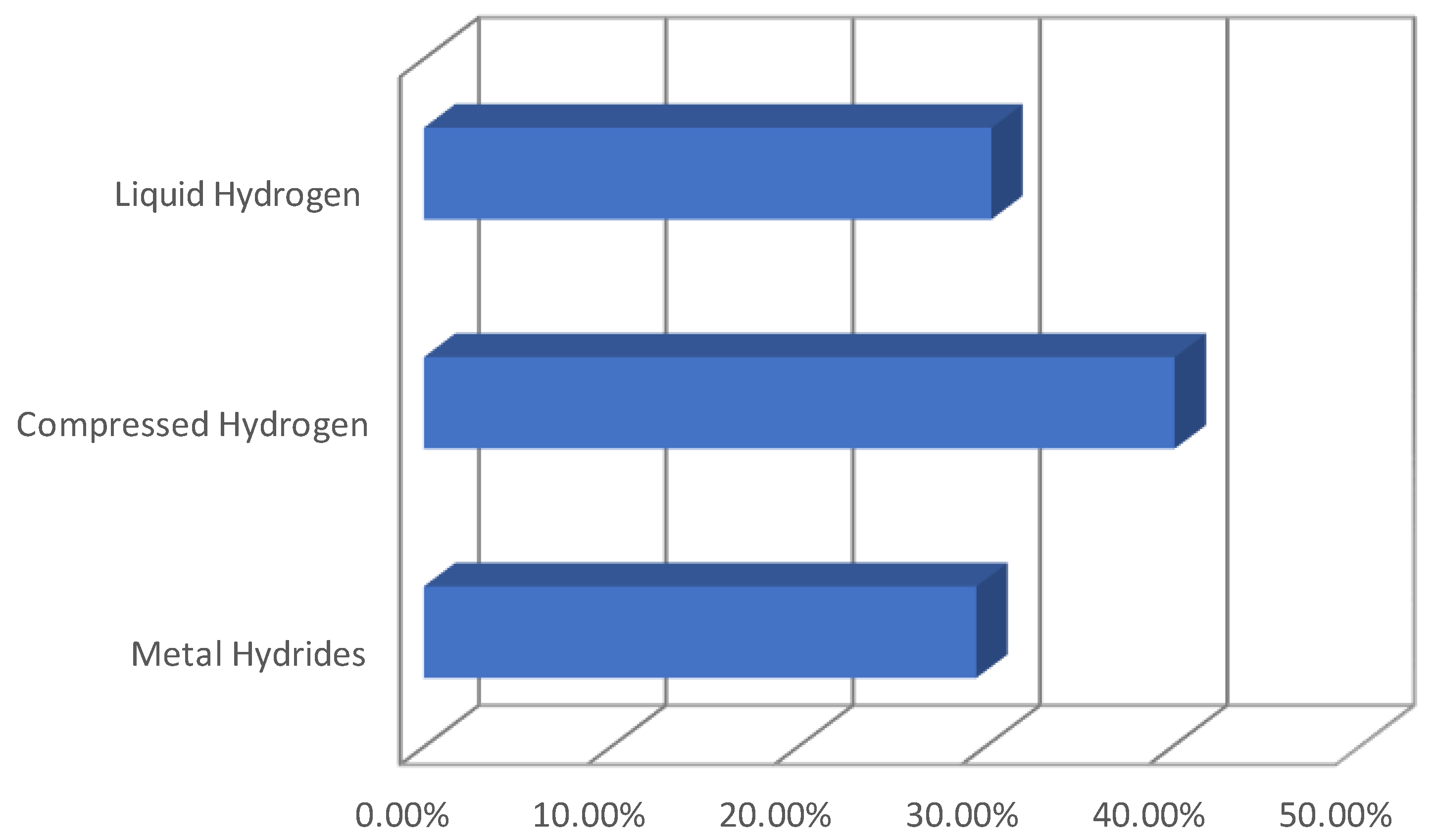
In this final step of the AHP, the final score for each alternative is calculated by multiplying the weights of the criteria by the scores of the alternatives (Table 9). This calculation yields the overall score for each hydrogen storage method, allowing for a direct comparison based on the weighted criteria (Figure 1).
The results show that compressed hydrogen achieves the highest score with a value of 0.4013, indicating it as the most favorable option within the scope of this analysis for hydrogen storage in maritime applications. This result aligns with the current state of the industry, where compressed hydrogen is widely adopted due to its balance between technical feasibility, implementation, and cost [6]. The availability of infrastructure and the relatively low operational costs make it the most practical choice for vessels, as evidenced by its use in a variety of maritime applications [45]. Compressed hydrogen provides a reliable and efficient solution, with the technology already proven in numerous vessels, ranging from smaller craft to larger commercial ships.
Following compressed hydrogen, liquid hydrogen scores 0.3033, reflecting its potential for long-range applications due to its high volumetric energy density. This makes liquid hydrogen an attractive choice for applications requiring a significant amount of fuel stored in a compact space [30]. However, its higher storage cost and the operational complexity related to cryogenic storage significantly impact its overall evaluation [36]. As noted in the literature [19], while liquid hydrogen can increase the autonomy of vessels, its energy-intensive liquefaction process and the challenging management of cryogenic temperatures result in a higher carbon footprint and require substantial infrastructure investment. Therefore, despite its high energy density, these drawbacks limit its overall performance compared to compressed hydrogen in this context.
Finally, metal hydrides receive the lowest score of 0.2953, reflecting their more limited applicability in the maritime sector. Although metal hydrides offer advantages in safety (operating at low pressures) and may present a lower environmental impact compared to other methods [66], they are significantly affected by their high weight and slower hydrogen release [67], which negatively impact vessel autonomy. The high mass of the storage systems increases the displacement of the vessel, reducing overall efficiency and range. These challenges make metal hydrides less suitable for larger vessels that require higher storage capacities for long-range operations [68]. However, they may still be suitable for specific applications, such as submarines with air-independent propulsion (AIP) systems, where their characteristics align with operational requirements [19].
It should be noted that the ranking results are influenced by the structured scoring framework used in this study, and therefore reflect the relative performance of the alternatives within the defined assumptions and criteria.

5.2. Technique for Order Preference by Similarity to Ideal Solution

The Technique for Order Preference by Similarity to Ideal Solution (TOPSIS) is a widely used multi-criteria decision-making (MCDM) method that ranks alternatives based on their relative closeness to an ideal solution [69]. The ideal solution maximizes the benefit criteria and minimizes the cost criteria, while the negative ideal solution represents the worst-case scenario for each criterion [70]. The method consists of the following six structured steps:

5.2.1. Step 1: Construct the Decision Matrix

A decision matrix (Table 10) is created with alternatives as rows and criteria as columns. Each element xij in the matrix represents the performance score of alternative i with respect to criterion j. In this study, the TOPSIS method is applied using the same scores previously employed in the AHP analysis to maintain methodological consistency.

5.2.2. Step 2: Normalize the Decision Matrix

The values in the matrix are normalized to transform them into comparable units. Normalization is done by dividing each value by the square root of the sum of the squared values in the column, as follows:
r i j = x i j i = 1 m ( x i j ) 2
where rij is the normalized value, xij is the original score, and m is the number of alternatives.

5.2.3. Step 3: Weight the Normalized Decision Matrix

After normalization, the criteria are weighted according to their relative importance. Each normalized value rij is multiplied by the corresponding weight wj of criterion j, which in this case are the same weights obtained from the AHP. The weighted normalized matrix is calculated as:
v i j = w i   ×   r i j

5.2.4. Step 4: Determine the Ideal and Negative-Ideal Solutions

The positive ideal solution A+ and negative ideal solution A are determined from the weighted normalized matrix (Table 11). For benefit criteria (e.g., safety, autonomy), the ideal value is the maximum; for cost criteria (e.g., environmental impact, implementation and cost), the ideal value is the minimum.
A + = m a x   ( v i j )   f o r   b e n e f i t   c r i t e r i a ;   m i n   ( v i j )   f o r   c o s t   c r i t e r i a
A = m i n   ( v i j )   f o r   b e n e f i t   c r i t e r i a ;   m a x   ( v i j )   f o r   c o s t   c r i t e r i a

5.2.5. Step 5: Calculate the Distances to Ideal and Negative-Ideal Solutions

After identifying the positive ideal solution A+ and the negative ideal solution A, the next step is to calculate the distance of each alternative from these two reference points. This distance (Euclidean distance) reflects how close each alternative is to the ideal (best) and how far it is from the worst-case scenario. The Euclidean distance of each alternative from the ideal solutions is calculated as:
D i + = j = 1 n v i j v j + 2
D i = j = 1 n ( v i j v j ) 2
where Di+ is the distance from the ideal solution, Di is the distance from the negative-ideal solution, vij is the weighted normalized value for alternative i and criterion j, vj+ and vj are the ideal and negative-ideal values for criterion j, respectively, and n is the number of criteria.

5.2.6. Step 6: Compute the Relative Closeness to the Ideal Solution

The final step is to calculate the proximity ratio (Ci) for each alternative (Equation (13)), which is the ratio of the distance to the negative ideal solution to the total distance (distance to the ideal and negative ideal solutions). The alternative with the highest Ci value is considered the most preferable option (Table 12).
C i = D i D i + D i +
The results confirm that compressed hydrogen (CH2) is the most favorable storage option, followed by liquid hydrogen (LH2). Metal hydrides (MHs), although offering advantages in safety, rank lowest due to implementation and autonomy limitations.
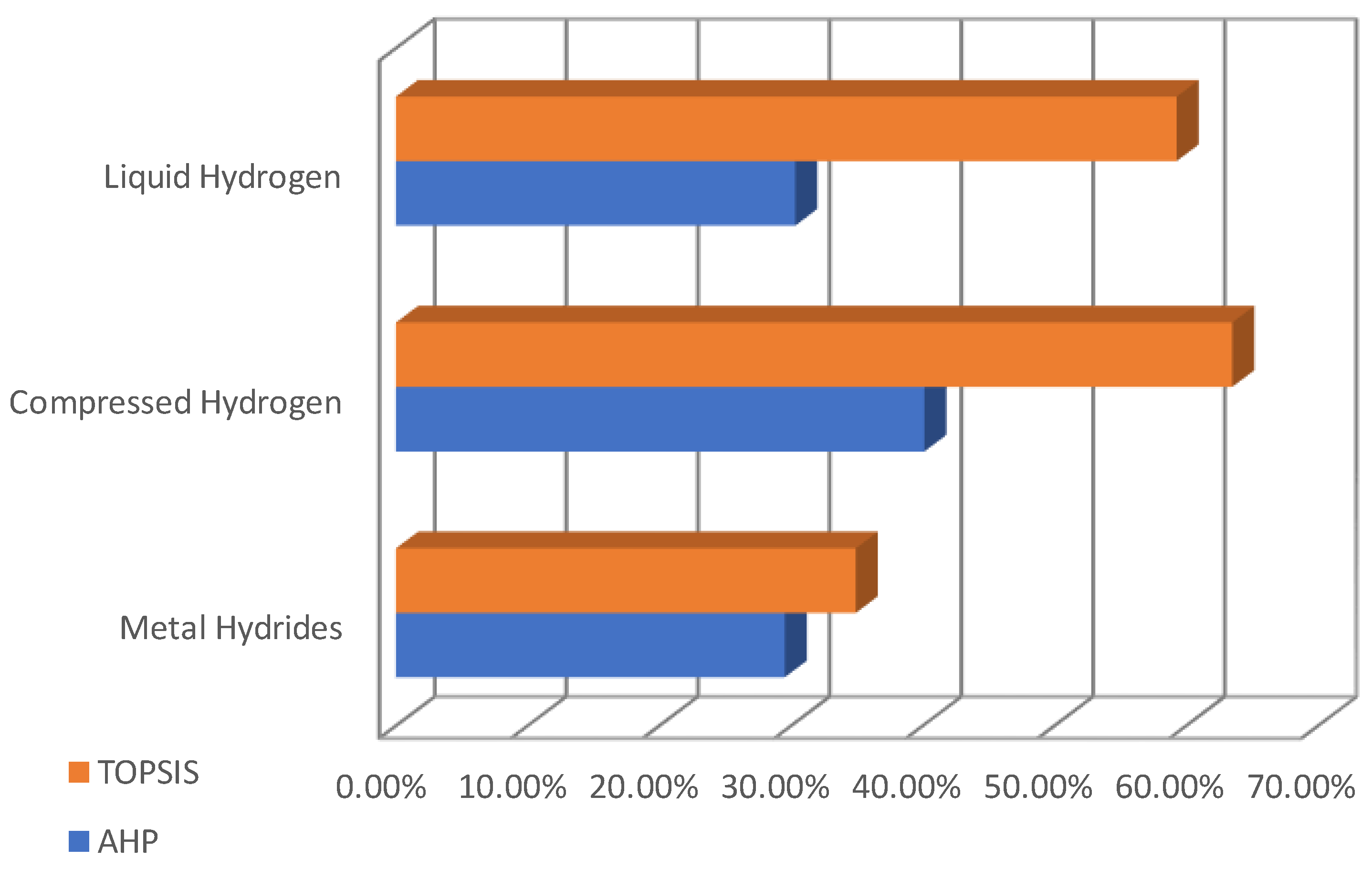
Both the Analytic Hierarchy Process (AHP) and the Technique for Order Preference by Similarity to Ideal Solution (TOPSIS) were applied to evaluate hydrogen storage alternatives in maritime contexts. Despite their different methodologies, AHP relying on pairwise comparisons and expert judgment, and TOPSIS based on distance from an ideal solution, both methods produced consistent rankings: compressed hydrogen (CH2) ranked first, followed by liquid hydrogen (LH2), and metal hydrides (MHs) in last place.
The comparative results are illustrated in Figure 2, which shows the final scores assigned by each method. While the ranking order remains unchanged, TOPSIS produced a more pronounced separation between the alternatives, highlighting greater contrast in relative performance. In contrast, AHP provided more moderate differences due to its structured weighting process. This score dispersion from TOPSIS compared to AHP has been observed in other studies [71].
From a quantitative perspective, compressed hydrogen (CH2) achieves the highest score in both methods, with a noticeable margin over the other alternatives. In TOPSIS, the score difference between CH2 and LH2 is more significant than in AHP, indicating a stronger preference when distance-based evaluation is applied. However, the differences between LH2 and MH remain relatively small, suggesting that these two alternatives present comparable performance under the selected criteria.
In both methods, compressed hydrogen ranked as the most suitable storage alternative, combining favorable scores in safety, cost, and ease of implementation. Liquid hydrogen consistently placed second, primarily due to its superior autonomy but penalized by its higher costs and complex infrastructure requirements. Metal hydrides ranked third in both methods, reflecting limitations related to gravimetric efficiency, weight, and integration complexity, despite their advantages in safety and volumetric storage capacity.
Although the ranking is consistent across methods, the relatively small differences between the alternatives indicate that the selection of hydrogen storage technology is sensitive to the specific evaluation criteria and application context. The consistency between AHP and TOPSIS results reinforces the robustness of the evaluation, while also highlighting the importance of contextual factors in determining the most appropriate storage solution. The consistency in the final rankings indicates a consistent preference for compressed hydrogen under the evaluated conditions.

5.3. Sensitivity Analysis

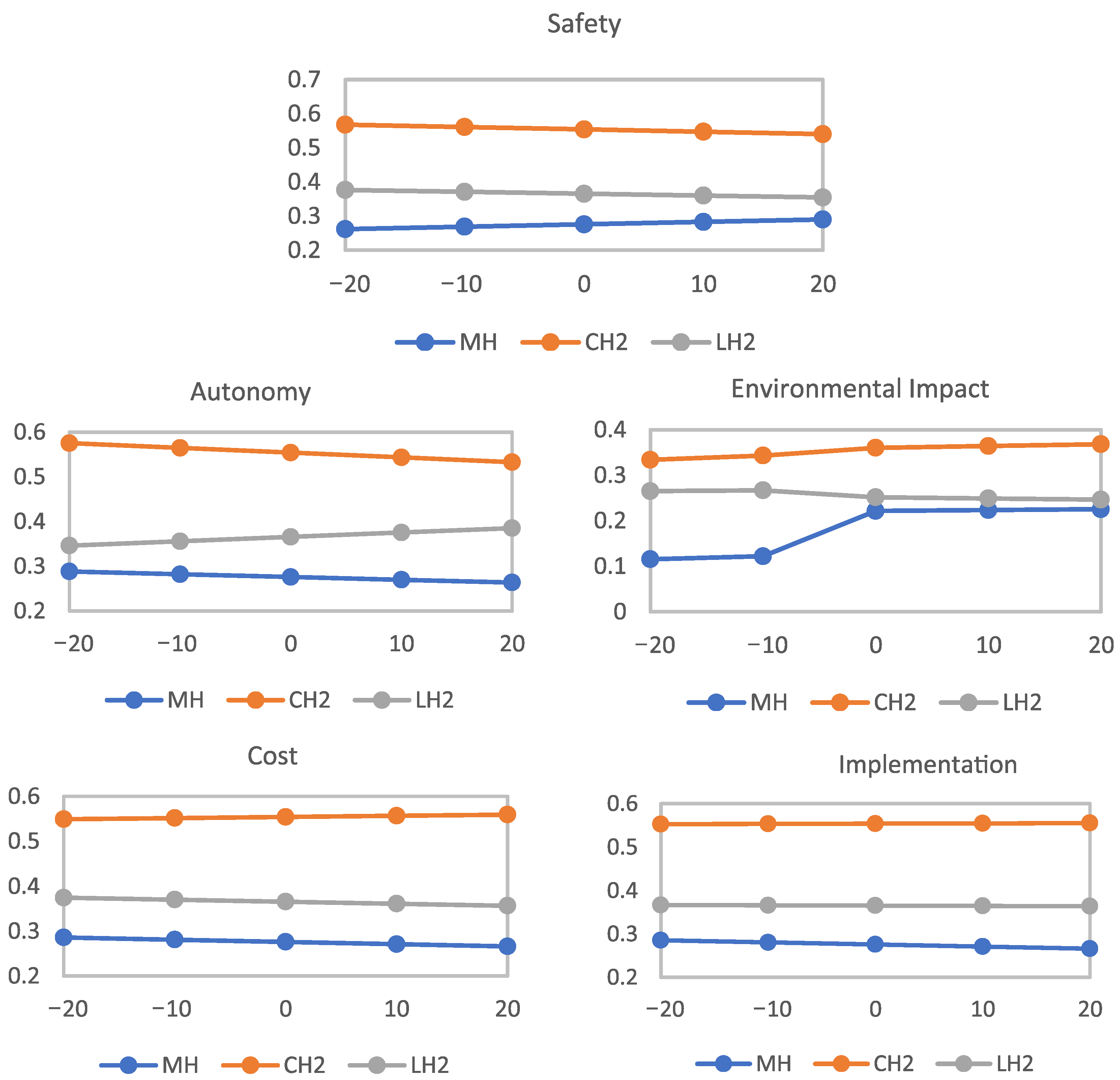
A sensitivity analysis was conducted to evaluate the robustness of the results with respect to variations in the weighting factors derived from the AHP method. The weight of each criterion was independently varied by ±10% and ±20%, while maintaining the relative structure of the remaining criteria. The modified weights were subsequently used to recalculate the TOPSIS scores and assess their impact on the final ranking of the alternatives.
The results of the sensitivity analysis are presented in Figure 3. In all evaluated scenarios, the ranking of the hydrogen storage technologies remains unchanged, with compressed hydrogen (CH2) consistently identified as the most favorable option, followed by liquid hydrogen (LH2) and metal hydrides (MHs).
Although variations in the weighting factors lead to observable changes in the scores, these variations are relatively small and do not affect the relative ordering of the alternatives. This indicates that the differences between the evaluated technologies are sufficiently pronounced to ensure stability of the ranking under moderate and significant perturbations of the input weights.
A closer examination of the results reveals that certain criteria, such as autonomy, exert a more significant influence on the score variation, leading to slightly larger deviations in the performance of LH2 and MH. In contrast, criteria such as implementation show minimal impact on the results, indicating a lower sensitivity of the model to changes in their associated weights.
Overall, the absence of ranking changes under both moderate (±10%) and significant (±20%) variations in the AHP-derived weights demonstrates the robustness of the proposed decision-making framework. These findings confirm that the results are reliable and not significantly affected by reasonable uncertainties in the weighting process.

6. Conclusions

This study conducted a comprehensive evaluation of three hydrogen storage technologies: compressed hydrogen (CH2), liquid hydrogen (LH2), and metal hydrides (MHs), for their suitability in maritime applications, using two well-established multi-criteria decision-making (MCDM) methods: Analytic Hierarchy Process (AHP) and Technique for Order Preference by Similarity to Ideal Solution (TOPSIS). Five key criteria were considered: safety, autonomy, environmental impact, cost, and implementation feasibility.
The results of both methods consistently identified compressed hydrogen as the most balanced and suitable storage alternative within the scope and assumptions of this study. CH2 achieved the highest overall ranking due to its technological maturity, cost-effectiveness, ease of implementation, and acceptable safety performance under established operational standards. Its compatibility with existing infrastructure and lower operational complexity make it particularly attractive for near-term adoption in maritime transport.
Liquid hydrogen was ranked second, recognized for its superior autonomy and high energy density. However, its high energy losses from liquefaction, cryogenic handling complexity, and infrastructure demands limit its short-term viability, making it more appropriate for long-range or high-capacity vessels where extended range is a critical factor.
Metal hydrides, while offering advantages in safety and volumetric energy density, ranked lowest in both AHP and TOPSIS analyses. Their low gravimetric efficiency, high system weight, and complex thermal management requirements limit their applicability to niche or specialized naval platforms rather than large-scale commercial shipping.
Furthermore, the comparative use of AHP and TOPSIS methods confirmed the robustness of the evaluation framework. While both methods yielded consistent rankings, TOPSIS provided a clearer differentiation between alternatives due to its distance-based approach, whereas AHP offered greater transparency in criteria weighting through structured evaluation. Although the differences in scores between the evaluated alternatives are relatively small, the sensitivity analysis confirms that the ranking remains unchanged under all tested scenarios. This indicates that the results are robust and not sensitive to reasonable variations in the weighting factors, supporting the reliability of the results.
These findings should be interpreted within the specific operational context and assumptions considered in this study. Variations in criteria weighting, technological development, infrastructure availability, or application scenarios may influence the relative performance of the evaluated storage technologies.
This study highlights the importance of integrating technical, economic, and operational considerations in selecting hydrogen storage systems for maritime applications and suggests that compressed hydrogen can currently be considered a practical and scalable option for decarbonizing shipboard propulsion systems under the conditions analyzed. These conclusions are based on the defined evaluation criteria and assumptions, and the assigned scores are directly supported by the technical data and literature discussed for each criterion.
In addition, a consistent and application-oriented comparison of hydrogen storage technologies is provided under maritime-specific conditions. The results improve the understanding of the relative suitability of CH2, LH2, and MH systems, offering practical insights for technology selection and supporting future implementation strategies.

Author Contributions

Conceptualization, R.M.; methodology, A.L.-G.; software, validation, R.M., V.A., J.F. and M.A.A.-F.; formal analysis, A.L.-G.; investigation, A.L.-G.; resources, J.F. and M.A.A.-F.; writing—original draft preparation, R.M.; writing—review and editing, J.F. and M.A.A.-F.; visualization, V.A.; supervision, R.M. All authors have read and agreed to the published version of the manuscript.

Funding

This research was funded by the Defense University Center at the Spanish Naval Academy (CUD-ENM under projects PICUD-2021-07 and PICUD-2024-01).

Data Availability Statement

The original contributions presented in this study are included in the article. Further inquiries can be directed to the corresponding author.

Conflicts of Interest

The authors declare no conflicts of interest. The funders had no role in the design of the study; in the collection, analyses, or interpretation of data; in the writing of the manuscript; or in the decision to publish the results.

Abbreviations

The following abbreviations are used in this manuscript:
FCFuel cell
PEMFCPolymeric electrolyte membrane fuel cell
AFCAlkaline fuel cell
MCFCMolten carbonate fuel cell

References

  1. Mallouppas, G.; Yfantis, E.A. Decarbonization in Shipping Industry: A Review of Research, Technology Development, and Innovation Proposals. J. Mar. Sci. Eng. 2021, 9, 415. [Google Scholar] [CrossRef] [Scilit]
  2. Roy, A.; Pramanik, S. A Review of the Hydrogen Fuel Path to Emission Reduction in the Surface Transport Industry. Int. J. Hydrogen Energy 2024, 49, 792–821. [Google Scholar] [CrossRef] [Scilit]
  3. Zainal, B.S.; Ker, P.J.; Mohamed, H.; Ong, H.C.; Fattah, I.M.R.; Rahman, S.M.A.; Nghiem, L.D.; Mahlia, T.M.I. Recent Advancement and Assessment of Green Hydrogen Production Technologies. Renew. Sustain. Energy Rev. 2024, 189, 113941. [Google Scholar] [CrossRef] [Scilit]
  4. Singh, S.; Jain, S.; Ps, V.; Tiwari, A.K.; Nouni, M.R.; Pandey, J.K.; Goel, S. Hydrogen: A Sustainable Fuel for Future of the Transport Sector. Renew. Sustain. Energy Rev. 2015, 51, 623–633. [Google Scholar] [CrossRef] [Scilit]
  5. Verhelst, S.; Wallner, T. Hydrogen-Fueled Internal Combustion Engines. Prog. Energy Combust. Sci. 2009, 35, 490–527. [Google Scholar] [CrossRef] [Scilit]
  6. Zhaka, V.; Samuelsson, B. Hydrogen as Fuel in the Maritime Sector: From Production to Propulsion. Energy Rep. 2024, 12, 5249–5267. [Google Scholar] [CrossRef] [Scilit]
  7. Sullivan, B.P.; Ansaloni, G.M.M.; Bionda, A.; Rossi, M. A Life Cycle Perspective to Sustainable Hydrogen Powered Maritime Systems—Functional and Technical Requirements. Int. J. Prod. Lifecycle Manag. 2022, 14, 125822. [Google Scholar] [CrossRef] [Scilit]
  8. Inal, O.B.; Charpentier, J.F.; Deniz, C. Hybrid Power and Propulsion Systems for Ships: Current Status and Future Challenges. Renew. Sustain. Energy Rev. 2022, 156, 111965. [Google Scholar] [CrossRef] [Scilit]
  9. Abedin, T.; Pasupuleti, J.; Paw, J.K.S.; Tak, Y.C.; Mahmud, M.; Abdullah, M.P.; Nur-E-Alam, M. Proton Exchange Membrane Fuel Cells in Electric Vehicles: Innovations, Challenges, and Pathways to Sustainability. J. Power Sources 2025, 640, 236769. [Google Scholar] [CrossRef] [Scilit]
  10. Van Rheenen, E.S.; Padding, J.T.; Slootweg, J.C.; Visser, K. Hydrogen Carriers for Zero-Emission Ship Propulsion Using PEM Fuel Cells: An Evaluation. J. Mar. Eng. Technol. 2024, 23, 166–183. [Google Scholar] [CrossRef] [Scilit]
  11. Brouzas, S.; Zadeh, M.; Lagemann, B. Essentials of Hydrogen Storage and Power Systems for Green Shipping. Int. J. Hydrogen Energy 2025, 100, 1543–1560. [Google Scholar] [CrossRef] [Scilit]
  12. Di Ilio, G.; Bionda, A.; Ponzini, R.; Salvadore, F.; Cigolotti, V.; Minutillo, M.; Georgopoulou, C.; Mahos, K. Towards the Design of a Hydrogen-Powered Ferry for Cleaner Passenger Transport. Int. J. Hydrogen Energy 2024, 95, 1261–1273. [Google Scholar] [CrossRef] [Scilit]
  13. Halder, P.; Babaie, M.; Salek, F.; Haque, N.; Savage, R.; Stevanovic, S.; Bodisco, T.A.; Zare, A. Advancements in Hydrogen Production, Storage, Distribution and Refuelling for a Sustainable Transport Sector: Hydrogen Fuel Cell Vehicles. Int. J. Hydrogen Energy 2024, 52, 973–1004. [Google Scholar] [CrossRef] [Scilit]
  14. Aziz, M. Liquid Hydrogen: A Review on Liquefaction, Storage, Transportation, and Safety. Energies 2021, 14, 5917. [Google Scholar] [CrossRef] [Scilit]
  15. Osman, A.I.; Nasr, M.; Eltaweil, A.S.; Hosny, M.; Farghali, M.; Al-Fatesh, A.S.; Rooney, D.W.; Abd El-Monaem, E.M. Advances in Hydrogen Storage Materials: Harnessing Innovative Technology, from Machine Learning to Computational Chemistry, for Energy Storage Solutions. Int. J. Hydrogen Energy 2024, 67, 1270–1294. [Google Scholar] [CrossRef] [Scilit]
  16. Mulky, L.; Srivastava, S.; Lakshmi, T.; Sandadi, E.R.; Gour, S.; Thomas, N.A.; Shanmuga Priya, S.; Sudhakar, K. An Overview of Hydrogen Storage Technologies—Key Challenges and Opportunities. Mater. Chem. Phys. 2024, 325, 129710. [Google Scholar] [CrossRef] [Scilit]
  17. Drawer, C.; Lange, J.; Kaltschmitt, M. Metal Hydrides for Hydrogen Storage—Identification and Evaluation of Stationary and Transportation Applications. J. Energy Storage 2024, 77, 109988. [Google Scholar] [CrossRef] [Scilit]
  18. IEA. Global Hydrogen Review 2024—Analysis—IEA; IEA: Paris, France, 2024. [Google Scholar]
  19. Jayabal, R. Hydrogen Energy Storage in Maritime Operations: A Pathway to Decarbonization and Sustainability. Int. J. Hydrogen Energy 2025, 109, 1133–1144. [Google Scholar] [CrossRef] [Scilit]
  20. Di Profio, P.; Arca, S.; Rossi, F.; Filipponi, M. Comparison of Hydrogen Hydrates with Existing Hydrogen Storage Technologies: Energetic and Economic Evaluations. Int. J. Hydrogen Energy 2009, 34, 9173–9180. [Google Scholar] [CrossRef] [Scilit]
  21. Sotoodeh, F.; Smith, K.J. An Overview of the Kinetics and Catalysis of Hydrogen Storage on Organic Liquids. Can. J. Chem. Eng. 2013, 91, 1477–1490. [Google Scholar] [CrossRef] [Scilit]
  22. Semchukova, V.; Topolski, K.; Abdin, Z. Hydrogen Technology for Maritime Applications: A Review of Challenges, Opportunities, and Lessons from the Port Authority of New York and New Jersey. Renew. Sustain. Energy Rev. 2025, 216, 115641. [Google Scholar] [CrossRef] [Scilit]
  23. Garcia, G.; Arriola, E.; Chen, W.H.; De Luna, M.D. A Comprehensive Review of Hydrogen Production from Methanol Thermochemical Conversion for Sustainability. Energy 2021, 217, 119384. [Google Scholar] [CrossRef] [Scilit]
  24. Zamljen, A.; Prašnikar, A.; Vizintin, A.; Huš, M.; Likozar, B. Structural Deactivation Mechanisms of Zeolite-Supported Magnesium Chloride with Water: Ammonia Sorption Stability for Intensified Scalable Hydrogen Storage. Chem. Eng. J. 2026, 530, 173423. [Google Scholar] [CrossRef] [Scilit]
  25. Hossain Bhuiyan, M.M.; Siddique, Z. Hydrogen as an Alternative Fuel: A Comprehensive Review of Challenges and Opportunities in Production, Storage, and Transportation. Int. J. Hydrogen Energy 2025, 102, 1026–1044. [Google Scholar] [CrossRef] [Scilit]
  26. Panić, I.; Cuculić, A.; Ćelić, J. Color-Coded Hydrogen: Production and Storage in Maritime Sector. J. Mar. Sci. Eng. 2022, 10, 1995. [Google Scholar] [CrossRef] [Scilit]
  27. Inal, O.B.; Dere, C.; Deniz, C. Onboard Hydrogen Storage for Ships: An Overview. In Proceedings of the 5th International Hydrogen Technologies Congress; Hidrojen Teknolojileri Derneği: Istanbul, Turkey, 2021. [Google Scholar]
  28. Amirthan, T.; Perera, M.S.A. The Role of Storage Systems in Hydrogen Economy: A Review. J. Nat. Gas. Sci. Eng. 2022, 108, 104843. [Google Scholar] [CrossRef] [Scilit]
  29. Davies, E.; Ehrmann, A.; Schwenzfeier-Hellkamp, E. Safety of Hydrogen Storage Technologies. Processes 2024, 12, 2182. [Google Scholar] [CrossRef] [Scilit]
  30. Gómez, J.A.; Santos, D.M.F. The Status of On-Board Hydrogen Storage in Fuel Cell Electric Vehicles. Designs 2023, 7, 97. [Google Scholar] [CrossRef] [Scilit]
  31. Callari, M. The Future of Shipping: Hydrgoen Powers a Zero-Emission Maritime Industry; AVEVA: Cambridge, UK, 2025. [Google Scholar]
  32. Sun, Z.; Lu, X.; Nyahuma, F.M.; Yan, N.; Xiao, J.; Su, S.; Zhang, L. Enhancing Hydrogen Storage Properties of MgH2 by Transition Metals and Carbon Materials: A Brief Review. Front. Chem. 2020, 8, 552. [Google Scholar] [CrossRef] [Scilit]
  33. Hong, H.; Guo, H.; Cui, Z.; Ball, A.; Nie, B. Structure Modification of Magnesium Hydride for Solid Hydrogen Storage. Int. J. Hydrogen Energy 2024, 78, 793–804. [Google Scholar] [CrossRef] [Scilit]
  34. Nuclear Threat Initiative. 2024. Available online: https://www.nti.org/news/what-does-it-take-to-build-a-safer-world-read-ntis-2024-impact-report/ (accessed on 30 March 2026).
  35. McCay, M.H.; Shafiee, S. Hydrogen: An Energy Carrier. In Future Energy: Improved, Sustainable and Clean Options for Our Planet; Elsevier: Amsterdam, The Netherlands, 2020; pp. 475–493. [Google Scholar] [CrossRef] [Scilit]
  36. Zhang, T.; Uratani, J.; Huang, Y.; Xu, L.; Griffiths, S.; Ding, Y. Hydrogen Liquefaction and Storage: Recent Progress and Perspectives. Renew. Sustain. Energy Rev. 2023, 176, 113204. [Google Scholar] [CrossRef] [Scilit]
  37. Al Ghafri, S.Z.; Munro, S.; Cardella, U.; Funke, T.; Notardonato, W.; Trusler, J.P.M.; Leachman, J.; Span, R.; Kamiya, S.; Pearce, G.; et al. Hydrogen Liquefaction: A Review of the Fundamental Physics, Engineering Practice and Future Opportunities. Energy Environ. Sci. 2022, 15, 2690–2731. [Google Scholar] [CrossRef] [Scilit]
  38. Sadeq, A.M.; Homod, R.Z.; Hussein, A.K.; Togun, H.; Mahmoodi, A.; Isleem, H.F.; Patil, A.R.; Moghaddam, A.H. Hydrogen Energy Systems: Technologies, Trends, and Future Prospects. Sci. Total Environ. 2024, 939, 173622. [Google Scholar] [CrossRef] [Scilit] [PubMed]
  39. Fan, H.; Abdussamie, N.; Chen, P.S.L.; Harris, A.; Gray, E.M.A.; Arzaghi, E.; Bhaskar, P.; Mehr, J.A.; Penesis, I. Two Decades of Hydrogen-Powered Ships (2000–2024): Evolution, Challenges, and Future Perspectives. Renew. Sustain. Energy Rev. 2025, 219, 115878. [Google Scholar] [CrossRef] [Scilit]
  40. Drăgan, O. This Futuristic Ship Will Be Able to Deliver Green Fuel for 400K Hydrogen Cars. Autoevolution 2022. [Google Scholar]
  41. Li, F.; Yuan, Y.; Yan, X.; Malekian, R.; Li, Z. A Study on a Numerical Simulation of the Leakage and Diffusion of Hydrogen in a Fuel Cell Ship. Renew. Sustain. Energy Rev. 2018, 97, 177–185. [Google Scholar] [CrossRef] [Scilit]
  42. Sæther, S.R.; Moe, E. A Green Maritime Shift: Lessons from the Electrification of Ferries in Norway. Energy Res. Soc. Sci. 2021, 81, 102282. [Google Scholar] [CrossRef] [Scilit]
  43. Klebanoff, L. MV Sea Change: Fuel Cell, Emissions, and Hydrogen Fueling Performance; Sandia National Laboratories (SNL-CA): Albuquerque, NM, USA; Livermore, CA, USA, 2024. [Google Scholar]
  44. Pagliaro, M. Hydrogen-Powered Boats and Ships. In Current Trends and Future Developments on (Bio-) Membranes: New Perspectives on Hydrogen Production, Separation, and Utilization; Elsevier: Amsterdam, The Netherlands, 2020; pp. 411–419. [Google Scholar] [CrossRef] [Scilit]
  45. Wang, Z.; Li, M.; Zhao, F.; Ji, Y.; Han, F. Status and Prospects in Technical Standards of Hydrogen-Powered Ships for Advancing Maritime Zero-Carbon Transformation. Int. J. Hydrogen Energy 2024, 62, 925–946. [Google Scholar] [CrossRef] [Scilit]
  46. Guan, W.; Chen, J.; Chen, L.; Cao, J.; Fan, H. Safe Design of a Hydrogen-Powered Ship: CFD Simulation on Hydrogen Leakage in the Fuel Cell Room. J. Mar. Sci. Eng. 2023, 11, 651. [Google Scholar] [CrossRef] [Scilit]
  47. Cavo, M.; Rivarolo, M.; Gini, L.; Magistri, L. An Advanced Control Method for Fuel Cells—Metal Hydrides Thermal Management on the First Italian Hydrogen Propulsion Ship. Int. J. Hydrogen Energy 2023, 48, 20923–20934. [Google Scholar] [CrossRef] [Scilit]
  48. Bevan, A.I.; Züttel, A.; Book, D.; Harris, I.R. Performance of a Metal Hydride Store on the “Ross Barlow” Hydrogen Powered Canal Boat. Faraday Discuss. 2011, 151, 353–367. [Google Scholar] [CrossRef] [Scilit]
  49. Ustolin, F.; Campari, A.; Taccani, R. An Extensive Review of Liquid Hydrogen in Transportation with Focus on the Maritime Sector. J. Mar. Sci. Eng. 2022, 10, 1222. [Google Scholar] [CrossRef] [Scilit]
  50. Arikan, Y.; Dogrul, A.; Çelik, F. Energy Efficient Hull Form Design for a Pleasure Boat Powered by a Solar-Hydrogen Energy System. In Proceedings of the International Conference on High Performance Marine Vessels (HSMV 2011), Naples, Italy, 25–27 May 2011; pp. 25–27. [Google Scholar]
  51. Bellosta von Colbe, J.; Ares, J.R.; Barale, J.; Baricco, M.; Buckley, C.; Capurso, G.; Gallandat, N.; Grant, D.M.; Guzik, M.N.; Jacob, I.; et al. Application of Hydrides in Hydrogen Storage and Compression: Achievements, Outlook and Perspectives. Int. J. Hydrogen Energy 2019, 44, 7780–7808. [Google Scholar] [CrossRef] [Scilit]
  52. Chakraborty, S.; Dzielendziak, A.S.; Koroglu, T.; Yang, K. Evaluation of Smart Eco-Friendly Public Transport Options in Coastal Cities: Towards a Green Future for the City of Southampton; Shenoi, R.A., Wilson, P.A., Bennett, S.S., Eds.; LRF Collegium 2013 Series 2; University of Southampton: Southampton, UK, 2013; Volume 2. [Google Scholar]
  53. Taherdoost, H.; Madanchian, M. Multi-Criteria Decision Making (MCDM) Methods and Concepts. Encyclopedia 2023, 3, 6. [Google Scholar] [CrossRef] [Scilit]
  54. Wang, J.J.; Jing, Y.Y.; Zhang, C.F.; Zhao, J.H. Review on Multi-Criteria Decision Analysis Aid in Sustainable Energy Decision-Making. Renew. Sustain. Energy Rev. 2009, 13, 2263–2278. [Google Scholar] [CrossRef] [Scilit]
  55. Alavi-Borazjani, S.A.; Adeel, S.; Chkoniya, V. Hydrogen as a Sustainable Fuel: Transforming Maritime Logistics. Energies 2025, 18, 1231. [Google Scholar] [CrossRef] [Scilit]
  56. U.S. Department of Energy. Target Explanation Document: Onboard Hydrogen Storage for Light-Duty Fuel Cell Vehicles. US Drive 2017, 1, 1–29. [Google Scholar]
  57. Xie, Z.; Jin, Q.; Su, G.; Lu, W. A Review of Hydrogen Storage and Transportation: Progresses and Challenges. Energies 2024, 17, 4070. [Google Scholar] [CrossRef] [Scilit]
  58. Carvalho, F.; Osipova, L.; Zhou, Y. Life-Cycle GHG Emissions of Hydrogen as a Maritime Fuel and Green Hydrogen Production Costs in Brazil. In Proceedings of the International Council on Clean Transportation; International Council on Clean Transportation: Washington, DC, USA, 2023. [Google Scholar]
  59. Li, J.Q.; Xu, H.; Wang, J.B.; Wang, X.Y.; Li, J.C.; Kwon, S.K.; Kwon, J.T.; Koh, M.S. A Review of Methods to Study the Fatigue Life of Nodes Connecting Marine Composite Hydrogen Storage Tanks to Ships under the Action of External Forces. J. Energy Storage 2023, 72, 108367. [Google Scholar] [CrossRef] [Scilit]
  60. Danebergs, J.; Deledda, S. Can Hydrogen Storage in Metal Hydrides Be Economically Competitive with Compressed and Liquid Hydrogen Storage? A Techno-Economical Perspective for the Maritime Sector. Int. J. Hydrogen Energy 2024, 50, 1040–1054. [Google Scholar] [CrossRef] [Scilit]
  61. Thangalakshmi, S.; Balaji, R. Potential Challenges of Hydrogen as a Fuel for International Maritime Transport. Mar. Eng. Rev. 2023, 29–34. [Google Scholar]
  62. Kumar, A.; Sah, B.; Singh, A.R.; Deng, Y.; He, X.; Kumar, P.; Bansal, R.C. A Review of Multi Criteria Decision Making (MCDM) towards Sustainable Renewable Energy Development. Renew. Sustain. Energy Rev. 2017, 69, 596–609. [Google Scholar] [CrossRef] [Scilit]
  63. Nantes, E.A. El Método Analytic Hierarchy Process Par La Toma de Decisiones. Repaso de La Metodología y Aplicaciones. Investig. Oper. 2019, 46. [Google Scholar]
  64. Pérez Peinado, G. Proceso Analítico Jerárquico y TOPSIS Aplicados a La Selección de Una Cámara Digital. Bachelor’s Thesis, Universidad de Sevilla, Sevilla, Spain, 2019. [Google Scholar]
  65. Saaty, R.W. The Analytic Hierarchy Process: Planning, Priority Setting, Resource Allocation; Decision Making Series; Mathematical Modelling; McGraw Hill Higher Education: New York, NY, USA, 1980. [Google Scholar]
  66. Giakoumakis, G.; Sidiras, D. Production and Storage of Hydrogen from Biomass and Other Sources: Technologies and Policies. Energies 2025, 18, 650. [Google Scholar] [CrossRef] [Scilit]
  67. Klopčič, N.; Grimmer, I.; Winkler, F.; Sartory, M.; Trattner, A. A Review on Metal Hydride Materials for Hydrogen Storage. J. Energy Storage 2023, 72, 108456. [Google Scholar] [CrossRef] [Scilit]
  68. Farazmand, M.; Saadat, Z.; Sameti, M. Above-Ground Hydrogen Storage: A State-of-the-Art Review. Int. J. Hydrogen Energy 2024, 90, 1173–1205. [Google Scholar] [CrossRef] [Scilit]
  69. Madanchian, M.; Taherdoost, H. A Comprehensive Guide to the TOPSIS Method for Multi-Criteria Decision Making. Sustain. Soc. Dev. 2023, 1, 2220. [Google Scholar] [CrossRef] [Scilit]
  70. Parida, P.K. A General View of TOPSIS Method Involving Multi-Attribute Decision Making Problems. Int. J. Innov. Technol. Explor. Eng. 2019, 2, 3205–3214. [Google Scholar] [CrossRef] [Scilit]
  71. Jozaghi, A.; Alizadeh, B.; Hatami, M.; Flood, I.; Khorrami, M.; Khodaei, N.; Tousi, E.G. A Comparative Study of the AHP and TOPSIS Techniques for Dam Site Selection Using GIS: A Case Study of Sistan and Baluchestan Province, Iran. Geosciences 2018, 8, 494. [Google Scholar] [CrossRef] [Scilit]
Figure 1. Evaluation of hydrogen storage alternatives using AHP.
Hydrogen 07 00061 g001
Figure 2. Comparison of AHP and TOPSIS results for hydrogen storage alternatives.
Hydrogen 07 00061 g002
Figure 3. Sensitivity analysis of scores under ±10% and ±20% variations in AHP weights.
Hydrogen 07 00061 g003
Table 2. Advantages and limitations of selected hydrogen storage methods.
Storage TypeAdvantagesDisadvantages
CH2Technologically mature
Simple infrastructure
Limited energy density and capacity
Safety concerns due to high pressure
LH2Higher volumetric energy densityRequires extremely low temperatures
High energy losses from liquefaction
Safety and boil-off management challenges
MHHigh volumetric density
Increased safety at low pressure
Low gravimetric efficiency
Thermal management required for hydrogen release
Table 4. Structured scoring rationale linking evaluation criteria with technical parameters and qualitative scores.
CriterionMain Technical BasisScoring Rationale
SafetyOperating pressure, temperature, risk of leakage/explosion, storage stateHigher pressure and cryogenic conditions reduce scores; solid-state storage increases scores
AutonomyGravimetric and volumetric energy density, system weight, storage efficiencyHigher energy density and lower system weight increase scores
Environmental impactEnergy consumption, energy losses, CO2 emissions, recyclabilityLower energy use and higher recyclability increase scores
CostCAPEX, OPEX, infrastructure availabilityLower costs and simpler systems increase scores
ImplementationTechnological maturity, infrastructure, integration complexityMore mature technologies and easier integration increase scores
Table 5. Hierarchy model for selecting hydrogen storage methods.
LevelElementDescription
1Overall GoalSelection of the best hydrogen storage method
2CriteriaSafety
Autonomy
Environmental Impact
Cost
Implementation
3AlternativesCompressed Hydrogen (CH2)
Liquid Hydrogen (LH2),
Metal Hydrides (MHs)
Table 6. Summary of scores for hydrogen storage alternatives by evaluation criterion.
CriterionCompressed HydrogenLiquid HydrogenMetal Hydrides
Safety657
Autonomy573
Environmental Impact746
Cost745
Implementation762
Table 7. Pairwise comparison matrix of criteria for hydrogen storage selection.
CriteriaSAEICIPriority Vector
Safety (S)15/45/35/250.3333
Autonomy (A)4/514/3240.2667
Environmental Impact (EI)3/53/413/230.2000
Cost (C)2/51/22/3120.1333
Implementation (I)1/51/41/31/210.0667
Table 8. Pairwise comparison matrices.
CriteriaAlternativesMHCH2LH2
SafetyMH1.00002.00003.0000
CH20.50001.00002.0000
LH20.33330.50001.0000
AutonomyMH1.00000.33330.2000
CH23.00001.00000.3333
LH25.00003.00001.0000
Environmental ImpactMH1.00000.50003.0000
CH22.00001.00004.0000
LH20.33330.25001.0000
CostMH1.00000.25000.5000
CH24.00001.00003.0000
LH22.00000.33331.0000
ImplementationMH1.00000.16670.2000
CH26.00001.00002.0000
LH25.00000.50001.0000
Table 9. Eigenvector and consistency test for the alternatives.
Eigenvector
SAEICI
MH0.53960.10470.31960.13650.0811
CH20.29700.29700.55840.62500.5769
LH20.16340.63690.12200.23850.3420
Consistency test
λmax3.00923.03853.01833.01833.0291
CI0.00460.01930.00910.00910.0145
CR0.00790.03320.01580.01580.0251
Table 10. Decision matrix.
Alternatives Criteria
SAEICI
MH73642
CH265777
LH257456
Table 11. Weighted normalized decision matrix and ideal and negative-ideal values.
AlternativesCriteria
SAEICI
MH0.22250.08780.11940.02830.0281
CH20.19070.14640.13930.09890.0492
LH20.15890.20490.07960.08480.0351
A+0.22250.20490.13930.09890.0492
A0.15890.08780.07960.02830.0281
Table 12. Proximity ratio and final ranking.
AlternativesD+DCi Ranking
MH0.13980.07500.34923rd
CH20.06660.11590.63511st
LH20.08950.13020.59282nd
Disclaimer/Publisher’s Note: The statements, opinions and data contained in all publications are solely those of the individual author(s) and contributor(s) and not of MDPI and/or the editor(s). MDPI and/or the editor(s) disclaim responsibility for any injury to people or property resulting from any ideas, methods, instructions or products referred to in the content.