Article

Understanding the Application Envelope for Metal Hydride Compressors (Techno-Economic Considerations)


1
Energy Technologies, CSIRO Energy, CSIRO, Pullenvale, QLD 4069, Australia
2
School of Environment and Science, Griffith University, Nathan, QLD 4111, Australia
*
Author to whom correspondence should be addressed.
Hydrogen 2026, 7(1), 35; https://doi.org/10.3390/hydrogen7010035
Submission received: 6 January 2026 / Revised: 20 February 2026 / Accepted: 21 February 2026 / Published: 26 February 2026

Abstract

Currently, H2 compression is one of the highest-cost items, both in terms of capital and operating costs, at H2 refuelling stations. Metal hydride (MH) compressors are an alternative H2 compression technology, which uses heat rather than electricity to provide the driving force for compression. Where waste heat is available, these compressors have the potential to be lower in cost than current mechanical alternatives. While the development of metal hydride compressors has been underway for the last 40–50 years, only a few have made it through to demonstration at industrial sites. To better understand where these compressors see best potential, we have completed a high-level assessment of the levelised costs associated with MH compression. We explore the impact of cost assumptions (capital and operating cost items) on the overall cost of MH compression over an assumed 10-year life. Results indicate that MH compressors have similar capital costs to currently available mechanical compressors but have a significant advantage in operating costs where waste or solar heat is available. This analysis highlights that it is the cost of energy that has the greatest impact on the cost competitiveness of the metal hydride compressor.

1. Introduction

Despite the recent wave of project delays and cancellations, low-emission H2 is still expected to play an important part of global ambitions to limit global warming. In its 2025 global H2 review, the International Energy Agency noted that final investment decisions for low-emission H2 projects are at over 200, a significant increase from the previous review completed in 2020 [1]. This reflects the continued importance (though perhaps slower than previously expected) of H2 for achieving climate goals, energy security and industrial decarbonisation [1]. As efforts to decrease carbon emissions accelerate, H2 usage is anticipated to increase [2,3]. One potential early adopter of H2 is the automotive industry, particularly for long-haul and heavy-duty transport, where fast-refuelling times and increased range give fuel cell electric vehicles an advantage over battery electric [4]. There are still challenges however with the widespread use of H2 for transport, including costs that still need to be reduced to encourage greater uptake. Due to its low density, compression and/or liquefaction of hydrogen is required for it to be stored at a reasonable volume. Its low density also makes compression of hydrogen more energy-intensive compared to other gases. The high diffusivity and fluidity of hydrogen create additional difficulties in the development of mechanical facilities for its compression [5]. Current fuel cell electric vehicles (FCEVs) utilise H2 gas compressed to 200–350 bar, with efforts underway to increase this to 700 bar, requiring continuous pressure in refuelling stations above 900 bar. A report by the National Renewable Energy Laboratory (NREL) [6] evaluated the costs of compressing, storing and distributing H2 at a theoretical H2 refuelling station. This study highlighted that approximately two-thirds of the cost of delivering H2 at refuelling stations was due to the cost of compression, regardless of the H2 delivery method used.
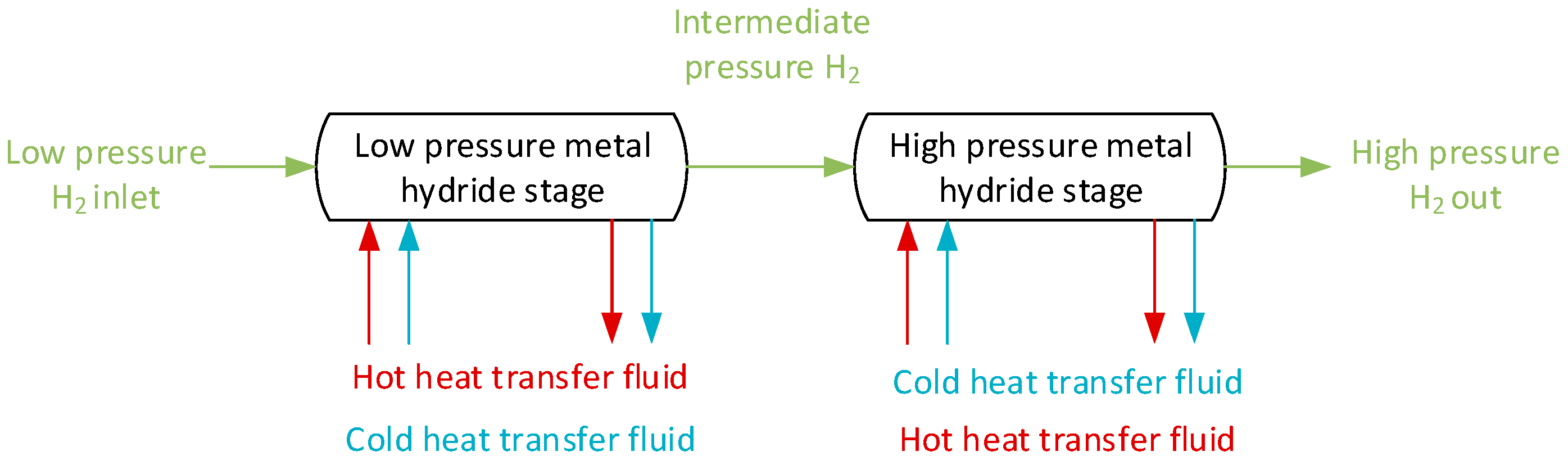
Metal hydrides (MHs) have been extensively evaluated for H2 storage applications [3] but can also be used for compression. MH H2 compression utilises a reversible heat-driven interaction of a hydride-forming metal alloy or intermetallic compound with hydrogen gas [7]. Metal hydrides can absorb large amounts of hydrogen at a constant pressure, i.e., the pressure does not increase with the amount of hydrogen absorbed [8]. The formed hydrides can then, under certain temperatures and pressures, desorb the stored hydrogen [9]. At low temperatures, H2 will be absorbed at lower pressures. If the metal hydride is then isolated and heated, it will desorb the H2 at a higher pressure, achieving compression (see Figure 1). Metal hydride-based compressors have the advantages of simplicity in design and operation, absence of moving parts, compactness, safety and reliability, and the possibility to consume waste industrial heat instead of electricity [7]. Rusanov et al. (2020) [5] showed that when you take the full energy conversion into account, including heat to electrical power at the power station, then the MH compressor is more efficient than mechanical compression.
Metal hydride (MH) hydrogen compressors offer several potential advantages over conventional mechanical compressors. These include lower maintenance needs due to the absence of moving parts, the ability to use waste or solar heat instead of electricity for compression, and the delivery of high-purity hydrogen as a result of the inherent chemical nature of the process. A good overview of MH compression and its operating principles is provided in Lototskyy et al. (2014) [7]. Despite being developed over many years, and several working prototypes of MH hydrogen compressors (MHHCs) being built (examples include [10,11,12,13,14,15]), they still lack significant market uptake (currently, MH compressors can be purchased from Hystorsys [16]).
Despite their well-known low thermodynamic efficiency and lack of an existing market, Lototskyy and Linkov (2022) [15] suggest that MHHCs offer promising solutions for niche applications. They highlight the modular design and scalability of the technology, noting that downscaling in particular offers compact and effective solutions/options for handling high-pressure H2 in laboratories. Applications subject to weight and space constraints are a further potential niche for MHHCs (e.g., the spacecraft compressor developed by Jet Propulsion Laboratory [17]).
The advantages of MHHCs over conventional mechanical compressors follow from their utilisation of available heat in place of electricity: greatly reduced electricity cost, reduced maintenance and near-silent operation. In contrast, a NREL report found that for a 700-bar H2 refuelling station, the mechanical hydrogen compressor contributed 58% of the capital costs and about 65% of the operating costs [6]. It was the second-largest contributor to maintenance hours (24%) and frequency of incidents (18%) [15,18].
For MHHCs, the two main cost items are the capital costs of the MH and the pressure vessels. Corgnale and Sulic (2018) [19] suggested that the MH constitutes 40–85% of the installed cost. Their sensitivity analysis predicted that MHHC costs could be dramatically decreased by reducing the MH cost, reducing the cycle time, and increasing the MH density inside the vessel (i.e., less dead space). According to Johnston et al. (2022) [12] and Lototskyy et al. (2020) [11], however, the costs of pressure vessels were higher than estimated by Corgnale and Sulic, resulting in the MH constituting 20–25% of the MH compressor cost. As throughput increases, the volume of the pressure vessel in each stage of the MHHC increases, leading to rapidly escalating costs. This approach will eventually become unrealistic, necessitating modular designs replicating vessels at an optimum scale. This in turn will benefit the economic scalability of MHHCs.
Stamatakis et al. (2018) [20] completed a preliminary market evaluation for MHHCs and identified three significant niche markets: (1) chemical industry, by utilisation of waste industrial and/or available renewable heat; (2) hydrogen filling stations for vehicles; and (3) renewable energy systems and H2 autonomous power systems for remote communities. Hydrogen compressors currently used at refuelling stations are generally either diaphragm or reciprocating compressors. Poor reliability continues to plague forecourt hydrogen compressors because current designs assume prolonged operation at peak pressure. This operating regime is not representative of the conditions to which forecourt hydrogen compressors are exposed [20].
Direct costs (excluding labour) are available for the refuelling system operated at the Impala Platinum Refineries in South Africa [11]. This refuelling station incorporated a one-stage MH compressor and compressed 13 Nm3/h H2 (approx. 1.1 kg/h) from 50 to 200 bar using 140 °C steam. The total cost of the refuelling station is given as 1.94 million Rand (approx. $140,000 USD in 2015). The main cost components were the MH compressor, H2 dispensing and assembly costs. For the MH compression system (475,000 Rand, 25% of total costs), about 25% of the cost was due to the metal alloy (118,750 Rand), with the remaining 75% being the cost of the pressure vessels (356,250 Rand). Operating costs for the refuelling station were estimated to be 100,000 Rand (approx. $7000 USD in 2017). The majority of these costs related to upgrading the prototype compressor to eliminate defects identified through prolonged operation (e.g., blocking of filters). They concluded that the capital and operating costs of this refuelling station were significantly lower than for standard refuelling stations available on the market. The cost benefits were due to (i) a lower H2 dispensing pressure (185 bar), which enabled the use of standard gas service components; (ii) slow pressure ramping, which prevents overheating of the supplied H2 and thus eliminates the requirement for deep cooling; and (iii) the replacement of a mechanical H2 compressor with an MH compressor.
Several cost studies have been completed for theoretical and demonstration-scale metal hydride compressors. The results from some of these studies are summarised in Table 1.
When a particular use case is identified, it is possible to design and cost a potential compressor, facilitating a detailed comparison of functionally equivalent MH and mechanical compressors. Such a comparison would include a price for waste heat supplied to the MH compressor, which would depend on site-specific requirements. The waste heat available (particularly temperature) would also then be used to determine specific alloys for each stage of the compressor. What is less clear are the scenarios where MH compressors deliver a greater economic advantage over mechanical counterparts (i.e., where the site is not yet known). To shed light on this, the authors have obtained commercial quotes and identified costs for mechanical compressors available in the literature. High-level designs of theoretical MH compressors able to achieve the same compression ratio and throughput as the quoted mechanical compressors were then completed. This necessarily requires some assumptions for the design of the MH compressor. The impact of these assumptions is then explored through a sensitivity analysis. Through this comparison, we hope to identify the application range where MH compressors see greatest advantage. The calculations reported here are indicative only; the intent is not to attempt an accurate analysis of the cost of a specific design, but to make a high-level comparison of costs, to achieve an understanding of how the major cost components impact the overall feasibility of different MHHCs deployed in different scenarios. It should also be noted that we have not at this stage included any cost reductions due to learning that would be expected should a market for MHHCs develop (as is currently the case for mechanical compressors). Thus, the costs provided here for MHHCs are conservative in nature, and additional cost reductions could be expected with scale and market development.

2. Methods: Levelised Cost of Hydrogen Compression

Detail on assumptions and methods used to calculate the cost of the theoretical metal hydride compressor can be found in Appendix A.
As we are completing a high-level comparison, we are only considering basic operating costs, including the cost of electricity. At this stage, we assume that labour required for installing the MH and mechanical compressors is comparable and hence excluded from consideration at this stage. While it has been suggested that maintenance requirements of MH compressors should be lower than that of mechanical compressors, at this stage, we assume they are comparable and again remove them from consideration.
When calculating the levelised cost of hydrogen compression, we assume a lifetime of 10 years for both the mechanical and MH compressors, a discount rate of 9%, and a capacity factor of 0.85. We assume that electricity is at a cost of $100/MWhe, and in the first instance, that waste heat is available at no cost.
The levelised cost of hydrogen compression ($/kgH2) is then calculated via Equation (1). CAPEX is treated as a year-0 lump-sum cost while OPEX is discounted annually over the project lifetime. The resulting levelised cost is then normalised on a $/kg-H2 basis.
L e v e l i s e d   c o s t   o f   c o m p r e s s i o n = C A P E X + Σ a n n u a l   O P E X ( 1 + r ) n H 2 × C F  
where
  • CAPEX—purchased cost of the equipment ($);
  • Annual OPEX—operating cost over a year ($);
  • H2—annual H2 throughput (kg/year);
  • CF—capacity factor (0.85);
  • r—discount rate (9%);
  • n—lifetime of asset (10 years).
In the net present value calculations, CAPEX is assumed to be spent in the first year. OPEX is then spent over the subsequent 9 years of the asset life. Electricity costs are assumed to be constant over the asset life. All cost estimates represent uninstalled equipment costs for both the MH and mechanical compressors. We have not at this stage included a generic installation multiplier, as installation and site integration costs are expected to scale in a similar manner for both technologies.

Example

We received a quote for a compressor to compress H2 from 1 to 16 bara at a rate of 87 Nm3/h H2 throughput (7.22 kg/h). The cost of this compressor was approximately $196,000 AUD (2023; unless stated otherwise, costs are in AUD 2023).
Increasing the pressure from 1 to 16 bar can be accomplished by one stage in an MH compressor. Alloys that can achieve this include LaNi4.65Mn0.35, LaCu5, MmNi4.2Al0.8, La0.7Ce0.2Co0.5, and LaNi4.25Co0.5Sn0.25 [22]. These alloys all have equilibrium pressures below 1 bar at 25 °C and above 16 bar at 150 °C. We assume that an AB5 alloy (e.g., properties comparable to LaNi5) is used in the single stage of the compressor, with the time required for each half cycle (e.g., absorption or desorption) being 20 min. This is comparable to the half cycle time experienced in the MH compressor used in the refuelling station at the Impala refinery [11]. We assumed two parallel sections per stage, so that as one is absorbing, the other is desorbing to give nearly constant flow from the compressor. This means that 2.41 kg of H2 needs to be moved during each absorption/desorption step to meet the target flow rate of 7.22 kg/h. For LaNi5, the maximum H2 uptake is typically around 1.4 wt%. The lower end of the pressure plateau is typically below 0.2 wt%. Thus, we have assumed a cyclic capacity of 1 wt%. This means that 241 kg of alloy is required for each absorption/desorption step. To improve performance, thermal conductivity enhancers are often added to MH vessels. Examples include expanded natural graphite (ENG) typically added at 10–15 wt% of the alloy. We assume that 15 wt% ENG is added to each vessel (36.1 kg) as this is the fraction used in the prototype compressor operated by Johnson et al. (2022) [12]. This brings the total mass in each vessel to 276.8 kg. As MHs absorb H2, they expand, and as a result, dead space is required in each vessel to accommodate this expansion. For LaNi5, we assume that the non-hydrogenated density is 3000 kg/m3 to accommodate this expansion (based on experience with LaNi5 in our laboratory (unpublished)). This means that the volume required to house the metal hydride is 0.092 m3 per vessel. If we assume a vessel diameter of 0.25 m, and 10% of the cross-sectional area is lost to heat transfer tubing, a vessel 2.09 m long is required for each absorption/desorption step. We have assumed that so long as the length of the pressure vessel is below 8 m (see Table A1), the pressure vessel can be manufactured, and additional pressure vessels are not required. We have not scaled the cost for length as the change in cost is expected to be minimal. Thus, in each 20 min cycle, we have one vessel absorbing, and one vessel desorbing, with each vessel containing 276.8 kg alloy and ENG. The total mass of alloy for the whole compressor is 481.4 kg, and the total mass of ENG required is 72.2 kg. Using the quote we received for LaNi5 ($100/kg, see Appendix A2.2) as the estimate for the cost of the alloy, the cost of the alloy for the compressor is $48,140. Using the quote from Johnson et al. (2022) [12] for the cost of the ENG ($70/kg), the cost of ENG is $5055. At $30,000 each, the cost of the two pressure vessels required comes to $60,000. Thus, the approximate total capital cost of the compressor is $113,000 (AUD 2023). Adding in the cost of the heat transfer pumps and air cooler (see Appendix A) brings the total uninstalled cost to $119,070. This is lower than the uninstalled cost of the mechanical compressor.
To provide a more thorough understanding of where the MH compressor could see an advantage, we have looked through the literature for additional quoted costs of current commercially available mechanical compressors. These are provided in Table 2 (taken from Parks et al. (2014) [6]), in addition to a second compressor quoted for use in Australia. Following the methodology outlined above, we have sized a theoretical MH compressor able to achieve the same throughput and compression ratio. The high-level details of the MH compressor to match each of these cases are provided in Table 3.

3. Results

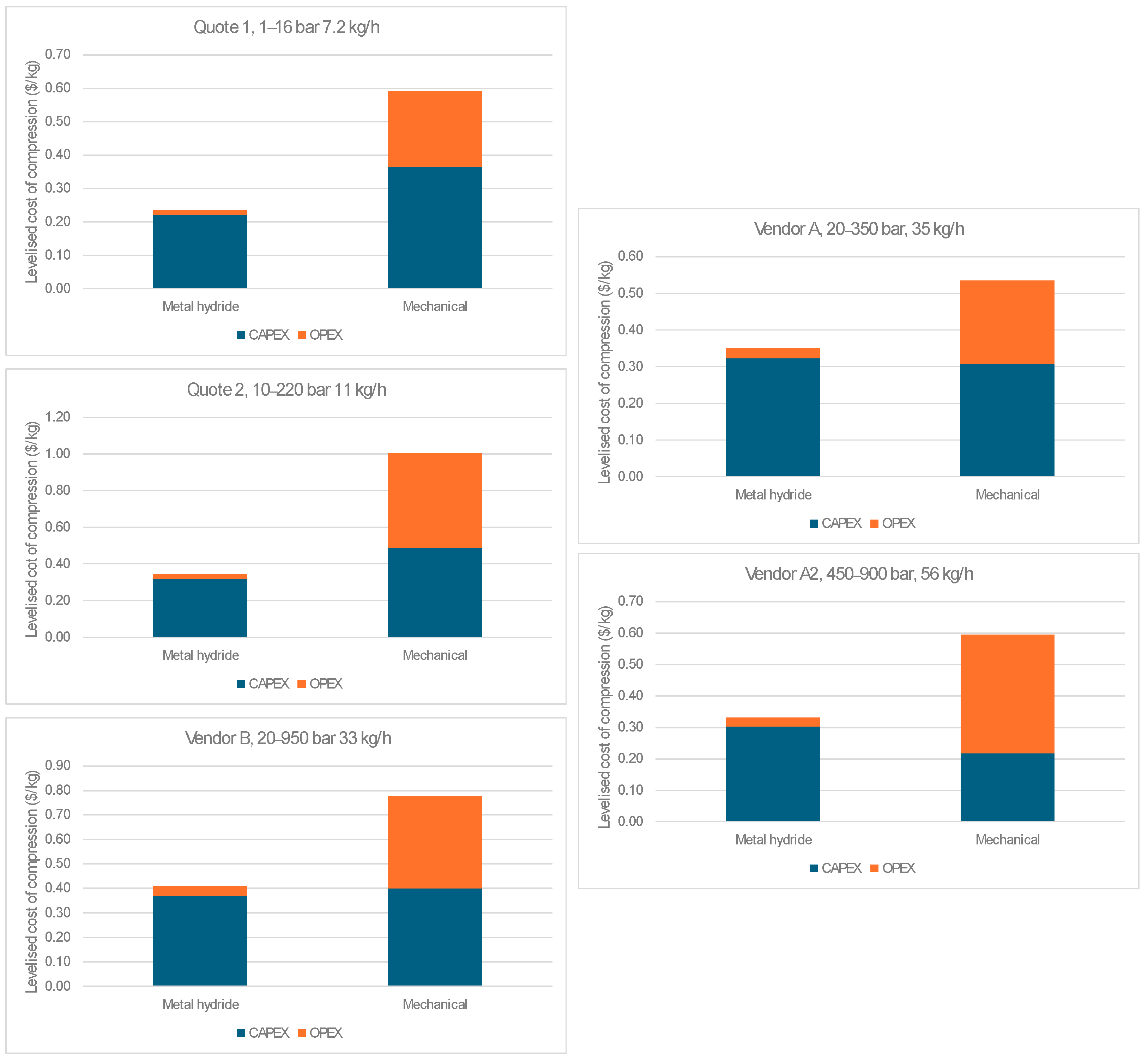
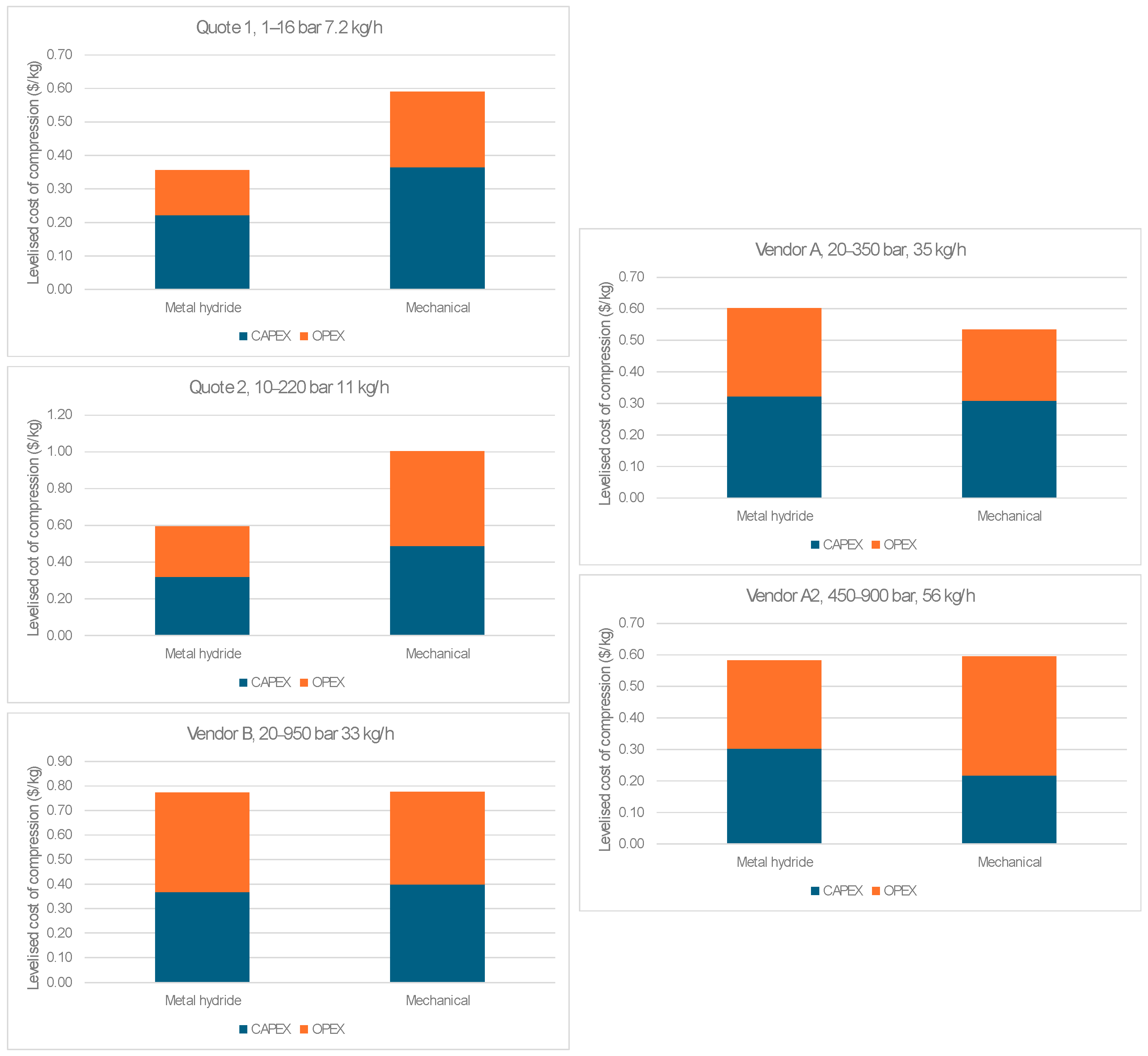
Noting the back-of-the-envelope nature of these calculations, the capital costs of the metal hydride and mechanical compressors are fairly comparable. To provide greater insight into the overall costs of the compressors, the levelised cost over an assumed lifespan of 10 years is provided in Figure 2. In this first comparison, we have assumed that waste heat for the MH compressor can be sourced at no cost.
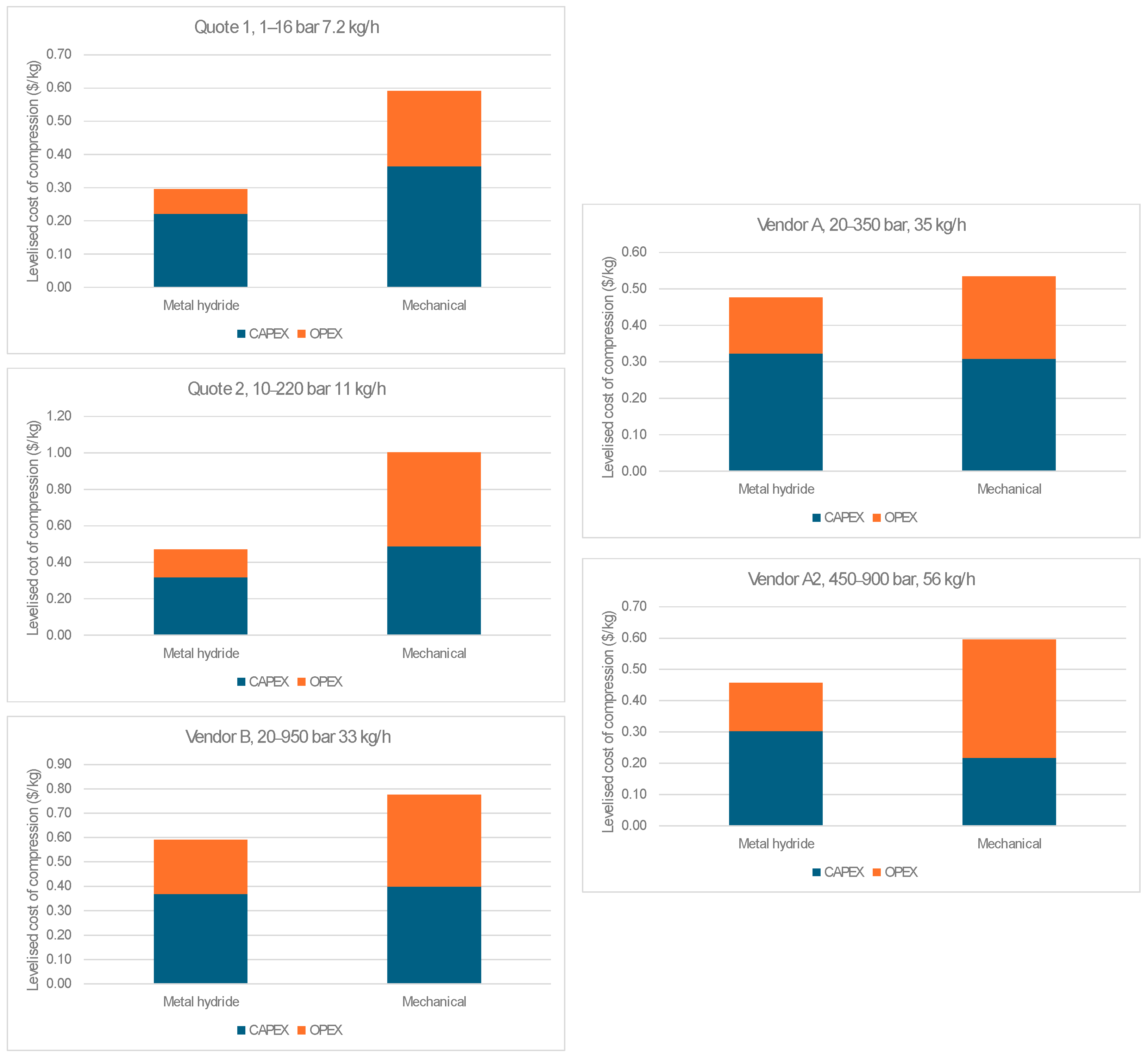
Figure 2 highlights the large impact of the operating cost (mainly electricity) on the overall cost of mechanical compressors. For MH compressors, the capital cost dominates the overall cost (see Appendix A for the cost distribution of the MH compressor). The low operating cost of the metal hydride compressors stems largely from the assumption that waste heat is provided free to the compressor. Figure 3 explores the impact of this assumption with a cost of $10/MWth applied to the operating cost of the MH compressor.
Figure 3 highlights that even with a cost of $10/MWth applied to the metal hydride compressors, they are still economical compared to mechanical compressors. However, the cost for Vendor A is now within the error of this analysis, and in this instance, there is no clear cost advantage of the metal hydride compressor. Clearly, a rigorous design and cost analysis would need to be completed before settling on a particular compressor for a particular use case. However, Figure 3 highlights that even if there is some cost applied to the waste heat, MH compressors could still potentially see an advantage. In Appendix A, we explore the impact of supplying part of the thermal energy requirement for the metal hydride compressors via electricity.

3.1. Sensitivity Analysis

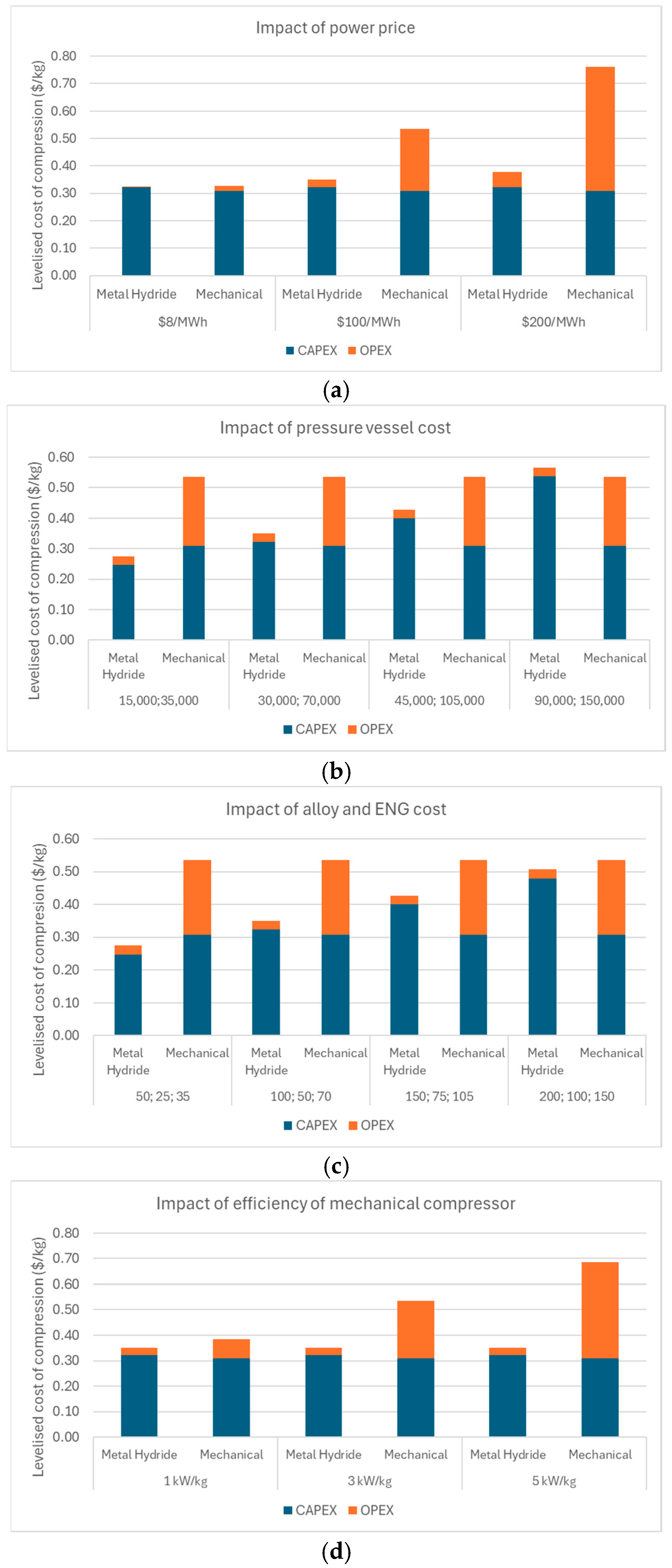
In this section, the impact of the assumptions made when sizing and costing the metal hydride compressors is explored. Here, we selected the comparison to Vendor A, and we evaluated the impact of electricity, pressure vessel and alloy costs, and efficiency assumed for the mechanical compressor. These results are provided in Figure 4.
From Figure 4a, it can be seen that where waste heat is free, the electricity cost would need to drop to $8/MWhe for the cost of a mechanical compressor to be comparable to that of the metal hydride compressor. From Figure 4b, it can be seen that even if the pressure vessel costs were 50% higher than estimated (at $45k for the low-pressure vessel and $105k for the high-pressure vessel), the levelised cost of the metal hydride compressor is still competitive compared to the mechanical compressor. From Figure 4c, it can be seen that the costs of the alloys would need to double from those considered here (to $200/kg for AB5, $100/kg for AB2 and $150/kg for ENG) for the cost of the metal hydride compressor to match that of the mechanical compressor. Finally, from Figure 4d, we can see that the efficiency of the mechanical compressor would need to improve to 1 kWe/kgH2 to have similar costs to the metal hydride compressor over the assumed 10 yr lifespan.

3.2. Limitations of Current Economic Assessment and Recommendations for Future Work

This paper is intended to provide a high-level comparison of the costs of metal hydride and mechanical compressors so that the areas where MH compressors potentially see an economic advantage could be identified. As noted in the introduction, as a specific site or use case has not yet been identified, it is not possible to select specific alloys for each stage of the compressor, nor incorporate site-specific integration costs at this stage. In addition, we have not yet explored the impact of metal hydride deactivation, which can only be predicted once specific metal hydrides have been selected. In addition, for this first-pass comparison, we have excluded maintenance and labour costs. Due to their absence of moving parts, MH compressors are anticipated to have lower maintenance requirements than mechanical compressors [7]. Inclusion of maintenance costs in the cost comparison is anticipated to further enhance the cost competitiveness of MH compressors.
It is recommended that before a final investment decision is made, such costs need to be determined. At that point, a more detailed techno-economic comparison can be completed, providing a more robust comparison of the two technologies for the particular scenario of interest.

4. Summary and Conclusions

This paper considers a back-of-the-envelope cost comparison between metal hydride and mechanical compression. The aim was not to provide a detailed comparison between the two technologies. Rather, the intent was to explore the scenarios where metal hydride compressors are likely to see the greatest cost advantage.
Five compressor specifications corresponding to received quotations for the commercial supply of mechanical compressors were adopted, and each was matched by a metal hydride compressor, based on cost assumptions for hydrogen storage alloys, pressure vessels, etc.
With the exception of the “Vendor 2” scenario (450–900 bar compression, 56 kg/h throughput), the predicted capital cost of the metal hydride compressor was similar or significantly lower than the cost of the equivalent mechanical compressor. While the absolute numbers should not be taken too literally, the trend towards a lower relative capital cost for smaller metal hydride compressors appears to be significant.
Adding operating costs changes the picture considerably in favour of metal hydride compression. Where waste heat can be supplied free, or at a small cost, metal hydride compressors are expected to achieve significantly lower levelised costs of H2 compression compared to mechanical alternatives. The sensitivity analysis highlights that the electricity price would have to drop to $8/MWe (AUD) for the mechanical compressor to be cost-competitive when heat can be sourced for MH compression at no cost.
The sensitivity analysis shows that while capital costs dominate for the metal hydride compressor, these would need to double from those estimated here (alloy costs increased to $100–$200/kg (AB2/AB5) and pressure vessels costs $90,000–$150,000 (low/high pressure)) for the mechanical compressor to be cost-competitive (where waste heat can be sourced at no cost).
This analysis highlights that the cost of electricity for mechanical compression has the greatest impact on cost-competitiveness. Metal hydride-based compressors see the greatest cost advantage where electricity costs are high, and where waste or solar heat can be provided at low or no cost.

Author Contributions

Conceptualisation, A.C. and N.K.; methodology, A.C. and N.K.; data curation, M.L., S.E. and E.M.G.; writing—original draft preparation, A.C.; writing—review and editing, N.K. and E.M.G.; supervision, N.K. and E.M.G. All authors have read and agreed to the published version of the manuscript.

Funding

This research received no external funding.

Data Availability Statement

The original contributions presented in this study are included in the article. Further inquiries can be directed to the corresponding author(s).

Acknowledgments

Funding for this work was provided through the Hydrogen Energy Systems Future Science Platform at CSIRO.

Conflicts of Interest

The authors declare no conflicts of interest.

Appendix A. Levelised Cost of Metal Hydride Compression

Appendix A.1. Cost Conversions

Literature values and quotes have been used to supply estimates for the cost of a theoretical MH compressor and for comparison to mechanical compression. Costs have been converted to first-quarter 2023 using the inflation index [23]. Costs were then converted to AUD using currency conversion [24].

Appendix A.2. Assumptions for Design of Theoretical MH Compressor

The two main cost items in the metal hydride compressor are the cost of the alloy and the cost of the pressure vessel. The costs of these items are considered in the following sections. Here, we assume a design similar to that of Johnson et al. (2022) [12], where heat transfer fluid is provided by internal tubes, while the metal hydride is contained in the shell of the vessel. We assume that there is an insulating layer on the inside of the pressure vessel wall, minimising the heat lost to heating the pressure vessel and surrounds. We assume that heat transfer tubes take up around 10% of the cross-section of the pressure vessel, rounded to the nearest whole number.

Appendix A.2.1. Cost of Alloy

The most widely considered alloys for MH compression applications are AB5 and AB2 alloys. This is due to their suitable operating range and stability. For the idealised compressor, it was assumed that an AB5-type alloy is used in the first, lower-pressure stage of the compressor. Higher-pressure stages were assumed to use AB2-type alloys.
We received a quote for LaNi5, which came in at $65 USD/kg for orders over 100 kg (2021, approx. $106 AUD/kg 2023). This was for particle sizes < 2 mm and has been used in our prototype compressor without additional processing.
Johnson et al. (2022) [12] received quotes for the manufacture of an AB2-type alloy at scale from manufacturers in the US, Japan and China. The price of the alloy varied between $17 and 46/kg (USD 2022, approx. $26–65/kg AUD 2023).
Most compressors use additives to improve heat transfer inside the vessel. A commonly used additive is to add 10–15 mass% expanded natural graphite (ENG) to improve thermal conductivity. Johnson et al. (2022) [12] received a quote for at-scale manufacture of ENG at $46/kg (USD 2022, approx. $69/kg AUD 2023).
Thus, for our calculations, we assume an AB5-type alloy at $100/kg AUD in the first lower-pressure stage and an AB2-type alloy at $50/kg AUD for higher-pressure stages. A cost of $70/kg is assumed for ENG.
Note: Operation of prototype metal hydride compressors have shown a reduction in throughput with operation [11,25]. Causes for degradation of metal hydrides with operation are an ongoing area of research. We direct interested readers to the recent review by Zohra et al. (2024) [26]. Deterioration of AB5-type alloys has been linked to disassociation reactions, the appearance of lattice strains, pulverisation in combination with poisoning via trace impurities in H2, and the formation of defects in the metallic matrix [15,26,27]. Where degradation is from poisoning, capacity can be reclaimed by heating hydrides to 100–150 °C in vacuum or low-pressure H2 [15]. Grey and Webb (2020) [27] observed the reversing of disproportionation in LaNi5 by heating under vacuum at 200 °C. They also note that in the case of amorphisation, the MH would require annealing to restore its crystallinity, and this would require an ex situ heating process, as the temperatures are likely to be too high for a compressor container. Bowman et al. (2013) [28] purposefully degraded a LaNi4.78Sn0.22 sample by holding at high temperature (500 K) and high H2 pressure (171 bar over pressure). This resulted in a ~30% loss of the reversible H2 capacity. Nearly full recovery of the capacity was achieved by heating to 400 °C under ~1-bar H2. Without knowing the particular application (which would determine impurities in the H2 and specific alloy choice), it is difficult to predict the long-term performance of an MH compressor. It is likely that re-activation of the alloys would be required periodically over the lifetime of the MH compressor (this was done every 6 months at the Impala refinery over their 3-year operation). This is not expected to significantly impact the capital or operating cost of the MH compressor, and at this stage, we have not included it in the analysis. This should however be included when completing a detailed techno-economic assessment for a specific use case.

Appendix A.2.2. Cost of Pressure Vessel

Johnson et al. (2022) [12] used a pressure vessel made from Nitronic 50 alloy in their prototype MH compressor. When scaling this for a 100 kg/h scenario, they received quotes of $43,400 USD (2022, low-pressure vessel, approx. $65,000 AUD 2023) to $56,400 USD (2022, high-pressure vessel, approx. $83,000 AUD 2023). These vessels were 0.3 m diameter, 0.9 m length and housed 200 kg MH material. This resulted in a total compressor cost of $2–5 million (depending on the MH used; note that the large cost of compression is due to the high throughput, 100 kg/h). To lower costs, they suggested using a composite vessel instead of the Nitronic alloy. They received a quote for an open-ended Type III vessel able to operate up to 1000 bar and 163 °C. These vessels were quoted at around $10,000 USD each (2022, approx. $15,000 AUD 2023). These are assumed to be uninstalled costs.
Parks et al. (2014) [6] received vendor quotes for several pressure vessels for H2 storage, as outlined in Table A1 below.
Table A1. Cost of pressure vessels [6].
Type of Storage VesselCost
ASTM SA 372 Grade J class 70 vessel
0.4 m OD, 7.3 m long
430 bar
$18,000 USD 2007 (approx. $38,400 AUD 2023)
Carbon wrapped ASME type 1 cylinder
0.6 m OD, 7.3 m long
193 bar
$20,700 USD 2007 (approx. $44,000 AUD 2023)
Type 2 cylinder
0.46 m ID, 2.4/4.4/8.8 m lengths
900 bar
$36,000 USD 2007 (approx. $76,900 AUD 2023)
Type 4 cylinder
0.6 m OD, 2 m length
900 bar
$24,000 USD 2007 (approx. $51,000 AUD 2023)
For the low-pressure stage of the compressor (pressures below 350 bar), we have assumed a lower cost of the pressure vessel, at $30,000 AUD per vessel. This cost is between the two quotes received from Johnson et al. (2022) [12] for their low-pressure-stage pressure vessel. For the medium- and higher-pressure stages (up to 900 bar), we assume a higher cost of $70,000 AUD per vessel. This is between the costs quoted in Parks et al. (2014) [6] for pressure vessels.

Appendix A.2.3. Other Assumptions for Design of a Theoretical MH Compressor

The key design assumptions that affect the amount of metal hydride required, and hence the size of the compressor, include the MH density, capacity, and cycle time (time for absorption/desorption). For our high-level comparison, we have assumed the following:
Cycle time: The time for H2 to absorb/desorb into the metal alloy is assumed to be 20 min. This is in line with MH compressors that have been operated in South Africa ([11] 20–30 min), the USA ([12] 15–20 min), and Russia ([25] 10 min).
Cyclic capacity: This is the amount of H2 that can be reversibly absorbed by the MH. Here, we have assumed a cyclic capacity of 1 wt%, which is typical of a LaNi5 system, and is comparable to that used by Johnson et al. (2022) [12].
MH density: MHs expand as they absorb H2, and additional space needs to be provided in the vessel to account for this expansion. While the real density of metals is quite high (7950 kg/m3 for LaNi5), a lower density is required when calculating the mass of alloy that can added to a vessel. We have assumed a packing density of 3000 kg/m3, which again is typical for a powdered LaNi5 system (based on experience in our laboratory, unpublished data). For a given vessel diameter, the mass of alloy and its packing density are then used to determine the length of the pressure vessel required.
ENG: Expanded natural graphite is often added to MH compression systems to improve heat transfer, typically around 10–15 wt%. For this comparison, we have assumed the addition of 15 wt% ENG to the metal hydride vessels. This is in line with that added by Johnson et al. (2022) [12] in their prototype.
Energy requirement
The energy that needs to be supplied to the vessels when desorbing H2 includes the energy needed to heat the vessel and alloy (sensible heat, Equation (A1)), and the energy needed to desorb the H2 (desorption heat, Equation (A2)). The mass of alloy and ENG, and the mass of stainless steel were used to determine the sensible heat requirement. The mass of steel was assumed to be the heat transfer tubes, based on an OD of 25 mm and a wall thickness of 5 mm. The length of the tubes is taken as the same as the length of the pressure vessel. Table A2 provides the data required for these calculations.
S e n s i b l e   h e a t = m a l l o y C p , a l l o y Δ T + m s t e e l C p , s t e e l Δ T
d e s o r p t i o n   h e a t = m H 2 Δ H
where
  • malloy/steel = mass of alloy and ENG or steel;
  • Cp,alloy/steel = heat capacity of the alloy or steel;
  • ΔT = temperature difference, assumed to be from 50 to 150 °C;
  • mH2 = moles of H2 desorbed;
  • ΔH = enthalpy of H2 desorption.
Table A2. Data used for energy calculations.
Density stainless steel8000 kg/m3[29]
Cp stainless steel0.515 kJ/kgK@ 127 °C [30]
ΔH AB5 alloy32 kJ/molH2Own data (for LaNi5)
ΔH AB2 alloy25.9 kJ/molH2Own data (for hydralloy)
Cp alloy0.419 kJ/kgK[31]
Cp ENG0.7069 kJ/kgK[32]
Cp Duratherm 4502.331 kJ/kgK@ 100 °C [33]
Density Duratherm 450852 kg/m3@ 38 °C [33]
Once calculated, the energy required for absorption and desorption was then increased to account for inefficiencies in the system. Johnson et al. (2022) [12] noted that despite the internal insulation when heating their vessel, around 40% went to heating the alloy, with the remainder going to heating the vessel and surrounds. When calculating the energy required for heating the MH system, we increased the energy requirement by 30% of that calculated. When cooling, we increased the energy requirement by 15%.
Cost of pumps
Once the energy requirement was known, pumps could then be sized. Duratherm 450 was assumed as the heat transfer fluid and was assumed to have a temperature change of 40 to 145 °C. The properties of Duratherm 450 are provided in Table A2. The heat transfer required as calculated above was then used to determine the flow rate of heat transfer fluid. The flow rate of heat transfer fluid was then used to size the pump via Equation (A3):
p u m p   p o w e r ( k W e ) = q ρ g h 1000
where
  • q is the flow rate of fluid (m3/s);
  • r is the fluid density (kg/m3);
  • g = 9.81 m/s2;
  • h is the head (assume 10 m).
The electrical power requirement was then calculated via Equation (A4):
p u m p   e l e c t r i c a l   r e q u i r e m e m t ( k W e ) = p u m p   p o w e r m o t o r   e f f i c i e n c y × p u m p   e f f i c i e n c y
where pump efficiency was assumed to be 0.7, and motor efficiency assumed to be 0.9.
The flow rate of the pump was also used to estimate the cost of the pump by scaling from a known pump cost. In this case, we scaled from the cost of pumps installed on our prototype MH compressor using Equation (A5):
c o s t = c o s t p r o t o t y p e ( f l o w f l o w p r o t o t y p e ) 0.6
Cost of air cooler
The energy required for cooling was used to estimate the size and cost of an air cooler. The air was assumed to heat from 30 to 80 °C when cooling the oil. This was used to calculate the log mean temperature difference. An overall heat transfer coefficient of 100 W/m2K was then used to estimate the heat transfer area required. The cost of the air cooler was calculated assuming a cost of $1800 per m2 of the heat transfer area.
The air flow required for cooling was estimated via Equation (A6):
V = Q C p Δ T ρ
where
  • V is the volume of flow air required (m3/s);
  • Q is the energy to be removed (Wth);
  • Cp is the heat capacity of air (1000.5 J/kgK);
  • ρ is the density of air (1.2 kg/m3).
The power required for the cooling fan was estimated via Equation (A7):
P f a n = V Δ P η o v e r a l l
where
  • Pfan is the power requirement of the fan (We);
  • ηoverall is the overall efficiency, assumed to be 0.7;
  • ΔP is the pressure drop, assumed to be 1 kPa.

Appendix A.3. Assumptions for Mechanical Compressors

For this comparison, we have sourced quotes and literature information on the costs of currently available mechanical compressors. For one of these, the efficiency of the compressor was known (Quote 2 (see Table 2) at 6.8 kWe/kgH2). For all others, we have had to assume an efficiency. Parks et al. (2014) [6] provide the power requirement of theoretical mechanical compressors as being between 2.3 and 3.3 kWhe/kgH2. They note however that the only value they could find reported for the efficiency of a real operating compressor was 8 kWe/kgH2 (for compression from 13 to 450 bar). For compression up to around 350 bar, we have assumed a mechanical compression efficiency of 3 kWe/kgH2. For higher pressures (up to 900 bar), we assume an efficiency of 5 kWe/kgH2.

Appendix A.4. Cost Distribution for MH Compressors

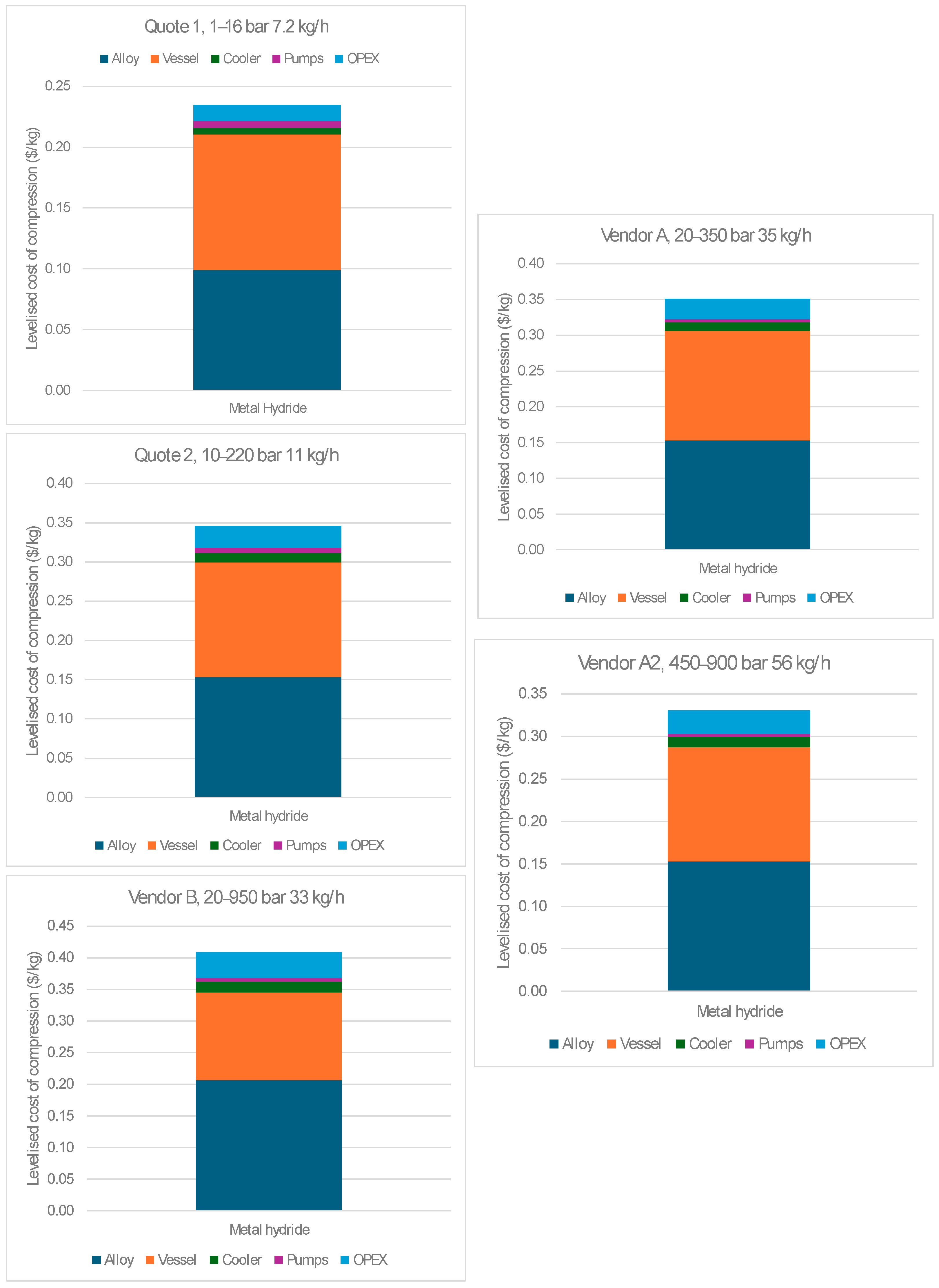
Figure A1 shows the cost distribution for the metal hydride compressors (assuming waste heat is available for free). This highlights that the alloy and pressure vessel costs dominate the capital costs.
Figure A1. Cost distribution of metal hydride compressors for each case (cost of heat @ $0/MWh, electricity @ $100/MWh, 10-year life, 9% discount rate, capacity factor 0.85).
Hydrogen 07 00035 g0a1

Appendix A.5. Impact of Using Electricity to Supply Some of the Heat Energy Required for Compression

There may be instances (e.g., start-up, maintenance, etc.) where heat is not available to the metal hydride compressor. Figure A2 explores the impact of using electricity to provide some of the heat needed for the metal hydride compressors. Here, we assume that 1 kWe can provide 1 kWth of heating, and that 20% of the thermal energy required by the metal hydride compressor is provided by electricity. We have not included the capital cost of the electric heaters at this stage. Only the increased operating costs resulting from the higher electricity use are considered.
Figure A2. Comparison of levelised cost of compression for metal hydride and mechanical compressors, where 20% of the thermal requirement for the metal hydride compressor is provided via electricity (cost of heat @ $0/MWh, electricity @ $100/MWh, 10-year life, 9% discount rate, capacity factor 0.85).
Hydrogen 07 00035 g0a2
Figure A2 highlights that metal hydride compressors start to lose their economic advantage if a significant part of the thermal energy requirement is instead provided via electricity. While limited thermal input via electricity is probably okay (e.g., during start-up), metal hydride compressors see the greatest advantage where waste heat is used to provide the energy requirement.

Appendix A.6. Potential for Sourcing Waste Heat

Most industrial processes re-use heat as much as practicable to improve efficiency and lower costs. This means that heat available for compression would be of little value to re-use elsewhere in said process (i.e., waste heat). As such, it is likely that available heat would be below 150 °C. There will also be challenges in integrating a MH compressor with site-based waste heat, which, depending on the process, could contain contaminants and require filtering/treating before it is supplied to the compressor, impacting integration costs. An alternative would be to source low-cost solar heat for the compressor. This would likely require little pre-treatment but would require space for solar collectors. Thought would also have to be given to integration where the heat supply is only available during the day. The particular process where the H2 compression is integrated will also impact operation. Where waste heat supply varies (temperature or quantity), consideration will have to be given in the design of the compressor and alloy selection such that expected variability can be managed. If heat supply is not continuous (e.g., when sourcing solar heat), then additional buffering/storage may be required.
Despite these challenges, MH compressors have been operated at industrial sites using waste heat. An example is the MH compressor incorporated into the H2 refuelling station at the Impala Platinum Refinery, South Africa [11]. Waste heat (140 °C steam) and cooling water were sourced from the refinery. H2 dispensing was independent of the compressor operation and took between 6 and 15 min. The novel refuelling station complied with South African regulations for operation in a hazardous environment and operated for 3 years.

References

  1. International Energy Agency. Global Hydrogen Review 2025. Available online: https://www.iea.org/reports/global-hydrogen-review-2025 (accessed on 2 February 2026).
  2. CSIRO Hydrogen. Available online: https://www.csiro.au/en/research/environmental-impacts/fuels/hydrogen?start=0&count=12 (accessed on 8 January 2026).
  3. Pistidda, C. Solid-State Hydrogen Storage for a Decarbonized Society. Hydrogen 2021, 2, 428–443. [Google Scholar] [CrossRef]
  4. CSIRO and GHD, Hydrogen Vehicle Refuelling Infrastructure: Priorities and Opportunities for Australia. CSIRO, Canberra. 2023. Available online: https://www.csiro.au/en/about/challenges-missions/Hydrogen/Hydrogen-Vehicle-Refuelling-Infrastructure (accessed on 8 January 2026).
  5. Rusanov, A.V.; Solovey, V.V.; Lototskyy, M.V. Thermodynamic features of metal hydride thermal sorption compressors and perspectives of their application in hydrogen liquefaction systems. J. Phys. Energy 2020, 2, 021007. [Google Scholar] [CrossRef]
  6. Parks, G.; Boys, R.; Cornish, J.; Remick, R. Hydrogen Station Compression, Storage, and Dispensing Technical Status and Costs; NREL technical report NREL/BK-6A10-58564; National Laboratory of the Rockies (NLR): Golden, CO, USA, 2014. [Google Scholar]
  7. Lototskyy, M.V.; Yartys, V.A.; Pollet, B.G.; Bowman, R.C. Metal hydride hydrogen compressors: A review. Int. J. Hydrogen Energy 2014, 39, 5818–5851. [Google Scholar] [CrossRef]
  8. Zuttel, A. Materials for H2 storage. Mater. Today 2003, 6, 24–33. [Google Scholar] [CrossRef]
  9. Makridis, S.S. H2 storage and compression. In Methane and Hydrogen for Energy Storage, 1st ed.; Carriveau, R., Ting, S.S.-K., Eds.; IET Digital Library: London, UK, 2016; Chapter 1; pp. 1–28. [Google Scholar]
  10. Lototskyy, M.; Klochko, Y.; Linkov, V.; Lawrie, P.; Pollet, B.G. Thermally Driven Metal Hydride Hydrogen Compressor for Medium-Scale Applications. Energy Procedia 2012, 29, 347–356. [Google Scholar] [CrossRef]
  11. Lototskyy, M.V.; Davids, M.W.; Swanepoel, D.; Louw, G.; Klochko, Y.; Smith, F.; Haji, F.; Tolj, I.; Chidziva, S.; Pasupathi, S.; et al. Hydrogen refuelling station with integrated metal hydride compressor: Layout features and experience of three-year operation. Int. J. Hydrogen Energy 2020, 45, 5415–5429. [Google Scholar] [CrossRef]
  12. Johnson, T.A.; Mallow, A.M.; Bowman, R.C.; Barton Smiht, D.; Anovitz, L.M.; Jensen, C.M. Metal Hydride Compressor for High-Pressure (875 bar) Hydrogen Delivery; Sandia Report SAND2022-15920; Sandia National Laboratories: Albuquerque, NM, USA, 2022. [Google Scholar]
  13. Karagiorgis, G.; Christodoulou, C.N.; von Storch, H.; Tzamalis, G.; Deligiannis, K.; Hadjipetrou, D.; Odysseos, M.; Roeb, M.; Sattler, C. Design, development, construction and operation of a novel metal hydride compressor. Int. J. Hydrogen Energy 2017, 42, 12364–12374. [Google Scholar] [CrossRef]
  14. Barale, J.; Nastro, F.; Violi, D.; Rizzi, P.; Luetto, C.; Baricco, M. A metal hydride compressor for small scale H2 refuelling station. Int. J. Hydrogen Energy 2023, 48, 34105–34119. [Google Scholar] [CrossRef]
  15. Lototskyy, M.V.; Linkov, V. Thermally driven hydrogen compression using metal hydrides. Int. J. Energy Res. 2022, 46, 22049–22069. [Google Scholar] [CrossRef]
  16. Hystorsys. Available online: https://www.hystorsys.no (accessed on 8 January 2026).
  17. Pearson, D.; Bowman, R.; Prina, M.; Wilson, P. The Planck sorption cooler: Using metal hydrides to produce 20K. J. Alloys Compd. 2007, 446–447, 718–722. [Google Scholar] [CrossRef]
  18. Kurtz, J.; Sprik, S.; Peters, M.; Bradley, T.H. Retail H2 station reliability status and advances. Reliab. Eng. Syst. Saf. 2020, 106823. [Google Scholar] [CrossRef]
  19. Corgnale, C.; Sulic, M. Techno-economic analysis of high-pressure metal hydride compressor. Metals 2018, 8, 469. [Google Scholar] [CrossRef]
  20. Stamatakis, E.; Zoulias, E.; Tzamalis, G.; Massina, Z.; Analytis, V.; Christodoulou, C.; Stubos, A. Metal hydride hydrogen compressors: Current developments and early markets. Renew. Energy 2018, 127, 850–862. [Google Scholar] [CrossRef]
  21. Costamagna, M.; Barale, J.; Carbone, C.; Luetto, C.; Agostini, A.; Baricco, M.; Rizzi, P. Environmental and economic assessment of hydrogen compression with metal hydride technology. Int. J. Hydrogen Energy 2022, 47, 10122–10136. [Google Scholar] [CrossRef]
  22. Voskuilen, T.G.; Waters, E.L.; Pourpoint, T.L. A comprehensive approach for alloy selection in metal hydride thermal systems. Int. J. Hydrogen Energy 2014, 39, 13240–13254. [Google Scholar] [CrossRef]
  23. Inflation Tool. Available online: https://www.inflationtool.com/euro?amount=1&year1=2011&year2=2015 (accessed on 8 January 2026).
  24. OFX Currency Conversion. Available online: https://www.ofx.com/en-au/forex-news/historical-exchange-rates/yearly-average-rates/ (accessed on 8 January 2026).
  25. Tarasov, B.P.; Bocharnikov, M.S.; Yanenko, Y.B.; Fursikov, P.V.; Lototskyy, M.V. Cycling stability of RNi5 (R = La, La+Ce) hydrides during operation of metal hydride hydrogen compressor. Int. J. Hydrogen Energy 2018, 43, 4415–4427. [Google Scholar] [CrossRef]
  26. Zohra, F.T.; Webb, C.J.; Lamb, K.E.; Gray, E.M. Degradation of metal hydrides in hydrogen-based thermodynamic machines: A review. Int. J. Hydrogen Energy 2024, 64, 417–438. [Google Scholar] [CrossRef]
  27. Gray, E.M.; Webb, C.J. Metal-hydride hydrogen compressors for laboratory use. J. Phys. Energy 2020, 2, 034004. [Google Scholar] [CrossRef]
  28. Bowman, R.C., Jr.; Payzant, E.A.; Wilson, P.R.; Ledovskikh, A.; Danilov, D.; Notten, P.H.L.; An, K.; Skorpenske, H.D.; Wood, D.L. Characterization and analyses of degradation and recovery of LaNi4.78Sn0.22 hydrides following thermal aging. J. Alloys Compd. 2013, 580, S207–S210. [Google Scholar] [CrossRef]
  29. Density Stainless Steel. Available online: https://www.azom.com/properties.aspx?ArticleID=863 (accessed on 2 February 2026).
  30. Specific Heat Capacity Stainless Steel. Available online: https://www.engineeringtoolbox.com/stainless-steel-specific-heat-thermal-conductivity-vs-temperature-d_2225.html (accessed on 2 February 2026).
  31. Liu, L.; Johnson, J.X. Technical and Environmental feasibility of renewable metal hydride-based off-grid energy systems. Int. J. Hydrogen Energy 2025, 130, 595–604. [Google Scholar] [CrossRef]
  32. Nair, A.M.; Wilson, C.; Kamkari, B.; Hodge, S.; Huang, M.J.; Griffiths, P.; Hewitt, N.J. Enhancing thermal energy storage performance with expanded graphite composite: A comparative energy-exergy analysis. J. Energy Storage 2025, 108, 115037. [Google Scholar] [CrossRef]
  33. Heat Capacity and Density of Duratherm 450. Available online: https://durathermfluids.com.au/products/duratherm-450 (accessed on 2 February 2026).
Figure 1. Schematic of a metal hydride compressor. In the first cycle, the low-pressure stage of the compressor is cooled, removing the heat generated as H2 is absorbed by the metal alloy. When saturated, the low-pressure stage is then heated (and the high-pressure stage cooled) to discharge H2 from the low-pressure stage to the high-pressure stage. In the final step, the high-pressure stage is heated, discharging the higher-pressure H2. The cycle is then repeated.
Hydrogen 07 00035 g001
Figure 2. Comparison of levelised cost of compression for metal hydride and mechanical compressors. Waste heat assumed to be provided at no cost (electricity @ $100/MWh, 10-year life, 9% discount rate, capacity factor 0.85).
Hydrogen 07 00035 g002
Figure 3. Comparison of levelised cost of compression for metal hydride and mechanical compressors. Waste heat provided at a cost of $10/MWth (electricity @ $100/MWh, 10-year life, 9% discount rate, capacity factor 0.85).
Hydrogen 07 00035 g003
Figure 4. Evaluation of impact of changes to (a) electricity cost, (b) pressure vessel cost [low pressure vessel; high pressure vessel], (c) alloy cost [AB5; AB2; ENG cost] and (d) mechanical compressor efficiency on levelised cost of H2 compression between Vendor A and a theoretical metal hydride compressor.
Hydrogen 07 00035 g004
Table 1. Summary of suggested costs for metal hydride (MH) and mechanical (MC) compressors.
Scale and CostCapital CostOperating and
Maintenance Cost
Overall CostEconomic AssumptionsReferences and Comments
For forklift
1.92 kg H2 30–200 bar over 7 h (0.3 kg H2/h)
MH—€16,000
MC—€71,000
MH—€6/kgH2
MC—€16/kgH2
Costs provided per unit of compressor.
Cost of electricity based on Italian mix
[21]
Type of mechanical compressor not provided. Compressor costs from web search.
Waste heat assumed free.
Majority of capital cost for MH compressor from alloy
7 to 250 bar
56 Nm3/h (5 kg/h)
MH—€130,000
MC—€145,000
Annual power cost
MH—€100, MC—€4000
Annual maintenance
MH—€1000, MC—€4000
Power €0.10/kWh, waste heat €0.0/kWh.
MC annual re-build, MH compressor valve replacement every other year.
[20]
Type of mechanical compressor not provided.
Weight of MH compressor about 1/3 that of mechanical compressor.
100–875 bar
1 and 100 kg H2/h
Installed cost
$46,000–$73,000 for 1 kg/h H2
$2,400,000–$5,200,000 for 100 kg/h H2
Cost range due to different costs of MH materials
Installed cost estimated by applying installation factor to free on-board component cost.
Free on-board cost = cost of metal hydride + cost of tube heat exchanger.
[19] Costs in USD 2017
Second stage in hybrid system with electrochemical compressor (EHC) for LP stage. Minichannel reactor design with TH = 150 °C. Desorption heat assumed supplied from EHC. 10 min ABS/DES time with no degradation for 35,000 cycles. Conductivity of 8 W/mK (10 wt% ENG) and volume expansion of 15% assumed.
(US DOE target uninstalled cost for 100 kg/h H2 is $275,000 USD2020)
1 compression stage, 2 parallel tanks per stage for continuous output. Used factor to increase from FOB to installed cost, where FOB cost includes MH and cost of heat exchanger. Costs found to be very sensitive to cycle time. Costs found to be comparable to current mechanical compressors. Lowering MH cost and increasing bulk density suggested as methods for reducing system cost.
100–875 bar
100 kg H2/h
4000 kg for each MH (HP and LP).
MH costs $136,000–$344,000
ENG cost $36,000–$55,000
Vessel cost $868,300 (LP),
$1,129,100 (HP)
Total cost compressor ~$2MInitial cost estimates based on scaling calculations from prototype system. Costs for MH, heat transfer additives and pressure vessels taken from received quotes.[12]
Scaled up from prototype achieving 33.6 gH2/h. Assumed 2 beds per stage, 2 stages of compression, 12 min half cycles, 1 wt% utilisation of MH. Cost of alloy from commercial vendors ranged from $17 to $43 per kg.
Scaling calculations used to reduce number of vessels to 10 vessels per bed. Quote from manufacture at $43,000/$56,000 (LP/HP) per vessel.
Manufacture of Type III composite vessel suggested vessel cost of ~$10,000 per vessel possible, dropping HP vessel cost to $200,000 (5 x cost reduction compared to Nitronic 50 vessel)
Note: MH—metal hydride compressor; MC—mechanical compressor; EHC—electrochemical hydrogen compressor; ENG—expanded natural graphite; LP—low-pressure compression stage; HP—high-pressure compression stage; ABS/DES time—absorption/desorption.
Table 2. Summary of uninstalled capital costs identified for mechanical compressors.
Title 1Type of Compressor and ThroughputCost (AUD 2023)
Own quote 1Compression from 1 to 16 bar.
Throughput 49–87 Nm3/h (nominally 7.2 kg/h)
$196,000
Own quote 2Compression from 10 to 220 bar
11 kg H2/h, two-stage compressor
Power requirement 75 kWe
$400,000
Parks et al. (2014) [6]
Vendor B
Two-stage diaphragm compressor (20–350 bar), then dry-running piston compressor (350–950 bar). 33 kg H2/h$980,000
Parks et al. (2014) [6]
Vendor A
Two-stage diaphragm compressor (20–120–350 bar). 35 kg H2/h$803,000
Parks et al. (2014) [6]
Vendor A2
Single-stage two-head compressor (450–900 bar). 56 kg H2/h$908,000
Table 3. Cost information for mechanical and theoretical MH compressors. For further detail, see Appendix A.
Mechanical CompressorQuote 1Quote 2Vendor BVendor AVendor A2
Compression range (bar)1–1610–22020–95020–350450–900
H2 throughput (kg/h)7.22111333556
Capital cost (AUD 2023)196,000400,000980,000803,000908,000
Efficiency (kWh/kgH2)36.8535
MH compressor detail
Mass H2 that needs to be moved per 20 min cycle (kg)2.4073.671111.6718.67
Mass alloy per 20 min cycle (kg)240.7366.711001166.71866.7
Number of stages12322
Number of vessels per stage22244
Total number of vessels24688
Mass alloy per vessel (kg)240.7366.71100583.3933.3
Mass ENG per vessel (kg)36.15516587.5140
Total mass per vessel (kg)278.8421.671265670.81073.3
Volume alloy + ENG (m3)0.0920.1410.4220.2240.358
Number of heat transfer tubes1015252535
Vessel ID (m)0.250.250.30.30.35
Vessel length (m)2.093.176.713.564.2
Cost of alloy stage 1 ($)48,10073,333220,000233,333373,333
Cost of alloy stage 2 ($)-36,667110,000116,667186,667
Cost of alloy stage 3 ($)--110,000--
Total cost of ENG ($)505515,40069,30049,00078,400
Cost of vessel stage 1 ($)60,00060,00060,000120,000280,000
Cost of vessel stage 2 ($)-60,000140,000280,000280,000
Cost pf vessel stage 3 ($)--140,000--
Cost of air cooler ($)3053953441,97530,73049,303
Cost of pumps ($)2822573514,00111,61215,420
Total cost of compressor ($ AUD)119,070260,687905,276841,3421,263,123
Disclaimer/Publisher’s Note: The statements, opinions and data contained in all publications are solely those of the individual author(s) and contributor(s) and not of MDPI and/or the editor(s). MDPI and/or the editor(s) disclaim responsibility for any injury to people or property resulting from any ideas, methods, instructions or products referred to in the content.