1. Introduction
Climate change is already exerting negative impacts on the yields of staple crops across agricultural regions worldwide [
1,
2,
3]. As global temperatures rise, alterations in hydrological cycles are generally increasing aridity and the frequency of droughts [
4,
5,
6]. In this context of global change, the vulnerability of plant species to both biotic and abiotic stresses is intensifying due to ongoing and projected climate shifts [
7,
8,
9], as well as widespread outbreaks of pathogens and pests [
10,
11,
12]. The rapid pace of climate change threatens the long-term persistence and resilience of plant species [
7,
13,
14]. For example, the Mediterranean region is already experiencing pronounced effects of climate change combined with anthropogenic pressures [
15,
16,
17]. These challenges pose severe risks for Mediterranean plants [
17], especially those with narrow biogeographical ranges, such as the emblematic olive tree [
9,
18,
19,
20]. The increasing frequency of droughts stems from amplified interannual variability in precipitation and extended periods of reduced rainfall. Climate models consistently project a marked rise in drought occurrence, largely attributable to anthropogenic greenhouse gas emissions [
21]. These disturbances are especially pronounced in southern Europe and northern Africa, making the Mediterranean basin a recognized climate change “hotspot” [
21,
22]. Notably, between 1990 and 2010, ten of the driest winters of the past century were recorded in this region [
21].
Against this backdrop of rapid environmental change, agriculture must adapt to ensure efficient water use, the most critical resource for plants, while safeguarding global food security in the face of a growing population. Sustainable and climate-smart management of water, land, and biodiversity is therefore essential [
23,
24]. Developing crop varieties with improved water-use efficiency (WUE, the amount of CO
2 assimilated during photosynthesis relative to the amount of water lost through transpiration) under future climate scenarios is particularly critical [
8,
25]. For instance, the shift toward modern olive cultivation, characterized by dense planting, advanced irrigation, and soluble fertilizers, has replaced traditional practices, narrowing the diversity of cultivars in use and threatening the genetic diversity of local varieties [
26,
27]. The genetic uniformity of many cultivars limits the effectiveness of clonal selection, underscoring the need to identify or develop olive varieties with unique traits that enhance adaptability and resilience to diverse stressors [
26,
28]. Expanding breeding programs to incorporate broader genetic resources is thus essential, despite the domestication bottlenecks that have reduced genetic diversity in modern populations [
29].
Plant functional traits are increasingly recognized as central to crop breeding, offering a framework to address the complex challenges facing agriculture [
30,
31]. Traits such as leaf morphology, xylem architecture, and physiological properties govern plant performance under varying environmental conditions [
32] and are key to understanding adaptation to both abiotic and biotic stresses [
19,
33,
34,
35,
36,
37]. Prioritizing traits related to drought tolerance, disease resistance, and nutrient-use efficiency can enhance crop yields and quality. Integrating trait-based approaches into breeding strategies can therefore produce robust crops capable of thriving under climate change, resisting pests and diseases, and maintaining high productivity [
38].
A major advantage of trait-based breeding lies in optimizing resource use. For example, studies on leaf functional traits have revealed a fundamental trade-off between resource acquisition and conservation, described as the ‘Leaf Economic Spectrum’ (LES) [
39,
40]. Plants at the acquisitive end of this spectrum exhibit high resource investment in growth (high leaf nitrogen, high specific leaf area (SLA), low leaf dry matter content (LDMC)), coupled with high photosynthetic and respiration rates. In contrast, conservative species invest fewer resources but achieve greater persistence under stress [
39,
41]. Similar trade-offs occur in wood functional traits, reflecting a spectrum between hydraulic efficiency and safety [
18,
37,
42,
43,
44]. These trade-offs manifest at both the interspecific [
45] and intraspecific [
46] level. For instance, Kassout et al. [
34,
36] demonstrated substantial intraspecific variation in leaf traits, with wild olive trees (
Olea europaea subsp.
europaea var.
sylvestris) in Morocco spanning a wide resource acquisition–conservation spectrum along aridity gradients. Furthermore, Kassout et al. [
18] highlighted variation in sap conduction linked to hydraulic safety–efficiency trade-offs in wild olives across these gradients. Similarly, in cultivated olives, Terral et al. [
43] revealed variability in hydraulic traits associated with biogeography and evolutionary history. Thus, applying a trait-based approach provides valuable insights into the mechanisms that enhance resilience and adaptability to climate change in high-value crops such as the olive tree. It is also essential to assess the effects of crossbreeding on trait values, variability, and syndromes to refine the screening and selection of olive cultivars. The development of sustainable, low-input agricultural systems will increasingly depend on creating and deploying suitable varieties and mixtures, informed by functional trait knowledge [
47,
48].
Building on previous findings on functional trait variability [
18,
34,
37,
43], this study investigates whether plants obtained from crossbreeding Moroccan and introduced olive cultivars exhibit differential functional responses compared to their parental lines. Cultivated olive varieties have historically undergone long-term selection for agronomic traits such as yield and fruit quality, which may have led to distinct functional adaptations relative to newly developed crossbreed genotypes [
43]. By analyzing both leaf and wood anatomical traits, we assess whether crossbreed genotypes display trait combinations that enhance productivity, water-use efficiency, or resilience to environmental stress. This approach provides a mechanistic understanding of trade-offs between growth, resource acquisition, and stress tolerance—key processes for optimizing breeding strategies. Furthermore, integrating functional trait analysis with agronomic performance metrics, such as yield and oil content, establishes a quantitative basis for selecting superior genotypes. Unlike traditional breeding approaches that rely largely on phenotypic selection, a trait-based framework enables breeders to identify individuals with high adaptive potential. This methodology increases selection efficiency and ensures that breeding programs address the challenges of climate variability while promoting sustainable olive production.
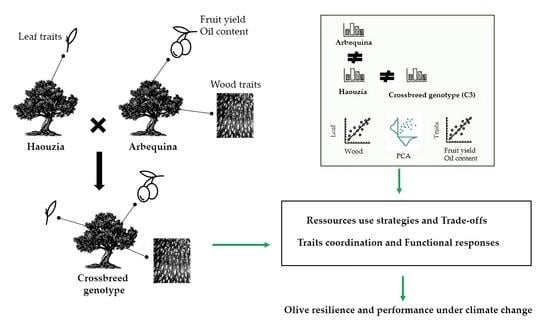
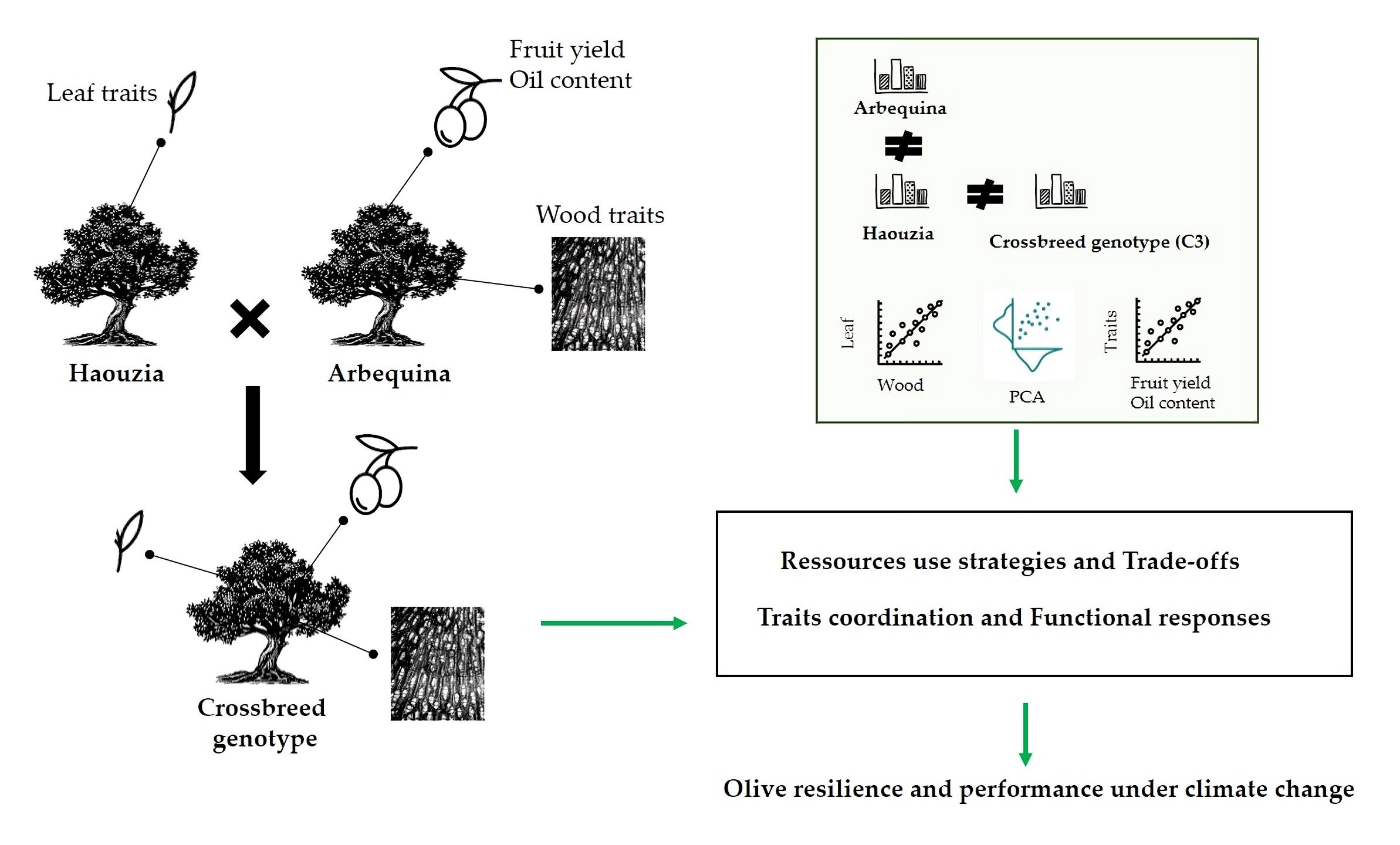
We hypothesize that different combinations of cultivars in the crossing process will generate distinct functional responses, potentially conferring greater plasticity under variable environmental conditions. To test this hypothesis, six crossbreed genotypes resulting from crosses between Moroccan and introduced cultivars, grown under similar conditions, were evaluated. The study had three main objectives. First, we aimed to characterize the extent and magnitude of leaf and wood functional trait variability among crossbreed genotypes and cultivars, and to assess potential functional differences between the two groups. Second, we examined the relationships between leaf and wood anatomical traits to identify key axes of variability that may enhance resilience in crossbreed genotypes, in line with breeding program objectives. Finally, we investigated the relationship between functional traits and agronomic performance, with a particular focus on yield and oil content. Overall, this study demonstrates the value of a trait-based approach for evaluating the effectiveness of crossbreeding programs and for developing new, climate-resilient olive cultivars.
4. Discussion
Employing functional traits as descriptors to capture fundamental trade-offs that define species’ functional responses and adaptations to environmental conditions has proven effective [
63]. Assessing trait variability at both interspecific [
64] and intraspecific levels [
18,
35,
36,
45,
65,
66] has revealed plant strategies related to resource capture and allocation under contrasting and challenging environmental conditions. Moreover, functional trait-based approaches have been suggested as efficient in understanding the effects of crop selection and breeding, and their performances under various ecological conditions [
31,
38,
67]. While traditional breeding programs have primarily focused on agronomic traits, such as crop yield, a trait-based approach can provide an additional valuable framework for understanding the adaptive mechanisms of crops under varying environmental conditions [
38,
43,
68,
69]. In this study, we assessed the variability in leaf and wood functional traits at the intraspecific level in olive cultivars and crossbreed genotypes. We also examined their relationships to capture key dimensions of resource use and allocation under similar conditions. Our aim is to highlight the functional strategies in the crossbreed genotypes compared to their parent cultivars, which could prove valuable in incorporating selection criteria for drought resistance within olive breeding programs.
The study of wood hydraulic, economic, and anatomical leaf traits in olive crossbreed genotypes and cultivars revealed substantial variation. Specifically, leaf traits such as SLA, SLWC, and LA exhibited considerable variation. This reflects notable intraspecific variability, consistent with findings in wild olive trees [
34,
36,
65], and cultivars [
43,
66]. This variability indicates significant phenotypic plasticity, suggesting different functional responses to environmental conditions [
70]. The significant differences in SLA and SLWC among olive crossbreed genotypes and cultivars point to distinct resource-use strategies [
34,
36,
71]. SLA, an important trait within the leaf economic spectrum (LES), is correlated with resource-use efficiency [
39,
72], light interception capacity, and heat balance during transpiration [
71,
73,
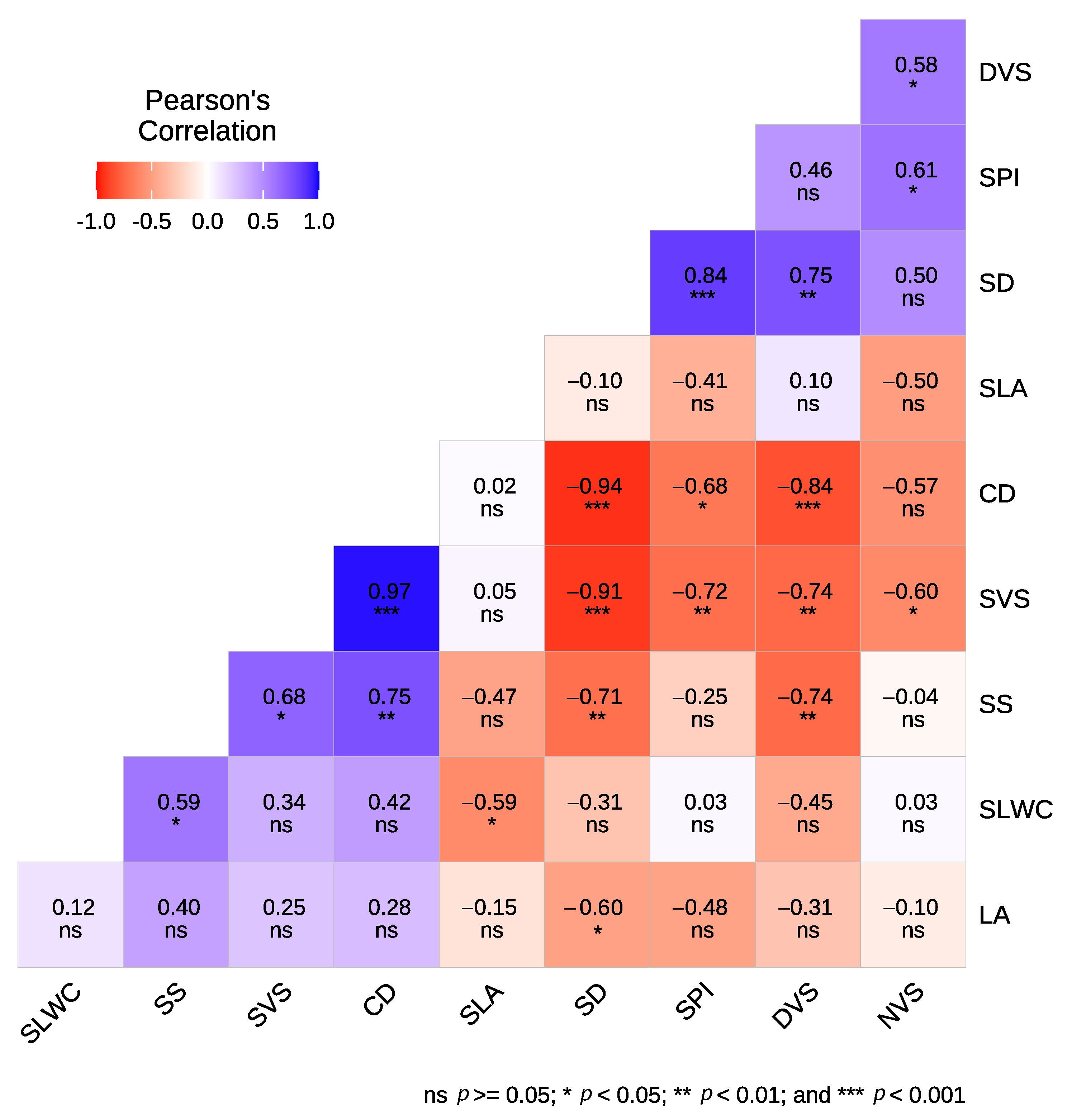
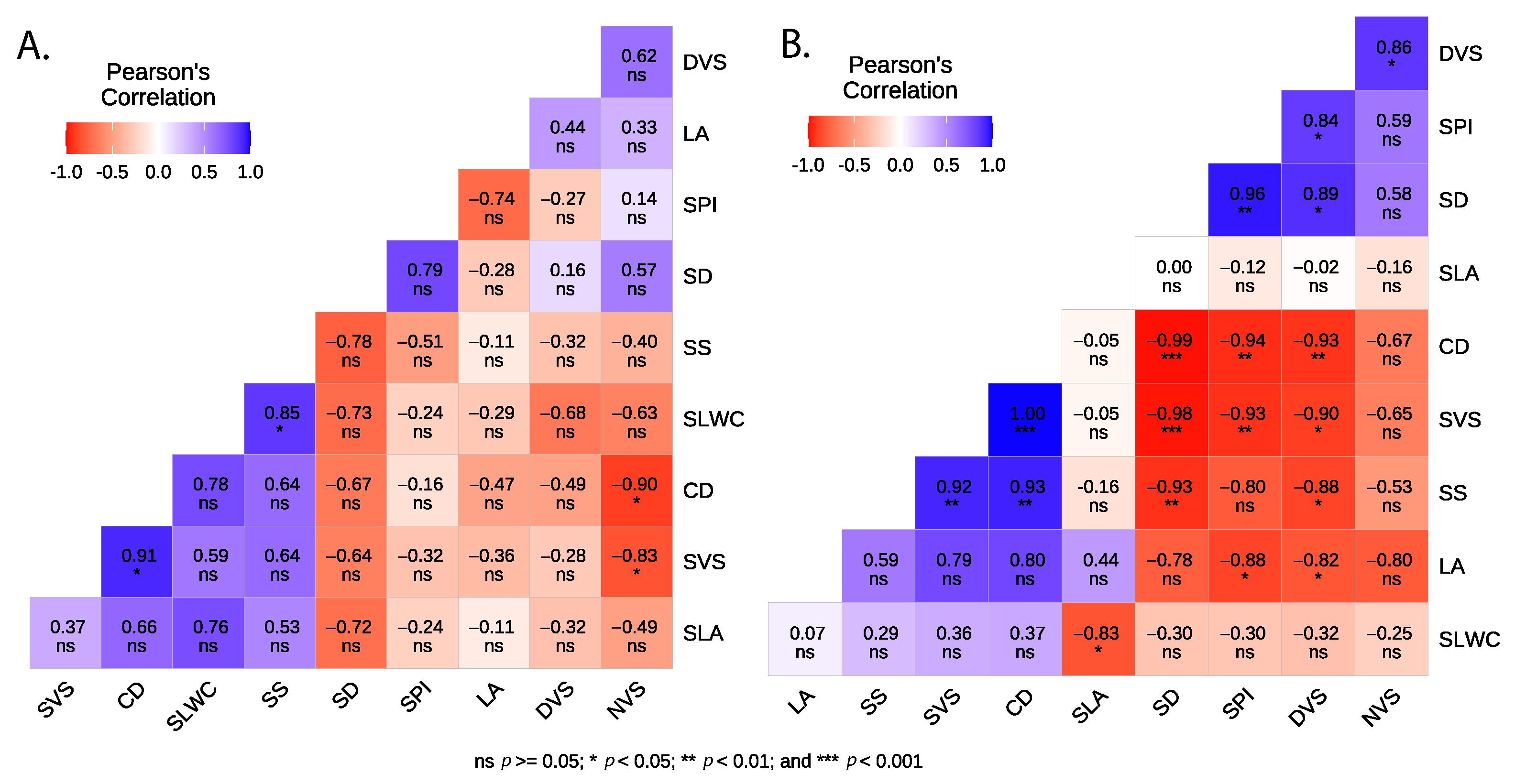
74]. The observed decrease in SLA and increase in SLWC for most crossbreed genotypes likely reflect a water loss control strategy, as evidenced by the negative correlation between these traits (
Figure 2), which can be beneficial under drier and warmer conditions. This functional strategy was also observed in wild olive trees along an aridity gradient in Morocco [
34]. Hence, previous studies have shown that leaf water content is crucial for thermal regulation and CO
2 assimilation [
75,
76], which is vital under warmer and drier conditions. Moreover, several studies showed that plant species from Mediterranean-type ecosystems, which face seasonal droughts, have developed diverse water usage strategies and distinctive leaf-level functional traits [
15,
77,
78].
Stomatal traits, including stomatal size (SS) and stomatal density (SD), exhibited substantial variability and significant differences between the studied crossbreed genotypes and cultivars (
Table 1 and
Table A1). Variations in stomatal traits significantly influence plant adaptation and function [
79,
80,
81]. Stomatal size and density are crucial for water use and carbon assimilation [
82], directly impacting water use efficiency [
83]. Changes in SD and SS also regulate stomatal conductance, with increased SD linked to reduced CO
2 diffusion resistance [
60,
84], while smaller stomata enable rapid opening and closing, allowing for quick responses to environmental changes [
85]. Therefore, low SD is often associated with improved water use, whereas smaller stomata (low SS) are linked to drought avoidance [
86]. Although larger stomata can facilitate faster and more efficient CO
2 uptake, enhancing photosynthesis and water and nutrient transport, they may also lead to higher water loss under drier and warmer conditions [
87]. The negative correlation between SD and SS observed in our study aligns with previous findings [
83,
88]. This inverse relationship has also been documented as a plastic response of plants to environmental changes [
81,
89]. The positive correlation found between SD and stomatal pore index (SPI) was linked to reduced stomatal conductance [
90]. Low SD and SPI are associated with reduced water loss under drier conditions [
91,
92]. Overall, our findings indicate that the studied crossbreed genotypes and cultivars might adopt different strategies for efficient water use through stomatal trait regulation. Notably, a reduction in SS can occur without altering SD [
89].
Regarding wood anatomical traits, vessel size (SVS) and vessel number (NVS) varied the most between crossbreed genotypes and cultivars (
Table 2), with SVS showing an important range of variability. These findings align with Kassout et al. [
18], who identified SVS as a crucial factor in hydraulic conduction related to olive tree growth. Hence, increasing SVS was modulated by environmental conditions, especially water availability [
18]. Higher SVS was linked to the increasing volume of plant parts to be nourished [
93], leading to an overall increase in conducting tissue [
94]. However, smaller SVS could represent an advantage forward-limiting rapid desiccation under drier conditions [
95]. Both SVS and NVS showed significant differences and higher mean values in crossbreed genotypes compared to cultivars. The variability in NVS is linked to sap conduction safety, with higher NVS representing a mechanism to avoid gaseous embolism [
44]. The correlation between SVS and NVS (and DVS) suggests a trade-off between conduction efficiency (SVS) and safety (NVS) [
44,
96]. Although DVS and vascular conductivity (CD) did not vary between crossbreed genotypes and cultivars, the negative correlation between SVS, DVS, and NVS supports this trade-off between safety and efficiency.
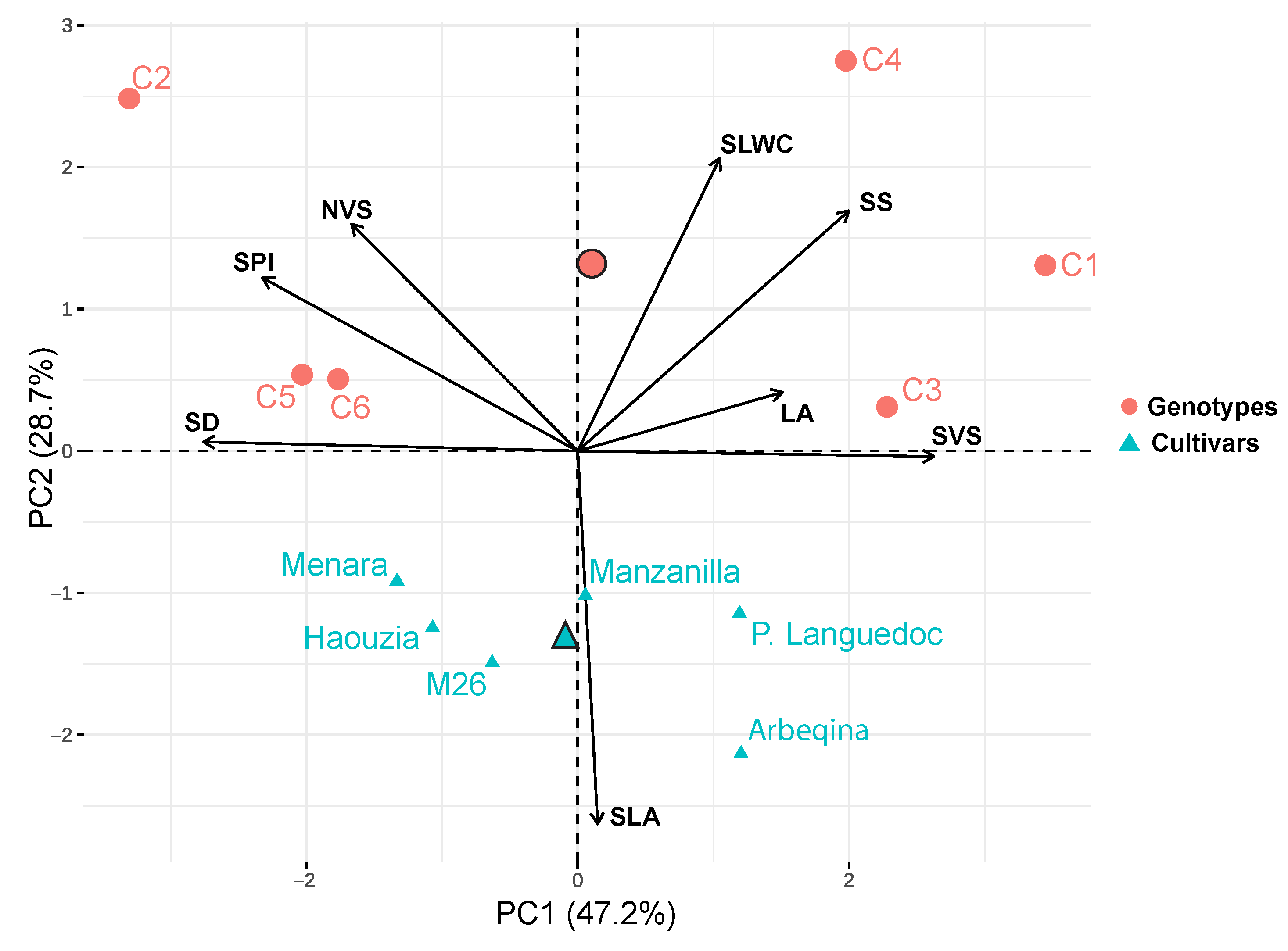
The principal component analysis (PCA) results indicate contrasting patterns of variability among the studied crossbreed genotypes and cultivars (
Figure 3). The first PCA axis was associated with an increase in SVS, SS, and LA, and a decrease in SD, SPI and NVS (
Table A3). Crossbreed genotypes C1, C3, and C4 showed high SVS values, with C3 and C4 exhibiting higher SS compared to other crossbreed genotypes. The correlation between xylem vessel size and stomatal size suggests coordination at the plant level to ensure sufficient water transport while maintaining balanced water use [
77,
97]. This relationship is crucial for maintaining balanced water exchange from the liquid to vapor phase [
98,
99]. Conversely, crossbreed genotypes C2 and C5 showed high SD and SPI, with C6 displaying an important SS value and C5 displaying an important NVS value (
Table 3). Crossbreed genotypes C2, C5, and C6 showed higher NVS compared to other crossbreed genotypes and cultivars, with C6 exhibiting low SD and significant SS. Notably, genotype C5 resulted from crossing two Moroccan cultivars (Haouzia and Menara), both characterized by high SD, SPI, and NVS. Higher stomatal density and stomatal pore index correspond to higher photosynthetic rates and competitiveness for resources [
90,
91], while increasing NVS provides greater sap conduction security under drier conditions [
18,
44]. The first PCA axis also distinguished Moroccan from introduced cultivars, with Moroccan cultivars generally showing high NVS values, which are considered advantageous under drier conditions by preventing gaseous embolism and xylem cavitation [
44,
100]. The high phenotypic plasticity index (PI) observed in SVS, NVS, SD, and SS for the studied crossbreed genotypes (PI
GE) compared to the cultivars (PI
CV) can be attributed to environmental variability [
101] or genetic differences [
102]. The expression of phenotypic traits is directly linked to the ecological plasticity of plant species, having a direct impact on their acclimation and resilience to environmental changes [
103,
104]. Phenotypic plasticity is therefore associated with the future adaptability of plant species [
105]. Previous findings have shown higher plasticity in physiological traits compared to morphological allocation traits [
106]. However, it is challenging to determine if these responses are functionally adaptive, as the phenotypic index (PI) measures phenotypic differences resulting from genetic and environmental interactions [
102]. Thus, both intrinsic and extrinsic factors can constrain phenotypic plasticity in some traits while favoring others [
105].
The second PCA axis, analogous to the LES, with a negative correlation between SLA and SLWC, clusters cultivars from crossbreed genotypes (
Figure 3). This relationship, previously documented for wild olive [
34,
36], reflects the crossbreed genotypes’ rapid nutrient acquisition under favorable conditions, especially water availability. Thus, low SLA and high SLWC confer a reduction in water loss with more resource conservation and therefore less vulnerability to stressful conditions [
78,
107,
108]. Moreover, SLWC was identified as a ‘mechanistic’ trait playing a key role in identifying mechanisms of climatic restriction in the olive tree [
34]. Consequently, higher SLWC with low SLA could be more advantageous under drier conditions [
34,
36,
109]. Finally, the crossbreed genotypes resulting from crossbreeding between cultivars exhibited different functional responses compared to cultivars, attributed to significant trait variability and trade-offs in leaf and wood traits. For instance, crossing between Moroccan cultivars (as for C5, (Haouzia * Menara)) resulted in important hydraulic security (high NVS) and much more important photosynthetic rates and competitiveness for resources. These findings demonstrate that the trait-based approach can be effectively applied for rapid screening of new olive cultivars under development. Meanwhile, our findings should be interpreted in light of the influence of cultivar origin and biogeographical history on olive tree functional responses. Previous work has shown that sap conduction traits and their sensitivity to climate stress are strongly shaped by the evolutionary background of varieties [
43]. Thus, the observed variability in our study likely reflects both genetic background and phenotypic plasticity. Nevertheless, our aim here was not to assess biogeographical differentiation but rather to compare functional responses between crosses and their parental cultivars under common conditions. It is also well established that stress regimes can induce shifts in tree functional behavior, as demonstrated in Moroccan wild olive populations distributed along an aridity gradient [
18]. In addition, it should be noted that only one tree per cross combination was studied, which could represent a limitation within the present study; therefore, further investigations are needed in order to evaluate the functional responses of crossbreed genotypes from crossbreeding under different environmental conditions.
Our findings suggest that variability in leaf and wood anatomical traits significantly influences the agronomic characteristics of the studied cultivars and crossbreed genotypes. When considering the full dataset, our results showed that an increase in vessel size (SVS) and hydraulic conductivity (CD) was associated with a decrease in oil content (OC), whereas OC increased with higher NVS, DVS, and SD. This pattern remained consistent when analyzing cultivars and crosses separately: in both cases, OC increased with NVS, while in cultivars, OC decreased with increasing SVS (
Table A5). Since vessel size and hydraulic conductivity determine water transport efficiency, an increase in these traits facilitates greater water supply to leaves and fruits [
18]. In addition, recent findings showed that the adjustment of the hydraulic system, and consequently sap conduction performances, in olive cultivars involve particularly changes in vessel size as a function of branch diameter [
43]. Excess water availability can shift carbon allocation from oil accumulation to vegetative growth. These results align with previous studies showing that increased water availability can reduce oil content in olive trees. For instance, Grattan et al. [
110] reported a linear decline in the percentage of oil extracted from Arbequina fruits with increasing irrigation. Similarly, Moroccan Menara cultivars exhibited a decrease in OC with higher irrigation levels [
49], and Razouk et al. [
66] observed a similar trend across four olive cultivars, comparing stressed trees with well-watered ones. Notably, olive trees are relatively drought-tolerant, and moderate water stress can enhance oil accumulation in the fruit [
111,
112], which suggests a resource allocation strategy allowing increased oil production under water-limited conditions, possibly as a metabolic response to stress.
The observed negative relationship between fruit yield and SLA in cultivars (
Table A5) suggests a trade-off between reproduction and resource conservation [
113]. Lower SLA is typically associated with thicker, more resource-conservative leaves, which can enhance water-use efficiency but may limit photosynthetic rates. In contrast, high SLA is often linked to rapid growth, which may support vegetative allocation rather than reproductive investment [
114]. Additionally, our results indicate that in crosses, fruit weight increased with SS but decreased with DVS (
Table A5). Larger stomata allow for greater stomatal conductance, which enhances photosynthetic rates and carbohydrate accumulation, both of which are critical for fruit growth and development [
115,
116,
117]. A decrease in vessel density (DVS), which is negatively correlated with SVS, might limit the amount of water supply to fruits, and therefore cause a reduction in fruit weight.
Overall, our findings highlight the complex interplay between leaf and wood functional traits, and agronomic output in olive cultivars and crosses. These results underscore the importance of considering both anatomical and physiological traits when selecting crossbreed genotypes for improved agronomic performance under varying environmental conditions.
The main limitation of this study lies in its environmental scope. Because all trees were grown under common garden conditions at a single experimental site, the observed functional differences may not fully reflect the responses of cultivars and crossbreed genotypes under contrasting climates or management regimes. Previous studies have shown that stress intensity, particularly drought and heat, can strongly modify hydraulic behavior and leaf trait expression in the olive [
18]. While this design enabled a controlled comparison, the generalization of our findings to diverse agroecosystems should be made with caution. A second limitation concerns the temporal scope: trait measurements were conducted during a single growing season, providing only a snapshot of functional performance. As the olive is a long-lived perennial species with strong interannual variability in yield and physiology, long-term monitoring would be valuable to assess the stability of trait–performance relationships across years with differing climatic conditions. In addition, because only one tree per cross was available, intra-genotype variability could not be fully addressed. This aspect will be evaluated in future stages of the INRA breeding program, once vegetative material allows for replicated trials. Finally, while we identified associations between functional traits and agronomic variables such as oil content and fruit yield, these relationships remain correlative. A more mechanistic understanding of the physiological and biochemical pathways linking water-use efficiency, hydraulic architecture, and oil biosynthesis will be necessary to establish causal connections. Integrating functional trait analysis with detailed physiological measurements and omics approaches will help refine selection criteria for breeding drought-resilient olive cultivars.




 ,
,