1. Introduction
Space-time adaptive processing (STAP) has long been recognized as a highly effective signal processing framework for airborne radar-based moving target detection [
1,
2,
3]. Since Brennan’s early seminal work in 1973 [
1], this technique has continued to draw considerable interest from both academic and engineering communities, mainly due to its strong ability to suppress intense ground clutter and enhance detection performance. In airborne radar scenarios, clutter echoes typically present pronounced coupling across spatial and temporal dimensions. STAP addresses this issue by simultaneously utilizing spatial information from antenna arrays and temporal information from coherent pulse bursts, enabling effective discrimination between moving targets and clutter returns. As a result, a substantial improvement in output signal-to-interference-plus-noise ratio (SINR) can be achieved, which plays a critical role in ensuring robust target detection in complex and challenging electromagnetic environments.
In modern airborne radar systems, platforms operating at high velocities are being increasingly utilized because of their strong maneuverability and rapid reaction performance. For these fast-moving platforms, severe Doppler ambiguity can arise, which typically necessitates the use of a relatively high pulse repetition frequency (PRF) to meet the sampling requirements in the Doppler frequency domain. Nevertheless, elevating the PRF inevitably leads to a reduction in the unambiguous detection range, thereby introducing the issue of range ambiguity. Most conventional STAP approaches are developed under the premise that such range ambiguity does not exist. Once ambiguous returns from multiple ranges are present, traditional STAP techniques struggle to distinguish echoes originating from different range bins, since they do not incorporate sufficient range-related degrees of freedom (DoFs). As a consequence, the capability to suppress clutter is significantly impaired, resulting in degraded overall performance.
To mitigate the adverse effects caused by range ambiguity, a variety of approaches have been explored in prior research efforts. Broadly speaking, these strategies focus on providing additional degrees of freedom related to range, mainly including spatial filtering-based techniques [
4,
5,
6,
7] and waveform-diverse array schemes [
8,
9,
10,
11,
12]. Spatial filtering methods typically rely on antenna elements arranged along the elevation dimension to introduce extra degrees of freedom in the elevation domain. Because echoes originating from different ranges correspond to distinct elevation angles, elevation information can be exploited to discriminate clutter components that suffer from range ambiguity. This strategy can deliver good ambiguity mitigation performance when a sufficient number of array elements are available. However, its effectiveness becomes limited when the array size is restricted. In addition, extending the elevation aperture inevitably increases the hardware burden of the radar system, which is generally undesirable for airborne platforms. In contrast, waveform-diverse array techniques obtain range-dependent discrimination capability by properly designing transmitted waveform parameters, such as carrier frequency, phase coding, or modulation schemes. Since returns from different ranges respond differently to the transmitted waveforms, waveform diversity introduces extra range-related degrees of freedom. With suitable demodulation and subsequent processing, these methods can effectively resolve range ambiguity while avoiding significant increases in system hardware complexity.
Element-pulse coding (EPC) constitutes a prominent paradigm within the family of waveform-diversity array methodologies, characterized by its utilization of composite encoding across the transmit elements and the slow-time pulse. Through the application of unique phase modulations to every combination of element and pulse, EPC engenders range-dependent signatures in the observed echo signals, thereby rendering it particularly effective for mitigating range ambiguity effects in radar systems. Currently, EPC has proven its effectiveness across a wide field of radar signal processing functionalities, encompassing spectrum estimation [
13,
14], adaptive beamforming [
15], target discrimination [
16,
17], and interference rejection [
18,
19,
20]. Despite these notable advances, the incorporation of EPC into the STAP framework has attracted less scholarly attention, calling for further in-depth exploration [
21,
22].
It is important to point out that an optimal EPC-STAP implementation depends on accurate knowledge of the clutter covariance matrix (CCM), which is generally unknown in real applications and therefore has to be inferred from a limited number of training snapshots. When the available snapshots are insufficient [
23], the resulting covariance estimate becomes unreliable, which can cause significant degradation in STAP performance. Although the Reed–Mallett–Brennan criterion provides a theoretical guideline on the number of snapshots required for reliable estimation, this condition is often difficult to satisfy in practical operational environments. It is noted that in [
24], the rank characteristics of range-ambiguous clutter in EPC radar were first investigated, verifying that the clutter exhibits a low-rank structure. This finding offers useful insight for the development of EPC-STAP algorithms. Furthermore, a subspace-based EPC-STAP method is presented in [
24], which demonstrates improved performance under limited training data conditions. In addition, references [
25,
26,
27] introduce a sparse-reconstruction-based EPC-STAP approach that enables CCM estimation with a small number of snapshots and shows encouraging results. However, the sparse reconstruction and subspace-based frameworks typically incur high computational cost, which limits their applicability in real-time airborne radar processing.
As is well known, conventional phased-array STAP often adopts reduced-dimension processing strategies [
28,
29,
30]. By introducing an appropriate linear transformation, the dimensionality of the adaptive processing problem can be significantly lowered, which consequently reduces the number of required training snapshots in accordance with the RMB criterion. Therefore, in this paper, we also exploit this strategy, thereby developing RD-EPC-STAP, which is expected to offer a practical and efficient way to mitigate range-ambiguous clutter when only limited snapshots are available. In particular, the joint domain localization (JDL) method in phased-array STAP has attracted considerable attention due to its simplicity and relatively low computational burden. JDL constructs a reduced-dimension transformation by selecting a group of space-time channels within a local rectangular neighborhood centered on the target channel as auxiliary channels, together with the target channel. The validity of this approach has been confirmed through theoretical analysis and simulation results in [
30]. However, this channel selection mechanism is originally designed for two-dimensional processing frameworks. In contrast, EPC-STAP involves a three-dimensional structure, i.e., transmit, receive, and slow-time dimensions, so the JDL transformation cannot be directly applied. For range-ambiguous clutter scenarios, it has been observed that clutter components from different range bins can be processed independently due to their weak correlation across ambiguous regions, implying that training data from other range cells contributes little useful information. Motivated by this observation, this work extends the JDL concept and proposes a reduced-dimension strategy suitable for EPC-STAP. Following the general principle of reduced-dimension design, a key idea is to choose a limited set of auxiliary channels that maintain strong correlation with the target channel [
3]. Accordingly, a local cube-shaped neighborhood around the target channel is selected as auxiliary channel to construct the linear transformation matrix in EPC-STAP.
Reduced-dimension STAP has been extended from conventional phased-array radar to MIMO and FDA-MIMO radar [
31] proposed a three-dimensional cascaded reduced-dimension MIMO-STAP, but it cannot handle range ambiguity due to the absence of range-dependent terms [
32] exploited the frequency increment of FDA to make clutter from different ambiguous range regions separable in the transmit-receive spatial frequency domain. However, FDA-based methods require strict carrier frequency consistency across adjacent transmit elements, which is vulnerable to phase noise. In contrast, EPC introduces a phase shift directly related to the ambiguous region index through element-pulse joint coding, without relying on carrier frequency offset. This paper constructs a local cuboidal neighborhood for dimensionality reduction, which provides an effective solution for range-ambiguous clutter suppression in EPC-STAP with limited snapshots.
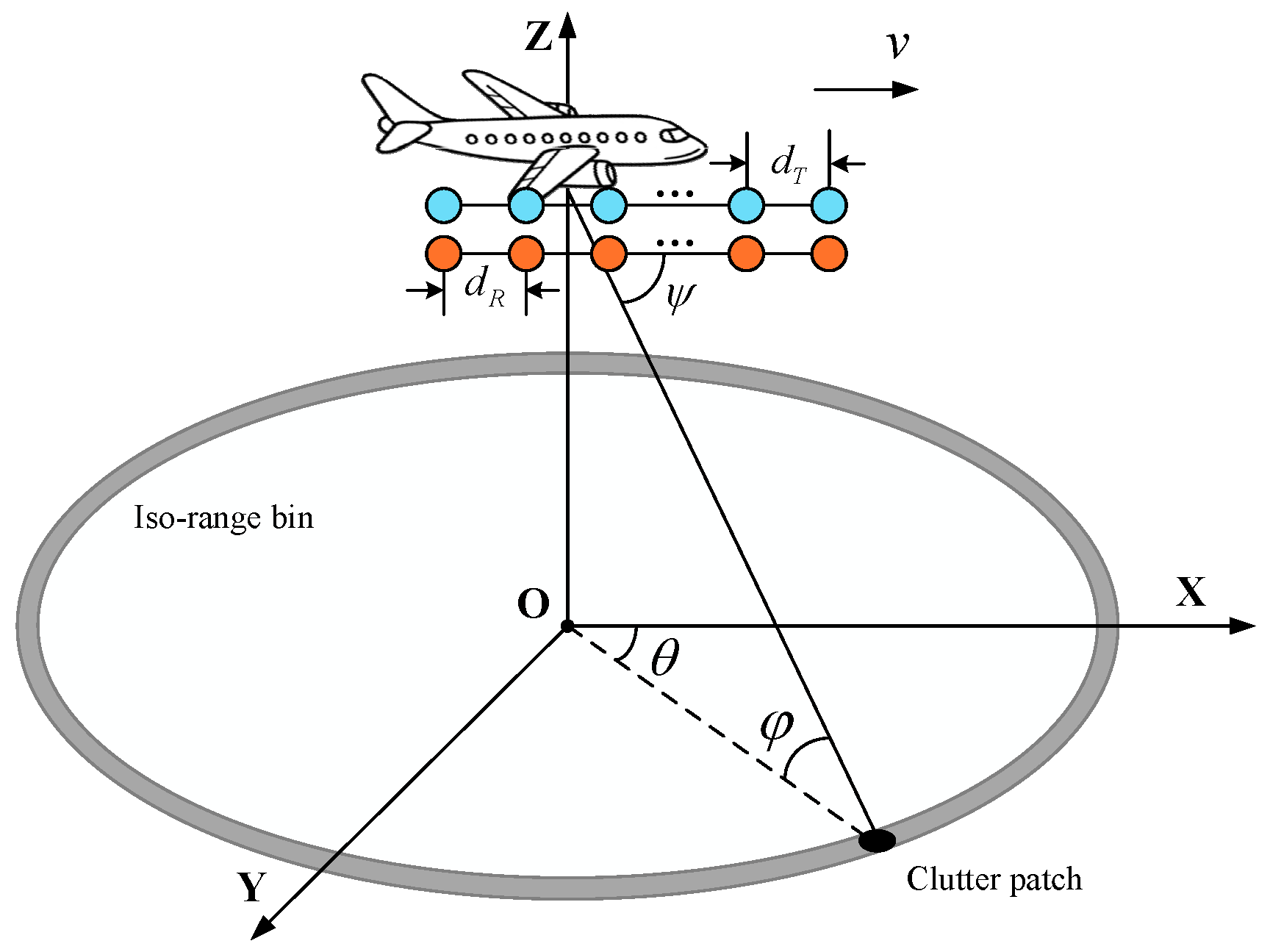
In this work, an effective reduced-dimension EPC-STAP approach, named ERD-EPC-STAP, is developed for airborne EPC radar operating in range-ambiguous scenarios. To begin with, a mathematical model of the received signal in the airborne EPC-STAP system is formulated, which serves as the foundation for the following processing stages. Subsequently, a carefully constructed linear transformation matrix is introduced to compress the overall system dimension while retaining as many useful degrees of freedom as possible. Based on this reduced representation, the corresponding RD-EPC-STAP processor is derived under the minimum variance distortionless response (MVDR) criterion. Simulation results show that the proposed RD-EPC-STAP technique achieves enhanced clutter suppression capability and maintains strong robustness in the presence of array gain and phase errors.
Notation: In this paper, expresses an identity matrix of size . The symbol refers to the Kronecker product. For a matrix or vector, and are used to represent the transpose and Hermitian transpose, respectively. The complex field is denoted by , while denotes mathematical expectation.
3. The Proposed Effective RD-EPC-STAP
This section is devoted to the development of an effective RD-EPC-STAP methodology. To begin with, the rationale behind incorporating reduced-dimension processing into the EPC-STAP framework is elaborated. Subsequently, the conventional JDL strategy is revisited, and its underlying design principles are examined. Ultimately, the detailed formulation of the proposed RD-EPC-STAP scheme is provided.
3.1. Motivation for Reduced-Dimension EPC-STAP
Widely recognized for its effectiveness in clutter rejection with limited snapshots and its ability to substantially curtail processing costs, RD-EPC-STAP constitutes the primary focus of this study, which aims to tackle range-ambiguous clutter suppression.
The core idea behind RD-EPC-STAP is to apply a linear projection to the received data, thereby compressing its original dimensionality. According to the RMB rule, the required number of training snapshots is correspondingly reduced. Moreover, the overall computational burden is markedly alleviated. Following the MVDR principle and by analogy with (6), the resultant optimization problem for RD-EPC-STAP can be cast as
where
is the radar output power under RD-EPC-STAP,
is named linear transformation matrix,
and
.
Then, the optimal RD-EPC-STAP weight vector
is given by
and the corresponding minimal radar output power can be given as
Under limited snapshots, the optimal RD-EPC-STAP weight vector in (14) is replaced by
where
. Therefore, the radar output power by (15) can be derived by
Given that the RD DoFs are substantially smaller than those of the full-dimensional space, the RMB rule guarantees that the RD CCM can be estimated accurately, ensuring that the discrepancy between and remains well controlled. As a result, the RD-EPC-STAP processor can deliver robust performance even when the number of available training snapshots is severely limited.
3.2. The Classical Joint Domain Localized Strategy in Phased-Array STAP
As can be seen from (13) and (14), the central design challenge amounts to the synthesis of the linear transformation matrix . Consequently, subsequent discussions are devoted exclusively to the elaboration of .
Within the realm of conventional phased-array STAP, the JDL strategy has garnered significant attention, primarily owing to its favorable trade-off between clutter suppression efficacy and computational expenditure. This approach selects, as auxiliary channels, a set of space-time cells lying within a rectangular neighborhood centered at the candidate target channel. In conjunction with the target channel, which is specified by its conic angle
and velocity
, the JDL processor subsequently constructs the associated reduced-dimension transformation matrix, expressed as follows:
where
and
represent the selected space and time assisted channels, respectively, which can be expressed as
where
and
mean the number of selected time and receive assisted channels, respectively.
Prior studies have repeatedly validated the efficacy of the JDL strategy via both theoretical derivations and numerical simulations [
30]. Nevertheless, this channel selection framework was originally devised within a two-dimensional processing paradigm. In particular, the potential influence of range ambiguity is not taken into consideration in the JDL formulation. Consequently, a direct transplantation of the conventional JDL into the EPC-STAP context is infeasible, which strongly motivates the development of a dedicated reduced-dimension EPC-STAP scheme.
3.3. The Proposed ERD-EPC-STAP
For the EPC-STAP scenario with range-ambiguous clutter, it is observed that clutter components originating from distinct ambiguous range regions exhibit negligible mutual correlation [
32]. This inherent property enables the independent treatment of such components without significant performance loss. As a corollary, secondary data collected from range cells outside the current region contribute only marginally to the estimation process. Motivated by this observation, we use the core philosophy of JDL to devise an effective RD processing framework for EPC-STAP, referred to as ERD-EPC-STAP.
The prevailing paradigm for the construction of reduced-dimension transformation matrices advocates the retention of a small subset of auxiliary channels exhibiting strong correlation with the designated target channel. Guided by this principle, a cuboidal neighborhood centered on the target channel, which is specified by range region
, conic angle
and velocity
, is adopted to define the auxiliary channel set for constructing the linear transformation matrix in EPC-STAP. The corresponding analytical expression of this transform is described as
where
,
and
represent the selected transmit, time and receive assisted channels, respectively, which can be expressed as
where
,
and
denote the number of selected transmit, time and receive assisted channels.
With the linear transformation matrix in (20), the developed ERD-EPC-STAP problem can be expressed as
where
is the radar output power under ERD-EPC-STAP, with
and
.
Then, the optimal RD-EPC-STAP weight vector
can be given as
In practice, with limited snapshots, the optimal RD-EPC-STAP weight vector in (23) is re-expressed as
where
.
As indicated by (24), the proposed processor can suppress range-ambiguous clutter in an effective manner. The reduced dimensionality inherently lowers the demand for training snapshots and simultaneously curtails the arithmetic workload. These advantages render the developed approach highly attractive in terms of both clutter rejection performance and computational burden.
Remark 2. Conventional JDL is designed for two-dimensional phased-array systems and cannot handle range ambiguity. Directly applying it to such scenarios causes clutter from different ambiguous regions to be aliased after dimensionality reduction. Reduced-dimension STAP has also been extended to MIMO radar, but these methods still operate within the conventional signal model and do not incorporate range information, so they cannot distinguish clutter from different ambiguous regions. Our ERD-EPC-STAP is specifically designed for the three-dimensional EPC scenario under range ambiguity. Mathematically, when JDL is naively extended to three dimensions, the transmit steering vector is with , where the transmit spatial frequency depends only on the spatial angle. In our method, the transmit steering vector becomes with , where the additional term is directly tied to the ambiguous region index . This range-dependent frequency shift is the key mathematical distinction of our method.
3.4. Computational Complexity
It should be noted that the required snapshots in the table refer to the number of training snapshots needed for each method to achieve an output SINR loss of approximately 3 dB. According to the RMB rule, when the number of training snapshots reaches twice the system degrees of freedom, the STAP processor can attain an average performance loss of about 3 dB. For the subspace-based method, denotes the clutter rank. For the sparse-reconstruction-based method, while it can approach the target performance with only a very small number of snapshots under ideal conditions, its computational burden is extremely heavy. This burden is primarily due to the iterative optimization process, which involves repeated dictionary searches and matrix inversions in a high-dimensional space. The total computational cost is on the order of , where denotes the dictionary size. It is far higher than that of the other two methods, making it difficult to satisfy processing requirements in practical engineering. Although all three methods can handle range ambiguity, the subspace method requires accurate prior information of clutter rank and involves high decomposition cost. Without relying on any prior knowledge, the proposed ERD-EPC-STAP operates effectively with a limited number of snapshots through a fixed low-cost transformation. It thus achieves an optimal balance between performance, computational efficiency, and practical engineering.
The computational cost of the proposed ERD-EPC-STAP consists of three main parts: first, the projection of training data using the reduced-dimension transformation matrix, with complexity , where is the number of training snapshots; second, the estimation of the reduced-dimension covariance matrix, with complexity ; and third, the inversion of the reduced-dimension covariance matrix, with complexity . Since the three-dimensional neighborhood dimensions satisfy , all three complexity terms are far lower than the corresponding and costs in full-dimensional processing. In contrast, the subspace-based method requires eigenvalue decomposition of the high-dimensional covariance matrix, with complexity , and relies on accurate prior information of the clutter rank. The sparse-reconstruction-based method solves the sparse recovery problem through iterative optimization, where each iteration involves atom selection and matrix operations on a high-dimensional dictionary. Its total computational cost is on the order of with a typically large number of iterations, making it extremely expensive and unsuitable for real-time processing.
4. Numerical Experiments
To illustrate the superiority of the ERD-EPC-STAP approach, this section presents a set of simulation experiments, whose configurations are summarized in
Table 1. The proposed processor is examined with localized dimensions fixed at
,
and
. In addition,
, the number of range ambiguities is set to 2,
and
are set to different numbers to show the performance advantages of ERD-EPC-STAP under diverse clutter environments. Moreover, the robustness of the algorithm is further tested by introducing amplitude and phase perturbations across the array channels.
The performance of different EPC-STAP methods is evaluated in terms of the output SINR loss [
2]. For instance, the output SINR loss corresponding to the optimal EPC-STAP can be expressed as:
The loss in output SINR for FD-EPC-STAP, ERD-EPC-STAP, and the optimal EPC-STAP is evaluated using identical computational procedures. The final values are subsequently derived by performing ensemble averaging across 100 independent Monte Carlo realizations.
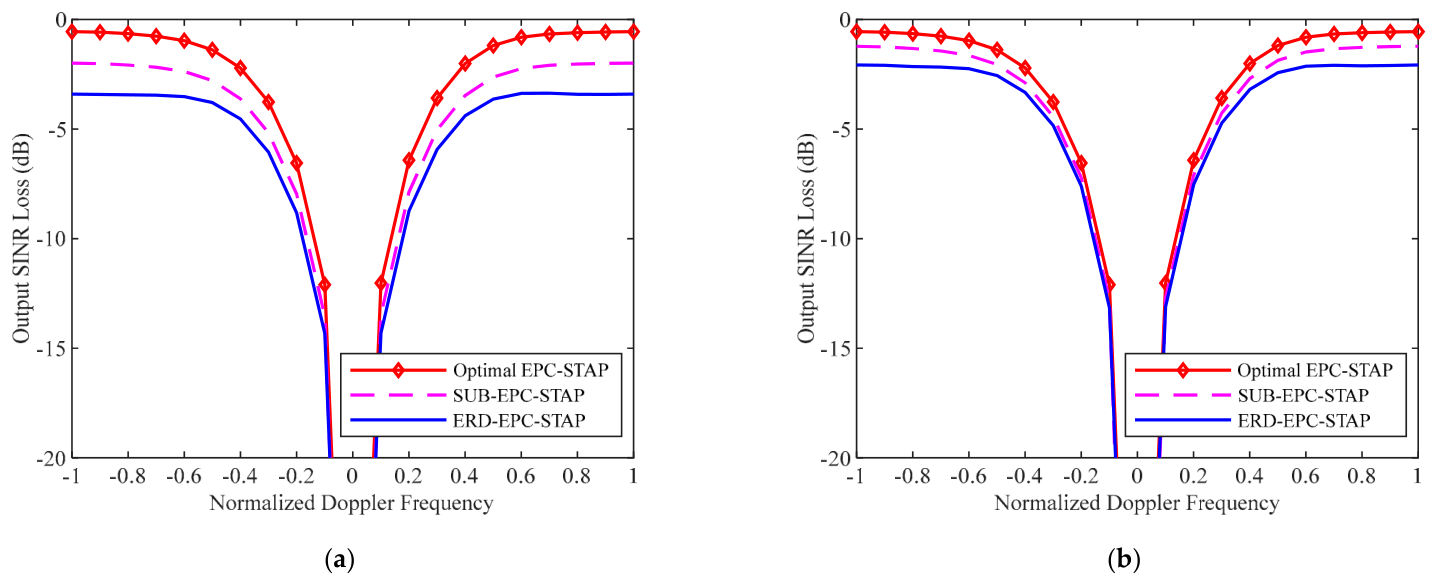
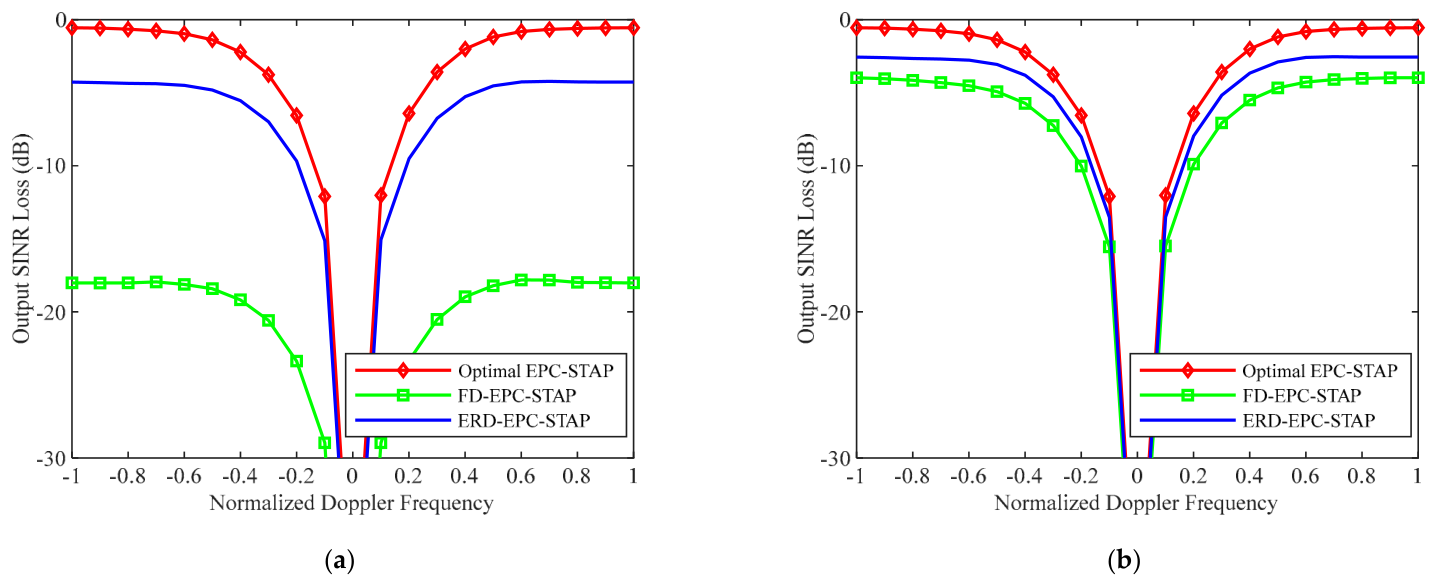
Figure 2 compares the SINR loss of the proposed ERD-EPC-STAP and the subspace-based method for
and
, with
and
. In
Figure 2a, the subspace method slightly outperforms ours due to its use of low-rank clutter prior. However, it requires accurate clutter rank knowledge, which is hard to obtain and errors cause severe degradation. Our method needs no prior information and still gives reliable estimation with fewer snapshots. In
Figure 2b, when the number of training snapshots increases to
, both improve and the performance gap narrows. Considering the sensitive dependence of the subspace-based method on clutter rank estimation accuracy and its high computational burden in practical engineering, the proposed method achieves satisfactory clutter suppression performance without prior information and with low computational cost, striking a better balance between performance and efficiency. Therefore, we do not include the subspace-based method as a primary comparison in subsequent experiments but instead focus on comparing with the full-dimensional method.
Firstly,
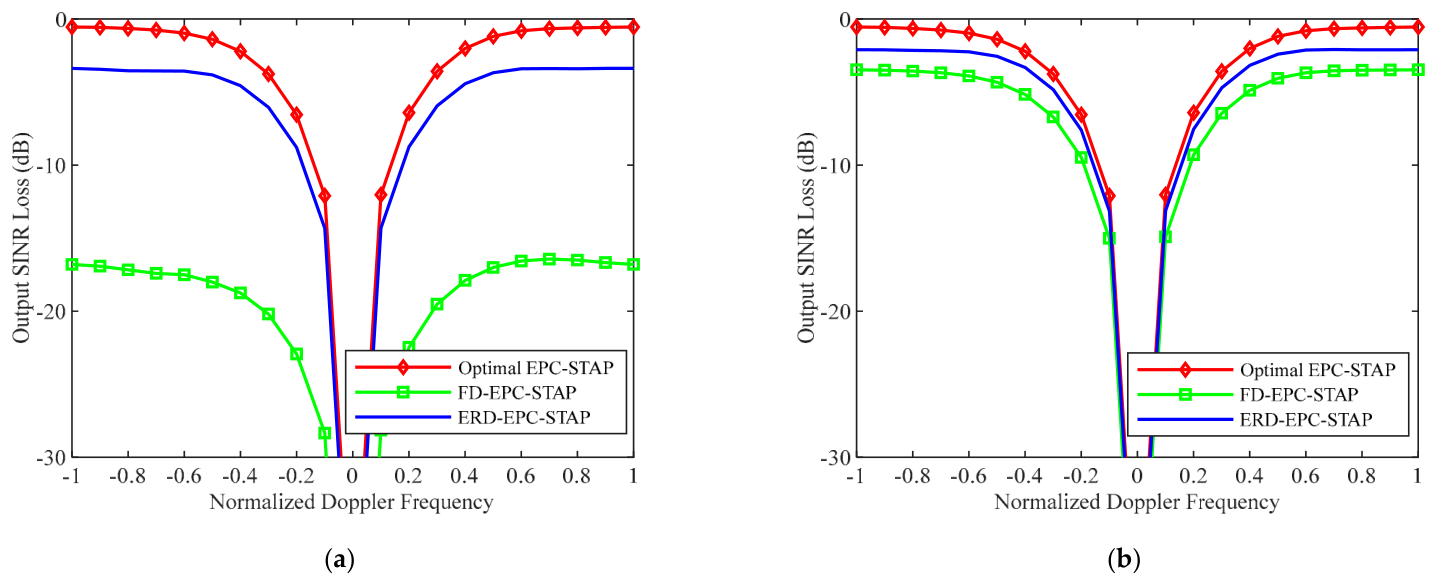
Figure 3 presents the output SINR loss plotted against the normalized Doppler frequency under two distinct snapshot configurations, namely
and
. The platform velocity is fixed at
and the ratio of transmit to receive element spacings is set to
; these parameters serve as the baseline for evaluating the proposed ERD-EPC-STAP. The experimental results consistently demonstrate that the proposed ERD-EPC-STAP outperforms FD-EPC-STAP, with the performance gap being particularly pronounced when the number of training snapshots is scarce. As shown in
Figure 3a, when
, ERD-EPC-STAP exhibits clear superiority over the conventional FD-EPC-STAP method, yielding about a 13 dB reduction in SINR loss. Turning to
Figure 3b, when
, the RMB criterion is satisfied. In this scenario, the loss of the proposed method diminishes relative to that observed in
Figure 3a. Although the traditional FD-EPC-STAP benefits from considerable improvement under the increased snapshot support, it still falls short of the proposed method. When
, the number of snapshots is insufficient to satisfy the RMB rule for FD-EPC-STAP, resulting in substantial covariance matrix estimation errors. ERD-EPC-STAP reduces the effective DoFs and achieves more accurate estimation, yielding an advantage of approximately 13 dB. When
, FD-EPC-STAP satisfies the RMB rule, and the performance gap decreases to approximately 2 dB.
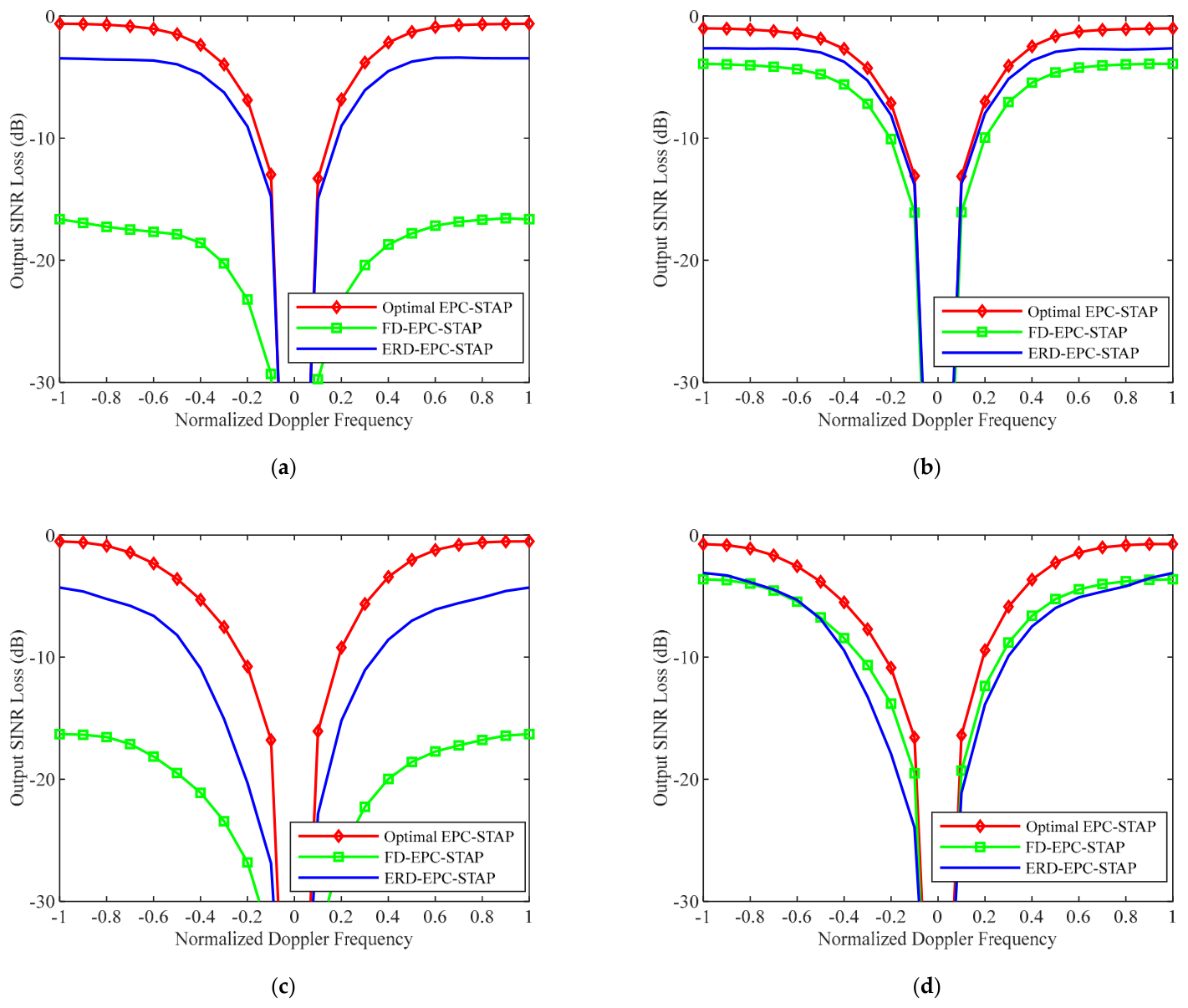
Figure 4 depicts the variation in output SINR loss with respect to the normalized Doppler frequency under an elevated clutter rank condition.
and
are considered in this experiment, the platform velocity is
, and
. As noted in [
24], the rank of the clutter subspace grows as the platform speed rises, which accounts for the observed degradation in performance across all methods when compared with
Figure 3. Even so, the proposed ERD-EPC-STAP manages to maintain a clear advantage. From
Figure 4a, when
, the SINR loss is roughly 13 dB less than that of FD-EPC-STAP. Under the
condition with the elevated velocity in
Figure 4b, the loss is even lower than in
Figure 4a, and the proposed scheme once again achieves a high SINR level. When
, the high DoFs of FD-EPC-STAP make accurate covariance matrix estimation difficult. In contrast, ERD-EPC-STAP improves the estimation accuracy through dimensionality reduction, resulting in an approximately 13 dB lower SINR loss. When
, the estimation accuracy of both methods improves, thereby narrowing the performance gap.
Subsequently,
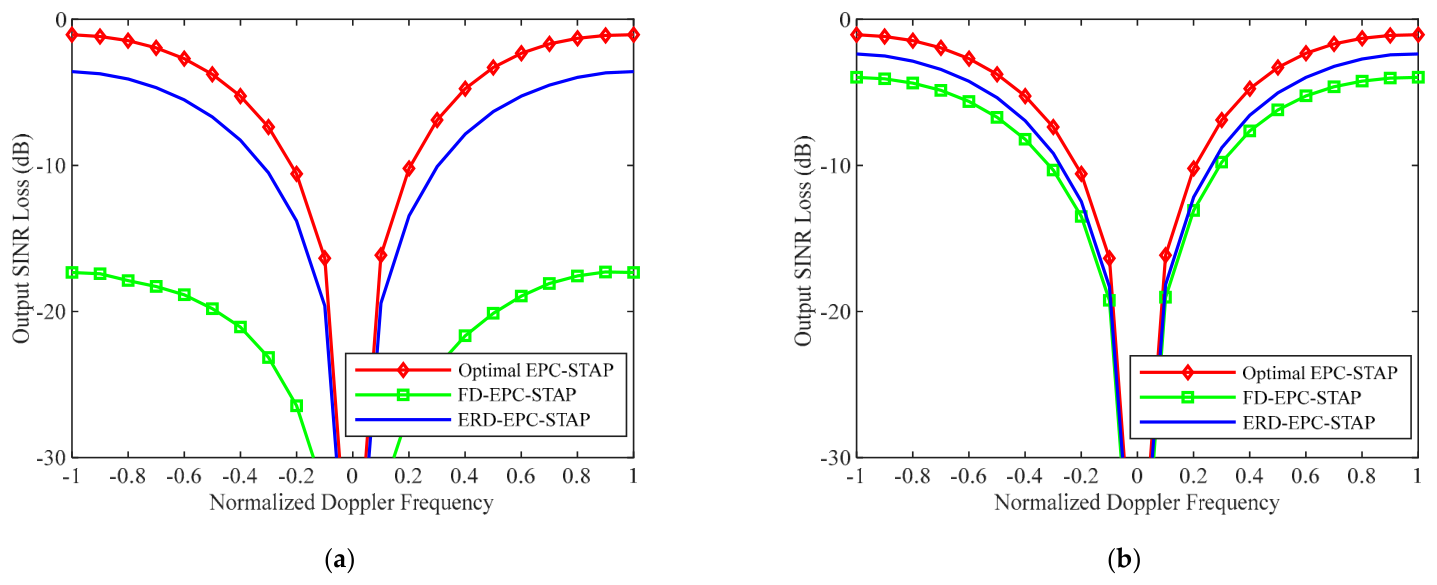
Figure 5 depicts the normalized-Doppler-frequency dependence of the output SINR loss, where the numbers of snapshots are set to
and
in the two cases, respectively. The platform velocity remains at
and the ratio of transmit to receive element spacings is set to
. As demonstrated in [
24], the rank of the clutter subspace increases when the transmit–receive spacing ratio grows. A comparison with
Figure 3 reveals that all evaluated algorithms exhibit a certain degree of degradation. However, the ERD-EPC-STAP approach continues to surpass FD-EPC-STAP. In particular, the SINR loss of the proposed method is approximately 14 dB and 1.5 dB lower than that of the full-dimensional counterpart in the two snapshot scenarios, respectively. When
, limited snapshots cause covariance matrix estimation errors to accumulate in FD-EPC-STAP, whereas ERD-EPC-STAP achieves more stable estimation by reducing the effective DoFs. Consequently, its SINR loss is approximately 14 dB lower. When
, FD-EPC-STAP satisfies the RMB rule, and the performance gap decreases to approximately 1.5 dB.
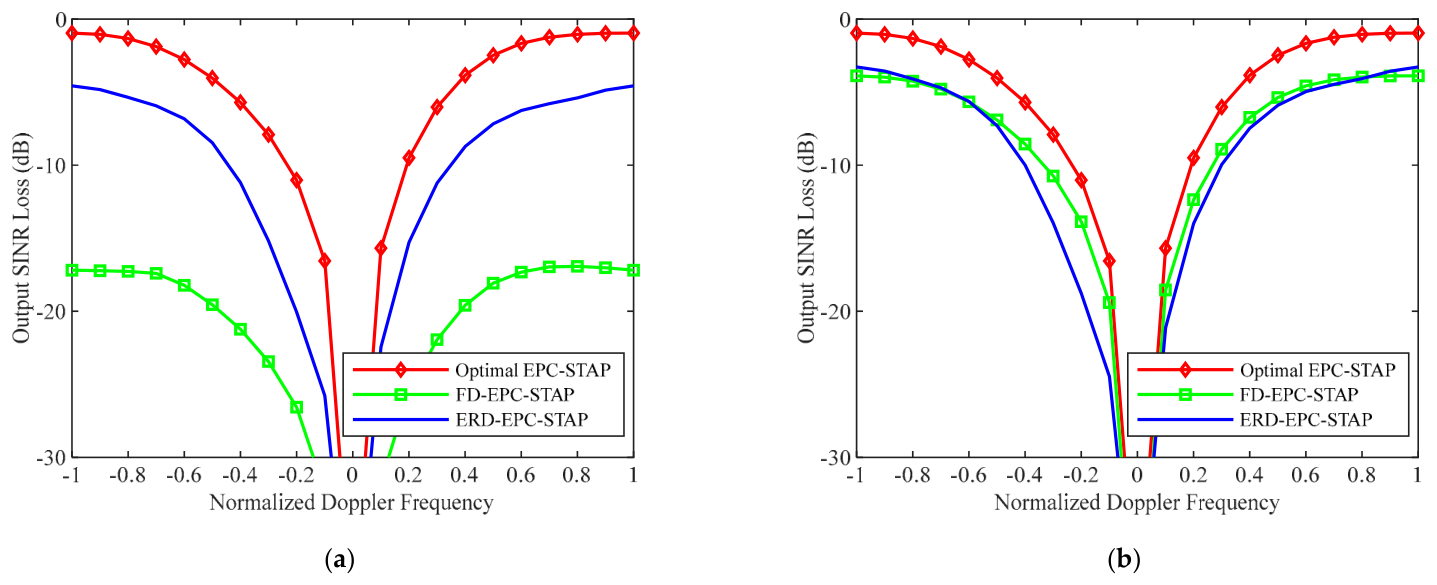
A further experiment is conducted to assess the performance under increased clutter rank, with the results displayed in
Figure 6. The simulation parameters are configured as
and
, and the snapshot numbers are
and
, respectively. According to [
24], an increase in either the platform speed or the spacing ratio tends to elevate the clutter rank. In line with this reason, the performance of every algorithm under test falls short of that recorded in
Figure 3, with the extent of degradation varying from one method to another. Despite this universal decline, the proposed ERD-EPC-STAP continues to hold an edge over the conventional FD-EPC-STAP. Concretely, a reduction in SINR loss of roughly 13 dB and 1 dB is attained by the proposed scheme relative to the full-dimensional counterpart for
and
settings, respectively. These findings lend further credence to the effectiveness and resilience of the developed strategy in the face of increased clutter rank. When
, ERD-EPC-STAP reduces the effective DoFs and alleviates the covariance matrix estimation errors caused by limited snapshots, achieving an approximately 13 dB lower SINR loss than FD-EPC-STAP. When
, both methods satisfy the RMB rule, and the performance gap decreases to approximately 1 dB, indicating that the proposed method provides its greatest advantage under limited-snapshot conditions.
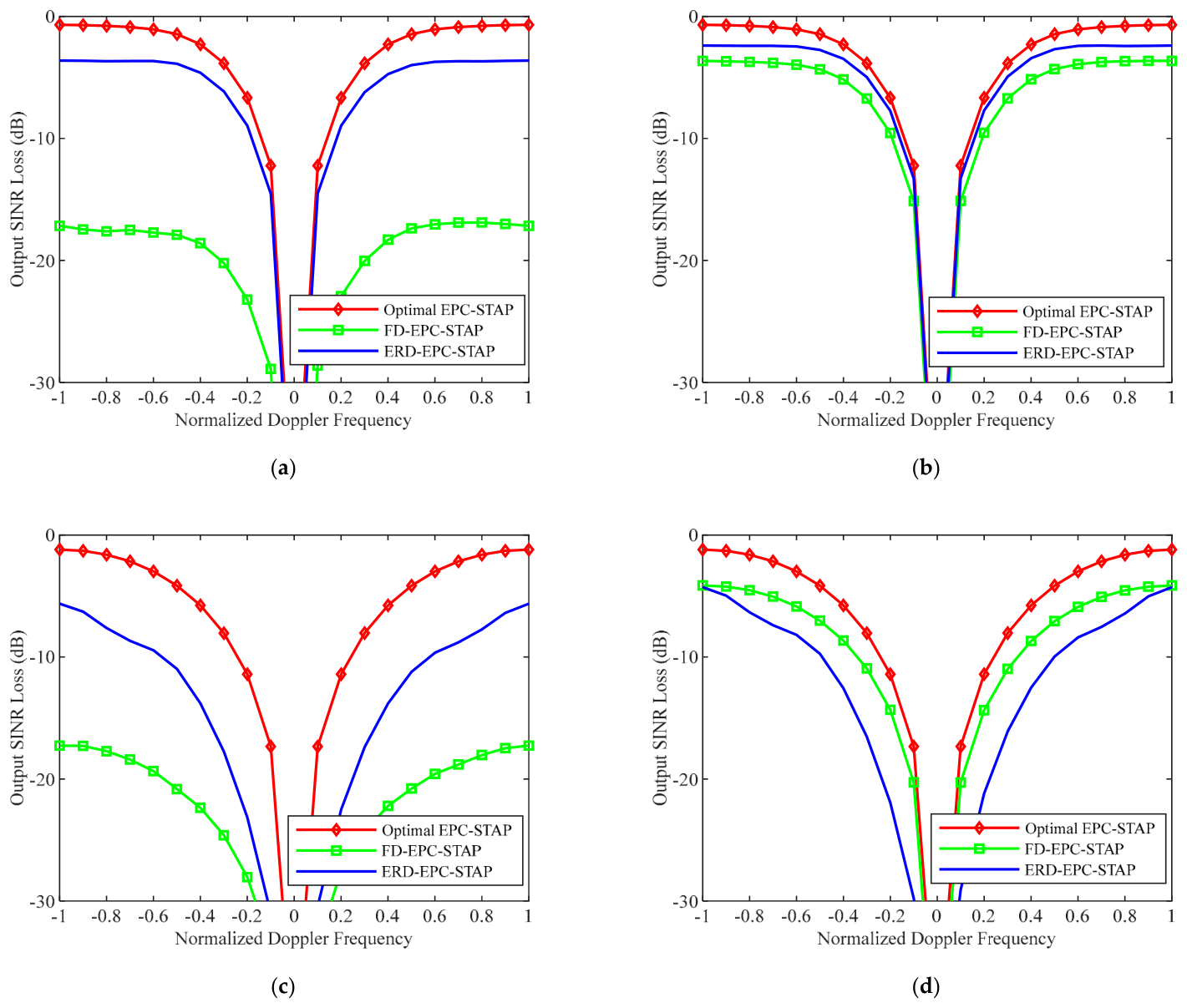
Field operating conditions frequently introduce unintended discrepancies in both the amplitude and phase responses of the receiving array channels, a phenomenon commonly attributed to environmental fluctuations. Such mismatches are conventionally characterized as array gain and phase errors [
37]. As pointed out in [
2], these impairments tend to break the coherence between the transmit and receive paths, which in turn degrade the overall performance of EPC-STAP processors. To evaluate the tolerance of the proposed ERD-EPC-STAP scheme against such non-ideal behavior, we deliberately inject 5% gain-phase deviations into the synthetic clutter returns, and the ensuing SINR loss curves are compiled in
Figure 7. The platform velocities are
and
, the two transmit-receive spacing ratios are
and
, and the numbers of snapshots are
and
, respectively. Under the more restrictive sample condition
, the proposed method clearly outshines the conventional FD-EPC-STAP. When
, the performance difference between the two contenders shrinks noticeably; nevertheless, the ERD-EPC-STAP processor consistently registers the smaller SINR loss and secures the leading position between the two methods.
A further set of simulations is undertaken to ascertain whether the proposed ERD-EPC-STAP retains its efficacy when the number of range ambiguity regions is increased to three, the outcomes of which are depicted in
Figure 8. The platform velocities are given as
and
, the ratios between the transmitting and receiving element spacings are
and
, and the numbers of snapshots are
and
, respectively. These configurations are deliberately chosen to probe the algorithm’s clutter-rejection capability under more intricate range ambiguity conditions. When the snapshot resource is tight, the proposed scheme substantially outperforms the conventional FD-EPC-STAP, demonstrating its competence in suppressing ambiguous returns even with limited data support. As the snapshot count increases to
, the margin between the two methods narrows, implying that both benefit from the more favorable experimental setting. Even so, the ERD-EPC-STAP processor consistently yields the lower SINR loss of the two methods. Taken together, these observations confirm that the developed approach maintains its leading performance even under the three-ambiguity-region scenario, reinforcing its robustness and broad applicability across varying range-ambiguous clutter environments.
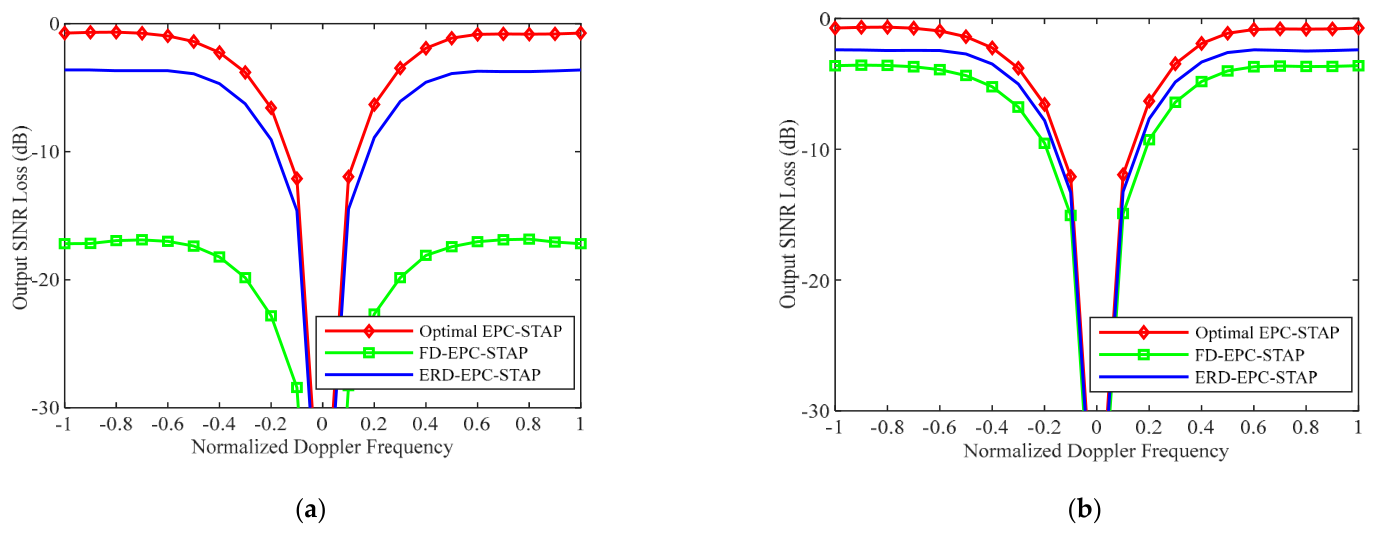
To demonstrate the superiority of the proposed method, we model the high-fidelity inhomogeneous clutter according to [
38], which can be considered as semi-realistic clutter data. The numerical results are shown in
Figure 9. The simulation employs the same parameter configuration as the previous experiments, with the platform moving at
and the transmit-receive element spacing ratio
. The output SINR losses are evaluated for
and
. Under this inhomogeneous clutter setting, all methods exhibit increased SINR loss compared with the homogeneous case. Nevertheless, the proposed ERD-EPC-STAP consistently retains a clear performance edge over FD-EPC-STAP under both snapshot configurations.
Under the same simulation environment with parameters listed in
Table 2, we used a platform equipped with an AMD Ryzen 78845H processor and MATLAB R2024b to record the average running times of FD-EPC-STAP and ERD-EPC-STAP, and the results are shown in
Table 3. Under the tested scenario, the average runtime of the full-dimensional method is about 0.0044 s, while that of the proposed reduced-dimensional method is only about 0.0038 s, achieving a reduction of about 13% in computational burden. This result is fully consistent with the theoretical analysis in
Section 3. It is expected that as the number of transmit elements, receive elements, or pulses further increases, the advantage of our method in computational burden will become even more significant, which further validates the practical value of the proposed dimensionality reduction strategy for real-time applications.