
Review

A Unified DMAIC-Based Conceptual Framework for Lean Six Sigma and Industry 4.0 Integration in Electronics Manufacturing Services

by
Yasser Ibrahim
1,
Mohamed Thariq Hameed Sultan
1,2,3,*,
Jan Lean Tai
1 and
Navaneetha Krishna Chandran
2
1
Department of Aerospace Engineering, Faculty of Engineering, Universiti Putra Malaysia (UPM), Serdang 43400, Selangor, Malaysia
2
Laboratory of Biocomposite Technology, Institute of Tropical Forest and Forest Product (INTROP), Universiti Putra Malaysia (UPM), Serdang 43400, Selangor, Malaysia
3
Aerospace Malaysia Innovation Centre [944751-A], Prime Minister’s Department, MIGHT Partnership Hub, Jalan Impact, Cyberjaya 63600, Selangor, Malaysia
*
Author to whom correspondence should be addressed.
Eng 2026, 7(8), 364; https://doi.org/10.3390/eng7080364
Submission received: 15 May 2026 / Revised: 11 July 2026 / Accepted: 15 July 2026 / Published: 24 July 2026
(This article belongs to the Special Issue Emerging Trends and Technologies in Manufacturing Engineering)

Abstract

The convergence of Lean Six Sigma and Industry 4.0 has emerged as a critical pathway toward intelligent manufacturing transformation. However, existing integration studies remain fragmented across technologies, DMAIC phases, and industrial contexts, with limited deployment architectures tailored to Electronics Manufacturing Services environments. This study addresses this gap by conducting a systematic literature review of Lean Six Sigma–Industry 4.0 integration research and developing a unified DMAIC-based conceptual framework specifically designed for EMS. Using a PRISMA-guided systematic review methodology, the selected studies were evaluated through quality appraisal, multidimensional analytical coding, quantitative diagnostic analysis, and cross-dimensional synthesis to move beyond descriptive literature mapping toward mechanism-based interpretation. The findings reveal that Industry 4.0 technologies are heavily concentrated in the Measure and Analyze phases, whereas Define and Control remain underdeveloped, resulting in structurally imbalanced maturity. To address these limitations, this study proposes an EMS-oriented conceptual framework that adapts established DMAIC practices by integrating Industry 4.0 technologies, deployment readiness criteria, digital traceability, and data-driven decision support into unified conceptual architecture. Rather than introducing a new DMAIC methodology, the framework contextualizes existing Lean Six Sigma principles for Electronics Manufacturing Services (EMS), providing a structured approach for intelligent continuous improvement in defect-sensitive manufacturing environments. Unlike previous frameworks that primarily associate Industry 4.0 technologies with individual DMAIC phases, the proposed framework introduces deployment readiness assessment, adaptive decision-gate mechanisms, enterprise-specific conceptual guidance, and EMS-oriented operational integration within a unified conceptual architecture.

1. Introduction

Manufacturing industries are undergoing profound transformations as digital technologies reshape conventional production systems into intelligent, interconnected, and adaptive operational ecosystems. Industry 4.0 (I4.0), characterized by cyber-physical systems (CPS), the Internet of Things (IoT), artificial intelligence (AI), machine learning (ML), and real-time analytics, has accelerated the transition from conventional automation to predictive and autonomous manufacturing. Simultaneously, Lean Six Sigma (LSS) remains one of the most widely adopted methodologies for systematic waste elimination, defect reduction, and continuous process improvement across industries [1,2,3,4,5,6,7].
Although I4.0 and LSS independently contribute to operational excellence, recent studies indicate that their integration provides greater transformational potential than isolated implementation [8,9,10,11,12,13].
Skalli et al. [14] demonstrated that LSS 4.0 strengthens DMAIC execution by embedding digital technologies into structured improvement cycles, whereas Buer et al. [15] found that digitalization enhances Lean responsiveness by shifting manufacturing systems from reactive process correction toward predictive optimization. Similarly, Pongboonchai-Empl et al. [16] showed that I4.0 technologies create the strongest impact in the Measure and Analyze phases of DMAIC, particularly through IoT-enabled sensing, ML analytics, and process mining tools.
Despite the growing academic attention, the literature remains fragmented in several important ways. First, many studies focus on isolated technological applications rather than integrated deployment architectures. Second, existing frameworks disproportionately emphasize technologically observable DMAIC phases, such as Measure and Analyze, whereas governance-intensive phases, such as Define and Control, remain comparatively underdeveloped. Third, most studies provide a limited explanation of how LSS–I4.0 integration should be adapted across enterprise scales, especially between SMEs and large manufacturing firms. Macias-Aguayo et al. [17] further identified organizational readiness, workforce capability, and infrastructure maturity as stronger determinants of successful integration than technology availability alone, indicating that current frameworks insufficiently address contextual deployment variability.
Furthermore, empirical evidence reported in the reviewed literature indicates that many digital transformation and Lean Six Sigma–Industry 4.0 integration initiatives encounter substantial implementation challenges despite the availability of advanced technologies. Common barriers include inadequate organizational readiness, insufficient workforce competencies, fragmented technology integration, legacy manufacturing systems, and ineffective change management practices. These challenges frequently result in uneven deployment across the DMAIC lifecycle and limit the sustainability of continuous improvement initiatives. Consequently, the key challenge lies not in technology availability but in providing structured conceptual guidance that supports systematic, context-sensitive, and organization-specific deployment.
This fragmentation creates a critical unresolved gap in both theory and practice: while prior studies confirm that LSS and I4.0 are complementary, there remains no unified conceptual framework capable of integrating LSS, DMAIC 4.0, AI-enabled analytics, IoT connectivity, and adaptive deployment logic into a coherent conceptual architecture tailored specifically for Electronics Manufacturing Services (EMS) environments.
The EMS sector represents a particularly important yet underexplored context for this challenge. EMS manufacturing, especially Printed Circuit Board Assembly (PCBA) and electronics assembly operations, is characterized by high process complexity, stringent traceability requirements, defect sensitivity, short product life cycles, and mixed automated-manual production interfaces. These characteristics create unique implementation demands that generic manufacturing integration models often fail to address.
In contrast to discrete manufacturing sectors, EMS production relies heavily on integrated digital inspection and traceability systems throughout the manufacturing lifecycle. Technologies such as Solder Paste Inspection (SPI), Automated Optical Inspection (AOI), In-Circuit Test (ICT), Functional Circuit Test (FCT), X-ray inspection, Manufacturing Execution System (MES), and Statistical Process Control (SPC) are routinely employed to ensure solder quality, assembly integrity, defect containment, and regulatory traceability. These operational characteristics necessitate a conceptual architecture that integrates manufacturing quality systems directly into DMAIC execution rather than treating them as isolated inspection activities. This integration enables quality assurance, process control, and digital traceability to function as embedded elements of continuous improvement rather than as standalone inspection activities.
To clarify the current state of research and establish the novelty of this study, Table 1 compares the major prior integration frameworks and identifies the unresolved limitations addressed by the present work.
Accordingly, this study aims to develop a unified EMS-oriented conceptual framework for integrating LSS and Industry 4.0 technologies into structured DMAIC deployment architecture. Unlike previous studies that primarily map Industry 4.0 technologies to individual DMAIC phases or describe general Lean–Industry 4.0 convergence, the proposed framework extends the current body of knowledge in four important ways. First, it incorporates organizational deployment readiness assessment before digital implementation begins. Second, it introduces adaptive decision-gate mechanisms to govern progression between DMAIC phases rather than assuming linear execution. Third, it provides differentiated deployment pathways for SMEs and large manufacturing enterprises based on organizational maturity. Finally, the framework embeds EMS-specific operational requirements, including traceability, defect-sensitive manufacturing, SPI, AOI, ICT, FCT, X-ray inspection, and MES integration within the conceptual architecture. Consequently, the proposed framework contributes beyond technology–phase mapping by providing an adaptive deployment architecture that explains not only where Industry 4.0 technologies are applied, but also how they should be governed, sequenced, and sustained throughout the DMAIC lifecycle. The framework serves as a conceptual foundation for future empirical validation within EMS environments.

1.1. Theoretical Foundation

This study is theoretically grounded in two complementary perspectives: socio-technical systems theory and dynamic capability theory. Socio-technical systems theory is highly relevant to I4.0-enabled manufacturing because successful digital transformation requires alignment between technological infrastructure and human organizational systems. Mezher et al. [20] extended this perspective to Lean 4.0 by demonstrating that the interaction between Lean soft practices and I4.0 technologies should be understood as an integrated socio-technical system rather than isolated technological adoption. Their findings show that human-centered lean practices and digital technologies must co-evolve to achieve sustainable transformation in smart manufacturing.
The concept of dynamic capability provides a useful perspective for understanding how organizations continuously adapt their operational capabilities in response to technological change. Within EMS, successful integration of LSS and Industry 4.0 depends not only on technology adoption but also on the organization’s ability to align processes, workforce capabilities, and implementation practices. Accordingly, this study applies dynamic capability as supporting conceptual perspective rather than proposing or extending the underlying theory. Together with the socio-technical systems perspective, it provides an appropriate foundation for interpreting the integration of LSS and Industry 4.0 within EMS environments.

1.2. Research Objectives

This study addresses the identified research gap through three primary objectives.
  • To systematically analyze the current literature on LSS and I4.0 integration in manufacturing systems.
  • To identify structural imbalances, unresolved limitations, and contextual barriers in existing integration models.
  • To develop a unified conceptual framework for EMS manufacturing that integrates LSS, DMAIC 4.0, I4.0 technologies, and adaptive deployment logic.

2. Systematic Review Methodology and Analytical Framework

This study employs a systematic literature review methodology to critically investigate the integration of LSS and I4.0 technologies into manufacturing systems to improve productivity. A systematic literature review is appropriate for this study because the research field spans multiple interdisciplinary domains, including manufacturing engineering, quality management, smart manufacturing, and digital transformation, which require transparent evidence selection and structured analytical synthesis. Snyder et al. [21] emphasized that SLR provides a rigorous and reproducible approach to synthesizing fragmented research streams and identifying unresolved knowledge gaps.
To ensure methodological transparency and replicability, this review followed the Preferred Reporting Items for Systematic Reviews and Meta-Analysis (PRISMA) framework proposed by Page et al. [22]. PRISMA is particularly suitable for this study because it provides a structured process for identifying, screening, assessing eligibility, and selecting relevant studies from large heterogeneous datasets. Given the wide variation in LSS–I4.0 publications across sectors and methodologies, PRISMA helps to maintain consistency in filtering and documenting review processes.

2.1. Literature Search Strategy and Data Sources

A systematic literature search was conducted to identify peer-reviewed studies examining the integration of LSS and I4.0. Three major academic databases: Scopus, Web of Science Core Collection, and Google Scholar were selected to ensure comprehensive coverage of manufacturing engineering, industrial management, quality improvement, and digital transformation research. Scopus and Web of Science were used as the primary citation-indexed databases because of their broad coverage of high-quality peer-reviewed literature, while Google Scholar served as a supplementary source to identify relevant interdisciplinary and emerging publications that may not yet have been indexed in the primary databases, thereby improving retrieval coverage and reducing database-specific publication bias [11,13,22,23,24,25,26].
The literature search was restricted to peer-reviewed journal articles published in English between 2020 and 2025 within the fields of manufacturing engineering, industrial engineering, operations management, quality management, and digital transformation. The selected review period reflects the rapid advancement of Industry 4.0 technologies, including AI, IoT, CPS, digital twins, and smart manufacturing. To ensure that the conceptual foundation of LSS and DMAIC was adequately represented, seminal studies published before 2020 were considered through backward citation chaining where appropriate.
Database-specific Boolean search strategies were developed using three principal search domains: (i) Lean Six Sigma, (ii) Industry 4.0, and (iii) continuous improvement methodologies. Both abbreviated terms (e.g., LSS and I4.0) and fully spelled terminology were incorporated to maximise retrieval sensitivity and capture studies employing different terminologies. The database-specific search strategies are presented below.
  • Scopus
TITLE-ABS-KEY(…)
  • Web of Science Core Collection
TS = (…)
  • Google Scholar
Because Google Scholar uses a different search algorithm, simplified keyword combinations were applied, including “Lean Six Sigma” AND “Industry 4.0”, “Lean Six Sigma” AND DMAIC, and “Quality 4.0” AND manufacturing.
To maximize literature coverage, Scopus, Web of Science Core Collection, and Google Scholar were searched independently using database-specific search strategies. Because the searches were conducted iteratively during the review process and merged before duplicate removal, database-specific retrieval counts were not preserved. Nevertheless, all retrieved records underwent the same duplicate removal, title and abstract screening, full-text eligibility assessment, and quality appraisal procedures before inclusion in the final review dataset. Google Scholar was used solely as a supplementary retrieval source to broaden literature coverage beyond citation-indexed databases and minimize the likelihood of overlooking relevant studies.
The review period (2020–2025) was selected because the integration of LSS and Industry 4.0 has accelerated significantly during this period, driven by advances in AI, IIoT, digital twins, cyber-physical systems, and smart manufacturing technologies. Earlier publications remain important in establishing the theoretical foundations of LSS and DMAIC; therefore, seminal pre-2020 studies were considered through backward citation chaining where necessary to support the conceptual background and theoretical interpretation of the review findings as per Table 2.
Scopus and Web of Science Core Collection served as the primary citation-indexed databases, while Google Scholar was used as a supplementary search source to broaden literature coverage and minimize the possibility of overlooking relevant studies. Following retrieval, all records were merged into a single dataset and subjected to duplicate removal, title and abstract screening, full-text eligibility assessment, and quality appraisal using identical inclusion and exclusion criteria.

2.2. Inclusion and Exclusion Criteria

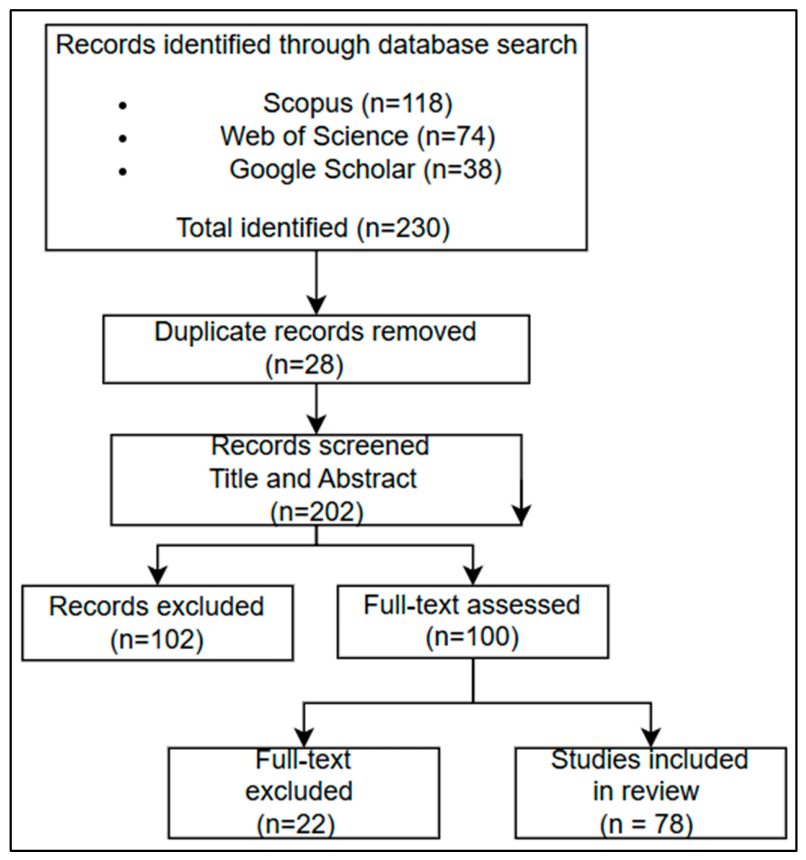
The study selection process followed the PRISMA 2020 reporting guideline to ensure a transparent, systematic, and reproducible literature review process. Following the database search described in Section 2.1, records were screened through four sequential stages: identification, duplicate removal, title and abstract screening, and full-text eligibility assessment, as illustrated in Figure 1.
Studies were included if they:
  • focused on manufacturing, smart manufacturing, or industrial production systems;
  • investigated Lean, Six Sigma, DMAIC, Industry 4.0, or the integration of these approaches;
  • were published as peer-reviewed journal articles;
  • were written in English;
  • provided conceptual, empirical, methodological, or implementation-oriented contributions relevant to Lean Six Sigma–Industry 4.0 integration.
Studies were excluded if they:
  • focused on domains outside manufacturing or industrial engineering;
  • were conference papers, review articles, editorials, book chapters, or non-peer-reviewed publications;
  • discussed individual Industry 4.0 technologies without relating them to structured process improvement or LSS implementation;
  • lacked sufficient methodological or analytical information to support the objectives of this review.
The initial database search identified 230 records from Scopus, Web of Science Core Collection, and Google Scholar. After removing 28 duplicate records, 202 studies remained for title and abstract screening. During title and abstract screening, 102 records were excluded because they did not satisfy the predefined inclusion criteria or were outside the scope of this review. The remaining 100 full-text articles were subsequently assessed for eligibility. Following full-text eligibility assessment, 22 articles were excluded because they lacked sufficient methodological detail, did not address the integration of LSS and Industry 4.0, or were not directly relevant to the research objectives. Consequently, 78 studies satisfied all predefined inclusion criteria and were included in the qualitative synthesis that formed the evidence base for the proposed conceptual framework.
Conference proceedings, book chapters, editorials, and other non-peer-reviewed publications were excluded because the primary objective of this review was to synthesise mature and methodologically validated evidence suitable for conceptual framework development. Although conference papers often present emerging findings, they typically provide limited methodological detail and are not always subjected to the same level of peer review as journal articles. Restricting the review to peer-reviewed journal articles, therefore, enhanced methodological consistency, evidence quality, and the reliability of the analytical synthesis underpinning the proposed framework.
This structured study selection process ensured that the final dataset comprised high-quality and directly relevant studies aligned with the objectives of this systematic literature review. The transparent application of predefined inclusion and exclusion criteria enhances the reproducibility, methodological rigor, and credibility of the literature synthesis. Figure 1 illustrates the complete PRISMA 2020 study selection process, including identification, screening, eligibility assessment, and final study inclusion.

2.3. Quality Appraisal Criteria

To strengthen the methodological rigor of the review and avoid treating all selected publications as having equal analytical weight, a quality appraisal procedure was applied after inclusion and exclusion screening. The purpose of this appraisal was not to exclude studies solely based on the methodological type but to assess the extent to which each study contributed meaningful evidence to the understanding of LSS–I4.0 integration.
Each selected study was evaluated using five quality appraisal criteria: conceptual clarity, methodological transparency, depth of integration, practical applicability, and contextual relevance. Conceptual clarity refers to whether the study clearly explains the relationship between LSS, DMAIC, and I4.0 technologies. Methodological transparency assesses whether a study provides sufficient information on the research design, data sources, analytical approach, or framework development process. The integration depth evaluates whether the study addresses integration at the tool level, DMAIC phase level, or broader architectural level.
Practical applicability considers whether the study provides conceptual guidance, deployment logic or measurable operational implications. Contextual relevance assesses whether the study applies to manufacturing environments, particularly defect-sensitive or digitally enabled production systems. The appraisal criteria are presented in Table 3.
Studies with weak methodological transparency or limited practical applicability were not automatically excluded if they provided useful conceptual insights. However, such studies should be interpreted with caution during the synthesis stage. This quality appraisal step strengthened the review by ensuring that the final analysis moved beyond publication counting and considered the analytical value, implementation relevance, and framework contribution of the reviewed literature.

2.4. Multi-Dimensional Evidence Extraction and Analytical Framework

To enable deeper comparative synthesis, each selected study was systematically coded across multiple analytical dimensions including industry sector, DMAIC phase relevance, I4.0 technology category, LSS tool alignment, enterprise size context, and implementation scale. This multidimensional classification approach improves cross-study comparability and enables structured pattern identification across heterogeneous industrial contexts [27,28,29,30,31,32,33].
However, this study extends beyond descriptive classification by adopting a multidimensional analytical coding approach. Each selected study was categorized according to topic or technology type and evaluated in terms of integration depth, DMAIC coverage, deployment logic, validation mechanism, and organizational context. This approach allows the review to assess whether existing studies merely report technology applications or provide a structured and operational logic for LSS–I4.0 integration.
The analytical coding framework was organized into five main dimensions. First, the integration level was used to determine whether a study addressed integration at the level of individual tools, DMAIC phases, or a broader system architecture. Second, DMAIC coverage assessed whether the study focused on selected DMAIC stages or supported full-cycle integration across the DMAIC.
Third, deployment logic examined whether the implementation was presented as ad hoc technology adoption, linear phase mapping, or adaptive deployment sequencing. Fourth, the validation mechanism assessed whether the study provided measurable criteria, KPI linkage, decision gates, or other forms of implementation verification. Fifth, the organizational context captured whether the study addressed generic manufacturing environments, SMEs, large enterprises, or EMS-related production conditions. The coding dimensions are presented in Table 4.
This coding framework enables cross-study comparisons and the identification of structural patterns that are not visible through frequency analysis alone. In particular, it allows for differentiation between tool- and architecture-level integration, partial and full DMAIC coverage, technology- and methodology-driven deployment, and conceptual frameworks.
By applying this structured coding approach, the review moves from simple literature classification to analytical synthesis. The coded results were used to identify systematic inconsistencies, maturity gaps, and missing integration logic in existing studies. Importantly, the outputs of this coding process also served as the basis for deriving the framework design requirements presented in Section 4.
Pongboonchai-Empl et al. [16] demonstrated that the DMAIC phase distribution is a critical analytical lens for understanding the concentration of I4.0 technologies in continuous improvement systems. Skalli et al. [14] similarly showed that deployment maturity strongly influences the integration outcomes.
Accordingly, the coding framework used in this study links phase distribution, technology alignment, deployment maturity, and organizational context into a unified structure. This allows the review to preserve comparative depth while maintaining methodological transparency across heterogeneous studies.

2.5. Evidence Extraction and Analytical Synthesis Procedure

A structured evidence extraction and analytical synthesis procedure was employed to systematically examine the 78 studies included in this review. Each article was read in full, and relevant information was extracted using predefined analytical dimensions derived from the research objectives and conceptual scope of the review. The extracted evidence included publication characteristics, industrial application, LSS methodologies, Industry 4.0 technologies, DMAIC phase coverage, implementation characteristics, organisational context, validation approach, and principal findings.
Rather than relying on software-assisted qualitative coding, the review adopted an iterative evidence synthesis approach. Individual studies were examined comparatively to identify recurring implementation patterns, common technological applications, methodological limitations, and unresolved research gaps. Information extracted from the literature was continually compared across studies to ensure consistency of interpretation and to support the development of higher-level analytical themes.
The extracted evidence subsequently formed the basis for the quantitative frequency summaries presented in Table 5, the cross-dimensional comparisons in Section 2.7, and the framework design requirements developed in Section 4. This structured evidence extraction process ensured that the proposed conceptual framework was derived from systematic comparison rather than narrative description alone.

2.6. Quantitative Content Analysis as Diagnostic Evidence

A quantitative content analysis was conducted to identify recurring frequency patterns across the DMAIC phases and associated I4.0 technologies. This analysis focused on two main aspects: the frequency of I4.0 technology categories reported in the reviewed studies and the extent to which these technologies were associated with each DMAIC phase. The purpose of this study was to determine whether existing LSS–I4.0 research demonstrates balanced lifecycle integration or whether certain phases are disproportionately emphasized.
Importantly, the frequency results were not considered the final analytical output. Instead, they were used as diagnostic evidence to identify structural imbalances across the DMAIC lifecycle and to support the subsequent cross-dimensional synthesis. In this sense, quantitative analysis served as an entry point for deeper interpretation rather than a descriptive endpoint.
The analysis confirmed that I4.0 technologies are disproportionately concentrated in the Measure and Analyze phases, where IoT sensing, AI analytics, machine learning and predictive monitoring are most frequently applied. This finding is consistent with Pongboonchai-Empl et al. [16], who observed that digital technologies generate the strongest value in data-intensive DMAIC phases. Measure and Analyze dominate the literature because these phases are technologically observable, data-rich, and easier to quantify than Define and Control [34,35,36,37,38,39,40,41].
In contrast, Define and Control remain comparatively under-represented. This imbalance indicates that the current LSS–I4.0 maturity is not evenly distributed across the entire DMAIC lifecycle. While many studies demonstrate strong capabilities in digital measurement and analytical diagnosis, fewer studies explain how digital technologies should support strategic problem framing, project prioritization, long-term stabilization, and feedback-based sustainment.
Table 4 provides critical empirical evidence supporting one of the central arguments of this study: that current LSS–I4.0 integration remains structurally imbalanced and fragmented.
The percentages presented in Table 5 represent the frequency with which each DMAIC phase was addressed across the included studies rather than the proportion of unique studies assigned exclusively to a single phase. This analytical approach reflects the interdisciplinary nature of Lean Six Sigma–Industry 4.0 integration, where individual publications frequently report technologies or methodologies supporting multiple stages of the DMAIC lifecycle simultaneously.
The results clearly show that I4.0 technologies are disproportionately concentrated in the Measure (41%) and Analyze (33%) phases, where data acquisition and analytical capabilities are most naturally aligned with IoT and AI/ML technologies. In contrast, the Define (12%) and Control (14%) phases receive significantly less digital support. This pattern indicates that existing implementations tend to prioritize data acquisition and analytical intelligence while giving less attention to front-end strategic alignment and backend control stability.
This implies that not only do some DMAIC phases receive fewer publications, but also that the current LSS–I4.0 integration remains methodologically incomplete. A genuinely mature LSS–I4.0 architecture should not only capture and analyze process data but also guide problem selection, validate phase transitions, stabilize improvements, and sustain long-term performance. Therefore, the observed frequency imbalance provides a methodological basis for developing a phase-balanced architecture-driven framework, as described in Section 4.
While bibliometric techniques can provide valuable insights into citation networks, keyword evolution, and publication clustering, the present study prioritizes content-based classification and analytical synthesis. This is because its primary objective is to develop an operational DMAIC-based integration framework rather than a citation-structure map. This approach is consistent with recent review studies that move beyond literature mapping toward framework development and implementation-oriented insights, as demonstrated by Pongboonchai-Empl et al. [16], and Skalli et al. [14].

2.7. Cross-Dimensional Pattern Analysis

Beyond frequency counts, cross-dimensional analysis examines how technology deployment patterns vary across organizational contexts. Ciano et al. [18] demonstrated that I4.0 technologies tend to align with specific lean tools rather than with entire DMAIC systems. For example:
  • The IoT is strongly aligned with monitoring-oriented tools.
  • AI aligns more frequently with root cause diagnosis and predictive analyses.
Macias-Aguayo et al. [17] further identified organizational readiness, workforce capability, and infrastructure maturity as stronger determinants of successful integration than technology availability. These findings suggest that current implementation patterns are predominantly technology-driven rather than methodology-driven.
This cross-dimensional analysis was used to interpret the frequency patterns identified in Section 2.5 in relation to organizational readiness and implementation maturity. Rather than examining technology distribution in isolation, the analysis considered how enterprise size, workforce capability, infrastructure readiness, and deployment scale influenced the LSS–I4.0 integration outcomes. This step was important because the same technology may produce different results depending on whether it is deployed in a digitally mature large enterprise, SME with limited infrastructure, or EMS environment requiring strict traceability and defect control.

2.8. Reliability and Consistency Assessment

To enhance the methodological rigor of this systematic literature review, the study followed the principles of systematic evidence synthesis recommended by Snyder [21]. Throughout the review process, a structured and predefined coding framework was employed to ensure consistency in extracting and analysing information from the selected studies.
Each included article was reviewed using the same coding protocol, covering DMAIC phase(s), Industry 4.0 technologies, research methodology, manufacturing context, implementation characteristics, and key findings. Coding decisions were applied consistently across all 78 studies, and articles with ambiguous classifications were re-examined against the original publications before finalising the analytical dataset.
This systematic literature review was conducted by a single researcher using a predefined evidence extraction framework and consistent analytical procedures throughout the review process. All included studies were evaluated using the same coding definitions and analytical framework, and ambiguous classifications were resolved through repeated examination of the original publications to improve consistency. However, formal inter-rater reliability assessment (e.g., Cohen’s Kappa) was not performed because the evidence extraction and coding were conducted by a single researcher. Consequently, some degree of subjective interpretation may have influenced the classification and synthesis of the reviewed studies. Future systematic literature reviews should incorporate multiple independent reviewers and formal inter-rater agreement measures to further strengthen methodological robustness and reproducibility.

2.9. Summary of Methodological Contribution

By combining PRISMA-guided review procedures, quality appraisal, multidimensional analytical coding, quantitative diagnostic analysis, and cross-dimensional synthesis, this methodology provides a structured basis for identifying structural imbalances, technology concentration patterns, deployment gaps, and context-dependent limitations in the LSS–I4.0 integration literature.

3. Critical Analytical Synthesis of LSS and I4.0 Integration Literature

Building on the methodological framework developed in Section 2, this section provides a critical analytical synthesis of the literature on LSS–I4.0 integration. Rather than reiterating the reported benefits, the objective is to examine why existing studies remain fragmented, methodologically uneven, and insufficiently operational despite the growing recognition of the complementarity between LSS and Industry 4.0.
The reviewed literature consistently demonstrates that LSS contributes to structured problem-solving discipline through DMAIC, while I4.0 technologies provide real-time sensing, predictive analytics, cyber-physical connectivity, and intelligent automation. However, this complementarity has not yet been translated into a mature integration architecture. Most studies explain where digital technologies may support LSS, but far fewer explain how these technologies should be sequenced, governed, validated, and sustained across the entire DMAIC lifecycle.
A critical distinction emerges between technology mapping and integration maturity. Technology mapping identifies the association between specific I4.0 technologies and selected DMAIC phases or lean tools. However, integration maturity requires a deeper explanation of how these technologies function collectively as a coordinated improvement architecture. The literature remains stronger in the former area than in the latter.
This distinction is important because assigning IoT to Measure and AI to Analyze does not, by itself, provide operational guidance for implementation, transition control, or long-term sustainment. Consequently, the current LSS–I4.0 integration remains largely technology-driven rather than architecture-driven.
Accordingly, the synthesis in this section is structured around four recurring limitations identified through the analytical coding framework.
(i)
uneven DMAIC phase coverage,
(ii)
functional rather than architectural technology alignment,
(iii)
context-dependent implementation outcomes, and
(iv)
insufficient validation and transition logic in existing frameworks.
These limitations form the analytical basis for the conceptual framework proposed in Section 4.

3.1. From Reported Benefits to Integration Maturity

A major finding in the literature is that I4.0 technologies have been shown to enhance LSS performance by improving process visibility, accelerating root cause diagnosis, and enabling predictive intervention. Studies such as Skalli et al. [14] demonstrate that LSS 4.0 strengthens DMAIC execution through the integration of IoT sensing, machine learning analytics, and cyber-physical monitoring systems [42,43,44,45,46,47,48]. Similarly, Buer et al. [15] show that digitalization shifts lean manufacturing from reactive waste elimination toward predictive process optimization [49,50].
While these findings confirm the performance benefits of LSS–I4.0 integration, they also reveal a key limitation: most studies evaluate outcomes rather than the maturity of the integration. In other words, existing research demonstrates that digital technologies improve LSS performance but does not sufficiently explain how these technologies should be systematically integrated into a coherent, phase-complete DMAIC architecture.
Pongboonchai-Empl et al. [16] further observed that the strongest measurable impact of I4.0 technologies occurs in the Measure and Analyze phases, where IoT sensing and AI-driven analytics are most naturally aligned with data-intensive tasks. However, this concentration of benefits highlights a structural imbalance rather than a complete integration.
This indicates that the current LSS–I4.0 integration remains performance-driven but is not architecture-complete. Technologies are adopted when they generate immediate measurable value, but without a structured logic governing their deployment across all DMAIC phases. Consequently, many implementations achieve localized optimization without developing a fully integrated continuous improvement system.
Therefore, the key issue is not whether LSS and I4.0 are compatible, as this is already well established, but whether existing research provides sufficient guidance for achieving balanced, validated, and scalable integration maturity across the entire DMAIC lifecycle.

3.2. Structural Imbalance Across DMAIC Phases

Despite the well-documented benefits of integrating I4.0 technologies into LSS, the literature consistently reveals an uneven distribution of digital support across the DMAIC phases. As demonstrated in Section 2.5, I4.0 technologies are disproportionately concentrated in the Measure (41%) and Analyze (33%) phases, where data acquisition, monitoring, and analytical capabilities are most naturally aligned with IoT sensing, machine learning, and predictive analytics.
At a superficial level, this pattern reflects the technical compatibility between digital technologies and data-intensive work. However, a deeper interpretation suggests a more fundamental limitation: current LSS–I4.0 integration is driven by data availability rather than a structured lifecycle-oriented implementation logic.
The dominance of the Measure and Analyze phases indicates that organizations prioritize technologies that provide immediate visibility and diagnostic capabilities. IoT systems enhance process monitoring, whereas AI and machine learning strengthen root cause identification. These capabilities generate measurable short-term improvements and are therefore more frequently adopted and reported in the literature.
In contrast, the Define and Control phases remain comparatively underdeveloped in the literature. The Define phase requires strategic problem framing, project prioritization, and alignment with organizational objectives, which are less easily digitized and, therefore, less frequently addressed by I4.0 technologies. Similarly, the Control phase requires long-term stabilization, governance mechanisms, and feedback-based sustainment, which demand an integrated system design rather than isolated technological solutions.
This imbalance has important implications. This suggests that many LSS–I4.0 implementations are analytically strong but strategically and operationally incomplete. Organizations are increasingly capable of sensing and diagnosing process performance but are less capable of digitally supporting front-end decision-making and long-term sustainment.
Table 6 synthesizes these patterns by mapping the current literature’s strengths, dominant technologies, and associated weaknesses across each DMAIC phase.
The patterns presented in Table 6 confirm that digital maturity is concentrated in the data-intensive stages of the DMAIC cycle, whereas governance-intensive stages remain weakly supported. This indicates that existing integration approaches are largely technology-rather than architecture-driven.
Consequently, current implementations tend to emphasize localized optimization within individual phases rather than achieving full-cycle continuous improvement. This leads to fragmented deployment, where technologies are effectively applied within specific functions but are not coordinated across the entire DMAIC life cycle.
Therefore, the observed phase imbalance is not merely a distributional issue but a structural limitation in existing LSS–I4.0 research. A mature integration framework must ensure balanced digital support across all DMAIC phases, including the strategic definition, validated transition, and long-term control. This requirement directly informs the phase-balanced architecture proposed in Section 4.

3.3. Functional Alignment Versus Architectural Integration

Another important pattern in the literature concerns the relationship between I4.0 technologies and LSS tools. Ciano et al. [18] demonstrated that I4.0 technologies often align strongly with specific Lean methods or improvement functions rather than with the full DMAIC architecture. For example, IoT technologies are frequently associated with monitoring and process visibility, AI supports root cause diagnosis and predictive analytics, and CPS enables adaptive process intervention.
This functional alignment is valuable because it explains why certain technologies are linked repeatedly to specific improvement activities. However, functional alignment should not be confused with architectural integration. A technology may effectively support one tool, one process function, or one DMAIC phase, but this does not necessarily create an integrated LSS–I4.0 system.
This distinction explains why many existing implementations are fragmented. Technologies are often deployed to solve localized operational problems, such as monitoring process variations, detecting anomalies, and improving diagnostic speed. Although these applications may improve local performance, they do not automatically establish phase continuity, deployment sequencing, governance control, or sustainment mechanisms across the entire DMAIC lifecycle.
Consequently, the current literature tends to provide stronger evidence for technology–function compatibility than for system-level integration capabilities. This represents a key conceptual limitation. Existing studies show that IoT, AI, CPS, and robotics can support selected improvement activities; however, they provide less guidance on how these technologies should be coordinated into a unified improvement architecture.
Therefore, the challenge is not simply to identify which digital technologies match Lean or DMAIC tools. A more important challenge is to define how these technologies interact across phases, how decisions are validated between phases, and how improvement gains are stabilized over time. This architectural gap directly supports the need for decision gates and continuous feedback mechanisms incorporated into the proposed framework.

3.4. Why Integration Outcomes Differ Across Organizational Contexts

Although many studies report positive outcomes from LSS–I4.0 integration, implementation results vary significantly across organizations. This variation indicates that technological availability alone does not determine the success of integration. Instead, outcomes strongly depend on organizational readiness, infrastructure maturity, workforce capability, leadership commitment, and governance strength.
Macias-Aguayo et al. [17] identified infrastructure maturity, workforce capability, and organizational readiness as critical moderators of successful LSS–I4.0 implementation. Similarly, Saad et al. [19] argued that sustainable Lean–I4.0 convergence depends not only on technology adoption but also on leadership support, governance structures, and adequate resource allocation. These studies suggest that LSS–I4.0 integration should be understood as a sociotechnical transformation process rather than a purely technological upgrade.
The contrast between large and small and medium-sized enterprises (SMEs) further illustrates this readiness gap. Large enterprises typically possess stronger digital infrastructure, larger investment capacity, dedicated improvement teams, and mature data governance systems. These conditions allow for a broader and more coordinated deployment across multiple DMAIC phases. In contrast, SMEs often adopt I4.0 technologies selectively through pilot projects because of limited financial resources, weaker infrastructure, and insufficient specialist expertise. Alsaadi [47] further demonstrated that SMEs face disproportionately higher barriers, including infrastructure deficiencies, insufficient LSS training, and limited access to specialized expertise.
This comparison reveals an important inconsistency in the existing frameworks. Many models implicitly assume that organizations can implement LSS–I4.0 integration under similar conditions, even though the literature reviewed shows that implementation capability differs substantially across enterprise types. Consequently, generic frameworks risk becoming overly idealized because they do not sufficiently explain how deployment should be adapted to different maturity levels.
Table 7 summarizes these context-dependent patterns across various organizational settings.
The patterns presented in Table 7 show that integration outcomes are strongly shaped by readiness conditions rather than technology selection. Firms with higher lean and digital maturity are more likely to achieve balanced and sustained implementation, whereas low-maturity firms and SMEs tend to experience fragmented or partial adoption. This finding reinforces the need for a framework that incorporates readiness preconditions and differentiated deployment pathways, rather than assuming a uniform implementation model.
Therefore, the readiness gap is not a secondary implementation issue; it is a central design requirement for any operational LSS–I4.0 framework. This directly supports the inclusion of deployment preconditions and separate SME and large enterprise scaling pathways in the proposed framework.

3.5. Methodological and Conceptual Limitations in Existing Literature

Despite the rapid growth of research on LSS–I4.0 integration, several methodological limitations persist within the current body of literature.
First, a substantial proportion of studies remain technology-centric rather than architecture-oriented. Many focus on individual technologies, isolated case implementations, or sector-specific applications without clearly articulating how these elements should be systematically integrated within a complete DMAIC-based improvement architecture. Consequently, the literature provides strong evidence of technological capability but limited guidance on system-level integration logic [51,52].
Second, the literature exhibits a systematic bias toward successful implementation cases, while failed or partially implemented initiatives are rarely reported. This creates an overly optimistic representation of LSS–I4.0 maturity and obscures critical implementation barriers that are essential for developing robust and realistic conceptual deployment architecture [53,54].
Third, many studies rely on short-term pilot implementations or cross-sectional observations, with limited longitudinal validation of performance sustainability. Consequently, reported improvements often reflect immediate gains following digital deployment rather than stable, long-term transformation across the full DMAIC lifecycle [14,55].
Collectively, these limitations indicate that current research remains insufficiently developed in three key aspects.
(i)
system-level integration logic,
(ii)
validation and transition mechanisms across DMAIC phases, and
(iii)
long-term sustainability of implementation outcomes.
These gaps are critical because they prevent existing frameworks from evolving beyond conceptual models into structured conceptual frameworks that provide practical guidance for industrial deployment. Therefore, addressing these limitations requires the development of a framework that incorporates phase-balanced integration, structured decision-gate mechanisms, and context-adaptive deployment logic. These design requirements directly informed the development of the conceptual framework proposed in Section 4, which provides a foundation for future empirical validation in EMS environments.

3.6. Human-Centered Readiness and Workforce Capability Gap

A recurring limitation in the current body of literature is the insufficient emphasis placed on workforce capability and human-centered adaptation in LSS–I4.0 integration frameworks. Although Industry 4.0 technologies are widely promoted as key enablers of intelligent manufacturing transformation, many studies continue to treat these technologies primarily as technical deployment instruments rather than as components of broader socio-technical systems requiring coordinated organizational adaptation.
In practice, successful digital transformation depends not only on technological implementation but also on the parallel development of workforce training, behavioral adaptation, and leadership alignment. Macias-Aguayo et al. [17] identified workforce capability deficits as one of the most critical barriers to successful integration, demonstrating that inadequate operator readiness and limited digital literacy frequently undermine the effectiveness of otherwise advanced technological systems.
This finding is important because it challenges the assumption that digital transformation can be achieved through technology deployment. Human capability should not be treated as a peripheral support factor but as a central architectural condition for LSS 4.0 implementation. Accordingly, workforce preparedness must be embedded into integration frameworks as a foundational design requirement to ensure stable, scalable, and sustainable operational improvement outcomes [56,57,58,59].
Therefore, the workforce gap reinforces the need for a deployment precondition layer within the proposed framework, where process maturity, data infrastructure readiness, and human capability are assessed before the implementation of full DMAIC-based digital integration.

3.7. Synthesis of Gaps into Framework Design Requirements

Although prior studies have significantly advanced the theoretical and practical understanding of LSS–I4.0 integration, the remaining gaps are not isolated. Rather, they represent interconnected structural weaknesses that restrict the maturity, operational relevance, and industrial applicability of the existing frameworks. The synthesis developed in the preceding sections indicates that current research remains limited in five major areas: phase imbalance, functional rather than architectural integration, weak transition validation, insufficient context adaptation, and limited EMS-specific operational logic.
Instead of treating these limitations as general research gaps, this study translates them into explicit framework-design requirements. This approach strengthens the review’s analytical contribution by demonstrating how the literature synthesis directly informs the development of the proposed framework. Table 8 summarizes the gap-to-requirement logic.

3.8. Summary of Analytical Implications

The analytical synthesis of the reviewed literature demonstrates that the main limitation of current LSS–I4.0 integration research is not the absence of studies on the topic but the absence of a structured, validated, and context-adaptive deployment architecture. Although I4.0 technologies have substantial potential to strengthen LSS performance through real-time visibility, predictive analytics, and adaptive intervention, existing integration approaches remain uneven, fragmented, and only partially operationalized.
Four major analytical implications emerge from this study. First, digital technology deployment remains disproportionately concentrated in the Measure and Analyze phases, resulting in an imbalanced DMAIC maturity pattern that favors the Measure and Analyze phases over the other phases. Second, many existing studies provide technology–tool or technology–phase mapping but do not sufficiently explain how these technologies should be coordinated into a full-cycle improvement architecture.
Third, organizational readiness dimensions, including workforce capability, infrastructure maturity, and governance preparedness, continue to be insufficiently embedded in prevailing integration models. Finally, EMS-specific operational requirements, such as defect containment, traceability control, short product lifecycles, and mixed automated–manual workflows, remain inadequately addressed.
Collectively, these findings indicate that current LSS–I4.0 research is technologically advanced but architecturally deficient. Existing studies explain the value of digital technologies but provide limited guidance on how integration should be sequenced, validated, adapted, and sustained across the DMAIC lifecycle.
Beyond the studies specifically addressing LSS and Industry 4.0 integration, recent manufacturing research has explored broader smart production and sustainable manufacturing strategies. These studies have investigated autonomation for work-in-process inventory control, resilient production planning under supply chain disruptions, optimization of imperfect production systems through rework and intelligent inventory management, and sustainable electric vehicle production supported by digital technologies. Collectively, these contributions demonstrate the growing role of digital technologies in improving manufacturing efficiency, operational resilience, inventory optimization, and sustainability. Nevertheless, their primary emphasis remains production planning, inventory management, and supply chain optimization rather than providing a structured continuous improvement architecture integrating LSS and Industry 4.0 across the complete DMAIC lifecycle. This observation further supports the need for the proposed EMS-oriented conceptual framework developed in the present study [43,44,45,46].
Accordingly, the key contribution required from the next generation of LSS–I4.0 frameworks is not simply broader technology inclusion but a stronger deployment logic. This includes phase-balanced integration, structured transition validation, readiness-sensitive implementation, and context-specific adaptation for high-defect-sensitivity sectors such as EMS manufacturing.
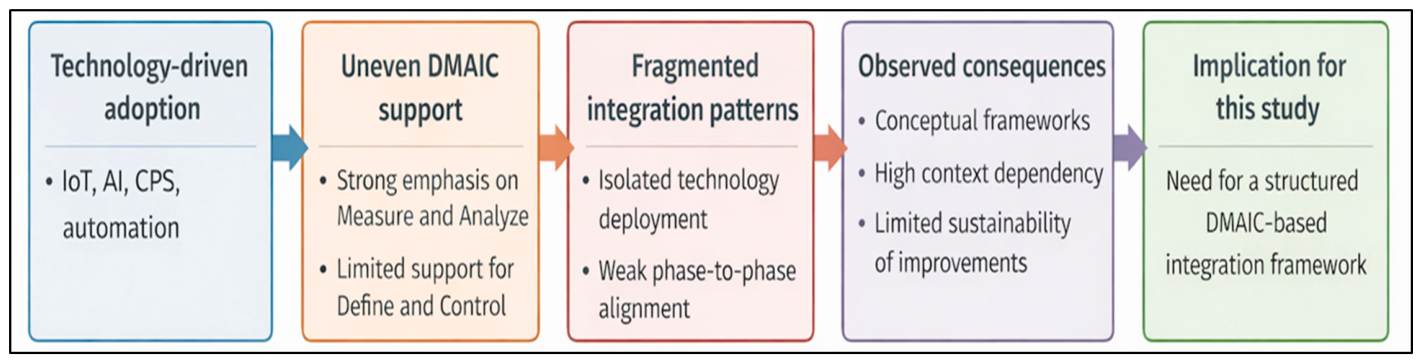
Figure 2 synthesizes this logic by illustrating how technology-driven adoption, uneven DMAIC phase support, weak validation logic, and limited contextual adaptation lead to fragmented implementation outcomes. These structural weaknesses directly motivate the development of the unified DMAIC-based conceptual EMS framework presented in Section 4.

4. Proposed Unified DMAIC-Based Conceptual Framework for LSS and I4.0 in EMS Manufacturing

4.1. Framework Development Rationale

The analytical synthesis presented in Section 3 demonstrates that, although substantial progress has been made in LSS and I4.0 integration research, existing studies remain fragmented in both theoretical scope and practical deployment logic. Although the literature consistently confirms that I4.0 technologies enhance LSS performance, no existing framework fully integrates DMAIC phase balance, technology sequencing, organizational readiness conditions, and enterprise-level adaptation into a unified conceptual architecture.
Pongboonchai-Empl et al. [16] showed that I4.0 technologies are disproportionately concentrated in the Measure and Analyze phases, resulting in structural imbalance across the DMAIC cycle. Ciano et al. [18] further demonstrated that I4.0 technologies are typically aligned with individual Lean tools rather than integrated across a complete end-to-end improvement architecture. Similarly, Skalli et al. [14] proposed a comprehensive LSS 4.0 framework; however, their model does not incorporate structured transition logic between DMAIC phases or mechanisms for adapting implementation across different organizational contexts.
In addition to structural limitations, several studies have highlighted the importance of organizational readiness in determining implementation success. Macias-Aguayo et al. [17] identified workforce capability, infrastructure maturity, and organizational readiness as critical determinants of successful integration, while Saad et al. [19] emphasized that long-term Lean–I4.0 convergence depends on governance capability, leadership commitment, and transformation readiness rather than technology acquisition alone. These findings indicate that current models insufficiently address the conditions required for sustainable deployment.
Furthermore, Ibrahim and Kumar [59] demonstrated that successful LSS–I4.0 integration depends on clearly prioritized critical success factors, including workforce competency, sustainability alignment, and continuous performance monitoring. Their findings reinforce the need to embed deployment readiness and control mechanisms in the framework design.
Collectively, these limitations reveal that existing studies fail to address three critical questions: when specific technologies should be deployed across the DMAIC phases, how transitions between phases should be validated, and how implementation should be adapted across different organizational contexts. The absence of a unified model that addresses these dimensions represents a significant gap in the current research.
Accordingly, this study proposes a unified EMS-oriented DMAIC-based integration framework specifically designed for EMS environments, where defect sensitivity, traceability requirements, and mixed automation dependencies necessitate a more structured and context-adaptive approach.
To summarize the identified limitations and corresponding framework responses, Table 9 presents a structured mapping of the literature gaps addressed by the proposed model. It is important to emphasize that the proposed model is a conceptual framework intended to guide the systematic integration of LSS and Industry 4.0 within EMS. The framework establishes the relationships and deployment principles required for future implementation but does not replace organization-specific implementation planning or empirical validation.
The proposed framework should be interpreted as a conceptual framework rather than a prescriptive one. Its primary purpose is to define the architectural constructs, relationships, deployment principles, and decision logic necessary for integrating LSS and Industry 4.0 within EMS. Although the framework provides structured conceptual guidance by identifying deployment readiness requirements, adaptive decision gates, and enterprise-specific pathways, it does not prescribe fixed implementation procedures, software configurations, or universally applicable performance thresholds. These implementation details will require empirical validation and adaptation to specific industrial contexts.

4.2. Unified EMS Framework Architecture

The proposed framework is structured as a four-layer architecture designed to address the key limitations identified in Section 3, including phase imbalance, fragmented technology deployment, insufficient readiness integration, and a lack of scalability across organizational contexts. Each layer serves a distinct functional role within a unified LSS–I4.0 integration system.
  • Layer 1: Deployment Preconditions
The first layer establishes the foundational conditions required for the effective implementation of DMAIC-based digital integration. Specifically, organizations must demonstrate adequate process maturity, data infrastructure readiness, and workforce capability. These preconditions ensure that digital technologies are deployed in a stable operational environment capable of supporting sustainable transformation.
This layer directly addresses one of the most critical failure points identified in the literature, where organizations attempt to implement I4.0 technologies without sufficient preparation. Macias-Aguayo et al. [17] highlighted that deficiencies in workforce capability, infrastructure maturity, and organizational preparedness significantly reduce implementation success rates. By embedding a readiness assessment into the framework architecture, this layer ensures that integration begins on a structurally sound foundation.
  • Layer 2: DMAIC Digital Integration Engine
The second layer represents the core operational engine of the framework, wherein I4.0 technologies are systematically embedded within each phase of the DMAIC cycle. Unlike prior models that treat technology adoption at a conceptual or tool-specific level, this framework aligns technologies according to their functional roles within each phase.
This phase-based integration ensures that technologies are not deployed arbitrarily but are instead matched to specific improvement objectives, such as data acquisition in the Measure phase or predictive analytics in the Analyze phase. Consequently, the framework establishes a structured and balanced digital integration logic across the entire DMAIC lifecycle.
  • Layer 3: Adaptive Decision Gate Mechanism
The third layer introduces an adaptive decision gate mechanism that regulates the progression between the DMAIC phases. Each transition is controlled by validation checkpoints that ensure that the preceding phase has achieved sufficient completion before moving forward.
This mechanism addresses a key limitation of existing frameworks, which often assume linear progression without verifying phase readiness. By embedding decision gates into the architecture, the framework enhances implementation robustness, reduces the risk of premature advancement, and improves the reliability of the improvement outcomes.
  • Layer 4: Continuous Feedback and Enterprise Scaling
The fourth layer ensures the long-term sustainment, continuous learning, and scalability of the framework across different organizational contexts. It incorporates feedback loops that enable real-time performance monitoring, adaptive process refinement and continuous improvement.
In addition, this layer introduces differentiated deployment pathways for SMEs and large organizations. This dual scaling approach recognizes that implementation requirements vary significantly depending on organizational size, resource availability, and digital maturity. By integrating scalability into the framework, this layer ensures that the model remains applicable to diverse industrial environments.
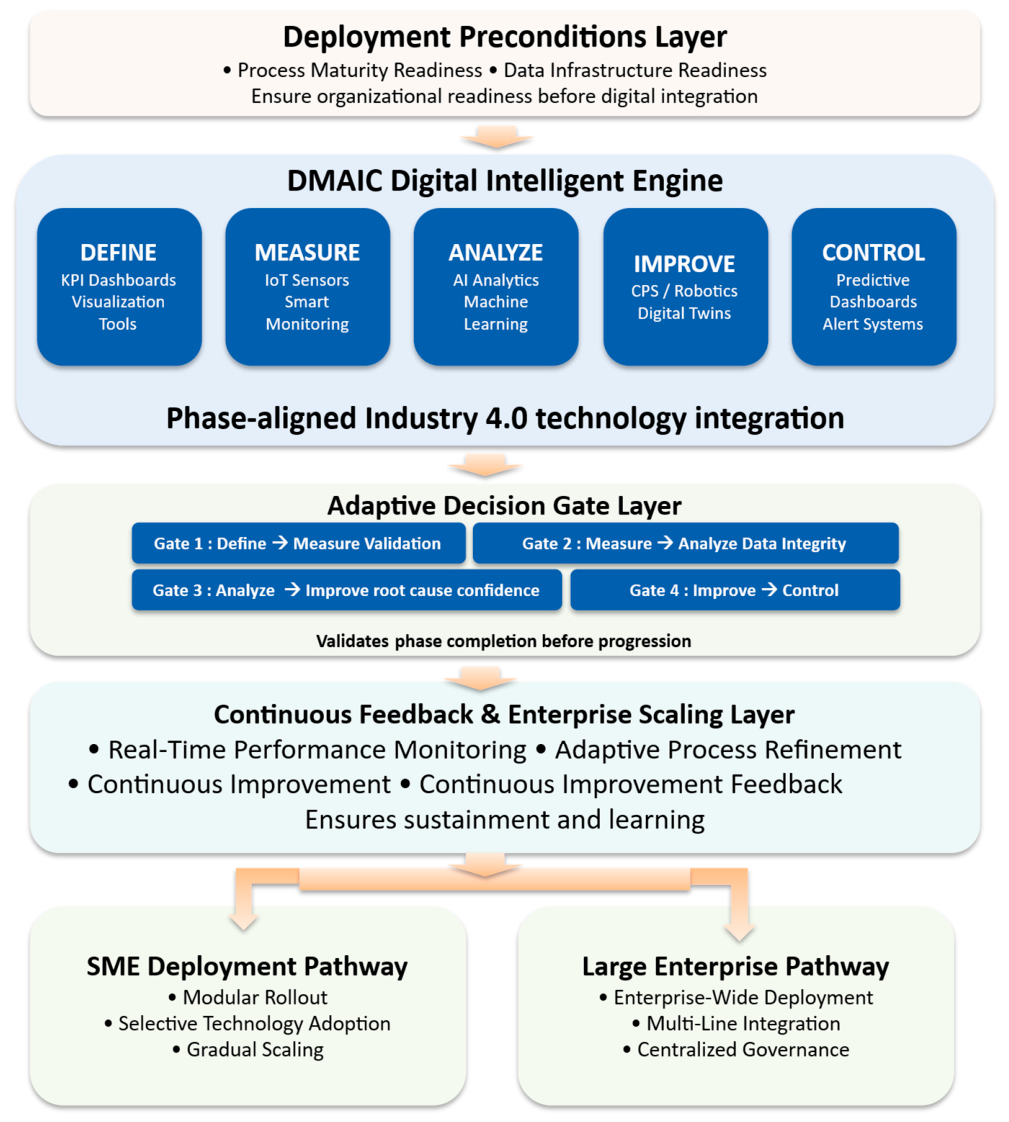
Figure 3 presents the overall conceptual architecture of the proposed framework. The framework is organized into four interrelated architectural layers that collectively describe the organizational conditions, technological integration, governance mechanisms, and continuous learning processes required for successful Lean Six Sigma–Industry 4.0 implementation within EMS.
Figure 3 illustrates the proposed framework as a four-layer conceptual architecture that should be interpreted sequentially from bottom to top. The first layer establishes organizational deployment readiness by evaluating strategic alignment, digital maturity, workforce capability, and leadership commitment before Lean Six Sigma–Industry 4.0 integration begins. The second layer embeds Industry 4.0 technologies across the DMAIC lifecycle, demonstrating how digital technologies support continuous improvement activities throughout Define, Measure, Analyze, Improve, and Control rather than concentrating only on isolated phases. The third layer introduces adaptive decision gates that evaluate organizational readiness before progression between successive DMAIC phases, thereby preventing premature implementation. Finally, the fourth layer provides continuous organizational learning through performance monitoring, feedback mechanisms, and continuous improvement, ensuring that knowledge generated during implementation is retained and transferred throughout the organization. Together, these four architectural layers establish an integrated conceptual framework for EMS-oriented digital transformation, in which organizational readiness enables technology deployment, adaptive decision gates govern progression across the DMAIC lifecycle, and continuous organizational learning provides continuous feedback for sustained improvement and future deployment cycles.
Building upon this four-layer architecture, the proposed framework systematically embeds Industry 4.0 technologies across each DMAIC phase to ensure that digital capabilities are aligned with the objectives of continuous improvement. This phase-based integration is consistent with the technology mapping identified by Pongboonchai-Empl et al. [16] and the technology–tool alignment logic demonstrated by Ciano et al. [18].

EMS Operational Integration

Although the proposed framework is conceptually applicable to manufacturing systems, its architectural design is specifically tailored to EMS. Unlike generic manufacturing environments, EMS production requires continuous product traceability, stringent quality assurance, rapid product changeovers, and high process repeatability. Consequently, the Measure phase incorporates manufacturing-specific quality monitoring technologies, including SPI, AOI, ICT, FCT, X-ray inspection, SPC, and MES traceability. These technologies provide the real-time production intelligence required for defect-sensitive electronics assembly and establish the operational foundation upon which the adaptive DMAIC framework is constructed.
  • Define Phase
In the Define phase, the framework incorporates KPI dashboards, digital visualization systems, and problem-prioritization platforms to strengthen strategic issue identification and project scoping. These technologies improve decision transparency during problem selection and enable management teams to prioritize improvement opportunities using real-time performance data. This directly addresses the weak digital support in the Define phase identified in Section 3, where strategic front-end integration remains underdeveloped in most existing LSS–I4.0 models.
  • Measure Phase
The Measure phase is supported by IoT sensor networks, MES-enabled data collection, barcode and serial-number traceability, SPI, AOI, ICT, X-ray inspection, and real-time SPC. These EMS-specific technologies provide end-to-end process visibility, verify product traceability, and enable early detection of process deviations throughout the PCBA manufacturing process. The integration of these digital quality systems ensures complete production records and supports evidence-based decision-making before progression to the Analyze phase.
  • Analyze Phase
In the Analyze phase, AI-enabled analytics, machine learning, statistical analysis, and defect trend analysis are integrated with MES quality records, AOI defect images, ICT failure logs, and X-ray inspection results to identify root causes of recurring manufacturing defects. This integrated analysis enables engineers to distinguish process-related variation from component-related failures while supporting predictive quality improvement within EMS production environments.
  • Improve Phase
The Improve phase applies digital twin simulation, robotics, process optimization, stencil and reflow profile optimization, dispensing parameter optimization, and automated process validation to verify corrective actions before implementation. Design of Experiments (DOE) and process validation are supported using production quality data collected through MES, thereby reducing implementation risk while improving first-pass yield and manufacturing robustness.
  • Control Phase
The Control phase integrates MES dashboards, SPC monitoring, traceability verification, defect escape monitoring, customer complaint feedback, and closed-loop corrective action management to sustain process improvements. Trigger conditions, including abnormal SPC trends, repeated AOI failures, ICT failure rate increases, or field-return trends, initiate corrective investigation before quality deterioration propagates through subsequent production stages.
  • Integrative Significance
The proposed framework further differentiates itself from existing generic Industry 4.0 integration models by explicitly embedding EMS-specific operational constraints within each DMAIC phase. These include PCBA traceability, mixed automated–manual production dependencies, MES-enabled process monitoring, SPI, AOI, ICT, X-ray inspection, SPC, defect escape prevention, and closed-loop corrective feedback. Rather than functioning as standalone digital technologies, these mechanisms operate as mandatory implementation controls that govern phase progression, strengthen deployment readiness, improve defect containment, and enhance product traceability throughout the PCBA manufacturing lifecycle.
To consolidate the phase-by-phase integration logic described above, Table 10 presents a structured mapping between DMAIC phases, their primary improvement objectives, the corresponding I4.0 technologies, and the expected operational outputs.
This mapping provides a clear operational representation of how digital technologies are functionally aligned within each DMAIC phase, transforming conceptual integration into a structured and implementable framework. Unlike generic Industry 4.0 integration frameworks, the proposed EMS-oriented framework embeds manufacturing-specific operational mechanisms within each DMAIC phase. These include digital product traceability, MES-enabled process monitoring, SPI, AOI, ICT, X-ray inspection, and closed-loop defect feedback to support data-driven decision making throughout the product lifecycle. These EMS-specific mechanisms strengthen deployment readiness, improve defect containment, and provide operational guidance beyond conventional DMAIC phase mapping.
The structured alignment presented in Table 10 further demonstrates that the proposed framework achieves a balanced and systematic integration of I4.0 technologies across all DMAIC phases. This directly addresses the phase imbalance and fragmented deployment patterns identified in Section 3, reinforcing the practical applicability of the framework in real-world manufacturing environments.

4.3. Adaptive Decision Gate Logic for EMS Implementation

A distinctive feature of the proposed framework is the introduction of an adaptive decision gate mechanism positioned between each DMAIC phase to regulate progression through structured validation checkpoints.
Within EMS environments, these adaptive decision gates are supported by manufacturing-specific quality verification mechanisms. For example, transition from the Measure phase to Analyze requires validated inspection data obtained from SPI, AOI, ICT, FCT, X-ray inspection, and MES traceability systems. Similarly, progression from Improve to Control requires confirmation that process capability indices, inspection yield, and traceability records satisfy predefined quality objectives before standardization activities commence. These EMS-specific verification mechanisms ensure that phase transitions are governed by objective manufacturing evidence rather than subjective managerial judgement.
Unlike conventional LSS–I4.0 integration models, which typically assume a linear and uninterrupted phase transition, the present framework introduces controlled transition logic to ensure that each DMAIC stage satisfies predefined readiness conditions before advancing to the next phase. This mechanism enhances implementation robustness by reducing premature progression, minimizing process instability, and improving deployment reliability across complex EMS manufacturing environments.
  • Gate 1: Define → Measure
The transition from Define to Measure is permitted only when the improvement project scope is formally validated and key performance indicators (KPIs) are clearly defined and approved. This gate ensures that measurement activities are based on strategically aligned improvement objectives rather than on incomplete or ambiguous project framing. By enforcing scope clarity at this stage, the framework strengthens front-end project discipline and directly addresses the weak Define-phase support identified in prior literature.
  • Gate 2: Measure → Analyze
Progression from Measure to Analyze requires confirmation that collected process data meet integrity standards and that sensor systems demonstrate stable operational reliability. This gate is critical because inaccurate, incomplete, or unstable measurement data compromise analytical validity and may lead to incorrect root-cause interpretation. In digitally enabled EMS environments, where IoT-based measurement systems generate high-volume data streams, this validation checkpoint protects downstream analytical accuracy.
  • Gate 3: Analyze → Improve
The Analyze-to-Improve transition is activated only when sufficient analytical evidence supports the identified root causes. Within the proposed conceptual framework, this may be demonstrated through statistically significant analytical findings, predictive model confidence, anomaly detection consistency, or other organization-specific validation criteria.
  • Gate 4: Improve → Control
The final transition from Improve to Control requires confirmation that the implemented interventions have achieved stable and repeatable performance under the operating conditions. Corrective actions must demonstrate measurable effectiveness before being institutionalized into long-term control systems. This gate ensures that only validated and sustainable improvements enter the Control phase, thereby strengthening process stabilization and preventing premature standardization of unstable solutions.
  • Integrative Significance of Adaptive Decision-Gate Mechanism
These adaptive decision gates represent a major advancement beyond existing LSS–I4.0 frameworks because they embed validation intelligence directly into DMAIC sequencing. While prior studies such as Pongboonchai-Empl et al. [16] and Skalli et al. [14] provide strong technology mapping across DMAIC phases; none explicitly incorporate structured transition gate logic as a mechanism for phase-readiness validation.
Similarly, existing framework models focus primarily on technology deployment alignment rather than transition governance between improvement stages. By introducing adaptive decision gates, the proposed framework transforms DMAIC progression from a static sequential model into a dynamic readiness-driven architecture, thereby improving implementation resilience, reducing deployment risk, and enhancing operational stability in EMS manufacturing applications.
To illustrate the practical application of the adaptive decision-gate mechanism, Table 11 presents representative examples of decision criteria that may be considered during progression between DMAIC phases. These examples are intended solely to demonstrate the conceptual operation of the framework and should not be interpreted as universally applicable industrial thresholds. Actual decision criteria and performance thresholds should be established according to organizational objectives, customer requirements, regulatory obligations, product complexity, and demonstrated process capability.
The decision criteria presented in Table 11 are illustrative examples intended to demonstrate how adaptive decision gates may operate within the proposed conceptual framework. The framework does not prescribe universal threshold values because acceptable performance levels vary according to organizational maturity, product complexity, customer requirements, regulatory standards, and manufacturing context. Future empirical studies should validate and refine these criteria within specific Electronics Manufacturing Services environments. Accordingly, the decision-gate mechanism should be interpreted as a conceptual governance model that supports systematic decision-making rather than as a prescriptive set of universally applicable industrial rules.

4.4. SME and Large Enterprise Scaling Pathways

Because organizational context significantly influences the success and sustainability of LSS–I4.0 integration, the proposed framework incorporates two differentiated scaling pathways: one tailored for SMEs and the other designed for large enterprise manufacturing environments. This dual-pathway architecture recognizes that firms differ substantially in terms of digital maturity, infrastructure capacity, investment capability, workforce specialization, and governance complexity. By embedding context-sensitive deployment routes, the framework improves scalability and enhances practical applicability across heterogeneous manufacturing ecosystems.
  • SME Deployment Pathway
For SMEs, the framework adopts a phased modular rollout strategy designed to accommodate limited financial resources, constrained technical infrastructure, and lower digital readiness levels. In this pathway, technology adoption is intentionally selective and prioritized according to immediate operational impact, enabling organizations to implement critical I4.0 tools incrementally rather than through full-scale simultaneous transformation.
Key characteristics of the SME pathway include:
  • phased modular rollout.
  • selective technology prioritization.
  • lower-cost staged adoption.
This staged approach reduces implementation risk, improves affordability, and allows SMEs to progressively build internal digital capabilities while maintaining operational continuity. Alsaadi [47] further demonstrated that SMEs frequently encounter barriers such as infrastructure limitations, inadequate specialist expertise, and training deficiencies, making phased adoption models essential for sustainable implementation success.
  • Large Enterprise Deployment Pathway
In contrast, large enterprises typically possess stronger infrastructure readiness, larger capital investment capacity, and more mature digital governance systems. Accordingly, the large-enterprise pathway supports enterprise-wide synchronized deployment in which I4.0 technologies are integrated across multiple production lines simultaneously.
Key characteristics of the large-enterprise pathway include:
  • enterprise-wide synchronized deployment.
  • multi-line integration.
  • centralized governance architecture.
This pathway enables coordinated cross-functional digital transformation, standardized data governance, and enterprise-level optimization across interconnected manufacturing operations. Saad et al. [19] showed that enterprise scale significantly influences implementation maturity, with larger firms more capable of sustaining full-scale integrated deployment architectures due to superior organizational and technological capacity.
  • Strategic Importance of Dual Scaling Logic
The inclusion of SME and large-enterprise scaling pathways strengthens the adaptive capability of the proposed framework by preventing one-size-fits-all implementation. Existing LSS–I4.0 models often assume uniform deployment conditions across organizations, despite significant differences in resource availability and transformation readiness. By differentiating deployment pathways according to enterprise scale, the proposed framework enhances practical realism and improves transferability across diverse industrial contexts.
This scaling logic is especially important in EMS manufacturing, where supplier ecosystems frequently include both multinational large-scale manufacturers and smaller specialized subcontracting firms operating within the same production network. A scalable dual-pathway model increases the industrial relevance and implementation robustness of the framework across the broader EMS value chain.

4.5. EMS-Specific Originality Contribution

The preceding architectural layers establish a generic conceptual foundation for adaptive DMAIC deployment. This section extends the framework by explicitly contextualizing each architectural component within EMS. Rather than functioning as a separate application example, EMS operational requirements are integrated throughout the framework to demonstrate how digital quality systems, manufacturing traceability, and inspection technologies support each stage of the DMAIC lifecycle.
EMS environments, particularly PCBA operations, present a unique set of manufacturing challenges that differ significantly from conventional discrete manufacturing. These include stringent traceability requirements across multi-stage assembly processes, high sensitivity to defect propagation across interconnected production steps, mixed automated–manual workflow dependencies, and short product lifecycles requiring rapid process adaptation. In such settings, even minor process deviations can propagate across stages and result in significant quality failures if not detected and corrected promptly.
In PCBA lines, incomplete or fragmented digital integration introduces substantial operational risk. Defects originating in early stages may remain undetected until downstream testing or final inspection, leading to defect escape, rework escalation, yield loss, and increased customer exposure. Generic LSS4.0 frameworks are often insufficient under these conditions because they do not explicitly address the need for synchronized traceability, rapid defect containment, and adaptive feedback mechanisms.
To address these limitations, the proposed framework was specifically designed to support EMS-critical operational capabilities, including defect-sensitive analytics for early anomaly detection, real-time traceability across assembly stages, and adaptive closed-loop corrective intervention. By embedding these capabilities directly into the framework architecture, the model aligns digital integration with the practical realities of defect-sensitive EMS manufacturing.
This EMS-oriented specialization represents a key contribution to the originality of this study. It extends beyond generic integration models by introducing a context-adaptive architecture specifically tailored to the digital transformation requirements of electronics manufacturing systems.

4.6. Illustrative Application of the Proposed Framework

To demonstrate the practical applicability of the proposed framework, an illustrative EMS, PCBA scenario is presented. The example considers a solderability issue identified during production, where intermittent functional failures were observed following a manual soldering process. The framework illustrates how LSS and I4.0 technologies can be integrated to systematically investigate, improve, and sustain process performance within an EMS environment.
During the Define phase, the problem is identified through increased ICT and FCT failures associated with the soldering process. The project objective is established to reduce solder-related defects while maintaining product quality and manufacturing efficiency.
In the Measure phase, manufacturing data are collected from the MES, ICT results, FCT results, X-ray inspection records, and process temperature measurements. Product traceability is verified to ensure complete production history, while soldering contact time and process temperature are recorded to quantify process variation.
During the Analyze phase, statistical analysis, Pareto analysis, and root cause investigation identify excessive soldering contact time and uncontrolled thermal exposure as the primary contributors to solderability defects. Digital production records and inspection results enable engineers to distinguish process-related variation from component-related failures.
In the Improve phase, corrective actions are implemented by optimizing soldering temperature and contact time based on Design of Experiments (DOE). Supporting improvements include revised work instructions, operator retraining, and standardized soldering practices to improve process consistency and reduce defect occurrence.
Finally, the Control phase sustains the improvement through SPC, continuous temperature monitoring, ICT yield trending, MES-based production monitoring, and periodic process verification. Any abnormal increase in ICT failures, temperature deviation, or solderability defects automatically triggers corrective investigation, thereby preventing defect escape into subsequent manufacturing stages.
This illustrative scenario in Figure 4 demonstrates how the proposed EMS-oriented framework integrates LSS with Industry 4.0 technologies to provide a structured, data-driven approach for continuous improvement throughout the complete DMAIC lifecycle.

4.7. Comparative Advantage over Existing Frameworks

To further highlight the contribution of the proposed framework, Table 12 provides a comparative assessment of selected representative LSS–I4.0 integration models.
The comparison demonstrates that while existing frameworks provide valuable conceptual, analytical, and technological insights, they do not offer a fully integrated architecture that simultaneously addresses phase balance, deployment sequencing, readiness conditions, and enterprise-level scalability.
In contrast, the proposed framework integrates these dimensions into a unified structure by combining a balanced DMAIC architecture, adaptive decision gate validation, readiness preconditions, and differentiated deployment pathways for SMEs and large enterprises. This integrated approach enables a more robust and scalable implementation of LSS 4.0 in complex manufacturing environments.

4.8. Summary of Framework Contribution

The proposed unified EMS-oriented framework makes a substantive contribution to the advancement of LSS–I4.0 integration by addressing several critical shortcomings identified in the existing literature. As demonstrated in the analytical synthesis presented in Section 3, current LSS–I4.0 models remain constrained by fragmented technology deployment, uneven DMAIC phase coverage, insufficient readiness integration, and limited adaptation to sector-specific manufacturing contexts. The framework developed in this study resolves these deficiencies by transforming disconnected technology adoption practices into a coherent, balanced, and scalable deployment architecture specifically tailored for EMS environments.
A central strength of the framework lies in its ability to unify previously disconnected dimensions of digital transformation into a single operational system. Unlike prior models that focus primarily on isolated technology applications or partial DMAIC enhancements, the proposed architecture integrates full five-phase DMAIC technology alignment, deployment readiness preconditions, adaptive decision gate validation, continuous feedback learning loops, and differentiated enterprise scaling pathways into one structured implementation model. This creates a more mature and operationally resilient architecture capable of supporting both strategic planning and execution-level transformation.
The framework also advances LSS 4.0 theory by introducing Adaptive Decision-Gate Mechanism as a novel governance mechanism for phase transition control. This contribution strengthens implementation robustness by ensuring that progression between DMAIC phases occurs only when predefined readiness criteria are satisfied, thereby reducing instability risk and improving deployment reliability in complex manufacturing systems.
From an industrial perspective, the framework provides a practical pathway for overcoming one of the most persistent weaknesses in current I4.0 implementation practice: the tendency to deploy advanced technologies without coherent integration sequencing. In this regard, the principal conceptual shift introduced by this study lies in moving the field beyond:
  • “Technology adoption without integration logic”
toward:
  • “Phase-complete intelligent continuous improvement architecture.”
This transition represents more than a structural redesign; it redefines how digital transformation should be operationalized within LSS environments by emphasizing balanced phase maturity, readiness-sensitive deployment, and context-adaptive scalability. As such, the framework not only contributes a new conceptual model to academic literature but also offers a strategically actionable architecture for real-world EMS digital transformation.

4.9. Operationalization and Testability of the Proposed Framework

Although the proposed framework is conceptually derived from a structured synthesis of the current literature, its value ultimately depends on its practical applicability and empirical testability. Accordingly, this section outlines how the framework can be operationalized and evaluated in real-world manufacturing environments.

4.9.1. Readiness Assessment Before Deployment

Before implementation, organizations should evaluate their readiness for LSS–I4.0 integration across three foundational dimensions: process maturity, digital infrastructure readiness, and workforce capability. Process maturity refers to the stability of existing operations, availability of baseline performance indicators, and discipline of current improvement practices. Digital infrastructure readiness reflects the availability of sensors, data connectivity, system interoperability, and reliable data-acquisition mechanisms. Workforce capability refers to digital literacy, cross-functional improvement competence, and an organization’s ability to support human–technology interaction during implementation.
These readiness dimensions provide a practical basis for determining an appropriate deployment pathway. Organizations with higher readiness may proceed toward broader DMAIC-based integration, whereas those with lower readiness may require phased rollout, capability building, or infrastructure preparation before full implementation. Thus, readiness assessment functions as an operational screening mechanism that reduces the risk of premature technology deployment and supports more context-sensitive implementation.

4.9.2. Decision-Gate Validation Logic

The adaptive decision-gate mechanism can be operationalized using phase-specific validation criteria. Rather than allowing automatic progression from one DMAIC phase to the next, each transition should be supported by evidence that the preceding phase has achieved sufficient analytical and operational maturity.
For the Define-to-Measure transition, validation should confirm that the improvement scope, baseline KPI, and problem prioritization logic have been clearly established. For the Measure-to-Analyze transition, the emphasis should be on data integrity, measurement completeness, and stability of the sensing or monitoring system. For the Analyze-to-Improve transition, the selected root cause should be supported by sufficient analytical confidence, whether through statistical evidence, predictive model outputs, or validated diagnostic logic. Finally, for the Improve-to-Control transition, the implemented solution should demonstrate a repeatable performance improvement before being institutionalized as part of the control system.
Thus, the decision-gate mechanism transforms DMAIC progression from a linear sequence into an evidence-based governance process. This strengthens the operational testability of the framework because each phase transition can be evaluated using measurable readiness evidence, rather than relying solely on managerial judgment.

4.9.3. Performance Evaluation Indicators

The effectiveness of the proposed framework can be evaluated using operational performance indicators that reflect both process improvement outcomes and the maturity of digital integration. General manufacturing indicators may include defect rate reduction, first-pass yield improvement, downtime reduction, cycle time reduction, rework cost reduction, process capability improvement, audit nonconformity reduction, and response speed to process deviation.
For EMS environments, additional indicators are required because of the sector’s high-traceability and defect-sensitivity requirements. These may include traceability completeness, defect escape rate, recurrence of test failures, line changeover stability, and effectiveness of closed-loop corrective actions. By linking the framework to measurable performance indicators, the proposed model is more suitable for empirical validation in real manufacturing settings.

4.9.4. Comparative Validation Pathways

The proposed framework can be empirically validated using several comparative research designs. A before-and-after implementation study can be used to examine changes in operational performance following framework deployment. A pilot-line and control-line comparison can provide stronger evidence by comparing a production line using the framework against a similar line operating under conventional improvement practices.
Longitudinal validation is also important because LSS–I4.0 integration should demonstrate not only short-term performance gains but also sustained process stability over time. Future studies should track maturity progression across a single site or compare implementation outcomes between SMEs and large enterprises. Cross-sector benchmarking, such as comparing EMS, automotive, and process industry applications, may further clarify the transferability of the framework across different industrial environments.

4.9.5. Strategic Significance

By defining deployment readiness criteria, adaptive decision-gate mechanisms, and illustrative implementation indicators, the proposed conceptual framework extends beyond existing Lean Six Sigma–Industry 4.0 integration models by establishing a structured conceptual architecture tailored to Electronics Manufacturing Services (EMS). This directly addresses a key limitation identified in prior studies, where many frameworks explain integration logic but provide limited guidance for systematic implementation. While the proposed framework offers structured conceptual guidance through its architectural constructs, adaptive decision logic, and EMS-oriented design principles, it is not intended to prescribe a universal implementation methodology. Rather, it provides a conceptual foundation to support future empirical validation, industrial adaptation, and context-specific implementation across diverse EMS environments.

5. Discussion and Theoretical Implications

As discussed in Section 3.2, the analytical synthesis demonstrated that Industry 4.0 technologies remain predominantly concentrated within the Measure and Analyze phases of the DMAIC cycle, whereas comparatively limited emphasis is placed on the Define and Control phases. Rather than repeating these findings, this section discusses their implications for framework development and explains how the proposed conceptual architecture addresses the observed imbalance through deployment readiness assessment, adaptive decision gates, and continuous organizational learning mechanisms.
The unified EMS-oriented framework proposed in Section 4 directly addresses this fragmentation by transforming disconnected technology adoption patterns into a coherent conceptual architecture that integrates phase-balanced DMAIC deployment, adaptive decision-gate Mechanism, readiness preconditions, and differentiated enterprise scaling pathways. In contrast to prior studies that focus primarily on technology compatibility or isolated implementation cases, the present framework advances the field by offering a structured deployment logic that links technological functionality with improvement sequencing and organizational readiness. This responds directly to the methodological gap identified in recent LSS–I4.0 integration studies, where most frameworks remain partial, technology-centric, or insufficiently adaptive across manufacturing contexts.

5.1. Implications for LSS 4.0 Maturity

One of the most significant insights emerging from this study is that current LSS 4.0 maturity remains structurally imbalanced across the DMAIC cycle. As demonstrated by Pongboonchai-Empl et al. [16], I4.0 technologies are disproportionately concentrated in the Measure and Analyze phases, where IoT sensing, AI analytics, and ML generate the strongest measurable operational value. This concentration creates the illusion of technological maturity while masking architectural incompleteness [60,61].
Organizations are increasingly capable of:
  • sensing process conditions in real time.
  • collecting high-volume digital process data.
  • diagnosing variation patterns predictively.
However, far less progress has been made in digitally strengthening the Define and Control phases, where strategic prioritization, project framing, sustainment discipline, and long-term process stabilization are determined. This imbalance weakens end-to-end continuous improvement capability and reduces implementation sustainability.
Ibrahim and Kumar [59] further emphasize that sustainable LSS–I4.0 maturity depends on full DMAIC phase integration rather than isolated digital optimization at selected stages. Therefore, LSS 4.0 maturity should be evaluated not by technology intensity alone, but by the completeness and balance of digital integration across all DMAIC phases [47,60,61,62,63,64,65,66,67,68,69,70].

5.2. Contribution to LSS 4.0 Theory

This study advances LSS 4.0 theory by repositioning LSS–I4.0 integration from a technology augmentation perspective toward an architecture-centric operational paradigm. Prior studies, such as Skalli et al. [14], have established that LSS 4.0 extends the DMAIC methodology through embedded digital intelligence.
However, most existing frameworks remain largely descriptive and do not explicitly define how I4.0 technologies should be systematically allocated and aligned across each DMAIC phase.
The present study contributes theoretically by demonstrating that effective digital transformation in LSS depends on the structured alignment between technological functionality, the specific objectives of each DMAIC phase, and the organization’s readiness capability. This integrated alignment ensures that digital technologies are not applied in isolation but are embedded within a coherent continuous improvement architecture.
This finding shifts the field away from a technology-centric enhancement logic toward an architecture-driven intelligent continuous improvement system, where value is generated through the coordinated interaction of processes, technologies, and organizational capabilities. Such a perspective extends existing LSS4.0 theory by emphasizing integration logic rather than tool adoption as the primary driver of transformation.
This theoretical repositioning is consistent with recent developments in sustainable manufacturing research, which increasingly recognize that integrated system architectures, rather than isolated technological implementations, are the key enablers of long-term transformation capability.
From a theoretical perspective, the proposed framework is informed by Dynamic Capability Theory, which emphasizes an organization’s ability to sense opportunities, seize improvements, and continuously transform operational capabilities in response to changing environments. In parallel, Socio-Technical Systems Theory recognizes that successful digital transformation depends on the alignment between technological capabilities, organizational processes, and human factors. Rather than proposing a new theory, the present study applies these established theoretical perspectives to contextualize the integration of LSS and Industry 4.0 technologies within EMS.

5.3. Socio-Technical Systems Perspective

From a socio-technical systems perspective, the findings of this study reinforce that technological infrastructure alone is insufficient to generate sustainable operational improvement unless it is aligned with human and organizational subsystems. This observation is consistent with Mezher et al. [20], who conceptualize Lean 4.0 as an integrated socio-technical configuration in which Lean soft practices act as mediators that amplify the value generated by I4.0 technologies.
Within the context of LSS–I4.0 integration, implementation failures often arise not from technological inadequacy but from misalignment between digital systems, workforce capability, and organizational adaptation capacity. Macias-Aguayo et al. [17] similarly identify workforce readiness, infrastructure maturity, and leadership alignment as critical determinants of successful transformation. These findings directly validate the inclusion of the deployment precondition layer within the proposed framework.
By embedding workforce capability and organizational readiness into the architectural design, rather than treating them as secondary implementation considerations, this study extends socio-technical systems theory into a structured and actionable deployment model for LSS 4.0 [71,72,73].

5.4. Dynamic Capability Perspective

Dynamic capability theory provides a valuable lens for understanding how organizations sustain competitive advantage in rapidly evolving technological environments. In digitally enabled manufacturing systems, competitive performance increasingly depends on the ability to continuously reconfigure internal processes, resources, and improvement systems in response to technological change.
The proposed framework operationalizes dynamic capability within the DMAIC structure. Specifically, the Define and Measure phases support sensing capability through structured problem identification and data acquisition; the Analyze phase enables interpretive capability through advanced analytics and root-cause diagnosis, the Improve phase facilitates reconfiguration capability through adaptive intervention, and the Control phase ensures adaptive stabilization through continuous monitoring and feedback mechanisms [74,75,76,77,78].
Saad et al. [19] emphasize that long-term Lean–I4.0 competitiveness depends more on adaptive organizational capability than on static technology ownership. The adaptive decision gate mechanism introduced in this study strengthens this perspective by embedding validation logic into phase transitions, thereby ensuring that improvement processes evolve in a controlled and capability-driven manner. In this way, the framework integrates dynamic capability directly into process governance.

5.5. Context Dependency and Organizational Variation

A key insight from the literature is that LSS–I4.0 integration outcomes are highly context-dependent and do not produce uniform benefits across organizations. Instead, implementation success varies significantly based on factors such as enterprise size, digital maturity, infrastructure readiness, workforce capability, and governance strength.
Alsaadi [47] demonstrates that small and SMEs face disproportionately severe barriers in integrating LSS with I4.0, particularly due to infrastructure limitations, lack of training, and insufficient access to expert support. In contrast, large enterprises typically possess stronger governance architectures and resource capacity, enabling more synchronized and scalable deployment across multiple production lines.
These findings highlight the importance of context-sensitive implementation strategies and directly support the inclusion of differentiated scaling pathways within the proposed framework. By accommodating variations in organizational capability and maturity, the framework enhances its applicability across diverse industrial environments [60,79,80].

5.6. Implications for EMS Manufacturing

The EMS sector represents one of the most underexplored contexts within existing LSS–I4.0 literature, despite its uniquely demanding production characteristics. EMS manufacturing, particularly in PCBA environments, requires ultra-high traceability precision, effective containment of defect propagation, synchronization between automated and manual processes, and rapid adaptation to short product lifecycles.
In such environments, incomplete digital integration significantly increases the risk of defect escape due to cascading failure propagation across interconnected production stages. Existing generic LSS4.0 frameworks rarely address these operational complexities explicitly, limiting their effectiveness in EMS applications [16,81,82,83].
The EMS-oriented design of the proposed framework represents a major industrial contribution. By incorporating defect-sensitive analytics, real-time traceability, and adaptive feedback mechanisms into a structured architecture, the framework provides a context-adaptive solution tailored to the specific requirements of electronics manufacturing systems [13,84,85].

5.7. Managerial Implications

From a managerial perspective, the findings of this study suggest that successful LSS–I4.0 implementation requires a shift from isolated technology acquisition toward structured architectural deployment. Investments in technologies such as IoT, AI, and robotics yield limited long-term value unless they are integrated within a coherent DMAIC-based improvement system [85,86].
Organizations should prioritize readiness assessment before technology deployment, workforce digital capability development, phase-balanced DMAIC digitization, and governance checkpoints across implementation stages.
These elements ensure that digital transformation efforts are aligned with organizational capability and process maturity.
This perspective is consistent with Goecks et al. [83], who emphasize that I4.0 success depends not only on technology selection but also on the development of implementation roadmaps capable of integrating digital systems into existing operational structures.

5.8. Strategic Interpretation of the Study

This study demonstrates that the future of LSS 4.0 lies not in increasing the quantity of deployed technologies, but in enhancing the structural intelligence through which technologies are sequenced, validated, and sustained within continuous improvement systems.
The transformation proposed in this research is therefore both conceptual and operational, shifting the field from fragmented digital enhancement toward intelligent, architecture-governed continuous improvement ecosystems. This shift provides a stronger theoretical foundation for LSS4.0 research while also offering a practical and scalable pathway for real-world industrial transformation, particularly within EMS manufacturing environments [84,85].

6. Future Research Directions

Although this study provides a structured synthesis of LSS and I4.0 integration and proposes a unified DMAIC-based conceptual framework tailored for EMS manufacturing, several important research directions remain open. These directions arise from the limitations identified in Section 3, Section 4 and Section 5, particularly the uneven digital support across DMAIC phases, the context dependency of implementation outcomes, and the limited empirical validation of existing frameworks.
Collectively, these gaps indicate that the field has progressed beyond establishing compatibility between LSS and I4.0; the more critical challenge now lies in understanding how integration can be validated, scaled, sustained, and adapted across diverse industrial environments.

6.1. Empirical Validation in Real Industrial Environments

A primary limitation of the current literature is that many LSS–I4.0 frameworks remain conceptual or review-based, with limited empirical validation in real manufacturing settings. While such frameworks contribute to theoretical advancement, there is insufficient evidence regarding how phase-based DMAIC integration performs under operational conditions.
Future research should focus on implementing and testing these frameworks in live industrial environments and evaluating measurable outcomes such as defect rate reduction, process stability, productivity improvement, lead-time compression, and long-term sustainability. As highlighted by Goecks et al. [83], advanced I4.0 systems require validation beyond pilot implementations to ensure robustness under dynamic production conditions. Comparative multi-sector studies across EMS, automotive, and process industries would further enhance understanding of contextual performance differences.
Future research may also extend the present study by applying quantitative analytical approaches, such as bibliometric analysis, meta-analysis, or statistical correlation analysis, to further investigate the relationships between I4.0 technology adoption, DMAIC implementation, organizational context, and implementation outcomes across different manufacturing sectors. Such complementary analyses would strengthen the empirical evidence base and provide additional insights into the effectiveness and scalability of the proposed conceptual framework.

6.2. Strengthening the Define and Control Phase Digitalization

The findings of this study confirm that I4.0 technologies are heavily concentrated in the Measure and Analyze phases, while the Define and Control phases remain comparatively underdeveloped. Pongboonchai-Empl et al. [16] attribute this imbalance to the natural alignment between digital technologies and data-intensive analytical functions.
However, insufficient digital support in the Define and Control phases leads to structural incompleteness in current integration models. Future research should explore how digital technologies can enhance strategic problem definition, intelligent project prioritization, and long-term process sustainment through predictive governance mechanisms and adaptive feedback systems. Without strengthening these phases, LSS–I4.0 integration will remain analytically advanced but operationally incomplete.

6.3. Context-Sensitive SME Deployment Models

Another important research direction concerns the development of context-sensitive implementation models, particularly for SMEs. Integration outcomes vary significantly depending on organizational size, digital maturity, infrastructure readiness, and workforce capability.
Alsaadi [47] highlights that SMEs face substantial barriers, including limited infrastructure, insufficient expertise, and training constraints. In contrast, large enterprises are better positioned to deploy integrated digital systems due to stronger governance structures and resource availability.
Future research should therefore focus on developing scalable SME-specific frameworks, including maturity assessment models, staged adoption pathways, and adaptive implementation strategies. The prioritization models proposed by Ibrahim and Kumar [59] also offer promising directions for tailoring integration strategies to varying maturity levels.

6.4. Workforce Capability and Competency Development

Workforce capability remains one of the most critical determinants of successful LSS–I4.0 integration. Macias-Aguayo et al. [17] emphasize that workforce readiness continues to be a major barrier to implementation success.
Future studies should focus on developing structured competency frameworks that integrate technical, analytical, and managerial capabilities required for digital LSS environments. This includes workforce reskilling strategies, training models, and capability assessment systems. Mezher et al. [20] further demonstrate that performance improves significantly when human capability evolves in parallel with technological deployment, reinforcing the importance of socio-technical alignment.

6.5. Integration Within Quality 4.0 Systems

Future research should also explore the positioning of LSS–I4.0 within broader Quality 4.0 frameworks. While current studies treat digital LSS primarily as a process improvement approach, this study suggests that it should be understood as part of a wider transformation in digital quality governance.
Research should therefore examine how LSS–I4.0 contributes to predictive quality systems, closed-loop control architectures, real-time learning mechanisms, and intelligent defect prevention. Such investigations would enhance theoretical clarity and strengthen the integration of LSS within next-generation quality management systems.

6.6. Sustainability and Resilience Integration

Current LSS–I4.0 research remains heavily focused on traditional operational metrics such as efficiency, productivity, and defect reduction. Future studies should expand this focus to include sustainability and resilience.
As highlighted by Martín-Gómez et al. [86], future manufacturing systems must integrate digital transformation with Industry 5.0 principles, including sustainability and human-centered design. Research should therefore investigate how LSS–I4.0 architectures contribute to energy efficiency, waste reduction, circular manufacturing, and resilient supply chain design, thereby enhancing the broader strategic relevance of the field.

6.7. Advanced Validation Methods: Digital Twins and Longitudinal Studies

Future studies should adopt more advanced methodologies to evaluate integration frameworks under dynamic conditions. Digital twin simulations, longitudinal case studies, and mixed-method research approaches provide promising avenues for assessing long-term performance and implementation sustainability.
These methods can improve understanding of why certain implementations succeed while others fail, and how performance evolves. As emphasized by Goecks et al. [83], advanced validation requires system-level testing beyond static pilot environments.

6.8. Strategic Closing Perspective

Overall, future research must move beyond demonstrating that LSS and I4.0 are complementary. The critical challenge now lies in determining how integration can be effectively operationalized across different organizational contexts, maturity levels, and technological environments.
Addressing these challenges will enable the field to transition from conceptual convergence toward mature, scalable, and evidence-based conceptual frameworks, thereby supporting intelligent and sustainable manufacturing transformation.

7. Conclusions

This study systematically examines the integration of LSS and I4.0 in manufacturing systems and addresses the absence of a unified conceptual framework capable of translating conceptual convergence into structured implementation logic. Through a systematic literature review and critical analytical synthesis, this study confirms that while LSS and I4.0 are increasingly recognized as complementary paradigms, current research remains fragmented across technologies, DMAIC phases, industrial contexts, and deployment scales.
Recent empirical evidence from Alsaadi [47] and Ibrahim and Kumar [59] further confirms that infrastructure readiness, workforce capability, and critical success factor prioritization are decisive determinants of the success of sustainable implementation.
The review findings revealed three central conclusions.
First, I4.0 technologies significantly enhance LSS performance by strengthening real-time process visibility, predictive diagnosis, and adaptive intervention capabilities. IoT sensing, AI, machine learning, CPS, and digital monitoring tools have shown particularly strong value in improving measurement accuracy and analytical responsiveness. Pongboonchai-Empl et al. [16] demonstrated that the Measure and Analyze phases receive the strongest digital support, confirming that the current integration maturity is heavily concentrated in data-rich diagnostic stages.
Second, despite these advances, literature remains structurally imbalanced. The Define and Control phases continue to receive comparatively weak digital support, resulting in incomplete end-to-end DMAIC integration. Many existing studies focus on isolated technology applications or tool-specific enhancements rather than full, continuous improvement architectures. As highlighted by Ciano et al. [18], I4.0 technologies are often linked to individual lean tools rather than integrated systematically across the full DMAIC cycle. This fragmentation limits both the scalability and long-term sustainability.
Third, successful integration is highly context-dependent. Organizational readiness, infrastructure maturity, workforce capability, and leadership commitment are decisive factors shaping implementation outcomes. Macias-Aguayo et al. [17] showed that technology availability alone is insufficient unless supported by adequate organizational capability, while Saad et al. [19] emphasized that long-term competitive advantage emerges only when firms possess sufficient transformation governance capacity.
To address these unresolved gaps, this study developed a unified EMS-oriented DMAIC-based integration framework that advances prior conceptual models by introducing:
  • full five-phase DMAIC technology alignment.
  • deployment readiness preconditions.
  • adaptive Decision-Gate Mechanism between DMAIC transitions
  • SME and large-enterprise scaling pathways.
This framework constitutes the principal original contribution of this study because it transforms fragmented LSS–I4.0 practices into a coherent, phase-balanced, and scalable deployment architecture specifically tailored for EMS manufacturing environments.
The EMS focus is particularly important because EMS production systems, especially PCBA operations, require high traceability, rapid defect containment, mixed automation coordination, and short-cycle adaptive responsiveness. Generic manufacturing models often fail to address these conditions adequately, whereas the proposed framework directly responds to these operational requirements.
From a theoretical perspective, this study contributes to the advancement of LSS 4.0 by shifting the field from technology-centric enhancement narratives to architecture-centric continuous improvement systems. By embedding socio-technical readiness conditions and dynamic capability logic into the DMAIC deployment design, this study strengthens both conceptual and operational maturity in the LSS–I4.0 domain.
From a practical perspective, the framework provides manufacturing leaders with a structured roadmap for phased digital transformation, helping organizations reduce fragmented investments, improve technology prioritization, and align digital initiatives with measurable improvement outcomes.
Overall, this study advances LSS–Industry 4.0 integration research by moving beyond descriptive technology mapping toward a mechanism-based, conceptual EMS-oriented conceptual framework. The proposed framework translates the identified literature gaps into structured conceptual guidance through phase-balanced DMAIC integration, deployment readiness preconditions, adaptive decision-gate mechanisms, and enterprise-scale conceptual guidance. While the framework is derived from a systematic literature review, it remains conceptual in nature and requires future empirical validation in real EMS production environments to evaluate its implementation effectiveness, scalability, and long-term sustainability. To further improve methodological transparency, Appendix A provides the complete list of the 78 primary studies included in the qualitative synthesis, enabling readers to trace the evidence supporting the development of the proposed framework.

Author Contributions

Conceptualization, Y.I.; methodology, Y.I.; software, Y.I.; validation, M.T.H.S., J.L.T. and N.K.C.; formal analysis, Y.I.; investigation, Y.I.; resources, Y.I.; data curation, Y.I.; writing—original draft preparation, Y.I.; writing—review and editing, M.T.H.S. and J.L.T.; visualization, M.T.H.S. and J.L.T.; supervision, M.T.H.S. and J.L.T.; project administration, M.T.H.S., J.L.T. and N.K.C.; J.L.T.; funding acquisition, M.T.H.S. All authors have read and agreed to the published version of the manuscript.

Funding

There is no external funding provided to this project.

Institutional Review Board Statement

Not applicable.

Informed Consent Statement

Not applicable.

Data Availability Statement

The data is available upon request.

Conflicts of Interest

The authors declare no conflict of interest.

Appendix A. Characteristics of the Primary Studies Included in the Systematic Literature Review

Appendix A presents the primary studies included in the qualitative synthesis of this systematic literature review. The appendix has been added to improve the transparency and reproducibility of the review process by clearly identifying the publications analysed in the frequency analysis, thematic synthesis, and conceptual framework development. The complete dataset comprises 78 peer-reviewed studies that satisfied the predefined inclusion criteria described in Section 2.2.
Table A1. Dataset of 78 peer-reviewed studies.
No.First AuthorYearArticle TitleKeyword
1Jaime Macias-Aguayo2022Industry 4.0 and LSS Integration: A Systematic Review of Barriers and EnablersAutomation;
barriers; enablers;
Industry 4.0; integration; Lean Six Sigma; IoT; Big Data; digital transformation;
operational excellence
2Tanawadee Pongboonchai-Emp 2023Integration of Industry 4.0 Technologies into LSS DMAIC: A Systematic ReviewIndustry 4.0, Lean Six Sigma, DMAIC, Big Data, IoT, Cyber-Physical Systems, Simulation, Process Improvement, PRISMA, Systematic Review
3Dounia Skalli2023Integrating LSS and Industry 4.0: Developing a Design Science Research-Based LSS4.0 Framework for Operational ExcellenceLean Six Sigma, Industry 4.0, Operational Excellence, Manufacturing, Framework Development
4Marek Nagy2025Predictive Maintenance Algorithms, Artificial Intelligence Digital Twin Technologies, and Internet of Robotic Things in Big Data-Driven Industry 4.0 Manufacturing SystemsPredictive maintenance, Internet of robotic things, Industry 4.0 manufacturing, Artificial intelligence, Digital twin technologies
5Arish Ibrahim2025Identification and Prioritization of Critical Success Factors of a Lean Six Sigmaâ -ndustry 4.0 Integrated Framework for Sustainable Manufacturing Using TOPSISLean Six Sigma, Industry 4.0, Sustainable Manufacturing, TOPSIS, Process Optimization
6Beata Milewska2025Lean, Agile, and Six Sigma: Efficiency and the Challenges of Today’s World: Is It Time for a Change?Lean Management, Agile, Six Sigma, LeanSixSigma, LeanAgile, COVID-19, Energy Efficiency, Crises
7Ammiel Jason2025The Future of Lean Six Sigma: Innovations and Trends Impacting Engineering Project ManagementLean Six Sigma, Engineering Project Management, Digitalization, Artificial Intelligence, Sustainability, Innovation, Process Improvement
8Ana Claudia Lara2022Relationship between Just in Time, Lean Manufacturing, and Performance Practices: A Meta-AnalysisJust in Time Practice, Lean Manufacturing, Performance, Meta Analysis
9Nicoleta-Mihaela Dascalu2025Exploring the Integration of Artificial Intelligence into LSS Methodologies: A Roadmap for Enhancing Manufacturing Efficiency and QualityArtificial Intelligence (AI), Lean Six Sigma, Industry 4.0, Machine Learning, Process Optimization, Manufacturing Efficiency, Quality Control
10Attia Hussien Gomaa2025Strategic Lean Leadership in LSS Projects for Manufacturing ExcellenceLean Leadership, Lean Six Sigma, Manufacturing Excellence, Strategic Projects
11Evelyn Amanda de Abreu Lopes Ramos2025Development of a Framework to Support Tool Selection in the DMAIC Method, in Lean Six SigmaDMAIC, Lean Six Sigma, Tool Selection, Framework
12M. Imran Khan2025Integrating Industry 4.0 for Enhanced Sustainability: Pathways and ProspectsIndustry 4.0, Sustainability, Circular Economy, Sustainable Manufacturing, Digital Transformation, SDGs
13Harsimran Singh Sodhi2020When Industry 4.0 Meets Lean Six Sigma: A ReviewLean Six Sigma, Industry 4.0, Digitalization, IoT, Big Data, Automation
14Mutaz Ryalat2023Design of a Smart Factory Based on Cyber-Physical Systems and Internet of Things towards Industry 4.0Cyber-physical systems, IoT, Industry 4.0, robotics, smart factory
15Muhammad Zafar Yaqub2023Industry-4.0-Enabled Digital Transformation: Prospects, Instruments, Challenges, and Implications for Business StrategiesIndustry 4.0, digital transformation, business strategy, blockchain, Big Data, IoT
16Nooshin Ghodsian2023Mobile Manipulators in Industry 4.0: A Review of Developments for Industrial ApplicationsMobile manipulators, Industry 4.0, Human–robot interaction, Technology readiness level
17Martin Pech and Jaroslav Vrchota2022The Product Customization Process in Relation to Industry 4.0 and DigitalizationProduct customization, Industry 4.0, digitalization, e-commerce, manufacturing, smart customization
18Matteo Ferrazzi2025Investigating the Influence of Lean Manufacturing Approach on Environmental Performance: A Systematic Literature ReviewLean Manufacturing, Environmental Sustainability, Eco-efficiency, Green Manufacturing
19Benedictus Rahardjo2023Lean Manufacturing in Industry 4.0: A Smart and Sustainable Manufacturing SystemLean Manufacturing, Industry 4.0, Smart Manufacturing, Sustainability, Digital Poka-Yoke, Dynamic Lean 4.0 tools
20Attia Hussien Gomaa2024Improving Productivity and Quality of a Machining Process by Using LSS Approach: A Case StudyLean Six Sigma, Kaizen, DMAIC, TQM, Continuous Improvement, Manufacturing
21Naif Alsaadi2024Roadblocks in Integrating LSS and Industry 4.0 in Small and Medium Enterpriseslean six sigma, Industry 4.0, barriers, Grey-DEMATEL, mitigating strategies
22Ke Xu2020Advanced Data Collection and Analysis in Data-Driven Manufacturing ProcessData-driven manufacturing, Intelligent manufacturing, Process monitoring, Data analysis, Machine learning
23Fausto Pedro García Márquez 2020Introduction to Lean ManufacturingLean manufacturing, waste elimination, 5S, Kanban, Poka-yoke, SMED, Total productive maintenance
24Olanrewaju Okuyelu2024AI-Driven Real-time Quality Monitoring and Process Optimization for Enhanced Manufacturing PerformanceAI integration, process optimization, fault prognosis, machine learning algorithms, Industry 5.0
25Tashkinov Aleksey2024The Impact of Lean Manufacturing and Industry 4.0 on the Efficient Operation of an EnterpriseLean Production, Industry 4.0, 5S Tool, Digital Transformation, Lean Manufacturing, Enterprise Efficiency
26Md. Shahidul Islam2024Work Standardization in Lean Manufacturing for Improvement of Production Line Performance in SMEWork standardization, Lean manufacturing, PDCA cycle, VSM, Performance
27Tariq Benslimane2024Understanding the relationship, trends, and integration challenges between lean manufacturing and industry 4.0. A literature reviewLean manufacturing, industry 4.0, digitalization, smart manufacturing, sustainability
28Norhana Mohd Aripin2024Sustenance Strategies for Lean Manufacturing Implementation in Malaysian Manufacturing IndustriesKeywords/Tags: Lean manufacturing, Sustenance strategies, Malaysia, Resource-based view, Manufacturing excellence
29Saad2023Industry 4.0 and Lean Manufacturing: A Systematic Review of the State of the Art Literature and Key Recommendations for Future ResearchLean Manufacturing, Industry 4.0, Systematic Literature Review
30Guilherme Luz Tortorella2020Designing Lean Value Streams in the Fourth Industrial Revolution Era: Proposition of Technology-Integrated GuidelinesValue Stream Mapping, Industry 4.0, Lean Production, Technology Integration, Operational Efficiency
31V. Tripathi2022A Sustainable Productive Method for Enhancing Operational Excellence in Shop Floor Management for Industry 4.0 Using Hybrid Integration of Lean and Smart Manufacturing: An Ingenious Case StudyIndustry 4.0, Lean Manufacturing, Smart Manufacturing, Shop Floor Management, Operational Excellence, Internet of Things
32Varun Tripathi2021An Innovative Agile Model of Smart Lean–Green Approach for Sustainability Enhancement in Industry 4.0Lean Manufacturing, Green Manufacturing, Industry 4.0, Industrial Sustainability, Process Optimization, Environmental Impacts
33Michael Sony2018Industry 4.0 and lean management: a proposed integration model and research propositionsIndustry 4.0, Lean Management, Cyber-Physical Systems, Automation, Integration, Manufacturing
34Robert Saxby2020An initial assessment of Lean Management methods for Industry 4.0Quality, Industry 4.0, Lean Management, Manufacturing
35Antonio Sartal2022Do technologies really affect that much? exploring the potential of several industry 4.0 technologies in today’s lean manufacturing shop floorsDigital transformation, Lean manufacturing, Industry 4.0, Fuzzy qualitative analysis, Plant performance, European manufacturing survey
36Hanane Rifqi2021Positive Effect of Industry 4.0 on Quality and Operations ManagementIndustry 4.0, Technologies, Quality Improvement, Quality 4.0, Lean Manufacturing, Six Sigma, Big Data, IoT
37Medyński D 2023Digital Standardization of Lean Manufacturing Tools According to Industry 4.0 ConceptLean manufacturing tools, Lean manufacturing methodologies, Digital standardization, Industry 4.0
38Ahmed Ghaithan2021Impact of Industry 4.0 and Lean Manufacturing on the Sustainability Performance of Plastic and Petrochemical Organizations in Saudi ArabiaIndustry 4.0 technologies, sustainability performance, lean manufacturing, Saudi Arabia, plastic and petrochemical industries
39Krzysztof Ejsmont2020Towards Lean Industry 4.0 — Current trends and future perspectivesLean management, Industry 4.0, Lean Manufacturing, Systematic Literature Network Analysis (SLNA), Bibliometrics, Operations Management, Smart Manufacturing
40
Cañas H,
2022A Conceptual Framework for Smart Production Planning and Control in Industry 4.0Integration, Production Planning and Control, I4.0 Component, RAMI 4.0, Smart Production Planning and Control (SPPC 4.0), Conceptual Framework
41Jos A.C. Bokhorst2022Assessing to what extent smart manufacturing builds on lean principlesSmart manufacturing, Industry 4.0,Lean principles, Operational performance, Necessary condition analysis
42Sven-Vegard Buer2021The complementary effect of lean manufacturing and digitalisation on operational performanceLean manufacturing, digitalisation, Industry 4.0, smart manufacturing, operational performance
43Anthony Anosike2021Lean manufacturing and internet of things — A synergetic or antagonist relationship?Lean manufacturing, Internet of Things (IoT), Industry 4.0, RFID, WSN, Middleware, TPMKaizen, JIT, VSM
44Pascal Langlotz2021Unification of Lean Production and Industry 4.0Lean Production Systems, Industry 4.0, Smart manufacturing, Digitalisation, Production
45Tommaso Gallo2021Industry 4.0 tools in lean production: A systematic literature reviewIndustry 4.0, Lean Production, IoT, Big Data
46Maria Pia Ciano2021One-to-one relationships between Industry 4.0 technologies and Lean Production techniques: A multiple case studyIndustry 4.0, Lean Production, Case Studies, Smart Factory, Manufacturing, Technology Integration
47Ilias Vlachos2021Lean manufacturing systems in the area of Industry 4.0: a lean automation plan of AGVs/IoT integrationLean Manufacturing, Industry 4.0, Lean Automation, AGV, Internet of Things, Socio-technical Systems
48Ana Beatriz Lopes de Sousa Jabboura2018When Titans Meet — Can Industry 4.0 Revolutionize the Environmentally-Sustainable Manufacturing Wave? The Role of Critical Success FactorsIndustry 4.0, Sustainable Manufacturing, Critical Success Factors, Green Manufacturing
49K. Mathiyazhagan2022A framework for implementing sustainable lean manufacturing in the electrical and electronics component manufacturing industry: An emerging economies country perspectiveSustainable lean manufacturing, triple-bottom line, electronics component manufacturing, critical success factors, complex proportional assessment, best-worst method
50Olivia McDermott2022Critical failure factors for continuous improvement methodologies in the Irish MedTech industryContinuous Improvement, Medical Device, Lean Six Sigma, Ireland, MedTech, Regulatory Compliance
51Ana Carolina Oliveira Santos2019Customer value in lean product development: Conceptual model for incremental innovationsCustomer value, lean product development, lean thinking, incremental innovation, product development, systems engineering
52Chunguang Bai2020Industry 4.0 technologies assessment: A sustainability perspectiveIndustry 4.0, Technology, Sustainability, Hesitant fuzzy set, Cumulative prospect theory, VIKOR
53Ping-Kuo Chen2020Lean Manufacturing and Environmental Sustainability: The Effects of Employee Involvement, Stakeholder Pressure, and ISO 14001Lean manufacturing, employee involvement, ISO 14001, environmental management, green practices, environmental performance
54Francesco Piccialli2025A Comprehensive Survey on Autonomous AI in Industry 4.0AgentAI, Industry 4.0, Autonomous AI, Distributed Artificial Intelligence, Decision-making, Multi-agent System
55Lukas Meitz2025A Literature Review Framework and Open Research Challenges for Predictive Maintenance in Industry 4.0Predictive Maintenance, Industry 4.0, Industrial IoT, Forecasting, Anomaly Detection, Machine Learning
56Andrea, Gažová 2025The development and optimization of processes in organizations in the context of the fourth industrial revolutionoptimization of processes, digital technologies, Industry 4.0
57Laurenz Lugera2025Investigating the Influence of the Transition from Industry 4.0 to 5.0 on the Education and Career Development of Industrial Engineers and ManagersIndustry 4.0, Industry 5.0, Industrial Engineers and Managers, Education, Digital Competences, Engineering Education 5.0
58Imane Boumsisse2025Optimizing Green Lean Six Sigma using Industry 5.0 technologiesGreen Lean Six Sigma, Industry 5.0,DMAIC approach, Operational excellence
59Funlade Sunmola2024Lean Green Practices in Automotive Components ManufacturingLean manufacturing, Lean green practices, Automotive components manufacturing, SCOR model
60Jonas Friederich2024Reliability assessment of manufacturing systems: A comprehensive overview, challenges and opportunitiesReliability assessment, Manufacturing systems, Literature review, Challenges, Opportunities
61Peter Onu2025Integration of AI and IoT in Smart Manufacturing: Exploring Technological, Ethical, and Legal FrontiersAI-driven manufacturing, IoT-enabled systems, smart manufacturing, ethical and legal challenges
62Zepei Li2025Application of IoT and Blockchain Technology in the Integration of Innovation and Industrial Chains in High-Tech ManufacturingIndustrial IoT, Anomaly detection, Blockchain technology, Predictive maintenance, Smart manufacturing, Real-time IoT monitoring, Secure IoT data management, Data quality
63Patricia Abril-Jimenez2025Practical deployment and validation of an IoT based semantic interoperability approach for industrial interoperability in smart manufacturingIndustry 5.0, interoperability, Web of Things, FIWARE, industrial automation.
64Anna Presciuttini2024Machine Learning Applications on IoT Data in Manufacturing Operations and Their Interpretability Implications: A Systematic Literature ReviewIoT, Cyber manufacturing, Artificial Intelligence, Interpretability, Operations
65Ahmed Azab2024CAPP-GPT: A Computer-Aided Process Planning-Generative Pretrained Transformer Framework for Smart ManufacturingCAPP-GPT, Smart Manufacturing, Hybrid Manufacturing, Machine Learning, Production Scheduling, Quality 4.0, Maintenance 4.0
66William de Paula Ferreira2022Extending the Lean Value Stream Mapping to the Context of Industry 4.0: An Agent-Based Technology ApproachLean, Industry 4.0, VSM, Simulation, Agent-based Modelling
67Andreas Lugert2018Dynamization of Value Stream Management by Technical and Managerial ApproachDynamic VSM, Industry 4.0, Data Analytics, Lean Management
68Pradip Gunaki2021Process Optimization by Value Stream MappingVSM, Process Simulation, Waste Reduction, Cycle Time
69S.N. Dinesh2022Improving Productivity in Carton Manufacturing Industry Using Value Stream MappingVSM, Lean, Cycle Time, Bottleneck
70Euclides S. Silva2024Value Stream Mapping for Sustainability: A Management Tool Proposal for More Sustainable CompaniesSustainable VSM, Multi-criteria, 5SEnSU Model, Circular Economy
71Mohd Javaid2023Digital Twin Applications Toward Industry 4.0: A ReviewDigital Twin, Industry 4.0, IoT, AI, Smart Manufacturing
72Rebecca Siegel2024A Framework for the Systematic Implementation of Green-Lean and Sustainability in SMEsGreen-Lean, Sustainability, SMEs, Framework
73Babatunde Moshood Adegbite2024Applying Lean Principles to Eliminate Project Waste and Maximize ValueLean Project Management, Value Stream Mapping, Waste Reduction
74Rudolf Hoffmann2023A Systematic Literature Review on Artificial Intelligence and Explainable AI for Visual Quality Assurance in ManufacturingAI, XAI, Quality Assurance, Machine Learning, Visual Inspection
75Lukas Hartmann2018Value Stream Method 4.0: Holistic Method to Analyse and Design Value Streams in the Digital AgeLean, Optimization, Value Stream, Industry 4.0
76Fu-Kwun Wang2022Lean Six Sigma with Value Stream Mapping in Industry 4.0 for Human-Centered Workstation DesignLean Six Sigma, VSM 4.0, Human-Centered Design, DMAIC
77Maximilian Bega2023Extension of Value Stream Mapping 4.0 for Comprehensive Identification of Data and Information Flows within the Manufacturing DomainValue Stream Mapping 4.0, Data Flow, Industry 4.0, Information Systems
78Santiago-Omar Caballero-Morales2023Six-Sigma Reference Model for Industry 4.0 Implementations in Textile SMEsSix Sigma, Industry 4.0, Textile, SMEs, Implementation

References

  1. Ejsmont, K.; Gladysz, B.; Corti, D.; Castaño, F.; Mohammed, W.M.; Martinez Lastra, J.L. Towards ‘Lean Industry 4.0’—Current Trends and Future Perspectives. Cogent Bus. Manag. 2020, 7, 1781995. [Google Scholar] [CrossRef]
  2. Yaqub, M.Z.; Alsabban, A. Industry-4.0-Enabled Digital Transformation: Prospects, Instruments, Challenges, and Implications for Business Strategies. Sustainability 2023, 15, 8553. [Google Scholar] [CrossRef]
  3. Benslimane, T.; Benabbou, R.; Mouatassim, S.; Benhra, J. Understanding the Relationship, Trends, and Integration Challenges between Lean Manufacturing and Industry 4.0. A Literature Review. Int. J. Prod. Manag. Eng. 2024, 12, 195–209. [Google Scholar] [CrossRef]
  4. Vazquez-Hernandez, J.; Martínez-García, R.; González-Aleu, F.; Verduzco-Garza, T.; Granda-Gutierrez, E.M.A. Application of Industry 4.0, Digital Transformation, and Lean Six Sigma to Detect Cold Weld Defects; CRC Press: Boca Raton, FL, USA, 2023; ISBN 9781032460994. [Google Scholar]
  5. Naciri, L.; Mouhib, Z.; Gallab, M.; Nali, M.; Abbou, R.; Kebe, A. Lean and Industry 4.0: A Leading Harmony. Procedia Comput. Sci. 2022, 200, 394–406. [Google Scholar] [CrossRef]
  6. Kassem, B.; Callupe, M.; Rossi, M.; Rossini, M.; Portioli-Staudacher, A. Lean 4.0: A Systematic Literature Review on the Interaction between Lean Production and Industry 4.0 Pillars. J. Manuf. Technol. Manag. 2024, 35, 821–847. [Google Scholar] [CrossRef]
  7. García Márquez, F.P.; Segovia Ramirez, I. Introduction to Lean Manufacturing; IntechOpen: London, UK, 2020. [Google Scholar] [CrossRef]
  8. Gil-Vilda, F.; Yagüe-Fabra, J.A.; Sunyer, A. From Lean Production to Lean 4.0: A Systematic Literature Review with a Historical Perspective. Appl. Sci. 2021, 11, 10318. [Google Scholar] [CrossRef]
  9. Boumsisse, I.; Benhadou, M.; Haddout, A. Optimizing Green Lean Six Sigma Using Industry 5.0 Technologies. Clean. Waste Syst. 2025, 10, 100234. [Google Scholar] [CrossRef]
  10. Solaiyappan, A. Implementation of Lean Six Sigma Methodology in a Refractory Company. J. Appl. Res. Ind. Eng. 2023, 10, 186–195. [Google Scholar] [CrossRef]
  11. Tissir, S.; Cherrafi, A.; Chiarini, A.; Elfezazi, S.; Bag, S. Lean Six Sigma and Industry 4.0 Combination: Scoping Review and Perspectives. Total Qual. Manag. Bus. Excell. 2023, 34, 261–290. [Google Scholar]
  12. Rajic, M.; Milosavljevic, P.; Pavlovic, D.; Kostic, Z. Lean Six Sigma: Integrating Knowledge, Data, and Innovation for Organizational Excellence. In Proceedings of the 8th International Conference on Big Data, Knowledge and Control Systems Engineering, BdKCSE 2023; Institute of Electrical and Electronics Engineers Inc.: New York, NY, USA, 2023. [Google Scholar]
  13. Popov, G.; Lyon, B.K.; Hollcroft, B.; Popov, G.; Popov, T.; Lyon, B. Risk Assessment Applications in Lean Six Sigma and Environmental Management Systems. In Risk Assessment; Popov, G., Lyon, B.K., Hollcroft, B., Eds.; John Wiley & Sons: Hoboken, NJ, USA, 2021. [Google Scholar] [CrossRef]
  14. Skalli, D.; Charkaoui, A.; Cherrafi, A. The Integration of Industry 4.0 in Operations Management: Toward Smart Lean Six Sigma. In Digital Technologies and Applications. ICDTA 2022; Motahhir, S., Bossoufi, B., Eds.; Lecture Notes in Networks and Systems; Springer: Cham, Switzerland, 2022; Volume 454. [Google Scholar] [CrossRef]
  15. Buer, S.V.; Semini, M.; Strandhagen, J.O.; Sgarbossa, F. The Complementary Effect of Lean Manufacturing and Digitalisation on Operational Performance. Int. J. Prod. Res. 2021, 59, 1976–1992. [Google Scholar] [CrossRef]
  16. Pongboonchai-Empl, T.; Antony, J.; Garza-Reyes, J.A.; Komkowski, T.; Tortorella, G.L. Integration of Industry 4.0 Technologies into Lean Six Sigma DMAIC: A Systematic Review. Prod. Plan. Control 2024, 35, 1403–1428. [Google Scholar] [CrossRef]
  17. Macias-Aguayo, J.; Garcia-Castro, L.; Barcia, K.F.; McFarlane, D.; Abad-Moran, J. Industry 4.0 and Lean Six Sigma Integration: A Systematic Review of Barriers and Enablers. Appl. Sci. 2022, 12, 11321. [Google Scholar] [CrossRef]
  18. Ciano, M.P.; Dallasega, P.; Orzes, G.; Rossi, T. One-to-One Relationships between Industry 4.0 Technologies and Lean Production Techniques: A Multiple Case Study. Int. J. Prod. Res. 2021, 59, 1386–1410. [Google Scholar] [CrossRef]
  19. Saad, S.M.; Bahadori, R.; Bhovar, C.; Zhang, H. Industry 4.0 and Lean Manufacturing—A Systematic Review of the State-of-the-Art Literature and Key Recommendations for Future Research. Int. J. Lean Six. Sigma 2023, 15, 997–1024. [Google Scholar] [CrossRef]
  20. Mezher, M.A.; Gunawan, I.; Fayezi, S. Lean 4.0 as a Socio-Technical System: Mapping the Interaction of Soft Practices and Industry 4.0 in Digital Transformation. Systems 2025, 14, 9. [Google Scholar] [CrossRef]
  21. Snyder, H. Literature Review as a Research Methodology: An Overview and Guidelines. J. Bus. Res. 2019, 104, 333–339. [Google Scholar] [CrossRef]
  22. Page, M.J.; McKenzie, J.E.; Bossuyt, P.M.; Boutron, I.; Hoffmann, T.C.; Mulrow, C.D.; Shamseer, L.; Tetzlaff, J.M.; Akl, E.A.; Brennan, S.E.; et al. The PRISMA 2020 Statement: An Updated Guideline for Reporting Systematic Reviews. BMJ 2021, 372, 71. [Google Scholar] [CrossRef] [PubMed]
  23. Constantin, E. Exploring the Integration of Artificial Intelligence into Lean Six Sigma Methodologies: A Roadmap for Enhancing Manufacturing Efficiency and Quality. Proc. Int. Conf. Bus. Excell. 2025, 19, 4130–4145. [Google Scholar] [CrossRef]
  24. McDermott, O.; Antony, J.; Sony, M.; Healy, T. Critical Failure Factors for Continuous Improvement Methodologies in the Irish MedTech Industry. TQM J. 2022, 34, 18–38. [Google Scholar] [CrossRef]
  25. Xu, K.; Li, Y.; Liu, C.; Liu, X.; Hao, X.; Gao, J.; Maropoulos, P.G. Advanced Data Collection and Analysis in Data-Driven Manufacturing Process. Chin. J. Mech. Eng. (Engl. Ed.) 2020, 33, 43. [Google Scholar] [CrossRef]
  26. Rossi, A.H.G.; Marcondes, G.B.; Pontes, J.; Leitão, P.; Treinta, F.T.; De Resende, L.M.M.; Mosconi, E.; Yoshino, R.T. Lean Tools in the Context of Industry 4.0: Literature Review, Implementation and Trends. Sustainability 2022, 14, 12295. [Google Scholar] [CrossRef]
  27. Oks, S.J.; Jalowski, M.; Lechner, M.; Mirschberger, S.; Merklein, M.; Vogel-Heuser, B.; Möslein, K.M. Cyber-Physical Systems in the Context of Industry 4.0: A Review, Categorization and Outlook. Inf. Syst. Front. 2024, 26, 1731–1772. [Google Scholar] [CrossRef]
  28. Pacheco, D.A.d.J.; Iwaszczenko, B. Unravelling Human-Centric Tensions towards Industry 5.0: Literature Review, Resolution Strategies and Research Agenda. Digit. Bus. 2024, 4, 100090. [Google Scholar] [CrossRef]
  29. Dekkers, R.; Found, P.; Cheng, Y. Guest Editorial: State-of-the-Art for Manufacturing Management: Advancing the Research Agenda and Practice through Literature Reviews. J. Manuf. Technol. Manag. 2024, 35, 609–623. [Google Scholar] [CrossRef]
  30. Javaid, M.; Haleem, A.; Suman, R. Digital Twin Applications toward Industry 4.0: A Review. Cogn. Robot. 2023, 3, 71–92. [Google Scholar] [CrossRef]
  31. Escobar, C.A.; McGovern, M.E.; Morales-Menendez, R. Quality 4.0: A Review of Big Data Challenges in Manufacturing. J. Intell. Manuf. 2021, 32, 2319–2334. [Google Scholar] [CrossRef]
  32. Seid Ahmed, Y.; Milani, A.S. A Review of Strategies, Challenges, and Ethical Implications of Machine Learning in Smart Manufacturing. Decis. Anal. J. 2025, 16, 100591. [Google Scholar] [CrossRef]
  33. Rahman, M.S.B.A.; Mohamad, E.; Rahman, A.A.B.A. Development of IoT—Enabled Data Analytics Enhance Decision Support System for Lean Manufacturing Process Improvement. Concurr. Eng. Res. Appl. 2021, 29, 208–220. [Google Scholar] [CrossRef]
  34. Dankan Gowda, V.; Sharma, A.; Suneel, S.; Veeramanikandan, P.; Anil Kumar, N. Design and Implementation of an IoT-Based Control System for Precision Food Manufacturing; Springer: Singapore, 2024; Volume 1007, ISBN 9789819751457. [Google Scholar]
  35. Azeema, N.; Nayira, R. Artificial Intelligence in Predictive Maintenance for Industrial IoT. Proceeding Int. Conf. Innov. Sci. Technol. Educ. Child. Health 2023, 3, 127–130. [Google Scholar]
  36. Stephen, K.; Archana, T. IoT and AI Integration for Real-Time Supply Chain Monitoring. In Ecological and Human Dimensions of AI-Based Supply Chain; Taghipour, A., Ed.; IGI Global Scientific Publishing: Hershey, PA, USA, 2025; pp. 339–372. [Google Scholar] [CrossRef]
  37. Kalsoom, T.; Ahmed, S.; Rafi-Ul-shan, P.M.; Azmat, M.; Akhtar, P.; Pervez, Z.; Imran, M.A.; Ur-Rehman, M. Impact of IoT on Manufacturing Industry 4.0: A New Triangular Systematic Review. Sustainability 2021, 13, 12506. [Google Scholar] [CrossRef]
  38. Santillan, D.Y.A.; Sandoval, L.A.N.; Santillán, A.I.M.; Yataco, P.J.A.; Quispe, H.S.P.; Huapaya, N.R.H. Industrial Process Optimization through Advanced HMI Systems: Exploring the Integration of IoT and AI. Indones. J. Electr. Eng. Comput. Sci. 2024, 36, 817–825. [Google Scholar] [CrossRef]
  39. Presciuttini, A.; Cantini, A.; Costa, F.; Portioli-Staudacher, A. Machine Learning Applications on IoT Data in Manufacturing Operations and Their Interpretability Implications: A Systematic Literature Review. J. Manuf. Syst. 2024, 74, 477–486. [Google Scholar] [CrossRef]
  40. Bueno, A.; Goyannes Gusmão Caiado, R.; Guedes de Oliveira, T.L.; Scavarda, L.F.; Filho, M.G.; Tortorella, G.L. Lean 4.0 Implementation Framework: Proposition Using a Multi-Method Research Approach. Int. J. Prod. Econ. 2023, 264, 108988. [Google Scholar] [CrossRef]
  41. Zulfiqar, M.; Sony, M.; Bhat, S.; Antony, J.; Salentijn, W.; McDermott, O. Unlocking the Potential: Empirical Analysis of Enablers, Barriers, Benefits and Technologies for Integrating Industry 4.0 and Lean Six Sigma in Manufacturing Organisations. TQM J. 2024, 36, 2360–2382. [Google Scholar] [CrossRef]
  42. Sharma, A.; Jit Singh, B.; Sehgal, R. Strategic Integration of Lean and Six Sigma in Era of Industry 4.0: Navigating the Confluence of Barriers and Enablers. In Optimization of Production and Industrial Systems. CPIE 2023; Bhardwaj, A., Pandey, P.M., Misra, A., Eds.; Lecture Notes in Mechanical Engineering; Springer: Singapore, 2024; pp. 37–50. [Google Scholar] [CrossRef]
  43. Vinodh, S.; Shimray, S.A. Analysis of Barriers for Implementation of Integrated Lean Six Sigma and Industry 4.0 Using Interpretive Ranking Process. TQM J. 2023, 35, 1761–1776. [Google Scholar] [CrossRef]
  44. Kumar, P.; Bhadu, J.; Singh, D.; Bhamu, J. Integration between Lean, Six Sigma and Industry 4.0 Technologies. Int. J. Six. Sigma Compet. Advant. 2021, 13, 19–37. [Google Scholar] [CrossRef]
  45. Titmarsh, R.; Assad, F.; Harrison, R. Contributions of Lean Six Sigma to Sustainable Manufacturing Requirements: An Industry 4.0 Perspective. Procedia CIRP 2020, 90, 589–593. [Google Scholar] [CrossRef]
  46. Onu, P.; Pradhan, A.; Madonsela, N.S.; Ajayi, S.A.; Osueke, C.O.; Samuel, D.R.; Adebayo, S. Integration of AI and IoT in Smart Manufacturing: Exploring Technological, Ethical, and Legal Frontiers. Procedia Comput. Sci. 2025, 253, 654–660. [Google Scholar] [CrossRef]
  47. Alsaadi, N. Roadblocks in Integrating Lean Six Sigma and Industry 4.0 in Small and Medium Enterprises. Systems 2024, 12, 125. [Google Scholar] [CrossRef]
  48. Ozkan-Ozen, Y.D.; Garza-Reyes, J.A.; Kazancoglu, Y. Integrating Lean Six Sigma with Life Cycle and Value Stream Level of RAMI 4.0. Qual. Manag. J. 2024, 31, 225–241. [Google Scholar] [CrossRef]
  49. Kumar, S.; Phanden, R.K.; Kumar, R.; Khanduja, D.; Chakraborty, A. Lean Six Sigma DMAIC Approach to Improve and Sustain Process Yield: A Case from the Glass Manufacturing Industry in India. In Advances in Materials and Manufacturing. ICDMT 2024; Singh, S., Singh, I., Eds.; Lecture Notes in Mechanical Engineering; Springer: Singapore, 2025; pp. 947–964. [Google Scholar] [CrossRef]
  50. Vigneshvaran, R.; Vinodh, S. State of Art Review on Lean Integration with Industry 4.0. Int. J. Serv. Oper. Manag. 2023, 46, 182–208. [Google Scholar] [CrossRef]
  51. Rajak, S.; Kumar, P.; Modi, A.; Swarnakar, V.; Antony, J.; Sony, M. An Assessment of Barriers to Integrate Lean Six Sigma and Industry 4.0 in Manufacturing Environment: Case Based Approach. Int. J. Comput. Integr. Manuf. 2025, 38, 386–407. [Google Scholar] [CrossRef]
  52. Ouled Laghzal, S.; Ouadi Abdelmajid, E. Integrating Artificial Intelligence into Continuous Improvement for Automotive Manufacturing. Int. J. Adv. Comput. Sci. Appl. 2025, 16, 87. [Google Scholar] [CrossRef]
  53. Wang, F.K.; Rahardjo, B.; Rovira, P.R. Lean Six Sigma with Value Stream Mapping in Industry 4.0 for Human-Centered Workstation Design. Sustainability 2022, 14, 11202. [Google Scholar] [CrossRef]
  54. Islam, S.; Ahmed, S. Work Standardization in Lean Manufacturing for Improvement of Production Line Performance in SME. Malays. J. Compos. Sci. Manuf. 2024, 13, 68–81. [Google Scholar] [CrossRef]
  55. Romero, D.; Stahre, J. Towards the Resilient Operator 5.0: The Future of Work in Smart Resilient Manufacturing Systems. Procedia CIRP 2021, 104, 1089–1094. [Google Scholar] [CrossRef]
  56. Safari, L.; Sadjadi, S.J.; Sobhani, F.M. Resilient and Sustainable Supply Chain Design and Planning under Supply Disruption Risk Using a Multi-Objective Scenario-Based Robust Optimization Model. Environ. Dev. Sustain. 2024, 26, 27485–27527. [Google Scholar] [CrossRef]
  57. Dey, B.K.; Pareek, S.; Tayyab, M.; Sarkar, B. Autonomation Policy to Control Work-in-Process Inventory in a Smart Production System. Int. J. Prod. Res. 2021, 59, 1258–1280. [Google Scholar] [CrossRef]
  58. Sarkar, B.; Guchhait, R.; Sarkar, M. A Sustainable Electric Vehicle Smart Production with Work-in-Process Inventory of Outsourced Spare Parts. J. Ind. Inf. Integr. 2026, 49, 100998. [Google Scholar] [CrossRef]
  59. Ibrahim, A.; Kumar, G. Identification and Prioritization of Critical Success Factors of a Lean Six Sigma–Industry 4.0 Integrated Framework for Sustainable Manufacturing Using TOPSIS. Sustainability 2025, 17, 1331. [Google Scholar] [CrossRef]
  60. Croci, S.; Mazzuto, G.; Ciarapica, F.E.; Bevilacqua, M.; Ortenzi, M.; Osler, G. A Digital Twin Framework for Optimized Production Configuration and Simulation for Order Deadline Fulfilment: A Case Study in an Italian Food Company. In Proceedings of the 31st ICE IEEE Itmc Conference on Engineering Technology and Innovation AI Driven Industrial Transformation Digital Leadership in Technology Engineering Innovation and Entrepreneurship ICE 2025, Valencia, Spain, 16–19 June 2025. [Google Scholar]
  61. Ito, T.; Abd Rahman, M.S.; Mohamad, E.; Abd Rahman, A.A.; Salleh, M.R. Internet of Things and Simulation Approach for Decision Support System in Lean Manufacturing. J. Adv. Mech. Des. Syst. Manuf. 2020, 14, JAMDSM0027. [Google Scholar] [CrossRef]
  62. Stanisavljev, S.; Ćoćkalo, D.; Bakator, M.; Vidas-Bubanja, M.; Djordjević, L.; Novaković, B.; Ugrinov, S. Sustainable Lean Performance Potential Amidst the Transition Process from Industry 4.0 to Industry 5.0. Processes 2025, 13, 2073. [Google Scholar] [CrossRef]
  63. Anosike, A.; Alafropatis, K.; Garza-Reyes, J.A.; Kumar, A.; Luthra, S.; Rocha-Lona, L. Lean Manufacturing and Internet of Things—A Synergetic or Antagonist Relationship? Comput. Ind. 2021, 129, 103464. [Google Scholar] [CrossRef]
  64. Jagtap, S.; Rahimifard, S.; Duong, L.N.K. Real-Time Data Collection to Improve Energy Efficiency: A Case Study of Food Manufacturer. J. Food Process. Preserv. 2022, 46, e14338. [Google Scholar]
  65. Okuyelu, O.; Adaji, O. AI-Driven Real-Time Quality Monitoring and Process Optimization for Enhanced Manufacturing Performance. J. Adv. Math. Comput. Sci. 2024, 39, 81–89. [Google Scholar] [CrossRef]
  66. Susilo, G.B.; Mujiyono; Nurhadiyanto, D.; Kristanto, D. Critical Success Factors in Implementing Green Lean Six Sigma (GLSS) for Sustainable Manufacturing: A Systematic Literature Review. Int. J. Lean Six Sigma 2025, 17, 1199–1219. [Google Scholar] [CrossRef]
  67. Herrera-Vidal, G.; Coronado-Hernández, J.R.; Maheut, J. Complexity Management Challenges in the Industry 4.0 Era: A Systematic Review in Production Systems. Results Eng. 2025, 26, 105329. [Google Scholar] [CrossRef]
  68. Moraes, A.; Carvalho, A.M.; Sampaio, P. Lean and Industry 4.0: A Review of the Relationship, Its Limitations, and the Path Ahead with Industry 5.0. Machines 2023, 11, 443. [Google Scholar] [CrossRef]
  69. Iyer, S.V.; Sangwan, K.S.; Dhiraj. Digitalization: A Tool for the Successful Long-Term Adoption of Lean Manufacturing. Procedia CIRP 2023, 116, 245–250. [Google Scholar] [CrossRef]
  70. Frick, N.; Metternich, J. The Digital Value Stream Twin. Systems 2022, 10, 102. [Google Scholar] [CrossRef]
  71. Prasetyo, V.; Rahardjo, J. The Use of the Lean Method and Failure Mode and Effects Analysis (FMEA) on Product Costing—An Implementation in Automotive Battery Manufacturing. Int. J. Ind. Res. Appl. Eng. 2020, 4, 13–20. [Google Scholar] [CrossRef]
  72. Sheikh, A.; Chong, E.K.P. Artificial Intelligence-Driven Optimization for 3-D Integrated Circuit Manufacturing: A System of Systems Framework. IEEE Trans. Compon. Packag. Manuf. Technol. 2025, 15, 1538–1552. [Google Scholar] [CrossRef]
  73. Alamuru, S.; Reddy, G.S.; Jagannadha Raju, M.V. Artificial Intelligence and Machine Learning for Defect Detection in Castings. J. Phys. Conf. Ser. 2024, 2837, 012079. [Google Scholar] [CrossRef]
  74. Caballero-Morales, S.-O.; Cuautle-Gutiérrez, L.; Cordero-Guridi, J.-D.; Alvarez-Tamayo, R.-I. Six-Sigma Reference Model for Industry 4.0 Implementations in Textile SMEs. Sustainability 2023, 15, 12589. [Google Scholar] [CrossRef]
  75. Siegel, R.; Antony, J.; Govindan, K.; Garza-Reyes, J.A.; Lameijer, B.; Samadhiya, A. A Framework for the Systematic Implementation of Green-Lean and Sustainability in SMEs. Prod. Plan. Control 2024, 35, 71–89. [Google Scholar] [CrossRef]
  76. Centea, D.; Lombardi, V.; Boer, J.; Singh, I. Tracking and Traceability Technologies: Implementation in the SEPT Learning Factory. In Open Science in Engineering. REV 2023; Auer, M.E., Langmann, R., Tsiatsos, T., Eds.; Lecture Notes in Networks and Systems; Springer: Cham, Switzerland, 2023; Volume 763, ISBN 9783031424663. [Google Scholar]
  77. Kopeinig, J.; Woschank, M.; Olipp, N. Industry 4.0 Technologies and Their Implications for Environmental Sustainability in the Manufacturing Industry. Procedia Comput. Sci. 2024, 232, 2777–2789. [Google Scholar] [CrossRef]
  78. Saimsakul, W.; Chomsuwan, K. Formation of Skill Standards for Printed Circuit Board Assembly Inspection by Define-Measure-Analyze- Improve-Control Method. In Proceedings of the IEEE Global Engineering Education Conference Educon, Tunis, Tunisia, 28–31 March 2022. [Google Scholar]
  79. Itani, A.; Alghamdy, M.; Nazir, H.; Sharma, S.; Ahmad, R. A Decision-Making Tool to Integrate Lean 4.0 in Windows Manufacturing Using Simulation and Optimization Models. In Proceedings of the 32nd European Modeling and Simulation Symposium Emss 2020, Online, 16–18 September 2020. [Google Scholar]
  80. Chen, P.K.; Lujan-Blanco, I.; Fortuny-Santos, J.; Ruiz-De-arbulo-lópez, P. Lean Manufacturing and Environmental Sustainability: The Effects of Employee Involvement, Stakeholder Pressure and Iso 14001. Sustainability 2020, 12, 7258. [Google Scholar] [CrossRef]
  81. Aleksey, T. The Impact of Lean Manufacturing and Industry 4.0 on the Efficient Operation of an Enterprise. Int. J. Manag. Humanit. 2024, 10, 7–12. [Google Scholar] [CrossRef]
  82. Florescu, A.; Barabas, S. Development Trends of Production Systems through the Integration of Lean Management and Industry 4.0. Appl. Sci. 2022, 12, 4885. [Google Scholar] [CrossRef]
  83. Goecks, L.S.; Habekost, A.F.; Coruzzolo, A.M.; Sellitto, M.A. Industry 4.0 and Smart Systems in Manufacturing: Guidelines for the Implementation of a Smart Statistical Process Control. Appl. Syst. Innov. 2024, 7, 24. [Google Scholar] [CrossRef]
  84. Turner, C.; Oyekan, J. Manufacturing in the Age of Human-Centric and Sustainable Industry 5.0: Application to Holonic, Flexible, Reconfigurable and Smart Manufacturing Systems. Sustainability 2023, 15, 10169. [Google Scholar] [CrossRef]
  85. Rejeb, A.; Rejeb, K.; Zrelli, I.; Süle, E. Industry 5.0 as Seen through Its Academic Literature: An Investigation Using Co-Word Analysis. Discov. Sustain. 2025, 6, 307. [Google Scholar] [CrossRef]
  86. Martín-Gómez, A.M.; Agote-Garrido, A.; Lama-Ruiz, J.R. A Framework for Sustainable Manufacturing: Integrating Industry 4.0 Technologies with Industry 5.0 Values. Sustainability 2024, 16, 1364. [Google Scholar] [CrossRef]
Figure 1. PRISMA 2020-based study selection process adopted for the systematic literature review.
Eng 07 00364 g001
Figure 2. Conceptual synthesis of fragmentation sources in existing LSS–I4.0 integration literature.
Eng 07 00364 g002
Figure 3. Unified EMS-Oriented Conceptual Framework for Lean Six Sigma–Industry 4.0 Integration Incorporating Deployment Readiness, Adaptive Decision-Gate Mechanisms, and Continuous Organizational Learning.
Eng 07 00364 g003
Figure 4. Illustrative Application of the Proposed Conceptual Framework to an EMS PCBA Solderability Case Study.
Eng 07 00364 g004
Table 1. Comparison of the proposed framework with prior studies.
StudyScopeKey ContributionLimitationGap Addressed by Present Study
Skalli et al. [14]LSS4.0 FrameworkStructured integration model combining LSS and I4.0No EMS-specific deployment logicAdds EMS-oriented adaptive deployment architecture
Buer et al. [15]Lean DigitalizationDemonstrates digitalization improves Lean responsivenessLimited DMAIC phase integration depthExtends into full DMAIC-balanced integration model
Pongboonchai-Empl et al. [16]DMAIC 4.0 MappingMaps I4.0 technologies across DMAIC phasesNo staged deployment sequencingAdds decision gates and deployment logic
Macias-Aguayo et al. [17]Barriers & EnablersIdentifies organizational readiness constraintsNo unified conceptual deployment architectureIntegrates readiness conditions into architecture
Ciano et al. [18]Technology–Tool AlignmentDemonstrates one-to-one mapping between I4.0 tools and Lean methodsNo full DMAIC implementation architectureExtends into complete phase-based conceptual model
Saad et al. [19]Lean–I4.0 ConvergenceExplains strategic convergence benefitsLimited enterprise adaptation guidanceAdds SME vs. large-enterprise scaling pathways
Present StudyUnified EMS FrameworkProposes phase-balanced adaptive EMS deployment architectureConceptual framework requiring future empirical validation in industrial EMS environment Addresses the identified research gaps through structured conceptual guidance tailored to EMS
Table 2. Database Search Strategy Summary.
DatabaseSearch FieldsSearch PeriodSearch PurposeFilters Applied
ScopusTITLE-ABS-KEY2020–2025Primary database for peer-reviewed engineering and manufacturing literatureEnglish, Peer-reviewed Journal Articles
Web of ScienceTS2020–2025Cross-validation and complementary retrieval of indexed literatureEnglish, Peer-reviewed Articles
Google ScholarGeneral Search2020–2025Supplementary search to broaden coverage and identify additional relevant publicationsEnglish
Table 3. Quality appraisal criteria applied to the selected studies.
CriterionEvaluation FocusRelevance to This Review
Conceptual clarityClear explanation of LSS–I4.0 integration logicEnsures that the study contributes to integration theory rather than general digitalization discussion
Methodological transparencyClear research design, data source, review method, case basis, or framework development approachSupports reliability and reproducibility of the reviewed evidence
Integration depthTool-level, phase-level, or architecture-level integrationHelps distinguish isolated technology applications from full DMAIC-based integration
Practical applicabilityconceptual guidance, deployment sequence, KPI linkage, or operational implicationsIdentifies whether the study offers usable knowledge for industrial deployment
Contextual relevanceRelevance to manufacturing, EMS, SMEs, or defect-sensitive production environmentsSupports the development of an EMS-oriented framework
Table 4. Multi-dimensional analytical coding framework.
Coding DimensionCoding FocusAnalytical Purpose
Integration levelTool-level, phase-level, or architecture-level integrationDistinguishes isolated technology applications from system-level LSS–I4.0 architectures
DMAIC coveragePartial DMAIC coverage or full-cycle DMAIC integrationIdentifies whether digital support is balanced across all DMAIC phases
Deployment logicAd hoc adoption, linear mapping, or adaptive sequencingAssesses whether studies explain how implementation should progress
Validation mechanismNo validation, KPI linkage, readiness criteria, or decision-gate logicEvaluates the practical applicability and implementation readiness of the proposed framework
Organizational contextGeneric manufacturing, SMEs, large enterprises, or EMS-related environmentsDetermines whether integration logic is context-sensitive or one-size-fits-all
Table 5. Frequency Pattern of Technology Concentration Across DMAIC Phases.
CategorySub-CategoryFrequency (%)Analytical Interpretation
I4.0 technologyIoT46%Most strongly associated with real-time monitoring, process visibility, and data acquisition
AI/ML28%Predominantly linked to analytics, anomaly detection, and predictive diagnosis
CPS15%More often associated with implementation, system integration, and adaptive improvement
Automation/Robotics11%Commonly linked to execution-oriented improvement and process optimization
DMAIC phaseDefine12%Indicates comparatively limited digital support in early-stage problem scoping and project prioritization
Measure41%Reflects the strongest concentration of digital support, particularly through IoT-enabled monitoring
Analyze33%Shows strong use of AI/ML and advanced analytics for diagnosis and root-cause identification
Improve24%Indicates moderate digital support through CPS, automation, and simulation-based intervention
Control14%Suggests underdeveloped support for long-term sustainment, standardization, and feedback-based control
Note: DMAIC phase percentages are based on multi-label evidence extraction. Individual studies may contribute to more than one DMAIC phase because many Industry 4.0 applications span multiple stages of the continuous improvement of lifecycle. Consequently, cumulative percentages exceed 100% and should not be interpreted as mutually exclusive study proportions.
Table 6. Analytical Pattern of I4.0 Concentration Across DMAIC Phases.
DMAIC PhaseCurrent Literature StrengthDominant TechnologiesIdentified Weakness
DefineLowKPI dashboards, visualization toolsWeak strategic digital integration
MeasureHighIoT sensors, smart monitoringStrongest maturity phase
AnalyzeHighAI, ML, predictive analyticsStrong analytical depth
ImproveModerateCPS, robotics, digital twinsUneven deployment consistency
ControlLowAlert dashboards, monitoring systemsWeak sustainment architecture
Table 7. Cross-Context Variation in LSS–I4.0 Integration Outcomes.
Organizational ContextDominant PatternTypical OutcomeMain Constraint
Large EnterprisesMulti-phase deploymentStrong sustained gainsInfrastructure complexity
SMEsSelective pilot adoptionPartial uneven gainsCost and capability limitations
Lean-Mature FirmsBalanced integrationHigher implementation successStrategic alignment required
Low-Maturity FirmsFragmented adoptionWeak inconsistent resultsReadiness deficiency
Table 8. Gap–Mechanism–Framework Requirement Matrix.
Literature GapCritical InterpretationFramework Requirement
I4.0 support is concentrated in Measure and Analyze phasesIntegration is data-driven rather than lifecycle-drivenFull five-phase DMAIC-balanced architecture
Technology–tool mapping dominates existing studiesFunctional alignment does not equal system-level integrationArchitecture-level integration logic across DMAIC phases
Existing frameworks lack transition validationPhase progression is often assumed rather than verifiedAdaptive decision-gate mechanism
SME and large-enterprise conditions differ significantlyOne-size-fits-all deployment models are unrealisticDifferentiated SME and large-enterprise scaling pathways
EMS environments remain underrepresentedGeneric models overlook defect escape, traceability, and mixed automation risksEMS-specific traceability and defect-control logic
Workforce and readiness factors are insufficiently embeddedTechnology adoption alone cannot ensure implementation successDeployment preconditions based on readiness, infrastructure, and capability
Table 9. Key Research Gaps Identified from the Systematic Literature Review and Corresponding Framework Responses.
Identified GapEvidence from Prior LiteratureFramework Response
Uneven support across
DMAIC phases
Literature shows that Industry 4.0 technologies are predominantly applied in the Measure and Analyze phases, while the Define, Improve, and Control phases receive comparatively less attention.A balanced EMS-oriented framework integrating Industry 4.0 technologies across all five DMAIC phases.
Fragmented Industry 4.0
deployment
Most studies focus on individual technologies or one-to-one technology–tool mapping, resulting in fragmented implementation rather than an integrated deployment strategy.A unified phase-wide technology deployment architecture supporting end-to-end implementation throughout the DMAIC lifecycle.
Lack of structure
implementation guidance
Existing frameworks are largely conceptual and provide limited guidance on how organisations should implement Lean Six Sigma–Industry 4.0 integration in practice.A conceptual framework incorporating deployment readiness assessment and adaptive decision gates to guide systematic adoption.
Limited consideration
of organizational readiness
Previous studies recognise implementation barriers but rarely integrate organisational readiness as part of the framework architecture.A readiness layer embedded into the framework to assess organisational preparedness before deployment.
Limited scalability across enterprise typesMost published frameworks do not distinguish implementation strategies for SMEs and large manufacturing organisations, despite differences in resources and digital maturity.Scalable implementation guidance tailored to different organisational sizes and digital maturity levels.
Table 10. Phase-Based Technology Alignment in the Proposed Framework.
DMAIC PhasePrimary ObjectiveRelevant I4.0 TechnologiesExpected Output
DefineProblem framingKPI dashboards, visualization toolsPrioritized improvement scope
MeasureReal-time data captureIoT, sensors, traceability systemsProcess visibility dataset
AnalyzeRoot-cause diagnosisAI, ML, predictive analyticsDiagnostic intelligence
ImproveSolution executionCPS, robotics, digital twinsOptimized interventions
ControlSustainment and stabilizationDashboards, alert systemsLong-term process stability
Table 11. Illustrative Decision Gate Criteria within the Proposed Conceptual Framework.
DMAIC TransitionIllustrative Decision CriteriaExample KPI
Define → MeasureProject scope approved; CTQs identified;
stakeholder agreement achieved
Approved project charter; CTQ list completed
Measure → AnalyzeMeasurement system validated;
sufficient production data collected
Data completeness ≥ 95%; acceptable MSA; stable SPC data
Analyze → ImproveRoot causes statistically validatedSignificant Pareto findings; Fishbone validation; DOE significance
Improve → ControlImprovement objectives achieved and
process stabilised
Cpk ≥ 1.33; FPY improvement achieved; defect rate reduced
Control → Project ClosureSustainable performance confirmedStable SPC trends; audit compliance; MES traceability maintained
Table 12. Comparative Analysis of Existing LSS–I4.0 Integration Frameworks and the Proposed Model.
FrameworkKey StrengthPrimary Limitation
Skalli et al. [14]Comprehensive conceptual LSS–Industry 4.0 integration structureLimited deployment sequencing and no adaptive decision-gate mechanism
Pongboonchai-Empel et al. [16] Clear DMAIC phase mapping and conceptual guidanceLimited support for context-specific adaptation and scalability
Ciano et al. [18]Strong technology–tool integration and Industry 4.0 alignmentDoes not provide a complete end-to-end DMAIC deployment architecture
Present StudyEMS-oriented framework integrating all five DMAIC phases with deployment readiness, adaptive decision gates, and contextual conceptual guidanceConceptual framework developed from a systematic literature review; requires empirical validation across different EMS and manufacturing environments
Disclaimer/Publisher’s Note: The statements, opinions and data contained in all publications are solely those of the individual author(s) and contributor(s) and not of MDPI and/or the editor(s). MDPI and/or the editor(s) disclaim responsibility for any injury to people or property resulting from any ideas, methods, instructions or products referred to in the content.