
A Physics-Informed Surrogate Model for the Bi-Flux Bevilacqua–Galeão Anomalous Diffusion Equation



Abstract
1. Introduction
- (i)
- A systematic, metaheuristic-driven evaluation of PINN hyperparameter configurations for the fourth-order bi-flux anomalous diffusion equation;
- (ii)
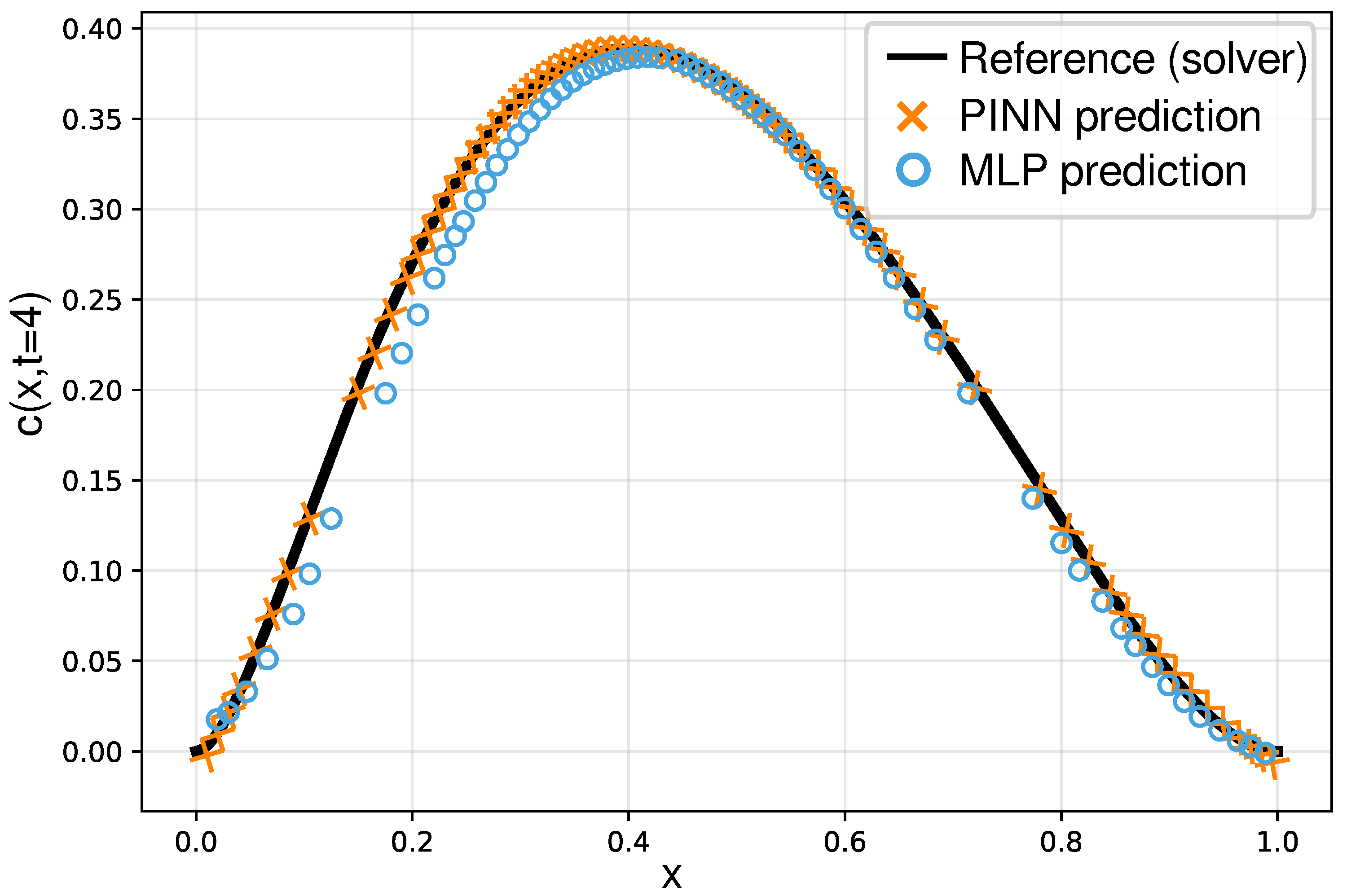
- A controlled comparison between physics-informed and purely data-driven surrogates sharing the same architecture, initialization, data, and training budget;
- (iii)
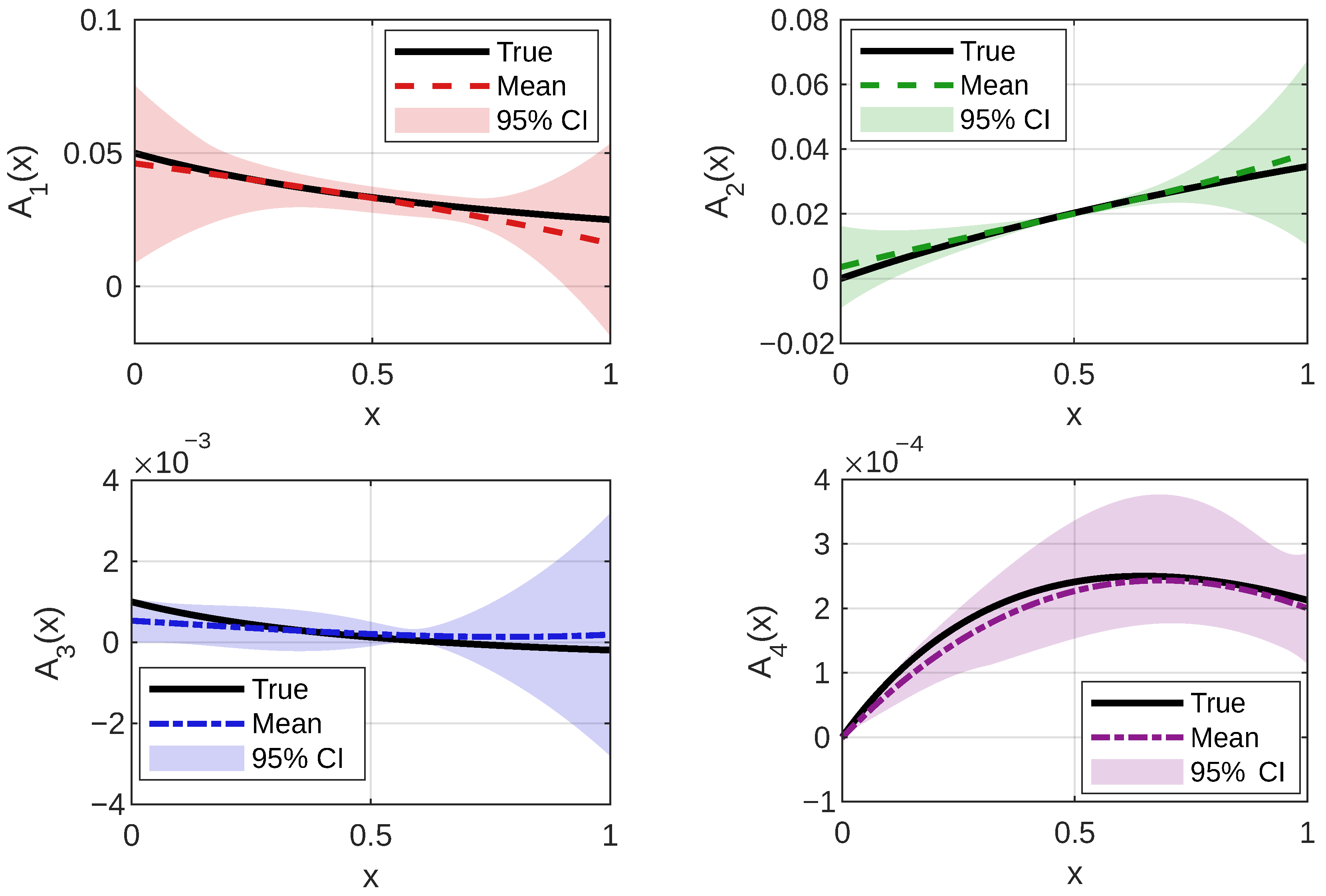
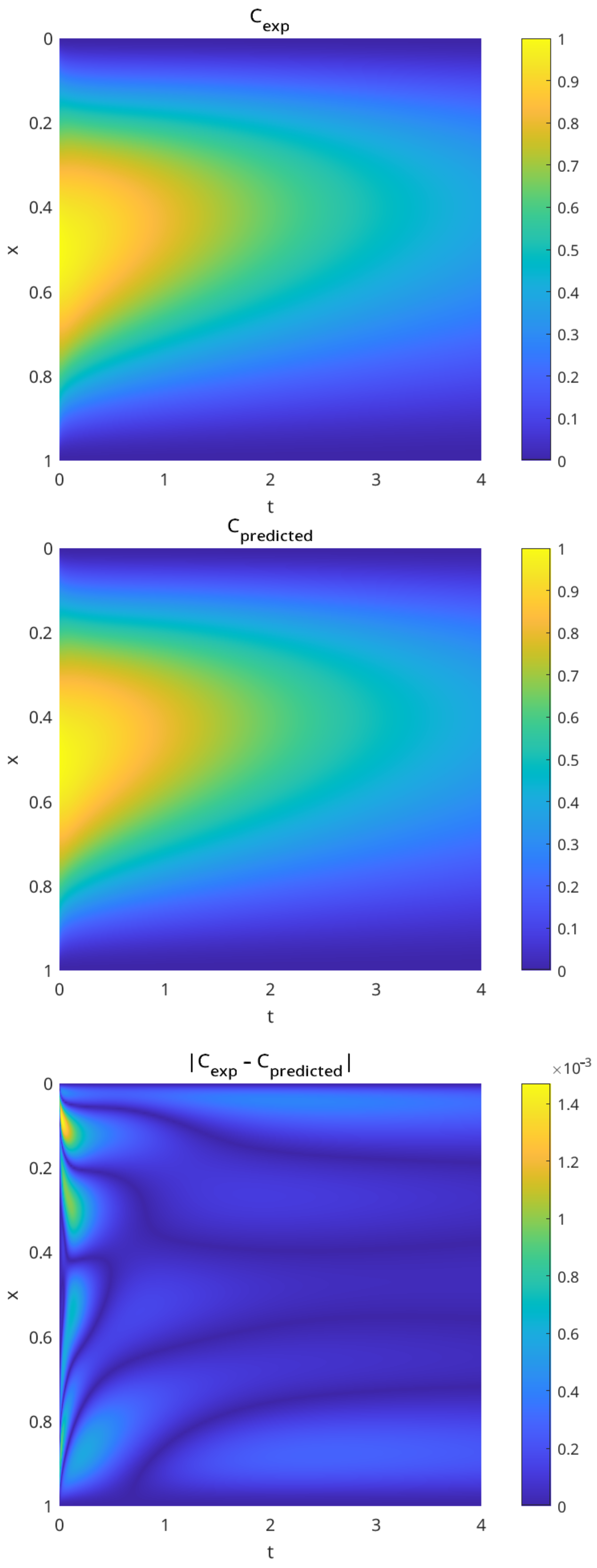
- The demonstration of the optimized surrogate in a practical engineering task, namely the estimation of heterogeneous-medium parameters and the reconstruction of the concentration of a simulated contaminant spill, with an approximately 52% reduction in recurring computational cost.
2. Formulation of the Direct Problem
2.1. Bi-Flux Bevilacqua–Galeão Anomalous Diffusion Model
2.1.1. The Constant Redistribution
2.1.2. The Logarithmic Law for the Redistribution
2.1.3. The Sigmoid Law for the Redistribution
2.2. Numerical Solution
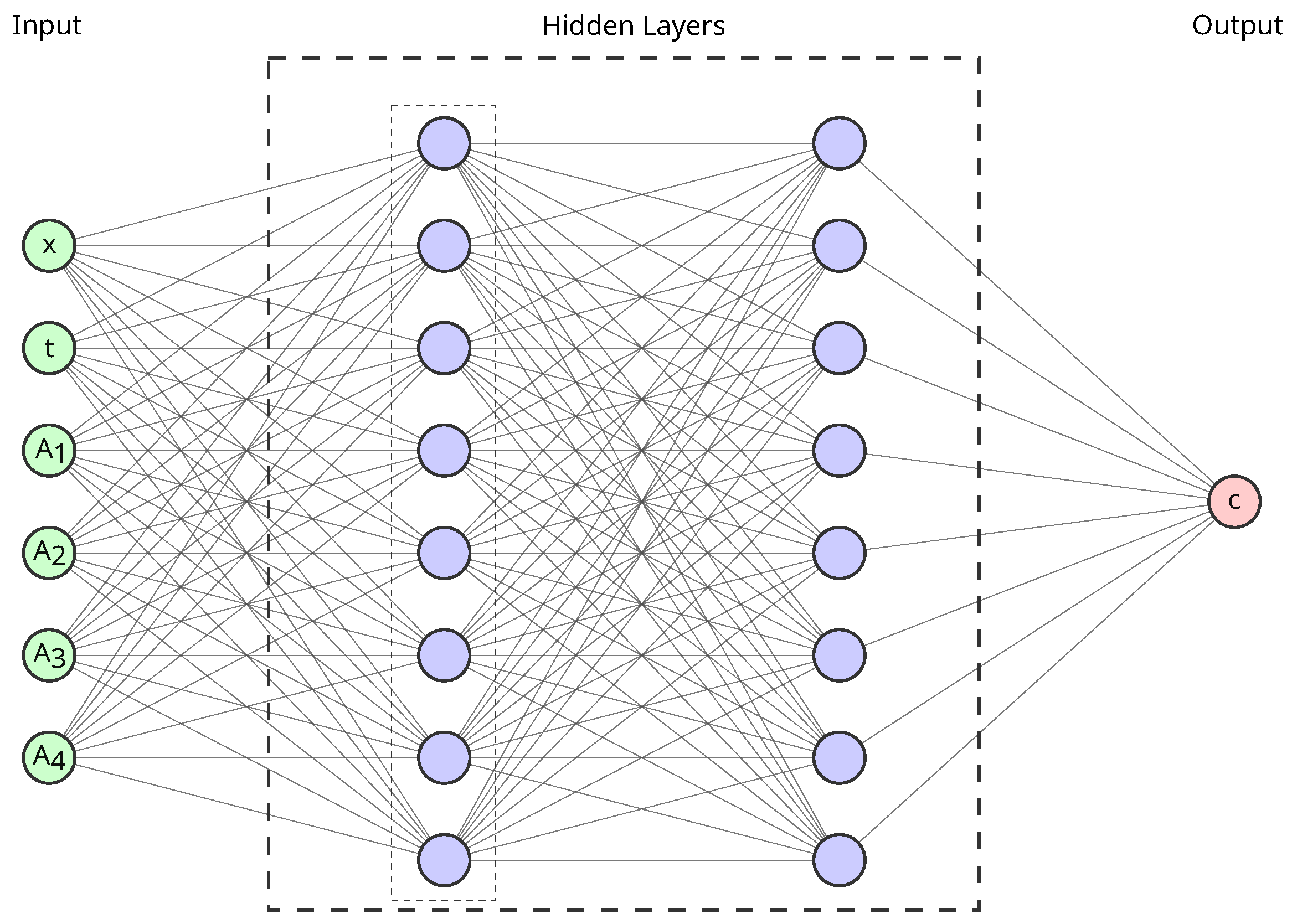
2.3. The Neural Network Configuration
3. Formulation of the Inverse Problem
3.1. Hyperparameter Estimation
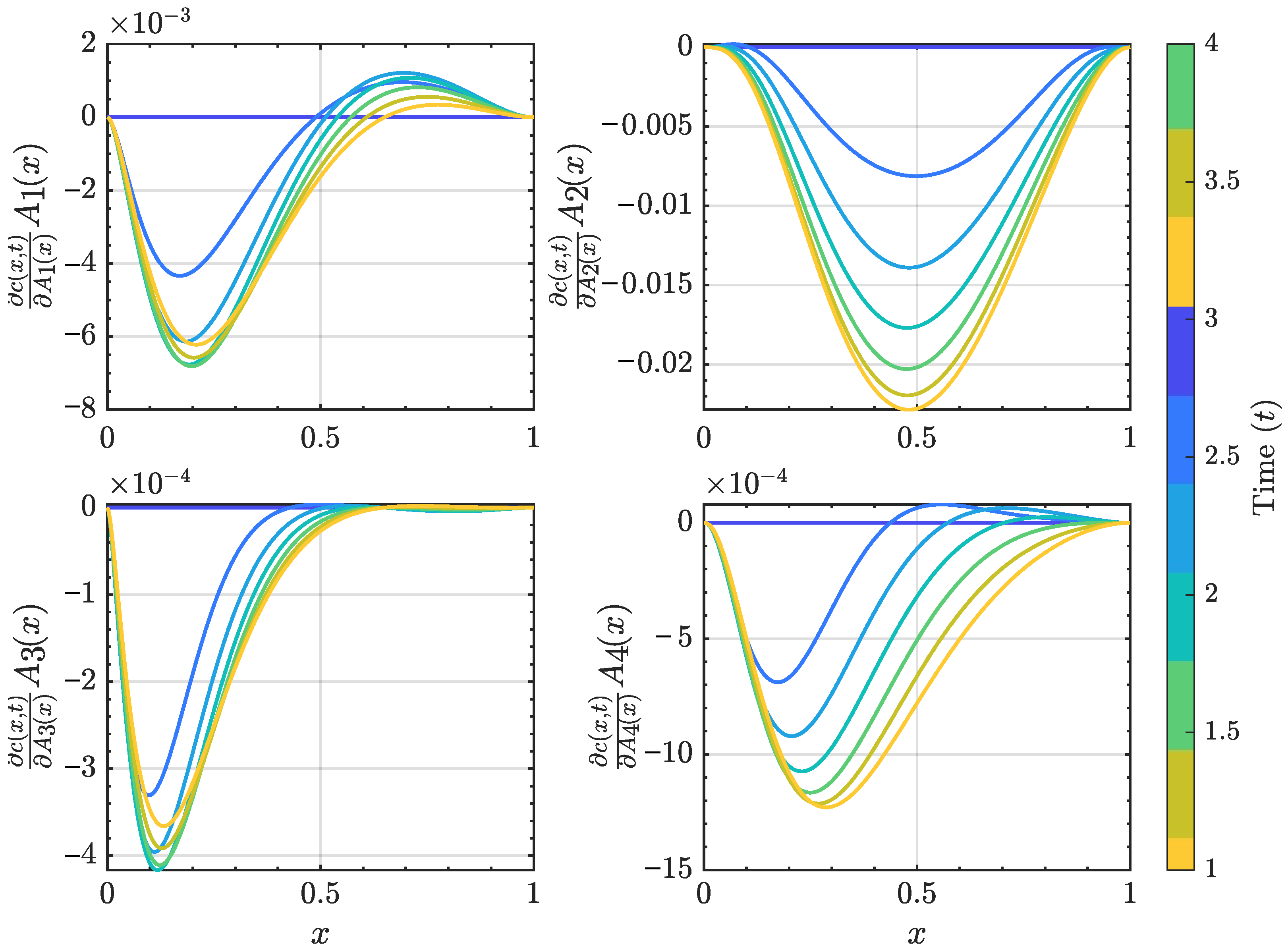
3.2. Heterogeneous Medium Parameter Estimation
3.3. Normalized Sensitivity Coefficient
3.4. Optimization Strategy
- Generation of an initial random populationwhere and are the upper and lower bounds of the k-th variable, is a random number between 0 and 1, and is the size of the population.
- Mutation operation in order to generate a candidatewhere F is a perturbation factor, and the vectors , and are randomly chosen from within the population and must be distinct from each other, if , or sizes differ, then a random number is sampled from a uniform distribution between 0 and 1 and if this random number is bigger than the probability of adding an element , the element missing is added into the small vector, this process is repeated until all vectors have the same size for the mutation operation to occur, these changes to the vector are made on a copy of the original vector, not changing the old vector.
- The next step is the crossover operation where the generated vector can be accepted or not depending on the criterionwhere is the crossover probability.
- Finally, if the new vector provides a better value for the objective function than vector , the latter is replaced by the former in the next generation, otherwise remains in the population for one more generation
- Repeat steps 2–4 until a predefined maximum number of generations is achieved.
3.5. Training Data
4. Results
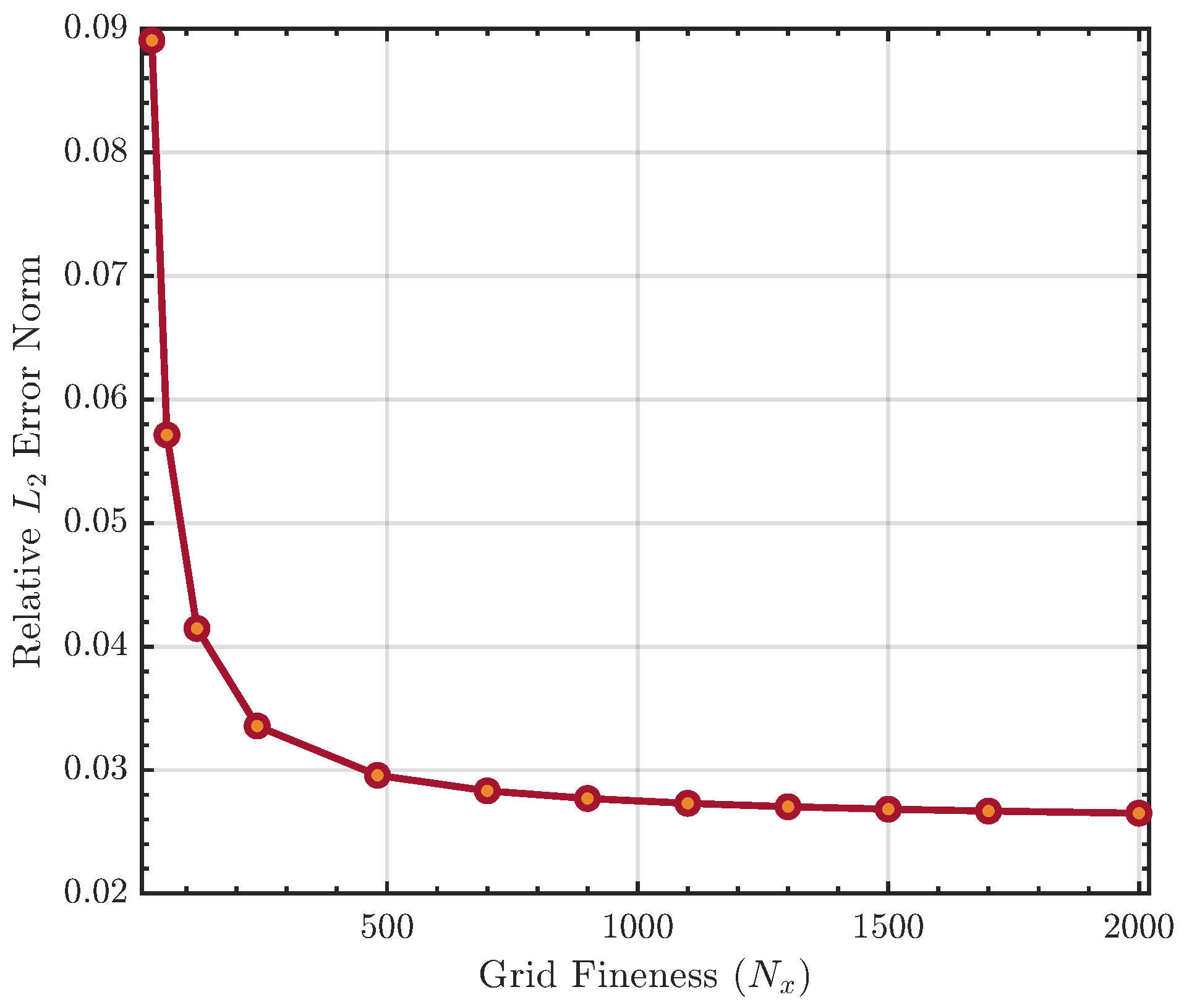
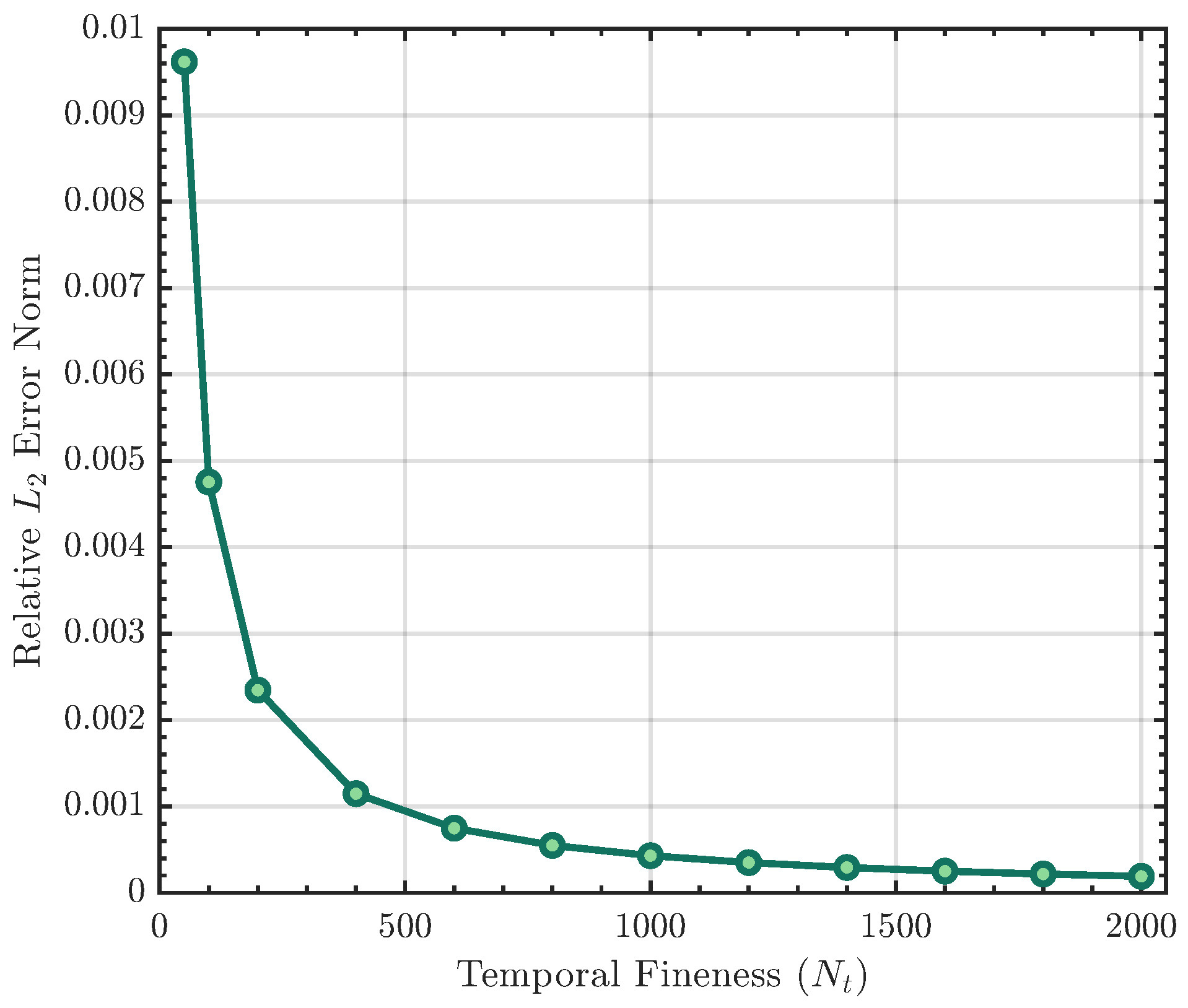
4.1. Numerical Validation and Verification
4.2. Surrogate Model
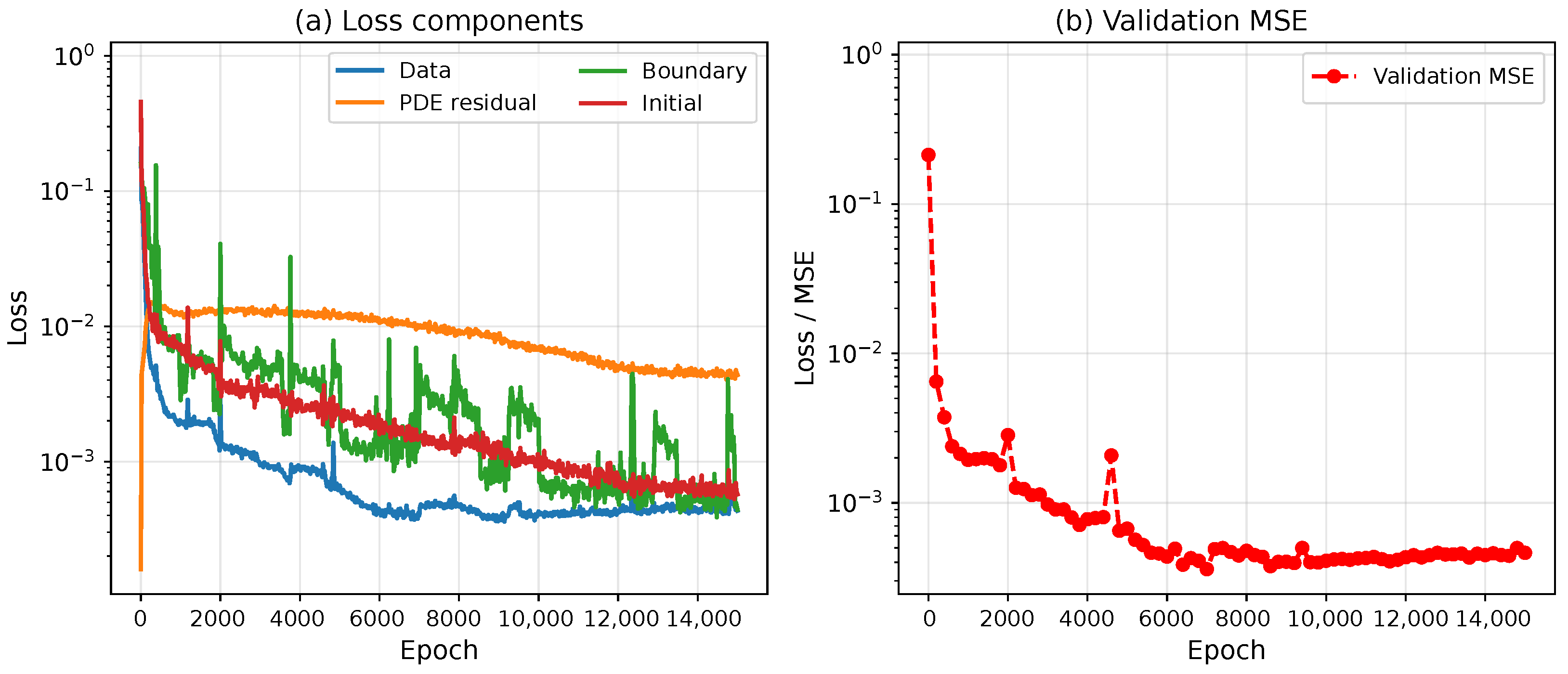
4.3. Training Stability and Robustness
4.4. Sensitivity Analysis
4.5. Parameter Estimation of a Heterogeneous Medium
4.6. Reconstruction of the Concentration Curve
5. Concluding Remarks
Author Contributions
Funding
Data Availability Statement
Acknowledgments
Conflicts of Interest
Abbreviations
| BG | Bevilacqua–Galeão |
| MLP | Multi-Layer Perceptron |
| PINN | Physics-Informed Neural Networks |
| CR | Crossover Rate |
| F | Mutation Factor |
| PDE | Partial Differential Equation |
References
- Metzler, R.; Jeon, J.-H.; Cherstvy, A.G.; Barkai, E. Anomalous diffusion models and their properties: Non-stationarity, non-ergodicity, and ageing at the centenary of single particle tracking. Phys. Chem. Chem. Phys. 2014, 16, 24128–24164. [Google Scholar] [CrossRef]
- Bevilacqua, L.; Jiang, M.; Silva Neto, A.J.; Galeão, A.C.R.N. An evolutionary model of bi-flux diffusion processes. J. Braz. Soc. Mech. Sci. Eng. 2015, 38, 1421–1432. [Google Scholar] [CrossRef]
- Bevilacqua, L.; Galeão, A.C.N.R.; Costa, F.P. On the significance of higher order differential terms in diffusion processes. J. Braz. Soc. Mech. Sci. Eng. 2011, 33, 166–175. [Google Scholar] [CrossRef][Green Version]
- Bevilacqua, L.; Galeão, A.C.N.R.; Costa, F.P. A new analytical formulation of retention effects on particle diffusion process. An. Acad. Bras. Cienc. 2011, 83, 1443–1464. [Google Scholar] [CrossRef]
- Bevilacqua, L.; Galeão, A.C.N.R.; Simas, J.G.; Doce, A.P.R. A new theory for anomalous diffusion with a bimodal flux distribution. J. Braz. Soc. Mech. Sci. Eng. 2013, 35, 431–440. [Google Scholar] [CrossRef]
- Lugon Junior, J.; Vasconcelos, J.V.; Bevilacqua, L.; Silva Neto, A.J. Desenvolvimento de solução para problema unidimensional de advecção e difusão bi-fluxo. In Proceedings of the 3º Seminário Internacional de Estatística com R, Niterói, Brazil, 22–24 May 2018; Galoá: Campinas, Brazil, 2018; Available online: https://proceedings.science/iii-ser-2018/papers/desenvolvimento-de-solucao-para-problema-unidimensional-de-adveccao-e-difusao-bi (accessed on 10 April 2026).
- Junior, J.L.; Vasconcellos, J.F.V.; Knupp, D.C.; Marinho, G.M.; Bevilacqua, L.; Silva Neto, A.J. Solution of Fourth-Order Diffusion Equations and Analysis Using the Second Moment. DDF 2020, 399, 10–20. [Google Scholar] [CrossRef]
- Jiang, M.; Bevilacqua, L.; Silva Neto, A.J.; Galeão, A.C.N.R.; Zhu, J. Bi-flux theory applied to the dispersion of particles in anisotropic substratum. Appl. Math. Model. 2018, 64, 121–134. [Google Scholar] [CrossRef]
- Silva, L.G.; Knupp, D.C.; Bevilacqua, L.; Galeão, A.C.N.R.; Silva Neto, A.J. Inverse problem in anomalous diffusion with uncertainty propagation. Comput. Assist. Methods Eng. Sci. 2014, 21, 245–255. [Google Scholar] [CrossRef]
- Silva, L.G.D.; Knupp, D.C.; Bevilacqua, L.; Galeão, A.C.N.R.; Silva Neto, A.J. Formulação E Solução De Um Problema Inverso De Difusão Anômala Com Técnicas Estocásticas. Ciência E Nat. 2014, 36, 82–96. [Google Scholar] [CrossRef]
- da Silva, L.G.; Knupp, D.C.; da Silva Neto, A.J.; Câmara, L.D.T.; Bevilacqua, L.; Galeão, A.C.N.R.; Santiago, O.L. Uma Versão Modificada do Método Evolução Diferencial para Estimativa de Parâmetros do Modelo de Difusão Anômala Assimétrica. Proc. Ser. Braz. Soc. Comput. Appl. Math. 2015, 3, 010452. [Google Scholar] [CrossRef]
- He, Q.; Solano, D.B.; Tartakovsky, G.; Tartakovsky, A.M. Physics-informed neural networks for multiphysics data assimilation with application to subsurface transport. Adv. Water Resour. 2020, 141, 103610. [Google Scholar] [CrossRef]
- Bandai, T.; Ghezzehei, T.A. Forward and inverse modeling of water flow in unsaturated soils with discontinuous hydraulic conductivities using physics-informed neural networks with domain decomposition. Hydrol. Earth Syst. Sci. 2022, 26, 4469–4495. [Google Scholar] [CrossRef]
- Almajid, M.M.; Abu-Al-Saud, M.O. Prediction of porous media fluid flow using physics informed neural networks. J. Pet. Sci. Eng. 2022, 208, 109205. [Google Scholar] [CrossRef]
- Jalili, D.; Jang, S.; Jadidi, M.; Giustini, G.; Keshmiri, A.; Mahmoudi, Y. Physics-informed neural networks for heat transfer prediction in two-phase flows. Int. J. Heat Mass Transf. 2024, 221, 125089. [Google Scholar] [CrossRef]
- Laubscher, R. Simulation of multi-species flow and heat transfer using physics-informed neural networks. Phys. Fluids 2021, 33, 087101. [Google Scholar] [CrossRef]
- Pratap, V.; Kumar, P.; Rao, C.; Gilchrist, M.D.; Tripathi, B.B. Modelling fourth-order hyperelasticity in soft solids using physics informed neural networks without labelled data. Brain Res. Bull. 2025, 224, 111318. [Google Scholar] [CrossRef] [PubMed]
- Zhang, W.; Li, J. The robust physics-informed neural networks for a typical fourth-order phase field model. Comput. Math. Appl. 2023, 140, 64–77. [Google Scholar] [CrossRef]
- De Luca, P.; Marcellino, L. Towards Numerical Method-Informed Neural Networks for PDE Learning. Mathematics 2025, 13, 2392. [Google Scholar] [CrossRef]
- Sitzmann, V.; Martel, J.; Bergman, A.; Lindell, D.; Wetzstein, G. Implicit neural representations with periodic activation functions. Adv. Neural Inf. Process. Syst. 2020, 33, 7462–7473. [Google Scholar]
- Moseley, B.; Markham, A.; Nissen-Meyer, T. Finite basis physics-informed neural networks (FBPINNs): A scalable domain decomposition approach for solving differential equations. arXiv 2021, arXiv:2107.07871. [Google Scholar] [CrossRef]
- Rodriguez-Torrado, R.; Ruiz, P.; Cueto-Felgueroso, L.; Green, M.C.; Friesen, T.; Matringe, S.; Togelius, J. Physics-informed attention-based neural network for solving non-linear partial differential equations. arXiv 2021, arXiv:2105.07898. [Google Scholar]
- Ahmad, T.; Sulaiman, M.; Bassir, D.; Alshammari, F.S.; Laouini, G. Enhanced Numerical Solutions for Fractional PDEs Using Monte Carlo PINNs Coupled with Cuckoo Search Optimization. Fractal Fract. 2025, 9, 225. [Google Scholar] [CrossRef]
- Aslam, M.N.; Aslam, M.W.; Arshad, M.S.; Afzal, Z.; Hassani, M.K.; Zidan, A.M.; Akgül, A. Neuro-computing solution for Lorenz differential equations through artificial neural networks integrated with PSO-NNA hybrid meta-heuristic algorithms: A comparative study. Sci. Rep. 2024, 14, 7518. [Google Scholar] [CrossRef] [PubMed]
- Baty, H. A hands-on introduction to Physics-Informed Neural Networks for solving partial differential equations with benchmark tests taken from astrophysics and plasma physics. arXiv 2024, arXiv:2403.00599. [Google Scholar] [CrossRef]
- Wang, Y.; Han, X.; Chang, C.; Zha, D.; Braga-Neto, U.; Hu, X. Auto-PINN: Understanding and Optimizing Physics-Informed Neural Architecture. arXiv 2023, arXiv:2205.13748. [Google Scholar] [CrossRef]
- Silva Neto, A.J.; Becceneri, J.C.; Campos Velho, H.F. Computational Intelligence Applied to Inverse Radiative Transfer Problems; EdUERJ: Rio de Janeiro, Brasil, 2016. (In Portuguese) [Google Scholar]
- Raoui, H.E.; Cabrera-Cuevas, M.; Pelta, D.A. The Role of Metaheuristics as Solutions Generators. Symmetry 2021, 13, 2034. [Google Scholar] [CrossRef]
- Vasconcellos, J.F.V.; Marinho, G.M.; Zani, J.H. Análise numérica da equação da difusão anômala com fluxo bimodal. Rev. Int. Métodos Numéricos Para Cálculo Diseño Ing. 2017, 33, 242–249. [Google Scholar] [CrossRef]
- Raissi, M.; Perdikaris, P.; Karniadakis, G.E. Physics-informed neural networks: A deep learning framework for solving forward and inverse problems involving nonlinear partial differential equations. J. Comput. Phys. 2019, 378, 686–707. [Google Scholar] [CrossRef]
- Beck, J.V.; Blackwell, B.; St Clair, C.R., Jr. Inverse Heat Conduction—Ill-Posed Problems, 1st ed.; John Wiley & Sons: New York, NY, USA, 1985. [Google Scholar]
- Storn, R.; Price, K. Differential Evolution—A Simple and Efficient Heuristic for Global Optimization over Continuous Spaces. J. Glob. Optim. 1997, 11, 341–359. [Google Scholar] [CrossRef]





| Hyperparameter | Lower Bound | Upper Bound |
|---|---|---|
| Hidden Layers | 1 | 15 |
| Neurons per Layer (Layer Width) | 1 | 512 |
| Learning Rate | ||
| Epochs | 10 | 30,000 |
| Batch Size | 2 | 32,768 |
| Optimizer | 0 | 9 |
| Activation Functions | 0 | 16 |
| Index | Activation Function |
|---|---|
| 0 | sigmoid |
| 1 | relu |
| 2 | softmax |
| 3 | linear |
| 4 | tanh |
| 5 | softplus |
| 6 | softsign |
| 7 | elu |
| 8 | selu |
| 9 | exponential |
| 10 | leaky_relu |
| 11 | relu6 |
| 12 | silu |
| 13 | hard_silu |
| 14 | mish |
| 15 | gelu |
| 16 | log_softmax |
| Hidden Layers | Layer Widths | Learning Rate | Activations | Epochs | Batch Size | ||||
|---|---|---|---|---|---|---|---|---|---|
| CR = 0.5 | F = 0.8 | #1 | 0.0118 | 2 | [63, 98] | 0.0086 | [3, 5] | 24,600 | 3112 |
| #2 | 0.0215 | 1 | [36] | 0.0069 | [3] | 15,437 | 390 | ||
| #3 | 0.0230 | 1 | [173] | 0.0073 | [3] | 23,358 | 4177 | ||
| #4 | 0.0119 | 1 | [512] | 0.0061 | [3] | 24,749 | 2639 | ||
| F = 0.4 | #1 | 0.0150 | 2 | [8, 3] | 0.0127 | [5, 3] | 25,188 | 64 | |
| #2 | 0.0085 | 2 | [74, 109] | 0.0089 | [11, 8] | 23,566 | 3183 | ||
| #3 | 0.0099 | 1 | [154] | 0.0046 | [3] | 24,485 | 544 | ||
| #4 | 0.0178 | 1 | [101] | 0.0096 | [5] | 22,718 | 1157 | ||
| CR = 0.7 | F = 0.8 | #1 | 0.0230 | 2 | [64, 41] | 0.5575 | [15, 10] | 14,910 | 1617 |
| #2 | 0.0157 | 1 | [89] | 0.1597 | [1] | 24,761 | 1427 | ||
| #3 | 0.0089 | 2 | [36, 117] | 0.5295 | [7, 3] | 23,755 | 7518 | ||
| #4 | 0.0191 | 1 | [32] | 0.1512 | [3] | 24,210 | 573 | ||
| F = 0.4 | #1 | 0.0205 | 3 | [225, 132, 82] | 0.0162 | [1, 0, 9] | 18,947 | 3298 | |
| #2 | 0.0153 | 1 | [122] | 0.2593 | [3] | 14,213 | 10,101 | ||
| #3 | 0.0086 | 1 | [253] | 0.0514 | [7] | 29,663 | 256 | ||
| #4 | 0.0165 | 1 | [32] | 0.3175 | [10] | 17,953 | 728 |
| Hidden Layers | Layer Widths | Learning Rate | Activations | Epochs | Batch Size | ||||
|---|---|---|---|---|---|---|---|---|---|
| CR = 0.5 | F = 0.8 | #1 | 0.033 | 10 | [193, 334, 288, 248, 32, 512, 32, 140, 398, 290] | 0.0029 | [4, 4, 1, 12, 4, 12, 4, 12, 4, 4] | 30,000 | 3681 |
| #2 | 0.015 | 6 | [136, 32, 32, 147, 202, 155] | 0.0146 | [4, 4, 12, 4, 4, 15] | 19,771 | 3468 | ||
| #3 | 0.008 | 9 | [364, 32, 263, 99, 32, 490, 32, 32, 512] | 0.0006 | [4, 4, 15, 12, 4, 15, 15, 1, 12] | 13,640 | 512 | ||
| #4 | 0.007 | 9 | [86, 32, 32, 296, 508, 32, 257, 32, 475] | 0.0011 | [4, 1, 4, 1, 12, 4, 15, 4, 12] | 16,504 | 2694 | ||
| F = 0.4 | #1 | 0.003 | 4 | [147, 32, 32, 239] | 0.0243 | [12, 15, 1, 12] | 1000 | 570 | |
| #2 | 0.039 | 3 | [383, 121, 268] | 0.0001 | [4, 4, 4] | 18,977 | 7249 | ||
| #3 | 0.018 | 8 | [367, 385, 69, 59, 176, 309, 330, 387] | 0.0044 | [12, 1, 15, 4, 12, 4, 1, 12] | 20,069 | 14,910 | ||
| #4 | 0.020 | 3 | [337, 417, 125] | 0.0125 | [12, 1, 15] | 26,681 | 9018 | ||
| CR = 0.7 | F = 0.8 | #1 | 0.010 | 7 | [163, 497, 118, 153, 194, 495, 213] | 0.0016 | [12, 12, 12, 12, 15, 1, 4] | 26,113 | 512 |
| #2 | 0.023 | 2 | [321, 143] | 0.0068 | [15, 4] | 16,864 | 8987 | ||
| #3 | 0.002 | 3 | [335, 32, 32] | 0.0037 | [12, 15, 12] | 25,354 | 9283 | ||
| #4 | 0.063 | 7 | [163, 380, 113, 143, 194, 495, 238] | 0.0016 | [12, 15, 12, 12, 4, 4, 1] | 27,025 | 1861 | ||
| F = 0.4 | #1 | 0.020 | 6 | [512, 144, 170, 512, 387, 309] | 0.0007 | [12, 4, 12, 12, 1, 12] | 14,467 | 4186 | |
| #2 | 0.015 | 4 | [318, 90, 301, 276] | 0.0007 | [4, 4, 1, 15] | 23,099 | 7880 | ||
| #3 | 0.004 | 4 | [231, 132, 378, 151] | 0.0030 | [4, 4, 1, 15] | 16,931 | 9678 | ||
| #4 | 0.003 | 7 | [512, 32, 344, 124, 369, 452, 32] | 0.0021 | [4, 1, 15, 12, 12, 1, 12] | 25,554 | 15,259 |
| Model | Regime | Data Size | RMSE |
|---|---|---|---|
| Interpolation | PINN | 449,764 | |
| MLP | 449,764 | ||
| Extrapolation | PINN | 449,764 | |
| MLP | 449,764 |
Disclaimer/Publisher’s Note: The statements, opinions and data contained in all publications are solely those of the individual author(s) and contributor(s) and not of MDPI and/or the editor(s). MDPI and/or the editor(s) disclaim responsibility for any injury to people or property resulting from any ideas, methods, instructions or products referred to in the content. |
© 2026 by the authors. Licensee MDPI, Basel, Switzerland. This article is an open access article distributed under the terms and conditions of the Creative Commons Attribution (CC BY) license.
Share and Cite
Corrêa, D.F.; Toledo, C.M.; Pelta, D.A.; Silva Neto, A. A Physics-Informed Surrogate Model for the Bi-Flux Bevilacqua–Galeão Anomalous Diffusion Equation. Eng 2026, 7, 293. https://doi.org/10.3390/eng7060293
Corrêa DF, Toledo CM, Pelta DA, Silva Neto A. A Physics-Informed Surrogate Model for the Bi-Flux Bevilacqua–Galeão Anomalous Diffusion Equation. Eng. 2026; 7(6):293. https://doi.org/10.3390/eng7060293
Chicago/Turabian StyleCorrêa, Douglas Ferraz, Cláudio Motta Toledo, David A. Pelta, and Antônio Silva Neto. 2026. "A Physics-Informed Surrogate Model for the Bi-Flux Bevilacqua–Galeão Anomalous Diffusion Equation" Eng 7, no. 6: 293. https://doi.org/10.3390/eng7060293
APA StyleCorrêa, D. F., Toledo, C. M., Pelta, D. A., & Silva Neto, A. (2026). A Physics-Informed Surrogate Model for the Bi-Flux Bevilacqua–Galeão Anomalous Diffusion Equation. Eng, 7(6), 293. https://doi.org/10.3390/eng7060293