1. Introduction
RF system design validation generally involves two stages: high-fidelity physical-characteristic characterization based on device- and circuit-level simulations, and upper-level validation for system evaluation. The former mainly supports parameter design, performance analysis, and problem diagnosis, whereas the latter focuses on overall system behavior under application-oriented conditions. However, these two stages differ significantly in model representation and validation objectives. High-fidelity simulations usually provide local physical-characteristic results, such as frequency response, noise, and nonlinearity, which are difficult to directly convert into executable models for upper-level validation. By contrast, upper-level validation often relies on idealized or empirical parameters to represent real hardware characteristics. As a result, a disconnect remains between physical-characteristic simulation and upper-level validation. Establishing an effective modeling approach to bridge these two stages has therefore become a key issue in RF system design validation.
One major research direction focuses on fine-grained RF performance simulation. Such studies aim to accurately characterize the physical properties of RF front ends and subsystems for detailed design and performance analysis. For example, Michailidis et al. proposed a unified design methodology for front-end RF/mmWave receivers [
1]. Gao et al. developed a simulation methodology for RF receiver front ends with frequency-selective limiting devices [
2]. Eid and Nahas proposed a dedicated simulation technique for the RF front-end transceiver of a UWB-FMCW radar system [
3]. Meanwhile, behavioral and surrogate modeling has expanded from individual RF power amplifiers to broader microwave circuits and active front ends. Ortali et al. developed a time-domain characterization approach for RF power-amplifier behavioral modeling [
4]. Morgan et al. proposed a generalized memory polynomial model for nonlinear power-amplifier behavior [
5]. Koziel et al. improved microwave circuit behavioral modeling through dimensionality reduction and fast global sensitivity analysis [
6]. Ma et al. discussed machine-learning-assisted microwave modeling [
7]. Cailleux et al. investigated the modeling of active integrated-array RF front ends [
8]. Vimal et al. implemented RF power-amplifier modeling using inverse system identification [
9]. Classical nonlinear microwave-circuit theory also provides an important foundation for this type of abstraction-oriented RF modeling [
10]. These studies show that both high-fidelity simulation and behavioral abstraction can provide reliable physical-characteristic information. However, their outputs are still mainly expressed as local parameters, response curves, or component-level mappings, and therefore usually cannot be directly reused as executable RF-link models in upper-level validation.
Another major research direction focuses on upper-level validation and system-level evaluation, where emphasis is placed on executable system organization, scenario construction, and application-level performance assessment. Pedersen et al. reviewed radio system-level simulations for 3GPP 5G-Advanced and beyond [
11]. Manalastas et al. pointed out that system-level simulators are becoming essential for evaluating next-generation 6G systems [
12]. Ferreira et al. developed the 5G-RCOLAB system-level simulator within a unified evaluation framework [
13]. In a radar-oriented context, Tantiparimongkol et al. established a radar system model for space-debris detection and evaluated its overall capability [
14]. More recent survey work has further highlighted the growing importance of integrated system-level platforms. For instance, Islam et al. reviewed performance evaluation and optimization methods for 6G networks, covering key performance indicators, tools, and AI-assisted models for system-level analysis [
15]. These studies indicate that upper-level evaluation tools have developed relatively mature capabilities in hierarchical organization, scenario construction, and performance assessment. However, such approaches usually rely on abstracted parameters and simplified hardware representations. As a result, although they are effective for large-scale executable evaluation, they often cannot preserve detailed RF physical characteristics in a sufficiently consistent manner, especially when frequency response, noise, coupling, and nonlinear effects need to be considered simultaneously.
Between detailed circuit-level characterization and upper-level system evaluation, receiver-chain and phased-array RF behavioral modeling provide an important intermediate modeling layer. Chen et al. proposed a block-oriented behavioral model for receiver front ends to predict nonlinear effects such as signal distortion, intermodulation, and spurious responses [
16]. Ding et al. developed a behavioral-level digital simulation model for a broadband phased-array RF system and applied it to system design and parameter validation [
17]. These studies are closely related to the present work because they also aim to abstract RF hardware behavior into executable model structures. However, existing studies mainly focus on specific receiver-front-end nonlinear effects or phased-array system-level performance evaluation. The simultaneous transfer and preservation of multiple RF physical characteristics, including frequency response, noise, coupling, nonlinearity, and code-controlled phase/attenuation responses, within a unified executable RF-link dataflow model remains insufficiently addressed.
Although substantial progress has been achieved in both fine-grained RF simulation and upper-level system evaluation, an effective connection between these two stages is still lacking. Existing approaches tend to emphasize either physical accuracy without executable system-level representation, or system-level executability without sufficient preservation of underlying physical characteristics. To address this issue, this paper proposes a dataflow-driven behavioral modeling method for RF-system design validation. The aim of this work is to establish a reusable modeling route that transfers physical-characteristic results into executable RF-link behavioral representations for upper-level validation. Unlike approaches that remain at the circuit-parameter level or rely mainly on simplified system-level abstractions, the proposed method preserves key RF physical characteristics while providing a unified executable dataflow interface.
The main contributions of this work are summarized as follows:
A dataflow-driven behavioral modeling method is proposed to bridge high-fidelity physical-characteristic simulation and upper-level RF-system validation through an executable RF-link representation.
A unified cascaded characteristic-block framework is established to represent key RF effects, including frequency response, noise, coupling, nonlinearity, and code-controlled phase/attenuation, within a single executable behavioral model.
An explicit parameter-transfer workflow from physical-characteristic results to behavioral-model parameters is developed and validated through wideband linear, wideband nonlinear, and transient experiments, demonstrating accurate end-to-end RF-link input–output reproduction.
2. Modeling Method
2.1. Dataflow Interface Construction for Executable RF-Link Modeling
The proposed method adopts a dataflow-driven form to construct an executable RF-link model for upper-level design validation. In this form, the model receives input sample streams and generates corresponding output sample streams through a unified interface, enabling the RF link to be represented as an executable cascaded module that can be directly connected to subsequent processing, analysis, and evaluation stages.
A practical challenge in RF systems is that the carrier frequency is typically in the gigahertz range. Direct RF sampling under the Nyquist criterion would produce an excessively large data stream and severely reduce execution efficiency. Since upper-level validation mainly concerns the information carried within the signal bandwidth rather than the carrier oscillation itself, a baseband-equivalent representation is adopted.
In the proposed framework, the standard complex-envelope representation of a bandpass RF signal is adopted as the basis of the executable sampled-data interface.
where
denotes the RF signal,
is the carrier frequency,
n is the sample index, and
j is the imaginary unit. The model input is therefore taken as the complex envelope
, which consists of the in-phase component
and the quadrature component
.
By reducing the effective data rate from the carrier-frequency scale to the signal-bandwidth scale, this representation preserves the essential signal characteristics while improving execution efficiency. The resulting output stream can also be directly reused as the input to subsequent modules in the design-validation workflow.
The dataflow-driven form is adopted because it is strongly consistent with the actual operating behavior of RF links. In a real RF system, both the input to and the output from an RF link are essentially continuous-time signals shaped by physical effects. In the proposed method, these signals are represented in discretized form as sampled data streams, allowing the executable model to remain naturally aligned with the signal-flow behavior of the real RF link. In addition, the dataflow-driven form is convenient for subsequent processing, because the stage following an RF link is typically sampled-data signal processing rather than event-level or logic-level processing.
2.2. Behavioral Modeling of Multidimensional Physical Characteristics
To transfer high-fidelity physical-characteristic results into an executable model for upper-level design validation, the proposed method constructs dataflow-driven behavioral representations for five key characteristics: frequency response, noise, coupling, nonlinearity, and phase shift. These characteristic blocks can be instantiated and cascaded as needed to represent the executable input–output behavior of a specific RF system. The modeling method for each characteristic block is described as follows.
2.2.1. Frequency Response Characteristic Model
Frequency-dependent gain variation within the passband is one of the most fundamental linear characteristics of an RF system. In the proposed framework, this behavior is implemented as an executable frequency-response block acting on the equivalent baseband data stream.
The underlying principle follows standard frequency-domain filtering, whereas the following input–output expression is defined in this work for executable dataflow modeling of the frequency-response characteristic.
The output of the frequency-response block is expressed as
where
denotes the spectrum of the input equivalent baseband signal,
denotes the frequency-dependent gain, and
represents the inverse fast Fourier transform.
To make the mathematical execution procedure clearer, Algorithm 1 summarizes the runtime process of the frequency-response block.
| Algorithm 1 Pseudo-code of the frequency-response characteristic block |
Input: Equivalent baseband signal , frequency response Output: Filtered signal Compute the spectrum of the input signal: Multiply the input spectrum by the frequency response point by point: Transform the result back to the time domain:
|
In this work, linear interpolation is adopted for simplicity and reproducibility. For higher accuracy, especially when the available S-parameter samples are sparse, this step can be replaced by more advanced S-parameter prediction or reconstruction methods, such as transfer-learning-based encoder–decoder models [
18].
In the proposed framework, the FFT/IFFT-based filtering operation is organized as an executable characteristic block, so that frequency-response data obtained from physical-characteristic simulation or measurement can be directly transferred to the sampled RF-link data stream.
2.2.2. Noise Characteristic Model Construction
In the proposed framework, the noise characteristic is represented by an additive noise generation and superposition block. The noise performance of an RF system is mainly characterized by two parameters: the signal-to-noise ratio (SNR) and the noise figure (NF). Here, SNR measures the relative strength of the signal and noise, whereas NF quantifies the SNR degradation introduced by the internal devices of the system.
To support executable dataflow modeling, the standard definitions of SNR and NF are reorganized into a noise-generation and superposition form for sampled complex-baseband streams.
Let the input of the noise block be denoted by
, which is the output sequence of the previous characteristic block and is represented here as a complex equivalent-baseband signal. The total input power of the noise block is calculated as
where
L is the sequence length.
From the definition of SNR,
where
is the useful input signal power and
is the input noise power. Accordingly,
In the executable model, the useful signal sequence before adding newly generated noise is taken as the SNR-scaled signal component derived from the input sequence:
According to the definition of NF, the relationship between the added noise power
and the input noise power
can be written as
where
and
denote the useful output signal power and output noise power, respectively, and
G is the system gain. Accordingly,
In the executable model, the corresponding additional noise sequence is generated as a Gaussian white-noise process and then superimposed on the useful output stream. The resulting noisy output is written as
where
denotes the generated additional noise sequence.
Since the gain varies significantly with frequency, a simple scalar multiplication is not sufficient. Therefore, consistent with the frequency-response characteristic model described above,
is treated as a frequency-dependent shaping term. The additional noise sequence is generated according to the corresponding power level and then shaped in the frequency domain. In this work, the generated noise is assumed to follow Gaussian white-noise behavior [
19].
To make the mathematical execution process clearer, Algorithm 2 summarizes the runtime procedure of the noise characteristic block. The pseudo-code is provided here as part of the complete mathematical description of the proposed executable model.
| Algorithm 2 Pseudo-code of the noise characteristic block |
Input: Complex equivalent-baseband sequence from the previous characteristic block, , frequency-dependent term Output: Noisy output sequence |
In this way, the NF-related physical-characteristic result is transferred into an executable additive-noise block, allowing the noise contribution of the RF link to be generated and superimposed directly on the sampled output stream.
2.2.3. Coupling Characteristic Model Construction
In RF systems, coupling arises from electromagnetic interactions among ports and may degrade signal integrity through inter-port interference [
20,
21]. Since this behavior can be characterized by a multiport S-parameter matrix, the proposed framework represents the coupling characteristic as an executable multiport mapping block.
To support executable dataflow modeling, the S-parameter-based multiport superposition relation is reorganized into a sampled-stream mapping form for coupling-characteristic representation.
According to the definition of S-parameters,
where
and
are the normalized incident and reflected waves, respectively. Under impedance-matched conditions, they can be directly interpreted as port-voltage waves.
Accordingly, the output sequence at port
m can be written as
where
i is the sample index,
is the input sequence at port
n,
is the output sequence at port
m, and
denotes the transfer coefficient from port
n to port
m.
By collecting the port-voltage sequences into the input vector
and the output vector
, the above port-wise relationship can be expressed in matrix form as
where
is the coupling matrix whose element in the
mth row and
nth column is
.
Its execution procedure is essentially the same as that of the frequency-response characteristic model, except that the frequency-dependent gain term is replaced here by the corresponding inter-port S-parameter coefficients. In this way, the coupling effect can be executed directly on the sampled multiport data stream. This formulation enables coupling coefficients obtained from physical-characteristic simulation or measurement to be transferred into an executable multiport mapping block within the proposed RF-link behavioral model.
2.2.4. Nonlinear Characteristic Model Construction
When the input power of an RF system exceeds its linear operating region, the input–output relationship becomes nonlinear. Nonlinear systems can be described by polynomial-based models, such as Taylor-series models, or by more general Volterra-series formulations [
22,
23]. Such behavioral modeling is widely used for efficient system-level verification and performance estimation in RF and microwave applications [
24].
In the proposed framework, the nonlinear characteristic is represented as an executable nonlinear mapping acting on the complex equivalent-baseband input stream. To support executable RF-link behavioral modeling, the polynomial-based nonlinear representation is organized into a dataflow-compatible form with a complex-baseband input, so that nonlinear parameters such as small-signal gain and intercept points can be transferred into the proposed nonlinear characteristic block.
Let the input of the nonlinear block be the complex equivalent-baseband signal
which is inherited from the output stream of the previous characteristic block. The corresponding real RF input signal is represented as
where
is the complex carrier. Accordingly, the real-signal form of
can be written as
Using a polynomial nonlinear representation, the input–output relationship of the system can be written as
Considering only components up to the third order, the output
can be expressed as
Therefore, once the parameters , , , and are determined, the nonlinear behavior up to the third order can be emulated.
Based on the definition of the second-order intercept point, the intercept occurs when the first- and second-order components are equal, yielding
where
corresponds to the small-signal gain
G, and
is the second-order output intercept point in volts. Similarly, the third-order intercept point occurs when the first- and third-order components are equal, leading to
where
is the third-order output intercept point in volts.
Algorithm 3 summarizes the runtime procedure of the nonlinear characteristic block.
| Algorithm 3 Pseudo-code of the nonlinear characteristic block |
Input: Complex equivalent-baseband signal , small-signal gain G, second-order intercept point , third-order intercept point , carrier frequency , sampling rate , signal bandwidth Output: Nonlinear output sequence Determine the nonlinear coefficients: If required, set according to the fitted DC term. Substitute the in-phase and quadrature components and of the complex baseband input into the nonlinear component expressions to obtain , , , and . Determine the final output according to the operating condition:
|
In this way, nonlinear physical-characteristic parameters extracted from circuit-level simulation or measurement are converted into executable coefficients of the nonlinear characteristic block, enabling the dominant nonlinear response of the RF link to be reproduced on sampled complex-baseband streams.
2.2.5. Phase Shift Characteristic Model Construction
In practical systems, the phase shift and attenuation states are jointly determined by the phase-control code and the attenuation-control code. Accordingly, in the proposed framework, the phase shift characteristic is represented as an executable code-controlled transformation block based on a phase–attenuation lookup table (LUT).
To support executable dataflow modeling, the code-controlled gain/phase relationship is organized into an LUT-based transformation form for sampled complex-baseband streams.
According to the LUT-based phase-shift representation, the output of the phase shift block can be written as
where
denotes the complex equivalent-baseband input sequence inherited from the previous characteristic block,
k and
l denote the attenuation-control code and phase-control code, respectively, and
and
are the corresponding attenuation and phase-shift values retrieved from the LUT.
To make the mathematical execution procedure clearer, Algorithm 4 summarizes the runtime process of the phase shift characteristic block.
| Algorithm 4 Pseudo-code of the phase shift characteristic block |
Input: Complex equivalent-baseband sequence from the previous characteristic block, attenuation-control code k, phase-control code l, phase–attenuation LUT Output: Transformed output sequence |
In this way, code-dependent attenuation and phase-shift characteristics obtained from physical-characteristic simulation or measurement are transferred into an executable LUT-based transformation block within the proposed RF-link behavioral model.
2.2.6. System Model Construction Method
For a given modeling target, the required characteristic blocks are instantiated according to the physical effects involved in the signal path and then cascaded following a clear construction principle. In general, deterministic characteristics are constructed first, whereas random characteristics are introduced afterward. Within the deterministic part, linear characteristics are constructed first, and the model is then extended to nonlinear characteristics. For linear characteristic blocks, the order can be adjusted according to the specific signal path and implementation requirement. By contrast, the noise characteristic, as a random effect, is added at the output stage.
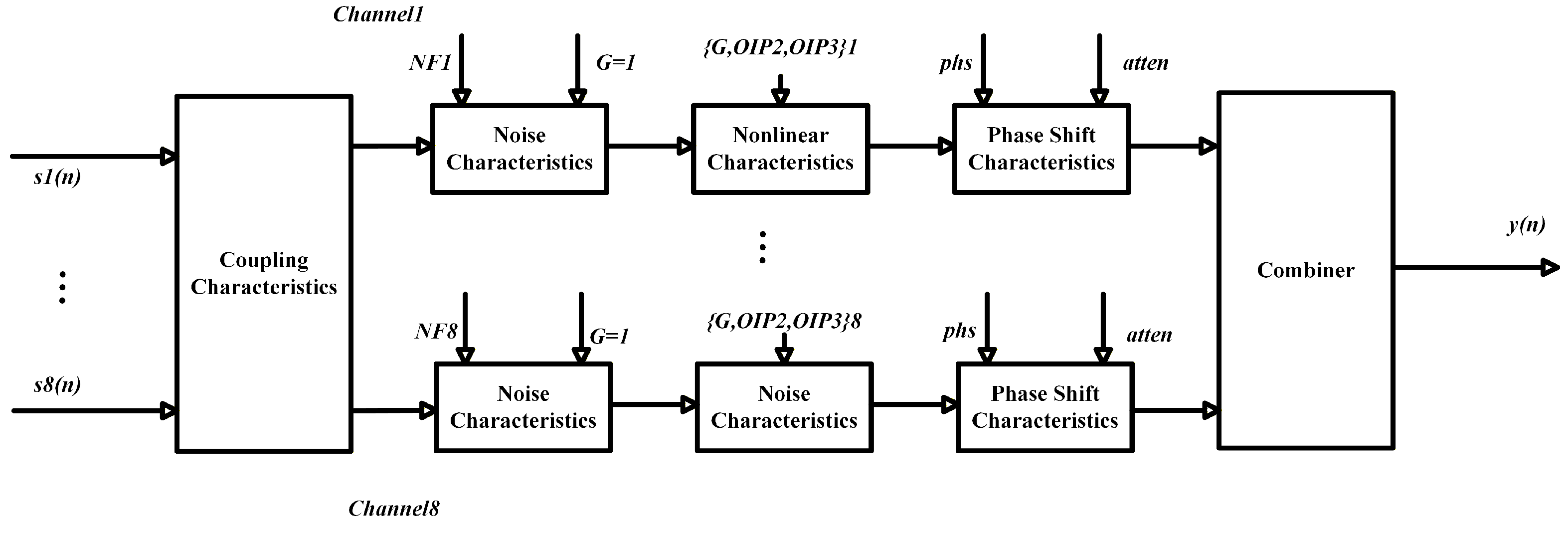
Taking the receive (Rx) channel of the X-band eight-channel phased-array T/R module as an example, the resulting model is shown in
Figure 1. Since the proposed method is based on characteristic-block instantiation rather than mandatory inclusion of all characteristic dimensions, only the blocks required by the target signal path are retained. In this case, each channel contains the nonlinear, phase-shift, and noise characteristic blocks. The frequency-response effect is incorporated into the frequency-dependent small-signal gain term of the nonlinear block, whereas the coupling characteristic is handled at the multi-channel level rather than instantiated as an independent per-channel block. Accordingly, the per-channel execution sequence follows the principle above: deterministic transformation is performed first, with the linear phase-shift transformation and the nonlinear mapping jointly forming the deterministic part, and noise superposition is applied afterward as the random part. The model input is the baseband-equivalent input data stream, and the output is the sampled stream after RF-link processing.
Here, “cascading” means that the complex output sequence of the preceding characteristic block is directly taken as the complex input sequence of the subsequent block, so that the overall RF-link model is executed as a stage-by-stage propagation of complex data streams. This point is emphasized here to make the complete mathematical execution relation of the proposed system model explicit.
2.3. Parameter Transfer from Physical-Characteristic Results to Behavioral Models
After the characteristic-level behavioral blocks are defined, they are configured using physical-characteristic results obtained from high-fidelity simulations and/or measurement data. The purpose of parameter transfer is not to reproduce the internal structure of the original RF system, but to migrate its key physical-characteristic results into an executable behavioral model for upper-level design validation.
In the proposed workflow, different parameter-transfer strategies are adopted according to the degree of frequency dependence. For characteristics with strong frequency dependence, such as frequency response and coupling, the original frequency-domain data are retained, and the required parameters are obtained at the target frequency points through interpolation or function fitting. For characteristics with relatively weak frequency dependence, such as noise figure, intercept points, and code-dependent phase/attenuation responses, equivalent upper-level parameters are extracted directly from the available physical-characteristic results, typically through mathematical conversion or averaging.
Through this workflow, the key physical effects captured by high-fidelity simulations and/or measurement data are embedded into the executable behavioral model without introducing lower-level structural complexity. As a result, a reusable mapping path is established from physical-characteristic results to behavioral-model parameters and further to behavioral output data streams.
3. Experimental Validation
3.1. Overview of the Validation Method
The validation in this work aims to verify the inheritance of physical-characteristic results and the generation of executable output data streams for upper-level design validation. Accordingly, the validation is carried out from three aspects: individual characteristic embedding and parameter transfer, cascaded RF-link input–output behavior, and the usability of the generated output sample streams. The representative case is the receive (Rx) channel of the X-band eight-channel phased-array T/R module, and the benchmark results are mainly obtained from circuit-level simulations of the corresponding physical system. Unless otherwise specified, the benchmark results in this work are obtained from circuit-level simulations in Keysight Advanced Design System 2021, where harmonic-balance (HB) analysis is used for steady-state validation and transient analysis is used for time-domain validation. The proposed behavioral model and the corresponding FFT-based post-processing are implemented in MATLAB R2022b. These software settings are reported here to clarify the validation environment of the proposed workflow.
3.2. Validation of Individual Characteristic-Model Accuracy
To verify the correctness of the individual characteristic models, a control-variable validation strategy is adopted in this section. For each characteristic under test, only the target physical effect is activated, while the remaining effects are disabled or fixed at reference states, so that the selected characteristic can be examined independently. Under this setting, the output of the behavioral model is compared with the corresponding circuit-level benchmark result to evaluate whether the characteristic is correctly embedded into the executable model.
3.2.1. Frequency Response Characteristic Validation
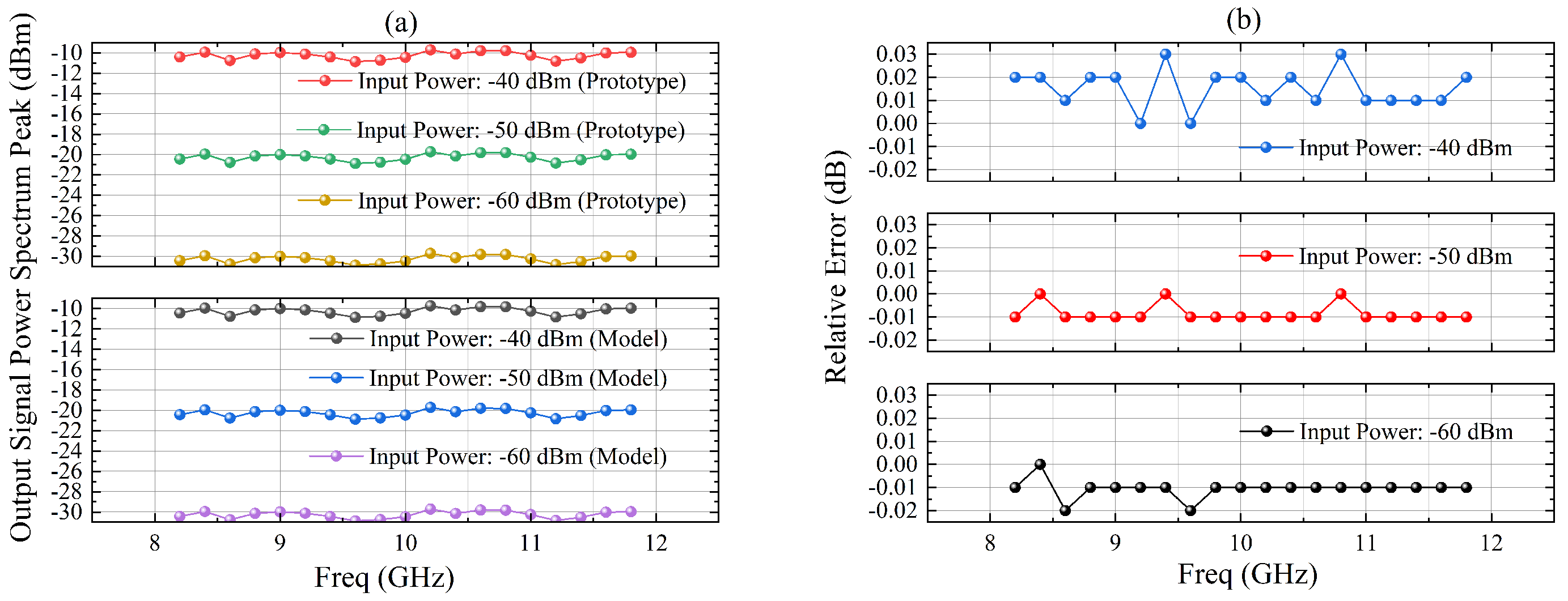
To validate the frequency-response characteristic, a control-variable strategy is adopted so that the output is mainly determined by the frequency-dependent gain. Only one channel is activated, while the others are disabled to exclude coupling. The phase-shift code and attenuation-control code are both fixed at 0, and the input power is limited to , , and dBm to keep the RF link in the small-signal region and suppress nonlinear effects. In addition, the noise characteristic is disabled, and the benchmark is taken as the fundamental spectral-line power obtained from noise-free HB simulations. Under these conditions, the validation is reduced to the isolated effect of the frequency-response characteristic.
The frequency is swept from 8.2 GHz to 11.8 GHz with a 200 MHz step size. For the behavioral model, a single-tone input data stream is generated using the same frequency, power, phase, and control-code settings, with only the frequency-response characteristic enabled. The output data stream is processed by FFT, and the spectral peak at each excitation frequency is extracted for comparison. As shown in
Figure 2a, the model and benchmark curves are nearly overlapped under all three input-power settings, and the corresponding errors are shown in
Figure 2b. The RMSE values are 0.015 dB at
dBm, 0.015 dB at
dBm, and 0.015 dB at
dBm, with an average RMSE of 0.015 dB. These results indicate that the frequency-response characteristic is correctly embedded into the behavioral model.
3.2.2. Coupling Characteristic Validation
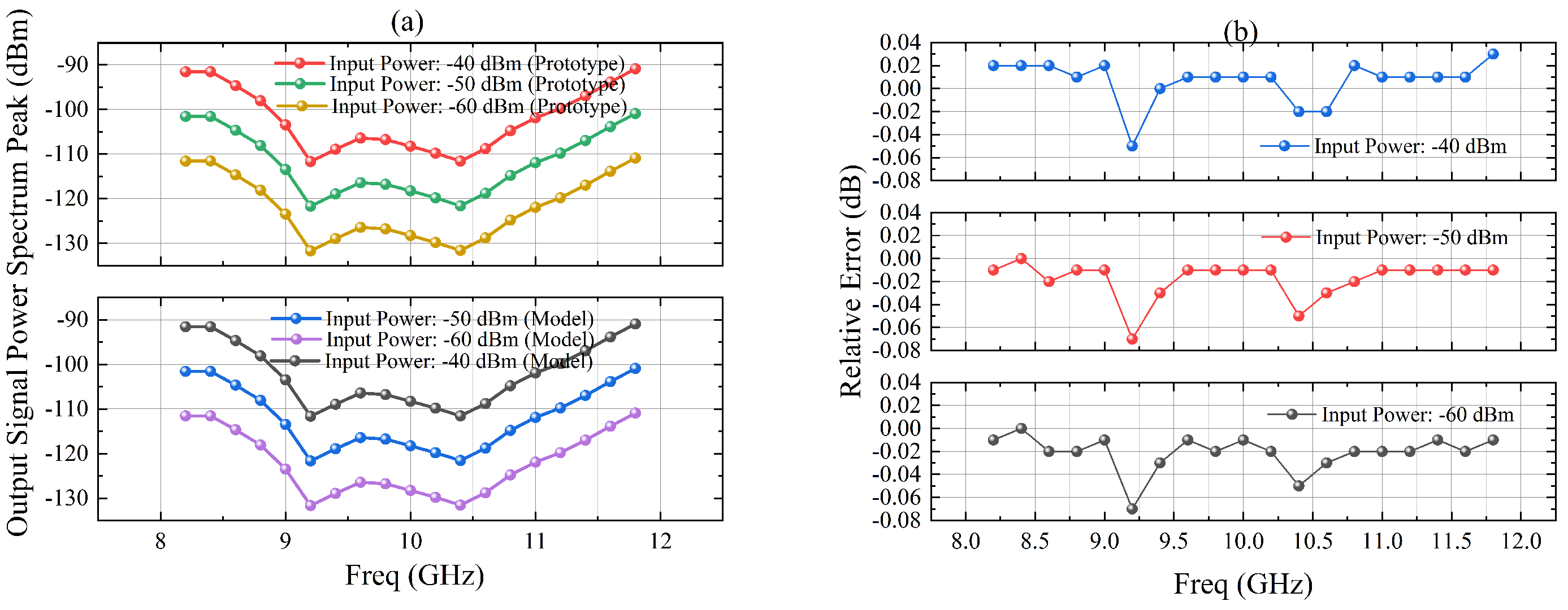
To validate the coupling characteristic, a control-variable strategy is adopted so that the observed output is mainly determined by inter-port coupling. The prototype system is configured in the receive mode, with only the ports involved in the coupling test activated. The phase-shift code and attenuation-control code are both fixed at 0, the noise characteristic is disabled, and the input power is limited to , , and dBm to suppress nonlinear effects. Under these conditions, the residual response observed at the coupled port can be mainly attributed to the coupling characteristic itself.
Specifically, Port 2 is used as the excitation port and Port 3 as the observation port. The frequency is swept from 8.2 GHz to 11.8 GHz with a 200 MHz step size, and the peak value of the output spectrum at Port 3 is recorded at each frequency point as the benchmark. For the behavioral model, the same port configuration is used, and a single-tone input data stream is generated with the same power, frequency, and phase. The output data stream is processed by FFT, and the spectral peak corresponding to the input tone is extracted for comparison. As shown in
Figure 3a, the model and benchmark curves agree well over the whole frequency band, and the corresponding errors are shown in
Figure 3b. The RMSE values are 0.87 dB, 0.84 dB, and 0.84 dB for input powers of
,
, and
dBm, respectively, with an average RMSE of 0.85 dB. These results indicate that the coupling characteristic is correctly embedded into the behavioral model.
Compared with the frequency-response validation, the coupling validation is based on much weaker port-to-port leakage responses rather than the main-path response. As a result, the extracted coupled spectral peaks are more sensitive to interpolation error, weak-signal numerical fluctuation, and small discrepancies in the S-parameter-based transfer relation, which leads to a relatively larger RMSE. Nevertheless, the overall coupling trend is reproduced correctly over the full band. Further improvement can be achieved in future work by using denser frequency-domain characterization or higher-accuracy fitting/interpolation for weak coupling responses.
3.2.3. Nonlinearity Characteristic Validation
To validate the nonlinearity characteristic, a control-variable strategy is adopted so that the observed output is mainly determined by gain compression. The prototype system is configured in the receive mode, with only one channel activated to exclude inter-channel coupling. The phase-shift code and attenuation-control code are both fixed at 0, and the noise characteristic is disabled. Under these conditions, the input–output power relationship is mainly governed by the nonlinear behavior of the RF link.
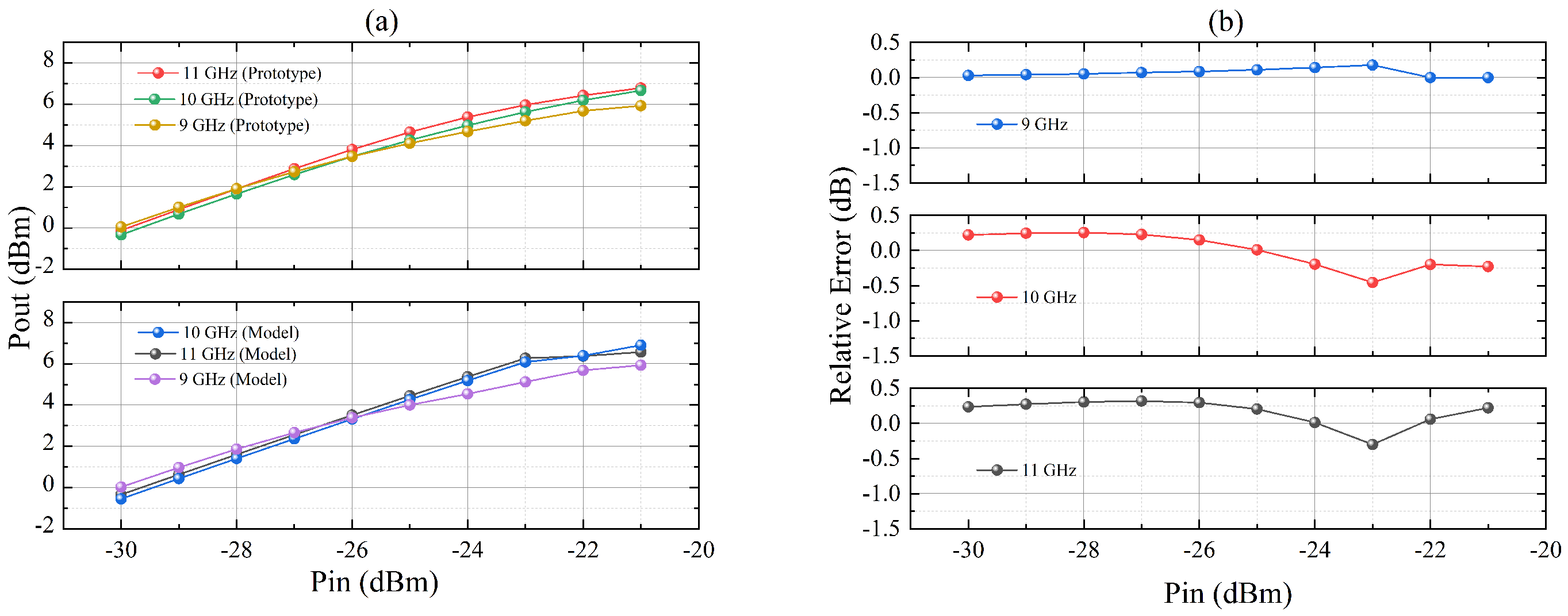
Specifically, Port 2 is used as the input and Port 1 as the output. The input frequencies are set to 9 GHz, 10 GHz, and 11 GHz, and the input power is swept with a 1 dB step from the small-signal region to the compression region. These three frequencies are selected as representative points in the lower, middle, and upper parts of the operating band, respectively, so that the nonlinear validation covers different frequency positions within the band rather than only closely spaced points. For each power level, the peak value of the fundamental output spectral line obtained from the HB simulation is used as the benchmark. For the behavioral model, a single-tone input data stream with the same frequency, power, phase, and control-code settings is applied, and the output data stream is processed to extract the spectral peak at the excitation frequency for comparison. As shown in
Figure 4a, the model reproduces the input–output power curves at all three frequencies and correctly captures the gain-compression trend, while the corresponding errors are shown in
Figure 4b. The RMSE values are 0.11 dB at 9 GHz, 0.97 dB at 10 GHz, and 0.75 dB at 11 GHz, with an average RMSE of 0.61 dB. These results indicate that the nonlinearity characteristic is correctly embedded into the behavioral model.
3.2.4. Phase-Shift Characteristic Validation
To validate the phase-shift characteristic, a control-variable strategy is adopted. The prototype system is configured in the receive mode, with only one channel activated to exclude inter-channel coupling. The noise characteristic is disabled, and the input power is fixed at dBm to keep the RF link in the small-signal region and suppress nonlinear effects. Since the phase-shift characteristic model includes both attenuation control and phase control, the two effects are validated separately.
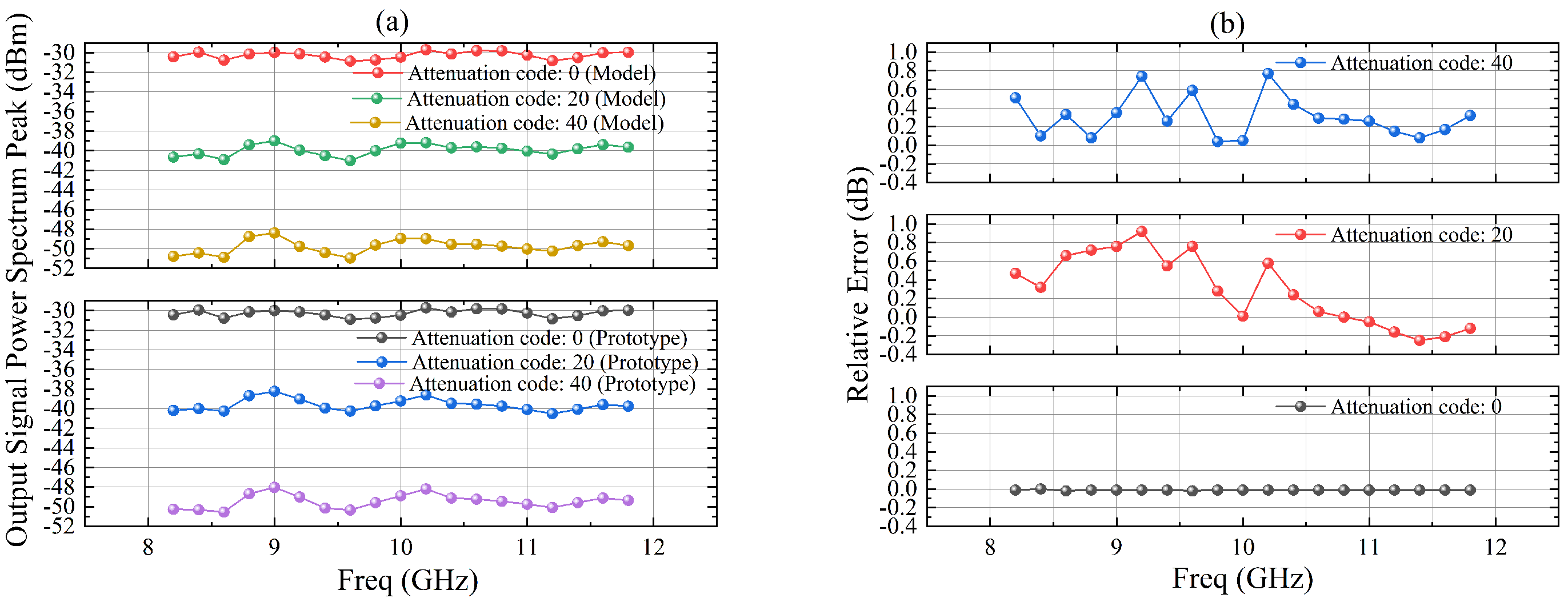
For attenuation validation, the phase-control code is fixed at 0, while the attenuation-control code is set to 0, 20, and 40, respectively. The prototype uses Port 1 as the input and Port 2 as the output. The frequency is swept from 8.2 GHz to 11.8 GHz with a 200 MHz step size, and the peak value of the single-tone output spectrum is recorded at each frequency point as the benchmark. For the behavioral model, a single-tone input data stream is generated using the same frequency, power, phase, and control-code settings, and the corresponding output spectral peak is extracted for comparison. As shown in
Figure 5a, the model and benchmark curves agree well under different attenuation-control codes, and the corresponding errors are shown in
Figure 5b. The RMSE values are 0.015 dB, 0.019 dB, and 0.018 dB for attenuation-control codes of 0, 20, and 40, respectively, with an average RMSE of 0.017 dB. These results indicate that the attenuation effect is correctly embedded into the behavioral model.
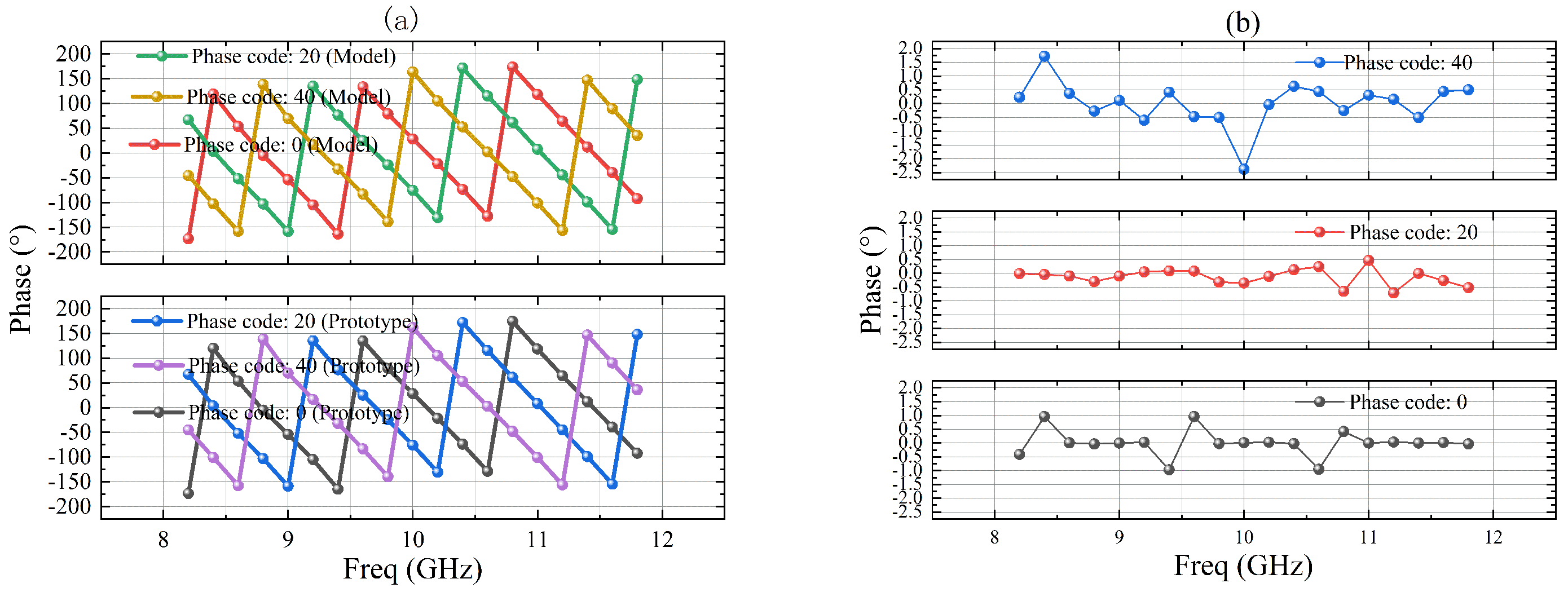
For phase validation, the attenuation-control code is fixed at 0, while the phase-control code is set to 0, 20, and 40, respectively. The remaining validation settings are kept the same as those used in attenuation validation. The phase responses obtained from the behavioral model and the prototype benchmark are compared, and the results are shown in
Figure 6a, with the corresponding errors shown in
Figure 6b. The RMSE values are
,
, and
for phase-control codes of 0, 20, and 40, respectively, with an average RMSE of
. These results indicate that the phase-control effect is correctly embedded into the behavioral model.
It should be noted that attenuation may gradually introduce impedance mismatch and thereby affect the phase response. This interaction is not explicitly modeled in the current implementation and will be considered in future work.
Although the interaction between attenuation and phase response has not yet been explicitly modeled in this work, the current phase-validation result gives an average RMSE of 1.58°. In many phased-array applications, phase control is typically quantized using 6-bit or lower resolution, with a phase step of about 5.625° or larger. Therefore, the present error level is well below the typical phase-quantization accuracy of many phased-array systems, and thus has limited influence within the current modeling scope, with acceptable engineering significance. If higher phase accuracy is required in future applications, the improvement strategy discussed in
Section 4 can be adopted for further refinement.
3.2.5. Noise Characteristic Validation
Noise-characteristic validation differs from the validation of deterministic characteristics, such as frequency response, coupling, nonlinearity, and phase shift. Those characteristics mainly act as deterministic transformations of the signal, whereas noise is introduced as an additive random component at the output. Therefore, the noise characteristic is evaluated through the resulting signal-to-noise ratio (SNR) degradation, namely the noise figure (NF), rather than by direct comparison of spectral-line peaks.
Accordingly, a control-variable strategy is adopted. The prototype system is configured in the receive mode, with only one channel activated to exclude coupling. The phase-shift code and attenuation-control code are both fixed at 0, and the input power is set to dBm to suppress nonlinear effects. Under these conditions, the validation focuses on whether the additive noise introduced by the behavioral model is consistent with the benchmark NF of the prototype system.
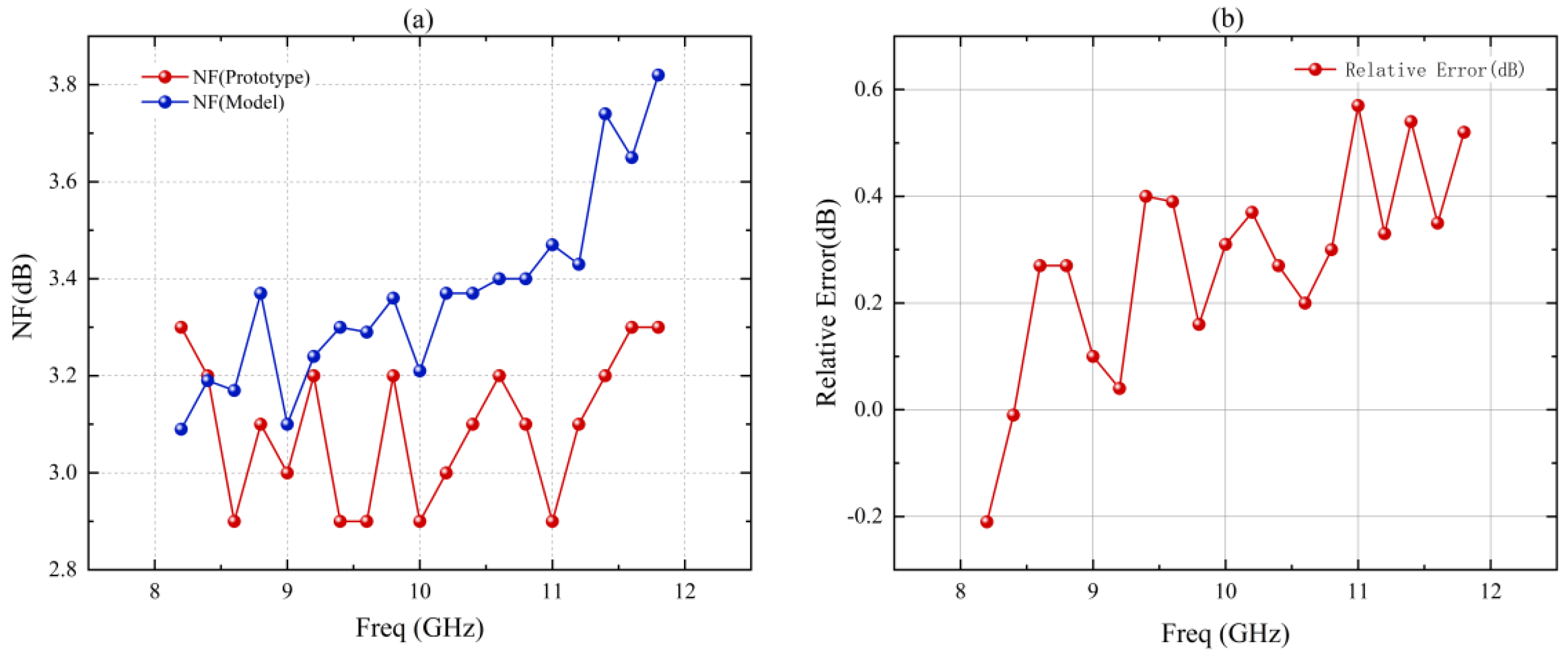
Specifically, the frequency is swept from 8.8 GHz to 11.8 GHz with a 200 MHz step size. For each frequency point, the output signal power of the prototype system is obtained from circuit-level simulation as the reference signal component, while the output noise power of the behavioral model is generated by the noise characteristic block. Based on the reference output signal power and the model-generated output noise power, the output SNR is calculated, and the corresponding NF is derived for comparison with the prototype NF. As shown in
Figure 7a, the NF curves of the behavioral model and the prototype exhibit similar trends over the whole band, and the corresponding error is shown in
Figure 7b. The RMSE is 0.33 dB. These results indicate that the noise characteristic is correctly embedded into the behavioral model and can be properly superimposed onto the output data stream.
3.3. HB-Based and Transient Validation of Cascaded RF-Link Behaviors
After the individual characteristic models are verified, system-level validation is further conducted to examine whether the proposed method can reproduce the overall input–output behavior of the reference physical system after characteristic-block cascading. To this end, three groups of experiments are carried out: wideband HB-based linear validation with a 200 MHz frequency step, wideband HB-based nonlinear validation with the same step, and transient validation at representative frequency points under single-tone and two-tone excitations. Through these experiments, the proposed framework is assessed from both wideband steady-state and transient perspectives.
3.3.1. HB-Based Validation Under Linear Operating Conditions
To verify the overall consistency of the proposed method beyond individual characteristic validation, cascaded RF-link validation is conducted under linear operating conditions by comparing the behavioral model with the HB simulation of the complete eight-channel RF link, with all channels enabled. Only the characteristic blocks required by the target signal path are activated, while the noise characteristic is excluded, because the present comparison focuses on the steady-state amplitude and phase responses of key spectral lines. Since noise is introduced as an additive random component and its correctness has already been verified by the previous NF-based validation, excluding it here does not affect the validity of the linear cascaded-response comparison.
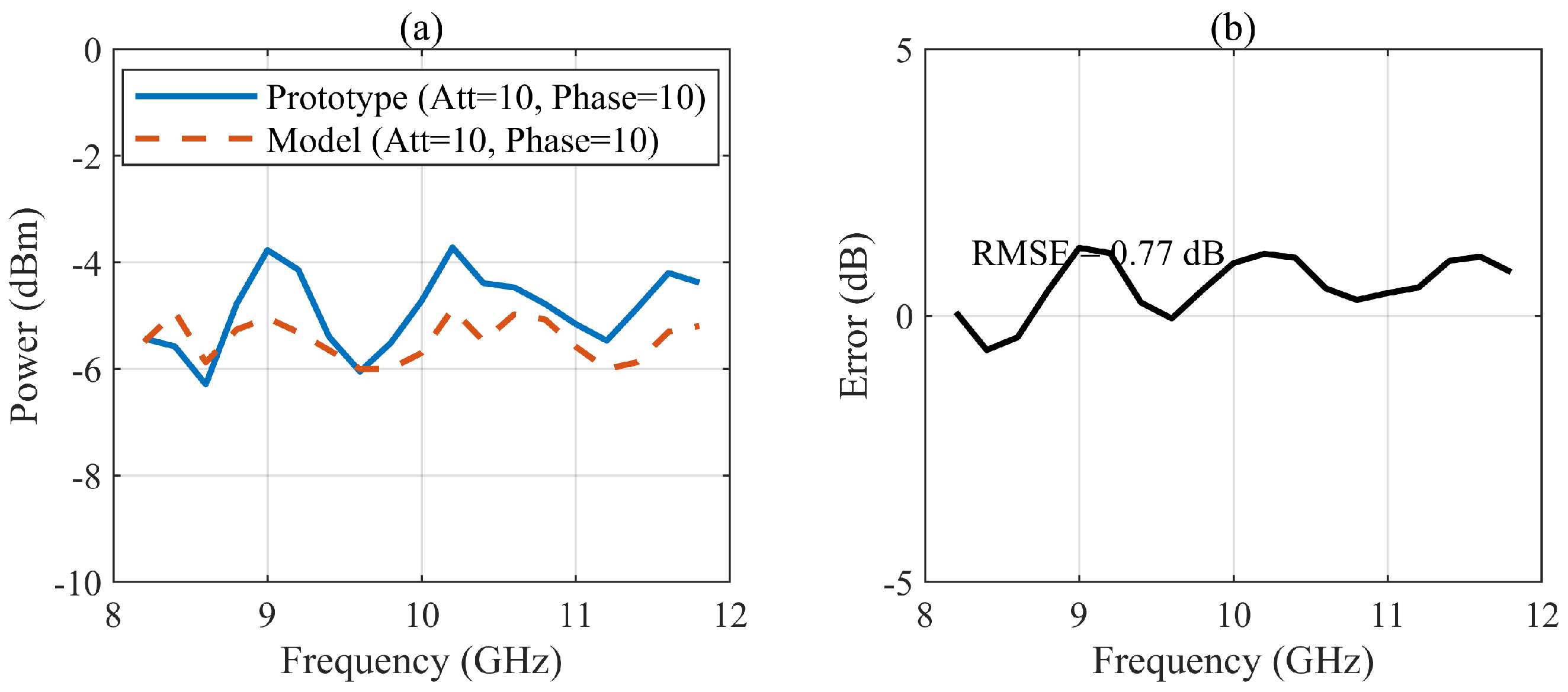
A wideband evaluation is conducted across the entire operating band under small-signal conditions. Specifically, the frequency is swept from 8.2 GHz to 11.8 GHz with a step size of 200 MHz. The output data stream of the behavioral model is processed by FFT, and the peak spectral power and phase at each frequency point are extracted for comparison with the HB simulation results.
As shown in
Figure 8a, the behavioral model exhibits good agreement with the reference results across the entire frequency band. The overall RMSE of the output spectral power is 0.77 dB, indicating that the proposed model can accurately capture the amplitude response over the full operating range.
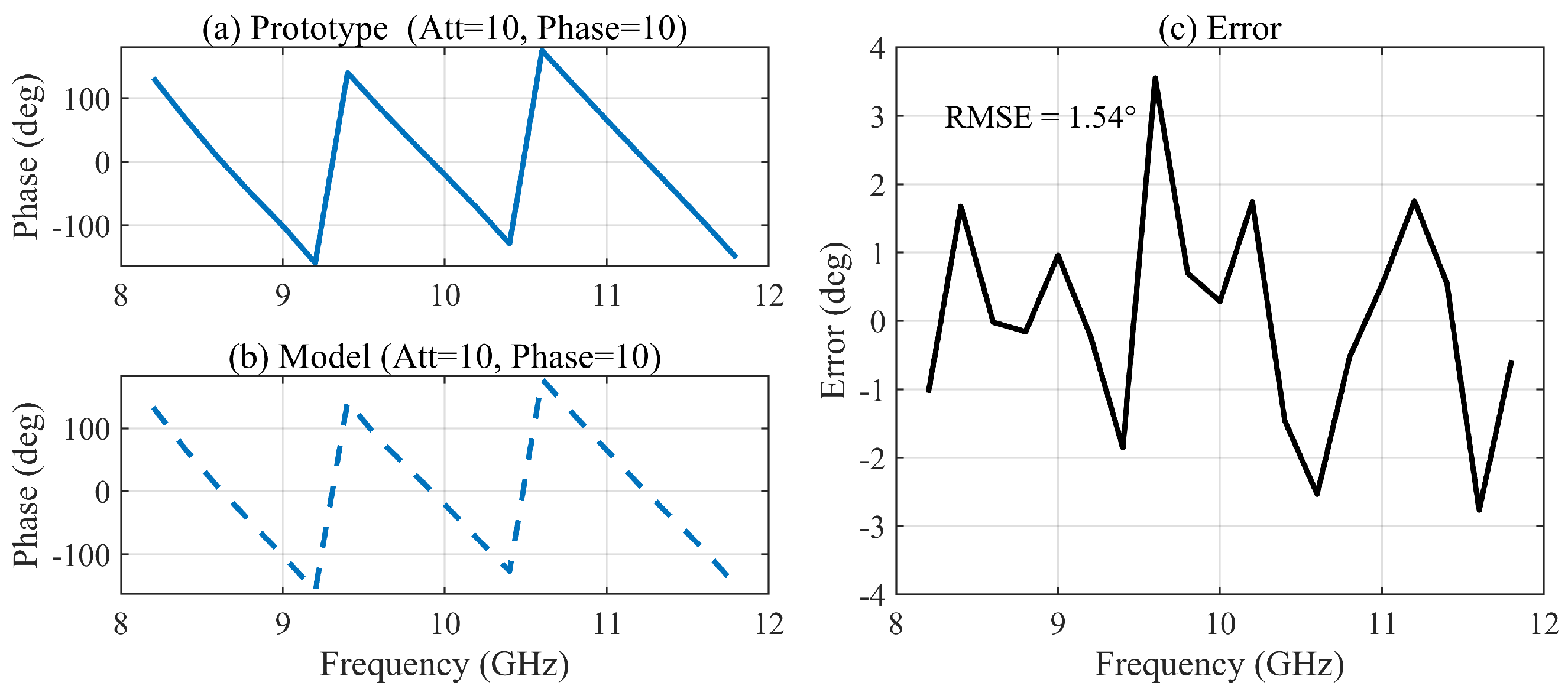
Figure 9 presents the corresponding phase comparison results. It can be observed that the model effectively reproduces the phase variation trend of the prototype, with an RMSE of
, demonstrating good accuracy in phase response representation.
These results indicate that the proposed behavioral model can accurately reproduce the end-to-end linear input–output response of the reference physical system across the full operating band.
3.3.2. HB-Based Validation Under Nonlinear Operating Conditions
Under nonlinear conditions, HB-based validation is performed using two-tone excitation and key-spectral-line comparison to assess whether the cascaded RF-link model can reproduce the nonlinear response of the reference physical system. In this test, the full eight-channel behavioral model is enabled, while the phase-shift code and attenuation-control code are fixed at 0 and the noise characteristic is disabled. The comparison focuses on the powers of the two fundamentals and the two IM3 components, so that the observed differences mainly reflect the nonlinear response of the cascaded RF link. Only spectral-line power is evaluated in this section, because the purpose here is to isolate the nonlinear amplitude response.
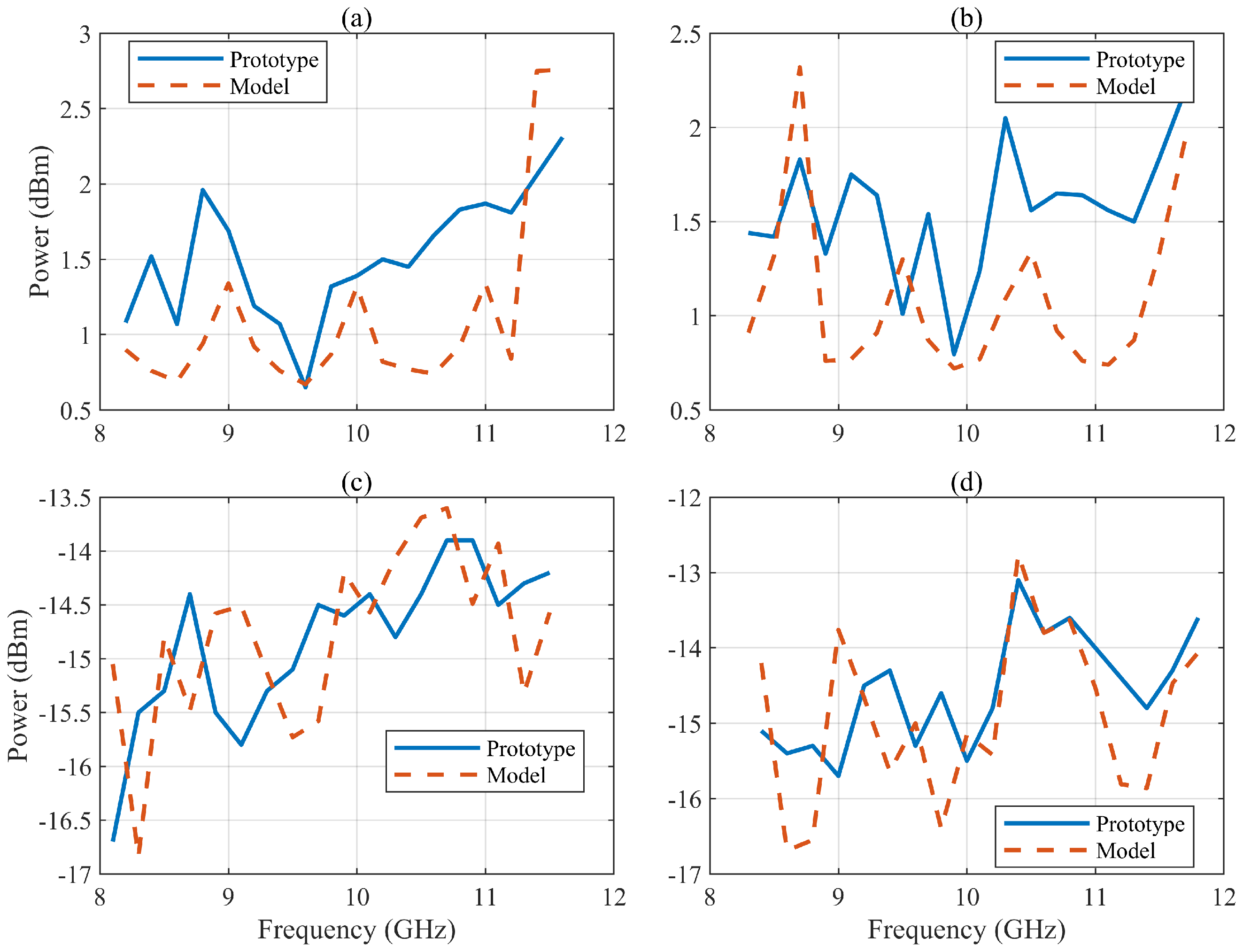
Based on the above control-variable setting, a wideband two-tone validation is conducted across the operating band. The first input tone is swept from 8.2 GHz to 11.6 GHz with a step size of 200 MHz, and the second tone is set to be 100 MHz higher than the first one. The case with the first tone at 11.8 GHz is not included, because the corresponding third-order intermodulation component falls outside the operating band, whereas the present work focuses on in-band spectral behavior. For the behavioral model, the output data stream is processed by FFT, and the corresponding spectral peaks are extracted for comparison with the HB benchmark. As shown in
Figure 10, the behavioral model reproduces the in-band nonlinear spectral-line powers of the prototype with good agreement across the swept frequency range. The RMSE values of tone 1, tone 2, the left-side IM3 component, and the right-side IM3 component are 0.61 dB, 0.86 dB, 0.61 dB, and 0.98 dB, respectively. These results indicate that, within the modeling scope of this work, the behavioral model can effectively capture the dominant in-band nonlinear spectral behavior of the cascaded RF link under two-tone excitation, thereby validating the cascaded interaction logic among the characteristic blocks under nonlinear operating conditions.
The interaction between nonlinearity and code-controlled phase/attenuation is not explicitly considered here, because the present model is not intended for deep strong-nonlinearity conditions. A possible extension is discussed in
Section 4.
3.3.3. Transient Validation Under Linear and Nonlinear Conditions
In addition to HB-based steady-state validation, transient validation is performed to examine whether the proposed behavioral model can reproduce the time-domain response and corresponding spectral characteristics under representative excitations. Direct transient simulation of the complete eight-channel X-band phased-array T/R module is not used because its complex active/passive structure causes severe convergence difficulties at the transistor level. Instead, a simplified two-channel basic-unit prototype is constructed from one multifunction chip extracted from the T/R module. This simplification is mainly introduced to ensure the convergence and reliability of ADS transient simulation. Although the prototype is simplified from the complete eight-channel T/R module, it still retains the main RF characteristics that need to be verified in this work, including the Rx signal path, frequency-dependent transmission behavior, code-controlled phase/attenuation response, and nonlinear response. Therefore, it can serve as a representative transient benchmark for evaluating whether the proposed behavioral model can reproduce the key time-domain and spectral responses of the RF link.
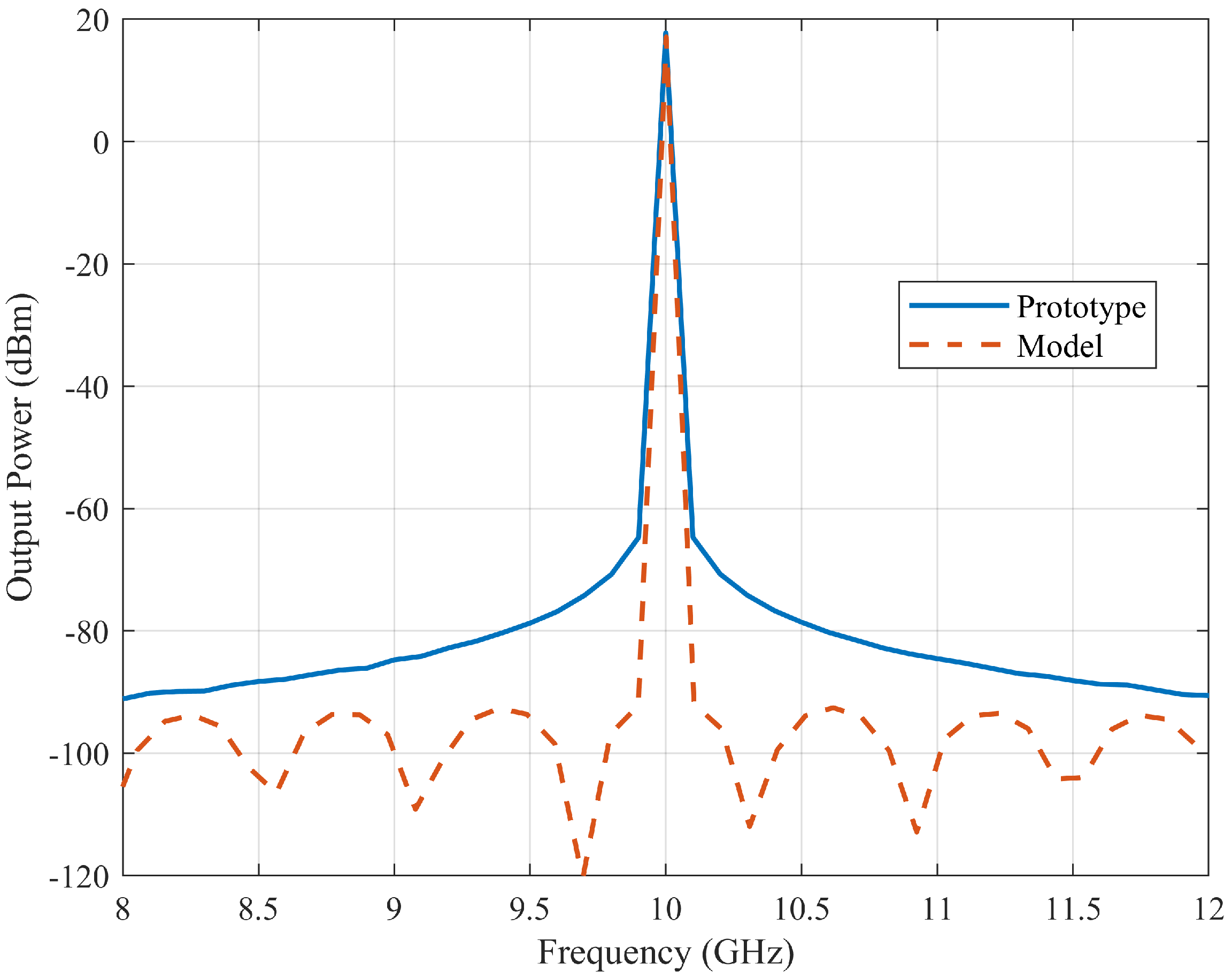
As shown in
Figure 11, the main spectral component of the behavioral model agrees well with that of the prototype transient result. The error of the main spectral line at 10 GHz is 0.67 dB. This result indicates that the proposed model can correctly reproduce the dominant linear spectral response of the prototype under transient excitation. Although the spectral components around the main line do not completely overlap, their power levels are much lower than that of the dominant component. Therefore, their influence on the overall system behavior is limited under the present validation conditions.
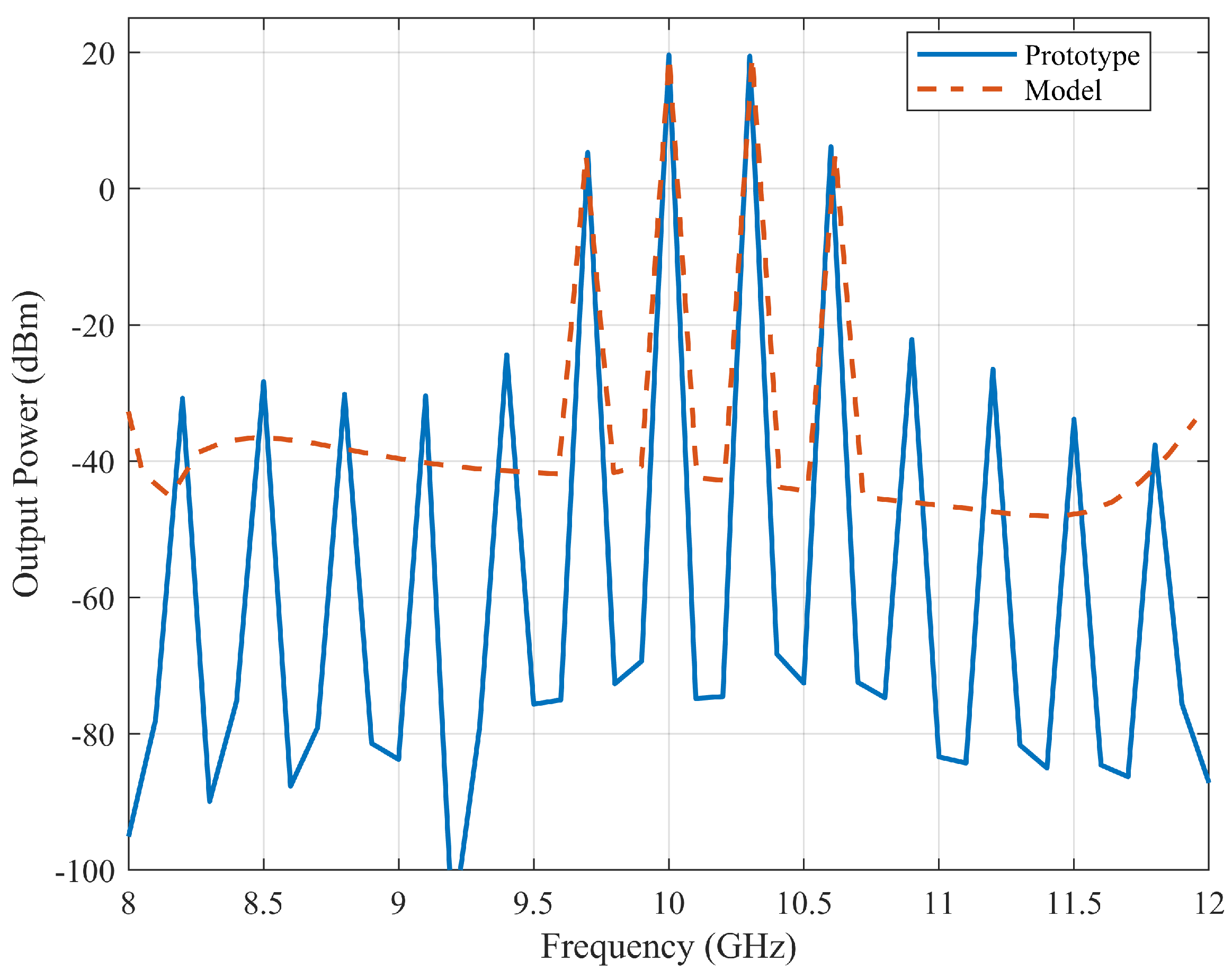
Under nonlinear operating conditions, a two-tone input signal with frequencies of 10 GHz and 10.3 GHz is applied. The FFT spectra of the prototype transient output and the behavioral-model output are compared in terms of the two fundamentals and the two third-order intermodulation components.
As shown in
Figure 12, the behavioral model reproduces the dominant nonlinear spectral components with good agreement. The errors of the 10 GHz and 10.3 GHz fundamentals and the 9.7 GHz and 10.6 GHz IM3 components are 0.11 dB, 0.06 dB, 0.31 dB, and 0.90 dB, respectively. These results indicate that the proposed method can capture the main transient spectral characteristics of the prototype under both linear and nonlinear excitations, thereby further supporting the correctness of the modeling framework from the time-domain perspective. Higher-order intermodulation components beyond the dominant fundamentals and IM3 terms are not explicitly included in the current model, because they are relatively weak and can be incorporated in future work by increasing the order of the nonlinear characteristic model if needed.
3.4. Demonstration of Executable Output Streams for Upper-Level Validation
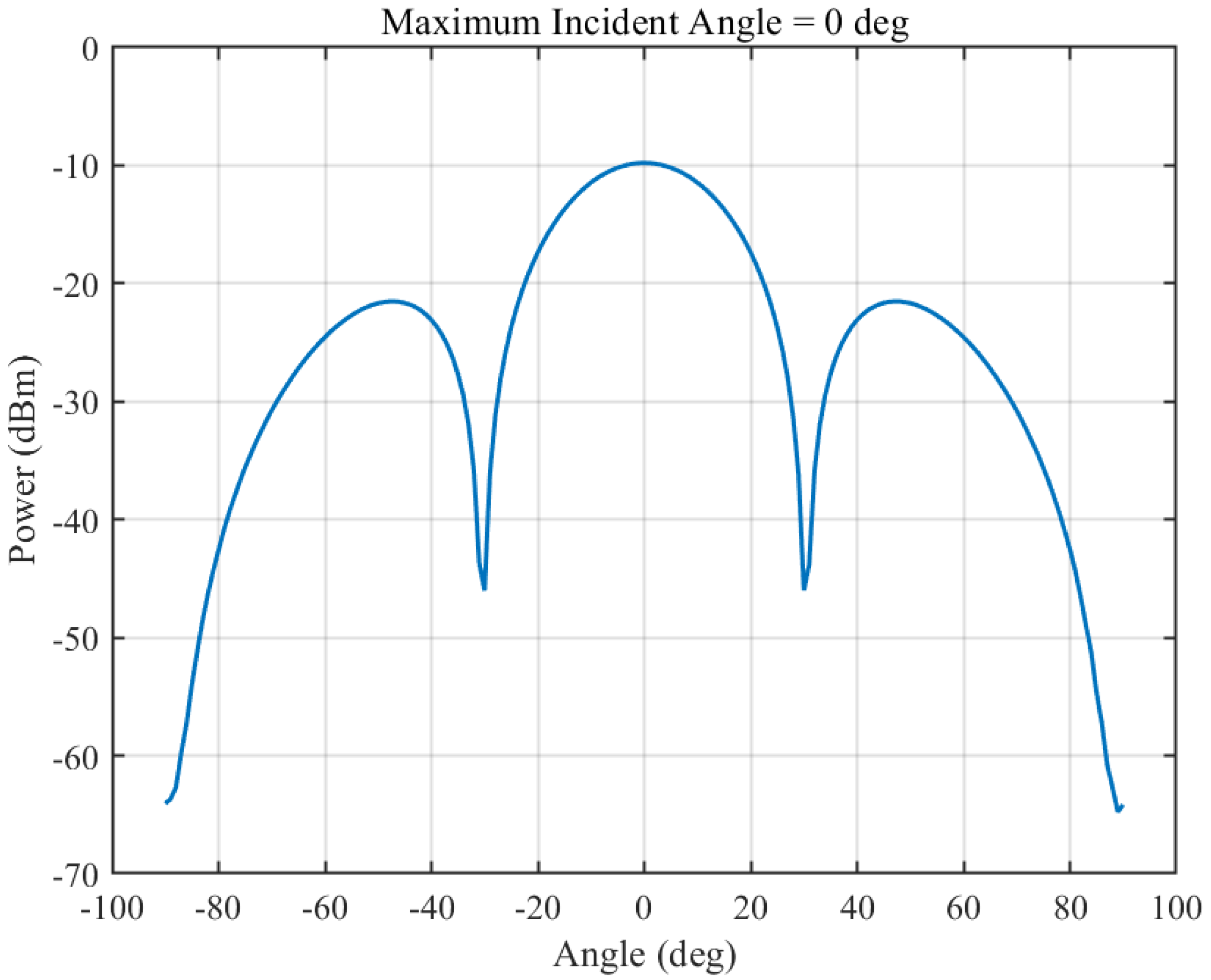
A multi-channel receive configuration is used to demonstrate output-stream usability. With the receive beam preset to , a 10 GHz single-tone signal sweeps the incident angle from to , and the normalized combined output amplitude is used to obtain the receiving-pattern response.
As shown in
Figure 13, the behavioral model exhibits clear angular selectivity. Two representative incident angles are therefore selected for further analysis:
, corresponding to the mainlobe direction, and
, which is close to the null.
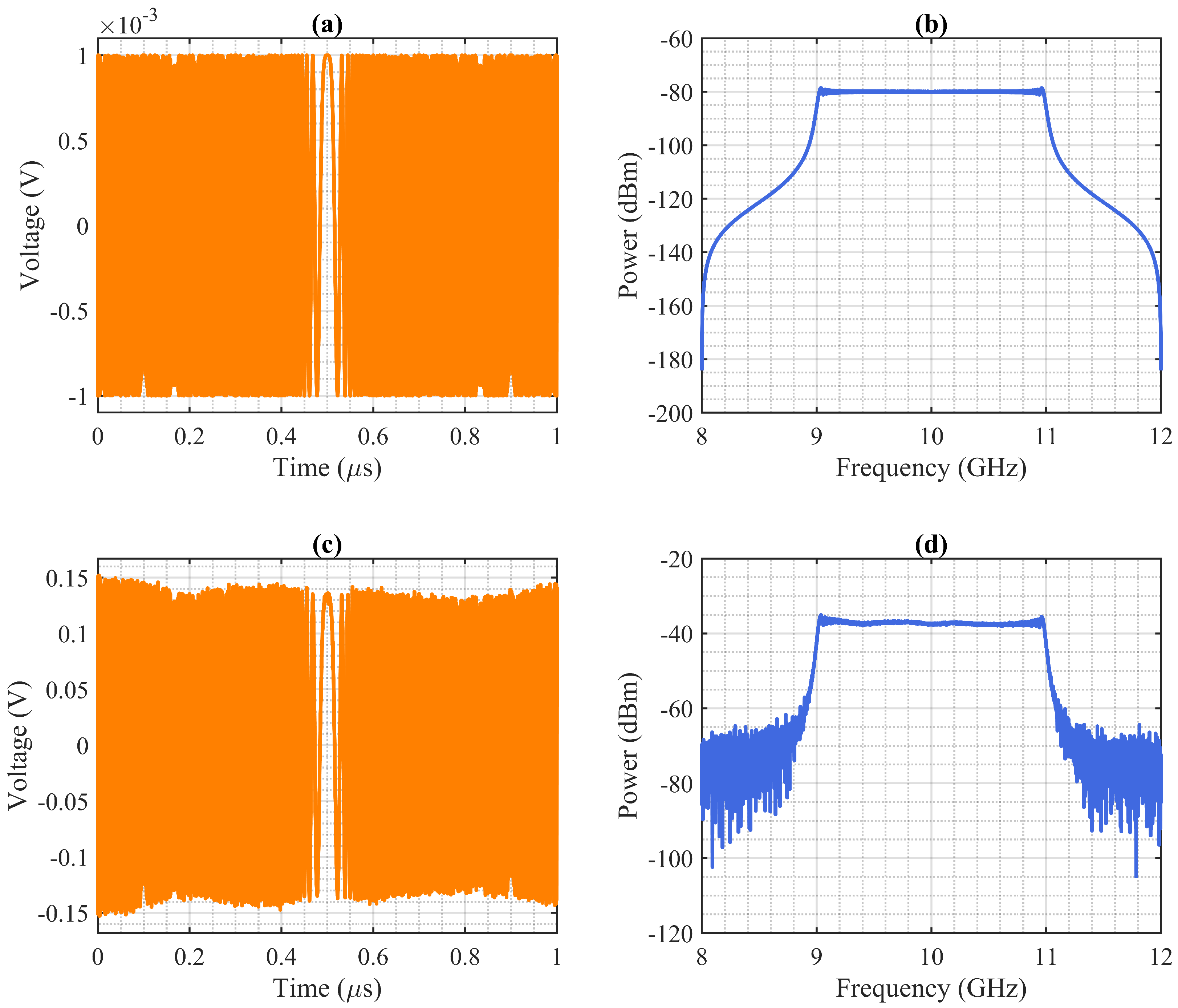
A first-order LFM signal sweeping from 9 GHz to 11 GHz is injected, with an input power of −60 dBm, a pulse width of 1 s, and 4000 sampling points. The multi-channel combined output stream is processed by FFT to obtain its power spectrum.
Figure 14 shows the time-domain sampled output stream and spectrum of the multi-channel behavioral model under a
incident LFM signal.
As shown in
Figure 14, the
incident LFM signal produces the maximum gain response in the preset receive-beam direction, and the output reflects the combined effects of multiple modeled characteristics.
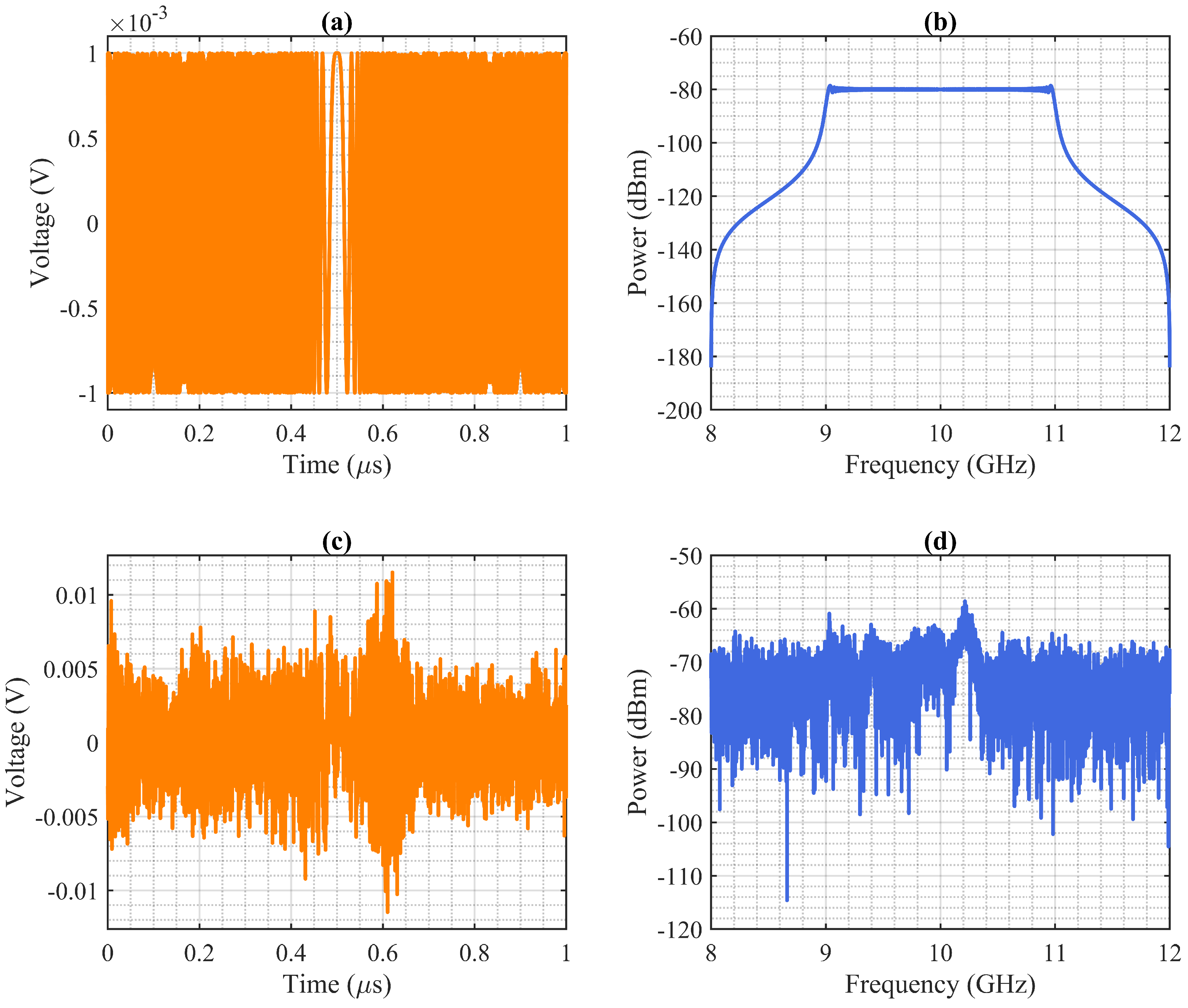
As shown in
Figure 15, at
, which is close to the null direction of the receiving pattern, the mainband energy is significantly suppressed and the residual output approaches the noise-floor level. Compared with the
case, the reduction in the useful-band energy directly reflects the angular selectivity of the multi-channel receive configuration. Therefore, the generated output streams vary with the incident angle in a manner consistent with the receiving pattern, demonstrating that the proposed model can provide reusable executable RF-link output streams for subsequent upper-level validation.
4. Discussion
This work proposes a dataflow-driven behavioral modeling method for RF systems, in which key physical-characteristic results are transferred into an executable cascaded RF-link model through configurable characteristic blocks and explicit parameter mapping. Validation results show good agreement with the reference physical system in both individual-characteristic and cascaded RF-link tests under wideband linear, wideband nonlinear, and transient conditions. By jointly representing multiple key RF physical effects, including frequency response, noise, coupling, nonlinearity, and code-controlled phase/attenuation response, the proposed framework provides a more complete executable RF-link representation than local characteristic fitting alone. On this basis, the model can generate reusable sampled output streams for subsequent upper-level validation, demonstrating its ability to feed physical-characteristic results into higher-level design-validation workflows.
From the computational perspective, the proposed model is not intended to serve as a standalone runtime benchmark against circuit-level simulators. Its main value lies in converting RF physical-characteristic results into reusable sampled-stream behavioral blocks. The resulting model is executed through operations such as FFT/IFFT-based filtering, multiport matrix mapping, sample-wise nonlinear transformation, noise generation, and LUT-based phase/attenuation control. Compared with circuit-level HB or transient simulations, which require repeated solutions of nonlinear device equations and convergence iterations, this computational structure is more suitable for repeated upper-level validation where RF-link input–output behavior needs to be reused under different signal and control-code settings.
Recent RF behavioral-modeling studies have mainly focused on surrogate or behavioral descriptions for specific components or subsystems, especially nonlinear power amplifiers and microwave circuits [
4,
7,
21,
22]. To further clarify the scientific positioning of the proposed method,
Table 1 provides a compact comparison with representative approaches mentioned in the reviewer comments. The purpose of this comparison is not to claim universal superiority over existing methods, but to highlight the specific scope of the present work in bridging physical-characteristic results and executable upper-level validation.
For the RF-link validation problem considered in this work, the main measurable advantage of the proposed framework lies in cross-domain fidelity preservation. Compared with conventional behavioral models directly assembled in platforms such as Keysight SystemVue or MATLAB RF Blockset, the proposed method does not only provide an executable RF-link structure, but also defines how physical-characteristic results obtained from circuit-level simulation or measurement are transferred into upper-level behavioral-model parameters. In conventional platform-based modeling, RF links are often constructed using ideal or semi-empirical functional blocks, and the mapping from physical-characteristic results to behavioral parameters is usually not explicitly specified. Consequently, only selected effects, such as gain, noise, or nonlinearity, may be represented, while the simultaneous preservation of frequency response, noise, coupling, nonlinear behavior, and code-controlled phase/attenuation is not always ensured within one consistent workflow. In contrast, the proposed framework embeds these physical effects into a unified cascaded sampled-stream model through explicit parameter transfer, so that the RF-link behavior inherited from the physical-characteristic domain can be directly reused in upper-level validation.
To further clarify the scientific positioning of the proposed method,
Table 1 provides a compact comparison with representative recent RF behavioral-modeling approaches. The purpose of this comparison is not to claim universal superiority over existing methods, but to highlight the specific scope of the present work in bridging physical-characteristic results and executable upper-level validation.
As indicated in
Table 1, representative recent methods usually focus on one dominant characteristic dimension, most commonly nonlinearity, at the device or subsystem level. By contrast, the proposed method explicitly organizes five categories of RF physical effects within one executable cascaded RF-link model and generates reusable sampled output streams for subsequent validation. Therefore, the novelty of this work lies not in proposing a universally more accurate black-box model for a single RF component, but in establishing a reusable route that transfers high-fidelity physical-characteristic results into executable RF-link representations for upper-level validation.
At the same time, the present study still has several limitations. First, the current nonlinear characteristic model is based on a relatively simplified memoryless third-order representation. It is mainly used to capture the dominant low-order in-band nonlinear behavior under the operating conditions considered in this work, such as gain compression and third-order intermodulation. This setting is consistent with the present validation scope, where the nonlinear response is examined through single-tone gain-compression and two-tone IM3 comparisons. However, this model does not fully describe strong nonlinear memory effects, thermal drift, dynamic bias variation, or higher-order nonlinear behavior that may become significant under broadband modulated excitations. If such effects need to be considered, the nonlinear characteristic block can be further extended within the same dataflow interface by introducing memory-polynomial, Volterra-series, or other dynamic behavioral models. Second, the code-controlled phase/attenuation responses are not yet modeled in a fully coupled state-dependent manner. In practical RF links, attenuation and phase-shift states may interact, and under nonlinear operating conditions these responses may be further perturbed by compression effects. A practical extension is to construct jointly indexed lookup tables. Under linear conditions, a three-dimensional lookup table can be established so that phase-shift and attenuation values are jointly indexed by the phase-control code and attenuation-control code. Under nonlinear conditions, an additional lookup table sampled in compressed states can be introduced so that the code-controlled phase/attenuation responses can be updated consistently with the operating state. Third, although the proposed framework has been validated using high-fidelity simulation benchmarks and representative transient results, broader validation with more measurement data and more complex RF-link configurations would still be beneficial. These issues will be addressed in future work.
5. Conclusions
This paper proposed a dataflow-driven behavioral modeling method for RF systems for design validation. By transferring physical-characteristic results into an executable behavioral model, the proposed method bridges the gap between high-fidelity physical-characteristic simulation and upper-level validation. In this framework, key RF physical effects are organized as configurable characteristic blocks, whose parameters are obtained from high-fidelity simulation results and/or measurement data.
The proposed method was instantiated and validated on the receive (Rx) channel of an X-band eight-channel phased-array T/R module. The results showed that the key characteristics were correctly embedded into the behavioral model and that the cascaded model achieved good agreement with the reference physical system under linear, nonlinear, and transient conditions. Moreover, the model can generate reusable sampled output streams containing key physical effects, demonstrating its suitability as an executable RF-link module for upper-level validation.
Overall, the proposed method provides a practical route for transferring physical-characteristic results into executable design-validation workflows. Future work will further improve the modeling of characteristic interactions and extend the validation with more measurement data and more complex RF-system configurations.
Author Contributions
Conceptualization, Z.L.; methodology, Y.K. and Z.L.; writing—original draft preparation, Y.K.; writing—review and editing, Z.L. and Y.Z.; supervision, J.L. All authors have read and agreed to the published version of the manuscript.
Funding
This research received no external funding.
Institutional Review Board Statement
Not applicable.
Informed Consent Statement
Not applicable.
Data Availability Statement
The original contributions presented in the study are included in the article; further inquires can be directed to the corresponding authors.
Acknowledgments
The authors used ChatGPT (GPT-5.5 Thinking, OpenAI) only for language polishing, phrasing refinement, and editing assistance during manuscript preparation. All scientific content, technical interpretation, experimental design, and final responsibility for the manuscript remain with the authors.
Conflicts of Interest
The authors declare no conflicts of interest.
References
- Michailidis, A.; Chatzis, A.; Tsimpou, P.; Gogolou, V.; Noulis, T. A Unified Design Methodology for Front-End RF/mmWave Receivers. Electronics 2025, 14, 235. [Google Scholar] [CrossRef]
- Gao, Y.; Hussein, H.M.E.; Yan, M.; Chen, C.; Leeser, M.; Cassella, C.; Onabajo, M. A Design and Simulation Methodology for Radio Frequency Receiver Front-Ends with Frequency Selective Limiting Devices. Analog Integr. Circuits Signal Process. 2025, 125, 40. [Google Scholar] [CrossRef]
- Eid, A.M.; Nahas, M. A Novel Simulation Technique for UWB-FMCW Radar: Enhancing Through-the-Wall Detection Capabilities. J. King Saud Univ. Eng. Sci. 2025, 37, 49. [Google Scholar] [CrossRef]
- Ortali, J.; Mons, S.; Reveyrand, T.; Ngoya, E.; Mazière, C. Behavioral Modeling of RF Power Amplifiers Using a Time-Domain Characterization Approach. Int. J. Microw. Wirel. Technol. 2025, 17, 942–949. [Google Scholar] [CrossRef]
- Morgan, D.R.; Ma, Z.; Kim, J.; Zierdt, M.G.; Pastalan, J. A Generalized Memory Polynomial Model for Digital Predistortion of RF Power Amplifiers. IEEE Trans. Signal Process. 2006, 54, 3852–3860. [Google Scholar] [CrossRef]
- Koziel, S.; Pietrenko-Dabrowska, A.; Leifsson, L. Improved Efficacy Behavioral Modeling of Microwave Circuits through Dimensionality Reduction and Fast Global Sensitivity Analysis. Sci. Rep. 2024, 14, 19465. [Google Scholar] [CrossRef] [PubMed]
- Ma, J.; Qiao, L.; Watkins, G.T.; Dang, S.; Piechocki, R.J.; Haine, J.L.; Beach, M.A. Revolutionizing Microwave Circuit Design with Machine Learning: Challenges and Opportunities. IEEE Commun. Mag. 2024, 62, 100–106. [Google Scholar] [CrossRef]
- Cailleux, A.; Rochas, P.; Hou, J.; Fan, H.; Ding, Y.; Fraysse, J.-P.; Goussetis, G. Modeling RF Frontend of Active Integrated Antenna Array for Direct-to-Device Communications. IEEE Trans. Aerosp. Electron. Syst. 2025, 62, 3522–3535. [Google Scholar] [CrossRef]
- Vimal, V.; Thakur, P.; Gupta, S.; Shukla, A. RF-Power Amplifier Modelling Using Inverse System Identification. Discov. Comput. 2025, 28, 21. [Google Scholar] [CrossRef]
- Maas, S.A. Nonlinear Microwave and RF Circuits, 2nd ed.; Artech House: Norwood, MA, USA, 2003; ISBN 1-58053-484-8. [Google Scholar]
- Pedersen, K.I.; Maldonado, R.; Pocovi, G.; Martinez, E.J.; Lauridsen, M.; Kovács, I.; Brix, M. A Tutorial on Radio System-Level Simulations with Emphasis on 3GPP 5G-Advanced and Beyond. IEEE Commun. Surv. Tutor. 2024, 26, 2290–2325. [Google Scholar] [CrossRef]
- Manalastas, M.; bin Farooq, M.U.; Zaidi, S.M.A.; Imran, A. Toward the Development of 6G System Level Simulators: Addressing the Computational Complexity Challenge. IEEE Wireless Commun. 2023, 30, 160–168. [Google Scholar] [CrossRef]
- Ferreira, G.C.; Barreto, P.S.; Caetano, M.F.; Alchieri, E.; Araujo, D.C.; Cavalcanti, R.P.; Sousa, D.A. 5G-RCOLAB: A System Level Simulator for 5G and Beyond in Rural Areas. Comput. Commun. 2023, 212, 161–181. [Google Scholar] [CrossRef]
- Tantiparimongkol, L.; Shen, M.; Gao, P.Q.; Guo, X.Z.; Yu, H.H.; Li, J.W.; Ding, J.L.; Chu, Y.T.; Duan, R.; Zhao, Y. Preliminary Design and Analysis of a Radar System Model Based-On a Phased-Array RF Astro-Receiver for Space Debris Detection and Tracking. Adv. Space Res. 2026, 77, 3654–3669. [Google Scholar] [CrossRef]
- Islam, M.M.; Hasan, K.; Jeong, S.H. Performance Evaluation and Optimization for 6G Networks: A Survey of KPIs, Tools, and AI Models. ICT Express 2026, 12, 390–416. [Google Scholar] [CrossRef]
- Chen, C.; Lu, H.; Zhang, Y.; Zhang, G. Behavioral Modeling for Nonlinear Effects of Receiver Front-Ends Based on Block-Oriented Structures. Prog. Electromagn. Res. C 2021, 115, 205–217. [Google Scholar] [CrossRef]
- Ding, J.; Shao, H.; Lv, J.; Ding, F. A Digital Simulation Model of Broadband Phased Array RF System and Its Application. Sensors 2025, 25, 4133. [Google Scholar] [CrossRef] [PubMed]
- Dai, R.; Xu, Y.; Qiu, J.; Ma, H.; Li, E.P. High-Fidelity S-Parameter Prediction Using Transfer Learning Based Encoder–Decoder Model. In Proceedings of the 2024 14th International Workshop on the Electromagnetic Compatibility of Integrated Circuits (EMC Compo), Torino, Italy, 7–10 July 2024; pp. 80–83. [Google Scholar] [CrossRef]
- Bonnin, M.; Van Brandt, L.; Delvenne, J.C.; Traversa, F.L.; Bonani, F. A Thermodynamically Consistent Thermal Equilibrium Gaussian White Noise Model for Nonlinear Resistors. IEEE Trans. Circuits Syst. I Reg. Pap. 2025, in press. [Google Scholar] [CrossRef]
- Zhang, H.X.; Zhou, L.; Zhao, Z.G.; Yin, W.Y. Parallel Multiphysics Simulation for Characterizing Performance Degradation of RF Components. In Proceedings of the 2019 IEEE MTT-S International Conference on Numerical Electromagnetic and Multiphysics Modeling and Optimization (NEMO), Boston, MA, USA, 29–31 May 2019; pp. 1–4. [Google Scholar] [CrossRef]
- Tsuji, H.; Kikuchi, K.; Honda, A.; Yamamoto, H. Electromagnetic Coupling Between Passive Circuits and Non-Uniform Transistor Operation in High-Power Microwave Packaged Devices. In Proceedings of the 2024 IEEE Topical Conference on RF/Microwave Power Amplifiers for Radio and Wireless Applications (PAWR), San Antonio, TX, USA, 21–24 January 2024; pp. 24–27. [Google Scholar] [CrossRef]
- Zheng, S.; Wang, W.; Wu, X.; Chen, Z.; Liu, L.; Li, J.; Zhao, M. Performing Volterra Series Based Indirect Learning Digital Pre-Distorter in Self-Homodyne Detection. J. Lightw. Technol. 2024, 42, 1453–1459. [Google Scholar] [CrossRef]
- Xie, L.; Wei, H.; Zhang, K. Behavioral Modeling of Nonlinear RF Power Amplifiers Using Ensemble SDBCC Network. Neurocomputing 2015, 154, 24–32. [Google Scholar] [CrossRef]
- Speicher, F.; Meier, J.; Beyerstedt, C.; Groll, T.; Casier, H.; Gielen, G. Advanced Modeling Methodology for Expedient RF SoC Verification and Performance Estimation. In Proceedings of the 2018 15th International Conference on Synthesis, Modeling, Analysis and Simulation Methods and Applications to Circuit Design (SMACD), Prague, Czech Republic, 2–5 July 2018; pp. 221–224. [Google Scholar]
Figure 1.
Behavioral model of the Rx channel of the X-band eight-channel phased-array T/R module.
Figure 1.
Behavioral model of the Rx channel of the X-band eight-channel phased-array T/R module.
Figure 2.
Frequency-response validation results: (a) peak output spectral power comparison (HB vs. model) under different input powers; (b) error under different input powers.
Figure 2.
Frequency-response validation results: (a) peak output spectral power comparison (HB vs. model) under different input powers; (b) error under different input powers.
Figure 3.
Port-to-port leakage validation for coupling characteristics: (a) peak output spectral power comparison (ADS HB vs. model); (b) error versus frequency.
Figure 3.
Port-to-port leakage validation for coupling characteristics: (a) peak output spectral power comparison (ADS HB vs. model); (b) error versus frequency.
Figure 4.
Nonlinearity validation results using gain–compression curves: (a) output power versus input power at 9 GHz, 10 GHz, and 11 GHz (prototype vs. model); (b) corresponding errors.
Figure 4.
Nonlinearity validation results using gain–compression curves: (a) output power versus input power at 9 GHz, 10 GHz, and 11 GHz (prototype vs. model); (b) corresponding errors.
Figure 5.
Attenuation validation results: (a) peak output power comparison (ADS HB vs. model) under different attenuation codes; (b) corresponding error.
Figure 5.
Attenuation validation results: (a) peak output power comparison (ADS HB vs. model) under different attenuation codes; (b) corresponding error.
Figure 6.
Phase validation results: (a) phase comparison (ADS HB vs. model) under different phase codes; (b) corresponding error.
Figure 6.
Phase validation results: (a) phase comparison (ADS HB vs. model) under different phase codes; (b) corresponding error.
Figure 7.
Noise characteristic validation results: (a) NF comparison (prototype vs. model); (b) error versus frequency.
Figure 7.
Noise characteristic validation results: (a) NF comparison (prototype vs. model); (b) error versus frequency.
Figure 8.
Wideband linear-condition validation across 8.2–11.8 GHz: (a) output spectral power comparison between the behavioral model and the prototype; (b) corresponding error.
Figure 8.
Wideband linear-condition validation across 8.2–11.8 GHz: (a) output spectral power comparison between the behavioral model and the prototype; (b) corresponding error.
Figure 9.
Wideband validation under linear conditions across 8.2–11.8 GHz: (a) prototype phase response; (b) model phase response; (c) corresponding error.
Figure 9.
Wideband validation under linear conditions across 8.2–11.8 GHz: (a) prototype phase response; (b) model phase response; (c) corresponding error.
Figure 10.
Wideband validation under nonlinear conditions using two-tone excitation: (a) power comparison of tone 1; (b) power comparison of tone 2; (c) power comparison of the left IM3 component; (d) power comparison of the right IM3 component.
Figure 10.
Wideband validation under nonlinear conditions using two-tone excitation: (a) power comparison of tone 1; (b) power comparison of tone 2; (c) power comparison of the left IM3 component; (d) power comparison of the right IM3 component.
Figure 11.
Transient validation under linear operating conditions: comparison between the FFT spectrum of the prototype transient output and that of the behavioral model under a 10 GHz single-tone input.
Figure 11.
Transient validation under linear operating conditions: comparison between the FFT spectrum of the prototype transient output and that of the behavioral model under a 10 GHz single-tone input.
Figure 12.
Transient validation under nonlinear operating conditions: comparison between the FFT spectrum of the prototype transient output and that of the behavioral model under a 10 GHz/10.3 GHz two-tone input.
Figure 12.
Transient validation under nonlinear operating conditions: comparison between the FFT spectrum of the prototype transient output and that of the behavioral model under a 10 GHz/10.3 GHz two-tone input.
Figure 13.
Receiving pattern response of the behavioral model under the preset receive beam.
Figure 13.
Receiving pattern response of the behavioral model under the preset receive beam.
Figure 14.
Time domain sampled output stream and spectrum of the multi-channel behavioral model under a incident LFM signal: (a) time-domain sampled output stream of an individual channel; (b) spectrum of the individual-channel output; (c) time-domain sampled combined output stream; (d) spectrum of the combined output.
Figure 14.
Time domain sampled output stream and spectrum of the multi-channel behavioral model under a incident LFM signal: (a) time-domain sampled output stream of an individual channel; (b) spectrum of the individual-channel output; (c) time-domain sampled combined output stream; (d) spectrum of the combined output.
Figure 15.
Time domain sampled output stream and spectrum of the multi-channel behavioral model under a incident LFM signal: (a) time-domain sampled output stream of an individual channel; (b) spectrum of the individual-channel output; (c) time-domain sampled combined output stream; (d) spectrum of the combined output.
Figure 15.
Time domain sampled output stream and spectrum of the multi-channel behavioral model under a incident LFM signal: (a) time-domain sampled output stream of an individual channel; (b) spectrum of the individual-channel output; (c) time-domain sampled combined output stream; (d) spectrum of the combined output.
Table 1.
Compact comparison between the proposed method and representative recent RF behavioral-modeling approaches.
Table 1.
Compact comparison between the proposed method and representative recent RF behavioral-modeling approaches.
| Modeling Approach | Typical Modeling Target | Explicitly Represented Physical Effects | Executable Sampled Data-Stream Output |
|---|
| Volterra-series-based nonlinear modeling [21] | Single nonlinear device/PA | 1 dominant effect (nonlinearity) | Usually not emphasized at cascaded RF-link level |
| Neural-network-/ML-assisted behavioral modeling [7,22] | Nonlinear PA or microwave circuit fitting | Usually 1 dominant effect or fitted response | Usually not emphasized at cascaded RF-link level |
| Time-domain PA behavioral modeling for system-level simulation [4] | PA/subsystem behavior | 1 dominant effect (nonlinearity-dominated behavior) | Component- or subsystem-oriented |
| This work | Cascaded RF link for upper-level validation | 5 categories: frequency response, noise, coupling, nonlinearity, and code-controlled phase/attenuation response | Yes |
| Disclaimer/Publisher’s Note: The statements, opinions and data contained in all publications are solely those of the individual author(s) and contributor(s) and not of MDPI and/or the editor(s). MDPI and/or the editor(s) disclaim responsibility for any injury to people or property resulting from any ideas, methods, instructions or products referred to in the content. |