1. Introduction
The design of the structures, with a lightweight core between two composite skins, aims to increase stiffness and flexural strength properties with minimal impact on overall mass.
The fact that the foam or balsa cores are viscoelastic makes the problem of fatigue even more complex. Fatigue damage to sandwiches is therefore a combination of damage to the skins and the core, even if the stresses applied are well below the permissible values for static strength.
It is therefore essential to improve our understanding of the relationships between loads, material properties, damage and the short- and long-term performance of composite sandwich materials. The level of understanding needs to progress so that the complex damage processes that occur in sandwich structures can be accurately monitored and predicted.
Recent studies have also investigated damage monitoring in composite structures using guided waves, acoustic emission, and vibration analysis. Guided-wave techniques have been applied to flax-fibre-reinforced composites under static and fatigue loading, demonstrating their effectiveness for damage detection and structural health monitoring [
1]. In parallel, acoustic emission has been used to follow damage evolution in bio-based composites during mechanical loading [
2]. Furthermore, vibration-based studies have shown that ageing significantly influences the dynamic response of synthetic and bio-based composites, leading to changes in resonance frequencies and damping characteristics, as confirmed by both experimental investigations and recent review studies [
3,
4]. In addition, hygrothermal ageing has been reported to significantly affect the static, fatigue, and vibrational response of flax-reinforced composites [
5,
6]. These monitoring techniques are complementary to mechanical fatigue testing and confirm the need for predictive models that relate stiffness degradation to the underlying damage evolution in sandwich composites.
The complexity of fatigue failure mechanisms in composite sandwich structures requires the development of reliable approaches for evaluating their mechanical durability under cyclic loading. Damage evolution is commonly assessed through the progressive degradation of mechanical properties, particularly stiffness and flexural strength, which are considered relevant indicators of fatigue deterioration in sandwich composites [
7,
8]. Experimental investigations have shown that the evolution of these properties with the number of cycles can provide useful information regarding the fatigue resistance and failure behaviour of composite sandwich panels subjected to bending loads.
To analyse the fatigue behaviour of sandwich composites, several studies have focused on monitoring stiffness degradation during cyclic loading and on establishing predictive approaches for fatigue life estimation [
7,
8,
9]. In particular, the work of Ma et al. [
8] examined the fatigue behaviour of sandwich panels under three-point bending, highlighting the influence of cyclic loading on stiffness reduction and damage propagation. Similarly, Dong et al. [
9] proposed a fatigue life prediction methodology for honeycomb sandwich structures subjected to bending fatigue loading, taking into account the evolution of damage mechanisms within the sandwich configuration.
In addition, fracture-mechanics-based parameters such as the energy restitution rate have been increasingly used to characterise damage initiation and crack propagation in composite structures [
10]. Experimental techniques including X-ray microtomography and three-dimensional crack analysis have also been employed to investigate internal damage evolution and crack morphology in heterogeneous materials [
11]. These approaches provide valuable insight into the mechanisms governing structural degradation and failure under mechanical loading.
However, despite these advances, most existing studies either rely heavily on extensive experimental campaigns or focus on specific indicators (such as stiffness degradation or energy release rate) without establishing a unified and simplified predictive framework capable of accurately describing damage kinetics and fatigue life under displacement-controlled bending. Moreover, limited attention has been given to developing empirical–analytical models that reduce experimental effort while maintaining prediction accuracy for different sandwich configurations.
This article focuses on the modelling of the flexural behaviour of sandwich composites under cyclic fatigue. Experiments and results are presented, highlighting the impact of displacement level, the construction of Wöhler curves and the progression of stiffness reduction over fatigue cycles. Fatigue life is also examined in detail. The definition of fatigue durability criteria and the prediction of fatigue life are discussed in detail. The derivation of analytical models forms the core of this article, with particular attention paid to the modelling of displacement control experiments and the determination of the damage kinetics model. The article then progresses with the experimental characterisation developed to validate the proposed models, thus providing a solid basis for their application. We analyse the kinetics of fatigue damage through variations in the rate of energy restitution and residual stiffness. Using empirical functions adapted to our experimental results, we identify laws associated with the state of structural degradation (C.D.S.), to gain a better understanding of the mechanisms specific to the sandwich composites studied.
2. Materials and Methods
2.1. Materials
In this work, different core materials were selected in order to examine their influence on the mechanical response of sandwich composites. Two types of cores were considered: synthetic PVC foams and a bio-based material, balsa wood. The external skins were reinforced using glass and flax fabrics, with areal densities of 202 g/m2 and 115 g/m2, respectively.
Prior to manufacturing, the flax fibres were dried at 110 °C for 1 h in a ventilated oven [
12] to eliminate residual moisture. This step is known to improve fibre–matrix adhesion while preserving the intrinsic mechanical properties of the fibres. Two types of matrices were used, namely conventional epoxy and green epoxy resin, both ensuring proper impregnation of the reinforcements.
To maintain consistent testing conditions, the thickness of the cores and skins was kept constant for all configurations. The study focuses on the effect of both core density and material nature. Three core configurations were therefore investigated: a PVC foam with a density of 60 kg/m3, a denser PVC foam with 80 kg/m3, and a bio-based balsa core with a density of 150 kg/m3.
The sandwich structures are identified using the following notation:
[FF4/Balsa150/FF4]: where ‘FF’ refers to flax fabric and ‘FF4’ indicates four stacked plies. ‘Balsa150’ corresponds to a balsa core with a density of 150 kg/m3.
[GF2/PVC60/GF2]: where ‘GF’ denotes glass fabric with two plies on each side, and ‘PVC60’ refers to a PVC core of 60 kg/m3.
[GF2/PVC80/GF2]: similar configuration, with a PVC core density of 80 kg/m3.
The sandwich panels were manufactured using a hand lay-up process followed by vacuum consolidation. Depending on the configuration, 4 or 8 plies were used to form the upper and lower skins. The epoxy system was prepared with a resin-to-hardener ratio of 3:1.
The fabrication process began with mould preparation. The fabric layers were then successively impregnated with resin and carefully laid up. After placing the first set of plies, the core (PVC or balsa) was positioned onto a uniformly distributed resin layer. The remaining plies were subsequently applied on the opposite side of the core, ensuring symmetry of the structure.
The entire assembly was sealed using a plastic film and subjected to vacuum at 300 mbar for 10 h. No additional external pressure was applied during this stage. After curing under vacuum, the plates were removed and cut into specimens using a diamond saw.
For the three-point bending tests, the samples were prepared with dimensions of 300 mm × 25 mm × 8 mm.
The manufacturing quality, flexural behaviour, and damage mechanisms of the investigated sandwich composites were previously analysed in detail using acoustic emission monitoring and microscopic observations in a preceding study [
2]. The present work extends this investigation by focusing on the modelling and prediction of fatigue behaviour under cyclic flexural loading conditions.
2.2. Methods
Fatigue tests were carried out to investigate the effect of cyclic loading and applied loading levels on the flexural behaviour of sandwich composites of different densities. These tests were carried out under displacement control. The levels of cyclic displacement applied were chosen based on the results obtained during the static tests. Prior to fatigue testing, three-point bending tests were performed on sandwich beams in accordance with the NF T 54-606 standard. The load was applied under displacement control at a crosshead speed of 1 mm/min in order to determine the initial flexural behaviour and the elastic displacement of each sandwich configuration.
For each loading configuration, at least three specimens were tested to ensure the repeatability and reliability of the experimental results. The experimental repeatability was assessed through the dispersion observed in fatigue life and stiffness degradation results obtained under identical loading conditions.
In some cases, the displacement at failure of materials is very high indeed. However, it is essential to note that the ability to withstand large deformations is not necessarily applicable to all situations, particularly in the case of cyclic fatigue. When the behaviour of materials subjected to repeated loads or loading cycles is examined, the importance of taking fatigue into account is emphasised. Fatigue occurs when repeated cyclic loading causes the material to fail progressively, even though these loads are well below the level of loading that would cause instantaneous failure. In such cases, the use of elastic displacement to assess loading levels is commonly practised.
In our case, the mean displacement was kept constant at 50% of the static elastic displacement. The loading ratio was defined as rd = drup/dmax, where dmax is the maximum applied displacement during cyclic loading and drup is the displacement at failure obtained from static bending tests. The level of applied loading rd varied between 55% and 100%. The test frequency was set at 5 Hz with a sinusoidal waveform.
Failure during fatigue testing was considered to occur when complete fracture of the sandwich specimen was observed or when a significant loss of structural stiffness prevented the specimen from sustaining the applied cyclic loading.
3. Construction of Wöhler Curves
Our understanding of the fatigue of sandwich structures, PVC foam and balsa materials is still developing. When a composite specimen undergoes sufficiently severe cyclic deformation, it can develop fatigue cracks and other types of damage, leading to total failure. Repeating the tests at a higher level of deformation or displacement reduces the number of cycles to failure. By performing these tests at several strain levels, it is possible to obtain curves of service life as a function of applied strain, commonly known as S-N curves. Fatigue performance is frequently expressed as a function of the number of cycles to failure at a certain level of maximum strain or maximum loading.
It is essential to note that S-N curves vary considerably from one class of material to another. They are influenced by various factors, such as geometry, chemical environments, temperature and cyclic frequency, etc. As part of this study, Wöhler curves were established for various sandwich composites, characterised by different constituents. These curves were constructed for reductions in stiffness from its initial value of 10%, 15% and 20%, represented by the notations N10, N15 et N20. The stiffness reduction levels of 10%, 15%, and 20% were selected because they are widely used as practical indicators of fatigue damage in composite materials and provide a progressive representation of stiffness degradation from early damage initiation to more advanced deterioration.
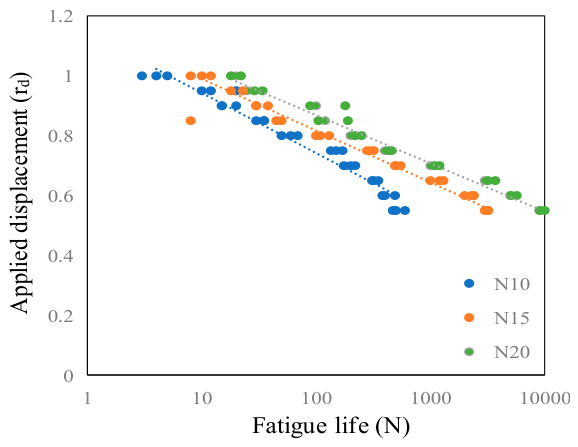
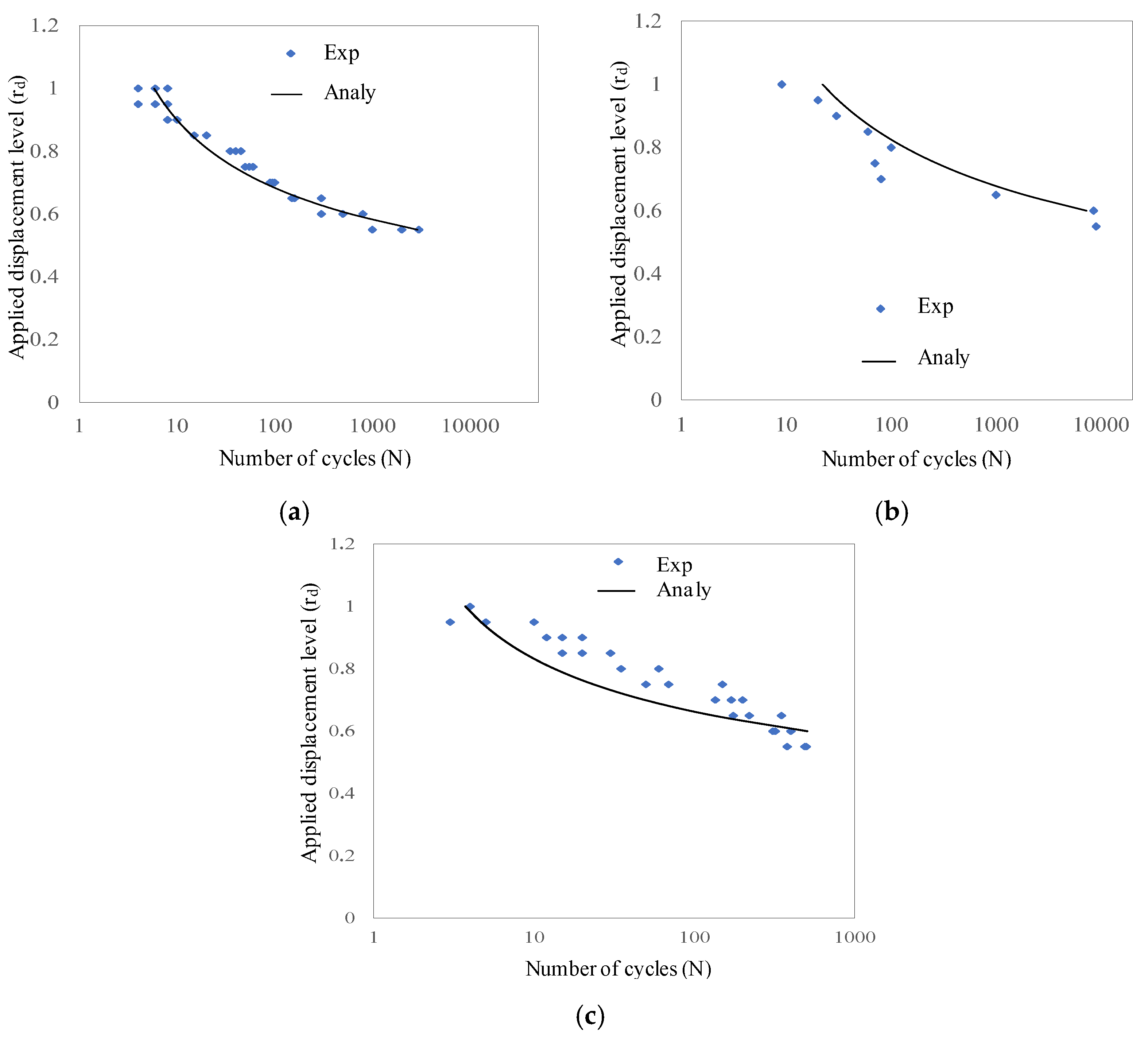
Figure 1 illustrates the progression of applied displacement levels in relation to fatigue life, based on the
N10,
N15 et
N20 criteria. It is observed that fatigue life decreases markedly with an increase in displacement level. The analysis highlights a clear correlation between stiffness degradation and fatigue endurance. The predicted fatigue performance of sandwich composites aligns well with Wöhler-type curve modeling. The variation in the displacement parameter
rd with respect to the number of cycles is captured by a logarithmic function, expressed in Equation (1) for the
N10 condition.
In this context, rd represents the applied displacement amplitude under controlled conditions, while N10 denotes the number of cycles corresponding to a 10% drop in the initial load level.
The equation coefficients are material-dependent and are derived from static and cyclic mechanical characterizations. Specifically, A corresponds to the intercept of the linear fit, which reflects the initial elastic stiffness and is typically close to unity, whereas B represents the absolute value of the slope, quantifying the stiffness degradation rate with increasing cycles.
Similar approaches based on stiffness degradation and fatigue-life prediction have been reported for composite laminates subjected to cyclic loading [
13,
14]. In addition, Mandell [
15] discussed the fatigue behaviour of composite materials under repeated loading and the influence of cyclic damage on their mechanical response.
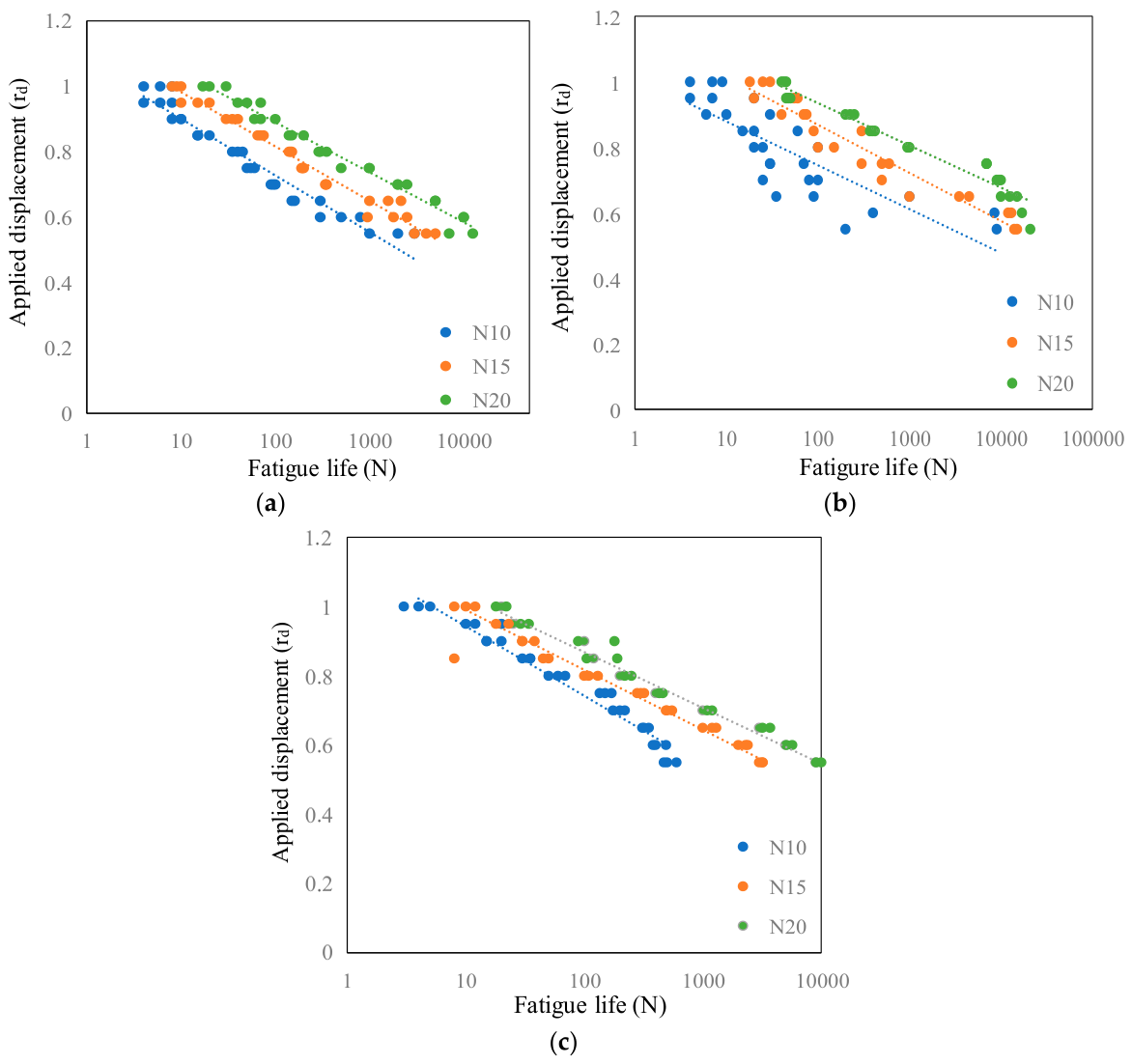
In displacement-controlled fatigue situations, load cycles vary continuously from high to low values, which is explained by the increase in damage. In order to investigate the effect of sandwich constituents on fatigue life, Wöhler curves were constructed for all the sandwiches in this study. These curves are shown in
Figure 2 for the three sandwiches [GF
2/PVC
60/GF
2], [GF
2/PVC
80/GF
2] and [FF
4/Balsa
150/FF
4] at different fatigue life criteria (
N10,
N15 et
N20).
High values of
rd result in low fatigue life. The experimental points were fitted using Equation (1), and the values obtained for parameter
B were used to compare the rate of stiffness degradation. The values of these parameters are shown in
Table 1. The curves in
Figure 2 show that at a given displacement level, the service life increases with the density of the core. The sandwich with a denser core generally has a longer fatigue life than the sandwich with a less dense core. This difference is explained by the way in which the density of the core influences the distribution of stresses within the structure. For sandwiches with a low-density core, the stresses on the outer skin are higher, leading to increased damage. The low density of the core does not stiffen the skin sufficiently, making it more vulnerable to cyclic fatigue stresses, which reduces the fatigue life of the structure. Fatigue stresses are better absorbed, extending fatigue life. The combination of a high-density skin and core, therefore, offers improved fatigue resistance and a longer service life.
4. Derivation of Analytical Models
4.1. Modelling Fatigue Behaviour
Fatigue tests were carried out using displacement control, with a static mean displacement
dmoy of 50% of elastic displacement applied as a sinusoidal waveform. The level of applied loading (
rd) varied between 55% and 100%. During the tests, the decrease in stiffness as a function of the number of cycles was recorded.
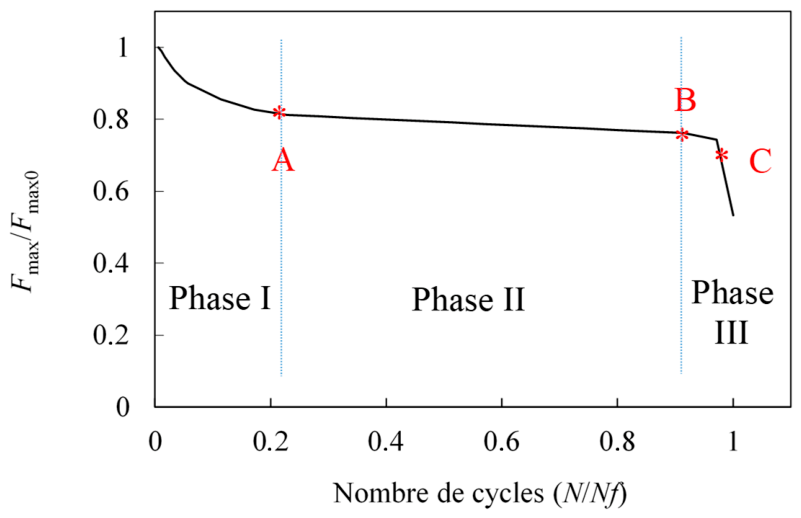
Figure 3. shows a typical curve in sandwich composites, where the load reduction
Fmax/
F0max is plotted against the number of cycles.
The experimental results showed that the load reduction can be expressed as a logarithmic function as a function of the number of fatigue cycles:
The coefficient
is influenced by initial loading conditions while
is a function of the displacement level and intrinsic mechanical properties of the material. This formulation is particularly relevant during the first two phases of the loading curve illustrated in
Figure 3. At the onset of loading, the peak force corresponds to the highest applied load, denoted as
F0max. Based on these parameters, the corresponding theoretical model is derived as:
The analysis of
in relation to displacement amplitude suggests that this parameter follows a power-law trend, leading to the following mathematical expression:
where
and
are parameters that are directly dependent on the material properties and the applied loading conditions.
By substituting Equation (4) into Equation (3), an updated analytical expression is obtained, describing the evolution of the load as a function of the number of cycles and the applied displacement amplitude then becomes:
The coefficients and can be experimentally identified through appropriate mechanical testing and data analysis procedures.
4.2. Determining Service Life
4.2.1. Definition of Fatigue Durability Criteria
The fatigue life of composite materials exhibits complex behaviour due to the progressive evolution of internal damage mechanisms under cyclic loading. In many cases, complete failure is difficult to achieve experimentally, particularly for sandwich composite structures, making it necessary to define a critical number of cycles for fatigue-life characterization.
Several studies have used strain- or damage-related criteria to evaluate fatigue failure in composite materials. For instance, failure has been associated with the attainment of critical strain levels or with the development of interlaminar damage under cyclic loading conditions [
16,
17]. Other investigations on sandwich composites have shown that fatigue degradation can also be characterized through the reduction in mechanical properties such as stiffness or residual strength during cyclic loading [
7,
18]. In this context, conventional fatigue criteria based on a given percentage of stiffness reduction, including the
N10 initiation criterion, are frequently adopted to describe the onset of significant fatigue damage in composite structures [
7,
18].
Fatigue-life prediction methods are generally empirical and rely on experimental observations for parameter identification and model calibration. Several approaches reported in the literature include statistical and probabilistic fatigue models, stiffness-degradation analyses, and strain–life relationships for materials subjected to cyclic loading [
19,
20]. These formulations are commonly employed to describe the relationship between loading conditions and the number of cycles to fatigue failure.
4.2.2. Life Prediction
For fatigue tests performed under displacement-controlled conditions, the number of critical cycles, denoted as
Nγ, associated with a load drop of
γ % from its initial magnitude, can be analytically estimated based on Equation (5), resulting in the following expression:
4.3. Damage Prediction
We also propose a damage parameter (D) for fatigue tests. This parameter is equal to zero initially (N = 0) and equal to unity when the number of cycles reaches the failure criterion (
).
Different definitions of the damage variable
D have been proposed in the literature to describe fatigue-induced degradation in composite materials, particularly based on stiffness reduction, strength evolution, or interlaminar damage under cyclic loading conditions [
16,
17,
18,
19]. These approaches generally relate the evolution of damage to the number of loading cycles and the progressive deterioration of mechanical properties.
In the present work, since fatigue tests are conducted under displacement-controlled conditions, the damage variable
D is evaluated using a stiffness-based approach consistent with residual stiffness degradation methodologies reported in the literature [
16,
18], while maintaining consistency with fatigue life modelling approaches proposed in previous studies [
19].
where
is the maximum load applied at the critical number of cycles
Nγ given by Equation (6). The conditions defined in Equation (8) can be verified by Equation (9).
Replacing Equations (5) and (6) with Equation (9) gives the following equation:
4.4. Mechanical Aspect: Damage Kinetics
An approach based on monitoring damage kinetics can be adopted as a criterion for assessing the service life of a structure. The variations observed provide crucial information about the progression of fatigue. It should be noted that in this process, Equations (1) and (4) are replaced in Equation (3) to obtain Equation (11).
This method can be used as a sensitive indicator to monitor the service life of the structure. Changes in this derivative provide an indication of how the structure reacts to repetitive loading cycles, allowing any degradation or changes in behaviour to be identified as a function of time.
4.5. Energy Aspect: Energy Restitution Rate
This is an important analysis in the field of composite materials and lightweight structures, where resilience and the ability to absorb and restore energy play a decisive role.
The central parameter in this study is the energy restitution rate,
G, defined by Broek et al. [
21]. This coefficient is essential for assessing the overall energy performance of sandwich structures, and is expressed as follows:
where
U is the elastic energy,
W is the work of the external forces, and a is the total length of the crack. This expression offers a rigorous mathematical perspective.
Generally speaking, the rate of energy restitution is expressed in joules per metre (J/m). However, there may be situations where the unit changes depending on the test conditions and parameters. In our study, the rate of energy restitution per damage density is used. This parameter was monitored during fatigue tests by means of acoustic emission testing in order to assess the structural condition of the sandwiches. In this case, a damage parameter (x) replacing the crack length (a) was defined.
Acoustic emission monitoring was performed using two broadband piezoelectric transducers from Physical Acoustics, operating over a frequency range of 100 kHz to 1 MHz. The transducers were mounted on the specimen surface using an appropriate couplant to ensure proper signal transmission. Two 40 dB preamplifiers were used to amplify the signals prior to acquisition. The detection threshold was set at 38 dB, based on preliminary noise measurements, to reject background and machine noise. The hit definition time (HDT), peak definition time (PDT), and hit lockout time (HLT) were fixed at 100 µs, 50 µs, and 200 µs, respectively. Signal acquisition was carried out using AE-Win software 3.6, and post-processing was performed with NOESIS software 4.0. The damage parameter x was defined as the number of acoustic emission events per active specimen volume.
When a load
P is applied in the
y direction with the corresponding displacement
d, Expression (13) can be obtained, and it can be simplified to Equation (14) when the displacement
d is constant.
With
The damage parameter x is assimilated to the number of acoustic events relative to the active volume of the sandwich specimen.
With
It follows that the energy restitution rate
G can be expressed as:
With .
5. Results and Discussions
5.1. Life Prediction
The use of Expression (6) is limited to cases where the γ% load reduction is achieved. However, damage to sandwich composites involves a variety of mechanisms occurring simultaneously. Macroscopic models, which do not require microscopic information, are useful for the design of these structures.
Figure 4 shows the comparison between experimental and analytical fatigue life for the three sandwiches. The analytical curves and experimental points show a progressive decrease in the number of cycles, indicating a gradual loss of stiffness under fatigue. The analytical results agree well with the experimental data, although slight discrepancies can be observed, particularly for the [FF
4/Balsa
150/FF
4] composite. This agreement is further confirmed by the relatively low Root Mean Square Error (RMSE) values obtained for the different sandwich configurations, namely 0.0225; 0.031; and 0.045 for [GF
2/PVC
60/GF
2], [GF
2/PVC
80/GF
2], and [FF
4/Balsa
150/FF
4], respectively. This could be due to differences in the microstructure and fatigue behaviour of the constituent materials (in particular, the nature of the balsa, which has a more heterogeneous structure compared with PVC). The [GF
2/PVC
60/GF
2] and [GF
2/PVC
80/GF
2] sandwiches show a more uniform and predictable decay, reflecting a better ability of this material to retain its mechanical properties over time. On the other hand, the [FF
4/Balsa
150/FF
4] sandwich, although promising in terms of initial performance, shows greater variability, resulting in experimental results that are more dispersed around the analytical curve.
5.2. Damage Prediction
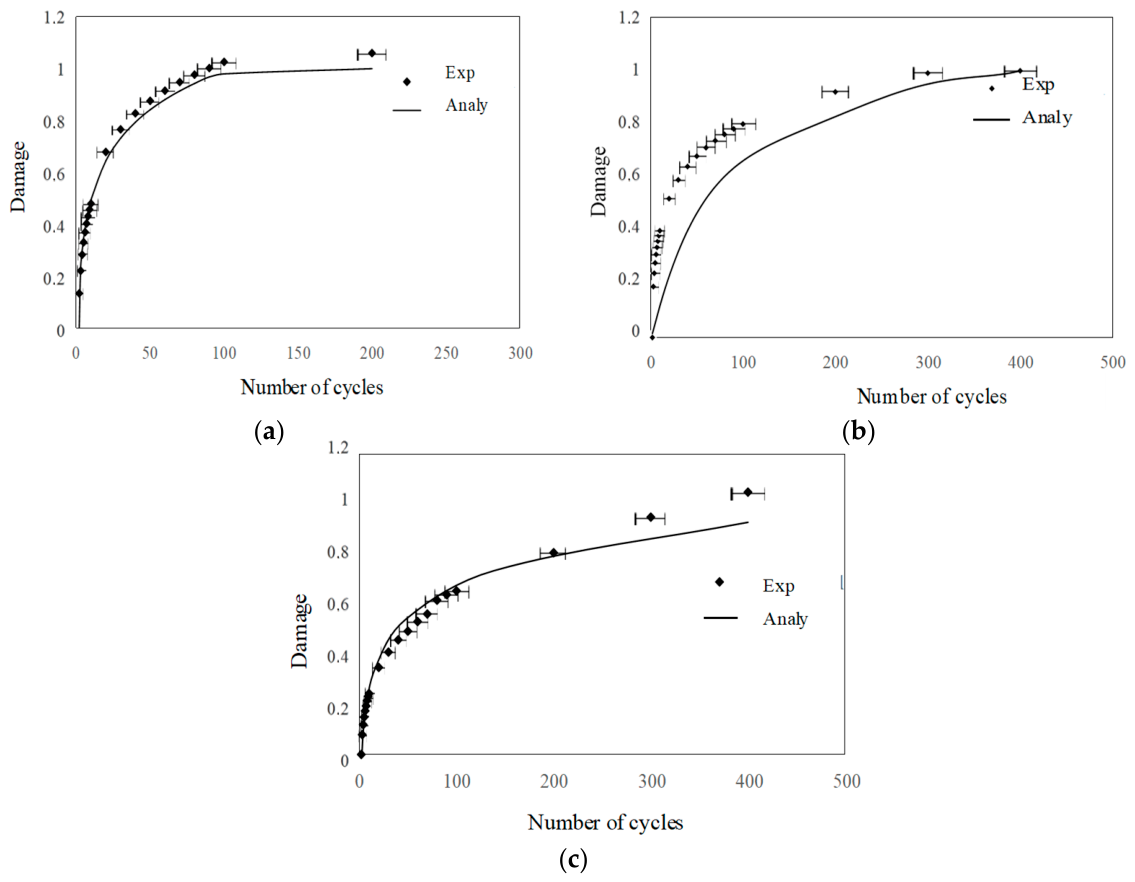
The fatigue performance of sandwich composites under cyclic loading is governed by the gradual development of multiple damage phenomena, including matrix cracking, interfacial delamination, skin fiber breakage, and debonding at the core–face interface. These damage processes typically initiate at early stages and propagate progressively, enlarging the zone of structural degradation over time. At the same time, the type of damage can evolve from skin to core. In our study, all the damage mechanisms are synthesised in a global damage parameter, denoted D, which is closely linked to the characteristics of the material, the level of applied displacement rd, and the type of loading. The values of the damage parameter are calculated from Equation (10).
In contrast to classical approaches based on Miner’s law, which do not account for the continuous evolution of stiffness, our damage parameter D explicitly integrates the progressive stiffness degradation and better captures the damage mechanisms in sandwich structures.
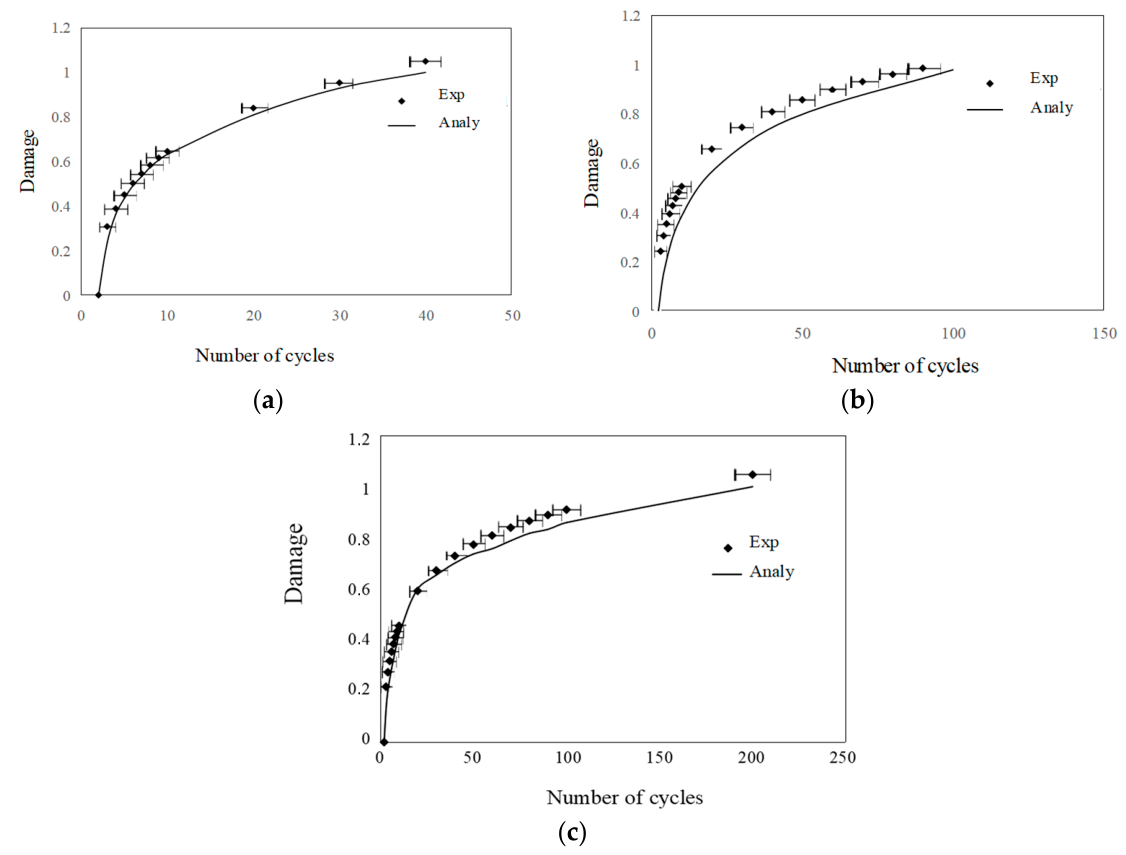
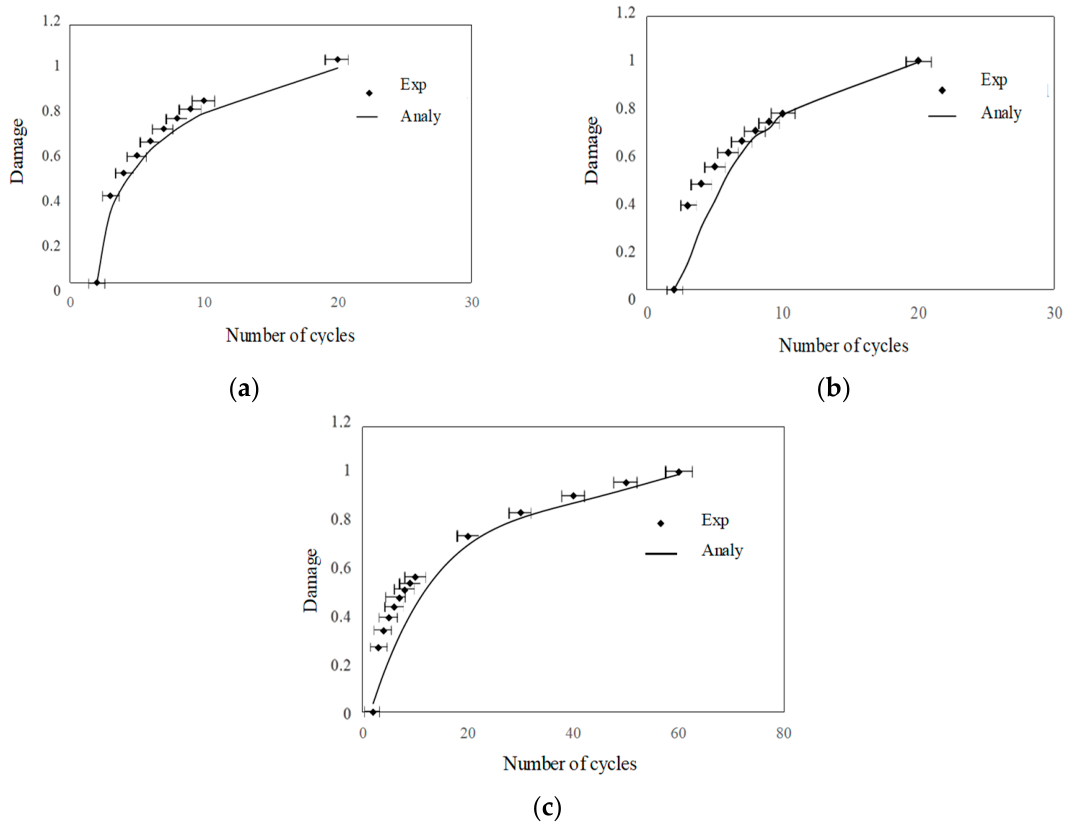
The experimental and analytical results are presented in
Figure 5,
Figure 6 and
Figure 7. These figures show the impact of three levels of applied displacement (0.6; 0.7; and 0.8) on the evolution of the damage parameter for different sandwich specimens. To evaluate the model accuracy, RMSE is used to measure the difference between experimental and predicted results. The figures show that the evolution of the damage follows two distinct phases as the number of cycles increases. Initially, a very rapid increase in damage is observed within a few cycles. This rapid growth is attributed to the initiation of damage in the skin, particularly matrix cracking. Subsequently, a progressive increase in damage is observed as a function of the number of cycles. This is characterised by the initiation and slower progression of damage in the skin.
The obtained RMSE values are low for all configurations, indicating good agreement between predictions and experiments, with 0.03 for [GF2/PVC60/GF2], 0.05 for [GF2/PVC60/GF2], and 0.04 for [FF4/Balsa150/FF4], respectively.
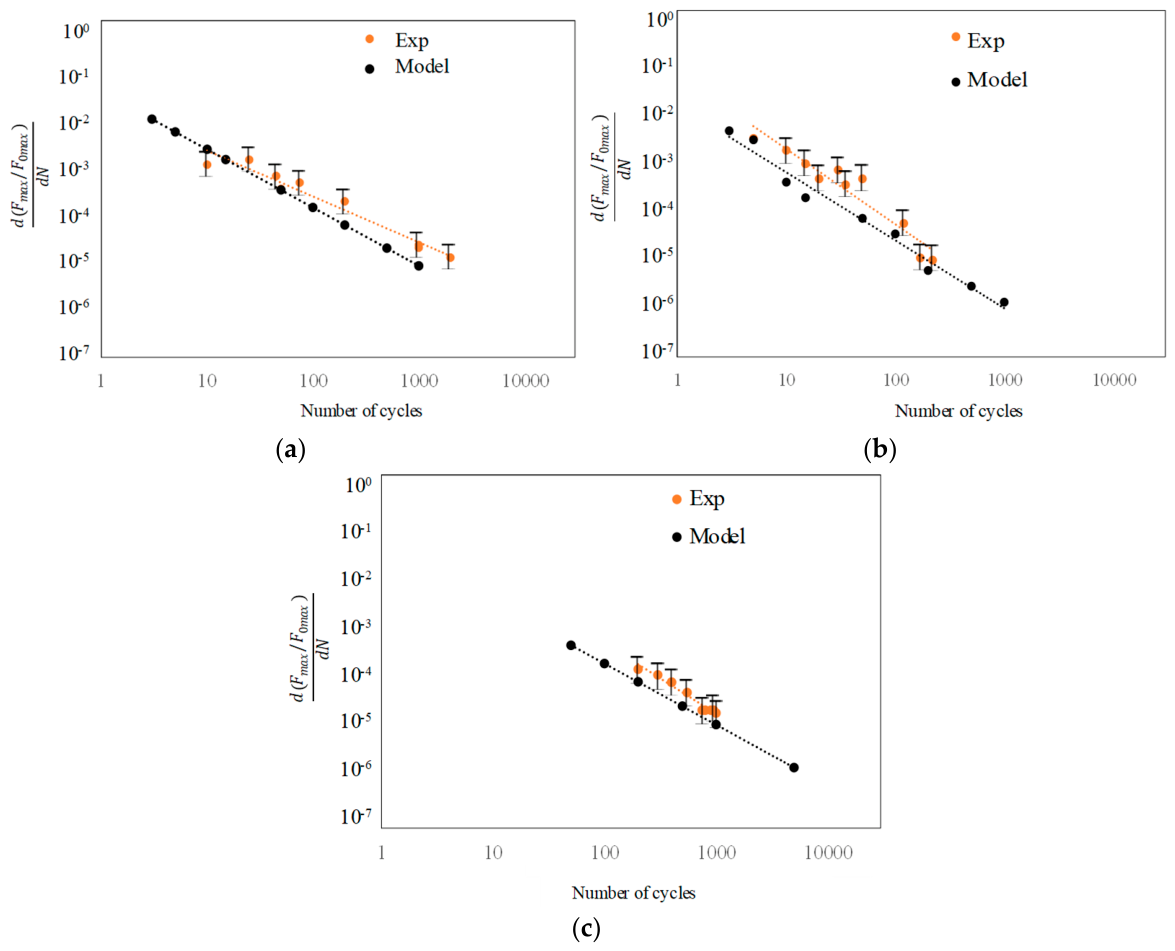
5.3. Mechanical Aspect: Damage Kinetics
To assess the applicability of the proposed analytical formulations, the different sandwich configurations were subjected to fatigue analysis. As detailed in
Section 4.1, load degradation was modeled using Equation (3), while correlation with Equation (5) enabled identification of the degradation coefficient
in relation to imposed displacement. The parameters values
and
derived for the three specimens are compiled in
Table 2, obtained via Equation (4). A logarithmic trend was observed to best match the experimental data for representing the variation in the coefficients
with the displacement level (
rd).
The fatigue sensitivity of sandwich materials is characterised by these two parameters. To assess the consistency between the analytical model and the experimental data, the results corresponding to the damage kinetics were compared with the slope corresponding to the stiffness evolution. The analysis between these two methods can provide information on the sensitivity of the analytical model as a function of the number of cycles. The trends observed in the experimental data suggest that the model effectively captures the underlying degradation mechanisms.
As shown in
Figure 8, good agreement between analytical predictions and experimental observations reinforces confidence in the model, while discrepancies could point to necessary improvements. In addition, the validation of the proposed approach is supported by very low RMSE values obtained across all configurations, namely 5 × 10
−5 for [GF
2/PVC
60/GF
2], 1 × 10
−4 for [GF
2/PVC
80/GF
2], and 5 × 10
−6 for [FF
4/Balsa
150/FF
4]. What is particularly remarkable about this approach is its ability to free itself from dependence on several parameters, such as the loading level, in order to anticipate the behaviour of the structure subjected to repetitive loading cycles. However, the model slightly underestimates the service life, creating a safety margin and reinforcing its robustness for practical applications. Damage kinetics allow accurate and safe modelling, ideal for the design and maintenance of components subjected to repetitive load cycles.
5.4. Energy Aspect: Energy Restitution Rate
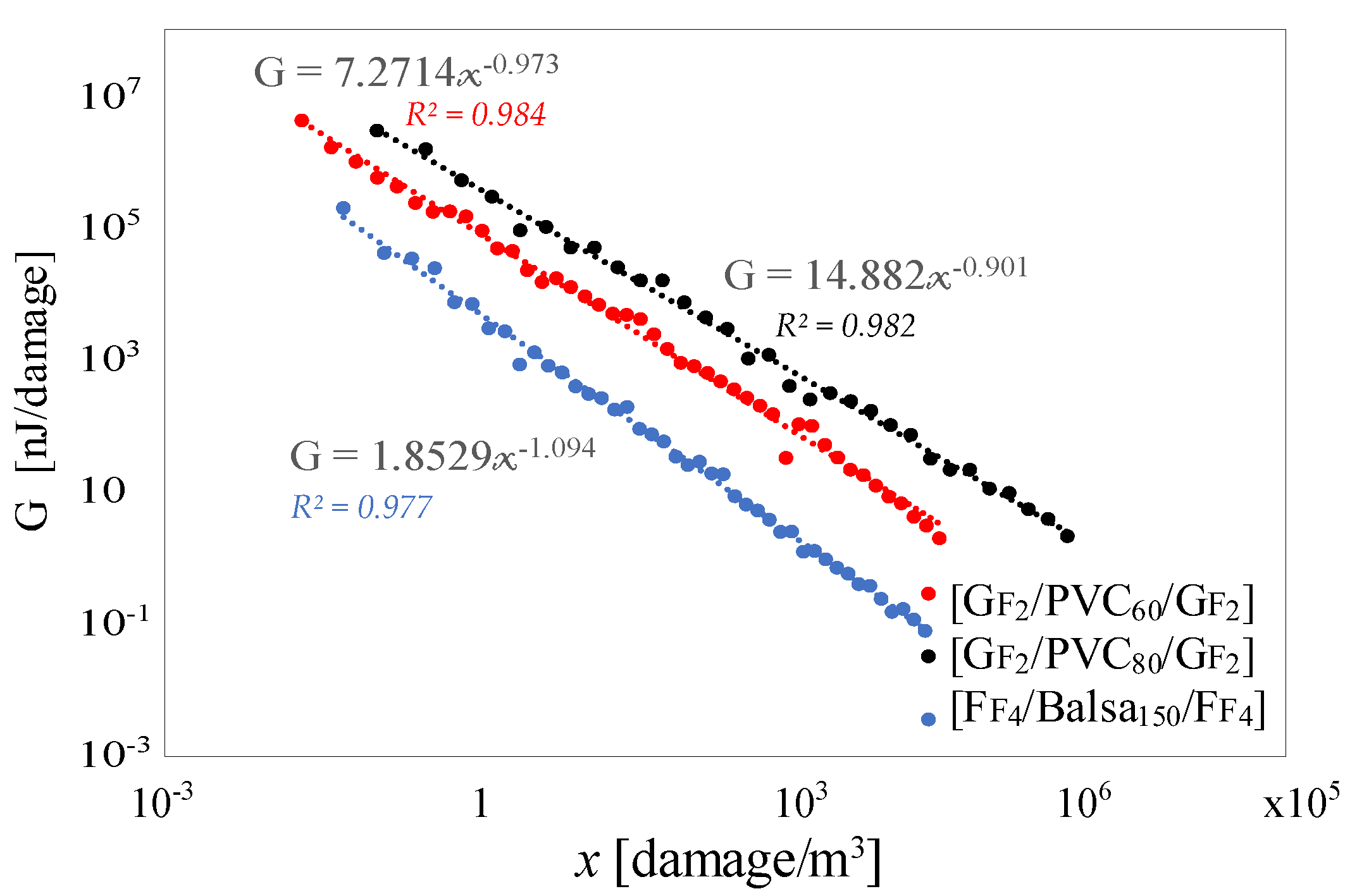
In
Figure 9, the curves show the evolution of the energy restitution rate as a function of the damage density (
x).
Also, by correlating the experimental results of () and the chronology of appearance of the acoustic events as a function of the number of cycles, it is possible to determine the rate of restitution G from Equation (15).
The influence of the specific value of the damage rate x on the behaviour of the material in terms of energy restitution is highlighted by this analysis. The curves are expressed in the form , highlighting distinct characteristics. A greater amplitude of damage density is indicated by the higher p coefficient of the [GF2/PVC80/GF2] sandwich. On the other hand, greater sensitivity to increasing damage density is suggested by the higher exponent q for the [FF4/Balsa150/FF4] sandwich.
The results reveal that a higher rate of energy restitution is observed for specific values of x in the case of the [GF2/PVC80/GF2] sandwich. Energy restitution efficiency persists even when the damage distribution is denser. On the other hand, relatively lower energy restitution rates are observed for similar values of x in the case of the materials [GF2/PVC60/GF2] and [FF4/Balsa150/FF4]. The results indicate that these materials may exhibit reduced energy restitution per unit volume, perhaps due to their particular deformation and strength characteristics. These observations provide essential information on the relative performance of these materials in terms of energy restitution.
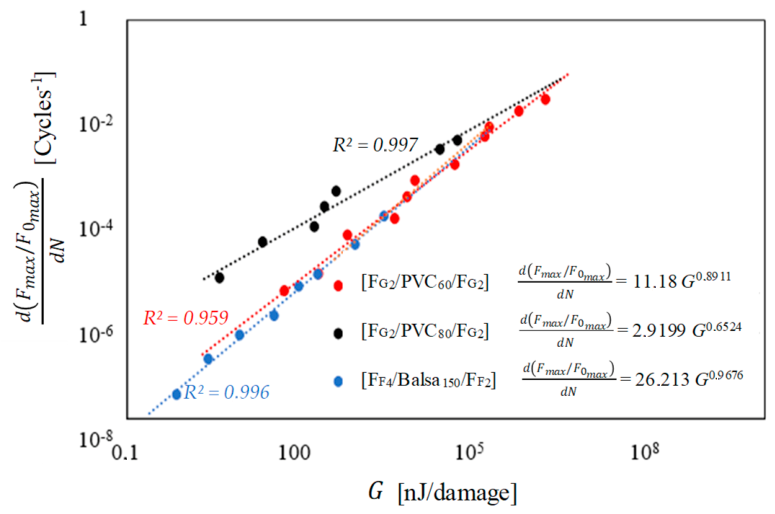
To study the impact of damage on material performance,
Figure 10 shows the analysis of damage kinetics as a function of the energy restitution rate (
G) for different sandwiches. A reduction in the energy restitution rate is associated with a decrease in damage kinetics. The power curve reveals differences between the sandwiches, particularly an increased sensitivity for [FF
4/Balsa
150/FF
4]. The comparison between the sandwiches also highlights the significant influence of composition, with the [GF
2/PVC
80/GF
2] sandwich showing a higher energy restitution rate than [GF
2/PVC
60/GF
2], itself higher than [FF
4/Balsa
150/FF
4], illustrating the variations induced by the specific properties of each material. The velocities decrease as the energy restitution rate decreases and become very low at the end of the tests, suggesting possible damage saturation.
The results of these tests suggest a propagation law or damage multiplication of the ‘Paris law’ type . However, the staggered slopes between the tests indicate different c and b coefficients for each material.
Differences between materials can be associated with viscoelastic behaviour superimposed on fatigue damage mechanisms. Damage mechanisms may also differ from one material to another. Despite this, the key finding remains the high values for [GF2/PVC80/GF2], inducing significant delays in damage initiation and a low rate of propagation or multiplication, suggesting a better resistance to damage compared to other sandwich materials.
6. Conclusions
This study addresses a key limitation in the literature by proposing a unified modelling framework that links stiffness degradation, energy restitution rate, and damage kinetics for sandwich composites under cyclic bending. The main contribution lies in the development of an empirical–analytical approach capable of predicting fatigue life with reduced dependence on extensive experimental data. This work provides a practical and efficient tool for the assessment of fatigue durability in composite sandwich structures, particularly under displacement-controlled loading conditions.
It should be emphasised that the choice of sandwich configuration plays a crucial role in its fatigue resistance.
Subsequently, in order to assess the reliability of the proposed model (Equation (11)), it is essential to compare the results obtained from the damage kinetics model developed analytically with the experimental data. This approach is distinguished by its ability to minimise dependence on various parameters, such as load level, thus facilitating prediction of the structure’s behaviour during repetitive load cycles.
Furthermore, an intuitive modelling strategy was implemented, drawing on the analogy between the mechanical response of sandwich structures and the progression of fatigue-induced damage. Proposed damage accumulation models were used to verify the stiffness degradation observed experimentally. It appears that any fatigue damage is reflected in the stiffness degradation. A distinctive difference is observed in the evolution of fatigue damage, notably with higher cycle number values for the [GF2/PVC80/GF2] sandwich, which induces a delay in damage initiation and a low propagation rate, suggesting a better resistance to damage compared with the other configurations. The differences between the materials may be associated with viscoelastic behaviour superimposed on the fatigue damage mechanisms. Good agreement was found between experimental and analytical results.
In addition, variations in the p and q coefficients reflect the different sensitivity of the energy restitution rate to the damage density and damage kinetics by the c and b coefficients derived from the betting law, linked to the specific characteristics of each material.