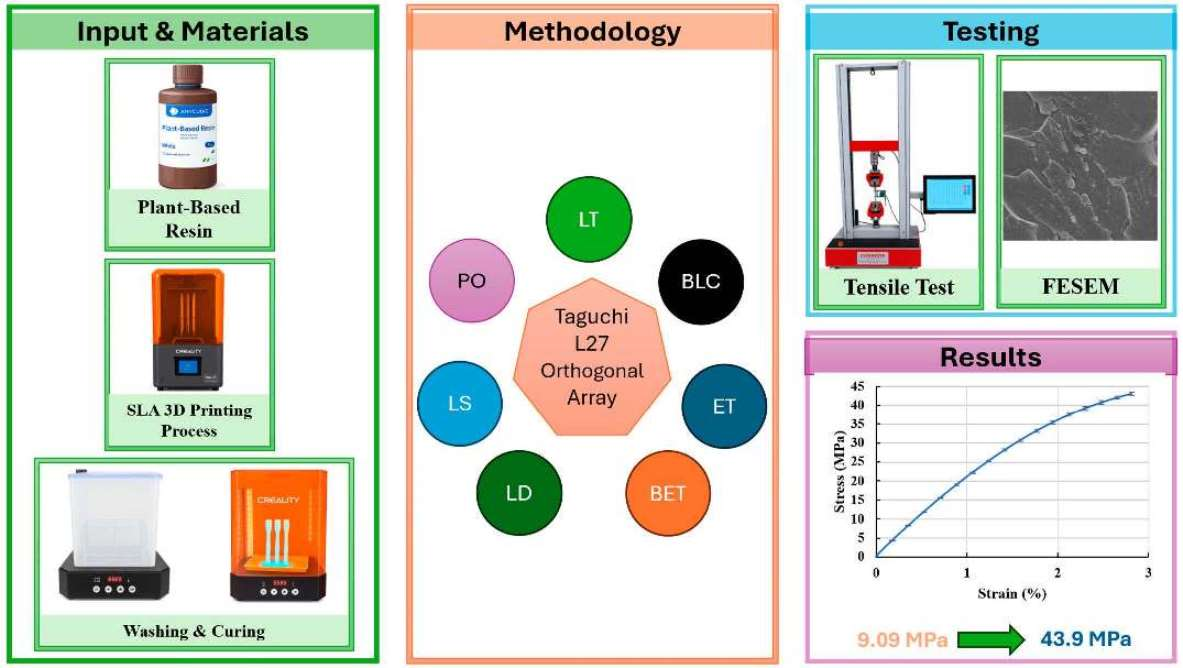

Experimental Investigation of Printing Parameters in SLA 3D Printing of Plant-Based Resin Using Taguchi Method: Effects on Tensile Properties and Fracture Surface Morphology


Abstract
Share and Cite
Jamal, Z.; Rostam, S. Experimental Investigation of Printing Parameters in SLA 3D Printing of Plant-Based Resin Using Taguchi Method: Effects on Tensile Properties and Fracture Surface Morphology. Eng 2026, 7, 237. https://doi.org/10.3390/eng7050237
Jamal Z, Rostam S. Experimental Investigation of Printing Parameters in SLA 3D Printing of Plant-Based Resin Using Taguchi Method: Effects on Tensile Properties and Fracture Surface Morphology. Eng. 2026; 7(5):237. https://doi.org/10.3390/eng7050237
Chicago/Turabian StyleJamal, Zana, and Sarkawt Rostam. 2026. "Experimental Investigation of Printing Parameters in SLA 3D Printing of Plant-Based Resin Using Taguchi Method: Effects on Tensile Properties and Fracture Surface Morphology" Eng 7, no. 5: 237. https://doi.org/10.3390/eng7050237
APA StyleJamal, Z., & Rostam, S. (2026). Experimental Investigation of Printing Parameters in SLA 3D Printing of Plant-Based Resin Using Taguchi Method: Effects on Tensile Properties and Fracture Surface Morphology. Eng, 7(5), 237. https://doi.org/10.3390/eng7050237